#help-38
1 messages · Page 90 of 1
 languid coyote
sorry yeah that's one representation where there's k zero columns and n-k non-zero columns
that should be a natural consequence right of the representation with k zero columns
since dim ker T = k
so the other columns are non-zero
 neon dirge
yup
languid coyote
for any general representation of this linear map though
it doesnt necessarily have to have k zero columns
the number of 0 columns it can have
can range from 0 all the way to k inclusive
neon dirge
yes
languid coyote
okay, and then in general i can think about it like
for every 1 dimension in dim range T
there will be a non-zero column in the matrix
at least
1
column
sliding scale from k zero columns and n-k non-zero columns all the way to n non-zero columns
but in the case where we have n non-zero columns
k of those will be in the span of the other n-k
neon dirge
sry I gtg, rlly don't want to cut off here, if you don't mind you can also write it in dms, will be available in a bit :)
languid coyote
no worries, this was super helpful i really appreciate the help!!
neon dirge
otherwise maybe another wanderer will come along and guide otherwise 🐛
 trim joltBOT
Channel closed
Closed by @languid coyote
Use .reopen if this was a mistake.
trim joltBOT
 Available help channel!
Send your question here to claim the channel.
Remember:
• Ask your math question in a clear, concise manner.
• Show your work, and if possible, explain where you are stuck.
• After 15 minutes, feel free to ping <@&286206848099549185>.
• Type the command .close to free the channel when you're done.
• Be polite and have a nice day!
Read #❓how-to-get-help for further information on how to ask a good question, and about conduct in the question channels.
 sudden sail
hey
trim joltBOT
sudden sail
hey
sudden sail

what should N equal for this to not have a solution
the answer is -inf:-20 if that helps
trim joltBOT
@sudden sail Has your question been resolved?
 edgy willow
try rearranging things to 10^x's on one side and numbers on the other
something like a*b^x will always be between 0 and infinity, it can't reach exactly 0 or a negative
sudden sail
edgy willow
something like a*b^x will always be between 0 and infinity, it can't reach exact...
thats the piece ive been missing then
edgy willow
uh it'd be 16*10^x=n+21
sudden sail
oh shit im sorry I sent
a
wrong one
the +1
in the end
is actualy
l
10^x+1
or 10x10^x
trim joltBOT
Channel closed
Closed due to timeout
Use .reopen if this was a mistake.
Available help channel!
Send your question here to claim the channel.
Remember:
• Ask your math question in a clear, concise manner.
• Show your work, and if possible, explain where you are stuck.
• After 15 minutes, feel free to ping <@&286206848099549185>.
• Type the command .close to free the channel when you're done.
• Be polite and have a nice day!
Read #❓how-to-get-help for further information on how to ask a good question, and about conduct in the question channels.
 sharp vine
da fuck do I do in part a
 trim joltBOT
sharp vine
da fuck do I do in part a
trim joltBOT
sharp vine
da fuck do I do in part a
 kindred pier
sharp vine
da fuck do I do in part a
kindred pier
sharp vine
da fuck do I do in part a
Try law of cosines
sharp vine
aigh lemme see here
sharp vine
kindred pier
Try law of cosines
im makin idiot mistakes here gimme a minute
andddd i got it
thank you very much mr SWR
.close
trim joltBOT
Channel closed
Closed by @sharp vine
Use .reopen if this was a mistake.
trim joltBOT
Available help channel!
Send your question here to claim the channel.
Remember:
• Ask your math question in a clear, concise manner.
• Show your work, and if possible, explain where you are stuck.
• After 15 minutes, feel free to ping <@&286206848099549185>.
• Type the command .close to free the channel when you're done.
• Be polite and have a nice day!
Read #❓how-to-get-help for further information on how to ask a good question, and about conduct in the question channels.
 subtle briar
hello i've been trying to find a pattern for this sequence but it just doesn't make any sense!! idk where to begin ;-;
trim joltBOT
subtle briar
hello i've been trying to find a pattern for this sequence but it just doesn't m...
subtle briar
 edgy willow
subtle briar
hello i've been trying to find a pattern for this sequence but it just doesn't m...
edgy willow
subtle briar
hello i've been trying to find a pattern for this sequence but it just doesn't m...
try reading across
 subtle briar
ok wait ill try this
i think the third sequence doesn't follow the same pattern as the 2 above
edgy willow
third sequence as in the bottom 3 honeycombs?
subtle briar
yes
edgy willow
how would you know that it doesn't follow
you'd have to fill in the bottom right part right
 edgy willow
are you asking like how do you add blanks?
you sort of have to guess the number system you're using, it's almost like binary if you know that
subtle briar
what i did was this
 edgy willow
ok ngl I can justify both A and D so uhhhh
 shrewd ridge
whether you read vertically or horizontally it's the same thing seemingly
trim joltBOT
Channel closed
Closed by @subtle briar
Use .reopen if this was a mistake.
shrewd ridge
d makes some sense
trim joltBOT
Available help channel!
Send your question here to claim the channel.
Remember:
• Ask your math question in a clear, concise manner.
• Show your work, and if possible, explain where you are stuck.
• After 15 minutes, feel free to ping <@&286206848099549185>.
• Type the command .close to free the channel when you're done.
• Be polite and have a nice day!
Read #❓how-to-get-help for further information on how to ask a good question, and about conduct in the question channels.
 bronze plover
Not sure how to start. I said force of gravity in x direction (parallel) - tension = ma. And that's about it lol
 trim joltBOT
bronze plover
Not sure how to start. I said force of gravity in x direction (parallel) - tensi...
bronze plover
trim joltBOT
bronze plover
Not sure how to start. I said force of gravity in x direction (parallel) - tensi...
bronze plover
I seriously have no idea how to approach pulley with mass problems
 placid juniper
suvat
get s with trigonometry
u is 0
v is the number in question
and u get acceleration from F=ma
bronze plover
what do u mean by "s" and "u"
 bright quarry
so this is a conservation of energy question
alternatively you could use torque
and forces to find the acceleration
bronze plover
I thought about using energy but wasn't sure how the pulley would affect that
and then i wasn't sure how to find tension if i wanted to use torque lol
I was going to say the initial potential energy of the block + the rotational kinetic energy of the pulley = final kinetic energy of the block? That didn't seem right tho and I don't know the angular speed either
bright quarry
well it’s released from rest
so there’s only potential energy
and the pulleys potential energy doesn’t change
bronze plover
So i can literally just set mgh = 1/2 mv^2?
bright quarry
so if you used conservation you’d have Upulley+Ublock=Kblock+Upulley+Kpulley
bronze plover
oh lol
bright quarry
Upulley is on both sides
cancels
so since it’s a disk we assume I=1/2 MR^2
the rest should be trivial algebra
 umbral maple
bronze plover
what do u mean by "s" and "u"
umbral maple
bronze plover
what do u mean by "s" and "u"
s is distance and u is initial velocity, not much point doing that method if you weren’t taught about it tho
bronze plover
bright quarry
so if you used conservation you’d have Upulley+Ublock=Kblock+Upulley+Kpulley
Ok just to clarify as well, the initial potential energy of the block is being split between the final kinetic energy of the pulley and final KE of the block right
bright quarry
umbral maple
s is distance and u is initial velocity, not much point doing that method if you...
you mean kinematics?
bronze plover
And I can just use v = rw to get rid of angular speed as well?
bright quarry
bronze plover
Ok just to clarify as well, the initial potential energy of the block is being s...
mhm
yes
and the block isn’t rotating
umbral maple
bright quarry
you mean kinematics?
yes
bright quarry
so it only has translational
bright quarry
umbral maple
yes
not sure wym using kinematics you would need to use torque to incorporate any kinematic equations
bronze plover
We do have problems in the future where it it's a sphere rotating, so in that case I'd do initial PE of sphere = KE of pulley + KE of sphere + rotational KE of sphere
bright quarry
bronze plover
We do have problems in the future where it it's a sphere rotating, so in that ca...
yes
but a block won’t rotate
so it’s rotational energy is zero
bright quarry
you’re welcome!
bronze plover
.close
trim joltBOT
Channel closed
Closed by @bronze plover
Use .reopen if this was a mistake.
bronze plover
Man i had such confidence but I got stuck again at part B lol

I said net torque is equal to moment of inertia * ang acceleration
Then said net toruqe is equal to radius * tension
but I dont know how I'm supposed to get tension
Could I set up a system with net force and net torque and use a = radius * angular acceleration?
I'm a little confused about v = rw and a = r*α.. I thought v and a corresponded to a spot on a rotating object, but they're also used as velocity and acceleration of the center of mass of the block?
trim joltBOT
Available help channel!
Send your question here to claim the channel.
Remember:
• Ask your math question in a clear, concise manner.
• Show your work, and if possible, explain where you are stuck.
• After 15 minutes, feel free to ping <@&286206848099549185>.
• Type the command .close to free the channel when you're done.
• Be polite and have a nice day!
Read #❓how-to-get-help for further information on how to ask a good question, and about conduct in the question channels.
bronze plover
I'm here
trim joltBOT
bronze plover
I'm here
bright quarry
bronze plover
I'm here
hello
bronze plover
Hey man, sorry I don't know why I'm not understanding rotations. Our whole final is on rotations tho so I'm trying to figure them out lol
bright quarry
bronze plover
Could I set up a system with net force and net torque and use a = radius * angul...
yes
bright quarry
bronze plover
Hey man, sorry I don't know why I'm not understanding rotations. Our whole final...
oof
bright quarry
bronze plover
I'm a little confused about v = rw and a = r*α.. I thought v and a corresponded ...
center of mass velocity is for rolling motion
the center of mass linear velocity for the fixed pulley is zero
it’s not moving
but yes
bronze plover
So does the equation v = v of CM = rw just mean that the velocity of the center of mass of the rolling object is the same as the velocity of the point where the "string" is coming off of the pulley
if that makes any sense lol
and same idea with acceleration?
bright quarry
so
for the pulley
v corresponds to the velocity of a point as it moves around the pulley at a distance r from the axis of rotation
this all comes from s=rtheta
from geometry
or the arc length equals the radius multiplied by the angle
then to derive a and v
we differentiate with respect to time
for both equations
bronze plover
So it is just a point and when you set the radius to being the radius of the disk, it becomes the velocity of the cm of the rolling object
That would make sense intuitively to me
bright quarry
yes
bronze plover
I might need to watch some remedial geometry videos
bright quarry
$100 dollars is a hefty price💀
bright quarry
bronze plover
I might need to watch some remedial geometry videos
just look up arc length geometry is you forgot what i was talking about
like length of a sector
bronze plover
bright quarry
$100 dollars is a hefty price💀
it's worth it tho trust
bright quarry
bronze plover
it's worth it tho trust
sure
you should have mgsintheta-T=ma
TR=Ialpha
and you can solve this
bronze plover
I did that as we were talking and ended up with a of cm = 1/3 g sin(theta)
Does that seem right? that it's only dependent on theta?
I'm prone to algebra mistakes
bronze plover
I can send a picture of my work, I just figured you wouldn't feel like checking it, and hopefully the prof posts the key in a few days
bronze plover
im looking lol idk
bright quarry
in inertia
bronze plover
idk I checked it earlier and check it again but I get pretty blind when I check my work
bright quarry
show
 bright quarry
oh wait
i messed up i think
the m isn’t the same
yea block is M/4
my fault
yea nice job
looks good
bronze plover
All good, thank you lots for helping me set it up. It's feels simple after I do haha
bright quarry
i’d hope so
bronze plover
Onto part c... something tells me I'll be back here soon
trim joltBOT
@bronze plover Has your question been resolved?
bronze plover
alright I may just be stuck on some algebra, or I may have set it up completely wrong
I'm not sure


Basically I set the initial PE of block = the total energy at y(c) = the KE of the block at the bottom
but I got stuck with two variables, y(c) and v at y(c)
bronze plover
I live in this channel now
bronze plover
I panicked when i read it, i had to read it like 3 times before i could understand it lol
bright quarry
so we need to look at the two situations of course
before and after the string is cut
bright quarry
bronze plover
Basically I set the initial PE of block = the total energy at y(c) = the KE of ...
well hold on
you’re thinking right but
what’s the kinetic energy of the block at yc?
…
bronze plover
uh
bright quarry
nonzero
ITS MOVING!!!
does this make sense
it has velocity when the string is cut
bronze plover
I thought I accounted for that in my equation
bright quarry
so the total energy is the potential + kinetic
bronze plover
Wait wait wiatwaitiatiw
bright quarry
i didn’t look at your work
bronze plover
lol
bright quarry
let me read it but based on what you said
bronze plover
I said that right before the string is cut, energy is equal to KE of the pulley + PE of the block + KE of the block
all at y(c)
bright quarry
oh lol
then yes
💀
i thought you did PE block at yc=K block at bottom
but yes what you did is correct then let me read your work
bright quarry
wait vyc is for the block
bronze plover
well
i guess I'd rather it be an algebra mistake than a conceptual misunderstanding
bronze plover
I appreciate you looking through my equations
bronze plover
I've spent like 3 hours today trying to teach myself rotations before I finally decided to go on discord lol
bright quarry
you do it without even telling you what to do
bright quarry
bronze plover
I've spent like 3 hours today trying to teach myself rotations before I finally ...
physics enthusiast
incline problems are always fun
bronze plover
More like I had an existential crisis when every single problem on the practice final involved some kind of rotational motion lol
bright quarry
i like these rotation problems
bronze plover
You're the opposite of my Ta, he said he avoided them at all costs haha
bronze plover
He's actually really good, honestly learned more from him in discussion than the prof, I unfortunately had class during his office hours though
bright quarry
never learned from a teacher in school tbh
i always just learn on my own through books and the internet
bronze plover
Yeah I was told that this is my introduction to classes that are a lot of self-teaching, as this is my first physics class
bronze plover
Yeahhhhhh I'm realizing that now lol
bright quarry
are you a math major?
bronze plover
But it's really cool, I've never thought about all the conservation laws and stuff, like it's crazy
bright quarry
or some sort of life science
bronze plover
I'm undeclared
bright quarry
so you’re taking physics 1
bronze plover
Yeah very first intro physics class and im struggling lol
bright quarry
bronze plover
But it's really cool, I've never thought about all the conservation laws and stu...
conservation of momentum is newton’s third law
good video
bright quarry
bronze plover
Yeah very first intro physics class and im struggling lol
you didn’t take physics in high school?
bronze plover
Not really, I did an online thing which covered the main topics in a super basic way
questions with two steps max
bright quarry
seems like intro physics
algebra based
almost no problems are more than 3 or 4 steps
most only take 2
bronze plover
Yeah it was also online so not to out myself or anything but...
bright quarry
happens
bronze plover
But my brother is a physics major and he's always telling me about cool stuff he's learning which is kinda inspiring
bright quarry
man of taste
bronze plover
this guy is physics, electrical engineering, and philosophy minor
bright quarry
tell him to teach you Lagrangian mechanics
bronze plover
its crazy
bronze plover
I told him ab having trouble with rotations and he told me to learn lagrangian mechanics in like 4 days
bright quarry
💀
bronze plover
before my final
bronze plover
Yeah he said he almost failed his intro classical mechanics class but lagrangian is much easier
So I got hope for the future
bright quarry
bronze plover
So I got hope for the future
i’d recommend taylor’s classical mechanics
bronze plover
oh upper div stuff is a long ways away for me
I gotta not fail intro physics first
bright quarry
i can’t imagine you do
bronze plover
I might be back on here later (or really soon) bc ima start another problem set lol
thank you
bronze plover
Yeah no worries, you've already helped me a ton, I feel bad for taking up so much time
bronze plover
I appreciate that! I'll try not to spam you haha
Nah bc I'm already looking at the next problem set... not looking good so far
bright quarry
bronze plover
Nah bc I'm already looking at the next problem set... not looking good so far
you’ll be fine
just rotation
trim joltBOT
@bronze plover Has your question been resolved?
Channel closed
Closed by @bronze plover
Use .reopen if this was a mistake.
Available help channel!
Send your question here to claim the channel.
Remember:
• Ask your math question in a clear, concise manner.
• Show your work, and if possible, explain where you are stuck.
• After 15 minutes, feel free to ping <@&286206848099549185>.
• Type the command .close to free the channel when you're done.
• Be polite and have a nice day!
Read #❓how-to-get-help for further information on how to ask a good question, and about conduct in the question channels.
bronze plover

 trim joltBOT
bronze plover
bronze plover
trim joltBOT
bronze plover
bronze plover
Seems simple, pretty sure I'm missing something. I set initial PE of block = rot KE + final PE but im not even sure what rot KE would be since wouldn't it change instantaneously
Then I said all the rotational energy goes back into potential energy but that doesnt seem right
trim joltBOT
@bronze plover Has your question been resolved?
trim joltBOT
Channel closed
Closed due to timeout
Use .reopen if this was a mistake.
trim joltBOT
Available help channel!
Send your question here to claim the channel.
Remember:
• Ask your math question in a clear, concise manner.
• Show your work, and if possible, explain where you are stuck.
• After 15 minutes, feel free to ping <@&286206848099549185>.
• Type the command .close to free the channel when you're done.
• Be polite and have a nice day!
Read #❓how-to-get-help for further information on how to ask a good question, and about conduct in the question channels.
 fluid compass
The question asks me which equation is the solution of the value of x of point P and Q.
2x^2 +3x -4 = 0
3x^2 +2x -4 = 0
2x^2 -3x -4 = 0
3x^2 -2x -4 = 0
I absolutely have no idea how to solve for this.
 trim joltBOT
fluid compass
The question asks me which equation is the solution of the value of x of point P...
trim joltBOT
fluid compass
The question asks me which equation is the solution of the value of x of point P...
 split chasm
consider something simpler,
would you be able to determine where the lines
y = x + 3 and y = -x = 5
intersect algebraically , and if so how would you approach it. (just how, i don't really care about the final solution)
fluid compass
They both would have to same value of y?
split chasm
and then
fluid compass
Set the two equations to be equal to each other?
and slowly arrange them step by step
split chasm
yeh
you could view it in two ways here, either as substitution of y into the other equation,
or transitive property of equality
substitution is more relevant for what you have
trim joltBOT
Channel closed
Closed by @fluid compass
Use .reopen if this was a mistake.
fluid compass
.reopen
trim joltBOT
✅
fluid compass
How do I turn this to available so that other people can use it?
 exotic pine
use .close, it will automatically be usable to other people after some time
fluid compass
.close
trim joltBOT
Channel closed
Closed by @fluid compass
Use .reopen if this was a mistake.
trim joltBOT
Available help channel!
Send your question here to claim the channel.
Remember:
• Ask your math question in a clear, concise manner.
• Show your work, and if possible, explain where you are stuck.
• After 15 minutes, feel free to ping <@&286206848099549185>.
• Type the command .close to free the channel when you're done.
• Be polite and have a nice day!
Read #❓how-to-get-help for further information on how to ask a good question, and about conduct in the question channels.
 merry zodiac

 trim joltBOT
merry zodiac
trim joltBOT
merry zodiac
 sterile egret
Do you know range of
acosx±bsinx?
merry zodiac
Ohh yes
sterile egret
Use that
merry zodiac
But here we need to find solutions?
[-√k^2+9<=y<=√k^2+9] =k+1
[-k-1-√k^2+9<=y<=-k-1√k^2+9]
@sterile egret
trim joltBOT
@merry zodiac Has your question been resolved?
merry zodiac
 trim joltBOT
@merry zodiac Has your question been resolved?
Channel closed
Closed by @merry zodiac
Use .reopen if this was a mistake.
trim joltBOT
Available help channel!
Send your question here to claim the channel.
Remember:
• Ask your math question in a clear, concise manner.
• Show your work, and if possible, explain where you are stuck.
• After 15 minutes, feel free to ping <@&286206848099549185>.
• Type the command .close to free the channel when you're done.
• Be polite and have a nice day!
Read #❓how-to-get-help for further information on how to ask a good question, and about conduct in the question channels.
 soft badge
 trim joltBOT
soft badge
soft badge
trim joltBOT
soft badge
soft badge
i havent started but i think its something to do with quadratic model
 frozen plover
drawing a graph of the function on the left would prove to be useful
then you need only find the interval for which y = k intersects the graph at 4 points
soft badge
how would i graph y=k
 worldly bloom

 knotty locust
worldly bloom
knotty locust
worldly bloom
 trim joltBOT
@soft badge Has your question been resolved?
Channel closed
Closed by @soft badge
Use .reopen if this was a mistake.
Available help channel!
Send your question here to claim the channel.
Remember:
• Ask your math question in a clear, concise manner.
• Show your work, and if possible, explain where you are stuck.
• After 15 minutes, feel free to ping <@&286206848099549185>.
• Type the command .close to free the channel when you're done.
• Be polite and have a nice day!
Read #❓how-to-get-help for further information on how to ask a good question, and about conduct in the question channels.
 nova raptor
for question b, what is the best way of finding P from here? i know that the magnitude of the lines leading from it to A and B must be equal to AC and BC (which i found to be sqrt29), but i'm honestly unsure what to do next.

 trim joltBOT
nova raptor
for question b, what is the best way of finding P from here? i know that the mag...
trim joltBOT
nova raptor
for question b, what is the best way of finding P from here? i know that the mag...
@nova raptor Has your question been resolved?
 vagrant prism
nova raptor
for question b, what is the best way of finding P from here? i know that the mag...
vagrant prism
nova raptor
for question b, what is the best way of finding P from here? i know that the mag...
notice that you got BC from AB and AC in part a
notice that should be symmetric around AB
so you should invert vector AC and do the same thing
 trim joltBOT
@nova raptor Has your question been resolved?
Channel closed
Closed by @nova raptor
Use .reopen if this was a mistake.
trim joltBOT
Available help channel!
Send your question here to claim the channel.
Remember:
• Ask your math question in a clear, concise manner.
• Show your work, and if possible, explain where you are stuck.
• After 15 minutes, feel free to ping <@&286206848099549185>.
• Type the command .close to free the channel when you're done.
• Be polite and have a nice day!
Read #❓how-to-get-help for further information on how to ask a good question, and about conduct in the question channels.
 next narwhal
does anyone get this?
 trim joltBOT
@next narwhal Has your question been resolved?
next narwhal
<@&286206848099549185>
 dark herald
next narwhal
<@&286206848099549185>
dark herald
next narwhal
<@&286206848099549185>
can you type?
next narwhal
hold on
Drawn below is a sketch of a bus intersection. To ease the traffic situation, new roads have to be built. The city engineer suggested constructing a road passing to the Gingerbread building. The building is already abandoned and is schedule to demolition. If the road is to be parallel to the side of a triangular history Park that is not a long of a along the road, how long will the road be?
sorry for my handwriting lol
trim joltBOT
@next narwhal Has your question been resolved?
edgy willow
it's hard to tell what's happening in the picture 😢
trim joltBOT
@next narwhal Has your question been resolved?
trim joltBOT
Channel closed
Closed due to timeout
Use .reopen if this was a mistake.
trim joltBOT
Available help channel!
Send your question here to claim the channel.
Remember:
• Ask your math question in a clear, concise manner.
• Show your work, and if possible, explain where you are stuck.
• After 15 minutes, feel free to ping <@&286206848099549185>.
• Type the command .close to free the channel when you're done.
• Be polite and have a nice day!
Read #❓how-to-get-help for further information on how to ask a good question, and about conduct in the question channels.
 strange delta
Find the arc length of the following
curves on the given interval.
strange delta

 uncut aspen
what's the formula for arc length?

 trim joltBOT
@strange delta Has your question been resolved?
strange delta
<@&286206848099549185>
uncut aspen
are you sure you are not allowed to use a calculator for this class?
for homework on arc length, we were allowed to use calculators
strange delta
we're allowed to use calculators
uncut aspen
your calculator can do integrals, right?
strange delta
you can't use graphing calculators that do derivatives/integrals
ti-83/84 series only
uncut aspen
those can do integrals
strange delta
where? Found it, for definite integrals at least
either way, these have to be done by hand for credit
trim joltBOT
@strange delta Has your question been resolved?
trim joltBOT
@strange delta Has your question been resolved?
 radiant star
strange delta
radiant star
strange delta
turn it into a single fraction
strange delta
I shall try
trim joltBOT
@strange delta Has your question been resolved?
Channel closed
Closed by @strange delta
Use .reopen if this was a mistake.
Available help channel!
Send your question here to claim the channel.
Remember:
• Ask your math question in a clear, concise manner.
• Show your work, and if possible, explain where you are stuck.
• After 15 minutes, feel free to ping <@&286206848099549185>.
• Type the command .close to free the channel when you're done.
• Be polite and have a nice day!
Read #❓how-to-get-help for further information on how to ask a good question, and about conduct in the question channels.
 wraith hinge
hi! im a bit confused. this book, when talking about the history of sets it says "a major stumbling block was how to use sets to define an ordered pair because the definition of a set is unaffected by the order in which the elements are listed." I dont quite get this, why would we need to use sets to define an ordered pair? why cant we just define an ordered pair as a pair with distinct elements where order has significance? Please help me understand the reasoning behind this. btw the answer proposed to this was {{a},{a,b}}
trim joltBOT
wraith hinge
hi! im a bit confused. this book, when talking about the history of sets it says...
 grim sparrow
hold on
 scarlet escarp
because the classical building blocks for mathematics are sets
grim sparrow
you've posted this in 3 places already lmao
wraith hinge
scarlet escarp
because the classical building blocks for mathematics are sets
oh okay ty!
scarlet escarp
it's like if i asked you to define what 1 is
wraith hinge
grim sparrow
you've posted this in 3 places already lmao
sorry i rlly wanna sleep
scarlet escarp
you can't just say "well it's just 1"
the building blocks you can use are sets, so you would define it using sets
wraith hinge
aah i see, so its kind of a way of proving it??
scarlet escarp
no just defining it
wraith hinge
oh
scarlet escarp
what you can prove though
wraith hinge
yeah idk..
wraith hinge
okay thats the perf answer i dont know why i thought i caught my textbook in a error
thank you!
scarlet escarp
 shrewd ridge
slothcucumber.png
trim joltBOT
@wraith hinge Has your question been resolved?
trim joltBOT
Channel closed
Closed due to timeout
Use .reopen if this was a mistake.
trim joltBOT
Available help channel!
Send your question here to claim the channel.
Remember:
• Ask your math question in a clear, concise manner.
• Show your work, and if possible, explain where you are stuck.
• After 15 minutes, feel free to ping <@&286206848099549185>.
• Type the command .close to free the channel when you're done.
• Be polite and have a nice day!
Read #❓how-to-get-help for further information on how to ask a good question, and about conduct in the question channels.
 civic thorn
How do I solve $7\cdot\cos(\frac{\pi}{2}x)=3$ over 0<=x<2\pi$
 solid kilnBOT
guy
Compile Error! Click the  reaction for more information.
(You may edit your message to recompile.)
 civic thorn
not quite sure why it says its wrong everthing there is right lmao
anyway im not sure how to solve this, im pretty sure its gonna involve some sort of identity but im not sure how to solve it
nvm im a dumbass haha
.close
trim joltBOT
Channel closed
Closed by @civic thorn
Use .reopen if this was a mistake.
trim joltBOT
Available help channel!
Send your question here to claim the channel.
Remember:
• Ask your math question in a clear, concise manner.
• Show your work, and if possible, explain where you are stuck.
• After 15 minutes, feel free to ping <@&286206848099549185>.
• Type the command .close to free the channel when you're done.
• Be polite and have a nice day!
Read #❓how-to-get-help for further information on how to ask a good question, and about conduct in the question channels.
trim joltBOT
Channel closed
Channel closed due to the original message being deleted.
If you did not intend to do this, please open a new help channel,
as this action is irreversible, and this channel may abruptly lock.
Available help channel!
Send your question here to claim the channel.
Remember:
• Ask your math question in a clear, concise manner.
• Show your work, and if possible, explain where you are stuck.
• After 15 minutes, feel free to ping <@&286206848099549185>.
• Type the command .close to free the channel when you're done.
• Be polite and have a nice day!
Read #❓how-to-get-help for further information on how to ask a good question, and about conduct in the question channels.
civic thorn
How do I turn $\frac{\sin(x)}{\sec(x)-\cos(x)}$ into a single trig function with no fractions
trim joltBOT
civic thorn
How do I turn $\frac{\sin(x)}{\sec(x)-\cos(x)}$ into a single trig function with...
solid kilnBOT
guy
 civic thorn
so far what ive done is $\frac{\sin(x)}{\frac{1}{\cos(x)}-cos(x)}$ which i havent been able to do muchw ith
solid kilnBOT
guy
 scarlet escarp
try multiplying the top and bottom by something
civic thorn
like sine?
scarlet escarp
like it, but not that
 round mango
civic thorn
so far what ive done is $\frac{\sin(x)}{\frac{1}{\cos(x)}-cos(x)}$ which i haven...
round mango
civic thorn
so far what ive done is $\frac{\sin(x)}{\frac{1}{\cos(x)}-cos(x)}$ which i haven...
go ahead, simplify the denominator by cross multipltying or otherwise
civic thorn
scarlet escarp
like it, but not that
ok im not sure then, i was thinking sine because it would make it a sine^2
civic thorn
round mango
go ahead, simplify the denominator by cross multipltying or otherwise
ok
ill try that
scarlet escarp
civic thorn
ok im not sure then, i was thinking sine because it would make it a sine^2
well what other thing would be good to multiply by?
round mango
a general tip, never stop your own chain of thought always keep moving your hands when doing math, youll always arrive somewhere

 civic thorn

 round mango
nice
trim joltBOT
Channel closed
Closed by @civic thorn
Use .reopen if this was a mistake.
Available help channel!
Send your question here to claim the channel.
Remember:
• Ask your math question in a clear, concise manner.
• Show your work, and if possible, explain where you are stuck.
• After 15 minutes, feel free to ping <@&286206848099549185>.
• Type the command .close to free the channel when you're done.
• Be polite and have a nice day!
Read #❓how-to-get-help for further information on how to ask a good question, and about conduct in the question channels.
 vapid tiger
Helep
trim joltBOT
vapid tiger
Helep

 fallen zealot
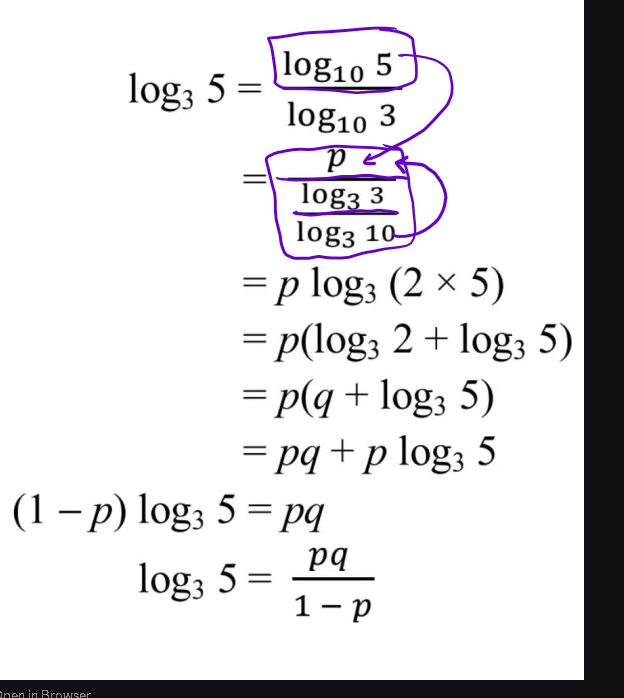
what is q
vapid tiger
q=log2 base 3
fallen zealot
so which part you dont understand exactly
 cyan zinc
what's the point of any of this
vapid tiger
Express in terms of p and q
vapid tiger
cyan zinc
what's the point of any of this
Wdym
cyan zinc
like what's the goal here
fallen zealot
fallen zealot
so which part you dont understand exactly
.
vapid tiger
Huh how
fallen zealot
 vapid tiger
Ah mann didn't see thsy
fallen zealot
np 🙂
trim joltBOT
Channel closed
Closed by @vapid tiger
Use .reopen if this was a mistake.
trim joltBOT
✅
vapid tiger
Log is so annoying
It's so time consuming
I don't have time
I got physics and chem to cover dammit
Someone helep plssss
 vernal warren

u get this
$$log_{3}5 - plog_{3} 5 = pq$$
here we can factor out $log_{3}5$ , and we then get
$$log_{3}5 (1 - p) = pq$$
solid kilnBOT
JustToPro
 vapid tiger
Bro how do you see this
Tell me how you can see that
Dang it
I'm still a long way away
vernal warren
vapid tiger
Tell me how you can see that
practice ig
vapid tiger
How much practicr
vernal warren
i mean i saw pq was independent and the rest of term was missing
then i just saw what could have happened to the other term
vapid tiger
I think it's cuz my brain is fried. Have been studying phys chem and math back to back for 5 hours
vapid tiger
vernal warren
then i just saw what could have happened to the other term
Such a simple explanation for a complex idea 😭😭
Ok tq
.close
trim joltBOT
Channel closed
Closed by @vapid tiger
Use .reopen if this was a mistake.
Available help channel!
Send your question here to claim the channel.
Remember:
• Ask your math question in a clear, concise manner.
• Show your work, and if possible, explain where you are stuck.
• After 15 minutes, feel free to ping <@&286206848099549185>.
• Type the command .close to free the channel when you're done.
• Be polite and have a nice day!
Read #❓how-to-get-help for further information on how to ask a good question, and about conduct in the question channels.
 foggy dragon
 trim joltBOT
foggy dragon
foggy dragon
trim joltBOT
foggy dragon
foggy dragon
can someone help me do 1a?
its a very simple question but ive expanded it like 4 times now and i keep getting it wrong
im just curious if its just incorrect
you just have to sub in 3i + 2
and expan
can someone try it and tell me if they get 0?
oh nbmind i see what i did wrong....
fuck thats such a stupid ass mistake
.close
trim joltBOT
Channel closed
Closed by @foggy dragon
Use .reopen if this was a mistake.
Available help channel!
Send your question here to claim the channel.
Remember:
• Ask your math question in a clear, concise manner.
• Show your work, and if possible, explain where you are stuck.
• After 15 minutes, feel free to ping <@&286206848099549185>.
• Type the command .close to free the channel when you're done.
• Be polite and have a nice day!
Read #❓how-to-get-help for further information on how to ask a good question, and about conduct in the question channels.
vapid tiger
Helep
trim joltBOT
vapid tiger
Helep
vapid tiger

Why they divide
I mena what made you think that way
I wanna understand the thought process
No answer sheet in exams
Bruh why is maths like this
 lilac cloud
probably so you can cancel out the a factor?
vapid tiger
Ok so in simultaneous situations like this
I can choose to divide multiply minus or plus?
In order to cancel out a factor?
Is that correct?
Breh I'll just use substitution method lah like this
 analog shale
you're right, though the presented solution is efficient enough
 sacred sapphire
vapid tiger
I can choose to divide multiply minus or plus?
sacred sapphire
vapid tiger
I can choose to divide multiply minus or plus?
you follow the operation of the thing you want to cancel
like in there the a is multiplied with something else
to cancel it you divide
if for example it was added with something like, a + something
you use minus
trim joltBOT
Channel closed
Closed by @vapid tiger
Use .reopen if this was a mistake.
trim joltBOT
Available help channel!
Send your question here to claim the channel.
Remember:
• Ask your math question in a clear, concise manner.
• Show your work, and if possible, explain where you are stuck.
• After 15 minutes, feel free to ping <@&286206848099549185>.
• Type the command .close to free the channel when you're done.
• Be polite and have a nice day!
Read #❓how-to-get-help for further information on how to ask a good question, and about conduct in the question channels.
 lofty elk
i dont have any issue solving this, but i do have an issue with why k=8 is rejected
 trim joltBOT
lofty elk
i dont have any issue solving this, but i do have an issue with why k=8 is rejec...
lofty elk
trim joltBOT
lofty elk
i dont have any issue solving this, but i do have an issue with why k=8 is rejec...
lofty elk
the way this is done for my syllabus is to apply the transformation to a point, and map that point onto another point on the line


Quora
Answer (1 of 6): For a line through the origin to be invariant, a vector along that line must be an eigenvector of the transformation. For the transformation to have two, distinct, invariant lines through the origin, the given matrix must have two,
- different,
- real,
- non-zero
eigenvalues....
lofty elk
lofty elk
https://www.quora.com/What-is-the-set-of-values-of-k-for-which-the-transformatio...
this is a resource i found
so my questions is: why is k=8 rejected? every point on the line should be mapped to the origin, which is part of the line
lofty elk
ohhhhhh
scarlet escarp
2x + y is not a line on its own
lofty elk
btw do you guys have a matrix calculator resource where i can play with this stuff
might be easier for me to visualise
actually nvm i think i got it
tysm guys ❤️
.close
trim joltBOT
Channel closed
Closed by @lofty elk
Use .reopen if this was a mistake.
trim joltBOT
Available help channel!
Send your question here to claim the channel.
Remember:
• Ask your math question in a clear, concise manner.
• Show your work, and if possible, explain where you are stuck.
• After 15 minutes, feel free to ping <@&286206848099549185>.
• Type the command .close to free the channel when you're done.
• Be polite and have a nice day!
Read #❓how-to-get-help for further information on how to ask a good question, and about conduct in the question channels.
 little oar
Hello, I have the following problem: We have a point A outside of a circle with origo O and radius r, a point B inside this circle. We know vectors AB and AO, now we extend AB such that it intersects the circle, we call this point C, we are looking for the OC vector.
I was aiming to find the angle between OC and the x-axis because then I could just apply the rotation on a x-axis unit vector and scale it with r.
I think I got the COA angle, but I just can't see how to get the desired angle from it.
 trim joltBOT
little oar
Hello, I have the following problem: We have a point A outside of a circle with ...
trim joltBOT
little oar
Hello, I have the following problem: We have a point A outside of a circle with ...
@little oar Has your question been resolved?
little oar
I guess I can get the angle between -AO vector (OA) and the x-axis and then on some cases I need to add it to beta and sometimes subtract it...
 trim joltBOT
@little oar Has your question been resolved?
little oar
.close
trim joltBOT
Channel closed
Closed by @little oar
Use .reopen if this was a mistake.
trim joltBOT
Available help channel!
Send your question here to claim the channel.
Remember:
• Ask your math question in a clear, concise manner.
• Show your work, and if possible, explain where you are stuck.
• After 15 minutes, feel free to ping <@&286206848099549185>.
• Type the command .close to free the channel when you're done.
• Be polite and have a nice day!
Read #❓how-to-get-help for further information on how to ask a good question, and about conduct in the question channels.
vagrant prism
!status
trim joltBOT
What step are you on?
1. I don't know where to begin.
2. I have begun but got stuck midway.
3. I got an answer but I was told that it's wrong.
4. I got an answer and would like my work checked.
5. I have a question about someone else's work/solution.
6. I have completed the problem and don't need help anymore. Thank you.
7. None of the above
also is this the full problem?
no other context?
hm
i think this is an FTC question
fundamental theorem of calculus
also interesting obervation - if x = 3, then x^2(x+2) = 45
the integral becomes $F(x^2 (x+2)) - F(0) = x$
solid kilnBOT
artemetra
 vagrant prism
then differentiate both sides w.r.t. x
@sterile compass
derivative of a constant is 0
F(0) is a constant
huh?
F' = f
i think you did something wrong
$f(x^2 (x+2)) = \frac{1}{3x^2 + 4x}$
solid kilnBOT
artemetra
 vagrant prism
then use the fact that x=3 makes x^2(x+2) = 45, which is what you are looking for
so $f(45) = \frac{1}{3(3)^2 + 4\cdot3}$
solid kilnBOT
artemetra
 vagrant prism
seems like so
yes
because derivative of a constant is always 0
F(0) does not depend on the value of x
so it is a constant
no problem, if you are done type ".close"
uhh
numerically seems to converge to 2/3 but i am still thinking about how to prove it
i wonder whether this is any useful

b = 1 obv
do you need to find the limit or determine whether it is convergent or not
the latter is easy
$\frac{(2-1)(3-1)\cdots (n-1)\cdot (2^2 + 2 + 1)(3^2 + 3 + 1)\cdots (n^2 + n + 1)}{(2+1)(3+1)\cdots(n+1)\cdot (2^2 - 2 + 1)(3^2 - 3 + 1)\cdots(n^2 - n + 1)}$
solid kilnBOT
artemetra
 vagrant prism
ooooh
$\frac{(2-1)(3-1)\cancel{(4-1)}\cancel{\cdots (n-1)}\cdot (2^2 + 2 + 1)(3^2 + 3 + 1)\cdots (n^2 + n + 1)}{\cancel{(2+1)(3+1)}\cdots\cancel{(n-1)}(n+1)\cdot (2^2 - 2 + 1)(3^2 - 3 + 1)\cdots(n^2 - n + 1)}$
solid kilnBOT
artemetra
 vagrant prism
so $=2\frac{(2^2 + 2 + 1)(3^2 + 3 + 1)\cdots (n^2 + n + 1)}{(2^2 - 2 + 1)(3^2 - 3 + 1)\cdots(n^2 - n + 1)}$
solid kilnBOT
artemetra
 vagrant prism
n^2 ± n + 1 looks like a geometric sequence sum
so $n^2 + n + 1 = \frac{n^3 - 1}{n -1}$ and $n^2 - n + 1 = \frac{(-n)^3 - 1}{(-n) -1} = \frac{-n^3 - 1}{-n -1} = -\frac{n^3 + 1}{n + 1}$
solid kilnBOT
artemetra
 vagrant prism
solid kiln
**artemetra**
vagrant prism
solid kiln
**artemetra**
so $=2 \frac{\frac{2^3 - 1}{2 - 1}\frac{3^3 - 1}{3 - 1}\cdots \frac{n^3 - 1}{n -1}}{(-1)^n \frac{2^3 + 1}{2 + 1}\frac{3^3 + 1}{3 + 1}\cdots \frac{n^3 + 1}{n +1}}$
solid kilnBOT
artemetra
 vagrant prism
okay the (-1)^n in the denominator is not nice
i am not sure where to take this further but i see some possible cancellations
hopefully some other helper will be able to help
i gtg
 turbid gazelle
solid kiln
**artemetra**
turbid gazelle
solid kiln
**artemetra**
Can someone explain this
 fathom oasis
Yo you
turbid gazelle
turbid gazelle
Can someone explain this
I get this part now
Its because when you diff F(x^2(x+2)) it becomes (3x^2+4x)f(x^2(x+2))
Ye
trim joltBOT
@sterile compass Has your question been resolved?
trim joltBOT
Channel closed
Closed due to timeout
Use .reopen if this was a mistake.
Available help channel!
Send your question here to claim the channel.
Remember:
• Ask your math question in a clear, concise manner.
• Show your work, and if possible, explain where you are stuck.
• After 15 minutes, feel free to ping <@&286206848099549185>.
• Type the command .close to free the channel when you're done.
• Be polite and have a nice day!
Read #❓how-to-get-help for further information on how to ask a good question, and about conduct in the question channels.
 old spindle
help with finding the b and c values of this graph
 old spindle
i thought the b value would be 4 but it comes as wrong
trim joltBOT
@old spindle Has your question been resolved?
old spindle
<@&286206848099549185>
old spindle
<@&286206848099549185>
 azure glacier
old spindle
i thought the b value would be 4 but it comes as wrong
azure glacier
old spindle
i thought the b value would be 4 but it comes as wrong
b = 1/2
a = 4
c = 11π/4
old spindle
are you sure about c it comes back as incorrect
azure glacier
old spindle
are you sure about c it comes back as incorrect
throughly
 azure glacier
No, I think (a) should be 4 and (c) should be 1
As for (b), I can say that it becomes π/2
old spindle
all of it comes incorrect 😭
the max of the graph is 5 and lowest is -1
so isnt a just 6/2 = 3
yeah it is that comes correct
azure glacier
old spindle
the max of the graph is 5 and lowest is -1
The maximum value of the blue curve is 5 and the minimum value is -3, the amplitude is half the difference: ( 5-(-3))/2
=8/2=4
old spindle
how is the minimum value -3 when it only goes down to y = -1 around x=-2
trim joltBOT
@old spindle Has your question been resolved?
trim joltBOT
@old spindle Has your question been resolved?
trim joltBOT
Channel closed
Closed due to timeout
Use .reopen if this was a mistake.
Available help channel!
Send your question here to claim the channel.
Remember:
• Ask your math question in a clear, concise manner.
• Show your work, and if possible, explain where you are stuck.
• After 15 minutes, feel free to ping <@&286206848099549185>.
• Type the command .close to free the channel when you're done.
• Be polite and have a nice day!
Read #❓how-to-get-help for further information on how to ask a good question, and about conduct in the question channels.
merry zodiac
Maximum value of cos theta+cos 2 theta
trim joltBOT
merry zodiac
Maximum value of cos theta+cos 2 theta
 tribal jetty
can you get rid of cos(2theta) ?
 prime lynx
merry zodiac
Maximum value of cos theta+cos 2 theta
prime lynx
merry zodiac
Maximum value of cos theta+cos 2 theta
differentiate with respect to theta?
when d/dx(cos theta+cos 2 theta) = 0 {it is a turning point]
 marsh forum
merry zodiac
Maximum value of cos theta+cos 2 theta
marsh forum
merry zodiac
Maximum value of cos theta+cos 2 theta
use $cos(2x)=2cos^2(x)-1$
solid kilnBOT
Why am. I here
 marsh forum
then compare it to the equation of a parabola
merry zodiac
 marsh forum
,w minima of cos(x)+cos(2x)
solid kilnBOT


 Requested by physicsrocks
marsh forum
Requested by physicsrocks
marsh forum
looks right to me
merry zodiac
Thank you
marsh forum
no problem
merry zodiac
.close
trim joltBOT
Channel closed
Closed by @merry zodiac
Use .reopen if this was a mistake.
Available help channel!
Send your question here to claim the channel.
Remember:
• Ask your math question in a clear, concise manner.
• Show your work, and if possible, explain where you are stuck.
• After 15 minutes, feel free to ping <@&286206848099549185>.
• Type the command .close to free the channel when you're done.
• Be polite and have a nice day!
Read #❓how-to-get-help for further information on how to ask a good question, and about conduct in the question channels.
 crimson rover
How do you calculate lambda in poisson distribution?
trim joltBOT
crimson rover
How do you calculate lambda in poisson distribution?
@crimson rover Has your question been resolved?
trim joltBOT
Channel closed
Closed due to timeout
Use .reopen if this was a mistake.
crimson rover
.reopen
 sterile musk
crimson rover
How do you calculate lambda in poisson distribution?
sterile musk
crimson rover
How do you calculate lambda in poisson distribution?
This is a bit of a poor question, in what context? In general the parameter lambda is equal to the mean number of successes over a certain time period.
trim joltBOT
@crimson rover Has your question been resolved?
Channel closed
Closed by @crimson rover
Use .reopen if this was a mistake.
Available help channel!
Send your question here to claim the channel.
Remember:
• Ask your math question in a clear, concise manner.
• Show your work, and if possible, explain where you are stuck.
• After 15 minutes, feel free to ping <@&286206848099549185>.
• Type the command .close to free the channel when you're done.
• Be polite and have a nice day!
Read #❓how-to-get-help for further information on how to ask a good question, and about conduct in the question channels.
 brittle pier
Could someone help me get started on solving these types of problems?
 edgy willow
there are equations but they all come from the fact that if you add distributions, their variance adds as well
variance is o^2 so with 100 students you'd have variance 100o^2, then you'd have to take the square root to get the standard deviation you want
trim joltBOT
@brittle pier Has your question been resolved?
edgy willow
brittle pier
so it would be sqrt (100 * 0.2)
oh the 0.2 is outside the square root
sqrt(100o^2)=10o=10*0.2
brittle pier
edgy willow
sqrt(100o^2)=10o=10*0.2
how did you know to use variance?
edgy willow
you just have to know that changing the variance is easier and convert to standard deviation at the end
it's from how the variance formula is just adding a bunch of things but the standard deviation formula has a big square root
like for a distribution the "natural" parameters are mean and variance
brittle pier
edgy willow
like for a distribution the "natural" parameters are mean and variance
So in this problem, they are basically giving us the average and standard deviation. So from that, you took the variance of that and used the 100 students as a constant?
edgy willow
yea 100 is how many distributions you're adding up
usually called n in all the formulas
brittle pier
Ohhh I see
brittle pier
edgy willow
usually called n in all the formulas
So if i wanted to find the average of the new 100 student distribution, I just multiply the old average (8oz) by that constant then right?
edgy willow
right
edgy willow
haha
trim joltBOT
Channel closed
Closed by @brittle pier
Use .reopen if this was a mistake.
trim joltBOT
Available help channel!
Send your question here to claim the channel.
Remember:
• Ask your math question in a clear, concise manner.
• Show your work, and if possible, explain where you are stuck.
• After 15 minutes, feel free to ping <@&286206848099549185>.
• Type the command .close to free the channel when you're done.
• Be polite and have a nice day!
Read #❓how-to-get-help for further information on how to ask a good question, and about conduct in the question channels.
 worldly monolith
How do I find this when the mean and x are the same
 trim joltBOT
worldly monolith
How do I find this when the mean and x are the same
trim joltBOT
worldly monolith
How do I find this when the mean and x are the same
@worldly monolith Has your question been resolved?
edgy willow
usually you'd adjust the standard deviation by o/sqrt(n) and do z-scores, here since the mean is the same it's z=0
but like clearly if you have a bell curve centered at x then the chance something is greater than the middle is 1/2 right?
worldly monolith
edgy willow
but like clearly if you have a bell curve centered at x then the chance somethin...
That’s what I figured but I didn’t think it was gonna be that simple 😭
trim joltBOT
@worldly monolith Has your question been resolved?
trim joltBOT
Channel closed
Closed due to timeout
Use .reopen if this was a mistake.
Available help channel!
Send your question here to claim the channel.
Remember:
• Ask your math question in a clear, concise manner.
• Show your work, and if possible, explain where you are stuck.
• After 15 minutes, feel free to ping <@&286206848099549185>.
• Type the command .close to free the channel when you're done.
• Be polite and have a nice day!
Read #❓how-to-get-help for further information on how to ask a good question, and about conduct in the question channels.
civic thorn
Why do we get multiple answers from this?
 trim joltBOT
civic thorn
Why do we get multiple answers from this?
scarlet escarp
trim joltBOT
civic thorn
Why do we get multiple answers from this?
scarlet escarp
well do you see why
cos(x) = 0
has multiple answers?
wraith hinge
cos is a periodic function
civic thorn
like i already found one answer, but im not sure why or how there are more
 civic thorn
scarlet escarp
well do you see why
cos(x) = 0
has multiple answers?
civic thorn
scarlet escarp
well do you see why
cos(x) = 0
has multiple answers?
oh yeah
so will there always be multiple answers for a cos function?
wraith hinge
arccos is one-to-one so you aint getting another solution with it
civic thorn
wraith hinge
arccos is one-to-one so you aint getting another solution with it
then how do i find the others?
wraith hinge
reference angles are your friends
civic thorn
how do i use them to find the other answers tho?
im looking at my teachers work, and mi not sure why he did this

 wraith hinge
well its because cos(theta) = x in the unit circle
so
you have an angle in the first quadrant that is positive
you want to find where else 3/7 occurs in-between the interval 0 and 2pi
the second and third quadrants are out rhe window because x is negative there
civic thorn
oh so basically all we're looking for is where 3/7 occurs in the circle
wraith hinge
yes
trim joltBOT
Channel closed
Closed by @civic thorn
Use .reopen if this was a mistake.
civic thorn
.reopen
trim joltBOT
✅
civic thorn
wraith hinge
you want to find where else 3/7 occurs in-between the interval 0 and 2pi
wait one more thing

why is he subtracting the version of arccos(3/7) before its multiplied by 2/pi
should he do 2pi-(arccos(3/7)*2/pi)
instead of 2pi-arccos(3/7)
trim joltBOT
@civic thorn Has your question been resolved?
Channel closed
Closed by @civic thorn
Use .reopen if this was a mistake.
Available help channel!
Send your question here to claim the channel.
Remember:
• Ask your math question in a clear, concise manner.
• Show your work, and if possible, explain where you are stuck.
• After 15 minutes, feel free to ping <@&286206848099549185>.
• Type the command .close to free the channel when you're done.
• Be polite and have a nice day!
Read #❓how-to-get-help for further information on how to ask a good question, and about conduct in the question channels.
 cosmic plinth
how can I count the number of gumballs in this jar?
 placid juniper
😭
 delicate belfry
You’ll probably have to find the mass of the glass jar, and an average mass of a gum, and get an average answer (besides counting).
 pearl tendon
cosmic plinth
how can I count the number of gumballs in this jar?
pearl tendon
cosmic plinth
how can I count the number of gumballs in this jar?
+1 to Good's answer.. but just so we don't leave any stone unturned... do you have any additional information? Size of the gumballs? Size of the jar? Volume? diameter? anything?
cosmic plinth
pearl tendon
+1 to Good's answer.. but just so we don't leave any stone unturned... do you ha...
nope I was just given this image and told to count the number of gumballs
pearl tendon
meh.. old county fair game... kinda lame, imho
imagine you're looking at a slice, vertically, through the jar
That's your diameter
cosmic plinth
so something like the shell method?
pearl tendon
The jar is relatively cylindrical, so you could take that number and, using "gumball" as your unit of measure, get the height of the cylinder, and then calculate volume
pearl tendon
cosmic plinth
so something like the shell method?
Not familiar with that terminology
cosmic plinth
okay can try
cosmic plinth
pearl tendon
Not familiar with that terminology
It's a method used to find volumes. Usually tought in calc 2
pearl tendon
At the end, it boils down to a guessing game, and your instructor likely just wants to get you to try and think logically
trim joltBOT
Channel closed
Closed by @cosmic plinth
Use .reopen if this was a mistake.
trim joltBOT
Available help channel!
Send your question here to claim the channel.
Remember:
• Ask your math question in a clear, concise manner.
• Show your work, and if possible, explain where you are stuck.
• After 15 minutes, feel free to ping <@&286206848099549185>.
• Type the command .close to free the channel when you're done.
• Be polite and have a nice day!
Read #❓how-to-get-help for further information on how to ask a good question, and about conduct in the question channels.
 wild dew
Can anyone please help me with no. 12? Im sort off confused on what to do or even where to start
 trim joltBOT
wild dew
Can anyone please help me with no. 12? Im sort off confused on what to do or eve...
trim joltBOT
wild dew
Can anyone please help me with no. 12? Im sort off confused on what to do or eve...
 pulsar plaza
wild dew
Can anyone please help me with no. 12? Im sort off confused on what to do or eve...
pulsar plaza
wild dew
Can anyone please help me with no. 12? Im sort off confused on what to do or eve...
you have two points B and C
and you want to find the equation of the line passing between
so do you know what equation to apply here?
trim joltBOT
@wild dew Has your question been resolved?
wild dew
pulsar plaza
so do you know what equation to apply here?
No im second guessing atp😭😭
pulsar plaza
wild dew
No im second guessing atp😭😭
equation of a line lol
trim joltBOT
Channel closed
Closed by @wild dew
Use .reopen if this was a mistake.
Available help channel!
Send your question here to claim the channel.
Remember:
• Ask your math question in a clear, concise manner.
• Show your work, and if possible, explain where you are stuck.
• After 15 minutes, feel free to ping <@&286206848099549185>.
• Type the command .close to free the channel when you're done.
• Be polite and have a nice day!
Read #❓how-to-get-help for further information on how to ask a good question, and about conduct in the question channels.
 summer ferry
basic question but is the inflection point the singular point?
 quaint aurora
dy/dx f(x) = 0, with d^2y/dx^2 < 0, is a maximum, the double derivative would be positive if it was a minimum. those are inflection points. you also need to check the bounds of the domain, because those might be maximums or minimums too, but are not contained in this test.
summer ferry
I understand the inflection point is the point where it changes concavity
but im just a bit confused if it is the singular point?
or is singular point a different thing
quaint aurora
the singular point is where dx/dy = 0 and the double deriviative is also exactly zero
summer ferry
so its when f'(x) = 0 and f''(x)= 0 at the same point?
quaint aurora
yeah
summer ferry
Okay wait sorry just to clarify
so if it's f'(x) = 0 and f''(x) = 0 at x=2
then the x=2 is the singular point?
quaint aurora
yes
summer ferry
ok and last dumb question haha
so if f'x = 0 and f''x = smth else at x=2
then that wouldnt be a singular point right
obv question but just making sure haha
quaint aurora
no it wouldn't be a singular point, but it would be a local max or min
summer ferry
ohhh so singular refers to the absolute max/min
quaint aurora
im not sure about that
i just know that the definition is that the double derivative and the derivative are both zero
quaint aurora
np
summer ferry
.close
trim joltBOT
Channel closed
Closed by @summer ferry
Use .reopen if this was a mistake.
trim joltBOT
Available help channel!
Send your question here to claim the channel.
Remember:
• Ask your math question in a clear, concise manner.
• Show your work, and if possible, explain where you are stuck.
• After 15 minutes, feel free to ping <@&286206848099549185>.
• Type the command .close to free the channel when you're done.
• Be polite and have a nice day!
Read #❓how-to-get-help for further information on how to ask a good question, and about conduct in the question channels.
 amber crescent
Pls help on probability problem algebra 2

 stable ore
amber crescent
Pls help on probability problem algebra 2
stable ore
amber crescent
Pls help on probability problem algebra 2
well
how many ways are there to choose 2 democrats
and how many ways can you choose 2 people
amber crescent
stable ore
and how many ways can you choose 2 people
So 22C2 and 10C2
You divide them?
trim joltBOT
@amber crescent Has your question been resolved?
trim joltBOT
Channel closed
Closed due to timeout
Use .reopen if this was a mistake.
Available help channel!
Send your question here to claim the channel.
Remember:
• Ask your math question in a clear, concise manner.
• Show your work, and if possible, explain where you are stuck.
• After 15 minutes, feel free to ping <@&286206848099549185>.
• Type the command .close to free the channel when you're done.
• Be polite and have a nice day!
Read #❓how-to-get-help for further information on how to ask a good question, and about conduct in the question channels.
 lapis burrow
I'M giga stuck on simplifying this
 trim joltBOT
lapis burrow
I'M giga stuck on simplifying this
trim joltBOT
lapis burrow
I'M giga stuck on simplifying this

 tepid hamlet
lapis burrow
tepid hamlet
lapis burrow
how did you end up with stuff ^4?
 lusty delta
by doing correct work
lusty delta
lapis burrow
notice u can factor a common term out from this expression inside the square root
lapis burrow
tepid hamlet
how did you end up with stuff ^4?
raising the problem to 2nd power
lapis burrow
lusty delta
notice u can factor a common term out from this expression inside the square roo...
9?
tepid hamlet
lapis burrow
raising the problem to 2nd power
oh right
lapis burrow
sin^2 and cos^2?
lusty delta
lapis burrow
sin^2 and cos^2?
yes
so factor out those 3 things and rewrite ur expression accordingly,
lusty delta
can u show what u have
lapis burrow
9cosx^2sinx^2(cosx^2+sinx^2
lapis burrow
my bad your right
lusty delta
v nice
lapis burrow
so the inside should cancel out?
lusty delta
sorta ye
lapis burrow
or justbe 1
lusty delta
since u know (cost)^2 + (sint)^2 = 1
lusty delta
welc 🎉
lapis burrow
.close
trim joltBOT
Channel closed
Closed by @lapis burrow
Use .reopen if this was a mistake.
Available help channel!
Send your question here to claim the channel.
Remember:
• Ask your math question in a clear, concise manner.
• Show your work, and if possible, explain where you are stuck.
• After 15 minutes, feel free to ping <@&286206848099549185>.
• Type the command .close to free the channel when you're done.
• Be polite and have a nice day!
Read #❓how-to-get-help for further information on how to ask a good question, and about conduct in the question channels.
 latent axle
71
 trim joltBOT
latent axle
71
lusty delta
latent axle
71
trim joltBOT
latent axle
71
lusty delta
latent axle
71
do u have any thoughts on this question so far
latent axle
lusty delta
do u have any thoughts on this question so far
Not really
lusty delta
so let's disregard some terms for now
do u know what the limit as x approaches infinity of (- 3^x) / (4^x) would be
@latent axle
lusty delta
latent axle
Inf/inf?
is correct but i'm asking do u know what the limit actually evaluates to
latent axle
No
lusty delta
latent axle
No
r u familiar with such equality
 latent axle
Yes
lusty delta
lusty delta
do u know what the limit as x approaches infinity of (- 3^x) / (4^x) would be
applying it here, what do u get
latent axle
(-3/4)^x
lusty delta
latent axle
(-3/4)^x
and as x goes to infinity what does this -(3/4)^x tend to
trim joltBOT
Channel closed
Closed by @latent axle
Use .reopen if this was a mistake.
trim joltBOT
Available help channel!
Send your question here to claim the channel.
Remember:
• Ask your math question in a clear, concise manner.
• Show your work, and if possible, explain where you are stuck.
• After 15 minutes, feel free to ping <@&286206848099549185>.
• Type the command .close to free the channel when you're done.
• Be polite and have a nice day!
Read #❓how-to-get-help for further information on how to ask a good question, and about conduct in the question channels.
 wheat bronze
i need help
trim joltBOT
wheat bronze
i need help
wheat bronze


i dont understand anything, teacher just handed this without intro or lesson.
<@&286206848099549185>
trim joltBOT
@wheat bronze Has your question been resolved?
trim joltBOT
@wheat bronze Has your question been resolved?
trim joltBOT
Channel closed
Closed due to timeout
Use .reopen if this was a mistake.
Available help channel!
Send your question here to claim the channel.
Remember:
• Ask your math question in a clear, concise manner.
• Show your work, and if possible, explain where you are stuck.
• After 15 minutes, feel free to ping <@&286206848099549185>.
• Type the command .close to free the channel when you're done.
• Be polite and have a nice day!
Read #❓how-to-get-help for further information on how to ask a good question, and about conduct in the question channels.
 foggy wharf
A rectangular parallelepiped has a side length of 5 cm, a diagonal cross-sectional area of 205 cm, and a base area of 360 cm. Find sides
trim joltBOT
foggy wharf
A rectangular parallelepiped has a side length of 5 cm, a diagonal cross-section...
@foggy wharf Has your question been resolved?
foggy wharf
<@&286206848099549185>
<@&286206848099549185>

i can find the answer but i dont like method which im using
<@&286206848099549185>
trim joltBOT
@foggy wharf Has your question been resolved?
foggy wharf
<@&286206848099549185>
trim joltBOT
@foggy wharf Has your question been resolved?
foggy wharf
<@&286206848099549185>
foggy wharf
<@&286206848099549185>
A rectangular parallelepiped has a side length of 5 cm, a diagonal cross-sectional area of 205 cm², and a base area of 360 cm². Find the lengths of its sides
 earnest granite
what answers did you find ?
foggy wharf
answer should be 40 and 9
earnest granite
hmmmm
foggy wharf
i solved it using biquadratic equation but
numbers are very high
so i used calculator
earnest granite
I found a way
earnest granite

 foggy wharf
and how to take sqrt form big numbers without calculator if u know any techniques
earnest granite
I tend to just gradually break up a large number until I get something okish
foggy wharf
7 digit number?
 earnest granite
yeaaa.........
foggy wharf
