#help-38
1 messages · Page 89 of 1

 tribal jetty
ok
 torpid moat
.close
 trim joltBOT
Channel closed
Closed by @torpid moat
Use .reopen if this was a mistake.
trim joltBOT
 Available help channel!
Send your question here to claim the channel.
Remember:
• Ask your math question in a clear, concise manner.
• Show your work, and if possible, explain where you are stuck.
• After 15 minutes, feel free to ping <@&286206848099549185>.
• Type the command .close to free the channel when you're done.
• Be polite and have a nice day!
Read #❓how-to-get-help for further information on how to ask a good question, and about conduct in the question channels.
 torn ether
how should I solve this. I honestly have no clue where to start

 torn ether
I think so based on my teachers notes but Ive never done one like this
 wanton rune
wanton rune
wanton rune
just try it using this as a basis
 round mango
There's a 2/z³ outside, I'd start by letting 1/z²=u
Multiply and divide by -1 first to form du at the top
wanton rune
huh
torn ether
??
wanton rune
ah
round mango
1/z²=u
wanton rune
i see
round mango
=> -2/z³=du/dz
torn ether
im so lost rn
trim joltBOT
Channel closed
Closed by @torn ether
Use .reopen if this was a mistake.
trim joltBOT
Available help channel!
Send your question here to claim the channel.
Remember:
• Ask your math question in a clear, concise manner.
• Show your work, and if possible, explain where you are stuck.
• After 15 minutes, feel free to ping <@&286206848099549185>.
• Type the command .close to free the channel when you're done.
• Be polite and have a nice day!
Read #❓how-to-get-help for further information on how to ask a good question, and about conduct in the question channels.
Channel closed
Channel closed due to the original message being deleted.
If you did not intend to do this, please open a new help channel,
as this action is irreversible, and this channel may abruptly lock.
 long iris
trim joltBOT
Available help channel!
long iris
trim joltBOT
Available help channel!
Send your question here to claim the channel.
Remember:
• Ask your math question in a clear, concise manner.
• Show your work, and if possible, explain where you are stuck.
• After 15 minutes, feel free to ping <@&286206848099549185>.
• Type the command .close to free the channel when you're done.
• Be polite and have a nice day!
Read #❓how-to-get-help for further information on how to ask a good question, and about conduct in the question channels.
 stiff briar
i need help on 52 😭
 trim joltBOT
stiff briar
i need help on 52 😭
stiff briar
trim joltBOT
stiff briar
i need help on 52 😭
stiff briar
i'm not sure if it's oscillating or not
but it converges to two values
0 and 2
so is that considered oscillating
and therefore diverging
 jagged fiber
yes ur correct
trim joltBOT
Channel closed
Closed by @stiff briar
Use .reopen if this was a mistake.
jagged fiber
np
trim joltBOT
Available help channel!
Send your question here to claim the channel.
Remember:
• Ask your math question in a clear, concise manner.
• Show your work, and if possible, explain where you are stuck.
• After 15 minutes, feel free to ping <@&286206848099549185>.
• Type the command .close to free the channel when you're done.
• Be polite and have a nice day!
Read #❓how-to-get-help for further information on how to ask a good question, and about conduct in the question channels.
 ocean lake
Hello! This is not a math related topic but i was wondering about how the availability bot and channels are made? I would like to do something similar in one of my study servers
trim joltBOT
ocean lake
Hello! This is not a math related topic but i was wondering about how the availa...
 sly pewter
not the person who made the bot but you can probably just add the bot to your server
ocean lake
may i know how?
ocean lake
and it would do the same function?
sly pewter
it would be similar
 austere cedar
GitHub
Contribute to discord-math/bot development by creating an account on GitHub.
austere cedar
That's the github. Not necessarily how you might actually add it to a server.
I am not certain myself
ocean lake
yea that was my next question lol
i'll try out a ticket bot since i cant download this one.. but thanks for your help!
.close
trim joltBOT
Channel closed
Closed by @ocean lake
Use .reopen if this was a mistake.
trim joltBOT
Available help channel!
Send your question here to claim the channel.
Remember:
• Ask your math question in a clear, concise manner.
• Show your work, and if possible, explain where you are stuck.
• After 15 minutes, feel free to ping <@&286206848099549185>.
• Type the command .close to free the channel when you're done.
• Be polite and have a nice day!
Read #❓how-to-get-help for further information on how to ask a good question, and about conduct in the question channels.
 tropic sequoia
How to solve this do I make the denominator the same?
 trim joltBOT
Channel closed
Closed by @tropic sequoia
Use .reopen if this was a mistake.
tropic sequoia
.reopen
trim joltBOT
✅
tropic sequoia

 tranquil widget
tropic sequoia
tranquil widget
tropic sequoia
.close
trim joltBOT
Channel closed
Closed by @tropic sequoia
Use .reopen if this was a mistake.
tropic sequoia
 trim joltBOT
Available help channel!
trim joltBOT
Available help channel!
Send your question here to claim the channel.
Remember:
• Ask your math question in a clear, concise manner.
• Show your work, and if possible, explain where you are stuck.
• After 15 minutes, feel free to ping <@&286206848099549185>.
• Type the command .close to free the channel when you're done.
• Be polite and have a nice day!
Read #❓how-to-get-help for further information on how to ask a good question, and about conduct in the question channels.
 odd spear
is the region from 1 to y the same as y to 1 for an integral?
odd spear
 trim joltBOT
@odd spear Has your question been resolved?
 thorny whale
odd spear
is the region from 1 to y the same as y to 1 for an integral?
thorny whale
odd spear
is the region from 1 to y the same as y to 1 for an integral?
i think so, because area is always be positive right?
trim joltBOT
Channel closed
Closed due to timeout
Use .reopen if this was a mistake.
trim joltBOT
Available help channel!
Send your question here to claim the channel.
Remember:
• Ask your math question in a clear, concise manner.
• Show your work, and if possible, explain where you are stuck.
• After 15 minutes, feel free to ping <@&286206848099549185>.
• Type the command .close to free the channel when you're done.
• Be polite and have a nice day!
Read #❓how-to-get-help for further information on how to ask a good question, and about conduct in the question channels.
 verbal nebula
 trim joltBOT
verbal nebula
verbal nebula
trim joltBOT
verbal nebula
verbal nebula
tried changing all to common bases in the expression t3-t2=t2-t1 but it got messy
 gritty harness
 verbal nebula
i got 2/log_k(m)=1+1/log_k(n)
trim joltBOT
@verbal nebula Has your question been resolved?
trim joltBOT
Channel closed
Closed due to timeout
Use .reopen if this was a mistake.
Available help channel!
Send your question here to claim the channel.
Remember:
• Ask your math question in a clear, concise manner.
• Show your work, and if possible, explain where you are stuck.
• After 15 minutes, feel free to ping <@&286206848099549185>.
• Type the command .close to free the channel when you're done.
• Be polite and have a nice day!
Read #❓how-to-get-help for further information on how to ask a good question, and about conduct in the question channels.
 orchid wagon
explain like im 5, when we say function f: A -> B, what does A and B mean?
trim joltBOT
orchid wagon
explain like im 5, when we say function f: A -> B, what does A and B mean?
 marble wharf
sets
orchid wagon
elaborate?
ive never seen this notation ever in my hs curriculum, yet it seems so prevalent in american hs
marble wharf
A, B are sets. A is the domain of the function f and B is the codomain
f takes inputs from the set A and gives outputs from the set B
orchid wagon
so A is the domain of the func, and B is the range?
 fathom ivy
A: all valid inputs
B: all things that you think has a chance of being the output
for example if i define a function and call it shredder
i might have shredder: {paper, printed letters im not gonna read, some idiot’s laptop} -> {shredded paper, shredded letters, the shredder catches fire, the universe explodes}
and we can assign a mapping:
shredder(paper) = shredded paper
shredder(letter) = shredded letter
shredder(some idiot’s laptop)=shredder catches fire
note that nothing maps to the universe explodes, not everything in the codomain must have something map to it
orchid wagon
so codomain is just range, except its not reliable?
fathom ivy
it always contains the range, but sometimes the function is so not well understood that it might contain extra stuff
orchid wagon
so it must contain the range
fathom ivy
a silly example is f: R -> {0, 1}, where
f(x) = 1 for all x if we establish contact with aliens in the next 50 years
f(x)=0 for all x if we don’t
marble wharf
and its just generally easier to be able to say f:R->R and not worry about the actual range of f for now
orchid wagon
makes sense
marble wharf
you are just saying: f takes as input a real number and produces a real number as output
which numbers it can actually output (aka the range) is not important yet at that point
trim joltBOT
Channel closed
Closed by @orchid wagon
Use .reopen if this was a mistake.
trim joltBOT
Available help channel!
Send your question here to claim the channel.
Remember:
• Ask your math question in a clear, concise manner.
• Show your work, and if possible, explain where you are stuck.
• After 15 minutes, feel free to ping <@&286206848099549185>.
• Type the command .close to free the channel when you're done.
• Be polite and have a nice day!
Read #❓how-to-get-help for further information on how to ask a good question, and about conduct in the question channels.
 sage harness
A light house of height 53m stands on horizontal ground level with the base of a 80m cliff. The angle of elevation of the top of the cliff from the top of the light house is 27 degrees. Calculate theangle of depression of the base of the cliff when viewed from the top of the light house, leaving your answers to 1 decimal place.
trim joltBOT
sage harness
A light house of height 53m stands on horizontal ground level with the base of a...
sage harness
i just dont get how it would look like so could somebody draw a diagram for me?
trim joltBOT
@sage harness Has your question been resolved?
sage harness
<@&286206848099549185>
trim joltBOT
@sage harness Has your question been resolved?
trim joltBOT
Channel closed
Closed due to timeout
Use .reopen if this was a mistake.
Available help channel!
Send your question here to claim the channel.
Remember:
• Ask your math question in a clear, concise manner.
• Show your work, and if possible, explain where you are stuck.
• After 15 minutes, feel free to ping <@&286206848099549185>.
• Type the command .close to free the channel when you're done.
• Be polite and have a nice day!
Read #❓how-to-get-help for further information on how to ask a good question, and about conduct in the question channels.
 distant abyss
hello! I need help on number 3
 trim joltBOT
distant abyss
hello! I need help on number 3
trim joltBOT
distant abyss
hello! I need help on number 3
 devout drift
What have you tried?
distant abyss
Through the set operation, i used
n[(C n E n J) U (C n J n E^c) U (C n E n J^c) U (E n J n C^c)]
I used venn diagram to come up with that notation
After expanding
distant abyss
 distant abyss
After expanding
distant abyss
distant abyss
After expanding
I used the venn diagram again to cancel out the mutual exclusives (which is not a formal proof sadly), and after all that I was left with
n (C n E n J) + n (C n J n E^c) + n (C n J^c n E) + n (C^c n J n E)
devout drift
I meant with the elements of the sets as well (for example how many eat in caffeine) those you have already found out right?
distant abyss
so 42 + (126 - 42) + (112 - 42) = 196
distant abyss
devout drift
I meant with the elements of the sets as well (for example how many eat in caffe...
Ah yes
devout drift
You don't expect me to solve this all over again just for last part when you already have that information 
distant abyss
But how am i supposed to get number 3 tho from number 1
distant abyss
damn.
trim joltBOT
@distant abyss Has your question been resolved?
distant abyss
hello @devout drift are you still on it and willing to continue?
distant abyss
devout drift
I don't know just show me the elements
ah i see what u mmean now
C= Caffeine, E = Express, J = Joe
n(C) = 308
n(E) = 238
n(J) = 504
n(C n E) = 112
n(C n J) = 126
n (E n J) = 42
n ( C n E n J) = 42
devout drift
distant abyss
hello <@548061006170161163> are you still on it and willing to continue?
Yea
distant abyss
mb i think im too late on that now
devout drift
You made me find all the elements
distant abyss
okay, thank you sm
devout drift
It's correct
You did
number of elements in exactly two sets + number of elements in all three sets correct?
distant abyss
yeah
devout drift
It's correct
distant abyss
alright, but how did you do it?
devout drift
This would have been fast with all those elements
distant abyss
im just not sure since my solution involved using venn diagrams to determine those which are mutually exclusive, and im kinda sure that my professor does not find that rigorous or sumn
devout drift
$n(C \cap E) + n(C \cap J) + n(J \cap E) - 3n(C \cap J \cap E) + n(C \cap J \cap E)$
 solid kilnBOT
ColdTee
 devout drift
Basically
devout drift
distant abyss
im just not sure since my solution involved using venn diagrams to determine tho...
I find set operations easier sometimes
For questions like these
distant abyss
devout drift
I find set operations easier sometimes
i did use set operations, but when i expanded, some terms like n[ (C n E n J) n (C n J n E^c) ] came up, and since i dont know any properties i can use to get an answer, i used venn diagram instead, and it showed me that they;re exclusive
distant abyss
solid kiln
**ColdTee**
oh i see
you headed directly for the ones with the arithmetic
based on how my prof taught it, she wants us to denote the thing being asked for in n(X) of something
then use properties to expand, blah blah blah
i think i shudve went with that instead
thanks so much for the time and energy spent @devout drift
.close
trim joltBOT
Channel closed
Closed by @distant abyss
Use .reopen if this was a mistake.
Available help channel!
Send your question here to claim the channel.
Remember:
• Ask your math question in a clear, concise manner.
• Show your work, and if possible, explain where you are stuck.
• After 15 minutes, feel free to ping <@&286206848099549185>.
• Type the command .close to free the channel when you're done.
• Be polite and have a nice day!
Read #❓how-to-get-help for further information on how to ask a good question, and about conduct in the question channels.
 red jolt
doing it for 5th time now and still can’t solve it. what am i doing wrong here?

 trim joltBOT
red jolt
doing it for 5th time now and still can’t solve it. what am i doing wrong here?
trim joltBOT
red jolt
doing it for 5th time now and still can’t solve it. what am i doing wrong here?
 brazen forge
arent you overcomplicating this?
 digital bolt
red jolt
doing it for 5th time now and still can’t solve it. what am i doing wrong here?
digital bolt
red jolt
doing it for 5th time now and still can’t solve it. what am i doing wrong here?
if you think about it, you should be using the negative root
a-sqrt(y-a)
the one you're integrating is like the right side of the parabola
whereas you want the left
if you think about it, sqrt(y - a) + a will never touch the y-axis
you want a - sqrt(y-a)
to match the graph
but also yes you are overcomplicating this
brazen forge
 digital bolt
just integrate wrt. x to get S+T and then subtract a^2 to get S
trim joltBOT
Channel closed
Closed by @red jolt
Use .reopen if this was a mistake.
trim joltBOT
Available help channel!
Send your question here to claim the channel.
Remember:
• Ask your math question in a clear, concise manner.
• Show your work, and if possible, explain where you are stuck.
• After 15 minutes, feel free to ping <@&286206848099549185>.
• Type the command .close to free the channel when you're done.
• Be polite and have a nice day!
Read #❓how-to-get-help for further information on how to ask a good question, and about conduct in the question channels.
 quick hound
if i do trigonmetric sbustitutin with this
 trim joltBOT
quick hound
if i do trigonmetric sbustitutin with this
trim joltBOT
quick hound
if i do trigonmetric sbustitutin with this

 rough goblet
x - 4?
quick hound
really?
 patent crow
that leaves you with a sqrt(8u^2+2) integral
quick hound
it has to be a trigonemtric thing
rough goblet
yea ik
 proven sluice
Do u know standard integrations of such function?
rough goblet
am dum lmao
quick hound
proven sluice
Do u know standard integrations of such function?
wdym by this
proven sluice
Int of √x²+a²
quick hound
like the other functions


the subs were pretty self epxlenatory
but this one is weird
proven sluice
That's when it's in denominator
proven sluice
Wait
 proven hound
,calc 16*8
solid kilnBOT
Result:
128
oh is it -2
quick hound
still dont know how to tdo the mian part;-;
 heady lava
take out sqrt(2) maybe
so the inside becomes 4(x-4)^2-1, idk if that actually helps tho
quick hound
heady lava
take out sqrt(2) maybe
still the (x-4)^2
i dont know what to do with it afterwards
is the problem
proven sluice
Use these
 heady lava
might be stupid, what if
(x-4) sqrt(4(x-4)^2-1) + 4 sqrt(4(x-4)^2-1)
proven hound
There's an x outside though
proven sluice
quick hound
whats this called?
Special integrals ig?
proven sluice
That's long , sure u can
heady lava
heady lava
might be stupid, what if
(x-4) sqrt(4(x-4)^2-1) + 4 sqrt(4(x-4)^2-1)
I think this is doable, not sure
proven sluice
proven hound
There's an x outside though
Well yeahh that might be challenging
heady lava
proven hound
There's an x outside though
im guess you can integration by parts? it’s just super annoying to do
proven sluice
By parts maybe?
proven sluice
Yeah
quick hound
i dont know what it is
proven sluice
quick hound
some sort of trognmeitc sub
Idk u can try
quick hound
how do i remove the -64x
proven sluice
quick hound
if i do trigonmetric sbustitutin with this
I think just take x² as t
proven hound
heady lava
im guess you can integration by parts? it’s just super annoying to do
What will be the first function then
heady lava
proven hound
What will be the first function then
differentiate x and integrate that monstrosity
lol
proven hound
Lol
heady lava
heady lava
might be stupid, what if
(x-4) sqrt(4(x-4)^2-1) + 4 sqrt(4(x-4)^2-1)
u=x-4 looks like it works for the first part
quick hound
if i do that using x^2 sub is easier
proven sluice
proven sluice
So it's solvable ig
Ok nvm
Cuz then x will be root t
Much more difficult
quick hound
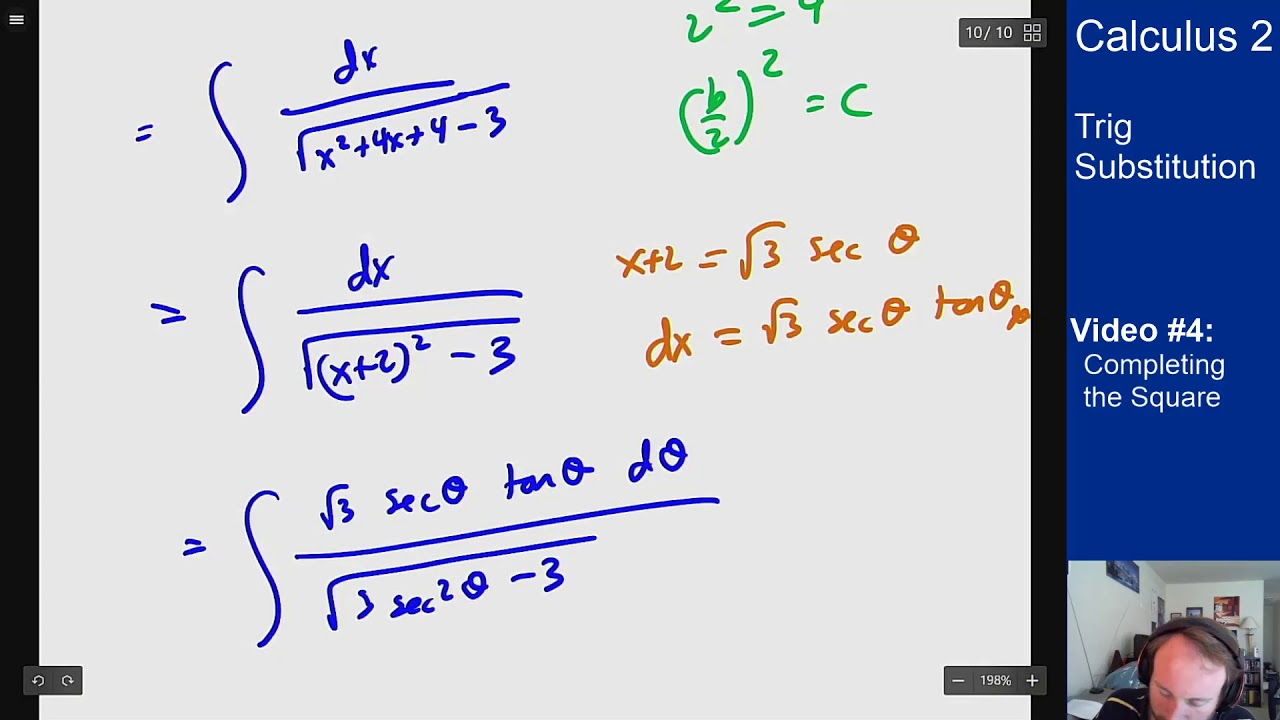
Video #4 on the method of Trigonometric Substitution, showing how completing the square can also be used to help solve these problems, converting a quadratic polynomial into one that can be used for trigonometric substitution.
Full Playlist of Calculus 2 Videos: https://www.youtube.com/playlist?list=PLbKymuaXja98kMr9eknYG23-dgnRaelR1
This was...
mighve found it
 charred trail
quick hound
like the other functions
charred trail
quick hound
like the other functions
isnt it x = t + 4
quick hound
no
charred trail
no like because when completing the square you get something (x-4)^2 or whatever, so let t = x-4, i.e. x = t+4
unless im getting confused
heady lava
heady lava
might be stupid, what if
(x-4) sqrt(4(x-4)^2-1) + 4 sqrt(4(x-4)^2-1)
the integral calculator agrees with this
although it tends to use stupid methods sometimes
the antiderivative is a heck of an expression btw
proven sluice
charred trail
no like because when completing the square you get something (x-4)^2 or whatever...
But again by parts right
quick hound
look at this guy

hemade the complete the square
by making the inside of the square
into smth else
heady lava
yeah but in this case it's very hard to find a good substitution
charred trail
proven sluice
But again by parts right
but isnt the question asking what substitution to make
quick hound
what trig substitution
heady lava
judging from the integral calculator result, it would be absolutely insane if there was a trig sub for this
charred trail
if the integral does come to the form of some sqrt(8u^2+2) or whatever it is, probs best to use the fact that sec^2(x) = tan^2(x) + 1
quick hound
GOT IT

oh
you guys got it too
nice 😄
ok thank god for that yt vid
that was hard to wrap around
proven sluice
quick hound
Ok maybe I got it
heady lava
I keep forgetting you can just add random constants to the trig sub lol
proven sluice
Ok nice lol
quick hound
ok trying the next one
ok so this one i use sin

i think
use 1-sin^2(x)
ok nice got it
thanks for the help guys
how do i integrrate tan^2x
nvm i did it
but i got smth wrong somewhere else
.close
trim joltBOT
Channel closed
Closed by @quick hound
Use .reopen if this was a mistake.
trim joltBOT
Available help channel!
Send your question here to claim the channel.
Remember:
• Ask your math question in a clear, concise manner.
• Show your work, and if possible, explain where you are stuck.
• After 15 minutes, feel free to ping <@&286206848099549185>.
• Type the command .close to free the channel when you're done.
• Be polite and have a nice day!
Read #❓how-to-get-help for further information on how to ask a good question, and about conduct in the question channels.
 viscid pagoda
Como eu posso práticar mais matemática, tipo eu assisto uma aula sobre frações, e depois de um tempo eu vejo que frações é muito mais aprofundado do que aquilo que eu pensava, o que eu faço?
Experiência? Tentativa e erro? Eu vim aqui para poder perguntar para vocês que obviamente estão a milhares de kilometros a minha frente, por favor alguem poderia me ajudar nisso?
trim joltBOT
viscid pagoda
Como eu posso práticar mais matemática, tipo eu assisto uma aula sobre frações, ...
 worthy eagle
translate it for us
 fathom gull
How can I practice more math, like I watch a class on fractions, and after a while I see that fractions are much more in-depth than what I thought, what do I do?
Experience? Trial and error? I came here so I could ask you who are obviously thousands of kilometers ahead of me, could someone please help me with this?
google translate
worthy eagle
maybe if you can show an example I'd be appreciate it
viscid pagoda
Sorry, I understand English, I just asked the question on the wrong server
worthy eagle
no worries
viscid pagoda
what can I do?
worthy eagle
viscid pagoda
what can I do?
do you have a question that you don't get
that's what I asked
I dont usually get "like I watch a class on fractions, and after a while I see that...depth than what I thought"
viscid pagoda
Relax, I managed to think of something here, thank you very much
trim joltBOT
@viscid pagoda Has your question been resolved?
trim joltBOT
Channel closed
Closed due to timeout
Use .reopen if this was a mistake.
trim joltBOT
Available help channel!
Send your question here to claim the channel.
Remember:
• Ask your math question in a clear, concise manner.
• Show your work, and if possible, explain where you are stuck.
• After 15 minutes, feel free to ping <@&286206848099549185>.
• Type the command .close to free the channel when you're done.
• Be polite and have a nice day!
Read #❓how-to-get-help for further information on how to ask a good question, and about conduct in the question channels.
 blazing socket
I have this example problem that my instructor didn't get to finish in class, could someone explain where the csc comes from in the second to last step?
 trim joltBOT
blazing socket
I have this example problem that my instructor didn't get to finish in class, co...
trim joltBOT
blazing socket
I have this example problem that my instructor didn't get to finish in class, co...
 fierce bay
 vagrant marsh
in line 5 you also need to divide the tan to the 1
oh
i see, this is a poorly written solution
blazing socket
yea my instructor was running low on time and tried to get it done as quickly as possible 😭
vagrant marsh
sec/tan simplifies to csc
when multiplying sec/tan with tan^2, you get sec*tan, and multiplying sec/tan with 1, you still get sec/tan which you can simplify
trim joltBOT
Channel closed
Closed by @blazing socket
Use .reopen if this was a mistake.
vagrant marsh
yw
blazing socket
.reopen
trim joltBOT
✅
blazing socket
i'm now attempting to finish the problem myself and i have no idea how to get back to x terms from here 🗿

do i need to get all of these trig functions into the form of tan theta to convert it back?
 craggy sage
u can make a right angle triangle in which one angle is theta and side oppo to it is x and adjacent to it is 1 and hypotenuse is root(1+x2) and then write the ratios
 knotty locust
Yes when you did the sub x=tan(theta) remember what that tells you
Using SOHCAHTOA to form the triangle
blazing socket
.close
trim joltBOT
Channel closed
Closed by @blazing socket
Use .reopen if this was a mistake.
blazing socket
i've got another problem now, and i'm not sure how to choose which trig function to use
 trim joltBOT
Available help channel!
trim joltBOT
Available help channel!
Send your question here to claim the channel.
Remember:
• Ask your math question in a clear, concise manner.
• Show your work, and if possible, explain where you are stuck.
• After 15 minutes, feel free to ping <@&286206848099549185>.
• Type the command .close to free the channel when you're done.
• Be polite and have a nice day!
Read #❓how-to-get-help for further information on how to ask a good question, and about conduct in the question channels.
 full dock
No idea how to integrate this thing
 trim joltBOT
full dock
No idea how to integrate this thing
trim joltBOT
full dock
No idea how to integrate this thing
 frozen plover
right path
Do a + 1 - 1 in the numerator
split the fraction
x^2 + 1 and x^2 - 1
then divide both fractions numerators and deniminators by x^2 and complete the square appropriately
full dock
Okay I’ll try that
 frozen plover
haha
 trim joltBOT
@full dock Has your question been resolved?
trim joltBOT
Channel closed
Closed due to timeout
Use .reopen if this was a mistake.
Available help channel!
Send your question here to claim the channel.
Remember:
• Ask your math question in a clear, concise manner.
• Show your work, and if possible, explain where you are stuck.
• After 15 minutes, feel free to ping <@&286206848099549185>.
• Type the command .close to free the channel when you're done.
• Be polite and have a nice day!
Read #❓how-to-get-help for further information on how to ask a good question, and about conduct in the question channels.
 tribal fractal
for this question, the derivative does not exist at x = 0

 vagrant prism
tribal fractal
is that enough to say why the formula doesnt work?
vagrant prism
tribal fractal
is that enough to say why the formula doesnt work?
yes
trim joltBOT
Channel closed
Closed by @tribal fractal
Use .reopen if this was a mistake.
trim joltBOT
Available help channel!
Send your question here to claim the channel.
Remember:
• Ask your math question in a clear, concise manner.
• Show your work, and if possible, explain where you are stuck.
• After 15 minutes, feel free to ping <@&286206848099549185>.
• Type the command .close to free the channel when you're done.
• Be polite and have a nice day!
Read #❓how-to-get-help for further information on how to ask a good question, and about conduct in the question channels.
 marble vault
How would I find the percentage of the triangle that doesn't contain the circle
 trim joltBOT
marble vault
How would I find the percentage of the triangle that doesn't contain the circle
sly pewter
trim joltBOT
marble vault
How would I find the percentage of the triangle that doesn't contain the circle
sly pewter
Where are you at right now
marble vault
My house
sly pewter
Like where are you at in the problem lol
marble vault
Lol i was gonna find the area of the circle and then after that find the heighrt of the triangle so i can find the area of it and then subtract the area of the circle from the triangle and get a percent
But im not sure how to fully find the area of this circle
Im in 9th grade btw so this is prob like a stupid easy question for u lol
sly pewter
There must be some geometry rule about circles being inside a triangle
I did geometry in 8th grade and it went by so fast 😭 let me see
marble vault
Damn thats impressive bro nice work
sly pewter
Not impressive if you can’t maintain
 placid juniper
radius = 2 x area of triangle / perimeter of triangle
sly pewter
Real formula
marble vault
how do i find the area of the triangle though
i dont have a height
can i juse use herons?
sly pewter
placid juniper
radius = 2 x area of triangle / perimeter of triangle
What is the name of the theorem
placid juniper
idk i made it up
marble vault
🔥🔥🔥
placid juniper
marble vault
can i juse use herons?
💀
no too complicated
did u get that off chat gbt
 placid juniper

Learn how to find the area of a circle inside of an isosceles triangle by using the tangent to a circle theorem, two-tangent theorem, and the pythagorean theorem. Step-by-step tutorial by PreMath.com
trim joltBOT
@marble vault Has your question been resolved?
Channel closed
Closed by @marble vault
Use .reopen if this was a mistake.
marble vault
.reopen
trim joltBOT
✅
marble vault
@sly pewter how do i use two tangent if it isnt a right isoceles
im a little confused
and @placid juniper in the vid i sent u the way he does it isnt possible without right isoceles
also i had to redraw the triangle got new area as 22.27
 trim joltBOT
@marble vault Has your question been resolved?
Channel closed
Closed by @marble vault
Use .reopen if this was a mistake.
Available help channel!
Send your question here to claim the channel.
Remember:
• Ask your math question in a clear, concise manner.
• Show your work, and if possible, explain where you are stuck.
• After 15 minutes, feel free to ping <@&286206848099549185>.
• Type the command .close to free the channel when you're done.
• Be polite and have a nice day!
Read #❓how-to-get-help for further information on how to ask a good question, and about conduct in the question channels.
 distant bay
HELPERS IN 31
distant bay
HELP
worthy eagle
!1c
trim joltBOT
Channel closed
Closed due to timeout
Use .reopen if this was a mistake.
trim joltBOT
Available help channel!
Send your question here to claim the channel.
Remember:
• Ask your math question in a clear, concise manner.
• Show your work, and if possible, explain where you are stuck.
• After 15 minutes, feel free to ping <@&286206848099549185>.
• Type the command .close to free the channel when you're done.
• Be polite and have a nice day!
Read #❓how-to-get-help for further information on how to ask a good question, and about conduct in the question channels.
 rain light
Can someone help me with this?
 trim joltBOT
rain light
Can someone help me with this?
trim joltBOT
rain light
Can someone help me with this?
 gaunt wave
So the sides are going to be equal
for the upper one, the hypotenuses are going to be equal
and the other sides are going to be equal assuming they are the respective sides
@rain light
rain light
Yeah
gaunt wave
Does what is above make sense?
trim joltBOT
@rain light Has your question been resolved?
Channel closed
Closed by @rain light
Use .reopen if this was a mistake.
Available help channel!
Send your question here to claim the channel.
Remember:
• Ask your math question in a clear, concise manner.
• Show your work, and if possible, explain where you are stuck.
• After 15 minutes, feel free to ping <@&286206848099549185>.
• Type the command .close to free the channel when you're done.
• Be polite and have a nice day!
Read #❓how-to-get-help for further information on how to ask a good question, and about conduct in the question channels.
distant bay
help
trim joltBOT
distant bay
help
distant bay

 burnt mulch
Where’s the question

 distant bay
burnt mulch
~~Where’s the question~~
distant bay
burnt mulch
~~Where’s the question~~
HElp
 candid roost
what do you need help with?
distant bay
This question
candid roost
The last one you posted, the image.
distant bay
Yes
candid roost
okay give me a sec to figure it out.
I think you just find the area of a rectangle then subtract the area of a triangle.
What do you think?
candid roost
Find the area of the rectangle first then subtract the triangle.
distant bay
I got it wrong
candid roost
Give me a sec to run a calculation on it.
 split chasm
show your work
candid roost
Okay so the rectangle's area is A=l*w
A=9*12=108
Can you now figure out the triangle and then subtract the two.
You can look at the image to get the base and height of the triangle.
The base is 6 and height is 5
Area of triangle is A=0.565=15
Thus the total area is rectangle - triangle
You should get 93 as the area so see if you can match my answer.
trim joltBOT
@distant bay Has your question been resolved?
trim joltBOT
Channel closed
Closed due to timeout
Use .reopen if this was a mistake.
trim joltBOT
Available help channel!
Send your question here to claim the channel.
Remember:
• Ask your math question in a clear, concise manner.
• Show your work, and if possible, explain where you are stuck.
• After 15 minutes, feel free to ping <@&286206848099549185>.
• Type the command .close to free the channel when you're done.
• Be polite and have a nice day!
Read #❓how-to-get-help for further information on how to ask a good question, and about conduct in the question channels.
 full flax
 full flax
i can't seem to find online if this is true or not. Can i use sum rule of asymptotic notation to add like this?
 heady swallow
full flax
i can't seem to find online if this is true or not. Can i use sum rule of asympt...
heady swallow
full flax
i can't seem to find online if this is true or not. Can i use sum rule of asympt...
gpt?
full flax
yes idk where else 😭
 left oriole
 tribal jetty
wtf
 frail heron
 understood
trim joltBOT
understood
trim joltBOT
Channel closed
Closed by @full flax
Use .reopen if this was a mistake.
trim joltBOT
Available help channel!
Send your question here to claim the channel.
Remember:
• Ask your math question in a clear, concise manner.
• Show your work, and if possible, explain where you are stuck.
• After 15 minutes, feel free to ping <@&286206848099549185>.
• Type the command .close to free the channel when you're done.
• Be polite and have a nice day!
Read #❓how-to-get-help for further information on how to ask a good question, and about conduct in the question channels.
 pure sluice
how would you solve for x when the denominator and numerator have x in both of them
trim joltBOT
pure sluice
how would you solve for x when the denominator and numerator have x in both of t...

 edgy willow
you can just ignore the bottom
split chasm
can't fully ignore though, still need to ensure that the denominator isn't 0 at the values you found when determining whether a solution is valid.
 gusty heart
but for this problem you can just keep in mind that you have to make sure the denominator isnt 0
pure sluice
so as long as (3x-x^2)^2 doesn't equal 0, it's fine?
gusty heart
yes
trim joltBOT
Channel closed
Closed by @pure sluice
Use .reopen if this was a mistake.
trim joltBOT
Available help channel!
Send your question here to claim the channel.
Remember:
• Ask your math question in a clear, concise manner.
• Show your work, and if possible, explain where you are stuck.
• After 15 minutes, feel free to ping <@&286206848099549185>.
• Type the command .close to free the channel when you're done.
• Be polite and have a nice day!
Read #❓how-to-get-help for further information on how to ask a good question, and about conduct in the question channels.
 quiet turret
 trim joltBOT
quiet turret
solid kilnBOT
trim joltBOT
quiet turret
solid kilnBOT
pixel
 solid kilnBOT
InfinityMango

 young swift
I got there by using (20-x)(20-x)x
 young swift
oh im dumb wow
 young swift
anyway, you should just be able to bring the 125 over to the left
solid kilnBOT
pixel
 young swift
then you can refactor it
quiet turret
wdym by refactor
young swift
get it back into the form (x-a)(x-b)(x-c)
you can use polynomial division
oh wait, it might be easier to use rational roots
trim joltBOT
@quiet turret Has your question been resolved?
quiet turret
young swift
oh wait, it might be easier to use rational roots
whats that
young swift
its one way of finding your first factor

Whether you're preparing for advanced maths study or in the midst of the mayhem, Beyond Maths can help you with tutorial-style posts like this one on how to factorise a cubic.
trim joltBOT
Channel closed
Closed due to timeout
Use .reopen if this was a mistake.
Available help channel!
Send your question here to claim the channel.
Remember:
• Ask your math question in a clear, concise manner.
• Show your work, and if possible, explain where you are stuck.
• After 15 minutes, feel free to ping <@&286206848099549185>.
• Type the command .close to free the channel when you're done.
• Be polite and have a nice day!
Read #❓how-to-get-help for further information on how to ask a good question, and about conduct in the question channels.
 static fern
Can you check this?
 trim joltBOT
static fern
Can you check this?
trim joltBOT
static fern
Can you check this?
 vernal warren
it is correct tho u didnt do any thing wrong and proved
 wind sonnet
you did mess up the signs
split chasm
think a lot of marks were deducted from the laziness of not having theta
static fern
Nope
split chasm
static fern
Nope
as in you don't think that's why you lost marks?
i also don't see this question being worth 10 marks
where does it say how much its worth
static fern
It doesn’t but he said in class
static fern
split chasm
as in you don't think that's why you lost marks?
Yes it isn’t
split chasm
did you ask your teacher why you lost marks?
trim joltBOT
@static fern Has your question been resolved?
Channel closed
Closed by @static fern
Use .reopen if this was a mistake.
Available help channel!
Send your question here to claim the channel.
Remember:
• Ask your math question in a clear, concise manner.
• Show your work, and if possible, explain where you are stuck.
• After 15 minutes, feel free to ping <@&286206848099549185>.
• Type the command .close to free the channel when you're done.
• Be polite and have a nice day!
Read #❓how-to-get-help for further information on how to ask a good question, and about conduct in the question channels.
 dusky tinsel
how to do ' - would u derive accel twice to get dispalcement, howevre i di that and when t = 0, i got -12 (not 1m to the right as said)
trim joltBOT
dusky tinsel
how to do ' - would u derive accel twice to get dispalcement, howevre i di that ...
dusky tinsel
this question
 trim joltBOT
@dusky tinsel Has your question been resolved?
 hallow crane
dusky tinsel
how to do ' - would u derive accel twice to get dispalcement, howevre i di that ...
hallow crane
dusky tinsel
how to do ' - would u derive accel twice to get dispalcement, howevre i di that ...
You wouldn't be deriving, but rather integrating
dusky tinsel
hallow crane
You wouldn't be deriving, but rather integrating
oh yea
dusky tinsel
hallow crane
You wouldn't be deriving, but rather integrating
while i do that, can any1 helpw ith this maybe you kanna

what i tried is setting say, point h on the x acis and b on y
then find area of rectangele (b * H)
it but divided/4 should = the area under the curve from 0 to h
but i stuck when i get bh = h^4 since i cant... prove that
hallow crane
dusky tinsel
while i do that, can any1 helpw ith this maybe you kanna
I mean if you want we can do this
let the length of the rectangle be l and the "width" of the rectangle is f(l)
dusky tinsel
i just thought while i try do the acceleratiion one again maybe you can figure out where i went wrong/how to do ^
hallow crane
dusky tinsel
i just thought while i try do the acceleratiion one again maybe you can figure o...
well we can do the rectangle question at one since u said you were working on this
hallow crane
hallow crane
let the length of the rectangle be l and the "width" of the rectangle is f(l)
what would the area of the rectangle be then?
can you get the area as a function of l?
dusky tinsel
lw
hallow crane
what is w?
dusky tinsel
width and length
dusky tinsel
ah k
 dusky tinsel
hm
area of rectangle is length * width, so whys w = f(l), since the function doesnt even have a 'l' value so its not rly a function i dont think, confused there
hallow crane
area = length * width and you can do nothing about it if you're doing single variable calculus
you want area as a function in a single variable

Anyway, look at the red point
if x = l then the y coordinate is necessarily l^3 lol
dusky tinsel
oh didnt know that
is that cuz x^3
and how that works
im sorry i have to go eat dinner right now so wont respond just wanted to let you know
hallow crane
dusky tinsel
and how that works
i mean if you want to find the corresponding y value (on the curve) for a given x then that's exactly what you'd do ig
I.e. x = 2 would give y = (2)^3 = 8 and this point lies on the curve y = x^3
hallow crane
dusky tinsel
im sorry i have to go eat dinner right now so wont respond just wanted to let yo...

dusky tinsel
hallow crane
I.e. x = 2 would give y = (2)^3 = 8 and this point lies on the curve y = x^3
oh ye that totally makes sense, just flew past my mind thx
hallow crane
dusky tinsel
oh ye that totally makes sense, just flew past my mind thx
okay so what's the area in terms of l?
hallow crane
dusky tinsel
l^4
nice
now try to integrate the function to get the area under the curve
so integrate the function from 0 to l and then yeah you should immediately have your "proof"
dusky tinsel
ye nice thx
hallow crane
dusky tinsel
this question
Now for this, you first integrate a(t) dt to get the velocity function + some constant
You're supposed to figure out the value of that constant by using the fact that it was "initially at rest"
Then you integrate v(t) to get x(t) + some constant again
which you can determine with the "1m to the right at the start"
dusky tinsel
hallow crane
which you can determine with the "1m to the right at the start"
yep i got 3t^2 -2(t+1)^4/12 + 2/3t + 7 = s
works for t = 0 to give 1
at t = 2 its displacement is 41/6
hallow crane
dusky tinsel
works for t = 0 to give 1
Hmm what? That's not what your check should be
dusky tinsel
hmm
hallow crane
You're supposed to make it work for t = 0 by finding the appropriate constant
dusky tinsel
dusky tinsel
yep i got 3t^2 -2(t+1)^4/12 + 2/3t + 7 = s
like thats the eqaution i integrated for displacement
or am i... delusional and wrong again
hallow crane
did you have $v(t) = 6t - \frac{2}{t+1} + C_1$
dusky tinsel
uhh
solid kilnBOT
kanna
 hallow crane
dusky tinsel
uhh
hallow crane
dusky tinsel
uhh
no?
dusky tinsel
hallow crane
no?
sorry long reply
did you... derive the t+1^2 shouldt it add a power
hallow crane
no it looks like you're deriving the second term
dusky tinsel
wait, i thought u.. add a power in integration
hallow crane
,, \int x^n \text{ dx} = \frac{x^{n+1}}{n+1} + C
solid kilnBOT
kanna
 hallow crane
for n != -1
hallow crane
yeah and (t+1)^-2 should have a -1 after the addition of exponent lol
dusky tinsel
k i got 3t^2 - 2ln(t+1) + 2t + 1 = s
hallow crane
dusky tinsel
k i got 3t^2 - 2ln(t+1) + 2t + 1 = s
okay but what did you have for C_1?
hallow crane
solid kiln
**kanna**
here
dusky tinsel
hallow crane
here
2 = c1
hallow crane
Looks good
dusky tinsel
hallow crane
Looks good
so i can make t = 2 for the dispalcement equaiton
but that gives displacement
how would i find the coords of particle b
hallow crane
,w integrate 6x - 2/(x+1) + 2
solid kilnBOT


 Requested by kannaaaaaaaaaaaaaaaaaaaaaaa
hallow crane
Requested by kannaaaaaaaaaaaaaaaaaaaaaaa
hallow crane
,w -1 + 2 x + 3 x^2 - 2 log(1 + x) + c = 1 when x = 0
solid kilnBOT
 Requested by kannaaaaaaaaaaaaaaaaaaaaaaa
hallow crane
Requested by kannaaaaaaaaaaaaaaaaaaaaaaa
hallow crane
Sure your s(t) is correct
hallow crane
dusky tinsel
so i can make t = 2 for the dispalcement equaiton
yeah you'd plug t = 2
hallow crane
+1 is correct
dusky tinsel
k
hallow crane
c = 2 so -1 + 2 = 1
dusky tinsel
hallow crane
yeah you'd plug t = 2
so is the answer just s(2)
or do you need cords of the particle - which idk how to get
hallow crane
I mean that's where the collision presumably occurs lol
well for those particles to collide, they have to be at the same place
disregarding the dimensions of the "particle" itself
dusky tinsel
yep
dusky tinsel
hallow crane
disregarding the dimensions of the "particle" itself
just that we know dispalcement = 17 -2ln(3) = s(2) but question asks where, so idk if we need coords on a plane as in (x, y)

or are you saying no then to that
hallow crane
dusky tinsel
just that we know dispalcement = 17 -2ln(3) = s(2) but question asks where, so i...
It's like a 1dimensional problem
dusky tinsel
ah lol
hallow crane
x = 1 when t = 0
dusky tinsel
so basicly dont include physics into it knowing what disaplcement actually is
dusky tinsel
hmm
dusky tinsel
hence anwer is just how far away from origin (in a straight line ofc) the particles collide
just when i see colliding particles i imagine a certgain point where they coolide, not a dispalcement from origin
hallow crane
Yeah, that's what you'd be dealing with in 1 dimensional physics problems too
It's either along a vertical straight line or a horizontal straight line
dusky tinsel
k ty
trim joltBOT
Channel closed
Closed by @dusky tinsel
Use .reopen if this was a mistake.
trim joltBOT
Available help channel!
Send your question here to claim the channel.
Remember:
• Ask your math question in a clear, concise manner.
• Show your work, and if possible, explain where you are stuck.
• After 15 minutes, feel free to ping <@&286206848099549185>.
• Type the command .close to free the channel when you're done.
• Be polite and have a nice day!
Read #❓how-to-get-help for further information on how to ask a good question, and about conduct in the question channels.
 quiet wasp
hey quick question
quiet wasp
sorry
 wraith hinge
say?

 radiant quartz
@quiet wasp which part(s) are you stuck on
quiet wasp
c and d
radiant quartz
okay we'll start with (c)
quiet wasp
thx
radiant quartz
it tells us the range of h is the same as the range of g
so you should be able to immediately write down γ and δ
quiet wasp
so 0 and sqrt(3/2) ?
radiant quartz
you can work out which value of x does h(x)=0
and which value of x does h(x)=√(3/2)
quiet wasp
-pi/6 +2kpi?
radiant quartz
yes but you need only one value
because we dont want every interval that maps it, but only one, because its bijective hence injective
quiet wasp
yeah
radiant quartz
So the domain of h better contain 0
quiet wasp
so alpha = 0?
radiant quartz
nuh uh
quiet wasp
oh damm
radiant quartz
quiet wasp
-pi/6 +2kpi?
does 0 = any of these?
proven sluice
[-π/6,π/2]
radiant quartz
Chill aditi im getting there
proven sluice
aight
quiet wasp
ohhhh rightt
radiant quartz
and by a similar process you can pick β
quiet wasp
so beta = pi/2
radiant quartz
correct
proven sluice
If that's the case then beta diff ryt?
radiant quartz
and we r done with (c)
quiet wasp
thanks so much appreciiate it fr
radiant quartz
on to (d)?
proven sluice
root3/2 is for π/3?
radiant quartz
Or u get it now
quiet wasp
radiant quartz
on to (d)?
yes sirr
radiant quartz
proven sluice
root3/2 is for π/3?
you're getting confused. h(π/2) = rt(3/2). Youre thinking of sin(π/3) = rt(3)/2
Note the change in parenthesis
and the different functions
proven sluice
Oh alrightt mb thanks
radiant quartz
quiet wasp
yes sirr
okay so h is bijective which makes finding h^-1 s domain and codomain a lot easier
theyre just going to be the opposite to h
quiet wasp
but how do we know where to restrict the domain to?
radiant quartz
the domain for h^-1 will be the codomain of h
and we already worked out the codomain of h
quiet wasp
[0. sqrt(3/2) is new domain?
quiet wasp
and the new range is [-pi/6, 7pi/6]
quiet wasp
yeah sorry
ok that makes sense, but how would i explain part c
mathematically and backed up with reason
are u able to write it out and send, if not its fine
radiant quartz
we already talked through it
quiet wasp
sorry to sound annoying but r we able to clarify c one more time?
quiet wasp
thx
cause i get confused with bijective surjective and injective and what it all allows us to do
radiant quartz
the range of h is the range of g
so the range of h is [0, rt(3/2)]
h is bijective so it is surjective
h is surjective so its range is its entire codomain
so its codomain is [0, rt(3/2)]
quiet wasp
ohhh this makes total sense now
how can we now relate this to find alpha, beta, gamma, delta?
radiant quartz
each of the intervals that make up g's domain individually map the entire range twice
h is bijective so it is injective
h is injective so each value should only get mapped to once
each value gets mapped to once so h's domain contains only one half of one of the intervals from g's domain
h(0) exists so 0 is inside h's domain
only one of the halves of the intervals from dom(g) contains 0
this interval is [-π/6, 7π/6]
the relevant half of the interval is [-π/6, π/2] because it contains 0
this is the domain of h
so now we have α, β, γ, δ
quiet wasp
it makes sense but to clarify, what does this mean "ach value gets mapped to once so h's domain contains only one half of one of the intervals from g's domain"
like the half of one interval part
radiant quartz
okay so if you see how g maps each interval
at the lower end of the interval g is at a minimum
then g increases towards a maximum
and symmetrically decreases back to a minimum at the end of the interval
quiet wasp
right yeah
radiant quartz
so each value that g maps to, gets mapped twice by each interval
once in the lower half and once in the upper half
radiant quartz
yep
quiet wasp
so the domain of h = [-pi/6, pi/2] ?
radiant quartz
yep
quiet wasp
so that means alpha and beta = -pi/6 and pi/2 respectively
and, gamma and delta = h(-pi/6) and h(pi/2) respectively?
radiant quartz
yep
quiet wasp
so does gamma = 1/sqrt(2) and delta = sqrt(3/2)
radiant quartz
well gamma = 0 but delta yes
quiet wasp
oh how come gamma wrong?
solid kilnBOT
Result:
7.4505805969238e-9
i thought it was sqrt(1/2)
radiant quartz
well you can just plug it in and find out its not
radiant quartz
i did tell you so
radiant quartz
radiant quartz
you just evaluated h wrong
🤷♀️
quiet wasp
hahahahah fair enough thanks very much
u literally saved me
this topic was garbage, now its less garbage
alr cya thanks alot appreciate the help!
quiet wasp
bye!
trim joltBOT
@quiet wasp Has your question been resolved?
trim joltBOT
Channel closed
Closed due to timeout
Use .reopen if this was a mistake.
Available help channel!
Send your question here to claim the channel.
Remember:
• Ask your math question in a clear, concise manner.
• Show your work, and if possible, explain where you are stuck.
• After 15 minutes, feel free to ping <@&286206848099549185>.
• Type the command .close to free the channel when you're done.
• Be polite and have a nice day!
Read #❓how-to-get-help for further information on how to ask a good question, and about conduct in the question channels.
 crimson void
least value of n such that 25^n + 16^n leaves a remainder of 1 upon being divided by 121
trim joltBOT
crimson void
least value of n such that 25^n + 16^n leaves a remainder of 1 upon being divide...
fathom gull
!status
trim joltBOT
What step are you on?
1. I don't know where to begin.
2. I have begun but got stuck midway.
3. I got an answer but I was told that it's wrong.
4. I got an answer and would like my work checked.
5. I have a question about someone else's work/solution.
6. I have completed the problem and don't need help anymore. Thank you.
7. None of the above
2
i tried putting n = 3k+1,3k+2,3k and taking mod 121
but couldnt continue from there
the reason for taking n = 3k,3k+1,3k+2 was that 5^3 and 16^3 ,both leave remainder 4 upon being divided by 121
i thought maybe that could lead somewhere
trim joltBOT
@crimson void Has your question been resolved?
 void anchor
trim joltBOT
void anchor
trim joltBOT
@crimson void Has your question been resolved?
crimson void
<@&286206848099549185>
trim joltBOT
@crimson void Has your question been resolved?
trim joltBOT
Channel closed
Closed due to timeout
Use .reopen if this was a mistake.
Available help channel!
Send your question here to claim the channel.
Remember:
• Ask your math question in a clear, concise manner.
• Show your work, and if possible, explain where you are stuck.
• After 15 minutes, feel free to ping <@&286206848099549185>.
• Type the command .close to free the channel when you're done.
• Be polite and have a nice day!
Read #❓how-to-get-help for further information on how to ask a good question, and about conduct in the question channels.
 river yoke
 trim joltBOT
river yoke
river yoke
trim joltBOT
river yoke
river yoke
Where is 1 represented here?
Shouldn't the beginning of the series begin with 1 and k? But the beginning of the sequence they wrong begins with k(k-1).
trim joltBOT
@river yoke Has your question been resolved?
trim joltBOT
@river yoke Has your question been resolved?
trim joltBOT
@river yoke Has your question been resolved?
trim joltBOT
Channel closed
Closed by @river yoke
Use .reopen if this was a mistake.
Available help channel!
Send your question here to claim the channel.
Remember:
• Ask your math question in a clear, concise manner.
• Show your work, and if possible, explain where you are stuck.
• After 15 minutes, feel free to ping <@&286206848099549185>.
• Type the command .close to free the channel when you're done.
• Be polite and have a nice day!
Read #❓how-to-get-help for further information on how to ask a good question, and about conduct in the question channels.
 proven palm
I'd like to know how this is not a counterexample to the inverse function theorem: let f(x) = x^2, let a = 0. Then f' is invertible and continuous everywhere, but f is not invertible in any neighborhood of a.
trim joltBOT
proven palm
I'd like to know how this is not a counterexample to the inverse function theore...
 naive crest
you forgot that the derivative being non zero at a is a condition
proven palm
huh it doesn't say that in my textbook
wait unless being a C'-mapping implies nonvanishing derivative...
 trail ingot
send pic of statement in book
proven palm

being a C' mapping is just continuous differentiability so the condition is not implied from there...
marble wharf
f'(a)=0 is not invertible
proven palm
so the texbook just has an error then?
proven palm
oh wait
but why would that imply non-invertibility? In my example f'(x) = 2x which should be invertible everywhere by the inverse function g(x) = (1/2)x ... ?
Or am I totally misunderstanding inverses here...?
wait....ohh
OHHH
i see now 
because f'(x) is the linear transformation, not just a value
thanks so much!
.close
trim joltBOT
Channel closed
Closed by @proven palm
Use .reopen if this was a mistake.
Available help channel!
Send your question here to claim the channel.
Remember:
• Ask your math question in a clear, concise manner.
• Show your work, and if possible, explain where you are stuck.
• After 15 minutes, feel free to ping <@&286206848099549185>.
• Type the command .close to free the channel when you're done.
• Be polite and have a nice day!
Read #❓how-to-get-help for further information on how to ask a good question, and about conduct in the question channels.
 languid coyote
Hi! Wanted to confirm some intuition regarding linear maps, null-spaces, and matrix representations.
trim joltBOT
languid coyote
Hi! Wanted to confirm some intuition regarding linear maps, null-spaces, and mat...
languid coyote
From Axler, we know that:

- Let $\dim \text{null} : T = k < n$. If this is the case, $\exists$ a matrix representation where $k$ of the columns have all $0$, is that correct?
- For any matrix representation of $T$ however, this is not necessarily true, but with some matrix manipulation, we should be able to get to the matrix representation where $k$ columns have all $0$, is that correct?
- Could you help demonstrate how to go from the matrix representation using the standard basis, to the matrix representation with a column of $0$s for the following linear map: $Te_1 = e_1 + e_2$, $Te_2 = e_1 + e_2$?
Just those three question, in order from top to bottom!


 languid coyote
yes, sorry just using Axler notation
 neon dirge
kk np
yes first is correct
bc you can bring it into Rref form via Gauß algorithm
for columns and get k zero-columns
@languid coyote 2nd is true as well, slightly oddly worded but yes
languid coyote
okay, i guess what im failing to connect then is
seeing it in action
so wanted to see if you could walk through one with me
neon dirge
sure
solid kilnBOT
txptr
 neon dirge
ok so we have the following matrix:

now via Gauß-Algorithm, we can subtract rows and columns from each other
if we subtract the first column from the second we receive

which gives us the form with a 0-column
languid coyote
oh wait hmmm
i thought gaussian elimination you can only use rows
also, in this case, how have the basis vectors changed
for both $V$ and $W$
solid kilnBOT
txptr
 neon dirge
languid coyote
i thought gaussian elimination you can only use rows
neon dirge
languid coyote
i thought gaussian elimination you can only use rows
oh in case you didn't have that yet, you can transpose a matrix, which preserves its core properties, but changes the way everything is arranged
which also allows you to perform manipulations both on rows and columns
languid coyote
ah i see hmmm i think transpose comes much later in the axler book
languid coyote
so im just tryna understand in terms of whatever basic properties have been explained so far
neon dirge
before our basis was (e1, e2) right
languid coyote
yep
neon dirge
for V
and now after the column manipulation
notice that we subtracted the first from the second
languid coyote
mhm
neon dirge
so now our basis is (e1, e2-e1)
which makes it so convenient to have done it column-wise
bc now we can simply subtract/add the basis vectors too
neon dirge
you can perform this manipulation as you like!
languid coyote
so that's why that column is 0
neon dirge
definitely experiment a little with manipulating a matrix
languid coyote
so i guess the basis is (e2-e1, e2)
languid coyote
neon dirge
in case you have some visualisation tool
do you have a recommendation for this?
neon dirge
hm maybe something like Desmos for starting
languid coyote
neon dirge
definitely experiment a little with manipulating a matrix
ye for sure; ive taken linear algebra before computationally, but im self-studying axler now to really understand it inside and out from the ground up
so i wanted to make sure i really understand why everything is true and then connect it to all the computations
so i can have a strong intuition
okay this was super helpful, apologies if it was too simple of a question haha
thank you!
neon dirge
nono, the essence of linear algebra and analysis are crucial
and some glance over them leading to uncertainties later on
languid coyote
for sure...haha
neon dirge
there's also a few neat channels such as 3Blue1Brown which elegantly visualise quite a bit
languid coyote
oh yeah i've watched some of his linear algebra stuff, pretty helpful
i guess while we're at it one more quick question
so for any linear transformation, we know that there exists a matrix representation
neon dirge
ys
languid coyote
in particular, one where we map the basis vectors of V to the basis vectors of W
*to some linear combination of basis vectors of W
so it is fair to say that
if dim ker T and dim range T are k, n-k
then there should exist a matrix representation where
i have n-k non-zero columns and k zero columns?
neon dirge
languid coyote
i have n-k non-zero columns and k zero columns?
and?
languid coyote
yes
neon dirge
hm 2nd yes, currently thinking about first
languid coyote
like let's say the dimension of V is n, dim ker T is k, dim range T is n-k