Channel closed
Closed by @frail portal
Use .reopen if this was a mistake.
1 messages · Page 81 of 1
 trim joltBOT
Closed by @frail portal
Use .reopen if this was a mistake.
 Available help channel!
Send your question here to claim the channel.
Remember:
• Ask your math question in a clear, concise manner.
• Show your work, and if possible, explain where you are stuck.
• After 15 minutes, feel free to ping <@&286206848099549185>.
• Type the command .close to free the channel when you're done.
• Be polite and have a nice day!
Read #❓how-to-get-help for further information on how to ask a good question, and about conduct in the question channels.
 crisp flicker
Why did they parametrize using x=f(y), x=f(t) so y=t instead of y=f(x), y=f(t) so x=t?
 trim joltBOT
crisp flicker
Why did they parametrize using x=f(y), x=f(t) so y=t instead of y=f(x), y=f(t) s...
trim joltBOT
crisp flicker
Why did they parametrize using x=f(y), x=f(t) so y=t instead of y=f(x), y=f(t) s...
 nimble stone
i mean, they could do that
but theyre just asking you to check which one is valid
find 'a' parametrization, there are a number of ways it can be done
crisp flicker
oh
I see
the way y=f(x), y=f(t), so x=t feels more natural
so I just found it a little weird
but thanks for clarifying
trim joltBOT
@crisp flicker Has your question been resolved?
Closed by @crisp flicker
Use .reopen if this was a mistake.
Available help channel!
Send your question here to claim the channel.
Remember:
• Ask your math question in a clear, concise manner.
• Show your work, and if possible, explain where you are stuck.
• After 15 minutes, feel free to ping <@&286206848099549185>.
• Type the command .close to free the channel when you're done.
• Be polite and have a nice day!
Read #❓how-to-get-help for further information on how to ask a good question, and about conduct in the question channels.
 wraith hinge
 trim joltBOT
wraith hinge
trim joltBOT
wraith hinge
 raw magnet
wraith hinge
Need help relating it to first principle
raw magnet
wraith hinge
Need help relating it to first principle
give me the definition of a derivative
 wooden oriole
Think of the h as the change in x
and, as that change in x approaches closer and closer to 0, what do you think happens to the function? What does it approach?
 austere cedar
So given that solution, which part doesn't make sense?
Can you state the definition of the derivative?
wraith hinge
raw magnet
give me the definition of a derivative
Derivative at some point c on f(x) is limit of f(x) as x approaches c?
Ik what derivatives are because I learnt it in physics but I don’t have the rigour with mathematical statements
In physics it would be rate of change of f(x) at c wrt x
wooden oriole
wraith hinge
Ik what derivatives are because I learnt it in physics but I don’t have the rigo...
Do you know what a secant line and a tangent line is?
raw magnet
wraith hinge
Derivative at some point c on f(x) is limit of f(x) as x approaches c?
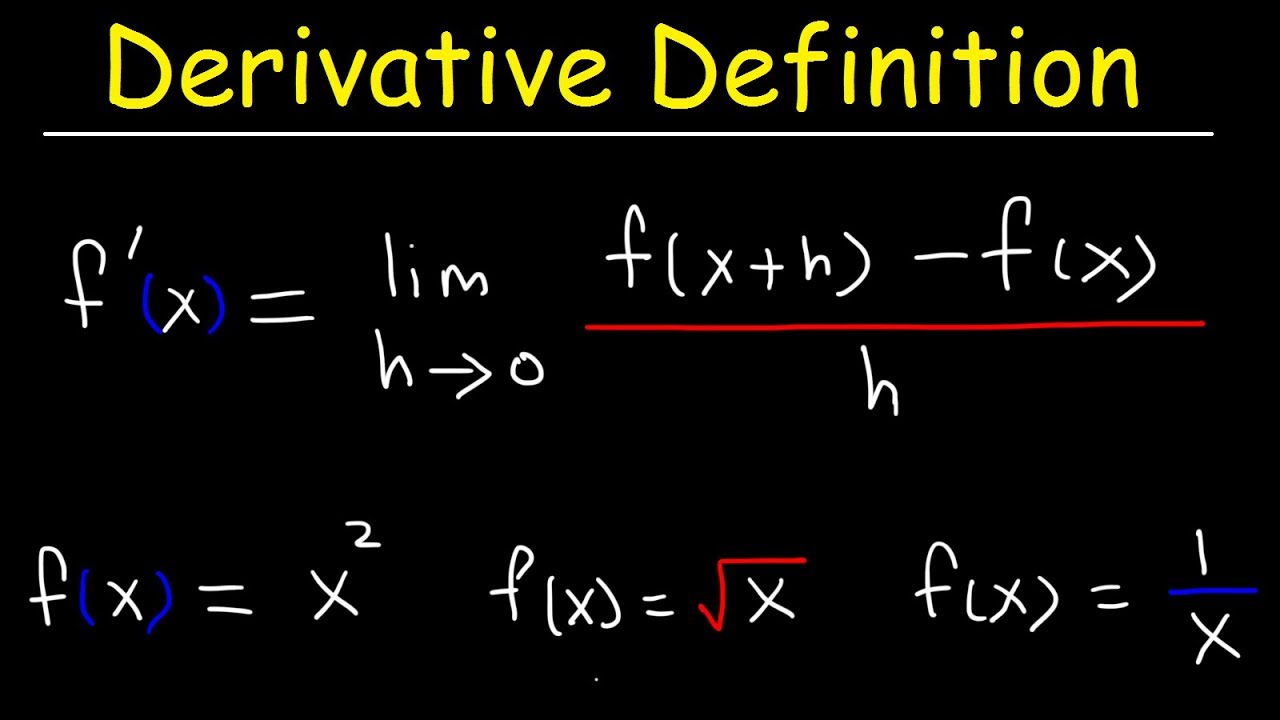
This calculus video tutorial provides a basic introduction into the definition of the derivative formula in the form of a difference quotient with limits. It explains how to find the derivative of a function using the limit process. This video contains plenty of examples and practice problems.
Derivatives - Fast Review:
https://ww...
wraith hinge
wooden oriole
Do you know what a secant line and a tangent line is?
Yes
wooden oriole
raw magnet
<@456226577798135808> Please watch the vidoe
i think he's looking for a conceptual point of view, not a solving point of view
This video from Khan Academy does a very good job explaining the concept of a derivative.
austere cedar
I think the issue is that they've never seen the definition, much less understand it
 quaint creek
I agree
wraith hinge
austere cedar
I think the issue is that they've never seen the definition, much less understan...
So if it was to be defined in one line, how could I do it?
austere cedar
f'(x) = lim [f(x + h) - f(x)] / h
(limit as h approaches 0)
Now, Azar isn't wrong, the conceptual understanding of why this definition relates to tangent lines is super important
But that's the equation your solution is using
wooden oriole
good
wooden oriole
wraith hinge
I understand
From my personal experience, watching Khan Academy's videos on differentiation helped a ton. They do a great job of explaining WHY. Organic Chemistry Tutor is good for practicing solving a variety of different problems.
trim joltBOT
Closed by @onyx badge
Use .reopen if this was a mistake.
trim joltBOT
Available help channel!
Send your question here to claim the channel.
Remember:
• Ask your math question in a clear, concise manner.
• Show your work, and if possible, explain where you are stuck.
• After 15 minutes, feel free to ping <@&286206848099549185>.
• Type the command .close to free the channel when you're done.
• Be polite and have a nice day!
Read #❓how-to-get-help for further information on how to ask a good question, and about conduct in the question channels.
 lament stone
 trim joltBOT
lament stone
trim joltBOT
lament stone
 hidden dew
ok what trig function can we use here ?
raw magnet
lament stone
do we have to solve for both x and y?
lament stone
yes
lament stone
hidden dew
ok what trig function can we use here ?
honestly idk
i don’t get this concept yet
raw magnet
lament stone
yes
dyk what tan and sin is
raw magnet
lament stone
is that what i use?
mhm I'll leave it to you from here
(come back in 15 if you are still confused)
lament stone
raw magnet
(come back in 15 if you are still confused)
okk
trim joltBOT
@lament stone Has your question been resolved?
lament stone
raw magnet
mhm I'll leave it to you from here
help
i sorta get it but it doesn’t make sense
wooden oriole
lament stone
help
We will start with 30 degrees, what side is opposite of 30 degrees?
lament stone
wooden oriole
We will start with 30 degrees, what side is opposite of 30 degrees?
4√3
lament stone
wooden oriole
now, what side is the x? (hint: it starts with a H)
hypotenuse
lament stone
so sin?
wooden oriole
yes!
lament stone
sin 90?
wooden oriole
not quite, its sin 30
lament stone
ohh
wooden oriole
because the opposite of 30 is that 4 rad 3
wooden oriole
lament stone
ohh
now, what does sin equal? is it opp / hypo or is it hypo / opp
lament stone
wait so opposite/hypotenuse is 4√3 / x?
lament stone
ohh
wooden oriole

we know sinx is equal to opp/hypo
so , sin30 is equal to 4 rad 3 / x
now, its a matter of solving for x
lament stone
so isolate?
wooden oriole
yes
lament stone
wait but i dont rlly get how we got opposite and hypotenuse
wooden oriole
ok
so
sin of some angle is equal to the length of the opposite side divided by the hypotenuse
if we look at the triangle
the opposite side of sin has the length of 4 rad 3
so that's our numerator
our denominator, no matter what, will always be the hypotenuse for sin
the hypotenuse is the longest side of the triangle
so whatever the length of that is, is your hypotenuse
in this case it's x
so its (4 rad 3) / (x)
opposite/hypotenuse
lament stone
wooden oriole
our denominator, no matter what, will always be the hypotenuse for sin
but how do we know its suppose to be sin
what abt tan or cos
wooden oriole
lament stone
but how do we know its suppose to be sin
are you familar with your SOH CAH TOA?
lament stone
yes
wooden oriole
sin is the first thing i saw
if you use cosine, your dealing with the adjacent side and the hypotenuse
and so your dealing with two variables, which is not ideal
lament stone
ohh
wooden oriole
now with tangent, you would be solving for Y
because your using the opposite, which we know is 4 rad 3
and thats over the adjacent
so
 lament stone
does tha tone work too?
wooden oriole
it solves for Y
lament stone
so for this one, it is 7/x as in sin45
 lament stone
wooden oriole
it solves for Y
lament stone
wooden oriole
it solves for Y
ohh
wooden oriole
lament stone
so for this one, it is 7/x as in sin45
yes
so, the takeaway here is use trig functions that you can solve for, you can't use a trig function if there are two different variables
lament stone
ohh ok
wooden oriole
lament stone
ohh ok
need anything else
wooden oriole
it depends, if you think you will need help in <5 minutes, then yea. But if longer, then close it
lament stone
wooden oriole
it depends, if you think you will need help in <5 minutes, then yea. But if lon...
okk
tysm
lament stone
wooden oriole
it depends, if you think you will need help in <5 minutes, then yea. But if lon...
wait i have a question
can u give me an exmaple of when i should use cos?
wooden oriole
lament stone
can u give me an exmaple of when i should use cos?

as you can see, we are given the adjacent side
and we need to find our hypotenuse
cosine involves adjacent and hypotenuse
lament stone
ohh
wooden oriole
so the cos(30) = 3/x
why? cos of some angle equal is equal to the length of the adjacent side (which is 3) over the length of the hypotenuse (which is x)
remember the SOH CAH TOA
That CAH is cosine, adjacent, hypotenuse
@lament stone understand?
trim joltBOT
Closed by @lament stone
Use .reopen if this was a mistake.
trim joltBOT
Available help channel!
Send your question here to claim the channel.
Remember:
• Ask your math question in a clear, concise manner.
• Show your work, and if possible, explain where you are stuck.
• After 15 minutes, feel free to ping <@&286206848099549185>.
• Type the command .close to free the channel when you're done.
• Be polite and have a nice day!
Read #❓how-to-get-help for further information on how to ask a good question, and about conduct in the question channels.
 trail bobcat
Hello, I needed somehelp with making a proof
raw magnet
trail bobcat
Hello, I needed somehelp with making a proof
Hi
raw magnet
trail bobcat
My question is in the help forum
Paste it here
trail bobcat
Okay
Given: Quadrilateral PAST, TX = AX;
||
Prove: Quadrilateral PAST is a parallelogram.
Write your proof in your journal and upload your answer. You will be awarded 5 points for your statements and 5 points for your reasons.
 trim joltBOT
@trail bobcat Has your question been resolved?
trail bobcat
<@&286206848099549185>
trim joltBOT
@trail bobcat Has your question been resolved?
 sterile egret
trail bobcat
Given: Quadrilateral PAST, TX = AX;
||
Prove: Quadrilateral PAST is a parall...
sterile egret
trail bobcat
Given: Quadrilateral PAST, TX = AX;
||
Prove: Quadrilateral PAST is a parall...
TX=AX only this much is given?
trail bobcat
sterile egret
ΔTPX andΔAXS
Yes
trim joltBOT
@trail bobcat Has your question been resolved?
 timid wing
trail bobcat
timid wing
trail bobcat
Properties of parallelogram: opposides parallel, opposides congruent, oppo angles congruent, diagonals bisect each other, consecutive angles are supplementary
To prove it’s a parallelogram: both pairs of oppo sides are parallel, both pairs of opposides congruent, both pairs of oppo angles congruent, one pair parallel and congruent (side), diagonals bis each other
That’s a visual representation of proving its a parallelogram…I can’t help more, it’s late here. Hope it helped!
 trim joltBOT
Closed due to timeout
Use .reopen if this was a mistake.
Available help channel!
Send your question here to claim the channel.
Remember:
• Ask your math question in a clear, concise manner.
• Show your work, and if possible, explain where you are stuck.
• After 15 minutes, feel free to ping <@&286206848099549185>.
• Type the command .close to free the channel when you're done.
• Be polite and have a nice day!
Read #❓how-to-get-help for further information on how to ask a good question, and about conduct in the question channels.
 heady summit
I think my brain is literally breaking at this point from exhaustion, but can someone pls explain to me why the rationals arent an open set?
trim joltBOT
heady summit
I think my brain is literally breaking at this point from exhaustion, but can so...
heady summit
this is our definition for open sets

 bold jay
take a rational point you like
0 for example
now take a neighborhood around it
is everything in the neighborhood rational?
heady summit
but doesn't there just need to be a single neighborhood since its a there exists statement?
ohh wait, are the irrational numbers dense in the real numbers too?
bold jay
yea
heady summit
well thats confusing lol
bold jay
in every neighborhood of 0, there are irrational points
heady summit
so both the rationals and irrationals are dense
right okay that makes sense
thank you
.close
trim joltBOT
Closed by @heady summit
Use .reopen if this was a mistake.
trim joltBOT
Available help channel!
Send your question here to claim the channel.
Remember:
• Ask your math question in a clear, concise manner.
• Show your work, and if possible, explain where you are stuck.
• After 15 minutes, feel free to ping <@&286206848099549185>.
• Type the command .close to free the channel when you're done.
• Be polite and have a nice day!
Read #❓how-to-get-help for further information on how to ask a good question, and about conduct in the question channels.
 prisma moon
Given this power series, what could the corresponding equation be? I'm confused on how the 6th term cld be negative
 trim joltBOT
prisma moon
Given this power series, what could the corresponding equation be? I'm confused ...
prisma moon
trim joltBOT
prisma moon
Given this power series, what could the corresponding equation be? I'm confused ...
prisma moon
I initially thought it wld be (-1)^n * x * n(x)^n
prisma moon
thats the think
i think this an error on the question makers part
since they ask to find where this converges but how can that be when the sequence isnt rlly clear
series*
 tranquil junco
in that case i think that's an error
trim joltBOT
Closed by @prisma moon
Use .reopen if this was a mistake.
trim joltBOT
Available help channel!
Send your question here to claim the channel.
Remember:
• Ask your math question in a clear, concise manner.
• Show your work, and if possible, explain where you are stuck.
• After 15 minutes, feel free to ping <@&286206848099549185>.
• Type the command .close to free the channel when you're done.
• Be polite and have a nice day!
Read #❓how-to-get-help for further information on how to ask a good question, and about conduct in the question channels.
 naive geyser
 trim joltBOT
naive geyser
naive geyser
trim joltBOT
naive geyser
naive geyser
so i know how to graph an ellipse cuz its more straight forward with + the sign between the terms
but since for hyperbolas there is - in between terms, im kinda lost

 vagrant prism
what exactly is your question
naive geyser
idk what else to do other than finding these two points
i just don't know how to graph the
hyperbola
vagrant prism
as in graph on paper?
 rough raven
are you asking about the process of graphing without desmos/computationalmethods ?
naive geyser
yeah
just like a scratch
like once you have enough points
you can sketch the graph
on paper
but how do you find all those points
i can only find (-3, 3), (-3, 1) so far
rough raven
well you take test values for x and y
so like let x = 1, you get a corresponding value for y because the function you plotted on desmos in the screenshot is some y in terms of x
if you put in x=1 here you should get a value for y as well

thats your first coordinate (x,y)
you plot that, and then you repeat the same process with different values of x, getting different coordinates for (x,y) each time
and you connect the dots
the more dots you have, the more accurate your graph
 neon dirge
naive geyser
i can only find (-3, 3), (-3, 1) so far
neon dirge
naive geyser
i can only find (-3, 3), (-3, 1) so far
you can directly find all 4 boundary points of the ellipsis

two boundaries have X coordinate -3 as you mentioned
since for the upper/lower boundary x+3 = 0 must be fulfilled ====> x = -3
and for the left/right boundary y-1 = 0 must be fulfilled ====> y = 1
insert x = -3 into the initial equation, solve for y and you get the upper/lower boundary points
insert y = 1 into the initial equation, solve for x and you get the left/right boundary points
these 4 points are certainly sufficient for a good sketch @naive geyser
naive geyser
neon dirge
these 4 points are certainly sufficient for a good sketch <@569841918532517898>
wait
you can use the + form for the ellipse to graph for both the ellipse and the hyperbola?
i.e. you can just use the ellipse equation to graph an hyperbola?
neon dirge
yeah
neon dirge
naive geyser
i.e. you can just use the ellipse equation to graph an hyperbola?
regard it like this:
first you determine the ellipsis using the four boundary points

then you find the two lines which limit the behavior of the corresponding hyperbola

and you can draw the hyperbola along these two lines, but deform it towards the ellipsis

such that it meets the upper/lower or left/right boundary points
trim joltBOT
@naive geyser Has your question been resolved?
naive geyser
yeah
i get what you mean
you basically create like a box
and make diagonal lines through the corners
and then draw the hyperbola
trim joltBOT
@naive geyser Has your question been resolved?
trim joltBOT
Closed due to timeout
Use .reopen if this was a mistake.
trim joltBOT
Available help channel!
Send your question here to claim the channel.
Remember:
• Ask your math question in a clear, concise manner.
• Show your work, and if possible, explain where you are stuck.
• After 15 minutes, feel free to ping <@&286206848099549185>.
• Type the command .close to free the channel when you're done.
• Be polite and have a nice day!
Read #❓how-to-get-help for further information on how to ask a good question, and about conduct in the question channels.
 lavish quest
 trim joltBOT
lavish quest
lavish quest
trim joltBOT
lavish quest
lavish quest
So the domain should be all real numbers
And I'm gonna feel so dumb when I realize my mistake
But I'm going crazy over this
Oh god never mind
.close
trim joltBOT
Closed by @lavish quest
Use .reopen if this was a mistake.
trim joltBOT
Available help channel!
Send your question here to claim the channel.
Remember:
• Ask your math question in a clear, concise manner.
• Show your work, and if possible, explain where you are stuck.
• After 15 minutes, feel free to ping <@&286206848099549185>.
• Type the command .close to free the channel when you're done.
• Be polite and have a nice day!
Read #❓how-to-get-help for further information on how to ask a good question, and about conduct in the question channels.
 fringe plaza
Can anyone help me calculating the domain of this function?

 inland citrus
hello?
 trim thicket
fringe plaza
Can anyone help me calculating the domain of this function?
trim thicket
fringe plaza
Can anyone help me calculating the domain of this function?
the thing under the root shoulld be positive
inland citrus
mean (x-1)?
fringe plaza
At the moment I did this

The solution however should be [1,5], not [2,5]
@trim thicket
trim thicket
,rotate
 solid kilnBOT
 fringe plaza
@trim thicket ?
trim thicket
wait u have to make sure the values on both sides aree positive before squaring an inequation
fringe plaza
what does that mean
trim thicket
fringe plaza
what does that mean
while squaring on both side, u have to make sure that x-3>0
for x-3<0 the inequality changes
fringe plaza
How do I make sure that x-3>0
trim thicket
fringe plaza
How do I make sure that x-3>0
make 2 cases, for x-3> 0 solve the inequality and take all solution which haas x>3
for x-3<0, solve the inequality with the inequality switches and take all solutions which has x<3
overall solution wud be the union of these 2 solution sets
fringe plaza
I don't know how to do so
fringe plaza
what is a case
Is it the equivalent of making a system with 2 equations equal to
x > 3
x^2-7x+10 >= 0
@trim thicket
.close
trim joltBOT
Closed by @fringe plaza
Use .reopen if this was a mistake.
trim joltBOT
Available help channel!
Send your question here to claim the channel.
Remember:
• Ask your math question in a clear, concise manner.
• Show your work, and if possible, explain where you are stuck.
• After 15 minutes, feel free to ping <@&286206848099549185>.
• Type the command .close to free the channel when you're done.
• Be polite and have a nice day!
Read #❓how-to-get-help for further information on how to ask a good question, and about conduct in the question channels.
 astral ore
Hi, i'm trying to prove diagonally dominant matrices are invertible, could someone help clarify if my thought process is correct
trim joltBOT
astral ore
Hi, i'm trying to prove diagonally dominant matrices are invertible, could someo...
astral ore
therefore Ax = 0 is only possible for x = 0 and hence A is invertible
trim joltBOT
@astral ore Has your question been resolved?
Closed by @astral ore
Use .reopen if this was a mistake.
trim joltBOT
Available help channel!
Send your question here to claim the channel.
Remember:
• Ask your math question in a clear, concise manner.
• Show your work, and if possible, explain where you are stuck.
• After 15 minutes, feel free to ping <@&286206848099549185>.
• Type the command .close to free the channel when you're done.
• Be polite and have a nice day!
Read #❓how-to-get-help for further information on how to ask a good question, and about conduct in the question channels.
 neon geode
Need help with this limit
 trim joltBOT
neon geode
Need help with this limit
neon geode
trim joltBOT
neon geode
Need help with this limit
neon geode
i tried using this formula for the 5^x - sqrt 5 part

And got here

but now im not sure how to continue
 thorn sparrow
can you use L'hopital's rule?
thorn sparrow
power series?
neon geode
how?
trim joltBOT
@neon geode Has your question been resolved?
neon geode
<@&286206848099549185>
trim joltBOT
@neon geode Has your question been resolved?
neon geode
.close
trim joltBOT
Closed by @neon geode
Use .reopen if this was a mistake.
Available help channel!
Send your question here to claim the channel.
Remember:
• Ask your math question in a clear, concise manner.
• Show your work, and if possible, explain where you are stuck.
• After 15 minutes, feel free to ping <@&286206848099549185>.
• Type the command .close to free the channel when you're done.
• Be polite and have a nice day!
Read #❓how-to-get-help for further information on how to ask a good question, and about conduct in the question channels.
 fair meteor
 trim joltBOT
fair meteor
fair meteor
trim joltBOT
fair meteor
fair meteor
am i able to do this with u sub
 cobalt cloak
fair meteor
cobalt cloak
fair meteor
break it down
1/cos^2x + cos^2x/cos^2x
= sec^2x + 1
so now the integral is integrate [0,pi/4] sec^2x+1 dx
cobalt cloak
yw
fair meteor
.close
trim joltBOT
Closed by @fair meteor
Use .reopen if this was a mistake.
trim joltBOT
Available help channel!
Send your question here to claim the channel.
Remember:
• Ask your math question in a clear, concise manner.
• Show your work, and if possible, explain where you are stuck.
• After 15 minutes, feel free to ping <@&286206848099549185>.
• Type the command .close to free the channel when you're done.
• Be polite and have a nice day!
Read #❓how-to-get-help for further information on how to ask a good question, and about conduct in the question channels.
 normal minnow
whats the identity used here?
 trim joltBOT
normal minnow
whats the identity used here?
normal minnow
trim joltBOT
normal minnow
whats the identity used here?
normal minnow
the cos alpha one to cos alpha.cos alpha/2
 dry viper
they multiplied and divided the matrix with cos (alpha/2)
trim joltBOT
@normal minnow Has your question been resolved?
normal minnow
dry viper
they multiplied and divided the matrix with cos (alpha/2)
oh i see
hm
what does the tan alpha change into
i thought it was that tan alpha which changes into sin alpha/2/ cos alpha/2
whats tan alpha/2 . cos alpha/2
i didnt understand that kind of
dry viper
normal minnow
whats tan alpha/2 . cos alpha/2
tan(a/2) = sin(a/2) / cos(a/2) , when you multiply cos(a/2) , the cos(a/2) in denominator of tan one gets cancelled
trim joltBOT
Closed by @normal minnow
Use .reopen if this was a mistake.
normal minnow
ooo alright thank u
trim joltBOT
Available help channel!
Send your question here to claim the channel.
Remember:
• Ask your math question in a clear, concise manner.
• Show your work, and if possible, explain where you are stuck.
• After 15 minutes, feel free to ping <@&286206848099549185>.
• Type the command .close to free the channel when you're done.
• Be polite and have a nice day!
Read #❓how-to-get-help for further information on how to ask a good question, and about conduct in the question channels.
trim joltBOT
Closed by @static tendon
Use .reopen if this was a mistake.
trim joltBOT
Available help channel!
Send your question here to claim the channel.
Remember:
• Ask your math question in a clear, concise manner.
• Show your work, and if possible, explain where you are stuck.
• After 15 minutes, feel free to ping <@&286206848099549185>.
• Type the command .close to free the channel when you're done.
• Be polite and have a nice day!
Read #❓how-to-get-help for further information on how to ask a good question, and about conduct in the question channels.
 sturdy lintel
(50/x^2)-(2x^2/36)------------Factorise
trim joltBOT
sturdy lintel
(50/x^2)-(2x^2/36)------------Factorise
sturdy lintel
Please help
 lone saffron
make this into a single fraction
sturdy lintel
as in with a common denominator?
lone saffron
yes
 spiral socket
$\frac{50}{x^2}-\frac{2x^2}{36}$
solid kilnBOT
dqvidutzul
 sturdy lintel
yes
spiral socket
what do you think the common denominator could be
sturdy lintel
18x^2
spiral socket
right, after you simplify the second fraction
sturdy lintel
after cancelling
spiral socket
and you get
sturdy lintel
900-x^2/18x^2
spiral socket
$\frac{50}{x^2}-\frac{x^2}{18}$
solid kilnBOT
dqvidutzul
 solid kilnBOT
Result:
900
$\frac{900}{x^2}-\frac{900}$
solid kilnBOT
Dying Dog
Compile Error! Click the  reaction for more information.
(You may edit your message to recompile.)
 spiral socket
hold up a second
sturdy lintel
lol idk how to use it
sturdy lintel
ah yes
solid kilnBOT
dqvidutzul
 sturdy lintel
yup
spiral socket
and thats gonna be your answer
sturdy lintel
what about the bottom
solid kilnBOT
dqvidutzul
 solid kilnBOT
dqvidutzul
 sturdy lintel
now I have [(30+x^2)(30-x^2)]/18x^2
sturdy lintel
I still dont think its fully factorised tho
spiral socket
,w factorise (30+x^2)(30-x^2)/18x^2
solid kilnBOT
solid kilnBOT
sturdy lintel
huhhh
spiral socket
so yeah thats the simplest form
spiral socket
no problem, hope you understood
trim joltBOT
Closed by @sturdy lintel
Use .reopen if this was a mistake.
trim joltBOT
Available help channel!
Send your question here to claim the channel.
Remember:
• Ask your math question in a clear, concise manner.
• Show your work, and if possible, explain where you are stuck.
• After 15 minutes, feel free to ping <@&286206848099549185>.
• Type the command .close to free the channel when you're done.
• Be polite and have a nice day!
Read #❓how-to-get-help for further information on how to ask a good question, and about conduct in the question channels.
 bleak quail
Hi
trim joltBOT
bleak quail
Hi
bleak quail
I need some help with one hw task
I need to solve 2x^2-5xy-3y^2-16=0
Well I already solved it
I needed to find natural solutions
there is only one answer
7 and 2
But my solution doesnt amaze me
It just some dumb trys and errors
So I want some better solution
wraith hinge
add 16 and factor
bleak quail
My solution is to simplify it like (2x+y)(x-3y)=16 and then try and error whilr knowing that both multipliers would be natural too
wraith hinge
nice
wraith hinge
theres only 5
wraith hinge
nice
wraith hinge
theres no better way
wraith hinge
nah
bleak quail
Could I simplify it into canonic?
I think no
<@&286206848099549185>
I need to solve 2x^2-5xy-3y^2-16=0
My solution is to simplify it like (2x+y)(x-3y)=16 and then try and error while knowing that both multipliers would be natural too
But I HATE try and error
So I want to find another way around
<@&286206848099549185>
 zinc ginkgo
why do you need trial and error
enumerate all the ways two integers can multiply to 16
 left sigil
Shut Up I haet math
zinc ginkgo
left sigil
Shut Up I haet math
<@&268886789983436800>
wraith hinge
left sigil
Shut Up I haet math
It ain't good
Math is the language in which lord has written the universe 😎
left sigil
wraith hinge
Math is the language in which lord has written the universe 😎
ITS just random useless Numbers
bleak quail
zinc ginkgo
enumerate all the ways two integers can multiply to 16
Yeah but this is stupid cause I would get 5 pairs and I need to look at every and try to solve and only one would be right
zinc ginkgo
bleak quail
Yeah but this is stupid cause I would get 5 pairs and I need to look at every an...
why is that stupid
what 5 pairs is there
x > 3y since you're looking for naturals
bleak quail
Because I hate writing that stuff on 2 pages, its dull. I want another solution up to 20 pages but interesting
zinc ginkgo

bleak quail
zinc ginkgo
x > 3y since you're looking for naturals
oh, than it would be 2
8 2 and 16 1
Could we do better?
Only one pair?
wraith hinge
bleak quail
Because I hate writing that stuff on 2 pages, its dull. I want another solution ...
Isn't the equation you gave here 2x²-5xy-3y²=16 is an equation of a hyperbola
bleak quail
wraith hinge
Isn't the equation you gave here 2x²-5xy-3y²=16 is an equation of a hyperbola
It is indeed
But I dont know how to do canon version
wraith hinge
bleak quail
It is indeed
Lemme try it up if I can solve it
bleak quail
wraith hinge
Isn't the equation you gave here 2x²-5xy-3y²=16 is an equation of a hyperbola
Its also rotated about 30 degrees
bleak quail
wraith hinge
Lemme try it up if I can solve it
thanks a lot
bleak quail
zinc ginkgo
<:sully:651816820122189834>
thanks to you too
wraith hinge
bleak quail
Its also rotated about 30 degrees
How about plotting the hyperbola on desmos
If you don't wanna solve using trial and error
bleak quail
wraith hinge
How about plotting the hyperbola on desmos
I did that on random site already
But how do I say it in hw
like "Hi teacher I used desmos so I could solve this easier the answer is 7 2"
wraith hinge
Not sure if we can use Newton Raphson here 💀
wraith hinge
bleak quail
like "Hi teacher I used desmos so I could solve this easier the answer is 7 2"
😂😂
(2x+y)(x-3y)=16
x > 3y for x and y to be natural numbers
bleak quail
wraith hinge
x > 3y for x and y to be natural numbers
yeah
wraith hinge
If both (2x+y) and (x-3y) are giving 16 as a product
bleak quail
but then it would be two cases
wraith hinge
Then it must imply that both are the factors of 16
bleak quail
which isnt bad actually
wraith hinge
Factors of 16 = 1,2,4,8,16
bleak quail
but can I get only one?
wraith hinge
bleak quail
but can I get only one?
You've to make the pairs out of these 5 factors of 16 and check them up for both of those terms in product
I don't think there's a way other than this
And if there is, am sorry, am not aware about it
bleak quail
wraith hinge
I don't think there's a way other than this
no way
bleak quail
wraith hinge
And if there is, am sorry, am not aware about it
okay, thanks a lot
wraith hinge
bleak quail
no way
Oh wait i got something, we can use the relation x > 3y, which can actually eliminate many of the pairs from the total ones
bleak quail
wraith hinge
Oh wait i got something, we can use the relation x > 3y, which can actually elim...
it would left 8 2 and 16 1
yeah
Thanks again
wraith hinge
bleak quail
it would left 8 2 and 16 1
(8,2) doesn't leads to any solution ig
bleak quail
so answer would be 7 and 2
wraith hinge
Neither does (16,1) just checked it up edit: it does
bleak quail
no wait
wraith hinge
bleak quail
so answer would be 7 and 2
Wait
16 and 1
2x + y = 16 and x - 3y = 1
— 2(1+3y)+y = 16
— 2+7y=16
— 7y=14
— y=2
And x = 7
I messed it up here
@bleak quail
bleak quail
Yeah
bleak quail
Huge thanks
wraith hinge
bleak quail
Huge thanks
Welcome man. Best of luck 😁
bleak quail
.close
trim joltBOT
Closed by @bleak quail
Use .reopen if this was a mistake.
Available help channel!
Send your question here to claim the channel.
Remember:
• Ask your math question in a clear, concise manner.
• Show your work, and if possible, explain where you are stuck.
• After 15 minutes, feel free to ping <@&286206848099549185>.
• Type the command .close to free the channel when you're done.
• Be polite and have a nice day!
Read #❓how-to-get-help for further information on how to ask a good question, and about conduct in the question channels.
 west basin
hello, if f is a complex function $\mathbb{R}-differentiable$ at a, which means $$\exists L: \mathbb{C} \rightarrow \mathbb{C}$$ such that f(a+z) - f(a) - L(z) = o(z) and L is $\mathbb{R}-lineair$; then what is the confition on L for f to be holomorphic at a?
trim joltBOT
west basin
hello, if f is a complex function $\mathbb{R}-differentiable$ at a, which means ...
solid kilnBOT
lilisworld.

 rotund cove
yo what even is this please explain
zinc ginkgo
rotund cove
I want to learn more but this is a hard one
If you don't know don't spam their help channel
west basin
zinc ginkgo
If you don't know don't spam their help channel
do you know how to do this? just in case
soooooo
holomorphic at a i think i need to find the derivative at least
$\lim_{z \to 0} \frac{f(a+z)-f(a)-L(z)}{z} = 0$
solid kilnBOT
lilisworld.
 west basin
since $\lim_{z \to 0} \frac{o(z)}{z} = 0$
solid kilnBOT
lilisworld.
 rotund cove
yo accept my request
trim joltBOT
@west basin Has your question been resolved?
trim joltBOT
Closed by @west basin
Use .reopen if this was a mistake.
Available help channel!
Send your question here to claim the channel.
Remember:
• Ask your math question in a clear, concise manner.
• Show your work, and if possible, explain where you are stuck.
• After 15 minutes, feel free to ping <@&286206848099549185>.
• Type the command .close to free the channel when you're done.
• Be polite and have a nice day!
Read #❓how-to-get-help for further information on how to ask a good question, and about conduct in the question channels.
 bleak basalt
I'm used to conic equations like X^2/a^2 - y^2/b^2 = 1
I ran into an equation where x is greater than one: y^2/1 - 4x^2/1 = 1
what do I do from here? How do I simplify 4x and keep 1?? (This is a hyperbolas equation)
trim joltBOT
bleak basalt
I'm used to conic equations like X^2/a^2 - y^2/b^2 = 1
I ran into an equation wh...
zinc ginkgo
$4 = \frac{1}{\tfrac{1}{4}}$
solid kilnBOT
riemann
 trim joltBOT
@bleak basalt Has your question been resolved?
Closed by @bleak basalt
Use .reopen if this was a mistake.
Available help channel!
Send your question here to claim the channel.
Remember:
• Ask your math question in a clear, concise manner.
• Show your work, and if possible, explain where you are stuck.
• After 15 minutes, feel free to ping <@&286206848099549185>.
• Type the command .close to free the channel when you're done.
• Be polite and have a nice day!
Read #❓how-to-get-help for further information on how to ask a good question, and about conduct in the question channels.
 tepid junco
n vectors that span an n−dimensional vector space V are linearly independent.
trim joltBOT
tepid junco
n vectors that span an n−dimensional vector space V are linearly independent.
tepid junco
True/False
 left oriole
which do you think it is?
 vernal wraith
tepid junco
n vectors that span an n−dimensional vector space V are linearly independent.
vernal wraith
tepid junco
n vectors that span an n−dimensional vector space V are linearly independent.
Take n = 3 and try to understand.
trim joltBOT
@tepid junco Has your question been resolved?
Closed by @tepid junco
Use .reopen if this was a mistake.
Available help channel!
Send your question here to claim the channel.
Remember:
• Ask your math question in a clear, concise manner.
• Show your work, and if possible, explain where you are stuck.
• After 15 minutes, feel free to ping <@&286206848099549185>.
• Type the command .close to free the channel when you're done.
• Be polite and have a nice day!
Read #❓how-to-get-help for further information on how to ask a good question, and about conduct in the question channels.
 terse haven
i need help understanding these two questions

 terse haven
the first image is question 13 to add clarification
second image is question 5
when doing question 5 i kept getting the answer 144 but the website says its wrong
vernal wraith
terse haven
when doing question 5 i kept getting the answer 144 but the website says its wro...
Can you try putting 288 ?
terse haven
288 is correct
vernal wraith
terse haven
i need help understanding these two questions
The code format will be {letter}xxxxxxxx{letter}
terse haven
for question 13?
vernal wraith
vernal wraith
The code format will be {letter}xxxxxxxx{letter}
This.....
Did you understand your mistake in question 5 ?
vernal wraith
You need help in the a part right ?
terse haven
yes
B is
67,600,000,000
And C is
42,000,000,000
i just dont know A
if that makes any sense
@vernal wraith ?
vernal wraith
Sorry, got involved in another question
terse haven
its alright
vernal wraith
Can you check if 1,17,93,60,000 is the answer ?
terse haven
its wrong
vernal wraith
Okay. This is interesting.
vernal wraith
Check 39,31,20,000 once. @terse haven
terse haven
i think i only got it wrong because of the "," placement
vernal wraith
Close this one then, if you're done.
trim joltBOT
Closed by @terse haven
Use .reopen if this was a mistake.
terse haven
.reopen
trim joltBOT
✅
terse haven
ok so I got the answers for B and C

for "A" I clicked the "Watch It" and got 28,304,640,000, but got it wrong somehow
@vernal wraith if youre still available, any idea?
vernal wraith
terse haven
for "A" I clicked the "Watch It" and got 28,304,640,000, but got it wrong someho...
You put this value in the question and it still gave as incorrect ?
terse haven
yes
vernal wraith
Probably the software is creating some issue then 😂
vernal wraith
terse haven
somehow it was 1,179,360,000
But I think this is still correct.
terse haven
this is what the video showed:
 terse haven
vernal wraith
But I think this is still correct.
terse haven
vernal wraith
But I think this is still correct.
this is a dif question
im on question 14 now
vernal wraith
terse haven
im on question 14 now
Oh man, should've told me that. Send the question no.
terse haven
terse haven
ok so I got the answers for B and C
its right here
The serial number on a new twenty-dollar bill consists of two letters followed by seven digits and then a letter. How many different serial numbers are possible, given the following conditions?
(a) Letters and digits cannot be repeated.
vernal wraith
terse haven
this is what the video showed:
Yeah this is the logic to that question. Just remove the 3 in it. You'll get the right answer.
terse haven
wdym by Just The 3 In IT
vernal wraith
terse haven
this is what the video showed:
I meant divide this answer by 3. That should be correct.
terse haven
how do i make that tiny 10 in text form
terse haven
vernal wraith
I meant divide this answer by 3. That should be correct.
ok is the answer 9,434,880,000?
yep it is
alright
.close
trim joltBOT
Closed by @terse haven
Use .reopen if this was a mistake.
Available help channel!
Send your question here to claim the channel.
Remember:
• Ask your math question in a clear, concise manner.
• Show your work, and if possible, explain where you are stuck.
• After 15 minutes, feel free to ping <@&286206848099549185>.
• Type the command .close to free the channel when you're done.
• Be polite and have a nice day!
Read #❓how-to-get-help for further information on how to ask a good question, and about conduct in the question channels.
 worthy sky
consolidating my attempt at an analysis problem here:
trim joltBOT
worthy sky
consolidating my attempt at an analysis problem here:
@worthy sky Has your question been resolved?
worthy sky
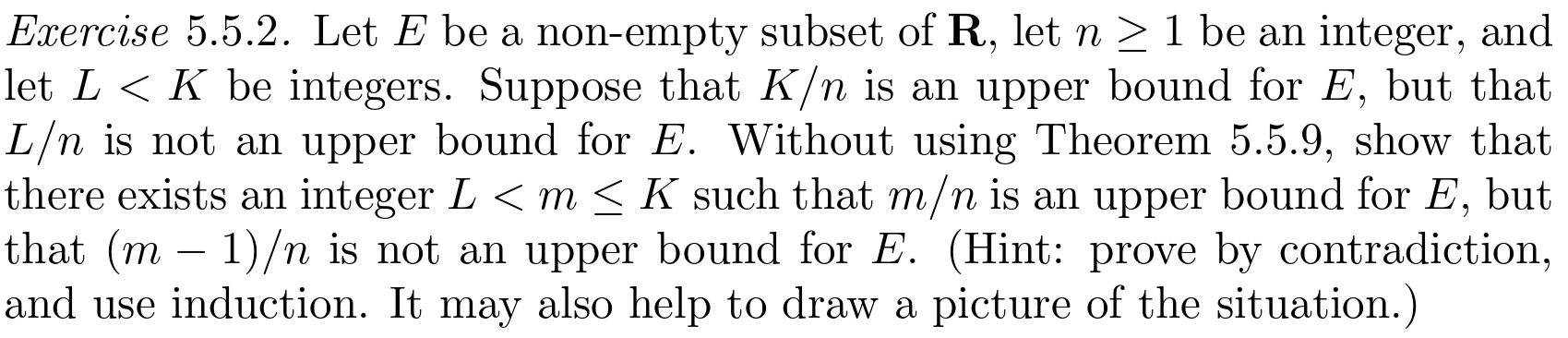
We need to show we can find an $m$ such that $L < m \leq K$, $\frac{m-1}{n} \leq \frac{L}{n}$, and $\frac{m}{n} \geq \frac{K}{n}$. But since $n$ is a positive integer, the latter 2 only hold when $m - 1 \leq L$ and $m \geq K$. And we have the conditions that $m \geq K$, and $m \leq K$, implying $m = K$, which then also implies $m = K = L + 1$. Is any observation up to this point wrong?
Then the exercise says to prove by induction/contradiction. So we can have $m = K = L + 1$ as our base case, and suppose by induction that there exists an $m$ meeting all our criteria, but that $m + 1$ does not.
Sidebar: I'm not very confident about this step at all, and it all feels very weird to me. I wouldn't think of solving this by induction (not that I see another way, I'd just be incredibly stuck without a hint).
So we have $\frac{m - 1}{n}$ which is not an upper bound of $E$ and $\frac{m}{n}$ which is an upper bound of $E$. We're assuming our hypothesis fails for $m + 1$, so this means either $\frac{m + 1}{n}$ is not an upper bound, or $\frac{m + 1 - 1}{n} = \frac{m}{n}$ is an upper bound. But $\frac{m}{n}$ is an upper bound by hypothesis, and we have a contradiction.
solid kilnBOT
nchoosek
 trim joltBOT
@worthy sky Has your question been resolved?
trim joltBOT
@worthy sky Has your question been resolved?
 thin pilot
worthy sky
We need to show we can find an $m$ such that $L < m \leq K$, $\frac{m-1}{n} \leq...
thin pilot
worthy sky
We need to show we can find an $m$ such that $L < m \leq K$, $\frac{m-1}{n} \leq...
Once again, the reasoning that you need to find m - 1 ≤ L and m ≥ K is faulty
While this would be sufficient, it is not necessary, but it seems like you are inducting on the distance between L and K, so it may potentially work
worthy sky
wait I thought you said it was fine 😭
thin pilot
worthy sky
wait I thought you said it was fine 😭
I said it was true that it would be sufficient, but its clearly not necessary
worthy sky
after your explanation I see now
thin pilot
Not in those terms, but that was my intent.
worthy sky
in the other chat
thin pilot
The solution or why we dont need m - 1 ≤ L, m ≥ K?
worthy sky
well I think I understand the solution you wrote, and then that explains why we dont need m - 1 ≤ L, m ≥ K?. If I did get it, what you're saying is since K/n is an upper bound but L/n is not, and they're integers, there is a finite distance between them and we can set k = m and keep decrementing until we hit an m such that m - 1 = L
but wait no
im still confusing myself
this doesn't guaruantee that m is an upper bound
I guess we're not finding m we're just proving it exists
thin pilot
This is the idea, though, as far as I can see. You let n ≥ 1 and let K/n an upper bound and L/n not an upper bound. If you suppose for contradiction that there are no integers m such that m/n is an upper bound and (m - 1)/n a lower bound, then K/n being an upper bound implies that (K - 1)/n must also be an upper bound and so on. But then eventually L/n must be an upper bound, by induction.
thin pilot
worthy sky
I guess we're not finding m we're just proving it exists
So yes, you are not explicity finding m here, you are just relying that if m did not exist, either E is empty or has no upper bound in the integers.
worthy sky
See intuitively that all makes sense, but I don't know the machinery
I've written maybe one inductive proof and that was the basic base case and m + 1 etc
but never a contradictory one and I didn't know you can just write things the way you did and have it be valid
thin pilot
I think you are thinking too much about how the contradiction and induction parts of the proof interact, but they don't actually do that much. You start by assuming a contradiction, then use that assumption to build an induction argument: explicitly, you are arguing that (K - j)/n is an upper bound for E for each j ≥ 1.
worthy sky
"K/n being an upper bound" th is is your base case?
thin pilot
The base case is (K - 1)/n, and this is true because if (K - 1)/n were not an upper bound for E, K would be an integer satisfying K/n an upper bound and (K - 1)/n not an upper bound, but we assumed such an integer did not exist for contradiction.
thin pilot
worthy sky
"K/n being an upper bound" th is is your base case?
This is true by assumption, so you could also treat it as your base case.
It might actually be better because it cuts down on the amount of explanation you have to do
worthy sky
this was massively helpful, the idea itself is so simple I can't believe I was stuck on it for 2 days
btw with the rest of the proof I wrote, taking m = K = L + 1 as a base case and continuing, is just that part of taking m = K = L + 1 as a base case for induction valid?
thin pilot
A priori, I don't think there is anything necessarily wrong with it, but I don't see how you would apply induction here. Also, at least in writing, you should really be inducting on K - L there.
worthy sky
I didn't even consider that
I see it though, because then that really is the base case
of distance between them being 1
and then we increment
thin pilot
Right, that would be the idea behind approaching it that way.
worthy sky
how is the rest of what I wrote? because if $m = K = L + 1$ is a valid base case the rest seems fine... But tbh I think the rest of the proof makes $m = K = L + 1$ not a valid base case
solid kilnBOT
nchoosek
 worthy sky
idk
thin pilot
It seems to me that it doesn't work, because the m that you are choosing is directly tied to the thing that you are inducting over
That is, by hypothesis, if K - L = j, then m/n is an upper bound for E and (m - 1)/n is not.
But when looking at K - L = j + 1, how do I change my m so it works?
worthy sky
I might just be being dumb but I actually don't see a way to find an m here without inducting on m again, even after inducting on K - L, so we don't need to induct on K - L
thin pilot
Its not dumb, necessarily, I just can't see a good way to make the argument work.
worthy sky
ok well I'm glad I didn't miss anything simple lol
recursion/induction it is
thanks again dude
thin pilot
yeah no problem
worthy sky
.close
trim joltBOT
Closed by @worthy sky
Use .reopen if this was a mistake.
Available help channel!
Send your question here to claim the channel.
Remember:
• Ask your math question in a clear, concise manner.
• Show your work, and if possible, explain where you are stuck.
• After 15 minutes, feel free to ping <@&286206848099549185>.
• Type the command .close to free the channel when you're done.
• Be polite and have a nice day!
Read #❓how-to-get-help for further information on how to ask a good question, and about conduct in the question channels.
trim joltBOT
@wraith hinge Has your question been resolved?
Closed by @leaden light
Use .reopen if this was a mistake.
trim joltBOT
Available help channel!
Send your question here to claim the channel.
Remember:
• Ask your math question in a clear, concise manner.
• Show your work, and if possible, explain where you are stuck.
• After 15 minutes, feel free to ping <@&286206848099549185>.
• Type the command .close to free the channel when you're done.
• Be polite and have a nice day!
Read #❓how-to-get-help for further information on how to ask a good question, and about conduct in the question channels.
 versed crypt
if u hv a parabola with equation y=1/3(x-1)^2+5/3 is the vertex still (1, 5/3)
trim joltBOT
versed crypt
if u hv a parabola with equation y=1/3(x-1)^2+5/3 is the vertex still (1, 5/3)
 umbral maple
versed crypt
if u hv a parabola with equation y=1/3(x-1)^2+5/3 is the vertex still (1, 5/3)
umbral maple
versed crypt
if u hv a parabola with equation y=1/3(x-1)^2+5/3 is the vertex still (1, 5/3)
ya
trim joltBOT
Closed by @versed crypt
Use .reopen if this was a mistake.
trim joltBOT
Available help channel!
Send your question here to claim the channel.
Remember:
• Ask your math question in a clear, concise manner.
• Show your work, and if possible, explain where you are stuck.
• After 15 minutes, feel free to ping <@&286206848099549185>.
• Type the command .close to free the channel when you're done.
• Be polite and have a nice day!
Read #❓how-to-get-help for further information on how to ask a good question, and about conduct in the question channels.
 glossy gale
How would I find the area under the curve for y = 1/x^2 and under y = 3x + 5
trim joltBOT
glossy gale
How would I find the area under the curve for y = 1/x^2 and under y = 3x + 5
 molten geyser
could you integrate under the curve?
glossy gale
molten geyser
could you integrate under the curve?
Uh idk how
Smth like this I'm curious about

As you can see, y = 1/x^2 converges
You can't rly integrate that for the area
Also this isn't "between" curves
It's just under a line
I'm mainly just curious
 calm jungle
can u split it into 3 different integrals
glossy gale
I just started integrals
glossy gale
calm jungle
can u split it into 3 different integrals
Can u?
I just wanna know if it's possible to find the area lol
calm jungle
yea i think u can
glossy gale
Well like with calculus not a software
calm jungle
can u use a calculator?
glossy gale
Ye sure
I'll not being tested on this
I'm not even learning it in class
I just randomly thought of this and was curious abt it
calm jungle
ok
calm jungle
so its -2 to 1?
glossy gale
It only can do in between curves
glossy gale
calm jungle
so its -2 to 1?
Yeah
calm jungle
let me try
calm jungle
ill just use urs
glossy gale
Kk
glossy gale
Yeah that's why I figured lol
I just made it up
Like y = x doesn't work cause it's not under the curve edit nvm it does lol
calm jungle
 glossy gale
That seems good
calm jungle
k
glossy gale
Oh qait I'm stupud
Just integrate
Find area under curve from -2 to the intersection
Then use triangles and rectangles to find the exact area in between
@calm jungle lmfao
Easy
calm jungle
ill send u what i did
glossy gale
😂
glossy gale
calm jungle
ill send u what i did
Kk
glossy gale
,rotate
solid kilnBOT
 calm jungle
yea
glossy gale
Nice
Can u do it with like let's say I changed the linear function to idk y = -x^2 + 3
glossy gale
Oh cool
calm jungle
just split it up and then integrate under each ufnctino
calm jungle
np
trim joltBOT
@glossy gale Has your question been resolved?
trim joltBOT
Closed due to timeout
Use .reopen if this was a mistake.
Available help channel!
Send your question here to claim the channel.
Remember:
• Ask your math question in a clear, concise manner.
• Show your work, and if possible, explain where you are stuck.
• After 15 minutes, feel free to ping <@&286206848099549185>.
• Type the command .close to free the channel when you're done.
• Be polite and have a nice day!
Read #❓how-to-get-help for further information on how to ask a good question, and about conduct in the question channels.
trim joltBOT
 vast valley
trim joltBOT
vast valley
trim joltBOT
@vast valley Has your question been resolved?
trim joltBOT
@vast valley Has your question been resolved?
trim joltBOT
@vast valley Has your question been resolved?
 knotty locust
vast valley
knotty locust
vast valley
is this a test
vast valley
knotty locust
is this a test
No it's hw
 lusty delta
vast valley
What do i do
lusty delta
vast valley
What do i do
r u asking for question 1a or
trim joltBOT
Closed due to timeout
Use .reopen if this was a mistake.
Available help channel!
Send your question here to claim the channel.
Remember:
• Ask your math question in a clear, concise manner.
• Show your work, and if possible, explain where you are stuck.
• After 15 minutes, feel free to ping <@&286206848099549185>.
• Type the command .close to free the channel when you're done.
• Be polite and have a nice day!
Read #❓how-to-get-help for further information on how to ask a good question, and about conduct in the question channels.
 ancient edge
An oil spill in the shape of a circle is expanding on the surface of a pond. The radius of the oil spill is r (measured in cm ) and the area of the oil spill is A (measured in cm^2 ). Suppose that at a certain time, the area of the spill is 30cm^2 , and the radius of the spill is increasing at 0.2 cm per second .
trim joltBOT
ancient edge
An oil spill in the shape of a circle is expanding on the surface of a pond. The...
ancient edge
would r be 3.09 at the certain time?
trim thicket
ancient edge
An oil spill in the shape of a circle is expanding on the surface of a pond. The...
is this from thomas' calculus?
ancient edge
whats tht
ancient edge
oh
 rough goblet
,calc (30/pi)^0.5
solid kilnBOT
Result:
3.0901936161855
Tjanks
trim joltBOT
@ancient edge Has your question been resolved?
Closed by @ancient edge
Use .reopen if this was a mistake.
Available help channel!
Send your question here to claim the channel.
Remember:
• Ask your math question in a clear, concise manner.
• Show your work, and if possible, explain where you are stuck.
• After 15 minutes, feel free to ping <@&286206848099549185>.
• Type the command .close to free the channel when you're done.
• Be polite and have a nice day!
Read #❓how-to-get-help for further information on how to ask a good question, and about conduct in the question channels.
 granite zealot
Hi ! Could someone kindly help with summing these two up? I am up till here now.
 trim joltBOT
granite zealot
Hi ! Could someone kindly help with summing these two up? I am up till here now.
granite zealot
trim joltBOT
granite zealot
Hi ! Could someone kindly help with summing these two up? I am up till here now.
granite zealot
I am at this step now.
1/(2n+3) (8n^3+60n^2+142n+105-30n(-1)^n+45(-1)^n /(2n+5)(2n+7)
I’m trying to get to this

Can someone please help? I have been trying and have been stuck for two days now
neon dirge
granite zealot
Can someone please help? I have been trying and have been stuck for two days now
you can start by excluding 2n+3 from both terms
and then getting the common denominator: (2n+5)*(2n+7)
@granite zealot
granite zealot
Hello!
Yes I have done that now..not sure if correct
I am at this step now.
1/(2n+3) (8n^3+60n^2+142n+105-30n(-1)^n+45(-1)^n /(2n+5)(2n+7)
^like this?
neon dirge
granite zealot
^like this?
hm would you mind if I instead send the latex version of the steps and you compare them with yours
might be easier than if I untangle it from text :D
granite zealot
Yeah sure…idk what’s latex but okay
Anything to help solve as I’m stuck for way too long
neon dirge
granite zealot
Yeah sure…idk what’s latex but okay
just fancy math text
so after factoring out

then you prob expanded:

brought together

and then multiplied out (will take a sec):

then summing up and I should be where you area

@granite zealot yop looks good
and now polynomial division
so the numerator div by 2n+3
granite zealot
Polynomial division? How can 8n^3 be divided by 2n+3?
neon dirge
granite zealot
Polynomial division? How can 8n^3 be divided by 2n+3?
yes are you not yet familiar with long polynomial division?
it essentially allows you to divide any polynomials with each other :)
we can start by ignoring the latter two terms at first:

this is what we want to calculate
are thee there?
granite zealot
Yeap! This is my second time hearing of long polynomial division
neon dirge
np, we'll go through step by step
granite zealot
Thank you! I was just really confused with how to resolve this
neon dirge
the principle is to always take the divisor and multiply it by a factor so that the largest powers and their coefficients match
what do I mean by match? the largest term in the numerator is 8n³
and the largest term in the denominator is 2n
so we can multiply our divisor by 4n²
since 2n * 4n² = 8n³
so now we found the factor we need to match the largest terms: 4n²
we'll now subtract 4n² * denominator from the numerator
so 4n² * (2n+3) = 8n³+12n²
we'll subtract that from the numerator and we get:

and we'll write down 4n² on the side
in the end we'll need all the factors we used
now the same principle again
largest term in the numerator is 48n²
and 2n * 24n = 48n²
so our next factor is 24n
24n * divisor = 24n * (2n+3) = 48n²+72n
we'll subtract that from the numerator again

and we'll note down 24n.
one more time: largest power in the numerator is 70n
2n * 35 = 70n
so we'll subtract once more and we get:

0!
and lastly we look at the factors we used throughout the division: 4n², 24n and 35
the remainder of the division thereby is 4n²+24n+35 🦇
@granite zealot hope the process is somewhat clear :)
granite zealot
The remainder becomes the numerator?
neon dirge
granite zealot
The remainder becomes the numerator?
yup!
granite zealot
Is long polynomial division legit?
neon dirge
granite zealot
Hmmm..let me try on the other end and see if I get it
sure
I'll write down the remaining steps:
so now we're at

since we've ignored the last two terms in the division, we still need to divide by them
luckily, we can quickly see that we can easily factor out 2n+3 from 30n(-1)^n+45(-1)^n
btw polynomial division would still work here (the factor would be 15(-1)^n)
meaning our only remainder is 15(-1)^n!
🐛
 granite zealot
What do you mean by we can easily factor out?
neon dirge
granite zealot
What do you mean by we can easily factor out?
I'd have argued that one can see that the upper numerator is a multiple of (2n+3) and 15(-1)^n

but if you prefer, you can do a second long division as well, it'd be just one iteration and gives the same result 👍
granite zealot
Would it be possible? I gotten 30n+45 after multiplying by 15 to match the highest numerator but there’s a problem. 30n(-1)^n
How can I minus 30n with 30n(-1)^n
neon dirge
granite zealot
Would it be possible? I gotten 30n+45 after multiplying by 15 to match the highe...
well let's look at it:

do the highest term above is 30n(-1)^n
and the highest term below is 2n
granite zealot
(-1)^n is so annoying
neon dirge
yea, our factor needs to include it
2n * 15(-1)^n = 30n(-1)^n
now the biggest terms match :)
and after subtracting you'll see that nothing remains
so 15(-1)^n is our remainder
neon dirge
which is the desired result, wehee!
 granite zealot
Is long polynomial division a thing?
neon dirge
granite zealot
Is long polynomial division a thing?
absolutely
as you've just seen it's super useful
granite zealot
It just seems like an out of the blue technique
Does it violate any laws? Are the equations still equal?
granite zealot
I see..maybe I will read a proof on it! Can I ask one more question?
You’re really good at this
neon dirge
a bit like trying to brew the numerator using the denominator 🫧
neon dirge
granite zealot
I see..maybe I will read a proof on it! Can I ask one more question?
sure
neon dirge
kk
do you happen to know a few basics of coding?
it's fine if not, I'd just explain it differently
granite zealot
How did they go from the left to the results on the right? I’m curious on this

My question doesn’t involve having to solve this aspect but it annoys me that I can’t figure it out
granite zealot
neon dirge
do you happen to know a few basics of coding?
Hmmm..I think I know abit of basics of Python..not sure if it is enough
neon dirge
granite zealot
How did they go from the left to the results on the right? I’m curious on this
um they defined the numerator and upper bound both as n...
granite zealot
Did they use a sigma notation formula?
neon dirge
which you aren't allowed to do
neon dirge
granite zealot
Did they use a sigma notation formula?
sigma notation is just another way to express any sum
e.g. here

I define a sum
and a new variable x, which is meant to be natural
and I iterate from x=0 to x=5
granite zealot
neon dirge
which you aren't allowed to do
Wait why? I always struggle when there’s a letter on top
neon dirge
and in each iteration I add the content of the sum
neon dirge
granite zealot
Wait why? I always struggle when there’s a letter on top
well the sum n: 1 -> n is undefined
granite zealot
I tried plugging in a number on Both side and they add up. That’s why I’m surprised and want to know how they did it
neon dirge
since n is not yet defined
granite zealot
It seemed legit
neon dirge
look you can say f.i. n=1 to 10
granite zealot
LHS=RHS
neon dirge
then n iterates from 1 to 10
or you can for instance say n=1 to x if x was previously defined
but n=1 to n is just senseless?
it's like n=n to n
where does it start? where does it end?
undefined
granite zealot
Wait so what’s up with the RHS? How did they come up with it?
I get what you are trying to say
neon dirge
well if the sum notation on the left would be correct
then I could say what they used
but since the sum doesn't make sense the equation is useless
granite zealot
Is this some higher level math they used?
neon dirge
granite zealot
Is this some higher level math they used?
I can't tell if I don't know what they meant to write into the sum :D
it's like asking me "why does the LHS equal 3?"
 granite zealot
Ahhh ok..they just wrote this down and wanted a proof via induction so I’m also not sure what else to add
Hahahaha
Right
I thought I was dumb for not being able to figure it out
neon dirge
granite zealot
Ahhh ok..they just wrote this down and wanted a proof via induction so I’m also ...
yea maybe they meant to write from n=1 to infinity
then induction would make sense
granite zealot
Ahhh..right right..
neon dirge
granite zealot
I thought I was dumb for not being able to figure it out
nw, always view sums as:
 granite zealot
Can I also ask another question?😂
granite zealot
For only the left hand side, why is it when I restricted it with the inequality 0< left hand side in the pic< 1, the number is even?
 neon dirge
you mean why n must be even if 0<LHS<1 is given?
granite zealot
Yes!!
neon dirge
because for odd n, the term (-1)^(n+1) is negative
granite zealot
That’s right!


 ivory talon

 static tendon


 visual pike


