#help-38
1 messages · Page 49 of 1
 hazy panther
You can look it up
But definitely try to learn the general shape
These will become simple
 sharp vine
hazy panther
But definitely try to learn the general shape
sharp vine
hazy panther
But definitely try to learn the general shape
yeah cuz they wont frickin give it to me in the exams 😭
hazy panther
sharp vine
yeah cuz they wont frickin give it to me in the exams 😭
Exactly
 solid kilnBOT
A brief description and guide on how to use me was sent to your DMs!
Please use ,list to see a list of all my commands, and ,help cmd to get detailed help on a command!
sharp vine
,ask cosx
what does my boi wolfram have to say about it
oh.

this is the original graph
 trim joltBOT
@sharp vine Has your question been resolved?
 grave bane
Any help would be appreciated 😊
 trim joltBOT
Channel closed
Closed due to timeout
Use .reopen if this was a mistake.
 Available help channel!
Send your question here to claim the channel.
Remember:
• Ask your math question in a clear, concise manner.
• Show your work, and if possible, explain where you are stuck.
• After 15 minutes, feel free to ping <@&286206848099549185>.
• Type the command .close to free the channel when you're done.
• Be polite and have a nice day!
Read #❓how-to-get-help for further information on how to ask a good question, and about conduct in the question channels.
 rare cradle
I'm not really sure how to find the limits for this and theta

 rare cradle
The second one is my working so far
Rho*, not "this"
I got rho actually just theta
trim joltBOT
@rare cradle Has your question been resolved?
rare cradle
Rho incorrect
trim joltBOT
@rare cradle Has your question been resolved?
trim joltBOT
Channel closed
Closed due to timeout
Use .reopen if this was a mistake.
Available help channel!
Send your question here to claim the channel.
Remember:
• Ask your math question in a clear, concise manner.
• Show your work, and if possible, explain where you are stuck.
• After 15 minutes, feel free to ping <@&286206848099549185>.
• Type the command .close to free the channel when you're done.
• Be polite and have a nice day!
Read #❓how-to-get-help for further information on how to ask a good question, and about conduct in the question channels.
 wraith hinge
alright , just to clarify, equating g(x) and f(x) and then integrating it will give me the shaded area?
 trim joltBOT
wraith hinge
alright , just to clarify, equating g(x) and f(x) and then integrating it will g...
wraith hinge
trim joltBOT
wraith hinge
alright , just to clarify, equating g(x) and f(x) and then integrating it will g...
wraith hinge
or do i need to do something else
 maiden dagger
depends on what f(x) an g(x) is
wraith hinge
its written there but without the brackets
maiden dagger
no worries
wraith hinge
yeah so equate them
i got +-sqrt6
and then intergrate with f(x)-g(x)
with the limits +-sqrt6
yeah i realised what the skull emoji was for now
wtf is this question!??!?!
 final sage
what you've shaded is the area below between the x-axis and the graph of the function f(x) = 4 - x^2
you can find this by integrating f from -2 to 2
wraith hinge
i didnt shade the whole thing
maiden dagger
im not usre if u can combine f(x) and g(x) imma be honest
wraith hinge
😭
 final sage
ah, so you want to find the area of the shaded region between 4 - x^2 and -2
maiden dagger
idk if theres a faster way to do that
im assuming that is the total area u wanna find, correct me if im wrong
final sage
in general, whenever you have two functions f and g, if you want to find the area above g and below f, you can integrate f - g
wraith hinge
thats what im thinking
final sage
in this case, its even easier to see this because g(x) = -2, a constant. so the area between 4 - x^2 and -2 is the same as if you just shifted the parabola 4 - x^2 up by two units, to get 6 - x^2, and integrated it normally
you're essentially just moving the x-axis down which raises the parabola up
wraith hinge
yeah i got (6 - x^2)
i intergrate to get
(6x-1/3x^3)
and then use the limits +-sqrt 6
final sage
well, you are integrating from -sqrt(6) to sqrt(6) since that's where the parabola intersects the line y = -2
final sage
maiden dagger
why f(x) - g(x) anbt not +
if you think of the riemann sum, you want the small rectangles at each point (really, a small interval around the point) to have height |f(x) - g(x)|. it helps if you draw it. since we are assuming f(x) >= g(x), this is just f(x) - g(x)
maiden dagger
no clue what a riemann sum is
final sage
sadge. that's how they usually define integration the first time you see it, right?
maiden dagger
i mean
final sage
summing up tiny rectangles
 wraith hinge
so am i doing the right thing?
final sage
this is one small rectangle
maiden dagger
are we subtracting the functions cuz g(x) is -ve
final sage
as the rectangles get smaller, the height approaches the distance between the functions at some point in the rectangle
final sage
wraith hinge
so am i doing the right thing?
yeah
maiden dagger
bc if g(x) was like 10 wouldnt we do f(x) + g(x)
 final sage
yep  desmos agrees
 final sage
maiden dagger
bc if g(x) was like 10 wouldnt we do f(x) + g(x)
final sage
maiden dagger
bc if g(x) was like 10 wouldnt we do f(x) + g(x)
you'd do g(x) - f(x)
wraith hinge
alright thanks bro
final sage
since the graph of g is now above the graph of f
wraith hinge
final sage
yep <:peepoHappy:1015078565567549531> desmos agrees
wow that is pretty cool , how do you do that?
final sage
so |f(x) - g(x)| = |g(x) - f(x)|
use this
it can help check your work and visualize stuff
try not to rely on it too much when you're learning, though...
wraith hinge
yeahhh
but how do you get the symbols
like the intergral sign and what not
oh wow
the functions button i didnt notice that ahhah
trim joltBOT
@wraith hinge Has your question been resolved?
trim joltBOT
Channel closed
Closed due to timeout
Use .reopen if this was a mistake.
trim joltBOT
Available help channel!
Send your question here to claim the channel.
Remember:
• Ask your math question in a clear, concise manner.
• Show your work, and if possible, explain where you are stuck.
• After 15 minutes, feel free to ping <@&286206848099549185>.
• Type the command .close to free the channel when you're done.
• Be polite and have a nice day!
Read #❓how-to-get-help for further information on how to ask a good question, and about conduct in the question channels.
 crimson rover
if i were to write this in leibniz notation would it be
 crimson rover
$\frac{d^2f(x)}{dx^2}=\frac{d^2}{dx^2}7x^3-\frac{d^2}{dx^2}6x^5$
solid kilnBOT
Joshii

 stark bison
Yeah sure, but it's more common to see $\dv[2]{f}{x}$ instead and I would put parenthesis around $7x^3$ and $6x^5$
solid kilnBOT
A Lonely Bean
 trim joltBOT
@crimson rover Has your question been resolved?
trim joltBOT
Channel closed
Closed due to timeout
Use .reopen if this was a mistake.
Available help channel!
Send your question here to claim the channel.
Remember:
• Ask your math question in a clear, concise manner.
• Show your work, and if possible, explain where you are stuck.
• After 15 minutes, feel free to ping <@&286206848099549185>.
• Type the command .close to free the channel when you're done.
• Be polite and have a nice day!
Read #❓how-to-get-help for further information on how to ask a good question, and about conduct in the question channels.
 silver arch
h
trim joltBOT
silver arch
h
silver arch
can someone check my set proof
the question is prove that there is no sets a,b,c such that AnB = ∅ , AnC = ∅, and (AnB)-C =∅
Using contradiction i said, Assume there are such sets a,b,c, and take xe((AnB)-C), which means xeAnB and x∉C, but if xeAnB, then xe∅, which is not possible as the empty set has no elements. Am I correct?
 marble wharf
!original
trim joltBOT
Please show the original problem, exactly as it was stated to you. A picture or screenshot is best.
If the original problem is not in English, then post it anyway! The additional context might still help helpers help you. Do your best to translate.
silver arch
bruh
that doesn't make any sense, if A=B the intersection of A and B is the elements shared between a and b not the empty set
.close
trim joltBOT
Channel closed
Closed by @silver arch
Use .reopen if this was a mistake.
Available help channel!
Send your question here to claim the channel.
Remember:
• Ask your math question in a clear, concise manner.
• Show your work, and if possible, explain where you are stuck.
• After 15 minutes, feel free to ping <@&286206848099549185>.
• Type the command .close to free the channel when you're done.
• Be polite and have a nice day!
Read #❓how-to-get-help for further information on how to ask a good question, and about conduct in the question channels.
trim joltBOT
 pastel crypt
a
pastel crypt
pastel crypt
a
pastel crypt
ok uh does anyone know how to do synthetic substitution
on a calculator
heres a question
Use synthetic substitution to find f(-3) and f(4) for each function.
- f(x) = x^2 + 2x + 3
 dapper flicker
remind me what synthetic substitution is
 fiery goblet
just replace the x's with the given values
dapper flicker
I did it last year but I can remember exactly ;-;
fiery goblet
why do you want to do synthetic substitution on a calculator
pastel crypt
teacher told me to
so id rather do it the way she recommends, especially since the exam will be timeed
i believe im meant to do it on mode 5,3
fiery goblet
if you're using a calculator, doing synthetic substituion will be a very big waste of time
just replace the x's with the given values
synthetic substituion makes sense when you don't have a calculator
trim joltBOT
@pastel crypt Has your question been resolved?
Channel closed
Closed by @pastel crypt
Use .reopen if this was a mistake.
Available help channel!
Send your question here to claim the channel.
Remember:
• Ask your math question in a clear, concise manner.
• Show your work, and if possible, explain where you are stuck.
• After 15 minutes, feel free to ping <@&286206848099549185>.
• Type the command .close to free the channel when you're done.
• Be polite and have a nice day!
Read #❓how-to-get-help for further information on how to ask a good question, and about conduct in the question channels.
 rugged spear
I have a question
trim joltBOT
rugged spear
I have a question
rugged spear

Regarding the 12^3
The problem requires to turn all into inches
But the right side equation is on Feet thus the 12
I don't know why it needs to be on ^3
Here's the link in case you need more references
Problem 613 If E = 29 × 106 psi, what value of I is required to limit the midspan deflection to 1/360 of the span for the beam in Fig. P-613?
trim joltBOT
@rugged spear Has your question been resolved?
trim joltBOT
Channel closed
Closed due to timeout
Use .reopen if this was a mistake.
Available help channel!
Send your question here to claim the channel.
Remember:
• Ask your math question in a clear, concise manner.
• Show your work, and if possible, explain where you are stuck.
• After 15 minutes, feel free to ping <@&286206848099549185>.
• Type the command .close to free the channel when you're done.
• Be polite and have a nice day!
Read #❓how-to-get-help for further information on how to ask a good question, and about conduct in the question channels.
 lunar moat
 trim joltBOT
lunar moat
lunar moat
trim joltBOT
lunar moat
lunar moat
On part e, i have the following pattern:
N=1: 22
N=2: 322
N=3: 4 * 32
i dont know how to write it in form of an equation using n though
 sleek canopy
$a_n=4-\sum_{k=1}^nk=4-\frac{(n+1)n}{2}$
solid kilnBOT
everg
 sleek canopy
for c)
solid kilnBOT
everg
 lunar moat
thats what i thought too but idk if we are allowed to use factorial\
sleek canopy
this satisfy $a_0=2$ and the recurrence equation
solid kilnBOT
everg
 sleek canopy
there is no simpler writing for factorial ... if there was, we didn't need to define symbole "!"
so i think your are allowed
trim joltBOT
Channel closed
Closed by @lunar moat
Use .reopen if this was a mistake.
Available help channel!
Send your question here to claim the channel.
Remember:
• Ask your math question in a clear, concise manner.
• Show your work, and if possible, explain where you are stuck.
• After 15 minutes, feel free to ping <@&286206848099549185>.
• Type the command .close to free the channel when you're done.
• Be polite and have a nice day!
Read #❓how-to-get-help for further information on how to ask a good question, and about conduct in the question channels.
 manic mirage
can someone explain how to find the domain and range of this rational function
 trim joltBOT
manic mirage
can someone explain how to find the domain and range of this rational function
trim joltBOT
trim joltBOT
manic mirage
can someone explain how to find the domain and range of this rational function
trim joltBOT
@manic mirage Has your question been resolved?
trim joltBOT
@manic mirage Has your question been resolved?
 zinc ginkgo
 scarlet cape
I need the channel cuh
scarlet cape
I need the channel cuh
!occupied
trim joltBOT
scarlet cape
I need the channel cuh
Someone else is already using this help channel. If you need help with a question, please open your own help channel/thread (see #❓how-to-get-help for instructions).
scarlet cape
zinc ginkgo
!occupied
!Iknow
zinc ginkgo
scarlet cape
!Iknow
Then wait
trim joltBOT
@manic mirage Has your question been resolved?
trim joltBOT
@manic mirage Has your question been resolved?
trim joltBOT
Channel closed
Closed by @manic mirage
Use .reopen if this was a mistake.
trim joltBOT
Available help channel!
Send your question here to claim the channel.
Remember:
• Ask your math question in a clear, concise manner.
• Show your work, and if possible, explain where you are stuck.
• After 15 minutes, feel free to ping <@&286206848099549185>.
• Type the command .close to free the channel when you're done.
• Be polite and have a nice day!
Read #❓how-to-get-help for further information on how to ask a good question, and about conduct in the question channels.
 fallow ether
are these formulas switched?
trim joltBOT
fallow ether
are these formulas switched?
fallow ether

for spherical coordinates for triple integrals

nvm
theyre not
i thought it was the angle on the inside
between the line and the y axis in this case
but if its sin we get r/ distance away from origin on xy plane
.close
trim joltBOT
Channel closed
Closed by @fallow ether
Use .reopen if this was a mistake.
Available help channel!
Send your question here to claim the channel.
Remember:
• Ask your math question in a clear, concise manner.
• Show your work, and if possible, explain where you are stuck.
• After 15 minutes, feel free to ping <@&286206848099549185>.
• Type the command .close to free the channel when you're done.
• Be polite and have a nice day!
Read #❓how-to-get-help for further information on how to ask a good question, and about conduct in the question channels.
 wintry lily
 trim joltBOT
wintry lily
wintry lily
trim joltBOT
wintry lily
wintry lily
help
 low gazelle
wintry lily
help
low gazelle
wintry lily
help
Pull out a negative 1 from the right side
trim joltBOT
@wintry lily Has your question been resolved?
wintry lily
<@&286206848099549185>
trim joltBOT
Channel closed
Closed by @wintry lily
Use .reopen if this was a mistake.
Available help channel!
Send your question here to claim the channel.
Remember:
• Ask your math question in a clear, concise manner.
• Show your work, and if possible, explain where you are stuck.
• After 15 minutes, feel free to ping <@&286206848099549185>.
• Type the command .close to free the channel when you're done.
• Be polite and have a nice day!
Read #❓how-to-get-help for further information on how to ask a good question, and about conduct in the question channels.
 void dew
 wraith hinge
this is not math
final sage
void dew
<@&286206848099549185>
This looks like something you could just google
Phospholipid bilayer
Also you said “is this right” but didnt say what your answer was
trim joltBOT
void dew
<@&286206848099549185>
Please only use the <@&286206848099549185> ping once if your question has not been answered for 15 minutes. Please do not ping or DM individual users about your question.
zinc ginkgo
wraith hinge
this is not math
.close
trim joltBOT
Channel closed
Closed by @zinc ginkgo
Use .reopen if this was a mistake.
trim joltBOT
Available help channel!
Send your question here to claim the channel.
Remember:
• Ask your math question in a clear, concise manner.
• Show your work, and if possible, explain where you are stuck.
• After 15 minutes, feel free to ping <@&286206848099549185>.
• Type the command .close to free the channel when you're done.
• Be polite and have a nice day!
Read #❓how-to-get-help for further information on how to ask a good question, and about conduct in the question channels.
 trim kestrel
 trim joltBOT
trim kestrel
trim kestrel
trim joltBOT
trim kestrel
trim kestrel
how do i factor it
honestly i dont even know how i got the zeros
i just charted it on desmos and guessed what the fractions were
im clueless
 tulip violet
trim kestrel
how do i factor it
tulip violet
trim kestrel
how do i factor it
A polynomial can be factored in the form of f(x) = (x - a)(x - b)...
When you find the zeros, you set each factor equal to 0, so (x - a) = 0, (x - b) = 0, then solve for x
So you would have x = a, x =b, etc
You have the zeros, you just need to work backwards
trim kestrel
but it should be the other way
around
the only way to get the zeros is by factoring it in quadratic form
tulip violet
Start with the x = a step then get them to look like (x - a) = 0, then combine the factors
tulip violet
trim kestrel
the only way to get the zeros is by factoring it in quadratic form
You have the zeros from part b
trim kestrel
yea how do i answer part b
like how do i get the rational zeros
like i said, i just guessed it on desmos
i want to know how to do it
tulip violet
You just plug in each combination into f(x) and see when f(x) = 0
tulip violet
tulip violet
A polynomial can be factored in the form of f(x) = (x - a)(x - b)...
When you fi...
Then for c, you do this
trim kestrel
tulip violet
A polynomial can be factored in the form of f(x) = (x - a)(x - b)...
When you fi...
so f(x)=(x+2/3)(x+3/2)(x-1/3)
tulip violet
Yes
trim kestrel
now what
tulip violet
That's it
trim kestrel
its not
tulip violet
That's f(x) in factored form
 tulip violet
What does it say in the blue, underneath that?
trim kestrel
 trim kestrel
tulip violet
What does it say in the blue, underneath that?
trim kestrel
tulip violet
What does it say in the blue, underneath that?
do you know what to do? if not lmk
ill just ask someone else
tulip violet
Looks like before anything happened, you can factor out a gcf from the original equation
So you might be missing that gcf
trim kestrel
huhh
i didnt even know that was a thing
if i have the zeros why is there a gcf at all
tulip violet
Because if you facotr out a gcf, it will make things easier
tulip violet
A gcf is a number that is common with all the terms, 54, 99, 15 and 18
Is 6 a common factor between all those?
tulip violet
Yes
 tulip violet
Try it
tulip violet
It means that it doesn't want fractions because 2/3 is a fraction
tulip violet
So in each factor, you want to "remove" that denominator, by multiplying all the terms of that factor by the denominator
For example, (x - 6/5) = 5(x - 6/5) = (5x - 6), notice how I multplied all the terms by 5, which was the denominator
tulip violet
trim kestrel
is it just lying?
It might have been for something else
trim kestrel
do the signs change
tulip violet
No
trim kestrel
so 3(3x+2)(2x+3)(3x-1)?
tulip violet
Try it
trim kestrel
tysm
ive been struggling with this for a minute
i didnt realize all i had to do was take out the gcf
tulip violet
trim kestrel
i didnt realize all i had to do was take out the gcf
If you're done with the channel, you can close it using .close
trim kestrel
.close
trim joltBOT
Channel closed
Closed by @trim kestrel
Use .reopen if this was a mistake.
Available help channel!
Send your question here to claim the channel.
Remember:
• Ask your math question in a clear, concise manner.
• Show your work, and if possible, explain where you are stuck.
• After 15 minutes, feel free to ping <@&286206848099549185>.
• Type the command .close to free the channel when you're done.
• Be polite and have a nice day!
Read #❓how-to-get-help for further information on how to ask a good question, and about conduct in the question channels.
 worn sun
 trim joltBOT
worn sun
https://i.imgur.com/0OhJAny.png
trim joltBOT
worn sun
https://i.imgur.com/0OhJAny.png
trim joltBOT
worn sun
https://i.imgur.com/0OhJAny.png
trim joltBOT
worn sun
https://i.imgur.com/0OhJAny.png
What step are you on?
1. I don't know where to begin.
2. I have begun but got stuck midway.
3. I got an answer but I was told that it's wrong.
4. I got an answer and would like my work checked.
5. I have a question about someone else's work/solution.
6. I have completed the problem and don't need help anymore. Thank you.
7. None of the above
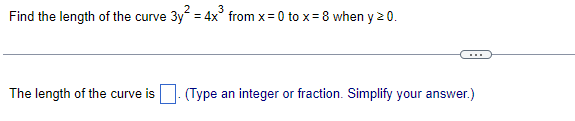
I think you may need to use u sub and use arclength but I am not really sure if that's right
 broken pilot
can you show your work?
worn sun
I havent started on it quite yet, but was wondering if that's the direction it wants me to go
broken pilot
Yes I think you’re supposed to use arc length, maybe after parametrizing
trim joltBOT
Channel closed
Closed by @worn sun
Use .reopen if this was a mistake.
Available help channel!
Send your question here to claim the channel.
Remember:
• Ask your math question in a clear, concise manner.
• Show your work, and if possible, explain where you are stuck.
• After 15 minutes, feel free to ping <@&286206848099549185>.
• Type the command .close to free the channel when you're done.
• Be polite and have a nice day!
Read #❓how-to-get-help for further information on how to ask a good question, and about conduct in the question channels.
scarlet cape
Can someone help verify this for me?
 trim joltBOT
scarlet cape
Can someone help verify this for me?
scarlet cape
trim joltBOT
scarlet cape
Can someone help verify this for me?
scarlet cape
for B, one solution because a is bigger than b
For C, one solution because a and b are the same length
right?
SSA conditions
trim joltBOT
@scarlet cape Has your question been resolved?
broken pilot
scarlet cape
SSA conditions
SSA is ambiguous
scarlet cape
broken pilot
SSA is ambiguous
yeah
i gotta find the number of solutions

using this
broken pilot
scarlet cape
Can someone help verify this for me?
one sure way to know is to try constructing the triangle
broken pilot
by drawing a line of length 26 cm, which is c, and then constructing a ray starting from one end of l and having an angle of 76 degrees with it
broken pilot
and then constructing a circle of radius 26 cm
scarlet cape
.close
trim joltBOT
Channel closed
Closed by @scarlet cape
Use .reopen if this was a mistake.
trim joltBOT
Available help channel!
Send your question here to claim the channel.
Remember:
• Ask your math question in a clear, concise manner.
• Show your work, and if possible, explain where you are stuck.
• After 15 minutes, feel free to ping <@&286206848099549185>.
• Type the command .close to free the channel when you're done.
• Be polite and have a nice day!
Read #❓how-to-get-help for further information on how to ask a good question, and about conduct in the question channels.
 left karma
Twice the sum of a number and 6 is equal to 18. What is the correct equation to solve this problem
trim joltBOT
left karma
Twice the sum of a number and 6 is equal to 18. What is the correct equation to ...
left karma
<@&286206848099549185>
 serene ferry
2(x+6) = 18
left karma
how to convert celsius into farenheit
28 degrees celsius into farenheit
formula please
trim joltBOT
@left karma Has your question been resolved?
 dry urchin
If you just need a formula without explanation try to google your question. If you dont understand what is said there come back here and ask again.
trim joltBOT
Channel closed
Closed due to timeout
Use .reopen if this was a mistake.
trim joltBOT
Available help channel!
Send your question here to claim the channel.
Remember:
• Ask your math question in a clear, concise manner.
• Show your work, and if possible, explain where you are stuck.
• After 15 minutes, feel free to ping <@&286206848099549185>.
• Type the command .close to free the channel when you're done.
• Be polite and have a nice day!
Read #❓how-to-get-help for further information on how to ask a good question, and about conduct in the question channels.
 mystic veldt
how can i find min value of sin theta + cos theta with calculus
mystic veldt
i have found the max value, but cant find the min
i rechecked my work
it was correct
 ripe valley
Show work
 mystic veldt
 ripe valley
You are solving for critical points, but u forgot to check for the second derivative for minima
marble wharf
well, what is f(5pi/4)
mystic veldt
0?
marble wharf
no
ripe valley
Wait u need to find a k such that f''(kpi + pi/4) is greater than 0
@mystic veldt just do the same thing for minima as u did for maxima, just find a solution using ur general solution such that the second derivative is greater than 0
mystic veldt
that is what i cant find
mystic veldt
marble wharf
f(5pi/4)=-sqrt(2)
wait let me see
ripe valley
mystic veldt
that is what i cant find
Sub npi + pi/4 in the second derivative
mystic veldt
,w sin(5 pi/4)+cos(5 pi/4)
solid kilnBOT


 Requested by yajatjamal
trim joltBOT
Requested by yajatjamal
trim joltBOT
Channel closed
Closed by @mystic veldt
Use .reopen if this was a mistake.
Available help channel!
Send your question here to claim the channel.
Remember:
• Ask your math question in a clear, concise manner.
• Show your work, and if possible, explain where you are stuck.
• After 15 minutes, feel free to ping <@&286206848099549185>.
• Type the command .close to free the channel when you're done.
• Be polite and have a nice day!
Read #❓how-to-get-help for further information on how to ask a good question, and about conduct in the question channels.
 pseudo parcel
 trim joltBOT
pseudo parcel
trim joltBOT
pseudo parcel
 vagrant marsh
Oh no not one of these
pseudo parcel
Can u guys help me?
pseudo parcel
Ok. If u find please write
sleek canopy
garlicb is the best in this type of problem!
vagrant marsh
Thanks lol
pseudo parcel
Really?!
vagrant marsh
I try my best
 willow urchin
19
pseudo parcel
How? Send me solution
sleek canopy
you can bet your house that he is goint to solve it
vagrant marsh
Ah yes, the everything is 19 rule
willow urchin
vagrant marsh
Ah yes, the everything is 19 rule
more formally its called the ann-liouville malicious compliance with underspecification theorem
 sour token
pseudo parcel
sour token
pseudo parcel
First two look like sum of two numbers - 1 but then third is just weird
pseudo parcel
Yeah I saw that too.
vagrant marsh
Gimme some time ill brb
pseudo parcel
Ok. Np. I am waiting
vagrant marsh
I have to go to class, but ill keep thinking about it
trim joltBOT
@pseudo parcel Has your question been resolved?
wraith hinge
man you sure this has to have a unique answer there are some interesting things about that I could tell you if you want but I don't think there is a definitive answer
trim joltBOT
@pseudo parcel Has your question been resolved?
vagrant marsh
Idk man, sorry
 rugged latch
Even chatgpt doesn’t know, which means it can’t be solved

Originally I was thinking it was number 1 + number 2 - 1
But that broke at case 3
sleek canopy
vagrant marsh
Idk man, sorry
you are tired ..maybe tomorrow you'll give one of your fantastic solution!
vagrant marsh
Perhaps
rugged latch
GarlicB #1 fan
pseudo parcel
Ok guys. Bye. I will find the answer soon. So I don't close it.

But, can u solve it?
sleek canopy
for the non-sniper people
 trim joltBOT
@pseudo parcel Has your question been resolved?
pseudo parcel
Can someone look this AMO question please ?!
 trim star
pretty sure its a but should i try help with the reasoning
trim joltBOT
@pseudo parcel Has your question been resolved?
 main mesa
do you know how to rationalize?
you would start off by multipling the whole equation by the roots that are present in the denominator,

for example of the propety ^
trim joltBOT
Channel closed
Closed due to timeout
Use .reopen if this was a mistake.
Available help channel!
Send your question here to claim the channel.
Remember:
• Ask your math question in a clear, concise manner.
• Show your work, and if possible, explain where you are stuck.
• After 15 minutes, feel free to ping <@&286206848099549185>.
• Type the command .close to free the channel when you're done.
• Be polite and have a nice day!
Read #❓how-to-get-help for further information on how to ask a good question, and about conduct in the question channels.
 pearl field
I'm not sure if these are correct

 trim joltBOT
pearl field
I'm not sure if these are correct
pearl field
trim joltBOT
pearl field
I'm not sure if these are correct
pearl field
<@&286206848099549185>
trim joltBOT
pearl field
<@&286206848099549185>
Please only use the <@&286206848099549185> ping once if your question has not been answered for 15 minutes. Please do not ping or DM individual users about your question.
pearl field
I'm not sure if my answers are correct, can someone help?
 edgy ermine
What are the checks that need to be done before we can determine differentiability?
pearl field
If f(x) is continuous right?
edgy ermine
The limit as x approaches a for f'(x) must also exist right?
pearl field
Yeah
pearl field
edgy ermine
The limit as x approaches a for f'(x) must also exist right?
That's the 3 step continuity rule right?
 pearl field
What's the next step?
edgy ermine
Tbh when I was taught this I was told that with absolute values, the place to check for kinks and discontinuity and vertical tangents was where you switch the two different equations (x = 0) in this case
Since we know cos(3x) is always differentiable, same with -4
 calm quarry
Check the continuity at 0. I think that'll be enough.
pearl field
It's continuous at 0 over the interval except (-1,1) right?
calm quarry
It's discontinuous at 0. RHL = cos(3*0) = 1
LHL = -4
calm quarry
Maybe to confuse as cos has range [-1, 1]
pearl field
But cos3×0=1, so it would be no and it would not be if the interval was (-1,1), since cos(3x) is 1
calm quarry
Yes, correct
pearl field
Ok thank you so much
What about the other one? Ik that 3(8)-9=15, so that should be continuous, but 3(9)-9=18
calm quarry
Which que? Your both pics are same
 calm quarry
For this you even need not to check continuity or differentiability.
First find the domain of the function.
Domain sry
Hint : the function is considered non-differentiable over values outside it's domain
pearl field
I used a graph calculator and the domain is (−∞,8)U(9,∞)
calm quarry
Now can you get the answer?
calm quarry
Yupp
No I mean, you need not to check the differentiability here.
For this question
calm quarry
Because in rest other answers the interval which is given has some values over which the function is not defined only
If function is not defined at a point, straight it's discontinuous there
pearl field
So you only need to find the differentiability when there's an interval?
calm quarry
Find the differentiability when it's required. Sometimes questions are bit simpler.
pearl field
Ok thank you so much, you're a great help
trim joltBOT
@pearl field Has your question been resolved?
Channel closed
Closed by @pearl field
Use .reopen if this was a mistake.
trim joltBOT
Available help channel!
Send your question here to claim the channel.
Remember:
• Ask your math question in a clear, concise manner.
• Show your work, and if possible, explain where you are stuck.
• After 15 minutes, feel free to ping <@&286206848099549185>.
• Type the command .close to free the channel when you're done.
• Be polite and have a nice day!
Read #❓how-to-get-help for further information on how to ask a good question, and about conduct in the question channels.
 remote pulsar
How do I apply the transformation $T(x, y) = (x - 2y, x + 2y)$ onto the circle $x^2 + y^2 = 1$? What is the image of the circle under $T$?
trim joltBOT
remote pulsar
How do I apply the transformation $T(x, y) = (x - 2y, x + 2y)$ onto the circle $...
solid kilnBOT
o.O
 remote pulsar
I suspected I need to reparametrize it as $x = \cos\theta$ and $y = \sin\theta$ with $0 \le \theta \le 2\pi$
solid kilnBOT
o.O
 remote pulsar
since now x and y can be expressed in terms of the same variable
but like, I am confused how to actually apply the transformation onto the circle with this
trim joltBOT
@remote pulsar Has your question been resolved?
Channel closed
Closed by @remote pulsar
Use .reopen if this was a mistake.
Available help channel!
Send your question here to claim the channel.
Remember:
• Ask your math question in a clear, concise manner.
• Show your work, and if possible, explain where you are stuck.
• After 15 minutes, feel free to ping <@&286206848099549185>.
• Type the command .close to free the channel when you're done.
• Be polite and have a nice day!
Read #❓how-to-get-help for further information on how to ask a good question, and about conduct in the question channels.
 maiden nova
How to work out the perc multiplier? Please ping if can help ty
 wraith hinge
maiden nova
How to work out the *perc multiplier?* Please ping if can help ty
wraith hinge
maiden nova
How to work out the *perc multiplier?* Please ping if can help ty
add 100% to multiply if increase, subtract from 100% if decrease
example: increase $5 by 15% = 5x(100+15)%= 5x115% on calc or 5 x 1.15
decrease $20 by 45% = 20x(100-45)%= 20 x 55% or 20x .55
maiden nova
wraith hinge
add 100% to multiply if increase, subtract from 100% if decrease
example: increa...
ohk
So for the first one since its increase by 11% I would hve to do 10 * 1.11, right?
wraith hinge
maiden nova
So for the first one since its increase by 11% I would hve to do 10 * 1.11, righ...
yep
maiden nova
ok perfect so thats 11
secound would be 40 * 1.04 so 41.6
third is 500 * 1.11 = 555
Is the fourth one 34 * .40 @wraith hinge
ok thanks
fifth is 60 * .98
😭

what I do wrong
wraith hinge
maiden nova
😭
you missed out on decimals
maiden nova
oh
wraith hinge
should be 11.1 on 1
wraith hinge
2 should be correct
maiden nova
hm
I'll skip no.2 for now cos it might be an issue in sys maybe
whats wrong w 4
I did 34 * 0.4
.close
trim joltBOT
Channel closed
Closed by @maiden nova
Use .reopen if this was a mistake.
Available help channel!
Send your question here to claim the channel.
Remember:
• Ask your math question in a clear, concise manner.
• Show your work, and if possible, explain where you are stuck.
• After 15 minutes, feel free to ping <@&286206848099549185>.
• Type the command .close to free the channel when you're done.
• Be polite and have a nice day!
Read #❓how-to-get-help for further information on how to ask a good question, and about conduct in the question channels.
 rancid aspen
 trim joltBOT
Channel closed
Closed due to timeout
Use .reopen if this was a mistake.
trim joltBOT
Available help channel!
Send your question here to claim the channel.
Remember:
• Ask your math question in a clear, concise manner.
• Show your work, and if possible, explain where you are stuck.
• After 15 minutes, feel free to ping <@&286206848099549185>.
• Type the command .close to free the channel when you're done.
• Be polite and have a nice day!
Read #❓how-to-get-help for further information on how to ask a good question, and about conduct in the question channels.
 primal sage
help me please
trim joltBOT
primal sage
help me please
primal sage
 wraith hinge
[
a^m \cdot a^n = a^{n+m} \tss{and} a(b\cdot c) = (a\cdot b)c
]
solid kilnBOT
 wraith hinge
the above is all you need to solve your particular problem
primal sage
i am not sure
wraith hinge
of?
wraith hinge
solid kiln
have you thought about this
primal sage
yeah i dont know what it is
 merry owl
its an exponent rule
since you already have 10^m and youre multiplying by 10^n, your final answer would just be 10^m+n
primal sage
How would you find that
What are the steps of solving this question
@merry owl @wraith hinge
@wraith hinge
.close
trim joltBOT
Channel closed
Closed by @primal sage
Use .reopen if this was a mistake.
Available help channel!
Send your question here to claim the channel.
Remember:
• Ask your math question in a clear, concise manner.
• Show your work, and if possible, explain where you are stuck.
• After 15 minutes, feel free to ping <@&286206848099549185>.
• Type the command .close to free the channel when you're done.
• Be polite and have a nice day!
Read #❓how-to-get-help for further information on how to ask a good question, and about conduct in the question channels.
wraith hinge
how to dertermine if |x| =<1 and |x| =<1 is clsoed or open or neither
wraith hinge
in (x,y) belongs to R^2
 nova spire
wraith hinge
how to dertermine if |x| =<1 and |x| =<1 is clsoed or open or neither
nova spire
wraith hinge
how to dertermine if |x| =<1 and |x| =<1 is clsoed or open or neither
you wrote the same thing twice, did you mean $B(0,1) = {(x,y)\in \bR^2, |(x,y)|<1}$ on one hand and $\overline{B(0,1)} = {(x,y)\in \bR^2, |(x,y)|\leq 1}$ on the other?
solid kilnBOT
rafilou2003
 wraith hinge
yes
nova spire
Do you have an opinion as if it is closed or open (or both or neither)?
wraith hinge
not is =<
nova spire
oops sorry yes
solid kilnBOT
rafilou2003
 nova spire
that's a good intuition
So let's try to prove it's closed, what tools do we have to prove it?
nova spire
if there are no obvious tools, we can go back to the definition
nova spire
wraith hinge
the set from (1.inft) is open
this is a possible approach, what do you have in mind?
nova spire
and?
wraith hinge
well this is open, right
nova spire
wraith hinge
and |y| > 1
no, I was talking about this "and"
nova spire
wraith hinge
with an and in the middle
this is how A is written
is this how the complement will be written?
(what's the opposite of "X and Y"?)
wraith hinge
i'd say there are a plethora of answers to this
but i assume you're hitting for or?
nova spire
well yes
the opposite of "X and Y" is "notX OR notY"
so, $A^c= {(x,y)\in \bR^2, |x|> 1$ or $|y|> 1}$
solid kilnBOT
rafilou2003
 nova spire
wraith hinge
the set from (1.inft) is open
nova spire
wraith hinge
the set from (1.inft) is open
so, what did you have in mind with this?
wraith hinge
will (-inft-0) and (1-inft) will not be in that set
in A
and those sets are open and are the complement to A, so a is clsoed
i think that is how it goes
nova spire
I think it's lacking the explanation of the tool you're using
nova spire
If $f$ is a continuous function and $O$ is an open set, then can we say something about $f^{-1}(O)$?
solid kilnBOT
rafilou2003
 wraith hinge
closed then?
nova spire
the preimage of an open set by a continuous function isn't closed, no
nova spire
solid kiln
**rafilou2003**
so?
nova spire
If you don't know then you probably can't use that tool
you have to go back to the definition of an open set
wraith hinge
what would be the easiest way to do it then
nova spire
If you don't know the following theorem : "If $f:X\to Y$ is a continuous function and $O\subseteq Y$ is an open set, then $f^{-1}(O)$ is an open set. Similarly, if $F\subseteq Y$ is a closed set, then $f^{-1}(F)$ is a closed set." then we have to use the definition of an open set
solid kilnBOT
rafilou2003
 wraith hinge
i just know of episolon neighborhood
nova spire
solid kiln
**rafilou2003**
And we will have to prove that this set is open by the definition of openness
yep
So show that every element of A^c has an epsilon neighborhood
wraith hinge
im not sure i can do it like imagine when it two variables
nova spire
ok, here's a hint
wraith hinge
since it says that both x and y is between (0,1]
nova spire
Show that $B= {(x,y)\in \bR^2, |x|> 1}$ is open
solid kilnBOT
rafilou2003
 nova spire
So show that every element of A^c has an epsilon neighborhood
nova spire
nova spire
So show that every element of A^c has an epsilon neighborhood
Well how to show it :
but with B
Prove the statement "for all (x,y) in B, there exists an epsilon neighborhood B((x,y),epsilon)"
wraith hinge
idk how you prove it tho
i can just tell you can add or subtract epsilon and it'll still be within
nova spire
So in order to do this, the following may apply :
"Let (x,y) in B.
We introduce epsilon = ...
Let (x',y') in B((x,y), epsilon).
...
Thus (x',y') is in B.
Thus (x,y) has an epsilon neighborhood.
Thus B is open"
wraith hinge
how is this a proof
"i will let this satifisfy the already known condition for it to be an open set, hereby this is an open set"
nova spire
?
Where the "..." are you need to fill in
this is the sketch of the proof, the value of epsilon chosen will depend on what B is, as well as how you prove that (x',y') is in B
recall that epsilon can depend on either x or y or both
nova spire
nova spire
So in order to do this, the following may apply :
"Let (x,y) in B.
We introduce ...
in any case, work your way backwards, suppose you've already chosen your epsilon, and you want to show that (x',y') is in B. So you want to show that (...) ?
wraith hinge
is there no algebraic way of this
where i can just modify it into something @nova spire
also what does it even when they say "and"
@nova spire i can solve for x+2y=1 or something
but what does "and" mean in this context
nova spire
wraith hinge
but what does "and" mean in this context
? means and
wraith hinge
yeah but can i seperate them?
nova spire
sure if you have any tools that would benefit you from separating them
how would you plan that?
wraith hinge
idk
this is the first time im ever doing this
and the book has like 2 pages about it, so i came here
nova spire
ok, do you know about the cartesian product of closed sets?
wraith hinge
no
nova spire
so it won't help
wraith hinge
only thing that is being said that open said are with epsilon neighborhood
and closed are when all "outer-points" are within
nova spire
nova spire
So in order to do this, the following may apply :
"Let (x,y) in B.
We introduce ...
ok, so start writing this sketch of proof, and try to see how to fill in the blanks
wraith hinge
nova spire
So in order to do this, the following may apply :
"Let (x,y) in B.
We introduce ...
well if (x'y') is in b(x,y,), epsilon) then because epsilon is in it will also be in
but that circles back to the fact i already know its open
so i know there must be a epsilon +/-
nova spire
epsilon is in what?
you have to find the epsilon that works
that you can express in terms of x and y
(maybe just in terms of x)
nova spire
just checking in, do you know the sequence caracterisation of closed sets or nah?
wraith hinge
nah
nova spire
if a sequence in a closed set converges then the limit is in the closed set?
nova spire
ok
nova spire
solid kiln
**rafilou2003**
What does it mean for (x',y') to be in B?
nova spire
What's the definition of B?
nova spire
solid kiln
**rafilou2003**
right there btw
wraith hinge
i dont know what you want me to say
it means that it is in B?
to me, this is like asking "what does it mean that 2+2= 4?"
nova spire
wraith hinge
to me, this is like asking "what does it mean that 2+2= 4?"
No, this is is more similar to asking "What does it mean that $x\in {y, y$ is even$}$"
solid kilnBOT
rafilou2003
 wraith hinge
if x belongs to a group called y
and that group is always even
then yes x is even
nova spire
wraith hinge
if x belongs to a group called y
The group is not called y, it's saying that it regroups all elements y that are even
you're perhaps not fully familiar with set notation and what it means
nova spire
what's your main language?
wraith hinge
danish
nova spire
alright can't help then (in danish)
nova spire
nova spire
so what does it mean for (x',y') to be in B?
So back to this question
wraith hinge
is this any different than (x,y)?
nova spire
We're just using different letters to distinguish
wraith hinge
so its the same?
nova spire
nothing else
nova spire
wraith hinge
so its the same?
serves the same purpose
wraith hinge

is this your question
so the set B consist of all points in a plane where is greater than 1
nova spire
which is, if you use x' and y'?
nova spire
wraith hinge
so the set B consist of all points in a plane where is greater than 1
literally re use this sentence with x' and y' instead of x and y
wraith hinge
how does this hlep me solve the question
nova spire
it will
wraith hinge
so the set B consist of all points in a plane where is greater than 1
ok i said this now but for x' y'
nova spire
wraith hinge
so the set B consist of all points in a plane where is greater than 1
where what is greater than 1?
wraith hinge
x'
nova spire
no, not x'
wraith hinge
then what
nova spire
|x'|
wraith hinge
omg
nova spire
are we good on this?
So if you want to prove that (x',y') is in B, you need to prove that |x'| > 1
wraith hinge
why would it not
nova spire
?
nova spire
nova spire
are we good on this?
if you're replying to this, ok then
so, we want to prove |x'| > 1, what info about x and x' can we use?
wraith hinge
how can i prove this
i have 0 idea
maybe you give give one example instead of asking me 100 questions?
nova spire
ok
for example, the point (2,100) is in B
because |2| > 1
and if I let epsilon = 0.5 for example
well for any (x,y) in B(2,0.5), we have |x| > 1.5 > 1
so (2,100) has an open neighborhood
nova spire
nova spire
and if I let epsilon = 0.5 for example
well the point is, how can you generalize finding this epsilon that works to ANY (x,y) ?
you can make a graph for example
wraith hinge
ok
but surely you can do that without making a graph
i cant understand how there isnt a straight way forward step by step
nova spire
well you can by working your way backwards in the proof
wraith hinge
like everything else in math that you follow and and reach at the goal
nova spire
There are sometimes when you will have a ridiculously complicated set, not even part of R^2, to prove is open or closed
and you won't be able to graph it
wraith hinge
ok
can you solve this one for me?

i have modfied the question since i assume you arent keen on solving my homework
wraith hinge
open
nova spire
yes
nova spire
wraith hinge
can you solve this one for me?
So Idk, name this set C
We want to prove it's open, so we will use the definition with epsilon neighborhoods
And so we can copy paste the proof sketch we had earlier :
"Let (x,y) in C.
We introduce epsilon = ...
Let (x',y') in B((x,y), epsilon).
...
Thus (x',y') is in C.
Thus (x,y) has an epsilon neighborhood.
Thus C is open"
So again, finding epsilon either results of going backwards in the proof to make sure that epsilon works, or graphing C
wraith hinge
i think you forgot the middle part
nova spire
again, "..." are blanks to be filled
nova spire
ok, this once because it's not the original question
wraith hinge
yh, that was my idea
nova spire
Let's start with the second blank
what do we need to prove in order for (x',y') to be in C?
wraith hinge
that B = {(x',y'})?
nova spire
?
wraith hinge
i really have no idea what you mean proof
i can set x'y' to be in C
why do i need to prove it is in C if that is done by my will
nova spire
The problem is we set (x',y') in B((x,y), epsilon).
and we want to show that (x',y') is in C
so no "done by my will" is not an argument
nova spire
nova spire
The problem is we set (x',y') in B((x,y), epsilon).
what do we need to prove for this (x',y') to be in C?
wraith hinge
because B(x,y,epsilon) in the set
nova spire
wraith hinge
because B(x,y,epsilon) in the set
and why?
wraith hinge
yh but idk that part
nova spire
you're running in circular arguments
wraith hinge
yes, that i what i said 100 msg ago was the problem
nova spire
in order to do so, we show that every element of B(x, y,epsilon) is in C
so we picked a random element (x',y') in B(x, y,epsilon)
that's where we stand for now, is that alright so far?
wraith hinge
yh
nova spire
wraith hinge
can you solve this one for me?
again, use the definition
nova spire
No, we already said this was a circular argument
nova spire
Let me take a smaller example
wraith hinge
then the other is also in
nova spire
A = {bananas}
B = {fruits}
to show that A is a subset of B :
"Let x be an element of A.
Thus x is a banana.
Thus x is a fruit.
Thus x is in B"
So every element of A is an element of B. So $A\subseteq B$
solid kilnBOT
rafilou2003
 wraith hinge
yes...
nova spire
Is this proof clear?
wraith hinge
yes, but here
you've returned the language of the common
so one can express themselves with ease
nova spire
yes, so I'm using this example to address more complicated examples later
wraith hinge
in math, it isnt as simple, if you dont know the correct terms
nova spire
nova spire
B = {fruits}
If I'm asking you what it means for x to be in B, what would you respond?
wraith hinge
that x is a fruit
nova spire
yes
Let's take another example
D = {fruits bigger than 5 inches}
What does it mean for x to be in D?
wraith hinge
that it adheres to the condition that it must be larger than 1
nova spire
wraith hinge
can you solve this one for me?
what does it mean for (x',y') to be in C?
wraith hinge
and C is which set again
nova spire
wraith hinge
can you solve this one for me?
this set
wraith hinge
just means it adheres to set conditions which such set provides
nova spire
and the conditions being?
nova spire
In this case, the conditions are?
It's always important to restate what the conditions are, otherwise we fail to progress
nova spire
wraith hinge
what is |-0.5| equal to?
|-0.5| = 0.5 which is < 1
wraith hinge
i assumed that step was one step
any interger which gets inserted into || will become positve
nova spire
first of, non-negative*
and it's the output that is non-negative, not the input itself
nova spire
yes
wraith hinge
ok, so -0.5 is also an option
nova spire
So, just say that |x| < 1
and |y| < 1
"(x',y') in C" means that "|x'| < 1 and |y'| < 1" and vice versa
is this alright?
wraith hinge
yes
nova spire
In general, when we say "what does it mean for x to be in such set", usually it's best to write out the condition(s)
without modification
and then build from that
and the other way around :
wraith hinge
now that we have concluded that, yes indeed, x' and y' are also contained within a set
now what
nova spire
If we prove that "|x'| < 1 and |y'| < 1", then we will have proved that (x',y') in C
nova spire
ok, now we need the generalization
wraith hinge
yes
nova spire
nova spire
So Idk, name this set C
so let's go back to this
Since you're struggling, i will add more steps in between so you see what needs to be done
"Let (x,y) in C.
We introduce epsilon = ...
Let (x',y') in B((x,y), epsilon).
This means, by definition of B((x,y), epsilon), that...
...
Thus |x'| < 1 and |y'| < 1.
Thus (x',y') is in C.
Thus (x,y) has an epsilon neighborhood.
Thus C is open"
Is this becoming clearer as to what to do?
nova spire
because in order to prove "(x',y') is in C" (what we want), we will need to compute |x'| and |y'| or at least reach some inequalities on them
wraith hinge
i dont see how episolon isnt the set
why does that need to be proved
ofc it is in the set
nova spire
which part?
wraith hinge
why do we introduce x' and y'
which could just be represented by our x and y
x' and y' is nothing but notation
nova spire
nova spire
"Let (x,y) in C.
We introduce epsilon = ...
Let (x',y') in B((x,y), epsilon).
Th...
Well no, (x,y) are already in use
It's like I said "Let x be an even number.
Let x be an odd number.
We have odd number = even number"
wraith hinge
yes that means x will be an even number
why do we have to write "if it is an odd number, then it becomes even"
we have two options
and you can only pick one
guess which one you will pick?
nova spire
Are you even understanding what I'm trying to point out?
If you want to take a random element of C first, and then pick another random element in B((x,y), epsilon), I can't use the same notation can I?
nova spire
wraith hinge
why cant this be done simply by the number line
If you can find a way to "do it simply by the number line", be my guest
wraith hinge
i am asking why
nova spire
because of the very nature of B((x,y), epsilon)
it can't be expressed as something on the number line
wraith hinge
we have a plane that never reaches one?
or is that incorrect
but gets closer and closer
nova spire
In what sense does a plane of pairs of real numbers reach 1?
wraith hinge
what does of couples mean
nova spire
tuple, pair
wraith hinge
i mean their value
nova spire
sure, you can technically represent this set, C, as two number lines, one for x and one for y. But then how would you represent B((x,y), epsilon)?
It can't be done using number lines, we need a plane
wraith hinge
episolon is just added onto x and y
nova spire
well definitely not added
nova spire
yes, and not by "adding" and not independently either
wraith hinge
nova spire
so let's go back to this
maybe you can go against your will and finish this here
i think you drastically underestimate the power of actual examples
not certain why you refuse to try to give one
nova spire
I will show you the full example here
"Let (x,y) in C.
We introduce epsilon = min(1-|x|,1-|y|) > 0.
Let (x',y') in B((x,y), epsilon).
This means, by definition of B((x,y), epsilon), that sqrt[(x-x')^2 + (y-y')^2] < epsilon.
This implies that |x-x'| < epsilon and |y-y'| < epsilon.
By triangular inequality, |x'| = |(x'-x)+x| <= |x'-x| + |x| < epsilon + |x| < 1.
Thus |x'| < 1. Similarly, |y'| < 1.
Thus (x',y') is in C.
Thus (x,y) has an epsilon neighborhood.
Thus C is open"
wraith hinge
how was i supposed to this
nova spire
as I said, working backwards
wraith hinge
i've never seen anything like this
nova spire
it's your first time so I can understand why you were lost a bit
But I now have to show you why this example works otherwise you won't get anything from it
wraith hinge
do you have any vidoes to watch on this
i could not find anything on this with two variables in R^2 to solve for open,closed or neither
nova spire
The method for "two variables" is the same as with one variable
because "two variables" = "a vector with two coordinates" = "one variable, the vector"
How do you prove, for example, that (1,3) U (5,6) is open?
nova spire
(without using the result that open intervals are open and closed intervals are closed)
nova spire
Well then it's back to the same problem
so I recommend you to this video maybe: https://www.youtube.com/watch?v=-QjTtHe27Bc
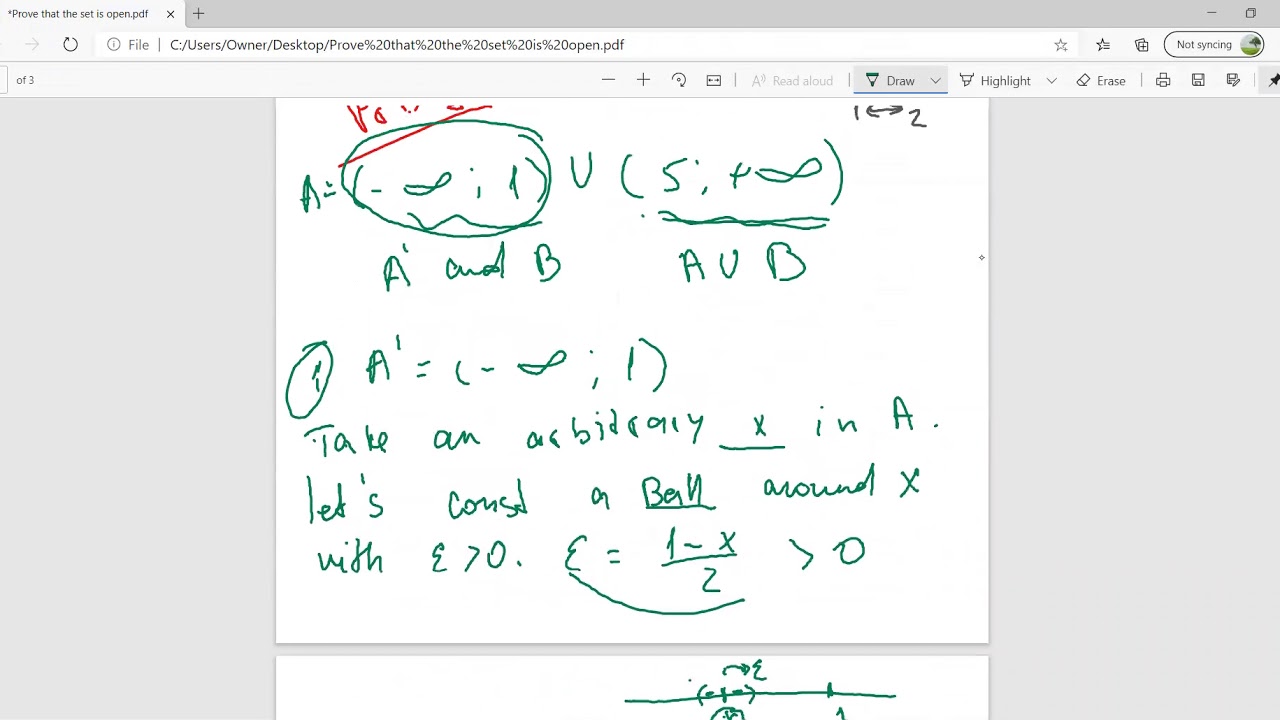


We introduce open sets in the context of the real numbers, along with examples and nonexamples of open sets. This is an important topic in the topology of the reals. We say a subset U of the reals is open if, for any x in U, there exists a delta-neighborhood of x that is contained in U. We'll prove that the real numbers are open, the empty set i...
wraith hinge
A C_ R is closed if (in R) if A^C = R\A is open
nova spire
Because clearly the problem is not that you can't prove it for 2D, it's that you've never proved it using the epsilon neighborhood definition
wraith hinge
what is Z in this case
nova spire
integers
wraith hinge
R is real numbers?
nova spire
yes
wraith hinge
All real numbers that arent intergers?
nova spire
yes
wraith hinge
what is the definition on an interger in english
nova spire
0, 1, -1, 2, -2, etc...
wraith hinge
i'd say its open
nova spire
ok, can you prove it?
nova spire
well then, i thought open sets in R were obvious
nova spire
nova spire
Because clearly the problem is not that you can't prove it for 2D, it's that you...
back to this problem
nova spire
yes, well you can guess what your teacher will reply to "it's very intuitive"
wraith hinge
i can
nova spire
yes
wraith hinge
sadly
nova spire
nova spire
Or this https://www.youtube.com/watch?v=pnWgj8jjs3w
So I would recommend this video to find examples of proofs of open sets
wraith hinge
would a proof be that between each interger is infintel many numbers?
wraith hinge
nova spire
So I would recommend this video to find examples of proofs of open sets
i've already seen this video
nova spire
wraith hinge
would a proof be that between each interger is infintel many numbers?
well no, "infinitely many numbers" doesn't guarantee "every non-integer has an epsilon neighborhood"
nova spire
wraith hinge
i've already seen this video
ok, so you must have seen that in the part "examples of open sets" for each x, we find an epsilon that gives us B(x,epsilon) an epsilon neighborhood
wraith hinge
i have seen examples of open sets
nova spire
wraith hinge
i have seen examples of open sets
I'm not talking about the open sets, I'm talking about the examples of proofs
wraith hinge
but he is just making a number line and saying
nova spire
wraith hinge
but he is just making a number line and saying
and saying delta = ...
wraith hinge
that is no different from what i am doing
nova spire
it is, you're not explicitely giving epsilon = ...