#help-38
1 messages · Page 47 of 1
 trim joltBOT
 tidal forge
Is there any more efficient way to do?
I'm thinking to do with line sketching, but how?
trim joltBOT
@tidal forge Has your question been resolved?
trim joltBOT
Channel closed
Closed due to timeout
Use .reopen if this was a mistake.
tidal forge
.reopen
trim joltBOT
✅
trim joltBOT
@tidal forge Has your question been resolved?
trim joltBOT
Channel closed
Closed due to timeout
Use .reopen if this was a mistake.
trim joltBOT
 Available help channel!
Send your question here to claim the channel.
Remember:
• Ask your math question in a clear, concise manner.
• Show your work, and if possible, explain where you are stuck.
• After 15 minutes, feel free to ping <@&286206848099549185>.
• Type the command .close to free the channel when you're done.
• Be polite and have a nice day!
Read #❓how-to-get-help for further information on how to ask a good question, and about conduct in the question channels.
 scarlet cape
What are the main topics in Calculus at the start of university? Like is trigonometry the main thing?
trim joltBOT
scarlet cape
What are the main topics in Calculus at the start of university? Like is trigon...
 zinc ginkgo
scarlet cape
What are the main topics in Calculus at the start of university? Like is trigon...
zinc ginkgo
scarlet cape
What are the main topics in Calculus at the start of university? Like is trigon...
This is better for #discussion . Help channels are for math problems
trim joltBOT
@scarlet cape Has your question been resolved?
trim joltBOT
Channel closed
Closed due to timeout
Use .reopen if this was a mistake.
trim joltBOT
Available help channel!
Send your question here to claim the channel.
Remember:
• Ask your math question in a clear, concise manner.
• Show your work, and if possible, explain where you are stuck.
• After 15 minutes, feel free to ping <@&286206848099549185>.
• Type the command .close to free the channel when you're done.
• Be polite and have a nice day!
Read #❓how-to-get-help for further information on how to ask a good question, and about conduct in the question channels.
trim joltBOT
Available help channel!
Send your question here to claim the channel.
Remember:
• Ask your math question in a clear, concise manner.
• Show your work, and if possible, explain where you are stuck.
• After 15 minutes, feel free to ping <@&286206848099549185>.
• Type the command .close to free the channel when you're done.
• Be polite and have a nice day!
Read #❓how-to-get-help for further information on how to ask a good question, and about conduct in the question channels.
 maiden parrot
Ok, so for context i go to a islamic school and we have a mosque in the school. Ok so on friday two previous gradutes form our school came back for friday prayer, after that they came in our class and sat down and made up a story that their grandpa died or something so they ahve not attended school much, then the teacher took us out and somebody told the teacher that they were not part of our class, then the teacher called them and asked them are you from the class and they said yes and then ignored her and then ran off in their car, now the admins are saying that they are going to take 10% overall mark off form the girls and 15% mark off from the boys since somebody didint tell the teacher that they were not from our school when she asked. ( I had not talked to them nor did i go and associate with them) what should i do now since this seems like a problem on the admin that a random stranger came in class and sat down.
trim joltBOT
maiden parrot
Ok, so for context i go to a islamic school and we have a mosque in the school. ...
maiden parrot
pls hlep me although not mah help
 pastel hedge
I don't think this is a maths question
Sounds like something you should take up with an advisor at your school or something
Or whatever government agency is responsible for education where you live
trim joltBOT
Channel closed
Closed by @maiden parrot
Use .reopen if this was a mistake.
maiden parrot
.reopen
trim joltBOT
✅
trim joltBOT
Channel closed
Closed by @maiden parrot
Use .reopen if this was a mistake.
Available help channel!
Send your question here to claim the channel.
Remember:
• Ask your math question in a clear, concise manner.
• Show your work, and if possible, explain where you are stuck.
• After 15 minutes, feel free to ping <@&286206848099549185>.
• Type the command .close to free the channel when you're done.
• Be polite and have a nice day!
Read #❓how-to-get-help for further information on how to ask a good question, and about conduct in the question channels.
 uncut needle
Can someone double check my work please? I’m trying to find the derivative of the original equation 2x / 1+x^2
 trim joltBOT
uncut needle
Can someone double check my work please? I’m trying to find the derivative of th...
trim joltBOT
uncut needle
Can someone double check my work please? I’m trying to find the derivative of th...
 austere cedar
2x•2x ≠ 4x
uncut needle
Would it be like this instead?
 trim joltBOT
@uncut needle Has your question been resolved?
uncut needle
.close
trim joltBOT
Channel closed
Closed by @uncut needle
Use .reopen if this was a mistake.
trim joltBOT
Available help channel!
Send your question here to claim the channel.
Remember:
• Ask your math question in a clear, concise manner.
• Show your work, and if possible, explain where you are stuck.
• After 15 minutes, feel free to ping <@&286206848099549185>.
• Type the command .close to free the channel when you're done.
• Be polite and have a nice day!
Read #❓how-to-get-help for further information on how to ask a good question, and about conduct in the question channels.
 foggy herald
 trim joltBOT
foggy herald
foggy herald
trim joltBOT
foggy herald
foggy herald
can someone help me?
 rugged latch
What’s the probability one die lands on a 2
foggy herald
1/6
rugged latch
What’s the probability one die lands on a 4
foggy herald
1/6
rugged latch
What’s the probability one die lands on a 2 or a 4
foggy herald
1/3
rugged latch
What’s the probability 2 dice lands on a 2 or a 4
rugged latch
You tell me haha, what’s your reasoning
foggy herald
well because if theres an or in the question then you add the probabilities
so
1/3 + 1/3?
rugged latch
So there’s 4 outcomes that we desire: a 2 on die 1, a 4 on die 1, a 2 on die 2, or a 4 on die 2
Do u agree?
rugged latch
How many total outcomes are there?
foggy herald
rugged latch
How many total outcomes are there?
so 24/36?
nvm i found out what i was doing weong lol
.close
trim joltBOT
Channel closed
Closed by @foggy herald
Use .reopen if this was a mistake.
rugged latch
trim joltBOT
Available help channel!
Send your question here to claim the channel.
Remember:
• Ask your math question in a clear, concise manner.
• Show your work, and if possible, explain where you are stuck.
• After 15 minutes, feel free to ping <@&286206848099549185>.
• Type the command .close to free the channel when you're done.
• Be polite and have a nice day!
Read #❓how-to-get-help for further information on how to ask a good question, and about conduct in the question channels.
 main olive
how to derive $\int \sec{x}dx$
trim joltBOT
main olive
how to derive $\int \sec{x}dx$
 solid kilnBOT
Jash
 solid kilnBOT
haylsGhost
 zinc ginkgo
Usual way is to multiply by sec(x) + tan(x) on the top and bottom
main olive
zinc ginkgo
Usual way is to multiply by sec(x) + tan(x) on the top and bottom
so $\int \frac{\sec²{x}+\sec{x}\tan{x}}{\sec{x}+\tan{x}}dx$
solid kilnBOT
Jash
 main olive
then what
main olive
u=secx i think
zinc ginkgo
 dull temple
oh that's cute
dull temple
oh that's cute
No u
dull temple
i don't think that will work because what are you going to do with the tan x?
main olive
ye so what u do you use
dull temple
secx + tanx
trim joltBOT
Channel closed
Closed by @main olive
Use .reopen if this was a mistake.
Available help channel!
Send your question here to claim the channel.
Remember:
• Ask your math question in a clear, concise manner.
• Show your work, and if possible, explain where you are stuck.
• After 15 minutes, feel free to ping <@&286206848099549185>.
• Type the command .close to free the channel when you're done.
• Be polite and have a nice day!
Read #❓how-to-get-help for further information on how to ask a good question, and about conduct in the question channels.
 inner kestrel
so if I have 3 < a < b
which is greater: a^b or b^a ?
idrk where to even start with this, I tried ln on both sides but it didnt rlly give me an answer
trim joltBOT
inner kestrel
so if I have 3 < a < b
which is greater: a^b or b^a ?
idrk where to even start ...
trim joltBOT
Channel closed
Closed by @inner kestrel
Use .reopen if this was a mistake.
Available help channel!
Send your question here to claim the channel.
Remember:
• Ask your math question in a clear, concise manner.
• Show your work, and if possible, explain where you are stuck.
• After 15 minutes, feel free to ping <@&286206848099549185>.
• Type the command .close to free the channel when you're done.
• Be polite and have a nice day!
Read #❓how-to-get-help for further information on how to ask a good question, and about conduct in the question channels.
 bronze hound
 trim joltBOT
bronze hound
trim joltBOT
bronze hound
 heady sedge
bronze hound
could someone explain this
heady sedge
bronze hound
could someone explain this
do you know what cis(x) means
bronze hound
yes
heady sedge
ok so we have this right
 bronze hound
right
heady sedge
which is this

and we are looking for theta

we dont want to deal with plus or minus
so what trig will relate -i and 1
bronze hound
uhhh pi/4?
heady sedge
bronze hound
uhhh pi/4?
tan(pi/4) is 1
bronze hound
oh so -pi/4
heady sedge
yeah
except cis(-pi/4) is sqrt(2)/2 - sqrt(2)/2*i
so how do we get
1-i
sqrt(2)/2*r = 1
actually this is a bad way to do it
so we have this triangle

and we want this

what do we multiply by
bronze hound
you multiple by sqrt 2?
 bronze hound
ok right
heady sedge
so we multiply by sqrt(x^2+y^2)
so to convert any rectangular coordinates x and y*i
we do
sqrt(x^2+y^2)*cis(arctan(y/x))
do you understand?
bronze hound
ya that makes sense
trim joltBOT
@bronze hound Has your question been resolved?
Channel closed
Closed by @bronze hound
Use .reopen if this was a mistake.
Available help channel!
Send your question here to claim the channel.
Remember:
• Ask your math question in a clear, concise manner.
• Show your work, and if possible, explain where you are stuck.
• After 15 minutes, feel free to ping <@&286206848099549185>.
• Type the command .close to free the channel when you're done.
• Be polite and have a nice day!
Read #❓how-to-get-help for further information on how to ask a good question, and about conduct in the question channels.
 drifting rose
can someone explain to me the justification for doing this part of the step for mathematical induction
 trim joltBOT
drifting rose
can someone explain to me the justification for doing this part of the step for ...
drifting rose
trim joltBOT
drifting rose
can someone explain to me the justification for doing this part of the step for ...
drifting rose
original question is (n+3)^2 <= 2^(n+3) where n is an interger n=>1
 low gazelle
You want to get a polynomial in the form (k+4)^2. This is the same as k^2+8k+16. If you compare term by term its obvious this is smaller than 2k^2+12k+18.
drifting rose
but how does that justify allowing you to replace it
because I understand replacing stuff from a given like a= 35 so therefore a+b = 5 is 35 + b = 5
low gazelle
It is not replaced. It is saying the 2k^2 polynomial is greater than the k^2 one
drifting rose

low gazelle
If I just said 2k^2+12k+18>k^2+8k+16 you would agree right
drifting rose
yes
drifting rose
oh were following the lines aren't we
OHHHH
wait why was it done there not like earlier
is it because they are similar or...
drifting rose

but why there can we do that
because before we subbed 2^(k+3) in as (k+3)^2
and thats obviously smaller than 2^(k+4)
am I only allowed to compare them when they are similar enough to each other
man
@low gazelle
soz for ping
low gazelle
drifting rose
am I only allowed to compare them when they are similar enough to each other
You can compare them if you can prove one is greater than the other. In the case of 2x^2+12k+18 and k^2+8k+16 though it is trivial
So you dont need to prove it
drifting rose
oh so you only do it when you know one is greater than the other
ahh

oh boy thats going to be hard to see
alright thanks for the help
.close
trim joltBOT
Channel closed
Closed by @drifting rose
Use .reopen if this was a mistake.
Available help channel!
Send your question here to claim the channel.
Remember:
• Ask your math question in a clear, concise manner.
• Show your work, and if possible, explain where you are stuck.
• After 15 minutes, feel free to ping <@&286206848099549185>.
• Type the command .close to free the channel when you're done.
• Be polite and have a nice day!
Read #❓how-to-get-help for further information on how to ask a good question, and about conduct in the question channels.
trim joltBOT
Available help channel!
Send your question here to claim the channel.
Remember:
• Ask your math question in a clear, concise manner.
• Show your work, and if possible, explain where you are stuck.
• After 15 minutes, feel free to ping <@&286206848099549185>.
• Type the command .close to free the channel when you're done.
• Be polite and have a nice day!
Read #❓how-to-get-help for further information on how to ask a good question, and about conduct in the question channels.
 quiet oasis
help :((
trim joltBOT
quiet oasis
help :((
quiet oasis

in synthetic division pls
i solved it and i checked it with a calcu, but my answer is diff
how do u do itt
trim joltBOT
Show your work, and if possible, explain where you are stuck.
 trim joltBOT
Please only use the <@&286206848099549185> ping once if your question has not been answered for 15 minutes. Please do not ping or DM individual users about your question.
@quiet oasis Has your question been resolved?
dull temple
you divided by x+1
dull temple
quiet oasis
you wanted to divide by (x+1)²
quiet oasis
how do u write that as a divisor??
dull temple
with the synthetic division you're doing it's kind of a pain
but you can just divide by (x+1) twice
quiet oasis
dull temple
with the synthetic division you're doing it's kind of a pain
yea, buts unfortunately its what our teacher want
dull temple
so just do it twice
quiet oasis
dull temple
but you can just divide by (x+1) twice
wdym
dull temple
well like
if you divide by 5 and then divide by 5 again, it's like you divided by 25 in the first place
quiet oasis
oh so, after i divide it by the divisor and get the quotient, i just divide the quotient with that divisor again??
dull temple
yeah since you're trying to divide by that divisor squared
quiet oasis
imma try it
dull temple
there's a way to do it all at once but it's just as much effort and harder to understand
quiet oasis
yea, our teacher kinda sucks how she doesn't explain certain stuff
WAIT NO WAY IT WORKED
dull temple
quiet oasis
yea, our teacher kinda sucks how she doesn't explain certain stuff
unfortunately common
dull temple
quiet oasis
WAIT NO WAY IT WORKED
of course it worked, it's algebra! 
trim joltBOT
Channel closed
Closed by @quiet oasis
Use .reopen if this was a mistake.
quiet oasis
 trim joltBOT
Available help channel!
trim joltBOT
Available help channel!
Send your question here to claim the channel.
Remember:
• Ask your math question in a clear, concise manner.
• Show your work, and if possible, explain where you are stuck.
• After 15 minutes, feel free to ping <@&286206848099549185>.
• Type the command .close to free the channel when you're done.
• Be polite and have a nice day!
Read #❓how-to-get-help for further information on how to ask a good question, and about conduct in the question channels.
 wraith hinge
Question: You have 1 Red candy, 2 blue candies and 3 green candies in a jar. You are taking them ouut one by one, what is the probability that there are at least 1 blue and 1 green candy lfet when you have taken out all the red candies
trim joltBOT
wraith hinge
Question: You have 1 Red candy, 2 blue candies and 3 green candies in a jar. You...
wraith hinge
I've seen the answer is 3/6 * 2/3 + 2/6 * 3/4 but am struggling to understand it
trim joltBOT
@wraith hinge Has your question been resolved?
wraith hinge
<@&286206848099549185>
 wild quail
Have you tried drawing a tree diagram?
wraith hinge
Not yet, would it have 3 branches initilly?
wild quail
Aight let’s not draw a tree diagram for this
I just had a better look
The probability that the last of the 6 candies taken out is green would be 3/6
wild quail
Then the probability that the last of the remaining 3 candies taken out is blue is 2/3
wild quail
 shrewd ridge
and then 1/3 of the time red is last out of blue +red
shrewd ridge
and then 1/3 of the time red is last out of blue +red
Yh so 2/3 would be blue
Now we can also do it vice versa
That being the probability of the last of the 6 candies being taken out being blue would be 2/6
Then the probability of the last of the 4 remaining candies being green would be 3/4
wraith hinge
wild quail
The probability that the last of the 6 candies taken out is green would be 3/6
sorry if it's dumb but why is it 3/6?
wild quail
Because there’s 3 green candies out of the total 6
wild quail
wild quail
Now we can also do it vice versa
For you were to draw a tree diagram, there would be 2 branches because there’s 2 possibilities but idk I wouldn’t for this
wraith hinge
why not 1/6 * 2/5 * 1/4 (first red then take out one of the blues then the last bblue) and then the sum of the different combinations ofthat
shrewd ridge
the probability that last is green is the same as first is green, or 4th is green
it's not obvious but that's how it works
it's not an easy problem to solve or explain
wild quail
wraith hinge
why not 1/6 * 2/5 * 1/4 (first red then take out one of the blues then the last ...
You could Ofc try that but then it would be much longer
wraith hinge
ah okok
shrewd ridge
,calc 1 - (1/6 + (2/6)(1/5)+(2/6)(1/5)(1/4) + (3/6)(2/5)(1/4)(1/3)+(3/6)(2/5)(1/4) + (3/6)(1/5))
solid kilnBOT
Result:
0.58333333333333
It should still lead to the same probability at the end as long as it’s done right
shrewd ridge
that's what i did to get the answer
wraith hinge
that's the right answer woah
wild quail
You could have many combinations and as long as it’s done right it should be right ^^
You could do a 3 branch tree diagram for this too
But I wouldn’t
wraith hinge
shrewd ridge
,calc 1 - (1/6 + (2/6)(1/5)+(2/6)(1/5)(1/4) + (3/6)(2/5)(1/4)(1/3)+(3/6)(2/5)(1/...
So is this 1 - the scenarios where you take out all the blue or green before taking out the red?
wraith hinge
wild quail
But I wouldn’t
ah ok
shrewd ridge
we fail if we draw red last
also we fail if we it goes ...rbb and if it goes ...rggg
but also ...rb and ...rg and ...rgg
so six things
still look backwards as in the short solution
wraith hinge
ah right ofc
wild quail
Did it make sense?
The way you were going to do it would’ve been right too as long as you did all the possibilities just wasn’t the fastest way
wraith hinge
wraith hinge
ah right ofc
Or do we fail if it's rggg? as the problem said what is the probability that there are at least 1 blue nd 1 green
afterr all the red candies are taken out
wild quail
wraith hinge
Or do we fail if it's rggg? as the problem said what is the probability that the...
Yh so you can’t do rggg
Because we need exactly 1g left at the end
wraith hinge
But after you take out the red (assuming it's the first draww) you have 3 green and 2 blue which are both at leaast 1 each?
wild quail
I meant exactly 1g
You need to keep going until you have exactly 1g and 1b left
If you wanted to do it 1 at a time
You could have rbgg
Or rgbg
shrewd ridge
it's not the first draw in any of the six cases
wild quail
wild quail
Or rgbg
Or rggb Or grgb and on and on
shrewd ridge
you're confusing rggg... and ...rggg
wraith hinge
hmm ok
I have to think about this problem some more but thank you both so much for your help
.close
trim joltBOT
Channel closed
Closed by @half anvil
Use .reopen if this was a mistake.
Available help channel!
Send your question here to claim the channel.
Remember:
• Ask your math question in a clear, concise manner.
• Show your work, and if possible, explain where you are stuck.
• After 15 minutes, feel free to ping <@&286206848099549185>.
• Type the command .close to free the channel when you're done.
• Be polite and have a nice day!
Read #❓how-to-get-help for further information on how to ask a good question, and about conduct in the question channels.
 smoky kite
Is this correct for Gaussian elimination
 trim joltBOT
smoky kite
Is this correct for Gaussian elimination
smoky kite
trim joltBOT
smoky kite
Is this correct for Gaussian elimination
smoky kite
And if so, are there no solutions because of the last row being absurd?
trim joltBOT
@smoky kite Has your question been resolved?
trim joltBOT
Channel closed
Closed due to timeout
Use .reopen if this was a mistake.
Available help channel!
Send your question here to claim the channel.
Remember:
• Ask your math question in a clear, concise manner.
• Show your work, and if possible, explain where you are stuck.
• After 15 minutes, feel free to ping <@&286206848099549185>.
• Type the command .close to free the channel when you're done.
• Be polite and have a nice day!
Read #❓how-to-get-help for further information on how to ask a good question, and about conduct in the question channels.
 mystic veldt
ik its physics, but its an easy one, wanted to ask why friction is not acting on the opposite side of friction in this FBD
 trim joltBOT
mystic veldt
ik its physics, but its an easy one, wanted to ask why friction is not acting on...
trim joltBOT
mystic veldt
ik its physics, but its an easy one, wanted to ask why friction is not acting on...
Please don't occupy multiple help channels.
@mystic veldt Has your question been resolved?
mystic veldt
.close
trim joltBOT
Channel closed
Closed by @mystic veldt
Use .reopen if this was a mistake.
Available help channel!
Send your question here to claim the channel.
Remember:
• Ask your math question in a clear, concise manner.
• Show your work, and if possible, explain where you are stuck.
• After 15 minutes, feel free to ping <@&286206848099549185>.
• Type the command .close to free the channel when you're done.
• Be polite and have a nice day!
Read #❓how-to-get-help for further information on how to ask a good question, and about conduct in the question channels.
 silver raven
 trim joltBOT
silver raven
silver raven
trim joltBOT
silver raven
silver raven
<@&286206848099549185>
trim joltBOT
Please only use the <@&286206848099549185> ping once if your question has not been answered for 15 minutes. Please do not ping or DM individual users about your question.
mystic veldt
!show
trim joltBOT
Show your work, and if possible, explain where you are stuck.
 silver raven
mystic veldt
!show
silver raven
mystic veldt
!show
help me work out in steps
wraith hinge
i think it might be the 2nd last and last one but iim not too sure myself @mystic veldt is that correct?
mystic veldt
wraith hinge
i think it might be the 2nd last and last one but iim not too sure myself <@7358...
idk
silver raven
mystic veldt
what can you write 8^4 as?
8x8x8x8
mystic veldt
also can be written as$(2^3)^4$?
solid kilnBOT
!Yajat!
 silver raven
mystic veldt
also can be written as$(2^3)^4$?
silver raven
mystic veldt
also can be written as$(2^3)^4$?
huhh
mystic veldt
,, 2^3=8
solid kilnBOT
!Yajat!
 silver raven
solid kiln
**!Yajat!**
silver raven
solid kiln
**!Yajat!**
but why the four
mystic veldt
mystic veldt
what can you write 8^4 as?
cuz this was the question
silver raven
mystic veldt
cuz this was the question
okay
mystic veldt
solid kiln
**!Yajat!**
okay now from laws of exponents can it be written as 2^12
mystic veldt
,, (m^a)^b=m^{a\times b}
solid kilnBOT
!Yajat!
 mystic veldt
silver raven
arent we supposed to mulityy 3 n 4 ?
mystic veldt
silver raven
arent we supposed to mulityy 3 n 4 ?
thats what i did
silver raven
nvm i got ocnfused on smt else
so ist 2 with the exponent 12 yeah
i do this exact steps on the 6 one too
mystic veldt
silver raven
i do this exact steps on the 6 one too
what?
,, 6 is already simplified, 6=2 \times 3
silver raven
silver raven
so ist 2^12 3^2
mystic veldt
no
silver raven
i dont understand i understood the 2^12 but not the other
mystic veldt
wait firsly, let us simplify this term only
then we will jump to the 6 part
okay so now its $\sqrt{2^{12}}$
silver raven
mystic veldt
wait firsly, let us simplify this term only
okay
solid kilnBOT
!Yajat!
 mystic veldt
solid kiln
**!Yajat!**
mystic veldt
solid kiln
**!Yajat!**
how would you solve this?
silver raven
mystic veldt
how would you solve this?
64?
mystic veldt
yea, better write it as 2^6 as the answers are somewhat given in this form
silver raven
mystic veldt
yea, better write it as 2^6 as the answers are somewhat given in this form
okay
mystic veldt
now simplify $\sqrt{6^4}$
solid kilnBOT
!Yajat!
 silver raven
solid kiln
**!Yajat!**
silver raven
solid kiln
**!Yajat!**
36?
silver raven
mystic veldt
please write it in the way i told you to
sorry i keep forgetting
silver raven
mystic veldt
6^2
yes
mystic veldt
so it is now $(2^6 \cdot 6^2)^{\frac{3}{2}}$
solid kilnBOT
!Yajat!
 mystic veldt
right?
silver raven
mystic veldt
right?
yes
mystic veldt
solid kiln
**!Yajat!**
what about you use this now?
silver raven
okay
silver raven
mystic veldt
what about you use this now?
9?
mystic veldt
yes
silver raven
aslo 3 on the second one
mystic veldt
$2^9\cdot 6^3$
solid kilnBOT
!Yajat!
 mystic veldt
this your answer now
silver raven
solid kiln
**!Yajat!**
yes
mystic veldt
so isnt that the second last option
silver raven
yes
silver raven
mystic veldt
so isnt that the second last option
yes
mystic veldt
no it wouldnt be
why do you think so?
why are you deleting it
if you have a doubt ask it
silver raven
mystic veldt
if you have a doubt ask it
i over confused myself n i relaised it so i deleted it dw abut that
silver raven
mystic veldt
so you got your answer now.
theres 2 anwser trying to figure out the second one
trim joltBOT
@silver raven Has your question been resolved?
Channel closed
Closed by @silver raven
Use .reopen if this was a mistake.
Available help channel!
Send your question here to claim the channel.
Remember:
• Ask your math question in a clear, concise manner.
• Show your work, and if possible, explain where you are stuck.
• After 15 minutes, feel free to ping <@&286206848099549185>.
• Type the command .close to free the channel when you're done.
• Be polite and have a nice day!
Read #❓how-to-get-help for further information on how to ask a good question, and about conduct in the question channels.
 strange inlet
Sarah places k objects into n boxes at random (i.e. with equal probability). Given that
the first box is empty, what is the probability that the second box is also empty?
trim joltBOT
strange inlet
Sarah places k objects into n boxes at random (i.e. with equal probability). Giv...
strange inlet
I found that P=(n-2)^k/(n-1)^k but I have a doubt
because when I calculate manually for 4 boxes and 3 objects I don't get the same value that from the formula
shrewd ridge
i don't understand that formula
why (n-1)^k
makes no sense
oh, you want to place more than one object
trim joltBOT
Channel closed
Closed by @strange inlet
Use .reopen if this was a mistake.
Available help channel!
Send your question here to claim the channel.
Remember:
• Ask your math question in a clear, concise manner.
• Show your work, and if possible, explain where you are stuck.
• After 15 minutes, feel free to ping <@&286206848099549185>.
• Type the command .close to free the channel when you're done.
• Be polite and have a nice day!
Read #❓how-to-get-help for further information on how to ask a good question, and about conduct in the question channels.
 odd galleon
calc// find where the function decreases and increases f(x) = x^(1/3) +1
 wooden mural
Hello there I did a proof for L'Hopital's rule for Derivatives of the 0/0 case using the definition of the derivative. One trouble I am having is that I know we have to continously imply L'Hopitals rule till we arrive at a limit that exists, but am trying to figure out the proof for it. Any ideas.

 uncut aspen
wooden mural
Hello there I did a proof for L'Hopital's rule for Derivatives of the 0/0 case u...
uncut aspen
wooden mural
Hello there I did a proof for L'Hopital's rule for Derivatives of the 0/0 case u...
please get your own help channel
wooden mural
odd galleon
calc// find where the function decreases and increases f(x) = x^(1/3) +1
So what we are going to do here is observe the concavity of the function.
uncut aspen
refer to #❓how-to-get-help
wooden mural
You need to start by observing the critical points.
odd galleon
okay
wooden mural
And then you need to test points within those intervals and determine the sign of the derivative which will thus indicate the behavior.
wooden mural
Set the derivative to 0 or DNE.
odd galleon
so no solution?
wooden mural
Well then its an extraneous solution. Here Ima take a look and work it out.
 wooden mural
So when we set the derivative equal to 0 there is no solution. However when we set the derivative equal to DNE we observe that x cannot equal 0.
And that is because our derivative would be infinity.
Now we set up our intervals
odd galleon
okay
first time i’ve heard of setting it equal to DNE
can you walk me through how to do
wooden mural
Interval: x > 0 & x < 0
f' sign: positive and positive
Behavior: increasing and increasing
 odd galleon
how’d you find that
wooden mural
odd galleon
first time i’ve heard of setting it equal to DNE
Sure, so the reason we also set it equal to Does Not Exist is because it gives us important information of the derivative.
I'll give you an example of a simpler function.
wooden mural
 odd galleon
yeah
wooden mural
If we observe this function and picturize a tangent line from both ends as x --> 0 the derivative would be infinity.
But we can't have that as the derivative has to be finite.
And it would therefore not exist.
odd galleon
yes
wooden mural
Now what our concern is the behavior of the function cause our end goal is to sketch the function.
Do you know about conacvity of functions?
wooden mural
taking the second derivative of the function have you learnt that yet?
odd galleon
yea
odd galleon
no
wooden mural
Mk are you a beginner in application of derivatives?
odd galleon
pretty much
wooden mural
Like just on the first unit sketching and analyzing functions?
odd galleon
yes
wooden mural
mk, ur gonna learn abt concavity later.
odd galleon
i think so
wooden mural
anwyays for now.
odd galleon
yeah
wooden mural
You always want to set the derivative equal to 0 and DNE. Remember that because there lies the possibility that a functions behavior can change.
for instance.
 odd galleon
okay
wooden mural
Here is the general formula you want to always apply when sketching and analyzing functions. Gimme a sec. Ima write it neatly for you.
odd galleon
alright thank you
wooden mural
np.
odd galleon
ping me when you finish
wooden mural
Follow this procedure if you want to determine the behavior of a function.
wooden mural
 wooden mural
odd galleon
ill ping if i need any more help
wooden mural
odd galleon
ill ping if i need any more help
I'll probs be busy, but I'm sure someone else will help if thats the case.
Gl wit it. Its quite an interesting unit man.
trim joltBOT
Channel closed
Closed by @odd galleon
Use .reopen if this was a mistake.
trim joltBOT
Available help channel!
Send your question here to claim the channel.
Remember:
• Ask your math question in a clear, concise manner.
• Show your work, and if possible, explain where you are stuck.
• After 15 minutes, feel free to ping <@&286206848099549185>.
• Type the command .close to free the channel when you're done.
• Be polite and have a nice day!
Read #❓how-to-get-help for further information on how to ask a good question, and about conduct in the question channels.
 daring brook
 trim joltBOT
daring brook
trim joltBOT
trim joltBOT
daring brook
trim joltBOT
Channel closed
Closed by @daring brook
Use .reopen if this was a mistake.
Available help channel!
Send your question here to claim the channel.
Remember:
• Ask your math question in a clear, concise manner.
• Show your work, and if possible, explain where you are stuck.
• After 15 minutes, feel free to ping <@&286206848099549185>.
• Type the command .close to free the channel when you're done.
• Be polite and have a nice day!
Read #❓how-to-get-help for further information on how to ask a good question, and about conduct in the question channels.
 true bridge
How do I prove that hyperspaces are convex but not affine, when I follow the same format as the proof given here it doesn't work
 trim joltBOT
true bridge
How do I prove that hyperspaces are convex but not affine, when I follow the sam...
true bridge
trim joltBOT
true bridge
How do I prove that hyperspaces are convex but not affine, when I follow the sam...
true bridge
i.e. why must theta be limited to [0,1] in the case of hyperspaces
trim joltBOT
@true bridge Has your question been resolved?
 left oriole
take a point on the boundary and another point not on the boundary
if you allowed arbitrary affine combinations then the entire line containing those points would have to be in the hyperspace
but that line is not parallel to the boundary, so part of the line is outside the hyperplane
whereas if you consider only convex combinations (theta in [0,1]) then you only consider the line segment between those two points, not the entire line
true bridge
I see, intuitively I see why however when I try to formally prove it where is the contradiction.

I've allowed theta to be any real number but it needs to tonly be from 0 to 1

 calm anchor
Yeah I’m stuck on that part let me just fix up the work and I’ll show where I’m stuck
Here it is idk what to do from where I am at

Was I supposed to use the quotient rule first ?
true bridge
$5 \left( \frac{x}{x+1} \right)^4 \frac{d}{dx} \left( \frac{x}{x+1} \right)$ chain rule then quotient rule
solid kilnBOT
Master Wanky
 true bridge
@left oriole any updates big bro 😦
trim joltBOT
@true bridge Has your question been resolved?
trim joltBOT
Channel closed
Closed due to timeout
Use .reopen if this was a mistake.
Available help channel!
Send your question here to claim the channel.
Remember:
• Ask your math question in a clear, concise manner.
• Show your work, and if possible, explain where you are stuck.
• After 15 minutes, feel free to ping <@&286206848099549185>.
• Type the command .close to free the channel when you're done.
• Be polite and have a nice day!
Read #❓how-to-get-help for further information on how to ask a good question, and about conduct in the question channels.
 trim hawk
is the top row of pascal’s triangle row 0 or row 1?
trim hawk
ping me if u respond pls
wraith hinge
trim hawk
is the top row of pascal’s triangle row 0 or row 1?
0th row is just [1]
then 1st is [1,1] etc
trim joltBOT
Channel closed
Closed by @trim hawk
Use .reopen if this was a mistake.
Available help channel!
Send your question here to claim the channel.
Remember:
• Ask your math question in a clear, concise manner.
• Show your work, and if possible, explain where you are stuck.
• After 15 minutes, feel free to ping <@&286206848099549185>.
• Type the command .close to free the channel when you're done.
• Be polite and have a nice day!
Read #❓how-to-get-help for further information on how to ask a good question, and about conduct in the question channels.
 warm kernel
 trim joltBOT
warm kernel
https://johnkerl.org/doc/eix.pdf
warm kernel
trim joltBOT
warm kernel
https://johnkerl.org/doc/eix.pdf
warm kernel
Can someone explain to me the definition, foiling, and collecting terms part?
I don't understand how it became
(cos a + i sin a)(cos B + i sin B)
(the doc is proving the cos and sin addition and subtraction rule)
ohh okay....
.close
trim joltBOT
Channel closed
Closed by @warm kernel
Use .reopen if this was a mistake.
trim joltBOT
Available help channel!
Send your question here to claim the channel.
Remember:
• Ask your math question in a clear, concise manner.
• Show your work, and if possible, explain where you are stuck.
• After 15 minutes, feel free to ping <@&286206848099549185>.
• Type the command .close to free the channel when you're done.
• Be polite and have a nice day!
Read #❓how-to-get-help for further information on how to ask a good question, and about conduct in the question channels.
 wind mortar
hello
trim joltBOT
wind mortar
hello
wind mortar
how do i find the domain of Arccos(cos(x)) ?
trim joltBOT
@wind mortar Has your question been resolved?
wind mortar
<@&286206848099549185>
trim joltBOT
@wind mortar Has your question been resolved?
trim joltBOT
Channel closed
Closed due to timeout
Use .reopen if this was a mistake.
Available help channel!
Send your question here to claim the channel.
Remember:
• Ask your math question in a clear, concise manner.
• Show your work, and if possible, explain where you are stuck.
• After 15 minutes, feel free to ping <@&286206848099549185>.
• Type the command .close to free the channel when you're done.
• Be polite and have a nice day!
Read #❓how-to-get-help for further information on how to ask a good question, and about conduct in the question channels.
 ornate quiver
 trim joltBOT
ornate quiver
trim joltBOT
ornate quiver
 boreal dome
A and B are included in U
ornate quiver
meaning?
I have to create a larger circle than the venn diagram that represents U?
boreal dome
A have elements of U
 forest egret
think of the universal set as elements you are focusing on
forest egret
an element is the thing in sets
ornate quiver
ok
boreal dome
I cant explain it better than this

 vagrant marsh
Diagram is a little off, A and B share an element
ornate quiver
8 is not in both a and b
forest egret
so where is 8 in the diagram?
vagrant marsh
boreal dome
i was just explaining the "included in" part
Ah ok
 trim joltBOT
Channel closed
Closed by @ornate quiver
Use .reopen if this was a mistake.
Available help channel!
Send your question here to claim the channel.
Remember:
• Ask your math question in a clear, concise manner.
• Show your work, and if possible, explain where you are stuck.
• After 15 minutes, feel free to ping <@&286206848099549185>.
• Type the command .close to free the channel when you're done.
• Be polite and have a nice day!
Read #❓how-to-get-help for further information on how to ask a good question, and about conduct in the question channels.
 sturdy holly
 trim joltBOT
sturdy holly
trim joltBOT
sturdy holly
 royal remnant
trim joltBOT
royal remnant
trim joltBOT
@sturdy holly Has your question been resolved?
Channel closed
Closed by @sturdy holly
Use .reopen if this was a mistake.
Available help channel!
Send your question here to claim the channel.
Remember:
• Ask your math question in a clear, concise manner.
• Show your work, and if possible, explain where you are stuck.
• After 15 minutes, feel free to ping <@&286206848099549185>.
• Type the command .close to free the channel when you're done.
• Be polite and have a nice day!
Read #❓how-to-get-help for further information on how to ask a good question, and about conduct in the question channels.
 wooden plover
<@&268886789983436800> spam
 fair bison
trim joltBOT
fair bison
trim joltBOT
Channel closed
Closed by @fair bison
Use .reopen if this was a mistake.
Available help channel!
Send your question here to claim the channel.
Remember:
• Ask your math question in a clear, concise manner.
• Show your work, and if possible, explain where you are stuck.
• After 15 minutes, feel free to ping <@&286206848099549185>.
• Type the command .close to free the channel when you're done.
• Be polite and have a nice day!
Read #❓how-to-get-help for further information on how to ask a good question, and about conduct in the question channels.
 noble vector
 trim joltBOT
noble vector
https://cdn.discordapp.com/attachments/238956921581862913/1145689303482109983/20...
trim joltBOT
noble vector
https://cdn.discordapp.com/attachments/238956921581862913/1145689303482109983/20...
 quasi wasp
isn't it actually -1/12?
warm kernel
Distributive law doesn't work over infinite sums.
quasi wasp
why not?
noble vector
^
warm kernel

Head to https://squarespace.com/brithemathguy to save 10% off your first purchase of a website or domain using code BRITHEMATHGUY
What is the sum of all the natural numbers?! Of course the answer is obvious...right? Many have actually pointed to the result that the sum of natural numbers is negative 1/12 !
We're going to do a 1+2+3+...=-1/12 ...
Just watch this, it'll be pretty hard to explain without any visuals.
noble vector
is there a stack exchange page with that property or whatever u call with distributive thingy not working over infinite sum?
noble vector
warm kernel
https://youtu.be/oaZKaV-oZ-g
in addition to this ofc
warm kernel
I can't really prove it tbh, it's an assumption.
noble vector
warm kernel
I can't really prove it tbh, it's an assumption.
no not you
do you know what it’s called
warm kernel
I don't really know, sorry.
warm kernel
But there are also multiple evidence that proves it's wrong
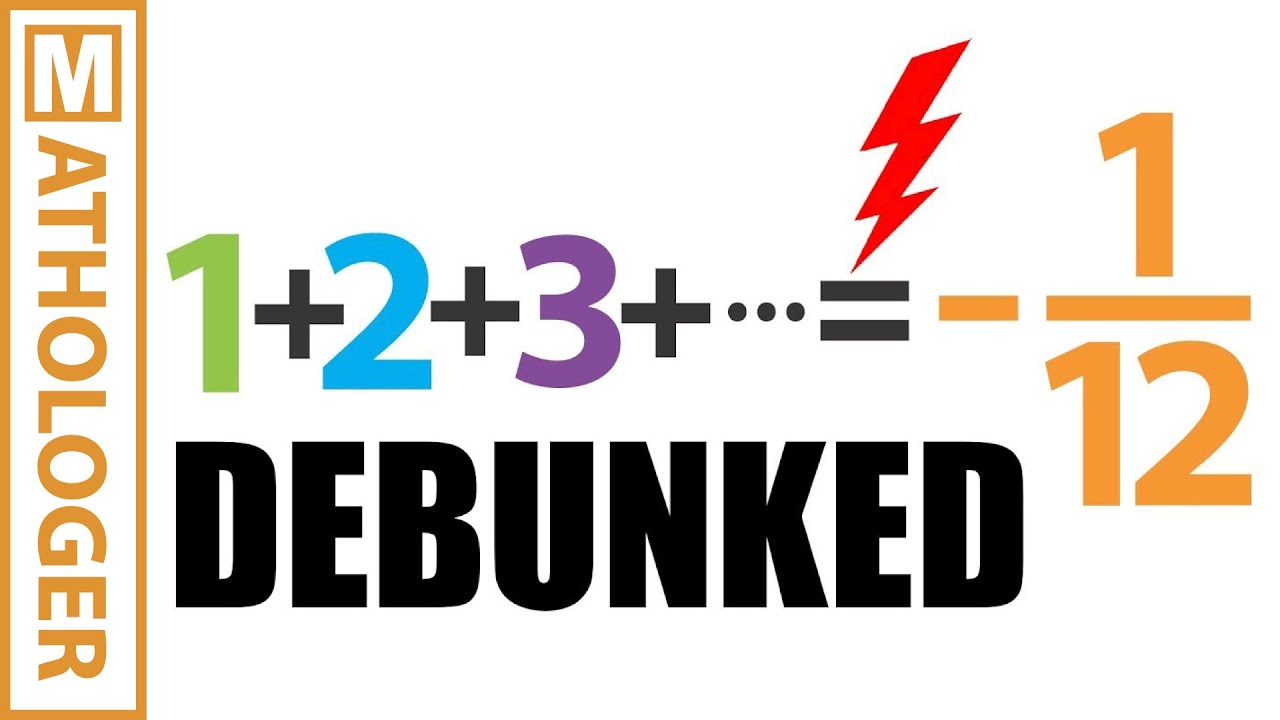
Confused 1+2+3+…=-1/12 comments originating from that infamous Numberphile video keep flooding the comment sections of my and other math YouTubers videos. And so I think it’s time to have another serious go at setting the record straight by having a really close look at the bizarre calculation at the center of the Numberphile video, to state cle...
quasi wasp
here, he is using the distributive property
 warm kernel
Distributive law doesn't work over infinite sums.
warm kernel
warm kernel
Distributive law doesn't work over infinite sums.
not the distributive law, i'm not really sure about that
noble vector
quasi wasp
here, he *is* using the distributive property
lol i just noticed too
warm kernel
quasi wasp
here, he *is* using the distributive property
to show that it's wrong.
quasi wasp
warm kernel
to show that it's wrong.
oh, yeah... i didn't watch the whole vid
warm kernel
there are multiple videos and articles that has debunked all of those "proofs"
just search it up.
 noble vector
quasi wasp
noble vector
quasi wasp
right right so basically the takeaway is infinite distributive law doesn't hold if the series doesn't converge
didn't quite get the riemann zeta part though
quasi wasp
noble vector
right right so basically the takeaway is infinite distributive law doesn't hold ...
yeahh
noble vector
like okay i get that we're using it beyond the domain it's defined for but hmm
analytic continuation?
okay nice video
thanks @warm kernel @quasi wasp
trim joltBOT
@noble vector Has your question been resolved?
trim joltBOT
Channel closed
Closed due to timeout
Use .reopen if this was a mistake.
trim joltBOT
Available help channel!
Send your question here to claim the channel.
Remember:
• Ask your math question in a clear, concise manner.
• Show your work, and if possible, explain where you are stuck.
• After 15 minutes, feel free to ping <@&286206848099549185>.
• Type the command .close to free the channel when you're done.
• Be polite and have a nice day!
Read #❓how-to-get-help for further information on how to ask a good question, and about conduct in the question channels.
 shy thorn
Hey guys im dealing with languages and regular expressions as well as regularity and irregularity.. In the first screen shot we prove the language is not regular via pumping lemma. However in the second screenshot the language satisfies all these definitions thus resulting in a regular language?

 trim joltBOT
shy thorn
Hey guys im dealing with languages and regular expressions as well as regularity...
dull temple
shy thorn
Hey guys im dealing with languages and regular expressions as well as regularity...
trim joltBOT
shy thorn
Hey guys im dealing with languages and regular expressions as well as regularity...
dull temple
shy thorn
Hey guys im dealing with languages and regular expressions as well as regularity...
the second thing is talking about a regular expression, and I don't see one for that language
shy thorn

What if I were to use this method instead. Try to come up with a regular expression for my language
dull temple
try it!
trim joltBOT
@shy thorn Has your question been resolved?
trim joltBOT
Channel closed
Closed due to timeout
Use .reopen if this was a mistake.
trim joltBOT
Available help channel!
Send your question here to claim the channel.
Remember:
• Ask your math question in a clear, concise manner.
• Show your work, and if possible, explain where you are stuck.
• After 15 minutes, feel free to ping <@&286206848099549185>.
• Type the command .close to free the channel when you're done.
• Be polite and have a nice day!
Read #❓how-to-get-help for further information on how to ask a good question, and about conduct in the question channels.
 errant pike
 trim joltBOT
errant pike
errant pike
trim joltBOT
errant pike
errant pike
Did I verify this right? Or Do i have mistakes?
errant pike
Haha what a coincidence
 lost wharf
..
wraith hinge
how did you get to the third line?
wraith hinge
fourth equality i mean
errant pike
That's where i went random Haha
Dunno what i'm doing
I tried trial and errors But i can't find a suitable one
Hmm?
So Like it would be 1+cosx/1-cosx?
wraith hinge
explain to me the fifth and sixth equality
errant pike
wraith hinge
explain to me the fifth and sixth equality
I just tried my best to come up with that.... Thats my explaination
Idk also why icame up with that
Haha
I'm dead at trigo
wraith hinge
try doing the common denominator right from the beginning
errant pike
With Sine?
wraith hinge
without replacing csc and cot
errant pike
 wraith hinge

here it is how i would've solve it
sorry for the handwriting , i know it isn't the best i've got alot of complaints
errant pike
No no... You've helped Me a lot
I'm thankful
Ohhh @wraith hinge you used phytagorean
I didn't know you can use it here
Hahahaha
Thanks
solid kilnBOT
john.
 wraith hinge
if you devise the whole thing by sin^2 you get the identity that i have used
if you devise it by cos^2 you get 1+ tan^2 =sec^2
and i have used (a-b)(a+b)=a^2-b^2
errant pike
Ohhhhhh
I see
Imma learn It tom
Now I sleep
Hahaha
Thanks For helping me Dear same name
.close
trim joltBOT
Channel closed
Closed by @errant pike
Use .reopen if this was a mistake.
Available help channel!
Send your question here to claim the channel.
Remember:
• Ask your math question in a clear, concise manner.
• Show your work, and if possible, explain where you are stuck.
• After 15 minutes, feel free to ping <@&286206848099549185>.
• Type the command .close to free the channel when you're done.
• Be polite and have a nice day!
Read #❓how-to-get-help for further information on how to ask a good question, and about conduct in the question channels.
 languid fog
can sombody help me about how to integrate this liner over quadratic?

 delicate belfry
So this is your integral: $$\int \frac{1-x}{(1+x)^2};dx$$
solid kilnBOT
Good
 delicate belfry
Are there any thoughts that you immediatly came up with when looking at this integral?
languid fog
delicate belfry
Are there any thoughts that you immediatly came up with when looking at this int...
yeah but nothing worked
delicate belfry
If you got the integral:$$\int \frac{x}{(1+x)^2};dx$$ How would you solve for it?
solid kilnBOT
Good
 languid fog
maybe by parts
delicate belfry
Alright, that might be a way. But what if I asked you to do substitution integration?
Will it be a way for you to solve it?
delicate belfry
Have you learned about substitution integration before?
languid fog
yes
delicate belfry
How does substituion integration work?
languid fog
something like u= 1+x then du= 1 then you replace and such...
delicate belfry
languid fog
something like u= 1+x then du= 1 then you replace and such...
Alright: $$\int \frac{x}{u^2};du$$
solid kilnBOT
Good
 delicate belfry
You're on the right track. But how about x? What could you do to make it u? If u = x + 1?
languid fog
x= u-1
I'm not bad at math i took B= in calclus 1 and 2 but it is been a long time since i solved a question
I forgot some of the rules
thats it
delicate belfry
This is your algebra intuition. But is that really true if we convert u to x again?
Our u is x + 1, when making u to x again, you get x + 1 - 1, which is just x.
But that doesn't seem as what u is that we defined before, which is u = x + 1.
delicate belfry
The point here is converting u and x. Our definition is u = x + 1, which means when we convert u to x again, we want x + 1.
languid fog
okay
delicate belfry
solid kiln
**Good**
If u = x + 1, then the numerator is missing the 1.
languid fog
what does this has to do with the problem I gave you
just give me an example that would be easier as english is not my mother tounge
delicate belfry
The question you gave is related to substituion integration.
languid fog
the square is just on the x not the whole x+1
solid kilnBOT
Good
 delicate belfry
Then it's part integration that you mentioned.
delicate belfry
solid kiln
**Good**
With the concept of the example, do the same with your question.
languid fog
so my main problem is integration by parts?
without supstitution
becuase it already looks like this

I can't use substitution on it
delicate belfry
I'm not sure if you could just dive into part integration, but it seems expect you to use substitution integration initially.
languid fog
I tried and it didn't work
delicate belfry
What if I did this instead? $$\int \frac{1-x}{(x+1)^2};dx$$
solid kilnBOT
Good
 delicate belfry
Are there any thoughts now?
languid fog
why do you keep putting the square on x+1
it is only on x
here I could just use partial fraction after playing with x+1 squared but that is not my problem
delicate belfry
languid fog
it is only on x
My bad, I saw you used parathesis, so I thought it was (1+x)^2 the whole time.
delicate belfry
So this question involves solving two integrals, meaning you're going to split the integration to two.
languid fog
how can I do this
delicate belfry
Just like fractions $\frac{a + 1}{b} => \frac{a}{b} + \frac{1}{b}$
solid kilnBOT
Good
 languid fog
there is a + constant on both sides
delicate belfry
What do you mean by that?
delicate belfry
$\frac{a - 1}{b} => \frac{a}{b} - \frac{1}{b}$
solid kilnBOT
Good
 delicate belfry
$$\int \frac{1-x}{1+x^2};dx$$ $$=>\int (\frac{1}{1+x^2}-\frac{x}{1+x^2});dx$$ $$=>\int (\frac{1}{1+x^2}); dx - \int (\frac{x}{1+x^2});dx$$
 delicate belfry
languid fog
how would you do this if the denominator is b+1 ?
delicate belfry
languid fog
how would you do this if the denominator is b+1 ?
$\frac{b - 1}{b} => \frac{b}{b} - \frac{1}{b} => 1 - \frac{1}{b} $
languid fog
THE SQUARE IS ONLY ON THE X
languid fog
what makes me satisfied?
delicate belfry
That I finally did it correctly.
languid fog
thanks for the help
forgive me
I'm al little bit stupid
sorry for speaking to you like this
delicate belfry
languid fog
sorry for speaking to you like this
All fine, it was my fault that I didn't see the expression correctly.
languid fog
the first is tan invers and the second is substitution right?
Thank you for your time and sorry again for being rude
solid kilnBOT
Good
 delicate belfry
languid fog
Thank you for your time and sorry again for being rude
delicate belfry
languid fog
Thank you for your time and sorry again for being rude
All fine.
 trim joltBOT
@languid fog Has your question been resolved?
Channel closed
Closed by @languid fog
Use .reopen if this was a mistake.
Available help channel!
Send your question here to claim the channel.
Remember:
• Ask your math question in a clear, concise manner.
• Show your work, and if possible, explain where you are stuck.
• After 15 minutes, feel free to ping <@&286206848099549185>.
• Type the command .close to free the channel when you're done.
• Be polite and have a nice day!
Read #❓how-to-get-help for further information on how to ask a good question, and about conduct in the question channels.
Channel closed
Channel closed due to the original message being deleted.
If you did not intend to do this, please open a new help channel,
as this action is irreversible, and this channel may abruptly lock.
 sweet ferry
 trim joltBOT
Available help channel!
trim joltBOT
Available help channel!
Send your question here to claim the channel.
Remember:
• Ask your math question in a clear, concise manner.
• Show your work, and if possible, explain where you are stuck.
• After 15 minutes, feel free to ping <@&286206848099549185>.
• Type the command .close to free the channel when you're done.
• Be polite and have a nice day!
Read #❓how-to-get-help for further information on how to ask a good question, and about conduct in the question channels.
 desert lichen
How does this work?
 trim joltBOT
desert lichen
How does this work?
trim joltBOT
desert lichen
How does this work?
 crimson cedar


 fiery goblet
desert lichen
How does this work?
fiery goblet
desert lichen
How does this work?

This algebra video tutorial provides a basic introduction into natural logarithms. It explains how to evaluate natural logarithmic expressions with the natural base e and how to evaluate exponential expressions with natural logs in on the exponent of the natural base e using properties of logarithms. This video contains plenty of examples and ...
trim joltBOT
@desert lichen Has your question been resolved?
trim joltBOT
Channel closed
Closed due to timeout
Use .reopen if this was a mistake.
Available help channel!
Send your question here to claim the channel.
Remember:
• Ask your math question in a clear, concise manner.
• Show your work, and if possible, explain where you are stuck.
• After 15 minutes, feel free to ping <@&286206848099549185>.
• Type the command .close to free the channel when you're done.
• Be polite and have a nice day!
Read #❓how-to-get-help for further information on how to ask a good question, and about conduct in the question channels.
wraith hinge
The mean and variance of the hypergeometric distribution $\map h{x;N,n,k}$ are [
\mu = \f{nk}{N} \tss{and} \sigma^2 = \f{N-n}{N-1} \cdot n \cdot \f k N \parens{1-\f k N}
]
trim joltBOT
wraith hinge
The mean and variance of the hypergeometric distribution $\map h{x;N,n,k}$ are \...
solid kilnBOT
 wraith hinge
i am trying to prove this but i really have no idea 
zinc ginkgo
do you know the formula for the pmf?
wraith hinge
can u show if u can
 wraith hinge
oh probability mass function
yes i do
wait
[
\map E X = \sum_{x=0}^m x\f{\binom k x \binom{N-k}{n-x}}{\binom N n}
]
solid kilnBOT
 wraith hinge
so like
ugh i have to remember some combinatoric bullshit identities dont i
okay one sec
 wintry stag
It's usually just a matter of absorbing the x into the n choose k terms and then splitting it into up or changing the indices in such a way that you have something multiplied by a known probability distribution. These kind of problems are not really that enlightening in my opinion
zinc ginkgo
 white merlin
help <#423244559682764800> idk how to
white merlin
help <#423244559682764800> idk how to
!noadvert
trim joltBOT
white merlin
help <#423244559682764800> idk how to
Please do not advertise your help channel or thread in other parts of the server. There are many people who need help, and no one person can be prioritized over other people, so please patiently wait. Anyone who chooses to help you is a volunteer who is doing so out of their own kindness.
wraith hinge
oh i see lol
set $z = x-1$, [
\f{nk}N \sum_{z=0}^{n-1} \f{\binom{k-1}z \binom{(N-1)-(k-1)}{n-1-z}}{\binom{N-1}{n-1}}
]
i think
so you just get nk/N
oh wait
solid kilnBOT
 wraith hinge
ok so thats neat lol
wraith hinge
wintry stag
It's usually just a matter of absorbing the x into the n choose k terms and then...
thanks doe
.close
trim joltBOT
Channel closed
Closed by @ionic frigate
Use .reopen if this was a mistake.
 trim joltBOT
Available help channel!
trim joltBOT
Available help channel!
Send your question here to claim the channel.
Remember:
• Ask your math question in a clear, concise manner.
• Show your work, and if possible, explain where you are stuck.
• After 15 minutes, feel free to ping <@&286206848099549185>.
• Type the command .close to free the channel when you're done.
• Be polite and have a nice day!
Read #❓how-to-get-help for further information on how to ask a good question, and about conduct in the question channels.
 sudden lagoon
In measure theory, I want to find the lebesgue measure of the interval [0,1] without the numbers in which 7 appears in the first second and third decimal place
trim joltBOT
sudden lagoon
In measure theory, I want to find the lebesgue measure of the interval [0,1] wit...
sudden lagoon
So with regards to the first decimal place I have an interval [0,0.7]U[0.8,1]
For the second decimal place I have [0,0.07]U[0.08,0.17]….
And similarly for the third decimal place
Where I have unions of 2, 11, and 101 intervals respectively
How do I combine these to get the total lebesgue measure in this case
zinc ginkgo
might be easier to find the measure of the complement of each
for the second decimal place, group the intervals into equal sized lengths
 weak kelp
!status
trim joltBOT
What step are you on?
1. I don't know where to begin.
2. I have begun but got stuck midway.
3. I got an answer but I was told that it's wrong.
4. I got an answer and would like my work checked.
5. I have a question about someone else's work/solution.
6. I have completed the problem and don't need help anymore. Thank you.
7. None of the above
!occupied
trim joltBOT
weak kelp
!status
Someone else is already using this help channel. If you need help with a question, please open your own help channel/thread (see #❓how-to-get-help for instructions).
weak kelp
zinc ginkgo
!occupied
mb
sudden lagoon
zinc ginkgo
for the second decimal place, group the intervals into equal sized lengths
So we’re looking at the interval we’re discarding, namely 10 intervals of length 0.01?
So in the case of the first decimal place, we’ve discarded an interval of length 0.1, for the second decimal place we’ve discarded 10 intervals of length 0.01, and for the third decimal place we’ve discarded 100 intervals of length 0.001
trim joltBOT
@sudden lagoon Has your question been resolved?
sudden lagoon
<@&286206848099549185>
sudden lagoon
<@&286206848099549185>
calm anchor
Help me
 sudden lagoon
!occupied
trim joltBOT
Someone else is already using this help channel. If you need help with a question, please open your own help channel/thread (see #❓how-to-get-help for instructions).
 naive crest
if your number has 7 in the first, second, and third decimal place, you can write it 0.777... with ... meaning whatever after
unless you meant or
sudden lagoon
I meant or, apologies
naive crest
then you can follow riemann advice
the number 0.7... are [0.7, 0.8[ so 0.1 of measure
then the number 0.x7 are [0.x7, 0.x8[ are of measure 0.01, and we count them for x = 0, 1, 2, 3, 4, 5, 6, 8, 9 (we already counted for 7)
so the total measure is for now 0.1+9*0.01
and you do the same for the third place
and you subtract that from [0, 1]
sudden lagoon
And the third place we’d have [0.xx7,0.xx8] of measure 0.001
Where neither position contains an x?
naive crest
where neither x is a 7 yeah
since we already counted for 7 in first and 2nd
the xx can be 00, or 01, or ... 06 or 08 etc
81 choices
naive crest
yes
also, there is another way of counting which was combinatorics, but I assumed you wanted to calculate some measure bc it was measure theory
sudden lagoon
Yea no you’re right, and it completely makes sense
I think again for today you’ve been a great help, thanks a million!
.close
trim joltBOT
Channel closed
Closed by @sudden lagoon
Use .reopen if this was a mistake.
Available help channel!
Send your question here to claim the channel.
Remember:
• Ask your math question in a clear, concise manner.
• Show your work, and if possible, explain where you are stuck.
• After 15 minutes, feel free to ping <@&286206848099549185>.
• Type the command .close to free the channel when you're done.
• Be polite and have a nice day!
Read #❓how-to-get-help for further information on how to ask a good question, and about conduct in the question channels.
wraith hinge
 trim joltBOT
wraith hinge
trim joltBOT
wraith hinge
What step are you on?
1. I don't know where to begin.
2. I have begun but got stuck midway.
3. I got an answer but I was told that it's wrong.
4. I got an answer and would like my work checked.
5. I have a question about someone else's work/solution.
6. I have completed the problem and don't need help anymore. Thank you.
7. None of the above
- I have an answer and I want to know why it's wrong
trim joltBOT
Show your work, and if possible, explain where you are stuck.
wraith hinge
if X=number of diesel cars, we are looking for P(x>1), wich is equal to 1-(P(x=0)+P(x=1)) since we have 5% chance to have a diesel car, Poisson's probability is 0.05*4=0.2. I think my Poisson's probability is wrong though since my answer is 0.001209
here is what ive done so far
naive crest
the number of Diesel's among 4 already filled spots car follows binomial distrib since it's a repeated independent event with a probability of 0.05
wraith hinge
uhm intersting
how can you describe the binomial probability? x\sim B(4,0.05) or x\sim B(4,0.2) ?
wraith hinge
yup i think i have it
i have 0.014018749999999
it's correct!
i'll go on with the 2 other problems
trim joltBOT
@wraith hinge Has your question been resolved?
naive crest
it was still not poisson for q2
wraith hinge
how can you tell if its poisson or not?
naive crest
you're looking for a probability of first success, it's geometric
wraith hinge
i think thats the issue
naive crest
the probability that an appearing car is a diesel car is 0.05 for each car that comes, the cars are independent
and they ask for the probability that to see at least 15 cars to see a first diesel car
so they're asking for P(X >= 15) where X follows a law of first success
the law that describes this situation is called geometric distribution, and is the discrete equivalent of Poisson
wraith hinge
ok i'll try again
 wraith hinge
first question is right though
naive crest
oh yeah ?
wraith hinge
yes
naive crest
the question is weird
bc there is only one spot for diesel at the gas station
so it's impossible that 4 cars at the gas station needs diesel
we could have interpreted the probability to be 0
wraith hinge
yes, that's what i initially thought, but they could be at the gas station but not refuelinh
naive crest
yeah I guess, that was ambiguous
for a sec I thought the question was a troll after reading for the 4 spots
wraith hinge
i saw it comming tried it first and lost a couple points
oops
is the geometric law for probability : p(X>=x)=(1-p)^(x-1) ?
naive crest
yes
naive crest
I find 0.48765, around that
wraith hinge
oh yeah
i found it too missed my formula
it's correct!
Last question now
i have an average profit of 1369,50$
naive crest
that's way too much
wraith hinge
there are 66 cars per hour
trim joltBOT
Channel closed
Closed by @zealous light
Use .reopen if this was a mistake.
Available help channel!
Send your question here to claim the channel.
Remember:
• Ask your math question in a clear, concise manner.
• Show your work, and if possible, explain where you are stuck.
• After 15 minutes, feel free to ping <@&286206848099549185>.
• Type the command .close to free the channel when you're done.
• Be polite and have a nice day!
Read #❓how-to-get-help for further information on how to ask a good question, and about conduct in the question channels.
 winter tendon
I don’t know what I’m doing wrong
 trim joltBOT
winter tendon
I don’t know what I’m doing wrong
winter tendon
trim joltBOT
winter tendon
I don’t know what I’m doing wrong
winter tendon
I don’t know what I’m doing wrong
trim joltBOT
@winter tendon Has your question been resolved?
trim joltBOT
Channel closed
Closed due to timeout
Use .reopen if this was a mistake.
Available help channel!
Send your question here to claim the channel.
Remember:
• Ask your math question in a clear, concise manner.
• Show your work, and if possible, explain where you are stuck.
• After 15 minutes, feel free to ping <@&286206848099549185>.
• Type the command .close to free the channel when you're done.
• Be polite and have a nice day!
Read #❓how-to-get-help for further information on how to ask a good question, and about conduct in the question channels.
 lilac coral
how could I prove that the set is closed under addition? It makes sense that a linear combination of orthogonal vectors would also be orthogonal but I am unsure how to convey that mathematically.
 trim joltBOT
lilac coral
how could I prove that the set is closed under addition? It makes sense that a l...
trim joltBOT
lilac coral
how could I prove that the set is closed under addition? It makes sense that a l...
 dusty vault
you know that, say, $u_1 \cdot v = u_2\cdot v = 0$. to show closure under addition, you need to show $(u_1 + u_2) \cdot v = 0$.
solid kilnBOT
gergill
 trim joltBOT
@lilac coral Has your question been resolved?
trim joltBOT
Channel closed
Closed due to timeout
Use .reopen if this was a mistake.
trim joltBOT
Available help channel!
Send your question here to claim the channel.
Remember:
• Ask your math question in a clear, concise manner.
• Show your work, and if possible, explain where you are stuck.
• After 15 minutes, feel free to ping <@&286206848099549185>.
• Type the command .close to free the channel when you're done.
• Be polite and have a nice day!
Read #❓how-to-get-help for further information on how to ask a good question, and about conduct in the question channels.
 rare fox
I am having trouble understanding this problem. Not quite sure how to find Q
 trim joltBOT
rare fox
I am having trouble understanding this problem. Not quite sure how to find Q
trim joltBOT
rare fox
I am having trouble understanding this problem. Not quite sure how to find Q
@rare fox Has your question been resolved?
trim joltBOT
@rare fox Has your question been resolved?
trim joltBOT
@rare fox Has your question been resolved?
 warped pawn
rare fox
I am having trouble understanding this problem. Not quite sure how to find Q
warped pawn
rare fox
I am having trouble understanding this problem. Not quite sure how to find Q
Find the slope of the secant line first


 potent smelt
rare fox
The formula: Mpq = f(x)-f(a) / x-a ?
potent smelt
rare fox
The formula: Mpq = f(x)-f(a) / x-a ?
yes
or wait
whats a?
Mpq = gradient of the secant line
not sure where you got a from
rare fox
a is 2?
potent smelt
rare fox
a is 2?
okay good, thats p
as for q, you substituted x = 2. that would just be p again
x values of q are given, they are not 2
you’ve basically tried finding Mpp which is undefined on a curve
rare fox
Oh
Also is it even possible to find Q since the point (0,2) was unintentional. I just was working on it, no point was given besides P
potent smelt
rare fox
Also is it even possible to find Q since the point (0,2) was unintentional. I ju...
P is given as (2, 0)
Q is given as (x, f(x)) ( cuz if x coordinate is x, y coordinate is f(x) as y = f(x))
youre given x values in the table. substitute them and find the corresponding y coordinates for Q if that is your x coordinate. then find the gradient (Mpq) between P and Q
using your formula, which is correct. except a = 2, f(a) = 0, which is P. x = whatever the table says, and f(x) you can find
rare fox
f(x) = 2- 1/2x^2 ?
potent smelt
rare fox
f(x) = 2- 1/2x^2 ?
as given, yes
rare fox
So Q can be (1.5, 2-1/2x^2)?
potent smelt
rare fox
So Q can be (1.5, 2-1/2x^2)?
yes but if x = 1.5, what is 2-1/2x^2?
rare fox
Ohhh, so 0.875?
rare fox
(1.5,0.875)?