#help-38
1 messages · Page 36 of 1
 cerulean hearth
 olive shale
Yeah I think if you wrote it in outer product form you could do this, this is what I was getting at and I've done this in the past but I don't know if my math is all correct on it
 trim joltBOT
@cerulean hearth Has your question been resolved?
trim joltBOT
Channel closed
Closed due to timeout
Use .reopen if this was a mistake.
 Available help channel!
Send your question here to claim the channel.
Remember:
• Ask your math question in a clear, concise manner.
• Show your work, and if possible, explain where you are stuck.
• After 15 minutes, feel free to ping <@&286206848099549185>.
• Type the command .close to free the channel when you're done.
• Be polite and have a nice day!
Read #❓how-to-get-help for further information on how to ask a good question, and about conduct in the question channels.
 scarlet kite
can anyone explain to me how to simplify this

 hollow latch
well first you can cancel x^2 and x^5 to x^3
and do you remember what a negative exponent does?
 red loom
$\left(\frac{a}{b}\right)^{-1}=\frac{a^{-1}}{b^{-1}}=\frac{\frac{1}{a}}{\frac{1}{b}}=\frac{b}{a}$
hollow latch
yeah it just flips the fraction
scarlet kite
yeah
 solid kilnBOT
XxMrFancyu2xX
 red loom
scarlet kite
yeah
red loom
scarlet kite
yeah
yeah so then what does that imply about your fraction?
red loom
$\left(\frac{x^2y}{4x^5}\right)^{-2}=\left(\left(\frac{x^2y}{4x^5}\right)^{-1}\right)^{2}$
solid kilnBOT
XxMrFancyu2xX
 trim joltBOT
Channel closed
Closed by @scarlet kite
Use .reopen if this was a mistake.
red loom
scarlet kite
nvm thanks i think i know how to get the answer
yw! (if I helped even a little 😅) 
trim joltBOT
Available help channel!
Send your question here to claim the channel.
Remember:
• Ask your math question in a clear, concise manner.
• Show your work, and if possible, explain where you are stuck.
• After 15 minutes, feel free to ping <@&286206848099549185>.
• Type the command .close to free the channel when you're done.
• Be polite and have a nice day!
Read #❓how-to-get-help for further information on how to ask a good question, and about conduct in the question channels.
 wet vigil
So, I have the following problem I’m stuck on: Bailey is trying to hold on to her toy boat. Her brother Quinn is pulling with a force of 5N on a bearing of 52 degrees and her sister Delilah is pulling with a force of 12N on a bearing of 168 degrees. What force does Bailey need to exert and in what direction to keep the toy in equilibrium? I understand the position of the resultant, I’m just confused with how to find the magnitude and the exact direction of the equilibriant vector.
trim joltBOT
wet vigil
So, I have the following problem I’m stuck on: Bailey is trying to hold on to he...
wet vigil

 steep cypress
wet vigil
So, I have the following problem I’m stuck on: Bailey is trying to hold on to he...
steep cypress
wet vigil
So, I have the following problem I’m stuck on: Bailey is trying to hold on to he...
It just addiction
You want to add the vectors up so that one of the axis is zero
Something like this
 wet vigil
I was instructed to use “geometric” methods only for the purpose of the unit we’re in. How would I approach this, using methods such as cos law and sine law?
 zenith sierra
wet vigil
I was instructed to use “geometric” methods only for the purpose of the unit we’...
zenith sierra
wet vigil
I was instructed to use “geometric” methods only for the purpose of the unit we’...
you probably want to ask the person that told you to use law of cosines in the first place because its not obvious to me at least the specific way they want you to solve it. Did they tell you law of sines as well? https://en.wikipedia.org/wiki/Law_of_sines
trim joltBOT
@wet vigil Has your question been resolved?
wet vigil
Yep, I was told to use cosine law to find the magnitude and then using sine law and to work towards finding direction
zenith sierra
I hope you can ask that person then as I don't see how using only those things to do that without breaking the vector up into components but I guess there must be a way, sorry I couldn't help in that case.
working it out it looks like I have a right-triangle and I have both angles so you probably need to use tangent or something else besides just those two things
trim joltBOT
@wet vigil Has your question been resolved?
wet vigil
.close
trim joltBOT
Channel closed
Closed by @wet vigil
Use .reopen if this was a mistake.
trim joltBOT
Available help channel!
Send your question here to claim the channel.
Remember:
• Ask your math question in a clear, concise manner.
• Show your work, and if possible, explain where you are stuck.
• After 15 minutes, feel free to ping <@&286206848099549185>.
• Type the command .close to free the channel when you're done.
• Be polite and have a nice day!
Read #❓how-to-get-help for further information on how to ask a good question, and about conduct in the question channels.
 wraith hinge
 trim joltBOT
wraith hinge
wraith hinge
trim joltBOT
wraith hinge
wraith hinge
I need help please
trim joltBOT
What step are you on?
1. I don't know where to begin
2. I have begun but got stuck midway
3. I got an answer but I'm told it's wrong
4. I got an answer and would like my work checked
5. I have a question about someone else's worked solution
6. None of the above
1
find the radius of the small circle first
Radius should be about 4.8
72/pi
and then i took the sqrt of that
yes
next, find the radius of the bigger circle
i do times 4
i suppose?
not quite
it would help to find AB first, then BC using the ratio
wraith hinge
wraith hinge
it would help to find AB first, then BC using the ratio
AB is the small circle right
yes
wraith hinge
wraith hinge
yes
radius is 6?
im assuming the big circle is the whole thing
yes, the big circle is the whole thing
wraith hinge
wraith hinge
radius is 6?
yes, but it might be better to write it in terms of pi
or at least use more decimal places
,calc sqrt(72/pi) * 5/4
okay yeah pi would be waay better
solid kilnBOT
Result:
5.9841342060215
hold on
wraith hinge
wraith hinge
yes, but it might be better to write it in terms of pi


radius of whole circle is what i circled in blue
yup, thats correct
now find the area of the bigger circle, then the area of the shaded part
wraith hinge
wraith hinge
now find the area of the bigger circle, then the area of the shaded part
how do i find the area of the shaded part tho
its the difference of the area of the big and small circles
wraith hinge
wraith hinge
its the difference of the area of the big and small circles
ahh i see
wraith hinge
wraith hinge
its the difference of the area of the big and small circles

I got it bro i appreciate it sooo much!
yw :)
.close
trim joltBOT
Channel closed
Closed by @pulsar creek
Use .reopen if this was a mistake.
trim joltBOT
Available help channel!
Send your question here to claim the channel.
Remember:
• Ask your math question in a clear, concise manner.
• Show your work, and if possible, explain where you are stuck.
• After 15 minutes, feel free to ping <@&286206848099549185>.
• Type the command .close to free the channel when you're done.
• Be polite and have a nice day!
Read #❓how-to-get-help for further information on how to ask a good question, and about conduct in the question channels.
 naive geyser
 trim joltBOT
naive geyser
naive geyser
trim joltBOT
naive geyser
naive geyser
Can someone please help me with this
So i started with the x-3y=8
Oh wait
Nvm
I saw it as perpendicular
Lmao my english
Thats why i got it wrong
Nvm nvm
 brazen mist
you just find derivative of x^2-5x+6 and equate it to 1/3
naive geyser
Yeah
I mean
That is setting it equal to the perpendicular line
Shouldn’t we get the opposite reciprocal of 1/3
And set it equal to the deravative of x^2… thingy?
I think you missed that step
Since deravative is the slope of the tangent line and 1/3 is the slope of the normal line
They shouldnt have the same slope
They are opposite reciprocals to each other
trim joltBOT
@naive geyser Has your question been resolved?
trim joltBOT
Channel closed
Closed due to timeout
Use .reopen if this was a mistake.
Available help channel!
Send your question here to claim the channel.
Remember:
• Ask your math question in a clear, concise manner.
• Show your work, and if possible, explain where you are stuck.
• After 15 minutes, feel free to ping <@&286206848099549185>.
• Type the command .close to free the channel when you're done.
• Be polite and have a nice day!
Read #❓how-to-get-help for further information on how to ask a good question, and about conduct in the question channels.
Channel closed
Closed due to the original message being deleted
 idle galleon
not necessarily
idle galleon
it's already closed
 coarse canopy
lol okay
trim joltBOT
Available help channel!
Send your question here to claim the channel.
Remember:
• Ask your math question in a clear, concise manner.
• Show your work, and if possible, explain where you are stuck.
• After 15 minutes, feel free to ping <@&286206848099549185>.
• Type the command .close to free the channel when you're done.
• Be polite and have a nice day!
Read #❓how-to-get-help for further information on how to ask a good question, and about conduct in the question channels.
 sage niche
Is it necessary to use L'Hopital's rule here? Or is it safe to assume the lim (a->0+) a^a=1?
 trim joltBOT
sage niche
Is it necessary to use L'Hopital's rule here? Or is it safe to assume the lim (a...
trim joltBOT
sage niche
Is it necessary to use L'Hopital's rule here? Or is it safe to assume the lim (a...
 dire vortex
trim joltBOT
dire vortex
trim joltBOT
Channel closed
Closed by @sage niche
Use .reopen if this was a mistake.
Available help channel!
Send your question here to claim the channel.
Remember:
• Ask your math question in a clear, concise manner.
• Show your work, and if possible, explain where you are stuck.
• After 15 minutes, feel free to ping <@&286206848099549185>.
• Type the command .close to free the channel when you're done.
• Be polite and have a nice day!
Read #❓how-to-get-help for further information on how to ask a good question, and about conduct in the question channels.
 daring dragon
would this be 0.5 or 1?
 trim joltBOT
daring dragon
would this be 0.5 or 1?
wraith hinge
daring dragon
would this be 0.5 or 1?
trim joltBOT
daring dragon
would this be 0.5 or 1?
wraith hinge
daring dragon
would this be 0.5 or 1?
1 means it is guaranteed to get heads
0.5 means there is a 1 in 2 chance to get heads
Does that clear it up?
trim joltBOT
@daring dragon Has your question been resolved?
trim joltBOT
Channel closed
Closed by @daring dragon
Use .reopen if this was a mistake.
Available help channel!
Send your question here to claim the channel.
Remember:
• Ask your math question in a clear, concise manner.
• Show your work, and if possible, explain where you are stuck.
• After 15 minutes, feel free to ping <@&286206848099549185>.
• Type the command .close to free the channel when you're done.
• Be polite and have a nice day!
Read #❓how-to-get-help for further information on how to ask a good question, and about conduct in the question channels.
 opaque lance
If any equation is true for all x belonging to real numbers, is it said to be an identity?
trim joltBOT
opaque lance
If any equation is true for all x belonging to real numbers, is it said to be an...
opaque lance
Just want to clear on definition of identity
My teacher told me that if x belongs to R then only an equation can be identity
 hallow cargo
 dusty hound
but every number for which you want it to hold
sin(2x) = 2 sin x cos x is an (trig) identity
sin(2x) = 2 sin x is an equation
 versed silo
like how most trig identities are identities over x in [1,-1]
you can specify if an equation is an identity over some set of x values
opaque lance
Oh, so over certain range it can be identity
versed silo
yeah
opaque lance
But If range is not mentioned
versed silo
assume it's an identity over all defined values of x
opaque lance
dusty hound
sin(2x) = 2 sin x is an equation
Even though there can be any x belonging to R
versed silo
like for all values where sin(x) is defined
versed silo
opaque lance
Even though there can be any x belonging to R
well not necessarily, not all x values satisfy it
opaque lance
versed silo
assume it's an identity over all defined values of x
I don't get it, is identity related to range or domain though?
versed silo
well kinda yeah
opaque lance
versed silo
well not necessarily, not all x values satisfy it
In sin2x=2sinxcosx which is a equation, all x satisfy it so is it not an identity?
versed silo
an identity equation means that the equation holds true for all values in some set
versed silo
opaque lance
In sin2x=2sinxcosx which is a equation, all x satisfy it so is it not an identit...
not all
only because sin(x) and cos(x) is defined over [-1,1]
not all real values
opaque lance
versed silo
not all
Isn't the domain of sin2x R
opaque lance
Ohh
opaque lance
It's a identity in general and not just a trigonometric identity, I see
I figured that because it's dependent on range as well
opaque lance
versed silo
sorry
It's okay
opaque lance
versed silo
its an identity over R
So when we say it's identity in general, we mean all values of x satisfy it?
versed silo
yeah, calling an equation an identity means it holds true over both sides of the equations range is another way of saying it
mhm
as long as the equation is defined
opaque lance
Ohh
Identity over certain range would mean that all values of x satisfy it for that range
versed silo
yeah
opaque lance
I see
So is quadratic function=0 a identity as well?
There is no restriction to x there
opaque lance
Sorry
versed silo
so its not an identity because it doesnt hold for all values of x that it's defined for
opaque lance
I mean the quadratic function written in terms of its roots
opaque lance
My teacher mentioned that
And if domain is restricted
We can't write it like that
Is that also true?
versed silo
hm
versed silo
i dont see why it wouldn't be
trim joltBOT
Channel closed
Closed by @opaque lance
Use .reopen if this was a mistake.
Available help channel!
Send your question here to claim the channel.
Remember:
• Ask your math question in a clear, concise manner.
• Show your work, and if possible, explain where you are stuck.
• After 15 minutes, feel free to ping <@&286206848099549185>.
• Type the command .close to free the channel when you're done.
• Be polite and have a nice day!
Read #❓how-to-get-help for further information on how to ask a good question, and about conduct in the question channels.
opaque lance
For a suitably chosen real constant a, let a function f: R-{-a}->R be defined by (a-x)/(a+x). Further suppose that for any real number x≠a, fof(x)=x then f(-1/2) is equal to?
trim joltBOT
opaque lance
For a suitably chosen real constant a, let a function f: R-{-a}->R be defined by...
opaque lance
I substituted f(x) into x of f(x) and got fof(x) which I equated it to x. Then I got a quadratic equation = 0
(a-1)x^2 + (a^2-1)x+ a(1-a)=0
The only thing I don't understand it, how the teacher called this equation as identity, and equated every terms of the quadratic to 0.
 burnt mulch
opaque lance
The only thing I don't understand it, how the teacher called this equation as id...
burnt mulch
opaque lance
The only thing I don't understand it, how the teacher called this equation as id...
The entire LHS must equal 0, which is only true when the coefficients are 0 (so that when multiplied by any x, the result is 0) and the constant term is also 0.
opaque lance
burnt mulch
The entire LHS must equal 0, which is only true when the coefficients are 0 (so ...
Why must they be all 0, there is x also
burnt mulch
because anything multiplied by 0 is 0
opaque lance
Ohh
opaque lance
burnt mulch
The entire LHS must equal 0, which is only true when the coefficients are 0 (so ...
They are in sum so can't it be 0+(-5)+5 kind of situation as well?
I don't get why they all must be simultaneously 0
Oh wait
That's not possible because x is there!
I understand now, thank you
Only 0+0+0 is the only option!
.close
trim joltBOT
Channel closed
Closed by @opaque lance
Use .reopen if this was a mistake.
Available help channel!
Send your question here to claim the channel.
Remember:
• Ask your math question in a clear, concise manner.
• Show your work, and if possible, explain where you are stuck.
• After 15 minutes, feel free to ping <@&286206848099549185>.
• Type the command .close to free the channel when you're done.
• Be polite and have a nice day!
Read #❓how-to-get-help for further information on how to ask a good question, and about conduct in the question channels.
 warm ginkgo
Ok so I want to confirm something from what I've learned from my teacher.
If you had a line: y=ax+b
And you got only one point that is (3;2,25). But you need to calculate the slope of that line. Can we just make another point? For the new point that we call B, we have x=3.001 then y=9003/4000. Then we do Δy/Δx, gives us 3/4. Which was actually the slope that we wanted. But I found it weird because no one have mentioned this before. Can we say that this is accurate?
trim joltBOT
warm ginkgo
Ok so I want to confirm something from what I've learned from my teacher.
If you...
wraith hinge
I have no clue how you deduced what y is from x=3.001
 long basin
If you have a line whose equation is y = ax + b, your slope is a
wraith hinge
Oh did you convert it to two points I see
 kindred pier
warm ginkgo
Ok so I want to confirm something from what I've learned from my teacher.
If you...
kindred pier
warm ginkgo
Ok so I want to confirm something from what I've learned from my teacher.
If you...
You can't make a line from just one point
long basin
Well I think they're given a line
And they wanna find the slope of that line
But if they're given in slope intercept form, the slope is given
 long basin
💀
warm ginkgo
long basin
If you have a line whose equation is y = ax + b, your slope is a
Sorry my fault, I mean in the form of y=ax+b. And where we need to find the value of a.
warm ginkgo
kindred pier
You can't make a line from just one point
That's what I was thinking too
kindred pier
long basin
You have a point
and a line
long basin
Just use the y-intercept as the second point
If they say something like:
"The point (3, 2) lies on the line y = ax + 5, find the value of a"
Then your second point is simply just (0,5)
warm ginkgo
long basin
If they say something like:
"The point (3, 2) lies on the line y = ax + 5, fin...
Yeah this one looks more obvious tho
I don't know how my teachers came up with that.
I mean I've seen it in my books from a long time ago when they introduced the slope and everything
long basin
Came up with what
warm ginkgo
Creating a random new point to find the slope of a line
warm ginkgo
warm ginkgo
Ok so I want to confirm something from what I've learned from my teacher.
If you...
So this concept is basically not accurate right?
<@&286206848099549185> Can someone please confirm?
trim joltBOT
@warm ginkgo Has your question been resolved?
warm ginkgo
.close
trim joltBOT
Channel closed
Closed by @warm ginkgo
Use .reopen if this was a mistake.
trim joltBOT
Available help channel!
Send your question here to claim the channel.
Remember:
• Ask your math question in a clear, concise manner.
• Show your work, and if possible, explain where you are stuck.
• After 15 minutes, feel free to ping <@&286206848099549185>.
• Type the command .close to free the channel when you're done.
• Be polite and have a nice day!
Read #❓how-to-get-help for further information on how to ask a good question, and about conduct in the question channels.
 wide charm
I didn't understand this theorem
 trim joltBOT
wide charm
I didn't understand this theorem
trim joltBOT
wide charm
I didn't understand this theorem
@wide charm Has your question been resolved?
trim joltBOT
@wide charm Has your question been resolved?
trim joltBOT
Channel closed
Closed due to timeout
Use .reopen if this was a mistake.
wide charm
.reopen
trim joltBOT
✅
 light crystal
Obviously, you're never going to get any help if you don't provide some kind of translation.
wide charm
@light crystal the theorem is written bilingually
light crystal
Oh. Is the part underneath just restating it in another language?
wide charm
Yes. But the explanation in hindi is not required to be translated
I just wanted to understand what this theorem means@light crystal
 light crystal
I'm not sure it seems to state the definition of Riemann integrability was a Theorem.
 light crystal
Advanced Calculus by David V. Widder.
If you start with the definition here you can just pick ξ_k to be x_k' and x_k'' where
$x_k' = \min_{x_{k-1} \leq x \leq x_k} f(x)$ and $x_k'' = \max_{x_{k-1} \leq x \leq x_k} f(x)$.
solid kilnBOT
stabulo
 light crystal
Then you will have
$\left| \lim_{\norm{\Delta} \to 0} \sum_{k = 1}^{n} f(x_k') (x_k - x_{k - 1}) - I \right| < \epsilon$.
solid kilnBOT
stabulo
 light crystal
You've then shown I is equal to the integral represented by the sum on the left. This is because you've shown they can be made arbitrarily close to one another. Similarly for x_k''.
Maybe a typo? Idk.
 wide charm
Yes. I didn't understand these terms. Is it possible to see them graphically?
light crystal
This?
 light crystal
solid kiln
**stabulo**
light crystal
solid kiln
**stabulo**
Oops. I should have x_k' as the point x such that f(x_k') = min .... Make a similar correction for x_k''.
wide charm
So this function creates an area of it between these xk' and xk"?
wide charm
light crystal
Maybe a typo? Idk.
This
trim joltBOT
@wide charm Has your question been resolved?
trim joltBOT
Channel closed
Closed due to timeout
Use .reopen if this was a mistake.
Available help channel!
Send your question here to claim the channel.
Remember:
• Ask your math question in a clear, concise manner.
• Show your work, and if possible, explain where you are stuck.
• After 15 minutes, feel free to ping <@&286206848099549185>.
• Type the command .close to free the channel when you're done.
• Be polite and have a nice day!
Read #❓how-to-get-help for further information on how to ask a good question, and about conduct in the question channels.
wide charm
. reopen
 autumn turtle
What does Degenerate mean in math ?
trim joltBOT
autumn turtle
What does Degenerate mean in math ?
autumn turtle
or in general cuz i've heard of it before in chem too
like degenerate orbitals
or degenerate number ?
hmm can someone help me out
 kindred mirage
just google it bro 💀
trim joltBOT
@autumn turtle Has your question been resolved?
trim joltBOT
Channel closed
Closed due to timeout
Use .reopen if this was a mistake.
Available help channel!
Send your question here to claim the channel.
Remember:
• Ask your math question in a clear, concise manner.
• Show your work, and if possible, explain where you are stuck.
• After 15 minutes, feel free to ping <@&286206848099549185>.
• Type the command .close to free the channel when you're done.
• Be polite and have a nice day!
Read #❓how-to-get-help for further information on how to ask a good question, and about conduct in the question channels.
 lusty kelp
help
trim joltBOT
lusty kelp
help
lusty kelp
how do i find the derivative of $$sqrt(2x^2+1)$$
solid kilnBOT
Daqupz
 kindred mirage
use chain rule
lusty kelp
For using chain rule i wrote it as root y where y + 2x^2+1 so the derivative becomes $$-1/(sqrt(2x^2+1) ) * 4x$$
solid kilnBOT
Daqupz
Compile Error! Click the  reaction for more information.
(You may edit your message to recompile.)
 lusty kelp
@kindred mirage
kindred mirage
huh
lusty kelp
isnt this correct
kindred mirage
i can’t read that
lusty kelp
since derivative of 2x^2+1 is 4x
kindred mirage
yeah it is but what’s your answer
lusty kelp
-4x/sqrt(2x^2+1)
lusty kelp
root x derivative is -1/rootx
kindred mirage
and d/dx(sqrt(x)) = 1/(2sqrt(x))
kindred mirage
lusty kelp
root x derivative is -1/rootx
nope
trim joltBOT
Channel closed
Closed by @lusty kelp
Use .reopen if this was a mistake.
trim joltBOT
Available help channel!
Send your question here to claim the channel.
Remember:
• Ask your math question in a clear, concise manner.
• Show your work, and if possible, explain where you are stuck.
• After 15 minutes, feel free to ping <@&286206848099549185>.
• Type the command .close to free the channel when you're done.
• Be polite and have a nice day!
Read #❓how-to-get-help for further information on how to ask a good question, and about conduct in the question channels.
cerulean hearth
how can i calculate $\int \frac{dt}{tln(t)}$
 cerulean hearth
i thought about u = ln(t) and du = 1/t
but it seems weird
wraith hinge
what's weird about that?
cerulean hearth
well where's dt
cerulean hearth
so du = dt/t
it's been a long time i didn't do integral so idk why a dt pop honestly
trim joltBOT
@cerulean hearth Has your question been resolved?
trim joltBOT
Channel closed
Closed due to timeout
Use .reopen if this was a mistake.
Available help channel!
Send your question here to claim the channel.
Remember:
• Ask your math question in a clear, concise manner.
• Show your work, and if possible, explain where you are stuck.
• After 15 minutes, feel free to ping <@&286206848099549185>.
• Type the command .close to free the channel when you're done.
• Be polite and have a nice day!
Read #❓how-to-get-help for further information on how to ask a good question, and about conduct in the question channels.
 fleet patrol
How can
f(x) = 2 - x * ln(x)
equal
f'(x) = -ln(x) - 1
Shouldn't it equal:
f'(x) = -1/x - 1?
trim joltBOT
fleet patrol
How can
f(x) = 2 - x * ln(x)
equal
f'(x) = -ln(x) - 1
Shouldn't it equal:
f'...
Please don't occupy multiple help channels.
 zinc ginkgo
fleet patrol
How can
f(x) = 2 - x * ln(x)
equal
f'(x) = -ln(x) - 1
Shouldn't it equal:
f'...
zinc ginkgo
fleet patrol
How can
f(x) = 2 - x * ln(x)
equal
f'(x) = -ln(x) - 1
Shouldn't it equal:
f'...
,w diff 2-x log(x)
solid kilnBOT


 Requested by riemann#2529
zinc ginkgo
Requested by riemann#2529
zinc ginkgo
,w diff -log(x) - 1
solid kilnBOT
 Requested by riemann#2529
zinc ginkgo
fleet patrol
How can
f(x) = 2 - x * ln(x)
equal
f'(x) = -ln(x) - 1
Shouldn't it equal:
f'...
Requested by riemann#2529
zinc ginkgo
fleet patrol
How can
f(x) = 2 - x * ln(x)
equal
f'(x) = -ln(x) - 1
Shouldn't it equal:
f'...
product rule
fleet patrol
As in: x * ln(x) - x = ln(x)?
solid kilnBOT
riemann
 zinc ginkgo
fleet patrol
As in: x * ln(x) - x = ln(x)?
zinc ginkgo
fleet patrol
As in: x * ln(x) - x = ln(x)?
4th row
fleet patrol
Thank you. But, how can it follow the product rule when we only have f(x) and not another function, g(x)?
Or, am I misunderstanding something?
 fleet patrol
Yes
zinc ginkgo
fleet patrol
Thank you. But, how can it follow the product rule when we only have f(x) and no...
do you recognize that your function has a product of two functions
fleet patrol
Are ln(x) times x two different functions?
Ah, so
f(x) = -x
g(x) = ln(x)
f'(x) * g(x) + f(x) * g'(x)
-1 * ln(x) + x * (-1/x)
-ln(x) - 1
trim joltBOT
@fleet patrol Has your question been resolved?
trim joltBOT
@fleet patrol Has your question been resolved?
 agile halo
fleet patrol
Ah, so
f(x) = -x
g(x) = ln(x)
f'(x) * g(x) + f(x) * g'(x)
=
-1 * ln(x) + x * ...
agile halo
fleet patrol
Ah, so
f(x) = -x
g(x) = ln(x)
f'(x) * g(x) + f(x) * g'(x)
=
-1 * ln(x) + x * ...
you dont need to wait an hour to get an answer for that
computers check calculations
people explain nieche concepts
 trim joltBOT
Channel closed
Closed due to timeout
Use .reopen if this was a mistake.
Available help channel!
Send your question here to claim the channel.
Remember:
• Ask your math question in a clear, concise manner.
• Show your work, and if possible, explain where you are stuck.
• After 15 minutes, feel free to ping <@&286206848099549185>.
• Type the command .close to free the channel when you're done.
• Be polite and have a nice day!
Read #❓how-to-get-help for further information on how to ask a good question, and about conduct in the question channels.
 inland cairn
Hey, atm I'm lost on this part of this question. I don't even know what this type of problem is called so I can't watch youtube tutorial videos - even the name of this type of problem would be appreciated so I can watch a youtube video on it
 trim joltBOT
inland cairn
Hey, atm I'm lost on this part of this question. I don't even know what this typ...
trim joltBOT
inland cairn
Hey, atm I'm lost on this part of this question. I don't even know what this typ...
@inland cairn Has your question been resolved?
trim joltBOT
Channel closed
Closed due to timeout
Use .reopen if this was a mistake.
Available help channel!
Send your question here to claim the channel.
Remember:
• Ask your math question in a clear, concise manner.
• Show your work, and if possible, explain where you are stuck.
• After 15 minutes, feel free to ping <@&286206848099549185>.
• Type the command .close to free the channel when you're done.
• Be polite and have a nice day!
Read #❓how-to-get-help for further information on how to ask a good question, and about conduct in the question channels.
 spare basin
Okay so i know that the vertex is (0,-3) but what am I supposed to put for the 2nd point??
 trim joltBOT
spare basin
Okay so i know that the vertex is (0,-3) but what am I supposed to put for the 2...
spare basin
trim joltBOT
spare basin
Okay so i know that the vertex is (0,-3) but what am I supposed to put for the 2...
spare basin

 lethal anvil
,rotate
solid kilnBOT
 lethal anvil
it depends on the tool here. what are your options on teh toolbar?
spare basin
this is the only one that’s on there 😭
 trim joltBOT
@spare basin Has your question been resolved?
trim joltBOT
Channel closed
Closed due to timeout
Use .reopen if this was a mistake.
trim joltBOT
Available help channel!
Send your question here to claim the channel.
Remember:
• Ask your math question in a clear, concise manner.
• Show your work, and if possible, explain where you are stuck.
• After 15 minutes, feel free to ping <@&286206848099549185>.
• Type the command .close to free the channel when you're done.
• Be polite and have a nice day!
Read #❓how-to-get-help for further information on how to ask a good question, and about conduct in the question channels.
 silent valve
Do all right triangles have a 90-45-45 angle measures?
silent valve
ping @silent valve when answering
 heavy lion
no
 nocturne gazelle
silent valve
Do all right triangles have a 90-45-45 angle measures?
nocturne gazelle
silent valve
Do all right triangles have a 90-45-45 angle measures?
No, that is a particular type of right triangle. As long as there's one right angle and the other two sum to 90° it is a right triangle.
heavy lion
@silent valve only one angle is required to be 90, the other two angles must and will add up to 90
trim joltBOT
@silent valve Has your question been resolved?
silent valve
thank you!
trim joltBOT
Channel closed
Closed by @silent valve
Use .reopen if this was a mistake.
trim joltBOT
Available help channel!
Send your question here to claim the channel.
Remember:
• Ask your math question in a clear, concise manner.
• Show your work, and if possible, explain where you are stuck.
• After 15 minutes, feel free to ping <@&286206848099549185>.
• Type the command .close to free the channel when you're done.
• Be polite and have a nice day!
Read #❓how-to-get-help for further information on how to ask a good question, and about conduct in the question channels.
 candid folio
Could somebody help me understand how to solve part b?

 celest heath
Write down E[X] = 1/4 in terms of f(-1) f(0) and f(1) and similarly for E[X^2] = 1/2 to generate a system of equations that determine f(x)
trim joltBOT
Channel closed
Closed by @candid folio
Use .reopen if this was a mistake.
trim joltBOT
Available help channel!
Send your question here to claim the channel.
Remember:
• Ask your math question in a clear, concise manner.
• Show your work, and if possible, explain where you are stuck.
• After 15 minutes, feel free to ping <@&286206848099549185>.
• Type the command .close to free the channel when you're done.
• Be polite and have a nice day!
Read #❓how-to-get-help for further information on how to ask a good question, and about conduct in the question channels.
wide charm
 trim joltBOT
wide charm
wide charm
trim joltBOT
wide charm
wide charm
Give me hints and teach me so that i can be able to solve this question
 crimson junco
are you familiar with the definition of a vector space?
 left oriole
what vector must be in every subspace?
wraith hinge
wide charm
Give me hints and teach me so that i can be able to solve this question
Remember the definition of a vector space
trim joltBOT
@wide charm Has your question been resolved?
 spring otter
wide charm
Give me hints and teach me so that i can be able to solve this question
spring otter
wide charm
Give me hints and teach me so that i can be able to solve this question
0 vector should be in Vector space
i hope this is enough hint
trim joltBOT
Channel closed
Closed due to timeout
Use .reopen if this was a mistake.
Available help channel!
Send your question here to claim the channel.
Remember:
• Ask your math question in a clear, concise manner.
• Show your work, and if possible, explain where you are stuck.
• After 15 minutes, feel free to ping <@&286206848099549185>.
• Type the command .close to free the channel when you're done.
• Be polite and have a nice day!
Read #❓how-to-get-help for further information on how to ask a good question, and about conduct in the question channels.
warm ginkgo
I want someone to confirm the following, if we can want to simply $-\frac{1}{p}+\frac{5p}{p}$ does it mean that the negative sign is only for the $-\frac{1}{p}$? So we can't say that the simplified version is $-\frac{(1+5p)}{p}$ right? But $\frac{-1+5p}{p}$. So what I mean is that the negative sign can't be put over the whole numerator 1+5p right?
trim joltBOT
warm ginkgo
I want someone to confirm the following, if we can want to simply $-\frac{1}{p}+...
solid kilnBOT
Bennxy

 grave pagoda
you are correct.
trim joltBOT
Channel closed
Closed by @warm ginkgo
Use .reopen if this was a mistake.
Available help channel!
Send your question here to claim the channel.
Remember:
• Ask your math question in a clear, concise manner.
• Show your work, and if possible, explain where you are stuck.
• After 15 minutes, feel free to ping <@&286206848099549185>.
• Type the command .close to free the channel when you're done.
• Be polite and have a nice day!
Read #❓how-to-get-help for further information on how to ask a good question, and about conduct in the question channels.
 frosty gyro
Given this graph, would these be correct
 trim joltBOT
frosty gyro
Given this graph, would these be correct
frosty gyro
trim joltBOT
frosty gyro
Given this graph, would these be correct
frosty gyro

I'm unsure if they would be infinite but there's no point and the lines seem to keep going with the arrows.
 twilit kraken
How is the first one "positive infinity"?
frosty gyro
This one? Hmm so if the line goes on infinitely up and down, would it be +-? Or a DNE or something else?
 twilit kraken
frosty gyro
This one? Hmm so if the line goes on infinitely up and down, would it be +-? Or ...
twilit kraken
frosty gyro
This one? Hmm so if the line goes on infinitely up and down, would it be +-? Or ...
Line goes downward, in the direction of negative y-axis. Right?
Same as on the left side of x=6
frosty gyro
Oh here, there's another arrow up top
 twilit kraken
SO, why does infinity changes sign on the right?
twilit kraken
frosty gyro
Oh here, there's another arrow up top
That's far from 6.
You need limit at 6.
frosty gyro
Ohhh so I would look for the closest one? Which goes downwards so, - infinity as well?
twilit kraken
Yes
trim joltBOT
Channel closed
Closed by @frosty gyro
Use .reopen if this was a mistake.
Available help channel!
Send your question here to claim the channel.
Remember:
• Ask your math question in a clear, concise manner.
• Show your work, and if possible, explain where you are stuck.
• After 15 minutes, feel free to ping <@&286206848099549185>.
• Type the command .close to free the channel when you're done.
• Be polite and have a nice day!
Read #❓how-to-get-help for further information on how to ask a good question, and about conduct in the question channels.
 vital anchor
 trim joltBOT
vital anchor
vital anchor
trim joltBOT
vital anchor
vital anchor
this is a section of proving the chain rule
i was just wondering why adding -g(a)+g(a) makes it helpful to write out the linear approximation for f(g(a+u))
.close
trim joltBOT
Channel closed
Closed by @vital anchor
Use .reopen if this was a mistake.
Available help channel!
Send your question here to claim the channel.
Remember:
• Ask your math question in a clear, concise manner.
• Show your work, and if possible, explain where you are stuck.
• After 15 minutes, feel free to ping <@&286206848099549185>.
• Type the command .close to free the channel when you're done.
• Be polite and have a nice day!
Read #❓how-to-get-help for further information on how to ask a good question, and about conduct in the question channels.
 high valve
 trim joltBOT
high valve
high valve
trim joltBOT
high valve
high valve
hey how should i do to solve the indeterminated form to find the limit in -infinity
i tried to do e^2x+5*-3x+9 but it would also be an indeterminated form
twilit kraken
What is x tending to?
high valve
-infinity
zinc ginkgo
l'hopital is probably easiest?
 spiral sedge
Yeah
twilit kraken
Yeah
high valve
i dont want to use l'hopital
cause thats not how we do in france
and ppl say teachers dont like that
twilit kraken
high valve
i dont want to use l'hopital
Well, you can do it directly as well. You'll have to use the fact that exponential infinity is way bigger than linear one and therefore it's zero from that directly.
high valve
twilit kraken
Well, you can do it directly as well. You'll have to use the fact that exponenti...
is it correct to do directly like that ?
whats the other way i could use to solve the indetermination?
zinc ginkgo
high valve
i dont want to use l'hopital

Mathematics Stack Exchange
In other words, how to prove:
For all real constants $a$ and $b$ such that $a > 1$,
$$\lim_{n\to\infty}\frac{n^b}{a^n} = 0$$
I know the definition of limit but I feel that it's not enough to p...
 twilit kraken
It says the same thing.
Once again, you are trying to restrict yourself to doing things in particular form. Rather try to understand the idea behind it.
twilit kraken
high valve
e^(2x+5)*(-3x+9)
$e^{2x-5} \cdot(-3x+9)$
high valve
of e^x/x for x+inf would be +infinity beacause e will grow faster
solid kilnBOT
Enemagneto
 twilit kraken
Only with certain other forms.
Like - Exponential function at positive infinity is always very very big than a polynomial one at positive infinity.
log(x) grows slower than any polynomial.
Also, use them properly.
twilit kraken
twilit kraken
log(x) grows slower than any polynomial.
Except for zero one. Lol
high valve
twilit kraken
That's just log with base e.
tbh ive always been using both knowing they are linked but not really knowing how
lol
log is with a base of 10^
twilit kraken
high valve
tbh ive always been using both knowing they are linked but not really knowing ho...
The correct representation is:
$\log_{a}{x}$,
Where, $x > 0, a >0$ and $a \neq 1$.
solid kilnBOT
Enemagneto
 high valve
i dont really understand this representation
twilit kraken
high valve
log is with a base of 10^
Generally, that's the standard although, honestly, it's different in different scenarios. In computer science, it's often considered to be 2.
twilit kraken
solid kiln
**Enemagneto**
Here, a is called the base. x is called the argument.
twilit kraken
high valve
right?
Yes
twilit kraken
Although, it's still wise to explicitly mention.
twilit kraken
high valve
i dont even know how to change
Hmm... There must be a way. If not, you can use your mathematical knowledge to get around it.
twilit kraken
high valve
i dont really understand this representation
Give me a moment.
 twilit kraken
high valve
automatically on 10
twilit kraken
high valve
automatically on 10
because that's the most common one.
,tex If we have $x = a^{n}$, where x and a are both positive, and $a \neq 1$,
then we can write the same equation in form of logarithms like this - $$\log_{a}{x} = n$$
So whenever we have, $\log_{a}{x} = n$, It is same as writing $x = a^{n}$.
solid kilnBOT
Enemagneto
 twilit kraken
Now, for example,
if we have $ 25 = 5^{2}$, we can write $\log_{5}{25} = 2$.
solid kilnBOT
Enemagneto
 twilit kraken
@high valve Makes sense now?
 twilit kraken
high valve
i just didnt know about the relation between ln and log
twilit kraken
high valve
i just didnt know about the relation between ln and log
Alright. I'll explain that.
,tex In cases, where base of logarithm is $e$, i.e. $\log_{e}{(x)}$,
we omit writing the base of logarithm and (can) write it as $\ln{(x)}$.
So, writing $\ln{(x)}$ intrinsically implies that the base is e.
$\ln{(x)}$ is also known as natural log.
high valve
ah its really clear now
solid kilnBOT
Enemagneto
 high valve
it was only created to make it easier cause the log base e is often used?
twilit kraken
high valve
it was only created to make it easier cause the log base e is often used?
Yes. Number e is special so yeah.
high valve
and instead of writing Loge(x) just ln(x)
thank you for the little explanation and help 😄
twilit kraken
Switching from any base to any other base is really simple. I think you must know that from your logarithm lesson.
You can use that to solve issue of not knowing how to change bases on your calculator.
high valve
i think we've seen mostly base 10
twilit kraken
high valve
i think we've seen mostly base 10
In scientific stuff, you'll almost never see base 10. Base e is most common.
twilit kraken
Btw, you are French. Right? How much does it annoy you when someone like me says "Bonjour!", and then goes back to speaking english? Lol
high valve
twilit kraken
Btw, you are French. Right? How much does it annoy you when someone like me says...
yeah im french ahah i dont mind tbh its classic shit
twilit kraken
high valve
barely log(x)
Yeah. Well, conversion is easy so it shouldn't be a problem for you.
high valve
where you from?
twilit kraken
India
twilit kraken
Nothing, honestly. I'm figuring stuff out.
twilit kraken
Out of interest
twilit kraken
Yeah. Maths mostly. I like maths.
twilit kraken
high valve
or physics too
I know basics. Lol
high valve
yeah i see
twilit kraken
Well, any more questions?
twilit kraken
close the channel.
high valve
.close
trim joltBOT
Channel closed
Closed by @high valve
Use .reopen if this was a mistake.
Available help channel!
Send your question here to claim the channel.
Remember:
• Ask your math question in a clear, concise manner.
• Show your work, and if possible, explain where you are stuck.
• After 15 minutes, feel free to ping <@&286206848099549185>.
• Type the command .close to free the channel when you're done.
• Be polite and have a nice day!
Read #❓how-to-get-help for further information on how to ask a good question, and about conduct in the question channels.
wraith hinge
hii
trim joltBOT
wraith hinge
hii

 eternal adder
there are a lot of help channels open right now, it's just busy
 thorn void
nah you're not being ignored
eternal adder
if you could be more specific with your question/what you want help with, it'd be easier for people to help
trim joltBOT
@wraith hinge Has your question been resolved?
 wraith hinge
thorn void
nah you're not being ignored
wraith hinge
thorn void
nah you're not being ignored
can you get out this isnt your ticket and you arent a helper so
I just Need someone to explain it to me
grave pagoda
he is a helper, and dont be rude to someone
trim joltBOT
Helpers are just people volunteering their time to help you. Be polite.
 grave pagoda
a helper doesnt need a role.
grave pagoda
yeah I am!
trim joltBOT
Channel closed
Closed by @fickle iris
Use .reopen if this was a mistake.
grave pagoda
nice
trim joltBOT
Available help channel!
Send your question here to claim the channel.
Remember:
• Ask your math question in a clear, concise manner.
• Show your work, and if possible, explain where you are stuck.
• After 15 minutes, feel free to ping <@&286206848099549185>.
• Type the command .close to free the channel when you're done.
• Be polite and have a nice day!
Read #❓how-to-get-help for further information on how to ask a good question, and about conduct in the question channels.
 fiery nest
How can I write the domain of f(x) = x/(x^2 - 25) ?
fiery nest
To me it seems like it would consist of all real numbers except for 5 and -5 I just don’t know how to write that in interval notation
eternal adder
requiring 5 and -5 to be excluded splits R into 3 portions
the part to the left of -5, the part between -5 and 5, and the part to the right of 5
try writing your domain as the union of these 3 parts
fiery nest
So something along the lines of (-infinity, -5) u (-5, 5) u (5, infinity)?
eternal adder
that's exactly it!
fiery nest
Weird. It’s not working on this site
eternal adder
could you show the original question/how you're inputting it?
fiery nest
 thorn void
wraith hinge
thorn void
wraith hinge
lol, i can add it if you want
zinc ginkgo
wraith hinge
yall dont do shit
oh butthurt left
trim joltBOT
@fiery nest Has your question been resolved?
 wise rune
its so funny to me how mostly kids come here and they just want answers with no effort lol
trim joltBOT
Channel closed
Closed due to timeout
Use .reopen if this was a mistake.
Available help channel!
Send your question here to claim the channel.
Remember:
• Ask your math question in a clear, concise manner.
• Show your work, and if possible, explain where you are stuck.
• After 15 minutes, feel free to ping <@&286206848099549185>.
• Type the command .close to free the channel when you're done.
• Be polite and have a nice day!
Read #❓how-to-get-help for further information on how to ask a good question, and about conduct in the question channels.
 lapis aspen
The answer is -13 how did i get this wrong?
 trim joltBOT
lapis aspen
The answer is -13 how did i get this wrong?
trim joltBOT
lapis aspen
The answer is -13 how did i get this wrong?
 dire kraken
lapis aspen
The answer is -13 how did i get this wrong?
dire kraken
lapis aspen
The answer is -13 how did i get this wrong?
third line is -22 not -11
I’m not sure if you’re writing -11 or -22 but you multiplied by 2 on both sides in the first step so.. should he -22 from there
lapis aspen
dire kraken
I’m not sure if you’re writing -11 or -22 but you multiplied by 2 on both sides ...
oh, so in the first step you multiply 2k-11 by 2? i thought you only devide the 2 in 6k+4/2 and multiply 2k by 2
lapis aspen
dire kraken
I’m not sure if you’re writing -11 or -22 but you multiplied by 2 on both sides ...
i did write 11
-11*
 feral ocean
Your handwriting is not very legible
Numbers flying everywhere, cancels
What is the original question?
lapis aspen
feral ocean
Your handwriting is not very legible
i was writing fast
lapis aspen
feral ocean
What is the original question?
ill write it neatlty ^^
Here

Oos
Wrong image

here:
feral ocean
,rccw
solid kilnBOT
 lapis aspen
feral ocean
-26 divided by 2 is not 7
lapis aspen
feral ocean
-26 divided by 2 is not 7
no no, i solve it, i didn't multiply -11 in the first stpe
lapis aspen
feral ocean
-26 divided by 2 is not 7
instead of -26, i devided it by -11, because i didn't multiply it by 2 like i did with 2k
lapis aspen
feral ocean
So you know what to do?
yea, also i have a question, if had more numbers in =2k-11 for example: =2k-11+3 would i multiply that by 2 also?
feral ocean
You would simplify the “-11+3” first ideally
You would have the same answer though
If you simplified “-11+3” then multiply
Or just multiply and simplify
 feral ocean
,rccw
solid kilnBOT
 feral ocean
Yeah
lapis aspen
why not 2k?
lapis aspen
feral ocean
Yeah
hm, i thougt in these cases you would only divide the denominator to simplify it and do it on the other side too
feral ocean
lapis aspen
why not 2k?
Wdym?
solid kilnBOT
𝕏
 feral ocean
The 2s cancel out basically
lapis aspen
feral ocean
The 2s cancel out basically
oh ok,
btw, in other equations, how would i know what to simplify first? for examplle this one: 2(4–y)–3(y+3)=–11
would i simplifiy the ones with the variables first or not?
lapis aspen
ok, but i meant like when you get to here:
how do i know if i simplify the variables first or not?

would it get a different answer?
feral ocean
Yeah it doesn’t matter if you start with variables or not
lapis aspen
hm, weird, i did it and gave me different results maybe i just did it wrong haha
dire kraken
yes it’s like if you’re solving 2 + 3 + 4, and you do 3+4 first instead of 2+3
trim joltBOT
@lapis aspen Has your question been resolved?
lapis aspen
feral ocean
Irrespective of if you start with variables or not
is it also true if which numbers/variables you simplifiy with? say i have three variables it wouldn't also matter which one goes with which?
trim joltBOT
Channel closed
Closed due to timeout
Use .reopen if this was a mistake.
trim joltBOT
Available help channel!
Send your question here to claim the channel.
Remember:
• Ask your math question in a clear, concise manner.
• Show your work, and if possible, explain where you are stuck.
• After 15 minutes, feel free to ping <@&286206848099549185>.
• Type the command .close to free the channel when you're done.
• Be polite and have a nice day!
Read #❓how-to-get-help for further information on how to ask a good question, and about conduct in the question channels.
 dreamy zephyr
B) Prove that br+s = brbs if r and s are rationa
C) If x is real, define B(x) to be the set of all numbers bt, where t is rational and t ≤ x.
Prove that
b^r = sup B(r)
when r is rational. Hence it makes sense to define
b^x = sup B(x)
for every real x
D) Prove that b^(x+y) = b^x*b^y for all real x and y
I am following Principles of Mathematical Analysis by Rudin Volume 3. I have proved parts b) and c) and need help on part d). My current approach is to prove the above statement by proving sup B(x+y) = sup B(x) * sup B(y) - sup is the supremum of the set, that is the least upper bound. However, this approach fails as we only have b^r = sup B(r) for r is rational.
trim joltBOT
dreamy zephyr
B) Prove that br+s = brbs if r and s are rationa
C) If x is real, define B(x) t...
 trim lichen
think you may want to screenshot the thing
because the superscripts did not survive the copypaste
dreamy zephyr

I've proved part a) with a uniqueness theorem given in the chapter. Part b) by representing rationals as integers and manipulating. Part c) by arguing that the maximal element of a set is its supremum and proving that.
Now im stuck on d)
trim joltBOT
@dreamy zephyr Has your question been resolved?
dreamy zephyr
Ok i may have got it, I will proceed by proving the supremum of B(x+y) = the product of supremum B(x) * supremum B(y), the crucial logical step is in realizing that the supremum of a product is equivalent to the product of the supremum of the multiplicands
trim joltBOT
Channel closed
Closed due to timeout
Use .reopen if this was a mistake.
Available help channel!
Send your question here to claim the channel.
Remember:
• Ask your math question in a clear, concise manner.
• Show your work, and if possible, explain where you are stuck.
• After 15 minutes, feel free to ping <@&286206848099549185>.
• Type the command .close to free the channel when you're done.
• Be polite and have a nice day!
Read #❓how-to-get-help for further information on how to ask a good question, and about conduct in the question channels.
 humble thistle
 trim joltBOT
humble thistle
humble thistle
trim joltBOT
humble thistle
humble thistle
solve
so,
I know what to do if it was just (x-1)(x+2)>0
but I don't know what to do now that it has an x in front
trim lichen
so you know the number line / wavy curve / sign table method yes?
the one where you mark the zeros and study the sign of your thing in the intervals between them
i think i might've already walked you specifically through it at least once before
@humble thistle
trim lichen
yes
the same method still works
you just have one more point
and thus one more interval
in fact if you can completely factor your polynomial then it doesn't even matter how many factors you have -- the method will still work with all of them
humble thistle
let me give it a try
trim joltBOT
@humble thistle Has your question been resolved?
trim joltBOT
Channel closed
Closed due to timeout
Use .reopen if this was a mistake.
trim joltBOT
Available help channel!
Send your question here to claim the channel.
Remember:
• Ask your math question in a clear, concise manner.
• Show your work, and if possible, explain where you are stuck.
• After 15 minutes, feel free to ping <@&286206848099549185>.
• Type the command .close to free the channel when you're done.
• Be polite and have a nice day!
Read #❓how-to-get-help for further information on how to ask a good question, and about conduct in the question channels.
 candid crag
Hello, just asking a quick question on what makes a function rational or algebraic (?), It's been a while and I just need a refresher
trim joltBOT
candid crag
Hello, just asking a quick question on what makes a function rational or algebra...
candid crag
I've got a couple of example questions if needed
zinc ginkgo
In mathematics, a rational function is any function that can be defined by a rational fraction, which is an algebraic fraction such that both the numerator and the denominator are polynomials. The coefficients of the polynomials need not be rational numbers; they may be taken in any field K. In this case, one speaks of a rational function and a ...
In mathematics, an algebraic function is a function that can be defined
as the root of a polynomial equation. Quite often algebraic functions are algebraic expressions using a finite number of terms, involving only the algebraic operations addition, subtraction, multiplication, division, and raising to a fractional power. Examples of such funct...
sqrt(x) is algebraic but not rational
candid crag
zinc ginkgo
sqrt(x) is algebraic but not rational
oh.. that explains a lot lol
thank you
.close
trim joltBOT
Channel closed
Closed by @candid crag
Use .reopen if this was a mistake.
trim joltBOT
Available help channel!
Send your question here to claim the channel.
Remember:
• Ask your math question in a clear, concise manner.
• Show your work, and if possible, explain where you are stuck.
• After 15 minutes, feel free to ping <@&286206848099549185>.
• Type the command .close to free the channel when you're done.
• Be polite and have a nice day!
Read #❓how-to-get-help for further information on how to ask a good question, and about conduct in the question channels.
 waxen snow
I have a question about expressing projections in Cartesian Form. I've tried to solve this problem by solving for missing angles but I don't understand how to properly find F2 or any of the z components.
trim joltBOT
waxen snow
I have a question about expressing projections in Cartesian Form. I've tried to ...
waxen snow
 trim joltBOT
@waxen snow Has your question been resolved?
 trail schooner
The key is trig functions
You don’t need to solve for any angles
You have all the angles you need
cos(45) = F_1/(F in x direction)
For example
Doing the others is similar
Actually there are some angles you should solve for (angle to y and z axis in b) but those are just 90-listed angle
Because listed angle + missing angle sweeps an entire quadrant
And is thus 90 degrees
waxen snow

I came up with a this to find the angles. But I mean I'm not exactly sure how to find the Z components. Since all I've seen has been to use cos/sin to find just the x and y
For example I found the x component and y components of F1 by doing 300cos(45)I and 300cos(60)
But the z axis I'm clueless
<@&286206848099549185>
trail schooner
It’s the exact same idea for the z axis as what you did for x and y
You know the hypotenuse and the angle of a right triangle
Therefore you know all the sides and angles
trim joltBOT
@waxen snow Has your question been resolved?
Channel closed
Closed by @waxen snow
Use .reopen if this was a mistake.
Available help channel!
Send your question here to claim the channel.
Remember:
• Ask your math question in a clear, concise manner.
• Show your work, and if possible, explain where you are stuck.
• After 15 minutes, feel free to ping <@&286206848099549185>.
• Type the command .close to free the channel when you're done.
• Be polite and have a nice day!
Read #❓how-to-get-help for further information on how to ask a good question, and about conduct in the question channels.
 agile veldt
i'm a bit stuck right now with letter b, i've tried using nPr with n = 7 and r = 2, i.e. 3(7!)/5! - the numbers that start with 0 and end with 2, 4, or 6 (which came out to 12), however the answer of 114 is not correct according to my book. can anyone help me figure out what values i'm missing?
 trim joltBOT
agile veldt
i'm a bit stuck right now with letter b, i've tried using nPr with n = 7 and r =...
agile veldt
trim joltBOT
agile veldt
i'm a bit stuck right now with letter b, i've tried using nPr with n = 7 and r =...
agile veldt
my thought process for this is that the last digit is locked, therefore there is only 2 numbers to choose from out of 7 (for ending in 2. multiply by 3 to solve for 4 and for 6). due to the stipulation of being unable to start with 0, i subtracted all the potential solutions which start with 0, which is
(012, 014, 016, 032, 034, 036, 052, 054, 056, 072, 074, 076), however i'd still be missing 6 solutions (according to the book, since the correct answer is apparently 108) to be subtracted and i'm not sure how i would find them
 unique sonnet
Can you show this calculation? I'm not getting 12.
 agile veldt
it's the length of the set of {012, 014, 016, 032, 034, 036, 052, 054, 056, 072, 074, 076} which is 12
unique sonnet
What if the second digit is even?
agile veldt
4 for each 1, 3, 5, and 7, times 3 for each 2, 4, 6 on the end
agile veldt
unique sonnet
What if the second digit is even?
wouldn't that not be allowed due to the permutation calculation which was done before?
WAIT
i see it now i think
like if you had 042?
unique sonnet
that's one example
agile veldt
alright, i think that's what i was missing then
unique sonnet
Yeah, each of 02-, 04, and 06- have two possible endings
By the way, there's a much easier way to solve this one that doesn't require any case counting.
agile veldt
i figured there was, i just don't see it
unique sonnet
Ask yourself how many digits can be last. Then ask how many can be first. Then ask how many can be in the middle.
agile veldt
so like
7 digits can be first, 3 digits can be last, and 6 digits can be in the middle?
unique sonnet
not quite. You need to consider them in order, because once you've used a digit in one place you can't reuse that digit
agile veldt
or wait no 6 digits can be first
unique sonnet
yeah, that's it
agile veldt
it appears as though i have overcomplicated the work that i needed to do
unique sonnet
Just note that choosing the last digit first is important because if you pick one of the other digits first then you'd have to break it up into cases of whether you've chosen an even number or not.
Indeed you did, but I think you came through with a better rounded understanding for your trouble.
There will be other questions where you have to count too many things and then subtract the overcount.
unique sonnet
you're welcome
agile veldt
.close
trim joltBOT
Channel closed
Closed by @agile veldt
Use .reopen if this was a mistake.
trim joltBOT
Available help channel!
Send your question here to claim the channel.
Remember:
• Ask your math question in a clear, concise manner.
• Show your work, and if possible, explain where you are stuck.
• After 15 minutes, feel free to ping <@&286206848099549185>.
• Type the command .close to free the channel when you're done.
• Be polite and have a nice day!
Read #❓how-to-get-help for further information on how to ask a good question, and about conduct in the question channels.
 feral grail
Can someone help
 trim joltBOT
feral grail
Can someone help
feral grail
trim joltBOT
feral grail
Can someone help
feral grail
These are my first three functions

How to merge them? into 1 single polynomial function
<@&286206848099549185>
trim joltBOT
@feral grail Has your question been resolved?
feral grail
<@&286206848099549185>
trim joltBOT
@feral grail Has your question been resolved?
trim joltBOT
Channel closed
Closed due to timeout
Use .reopen if this was a mistake.
Available help channel!
Send your question here to claim the channel.
Remember:
• Ask your math question in a clear, concise manner.
• Show your work, and if possible, explain where you are stuck.
• After 15 minutes, feel free to ping <@&286206848099549185>.
• Type the command .close to free the channel when you're done.
• Be polite and have a nice day!
Read #❓how-to-get-help for further information on how to ask a good question, and about conduct in the question channels.
 daring brook
 trim joltBOT
daring brook
daring brook
trim joltBOT
daring brook
daring brook
i got 0 but just checking
2/7 on this one

undefined

and thats it
lmk how i did
grave pagoda
!show
trim joltBOT
Show your work, and if possible, explain where you are stuck.
daring brook
grave pagoda
!show
 grave pagoda
you simplified the first correctly
but limits are wrong
and you still need to simplify the 3rd one, try rationalising the denominator
daring brook
grave pagoda
so how are you getting 0

so 1 and 2 are correct
i believe
im stuck on the last one
trim joltBOT
Channel closed
Closed by @daring brook
Use .reopen if this was a mistake.
Available help channel!
Send your question here to claim the channel.
Remember:
• Ask your math question in a clear, concise manner.
• Show your work, and if possible, explain where you are stuck.
• After 15 minutes, feel free to ping <@&286206848099549185>.
• Type the command .close to free the channel when you're done.
• Be polite and have a nice day!
Read #❓how-to-get-help for further information on how to ask a good question, and about conduct in the question channels.
 sage axle
what am I missing?
 trim joltBOT
sage axle
what am I missing?
trim joltBOT
trim joltBOT
sage axle
what am I missing?
trim joltBOT
Channel closed
Closed by @sage axle
Use .reopen if this was a mistake.
trim joltBOT
Available help channel!
Send your question here to claim the channel.
Remember:
• Ask your math question in a clear, concise manner.
• Show your work, and if possible, explain where you are stuck.
• After 15 minutes, feel free to ping <@&286206848099549185>.
• Type the command .close to free the channel when you're done.
• Be polite and have a nice day!
Read #❓how-to-get-help for further information on how to ask a good question, and about conduct in the question channels.
wraith hinge
I've been having issues with this one
 trim joltBOT
wraith hinge
I've been having issues with this one
wraith hinge
trim joltBOT
wraith hinge
I've been having issues with this one
wraith hinge
I know the answer to be 1
But don't know how to get there
I tried adding 3 on the other equation
Than logging both sides
I assumed if both sides are logged by the same log base, the arguments are the same
So then, I did x=-3x+13
But it gives me 13/4, not 1
agile veldt
x = log(-3x + 13)?
agile veldt
if you log both sides, then the 10^x will turn into x (since log(10^x) = x), and you would need to do the same thing from the other side
give me a few moments to think this through but i should be able to help
wraith hinge
Alright thank you.
agile veldt
what i've gotten so far is that x = log(13 - 3x), from there it's more logic than algebra but 13 - 3 is 10, and log(10) = 1, so 1 on both sides would make the equation work, however i'm sure there is an actual algebra-based way to make it work
wraith hinge
True. I think I got a question to ask tomorrow. I appreciate it.
agile veldt
of course :) i'll keep trying to see if i can find a solution still
trim joltBOT
@wraith hinge Has your question been resolved?
wraith hinge
Yes
trim joltBOT
Channel closed
Closed due to timeout
Use .reopen if this was a mistake.
Available help channel!
Send your question here to claim the channel.
Remember:
• Ask your math question in a clear, concise manner.
• Show your work, and if possible, explain where you are stuck.
• After 15 minutes, feel free to ping <@&286206848099549185>.
• Type the command .close to free the channel when you're done.
• Be polite and have a nice day!
Read #❓how-to-get-help for further information on how to ask a good question, and about conduct in the question channels.
 stiff locust
is $x^-1 = \frac{1}{x}$
trim joltBOT
stiff locust
is $x^-1 = \frac{1}{x}$
solid kilnBOT
geoxcaliber
 wraith hinge
stiff locust
is $x^-1 = \frac{1}{x}$
wraith hinge
stiff locust
is $x^-1 = \frac{1}{x}$
👍
trim joltBOT
Channel closed
Closed by @stiff locust
Use .reopen if this was a mistake.
trim joltBOT
Available help channel!
Send your question here to claim the channel.
Remember:
• Ask your math question in a clear, concise manner.
• Show your work, and if possible, explain where you are stuck.
• After 15 minutes, feel free to ping <@&286206848099549185>.
• Type the command .close to free the channel when you're done.
• Be polite and have a nice day!
Read #❓how-to-get-help for further information on how to ask a good question, and about conduct in the question channels.
 sturdy galleon
Could I get an explanation as to how it's possible to eliminate the denominator with the numerator for the 1st integral but then use the eliminated denominator for the -1 numerator for the 2nd integral?
 trim joltBOT
sturdy galleon
Could I get an explanation as to how it's possible to eliminate the denominator ...
trim joltBOT
sturdy galleon
Could I get an explanation as to how it's possible to eliminate the denominator ...
 uneven eagle
they just split up the fractions
$$\frac{u^2+1-1}{u^2+1}=\frac{u^2+1}{u^2+1}-\frac{1}{u^2+1}$$
solid kilnBOT
light
 wraith hinge
its just similar to
solid kilnBOT
starlight

 rugged latch
$\frac {a+b+c}{d+e} = \frac {a+b}{d+e} + \frac c {d+e} = \frac a {d+e} + \frac b {d+e} + \frac c {d+e}$
solid kilnBOT
Stephen
 wraith hinge

trim joltBOT
Channel closed
Closed by @sturdy galleon
Use .reopen if this was a mistake.
Available help channel!
Send your question here to claim the channel.
Remember:
• Ask your math question in a clear, concise manner.
• Show your work, and if possible, explain where you are stuck.
• After 15 minutes, feel free to ping <@&286206848099549185>.
• Type the command .close to free the channel when you're done.
• Be polite and have a nice day!
Read #❓how-to-get-help for further information on how to ask a good question, and about conduct in the question channels.
 spare oxide
 trim joltBOT
spare oxide
spare oxide
trim joltBOT
spare oxide
spare oxide
Thank you for feedbacks
spare oxide
yes
spare oxide
all good
 maiden zinc
But start by making everything a common denominator
spare oxide
wait a sec I'll send a pic

this is where I'm basing on, the pic I send first is just the first step of the first step xd
I'm so bad at math xd, already forgot
maiden zinc
I’m on the last part sec
 foggy drift
rather than getting all the terms under the same denominator, you can also multiply both sides of the equation by (x+3) to cancel out the existing denominator.
spare oxide
okay, take your time, Thanks much
spare oxide
foggy drift
rather than getting all the terms under the same denominator, you can also multi...
that's what I'm wondering
is it just an alternative, no particular reason?
foggy drift
its an alternative that can be utilized, yes. putting all the terms under the same denominator seems unnecessary.
spare oxide
I totally relate
maiden zinc

I did it the long way
But that’s just how I usually do it
Just rember that x can’t equal -3 either
It doesn’t apply to this problem but
spare oxide
Thanks a lot guys @foggy drift @maiden zinc
foggy drift
np
maiden zinc
Other way is probs faster
trim joltBOT
Channel closed
Closed by @spare oxide
Use .reopen if this was a mistake.
Available help channel!
Send your question here to claim the channel.
Remember:
• Ask your math question in a clear, concise manner.
• Show your work, and if possible, explain where you are stuck.
• After 15 minutes, feel free to ping <@&286206848099549185>.
• Type the command .close to free the channel when you're done.
• Be polite and have a nice day!
Read #❓how-to-get-help for further information on how to ask a good question, and about conduct in the question channels.
 real herald
Hi, I was wondering how to solve the abolute last equation on this problem
trim joltBOT
real herald
Hi, I was wondering how to solve the abolute last equation on this problem
real herald

Like how does he go from the 4/3 pi dr^3/dt=-k(4pir^2) to the solution
Here is my work so far:

 hallow spruce
treating r as a function of t, what is d/dt (r^3)?
real herald
0
hallow spruce
no
hallow spruce
treating r as a function of t
is a very important statement
hallow spruce
indeed
real herald
Oh
one second let me solve this out

@hallow spruce tysm
just as a question
why is r a funtion of t
is it not just the ratio of the sphere
is it because its shriking with time?
hallow spruce
well the surface area depends on the time, but the surface area is completely determined by the radius
real herald
Would that still not make the radius independent as it helps define surface area
Because the equation is alredy modeled as respective to time due to dv/dt and then v/s are respective to radius no
so wont it make t and r independent factors
hallow spruce
not at all
at a particular time, if the surface area is at a particular value, then r can't be any old number
if the surface area is changing at a particular rate, then the radius must also be changing at a (different) particular rate, since neither 4/3 nor pi can be changing at all
hallow spruce
idk if "dependent variable" is very good wording, hence why I said that r is a function of t
real herald
Ok so as a correction
anything that changes with time would be a funtion of t in these real world problems
hallow spruce
that's basically the layman's definition of a function, so yes
real herald
Ok that makes sense
K would not change with time tho because its always the same constant of proportionality regardless of t
hallow spruce
correct
trim joltBOT
Channel closed
Closed by @real herald
Use .reopen if this was a mistake.
Available help channel!
Send your question here to claim the channel.
Remember:
• Ask your math question in a clear, concise manner.
• Show your work, and if possible, explain where you are stuck.
• After 15 minutes, feel free to ping <@&286206848099549185>.
• Type the command .close to free the channel when you're done.
• Be polite and have a nice day!
Read #❓how-to-get-help for further information on how to ask a good question, and about conduct in the question channels.
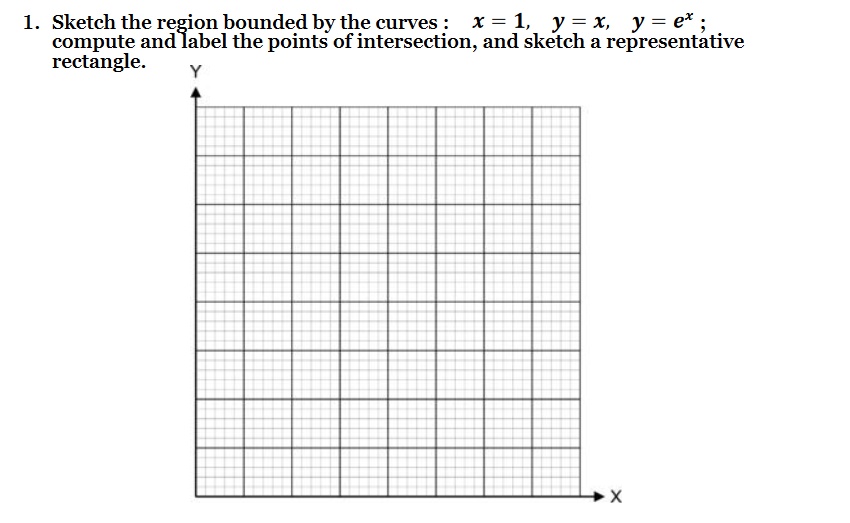
 lost trout
So I already graphed it

looks like this
is the shaded region just
between 0 and 1
also
because y=e^x and y=x
i am getting no solution
trim joltBOT
@lost trout Has your question been resolved?
 digital bolt
lost trout
https://gyazo.com/95b0edfa7336bc63feda5ee3c4b22b8c
digital bolt
lost trout
https://gyazo.com/95b0edfa7336bc63feda5ee3c4b22b8c
the shaded region should extend indefinitely to the left but they only want you to graph the positive finite bit given the axes they gave you
trim joltBOT
@lost trout Has your question been resolved?
lost trout
When evaluating the integral I got this
 trim joltBOT
@lost trout Has your question been resolved?
trim joltBOT
Channel closed
Closed by @lost trout
Use .reopen if this was a mistake.
Available help channel!
Send your question here to claim the channel.
Remember:
• Ask your math question in a clear, concise manner.
• Show your work, and if possible, explain where you are stuck.
• After 15 minutes, feel free to ping <@&286206848099549185>.
• Type the command .close to free the channel when you're done.
• Be polite and have a nice day!
Read #❓how-to-get-help for further information on how to ask a good question, and about conduct in the question channels.
 spare pawn
need help
trim joltBOT
spare pawn
need help
 trim joltBOT
@spare pawn Has your question been resolved?
spare pawn
<@&286206848099549185>
trim joltBOT
@spare pawn Has your question been resolved?
 delicate venture
You can evaluate the limit directly as they follow the limit laws
@spare pawn
so for functions that are continuous, composite of these functions are also continuous over a common domain
hence you can directly sub x=6 to look for the limit
trim joltBOT
Channel closed
Closed due to timeout
Use .reopen if this was a mistake.
Available help channel!
Send your question here to claim the channel.
Remember:
• Ask your math question in a clear, concise manner.
• Show your work, and if possible, explain where you are stuck.
• After 15 minutes, feel free to ping <@&286206848099549185>.
• Type the command .close to free the channel when you're done.
• Be polite and have a nice day!
Read #❓how-to-get-help for further information on how to ask a good question, and about conduct in the question channels.
wraith hinge
hello, can you help me how to solve this equation of circle in standard form?
trim joltBOT
wraith hinge
hello, can you help me how to solve this equation of circle in standard form?
trim lichen
find the center, find the radius, plug 'em in the template. results may vary depending on what you are starting with.
do you know in general what the equation of a circle in standard form looks like?
wraith hinge
(x+3)² + (y - 1)² = 64
wraith hinge
trim lichen
do you know in general what the equation of a circle in standard form looks like...
yes
i'm struggling in solving
TvT
can u show me how to solve it step by step? TvT
if it's okay TvT
wraith hinge
wraith hinge
can u show me how to solve it step by step? TvT
What are you asked to find exactly?
the radius and the center?
yess
okay so
\dm
for [
(x-h)^2 + (y-k)^2 = r^2
]
the radius is $r$ and the centre is $(h,k)$
solid kilnBOT
 solid kilnBOT
 wraith hinge
what is ?
i dont know TvT
like what two same numbers when multiplied give you 64
you mean what numbers can multiply to equal it in 64?
yea sure
wraith hinge
wraith hinge
like what two same numbers when multiplied give you 64
oh i think 3
i dont know TvT