#help-38
1 messages · Page 33 of 1
 steep cypress
 trim lichen
1/x **approaches** zero.
trim lichen
1/x **approaches** zero.
yeah and you said that was zero
trim lichen
"is" doesn't mean "approaches".
 inner orbit
steep cypress
yeah and you said that was zero
inner orbit
steep cypress
yeah and you said that was zero
Its concepts of intermediates
trim lichen
inner orbit
Its concepts of intermediates
"intermediate" is the wrong word.
you're thinking of indeterminate forms perhaps.
inner orbit
I meant indeterminate
trim lichen
of which 1^infty is one.
inner orbit
Typo
trim lichen
you have here a small (close to 1) number raised to a large (close to infinity) power
it's kind of a push and pull
you cannot tell without further info where the function will end up
steep cypress
what info do you need
trim lichen
in fact (1 + 1/x)^x ends up at neither 1 nor infinity but a number just over 2.7
you need to know what the base and exponent actually are. in this case you do.
i was saying you can't tell anything from JUST the fact that 1+1/x goes to 1 and x goes to infinity
steep cypress
why not?
steep cypress
0
 trim lichen
the reason is that (function which approaches 0) * (function which approaches infinity) could approach anything
or even nothing at all
inner orbit
trim lichen
in terms of limits, 0*infty is undefined.
But you never specified 0 is a tending value
trim lichen
it could be x/(x+1), but it could also be x^2/x, or x/x^2, or (something wild)/x
inner orbit
They are correct in their terms
trim lichen
inner orbit
But you never specified 0 is a tending value
we are talking about limits, and the motivation for leaving 0*infty undefined stems from there.
inner orbit
That pulls confusion
trim lichen
but maybe you know better and know how to explain things better than i do. should i leave it to you?
inner orbit
Continue
steep cypress
sleep is for the weak
Watched this video.
https://www.youtube.com/watch?v=nA6fz7DXHcA
it explains nothing
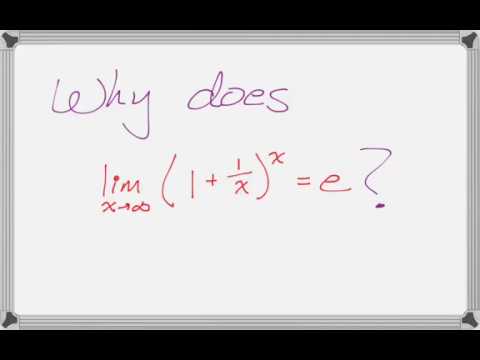
Taking the limit of (x+1/x)^x to get the mathematical constant e. This is a good L'Hopital's problem and a good limit to memorize because it comes up a lot. It's kind of a classic problem from Calculus II (or late Calculus I).
e = e
because ln(e) = 1
:clueless:
 trim joltBOT
@steep cypress Has your question been resolved?
trim joltBOT
@steep cypress Has your question been resolved?
trim joltBOT
@steep cypress Has your question been resolved?
trim joltBOT
@steep cypress Has your question been resolved?
trim joltBOT
@steep cypress Has your question been resolved?
 dense breach
steep cypress
Watched this video.
https://www.youtube.com/watch?v=nA6fz7DXHcA
it explains noth...
dense breach
steep cypress
Watched this video.
https://www.youtube.com/watch?v=nA6fz7DXHcA
it explains noth...
This is often the definition for e
steep cypress
dense breach
This is often the definition for e
Yeah I know I want to know why
How do they get the number for e
dense breach
like, how do they compute this as 2.71828...?
steep cypress
dense breach
like, how do they compute this as 2.71828...?
yes
 solid kilnBOT


 Requested by RedstonePlayz09#0205
dense breach
Requested by RedstonePlayz09#0205
dense breach
but the way that i expect it's done really is expanding (1+1/x)^x using binomial theorem
and looking at the kinds of things that happen as x goes to infinity
 wraith hinge
Madao
 mild salmon
steep cypress
How do they get the number for e
mild salmon
steep cypress
How do they get the number for e
Another way to calculate it is using the Taylor series expansion of e^x evaluated at x = 1, this series is relatively easy to compute and converges pretty fast: as you can see here I only have up to 1/6! but already the first 4 digits match

Going up to 13, it’s only around 0.00000000001 off
 trim joltBOT
@steep cypress Has your question been resolved?
wraith hinge
steep cypress
Yeah I know I want to know why
They computed it by hand
Well
I think the origin was from compounding
I could be totally wrong but
Let's say that you put in 100 in a bank with 100% interest per annum
So after a year, total amount = 200
But let's say instead of doing 100% after 1 year, we do 50% in half a year
So like
If you invest 100 now, after 6 months, you will have 150 and after another 6 months, you will get 150% of that
So after a year, total amount in bank = 225
Another smartie came and said what if we give interests every week?
There are 52 weeks in a year
So instead of giving 100% in 1 year, we can give 100/52% every week
And sum that up for a year
You can do the addition on your own or let a computer do it
But it will be more than what you got for 50% in 6 months
Those smarties kept on doing this, calculating interests for everyday, every hour, every second
Etc
And they realized that
The interest doesn't keep on going forever
It "maxes" out at 271.8%
That's wherever the number e came from ig
trim joltBOT
Channel closed
Closed due to timeout
Use .reopen if this was a mistake.
 Available help channel!
Send your question here to claim the channel.
Remember:
• Ask your math question in a clear, concise manner.
• Show your work, and if possible, explain where you are stuck.
• After 15 minutes, feel free to ping <@&286206848099549185>.
• Type the command .close to free the channel when you're done.
• Be polite and have a nice day!
Read #❓how-to-get-help for further information on how to ask a good question, and about conduct in the question channels.
trim joltBOT
 long basin
Yeah
trim joltBOT
Channel closed
Closed by @dapper lance
Use .reopen if this was a mistake.
Available help channel!
Send your question here to claim the channel.
Remember:
• Ask your math question in a clear, concise manner.
• Show your work, and if possible, explain where you are stuck.
• After 15 minutes, feel free to ping <@&286206848099549185>.
• Type the command .close to free the channel when you're done.
• Be polite and have a nice day!
Read #❓how-to-get-help for further information on how to ask a good question, and about conduct in the question channels.
 rugged latch
can someone help me understand how they got that its the "right half of the circle"?
trim joltBOT
rugged latch
can someone help me understand how they got that its the "right half of the circ...
rugged latch

i can show the original problem if needed
this is Converting from Rectangular Coordinates to Cylindrical Coordinates for triple integrals
 sturdy leaf
x=sqrt(1-y^2)
square both sides
x^2=1-y^2
rearrange
x^2+y^2=1=r^2
that is how we see that we are dealing with a circle
y ranges from -1 to 1
x ranges from 0 to sqrt(1-y^2)
y^2 will be between 0 and 1, therefore 1-y^2 is between 0 and 1
thus x is between 0 and 1 as well
thats why we only have the right half of the circle
rugged latch
ohhhhh
wow
that makes a lot of sense
thank you Martin
I wish they explained it like that in the book and didnt just imply that we knew it lol
ty again!
.close
trim joltBOT
Channel closed
Closed by @rugged latch
Use .reopen if this was a mistake.
Available help channel!
Send your question here to claim the channel.
Remember:
• Ask your math question in a clear, concise manner.
• Show your work, and if possible, explain where you are stuck.
• After 15 minutes, feel free to ping <@&286206848099549185>.
• Type the command .close to free the channel when you're done.
• Be polite and have a nice day!
Read #❓how-to-get-help for further information on how to ask a good question, and about conduct in the question channels.
 orchid kiln
I'm trying to understand the proof of the lemma that "if p is prime, then there exists a primitive elemtn g mod p"
trim joltBOT
orchid kiln
I'm trying to understand the proof of the lemma that "if p is prime, then there ...
orchid kiln
So I'll firstly give the whole proof, and then I hope someone can help me understand steps I don't currently understand
Whole Proof:
 indigo hatch
orchid kiln
So I'll firstly give the whole proof, and then I hope someone can help me unders...
indigo hatch
orchid kiln
So I'll firstly give the whole proof, and then I hope someone can help me unders...
I might be able to
orchid kiln
If p = 2, then $\phi(2) = 1,$ this is obvious as we can simply take g = 1. Suppose $p > 2$, by Fermat's little theorem, $a^{p-1} \equiv 1 ; (mod : p)$ for all a such that (a,p) = 1. So (x-a) divides $x^{p-1} - 1$ in Z/pZ[x]. This implies $x^{p-1} - 1 = (x-1)(x-2)...(x-(p-1)).$ Let $d \in \mathbb{N}$ such that d divides p -1, i.e. p-1 = dm for some $m \in \mathbb{N},$ then $(x^d - 1)(1 + x^d + x^{2d} + ... + x^{(m-1)d}) = x^{p-1} - 1.$ So $x^d - 1$ also factors into d linear factors, because the RHS of this equation does, so the LHS of this equation does; and because of this we know that $x^d - 1$ has d roots. Now, let $\psi(d) = #{a \in \mathbb{N} ; s.t. 1 \leq a < p ; and ; r(a) = d}$ (r(a) here is the multiplicative order of a modulo m). So, we note that $a^d \equiv 1 ; (mod : p)$ iff r(a) divides d. Therefore, $\sum_{c ; divides ; d} \psi(c) = d.$ Therefore, $\sum_{c ; divides ; d} \psi(c) I(\frac{d}{c}) = d,$ i.e. $\psi$ * I = id. We know that $\phi$ = $\mu$ * id, therefore $\phi$ * I = $\mu$ * id * I = $\mu$ * I * id= $\epsilon$ * id = id. By Mobius inversion, this implies $\psi$ = $\phi.$ In particular, $\psi(p-1) = \phi(p-1) > 0$ i.e. there exists $\phi(p-1)$ primitive elements mod p
solid kilnBOT
LeftySam
Compile Error! Click the  reaction for more information.
(You may edit your message to recompile.)
 orchid kiln
indigo hatch
I might be able to
orchid kiln
indigo hatch
I might be able to
Okay, so I've written up the proof. Firstly, I don't get why $a^d \equiv 1 ; (mod : p)$ iff r(a) divides d
solid kilnBOT
LeftySam

 potent bone
...isn't that kind of just what "multiplicative order" is?
like, it's the number of times you have to multiply something by itself (modulo whatever) until you get 1
and then if you raise a to the power of some multiple of that, that's just the same as (a^r(a))^k for some k, and a^r(a) is 1, so it's just 1^k which is 1
orchid kiln
potent bone
and then if you raise a to the power of some multiple of that, that's just the s...
Oh right, so basically here the order of the group formed by, say, a, a^2, a^3,...,1 is r(a), so r(a) necessarily divides d?
potent bone
...i feel like you might have skipped a step in there compared to what i said but i guess if it makes sense to you we can go with it
orchid kiln
potent bone
...i feel like you might have skipped a step in there compared to what i said bu...
So, I guess, say here that r(a) = 5, then we can form a multiplicative group that consists of elements a, a^2, a^3, a^4 and 1. The order of this is 5, so for a^d to be equal to 1; it must be the case that 5 divides d. Another example illustrating my logic I guess is, we know that 15 = 0 (mod 15), so therefore; any number d such that d = 0 (mod 15), we must necessarily have that 15 divides d.
trim joltBOT
@orchid kiln Has your question been resolved?
orchid kiln
potent bone
...i feel like you might have skipped a step in there compared to what i said bu...
Next point of confusion is, so I know that $\psi$ * I = $\phi$ * I, but I don't get why by the Mobius inversion theorem this means $\psi$ = $\phi$
solid kilnBOT
LeftySam
 orchid kiln
.close
trim joltBOT
Channel closed
Closed by @orchid kiln
Use .reopen if this was a mistake.
Available help channel!
Send your question here to claim the channel.
Remember:
• Ask your math question in a clear, concise manner.
• Show your work, and if possible, explain where you are stuck.
• After 15 minutes, feel free to ping <@&286206848099549185>.
• Type the command .close to free the channel when you're done.
• Be polite and have a nice day!
Read #❓how-to-get-help for further information on how to ask a good question, and about conduct in the question channels.
wraith hinge
Hey
trim joltBOT
wraith hinge
Hey
trim joltBOT
@wraith hinge Has your question been resolved?
trim joltBOT
Channel closed
Closed due to timeout
Use .reopen if this was a mistake.
trim joltBOT
Available help channel!
Send your question here to claim the channel.
Remember:
• Ask your math question in a clear, concise manner.
• Show your work, and if possible, explain where you are stuck.
• After 15 minutes, feel free to ping <@&286206848099549185>.
• Type the command .close to free the channel when you're done.
• Be polite and have a nice day!
Read #❓how-to-get-help for further information on how to ask a good question, and about conduct in the question channels.
wraith hinge
how is this indeterminate form?
 trim joltBOT
wraith hinge
how is this indeterminate form?
trim joltBOT
wraith hinge
how is this indeterminate form?
 wintry stag
its not
wraith hinge
wintry stag
its not
is the limit infinity?
that's what i got but apparently it's wrong
wintry stag
no
wraith hinge
wintry stag
no
why
wintry stag
you cant substitute when you have values like this
wraith hinge
wdym i cant sub?
wintry stag
for example $$1= \lim_{n\to \infty} 1 = \lim_{n\to \infty} n\cdot \frac{1}{n}$$
wraith hinge
yep
solid kilnBOT
ohNoiAmHere
 wintry stag
so even though 0 times infinity is indeterminate
you cannot simply substitute in those values
since the limit is more of a question about how fast those functions approach those values
 wraith hinge
can they not diverge?
wintry stag
without convergence if we go back to the example i gave

if you split it up youll get infinity times 0
which is indeterminate
wraith hinge
so u just simplify it
wintry stag
even though the limit is 1
yes, the simplification here is simple to see
the same might apply in the limit you have
you cannot change the limit the parts you change are convergent
wraith hinge
.close
trim joltBOT
Channel closed
Closed by @barren yoke
Use .reopen if this was a mistake.
Available help channel!
Send your question here to claim the channel.
Remember:
• Ask your math question in a clear, concise manner.
• Show your work, and if possible, explain where you are stuck.
• After 15 minutes, feel free to ping <@&286206848099549185>.
• Type the command .close to free the channel when you're done.
• Be polite and have a nice day!
Read #❓how-to-get-help for further information on how to ask a good question, and about conduct in the question channels.
 earnest breach
Why wouldn't x = 5 be the absolute max?
 trim joltBOT
earnest breach
Why wouldn't x = 5 be the absolute max?
earnest breach
trim joltBOT
earnest breach
Why wouldn't x = 5 be the absolute max?
earnest breach
According to my professor answers, there is no max
Does it have to do with there being an open circle on x = -1? If it were closed, that would be the absolute max
 cursive musk
yes
trim joltBOT
@earnest breach Has your question been resolved?
earnest breach
cursive musk
yes
Can you explain 🙂
cursive musk
what is the absolute max if its not defined there
earnest breach
cursive musk
what is the absolute max if its not defined there
My first guess was x = 5
Cause the endpoints can be a max/min for the absolute max
cursive musk
earnest breach
My first guess was x = 5
who said the max had to be at an integer?
every value between x = -1.3 and 0.3 is more than at x=5
trim joltBOT
Channel closed
Closed due to timeout
Use .reopen if this was a mistake.
trim joltBOT
Available help channel!
Send your question here to claim the channel.
Remember:
• Ask your math question in a clear, concise manner.
• Show your work, and if possible, explain where you are stuck.
• After 15 minutes, feel free to ping <@&286206848099549185>.
• Type the command .close to free the channel when you're done.
• Be polite and have a nice day!
Read #❓how-to-get-help for further information on how to ask a good question, and about conduct in the question channels.
wraith hinge
 trim joltBOT
wraith hinge
wraith hinge
trim joltBOT
wraith hinge
wraith hinge
question from a regional math contest from yesterday
is it possible to solve it via linear algebra?
 main sigil
you could solve for a^2, b^2 and c^2 using gaussian elimination or sth I guess
then do a^2*b^2*c^2
this approach would take around 4 mins I guess
not too bad
 merry bluff
Add all equations
wraith hinge
what was gaussian elimination again?
wait i think its easier than what i originally thought
merry bluff
Nvm, adding any 2 equations works
main sigil
Ic, its definitely faster
main sigil
wraith hinge
what was gaussian elimination again?
way to solve system of equations using linalg
wraith hinge
ah
main sigil
main sigil
this approach would take around 4 mins I guess
I take this back, it's 1 min
wraith hinge
merry bluff
Nvm, adding any 2 equations works
shit im slow
main sigil
if you dont know gaussian elimination, then by adding first 2 equations you get
2a^2=4, so a^2=2.
By adding 1st and 3rd you get 2b^2=6 so b^2=3
by adding 2nd and 3rd you get 2c^2=12, so c^2=6
merry bluff
Yes
wraith hinge
yup
main sigil
doing this in head is actually faster than writing out the matrix
although it's basically the same process
than (abc)^2=a^2*b^2*c^2
and you're done
trim joltBOT
Channel closed
Closed by @hidden iron
Use .reopen if this was a mistake.
trim joltBOT
Available help channel!
Send your question here to claim the channel.
Remember:
• Ask your math question in a clear, concise manner.
• Show your work, and if possible, explain where you are stuck.
• After 15 minutes, feel free to ping <@&286206848099549185>.
• Type the command .close to free the channel when you're done.
• Be polite and have a nice day!
Read #❓how-to-get-help for further information on how to ask a good question, and about conduct in the question channels.
 tidal finch
 trim joltBOT
tidal finch
tidal finch
trim joltBOT
tidal finch
tidal finch
Can somebody please help me
Why is the 2 on the left only being multiplied to the denominator but then the right part is being multiplied to the top to get 4t+3
It makes no sense

 rare lodge
tidal finch
rare lodge
tidal finch
if all of (3-4t) - 12 is being divided by 2 then multiplying that by 2 cancels out that division, leaving you with (3 - 4t) - 12 on the left
tidal finch
Yeah but
The right side
It’s being applied to the numerator
The 2
Why isn’t the 2 applied to the numerator on the left too
That’s what I don’t get I get that the 2 cancels the fractions out
rare lodge
you could do the left side by multiplying the numerator by 2 giving you 2(3 - 4t) - 24 all over 2, multiply out the brackets giving 6 - 8t - 24 all over 2, this simplifies down to -8t - 18 all over 2, -8t/2 = -4t and -18/2 = -9 meaning you end up with -4t - 9 which is the same answer as when you cancel out the division
rare lodge
sorry but im not entirely sure what part of the process you're unsure about?
trim joltBOT
@tidal finch Has your question been resolved?
trim joltBOT
Channel closed
Closed due to timeout
Use .reopen if this was a mistake.
trim joltBOT
Available help channel!
Send your question here to claim the channel.
Remember:
• Ask your math question in a clear, concise manner.
• Show your work, and if possible, explain where you are stuck.
• After 15 minutes, feel free to ping <@&286206848099549185>.
• Type the command .close to free the channel when you're done.
• Be polite and have a nice day!
Read #❓how-to-get-help for further information on how to ask a good question, and about conduct in the question channels.
wraith hinge
need help with double angle identities
trim joltBOT
wraith hinge
need help with double angle identities
wraith hinge

I plugged in the identity rule and not sure what to do after this step
according to this
 trim joltBOT
@wraith hinge Has your question been resolved?
wraith hinge
Nope
wraith hinge
Does anyone know?
cursive musk
wraith hinge
I plugged in the identity rule and not sure what to do after this step
I think thats wrong
you should only have 2 terms
cursive musk
try to use cos^2 + sin^2 = 1
 glad dirge
cos(a-b)=cos(a)cos(b)+sin(a)sin(b)
glad dirge
glad dirge
cos(a-b)=cos(a)cos(b)+sin(a)sin(b)
iirc
wraith hinge
glad dirge
cos(a-b)=cos(a)cos(b)+sin(a)sin(b)
This identity doesn’t work with cos(2x) right?
cursive musk
,tex .double angle
solid kilnBOT
Kefir
 glad dirge
wraith hinge
This identity doesn’t work with cos(2x) right?
glad dirge
wraith hinge
This identity doesn’t work with cos(2x) right?
it's a way to derive cos(2x) but you can use it in the problem cuz what you have on the left side is the same as cos(2x-x)
wraith hinge
can you possibly write it out so I can see it visually? It’s just a practice problem I just don’t understand the next step after substituting


 wraith hinge
no I mean we are specifically supposed to be using doings angle
glad dirge
oh these are specific problems for double angle?
wraith hinge
Yeah
wraith hinge
Oh actually it seems the identity you were using works the same way so it doesn’t even matter which we use
!solved
trim joltBOT
@wraith hinge Has your question been resolved?
Channel closed
Closed by @sharp shoal
Use .reopen if this was a mistake.
Available help channel!
Send your question here to claim the channel.
Remember:
• Ask your math question in a clear, concise manner.
• Show your work, and if possible, explain where you are stuck.
• After 15 minutes, feel free to ping <@&286206848099549185>.
• Type the command .close to free the channel when you're done.
• Be polite and have a nice day!
Read #❓how-to-get-help for further information on how to ask a good question, and about conduct in the question channels.
 flat cosmos
 trim joltBOT
flat cosmos
flat cosmos
trim joltBOT
flat cosmos
flat cosmos
Is this correct?
solid kilnBOT
riemann
 trim joltBOT
@flat cosmos Has your question been resolved?
flat cosmos
Oh
trim joltBOT
Channel closed
Closed by @flat cosmos
Use .reopen if this was a mistake.
Available help channel!
Send your question here to claim the channel.
Remember:
• Ask your math question in a clear, concise manner.
• Show your work, and if possible, explain where you are stuck.
• After 15 minutes, feel free to ping <@&286206848099549185>.
• Type the command .close to free the channel when you're done.
• Be polite and have a nice day!
Read #❓how-to-get-help for further information on how to ask a good question, and about conduct in the question channels.
 void wasp
what are the different ways to solve for x and y when you have the task
2x + 3y = 45
x + 4y = 35
trim joltBOT
void wasp
what are the different ways to solve for x and y when you have the task
2x + 3y...
void wasp
want 2 ways
trim joltBOT
@void wasp Has your question been resolved?
 zinc ginkgo
solve for x in the first eqn then plug into the second
that should give an eqn for y
repeat but solve for y in the first eqn and plug into 2nd
void wasp
zinc ginkgo
solve for x in the first eqn then plug into the second
yeah already figured out 2 ways but i also need help with how 12a + 20 / 4ab = 4a(3 + 5b) / 4ab
i want to know when to do this and how i would do this with other numbers
steep cypress
void wasp
what are the different ways to solve for x and y when you have the task
2x + 3y...
are those systems of linear equations?
void wasp
i dont need help with this one anymore
the last one is what i need help with understanding how to do it
steep cypress
void wasp
yeah already figured out 2 ways but i also need help with how 12a + 20 / 4ab = 4...
Solve for a variable, a or b.
then plug that solved variable back in
steep cypress
Is this the equation?
 steep cypress
Honestly
Too much work
I did this. No idea if its right.
It's not everything but its simplified ( i think )
 void wasp
steep cypress
Is this the equation?
void wasp
steep cypress
Is this the equation?
its 12a+20 / 4ab
steep cypress
void wasp
its 12a+20 / 4ab
(12a+20) / 4ab ?
void wasp
yes
steep cypress
 Write your equations down better
void wasp
sorry bout that
can you redo what you did with that equation
i have like 10 minutes til i need to have the test
void wasp
steep cypress
<:starebleak:911875700489871380> Write your equations down better
are you there?
void wasp
yes
steep cypress
What did you do first?
void wasp
i just dont know where to start
steep cypress
why not?
void wasp
thats what im asking for…
steep cypress
You're gonna fail your test
steep cypress
I can't really help you in 5 minutes
void wasp
10 min
steep cypress
but here's the first part of solving it i think
 steep cypress
oh yeah lol
howd that 3a get there
idk  too much work
oh wait
that 3a is supposed to be there
why'd you say it's wrong?
void wasp
because the answer is 3 + 5b / b
steep cypress
void wasp
because the answer is 3 + 5b / b
that's the value of a?
steep cypress
what is 3 + 5b/b
 steep cypress
must've gave the wrong equation again or something idk
@void wasp start taking this course https://www.khanacademy.org/math/college-algebra

Khan Academy
void wasp
i do work on math, i just didnt realize before now that those equations were included in the test…
steep cypress
that equation is something people in middle school would be able to solve
like 6th grade
void wasp
you werent avle to do it the way it got the answer i needed
im aware that you can find the value of something easily but thats not what im looking for
just trying to simplify the equation
steep cypress
No idea what else you would be looking for but pop off king
(3+5b)/b isn't even the same equation btw
 trim joltBOT
@void wasp Has your question been resolved?
trim joltBOT
Channel closed
Closed due to timeout
Use .reopen if this was a mistake.
Available help channel!
Send your question here to claim the channel.
Remember:
• Ask your math question in a clear, concise manner.
• Show your work, and if possible, explain where you are stuck.
• After 15 minutes, feel free to ping <@&286206848099549185>.
• Type the command .close to free the channel when you're done.
• Be polite and have a nice day!
Read #❓how-to-get-help for further information on how to ask a good question, and about conduct in the question channels.
 toxic hamlet
Can someone help me with this question? I've been going around in loops and I feel like you're supposed to use a neat trick.
 trim joltBOT
toxic hamlet
Can someone help me with this question? I've been going around in loops and I fe...
toxic hamlet
trim joltBOT
toxic hamlet
Can someone help me with this question? I've been going around in loops and I fe...
toxic hamlet
I'm used the definition of variance and cut down a lot of the work and I get to a stage where you can show the LHS is equal to the expressiom
E([Y-E(Y|X)]^2)
Which I have expanded and simplified but seems like I am not really getting anywhere since that's just the definition of variance it self ( i believe)
trim joltBOT
@toxic hamlet Has your question been resolved?
toxic hamlet
.close
trim joltBOT
Channel closed
Closed by @toxic hamlet
Use .reopen if this was a mistake.
trim joltBOT
Available help channel!
Send your question here to claim the channel.
Remember:
• Ask your math question in a clear, concise manner.
• Show your work, and if possible, explain where you are stuck.
• After 15 minutes, feel free to ping <@&286206848099549185>.
• Type the command .close to free the channel when you're done.
• Be polite and have a nice day!
Read #❓how-to-get-help for further information on how to ask a good question, and about conduct in the question channels.
 opaque lance
Prove that adj(I)=I; I is identity matrix
trim joltBOT
opaque lance
Prove that adj(I)=I; I is identity matrix
trim joltBOT
Channel closed
Closed by @opaque lance
Use .reopen if this was a mistake.
Available help channel!
Send your question here to claim the channel.
Remember:
• Ask your math question in a clear, concise manner.
• Show your work, and if possible, explain where you are stuck.
• After 15 minutes, feel free to ping <@&286206848099549185>.
• Type the command .close to free the channel when you're done.
• Be polite and have a nice day!
Read #❓how-to-get-help for further information on how to ask a good question, and about conduct in the question channels.
 trim joltBOT
 fallen crag
Hello
fallen crag
fallen crag
Hello
fallen crag
First time graphing really so I wanted to know if this was right or not
main sigil
D and C are correct
A and B are incorrect
-4i should be quite clear, it's even marked on the imaginary axis
 fallen crag
What’s wrong still
 south brook
A
 south brook
Ig
fallen crag
Does that mean it’s right?
south brook
Please show full question
south brook
fallen crag
Does that mean it’s right?
I wouldn't know unless you show me the question
fallen crag
That’s the full question kinda

Well this part is
A. 2+i
B. -4i
C. -1
D. 3+3i
And my answers for them
trim joltBOT
Channel closed
Closed by @fallen crag
Use .reopen if this was a mistake.
Available help channel!
Send your question here to claim the channel.
Remember:
• Ask your math question in a clear, concise manner.
• Show your work, and if possible, explain where you are stuck.
• After 15 minutes, feel free to ping <@&286206848099549185>.
• Type the command .close to free the channel when you're done.
• Be polite and have a nice day!
Read #❓how-to-get-help for further information on how to ask a good question, and about conduct in the question channels.
 wide charm
Yeah i know i did it but problem is how to do in exam hall
1+7+2+9 =19 is answer
trim joltBOT
wide charm
Yeah i know i did it but problem is how to do in exam hall
1+7+2+9 =19 is answer
wide charm
 zinc ginkgo
wide charm
Yeah i know i did it but problem is how to do in exam hall
1+7+2+9 =19 is answer
zinc ginkgo
wide charm
Yeah i know i did it but problem is how to do in exam hall
1+7+2+9 =19 is answer
what class is this for
wide charm
These kinds of questions come in indian govt job exams
Teaching exam
I want to know a method which is helpful
I can't remember 25 cube and multiply lots of numbers in the mean time
Help
Any@zinc ginkgo view on this problem
zinc ginkgo
nope
zinc ginkgo
wide charm
I can't remember 25 cube and multiply lots of numbers in the mean time
this is probably what you should do
wide charm
Yes. I did that method but failed@south brook
wraith hinge
mod 9 only gets rid of 2. So it does seem like a brute force calculation question
trim joltBOT
@wide charm Has your question been resolved?
trim joltBOT
Channel closed
Closed due to timeout
Use .reopen if this was a mistake.
Available help channel!
Send your question here to claim the channel.
Remember:
• Ask your math question in a clear, concise manner.
• Show your work, and if possible, explain where you are stuck.
• After 15 minutes, feel free to ping <@&286206848099549185>.
• Type the command .close to free the channel when you're done.
• Be polite and have a nice day!
Read #❓how-to-get-help for further information on how to ask a good question, and about conduct in the question channels.
 hot scarab
how do i prove this series is divergent?
 trim joltBOT
hot scarab
how do i prove this series is divergent?
trim joltBOT
hot scarab
how do i prove this series is divergent?
 quick narwhal
I cannot read that
zinc ginkgo
integral test and comparison test probably
hot scarab
im not sure how to do the integral test for this one :l
trim joltBOT
@hot scarab Has your question been resolved?
hot scarab
is this valid?
 trim joltBOT
@hot scarab Has your question been resolved?
zinc ginkgo
that doesn't look wrong, just a lot of unnecessary steps to get to
$\frac{1}{\sqrt{n}} < \frac{1}{\log(\sqrt{n})}$
solid kilnBOT
riemann
 zinc ginkgo
a simpler way is to compare $\frac{1}{n} < \frac{1}{\sqrt{n}}$
solid kilnBOT
riemann
 zinc ginkgo
then divide both sides by log(n)
trim joltBOT
Channel closed
Closed by @hot scarab
Use .reopen if this was a mistake.
Available help channel!
Send your question here to claim the channel.
Remember:
• Ask your math question in a clear, concise manner.
• Show your work, and if possible, explain where you are stuck.
• After 15 minutes, feel free to ping <@&286206848099549185>.
• Type the command .close to free the channel when you're done.
• Be polite and have a nice day!
Read #❓how-to-get-help for further information on how to ask a good question, and about conduct in the question channels.
 cerulean hearth
how can i calculate this kind of cross product :
(a; b) ^ (x; y)
I only know how to do it with 3 component's vector
trim joltBOT
cerulean hearth
how can i calculate this kind of cross product :
(a; b) ^ (x; y)
I only know ho...
cerulean hearth
is it = ay + bx?
 austere cedar
Cross product is only defined on vectors with 3 components
cerulean hearth
oh
austere cedar
Sometimes what we do with 2d vectors is turn them into 3d
By adding a 0 at the end
zinc ginkgo
you assume one of the components is 0 or 1 to get something meaningful
austere cedar
But that really is a sometimes. If you need to take a cross product of a vector with 2 components, you must have some agreed upon way to turn it into a 3 component vector
trim joltBOT
Channel closed
Closed by @cerulean hearth
Use .reopen if this was a mistake.
Available help channel!
Send your question here to claim the channel.
Remember:
• Ask your math question in a clear, concise manner.
• Show your work, and if possible, explain where you are stuck.
• After 15 minutes, feel free to ping <@&286206848099549185>.
• Type the command .close to free the channel when you're done.
• Be polite and have a nice day!
Read #❓how-to-get-help for further information on how to ask a good question, and about conduct in the question channels.
fallen crag
 trim joltBOT
fallen crag
austere cedar
trim joltBOT
fallen crag
austere cedar
,w (5 - 2i)(-3 + 7i)
solid kilnBOT

 Requested by Kaynex#7520
 mighty gazelle
austere cedar
mighty gazelle
austere cedar
If your questions are entirely computational, check out Wolfram Alpha to check your work. A lot faster than us
fallen crag
.close
trim joltBOT
Channel closed
Closed by @fallen crag
Use .reopen if this was a mistake.
Available help channel!
Send your question here to claim the channel.
Remember:
• Ask your math question in a clear, concise manner.
• Show your work, and if possible, explain where you are stuck.
• After 15 minutes, feel free to ping <@&286206848099549185>.
• Type the command .close to free the channel when you're done.
• Be polite and have a nice day!
Read #❓how-to-get-help for further information on how to ask a good question, and about conduct in the question channels.
 elder trellis
How come this isn’t 6
trim joltBOT
Channel closed
Closed due to the original message being deleted


 split chasm
you messed up the conversion again
trim joltBOT
Available help channel!
Send your question here to claim the channel.
Remember:
• Ask your math question in a clear, concise manner.
• Show your work, and if possible, explain where you are stuck.
• After 15 minutes, feel free to ping <@&286206848099549185>.
• Type the command .close to free the channel when you're done.
• Be polite and have a nice day!
Read #❓how-to-get-help for further information on how to ask a good question, and about conduct in the question channels.
 keen smelt
 trim joltBOT
keen smelt
keen smelt
trim joltBOT
keen smelt
keen smelt

 whole coral
You can keep applying log rules to that!
keen smelt
Yeah just wondering which rule...quotient? power? product?
keen smelt
of course, though im not sure how
like for example the numerator
do i use power first or product
whole coral
Product
You basically have $\ln\pqty{\frac{ab}{c}}$ that you’re dealing with initially
solid kilnBOT
@whole coral
 keen smelt
ah yes
the power inside also makes it a bit confusing

heres what i have when i applied product
whole coral
Careful!
whole coral
solid kiln
<@788085606483361802>
E.g. here you could take it in steps, but to expand this, at the very end you should have $\ln(a) + \ln(b) - \ln(c)$
solid kilnBOT
@whole coral
 keen smelt
ah
whole coral
Do you at least agree and see how you get there?
keen smelt
yeah
product in numerator then quotient

i was debating whether or not to include the quotient in all of these
whole coral
keen smelt
Remember that the 1/3 multiplies everything
 whole coral
Yep, both of them 
keen smelt
 whole coral
keen smelt
whole coral
keen smelt
Yep like that, and then from there it’s nice and easy to differentiate everything!
keen smelt
awesome! ill try to do that now

i have to then replace y with that huge cube root?
 whole coral
keen smelt
whole coral
keen smelt
Keep the y factored out
whole coral
keen smelt
Look at the form they ask you to answer in


 whole coral
Quotient rule 
The top line you can do individually without needing quotient rule as 8/3, 1/3 and 2/3 are just constants
whole coral
keen smelt
But also note that here it should have read as 6x + 6, think your handwriting got you there 
keen smelt
 keen smelt
whole coral
But also note that here it should have read as 6x + 6, think your handwriting go...
keen smelt
whole coral
But also note that here it should have read as 6x + 6, think your handwriting go...
mouse writing problems yeah
my handwriting screwed me on 3 different problems including this one
hopefully this one should be it
 whole coral
As before, remember that we started with
[
y = f(x) = \sqrt[3]{ \frac{ (x + 3)^{8} (2x - 1) }{(6x + 6)^{2} } }
]
and we converted that to
[
\ln(y) = \frac{8}{3} \ln(x + 3) + \frac{1}{3} \ln(2x - 1) - \frac{2}{3} \ln(6x + 6)
]
solid kilnBOT
@whole coral

 keen smelt
solid kiln
<@788085606483361802>
keen smelt
solid kiln
<@788085606483361802>
This is before differentiation?
whole coral
Yep
keen smelt
ok yes i made sure it matched this
it was the third term

I think?
So far I just multiplied the numerator with 3
now to divide by 3^2
whole coral
keen smelt
with here or?
 whole coral
Just divide each numerator by 9 though
whole coral
whole coral
Just divide each numerator by 9 though
Write those as
[
\frac{24/9}{x + 3} + \frac{6/9}{2x-1} + \frac{-36/9}{6x + 6}
]
then simplify
solid kilnBOT
@whole coral
 keen smelt
ah
i had to write it like that because of this problem?
the way i wrote it wasnt incorrect technically?
whole coral
keen smelt
the way i wrote it wasnt incorrect technically?
Yea it wasn't incorrect and would be fine were it just a question in isolation, but because of the way they phrased the question, you want to find the values of A, B and C that they gave
In which case you need to write it as that form so that it matches up
keen smelt
whole coral
Yea it wasn't incorrect and would be fine were it just a question in isolation, ...
ah i see!
thank you so much for your help chart, honestly one of the most helpful people on this server
whole coral
Awwww, why thank you  means a lot!
Once you do those, you get the right answers, right? 
keen smelt
yep!
keen smelt
looking forward to seeing you as my helper :)) have a good rest of your day/night
.close
trim joltBOT
Channel closed
Closed by @keen smelt
Use .reopen if this was a mistake.
Available help channel!
Send your question here to claim the channel.
Remember:
• Ask your math question in a clear, concise manner.
• Show your work, and if possible, explain where you are stuck.
• After 15 minutes, feel free to ping <@&286206848099549185>.
• Type the command .close to free the channel when you're done.
• Be polite and have a nice day!
Read #❓how-to-get-help for further information on how to ask a good question, and about conduct in the question channels.
 jolly forge
Prove that every simple undirected graph that has no vertices of degree 0 and 1 contains a cycle.
Any hints on how to start this problem?
trim joltBOT
jolly forge
Prove that every simple undirected graph that has no vertices of degree 0 and 1 ...
trim lichen
do you know what a cycle is?
jolly forge
Yes
A tour repeating no edge
So some walk v0, v1, ..., vn where vn = v0 (and no edge repeated)
trim lichen
okay
so what is stopping you from simply starting a walk at any vertex you want and continuing it while your current point has unvisited neighbors?
jolly forge
so the direct proof is as simple as that?
trim lichen
yeah sure is
jolly forge
Start at some arbitrary vertex u. As deg(u) >= 2, take some edge to v. As deg(v) >= 2, there exists some other edge to another vertex. Repeat this until no such edge to an unvisited vertex exists?
The last sentence of that feels flimsy
trim lichen
if your current point has no visited neighbors (other than the one you just came from), there is at least 1 way to go forward. if your current point does have a previously visited neighbor, you can go there and close the cycle, cutting off an initial segment as necessary.
jolly forge
Can you help state this formally? I have an exam tomorrow and the lecturer is very uppity about statements that require a little thinking
It's an introductory discrete class (previous exam questions have included "Prove emptyset != {emptyset} != {{emptyset}}", but the graph theory questions are usually way more difficult and I need a quick way to get some idea on how to rigorously prove them
trim lichen
jolly forge
Can you help state this formally? I have an exam tomorrow and the lecturer is ve...
pick a vertex v_0. by assumption its degree is at least 2 therefore it has at least one neighbor. pick a neighbor of v_0 and call it v_1. proceed inductively:
for k >= 1, consider the neighbors of v_k other than v_{k-1}. if there is any v_i for 0 <= i <= k-2 among them, we have the cycle (v_i, v_{i+1}, ..., v_k). otherwise, if there are no v_i among the neighbors of v_k, then there exists at least one unvisited neighbor of v_k. pick an unvisited neighbor of v_k and call it v_{k+1}.
trim joltBOT
@jolly forge Has your question been resolved?
trim joltBOT
Channel closed
Closed due to timeout
Use .reopen if this was a mistake.
trim joltBOT
Available help channel!
Send your question here to claim the channel.
Remember:
• Ask your math question in a clear, concise manner.
• Show your work, and if possible, explain where you are stuck.
• After 15 minutes, feel free to ping <@&286206848099549185>.
• Type the command .close to free the channel when you're done.
• Be polite and have a nice day!
Read #❓how-to-get-help for further information on how to ask a good question, and about conduct in the question channels.
 valid pebble
Hi everyone! I have a couple of questions so I will post them in this channel.
trim joltBOT
valid pebble
Hi everyone! I have a couple of questions so I will post them in this channel.
valid pebble
Here's the first question:

So I chose options A,C, E, and F, but the teacher says that the correct options are A, C, and F only.
How is my teacher correct?
Here's my reasoning for why I think E is correct:
angle 4 and angle 5 are corresponding angles
simple
but my teacher says that there isn't a name for angles 4 and 5...
helpp D:
valid pebble
valid pebble
**angle 4** and **angle 5** are corresponding angles
oh also if A was correct (which it is), then E must also be correct since 4 and 3 are vertical angles..

 rustic oxide
valid pebble
**angle 4** and **angle 5** are corresponding angles
rustic oxide
valid pebble
**angle 4** and **angle 5** are corresponding angles
it doesn't say C || D
line D can be going in some random direction and making 5 different from 4
A is correct because it says C || D
valid pebble
rustic oxide
it doesn't say C || D
sorry i meant angle 4 and angle 5 are corresponding angles
my bad
changed it
so yea if angle 3 and angle 5 are corresponding angles
and angle 3 and angle 4 are vertical angles
this means that angle 4 is congruent to angle 5
 valid pebble
but ur agreeing that angle 3 is congruent to angle 5, right?
 rustic oxide
look at E
valid pebble
E?
rustic oxide
the only thing it specifies is A || B
rustic oxide
rustic oxide
in my diagram, A and B are parallel
valid pebble
valid pebble
Here's the first question:
here i drew it exactly how it is in my book
rustic oxide
valid pebble
then what kind of angles are 3 and 5 if A || B?
they are not guaranteed to be any particular thing
line D can do whatever it wants
as in my diagram
valid pebble
sorry i meant 4 and 5
rustic oxide
ik
4 and 5 are not guaranteed to have any relationship
in terms of their measures
rustic oxide
rustic oxide
line D can do whatever it wants
because of this
valid pebble
so when the pair of parallel sides switches, do the angle pairs change?
thats why angle 4 is congruent to angle 5 when C is || D
but not when A || B?
rustic oxide
valid pebble
so when the pair of parallel sides switches, do the angle pairs change?
exactly
when A || B, 4 is congruent to 2
when C || D, 4 is congruent to 5
valid pebble
rustic oxide
when C || D, 4 is congruent to 5
wait ur saying that 4 is congruent to 5...
thats exactly what i said too
but my teacher is saying that its wrong
OH SHIT
ugh nvm
sorry im sleep deprived
rustic oxide
valid pebble
OH SHIT
finally saw it
valid pebble
ok so do u have a tip for knowing which angles are the same-side interior/alternate interior/ etc. angles for two different angle pairs then?
i know how to find out the angle pairs for one pair of parallel sides
rustic oxide
the corresponding angles are only congruent when the 2 lines they're on are parallel
valid pebble
but now its getting confusing with 2
yes
so when A || B, 3 is not congruent to 5?
rustic oxide
well, it's not forced to be congruent
valid pebble
must be true
rustic oxide
3 and 5 are congruent if and only if C || D
valid pebble
rustic oxide
3 and 5 are congruent if and only if C || D
how tho
shouldnt that be the same for A and B
😭
valid pebble
ohh so when u answer these types of problems, do u only focus on the lines thatthe angles lie on for each answer option?
rustic oxide
valid pebble
ohh so when u answer these types of problems, do u only focus on the lines thatt...
you only focus on the lines that the angles for the answer option depend on
valid pebble
changed the question
yea thats what i meant
ohh ok that makes a lot more sense
thank u so much!
.close
trim joltBOT
Channel closed
Closed by @valid pebble
Use .reopen if this was a mistake.
Available help channel!
Send your question here to claim the channel.
Remember:
• Ask your math question in a clear, concise manner.
• Show your work, and if possible, explain where you are stuck.
• After 15 minutes, feel free to ping <@&286206848099549185>.
• Type the command .close to free the channel when you're done.
• Be polite and have a nice day!
Read #❓how-to-get-help for further information on how to ask a good question, and about conduct in the question channels.
 opaque ivy
how do i convert this to factored form?
 trim joltBOT
opaque ivy
how do i convert this to factored form?
trim joltBOT
opaque ivy
how do i convert this to factored form?
 random citrus
Algebra (from Arabic الجبر (al-jabr) 'reunion of broken parts, bonesetting') is the study of variables and the rules for manipulating these variables in formulas; it is a unifying thread of almost all of mathematics.Elementary algebra deals with the manipulation of variables (commonly represented by Roman letters) as if they were numbers and ...
opaque ivy
?
 cosmic gate
Take out common factors
opaque ivy
i get -4(t^2-8t)
whole coral
 cosmic gate
What else is a factor
whole coral
t-intercepts 
opaque ivy
-4??????
whole coral
Not quite!
whole coral
opaque ivy
theres only x=8
How did you find this one?
opaque ivy
it was in brakets
whole coral
Alright, so if it were instead -4(t + 3)(t - 8), what would your answer be?
opaque ivy
t=-3 and t=8
whole coral
Cool cool, and if it were -4(t-0)(t-8), what would you say then?
opaque ivy
t=0 and t=8?
whole coral
Aha, but note that t-0 =t, do you agree?
opaque ivy
whats that
whole coral
opaque ivy
ok soo -4t(t-8)
I'm saying that technically you could write this as $-4(t - 0)(t - 8)$, because $t - 0 = t$ (you're "removing nothing")
solid kilnBOT
@whole coral
 whole coral
Another way you can see it is to find the x (or in this case, t)-intercepts, you're setting your function equal to zero and finding what solutions you could get
opaque ivy
ohh how do i know if its 0?
whole coral
opaque ivy
ok soo -4t(t-8)
if you had $-4t(t-8)=0$, then either $(t-8)=0$ (and so $t=8$), or $-4t = 0$ (so $t=0$)
solid kilnBOT
@whole coral
 whole coral
Perfect hopefully it did help you! 
opaque ivy
.close
trim joltBOT
Channel closed
Closed by @opaque ivy
Use .reopen if this was a mistake.
Available help channel!
Send your question here to claim the channel.
Remember:
• Ask your math question in a clear, concise manner.
• Show your work, and if possible, explain where you are stuck.
• After 15 minutes, feel free to ping <@&286206848099549185>.
• Type the command .close to free the channel when you're done.
• Be polite and have a nice day!
Read #❓how-to-get-help for further information on how to ask a good question, and about conduct in the question channels.
 lavish marten
 trim joltBOT
lavish marten
lavish marten
trim joltBOT
lavish marten
lavish marten
my math teacher is tripping 💀
 harsh berry
oh no
lavish marten
this is like the 10th time that one of the areas has been blank
what is he doing bruh
50/50 shot i guess
if i get the other ones right
.close
trim joltBOT
Channel closed
Closed by @lavish marten
Use .reopen if this was a mistake.
trim joltBOT
Available help channel!
Send your question here to claim the channel.
Remember:
• Ask your math question in a clear, concise manner.
• Show your work, and if possible, explain where you are stuck.
• After 15 minutes, feel free to ping <@&286206848099549185>.
• Type the command .close to free the channel when you're done.
• Be polite and have a nice day!
Read #❓how-to-get-help for further information on how to ask a good question, and about conduct in the question channels.
 spring halo
Hi, need some help
trim joltBOT
spring halo
Hi, need some help
spring halo
 wraith hinge
spring halo
wraith hinge
spring halo
I guess this is asking what hoy of 75 is... What is "hoy" supposed to be though? Seems like the Spanish name of a function
spring halo
oh sorry it is Log
wraith hinge
Ah, so first we need to figure out the base of the log
From the chart I'm guessing it's 10
spring halo
yes
wraith hinge
,calc log(2)/log(10)
solid kilnBOT
Result:
0.30102999566398
Mhm
Well just... Plug it into a calculator? This can hardly be done by hand so I don't see what else it would be
spring halo
yep i was kind of confused
it has answers tho, maybe its supossed to work it out of the answers
wraith hinge
By the way if you have ln but not log or your log is in a different base you can do log(x)/log(10) or ln(x)/ln(10)
This works for other bases too
trim joltBOT
Channel closed
Closed by @spring halo
Use .reopen if this was a mistake.
trim joltBOT
Available help channel!
Send your question here to claim the channel.
Remember:
• Ask your math question in a clear, concise manner.
• Show your work, and if possible, explain where you are stuck.
• After 15 minutes, feel free to ping <@&286206848099549185>.
• Type the command .close to free the channel when you're done.
• Be polite and have a nice day!
Read #❓how-to-get-help for further information on how to ask a good question, and about conduct in the question channels.
wraith hinge
Hi
trim joltBOT
wraith hinge
Hi
wraith hinge
Is there a faster eay to do this

I don’t wanna do all the distribution but that’s the way my teacher taught me if there’s an easier way please tell bro
trim lichen
what... are you trying to accomplish here exactly
wraith hinge
Simplify $$(4x^5+3x^3+x^2+12)(14x^6+32x^4+9x+8x^3+14x+26x^2)^5$$
solid kilnBOT
miky
 wraith hinge
Idk my teacher gave it to me
trim lichen
wraith hinge
Idk my teacher gave it to me
your teacher gave that monstrosity to you?
as-is?
wraith hinge
I mean that's the question that was given at school but I don't have the paper
I rewrote the question as is and it's in the image I posted
wraith hinge
Yea I just gave up after the 2nd part
dense breach
Are you sure it wasn't "find the sum of coefficients" or something
trim lichen
what are the conseqs of not doing this question
wraith hinge
dense breach
Are you sure it wasn't "find the sum of coefficients" or something
No I'm on polynomials yet we haven't done coefficients
wraith hinge
trim lichen
what are the conseqs of not doing this question
Nothing too major
Maybe like a mark or two deduction
trim lichen
that's like saying "no i'm on multiplication yet we haven't done digits"
anyway like
i think you are better off asking your teacher about it and skipping the problem for now
dense breach
your teacher gave you homework problems without a worksheet
wraith hinge
Because it's too long?
dense breach
but told you to just copy down some ridiculous problem
dense breach
wraith hinge
Because it's too long?
It would be like if I asked a 4th grader 23939644774973682×639636252962 on paper
wraith hinge
dense breach
It would be like if I asked a 4th grader 23939644774973682×639636252962 on paper
lol
Okay so I just skip this for now?
trim joltBOT
Channel closed
Closed by @honest flicker
Use .reopen if this was a mistake.
dense breach
though generally if you want to do that kind of distribution faster
being clever about your notation helps
wraith hinge
What do you mean?
dense breach
so don't write down x^6 x^5 etc
but maybe have a constant column, an x column, an x^2 column, etc
trim joltBOT
Available help channel!
Send your question here to claim the channel.
Remember:
• Ask your math question in a clear, concise manner.
• Show your work, and if possible, explain where you are stuck.
• After 15 minutes, feel free to ping <@&286206848099549185>.
• Type the command .close to free the channel when you're done.
• Be polite and have a nice day!
Read #❓how-to-get-help for further information on how to ask a good question, and about conduct in the question channels.
dense breach
and every time you get a new term write down the number in front of the x^ in the column
trim joltBOT
dense breach
and every time you get a new term write down the number in front of the x^ in th...
dense breach
stuff like that
trim joltBOT
Channel closed
Closed by @dense breach
Use .reopen if this was a mistake.
 amber python
almost like multiplying two numbers 
trim joltBOT
Available help channel!
Send your question here to claim the channel.
Remember:
• Ask your math question in a clear, concise manner.
• Show your work, and if possible, explain where you are stuck.
• After 15 minutes, feel free to ping <@&286206848099549185>.
• Type the command .close to free the channel when you're done.
• Be polite and have a nice day!
Read #❓how-to-get-help for further information on how to ask a good question, and about conduct in the question channels.
 fossil portal
 trim joltBOT
fossil portal
fossil portal
trim joltBOT
fossil portal
fossil portal
Would I have enough information from these tables to accurately sketch a graph?
This was my attempt

The X values of the minimum and the maximum points is correct
 supple copper
,rotate
fossil portal
but the Y values doesn't correspond to what the answer is
solid kilnBOT
 fossil portal
 supple copper
fossil portal
Would I have enough information from these tables to accurately sketch a graph?
supple copper
fossil portal
Would I have enough information from these tables to accurately sketch a graph?
Well
fossil portal
supposedly its supposed to look like this
supple copper
I don’t think so
I think you can’t place what the y value is
Since you’re only given g’ and g’’
fossil portal
yeah, so would this mean i fulfilled what the question wants?
the max, min, and inflexion point are placed correctly on the X-axis
supple copper
Could you show the entire question
fossil portal
 trim joltBOT
@fossil portal Has your question been resolved?
trim joltBOT
@fossil portal Has your question been resolved?
fossil portal
.close
trim joltBOT
Channel closed
Closed by @fossil portal
Use .reopen if this was a mistake.
Available help channel!
Send your question here to claim the channel.
Remember:
• Ask your math question in a clear, concise manner.
• Show your work, and if possible, explain where you are stuck.
• After 15 minutes, feel free to ping <@&286206848099549185>.
• Type the command .close to free the channel when you're done.
• Be polite and have a nice day!
Read #❓how-to-get-help for further information on how to ask a good question, and about conduct in the question channels.
 magic lintel
i use implicit differentiation and equalize derivative to zero but i dont know what to do after that
 trim joltBOT
magic lintel
i use implicit differentiation and equalize derivative to zero but i dont know w...
split chasm
trim joltBOT
magic lintel
i use implicit differentiation and equalize derivative to zero but i dont know w...
split chasm
show what you have
trim joltBOT
@magic lintel Has your question been resolved?
magic lintel
split chasm
show what you have

we have no idea about both x and y
what to do then
split chasm
have you made any attempts to solve the equation
how would you usually approach solving an equation with
a fraction = 0
magic lintel
hm maybe simplification if i have no other equation
split chasm
how would you solve something like
$$\frac{x+2}{x^2-3} = 0$$
solid kilnBOT
ℝamonov
 magic lintel
numerator must be equal to zero
magic lintel
split chasm
apply the same idea to your question
oh i did it
thank u so much
.close
trim joltBOT
Channel closed
Closed by @magic lintel
Use .reopen if this was a mistake.
Available help channel!
Send your question here to claim the channel.
Remember:
• Ask your math question in a clear, concise manner.
• Show your work, and if possible, explain where you are stuck.
• After 15 minutes, feel free to ping <@&286206848099549185>.
• Type the command .close to free the channel when you're done.
• Be polite and have a nice day!
Read #❓how-to-get-help for further information on how to ask a good question, and about conduct in the question channels.
 dusk summit
 trim joltBOT
dusk summit
dusk summit
trim joltBOT
dusk summit
dusk summit
am i right wit C here?
dusk summit
wraith hinge
(you can check on desmos as well)
thank you
wraith hinge
np
 red loom
dusk summit
am i right wit C here?
red loom
dusk summit
am i right wit C here?
also consider that circle $(x-k)^2+(y-h)^2=r^2$ has center at $(k,h)$ and radius $r$
solid kilnBOT
XxMrFancyu2xX
 dusk summit
red loom
also consider that circle $(x-k)^2+(y-h)^2=r^2$ has center at $(k,h)$ and radius...
dusk summit
red loom
also consider that circle $(x-k)^2+(y-h)^2=r^2$ has center at $(k,h)$ and radius...
yess
am i right with A here?

 finite oracle
dusk summit
am i right with A here?
finite oracle
dusk summit
am i right with A here?
I used to have a way to find the remaining area just by brute force…
Let me see if I can figure it out again
Should take like 30 mins
dusk summit
oh damnn
wraith hinge
dusk summit
am i right with A here?
yes, you are right
,w area of sector of circle with radius 10 and angle 37 degrees
solid kilnBOT

 Requested by Toby#2275
finite oracle
dusk summit
oh damnn
Requested by Toby#2275
finite oracle
dusk summit
oh damnn
Should be possible to take a square with the same area and radius= to circle and just calculate the area of the portion brute force
But that’s not as easy as the way I did it.. can’t remember for the life of me how I did it
dusk summit
wraith hinge
yes, you are right
ty
dusk summit
wraith hinge
yes, you are right
am i right with D here

was kinda confused on this one
wraith hinge
,calc pi*75/2
solid kilnBOT
Result:
117.80972450962
yup
dusk summit
wraith hinge
yup
tyy and for this one am i right with 65?

 torpid depot
Looks alright to me
dusk summit
torpid depot
Looks alright to me
tysm
this is my last one

@wraith hinge are u still here
wraith hinge
I'm not sure, sorry
dusk summit
.close
trim joltBOT
Channel closed
Closed by @dusk summit
Use .reopen if this was a mistake.
Available help channel!
Send your question here to claim the channel.
Remember:
• Ask your math question in a clear, concise manner.
• Show your work, and if possible, explain where you are stuck.
• After 15 minutes, feel free to ping <@&286206848099549185>.
• Type the command .close to free the channel when you're done.
• Be polite and have a nice day!
Read #❓how-to-get-help for further information on how to ask a good question, and about conduct in the question channels.
 mossy quarry
hey. calculus problem. look at the green Question mark that leads to the abs value there. Shouldnt the abs values not be there since you are finding x values of 1,5 which are positive numbers? compare that to image 2, which does this.
 trim joltBOT
mossy quarry
hey. calculus problem. look at the green Question mark that leads to the abs val...
mossy quarry
trim joltBOT
mossy quarry
hey. calculus problem. look at the green Question mark that leads to the abs val...
mossy quarry

 hallow wadi
 marble wharf
you only know that the absolute value in the first case was unnecessary after you put in the points 1 and 5
in general putting absolute values will never be wrong here
it might not be "as far simplified as possible" but that doesn't make it incorrect
trim joltBOT
@mossy quarry Has your question been resolved?
trim joltBOT
Channel closed
Closed due to timeout
Use .reopen if this was a mistake.
Available help channel!
Send your question here to claim the channel.
Remember:
• Ask your math question in a clear, concise manner.
• Show your work, and if possible, explain where you are stuck.
• After 15 minutes, feel free to ping <@&286206848099549185>.
• Type the command .close to free the channel when you're done.
• Be polite and have a nice day!
Read #❓how-to-get-help for further information on how to ask a good question, and about conduct in the question channels.
 lost vale
 lost vale
Can you please help me with a because I dont even know how to find an equation from points
 hazy sky
Okay there are two ways
Let's go by simplest but lengthy first
plane have a eqn of ax+by+cz=d
hazy sky
hazy sky
plane have a eqn of ax+by+cz=d
Put coordinates of points A,B,C,D in it you will have 4 equations with four variables then you can just use elimination
@lost vale
lost vale
elimination? ._.
hazy sky
Leave it throw this whole method away
hazy sky
(r-a).n = 0
Do you know this form of plane?
Where n is normal vector and a is any point
lost vale
I dont know this one but I know the first one
hazy sky
You are studying vectors and 3d I assume?
lost vale
Yes
hazy sky
You should know standard equation of plane in vector form
hazy sky
hazy sky
(r-a).n = 0
It is that
lost vale
Isnt it a(x-x1) + b(y-y1) + c(z-z1) = 0
hazy sky
lost vale
Isnt it a(x-x1) + b(y-y1) + c(z-z1) = 0
That is coordinate form
hazy sky
hazy sky
Put coordinates of points A,B,C,D in it you will have 4 equations with four vari...
Let's go back again then
Can you find value of a,b,c,d from 4 equations I told about
lost vale
No :/
hazy sky
Sorry I can't help you then you need to study the chapter before doing questions
trim joltBOT
@lost vale Has your question been resolved?
Channel closed
Closed by @lost vale
Use .reopen if this was a mistake.
Available help channel!
Send your question here to claim the channel.
Remember:
• Ask your math question in a clear, concise manner.
• Show your work, and if possible, explain where you are stuck.
• After 15 minutes, feel free to ping <@&286206848099549185>.
• Type the command .close to free the channel when you're done.
• Be polite and have a nice day!
Read #❓how-to-get-help for further information on how to ask a good question, and about conduct in the question channels.
 red cypress
 trim joltBOT
red cypress
red cypress
trim joltBOT
red cypress
red cypress
i thought you just do the compound interest formula and subtract 8400
but it doesnt work
like A=10,000 (1+0.09/1)^4x1
so what do i do instead
trim joltBOT
@red cypress Has your question been resolved?
red cypress
<@&286206848099549185>
 final coyote
after one year he has paid 2100, so he does not owe 10000 for the rest of the 4 years.
trim joltBOT
@red cypress Has your question been resolved?
trim joltBOT
Channel closed
Closed due to timeout
Use .reopen if this was a mistake.
trim joltBOT
Available help channel!
Send your question here to claim the channel.
Remember:
• Ask your math question in a clear, concise manner.
• Show your work, and if possible, explain where you are stuck.
• After 15 minutes, feel free to ping <@&286206848099549185>.
• Type the command .close to free the channel when you're done.
• Be polite and have a nice day!
Read #❓how-to-get-help for further information on how to ask a good question, and about conduct in the question channels.
 steel osprey
just a problem i thought of right now
Problem: Determine the number of palindromes of length n that can be composed from a set of k symbols
My solution:
Since palindromes are "mirrored" strings, palindromes of even length can be described by their first half.
So for even n we get:
n*n*n...*n (point n/2) *1*1*1... = k^(n/2)
If n is odd, there is an central symbol that doesn't influence the "palindromness" of the string
So for odd n we get:
n*n*n...*n (point ⌊n/2⌋+1)*1*1*1... = k^(⌊n/2⌋+1)
even: k^(n/2)
odd: k^(⌊n/2⌋+1)
Is my solution right?
trim joltBOT
steel osprey
just a problem i thought of right now
Problem: Determine the number of palindrom...
steel osprey
please
trim joltBOT
@steel osprey Has your question been resolved?
steel osprey
<@&286206848099549185>
cursive musk
steel osprey
please
Looks fine
trim joltBOT
Channel closed
Closed by @steel osprey
Use .reopen if this was a mistake.
Available help channel!
Send your question here to claim the channel.
Remember:
• Ask your math question in a clear, concise manner.
• Show your work, and if possible, explain where you are stuck.
• After 15 minutes, feel free to ping <@&286206848099549185>.
• Type the command .close to free the channel when you're done.
• Be polite and have a nice day!
Read #❓how-to-get-help for further information on how to ask a good question, and about conduct in the question channels.
 sage anvil
If I have : 36L - 6L^2 = 0
trim joltBOT
sage anvil
If I have : 36L - 6L^2 = 0
sage anvil
What is easiest way to get that L = 6
i did with calculator but I dont know how professionals do it
 light crystal
Factor out 6L and consider then consider the resulting two cases.
wraith hinge
Also keep in mind 6 isn't the only solution
wraith hinge
You don't even really need that here
just factor out 6L
and you can see both solutions
$6L(6-L)=0$
solid kilnBOT
CWolf
 wraith hinge
the values for which either 6L or (6-L) is 0, are your solutions
So for what does 6L equal 0?
trim joltBOT
@sage anvil Has your question been resolved?
trim joltBOT
Channel closed
Closed due to timeout
Use .reopen if this was a mistake.
Available help channel!
Send your question here to claim the channel.
Remember:
• Ask your math question in a clear, concise manner.
• Show your work, and if possible, explain where you are stuck.
• After 15 minutes, feel free to ping <@&286206848099549185>.
• Type the command .close to free the channel when you're done.
• Be polite and have a nice day!
Read #❓how-to-get-help for further information on how to ask a good question, and about conduct in the question channels.
 sour dagger
Hello I would like some help on how I find the first derivative of a function
trim joltBOT
sour dagger
Hello I would like some help on how I find the first derivative of a function
wraith hinge
What function are you trying to find the derivative for?
sour dagger
x^3-2x+1=0 with x_0 = -1.5
sour dagger
thats the issue i dont know how it works
the main thing i dont understand is how do i use the power rule for -2x and 1
for x^3 i understand that its 3x^2 but the others i dont know
wraith hinge
the general derivate power rule?
For -2x it still works, as the power goes down by one
and a term to the 0th power becomes what?
sour dagger
1
wraith hinge
so the answr is?
sour dagger
1?
wraith hinge
1 times what?
sour dagger
-2?
wraith hinge
Good lad