#help-38
1 messages · Page 8 of 1
 wraith hinge
 inland orbit
That should be 5, not 6, right?
wraith hinge
One message removed from a suspended account.
inland orbit
Oh, okay, right, I just meant the direction vector
Even if you shift the line up by one, the direction vector would still be (10,-5)
Because the bottom point would also move up one
wraith hinge
One message removed from a suspended account.
One message removed from a suspended account.
inland orbit
wraith hinge
One message removed from a suspended account.
This is a line parallel to that one, yes
But does it make sense to just talk about the direction vector (10,-5) as being parallel to the given line?
Because we still want to use a point on the original line
wraith hinge
One message removed from a suspended account.
inland orbit
A vector just has a direction and length
To say a vector is parallel to a line, just means that it's in the same direction
wraith hinge
One message removed from a suspended account.
inland orbit
Actually, forget about the word 'parallel'
Do you agree that (10,-5) is a valid direction vector for the given line?
wraith hinge
One message removed from a suspended account.
inland orbit
Then, any vector with the same direction will work too
We have (10,-5) but we want (___, -1)
So we need a vector in the same direction, but 1/5 the length
wraith hinge
One message removed from a suspended account.
inland orbit
Right, (2, -1) is the same direction as (10, -5)
wraith hinge
One message removed from a suspended account.
One message removed from a suspended account.
wraith hinge
One message removed from a suspended account.
inland orbit
Oh, no, we're scaling it down, that's multiplication, not addition
wraith hinge
One message removed from a suspended account.
inland orbit
Nothing meaningful, as far as I know
wraith hinge
One message removed from a suspended account.
 solid kilnBOT
tatpoj
 inland orbit
We just have to adjust one t-value to the other
So you have five choices, any or all of them could be correct
For the first one, you have to figure out if
$t \begin{bmatrix} 1 \ 0 \ 2 \end{bmatrix} + \begin{bmatrix} 0 \ 1 \ 0 \end{bmatrix} = \begin{bmatrix} -1 \ 0 \ 2 \end{bmatrix}$
for any values of $t$.
solid kilnBOT
tatpoj
 wraith hinge
One message removed from a suspended account.
One message removed from a suspended account.
One message removed from a suspended account.
One message removed from a suspended account.
wraith hinge
One message removed from a suspended account.
inland orbit
A solution means a value of t that makes all the equations true at the same time
wraith hinge
One message removed from a suspended account.
wraith hinge
One message removed from a suspended account.
wraith hinge
One message removed from a suspended account.
inland orbit
Yeah, I mean, you're looking for a value of t that makes x = (-1, 0, -2) satisfy the equation
So for the middle element, you need 0t+1
That's always 1, for any t
wraith hinge
One message removed from a suspended account.
inland orbit
Yeah, you can do that
If there's a solution for t (for all three equations), then it's on the line
If there isn't, then it's not
wraith hinge
One message removed from a suspended account.
One message removed from a suspended account.
inland orbit
Sure thing 👍
wraith hinge
One message removed from a suspended account.
 trim joltBOT
Channel closed
Closed by @high stump
Use .reopen if this was a mistake.
trim joltBOT
 Available help channel!
Send your question here to claim the channel.
Remember:
• Ask your math question in a clear, concise manner.
• Show your work, and if possible, explain where you are stuck.
• After 15 minutes, feel free to ping <@&286206848099549185>.
• Type the command .close to free the channel when you're done.
• Be polite and have a nice day!
Read #❓how-to-get-help for further information on how to ask a good question, and about conduct in the question channels.
 subtle lava
What is N(.) ?
 digital bison
oh, the null space?
no, that's the other direction.
Start with Nul(A-B) = R^n,
Prove that A=B
so that means (A-B)x = 0 for any x in R^n
sure
yep
you can't divide by a vector
vectors don't have inverses
well... maybe they sort of do
you want I though
You could put 1/(x entries) on the diagonal
assuming no entries of x are 0
(which you can assume since the equality holds for all x in R^n, so just pick an x with no 0 entries)
so, like
,w solve{{x,y}}^T{{1/x,1/y}}
oh wait. nope. can't multiply those....
solid kilnBOT


 Requested by Zybikron#5611
digital bison
Requested by Zybikron#5611
digital bison
yeah. ok.
New plan.
Ax=Bx for all x in R^n
Including elementary vectors like e_1, e_2, ....
What happens if you take Ae_1 = Be_1
column, but yeah.
And vectors are equal only if their entries are equal
yeah, I have to stop and think about it all the time haha
trim joltBOT
Channel closed
Closed by @gloomy heron
Use .reopen if this was a mistake.
Available help channel!
Send your question here to claim the channel.
Remember:
• Ask your math question in a clear, concise manner.
• Show your work, and if possible, explain where you are stuck.
• After 15 minutes, feel free to ping <@&286206848099549185>.
• Type the command .close to free the channel when you're done.
• Be polite and have a nice day!
Read #❓how-to-get-help for further information on how to ask a good question, and about conduct in the question channels.
 near ocean
how can you add these two fractions 3/sqrt(3^3a^3) + 2/sqrt(3 a)
 quaint gazelle
you mean square root?
near ocean
yes
quaint gazelle
usually its sqrt for square root
near ocean
ah
quaint gazelle
ok so use common denominator
near ocean
yeah i tried it but it was false
trim joltBOT
@near ocean Has your question been resolved?
trim joltBOT
Channel closed
Closed due to timeout
Use .reopen if this was a mistake.
Available help channel!
Send your question here to claim the channel.
Remember:
• Ask your math question in a clear, concise manner.
• Show your work, and if possible, explain where you are stuck.
• After 15 minutes, feel free to ping <@&286206848099549185>.
• Type the command .close to free the channel when you're done.
• Be polite and have a nice day!
Read #❓how-to-get-help for further information on how to ask a good question, and about conduct in the question channels.
 calm wigeon
I have two similar arbitrary signals coming in, one is offset from the other. How can I iteratively recover this offset? Note the phase between the signals can change slowly, and the two signals aren't perfectly identical.
Some mock code, I want the magic phase update method:
import random

def random_walk(start, n):
  result = [start]
  for _ in range(n):
    result.append(result[-1] + random.random())
  return result

offset = 20
sig_a = random_walk(0, 200)
sig_b = sig_a[offset:]
extra = random_walk(sig_a[-1], offset)
sig_b.extend(extra)

magic_phase_state = MagicPhaseState()
ts = [x * 0.3 for x, _ in enumerate(sig_a)]
for a, b, t in zip(sig_a, sig_b, ts):
  magic_phase_state = magic_phase_update(magic_phase_state, a, b, t)
  print(f'Phase difference is {magic_phase_state.phase}')
Here I'd expect it to start printing a phase difference of ~6s after 20+ samples
trim joltBOT
calm wigeon
I have two similar arbitrary signals coming in, one is offset from the other. Ho...
calm wigeon
I came across the Hilbert Transform, but it seems to operate on the entire dataset, which scales poorly with my iterative approach. I want a real time estimate
trim joltBOT
@calm wigeon Has your question been resolved?
trim joltBOT
@calm wigeon Has your question been resolved?
trim joltBOT
@calm wigeon Has your question been resolved?
calm wigeon
<@&286206848099549185>
 zinc ginkgo
calm wigeon
I have two similar arbitrary signals coming in, one is offset from the other. Ho...
zinc ginkgo
calm wigeon
I have two similar arbitrary signals coming in, one is offset from the other. Ho...
check #old-network for CS server
or rephrase your question as math
calm wigeon
Consider a sequence of real values X. Y_n = X_(n - p) + r where r is drawn from a normal distribution (mean 0, stddev 1) and p is an arbitrary natural number. How can I calculate p_n (an estimate of p) based on p_(n-1), X_n, Y_n and any other required state?
trim joltBOT
@calm wigeon Has your question been resolved?
trim joltBOT
@calm wigeon Has your question been resolved?
Channel closed
Closed by @calm wigeon
Use .reopen if this was a mistake.
Available help channel!
Send your question here to claim the channel.
Remember:
• Ask your math question in a clear, concise manner.
• Show your work, and if possible, explain where you are stuck.
• After 15 minutes, feel free to ping <@&286206848099549185>.
• Type the command .close to free the channel when you're done.
• Be polite and have a nice day!
Read #❓how-to-get-help for further information on how to ask a good question, and about conduct in the question channels.
 snow ocean
hi, one last question. how would you start to solve this?

 agile grail
snow ocean
hi, one last question. how would you start to solve this?
agile grail
snow ocean
hi, one last question. how would you start to solve this?
First thing that comes to mind is factorise and take ln on both sides
 terse pivot
snow ocean
hi, one last question. how would you start to solve this?
terse pivot
snow ocean
hi, one last question. how would you start to solve this?
Remember that 2^(x+a) is equal to 2^x times 2^a, so you can use that to get 2^x times a single coefficient equals 3^x times another coefficient
snow ocean
terse pivot
Remember that 2^(x+a) is equal to 2^x times 2^a, so you can use that to get 2^x ...
and I'd get this final result by factoring by 2^x on the left and 3^x on the right?
im just not too sure how to factor it as a whole
 heady cradle
snow ocean
and I'd get this final result by factoring by 2^x on the left and 3^x on the rig...
heady cradle
snow ocean
and I'd get this final result by factoring by 2^x on the left and 3^x on the rig...
yep, like you said, factor out 2^x on lhs and 3^x on the other
imagine you have to simplify something like:
(2^x + 2^(x+1))
how would you do it?
hint: try dividing both parts by 2^x
snow ocean
mmm I see, but when you divide both parts by 2^x you end up with 2^x(1+1), no?
or something of the sort
how would you deal with the 2^x+1?
heady cradle
close, remember what demaw said, 2^(x+a)= (2^x) times (2^a)
so when you divide 2^(x+a) by 2^x you get left with 2^a
snow ocean
ohhhhh
snow ocean
2^1
heady cradle
exactly :v
snow ocean
you're a lifesaver thank you so much
heady cradle
do that for all the lhs elements and you'll have some number times 2^x
good luck :v
snow ocean
heady cradle
do that for all the lhs elements and you'll have some number times 2^x
hi again. when I take the natural log of both sides, I get this. I feel like im doing something wrong though
 heady cradle
what was the question to begin with?
snow ocean
the original function?
snow ocean
snow ocean
hi, one last question. how would you start to solve this?
it wanted me to solve this
solve for x
heady cradle
oooh okay
so you have to find an x where 23(2^x)=40(3^x)
logs probably is the best way to go then I expect
and I hate logs lol
do you know what ln(a times b) is?
snow ocean
ln(a)+ln(b) right?
snow ocean
bln(a) ?
snow ocean
gotcha, thanks again
heady cradle
np, ping if stuck
terse pivot
snow ocean
hi again. when I take the natural log of both sides, I get this. I feel like im ...
isn't the coefficient of 2^x meant to be 15, not 23?
2^0+2^1+2^2+2^3=1+2+4+8=15
heady cradle
he's right ^
heady cradle
you could probably make the problem easier now and divide both sides by 5
snow ocean
okay. this is the last equation i have. i cancelled out the natural logs (can i do that?) and got a final result of x=-25 after some light algebra

ended up with 2x + 15 = 3x + 40
its never that easy though is it 
heady cradle
that might well be the right answer assuming you following the method, I'm thinking it might be worth attacking it from the angle of reducing the problem before taking the logs...
15(2^x) = 40 (3^x)
3(2^x) = 8 (3^x)
now on lhs you have 3^1 and on rhs you have 2^3 (multiplied by the main equation components)
now lets do the logs....
ln(3(2^x)) = ln(8(3^x))
xln(2)+ln(3) = xln(3) + ln(8)
xln(2)+ln(3) = xln(3) + ln(2^3)
xln(2)+ln(3) = xln(3) + 3ln(2)
Then reduce components on both sides... (first, minus ln(3) from both sides then minus ln 3ln(2) from both sides)
(x-3)ln(2) = (x-1)ln3
this would get you
2^(x-3) = 3^(x-1)
The probems been reduced but I honetly don't know where to go from here :I
What you had with
xln(2)+ln(15)=xln(3)
Im not sure reduces down to
2x + 15 = 3x + 40
but im not too sure, like I said, I hate logs
@terse pivot I think you're smarter than me, is this correct?
agile grail
Why would you reduce the logs?
heady cradle
simplify the problem
agile grail
$x = \frac{\ln(40) - \ln(15)}{\ln(2) - \ln(3)}$
solid kilnBOT
Memiya
 heady cradle
how come? (opportunity for me to learn as well)
agile grail
the natural logs are all constants
snow ocean
how do you separate the x from the ln(2) and ln(3)? you would just end up with x+(-x) on the left hand side if you were to divide out ln(2) and ln(3)
i might be misunderstanding
heady cradle
i see it oh god, that was the easy bit xd T-T
snow ocean
ohhhhhhhh makes sense
agile grail
snow ocean
hi, one last question. how would you start to solve this?
$2^x(1+2^1+2^2+2^3)=3^x(1+3^1+3^2+3^3), then
x\ln(2)+\ln(1+2+2^2+2^3)=x\ln(3)+\ln(1+3+3^2+3^3)$
Then just solve for x
solid kilnBOT
Memiya

 snow ocean
peacefully hoping logarithms are wiped from existence in the near future 🫡
eitherway, thank you guys
agile grail
snow ocean
peacefully hoping logarithms are wiped from existence in the near future 🫡
no way, logs and exponentials are great and simplify lots of stuff
heady cradle
good luck, and ty memiya :v
agile grail
welcome
trim joltBOT
@snow ocean Has your question been resolved?
trim joltBOT
Channel closed
Closed due to timeout
Use .reopen if this was a mistake.
Available help channel!
Send your question here to claim the channel.
Remember:
• Ask your math question in a clear, concise manner.
• Show your work, and if possible, explain where you are stuck.
• After 15 minutes, feel free to ping <@&286206848099549185>.
• Type the command .close to free the channel when you're done.
• Be polite and have a nice day!
Read #❓how-to-get-help for further information on how to ask a good question, and about conduct in the question channels.
wraith hinge
Is this function symmetrical?
 trim joltBOT
wraith hinge
Is this function symmetrical?
wraith hinge
trim joltBOT
wraith hinge
Is this function symmetrical?
wraith hinge
And how can you find out to which point (x|y) this function is symmetric?

 balmy vessel
wraith hinge
Is this function symmetrical?
balmy vessel
wraith hinge
Is this function symmetrical?
it’s symmetrical about the origin but not about the y axis
balmy vessel
wraith hinge
And how can you find out to which point (x|y) this function is symmetric?
find the x coordinate of the vertical asymptote, then, find the equation of the diagonal asymptote
the point’s x coordinate is just the x coord of the vertical asymptote
and the point’s y coordinate is the value of the diagonal asymptote at x
solid kilnBOT

 balmy vessel
i dont think so
the vertical asymptote is where the denominator hits 0
oh wait
yeah were talking about g(x) here right
 trim joltBOT
Channel closed
Closed by @atomic igloo
Use .reopen if this was a mistake.
Available help channel!
Send your question here to claim the channel.
Remember:
• Ask your math question in a clear, concise manner.
• Show your work, and if possible, explain where you are stuck.
• After 15 minutes, feel free to ping <@&286206848099549185>.
• Type the command .close to free the channel when you're done.
• Be polite and have a nice day!
Read #❓how-to-get-help for further information on how to ask a good question, and about conduct in the question channels.

 warped kestrel
Here the chord is the line through the points $(x_1,p(x_1))$ and $(x_2,p(x_2))$
solid kilnBOT
秋水
 warped kestrel
find the intersection of the line and the x-axis
 reef plaza
the line of the chord we just computed
warped kestrel
you should find the equation of the chord in (b)
trim joltBOT
Channel closed
Closed by @reef plaza
Use .reopen if this was a mistake.
Available help channel!
Send your question here to claim the channel.
Remember:
• Ask your math question in a clear, concise manner.
• Show your work, and if possible, explain where you are stuck.
• After 15 minutes, feel free to ping <@&286206848099549185>.
• Type the command .close to free the channel when you're done.
• Be polite and have a nice day!
Read #❓how-to-get-help for further information on how to ask a good question, and about conduct in the question channels.
 polar oriole
how do i ans this q?
trim joltBOT
polar oriole
how do i ans this q?
polar oriole
A clairvoyant claims that he can tell the suit of any card drawn randomly from a standard pack of
52 cards, without of course seeing it face up.
In a test, he succeeds with 4 out of 6 cards. Carry out a test at the 2.5% significance level, to see
whether his claim is realistic.
whats the null hypotheses at least
trim joltBOT
@polar oriole Has your question been resolved?
trim joltBOT
@polar oriole Has your question been resolved?
trim joltBOT
@polar oriole Has your question been resolved?
 dense breach
polar oriole
whats the null hypotheses at least
dense breach
polar oriole
whats the null hypotheses at least
null hypothesis is that he isn't clairvoyant
so he doesn't have any special knowledge of the suits, he has 1/4 chance every time
polar oriole
okay okay ill try test for that
trim joltBOT
@polar oriole Has your question been resolved?
wraith hinge
If you got the answer, please close the channel so others may have the channel to get answers as well thanks
trim joltBOT
Channel closed
Closed due to timeout
Use .reopen if this was a mistake.
Available help channel!
Send your question here to claim the channel.
Remember:
• Ask your math question in a clear, concise manner.
• Show your work, and if possible, explain where you are stuck.
• After 15 minutes, feel free to ping <@&286206848099549185>.
• Type the command .close to free the channel when you're done.
• Be polite and have a nice day!
Read #❓how-to-get-help for further information on how to ask a good question, and about conduct in the question channels.
 pure sedge
Quick question, for part b, how is the difference function evaluated if only one value (501) is provided?
 trim joltBOT
pure sedge
Quick question, for part b, how is the difference function evaluated if only one...
trim joltBOT
trim joltBOT
pure sedge
Quick question, for part b, how is the difference function evaluated if only one...
trim joltBOT
@pure sedge Has your question been resolved?
trim joltBOT
@pure sedge Has your question been resolved?
trim joltBOT
@pure sedge Has your question been resolved?
trim joltBOT
Channel closed
Closed due to timeout
Use .reopen if this was a mistake.
trim joltBOT
Available help channel!
Send your question here to claim the channel.
Remember:
• Ask your math question in a clear, concise manner.
• Show your work, and if possible, explain where you are stuck.
• After 15 minutes, feel free to ping <@&286206848099549185>.
• Type the command .close to free the channel when you're done.
• Be polite and have a nice day!
Read #❓how-to-get-help for further information on how to ask a good question, and about conduct in the question channels.
 steel widget
i have all this info, but how do i write out the tangent?

 rugged latch
point slope form
 lethal anvil
well you know your m now and you have your points
lethal anvil
rugged latch
point slope form
yeah that lol
rugged latch
 steel widget
but dont i only have one x and y?
lethal anvil
at the point (1, 1/2)
steel widget
is m 1/8?
rugged latch
mb, didnt check whether or not it was actually right
wait i thought his question was "why is m 1/8" LOL
i accidentally thought his name was part of the question
oops
trim joltBOT
Channel closed
Closed by @steel widget
Use .reopen if this was a mistake.
Available help channel!
Send your question here to claim the channel.
Remember:
• Ask your math question in a clear, concise manner.
• Show your work, and if possible, explain where you are stuck.
• After 15 minutes, feel free to ping <@&286206848099549185>.
• Type the command .close to free the channel when you're done.
• Be polite and have a nice day!
Read #❓how-to-get-help for further information on how to ask a good question, and about conduct in the question channels.
 subtle citrus
I kinda have an exam in a few hours and fogor how to do this
 trim joltBOT
subtle citrus
I kinda have an exam in a few hours and fogor how to do this
trim joltBOT
subtle citrus
I kinda have an exam in a few hours and fogor how to do this
@subtle citrus Has your question been resolved?
trim joltBOT
Channel closed
Closed due to timeout
Use .reopen if this was a mistake.
Available help channel!
Send your question here to claim the channel.
Remember:
• Ask your math question in a clear, concise manner.
• Show your work, and if possible, explain where you are stuck.
• After 15 minutes, feel free to ping <@&286206848099549185>.
• Type the command .close to free the channel when you're done.
• Be polite and have a nice day!
Read #❓how-to-get-help for further information on how to ask a good question, and about conduct in the question channels.
wraith hinge
How do I find the domain of sqrt 16-x^2
trim joltBOT
wraith hinge
How do I find the domain of sqrt 16-x^2
 long basin
Two ways:
• Recognize that it stems from the parent function for a semicircle
• Set the radicand greater than and equal to 0, solve for x
Which method you wanna do
wraith hinge
long basin
Two ways:
• Recognize that it stems from the parent function for a semicircle
• ...
solve for x
solid kilnBOT
Umbraleviathan
 wraith hinge
yes
long basin
Yeah so solve that
long basin
$$-4 \leq x \leq 4$$
solid kilnBOT
Umbraleviathan
 long basin
Yes
wraith hinge
yes
long basin
That's your domain
long basin
But before you go
wraith hinge
go ahead
long basin
Recognize that $\sqrt{a^2 - x^2}$ is the formula for the top half of a circle, centered at the origin, with radius of $|a|$. It's domain will be $x\in [-a, a]$
solid kilnBOT
Umbraleviathan

 surreal bough
NEAT
long basin
Save yourself the time and just be able to recognize that instead of having to go through the pain of inequalities
wraith hinge
ok thx
trim joltBOT
@wraith hinge Has your question been resolved?
trim joltBOT
Channel closed
Closed due to timeout
Use .reopen if this was a mistake.
Available help channel!
Send your question here to claim the channel.
Remember:
• Ask your math question in a clear, concise manner.
• Show your work, and if possible, explain where you are stuck.
• After 15 minutes, feel free to ping <@&286206848099549185>.
• Type the command .close to free the channel when you're done.
• Be polite and have a nice day!
Read #❓how-to-get-help for further information on how to ask a good question, and about conduct in the question channels.
 grim palm
Just making sure i did this right
trim joltBOT
grim palm
Just making sure i did this right
grim palm

is it the equation itself or is it -2?
or im not even sure if I got the steps right at all
@fervent thorn elp
its just derivative but idk if I got the steps right
<@&286206848099549185>
trim joltBOT
@grim palm Has your question been resolved?
zinc ginkgo
grim palm
its just derivative but idk if I got the steps right
looks good
grim palm
so is it -2 or the calculation?
@zinc ginkgo it says slope of the tangent line but idk if the ans is the plugged in version or the other one
zinc ginkgo
,w derivative -log((x + 3e^x - 1)/(2e)) at x=0
solid kilnBOT

 Requested by riemann#2529
zinc ginkgo
grim palm
so is it -2 or the calculation?
Requested by riemann#2529
zinc ginkgo
grim palm
so is it -2 or the calculation?
-2 is what the question is asking for
trim joltBOT
Channel closed
Closed by @grim palm
Use .reopen if this was a mistake.
Available help channel!
Send your question here to claim the channel.
Remember:
• Ask your math question in a clear, concise manner.
• Show your work, and if possible, explain where you are stuck.
• After 15 minutes, feel free to ping <@&286206848099549185>.
• Type the command .close to free the channel when you're done.
• Be polite and have a nice day!
Read #❓how-to-get-help for further information on how to ask a good question, and about conduct in the question channels.
wraith hinge
A ball is bouncing in such a way the height that the ball reached is decreasing geometrically. If the ball was dropped at 18ft high, how high will the ball have reached in its 2nd bounce if it reached 8 feet on its third bounce?
trim joltBOT
wraith hinge
A ball is bouncing in such a way the height that the ball reached is decreasing ...
wraith hinge
$\sqrt{(18)(8)}$
solid kilnBOT
The guy who asked
 wraith hinge
Am I right? I used the geometric mean formula to find the 2nd bounce of the problem
trim joltBOT
@wraith hinge Has your question been resolved?
zinc ginkgo
wraith hinge
Am I right? I used the geometric mean formula to find the 2nd bounce of the prob...
Show your work
wraith hinge
$\sqrt{(18)(8)}$
solid kilnBOT
The guy who asked
 solid kilnBOT
The guy who asked
 zinc ginkgo
wraith hinge
$\sqrt{(18)(8)}$
zinc ginkgo
wraith hinge
$\sqrt{(18)(8)}$
How did you get that formula from geometric series?
wraith hinge
zinc ginkgo
How did you get that formula from geometric series?
Grade 10 Math Book
.close
trim joltBOT
Channel closed
Closed by @jagged relic
Use .reopen if this was a mistake.
trim joltBOT
Available help channel!
Send your question here to claim the channel.
Remember:
• Ask your math question in a clear, concise manner.
• Show your work, and if possible, explain where you are stuck.
• After 15 minutes, feel free to ping <@&286206848099549185>.
• Type the command .close to free the channel when you're done.
• Be polite and have a nice day!
Read #❓how-to-get-help for further information on how to ask a good question, and about conduct in the question channels.
 dark lily
Hey guys I have a quick linear algebra question. When you do row reduction, can you just divide one row by a number to get a 1? For example, if you have following matrix, can you/ should you divide row 3 by 2? Thanks
 trim joltBOT
dark lily
Hey guys I have a quick linear algebra question. When you do row reduction, can ...
trim joltBOT
dark lily
Hey guys I have a quick linear algebra question. When you do row reduction, can ...
 delicate bobcat
dividing is multiplying by reciprocal, so you can do this
dark lily
so when you row reduce youre supposed to divide then right? Besically strive for a number '1' pivot in every collumn?
trim joltBOT
@dark lily Has your question been resolved?
trim joltBOT
@dark lily Has your question been resolved?
trim joltBOT
Channel closed
Closed due to timeout
Use .reopen if this was a mistake.
Available help channel!
Send your question here to claim the channel.
Remember:
• Ask your math question in a clear, concise manner.
• Show your work, and if possible, explain where you are stuck.
• After 15 minutes, feel free to ping <@&286206848099549185>.
• Type the command .close to free the channel when you're done.
• Be polite and have a nice day!
Read #❓how-to-get-help for further information on how to ask a good question, and about conduct in the question channels.
wraith hinge
For the series explain how you know it converges and find it's sum: $\sum_{n=0}^{\infty} n(\frac{1}{2})^{n}$
trim joltBOT
wraith hinge
For the series explain how you know it converges and find it's sum: $\sum_{n=0}^...
solid kilnBOT
Saul Gone
 wraith hinge
How would you find its sum?
 celest heath
The trick is to write down the infinite sum of just the geometric series part, differentiate both sides and manipulate the equality until you get what you want to calculate on one side
wraith hinge
yup
wraith hinge
celest heath
The trick is to write down the infinite sum of just the geometric series part, d...
I did that
but my professor said it was wrong
he said "how can a series be differentiable"
is there any way to prove that the method is okay?
cuz I learned it in calculus BC but I was never told why it was true
celest heath
You can subtract it from a series you know, namely the geometric series and algebraically manipulate it some other way
wraith hinge
okay
solid kilnBOT
Saul Gone
 wraith hinge
and then take the sum of that?
celest heath
Notice that if you have something that looks like $(n+1)\left(\frac{1}{2}\right)^{n} = n\left(\frac{1}{2}\right)^{n} + \left(\frac{1}{2}\right)^{n}$
So you essentially want to start with a sum $S = \sum_{n=0}^{\infty} n(1/2)^n $ and manipulate both sides to get an expression on the right hand side into a piece can calculate, the geometric part and the part you don't know which is some function of $S$ then solve for $S$.

 celest heath
Also if you already tried a method and was told it was not allowed, omitting that detail and then moving the goal post after the fact is really not appreciated.
trim joltBOT
@wraith hinge Has your question been resolved?
wraith hinge
okay
wraith hinge
celest heath
Also if you already tried a method and was told it was not allowed, omitting tha...
I didn't think it was a valid method since my professor said it wasn't possible
I thought I didn't remember my stuff from BC correctly
cuz I'm sure you can differentiate power series, but I thought I got this part wrong
I didn't include it as a possibility until you said it
trim joltBOT
Channel closed
Closed by @old wasp
Use .reopen if this was a mistake.
trim joltBOT
Available help channel!
Send your question here to claim the channel.
Remember:
• Ask your math question in a clear, concise manner.
• Show your work, and if possible, explain where you are stuck.
• After 15 minutes, feel free to ping <@&286206848099549185>.
• Type the command .close to free the channel when you're done.
• Be polite and have a nice day!
Read #❓how-to-get-help for further information on how to ask a good question, and about conduct in the question channels.
 torpid orchid
Hello, does anybody know how one should interpret this negation😅
 inland orbit
There do not exist elements y and z in U such that x = yz
torpid orchid
Would it be the same as this except that x = yz?
 inland orbit
Actually it's exactly equivalent to that, the =/= sign is correct
torpid orchid
oh so they're the same huh
inland orbit
Yeah
The first one says "There are no elements y and z such that x is the product"
The second says "For any elements y and z, x is not the product.
They mean the same
torpid orchid
if U={2,3,4,5,6,7,8,9,10,11,12,13,14,15,16,17,18,19,20}, does that mean that the answer will be all the prime numbers in that set?
inland orbit
Yes
torpid orchid
Alright, thank you so much!
inland orbit
That's actually very similar to the example I was gonna use lol
torpid orchid
Yeah haha, I just needed someone to confirm it
and one more doubt I have
For this would the answer be {4,9,16}?
 inland orbit
Is U the integers from 2 to 20 again?
torpid orchid
Yep
inland orbit
Then yes
torpid orchid
Oh alright thank you so much, that was it
inland orbit
Sure thing 👍
torpid orchid
.close
trim joltBOT
Channel closed
Closed by @torpid orchid
Use .reopen if this was a mistake.
Available help channel!
Send your question here to claim the channel.
Remember:
• Ask your math question in a clear, concise manner.
• Show your work, and if possible, explain where you are stuck.
• After 15 minutes, feel free to ping <@&286206848099549185>.
• Type the command .close to free the channel when you're done.
• Be polite and have a nice day!
Read #❓how-to-get-help for further information on how to ask a good question, and about conduct in the question channels.
 long oar
How does this
 trim joltBOT
long oar
How does this
trim joltBOT
long oar
How does this

 glossy urchin
First of all, 2! is 2
And because they have the same denominator you can just add the fractions to (n-1)(n+(n-2))/2
Because you can factor (n-1) out.
long oar
wait, how can you factor out the second (n-1)?
glossy urchin
You have n(n-1) + (n-1)(n-2)
And you can factor n-1 out so that you have (n-1) (n + (n-2))
long oar
so it would look like n/2 + 2(n-1)(n-2) then you divide by 2. and just add n?
glossy urchin
No
If you have ab + ac you can factor the a out to a*(b+c)
And here a = (n-1)
b = n
c = (n - 2)
trim joltBOT
@long oar Has your question been resolved?
Channel closed
Closed by @long oar
Use .reopen if this was a mistake.
Available help channel!
Send your question here to claim the channel.
Remember:
• Ask your math question in a clear, concise manner.
• Show your work, and if possible, explain where you are stuck.
• After 15 minutes, feel free to ping <@&286206848099549185>.
• Type the command .close to free the channel when you're done.
• Be polite and have a nice day!
Read #❓how-to-get-help for further information on how to ask a good question, and about conduct in the question channels.
 delicate tendon
(√-1)^2 with a nth of 3. it is part of a bigger problem.
trim joltBOT
Channel closed
Closed by @delicate tendon
Use .reopen if this was a mistake.
Available help channel!
Send your question here to claim the channel.
Remember:
• Ask your math question in a clear, concise manner.
• Show your work, and if possible, explain where you are stuck.
• After 15 minutes, feel free to ping <@&286206848099549185>.
• Type the command .close to free the channel when you're done.
• Be polite and have a nice day!
Read #❓how-to-get-help for further information on how to ask a good question, and about conduct in the question channels.
 haughty sinew
https://cdn.discordapp.com/attachments/326138783181438976/1029153065456111616/811750485735636993.png
 trim joltBOT
haughty sinew
https://cdn.discordapp.com/attachments/326138783181438976/1029153065456111616/81...
haughty sinew
trim joltBOT
haughty sinew
https://cdn.discordapp.com/attachments/326138783181438976/1029153065456111616/81...
haughty sinew
in particular trying to find the distribution f_u(U)
have X=UV^2 and Y=V-1
im assuming 1<V<2 and 0<U<1 but when i calculate
f_xy(UV^2,V-1)|J|
then integrate v out from 1 to 2 i am not getting the right answer
 amber python
your original bounds become 0 < v - 1 < uv^2 < 1
so to integrate out v you need to calculate the lower and upper bound of v correctly
1 < v is the easier one
the other one is not so nice it would seem
,w solve v - 1 = uv^2 for v
solid kilnBOT

 haughty sinew
amber python
so to integrate out v you need to calculate the lower and upper bound of v corre...
haughty sinew
amber python
so to integrate out v you need to calculate the lower and upper bound of v corre...
that looks terrible, thank you
.close
trim joltBOT
Channel closed
Closed by @haughty sinew
Use .reopen if this was a mistake.
Available help channel!
Send your question here to claim the channel.
Remember:
• Ask your math question in a clear, concise manner.
• Show your work, and if possible, explain where you are stuck.
• After 15 minutes, feel free to ping <@&286206848099549185>.
• Type the command .close to free the channel when you're done.
• Be polite and have a nice day!
Read #❓how-to-get-help for further information on how to ask a good question, and about conduct in the question channels.
 naive oxide
i am trying to prove this question
 trim joltBOT
naive oxide
i am trying to prove this question
naive oxide
trim joltBOT
naive oxide
i am trying to prove this question
naive oxide
i have tried making a set of all the maximums on closed subsets of A intersect with f(A) and i know each set will have a maximum
amber python
closed subsets of A intersect with f(A)?
f is a real valued function
that intersection will be empty
trim joltBOT
@naive oxide Has your question been resolved?
trim joltBOT
Channel closed
Closed due to timeout
Use .reopen if this was a mistake.
Available help channel!
Send your question here to claim the channel.
Remember:
• Ask your math question in a clear, concise manner.
• Show your work, and if possible, explain where you are stuck.
• After 15 minutes, feel free to ping <@&286206848099549185>.
• Type the command .close to free the channel when you're done.
• Be polite and have a nice day!
Read #❓how-to-get-help for further information on how to ask a good question, and about conduct in the question channels.
 brittle sapphire
 trim joltBOT
brittle sapphire
brittle sapphire
trim joltBOT
brittle sapphire
brittle sapphire
Do I cancel the (t^2+9)^2’s out?
trim joltBOT
@brittle sapphire Has your question been resolved?
trim joltBOT
Channel closed
Closed due to timeout
Use .reopen if this was a mistake.
Available help channel!
Send your question here to claim the channel.
Remember:
• Ask your math question in a clear, concise manner.
• Show your work, and if possible, explain where you are stuck.
• After 15 minutes, feel free to ping <@&286206848099549185>.
• Type the command .close to free the channel when you're done.
• Be polite and have a nice day!
Read #❓how-to-get-help for further information on how to ask a good question, and about conduct in the question channels.
 stable drift
 trim joltBOT
stable drift
stable drift
trim joltBOT
stable drift
stable drift
How do would you draw this
On a coordinate plane
It would be easy if it was just west and south but there’s angles too so that’s what’s confusing me
trim joltBOT
@stable drift Has your question been resolved?
stable drift
.close
trim joltBOT
Channel closed
Closed by @stable drift
Use .reopen if this was a mistake.
trim joltBOT
Available help channel!
Send your question here to claim the channel.
Remember:
• Ask your math question in a clear, concise manner.
• Show your work, and if possible, explain where you are stuck.
• After 15 minutes, feel free to ping <@&286206848099549185>.
• Type the command .close to free the channel when you're done.
• Be polite and have a nice day!
Read #❓how-to-get-help for further information on how to ask a good question, and about conduct in the question channels.
 inner furnace
one sec
trim joltBOT
inner furnace
one sec
inner furnace

I'm stuck on part D
C I got right its 28.7096
but D
i know its binomial but idk why the p would be 0.25
trim joltBOT
@inner furnace Has your question been resolved?
trim joltBOT
Channel closed
Closed due to timeout
Use .reopen if this was a mistake.
Available help channel!
Send your question here to claim the channel.
Remember:
• Ask your math question in a clear, concise manner.
• Show your work, and if possible, explain where you are stuck.
• After 15 minutes, feel free to ping <@&286206848099549185>.
• Type the command .close to free the channel when you're done.
• Be polite and have a nice day!
Read #❓how-to-get-help for further information on how to ask a good question, and about conduct in the question channels.
 gentle helm
how do I find the height of the thing? I copied work from my teacher a while ago and don't remember how she got the height
 trim joltBOT
gentle helm
how do I find the height of the thing? I copied work from my teacher a while ago...
trim joltBOT
gentle helm
how do I find the height of the thing? I copied work from my teacher a while ago...
 lament jewel
feel ive seen this answered not too long ago
gentle helm
idk but I remember you answered my truth value question a month ago
gentle helm
yep
lament jewel
im old
gentle helm
so about the height
amber python
lament jewel
a month ago
do you have a link
lament jewel
idk :c
amber python
:c
trim joltBOT
@gentle helm Has your question been resolved?
 vivid marsh
gentle helm
how do I find the height of the thing? I copied work from my teacher a while ago...
vivid marsh
gentle helm
how do I find the height of the thing? I copied work from my teacher a while ago...
the total height is 13, and the diameter of the cylinder (and hence diameter of the upper hemisphere) and 8, so the radius of the upper hemisphere is 4. Hence the height of the cylindrical portion is 13-4=9
gentle helm
vivid marsh
the total height is 13, and the diameter of the cylinder (and hence diameter of ...
aight ty
trim joltBOT
Channel closed
Closed by @gentle helm
Use .reopen if this was a mistake.
trim joltBOT
Available help channel!
Send your question here to claim the channel.
Remember:
• Ask your math question in a clear, concise manner.
• Show your work, and if possible, explain where you are stuck.
• After 15 minutes, feel free to ping <@&286206848099549185>.
• Type the command .close to free the channel when you're done.
• Be polite and have a nice day!
Read #❓how-to-get-help for further information on how to ask a good question, and about conduct in the question channels.
wraith hinge
 trim joltBOT
wraith hinge
trim joltBOT
wraith hinge
 trim joltBOT
Channel closed
Closed by @gritty atlas
Use .reopen if this was a mistake.
trim joltBOT
Available help channel!
Send your question here to claim the channel.
Remember:
• Ask your math question in a clear, concise manner.
• Show your work, and if possible, explain where you are stuck.
• After 15 minutes, feel free to ping <@&286206848099549185>.
• Type the command .close to free the channel when you're done.
• Be polite and have a nice day!
Read #❓how-to-get-help for further information on how to ask a good question, and about conduct in the question channels.
 meager python
prove that n*2^(n-1) = sum {0 < k <= n} k nCk
meager python
i've tried the binomial theorem
2^n = sum {0 < k <= n} nCk k(n-k)
maybe multiply by 1/2 n on both sides but idk how to proceed
 deft flame
using the binom theorem on (x+1)^n and then differentiating both sides probably works
meager python
hmm our class doesn't require calc but i'll see
how do you differentiate a summation
oops found it

hmm if i differentiate it i get:
sum {0 < k <= n} nCk (n-2k)
solid kilnBOT
Ham
 deft flame
the other side (x+1)^n you can use chain rule
meager python
ohh i'm dumb i did d/dk instead of d/dn
deft flame
its with respect to x
meager python
 deft flame
yea that also works
trim joltBOT
Channel closed
Closed by @meager python
Use .reopen if this was a mistake.
Available help channel!
Send your question here to claim the channel.
Remember:
• Ask your math question in a clear, concise manner.
• Show your work, and if possible, explain where you are stuck.
• After 15 minutes, feel free to ping <@&286206848099549185>.
• Type the command .close to free the channel when you're done.
• Be polite and have a nice day!
Read #❓how-to-get-help for further information on how to ask a good question, and about conduct in the question channels.
 minor vale
 trim joltBOT
minor vale
trim joltBOT
trim joltBOT
minor vale
trim joltBOT
@minor vale Has your question been resolved?
 cyan zinc
Idk if this is right but I think its (4)
It looks like a base 5 addition is occuring in each column
Actually nvm now I think its (1)
Because we have the triples (A, -, d) and (B, -, c)
So the last four question marks shouldn't give c or d
Making the assumption of course that this operation is one to one
trim joltBOT
Channel closed
Closed due to timeout
Use .reopen if this was a mistake.
meager python

2nd part of this
i assume you use pigeonhole bc of the ceiling and floors but idk how to do this
trim joltBOT
Available help channel!
Send your question here to claim the channel.
Remember:
• Ask your math question in a clear, concise manner.
• Show your work, and if possible, explain where you are stuck.
• After 15 minutes, feel free to ping <@&286206848099549185>.
• Type the command .close to free the channel when you're done.
• Be polite and have a nice day!
Read #❓how-to-get-help for further information on how to ask a good question, and about conduct in the question channels.
 solemn wigeon
hello, how might I find the solution to this one?

 dire kraken
have you done a similar question like this?
solemn wigeon
yes
dire kraken
so where’s your doubt?
solemn wigeon
I don't know how I can find out how many solutions this system have
dire kraken
hmm okay so multiply the second equation by 3 and see if you notice anything
solemn wigeon
dire kraken
hmm okay so multiply the second equation by 3 and see if you notice anything
I forgot about that method
thanks
!close
solemn wigeon
.close
trim joltBOT
Channel closed
Closed by @solemn wigeon
Use .reopen if this was a mistake.
Available help channel!
Send your question here to claim the channel.
Remember:
• Ask your math question in a clear, concise manner.
• Show your work, and if possible, explain where you are stuck.
• After 15 minutes, feel free to ping <@&286206848099549185>.
• Type the command .close to free the channel when you're done.
• Be polite and have a nice day!
Read #❓how-to-get-help for further information on how to ask a good question, and about conduct in the question channels.
 tardy moon
 trim joltBOT
tardy moon
tardy moon
trim joltBOT
tardy moon
tardy moon
Help


 velvet bolt
😐
 fierce bay
tardy moon
fierce bay
tardy moon
do u know vertical and supplementary angles
tardy moon
fierce bay
do u know vertical and supplementary angles
yuh

new question
@fierce bay
same thing tho
just different numbers
fierce bay
tardy moon
just different numbers
if u know how to do the previous one u should know this one
 silent canyon
Google angles in parallel lines
 silver coyote
16.2
trim joltBOT
@tardy moon Has your question been resolved?
Channel closed
Closed by @tardy moon
Use .reopen if this was a mistake.
Available help channel!
Send your question here to claim the channel.
Remember:
• Ask your math question in a clear, concise manner.
• Show your work, and if possible, explain where you are stuck.
• After 15 minutes, feel free to ping <@&286206848099549185>.
• Type the command .close to free the channel when you're done.
• Be polite and have a nice day!
Read #❓how-to-get-help for further information on how to ask a good question, and about conduct in the question channels.
 upbeat pike
Having trouble with question 1 level 2
 trim joltBOT
upbeat pike
Having trouble with question 1 level 2
trim joltBOT
upbeat pike
Having trouble with question 1 level 2
 split chasm
factorise
upbeat pike
split chasm
factorise
tan(0) + tan^2(0) = 0
split chasm
please do NOT use 0 for theta
split chasm
use t or something or maybe just type out the word theta
upbeat pike
alr
split chasm
or even x
try not to use e either, as that's quite an important letter later (so don't get into bad habits)
upbeat pike
alright
split chasm
anyway, factorise
tan(x) + tan^2(x)
split chasm
no
upbeat pike
tan(x)(1 + tan(x))
split chasm
yes
split chasm
yeh
trim joltBOT
Channel closed
Closed by @upbeat pike
Use .reopen if this was a mistake.
trim joltBOT
Available help channel!
Send your question here to claim the channel.
Remember:
• Ask your math question in a clear, concise manner.
• Show your work, and if possible, explain where you are stuck.
• After 15 minutes, feel free to ping <@&286206848099549185>.
• Type the command .close to free the channel when you're done.
• Be polite and have a nice day!
Read #❓how-to-get-help for further information on how to ask a good question, and about conduct in the question channels.
 hoary arrow
 trim joltBOT
hoary arrow
hoary arrow
trim joltBOT
hoary arrow
hoary arrow
this question is wild to me, and nobody in my lecture can seem to get it
long basin
hoary arrow
Why is it timed
hoary arrow
Oh because its an assignment that we get weekly, its not a test though I can assure you
its due tonight at 11pm
hoary arrow
I tried
long basin
I would split it into 5 different factors
hoary arrow
I tried factoring x³ out of the 4^(x³-5x²) giving me x³(ln(4^(1-(5/x)))
long basin
$$y = 3^{x^2} \cdot 3^{-5x} \cdot 4^{x^3} \cdot 4^{-5x^2} \cdot 7^{4x} \cdot 343$$
solid kilnBOT
Umbraleviathan
 long basin
Take the natural log of that
trim joltBOT
Channel closed
Closed by @hoary arrow
Use .reopen if this was a mistake.
Available help channel!
Send your question here to claim the channel.
Remember:
• Ask your math question in a clear, concise manner.
• Show your work, and if possible, explain where you are stuck.
• After 15 minutes, feel free to ping <@&286206848099549185>.
• Type the command .close to free the channel when you're done.
• Be polite and have a nice day!
Read #❓how-to-get-help for further information on how to ask a good question, and about conduct in the question channels.
 shrewd widget
Hey
trim joltBOT
shrewd widget
Hey
shrewd widget
In how many ways can you put n indistinguishable objects into k boxes?
 spark turtle
do you know what combination / choose formula is
spark turtle
i don't believe theres repetition :/
spark turtle
yes
shrewd widget
If you have 2 boxes and 5 objects, configs 2 3 and 3 2 are the same
spark turtle
shrewd widget
If you have 2 boxes and 5 objects, configs 2 3 and 3 2 are the same
yes, and choose accounts for that
shrewd widget
So whats the formula
spark turtle
choose ignores order
spark turtle
ah wait i misread... my bad
spark turtle
does it specify if a box can have 0 objects?
 shrewd ridge
it's called stars and bars
it's like you have (k-1) separators and N objects, lllllxxxxxxx, and you count all permutations of it
trim joltBOT
@shrewd widget Has your question been resolved?
shrewd widget
shrewd ridge
it's like you have (k-1) separators and N objects, lllllxxxxxxx, and you count a...
I know
But can we use it here
shrewd ridge
i don't know why you think we can't
we can't use it if empty boxes are bad but you said they are allowed
trim joltBOT
@shrewd widget Has your question been resolved?
wraith hinge
shrewd widget
In how many ways can you put n indistinguishable objects into k boxes?
If its n indistinguishable objects and k boxes, then its n+k-1 choose k-1.
So for 10 tomatos 🍅 on 3 different plates 🍽️ it would be
,calc 12!/2!10!
trim joltBOT
Channel closed
Closed due to timeout
Use .reopen if this was a mistake.
solid kilnBOT
Result:
66
Send your question here to claim the channel.
Remember:
• Ask your math question in a clear, concise manner.
• Show your work, and if possible, explain where you are stuck.
• After 15 minutes, feel free to ping <@&286206848099549185>.
• Type the command .close to free the channel when you're done.
• Be polite and have a nice day!
Read #❓how-to-get-help for further information on how to ask a good question, and about conduct in the question channels.
 earnest garden
ABC is a triangle
trim joltBOT
earnest garden
ABC is a triangle
earnest garden
:/
long basin
Know your unit circle
trim joltBOT
Channel closed
Closed by @earnest garden
Use .reopen if this was a mistake.
trim joltBOT
Available help channel!
Send your question here to claim the channel.
Remember:
• Ask your math question in a clear, concise manner.
• Show your work, and if possible, explain where you are stuck.
• After 15 minutes, feel free to ping <@&286206848099549185>.
• Type the command .close to free the channel when you're done.
• Be polite and have a nice day!
Read #❓how-to-get-help for further information on how to ask a good question, and about conduct in the question channels.
 tough wedge
How do we get 9/10 in the denominator? If I multiply the fraction with 1-sqr (1/10), I get (9+sqr 10)/10 in the denominator
 trim joltBOT
Channel closed
Closed due to the original message being deleted
tough wedge
sorry, I sent the wrong screenshot initially
split chasm
you violated the order of operations
forgetting the appropriate parentheses
you should be multiplying
**(**1 + sqrt(1/10) ) * (1 - sqrt(1/10))
also if you need to continue, make a new channel, this will close any minute now
trim joltBOT
Available help channel!
Send your question here to claim the channel.
Remember:
• Ask your math question in a clear, concise manner.
• Show your work, and if possible, explain where you are stuck.
• After 15 minutes, feel free to ping <@&286206848099549185>.
• Type the command .close to free the channel when you're done.
• Be polite and have a nice day!
Read #❓how-to-get-help for further information on how to ask a good question, and about conduct in the question channels.
 undone knoll
my very last question for today :D
(Z× {−1, −2}) ∩ ({3, 4} × Z)
Z stands for integer e.g. ( ...,-2-1,0, 1, 2, ...) but since i don't have a particular given number how will i find out all the elements :/ ?
or is it an empty set since none of the numbers written out are overlapping?
trim joltBOT
undone knoll
my very last question for today :D
(Z× {−1, −2}) ∩ ({3, 4} × Z)
Z stands for in...
trim joltBOT
@undone knoll Has your question been resolved?
 grand mason
is this right ??
if:
P(Predicted H | H) = 0.6
then:
1 - rule gives:
P(Predicted F | H) = 0.4
undone knoll
i am not sure... the topic is sets and this form: P(Predicted H | H) = 0.6 i never had it in school which is quite amusing since i'm gonna need it now in university
trim joltBOT
@undone knoll Has your question been resolved?
 orchid lagoon
undone knoll
my very last question for today :D
(Z× {−1, −2}) ∩ ({3, 4} × Z)
Z stands for in...
orchid lagoon
undone knoll
my very last question for today :D
(Z× {−1, −2}) ∩ ({3, 4} × Z)
Z stands for in...
okay so this might not be fully right since it was quite awhile since i did this but. × is suppose to mean cartesian product.
If so then Z× {−1, −2} would be
{... (-2,-1),(-1,-1),(0,-1),(1,-1)....(-1,-2),(0,-2),(1,-2)... } basically all the pairs such that (a,-1) and (a,-2) where for all a in Z
And {3, 4} × Z:
{... (3,-1),(3,0),(3,1)....(4,-1),(4,0),(4,1).... }
Then it's just about thinking what pairs overlapp in the first and second expression
trim joltBOT
@undone knoll Has your question been resolved?
trim joltBOT
Channel closed
Closed due to timeout
Use .reopen if this was a mistake.
Available help channel!
Send your question here to claim the channel.
Remember:
• Ask your math question in a clear, concise manner.
• Show your work, and if possible, explain where you are stuck.
• After 15 minutes, feel free to ping <@&286206848099549185>.
• Type the command .close to free the channel when you're done.
• Be polite and have a nice day!
Read #❓how-to-get-help for further information on how to ask a good question, and about conduct in the question channels.
 tidal dome
How am I supposed to solve this?
 trim joltBOT
tidal dome
How am I supposed to solve this?
trim joltBOT
tidal dome
How am I supposed to solve this?
@tidal dome Has your question been resolved?
tidal dome
<@&286206848099549185>
trim joltBOT
@tidal dome Has your question been resolved?
wraith hinge
a) let's put the point D where the median from vertex A collides with (BC)
Can you find the coordinates of D?
You can start by drawing the median, if you can't, check the definition of the median
Then you have a line with point A and D, you can find the equation of this line?!
@tidal dome
wraith hinge
Sure thing
tidal dome
Than use that midpoint with point a to find slope
Than use that slope with one of the points in the y=mx +b
I think
wraith hinge
Why not
tidal dome
Okay
Than for finding the right bisector of BC, you just find the slope of both points, make it perpendicular (opposite recirprocal), find the midpoint and use the y=mx+b formula with another point
tidal dome
tidal dome
Than for finding the right bisector of BC, you just find the slope of both point...
Not too sure if this would work though
wraith hinge
wlc
trim joltBOT
Channel closed
Closed by @tidal dome
Use .reopen if this was a mistake.
Available help channel!
Send your question here to claim the channel.
Remember:
• Ask your math question in a clear, concise manner.
• Show your work, and if possible, explain where you are stuck.
• After 15 minutes, feel free to ping <@&286206848099549185>.
• Type the command .close to free the channel when you're done.
• Be polite and have a nice day!
Read #❓how-to-get-help for further information on how to ask a good question, and about conduct in the question channels.
 delicate lance
How do I form the equation for this ? I'm very confused , its rational expression stuff
 trim joltBOT
delicate lance
How do I form the equation for this ? I'm very confused , its rational expressi...
trim joltBOT
delicate lance
How do I form the equation for this ? I'm very confused , its rational expressi...
 solemn thorn
delicate lance
How do I form the equation for this ? I'm very confused , its rational expressi...
solemn thorn
delicate lance
How do I form the equation for this ? I'm very confused , its rational expressi...
well firstly you should represent mr coulter and mr delnea rate as a variable
delicate lance
Okay
solemn thorn
you know how to solve work problems right
delicate lance
I know how to solve them idk how to form the equation
solemn thorn
can i just shorten coulter to C and delnea to D
delicate lance
Yeah
solemn thorn
since long name i hate it
according to the problem C takes 30 min longer than D
so lets say D is 1/x
and C is?
delicate lance
1/x + 30 ?
solemn thorn
seems legit
now according to the problem
they can devour a bag of chips in 8 minutes
you know how to calculate when 2 people work together right?
delicate lance
Not really
solemn thorn
lets say 2 people work on something together. 1 can do it in 2 minutes and 1 can do it in 3. how much time will it take if they work together?
usually the equation for this would be
1/2 + 1/3 = 1/x
@delicate lance you know the value when they work together
which is 1/8 isnt it
solemn thorn
x is the time both people work together
delicate lance
oh ok
delicate lance
yes
solemn thorn
solemn thorn
which is 1/8 isnt it
@delicate lance
1/8 is the time if they eat chips together
delicate lance
solemn thorn
which is 1/8 isnt it
That makes sense
solemn thorn
ok so form the equation
? + ? = 1/8
D has a rate of 1/x
and C has a rate of 1/x+30
delicate lance
1/x + 1/x + 30 = 1/8
solemn thorn
1/x + 1/(x+30) = 1/8
delicate lance
Ohh ok
solemn thorn
delicate lance
1/x + 1/x + 30 = 1/8
this makes it sound like youre adding 1/x twice and then adding 30
delicate lance
Ur right
The x's are just confusing me
The x means total time in that equation ?
solemn thorn
x means an unknown value
in the problem we dont know the value of how fast C and D can eat chips alone
but we do know the value of how fast C and D can eat chips together
so you have to firstly represent it with a variable
delicate lance
Oh i see
solemn thorn
solemn thorn
1/x + 1/(x+30) = 1/8
.
delicate lance
Okay will u be here to correct me when im done
solemn thorn
im not going to drop dead
solemn thorn
sounds about right
delicate lance
Okay
solemn thorn
it shouldnt really matter since ur gonna multiply everything anyway
delicate lance
oh yeah ur right
delicate lance
hahha
anyone who can do this in their head is crazy
Anyways so far i got x^2 + 14x - 240 = 0
solemn thorn
ok now try and plug iy in
delicate lance
Okayy
solemn thorn
1/10 + 1/40 = 1/8
solemn thorn
seems legit
delicate lance
Yay
I dont know why because i understood what you were saying on how to form the equation but i feel like i'll forget if i attempt alone
solemn thorn
just remember to represent what you dont know with a variable
delicate lance
Can we look through other hard questions and you tell me what i should set x as
 solemn thorn
eh ill just choose 1.
delicate lance
LOL
delicate lance
Okay
solemn thorn
mr T has a speed of 5
the length of Treadmill is 200
we are finding for the treadmill speed
so that will be our x
delicate lance
Oh okay
Wait
Is the trick to finding x
just looking at the last sentence
And seeing what its asking
solemn thorn
its just the unknown part
delicate lance
Oh
solemn thorn
@delicate lance btw for your first question
the speed of D is 10min and C is 40min
since thats whats asked in the problem
delicate lance
Ohh alright
I understand
Hold on im gonna zoom into the question and repost it
 delicate lance
Oky
delicate lance
Lolll no worries
solemn thorn
unknown would be the speed of the treadmill
which will be x
in 2 minutes and 5 seconds he is out of the treadmill
the treadmill must push him
200/(5+x) for pushing him.forward
and 200/(5-x) for backward
then you add both of them to get 125s
then do some magical hullaballoo
@delicate lance at this point i dont get the problem
if something is unknown its x
solemn thorn
i get that but im p sure ill confuse people more
just find the unknown part and its x
delicate lance
Yeah u dont need to explain that part im okay with it i guess
solemn thorn
ask your professor or some other smarter people here for more help
delicate lance
U explain it better
Everyone else uses big words to look smarter n it only helps less .
solemn thorn
close the thread once your done trying to grasp what im saying
delicate lance
okay
solemn thorn
im going to perish by
solemn thorn
just close it once ur done
delicate lance
.close
trim joltBOT
Channel closed
Closed by @delicate lance
Use .reopen if this was a mistake.
trim joltBOT
Available help channel!
Send your question here to claim the channel.
Remember:
• Ask your math question in a clear, concise manner.
• Show your work, and if possible, explain where you are stuck.
• After 15 minutes, feel free to ping <@&286206848099549185>.
• Type the command .close to free the channel when you're done.
• Be polite and have a nice day!
Read #❓how-to-get-help for further information on how to ask a good question, and about conduct in the question channels.
 snow eagle
sorry for bad translation,
A point which isnt an element of the set of points in a complex plane which are given by the following system of inequalities |z+i|>2 and |z-1|<2, where z is a complex number
- (1,-1) 2) (0,-1) 3) (1,0) 4) (1,1)
i got y>-x
so thenboth 1 and 2 dont belong in the set
but in the solutions its 4)
which im pretty sure isnt because also sqrt(1^2+2^2)>2 and sqrt((1-1)^2+1^2)<2 so it does belong
also if i use the definition of modulo i get that 1) and 2) dont belong, in first case its the first condition and in the second case its the second condition
could someone tell me if its correct that 1) and 2) dont belong in the set
trim joltBOT
snow eagle
sorry for bad translation,
A point which isnt an element of the set of points in...
 trim lichen
what's the original language?
trim joltBOT
@snow eagle Has your question been resolved?
trim joltBOT
Channel closed
Closed due to timeout
Use .reopen if this was a mistake.
trim joltBOT
Available help channel!
Send your question here to claim the channel.
Remember:
• Ask your math question in a clear, concise manner.
• Show your work, and if possible, explain where you are stuck.
• After 15 minutes, feel free to ping <@&286206848099549185>.
• Type the command .close to free the channel when you're done.
• Be polite and have a nice day!
Read #❓how-to-get-help for further information on how to ask a good question, and about conduct in the question channels.
Please only use the <@&286206848099549185> ping once if your question has not been answered for 15 minutes. Please do not ping or DM individual users about your question.
Channel closed
Closed due to the original message being deleted
Available help channel!
Send your question here to claim the channel.
Remember:
• Ask your math question in a clear, concise manner.
• Show your work, and if possible, explain where you are stuck.
• After 15 minutes, feel free to ping <@&286206848099549185>.
• Type the command .close to free the channel when you're done.
• Be polite and have a nice day!
Read #❓how-to-get-help for further information on how to ask a good question, and about conduct in the question channels.
 solid summit
yo yo yo does anyone know how to optimize with 2 variables
solid summit

im trying to get the maximum r by adjusting a and b
@edgy cedar ill wolfram it anyways its just the methid
 edgy cedar
Do you know partial derivatives?
edgy cedar
Let’s say you have a multi variable function f where $f(x,y)=x^2 + 3y$
solid kilnBOT
Pure
 edgy cedar
In Partial derivatives with the respect to x $\frac{\partial f}{\partial x}$ we treat y as a constant
solid kilnBOT
Pure
 solid kilnBOT
Pure
 edgy cedar
That’s another notation for partial f wrst x
solid summit
i think i get it?
so wait can i just do
$\frac{\partial }{\partial x}\left(\frac{0.31831a}{b}\left(-\:\frac{0.261799b^3}{a^2}-\sqrt{-\frac{0.0548311b^6}{a^4}+\frac{1.5708b\log \left|b+\sqrt{\left(b^2+1\right)}\right|}{a^2}+\frac{1.5708\sqrt{\left(b^2+1\right)}b^2}{a^2}+\frac{4663.51\:b}{a}}\right)\right)$
solid kilnBOT
lawl
 edgy cedar
The gradient vector of f is given by $\nabla f = \begin{bmatrix}
f_x\
f_y \
\end{bmatrix}
solid kilnBOT
Pure
Compile Error! Click the  reaction for more information.
(You may edit your message to recompile.)
 edgy cedar
solid kiln
**lawl**
edgy cedar
solid kiln
**lawl**
You have a function r which depends on a and b so r(a,b)
solid summit
i mean i dont really need to understand why any of this works
yeah
ive never done partial derivatives so im very confused by this
oh wait is it just like
edgy cedar

A description of maxima and minima of multivariable functions, what they look like, and a little bit about how to find them.
This is a nice video to look at
solid summit
i only differentiate a part of the f(x)?
edgy cedar
You only care about x and treat y like a constant
edgy cedar
Yeah
solid summit
ohh thats sick
i guess ill watch the video
thx a bunch for the help
before i do tho
will this be giga pain?
edgy cedar
You mean optimising your function by hand?
solid summit
no god not by hand
edgy cedar
Definitely
solid summit
with wolfram or symbolab
also do u know if u can input latex in wolfram natural text? it works sometimes for me
edgy cedar
Tbh I’m not sure it would be a bit painful to input all of this
solid summit
i have the latex form is why
edgy cedar
solid summit
also do u know if u can input latex in wolfram natural text? it works sometimes ...
I feel like wolfram natural language is different from latex
solid summit
hm okay
edgy cedar
But similar
solid summit
but this is doable right? finding the optimized version of this?
edgy cedar
Well probably you have to worry if it’s saddle point, local max or local min
I can’t really say at this stage
What is it anyway
solid summit
a and b are from this: y=ax^2+bx+c
edgy cedar
Right
solid summit
and r is the y component of the maxima
why sad?
oh but also theres 2 equations baked in that are requirements for what a and b can be
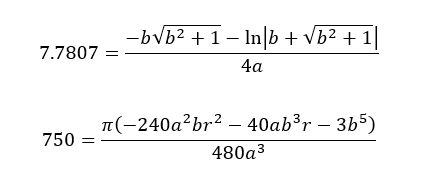


 solid summit
laga what
edgy cedar
Because you have constants on a and b
edgy cedar
How old are you?
solid summit
barely 18
edgy cedar
I mean I wouldn’t do this lol