#help-36
1 messages · Page 249 of 1
 rugged merlin
 pulsar axle
Lol ok
pulsar axle
Lol ok
i^3 does work
pulsar axle
i know
rugged merlin
But yeah it doesnt work otherwise
 brisk lion
then I'm curious. does i^2 or i^3 work if input through the arbitrary exponents button?
rugged merlin
brisk lion
then I'm curious. does i^2 or i^3 work if input through the arbitrary exponents ...
only those two
even i^1 gives an error
And i^-1 works
brisk lion
even if input through the arbitrary exponents button?
rugged merlin
brisk lion
even if input through the arbitrary exponents button?
Yes
brisk lion
hm, interesting. I thought they programmed it in such a way that the arbitrary exponent function expects a real base.
 formal trail
presumably it recognizes an exponent of 2 through the arbitrary exponents button and redirects it to the squaring program
although if it was smart enough to do that you would think they would bother doing integer exponents in general. but i guess they decided complex calculations were too niche for the effort required
brisk lion
I would at least think that even if they don't want to deal with non-integer exponents, they can detect if the base is i and the exponent is not an integer, and just throw a math error that way.
but I suppose they don't want to deal with more than a few cases.
rugged merlin
Anyways this isn't that catastrophic @pulsar axle. i^n always circularly rotates around the same values after i^4. So considering n mod 4 (n being the exponent) would get you the result you want
 final saddleBOT
@pulsar axle Has your question been resolved?
final saddleBOT
Channel closed
Closed due to timeout
Use .reopen if this was a mistake.
 Available help channel!
Send your question here to claim the channel.
Remember:
• Ask your math question in a clear, concise manner.
• Show your work, and if possible, explain where you are stuck.
• Do not immediately ping people or roles. After 15 minutes, feel free to ping <@&286206848099549185> once.
• Type the command .close to free the channel when you're done.
• Be polite and have a nice day!
Read #❓how-to-get-help for further information on how to ask a good question, and about conduct in the question channels.
 flint elk
is Wagner's Theorem applicable to infinite graphs, and if not, what is a counterexample?

In graph theory, Wagner's theorem is a mathematical forbidden graph characterization of planar graphs, named after Klaus Wagner, stating that a finite graph is planar if and only if its minors include neither K5 (the complete graph on five vertices) nor K3,3 (the utility graph, a complete bipartite graph on six vertices). This was one of the ea...
final saddleBOT
flint elk
is Wagner's Theorem applicable to infinite graphs, and if not, what is a counter...
flint elk
or is it simply that planar graphs must be finite?
final saddleBOT
@flint elk Has your question been resolved?
 muted prairie
This is essentially asking whether a graph is planar if every finite subgraph if it is planar
flint elk
wdym
muted prairie
Well, if G has a forbidden minor
Presumably that minor exists in a finite subgraph of G
Which is thereby nonplanar
flint elk
muted prairie
Presumably that minor exists in a finite subgraph of G
is this obvious?
muted prairie
Should be obvious from the definition of minor, right?
flint elk
can't you do an infinite amount of edge contractions and shit?
muted prairie
oh, I guess it's not obvious by the definition Wikipedia gives
flint elk
wdym
muted prairie
I could be wrong, but I think of a minor as an embedding in which edge lengthening is allowed
but you can't lengthen an edge infinitely
flint elk
is that more like https://en.wikipedia.org/wiki/Kuratowski's_theorem

In graph theory, Kuratowski's theorem is a mathematical forbidden graph characterization of planar graphs, named after Kazimierz Kuratowski. It states that a finite graph is planar if and only if it does not contain a subgraph that is a subdivision of
      K

        5
...
muted prairie
No, it should just be an alternate definition of minor
flint elk
which / where
muted prairie
Near the end
flint elk
-# but also aren't any two theorems "'"equivalent"'"
muted prairie
flint elk
is that more like https://en.wikipedia.org/wiki/Kuratowski%27s_theorem
Of this
Yeah but I assume it means they can be proven equivalent without proving them
muted prairie
well subdivisions of a finite graph should be finite right
flint elk
muted prairie
well subdivisions of a finite graph should be finite right
why necessarily? can i not shove infinite amount of vertices into it?
infinite graphs are just headaches
flint elk
tru...
muted prairie
It's hard to imagine what performing an infinite number of edge contractions at the same time could look like
There are some cases where it makes sense but like, is that even defined in general?
final saddleBOT
Channel closed
Closed by @flint elk
Use .reopen if this was a mistake.
muted prairie
flint elk
you've convinced me, i think
I think I was wrong about the subdivision thing being an alternative definition of minor
But then it's probably hard to define minors for infinite graphs
flint elk
yah yah
final saddleBOT
Available help channel!
Send your question here to claim the channel.
Remember:
• Ask your math question in a clear, concise manner.
• Show your work, and if possible, explain where you are stuck.
• Do not immediately ping people or roles. After 15 minutes, feel free to ping <@&286206848099549185> once.
• Type the command .close to free the channel when you're done.
• Be polite and have a nice day!
Read #❓how-to-get-help for further information on how to ask a good question, and about conduct in the question channels.
 delicate trench
How could i get the combined weight of 3 percentages to 100%
 worthy wren
is the weightage of each exam the same?
delicate trench
yes
 tired walrus
delicate trench
How could i get the combined weight of 3 percentages to 100%
tired walrus
delicate trench
How could i get the combined weight of 3 percentages to 100%
what do you mean combined weight
delicate trench
I dont remember the exact terminology
i mean how it would combine up to 100%
let me check something about them one sec
ok so they are all weighted the same
 abstract bramble
you mean... the mean?
delicate trench
i think i do
abstract bramble

worthy wren
yeah u just average it out like u usually do
delicate trench
well average and mean arent the same right?
abstract bramble
they are
tired walrus
average is an informal word for mean
delicate trench
oh well nevermind
no I have not had to use average as a concept in classes since probably elementry school
dont know why
thank you though
.close
final saddleBOT
Channel closed
Closed by @delicate trench
Use .reopen if this was a mistake.
final saddleBOT
Available help channel!
Send your question here to claim the channel.
Remember:
• Ask your math question in a clear, concise manner.
• Show your work, and if possible, explain where you are stuck.
• Do not immediately ping people or roles. After 15 minutes, feel free to ping <@&286206848099549185> once.
• Type the command .close to free the channel when you're done.
• Be polite and have a nice day!
Read #❓how-to-get-help for further information on how to ask a good question, and about conduct in the question channels.
 cursive aurora
Find all natural numbers $n$ such that $36n^2 - 6$ is the product of at least two consecutive natural numbers.
final saddleBOT
cursive aurora
Find all natural numbers $n$ such that $36n^2 - 6$ is the product of at least tw...
 soft zealotBOT
math

 rancid idol
what have you tried.
cursive aurora
I'm just starting.
rancid idol
what are you hoping to achieve by opening this channel?
 proud igloo
philosophical shuwi
cursive aurora
can help me?
rancid idol
well you have to at least try something?
or tell us where you're stuck?
or it's a bit hard to help
proud igloo
U should try to formulate your question more mathematically
Esp the part about the product...
cursive aurora
Let the product of at least two consecutive natural numbers be $P = k(k+1)\dots(k+m)$, where $k, m \in \mathbb{N}$ and $m \ge 1$.
We have the equation: $36n^2 - 6 = k(k+1)\dots(k+m)$.
soft zealotBOT
idk
 rancid idol
Have you tried simplifying that expression given
cursive aurora
ok
We have $36n^2 - 6 = 4(9n^2 - 2) + 2$. This implies that $36n^2 - 6 \equiv 2 \pmod{4}$. This means that this number is divisible by 2 but not divisible by 4.If the product consists of 4 or more consecutive natural numbers ($m \ge 3$), it certainly contains at least two even numbers.The product of two consecutive even numbers is always divisible by $2 \times 4 = 8$ (or at least $2 \times 2 = 4$).Therefore, the product cannot consist of 4 or more consecutive numbers.Thus, $m$ can only be 1 or 2.
soft zealotBOT
idk
 rancid idol
im surprised you didn't try factorizing that expression as much as possible
cursive aurora
It can be solved this way?
 solar crest
is there a method without modular arithmetic
cursive aurora
idk
rancid idol
cursive aurora
It can be solved this way?
I don't know, but that's the first thing I would try.
cursive aurora
try m=1
rancid idol
,,36n^2 - 6
soft zealotBOT
 rancid idol
what do you get when you try factorizing this expression
cursive aurora
Let me try.
rancid idol
(maybe it won't help, but anyways, that's the first thing I would have done to try this question)
 tranquil pine
soft zealot
**math**
tranquil pine
soft zealot
**math**
isn't this already on another channel
cursive aurora
$$36n^2 - 6 = 6(6n^2 - 1)$$
soft zealotBOT
idk
 cursive aurora
$$36n^2 - 6 = (6n)^2 - (\sqrt{6})^2$$$$= (6n - \sqrt{6})(6n + \sqrt{6})$$
soft zealotBOT
idk
 rancid idol
well yh maybe not the square roots
I then would consider something like 6((3n-1)(2n+1) - n) as possibly helpful
cursive aurora
$$4(36n^2 - 6) + 1 = 144n^2 - 23$$$$= (12n)^2 - 23$$
soft zealotBOT
idk

 trail mango
for solutions to 36n^2 - 6 = k(k+1), this is equivalent to (6n)^2 = k^2 + k + 6. so we want values of k such that k^2 + k + 6 is a square. for this, observe that for “large enough” k, we have k^2 < k^2 + k + 6 < (k+1)^2
this means k^2 + k + 6 lies between two consecutive squares and cannot be square
you can do some algebra to figure out which k’s satisfy that inequality. all the ones that do have no solutions associated with them
and the remaining ones to check will be a small finite list
 loud phoenix
$$m^2 + m = 36n^2 - 6$$. Multiply by 4 and add 1 to both sides to complete the square: $$4m^2 + 4m + 1 = 144n^2 - 24 + 1 \Rightarrow (2m+1)^2 = 144n^2 - 23$$ Rearranging this we get $$(12n)^2 - (2m+1)^2 = 23 \Rightarrow (12n - (2m+1))(12n + (2m+1)) = 23$$ Now just solve for n.
soft zealotBOT
Ajay
 cursive aurora
@trail mango You are referring to the square clamping method.?
trail mango
i have no idea what it’s called lol
i did not even know it was a “method with a name”
cursive aurora
trail mango
i did not even know it was a “method with a name”
🙂
trail mango
loud phoenix
$$m^2 + m = 36n^2 - 6$$. Multiply by 4 and add 1 to both sides to complete the s...

cursive aurora
soft zealot
**idk**
can we try m=1 or m=2?
trail mango
wdym
cursive aurora
try m=1 and m=2 and find n
trail mango
trail mango
for solutions to 36n^2 - 6 = k(k+1), this is equivalent to (6n)^2 = k^2 + k + 6....
that’s what i did here
cursive aurora
hmm...
trail mango
so we are just looking for natural numbers n such that there exists a natural number k such that 36n^2 - 6 = k(k+2). yes?
cursive aurora
Find all natural numbers n that satisfy 36n^2-6 is the product of at least two consecutive natural numbers.
trail mango
trail mango
for solutions to 36n^2 - 6 = k(k+1), this is equivalent to (6n)^2 = k^2 + k + 6....
do you accept this as a way to solve the problem for m = 1 (so the product of 2 consecutive integers case)
cursive aurora
ye
trail mango
okay. moving on to the m = 2 case…
cursive aurora
i'll try
trail mango
i do not know how to do this one anyway
cursive aurora
Case 2: Product of two consecutive numbers ($m=1$) Suppose $36n^2 - 6 = k(k+1)$. Multiply both sides by 4 and add 1 to create a square: $$4(36n^2 - 6) + 1 = 4k^2 + 4k + 1$$$$144n^2 - 24 + 1 = (2k + 1)^2$$$$(12n)^2 - 23 = (2k + 1)^2$$$$(12n)^2 - (2k + 1)^2 = 23$$$$(12n - 2k - 1)(12n + 2k + 1) = 23$$Since 23 is a prime number and $12n + 2k + 1 > 12n - 2k - 1$, we have the system of equations:$$\begin{cases} 12n + 2k + 1 = 23 \ 12n - 2k - 1 = 1
\end{cases}$$Add the two equations together: $24n = 24 \implies n = 1$.With $n=1$, we have $36(1)^2 - 6 = 30$.Check: $30 = 5 \times 6$ (is the product of two consecutive natural numbers).
soft zealotBOT
idk
 trail mango
yes that looks fine
trail mango
why
trail mango
i’m too stupid for that. just ask in the server
 scarlet sequoia
cursive aurora
I might ask you a few questions later.
scarlet sequoia
cursive aurora
I might ask you a few questions later.
Speaking out of generality, most helpers prefer to keep the help on the server
cursive aurora
scarlet sequoia
Speaking out of generality, most helpers prefer to keep the help on the server
🙂
cursive aurora
trail mango
i’m too stupid for that. just ask in the server
ok and cya
how to close this @scarlet sequoia
?
brisk lion
type .close.
final saddleBOT
Channel closed
Closed by @cursive aurora
Use .reopen if this was a mistake.
final saddleBOT
Available help channel!
Send your question here to claim the channel.
Remember:
• Ask your math question in a clear, concise manner.
• Show your work, and if possible, explain where you are stuck.
• Do not immediately ping people or roles. After 15 minutes, feel free to ping <@&286206848099549185> once.
• Type the command .close to free the channel when you're done.
• Be polite and have a nice day!
Read #❓how-to-get-help for further information on how to ask a good question, and about conduct in the question channels.
 manic atlas
I may need some help
final saddleBOT
manic atlas
I may need some help

 dull compass
hmm
manic atlas
here
 dull compass
multiply z by both sides
give z^2025 = i (|z|^2)
 strange sparrow
or write z in polar form
final saddleBOT
@manic atlas Has your question been resolved?
Channel closed
Closed by @manic atlas
Use .reopen if this was a mistake.
Available help channel!
Send your question here to claim the channel.
Remember:
• Ask your math question in a clear, concise manner.
• Show your work, and if possible, explain where you are stuck.
• Do not immediately ping people or roles. After 15 minutes, feel free to ping <@&286206848099549185> once.
• Type the command .close to free the channel when you're done.
• Be polite and have a nice day!
Read #❓how-to-get-help for further information on how to ask a good question, and about conduct in the question channels.
 tranquil lantern
my exams are coming up soon, and it's all mcq questions, 1 mark for each question, -0.25 for getting it wrong, does that mean I should hypothetically answer each and every one?
final saddleBOT
tranquil lantern
my exams are coming up soon, and it's all mcq questions, 1 mark for each questio...
tranquil lantern
since I need to get 1/4 to break even
and even if I can cross out one option from the 16 options, that's a win?
there's 100 questions in total
rugged merlin
Are we assuming you are randomly answering each one?
 wild venture
Yeah you must
brisk lion
you need to get 20 questions correct to break even (20 - (1/4)(80)).
wild venture
See doing one question correct you have leverage of doig 4 questios wrong
brisk lion
how many options are there per question though?
wild venture
brisk lion
how many options are there per question though?
4 ig, most common
rugged merlin
tranquil lantern
and even if I can cross out one option from the 16 options, that's a win?
No you shouldnt guess if its 16
brisk lion
if it's the typical four, then you should answer all of them. after all, you're not going to answer all of them by chance, right?
rugged merlin
He said 16, guys
wild venture
rugged merlin
He said 16, guys
Who tf has 16 options
brisk lion
oh wait I thought they meant 16 questions correct. sorry for the misread.
but that is a gigantic number of options per question... 
tranquil lantern
rugged merlin
Are we assuming you are randomly answering each one?
yess, but I cancel one option
out of the 16
rugged merlin
If you guess on 16 questions, you’d likely get 1 right and 15 wrong (-3.75). Your net score would hence be -2.75. So in that specific weird case you shouldnt
trail mango
guessing is also higher variance than not answering
 halcyon ether
wild venture
Who tf has 16 options
halcyon ether
wild venture
Who tf has 16 options
100 questions in a test is already insane to me
tranquil lantern
so I do 4 questons randomly, but on one I'm able to cross one out
tranquil lantern
rugged merlin
No you shouldnt guess if its 16
nonono 4 options per question
rugged merlin
......
tranquil lantern
sorry lol
16 as in, counting the 4 options from the 4 questions, and i'm able to for sure cross one option out
rugged merlin
tranquil lantern
out of the 16
So what is this all about
trail mango
,calc 0.75*(-0.25) + 0.25*1
soft zealotBOT
Result:
0.0625
whether I should attempt every question in the exam
brisk lion
are there four options per question? if so, yes.
tranquil lantern
it sounds like i should, but i don't know why they'd set it up like that cus there's like 10k students giving the exam every year and a lot of students skip questions
and there's talk about "skipping smartly"
tranquil lantern
brisk lion
are there four options per question? if so, yes.
oh sweet
 candid pulsar
tranquil lantern
and there's talk about "skipping smartly"
candid pulsar
tranquil lantern
and there's talk about "skipping smartly"
dont you need to read the syllabus for that
tranquil lantern
candid pulsar
dont you need to read the syllabus for that
wym? for skipping smartly?
I was just unsure cus I thought there might be a reason people don't attempt every question
brisk lion
I mean, I suppose if you really can't properly guess, at least taking the 0 is better than taking the penalty. that could be their reasoning.
tranquil lantern
brisk lion
I mean, I suppose if you really can't properly guess, at least taking the 0 is b...
yeah I guess
candid pulsar
yeah just skipping by feels doesnt seem smart
tranquil lantern
like if you're aiming for 100%
brisk lion
but most of the time you're going to have an educated guess.
tranquil lantern
yessss
brisk lion
and there's the process of elimination too.
tranquil lantern
okay so rule of thumb probably, if I can cross out one option from 4 that's a for sure attempted question
okay sweet thanks
trail mango
is it not just good to guess if you have no idea?
you expect positive points from doing that
maybe i just don’t understand the question
do you get 0 points if you just don’t answer, and -0.25 if you answer wrong?
final saddleBOT
@tranquil lantern Has your question been resolved?
tranquil lantern
trail mango
do you get 0 points if you just don’t answer, and -0.25 if you answer wrong?
yup
tranquil lantern
trail mango
is it not just good to guess if you have no idea?
yeah I was just making sure
.close
final saddleBOT
Channel closed
Closed by @tranquil lantern
Use .reopen if this was a mistake.
Available help channel!
Send your question here to claim the channel.
Remember:
• Ask your math question in a clear, concise manner.
• Show your work, and if possible, explain where you are stuck.
• Do not immediately ping people or roles. After 15 minutes, feel free to ping <@&286206848099549185> once.
• Type the command .close to free the channel when you're done.
• Be polite and have a nice day!
Read #❓how-to-get-help for further information on how to ask a good question, and about conduct in the question channels.
 drifting spire
 final saddleBOT
drifting spire
final saddleBOT
drifting spire
 marsh mountain
drifting spire
marsh mountain
drifting spire
!status
final saddleBOT
drifting spire
What step are you on?
1. I don't know where to begin.
2. I have begun but got stuck midway.
3. I got an answer but I was told that it's wrong.
4. I got an answer and would like my work checked.
5. I have a question about someone else's work/solution.
6. I have completed the problem and don't need help anymore. Thank you.
7. None of the above
I don't understand how the first part can be true in even case.
For Ve to be vector space it should contain 0 which is not necessarily true
marsh mountain
drifting spire
I don't understand how the first part can be true in even case.
For Ve to be vec...
0(x) = 0
the zero function maps R to 0
thats the “zero” of the vector space anyways
drifting spire
like doesn't the condition means that for every f(x) there should be some c for which f(c) = 0
marsh mountain
wdym?
drifting spire
the function should contain 0 which is not true
not every even function contain 0 in it's range
drifting spire
marsh mountain
the zero function maps R to 0
ok so what does 0 function would mean
marsh mountain
drifting spire
ok so what does 0 function would mean
yes that is what the zero function would do
maybe ill use a different letter, ill use g
the zero element of V is the function $g : \r \to \r$ defined by $g(x) = 0$
soft zealotBOT
blanketism
 marsh mountain
can you see why?
drifting spire
sorry no
marsh mountain
okay lets pause for a sec
so the additive identity* of a vector space added dont give anything new, right?
the additive identity for the real numbers is 0
yk x + 0 is still x
yes?
okay coolio
drifting spire
it is ykx or just x?
drifting spire
marsh mountain
yk x + 0 is still x
ok yeh x
marsh mountain
alright, so the additive identity of the vector space of real valued functions
lets take a function f
we want to add some function g (we dont know what it is yet) to f so that we get f again, right?
i.e f + g = f
drifting spire
yes ok
marsh mountain
okay great
if theyre the same function, they should agree on output as well right?
so (f + g)(x) should be the same as f(x) for EVERY x in R
drifting spire
or g = 0?
marsh mountain
yeah, you should see that g = 0
drifting spire
yeah
marsh mountain
soft zealot
**blanketism**
does this make sense now?
drifting spire
it does make sense
drifting spire
marsh mountain
can you see why both vector spaces contain the 0 function then?
we have to show that there is g(c) = 0 so as to prove it vector space
marsh mountain
no
drifting spire
it's not already known that they both functions are VS
marsh mountain
not showing there is some input c that outputs to 0
but rather, does the zero function follow the description of both V_e and V_o?
like functions in V_e say that f(x) = f(-x)
if i put in x in the zero function, what do i get?
drifting spire
0
marsh mountain
what if i put in -x?
drifting spire
still 0
marsh mountain
so is the zero function in V_e?
drifting spire
ok yeah
marsh mountain
does that make sense a little more now
 strange sparrow
because the zero function is a map R to R which is all that is needed to be in V
drifting spire
strange sparrow
because the zero function is a map R to R which is all that is needed to be in V
ok
so we don't look at the function ?
directly see the co domain and domain and say wether it satisfies the condition
@strange sparrow Because what argument you give would be valid for whatever the function is until the sets are same
strange sparrow
oh in V_o
Well you can just check that the zero function is an odd function
That is trivial to check
final saddleBOT
Channel closed
Closed by @drifting spire
Use .reopen if this was a mistake.
final saddleBOT
Available help channel!
Send your question here to claim the channel.
Remember:
• Ask your math question in a clear, concise manner.
• Show your work, and if possible, explain where you are stuck.
• Do not immediately ping people or roles. After 15 minutes, feel free to ping <@&286206848099549185> once.
• Type the command .close to free the channel when you're done.
• Be polite and have a nice day!
Read #❓how-to-get-help for further information on how to ask a good question, and about conduct in the question channels.
halcyon ether
<@&268886789983436800>
 willow tiger
ys
final saddleBOT
Channel closed
Channel closed due to the original message being deleted.
If you did not intend to do this, please open a new help channel,
as this action is irreversible, and this channel may abruptly lock.
halcyon ether
@modulatorics
rugged merlin
logan paul hired like 54174516 discord bots apparently
 cyan kayak
This one was Elon musk
 leaden moon
oh dang
leaden moon
halcyon ether
<@&268886789983436800>
grind green
halcyon ether
ofc
leaden moon
halcyon ether
ofc
get some sleep btw
halcyon ether
leaden moon
get some sleep btw
Eh no worry, Imma skip school tomorrow
for the 6th time this year
leaden moon
halcyon ether
Eh no worry, Imma skip school tomorrow
ts gonna be the last day imma get absent from school
i did it from this monday until today
willow tiger
cyan kayak
This one was Elon musk
why did the role change color tho
leaden moon
willow tiger
why did the role change color tho
wym?
willow tiger
the mod role was cyan before
leaden moon
willow tiger
the mod role was cyan before
no?
willow tiger
yes
leaden moon
it was pink all the time
willow tiger
no
leaden moon
wdym?
halcyon ether
willow tiger
why did the role change color tho
rugged merlin
leaden moon
wdym?
it was cyan for years
willow tiger
right
halcyon ether
Oh yeah
halcyon ether
I completely forgot they changed moderator color
rugged merlin
senior moderators became pink and (junior) moderators retained the cyan. The two were then given pink a while after
leaden moon
halcyon ether
I completely forgot they changed moderator color
i didn't even know that's happening
willow tiger
bruh
leaden moon
willow tiger
bruh
OG ig
willow tiger
yea
willow tiger
it was cyan for a long time no?
willow tiger
cyan fr better than pink
leaden moon
i'd make yellow for the admin color
willow tiger
cyan kayak
This one was Elon musk
btw is there any insider information on how to get helpful?
leaden moon
willow tiger
btw is there any insider information on how to get helpful?
grind a lot in help channels
 fossil belfry
can any1 help me w/ this problem
willow tiger
you dont say
leaden moon
fossil belfry
can any1 help me w/ this problem
!occupied
willow tiger
another channel pls
final saddleBOT
fossil belfry
can any1 help me w/ this problem
Someone else is already using this help channel. If you need help with a question, please open your own help channel/thread (see #❓how-to-get-help for instructions).
fossil belfry
demmit
halcyon ether
fossil belfry
can any1 help me w/ this problem
!help
final saddleBOT
fossil belfry
can any1 help me w/ this problem
To ask for mathematics help on this server, please open your own help channel or help thread. See #❓how-to-get-help for instructions.
willow tiger
xD
leaden moon
willow tiger
another channel pls
OG should use factoids
willow tiger
thats why i didnt use
leaden moon
oh i see
willow tiger
xD
halcyon ether
Well why not use !help
leaden moon
willow tiger
thats why i didnt use
you tryna hack me?
willow tiger
nah
leaden moon
halcyon ether
Well why not use !help
i used !occupied so much
leaden moon
halcyon ether
Well why not use !help
-# i think i need to sue this server for emotional distress
-# i helped so much and didn't get green
😭
final saddleBOT
Available help channel!
Send your question here to claim the channel.
Remember:
• Ask your math question in a clear, concise manner.
• Show your work, and if possible, explain where you are stuck.
• Do not immediately ping people or roles. After 15 minutes, feel free to ping <@&286206848099549185> once.
• Type the command .close to free the channel when you're done.
• Be polite and have a nice day!
Read #❓how-to-get-help for further information on how to ask a good question, and about conduct in the question channels.
 formal laurel
I’m not sure on how to get the critical numbers and how to know where the minimum and maximum is

 final saddleBOT
formal laurel
I’m not sure on how to get the critical numbers and how to know where the minimu...
abstract bramble
formal laurel
I’m not sure on how to get the critical numbers and how to know where the minimu...
final saddleBOT
formal laurel
I’m not sure on how to get the critical numbers and how to know where the minimu...
abstract bramble
formal laurel
I’m not sure on how to get the critical numbers and how to know where the minimu...
critical numbers? but you can just look at graph
formal laurel
Does 1 and 3 count
 tiny gorge
which graph are you referring to
formal laurel
The first one without questions
tiny gorge
what's the definition of a critical point?
formal laurel
a point where the graph has a sharp turn?
tiny gorge
that's not the definition, is it?
what about points where the derivative is zero, isn't that one case?
formal laurel
So what should I look for in the graph
tiny gorge
well a critical point is one of two things
either the derivative is zero, or the derivative doesn't exist
you asked about x = 1, do either of those conditions apply there?
tiny gorge
well be careful about the second condition
one way the derivative can fail to exist is if the slopes are different to the left and to the right of the point
and visually it appears that is the case for x=1
formal laurel
And the same applies to x =3?
tiny gorge
yes it's hard to say for sure because the graph is a bit fuzzy, but it looks like the slope as you approach from the left is becoming flatter and flatter (maybe approaching zero) whereas from the right it looks to be a steady slope of 1
so i would say it's not differentiable there
formal laurel
So the critical numbers would be -2,-1,0,2?
tiny gorge
x=2 is another point where the slopes clearly disagree
tiny gorge
formal laurel
So the critical numbers would be -2,-1,0,2?
what about 1 and 3 like we just discussed?
formal laurel
A method my teacher told me was to look where the slope is horizontal or when there’s a cusp
tiny gorge
cusp or "corner" yea, basically indicative of slopes differing on the two sides
another way the derivative can fail to exist is if there's a discontinuity
so watch for those too (i don't see any in these examples)
formal laurel
tiny gorge
another way the derivative can fail to exist is if there's a discontinuity
Oh yea I remembered
Okay how about the second image how do I identify the maximum and minimum do I just look at the highest and lowest points?
tiny gorge
yep, pretty much
they can occur at any critical point or possibly at one of the endpoints of the domain
formal laurel
So the answer would be max =4 at x=3.5
Min = -3 at x=-2?
tiny gorge
are we still talking about this one
 formal laurel
No this one
 tiny gorge
the max y value looks to be 4, but it occurs at x = -3.5, not 3.5
your min looks right
tiny gorge
well if there's a min there and the function is differentiable there then the derivative must equal what number?
formal laurel
0?
tiny gorge
yea because it's a critical point and (visually anyway) it looks differentiable
formal laurel
Tysm for your help
tiny gorge
yw
formal laurel
.close
final saddleBOT
Channel closed
Closed by @formal laurel
Use .reopen if this was a mistake.
final saddleBOT
Available help channel!
Send your question here to claim the channel.
Remember:
• Ask your math question in a clear, concise manner.
• Show your work, and if possible, explain where you are stuck.
• Do not immediately ping people or roles. After 15 minutes, feel free to ping <@&286206848099549185> once.
• Type the command .close to free the channel when you're done.
• Be polite and have a nice day!
Read #❓how-to-get-help for further information on how to ask a good question, and about conduct in the question channels.
trail mango
define $\mathbb{T}={z\in \bC:|z|=1}$. prove there is no continuous function $f:\mathbb{T}\to \mathbb{T}$ such that $f(z)^2 = z$ for all $z\in\mathbb{T}$
final saddleBOT
trail mango
define $\mathbb{T}=\{z\in \bC:|z|=1\}$. prove there is no continuous function $f...
trail mango
a long time i worked on this problem with snow but now i'm afraid we came up with nonsense so i ask once again
soft zealotBOT
generating function shill
 trail mango
if you ain't got nothing mathematical to say then don't say nothin
final saddleBOT
@trail mango Has your question been resolved?
 plucky rover
trail mango
define $\mathbb{T}=\{z\in \bC:|z|=1\}$. prove there is no continuous function $f...
plucky rover
trail mango
define $\mathbb{T}=\{z\in \bC:|z|=1\}$. prove there is no continuous function $f...
You're familiar with fundamental groups?
trail mango
yes
plucky rover
The map z ↦z^2 is a 2-fold covering map
Call it idk, s
Now suppose f exists as required
Then s ∘ f = id
Now use fundamental groups
||In terms of winding number, the function it's asking for would have to halve the winding number. Which isn't exactly possible||
I'm sure there is a purely complex analysis proof but I'm not familiar
trail mango
hm. this would not have been accepted in my complex analysis class
plucky rover
Fine lemme ask my anal friends
trail mango
wish i had friends like that
plucky rover
trail mango
hm. this would not have been accepted in my complex analysis class
Actually how about parametrizing the unit circle
 proper dagger
would writing z as e^(i theta) and then fuzzing with it work
trail mango
hi hanako 
proper dagger

trail mango
plucky rover
||In terms of winding number, the function it's asking for would have to _halve_...
why is this?
winding number of what?
of the circle?
plucky rover
Of any loop on the circle
trail mango
my failing algebraic topology is showing
i don't understand how any of ts is relevant
plucky rover
proper dagger
would writing z as e^(i theta) and then fuzzing with it work
Yes
That's what I meant by parametrizing
plucky rover
trail mango
i don't understand how any of ts is relevant
Gimme 5 mins
trail mango
the z \mapsto z^2 is a 2-sheeted covering map and s \circ f = id stuff is ok btw. just so you don't have to explain that more if you don't want
trail mango
yep
plucky rover
And π_1(S^1) is integers
trail mango
yep
plucky rover
If you square a loop, you double the number of times it "winds"
trail mango

plucky rover
So s* is basically x ↦2x on the fundamental group
Now you want s* ∘ f* to be identity on integers
plucky rover
trail mango
<:catthin4K:811354320460578896>
Okay let's put it this way
Every point has two points that square to it
plucky rover
trail mango
my failing algebraic topology is showing
Think of the winding number of a loop as, quite literally, the representative of that loop in the fundamental group
Also if you're not comfortable doing this, we can go the complex analysis route instead
trail mango
plucky rover
If you square a loop, you double the number of times it "winds"
ok i accept this.. you just add up the winding numbers when you multiply two loops
plucky rover
Yes
plucky rover
plucky rover
Now you want s* ∘ f* to be identity on integers
So what would f* need to be
trail mango
x \mapsto x/2
trail mango
no
plucky rover
There we gk
trail mango
i hate to see algebraic topology being useful
plucky rover
Pfft
It makes a lot of problems very easy
For example, there is no retraction of the 2d disc onto its boundary
trail mango
no it doesn't because you have to understand algebraic topology first
plucky rover
Ehhh basic alg top isn't that bad
 lavish surge
trail mango
i hate to see algebraic topology being useful
lavish surge
trail mango
i hate to see algebraic topology being useful
Algebraic topology is combinatorical Topology 😌
plucky rover
Homology and cohomology is when it gets annoying
You can solve a lot of problems with homotopy and π_1
trail mango
fine fine your proof is cool
plucky rover
Pfft
trail mango
now i want a NO ALGEBRAIC TOPOLOGY proof
plucky rover
Ah cool
Let's parametrize the circle like Hana said
Every point on it is of the form e^iθ
A function S^1 → S^1 therefore reduces to a function [0,2π] → [0,2π]
trail mango
sure
plucky rover
Now what function does z ↦ z^2 reduce to
trail mango
my brain does not like this reduction
plucky rover
I mean, a complex function is two real functions in a cauchy criterion shaped trenchcoat
plucky rover
plucky rover
A function S^1 → S^1 therefore reduces to a function [0,2π] → [0,2π]
Oh right one of those sides isn't closed, whatever
trail mango
that remark makes my brain like the reduction a tiny bit more
plucky rover
Pfft
trail mango
plucky rover
Now what function does z ↦ z^2 reduce to
x\mapsto 2x (mod 2pi)? (i didn't really want to use z again here)
strange sparrow
trail mango
i hate to see algebraic topology being useful
there's a similar proof of the fundamental theorem of algebra using this
also winding numbers
plucky rover
Yes
plucky rover
trail mango
x\mapsto 2x (mod 2pi)? (i didn't really want to use z again here)
Now if there was a square root, what function would it induce
trail mango

plucky rover
plucky rover
Oh right one of those sides isn't closed, whatever
Actually my bad, it's not exactly [0,2π), it's [0,2π] with the quotient topology
trail mango
i don't understand the question
plucky rover
Like the square function doubles the abgle
What would a square root function do
(notice that f is a square root function)
plucky rover
strange sparrow
there's a similar proof of the fundamental theorem of algebra using this
The fundamental theorem of algebra has proofs using everything but algebra huh
lavish surge
trail mango
i don't understand the question
A rather simplification would be how does the equation x^2+y^2 =1 differ from sqrt(x^2+y^2)=1
trail mango
plucky rover
What would a square root function do
we can map each x to whatever y solves 2y = x (mod 2pi). so x/2 or... (x+2pi)/2
plucky rover
trail mango
we can map each x to whatever y solves 2y = x (mod 2pi). so x/2 or... (x+2pi)/2
Yes
Now is this function well defined
trail mango
can you clarify what domain and codomain you decided on
plucky rover
Well it's the remainder classes of ℝ modulo 2π
Oh my notation has been fucked throughout this, don't worry about it
You're making a type theorist do analysis this is the best you're getting 
trail mango
don't worry about it?
plucky rover
Okay fair
trail mango
why don't we just say R/[0,2π)
plucky rover
I believe that would work yeah
Whatever the notation is for remainder classes in R
In Z it's Z/nZ
trail mango
but [0,2π) partitions R well, [0,2π] does not
plucky rover
Yeye you're correct, I was abusing notation there
trail mango
why do we need to worry about well defined-ness anyway. can we not just look at it as a function from [0,2π) to [0,2π)
plucky rover
It would be a problem if it gave you a different result when you express a point as e^ix compared to e^i(2π+x)
Are you familiar with why a holomorphic logarithm doesn't exist
This is a similar argument to that essentially
trail mango
yea but my point is the points on the circle correspond to numbers that look like e^ix with x in [0,2π) so i want to just not give a fuck about the ones that look like e^i(2π+x) (or all the other ways you could write them). we're already looking at them
plucky rover
For a function to be well defined, you want it to give the same result no matter how you express your points
Even if you're looking at all of them, you want to look at all possible representations of them
trail mango
trail mango
we can map each x to whatever y solves 2y = x (mod 2pi). so x/2 or... (x+2pi)/2
i understand this is not well defined with your interpretation
plucky rover
Exactly
It is easy to say "this function works when the argument is kept between 0 and 2π"
But what happens when you multiply smth and the powers add up to more than 2π
trail mango
i don't think that's a problem there?
if x is in [0,2pi), then x/2 and (x+2pi)/2 are also in [0,2pi)
plucky rover
Yes but they're different values
x/2 ≠ x + π/2
And both of these lie in the codomain
When dealing with functions on quotients, checking that they're well defined is important
Cuz while it looks like the angle is between [0,2π), it just happens to be the case that it loops back around
And while we can work with [0,2π) most of the time, we wanna be careful in case situations like this one arise
trail mango
trail mango
if x is in [0,2pi), then x/2 and (x+2pi)/2 are also in [0,2pi)
i honestly don't know what the problem is. for a fixed z there are two ways to assign a value to f(z) so that f(z)^2 = z. that's what my things here correspond to. for example, when x is 0 that corresponds to the point e^(xi) = 1 on the circle. the values we could assign f(z) so that f(z)^2 = 1 are 1 and -1. which match with e(ix/2) = e^0 = 1 and e^(i(x+2pi)/2) = e^(ipi) = -1
 flint sleet
what came to my mind is to try to do something with the integral of f(z)^2 = z
ie. integrate both sides and show a contradiction
its been ages since i did this stuff
loud phoenix
flint sleet
what came to my mind is to try to do something with the integral of f(z)^2 = z
Not quite. To integrate $f(z)$, you first need $f(z)$ to actually be a function. The previous argument shows that we can't even define $f(z)$ continuously on the circle, and if a function isn't continuous (or at least measurable/integrable), the integral itself cant be done.
soft zealotBOT
Ajay
 trail mango
i honestly don't know what the problem is. for a fixed z there are two ways to a...
trail mango
trail mango
i honestly don't know what the problem is. for a fixed z there are two ways to a...
i understand that if we work with functions with domain R/[0,2π) then my 'function' is not well defined. the elements are really equivalence classes and it needs to make sense regardless of what representative is chosen. i know. but i really don't think there is anything wrong with how i set this up. besides being morally wrong to you, i guess
plucky rover
Can you make your setup concrete then, so that I can point out precisely where the problem is?
plucky rover
plucky rover
Can you make your setup concrete then, so that I can point out precisely where t...
Or of course correct myself if there isn't one
plucky rover
flint sleet
can we show that if f was continuous, then it is constant?
You're trying to use Liouville on a function that isn't entire
That's not going to work
flint sleet
not directly use, but replicate the proof idea somehow
plucky rover
How do you even conclude f is constant from f(z)^2 = z
flint sleet
if we show that f is constant, then f(z)^2 = z cannot hold
plucky rover
I mean yes if we can do that
flint sleet
so then we'd conclude that such a continuous function cannot exist
plucky rover
If being a very big part here
plucky rover
trail mango
i understand that if we work with functions with domain R/[0,2π) then my 'functi...
Can you post your setup concretely please? Just in case I might be misunderstanding you
loud phoenix
@flint sleet that's too complicated for this question. You don't need to prove $f$ is constant; you just need to show that $f$ cannot close the loop continuously.
soft zealotBOT
Ajay
 plucky rover
We already have a proof by algebraic topology, and we essentially have a proof without one as well
All that remains is to make the arguments precise
proper dagger

plucky rover
Hi Hanako
trail mango
plucky rover
Can you post your setup concretely please? Just in case I might be misunderstand...
let $f$ be a function as defined in the problem. define $g: [0, 2\pi) \to [0, 2\pi)$ by $g(z)$ is the unique point $x$ in $[0, 2\pi)$ such that $e^{ix} = z$. now for each $z\in\mathbb{T}$, there are two values $f(z)$ could be assigned so that $f$ has the square root property. namely the square roots of $z$. i claim we can write them down with $g$. they are $$e^{i g(z)/2}$$ and $$e^{i(g(z) + 2\pi)/2}.$$ also, both $g(z)/2$ and $(g(z) + 2\pi)/2$ are in the interval $[0, 2\pi)$
soft zealotBOT
generating function shill
 plucky rover
A function can't map one point to two points though
trail mango
yea
plucky rover
Isn't your f doing that
trail mango
no, when you declare f you need to pick one of those solutions
but i'm saying you can pick either of them and f will have the square root property in the problem
whichever one you want, for each z
trail mango
i would sure hope not
plucky rover
Take a sequence converging to 2π
trail mango
tis ok
plucky rover
plucky rover
plucky rover
Take a sequence converging to 2π
Well can you use this to show it's not continuous
flint sleet
ill spitball for a bit
the numbers in set T are defined by one parameter, theta (r is 1)
so then z = e^ix where x is the angle
f(z) is e^(2i f(x))
my notation is a bit lacking here
hopefully it makes some sense
plucky rover
Dude you're treading ground that has already been tread
flint sleet
should be able to use complex log
trail mango
plucky rover
Well can you use this to show it's not continuous
i will be done for the night and think about ts tomorrow
trail mango
sleep is for relaxing not doing stupid math
plucky rover
trail mango
i will be done for the night and think about ts tomorrow
Understandable
final saddleBOT
@trail mango Has your question been resolved?
 harsh dock
Is there a question here this is such a long discussion
loud phoenix
@harsh dock look at pinned message.
final saddleBOT
@trail mango Has your question been resolved?
 obtuse hedge
shut up clanker
obtuse hedge
trail mango
yea but my point is the points on the circle correspond to numbers that look lik...
Based on this limitation to [0,2pi) is it not just enough to say that sin changes sign on the interval and be done
trail mango
i don’t see what the implication of this is
loud phoenix
obtuse hedge
Based on this limitation to [0,2pi) is it not just enough to say that sin change...
Not rigorous enough.
obtuse hedge
As in $f(z)^2 = z \implies f(z) = \sqrt{z} = e^{i\frac{g(z)}{2}} = \cos(\frac{g(z)}{2}) + i\sin(\frac{g(z)}{2}) = \pm\sqrt{\frac{1 + \cos(g(z))}{2}} \pm i\mathrm{sgn}(\sin(g(z))\sqrt{\frac{1 - \cos(g(z))}{2}}$ since your function f chooses one value, arbitrarily choose any branch here so $f(z)$ is continuous at $g(z) = \frac{\pi}{2}$
soft zealotBOT
Coolempire93
 loud phoenix
was wondering why you were writing out the half-angle identity lol
obtuse hedge
because I thought the inside of the root was nonzero 😔 i'm dumb
this function feels very continuous, I wonder where the discontinuity will end up being
plucky rover
obtuse hedge
this function feels very continuous, I wonder where the discontinuity will end u...
I think it's gonna be less about where and more about if
You can always choose values so that the function is continuous at a point you choose
But you cannot do so consistently so that the function is continuous at every point
The core idea is that a continuous function must take a closed loop to a closed loop. However, square root fails to do that. That is a topology argument however, and the purely analysis argument isn't as clean
final saddleBOT
@trail mango Has your question been resolved?
 grim nebula
trail mango
define $\mathbb{T}=\{z\in \bC:|z|=1\}$. prove there is no continuous function $f...
grim nebula
trail mango
define $\mathbb{T}=\{z\in \bC:|z|=1\}$. prove there is no continuous function $f...
what the blud
final saddleBOT
Channel closed
Closed due to timeout
Use .reopen if this was a mistake.
Available help channel!
Send your question here to claim the channel.
Remember:
• Ask your math question in a clear, concise manner.
• Show your work, and if possible, explain where you are stuck.
• Do not immediately ping people or roles. After 15 minutes, feel free to ping <@&286206848099549185> once.
• Type the command .close to free the channel when you're done.
• Be polite and have a nice day!
Read #❓how-to-get-help for further information on how to ask a good question, and about conduct in the question channels.
 knotty sigil
On this proof of the Pascal's Triangle Formula, what step is made between the starting point and the first step? Feels like a huge leap
 final saddleBOT
knotty sigil
On this proof of the Pascal's Triangle Formula, what step is made between the st...
final saddleBOT
knotty sigil
On this proof of the Pascal's Triangle Formula, what step is made between the st...
 severe canyon
Just ordinary algebra, nothing weird 🤷♂️
And they also used the fact that (k+1)! = (k+1)•k!
 iron aspen
they skipped:
Expanding factorials
Identifying the common denominator
Factoring it out
 ornate sky
expand factorial trying to factorise
final saddleBOT
Channel closed
Closed by @knotty sigil
Use .reopen if this was a mistake.
 meager shell
hey
knotty sigil
There's a 15 minute period or so before a channel reopens, you should try another channel in the meanwhile
final saddleBOT
Available help channel!
Send your question here to claim the channel.
Remember:
• Ask your math question in a clear, concise manner.
• Show your work, and if possible, explain where you are stuck.
• Do not immediately ping people or roles. After 15 minutes, feel free to ping <@&286206848099549185> once.
• Type the command .close to free the channel when you're done.
• Be polite and have a nice day!
Read #❓how-to-get-help for further information on how to ask a good question, and about conduct in the question channels.
 ivory vessel
 final saddleBOT
ivory vessel
ivory vessel
final saddleBOT
ivory vessel
ivory vessel
p(x) doesn't look like poisson to me, shouldn't it be x! on the denom?
 barren hound
,w sum (e^-t * t^x) / x from 1 to infinity
soft zealotBOT


 Requested by kitten.in.a.teacup
barren hound
Requested by kitten.in.a.teacup
barren hound
thanks wolfie very cool
does kinda feel like it should be x! yea
ivory vessel
hmmmmm
iron aspen
what level is this poblem again
ivory vessel
original problem in the book also doesn't have x!
 ivory vessel
iron aspen
what level is this poblem again
ivory vessel
iron aspen
what level is this poblem again
er, basic stats
iron aspen
oh k makes sense
barren hound
ivory vessel
original problem in the book also doesn't have x!
doesn't that diverge for reasonable values of t?
ivory vessel
yeah seems like it
iron aspen
barren hound
doesn't that diverge for reasonable values of t?
it might
final saddleBOT
Channel closed
Closed by @ivory vessel
Use .reopen if this was a mistake.
 silver cargo
ivory vessel
p(x) doesn't look like poisson to me, shouldn't it be x! on the denom?
silver cargo
ivory vessel
p(x) doesn't look like poisson to me, shouldn't it be x! on the denom?
chiming in to confirm that this is 99% right (x!, not x)
(sorry for the post-closure ping)
final saddleBOT
Available help channel!
Send your question here to claim the channel.
Remember:
• Ask your math question in a clear, concise manner.
• Show your work, and if possible, explain where you are stuck.
• Do not immediately ping people or roles. After 15 minutes, feel free to ping <@&286206848099549185> once.
• Type the command .close to free the channel when you're done.
• Be polite and have a nice day!
Read #❓how-to-get-help for further information on how to ask a good question, and about conduct in the question channels.
 spring haven
 final saddleBOT
spring haven
spring haven
final saddleBOT
spring haven
spring haven
how does one define $\int_{\partial\Sigma} f\dd{\mathbf r}$?
soft zealotBOT
kheer257
 spring haven
is dr the unit vector in the direction of the derivative of the parametrisation?
or is it $\int_a^b f(\mathbf r(t)) \mathbf r'(t) \dd{t}$
soft zealotBOT
kheer257
 final saddleBOT
Channel closed
Closed by @spring haven
Use .reopen if this was a mistake.
final saddleBOT
Available help channel!
Send your question here to claim the channel.
Remember:
• Ask your math question in a clear, concise manner.
• Show your work, and if possible, explain where you are stuck.
• Do not immediately ping people or roles. After 15 minutes, feel free to ping <@&286206848099549185> once.
• Type the command .close to free the channel when you're done.
• Be polite and have a nice day!
Read #❓how-to-get-help for further information on how to ask a good question, and about conduct in the question channels.
 modern estuary
hi can anybody suggest me mathematical models i can use for some data i have
final saddleBOT
modern estuary
hi can anybody suggest me mathematical models i can use for some data i have
modern estuary
heres what ive used so far
trig (sin / cos, arctan)
logistic function
power and exponential functions
normal distribution
polynomial
im not looking for a perfect fit
im basically evaluating models
 onyx peak
You should probably send the data as well (maybe as a graph?)
It's hard to suggest anything without knowing the context
 worldly spruce
modern estuary
im not looking for a perfect fit
worldly spruce
modern estuary
im not looking for a perfect fit
That would be pretty much impossible
If it's real world data
modern estuary
onyx peak
It's hard to suggest anything without knowing the context
im not too sure whether im allowed to share my data
modern estuary
worldly spruce
That would be pretty much impossible
nor a near perfect fit
it can be bad as well
i just need a couple models
ill share a graph

this is my data
onyx peak
did logistic not work?
 stone flint
does a normal distribution not fit this? this looks like a typical cumulative frequency curve.
onyx peak
modern estuary
can u link the desmos btw?
onyx peak
Or is the data somehow meant to be private?
modern estuary
onyx peak
Or is the data somehow meant to be private?
sort of. im not sure whether i can share it so publicly, i could send it to you in a dm if you're all right with that
onyx peak
Okay, sure
modern estuary
i asked for help with creating a normal distribution with this data a few hours ago in this server. i determined my mean to be 137.424 and my stddev as 96.3595
which did not fit this data
modern estuary
onyx peak
Okay, sure
sent
 opal plinth
onyx peak
modern estuary
opal plinth
onyx peak
modern estuary
The question then is whether you you just tried to put bell curve on this, because thats not what hyposelenia suggested
modern estuary
opal plinth
<https://en.wikipedia.org/wiki/Sigmoid_function>
yup
onyx peak
it looks like cumulative normal distr though
modern estuary
the sigmoid function was excellent
modern estuary
onyx peak
it looks like cumulative normal distr though
that it is
does that make a difference?
i dont know much about normal dists, just z score and some other basic stuff
i used the standard 1/sigma 2pi formula to create the equation for it
onyx peak
Cumulative plot of the bell curve looks like this
 modern estuary
 onyx peak
It's basically plotting the integral until certain point
modern estuary
you see the black line? thats the result of my equation
 modern estuary
onyx peak
It's basically plotting the integral until certain point
modern estuary
onyx peak
It's basically plotting the integral until certain point
oh, i see
yea this might be a more promising avenue
how do I get started with this?
ive sent you a desmos graph via dm
onyx peak
,w normal distribution CDF
soft zealotBOT

 Requested by methisalwaysright
onyx peak
Requested by methisalwaysright
onyx peak
,w erfc
soft zealotBOT
 Requested by methisalwaysright
modern estuary
soft zealot
Requested by methisalwaysright
modern estuary
soft zealot
this is very promissing. im following another paper to do some stuff, and they also used this
and erfc
I have no idea what any of this is, sadly. My knowledge of normal distributions is very limited
stone flint
that is one of the functions in the family of Gaussian error functions.
modern estuary
yeaaa, im getting in a little over my head with this sorta stuff tbh
im still in HS
or maybe the wiki link is just a bit more high level
stone flint
I'm not sure why the embed is not showing up, but if you click into the Wikipedia link, the first image is of the typical cumulative frequency graph for a normal distribution.
modern estuary
stone flint
I'm not sure why the embed is not showing up, but if you click into the Wikipedi...
indeed
stone flint
modern estuary
or maybe the wiki link is just a bit more high level
I agree. unfortunately, I think this is one of the harder things to motivate about the normal distribution.
there is a YouTube video going over its derivation but it too sounds like raging fanatical talk (to me at least!).
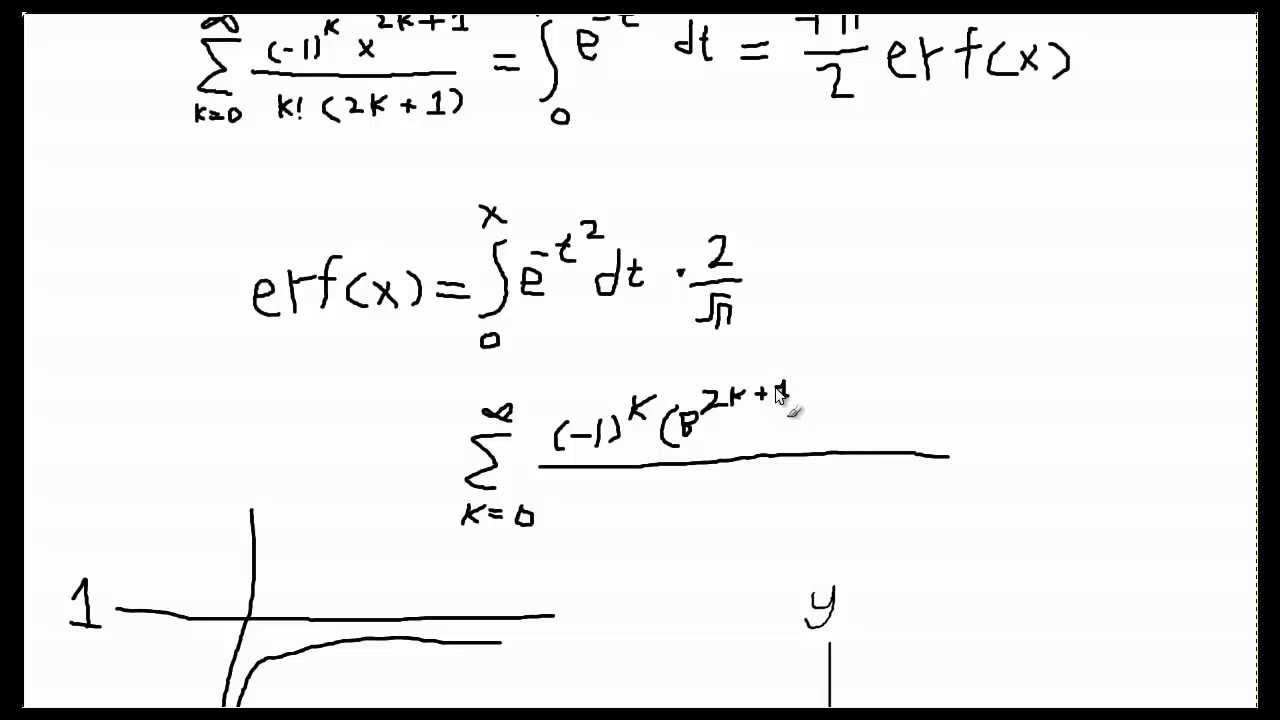
This is a special function related to the Gaussian. In this video I derive it.
oh, the embed for this one does show up. how interesting.
modern estuary
i guess i can simplify my question with regards to this
what would the standard equation for the cumulative normal distribution be?
final saddleBOT
@modern estuary Has your question been resolved?
final saddleBOT
@modern estuary Has your question been resolved?
 royal gust
soft zealot
royal gust
soft zealot
This is it up here
Note there's no closed form. That is, you can't express it in terms of the standard functions. Sometimes we express it in terms of erf, but usually we just let "the normal distribution CDF" be it's own thing.
modern estuary
royal gust
Note there's no closed form. That is, you can't express it in terms of the stand...
oh, i see
and how do i get erfc?
royal gust
Erf is the integral of e^(x²). No closed form, that's why we call it erf
Error function
modern estuary
i see. how do i go about determing this quantity?
royal gust
Not sure what you mean
modern estuary
lets say i wanna plot my data as a normal dist
royal gust
Excel, for example, has the normal CDF function built in
royal gust
You'd numerically approximate the integral
modern estuary
ah, that makes sense
royal gust
So, that's like adding 1000 terms
modern estuary
so when you say no closed solution, is that because the integral is non-terminating? or does it mean that the integral doesnt have a value at all, and we try approximating
royal gust
So we can quickly get ∫ sin(x) dx, because sin(x) has an anti-derivative. That is, there's some function that, when the derivative is taken, gives sin(x)
Now, all real functions have anti-derivatives! (wait no, that's probably not true. There's a better statement there if someone wants to fill the gap)
But they're not always expressible in terms of our standard functions.
In a sense, our standard functions aren't expressive enough to capture them
Tbh this is more mundane than I'm making it out to be. For example, how do you calculate ln(2)? You can't really write that one down either
Your calculator just happens to have a ln() button, but usually doesn't have a NormalCDF() button
Except excel does
modern estuary
royal gust
Tbh this is more mundane than I'm making it out to be. For example, how do you c...
yea thats what i thought
so can you also say ln(2) doesnt have a closed solution/
dull compass
modern estuary
so can you also say ln(2) doesnt have a closed solution/
yes
ln of any integer other than 0 or 1 pretty much doesnt have closed solution
modern estuary
dull compass
ln of any integer other than 0 or 1 pretty much doesnt have closed solution
ln 0 is defined?
dull compass
no but like theres a symbol for it I guess
modern estuary
there is?
 deep condor
i would personally say that ln(0) is not defined (over R) since the right-hand limit doesn't tend to a real number, and so doesn't technically exist
(and there's no left-hand limit, obviously, but that's a different story)
also, most of the fundamental log properties require the argument to be strictly positive, so if ln(0) existed, the log properties now have a massive exception to them
final saddleBOT
@modern estuary Has your question been resolved?
final saddleBOT
Channel closed
Closed due to timeout
Use .reopen if this was a mistake.
Available help channel!
Send your question here to claim the channel.
Remember:
• Ask your math question in a clear, concise manner.
• Show your work, and if possible, explain where you are stuck.
• Do not immediately ping people or roles. After 15 minutes, feel free to ping <@&286206848099549185> once.
• Type the command .close to free the channel when you're done.
• Be polite and have a nice day!
Read #❓how-to-get-help for further information on how to ask a good question, and about conduct in the question channels.
 rocky lantern
i have this function here. how do i choose a branch of ln() so that the function is continuous on C except at ±1 and ±i? i’m currently assuming the principal branch, but there’s a discontinuity along z = t and it for −1 < t < 1. how should i handle this?
 final saddleBOT
rocky lantern
i have this function here. how do i choose a branch of ln() so that the function...
final saddleBOT
rocky lantern
i have this function here. how do i choose a branch of ln() so that the function...
@rocky lantern Has your question been resolved?
rocky lantern
<@&286206848099549185>
final saddleBOT
Channel closed
Closed by @rocky lantern
Use .reopen if this was a mistake.
rocky lantern
.reopen
final saddleBOT
✅ Original question: #help-36 message
final saddleBOT
Channel closed
Closed by @rocky lantern
Use .reopen if this was a mistake.
final saddleBOT
Available help channel!
Send your question here to claim the channel.
Remember:
• Ask your math question in a clear, concise manner.
• Show your work, and if possible, explain where you are stuck.
• Do not immediately ping people or roles. After 15 minutes, feel free to ping <@&286206848099549185> once.
• Type the command .close to free the channel when you're done.
• Be polite and have a nice day!
Read #❓how-to-get-help for further information on how to ask a good question, and about conduct in the question channels.
 fathom meteor
The question I have and the work I've done to attempt to solve it can be found in the screenshot below. (I have already asked this question in the questions forum in the Physics discord server, so forgive me if it's stupid to post it here as well; however, it's a coin flip whether I get help there or not.)
 final saddleBOT
fathom meteor
The question I have and the work I've done to attempt to solve it can be found i...
fathom meteor
final saddleBOT
fathom meteor
The question I have and the work I've done to attempt to solve it can be found i...
fathom meteor
The turntable is assumed to have no mass.
Interesting, turns out it's dependent on the moment of inertia.
<@&286206848099549185>
In that case, I know that the moment of inertia would be 26 kg*m^2
Well, I guessed and got it right myself so I don't need help anymore.
.close
final saddleBOT
Channel closed
Closed by @fathom meteor
Use .reopen if this was a mistake.
final saddleBOT
Available help channel!
Send your question here to claim the channel.
Remember:
• Ask your math question in a clear, concise manner.
• Show your work, and if possible, explain where you are stuck.
• Do not immediately ping people or roles. After 15 minutes, feel free to ping <@&286206848099549185> once.
• Type the command .close to free the channel when you're done.
• Be polite and have a nice day!
Read #❓how-to-get-help for further information on how to ask a good question, and about conduct in the question channels.
 karmic radish
what di i do?
 final saddleBOT
karmic radish
what di i do?
karmic radish
final saddleBOT
karmic radish
what di i do?
karmic radish
I mean if i could take det of it all
but i dont think i can do that?
like can i do AB^-1 = A^-1 => B^1 = A^2?
karmic radish
and if i can, can i BCB^-1 = A => A^2CA^-2 = A
karmic radish
 meager hedge
Like C = B-1AB
meager hedge
Like C = B-1AB
no
meager hedge
B is just A^2
karmic radish
karmic radish
and if i can, can i BCB^-1 = A => A^2CA^-2 = A
hence getting C = A?i feel like it wouldnt be right?
karmic radish
karmic radish
hence getting C = A?i feel like it wouldnt be right?
like they are matrices, can i do that?
meager hedge
If they are invertible (which) they are, you can multiply by the inverse
Just be careful with the order
karmic radish
meager hedge
Just be careful with the order
like?
meager hedge
AB is not BA … in general
Look det B is not 0
So B is invertible
A is also invertible since they’re using A^-1
Let me help you simplify
The first equation, if you rearrange gives you : B=A^2
karmic radish
meager hedge
The first equation, if you rearrange gives you : B=A^2
Yes
This is what you said right?
 meager hedge
The second gives you C = A
karmic radish
meager hedge
The second gives you C = A
Yuup
But we don't know if C is invertible right?
karmic radish
meager hedge
It is necessarily since C= A
Like before moving B from BCB^-1, we didn't know if C was invertible, was it still legal to move B?
meager hedge
You get : A4 + alpha A2 + beta I = 0 you replace A2 with B and you can solve
karmic radish
meager hedge
You get : A4 + alpha A2 + beta I = 0 you replace A2 with B and you can solve
I figured it from that part, but I'm not sure what is legal
meager hedge
You can move B, no matter if C is invertible or not
karmic radish
Ooh
meager hedge
You just have to make sure B is, which you already did
And then when you do that you get C = A
Another way of seeing it is using determinants
You can easily prove that det C = det A
A third way of seeing it is like a basis change. C is A expressed in a different basis (and B is the basis change vector)
Is this making sense ?
karmic radish
meager hedge
A third way of seeing it is like a basis change. C is A expressed in a different...
Nope, I'm in highschool, they haven't gotten to linear transformations or whatever
meager hedge
Oh you must be in a good high school. So you don’t know about basis changes right ?
meager hedge
Alright, the other 2 explanations make sense ?
meager hedge
Good ! You’re welcome
karmic radish
.close
final saddleBOT
Channel closed
Closed by @karmic radish
Use .reopen if this was a mistake.
final saddleBOT
Available help channel!
Send your question here to claim the channel.
Remember:
• Ask your math question in a clear, concise manner.
• Show your work, and if possible, explain where you are stuck.
• Do not immediately ping people or roles. After 15 minutes, feel free to ping <@&286206848099549185> once.
• Type the command .close to free the channel when you're done.
• Be polite and have a nice day!
Read #❓how-to-get-help for further information on how to ask a good question, and about conduct in the question channels.
 final saddleBOT
 weak silo
hey everyone how would i do this?
loud phoenix
weak silo
hey everyone how would i do this?
loud phoenix
Start by using cylindrical coordinates
weak silo
tiny gorge
so you could study it
😭
weak silo
loud phoenix
Start by using cylindrical coordinates
here's what i've done so far
loud phoenix
What substitutions did you use?
weak silo
i've found the domain of integration which is like a prism minus a paraboloid
1 sec
sorry cylinder minus paraboloid
loud phoenix
Ok, can you show me your integral setup?
weak silo

anyways by noticing that the integrand is always positive we can see that tonelli's theorem can be applied, and so i let $z \in [0,1]$ be fixed. but then i didn't know where to go from there
soft zealotBOT
Moonful
 loud phoenix
so you're working with a ring defined by $$z \leq x^2 + y^2 \leq 1$$
soft zealotBOT
Ajay
 weak silo
yessir
sorry how do i know to use cylindrical coordinates? i mean obv its a "cylinder" domain so cylindrical are useful but is there certain things to look out for?
loud phoenix
weak silo
sorry how do i know to use cylindrical coordinates? i mean obv its a "cylinder" ...
because the boundary $x^2 + y^2 \leq 1$ describes a circle in the $xy$-plane.
soft zealotBOT
Ajay
 weak silo
ohh i see so its just a matter of a cylindrical domain
loud phoenix
Yes, so in this case
we use the following substitutions:$x = r\cos\theta$, $y = r\sin\theta$, $z = z$. The differential volume becomes $dV = r , dz , dr , d\theta$.
soft zealotBOT
Ajay
 loud phoenix
You need to find the limits of integration now
weak silo
$$\int \int \int_D z^2 dx dy dz = \int \int \int_{\varphi(D)} z^2 r dz dr d\theta$$
$$D = {(x,y,z) \in \mathbb{R}^3 \ | \ x^2 + y^2 \leq 1 \text{ and } 0 \leq z \leq x^2 + y^2}$$
$$\varphi(D) = {(r, \theta , z) \in (0, \infty) \times (0, 2\pi ) \times (0, \infty) \ | \ r^2 \leq 1 \text{ and } 0 \leq z \leq r^2}$$
$$\varphi(D) = {(r, \theta , z) \in (0, \infty) \times (0, 2\pi ) \times (0, \infty) \ | \ r \leq 1 \text{ and } 0 \leq z \leq r^2}$$
so our integral becomes
$$\int_0^{2\pi} \int_0^1 \int_0^{r^2} z^2 r dz dr d\theta$$
is this correct?
loud phoenix
Yes
soft zealotBOT
Moonful
 loud phoenix
And now you just need to integrate
final saddleBOT
Channel closed
Closed by @weak silo
Use .reopen if this was a mistake.
final saddleBOT
✅ Original question: #help-36 message
weak silo
can i also do it without cylindrical?
like if i did
$$\int_{-1}^1 \int_{-\sqrt{1-x^2}}^{\sqrt{1-x^2}} \int_0^{x^2+y^2} z^2 dz dy dx$$
would this be correct?
 steady locust
yeah
soft zealotBOT
Moonful
 steady locust
its more complicated than using cylindrical coordinates but it works
weak silo
ohhh easy
😭
do integrals exist which you 100% NEED polar/cylindrical coordinates for?
and theyre impossible without
weak silo
i guess gauss
yeah haha
that makes sense LOL
ok thats all my questions
thank youu
.close
final saddleBOT
Channel closed
Closed by @weak silo
Use .reopen if this was a mistake.
final saddleBOT
Available help channel!
Send your question here to claim the channel.
Remember:
• Ask your math question in a clear, concise manner.
• Show your work, and if possible, explain where you are stuck.
• Do not immediately ping people or roles. After 15 minutes, feel free to ping <@&286206848099549185> once.
• Type the command .close to free the channel when you're done.
• Be polite and have a nice day!
Read #❓how-to-get-help for further information on how to ask a good question, and about conduct in the question channels.
ivory vessel
 final saddleBOT
ivory vessel
ivory vessel
final saddleBOT
ivory vessel
ivory vessel
for part (c), is there a way to calculate E[X^2] without calculating an infinite sum?
$\sum_{x = 1}^\infty \frac{x^2 2^x}{x!}$
soft zealotBOT
 ivory vessel
i have already found theta = 2 on part b
tiny gorge
compute the sum from k=0 to infinity, and then subtract the x=0 term?
ivory vessel
i have only dealt with determining convergence, i'm not familiar with actually computing the infinite sum value
tiny gorge
there's a bit of trickery involved
see here for example: https://statproofbook.github.io/P/poiss-var.html
The Book of Statistical Proofs
The Book of Statistical Proofs – a centralized, open and collaboratively edited archive of statistical theorems for the computational sciences

 ivory vessel
oh didn't know that
tiny gorge
it's because E is defined in terms of an integral or sum (a sum in this case since poisson rv's are discrete), and both integrals and sums have that property
ivory vessel
yeah makes sense
ivory vessel
tiny gorge
see here for example: https://statproofbook.github.io/P/poiss-var.html
using this method i was able to find E[X^2] = 5.060894
pretty good
tiny gorge
nice
final saddleBOT
@ivory vessel Has your question been resolved?
Channel closed
Closed by @ivory vessel
Use .reopen if this was a mistake.
Available help channel!
Send your question here to claim the channel.
Remember:
• Ask your math question in a clear, concise manner.
• Show your work, and if possible, explain where you are stuck.
• Do not immediately ping people or roles. After 15 minutes, feel free to ping <@&286206848099549185> once.
• Type the command .close to free the channel when you're done.
• Be polite and have a nice day!
Read #❓how-to-get-help for further information on how to ask a good question, and about conduct in the question channels.
ivory vessel
ivory vessel
using this method i was able to find E[X^2] = 5.060894
.there was actually a mistake, it's actually 6.939106
 winter lava
is it 6k?
final saddleBOT
winter lava
is it 6k?
final saddleBOT
Channel closed
Closed by @winter lava
Use .reopen if this was a mistake.
 strange sparrow
!occupied
final saddleBOT
Someone else is already using this help channel. If you need help with a question, please open your own help channel/thread (see #❓how-to-get-help for instructions).
 muted olive
strange sparrow
!occupied
muted olive
strange sparrow
!occupied
This isn't occupied
muted olive
 solar tapir
<@397068881362944011>
solar tapir
<@397068881362944011>
Where are you currently, choose from below
!status
final saddleBOT
What step are you on?
1. I don't know where to begin.
2. I have begun but got stuck midway.
3. I got an answer but I was told that it's wrong.
4. I got an answer and would like my work checked.
5. I have a question about someone else's work/solution.
6. I have completed the problem and don't need help anymore. Thank you.
7. None of the above
Are you aware of how to identify similarity between triangles? Also Basic Proportionality Theorem?
muted olive
Good. Then you need to firstly establish that the point O bisects the segment PQ
muted olive
solar tapir
but stuck in this question
Can you tell me how you can do it?
muted olive
weak silo
reopen the channel so it doesnt lock itself
This dude has opened multiple channels, let him stay here it's not occupied. I'll ask him to close everywhere else.
weak silo
ah okay
final saddleBOT
Available help channel!
Send your question here to claim the channel.
Remember:
• Ask your math question in a clear, concise manner.
• Show your work, and if possible, explain where you are stuck.
• Do not immediately ping people or roles. After 15 minutes, feel free to ping <@&286206848099549185> once.
• Type the command .close to free the channel when you're done.
• Be polite and have a nice day!
Read #❓how-to-get-help for further information on how to ask a good question, and about conduct in the question channels.
strange sparrow
muted olive
Where are you currently, choose from below
.The channel was going to close and they'd have to open another one anyway
.That's why I said !occupied
muted olive
strange sparrow
.That's why I said !occupied
Yeah sorry, I saw it later.
final saddleBOT
muted olive
Yeah sorry, I saw it later.
final saddleBOT
Channel closed
Closed by @muted olive
Use .reopen if this was a mistake.
final saddleBOT
Available help channel!
Send your question here to claim the channel.
Remember:
• Ask your math question in a clear, concise manner.
• Show your work, and if possible, explain where you are stuck.
• Do not immediately ping people or roles. After 15 minutes, feel free to ping <@&286206848099549185> once.
• Type the command .close to free the channel when you're done.
• Be polite and have a nice day!
Read #❓how-to-get-help for further information on how to ask a good question, and about conduct in the question channels.
solar tapir
muted olive
Can you tell me how you can do it?
Basic proportionality theorem
final saddleBOT
solar tapir
Basic proportionality theorem
solar tapir
and similarity
muted olive
solar tapir
Basic proportionality theorem
Please stay in one channel- #help-6 is the one assigned to you. Reopen it if you have any questions, I've already given you the pointers by which you can solve the question.
And please close this channel