#help-36
1 messages · Page 212 of 1
 final saddleBOT
 dense coral
<@&268886789983436800>
final saddleBOT
Channel closed
Channel closed due to the original message being deleted.
If you did not intend to do this, please open a new help channel,
as this action is irreversible, and this channel may abruptly lock.
 Available help channel!
Send your question here to claim the channel.
Remember:
• Ask your math question in a clear, concise manner.
• Show your work, and if possible, explain where you are stuck.
• Do not immediately ping people or roles. After 15 minutes, feel free to ping <@&286206848099549185> once.
• Type the command .close to free the channel when you're done.
• Be polite and have a nice day!
Read #❓how-to-get-help for further information on how to ask a good question, and about conduct in the question channels.
 jade fable
I hace a design of a math app
final saddleBOT
jade fable
I hace a design of a math app
 proper dagger
#math-discussion maybe
final saddleBOT
Channel closed
Closed by @jade fable
Use .reopen if this was a mistake.
final saddleBOT
Available help channel!
Send your question here to claim the channel.
Remember:
• Ask your math question in a clear, concise manner.
• Show your work, and if possible, explain where you are stuck.
• Do not immediately ping people or roles. After 15 minutes, feel free to ping <@&286206848099549185> once.
• Type the command .close to free the channel when you're done.
• Be polite and have a nice day!
Read #❓how-to-get-help for further information on how to ask a good question, and about conduct in the question channels.
 digital turtle

 final saddleBOT
digital turtle
digital turtle
final saddleBOT
digital turtle
digital turtle
umm I don't know how to set up my theta equation
Like for example sin theta= y/z
I know how to set it up when I have dy/dt and dx/dt but not when I only have dz/dt
This is a related rates problem
final saddleBOT
@digital turtle Has your question been resolved?
 formal trail
digital turtle
I know how to set it up when I have dy/dt and dx/dt but not when I only have dz/...
formal trail
digital turtle
I know how to set it up when I have dy/dt and dx/dt but not when I only have dz/...
you have one more derivative that you haven't considered yet
digital turtle
dtheta/dt?
formal trail
well that's what you're trying to find
digital turtle
Uhh
formal trail
you have one more derivative which is given to you in the information
digital turtle
I'm reading it I can't find anything
formal trail
it's not given explicitly, but you can figure it out from context
digital turtle
do I use PT?
formal trail
a thing to consider is, what quantities are constant in this problem
formal trail
yes, exactly
digital turtle
ok wait let me see if I can solve it now
Wait
I still can't solve it
Cos(theta) •dtheta/dt=1/z(dy/dt) right?
formal trail
not quite
since y is a constant you can just treat it as one
but you are neglecting that z can change with time
digital turtle
formal trail
but you are neglecting that z can change with time
I do not understand
formal trail
when you took the derivative of y/z as 1/z dy/dt that is basically treating z as constant
but z isn't constant
digital turtle
Ohhh
Oh my god
I've just been doing that because z has been my constant for like every other angle problem
 eager mortar
you shouldn't need it for this problem
digital turtle
 formal trail
that's not applying the power rule
eager mortar
where are you getting y/1 ?
digital turtle
umm i don't know.. 😅
I was able to solve another similar problem where z was my constant instead of y

Idk why this one's giving me so much trouble
eager mortar
i think you need to write out more of your steps, im not seeing your entire process here
cos(theta) dtheta/dt is correct, how did you get there?
digital turtle
eager mortar
i think you need to write out more of your steps, im not seeing your entire proc...
I derived sintheta
eager mortar
okay, why
digital turtle
sintheta=y/z
eager mortar
so you differentiated both sides with respect to t and got cos(theta) dtheta/dt
but what about the other side
what is the derivative of y/z with respect to t
digital turtle
That's what im struggling with
eager mortar
okay, well when we say "differentiate with respect to t", its because the expression we are differentiating is actually a function of time
if it wasn't itd be constant with respect to t and the derivative would be 0
so in what way is y/z defined with respect to time?
sin(theta) is defined with respect to time because the angle is changing every second.
digital turtle
y/z defined with respect to time because
eager mortar
eager mortar
so in what way is y/z defined with respect to time?
sin(theta) is defined with...
that might help you figure out how to solve d/dt y/z
eager mortar
which is a process that happens over time
 soft zealotBOT
Karma
Compile Error! Click the  reaction for more information.
(You may edit your message to recompile.)
 eager mortar
oops
soft zealotBOT
mtt

 whole halo
,,\dt test
soft zealotBOT
mtt
Compile Error! Click the reaction for more information.
(You may edit your message to recompile.)
 whole halo
,,\frac d{dt}\frac y{z(t)}
soft zealotBOT
mtt
 eager mortar
havent done latex actively in like 9 months but couldve sworn there was something to make the d upright
whole halo
you have to define that command yourself, popular option is \mathrm d or for this server \dd{t}
eager mortar
digital turtle
and y is our content here
yes, the reason i had you express it like this is because it becomes obvious what your constants are when you explicitly label what is and isnt a function of time
use your derivative rules
eager mortar
no
is the derivative of 1/x with respect to x 0?
y is a constant, the quantity y*z(t) is not
digital turtle
eager mortar
is the derivative of `1/x` with respect to x 0?
no its 1
digital turtle
wait
can you relate what you're saying
To this

Hold on
Getting you the word problem
eager mortar
soft zealot
**mtt**
this is the right half of what you get after differentiating sin(theta)
your current right half of that equation is wrong
if it was right you could move onto the next step
digital turtle
 eager mortar
dont need the word problem
eager mortar
soft zealot
**mtt**
you dont seem to know how to differentiate this
even outside the context of the problem
but that is required knowledge
digital turtle
y•z^-1?
eager mortar
thats another way of writing the same thing, not the derivative
eager mortar
yes
digital turtle
digital turtle
To this
I don't know how I derived in this problem so easily but why I'm struggling with the problem were on right now so much
eager mortar
so back to the original thought process
you relate the sin of the angle to the ratio of the opposite side (y, constant) over the hypotenuse (line length, changing with time)
$sin(\theta) = \frac{y}{z(t)}$
soft zealotBOT
Karma
 eager mortar
then you differentiate with respect to time, because the goal is to figure out how the angle is changing with time
$sin(\theta)\frac{d}{dt}=\frac{y}{z(t)}\frac{d}{dt}$
which gets you what we just worked out
$cos(\theta)\frac{d\theta}{dt}=-\frac{y}{z^2(t)}\frac{dz}{dt}$
soft zealotBOT
Karma
 digital turtle
I have that but I only have z^2 not the (t)
eager mortar
its the same thing, im just denoting that z is a function of time, but you can just write z
digital turtle
Can I plug in at this point
eager mortar
not quite
what are we trying to find? we want the rate of change of theta with respect to time, is that anywhere in our equation?
digital turtle
This problem is confusing me so much more than the other but it's the same layout
digital turtle
eager mortar
what are we trying to find? we want the rate of change of theta with respect to ...
Yes
eager mortar
which term is it
digital turtle
 eager mortar
which term in the equation is the derivative of theta wrt time?
digital turtle
wrt?
eager mortar
with respect to, shorthand. just tired of typing it lol
digital turtle
I mean for my other problem I just
Divided both sides by
costheta
And got the answer
I thought I could do that here too
eager mortar
yeah but you dont have theta
digital turtle
oh well I mean I'd have to plug in my values yeah
eager mortar
cos(theta) is adjacent / hypotenuse
the adjacent side is shrinking.
actually
it might still work i might be doing too much
digital turtle
I am so lost
digital turtle
eager mortar
it might still work i might be doing too much
Should I try it
eager mortar
yeah actually it should be fine
eager mortar
that and recognizing what your constants were
digital turtle
Okay um can you help me understand why the derivative for this problem was -y/z^2,
but for my other problem, it was as easy as 1/z(dy/dt)
eager mortar
thats why instead of z i used z(t)
digital turtle

 eager mortar
digital turtle
Okay um can you help me understand why the derivative for this problem was -y/z^...
eager mortar
digital turtle
Okay um can you help me understand why the derivative for this problem was -y/z^...
i dont really know what your other problem was but the derivative of y/z just is (-y/z^2)
you had to derive y/z
so you got that
simple as
if the problem was different and you had to derive something else, then you wouldnt have had to derive y/z and wouldnt have gotten that
digital turtle
eager mortar
i dont really know what your other problem was but the derivative of y/z just is...
 eager mortar
digital turtle
eager mortar
digital turtle
because this last problem was of the form
$a * \frac{1}{f(t)}$
while that one gives you something that looks like
$f(t) * \frac{1}{a}$
soft zealotBOT
Karma
 eager mortar
in the first case, the function is in the denominator
in the second, the fraction 1/a is a constant.
the derivative of
$Cf(t)$ where $C$ is a constant (and $f$ is linear) is just $C$
so if you do some algebra for the sake of demonstration:
$C = \frac{1}{a}$
the second example becomes
$Cf(t)$ and so the derivative is $\frac{1}{a}$
soft zealotBOT
Karma
 eager mortar
the point being, the derivative becomes less "clean" when the variable is in the denominator
the reason that doesnt "apply" to the second case is because the variable isnt in the denominator, which means we can represent most of the fraction as a constant
and then the power rule removes the function and leaves you with the constant
digital turtle
Wow that makes a lot of sense
Thank you so much
that was a rough journey
Have a good night!
final saddleBOT
Channel closed
Closed by @digital turtle
Use .reopen if this was a mistake.
Available help channel!
Send your question here to claim the channel.
Remember:
• Ask your math question in a clear, concise manner.
• Show your work, and if possible, explain where you are stuck.
• Do not immediately ping people or roles. After 15 minutes, feel free to ping <@&286206848099549185> once.
• Type the command .close to free the channel when you're done.
• Be polite and have a nice day!
Read #❓how-to-get-help for further information on how to ask a good question, and about conduct in the question channels.
 delicate trench
 final saddleBOT
delicate trench
delicate trench
delicate trench
final saddleBOT
delicate trench
delicate trench
delicate trench
struggling a little bit, how would i convert x+3 to x^2 + 5x + 6?
delicate trench
well its that i have to end with x^2 + 5x + 6 as the denominator
 final tangle
yes
final tangle
and doing what i mentioned will indicate
(x+3) * what = x^2 + 5x + 6
delicate trench
on it
so (x + 3) * (x + 2)
and numerator adds to x^2 + 7x
and its right boom
ty
.close
final saddleBOT
Channel closed
Closed by @delicate trench
Use .reopen if this was a mistake.
delicate trench
.reopen
final saddleBOT
✅ Original question: #help-36 message

 pliant shore
delicate trench
why is this wrong
pliant shore
delicate trench
why is this wrong
how did you get the numerator?
pliant shore
yeah I figured
final saddleBOT
Channel closed
Closed by @delicate trench
Use .reopen if this was a mistake.
final saddleBOT
Available help channel!
Send your question here to claim the channel.
Remember:
• Ask your math question in a clear, concise manner.
• Show your work, and if possible, explain where you are stuck.
• Do not immediately ping people or roles. After 15 minutes, feel free to ping <@&286206848099549185> once.
• Type the command .close to free the channel when you're done.
• Be polite and have a nice day!
Read #❓how-to-get-help for further information on how to ask a good question, and about conduct in the question channels.
delicate trench
whats the difference between an extraneous solution and a wrong answer
final saddleBOT
delicate trench
whats the difference between an extraneous solution and a wrong answer
delicate trench
delicate trench
whats the difference between an extraneous solution and a wrong answer
.close
final saddleBOT
Channel closed
Closed by @delicate trench
Use .reopen if this was a mistake.
 vestal crest
oh.
final saddleBOT
Available help channel!
Send your question here to claim the channel.
Remember:
• Ask your math question in a clear, concise manner.
• Show your work, and if possible, explain where you are stuck.
• Do not immediately ping people or roles. After 15 minutes, feel free to ping <@&286206848099549185> once.
• Type the command .close to free the channel when you're done.
• Be polite and have a nice day!
Read #❓how-to-get-help for further information on how to ask a good question, and about conduct in the question channels.
 fair sigil
yo
final saddleBOT
fair sigil
yo
fair sigil
i just need a hint solving the problem
 gritty chasm
ok post the problem then?
fair sigil
yeah i m posting
I need a hint to solve the concurrency point

figure on left
I need a hint to solve the concurrency point
 opal plinth
Do you have an idea of the position of N?
fair sigil
i have drawn it in my nb
opal plinth
Not my question
fair sigil
<@&286206848099549185>
proper dagger
hm, but you haven't answered the previous helper's question
fair sigil
proper dagger
hm, but you haven't answered the previous helper's question
i hv drawn it in my nb
proper dagger
but the helper said that that's not what they're asking, no?

 severe verge
fair sigil
I need a hint to solve the concurrency point
severe verge
fair sigil
I need a hint to solve the concurrency point
since we know OA'DH is a trapezoid with OA'//DH, if I construct the perpendicular bisector of A'D, which point on OH would that perpendicular bisector go through?
final saddleBOT
@fair sigil Has your question been resolved?
final saddleBOT
Channel closed
Closed due to timeout
Use .reopen if this was a mistake.
Available help channel!
Send your question here to claim the channel.
Remember:
• Ask your math question in a clear, concise manner.
• Show your work, and if possible, explain where you are stuck.
• Do not immediately ping people or roles. After 15 minutes, feel free to ping <@&286206848099549185> once.
• Type the command .close to free the channel when you're done.
• Be polite and have a nice day!
Read #❓how-to-get-help for further information on how to ask a good question, and about conduct in the question channels.
 blazing fable
 final saddleBOT
blazing fable
final saddleBOT
blazing fable
 cursive bough
it usually helps to start with smaller cases. consider the number 777 (3 7's). what if you take the square root of that number? it will be about 27.9. figuring out the first digit (in this case 2) isn't very difficult actually.
since you only need the first digit, think about powers of 10. it should be pretty clear that the square root of 777 is between 10 and 100. you just need to test 2x10, 3x10, 4x10, etc, and square those numbers
for example, if you square 20 you get 400, and if you square 30 you get 900. so the square root of 777 has to have the first digit "2"
you can do something similar for cube roots and higher roots
blazing fable
Oh
final saddleBOT
@blazing fable Has your question been resolved?
blazing fable
Just wait a second. Bot
final saddleBOT
@blazing fable Has your question been resolved?
final saddleBOT
Channel closed
Closed due to timeout
Use .reopen if this was a mistake.
final saddleBOT
Available help channel!
Send your question here to claim the channel.
Remember:
• Ask your math question in a clear, concise manner.
• Show your work, and if possible, explain where you are stuck.
• Do not immediately ping people or roles. After 15 minutes, feel free to ping <@&286206848099549185> once.
• Type the command .close to free the channel when you're done.
• Be polite and have a nice day!
Read #❓how-to-get-help for further information on how to ask a good question, and about conduct in the question channels.
 velvet pivot
Can I get help with this question about finding the a value in a quadratic function and also with this other question that I don't even know what it's looking for? I tried to substitute -2 and 18 into the factored form of the quadratic function a(x-4)(x+8) by making it 18=a(-2-4)(-2+8) which should equal 18=12a and that should simplify to a=3/2 but the multiple choice had a negative 3/2 so I chose that. And for the 2nd question I got (x+1) as the y value in a coordinate plane and (2x+0.5) as the x thing and if we're supposed to take the formula for a triangle then the base would be halved which would equal 1x+0.25 and when that's multiplied with the height of x+1 we should get answer C?

 final saddleBOT
velvet pivot
Can I get help with this question about finding the a value in a quadratic funct...
velvet pivot
final saddleBOT
velvet pivot
Can I get help with this question about finding the a value in a quadratic funct...
velvet pivot
If you let y represent the north direction of their trajectories and let x represent the west trajectory from the camp, then at x = 1 (because in the question x represents Lindsey's distance) it would be the function of f(1) = 2(1) because 2x represents the distance in 2 pm how far away the other girl is away from the camp compared to the first girl right?
 late rose
velvet pivot
Can I get help with this question about finding the a value in a quadratic funct...
late rose
velvet pivot
Can I get help with this question about finding the a value in a quadratic funct...
you likely had a calculation error for the first question
everything you did was right
velvet pivot
Wouldn't replacing one of the vertices as in like instead of inputting -2 and 18 which is the vertex for something like one of the x intercepts just result in a = 0?
late rose
however (-2-4)(-2+8) is not 12
late rose
-6 * 6 = ?
velvet pivot
so it's equal to -0.5?
late rose
yeah
velvet pivot
YAyyy tysm
velvet pivot
Thanks! okay
late rose
velvet pivot
Can I get help with this question about finding the a value in a quadratic funct...
read the second question very very carefully
and maybe try drawing it out
velvet pivot
At 2:30 PM, would the x-axis girl be at 2x+0.5 and the y axis girl be at x+1?
velvet pivot
 velvet pivot
 lethal estuary
Is the x-axis girl Kara or Lindsey?
lethal estuary
Is the x-axis girl Kara or Lindsey?
X is kara
late rose
velvet pivot
X is kara
and the question says kara moves what amount at 2.30?
velvet pivot
late rose
and the question says kara moves what amount at 2.30?
x amount of miles +1 mile right?
Wait
late rose
velvet pivot
x amount of miles +1 mile right?
kara moves 2x at 2.00
velvet pivot
late rose
kara moves 2x at 2.00
Yes
lethal estuary
Right now your sketch states that Kara moved an extra half a mile at 2:30, and Lindsey moved an extra mile
velvet pivot
lethal estuary
Right now your sketch states that Kara moved an extra half a mile at 2:30, and L...
when i was solving this for the first time, i just subtracted 1 mile from Lindsey and um i dont know
velvet pivot
lethal estuary
Right now your sketch states that Kara moved an extra half a mile at 2:30, and L...
Yes because in the question at 2:30 PM the girl that's length moved away from the camp North is represented by x + 1 mile
and the girl that moved west, Kara, is twice the distance away and also travelled 0.5 miles
oh i switched them around
lethal estuary
Yes 
velvet pivot
XD
lethal estuary
That's what I was trying to get you to notice
late rose
yeah so basically you just need to work on reducing your careless mistakes
velvet pivot
Yayyy thanks a lot! I feel like I have a way better grasp on this now because it's Algebra 1b that im taking
late rose
are you allowed to use a calculator?
velvet pivot
late rose
are you allowed to use a calculator?
Yes, but it takes me so long to solve questions so i just try to be fast which causes me to make mistakes
late rose
cause in the first question if you had just typed in (-2 - 4)(-2 + 8) into your calculator you would've just avoided that careless mistake entirely
late rose
velvet pivot
Yes, but it takes me so long to solve questions so i just try to be fast which c...
ah okay
dont be afraid to go slow
velvet pivot
late rose
cause in the first question if you had just typed in (-2 - 4)(-2 + 8) into your ...
i was writing the stuff down, but when i got to this part i did the rest in my head so i thought -6+-6 = -12 XD
late rose
!done
final saddleBOT
Channel closed
Closed by @velvet pivot
Use .reopen if this was a mistake.
If you are done with this channel, please mark your problem as solved by typing .close
velvet pivot
.close
final saddleBOT
Available help channel!
Send your question here to claim the channel.
Remember:
• Ask your math question in a clear, concise manner.
• Show your work, and if possible, explain where you are stuck.
• Do not immediately ping people or roles. After 15 minutes, feel free to ping <@&286206848099549185> once.
• Type the command .close to free the channel when you're done.
• Be polite and have a nice day!
Read #❓how-to-get-help for further information on how to ask a good question, and about conduct in the question channels.
 warm prairie
hey helpers
final saddleBOT
warm prairie
hey helpers
soft zealotBOT
Bro
 warm prairie
k is a constant
are you sure man
hold on
bro it cant be
[\int \frac{\ln(x)}{x - k},dx=\ln(x),\ln|x - k| - \int \frac{\ln|x - k|}{x},dx
]
soft zealotBOT
Bro

 vital crag
,w int log(x) / (x-k)
warm prairie
how tf do I even solve this
soft zealotBOT


 warm prairie
smart
vital crag
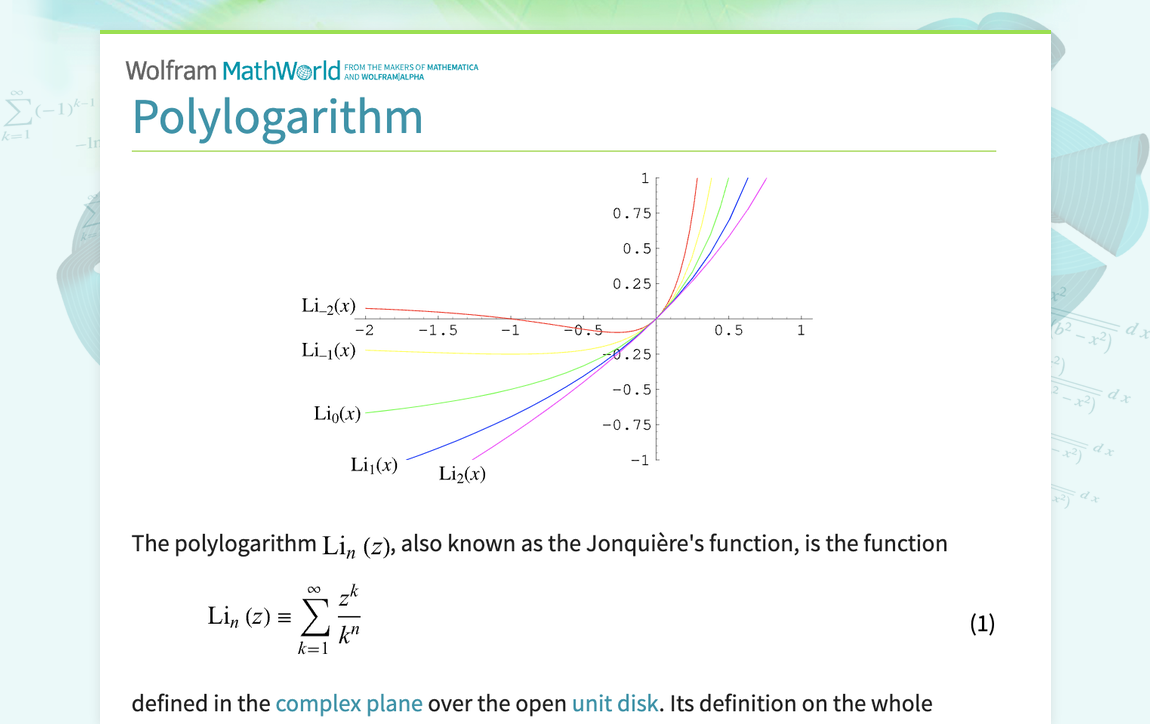
The polylogarithm Li_n(z), also known as the Jonquière's function, is the function Li_n(z)=sum_(k=1)^infty(z^k)/(k^n) (1) defined in the complex plane over the open unit disk. Its definition on the whole complex plane then follows uniquely via analytic continuation. Note that the similar notation Li(z) is used for the logarithmic integral. ...
final saddleBOT
Channel closed
Closed by @warm prairie
Use .reopen if this was a mistake.
final saddleBOT
Available help channel!
Send your question here to claim the channel.
Remember:
• Ask your math question in a clear, concise manner.
• Show your work, and if possible, explain where you are stuck.
• Do not immediately ping people or roles. After 15 minutes, feel free to ping <@&286206848099549185> once.
• Type the command .close to free the channel when you're done.
• Be polite and have a nice day!
Read #❓how-to-get-help for further information on how to ask a good question, and about conduct in the question channels.
 keen wolf
What is the equation of the line tangent to the curve at the given point? xsin2y=ycos2x at (pi/4, pi/2)
final saddleBOT
keen wolf
What is the equation of the line tangent to the curve at the given point? xsin2y...
keen wolf
I know that you have to use implicit differentiation and apply the product rule and chain rule to solve it, but im not sure if im getting the correct answer and chatgpt is too stupid for this type of thing
vital crag
keen wolf
I know that you have to use implicit differentiation and apply the product rule ...
!show
final saddleBOT
keen wolf
I know that you have to use implicit differentiation and apply the product rule ...
Show your work, and if possible, explain where you are stuck.
keen wolf
left side: 1(sin2y) + (cos2y dy/dx)(x)(2 dy/dx)
right side: dy/dx (cos2x) + (y)(-sin2y)(2)
right now, i am confused on whether or not i should have the dy/dx after cos2y after taking the derivative of sin2y in the product rule part of the right side, and im stuck on how to get the derivatives to all be on one side
final saddleBOT
@keen wolf Has your question been resolved?
 loud sundial
keen wolf
left side: 1(sin2y) + (cos2y dy/dx)(x)(2 dy/dx)
right side: dy/dx (cos2x) + (y)(...
loud sundial
keen wolf
left side: 1(sin2y) + (cos2y dy/dx)(x)(2 dy/dx)
right side: dy/dx (cos2x) + (y)(...
$\dv{x} (\cos 2y)=-\sin(2y) \dv{x} (2y)=(-\sin 2y) \left(2 \dv{y}{x} \right)$
soft zealotBOT
Civil Service Pigeon
 loud sundial
isolating dy/dx is standard algebra
recall how you solve equations of the form ax+b=cx+d by getting all the terms with x on one side and the constant terms on the other
the idea is the exact same here
keen wolf
now im confused as to why cos2xdy/dx is crossed out (deemed to equal 0) and not included in the 2nd step of the solution

 deep condor
keen wolf
now im confused as to why cos2xdy/dx is crossed out (deemed to equal 0) and not ...
deep condor
keen wolf
now im confused as to why cos2xdy/dx is crossed out (deemed to equal 0) and not ...
sub x = pi/4 and see what happens :)
final saddleBOT
Channel closed
Closed due to timeout
Use .reopen if this was a mistake.
Available help channel!
Send your question here to claim the channel.
Remember:
• Ask your math question in a clear, concise manner.
• Show your work, and if possible, explain where you are stuck.
• Do not immediately ping people or roles. After 15 minutes, feel free to ping <@&286206848099549185> once.
• Type the command .close to free the channel when you're done.
• Be polite and have a nice day!
Read #❓how-to-get-help for further information on how to ask a good question, and about conduct in the question channels.
 shrewd juniper
I'm fairly certain my answer is right. Why isn't it taking it?
 shrewd juniper
This is WeBWork
I tried the U instead of a comma and that didnt work but that still doesnt answer why the first one isnt working anyway
<@&286206848099549185>
 muted prairie
!15m
final saddleBOT
Please only use the <@&286206848099549185> ping once if your question has not been answered for 15 minutes. Please do not ping or DM individual users about your question.
muted prairie
I guess you could try closed brackets?
Would be a bit weird but thats the interval a set theorist would say it's increasing on
shrewd juniper
I'll try it
okay it worked
why would a set theorist say that
Well thank you so much
.close
final saddleBOT
Channel closed
Closed by @shrewd juniper
Use .reopen if this was a mistake.
final saddleBOT
Available help channel!
Send your question here to claim the channel.
Remember:
• Ask your math question in a clear, concise manner.
• Show your work, and if possible, explain where you are stuck.
• Do not immediately ping people or roles. After 15 minutes, feel free to ping <@&286206848099549185> once.
• Type the command .close to free the channel when you're done.
• Be polite and have a nice day!
Read #❓how-to-get-help for further information on how to ask a good question, and about conduct in the question channels.
 tranquil pine
How do I reflect

 final saddleBOT
tranquil pine
How do I reflect
vestal crest
final saddleBOT
tranquil pine
How do I reflect
vestal crest
first, imagine or screencap/draw a line at wherever they told you to.
then, apply the reflection that way.
final saddleBOT
@tranquil pine Has your question been resolved?
tranquil pine
vestal crest
first, imagine or screencap/draw a line at wherever they told you to.
then, appl...
Huh
vestal crest
which part do you not understand? or perhaps you don't get what reflection is?
tranquil pine
Honestly none of it
tranquil pine
vestal crest
which part do you not understand? or perhaps you don't get what reflection is?
I never really understood it
And he hasn’t taught us about it in class but we got a test tomorrow
vestal crest
then this is the idea of reflection. suppose the green shape is the original and the red one is the image.

to get from green to red, draw a straight line, horizontal or vertical*, from one of the corners of the shape to the line of reflection (the "mirror").
then, extend the line by the same length (if you drew 2cm from the original point to the mirror, draw 2 more cm in the same direction).
do this for all of the points of the shape to get your reflected image.
vestal crest
vestal crest
to get from green to red, draw a straight line, horizontal or vertical*, from on...
*I assume you won't see slanted mirrors, but if you do, the line you draw should be perpendicular to the mirror (aka 90 degrees).
vestal crest
vestal crest
then, extend the line by the same length (if you drew 2cm from the original poin...
this step and the one above looks like this.
 vestal crest
for your case, the line x = -2 is here, and so that's your mirror.
 tranquil pine
And since it’s negative it would go down?
vestal crest
no. it will go left. there is no downward movement necessary here.
tranquil pine
 vestal crest
your choice is D?
tranquil pine
So it wouldn’t be A?
tranquil pine
vestal crest
your choice is D?
I guessed
vestal crest
A is definitely out.
tranquil pine
Wait would it be c since it’s reflective over the line you drew
vestal crest
tranquil pine
I guessed
D is close, but not the right image. the image is too close to the mirror.
vestal crest
tranquil pine
Wait would it be c since it’s reflective over the line you drew
C is correct! and that's exactly the right idea.
you want the image to be a reflection over the mirror.
 vestal crest
have you learnt about the equations of horizontal and vertical lines, actually?
tranquil pine
No
vestal crest
they will be useful here, but in case you haven't, y = {some number} is a horizontal line.
vestal crest
tranquil pine
No
consider looking up on them.
tranquil pine
I will
vestal crest
vestal crest
they will be useful here, but in case you haven't, y = {some number} is a horizo...
anyway for the case of y = number, this is your situation.
tranquil pine
So y=3?
vestal crest
well, yeah, that's what you've been given.
tranquil pine
Would you draw the line on 3 then reflect over it?
tranquil pine
I think
vestal crest
how did you do it for the first one? apply the same strategy here.
tranquil pine
Uhhhhh
The first was easier
I know it’s A but idk how I translated it
Or reflected
vestal crest
it's more or less the same idea here.
except that you're now reflecting upwards rather than leftwards because the mirror is above your object.
if in doubt, reflect each point separately.
tranquil pine
So go up three
vestal crest
not necessarily. see, point K is only one unit under the mirror. it doesn't need to go up three.
if point K is one unit under the mirror, then point K' (the image) will be one unit above the mirror. makes sense?
tranquil pine
Can you dumb that down
vestal crest
stand in front of a mirror. notice that you are as far from the mirror as your image seems to be. do you agree?
tranquil pine
Yes
vestal crest
if your hand is 3cm away from the mirror, the image's hand is also 3cm away from the mirror, just from the other side.
vestal crest
vestal crest
if point K is one unit under the mirror, then point K' (the image) will be one u...
that's the idea.
since K is 1cm from the mirror, K' will be 1cm from the mirror as well, but from the other side.
since K was under the mirror, K' will be above, hence other side.
tranquil pine
Why couldn’t it be B?
 vestal crest
draw a line at y = 3. you'll see why.
tranquil pine
Okay thank you
vestal crest
glad to have helped.
tranquil pine
This makes no sense bro
vestal crest
what makes no sense?
vestal crest
what do you mean, though? you did it for the first one after I drew the line for you, and you correctly identified that you need to reflect your object over the mirror.
tranquil pine
I tried to do two on my own and got them wrong
And don’t understand it
It’s stupid
vestal crest
since I don't understand your confusion, let me list some possibilities and you tell me which one you're confused about.
- I don't know where y = 3 is.
- I got y = 3, and drew the line, but I don't know how to reflect the object over.
- I reflected the object over, but I got the wrong answer.
- None of the above.
vestal crest
why does reflection not make sense, in your opinion?
you clearly identified in the first question that you have to reflect the object over the mirror to get the image, and identified the correct image with some help.
tranquil pine
Cause you basically did it from me
vestal crest
tranquil pine
Wait would it be c since it’s reflective over the line you drew
so one would presume that reflection already makes sense from the way you phrased your answer here.
vestal crest
tranquil pine
Cause you basically did it from me
in that case, let's reproduce what I did, but this time I'll only tell you what to do. you do it, and show each step.
step 1: draw a line at y = 3.
(hint: if you're on Windows, take a screenshot with Win + Shift + S, then draw on the screenshot.)
tranquil pine
Yeah but what could y=x mean and I did the same thing for y=2 and got it wrong
It’s all stupid
vestal crest
tranquil pine
Yeah but what could y=x mean and I did the same thing for y=2 and got it wrong
now you never said anything about y = x and y = 2. your question says y = 3.
tranquil pine
I know I tried to other that said that
vestal crest
also, have you learnt how to graph linear/straight-line equations before tackling this chapter?
vestal crest
tranquil pine
Yeah but what could y=x mean and I did the same thing for y=2 and got it wrong
in that case, show what you did! I can't help what I can't see.
tranquil pine
Not even has to use demos
tranquil pine
vestal crest
in that case, show what you did! I can't help what I can't see.
How does y=x make sense

 vestal crest
why not?
okay, maybe it doesn't make sense to you because you are not taught linear functions, in which case I urge you to study that first.
but in this case, y = x is the set of points where the x/y-coordinates are the same (like (0,0), (1,1), etc.)
tranquil pine
I have to know this by tomorrow
vestal crest
vestal crest
but in this case, y = x is the set of points where the x/y-coordinates are the s...
so you would expect to see a straight line slanted upwards (from bottom left to top right). just for this one, I'll draw it for you.

the image for this one will be located in the bottom right corner, so you'll have to move down and right this time around.
tranquil pine
So b would be on bottom?
vestal crest
point B would be the most bottom-right.
and yes, B will now be on the bottom of the shape.
tranquil pine
Then it would be in the 4th?
vestal crest
if you mean 4th quadrant, yes.
but the entire image shape would be in the 4th quadrant, save for point D' which lies on the x-axis.
tranquil pine
So it would be upside down in the 4th quadrant
vestal crest
it would be facing the right side in the 4th quadrant. (as in, BC will be on the right, and AD on the left.)
tranquil pine
So like flipped upside then turned
 vestal crest
by first understanding what reflection does to an object, then understanding how to graph a line.
from there, it's drawing lines to connect the object to the mirror, and then extending them to the image.
 vestal crest
what do you mean?
tranquil pine
It just gives me the cords
vestal crest

the blue shape is your original shape.
technically you don't need the coords, unless you want to check the blue shape against the coordinates.
tranquil pine
How would I do it without a graph
vestal crest
again, I don't understand what you mean.
tranquil pine
I only can do it when I out a line with just the numbers idk what to do
Im sorry being so stupid
vestal crest
why are you so fixated on the coordinates? the answer options show you the original shape!
vestal crest
vestal crest
also, the line is given here!
the only reason you might want to refer to the coordinates is to check whether an option deliberately drew the original shape in the wrong place.
(of course, if you're gungho, you can draw the entire diagram yourself, original shape, mirror and image included.)
tranquil pine
So how do I get the answer if it’s just 1
vestal crest
it's x = 1.
draw in the line in every option and check whether the reflection makes sense.
alternatively, you can draw the diagram from scratch, but given how confused you are right now, that probably won't help.
a reminder that x = 1 is a vertical line.
actually wait a minute. they are generous enough to draw in the line for you!
you just need to check whether the line is correct, the original shape is in the correct place (if you want to) and if the image makes sense.

for you, though, I would recommend checking the original shape last, because it is the most tedious to check. check the line and the image first.
I will tell you right now that A is wrong in like eight different ways. (this is an exaggeration, if you can't tell.)
try the rest yourself.
tranquil pine
Im just gonna fail it this is way to complicated
vestal crest
if so, I bid you a good day, and you may close the channel when you're done, or leave it open if you decide to come back to it.
tranquil pine
.close
final saddleBOT
Channel closed
Closed by @undone vortex
Use .reopen if this was a mistake.
final saddleBOT
Available help channel!
Send your question here to claim the channel.
Remember:
• Ask your math question in a clear, concise manner.
• Show your work, and if possible, explain where you are stuck.
• Do not immediately ping people or roles. After 15 minutes, feel free to ping <@&286206848099549185> once.
• Type the command .close to free the channel when you're done.
• Be polite and have a nice day!
Read #❓how-to-get-help for further information on how to ask a good question, and about conduct in the question channels.
 unique gale
this is my problem. so far ive shown that the two sets for the constraints are bounded and closed, but now idk how to prove the minimum part.
 final saddleBOT
unique gale
this is my problem. so far ive shown that the two sets for the constraints are b...
final saddleBOT
unique gale
this is my problem. so far ive shown that the two sets for the constraints are b...
@unique gale Has your question been resolved?
 supple marten
Not an answer, but a way to get the distance value: Given that the tangent to x^2+2y^2=1 at the closest point to a line is parallel (or equivalently the shortest distance is along a normal line out) the tangent at P being x x(P) + 2 y y(P) = 1, with the slopes matching when x(P)=2y(P), solving the system with the other equation being x(P)^2+2y(P)^2=1, we get (2/sqrt6,1/sqrt6) (and also the point with the tangent on the other side), the tangent there is (x+y)/sqrt2=sqrt3/2 which has distance 5sqrt2-sqrt3/2 or approx 6.2050... from (x+y)/sqrt2=5sqrt2 just x+y=10 written in unit covector form.
final saddleBOT
@unique gale Has your question been resolved?
final saddleBOT
Channel closed
Closed due to timeout
Use .reopen if this was a mistake.
Available help channel!
Send your question here to claim the channel.
Remember:
• Ask your math question in a clear, concise manner.
• Show your work, and if possible, explain where you are stuck.
• Do not immediately ping people or roles. After 15 minutes, feel free to ping <@&286206848099549185> once.
• Type the command .close to free the channel when you're done.
• Be polite and have a nice day!
Read #❓how-to-get-help for further information on how to ask a good question, and about conduct in the question channels.
 bleak elbow
someone please help me I am so so tired
final saddleBOT
bleak elbow
someone please help me I am so so tired
 final saddleBOT
@bleak elbow Has your question been resolved?
final saddleBOT
@bleak elbow Has your question been resolved?
soft zealotBOT

 soft zealotBOT
 muted prairie
Idk why this is <1/2
I give up
Wait no I'm doing it backwards
,w sum from k=0 to 11 of (nCr(20,k).4^k.6^(20-k))
soft zealotBOT
 soft zealotBOT
 muted prairie
that looks like .979
idk I guess your teacher screwed up
they counted X=12 as a false positive
final saddleBOT
Channel closed
Closed due to timeout
Use .reopen if this was a mistake.
Available help channel!
Send your question here to claim the channel.
Remember:
• Ask your math question in a clear, concise manner.
• Show your work, and if possible, explain where you are stuck.
• Do not immediately ping people or roles. After 15 minutes, feel free to ping <@&286206848099549185> once.
• Type the command .close to free the channel when you're done.
• Be polite and have a nice day!
Read #❓how-to-get-help for further information on how to ask a good question, and about conduct in the question channels.
 timber plume
Hi, how do I know which formula sum to use? the Arithmetic or geometric?
 final saddleBOT
timber plume
Hi, how do I know which formula sum to use? the Arithmetic or geometric?
final saddleBOT
timber plume
Hi, how do I know which formula sum to use? the Arithmetic or geometric?
 thorny canyon
timber plume
Hi, how do I know which formula sum to use? the Arithmetic or geometric?
thorny canyon
timber plume
Hi, how do I know which formula sum to use? the Arithmetic or geometric?
all of these are geometric, because a common factor is being multiplied each consecutive term
timber plume
how did u figure it out? because if you calculated all the terms, that would take time
thorny canyon
all the summands are written in form $ab^n$
soft zealotBOT
Donkey

 craggy plank
timber plume
how did u figure it out? because if you calculated all the terms, that would tak...
craggy plank
timber plume
how did u figure it out? because if you calculated all the terms, that would tak...
Let's take a for example, can you write the first three terms of it?
timber plume
2, 4, 8
craggy plank
what is your confusion?
timber plume
soft zealot
**Donkey**
what are summands?
thorny canyon
things that are getting added
craggy plank
 thorny canyon
its geometric if $\frac{a_{n+1}}{a_n}$ is constant for all values of n
soft zealotBOT
Donkey
 thorny canyon
where $a_n$ is the $n^{th}$ term of the sequence
soft zealotBOT
Donkey
 thorny canyon
timber plume
so if they are written with a power
thorny canyon
timber plume
so if they are written with a power
this assumption is incomplete cuz agp such as $\sum_{i=1}^n(2i-1)b^i$ may also exist
soft zealotBOT
Donkey
 timber plume
I think I am lost
timber plume
soft zealot
**Donkey**
I understand this
timber plume
soft zealot
**Donkey**
not this
timber plume
soft zealot
**Donkey**
not this
thorny canyon
timber plume
the r=2
here you say r=2 right?
timber plume
yes
thorny canyon
what's the definition of r?
timber plume
common ratio
thorny canyon
that's right
thorny canyon
soft zealot
**Donkey**
and that's exactly what's written here
whenever you divide a term by its previous term, you always get same ratio
that's what a gp is
timber plume
soft zealot
**Donkey**
what about this?
timber plume
in what cases?
thorny canyon
yk in ap, difference bw consecutive terms is constant
and in gp ratio bw consecutive terms is constant
thorny canyon
soft zealot
**Donkey**
in agp see the (2i-1) part behaves like an ap, the $b^i$ part behaves like a gp
soft zealotBOT
Donkey
 thorny canyon
so its a mix of both, so to speak
sequence looks something like b, $3b^2$, $5b^3$, $7b^4$ and so on
soft zealotBOT
Donkey
 timber plume
thorny canyon
in agp see the (2i-1) part behaves like an ap, the $b^i$ part behaves like a gp
timber plume
thorny canyon
in agp see the (2i-1) part behaves like an ap, the $b^i$ part behaves like a gp
whats agp? arithmetic geometric progression?
thorny canyon
yeah
thorny canyon
its a sequence where one part resembles ap, another resembles gp
final saddleBOT
Channel closed
Closed by @timber plume
Use .reopen if this was a mistake.
final saddleBOT
Available help channel!
Send your question here to claim the channel.
Remember:
• Ask your math question in a clear, concise manner.
• Show your work, and if possible, explain where you are stuck.
• Do not immediately ping people or roles. After 15 minutes, feel free to ping <@&286206848099549185> once.
• Type the command .close to free the channel when you're done.
• Be polite and have a nice day!
Read #❓how-to-get-help for further information on how to ask a good question, and about conduct in the question channels.
 vague anchor
24th please
 final saddleBOT
vague anchor
24th please
severe verge
final saddleBOT
vague anchor
24th please
severe verge
,rotate
soft zealotBOT
 vague anchor
<@&286206848099549185>
severe verge
vague anchor
<@&286206848099549185>
Do you know how to find the coordinates of the incenter of a triangle?
vague anchor
severe verge
Do you know how to find the coordinates of the incenter of a triangle?
Equidistant from sides?
severe verge
seems like you're getting the idea...
for x coordinate it is (axA + bxB + cxC) / (a+b+c)
likewise for y
vague anchor
Yea
severe verge
you might be wondering why this is important
 vague anchor
Yes
severe verge
D, E and F are perpendicular feets
vague anchor
H is orthocentre
vague anchor
Go ahead
severe verge
H is actually the incenter of ∆DEF
vague anchor
Oh wow idk that
severe verge
you can easily prove that DH, EH and FH are angle bisectors in ∆DEF
this is true for any triangle
 vague anchor
??
severe verge
interesting
severe verge
severe verge
anyways getting back to this acute triangle case
H is the incenter of ∆DEF so you can easily find its coordinates
then you just find the coordinates of A so that A lies on DH and AE is perpendicular to HE
likewise for other points
final saddleBOT
Channel closed
Closed by @vague anchor
Use .reopen if this was a mistake.
Available help channel!
Send your question here to claim the channel.
Remember:
• Ask your math question in a clear, concise manner.
• Show your work, and if possible, explain where you are stuck.
• Do not immediately ping people or roles. After 15 minutes, feel free to ping <@&286206848099549185> once.
• Type the command .close to free the channel when you're done.
• Be polite and have a nice day!
Read #❓how-to-get-help for further information on how to ask a good question, and about conduct in the question channels.
 wicked crystal
hey
final saddleBOT
wicked crystal
hey
wicked crystal
.close
final saddleBOT
Channel closed
Closed by @wicked crystal
Use .reopen if this was a mistake.
proper dagger

 tired walrus

 latent dragon
yeah…
 glossy zephyr
fire stuff
severe verge
hmm scam service...
craggy plank
Indeed
latent dragon
5 greens 1 blue. 👀
 bleak granite
nah
craggy plank
nah, I'm purple
latent dragon
craggy plank
nah, I'm purple
forgot about that.
final saddleBOT
Available help channel!
Send your question here to claim the channel.
Remember:
• Ask your math question in a clear, concise manner.
• Show your work, and if possible, explain where you are stuck.
• Do not immediately ping people or roles. After 15 minutes, feel free to ping <@&286206848099549185> once.
• Type the command .close to free the channel when you're done.
• Be polite and have a nice day!
Read #❓how-to-get-help for further information on how to ask a good question, and about conduct in the question channels.
vague anchor
32
,rccw
 final saddleBOT
vague anchor
32
,rccw
proper dagger
final saddleBOT
vague anchor
32
,rccw
proper dagger
,rccw
soft zealotBOT
 final saddleBOT
@vague anchor Has your question been resolved?
vague anchor
<@&286206848099549185>
 barren schooner
vague anchor
<@&286206848099549185>
barren schooner
vague anchor
<@&286206848099549185>
?
vague anchor
barren schooner
?
I want help with the question
barren schooner
vague anchor
I want help with the question
Any questions?
vague anchor
vague anchor
32
,rccw
This 32
 lunar jewel
Do you know that for an Equilateral triangle...
Orthocentre=Circumcentre=Centroid
vague anchor
Yea
lunar jewel
Yea so have used it?
Hint:- H=(A+B+C)/3
||Then you may write the co-ordinates of H explicitly||
Is the answer 8
@vague anchor
vague anchor
lunar jewel
Is the answer 8
Yea
lunar jewel
Kindly reinstate what you want to convey I did not get you
vague anchor
I Obv know that
lunar jewel
Centroid
The Coordinates of Centroid
The sum of co-ordinates of vertices of triangle divided by 3 (As the segments are divided in the ratio of 2:1)
lunar jewel
Then why were you unable to solve the question
vague anchor
lunar jewel
Then why were you unable to solve the question
Gimme vertices of A, B and C
Who did u get that
There would be equations to solve these 3 variable problem how shall I get it
@lunar jewel ??
lunar jewel
I hinted you
lunar jewel
lunar jewel
||Then you may write the co-ordinates of H explicitly||
Try this
vague anchor
lunar jewel
Try this
Oh god
lunar jewel
Wut
final saddleBOT
Channel closed
Closed by @vague anchor
Use .reopen if this was a mistake.
Available help channel!
Send your question here to claim the channel.
Remember:
• Ask your math question in a clear, concise manner.
• Show your work, and if possible, explain where you are stuck.
• Do not immediately ping people or roles. After 15 minutes, feel free to ping <@&286206848099549185> once.
• Type the command .close to free the channel when you're done.
• Be polite and have a nice day!
Read #❓how-to-get-help for further information on how to ask a good question, and about conduct in the question channels.
 shadow gyro
I did this statistics question and I got all three of my tries wrong
 final saddleBOT
@shadow gyro Has your question been resolved?
 coarse loom
Hi i have a question so when iam proving the limit of the sequence i can keep increasing the value of the fraction
 cursive bough
shadow gyro
I did this statistics question and I got all three of my tries wrong
cursive bough
shadow gyro
I did this statistics question and I got all three of my tries wrong
you reject your null hypothesis when the p value is less than α = 0.01, not greater
cursive bough
coarse loom
Hi i have a question so when iam proving the limit of the sequence i can keep in...
this channel is occupied, you need to start a new help channel
shadow gyro
cursive bough
you reject your null hypothesis when the p value is less than α = 0.01, not grea...
so it would've been D?
cursive bough
coarse loom
how to start
shadow gyro
hm
cursive bough
they both say the same thing but in different ways
also you never compare the critical value to the p-value, they are measuring different things
you either compare the test statistic to the critical value or you compare the p value to α
final saddleBOT
Channel closed
Closed due to timeout
Use .reopen if this was a mistake.
final saddleBOT
Available help channel!
Send your question here to claim the channel.
Remember:
• Ask your math question in a clear, concise manner.
• Show your work, and if possible, explain where you are stuck.
• Do not immediately ping people or roles. After 15 minutes, feel free to ping <@&286206848099549185> once.
• Type the command .close to free the channel when you're done.
• Be polite and have a nice day!
Read #❓how-to-get-help for further information on how to ask a good question, and about conduct in the question channels.
 sturdy badge
SOMEONE explain this plEASE
 final saddleBOT
sturdy badge
SOMEONE explain this plEASE
thorny canyon
sturdy badge
SOMEONE explain this plEASE
final saddleBOT
sturdy badge
SOMEONE explain this plEASE
thorny canyon
sturdy badge
SOMEONE explain this plEASE
you can use ratio test for convergence for such stuff
sturdy badge
thorny canyon
you can use ratio test for convergence for such stuff
wdym
i thought that was only for series
and not sequences
thorny canyon
formally yeah
thorny canyon
well it's a standard result that if $\lim_{n\to\infty}\frac{a_{n+1}}{a_n}=L<1$ then $a_n\to0$
soft zealotBOT
Donkey
 thorny canyon
or you could js say $0<a_n<2x\frac{2}{3}x\frac{2}{4}x\frac{2}{5}x\frac{2}{6}x\frac{2}{7}....x\frac{2}{n}\to0$ as $n\to\infty$
soft zealotBOT
Donkey
 thorny canyon
x as in multiplication 😭
sturdy badge
.close
final saddleBOT
Channel closed
Closed by @sturdy badge
Use .reopen if this was a mistake.
final saddleBOT
Available help channel!
Send your question here to claim the channel.
Remember:
• Ask your math question in a clear, concise manner.
• Show your work, and if possible, explain where you are stuck.
• Do not immediately ping people or roles. After 15 minutes, feel free to ping <@&286206848099549185> once.
• Type the command .close to free the channel when you're done.
• Be polite and have a nice day!
Read #❓how-to-get-help for further information on how to ask a good question, and about conduct in the question channels.
 balmy forge
i dont recognize this from my notes so im not sure where to start
 thorny canyon
balmy forge
i dont recognize this from my notes so im not sure where to start
thorny canyon
balmy forge
i dont recognize this from my notes so im not sure where to start
yk polynomial long division?
balmy forge
i do
thorny canyon
that's the question basically
divide the polynomial by k-2
the quadratic you get is your answer
final saddleBOT
Channel closed
Closed by @balmy forge
Use .reopen if this was a mistake.
late rose
balmy forge
i dont recognize this from my notes so im not sure where to start
there's a faster way, by comparing coefficients like so: Let
$$k^3 - k^2 -k - 2 = (k - 2)(k^2 + bx + 1)$$
Whence, compare coefficients of $k^2$
soft zealotBOT
 final saddleBOT
Available help channel!
final saddleBOT
Available help channel!
Send your question here to claim the channel.
Remember:
• Ask your math question in a clear, concise manner.
• Show your work, and if possible, explain where you are stuck.
• Do not immediately ping people or roles. After 15 minutes, feel free to ping <@&286206848099549185> once.
• Type the command .close to free the channel when you're done.
• Be polite and have a nice day!
Read #❓how-to-get-help for further information on how to ask a good question, and about conduct in the question channels.
 warm flame
Hi, is this correct?
 final saddleBOT
warm flame
Hi, is this correct?
final saddleBOT
warm flame
Hi, is this correct?
 coarse aurora
warm flame
Hi, is this correct?
coarse aurora
warm flame
Hi, is this correct?
You should label your axes
warm flame
coarse aurora
You should label your axes
 coarse aurora
warm flame
coarse aurora
warm flame
The line y = 12 is not correct, the parabola is also not correct. If you labelled the axes the other way then it would be fine (besides y = a which will not be perpendicular to y = 12)
warm flame
coarse aurora
The line y = 12 is not correct, the parabola is also not correct. If you labelle...
True, i'm going to continue studying this, ty!
.close
final saddleBOT
Channel closed
Closed by @warm flame
Use .reopen if this was a mistake.
final saddleBOT
Available help channel!
Send your question here to claim the channel.
Remember:
• Ask your math question in a clear, concise manner.
• Show your work, and if possible, explain where you are stuck.
• Do not immediately ping people or roles. After 15 minutes, feel free to ping <@&286206848099549185> once.
• Type the command .close to free the channel when you're done.
• Be polite and have a nice day!
Read #❓how-to-get-help for further information on how to ask a good question, and about conduct in the question channels.
timber plume
is my answer correct for q8?
 final saddleBOT
timber plume
is my answer correct for q8?
final saddleBOT
timber plume
is my answer correct for q8?
 gloomy river
Yeah, that's correct!
 atomic moon
Yep
final saddleBOT
Channel closed
Closed by @timber plume
Use .reopen if this was a mistake.
final saddleBOT
Available help channel!
Send your question here to claim the channel.
Remember:
• Ask your math question in a clear, concise manner.
• Show your work, and if possible, explain where you are stuck.
• Do not immediately ping people or roles. After 15 minutes, feel free to ping <@&286206848099549185> once.
• Type the command .close to free the channel when you're done.
• Be polite and have a nice day!
Read #❓how-to-get-help for further information on how to ask a good question, and about conduct in the question channels.
 wheat oriole
The answer key says this should be θ(n) but I don't get it why shouldn't it be θ(nlgn) θ(x+y) is basically θ(n) and the recursion runs lg n times
 final saddleBOT
wheat oriole
The answer key says this should be θ(n) but I don't get it why shouldn't it be θ...
wheat oriole
final saddleBOT
wheat oriole
The answer key says this should be θ(n) but I don't get it why shouldn't it be θ...
wheat oriole
.close
final saddleBOT
Channel closed
Closed by @wheat oriole
Use .reopen if this was a mistake.
final saddleBOT
Available help channel!
Send your question here to claim the channel.
Remember:
• Ask your math question in a clear, concise manner.
• Show your work, and if possible, explain where you are stuck.
• Do not immediately ping people or roles. After 15 minutes, feel free to ping <@&286206848099549185> once.
• Type the command .close to free the channel when you're done.
• Be polite and have a nice day!
Read #❓how-to-get-help for further information on how to ask a good question, and about conduct in the question channels.
 gritty flume
Can I get help w number b1)
 final saddleBOT
gritty flume
Can I get help w number b1)
thorny canyon
final saddleBOT
gritty flume
Can I get help w number b1)
thorny canyon
,rccw
soft zealotBOT
 soft zealotBOT
Donkey
 gritty flume
I don’t understand
thorny canyon
its given that you have to use $\frac{\sqrt{a}}{\sqrt{a}}=1$
soft zealotBOT
Donkey
 thorny canyon
and we know that multiplying anything by 1 doesn't change its value
so lhs x 1 = lhs
gritty flume
i still don’t get it
why is it root2 over 2
this must be dome without a calculator btw
thorny canyon
what is 1/root(2) times root(2)/root(2)
gritty flume
oh ic
thorny canyon
gritty flume
this must be dome without a calculator btw
well yeah
gritty flume
then how do i solve b2)
thorny canyon
I take it you remember values of cos(45), tan(30), sin(60) and tan(60)?
gritty flume
yes
thorny canyon
so b2) (i) is just asking you the same question as b1)
b2) (ii) is asking you to prove 1/root(3) = root(3)/3
and so on
thorny canyon
gritty flume
what do i multiply the 1/2 by
whats the value of cos45?
gritty flume
1/2
thorny canyon
no
gritty flume
huh
thorny canyon
1/2 is cos60
gritty flume
1/root 2
gritty flume
yuh
thorny canyon
because in the question it wants you to use root(a)/root(a) = 1
try b2) (ii)
what do you multiply to tan60 to prove it?
gritty flume
root3/root3?
thorny canyon
correct
 rugged merlin
gritty flume
how do i do an inverse without a calculator
rugged merlin
gritty flume
how do i do an inverse without a calculator
Inverse of a function?
 rugged merlin
,rccw
soft zealotBOT
 rugged merlin
gritty flume
Please
rugged merlin
gritty flume
Please
Do you know your trig table
gritty flume
I don’t think so
rugged merlin
gritty flume
I don’t think so
Well you should
gritty flume
rugged merlin
Well you should
What’s it about
 gritty flume
Dang🥀
rugged merlin
Or if you dont want to remember derive them via the 45-45-90 and 30-60-90 triangles
rugged merlin
rugged merlin
You look at this table and see that it is x = 30 degrees
rugged merlin
Ye
gritty flume
What if I just use a calculator
rugged merlin
gritty flume
What if I just use a calculator
Probably not a good idea
Bcuz they probably wont allow u to use one in the exam
And you wont remember by then
gritty flume
💔
tired walrus
rugged merlin
this is like the times tables for trig
gritty flume
why is there a timetable for this
tired walrus
i didn't mean timetable like schedule
i meant times tables like multiplication table
gritty flume
oh
gritty flume
rugged merlin
what is csc, sec and cot
rugged merlin
The multiplicative inverses of sin, cos, and tan, respectively
rugged merlin
Ann beat me to the punch 😔 (damn typing on phone)
gritty flume
Wait what’s the inverse?
gritty flume
rugged merlin
The multiplicative inverses of sin, cos, and tan, respectively
I don’t get Thai
gritty flume
rugged merlin
What ann said
so is it for only finding the inverse or are those the general terms
rugged merlin
gritty flume
so is it for only finding the inverse or are those the general terms
Idk what you mean by thay
gritty flume
rugged merlin
Idk what you mean by thay
can u explain everything again
rugged merlin
gritty flume
can u explain everything again
You know sin cos and tan yes?
gritty flume
yes
rugged merlin
gritty flume
yes
Ok so
Csc is quite literally just
csc(x) = 1/sin(x)
You just flip it
So if sin(x) = 1
Then csc(x) = 1
If sin(x) = 1/2
Then csc(x) = 2
gritty flume
so csc= hypp/opp?
rugged merlin
Just flip the fraction if u wanna convert to rhe other
gritty flume
like tht
gritty flume
rugged merlin
Yuh good job
tysm
rugged merlin
I flipped nothing
rugged merlin
rugged merlin
Where is 1/2 here on the row of cos
gritty flume
rugged merlin
Where is 1/2 here on the row of cos
60
 compact saddle
rugged merlin
compact saddle
rugged merlin
you could just remember the table for sine and cosine(which is the sine table but goes backwards) and get the other values using tan=sin/cos sec=1/cos, csc=1/sin in the beginning
though you will remember better as you practice the questions
atleast thats what i did
also helps to know that the value of sine keeps increasing from 0 to 90 while that of cos keeps decreasing
gritty flume
Ty
compact saddle
also remembering the value of sin and cos at 45 degrees as √2/2 might it more obvious that the value is increasing for sine as decreasing for cos and also make it easier to remember in the beginning since everything would be divided by 2 then
(you can verify 1/√2=√2/2 by multiplying √2 on numerator and denominator)
though memorise whichever one feels better to you

 odd seal
,rccw
soft zealotBOT
 odd seal
gritty flume
Is it just the normal formula
odd seal
gritty flume
Is it just the normal formula
yes, directly use the definitions of the quantities
gritty flume
odd seal
yes, directly use the definitions of the quantities
Ty


I got the b2) wrong
Could someone help me
final saddleBOT
@gritty flume Has your question been resolved?
compact saddle
gritty flume
I got the b2) wrong
i dont see b2) in the image u sent earlier
gritty flume
 compact saddle
,rccw
soft zealotBOT
 compact saddle
gritty flume
compact saddle
gritty flume
i dont see how you got sin 30=5.8/h


 compact saddle
gritty flume
compact saddle
gritty flume
uhh these look like answers to questions other than the Q 2) you sent above
compact saddle
oh nvm
it is the saame question mb
were you asked to use decimal approximations
cus usually you just use root 3 as is
gritty flume
To one decimal point
compact saddle
gritty flume
To one decimal point
i see
was the answer supposed to be
around 44.4 degrees?
compact saddle
gritty flume
Yes
the problem is that you used a approximation of root 3 to calculate the length of BD
also it can clearly be seen that BD eqials 10 since BDEF is a rectangle but your calculations resulted in 10.0smth cuz root 3 was approximated
gritty flume
compact saddle
the problem is that you used a approximation of root 3 to calculate the length o...
I bc it another questions pls
Ig it
I got
gritty flume
Question b

Do you think the work must be done in the first or second wuadriant
Bc y and x are positive
And sin is greater than 0
compact saddle
gritty flume
Do you think the work must be done in the first or second wuadriant
they gave the value of tan as 5/12
can you deduce which quadrant it is from both tan=5/12 and sin>0?
gritty flume
compact saddle
can you deduce which quadrant it is from both tan=5/12 and sin>0?
It’s either the first or second
But I think the first
Bc everything is positive
compact saddle
gritty flume
It’s either the first or second
thats ony using the fact that sin>0
gritty flume
compact saddle
thats ony using the fact that sin>0
The axis are positive
compact saddle
gritty flume
Bc everything is positive
yes, since tan is negative in the second quadrant, you have to go in the first
 tysm
compact saddle
tysm
compact saddle

compact saddle
gritty flume
But would there be a specific way to draw the triangle
what to you mean by specific way?

 compact saddle
gritty flume
How will the triangle be drawn on the quadrants
compact saddle
gritty flume
How will the triangle be drawn on the quadrants
yeah there is a specific way if your using the coordinate system
to represent it
gritty flume
Oh ok
compact saddle
the hypetoneuse has to make the angle theta being considered with the positive x axis
compact saddle
gritty flume
Wdym
https://www.youtube.com/shorts/3yT1ndjaoVE
this might make it easier to understand why it is that specific way
 gritty flume
Ty
compact saddle
i think you already saw smth like this before since you know about the values being negatve in different coordinates
compact saddle
gritty flume
Ty
np!
compact saddle
gritty flume
btw, its not that you will get a different answer if you drew it a different way, its just that (rcosθ,rsinθ) being the coordinates of a line with length r starting from the origin making a angle theta with the positive x axis is a neat fact
and is mostly what "representing" the trig functions in a coordinate system would conventionally mean