

1 messages · Page 208 of 1
 inner spoke
also just asking this would mean 1s new post is 3, 2's pos is 2, and 3's is 1, so it describes the perm 3 2 1?
right
 rare girder
inner spoke
also just asking this would mean 1s new post is 3, 2's pos is 2, and 3's is 1, ...
rare girder
inner spoke
also just asking this would mean 1s new post is 3, 2's pos is 2, and 3's is 1, ...
I don't think of the bottom row as the new positions of each of the inputs, because surely this notation would work on sets containing things that aren't numbers
so anyway, we can gather that information succinctly into a cycle, (1 3)
so if we read something like (a b c d e), this is a permutation that sends a -> b -> c -> d -> e -> a
or rather
phi(a) = b, phi(b) = c, ...
inner spoke
right
rare girder
2 goes to 4, 4 goes to 5, and 5 goes to 2, so this would be the cycle (2 4 5)
lastly, 6 goes to 6, so actually we just don't write anything here lol
inner spoke
rare girder
I don't think of the bottom row as the new positions of each of the inputs, beca...
ok so the bottom row is just the output row?
rare girder
it's not clear without context where the permutation lives
yes, exactly
so in cycle notation we can write $\phi=(1;3)(2;4;5)$
 soft zealotBOT
Flip
 rare girder
maybe you can also say $\phi=(1;3)(2;4;5)(6)$?
soft zealotBOT
Flip
 rare girder
it doesn't seem too offensive, but you would normally omit the (6)
 final saddleBOT
Closed by @inner spoke
Use .reopen if this was a mistake.
final saddleBOT
 Available help channel!
Send your question here to claim the channel.
Remember:
• Ask your math question in a clear, concise manner.
• Show your work, and if possible, explain where you are stuck.
• Do not immediately ping people or roles. After 15 minutes, feel free to ping <@&286206848099549185> once.
• Type the command .close to free the channel when you're done.
• Be polite and have a nice day!
Read #❓how-to-get-help for further information on how to ask a good question, and about conduct in the question channels.
 brazen stump
is the 2 equations correct here
 final saddleBOT
brazen stump
is the 2 equations correct here
final saddleBOT
brazen stump
is the 2 equations correct here
@brazen stump Has your question been resolved?
 loud sundial
brazen stump
is the 2 equations correct here
loud sundial
brazen stump
is the 2 equations correct here
In the future, if you’re going to ask if something is correct, please show where it came from (helps point out minor errors more quickly without back and forth). But no, neither of those equations is correct.
brazen stump
loud sundial
In the future, if you’re going to ask if something is correct, please show where...
wait let me send

ignore the bubly bit and the other question on the side
loud sundial
brazen stump
Sign error with OX in step 1
brazen stump
the top arrow thing?
loud sundial
Where did 0.5a-2b come from in step 2
Did you assume OA and BC are the same
Because you’re not told that this is a parallelogram
So that isn’t necessarily true
loud sundial
brazen stump
the top arrow thing?
How is a+5a equal to 4a
loud sundial
brazen stump
 loud sundial
Sign error with OX in step 1
loud sundial
loud sundial
Sign error with OX in step 1
Sign error with OX in step 1
How is a+5a equal to 4a
Also be careful with your signs
brazen stump
wht abt it
brazen stump
loud sundial
You good? <@1024031973750083645>
hello im really sorry i have to
ty for trying to help hopefully u can continue next time plss
ty
.close
final saddleBOT
Closed by @brazen stump
Use .reopen if this was a mistake.
final saddleBOT
Available help channel!
Send your question here to claim the channel.
Remember:
• Ask your math question in a clear, concise manner.
• Show your work, and if possible, explain where you are stuck.
• Do not immediately ping people or roles. After 15 minutes, feel free to ping <@&286206848099549185> once.
• Type the command .close to free the channel when you're done.
• Be polite and have a nice day!
Read #❓how-to-get-help for further information on how to ask a good question, and about conduct in the question channels.
 vague hare
Prove that there are infinitely many primes of the form 4n + 3.
 ionic venture
Have you tried proof by contradiction?
By asuming there are only finite amount of primes in the form 4n + 3?
ionic venture
I think this video might help you:
https://youtu.be/aKArGv4xdFI?si=a-8MFm0jcDumAkaw

We prove that there are infinitely many primes of the form 4n+3.
http://www.michael-penn.net
http://www.randolphcollege.edu/mathematics/
final saddleBOT
Closed by @vague hare
Use .reopen if this was a mistake.
final saddleBOT
Available help channel!
Send your question here to claim the channel.
Remember:
• Ask your math question in a clear, concise manner.
• Show your work, and if possible, explain where you are stuck.
• Do not immediately ping people or roles. After 15 minutes, feel free to ping <@&286206848099549185> once.
• Type the command .close to free the channel when you're done.
• Be polite and have a nice day!
Read #❓how-to-get-help for further information on how to ask a good question, and about conduct in the question channels.
 remote parcel
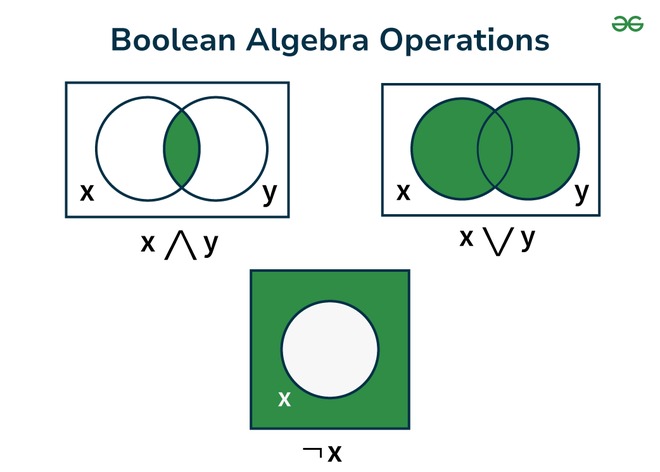
What is boolean algebra?
final saddleBOT
remote parcel
What is boolean algebra?
 gritty drift
remote parcel
What is boolean algebra?
gritty drift
remote parcel
What is boolean algebra?
https://www.geeksforgeeks.org/digital-logic/boolean-algebra/
Math that formalizes statements like AND, NOT, OR, etc. Deals with variables that can take either 0 or 1- useful in computing (True/False, binary, etc)
Your All-in-One Learning Portal: GeeksforGeeks is a comprehensive educational platform that empowers learners across domains-spanning computer science and programming, school education, upskilling, commerce, software tools, competitive exams, and more.
 tired walrus
<@&268886789983436800> troll
 latent dragon
i think i just went through the 7 stages of grief
final saddleBOT
@remote parcel Has your question been resolved?
final saddleBOT
Closed due to timeout
Use .reopen if this was a mistake.
Available help channel!
Send your question here to claim the channel.
Remember:
• Ask your math question in a clear, concise manner.
• Show your work, and if possible, explain where you are stuck.
• Do not immediately ping people or roles. After 15 minutes, feel free to ping <@&286206848099549185> once.
• Type the command .close to free the channel when you're done.
• Be polite and have a nice day!
Read #❓how-to-get-help for further information on how to ask a good question, and about conduct in the question channels.
 red mango
hello I've been struggling on this for a while. I've been drawing a bunch of functions and nothing has been working. Is this actually possible?
Here's what I've done so far.
Let g(x) = f(x) - f(x + 3/7)
g(x) is continuous on [2, 18/7] and for the function to work, g(x) must never be 0. As a result, g(x) > 0 or g(x) < 0 for all x.
If we assume g(x) < 0, then by the EVT, f must have a min on the interval (2, 17/7] and f must have a max on [18/7, 3). If g(x) < 0, the mins and maxs are flipped. This is all I've figured out so far about properties of f.
 final saddleBOT
red mango
hello I've been struggling on this for a while. I've been drawing a bunch of fun...
final saddleBOT
red mango
hello I've been struggling on this for a while. I've been drawing a bunch of fun...
@red mango Has your question been resolved?
final saddleBOT
@red mango Has your question been resolved?
red mango
:(
gritty drift
<@&268886789983436800>
final saddleBOT
Closed due to timeout
Use .reopen if this was a mistake.
Available help channel!
Send your question here to claim the channel.
Remember:
• Ask your math question in a clear, concise manner.
• Show your work, and if possible, explain where you are stuck.
• Do not immediately ping people or roles. After 15 minutes, feel free to ping <@&286206848099549185> once.
• Type the command .close to free the channel when you're done.
• Be polite and have a nice day!
Read #❓how-to-get-help for further information on how to ask a good question, and about conduct in the question channels.
 simple berry
what would the transformation of a point (x,y) be on this transformed function?
 final saddleBOT
simple berry
what would the transformation of a point (x,y) be on this transformed function?
simple berry
final saddleBOT
simple berry
what would the transformation of a point (x,y) be on this transformed function?
simple berry
the -4 is throwing me off because im not sure whether to interpret that as a y-translation or an x-translation, it seems like it would be a movement of 4 down to me but the answer key says otherwise so im not sure
this is what the answer key has given me and i dont see the -4 being used in either x or y so its kind of confusing
 simple berry
the question asks to transform a point on the function f(x) so were just taking the square root of the OG function
 abstract bramble
ig the function is
$g(z) = \sqrt{f(z) - 4}$??
simple berry
they just gave me an ordered pair
soft zealotBOT
ten
 abstract bramble
ok i got it
simple berry
soft zealot
**ten**
im gna be honest i dont rlly know what this notation means 💀
abstract bramble
the -4 IS being used
simple berry
right
abstract bramble
without it the transform on x is -x - 2
see y = x vs y = x + 2
the transform is (x - 2, y)
simple berry
wouldn't it be -x+2 without the -4 though? since x-h is a positive shift along the x axis
simple berry
abstract bramble
see y = x vs y = x + 2
the transform is (x - 2, y)
yeah
simple berry
ah wait youre right
abstract bramble
then add the 4 in
abstract bramble
.close
final saddleBOT
Closed by @abstract bramble
Use .reopen if this was a mistake.
Available help channel!
Send your question here to claim the channel.
Remember:
• Ask your math question in a clear, concise manner.
• Show your work, and if possible, explain where you are stuck.
• Do not immediately ping people or roles. After 15 minutes, feel free to ping <@&286206848099549185> once.
• Type the command .close to free the channel when you're done.
• Be polite and have a nice day!
Read #❓how-to-get-help for further information on how to ask a good question, and about conduct in the question channels.
 remote stream
 final saddleBOT
remote stream
remote stream
final saddleBOT
remote stream
remote stream
helpp
 vital surge
red mango
hello I've been struggling on this for a while. I've been drawing a bunch of fun...
vital surge
red mango
hello I've been struggling on this for a while. I've been drawing a bunch of fun...
(yes essentially find f so that f(x + 3/7) - f(x) is always non-zero, there are a few simple examples where it is constant: https://www.desmos.com/calculator/ggeqi4eujm)
final saddleBOT
Closed by @remote stream
Use .reopen if this was a mistake.
Available help channel!
Send your question here to claim the channel.
Remember:
• Ask your math question in a clear, concise manner.
• Show your work, and if possible, explain where you are stuck.
• Do not immediately ping people or roles. After 15 minutes, feel free to ping <@&286206848099549185> once.
• Type the command .close to free the channel when you're done.
• Be polite and have a nice day!
Read #❓how-to-get-help for further information on how to ask a good question, and about conduct in the question channels.
 naive ocean
Struggling really hard with the chain rule, derivative of a composite function. The derivative of x squared would be 2x, so i dont get where the x disappears off to when reentering it into the (4x-5) squared
 final saddleBOT
naive ocean
Struggling really hard with the chain rule, derivative of a composite function. ...
abstract bramble
naive ocean
Struggling really hard with the chain rule, derivative of a composite function. ...
final saddleBOT
naive ocean
Struggling really hard with the chain rule, derivative of a composite function. ...
abstract bramble
naive ocean
Struggling really hard with the chain rule, derivative of a composite function. ...
no no x in x^2 is 4x-5
let's use a different variable
a = 4x - 5
derivative of a^2 is 2a
since a is a function of x we need to use chain rule
so it's 2a * a' or 2a * 4 = 8a
when we say the derivative of x^2 is 2x, we are assuming f(x) = x
chain rule still applies, it's just that d/dx x = 1
so its 2x * 1 = 2x
therefore the general rule is actually
d/dx f(x)^2 = 2 f(x) * f'(x)
naive ocean
this genuinely just made it more confusing
naive ocean
32x
abstract bramble
theres two ways you can do it
(4x)^2 = 16x^2 so the derivative is 32x
but what if it's a really complicated term and not 4x?
that's why chain rule is helpful
instead of multiplying it out, you can see that
d/dx (4x)^2 = 2(4x) * d/dx 4x
or 32x
so its the same answer but less "work" (i mean, in this example of 4x it seems trivial but imagine if it was a trinomial for example)
final saddleBOT
@naive ocean Has your question been resolved?
final saddleBOT
Closed due to timeout
Use .reopen if this was a mistake.
final saddleBOT
Available help channel!
Send your question here to claim the channel.
Remember:
• Ask your math question in a clear, concise manner.
• Show your work, and if possible, explain where you are stuck.
• Do not immediately ping people or roles. After 15 minutes, feel free to ping <@&286206848099549185> once.
• Type the command .close to free the channel when you're done.
• Be polite and have a nice day!
Read #❓how-to-get-help for further information on how to ask a good question, and about conduct in the question channels.
 fervent eagle
Did I needed the line highlighted inside the textbox in order to prove the two sets are not equal? Thank you. Otherwise I don't know how else I would show this.

 final saddleBOT
fervent eagle
Did I needed the line highlighted inside the textbox in order to prove the two s...
final saddleBOT
fervent eagle
Did I needed the line highlighted inside the textbox in order to prove the two s...
@fervent eagle Has your question been resolved?
final saddleBOT
@fervent eagle Has your question been resolved?
 terse dagger
what does the line above the sets represent? Not?
final saddleBOT
Closed due to timeout
Use .reopen if this was a mistake.
Available help channel!
Send your question here to claim the channel.
Remember:
• Ask your math question in a clear, concise manner.
• Show your work, and if possible, explain where you are stuck.
• Do not immediately ping people or roles. After 15 minutes, feel free to ping <@&286206848099549185> once.
• Type the command .close to free the channel when you're done.
• Be polite and have a nice day!
Read #❓how-to-get-help for further information on how to ask a good question, and about conduct in the question channels.
fervent eagle
terse dagger
what does the line above the sets represent? Not?
They're "not", yes, they show that it's a complement. I'll try to get the professor to explain more though. Thank you for replying.
final saddleBOT
fervent eagle
They're "not", yes, they show that it's a complement. I'll try to get the profes...
fervent eagle
Sorry, I think we went into this channel at the same time. I'm going to close it, opal, so you can reopen it under your name. I just was replying to the previous person too late, my bad.
.close
final saddleBOT
Closed by @fervent eagle
Use .reopen if this was a mistake.
fervent eagle
Yea, sorry about that, not sure how this thing works.
terse dagger
.reopen
final saddleBOT
✅ Original question: #help-36 message
terse dagger
@fervent eagle @soft pewter lemme try to answer opal first real quick
what's your question?
 soft pewter
im trying to test if the a i found is good
-31 000 = -40000/x-(-10) + 35 000
-4000 = -40000/x+10
-4000x -40 000 = -40000
terse dagger
you are given x = 0?
soft pewter
terse dagger
you are given x = 0?
yeah before
but now im testing
to see if the a is good
terse dagger
ok then you just do some algebra and get a
which you did correctly as far as i can tell
terse dagger
yes. alright you good now?
soft pewter
yeah tysm
terse dagger
so @fervent eagle that your proof?
fervent eagle
terse dagger
so <@232991282488672258> that your proof?
Yes. But I added a line which I made the textbox around, because that was the feedback my professor gave.
Would that line fulfill the missing requirement he was asking? Otherwise I don't know how you would prove those two sets aren't equal.
Here, just so you don't have to scroll up.


Thank you.
terse dagger
do you know the definition of xor?
fervent eagle
terse dagger
do you know the definition of xor?
Yes, it means the element has to be in one or the other set, can't be in both.
fervent eagle
Ah I see, I was trying to do it with someone else yesterday too and we ended up truncating it.
...That. Might have made it confusing. Or I just did this wrong.
Sorry, go ahead.
terse dagger
as xor is given by $A \oplus B = \neg (A \cap B) \cap (A \cup B)$
fervent eagle
But we're trying to prove via contradiction?
Also, sorry, give me 5-10 minutes to respond.
soft zealotBOT
Katharine
 terse dagger
i think that might be what's confusing me because in my mind it is very easy to show that if $A \oplus B = \neg (A \cap B)$ then $A \cup B = \emptyset$
soft zealotBOT
Katharine
 final saddleBOT
@fervent eagle Has your question been resolved?
fervent eagle
terse dagger
i think that might be what's confusing me because in my mind it is very easy to ...
I see. That makes sense, but problem is I can't use the symmetric difference to just say that.
At least from what I understand, professor did write we should either prove by contradiction or contrapositive.
Unless I'm not understanding it.
He said I have to prove that the two sets contradict each other.
Also it's (A U B)' = {}, not (A U B).
terse dagger
you're right i wrote it wrong
fervent eagle
terse dagger
you're right i wrote it wrong
That's ok, does my proof make more sense then?
We're proving (A U B)' = {}, sorry, I'm just learning the Texit syntax.
$\overline{A\cup B}$
soft zealotBOT
Xeryvelgarde
 terse dagger
i don't really understand where you get the subset from
$A \oplus B \subseteq A \cup B$
soft zealotBOT
Katharine
 fervent eagle
Give me a bit, I got it from the complement.
The complement of $\overline{A}\cup \overline{B}$ is ${A} \cup {B}$, and I had to try to prove that $\overline{A\cup B}$ and $A \oplus B \subseteq A \cup B$ are disjoint.
soft zealotBOT
Xeryvelgarde
 fervent eagle
And $A \oplus B \subseteq A \cup B$ has to be a subset of ${A} \cup {B}$ by definition of a union, from what I understand.
soft zealotBOT
Xeryvelgarde
 terse dagger
the complement of $\neg A \cup \neg B$ is $A \cap B$
soft zealotBOT
Katharine
 fervent eagle
I wrote this wrong, sorry.
Give me a bit.
$\overline{A}\cap \overline{B}$ is ${A} \cup {B}$
soft zealotBOT
Xeryvelgarde
 fervent eagle
That's what I meant.
Sorry.
And I got $\overline{A}\cap \overline{B}$ from getting the complement of $\overline{{A} \cup {B}}$
soft zealotBOT
Xeryvelgarde
 fervent eagle
soft zealot
**Xeryvelgarde**
fervent eagle
soft zealot
**Xeryvelgarde**
Wait, that's where I went wrong, didn't I.
terse dagger
$\neg A \cap \neg B = \neg (A \cup B)$
soft zealotBOT
Katharine
 terse dagger
if the negations are confusing i will use overline but it's so much typing
fervent eagle
terse dagger
if the negations are confusing i will use overline but it's so much typing
No, it's fine, I understand.
fervent eagle
soft zealot
**Katharine**
Wait, why is it $\overline{{A} \cup {B}}$.
soft zealotBOT
Xeryvelgarde
 terse dagger
demorgan
fervent eagle
But with DeMorgan's, you'd have to negate each individual part, right? So $\overline{A} becomes {A}, \cap becomes \cup, and $\overline{B} becomes {B}$.
soft zealotBOT
Xeryvelgarde
Compile Error! Click the  reaction for more information.
(You may edit your message to recompile.)
 fervent eagle
If those parts are already negated, isn't it negated already?
terse dagger
demorgan's laws are the way to turn unions into intersections and otherwise
by splitting the negations
or merging them
$\neg (A \cup B) = \neg A \cap \neg B \ \neg (A \cap B) = \neg A \cup \neg B$
soft zealotBOT
Katharine
 fervent eagle
Ok, rubs temples And originally I did convert (A U B)' to A' \cap B', yea no, I don't remember how I got A U B. I think it was just by deduction, because I was looking for a set to prove that these two were disjoint.
 terse dagger
can i rewrite the proof in different words?
fervent eagle
terse dagger
can i rewrite the proof in different words?
Please do, I'm willing to compare.
The person who helped me yesterday ended up using the universal set and finding the set difference.
Professor said I didn't need to do that.
Again, thank you for responding, I appreciate it.
terse dagger
if $A \oplus B = \overline{A \cap B}$ then $\overline{A \cup B} = \emptyset \$
proof by contradiction: $\$
Let $A \oplus B = \overline{A \cap B}$.
Assume to the contrary that $\overline{A \cup B} \neq \emptyset$.
Then $\exists x \in \overline{A \cup B}$.
By DeMorgan's laws $\overline{A \cup B} = \overline{A} \cap \overline{B}$.
Since $x \in \overline{A} \cap \overline{B}$ it means $x \in \overline{A}$ and $x \in \overline{B}$ meaning $x \in \overline{A} \cup \overline{B}$.
soft zealotBOT
Katharine
 terse dagger
this is how far i got before i couldn't really understand it anymore
well before i didn't understand the line of thinking
i guess you could do this
fervent eagle
Yea no, that makes sense. Sorry, so what I was trying to prove was that (A U B)' and A XOR B were incompatible. Deducing it, A U B has to have A XOR B as the subset, but (A U B)' is literally all elements outside of sets A U B, so that means it's contradictory.
Those two sets cannot share the same elements.
terse dagger
if $A \oplus B = \overline{A \cap B}$ then $\overline{A \cup B} = \emptyset \$
proof by contradiction: $\$
Let $A \oplus B = \overline{A \cap B}$.
Assume to the contrary that $\overline{A \cup B} \neq \emptyset$.
Then $\exists x \in \overline{A \cup B}$.
By DeMorgan's laws $\overline{A \cup B} = \overline{A} \cap \overline{B}$.
Since $x \in \overline{A} \cap \overline{B}$ it means $x \in \overline{A}$ and $x \in \overline{B}$ meaning $x \in \overline{A} \cup \overline{B}$.
Also by De Morgan's laws $\overline{A \cap B} = \overline{A} \cup \overline{B}$.
And since $A \oplus B = \overline{A \cap B}$, $x \in A \oplus B$.
soft zealotBOT
Katharine
 fervent eagle
Show it is in one of the two equal sets but not the other. Then you can say that means the two sets are not equal, but they are assumed equal so that is the contradiction
Yes, I think what he means is that x cannot be an element of A XOR B and an element of (A U B)'. Unless I'm entirely misunderstanding this.
That's essentially what I was trying to prove with using A U B.
Unless I should've not done that at all.
terse dagger
my thought process goes this way
fervent eagle
soft zealot
**Katharine**
This way?
fervent eagle
Oh ok, sorry.
I just wasn't sure. 🤣 Again, I've asked the professor for clarification, he hasn't responded.
fervent eagle
terse dagger
it's too late
It's ok.
Thank you for trying.
I'm also sick.
So my brain is fried too.
I hope you get good rest.
terse dagger
i just figured it out sortof
fervent eagle
terse dagger
i just figured it out sortof
Feel free to share if you want?
Again, I appreciate the feedback I can get, as I suck at proofs.
terse dagger
if $A \oplus B = \overline{A \cap B}$ then $\overline{A \cup B} = \emptyset \$
proof by contradiction: $\$
Let $A \oplus B = \overline{A \cap B}$.
Assume to the contrary that $\overline{A \cup B} \neq \emptyset$.
Then $\exists x \in \overline{A \cup B}$.
By DeMorgan's laws $\overline{A \cup B} = \overline{A} \cap \overline{B}$.
Since $x \in \overline{A} \cap \overline{B}$ it means $x \in \overline{A}$ and $x \in \overline{B}$ meaning $x \in \overline{A} \cup \overline{B}$.
Also by De Morgan's laws $\overline{A \cap B} = \overline{A} \cup \overline{B}$.
And since $A \oplus B = \overline{A \cap B}$, $x \in A \oplus B$.
This means $x \in A \cup B$ because $A \cup B = (A \oplus B) \cup (A \cap B)$.
The result is contradictory since $A \cup B$ and $\overline{A \cup B}$ are complementary meaning there is no element of both sets.
Therefore the assumption that $\overline{A \cup B} \neq \emptyset$ is incorrect.
fervent eagle
Wait, let me read that.
You're using the definition of symmetric difference here, right?
soft zealotBOT
Katharine
 terse dagger
i multiply the definition of symmetric difference by the intersection of A and B
fervent eagle
Ok, I think I see what you're doing. I think. Again, my brain's fried too from this one problem.
terse dagger
$A \oplus B = (A \cup B) \setminus (A \cap B)$ union both sides with the intersection gives
soft zealotBOT
Katharine
 fervent eagle
soft zealot
**Katharine**
fervent eagle
soft zealot
**Katharine**
Yes.
terse dagger
$(A \oplus B) \cup (A \cap B) = (A \cup B) \setminus (A \cap B) \cup (A \cap B) = A \cup B$
soft zealotBOT
Katharine
 fervent eagle
terse dagger
i have no idea what your teacher said
fervent eagle
terse dagger
i have no idea what your teacher said
As in you don't understand it?
Or you didn't see it, I can post it again
terse dagger
yeah
fervent eagle
Oh ok.
Yea, I don't understand it either, but I interpreted it as trying to make sure our variable, x cannot be in A XOR B and (A U B)' simultaneously.
I know he has a very specific way of wanting us to write proofs.
Because apparently some people in our class use AI to write them
terse dagger
i guess what he means is that you need to show that $A \oplus B$ is both equal to $\overline{A \cap B}$ and also not equal to it
soft zealotBOT
Katharine
 fervent eagle
soft zealot
**Katharine**
fervent eagle
soft zealot
**Katharine**
Maybe?
I'm just hoping he answerss.
Otherwise I have no clue what he means.
Again, thank you for your help.
I appreciate it though.
terse dagger
i think you need to show that if you assume the contrary
that $\overline{A \cup B} \neq \emptyset$
soft zealotBOT
Katharine
 fervent eagle
terse dagger
that $\overline{A \cup B} \neq \emptyset$
fervent eagle
terse dagger
that $\overline{A \cup B} \neq \emptyset$
Then you prove that is not possible.
terse dagger
that $A \oplus B \neq \overline{A \cap B}$
soft zealotBOT
Katharine
 fervent eagle
I see.
terse dagger
ah i think i see it maybe
fervent eagle
Ok, yea maybe I did this wrong then, I thought that it was $\overline{A \cup B} \neq \emptyset$, such that $A \oplus B \neq $\overline{A \cup B}$
soft zealotBOT
Xeryvelgarde
Compile Error! Click the reaction for more information.
(You may edit your message to recompile.)
 fervent eagle
soft zealot
**Katharine**
fervent eagle
soft zealot
**Katharine**
Oh man, I think I see what you mean.
terse dagger
if $\overline{A \cup B} \neq \emptyset$ then $\overline{A \cap B} \neq (\overline{A} \cap B) \cup (A \cap \overline{B})$
soft zealotBOT
Katharine
 terse dagger
since $\overline{A \cap B} = (\overline{A} \cap B) \cup (A \cap \overline{B}) \cup (\overline{A \cup B})$
soft zealotBOT
Katharine
 terse dagger
thus contradiction
$A \oplus B = \overline{A \cap B}$ and $A \oplus B \neq \overline{A \cap B}$
soft zealotBOT
Katharine
 fervent eagle
I see. Ok.
Ok, thank you.
I'll try parsing this tomorrow, I think I get the gist of what you mean.
As I unfortunately do have to go.
But yea no, that makes sense, I screwed up on the sets I needed to prove weren't equal.
fervent eagle
terse dagger
thus contradiction
Thanks again. 🙂
terse dagger
if you really need to prove the second statement, use the fact that set equality is subset in both directions
final saddleBOT
@fervent eagle Has your question been resolved?
final saddleBOT
Closed due to timeout
Use .reopen if this was a mistake.
Available help channel!
Send your question here to claim the channel.
Remember:
• Ask your math question in a clear, concise manner.
• Show your work, and if possible, explain where you are stuck.
• Do not immediately ping people or roles. After 15 minutes, feel free to ping <@&286206848099549185> once.
• Type the command .close to free the channel when you're done.
• Be polite and have a nice day!
Read #❓how-to-get-help for further information on how to ask a good question, and about conduct in the question channels.
 earnest wave
hey guys, trying to prove every metric space is normal. my idea was to start with F,G disjoint closed and then for each one, since F^C and G^C will be open, they will contain epsilon neighborhoods around each point in G,F respectively, and so I could just take the union over all of those epsilon neighborhoods, which would therefore still be open, and would be an open set containing G,F respectively. the problem is in proving that these constructed open sets are disjoint, and i have a feeling they might not be
final saddleBOT
earnest wave
hey guys, trying to prove every metric space is normal. my idea was to start wit...
earnest wave
the problem im envisioning is something like this, where i pick an epsilon thats in some sense "too big" and restricts the expansion of the other set at all

i was wondering if literally doing some bullshit like picking epsilon/2 instead would work, or if my construction already works, or if this is fundamentally the wrong idea and i should do something else
earnest wave
 tiny gorge
F^c and G^c are not disjoint
tiny gorge
F^c and G^c are not disjoint
thats the problem
the thing i want to do would be like
take the union of these little circles around every point in each one

so that it would like do this or something
 tiny gorge
i think it would be simpler to draw neighborhoods only in one of the sets
earnest wave
wdym
tiny gorge
you know that for each point x in F, there's a ball B_x around that point of some radius r_x that does not intersect G
now if you just take the unions of the B_x, you get an open set containing F that does not intersect G, but it may get so close to G that you can't find a corresponding open set around G
so instead of taking balls of radius r_x, you could try making them smaller and see if that works
e.g. like take radius r_x/2
(i'm not actually working this out so i can't promise that will work)
earnest wave
yeah thats what i was thinking
i guess it probably works
so i would have to go by contradiction to show that the intersection would be empty
earnest wave
like lets say i literally just take the union over all these balls of radius epsilon/2 where balls of radius epsilon are such that they do not intersect the other guy
tiny gorge
yea (the epsilons are can be different for each ball but yes)
earnest wave
does it matter that if my open sets are F<U and G<V, then since U and V open, U cap V is open
so if i have x in U cap V, then there exists epsilon such that V_epsilon(x)<U cap V
tiny gorge
yes true
earnest wave
ok so then its like
lets say that x is in the epsilon_1/2 neighborhood of some f in F, and the epsilon_2/2 neighborhood of some g in G
then we also have that the epsilon neighborhood of f still does not intersect G
lets say wlog that epsilon_1 is the smaller one
or would i want the larger one
hmmm
ok well in any case we have epsilon_1<=epsilon_2 just by assumption
tiny gorge
yea that sounds promising, maybe draw a picture
earnest wave

oh i think this is gonna work
so d(x,g)<epsilon_2/2, and d(x,f)<epsilon_1/2
so triangle inequality says that d(f,g)<=d(f,x)+d(x,g)
and then if epsilon_1 is the smaller one
hmmm
so we know that d(f,x)<epsilon_1/2
maybe i want the larger one
so we know that d(f,x)<epsilon_1/2<=epsilon_2/2
and d(x,g)<=epsilon_2/2
so d(f,g)<epsilon_2
but we had said that epsilon_2 was such that V_(epsilon_2)(g) did not intersect F
does this look correct
in total

ok i have confidence in mysmellf
.close
final saddleBOT
Closed by @earnest wave
Use .reopen if this was a mistake.
earnest wave
thank you for help
final saddleBOT
Available help channel!
Send your question here to claim the channel.
Remember:
• Ask your math question in a clear, concise manner.
• Show your work, and if possible, explain where you are stuck.
• Do not immediately ping people or roles. After 15 minutes, feel free to ping <@&286206848099549185> once.
• Type the command .close to free the channel when you're done.
• Be polite and have a nice day!
Read #❓how-to-get-help for further information on how to ask a good question, and about conduct in the question channels.
 pulsar axle
yo
final saddleBOT
pulsar axle
yo
pulsar axle

why is one of the answers for ts 26.6?
i got cotx =1 and cotx =2
one of the x is 45 which is correct
the other one i got 63.4 but the answer is 90-that why?
 plucky rover
!show
final saddleBOT
Show your work, and if possible, explain where you are stuck.
plucky rover
I love that you wrote cot(2x) in terms of tan and then decided "fuck this shit"
plucky rover
,w arctan(2)
soft zealotBOT


 Requested by xavier_dragon
soft zealotBOT
Requested by xavier_dragon
soft zealotBOT
 Requested by xavier_dragon
plucky rover
Requested by xavier_dragon
plucky rover
You did like 7 unnecessary steps after the third line, only to end up with the same thing in the end
plucky rover
Lemme check hold on
plucky rover
$\frac{3}{\tan x} - \frac{2-2\tan^2x}{\tan x} = 3$
pulsar axle
oh my god bro ur right
i had ts at the beginning
but made one mistake
so i fucked it
LOL
final saddleBOT
Closed by @pulsar axle
Use .reopen if this was a mistake.
soft zealotBOT
Xavier 🌺
 final saddleBOT
Available help channel!
final saddleBOT
Available help channel!
Send your question here to claim the channel.
Remember:
• Ask your math question in a clear, concise manner.
• Show your work, and if possible, explain where you are stuck.
• Do not immediately ping people or roles. After 15 minutes, feel free to ping <@&286206848099549185> once.
• Type the command .close to free the channel when you're done.
• Be polite and have a nice day!
Read #❓how-to-get-help for further information on how to ask a good question, and about conduct in the question channels.
final saddleBOT
Channel closed due to the original message being deleted.
If you did not intend to do this, please open a new help channel,
as this action is irreversible, and this channel may abruptly lock.
final saddleBOT
Available help channel!
Send your question here to claim the channel.
Remember:
• Ask your math question in a clear, concise manner.
• Show your work, and if possible, explain where you are stuck.
• Do not immediately ping people or roles. After 15 minutes, feel free to ping <@&286206848099549185> once.
• Type the command .close to free the channel when you're done.
• Be polite and have a nice day!
Read #❓how-to-get-help for further information on how to ask a good question, and about conduct in the question channels.
 twin wasp
Hello, i'm in highschool and we recently started working on "Common apparent factors" (Not sure if that's how you call it in english since I live in France) I understood how you find it but I still haven't got how i'm supposed to do the calculation that comes after that
final saddleBOT
twin wasp
Hello, i'm in highschool and we recently started working on "Common apparent fac...
 storm haven
twin wasp
Hello, i'm in highschool and we recently started working on "Common apparent fac...
storm haven
twin wasp
Hello, i'm in highschool and we recently started working on "Common apparent fac...
I think what you meant is GCD (greatest common denominator)
But maybe you should send the original question
twin wasp
Probably, sorry for the error
storm haven
storm haven
But maybe you should send the original question
So we can help you more easily 
twin wasp
okkk
storm haven
twin wasp
Probably, sorry for the error
Np
twin wasp
a picture?
storm haven
Yes
twin wasp
I hope you can understand what I wrote
 storm haven
Ok this is not GCD
twin wasp
Ah...
twin wasp
It was done with our teacher, but I didn't understand the process
twin wasp
Kinda
storm haven
Factorization (that is the correct term) is the opposite/reverse of distribution
storm haven
twin wasp
I hope you can understand what I wrote
In the first line for A, both addends have (2x+3)
twin wasp
yeah
storm haven
So, we can 'pull' out that common term (2x+3)
And divide both addends by 2x+3, then sum that up
twin wasp
I think I see
storm haven
Basically just :
Pull out the common term (2x+3)
Sum the addends after removing the 2x+3
storm haven
twin wasp
I hope you can understand what I wrote
Do you understand line 3 and 4? It's basic algebra
twin wasp
storm haven
Do you understand line 3 and 4? It's basic algebra
Yeah I get it
twin wasp
storm haven
Basically just :
Pull out the common term (2x+3)
Sum the addends after removing...
Oh, it's just that, it's actually simple
storm haven
Yes
twin wasp
Well, thanks a lot, I get it better!
storm haven
twin wasp
Well, thanks a lot, I get it better!
Your welcome!
Well, if you don't have any more questions, type ".close"
twin wasp
.close
final saddleBOT
Closed by @twin wasp
Use .reopen if this was a mistake.
Available help channel!
Send your question here to claim the channel.
Remember:
• Ask your math question in a clear, concise manner.
• Show your work, and if possible, explain where you are stuck.
• Do not immediately ping people or roles. After 15 minutes, feel free to ping <@&286206848099549185> once.
• Type the command .close to free the channel when you're done.
• Be polite and have a nice day!
Read #❓how-to-get-help for further information on how to ask a good question, and about conduct in the question channels.
 cunning path
 final saddleBOT
cunning path
cunning path
final saddleBOT
cunning path
cunning path
I can find it via the rule
but I dont know how I could prove that
final saddleBOT
@cunning path Has your question been resolved?
final saddleBOT
@cunning path Has your question been resolved?
Closed by @cunning path
Use .reopen if this was a mistake.
final saddleBOT
Available help channel!
Send your question here to claim the channel.
Remember:
• Ask your math question in a clear, concise manner.
• Show your work, and if possible, explain where you are stuck.
• Do not immediately ping people or roles. After 15 minutes, feel free to ping <@&286206848099549185> once.
• Type the command .close to free the channel when you're done.
• Be polite and have a nice day!
Read #❓how-to-get-help for further information on how to ask a good question, and about conduct in the question channels.
 cedar obsidian
The equation of a circle which passes thru the three points (1, 2), (-6, 2) and (2,4) is ____
final saddleBOT
cedar obsidian
The equation of a circle which passes thru the three points (1, 2), (-6, 2) and ...
 deft terrace
cedar obsidian
The equation of a circle which passes thru the three points (1, 2), (-6, 2) and ...
deft terrace
cedar obsidian
The equation of a circle which passes thru the three points (1, 2), (-6, 2) and ...
hint: relation between a chord of a circle and it's centre
cedar obsidian
x²+y²+2gx+2fy+c=0
deft terrace
cedar obsidian
x²+y²+2gx+2fy+c=0

actually
yea you could use that too just put the points in place of x and y one by one and solve a 3 variable linear equation
cedar obsidian
deft terrace
hint: relation between a chord of a circle and it's centre
Line dropped from centre in perp to chord and bisects it
deft terrace
cedar obsidian
Line dropped from centre in perp to chord and bisects it
yup now find the centre using ts method
cedar obsidian
what is ts?
deft terrace
ts= this
cedar obsidian
Can I assume c(0, 0
 lucid nymph
No
You need to find f, g and c through simultaneous equations
Which is kind of annoying but its what you need to do
deft terrace
cedar obsidian
I can't find
do you know how to solve a linear equation with 3 variables
cedar obsidian
Yes
deft terrace
use the points given ,in the standard equation of a circle
you should get 3 equations
final saddleBOT
Closed by @cedar obsidian
Use .reopen if this was a mistake.
 pliant shore
cedar obsidian
I am annoyed by c
pliant shore
cedar obsidian
I am annoyed by c
you should get one more equation with the 3rd point
oh ok
final saddleBOT
Available help channel!
Send your question here to claim the channel.
Remember:
• Ask your math question in a clear, concise manner.
• Show your work, and if possible, explain where you are stuck.
• Do not immediately ping people or roles. After 15 minutes, feel free to ping <@&286206848099549185> once.
• Type the command .close to free the channel when you're done.
• Be polite and have a nice day!
Read #❓how-to-get-help for further information on how to ask a good question, and about conduct in the question channels.
 heavy plaza
hiya im trying part (i) but my solution is incorrect, wondering what ive done wrong
 final saddleBOT
heavy plaza
hiya im trying part (i) but my solution is incorrect, wondering what ive done wr...
heavy plaza
final saddleBOT
heavy plaza
hiya im trying part (i) but my solution is incorrect, wondering what ive done wr...
heavy plaza
i say that the series is $f(x)$ and define $g(x)=f(x^2)=\sum_{i=1}^{\infty}(-1)^nnx^n$, and then $g(x)=xh(x)=x\sum_{i=1}^{\infty}(-1)^nnx^{n-1}$
soft zealotBOT
Syrenate
 heavy plaza
to find $h(x)$, i integrate to get $\int h(x),dx=\sum_{n=0}^{\infty}(-1)x^n=\sum_{n=0}^{\infty}(-x)^n$
soft zealotBOT
Syrenate
 heavy plaza
so if $|x|<1$, $\int h(x),dx=1+\frac{1}{1-(-x)}=\frac{x+2}{x+1}$ so $h(x)=\frac{1}{(x+1)(x+2)}$
soft zealotBOT
Syrenate
 final saddleBOT
Closed by @heavy plaza
Use .reopen if this was a mistake.
heavy plaza
were u gonna say the denominator is $(x+1)^2$ cuz yeah just realised
soft zealotBOT
Syrenate
 deft terrace
heavy plaza
were u gonna say the denominator is $(x+1)^2$ cuz yeah just realised
deft terrace
heavy plaza
were u gonna say the denominator is $(x+1)^2$ cuz yeah just realised
are you talking to yourself like whats happening here ....?

heavy plaza
someone was typing lol
deft terrace
ohh nvm then
heavy plaza
before i closed
final saddleBOT
Available help channel!
Send your question here to claim the channel.
Remember:
• Ask your math question in a clear, concise manner.
• Show your work, and if possible, explain where you are stuck.
• Do not immediately ping people or roles. After 15 minutes, feel free to ping <@&286206848099549185> once.
• Type the command .close to free the channel when you're done.
• Be polite and have a nice day!
Read #❓how-to-get-help for further information on how to ask a good question, and about conduct in the question channels.
 echo bramble

final saddleBOT
echo bramble
<:mathQED:406575734312927232>
 robust mulch
do you have a question?
latent dragon
@echo bramble you just opened a help channel.
echo bramble
im so sorry man
i dont know what it does and i was just finishing the tutorial
sorry wont happen again
latent dragon
…why are you apoligizing lmao.
if you don’t have a question that’s fine just use .close
 graceful mortar
echo bramble
sorry wont happen again
graceful mortar
echo bramble
sorry wont happen again
You’re all good man! It happens
echo bramble
.close
final saddleBOT
Closed by @echo bramble
Use .reopen if this was a mistake.
Available help channel!
Send your question here to claim the channel.
Remember:
• Ask your math question in a clear, concise manner.
• Show your work, and if possible, explain where you are stuck.
• Do not immediately ping people or roles. After 15 minutes, feel free to ping <@&286206848099549185> once.
• Type the command .close to free the channel when you're done.
• Be polite and have a nice day!
Read #❓how-to-get-help for further information on how to ask a good question, and about conduct in the question channels.
 dull shale
"find the bounds of this sequence"
i'd say it's both upper and lower bound, right?
 final saddleBOT
dull shale
"find the bounds of this sequence"
i'd say it's both upper and lower bound, righ...
dull shale
final saddleBOT
dull shale
"find the bounds of this sequence"
i'd say it's both upper and lower bound, righ...
dull shale
cause it never goes smaller than 0 and never goes greater than 1 right?
deft terrace
can n be all real numbers
dull shale
okay perfect thanks
deft terrace
[0,1)
final saddleBOT
Closed by @dull shale
Use .reopen if this was a mistake.
Available help channel!
Send your question here to claim the channel.
Remember:
• Ask your math question in a clear, concise manner.
• Show your work, and if possible, explain where you are stuck.
• Do not immediately ping people or roles. After 15 minutes, feel free to ping <@&286206848099549185> once.
• Type the command .close to free the channel when you're done.
• Be polite and have a nice day!
Read #❓how-to-get-help for further information on how to ask a good question, and about conduct in the question channels.
 solar crest
did i do smth wrong
 final saddleBOT
solar crest
did i do smth wrong
deft terrace
solar crest
did i do smth wrong
final saddleBOT
solar crest
did i do smth wrong
deft terrace
solar crest
did i do smth wrong
well
you didnt multiply the 3 with the u^2 term
thats pretty much it
final saddleBOT
@solar crest Has your question been resolved?
final saddleBOT
Closed due to timeout
Use .reopen if this was a mistake.
Available help channel!
Send your question here to claim the channel.
Remember:
• Ask your math question in a clear, concise manner.
• Show your work, and if possible, explain where you are stuck.
• Do not immediately ping people or roles. After 15 minutes, feel free to ping <@&286206848099549185> once.
• Type the command .close to free the channel when you're done.
• Be polite and have a nice day!
Read #❓how-to-get-help for further information on how to ask a good question, and about conduct in the question channels.
 open quest
How do I argue that a bijective function has the same amount of elements within the sets x and y
final saddleBOT
open quest
How do I argue that a bijective function has the same amount of elements within ...
open quest
My explanation was that it’s both injective and surjective but I’m split on this
Having those two conditions means that there’s ONE specific value x for every possible y
Does that imply a 1:1 ratio already?
Technically my argument doesn’t consider the case of there being more elements for x than y
Wait nvm it couldnt be bijective if that was the case because the x would have to refer to a y
Which isn’t possible because all the values of y already have their respective x
Im still doubting everything can someone clarify this?
 shrewd nexus
open quest
How do I argue that a bijective function has the same amount of elements within ...
shrewd nexus
open quest
How do I argue that a bijective function has the same amount of elements within ...
when your talking amount here, are you assuming that X and Y are finite?
 gloomy river
If your two sets are X and Y, you can show that if there is an injection from X to Y, then $|X| \leq |Y|$.
Likewise, you can show that if there is a surjection from X to Y, then $|X| \geq |Y|$.
soft zealotBOT
Feltheshovel
 open quest
shrewd nexus
when your talking amount here, are you assuming that X and Y are finite?
open quest
shrewd nexus
when your talking amount here, are you assuming that X and Y are finite?
I can’t show you the problem itself because it’s German but it pretty much said there’s a function f where all of this magic happens:
f : A —> B
|A| = |B|
(It’s also clear that it’s bijective but I need to explain the last statement)
shrewd nexus
Then you can use what feltheshovel said
open quest
So basically there’s two cases depending on whether it’s sur- or injective and those two cases only overlap if the amount of elements within the two sets is equal?
gloomy river
Yup!
open quest
Problem is the professor didn’t give us more than a short paragraph to explain all three terms so I was struggling to put it into words myself
I don’t quite understand the two statements you came up with either to be honest
I just know what they imply and that it’d be useful for the problem
gloomy river
You can understand an injective function as more general "inclusion": for every element in X, there is an element in Y which corresponds to it, and which corresponds to no other element in X.
So if there is an injection from X to Y, Y must contain a set in which every element corresponds to a unique element in X - so rougly, Y "contains" X.
open quest
Cant it only be |y|=|x| in that case?
I don’t see how there can be a value of y without an x
gloomy river
It can! Which is why you have the $\leq$ instead of $<$
soft zealotBOT
Feltheshovel
 open quest
My simplified version of injection was just „no y has 2 different x“
gloomy river
Yeah, that's a good way to see it
open quest
gloomy river
It can! Which is why you have the $\leq$ instead of $<$
I acknowledge it’s possible I just don’t understand how
Is it still part of the set of y if the function never gives you that value because there’s simply no input „x“ for that desired y?
gloomy river
Well, consider $X = \lbrace{0}\rbrace, Y = \lbrace{0,1}\rbrace$. You can define the function $f:X \to Y, f(0) = 0$, which is injective, but $|X| \neq |Y|$
soft zealotBOT
Feltheshovel
 gloomy river
So yes, it can be part of Y, even if it has no preimage
open quest
So you can just add useless values to y? Are you just allowed keep the 1 in the set even if it’s never a result of the function?
open quest
gloomy river
So yes, it can be part of Y, even if it has no preimage
Alright
That implies y>=x then
What about the other one?
Surjection means that every y has a value x right
gloomy river
open quest
So you can just add useless values to y? Are you just allowed keep the 1 in the ...
Yeah; you're not really adding the value, the value is given to you in the definition of Y. In other words, you don't decide what is in Y or not
open quest
open quest
Surjection means that every y has a value x right
Which means x is either greater or equal to the amount of elements in y
open quest
gloomy river
Yeah; you're not really adding the value, the value is given to you in the defin...
I see
 ancient nacelle
open quest
My explanation was that it’s both injective and surjective but I’m split on this...
ancient nacelle
open quest
My explanation was that it’s both injective and surjective but I’m split on this...
Generally, yes. For every x, there is exactly one y for which f(x)=y.
open quest
I fail to see the purpose of such an element in the set but I won’t blame you for it lmao
ancient nacelle
If it is both injective and surjective, there is a 1:1. Because for every x there is a y and for every y there is an x.
More like for every unique x there is a unique y and for every y there is an x.
open quest
So it’s two different properties that imply a unique relation to their counterpart
Except it’s going both ways because of the fact that we have two such properties
Which means that every pair is unique
ancient nacelle
Exactly.
open quest
Alright thanks
I have another question tho
It’s about the karthesian product
How would you do
A x A x A
Let’s say A = {1,2,3}
I’m supposed to figure out a rule for A^n = A x A x A x …. (N times)
ancient nacelle
A x A x A = { (1,1,1), (1,1,2), (1,1,3), (1,2,1)... etc until (3,3,3)}
It would have the cardinal of A to the power of n elements
open quest
Cardinal?
open quest
Ohhh ok
ancient nacelle
So A^n would have 3^n elements
open quest
In what order do I write down the Tupels
Do I „calculate“ A x A first
And do it like (A x A) x A
Or do I just do all three at once
gloomy river
You can treat this as a combinatorial problem; an element of $A^n$ is of the form $(a_1, a_2, ..., a_n)$, with $a_i \in A$. Each $a_i$ has $|A|$ choices, so in total there are $|A|^n$ elements.
soft zealotBOT
Feltheshovel
 ancient nacelle
I need to learn to write like this
But, yes, it works like a combinatorial problem.
gloomy river
It's latex
ancient nacelle
I tried to learn it at some point
open quest
ancient nacelle
I think it works both ways
I see
open quest
gloomy river
You can treat this as a combinatorial problem; an element of $A^n$ is of the for...
I’ll work on this rq thank you
Ok this is more confusing than I thought
It says prove the blue statement by applying the purple statement to the green one


The colors are messed up on my screen
Blue is above green and purple is the lonely one
.close
final saddleBOT
Closed by @open quest
Use .reopen if this was a mistake.
Available help channel!
Send your question here to claim the channel.
Remember:
• Ask your math question in a clear, concise manner.
• Show your work, and if possible, explain where you are stuck.
• Do not immediately ping people or roles. After 15 minutes, feel free to ping <@&286206848099549185> once.
• Type the command .close to free the channel when you're done.
• Be polite and have a nice day!
Read #❓how-to-get-help for further information on how to ask a good question, and about conduct in the question channels.
 crimson cypress
 final saddleBOT
crimson cypress
crimson cypress
final saddleBOT
crimson cypress
crimson cypress
i found that k = 1/3
is that correct?
approached to x from left and right as x->0
got 1
3k = 1
 opal plinth
No, that's wrong
crimson cypress
oh
opal plinth
How did you compute the limit?
 rocky tusk
opal plinth
No, that's wrong
rocky tusk
opal plinth
No, that's wrong
what?
 hasty mist
rocky tusk
what?
hasty mist
rocky tusk
what?
It is wrong
opal plinth
rocky tusk
what?
x sin(1/x) ?
hasty mist
crimson cypress
approached to x from left and right as x->0
Remember: you cannot approximate sin(1/x) to be 1/x because 1/x becomes very large near 0
crimson cypress
 opal plinth
That would be as 1/x tends to 0
rocky tusk
yea it’s wrong then
crimson cypress
but isn't sina/a as lim x->0 equals 1?
opal plinth
crimson cypress
sin(x)/x tends to x/x as x tends to 0
In your question, it's 1/x, not x
opal plinth
In other words, sin(1/x) / (1/x) tends to (1/x) / (1/x) as 1/x tends to 0, but not as x tends to 0
lucid nymph
Sin hardly changes as it goes towards infinity since sine only ranges between -1 and 1
opal plinth
The limit at 0 of x sin(1/x) is actually very easy to get since sin(1/x) is bounded
crimson cypress
squeeze theorem?
opal plinth
Sure
opal plinth
Yes
final saddleBOT
Closed by @crimson cypress
Use .reopen if this was a mistake.
crimson cypress
.reopen
final saddleBOT
✅ Original question: #help-36 message
crimson cypress
is that one correct?

 shadow marlin
crimson cypress
is that one correct?
shadow marlin
crimson cypress
is that one correct?
be careful: x = sqrt(x)^2 only when x > 0
final saddleBOT
What step are you on?
1. I don't know where to begin.
2. I have begun but got stuck midway.
3. I got an answer but I was told that it's wrong.
4. I got an answer and would like my work checked.
5. I have a question about someone else's work/solution.
6. I have completed the problem and don't need help anymore. Thank you.
7. None of the above
3

what to do?
crimson cypress
copy

can they cancel each other out?
i mean this is basically what i did previously
crimson cypress
crimson cypress
is that one correct?
here
 thorny canyon
crimson cypress
thorny canyon
crimson cypress
that won't work right
denominator is x, not |x|
so you can't convert it to sqrt(x^2)
crimson cypress
yeah
thorny canyon
what you could do
is take out sqrt(x^2) common from the numerator instead of sqrt(x)
so your new eqn shd look something like (|x|sqrt(3+1/x))/x
|x|/x = -1 as x<0
and there you have it
thorny canyon
(x^2)(3 + 1/x) is the same as (3x^2 + 1)
crimson cypress
oh right
 opaque vine
crimson cypress
is that one correct?
opaque vine
crimson cypress
is that one correct?
ur looking at the limit as x->infty
crimson cypress
yeah but - inf.
opaque vine
be careful when computing limit
opaque vine
crimson cypress
yeah but - inf.
mb didnt see
crimson cypress
 thorny canyon
that's right
final saddleBOT
Closed by @crimson cypress
Use .reopen if this was a mistake.
Available help channel!
Send your question here to claim the channel.
Remember:
• Ask your math question in a clear, concise manner.
• Show your work, and if possible, explain where you are stuck.
• Do not immediately ping people or roles. After 15 minutes, feel free to ping <@&286206848099549185> once.
• Type the command .close to free the channel when you're done.
• Be polite and have a nice day!
Read #❓how-to-get-help for further information on how to ask a good question, and about conduct in the question channels.
 tough shard
does a variable have to change in value in order to be a variable?
thorny canyon
It needs to be capable of representing different values
doesn't have to vary so to speak
tough shard
wdym by representing different values
 late rose
tough shard
does a variable have to *change* in value in order to be a variable?
late rose
tough shard
does a variable have to *change* in value in order to be a variable?
it can change but it doesnt have to
tough shard
can you give me an example?
of two cases: where it can change but it doesn't have to, and where it changes
for example if u have the equation x + 5 = 2
x has only one solution, -3, right?
so it doesn't change
wdym by it can change
 drowsy epoch
tough shard
x has only one solution, -3, right?
drowsy epoch
tough shard
x has only one solution, -3, right?
it's a variable in the sense of you being allowed to choose x however you like, whether choice you made makes sense or not is another question
ancient nacelle
tough shard
can you give me an example?
x+5=2 is an equation, where x is the unknown value
But if you go for f(x)=x+5, x is a variable, which can take different values
x can be 1, can be 2 or it can be 10^5
Depending on your needs
final saddleBOT
@tough shard Has your question been resolved?
final saddleBOT
Closed due to timeout
Use .reopen if this was a mistake.
Available help channel!
Send your question here to claim the channel.
Remember:
• Ask your math question in a clear, concise manner.
• Show your work, and if possible, explain where you are stuck.
• Do not immediately ping people or roles. After 15 minutes, feel free to ping <@&286206848099549185> once.
• Type the command .close to free the channel when you're done.
• Be polite and have a nice day!
Read #❓how-to-get-help for further information on how to ask a good question, and about conduct in the question channels.
soft pewter
f(x) = -asqrt x-h + k
final saddleBOT
soft pewter
f(x) = -asqrt x-h + k
soft zealotBOT
ten
 final saddleBOT
Closed by @soft pewter
Use .reopen if this was a mistake.
Available help channel!
Send your question here to claim the channel.
Remember:
• Ask your math question in a clear, concise manner.
• Show your work, and if possible, explain where you are stuck.
• Do not immediately ping people or roles. After 15 minutes, feel free to ping <@&286206848099549185> once.
• Type the command .close to free the channel when you're done.
• Be polite and have a nice day!
Read #❓how-to-get-help for further information on how to ask a good question, and about conduct in the question channels.
 toxic tree
 final saddleBOT
toxic tree
toxic tree
final saddleBOT
toxic tree
toxic tree
For a I said that it was x = 1 but apparently it doesnt exist
I get that it jumps from the rhs but it exists from the lhs no?
drowsy epoch
x to 1 means from both sides
toxic tree
Ahh ok
drowsy epoch
-# btw it jumps from the lhs
toxic tree
Oh ok haha
 hollow needle
toxic tree
hollow needle
toxic tree
for lim x-->1, when we approach from the left of 1, the function tends to 1. but approaching from the right, the function tends to 0, because it dosent tend to the same value we say the limit does not exist
do u understand why lim x-->3 g(x) exists?
toxic tree
Yes because it approaches from both sides, right?
hollow needle
yes it tends to the same value from both sides
and when we take a limit we dont plug in the value usually
toxic tree
hollow needle
and when we take a limit we dont plug in the value usually
What do we do
Thats what I did, I guess I got lucky haha
hollow needle
toxic tree
What do we do
we take values closer and closer to the limiting value
for example lim x-->2 (x²-2x)/(x-2)
we cant plug in x=2
because we get 0/0 which is undefined
toxic tree
Ahh yeah
hollow needle
but we see what happens when we plug in values closer and closer to 2
toxic tree
I know these kind of examples
Alright I think I get it
I did these before its just been a while im rusty :p
But thanks for your help! both of you
❤️
.close
final saddleBOT
Closed by @toxic tree
Use .reopen if this was a mistake.
hollow needle
glad to help
final saddleBOT
Available help channel!
Send your question here to claim the channel.
Remember:
• Ask your math question in a clear, concise manner.
• Show your work, and if possible, explain where you are stuck.
• Do not immediately ping people or roles. After 15 minutes, feel free to ping <@&286206848099549185> once.
• Type the command .close to free the channel when you're done.
• Be polite and have a nice day!
Read #❓how-to-get-help for further information on how to ask a good question, and about conduct in the question channels.
 supple bay
!help
final saddleBOT
To ask for mathematics help on this server, please open your own help channel or help thread. See #❓how-to-get-help for instructions.
final saddleBOT
supple bay
!help
 glossy zephyr
supple bay
!help
glossy zephyr
supple bay
!help
Send out your problem if you need help
glossy zephyr
supple bay
I did
Close this one then
supple bay
.close
final saddleBOT
Closed by @supple bay
Use .reopen if this was a mistake.
Available help channel!
Send your question here to claim the channel.
Remember:
• Ask your math question in a clear, concise manner.
• Show your work, and if possible, explain where you are stuck.
• Do not immediately ping people or roles. After 15 minutes, feel free to ping <@&286206848099549185> once.
• Type the command .close to free the channel when you're done.
• Be polite and have a nice day!
Read #❓how-to-get-help for further information on how to ask a good question, and about conduct in the question channels.
cedar obsidian
 final saddleBOT
cedar obsidian
cedar obsidian
final saddleBOT
cedar obsidian
cedar obsidian
How to solve problem 12
Altho I simplified it to tanxtan4x= 1
What are the exact steps to follow to find the number of solutions
 scarlet sequoia
cedar obsidian
Altho I simplified it to tanxtan4x= 1
scarlet sequoia
cedar obsidian
Altho I simplified it to tanxtan4x= 1
Well that's forgetting a solution if you do that
cedar obsidian
scarlet sequoia
Well that's forgetting a solution if you do that
Okay then consider explaining it in your way
scarlet sequoia
Ok so, you're dividing by cos(x), which is only valid if...
Meanwhile, I would suggest instead to multiply both sides by cos(4x)
And then put every term on the left side
scarlet sequoia
scarlet sequoia
Ok so, you're dividing by cos(x), which is only valid if...
For this you would need cos(x) ≠ 0
So you're forgetting about potential solutions where cos(x) = 0
cedar obsidian
Yes agree till here
hasty mist
cedar obsidian
But if we say the first thing the cos(x) ≠0 right
You can do it your way by first noting that if cosx = 0, then there’s one solution which is x=pi/2
scarlet sequoia
scarlet sequoia
Meanwhile, I would suggest instead to multiply both sides by cos(4x)
Anyways going back to what I suggested
sin(x)sin(4x) = cos(x)cos(4x), where cos(4x) ≠ 0 (otherwise the original equation doesn't make sense)
Can you see where this is going?
sin(x)sin(4x) - cos(x)cos(4x) = 0, where cos(4x) ≠ 0
cedar obsidian
scarlet sequoia
sin(x)sin(4x) - cos(x)cos(4x) = 0, where cos(4x) ≠ 0
Cos (B+A)
Where cos4x ≠ 0
cos(5x) = 0 where cos (4x) ≠ 0
this yeilds cos 5x is zero in 0,pi at π/2 only
But this will be count as 5 times right because π/2 is of one time
5 solution from here
how to do this for cos(4x) @scarlet sequoia
hasty mist
cedar obsidian
how to do this for cos(4x) <@246787399991033858>
What do you mean?
cedar obsidian
I mean do I have to exclude the solution for cos4x≠0 from 5 or 5 is answer?
hasty mist
cos(4x) cannot be zero because of the tan(4x) in the original expression.
So the final answer should be 5.
final saddleBOT
Closed by @cedar obsidian
Use .reopen if this was a mistake.
hasty mist
cedar obsidian
Thanks you both
As an aside, you might want to have a think about how you’d get to the answer from tanxtan4x = 1, which you got from your initial approach.
cedar obsidian
.reopen
final saddleBOT
✅ Original question: #help-36 message
cedar obsidian
Sure I am gonna solve that rn
hasty mist
It’s quite a nice solution in my opinion
cedar obsidian
So i think tanxtan4x = tanπ/4
hasty mist
Maybe… Wasn’t what I was thinking though
hasty mist
We have 1 - tanxtan4x = 0
\FT We also know that
[\wrb{
\tan 5x=\tan(4x+x)=\f{\tan 4x+\tan x}{1-\tan x\tan 4x}
}]
cedar obsidian
?
hasty mist
One sec
soft zealotBOT
Cooly
 hasty mist
Can you go from here?
cedar obsidian
From yourside you wrote tan5x in terms of its formula do that 4x and x get used in this?
Okay continue
hasty mist
cedar obsidian
Okay continue
Well we know that 1-tanxtan4x = 0
cedar obsidian
Yes
hasty mist
So tan5x = (tan4x+tanx)/0 = “♾️”
cedar obsidian
Yoo
hasty mist
You know what I mean
cedar obsidian
This equation is not defined?
hasty mist
Well, what’s tan(pi/2)
cedar obsidian
infinity
hasty mist
Bruh
cedar obsidian
Wtf is going in math server this has nothing to do with math
hasty mist
cedar obsidian
infinity
Right so, we can say that 5x = pi/2 + kpi
cedar obsidian
Yes
hasty mist
cedar obsidian
Wtf is going in math server this has nothing to do with math
Bot spams
hasty mist
hasty mist
Right so, we can say that 5x = pi/2 + kpi
And that’s how you get the other four solutions.
cedar obsidian
hasty mist
And that’s how you get the other four solutions.
What is the 5th solution
Pi/2
Ol
Ok
hasty mist
hasty mist
You can do it your way by first noting that if cosx = 0, then there’s one soluti...
From here
Yeah
cedar obsidian
hasty mist
Right so, we can say that 5x = pi/2 + kpi
And from here how to get four solution
hasty mist
I mean you just get x = pi/10 + kpi/5 and, in (0,pi) there are four solutions.
cedar obsidian
How do you see those four solution?
cedar obsidian
hasty mist
I mean you just get x = pi/10 + kpi/5 and, in (0,pi) there are four solutions.
In
hasty mist
pi/10, 3pi/10, 7pi/10, 9pi/10
hasty mist
cedar obsidian
In
What do you mean?
cedar obsidian
In x = pi/10 + kpi/5
hasty mist
Why is there ln
cedar obsidian
No, how did you get "pi/10, 3pi/10, 7pi/10, 9pi/10" from "x = pi/10 + kpi/5?"
What values of k you put?
hasty mist
0, 1, 2, 3
cedar obsidian
But (0,pi) 0 and pi do not count
cedar obsidian
oh that interval is constrained to x only, doesn't matter for k?
cedar obsidian
Thansk you good luck you to
final saddleBOT
@cedar obsidian Has your question been resolved?
final saddleBOT
Closed due to timeout
Use .reopen if this was a mistake.
final saddleBOT
Available help channel!
Send your question here to claim the channel.
Remember:
• Ask your math question in a clear, concise manner.
• Show your work, and if possible, explain where you are stuck.
• Do not immediately ping people or roles. After 15 minutes, feel free to ping <@&286206848099549185> once.
• Type the command .close to free the channel when you're done.
• Be polite and have a nice day!
Read #❓how-to-get-help for further information on how to ask a good question, and about conduct in the question channels.
 quiet garden
How do I sketch the range of integration for a double integral
final saddleBOT
quiet garden
How do I sketch the range of integration for a double integral
@quiet garden Has your question been resolved?
final saddleBOT
Closed due to timeout
Use .reopen if this was a mistake.
final saddleBOT
Available help channel!
Send your question here to claim the channel.
Remember:
• Ask your math question in a clear, concise manner.
• Show your work, and if possible, explain where you are stuck.
• Do not immediately ping people or roles. After 15 minutes, feel free to ping <@&286206848099549185> once.
• Type the command .close to free the channel when you're done.
• Be polite and have a nice day!
Read #❓how-to-get-help for further information on how to ask a good question, and about conduct in the question channels.
quiet garden
 final saddleBOT
quiet garden
quiet garden
final saddleBOT
quiet garden
quiet garden
how u do b
glossy zephyr
As an updown view
You end up getting a xy plane with inequalities.
You do it by looking at the bounds
quiet garden
glossy zephyr
As an updown view
what
glossy zephyr
If you are integrating a function z(x,y), that means you are working in R^3
In the physical sense, the region of integration, is like finding what points in xy-plane are part of your integral.
To describe it, you use bounds on x and y.
quiet garden
glossy zephyr
If you are integrating a function z(x,y), that means you are working in R^3
In t...
whats r^3
quiet garden
glossy zephyr
If you are integrating a function z(x,y), that means you are working in R^3
In t...
so y is x and 0
and x is 2 and 1
glossy zephyr
a $f(x,y)$ is said to recide in $\mathbb{R}^3$ because f takes a point and i transforms it into a number, $f: \mathbb{R}^2 \to \mathbb{R}$
soft zealotBOT
∫ᴄ 𝐅·𝑑𝑟 = ∬ʀ ∇⨯𝐅 𝑑𝐴
 quiet garden
so y is x and 0
quiet garden
quiet garden
so y is x and 0
so am i suppose to put these bounds on the y axis and the other one x axis
glossy zephyr
Yes, but you have to find a set of inequalities that satisfy that conditions
quiet garden
this?
 quiet garden
glossy zephyr
Yes, but you have to find a set of inequalities that satisfy that conditions
quiet garden
glossy zephyr
Yes, but you have to find a set of inequalities that satisfy that conditions
bruh i dont get it
glossy zephyr
Gimme a sec
For a f(x), the integral from a to b

Is basically taking the value of the function all through that interval
And adding them, right?
quiet garden
glossy zephyr
Is basically taking the value of the function all through that interval
what about the other bound with x and 0
glossy zephyr
quiet garden
what about the other bound with x and 0
Im giving an example
Here, the integration variable is x
and is ranging from a to b.
Right?
quiet garden
glossy zephyr
Im giving an example
ye ik but for double integrals then i draw 2 graphs or what
glossy zephyr
We can write that one as $a\leq x\leq b$
soft zealotBOT
∫ᴄ 𝐅·𝑑𝑟 = ∬ʀ ∇⨯𝐅 𝑑𝐴
 glossy zephyr
If you remember the start of your calc classes
This can be represented on the number line.
Well, if we got
$a\leq x\leq b\ c\leq y \leq d$
soft zealotBOT
∫ᴄ 𝐅·𝑑𝑟 = ∬ʀ ∇⨯𝐅 𝑑𝐴
 glossy zephyr
Then we can represent that in the xy plane.
If a,b,c,d are numbers, this is a rectangle.
Instead, if one of the bounds is a function of the other variable
for example:
$c\leq y\leq x^2$
soft zealotBOT
∫ᴄ 𝐅·𝑑𝑟 = ∬ʀ ∇⨯𝐅 𝑑𝐴
 glossy zephyr
That means that the upper bound on y is a function of x.
So the upperpart of the region will be a curve
Try to set the bounds for the question they gave you
quiet garden
glossy zephyr
That means that the upper bound on y is a function of x.
i dont understand this
do i need to use the answer from the double integral or nah
quiet garden
ye
glossy zephyr
Well, I hope you understand that the points that form that curve
Are Only those values of Y which equal some square of x
quiet garden
glossy zephyr
For a f(x), the integral from a to b
how do i determine how high i draw it
for a and b
glossy zephyr
Can you imagine how y < x^2 looks like then?
quiet garden
no
glossy zephyr
Instead of a curve, its a plane
All values of y that are less that the square of x they have.
,w plot y <x^2
soft zealotBOT
glossy zephyr
Every value below the curve y=x^2 is coloured in
Because those y's are lesser than the square of x.
quiet garden
this is dx?
 quiet garden
so i draw dy seperate
glossy zephyr
No
glossy zephyr
quiet garden
this is dx?
To start with, here you drew a plane
The bounds of x itself are part of the number line
glossy zephyr
soft zealot
Based on this, can you imagine how y =< x looks?


