#help-36
1 messages · Page 206 of 1
 manic helm
uhh
 glossy zephyr
It asks for you to find the streamlines of the extensional flow
The original question asks for you to find an equation of the particle that has a IVP on R(0) for (x_0, y_0, z_0)
Based on time
glossy zephyr
Aka they are asking for general solution but just adapted to admit a starting value
manic helm
Because
i thought the flow was steady-state and thus used the method for finding streamlines instead
as streamlines = particle path for steady-state flows
glossy zephyr
They are, again, the problem is just adapted differently, the process remains essentially the same
it wouldnt be steady state if some of the equations of the vector form included t
manic helm
if it asked me to find the streamlines instead, would i have still used t?
glossy zephyr
Not in this case, no
Again, for this case, the difference between the two is just symbols
 final saddleBOT
@manic helm Has your question been resolved?
manic helm
i got some complicated functions 💀
yea in hindsight it rly wasnt that hard
i think i just wasnt expecting a coupled de
lol
one thing i will ask tho
which im trying to get my head around
if you have a steady-state flow
then u know its streamlines dont change wrt time
and for steady-state flows, particle paths = streamline
yet particle path can be time dependent ?
final saddleBOT
Channel closed
Closed due to timeout
Use .reopen if this was a mistake.
 Available help channel!
Send your question here to claim the channel.
Remember:
• Ask your math question in a clear, concise manner.
• Show your work, and if possible, explain where you are stuck.
• Do not immediately ping people or roles. After 15 minutes, feel free to ping <@&286206848099549185> once.
• Type the command .close to free the channel when you're done.
• Be polite and have a nice day!
Read #❓how-to-get-help for further information on how to ask a good question, and about conduct in the question channels.
 fickle holly
Hi, I hope all is well. I'm a bit confused about which formula to use and how to set up the statistical problem # 2. I understand how to solve it when it's a single probability like Pr(ȳ > 17), but this one is throwing me off. I’ve already solved for the standard error but unsure of where to go from there.
N=3, mean=16.2,standard deviation=1.2
 final saddleBOT
fickle holly
Hi, I hope all is well. I'm a bit confused about which formula to use and how to...
final saddleBOT
fickle holly
Hi, I hope all is well. I'm a bit confused about which formula to use and how to...
@fickle holly Has your question been resolved?
fickle holly
<@&286206848099549185>
final saddleBOT
@fickle holly Has your question been resolved?
 vernal vale
fickle holly
<@&286206848099549185>
vernal vale
fickle holly
<@&286206848099549185>
likely sleeping
fickle holly
vernal vale
likely sleeping
True haha thanks, and is your mom or dad jamaican
vernal vale
fickle holly
True haha thanks, and is your mom or dad jamaican
dad korean mom jamaican
i was born in korea though
fickle holly
vernal vale
dad korean mom jamaican
LOL omg!! would u believe me if i said the same
vernal vale
fickle holly
LOL omg!! would u believe me if i said the same
no way, thats awesome though
final saddleBOT
@fickle holly Has your question been resolved?
final saddleBOT
Channel closed
Closed due to timeout
Use .reopen if this was a mistake.
Available help channel!
Send your question here to claim the channel.
Remember:
• Ask your math question in a clear, concise manner.
• Show your work, and if possible, explain where you are stuck.
• Do not immediately ping people or roles. After 15 minutes, feel free to ping <@&286206848099549185> once.
• Type the command .close to free the channel when you're done.
• Be polite and have a nice day!
Read #❓how-to-get-help for further information on how to ask a good question, and about conduct in the question channels.
 patent pulsar
 final saddleBOT
patent pulsar
patent pulsar
final saddleBOT
patent pulsar
patent pulsar
why is det (A) = 1 wrong
I did the RREF to see if it could be simplified and I got an I3 Matrix so wouldn't det (A) = 1?
 odd seal
rref doesnt preserve determinant
every invertible matrix can be rref'ed into an identity
doesnt mean all invertible matrices have det = 1
simple counterexample to your claim: 2I
patent pulsar
odd seal
rref doesnt preserve determinant
ok good to know I guess
I did it by cofactor expansion and got 16 which is right
patent pulsar
odd seal
simple counterexample to your claim: 2I
Is there a connection between RREF and determinants otherwise somewhere else?
odd seal
not really, you achieve RREF thru ERO, and EROs dont preserve determinant. But, if RREF has a form of identity matrix, then you can prove that the determinant is not 0
you can only use RREF to check if the det is 0, otherwise its not useful to calculate the determinant
patent pulsar
odd seal
not really, you achieve RREF thru ERO, and EROs dont preserve determinant. But, ...
yeah if RREF (A) = I, det (A) is different of 0 because AA^-1 = I Ithink
 tiny gorge
if you keep track of the row manipulations you can deduce the effect on the determinant
scaling a row by k multiplies the det by k
swapping two rows changes the sign of the det
and the "add scalar multiple of one row to another row" does not change the det
odd seal
patent pulsar
yeah if RREF (A) = I, det (A) is different of 0 because AA^-1 = I Ithink
yes, rref proves the existence of the inverse, so its same as claiming det is not 0
patent pulsar
tiny gorge
if you keep track of the row manipulations you can deduce the effect on the dete...
I know EROs can be expressed as elementary matrices but does that have something to do with determinants?
tiny gorge
patent pulsar
I know EROs can be expressed as elementary matrices but does that have something...
sure
RREF = (ERO_1)(ERO_2)...(ERO_n)A
so
det(RREF) = det(ERO_1)det(ERO_2)...det(ERO_n)det(A)
patent pulsar
In class I think we also saw that if Ek...E3E2E1A = I, then A = E1^-1E2^-2E3^-3....Ek^-1
tiny gorge
correct
patent pulsar
Also I notice determinants can get tedious really quickly, is there a fast method for 4 by 4 or more matrices
like whatever this is

there must be a short way for this
 azure wren
row reduction is your best bet i believe, cofactor is a pain for 4x4
i doubt they would give you a 4x4 question in an exam unless it has a bunch of zeros in it (therefore making cofactor easy), otherwise just use matlab or numpy for determinants
patent pulsar
azure wren
i doubt they would give you a 4x4 question in an exam unless it has a bunch of z...
0s on a column or a row right?
azure wren
yeah
patent pulsar
cofactor doesn't care about column or row
azure wren
then you can do cofactor expansion down that row or column
yup
just be careful about the sign
tiny gorge
patent pulsar
like whatever this is
try subtracting row 1 from each of the other rows, most of the coefficients become zero
and that operation does not affect the determinant
azure wren
azure wren
just be careful about the sign
this thing
 patent pulsar
yes the (-1)^i+j alternates the sign
I think I saw that kind of when I did telescoping series in Calculus 2
azure wren
yeah it's the same thing basically
checkerboard matrix makes it pretty easy to work out if (-1)^i+j is confusing
patent pulsar
at least the teacher made some problems really easy like this

 digital carbon
lol
patent pulsar
0s = det(A) = 0
azure wren
hahaha that's great
digital carbon
It would have been really funny if he added a random different number in each row
final saddleBOT
@patent pulsar Has your question been resolved?
final saddleBOT
Channel closed
Closed due to timeout
Use .reopen if this was a mistake.
Available help channel!
Send your question here to claim the channel.
Remember:
• Ask your math question in a clear, concise manner.
• Show your work, and if possible, explain where you are stuck.
• Do not immediately ping people or roles. After 15 minutes, feel free to ping <@&286206848099549185> once.
• Type the command .close to free the channel when you're done.
• Be polite and have a nice day!
Read #❓how-to-get-help for further information on how to ask a good question, and about conduct in the question channels.
 fair sigil
hi
final saddleBOT
fair sigil
hi

 final saddleBOT
Please only use the <@&286206848099549185> ping once if your question has not been answered for 15 minutes. Please do not ping or DM individual users about your question.
Please do not ping individual helpers unprompted.
 tiny kraken
 Hey mate, do you want a moderator to be here?
fair sigil
tiny kraken
<:emojigg_Huh:1398783215405367409> Hey mate, do you want a moderator to be here...
sorrry
can u solve
tiny kraken
fair sigil
can u solve
just XB' is parallel to CF, can you prove CF is perpendicular to XY?
 gray yacht
fair sigil
<@&286206848099549185>
gray yacht
fair sigil
<@&286206848099549185>
Chill bro, my whole family might join this ticket if you keep tagging
fair sigil
tiny kraken
just XB' is parallel to CF, can you prove CF is perpendicular to XY?
yes
og
oh*
i got it
thanks man
final saddleBOT
@fair sigil Has your question been resolved?
fair sigil
.close
final saddleBOT
Channel closed
Closed by @fair sigil
Use .reopen if this was a mistake.
Available help channel!
Send your question here to claim the channel.
Remember:
• Ask your math question in a clear, concise manner.
• Show your work, and if possible, explain where you are stuck.
• Do not immediately ping people or roles. After 15 minutes, feel free to ping <@&286206848099549185> once.
• Type the command .close to free the channel when you're done.
• Be polite and have a nice day!
Read #❓how-to-get-help for further information on how to ask a good question, and about conduct in the question channels.
 thin thicket
Is the multiplicative identity usually required in the definition of a ring?
 final saddleBOT
thin thicket
Is the multiplicative identity usually required in the definition of a ring?
final saddleBOT
thin thicket
Is the multiplicative identity usually required in the definition of a ring?
 soft zealotBOT
Julian

 desert mantle
really depends on the book
thin thicket
my goal is to
construct the real numbers and i heard learning some basic algebra is nice
i mean R has the mult identity so it doesnt matter?
for my purposes?
desert mantle
while the cauchy sequence construction of R is technically a factor ring, that perspective does not help that much imo
so not sure who gave you that advice
 plucky rover
Ig the perspective helps you with the stuff building up to ℝ
desert mantle
or what they intended with it
plucky rover
But still, I agree with Dena. This isn't very helpful
thin thicket
hm ok
desert mantle
you construct R from Q and thats already a field anyway
thin thicket
i wanted to construct Q too i forgot to mention\
and since fields are rings i figured learn what rings are
desert mantle
well ok sure then you need to know what a ring is
well, you need to know what Z is
thin thicket
and then i clicked all the links on wikipedia and started on magma
desert mantle
and all the basic axioms about it
thin thicket
got to*
desert mantle
and then you arrived at a ring
plucky rover
Are you trying to construct starting from basic set theory
thin thicket
yea ring monoid semiring magma
well i know how N is constructed
i havent looked at Z but im assuming its not too complicated
plucky rover
Are you familiar with equivalence relations
desert mantle
go back to those
thin thicket
i have the properties of homogeneous relations in myu notes
desert mantle
all constructions N->Z->Q->R are about equivalence relations
thin thicket
ok
desert mantle
all those constructions can be generalized but you dont need to know the general framework here
thin thicket
im doing an analysis class rn and we have a project where we construct a set that is isomorphic to R from an assumed Q
but i kinda just wanna fill in the details
thanks yall
desert mantle
i.e. N->Z can be generalised to constructing a group from a monoid, Z->Q can be generalised to constructing a field from an integral domain, Q->R can be generalised to constructing a completing of a metric space/completion of a linear order
final saddleBOT
Channel closed
Closed by @thin thicket
Use .reopen if this was a mistake.
final saddleBOT
Available help channel!
Send your question here to claim the channel.
Remember:
• Ask your math question in a clear, concise manner.
• Show your work, and if possible, explain where you are stuck.
• Do not immediately ping people or roles. After 15 minutes, feel free to ping <@&286206848099549185> once.
• Type the command .close to free the channel when you're done.
• Be polite and have a nice day!
Read #❓how-to-get-help for further information on how to ask a good question, and about conduct in the question channels.
plucky rover
I'm looking to prove something using the following axioms and modus ponens: /
\begin{enumerate}
\item $A \lor A \to A$
\item $A \to A \lor B$
\item $A \lor B \to B \lor A$
\item $(A \to B) \to (C \lor A \to C \lor B)$
\end{enumerate}
Using the above I want to prove that $A \lor (B \lor C) \to (A \lor B) \lor C$
final saddleBOT
plucky rover
I'm looking to prove something using the following axioms and modus ponens: \/
...
soft zealotBOT
Xavier 🌺
 plucky rover
Not looking for a solution, just looking for a hint
The first thing I think I need is proving transitivity of implication
Also $A \to B$ is defined as $\neg A \lor B$
soft zealotBOT
Xavier 🌺

 craggy plank

 lapis wedge
could you use truth trees?
plucky rover
The problem is that I'm pretty sure I'm not allowed to use ∧ for this problem cuz it's Russell-Whitehead
plucky rover
lapis wedge
could you use truth trees?
I wish lmao
I want to start with $A \to B$ and $B \to C$ and get $A \to C$
soft zealotBOT
Xavier 🌺
 plucky rover
I'm just unsure what exactly I'm allowed to use
gray yacht
soft zealot
**Xavier 🌺**
Start with axiom 2 and 4
Couple of modus ponens and then chain implications might work
gray yacht
plucky rover
I'm pretty sure I don't even need axiom 2 lol
You do ig
plucky rover
We don't have A to begin with though
So I don't see what axiom 2 yields
Actually no the only way axiom 2 would help here would use transitivity
And that's what I'm trying to prove in the first place
Ah nvm I figured out how to write ∧ in this system, the problem is trivial now
$(A \to B) \to ((B \to C) \to (A \to C))$
soft zealotBOT
Xavier 🌺
 plucky rover
.close
final saddleBOT
Channel closed
Closed by @plucky rover
Use .reopen if this was a mistake.
final saddleBOT
Available help channel!
Send your question here to claim the channel.
Remember:
• Ask your math question in a clear, concise manner.
• Show your work, and if possible, explain where you are stuck.
• Do not immediately ping people or roles. After 15 minutes, feel free to ping <@&286206848099549185> once.
• Type the command .close to free the channel when you're done.
• Be polite and have a nice day!
Read #❓how-to-get-help for further information on how to ask a good question, and about conduct in the question channels.
 warm python
<@&268886789983436800>
final saddleBOT
Channel closed
Channel closed due to the original message being deleted.
If you did not intend to do this, please open a new help channel,
as this action is irreversible, and this channel may abruptly lock.
warm python
warm python
<@&268886789983436800>
Spam messages please check logs
oh, were the messages delted by mods
nvm
final saddleBOT
Available help channel!
Send your question here to claim the channel.
Remember:
• Ask your math question in a clear, concise manner.
• Show your work, and if possible, explain where you are stuck.
• Do not immediately ping people or roles. After 15 minutes, feel free to ping <@&286206848099549185> once.
• Type the command .close to free the channel when you're done.
• Be polite and have a nice day!
Read #❓how-to-get-help for further information on how to ask a good question, and about conduct in the question channels.
 sharp wraith
how do i rigorously show this
 final saddleBOT
sharp wraith
how do i rigorously show this
plucky rover
final saddleBOT
sharp wraith
how do i rigorously show this
plucky rover
 pliant shore
sharp wraith
how do i rigorously show this
pliant shore
sharp wraith
how do i rigorously show this
what have you tried?
also, what tools are you allowed to use?
final saddleBOT
@sharp wraith Has your question been resolved?
Channel closed
Closed by @sharp wraith
Use .reopen if this was a mistake.
Available help channel!
Send your question here to claim the channel.
Remember:
• Ask your math question in a clear, concise manner.
• Show your work, and if possible, explain where you are stuck.
• Do not immediately ping people or roles. After 15 minutes, feel free to ping <@&286206848099549185> once.
• Type the command .close to free the channel when you're done.
• Be polite and have a nice day!
Read #❓how-to-get-help for further information on how to ask a good question, and about conduct in the question channels.
 static oak
How do I do this? I did this over a year ago so it’s review but I forget how
 final saddleBOT
static oak
How do I do this? I did this over a year ago so it’s review but I forget how
final saddleBOT
static oak
How do I do this? I did this over a year ago so it’s review but I forget how
 worldly mesa
,rotate
soft zealotBOT
 static oak
Or actually I did this like two years ago
 harsh cobalt
ax² + bx + c = 0
static oak
worldly mesa
just plug in the values
But I don’t know what variables to plug in
I don’t know which ones are a which ones r b which ones r c
worldly mesa
harsh cobalt
ax² + bx + c = 0
.
 errant basin
looking at your tag makes me want to ragebait swifties brb
harsh cobalt
worldly mesa
.
Thanks.
static oak
So 3x^2 js a 4 is band 7 is c
Do I include X when I put them? If I don’t what do I do with the square for 3
 polar spruce
no
harsh cobalt
static oak
So 3x^2 js a 4 is band 7 is c
The equation format is
ax² + bx + c
Just take a, b and c.
And plug then in the equation
polar spruce
only the coefficients
desert mantle
the thing in front of the x^2 is a. the thing in front of x is b. the thing on its own is c
worldly mesa
static oak
So 3x^2 js a 4 is band 7 is c
you say c is 7 but that is not the value of the coefficient
polar spruce
c is -7
harsh cobalt
In this case,
3x² + 4x - 7
Thus being,
a = 3, b = 4, c = -7
 bleak granite
[\underbrace{3}{a}x^2+\underbrace{4}{b}x+\underbrace{-7}_{c}=0]
soft zealotBOT
ΠαϳαμαΜαμαΛλαμα
 static oak
On the top why is it a + and - sign how do I know which one to use
bleak granite
the form if a^2+bx+c, in the first equation we have a -7
harsh cobalt
+- = -
It's just you take the minus with it
bleak granite
note that since -7=+(-7), c=-7
harsh cobalt
static oak
So it’s just a - not a plus?
Yes, but since the format is + (number)
If that number is negative it will be +(–n)
Thus c = –n
In this case, c = –7
bleak granite
static oak
On the top why is it a + and - sign how do I know which one to use
wait - do you mean in the formula?
[x=\frac{-b\pm\sqrt{b^2-4ac}}{2a}]
harsh cobalt
I believe it's minus b
soft zealotBOT
ΠαϳαμαΜαμαΛλαμα
 static oak
I don’t think I did it rigjt for the firsg one I got -1.23
harsh cobalt
@static oak
This is the formula,
The equation is 3x² + 4 -7
Let's simplify it.
3x² + 4 + (-7)
Because + - = –
static oak
 harsh cobalt
static oak
harsh cobalt
static oak
,rotate
bleak granite
,rccw
soft zealotBOT
 bleak granite
don't write the sqrt(130) as a decimal
then it's no logner equal
because sqrt(130) has infinitely many decimals
 final tangle
how are you getting 130
harsh cobalt
@static oak If you want to verify your answer, grab a calculator, press
Mode 5 3
And plug in the values
static oak
I’m not sure where to put the numbers 53 after I click mode
It just sends me back to the main page
harsh cobalt
static oak
It just sends me back to the main page
Then u must have a different one. There should be a root equation in it
Just not in mode 5 3

CalculatorSoup
Solve quadratic equations using a quadratic formula calculator. Calculator solution will show work for real and complex roots. Uses the quadratic formula to solve a second-order polynomial equation or quadratic equation. Shows work by example of the entered equation to find the real or complex root solutions.
 final tangle
static oak
Now I got -2.333
final tangle
static oak
Now I got -2.333
ideally leave the answers in exact form, with fractions / radicals depending on what you have
that would be the decimal approximation of one of the values
(-7/3 as shown in the calculator above, but the values are nice enough that you shouldn't be using a calc)
final tangle
static oak
On the top why is it a + and - sign how do I know which one to use
you use both, the QF indicates two values.
$$x = \frac{-b\pm\sqrt{b^2-4ac}}{2a}$$
indicates
$$x = \frac{-b-\sqrt{b^2-4ac}}{2a} \gray{\underbrace{\black{\vee}}_{\text{or}}} x = \frac{-b+\sqrt{b^2-4ac}}{2a}$$
soft zealotBOT
ραμOmeganato5
 final saddleBOT
@static oak Has your question been resolved?
final saddleBOT
Channel closed
Closed due to timeout
Use .reopen if this was a mistake.
final saddleBOT
Available help channel!
Send your question here to claim the channel.
Remember:
• Ask your math question in a clear, concise manner.
• Show your work, and if possible, explain where you are stuck.
• Do not immediately ping people or roles. After 15 minutes, feel free to ping <@&286206848099549185> once.
• Type the command .close to free the channel when you're done.
• Be polite and have a nice day!
Read #❓how-to-get-help for further information on how to ask a good question, and about conduct in the question channels.
 late magnet
 final saddleBOT
late magnet
late magnet
final saddleBOT
late magnet
late magnet
(Mark scheme in red box) I don’t understand why you can just sub x=-1? Is it something to do with the factor theorem? My working is in black but it got me nowhere as seen lol
 late rose
late magnet
late rose
late magnet
do you know the remainder theorem?
late rose
late magnet
No
If $f(x)$ is a polynomial, then the remainder when $f(x)$ is divided by $(x - a)$ is $f(a)$
soft zealotBOT
 late rose
the proof of this is as follows
Let $Q(x)$ be the quotient and $R$ the remainder. Then $f(x) = (x - a)Q(x) + R$. To make the divisor 0, substitute $x = a$. Thus, when $x = a$, $f(a) = (a - a)Q(a) + R = 0 + R = R$
soft zealotBOT
 late rose
Similarly, the remainder when $f(x)$ is divided by $(ax + b)$ is $f\left(-\frac{b}{a}\right)$
soft zealotBOT

 leaden moon
It's bezout's if im not mistaken
late magnet
soft zealot
That’s so clean
late rose
leaden moon
It's bezout's if im not mistaken
it's different
late magnet
Thanks! For the proof and help 🙂
leaden moon
late magnet
Or youcan use the traditional way
If $f(x)$ divided by $g(x)$ gives $Q(x)$ and a remainder of $r(x)$ then $f(x) = Q(x)g(x) + r(x)$
soft zealotBOT
1 divided by 0 equals Infinity
 late magnet
Yea
late magnet
leaden moon
If $f(x)$ divided by $g(x)$ gives $Q(x)$ and a remainder of $r(x)$ then $f(x) = ...
But how would we know Q(x)
leaden moon
Oh yeah
late magnet
😭
But that looks helpful, I’ll probs use it in other q.s similar to this one so thanks still!
.close
final saddleBOT
Channel closed
Closed by @late magnet
Use .reopen if this was a mistake.
final saddleBOT
Available help channel!
Send your question here to claim the channel.
Remember:
• Ask your math question in a clear, concise manner.
• Show your work, and if possible, explain where you are stuck.
• Do not immediately ping people or roles. After 15 minutes, feel free to ping <@&286206848099549185> once.
• Type the command .close to free the channel when you're done.
• Be polite and have a nice day!
Read #❓how-to-get-help for further information on how to ask a good question, and about conduct in the question channels.
 sturdy cloak
 final saddleBOT
sturdy cloak
final saddleBOT
sturdy cloak

 scarlet sequoia
sturdy cloak
how do i calc the partial derivative of this wrt q dot?
scarlet sequoia
sturdy cloak
how do i calc the partial derivative of this wrt q dot?
Well since it's wrt q dot, all "q" terms are like constants
so you just need to differentiate a dot product

 formal trail
how are you dotting a vector with a scalar
sturdy cloak
formal trail
how are you dotting a vector with a scalar
ah mb so here q is a constant vector right?
wrt to q dot
formal trail
yes
formal trail
yes, i agree with |q|^2 being a constant scalar
sturdy cloak
formal trail
yes, i agree with |q|^2 being a constant scalar
so the derivative is just |q|^2 times q
ie (|q|^2 )q
formal trail
if you've established that $\pdv{}{\dot q} \dot q \cdot q = q$ then yes
soft zealotBOT
κλαουντ ☁ (cloud)
 formal trail
just make sure not to use dot to denote scalar multiplication
sturdy cloak
yes ok
sturdy cloak
formal trail
just make sure not to use dot to denote scalar multiplication
this might sound like a dumb question but how would u calc pdv of q dot q wrt to q?

ie this
would u use product rule?
formal trail
yes, the product rule does apply to dot products (you can prove this if you want)
sturdy cloak
formal trail
yes, the product rule does apply to dot products (you can prove this if you want...
thx for the help
appreicate it
.close
final saddleBOT
Channel closed
Closed by @sturdy cloak
Use .reopen if this was a mistake.
final saddleBOT
Available help channel!
Send your question here to claim the channel.
Remember:
• Ask your math question in a clear, concise manner.
• Show your work, and if possible, explain where you are stuck.
• Do not immediately ping people or roles. After 15 minutes, feel free to ping <@&286206848099549185> once.
• Type the command .close to free the channel when you're done.
• Be polite and have a nice day!
Read #❓how-to-get-help for further information on how to ask a good question, and about conduct in the question channels.
 tidal birch
whats the answer for unstable?
 final saddleBOT
tidal birch
whats the answer for unstable?
tidal birch
final saddleBOT
tidal birch
whats the answer for unstable?
tidal birch
.close
final saddleBOT
Channel closed
Closed by @tidal birch
Use .reopen if this was a mistake.
Available help channel!
Send your question here to claim the channel.
Remember:
• Ask your math question in a clear, concise manner.
• Show your work, and if possible, explain where you are stuck.
• Do not immediately ping people or roles. After 15 minutes, feel free to ping <@&286206848099549185> once.
• Type the command .close to free the channel when you're done.
• Be polite and have a nice day!
Read #❓how-to-get-help for further information on how to ask a good question, and about conduct in the question channels.
 silk wind
What am I doing wrong here?
 final saddleBOT
silk wind
What am I doing wrong here?
final saddleBOT
silk wind
What am I doing wrong here?
@silk wind Has your question been resolved?
 rocky tusk
silk wind
What am I doing wrong here?
rocky tusk
silk wind
What am I doing wrong here?
this doesn't make any sense
you aren't choosing epsilon
you choose delta as a function of epsilon
the epsilon is some arbitrary value
you know that you have control over |x| since we will have 0 < |x| < delta
we want to also bound 1/|x + 2|
final saddleBOT
@silk wind Has your question been resolved?
Channel closed
Closed by @silk wind
Use .reopen if this was a mistake.
Available help channel!
Send your question here to claim the channel.
Remember:
• Ask your math question in a clear, concise manner.
• Show your work, and if possible, explain where you are stuck.
• Do not immediately ping people or roles. After 15 minutes, feel free to ping <@&286206848099549185> once.
• Type the command .close to free the channel when you're done.
• Be polite and have a nice day!
Read #❓how-to-get-help for further information on how to ask a good question, and about conduct in the question channels.
 simple gate
help
final saddleBOT
simple gate
help
simple gate
i need help with the end of year, year 9 exams in sydney australia
 vital crag

vital crag
final saddle
a math question specifically
final saddleBOT
@simple gate Has your question been resolved?
final saddleBOT
Channel closed
Closed due to timeout
Use .reopen if this was a mistake.
Available help channel!
Send your question here to claim the channel.
Remember:
• Ask your math question in a clear, concise manner.
• Show your work, and if possible, explain where you are stuck.
• Do not immediately ping people or roles. After 15 minutes, feel free to ping <@&286206848099549185> once.
• Type the command .close to free the channel when you're done.
• Be polite and have a nice day!
Read #❓how-to-get-help for further information on how to ask a good question, and about conduct in the question channels.
 vital kelp
vital crag
a math question specifically
vital kelp
vital crag
a math question specifically
Darboux integral > riemann integral
final saddleBOT
vital kelp
Darboux integral > riemann integral
vital kelp
.close
final saddleBOT
Channel closed
Closed by @vital kelp
Use .reopen if this was a mistake.
Available help channel!
Send your question here to claim the channel.
Remember:
• Ask your math question in a clear, concise manner.
• Show your work, and if possible, explain where you are stuck.
• Do not immediately ping people or roles. After 15 minutes, feel free to ping <@&286206848099549185> once.
• Type the command .close to free the channel when you're done.
• Be polite and have a nice day!
Read #❓how-to-get-help for further information on how to ask a good question, and about conduct in the question channels.
static oak
I’m really confused here how does 2•the square root of six equal the square root of 24 it would be the square root of 12
 final saddleBOT
static oak
I’m really confused here how does 2•the square root of six equal the square root...
static oak
final saddleBOT
static oak
I’m really confused here how does 2•the square root of six equal the square root...
static oak
The square root of 4?
 true escarp
static oak
The square root of 4?
true escarp
static oak
The square root of 4?
yes
static oak
true escarp
or better yet whats sqrt(4) * sqrt(6)
Square root of 24?
true escarp
static oak
Square root of 24?
yes
static oak
Oh wait
true escarp
now can you simplify sqrt(4)
static oak
Is it because we are adding the twos together which equal four and then it’s 4• the square foot of six?
Sorry this concept is new to me
true escarp
we've established that sqrt(24) = sqrt(4) * sqrt(6) right
static oak
Yea
true escarp
but can you simplify sqrt(4)
do we know the square root of 4
is there a number that when squared equals 4
static oak
2
static oak
Ohhh
true escarp
we dont get 12 because we aren't factoring out 2 from 24
we are factoring out 4
and then we simplify sqrt(4) = 2
static oak
How did we get one after tho?
true escarp
the 1 + sqrt(6)?
static oak
Yea
true escarp
just divied both terms by 2
static oak
Then why does the square root stay the same?
true escarp
because you have 2 * sqrt(6)
if you divide that by two then its just sqrt(6)
you are just undoing the multiplication by two
like if I did 2 * 5
static oak
I thought we would cancel the terms here so we get rid of the 2 next to the + and - so we would get 2 +- square roo of six
true escarp
but then i divided it by 2
i would just get 5
because i first doubled it and then I halved it
true escarp
static oak
I thought we would cancel the terms here so we get rid of the 2 next to the + an...
no you need to divide both terms by two
just how you expand multiplication across each term
static oak
I know in class we talk about cancelling so how would I know when to divide and when to cancel?
true escarp
static oak
I know in class we talk about cancelling so how would I know when to divide and ...
its the same thing
cancelling is for when you divide by something you already multiplied by
you can 'cancel' them out
because they are inverse of each other
for example
say I have 5 times some number x, so 5 * x
if I divide this by 5
I know I will just get x
because im multiplying by 5
but then dividing by it as well
so I can cancel the 5s
(5x)/5 = x
static oak
Ohh I think I got confused because in the answer key it never kept the thing we are multiply the square root of six by since it is 1
true escarp
yes
static oak
 true escarp
exactly
but writing 1 times something is redundant
because 1 * sqrt(6) is still sqrt(6)
so you dont need to write the 1
just like how you would write 2x but not 1x
you just write x
static oak
Honestly I write 1 with X when I’m doing problems because it messes me up with just having X in the middle of solving a problem. Sorry if that doesn’t make sense
true escarp
it makes sense
and that's fine
but generally its considered than 1 * something can just be written as something
because its not providing any additional information
so just make sure you do that for the final answer
leaden moon
static oak
I’m really confused here how does 2•the square root of six equal the square root...
Ngl the table method is the method I HAVE to use later on. Haven't heard of it before lol
final saddleBOT
@static oak Has your question been resolved?
static oak
Ok I’m doing smth wrong for the second long deviation should I use (X+2) instead
 final saddleBOT
Channel closed
Closed due to timeout
Use .reopen if this was a mistake.
final saddleBOT
Available help channel!
Send your question here to claim the channel.
Remember:
• Ask your math question in a clear, concise manner.
• Show your work, and if possible, explain where you are stuck.
• Do not immediately ping people or roles. After 15 minutes, feel free to ping <@&286206848099549185> once.
• Type the command .close to free the channel when you're done.
• Be polite and have a nice day!
Read #❓how-to-get-help for further information on how to ask a good question, and about conduct in the question channels.
 smoky fog
I would like to confirm if my graphs are correct
 final saddleBOT
smoky fog
I would like to confirm if my graphs are correct
smoky fog
final saddleBOT
smoky fog
I would like to confirm if my graphs are correct
smoky fog
I am unsure about the last one
tiny gorge
yes this is right
the last one is not hamiltonian because any cycle that touches every vertex has to pass through v5 twice
smoky fog
Awesome tysm
final saddleBOT
@smoky fog Has your question been resolved?
final saddleBOT
Channel closed
Closed due to timeout
Use .reopen if this was a mistake.
Available help channel!
Send your question here to claim the channel.
Remember:
• Ask your math question in a clear, concise manner.
• Show your work, and if possible, explain where you are stuck.
• Do not immediately ping people or roles. After 15 minutes, feel free to ping <@&286206848099549185> once.
• Type the command .close to free the channel when you're done.
• Be polite and have a nice day!
Read #❓how-to-get-help for further information on how to ask a good question, and about conduct in the question channels.
 jagged flare
 final saddleBOT
jagged flare
jagged flare
final saddleBOT
jagged flare
jagged flare
ok i havent solved this yet, i just want to know if this is something you can actually do
ok nvm im silly
.close
final saddleBOT
Channel closed
Closed by @jagged flare
Use .reopen if this was a mistake.
jagged flare
.reopen
final saddleBOT
✅ Original question: #help-36 message
jagged flare
wait im double silly
ok so
if we do P(x0,y0) such that y0=1/4 and x0 such that x0^2+1/4=x0, then we are left with f(f(x0)-y0)=0, let f(x0)-y0=a, so there exists a such that f(a)=0
plug in x=a, we get f(a^2+y)=f(-y)
by guessing we get that f(x)=x^2 is a solution
ok heres the iffy part which i dont know is possible or not, but can i do like
f(a^2+y)=f(-y)
(a^2+y)^2=(-y)^2
a^4+2a^2y+y^2=y^2
a^2(a^2+2y)=0, since a is fixed and y can be anything, a^2+2y cant be 0, so a^2 must be 0 which implies a=0
is this something i can do?
i think from this i can only get that f is even, but eh anything helps atp cause im hella stuck
worldly mesa
Looks fine
jagged flare
so, if we guess a solution, we can use it for the functional equation bit?
worldly mesa
Knowing a solution doesn't tell you much about other solutions just by itself
But it can be a guideline on what function are you dealing with
jagged flare
so by knowing one of the solution, the fact that i can deduce a=0 can be used yes?
worldly mesa
Yeah
final saddleBOT
Channel closed
Closed by @jagged flare
Use .reopen if this was a mistake.
final saddleBOT
Available help channel!
Send your question here to claim the channel.
Remember:
• Ask your math question in a clear, concise manner.
• Show your work, and if possible, explain where you are stuck.
• Do not immediately ping people or roles. After 15 minutes, feel free to ping <@&286206848099549185> once.
• Type the command .close to free the channel when you're done.
• Be polite and have a nice day!
Read #❓how-to-get-help for further information on how to ask a good question, and about conduct in the question channels.
 supple heath
Im struggling a lot with linear algebra, i dont understand what does the notation M(...) mean and how to start this problem
 final saddleBOT
supple heath
Im struggling a lot with linear algebra, i dont understand what does the notatio...
worldly mesa
final saddleBOT
supple heath
Im struggling a lot with linear algebra, i dont understand what does the notatio...
worldly mesa
M(f,C,B) is the matrix representation of f with respect to the basis C and B
Where the i'th column is made of the coefficients when you write f(c_i) as a linear combination of b_i
supple heath
i'th column?
worldly mesa
Yeah, like the first column, second column etc
supple heath
hm im not gettint it :(
final saddleBOT
@supple heath Has your question been resolved?
final saddleBOT
@supple heath Has your question been resolved?
 blissful stream
Hi Erika :) If you haven't yet I would recommend you watch the three blue one brown 'Essence of linear algebra' I feel like it helped me a lot to develop some intuition. https://www.youtube.com/watch?v=fNk_zzaMoSs&list=PLZHQObOWTQDPD3MizzM2xVFitgF8hE_ab

Beginning the linear algebra series with the basics.
Help fund future projects: https://www.patreon.com/3blue1brown
Music: https://vincerubinetti.bandcamp.com/track/grants-etude
Thanks to Elo Marie Viennot and Ambros Gleixner from HTW Berlin (www.htw-berlin.de) for contributing German translations and dubbing.
Thanks also to these viewers for...
https://www.youtube.com/watch?v=P2LTAUO1TdA this video is on change of basis so kind of the problem you are working on right now
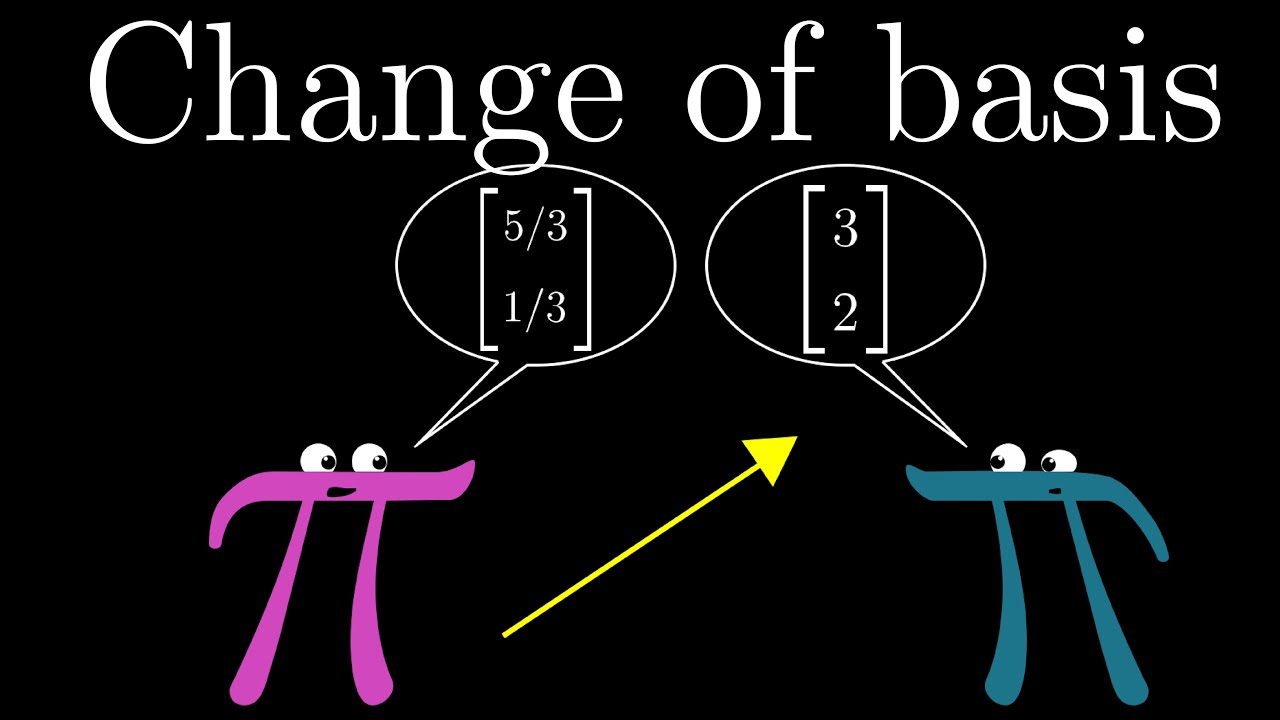
How do you translate back and forth between coordinate systems that use different basis vectors?
Help fund future projects: https://www.patreon.com/3blue1brown
An equally valuable form of support is to simply share some of the videos.
Home page: https://www.3blue1brown.com/
Future series like this are funded by the community, through Patreon, w...
Let me try to explain (but take everything with a huge grain of salt since honestly I've forgotten like all about it). But M(f, C_3, B_2) is as has been said the matrix representation of the mapping f with respect to the basis C_3 and B_2. That means to get this matrix what they did is take the unit vectors (1, 0, 0)^T, (0,1,0)^T, (0, 0, 1)^T then write it in the basis of C_3 here that's the canonical basis of R^3 so nothing changes. Then you apply f to these vectors and get the two dimensional ones. Which are then written as the linear combinations of the other basis. Here that's B_2 or C_2 (in C_2 you have the canonical basis again which means you don't really do anything)
So to start try finding out what f does
supple heath
yes i already wtched those videos and helped me a lot, but even that im still struggling
blissful stream
the second matrix should tell you
blissful stream
supple heath
yes i already wtched those videos and helped me a lot, but even that im still st...
yeah I totally feel that! I also struggled with linear algebra a lot to be honest
supple heath
the second matrix is telling me that to change of C_3 to C_2 its using (2 -3 2, 4 -1 24)?
supple heath
but how is that represented? i mean, is a multiplication right?
blissful stream
I don't know if you have the same notation as we did but this is basically how I would always write it to understand
 supple heath
is that phi?
supple heath
why the inverse of C3?
blissful stream
cuz that took very long for me to understand
supple heath
blissful stream
do you understand what phi does?
no, ive never seen that phi
blissful stream
oh okay yeah that makes sense
basically phi is writing a vector you have to another basis
so for phi_c2 you take whatever vector you have and write it in the basis of c2
supple heath
oh okay, for me its like this i think
blissful stream
the inverse is basically taking that vector from c3 and writing it in the canonical basis
 blissful stream
interesting yeah that seems to be the same then
supple heath
blissful stream
the inverse is basically taking that vector from c3 and writing it in the canoni...
ok but why are you doing the inverse?
i dont understand this part, its like ure returning to canonical basis applying the inverse but what does that (1 0 0) has to do
 blissful stream
that's the unit vector
since we're already in the canonical that doesn't do anything (I just added it because it's a step that you do need to do in case you start out in another basis like B3 for example)
 supple heath
that (1 0), (-1 1) and (3 4) from what basis are?
blissful stream
we know that if we write the vector (2,4)^T in the basis B2 we get (1, 0)
what does that tell you?
 blissful stream
I don't quite understand what you are trying to do tbh
supple heath
blissful stream
we know that if we write the vector (2,4)^T in the basis B2 we get (1, 0)
we get (1, 0) in the canonical base right?
blissful stream
we have (2, 4) in the canonical base
and that is (1, 0) in the b2 base
so you're only using 1*( first basis vector of b2)
 supple heath
yes
blissful stream
so you have found the first one :)))
supple heath
blissful stream
but if i do the same with (-3 -1) and (2 24) i get different a and c
blissful stream
a and c should be fixed now. then you use that to find b and d
supple heath
i dont know how to get b and d
 supple heath
but how do i get to that conclusion, when i see the exercices i dont know where to begin, and i dont know how did u get to that equations
 supple heath
yes
blissful stream
then that's where you need to look for answers
once you actually understand what's happening there you can apply it to basically anything involving this
at least it worked like that for me. took forever to actually get a feel for
supple heath
the writing is so aesthetic
blissful stream
but is very useful
blissful stream
supple heath
the writing is so aesthetic
aw thank you ☺️
blissful stream
blissful stream
usually all the blue things are given. you know all the bases and f and want to figure out how to use f to map from B3 to B2
you're trying to build M(f, B3, B2)
in this exercise you were given M(f, C3, B2) and f (although it was written confusingly as M(f, C3, C2) which means the phis are just the identity function and you can see how that just gives you f)
supple heath
i see
blissful stream
instead you were looking for the basis B2. and for that you basically just use the vectors you get out of f when you're in the canonical basis and compare them with the ones the matrix spits out in B2
blissful stream
blissful stream
that's how you get this
supple heath
this is insane
blissful stream
we were super lucky that the first equation was basically super lucky we got the a and c directly
 blissful stream
supple heath
this is insane
blissful stream
supple heath
this is insane
it is!!!
for my linear algebra class we actually got that problem in the exam when all we ever did before was find M(f, Bn, Bm)
supple heath
oh
blissful stream
it was horrible 😭
supple heath
I’ve had a really bad streak. It’s exam week, and I hadn’t been able to study either algebra or calculus because I was busy with other exams. I was planning to start studying from Friday to Monday for the exams, but I got sick and have been in bed all these days. Today I finally feel a bit better, so I started working on algebra, but I didn’t understand anything :/
supple heath
thanks a lot, now I understand a little bit more about this.
blissful stream
there's tons of videos online with professors explaining it on other problems
going through them helped me tons personally
so I can only recommend that
supple heath
yes, thank you so much :)
supple heath
.close
final saddleBOT
Channel closed
Closed by @supple heath
Use .reopen if this was a mistake.
final saddleBOT
Available help channel!
Send your question here to claim the channel.
Remember:
• Ask your math question in a clear, concise manner.
• Show your work, and if possible, explain where you are stuck.
• Do not immediately ping people or roles. After 15 minutes, feel free to ping <@&286206848099549185> once.
• Type the command .close to free the channel when you're done.
• Be polite and have a nice day!
Read #❓how-to-get-help for further information on how to ask a good question, and about conduct in the question channels.
 potent shuttle
hey can someone give me a simple proof for f(x) = e^x not being a surjective (onto function)
final saddleBOT
potent shuttle
hey can someone give me a simple proof for f(x) = e^x not being a surjective (on...
jagged flare
e^x=-1 does not have a solution
 zealous storm
potent shuttle
hey can someone give me a simple proof for f(x) = e^x not being a surjective (on...
zealous storm
potent shuttle
hey can someone give me a simple proof for f(x) = e^x not being a surjective (on...
what's the codomain you're working with?
jagged flare
real
pliant shore
I bet it's the reals too
potent shuttle
zealous storm
what's the codomain you're working with?
(0, ∞). f: ℝ → (0, ∞)
 amber holly
potent shuttle
(0, ∞). f: ℝ → (0, ∞)
amber holly
potent shuttle
(0, ∞). f: ℝ → (0, ∞)
In that case it is surjective
potent shuttle
zealous storm
did you mean [0, inf)?
yes
zealous storm
yeah well there's no value of x such that e^x = 0
potent shuttle
amber holly
In that case it is surjective
🥲 i have made my assignment for proof of a function being oneone but not onto with this e^x function thinking id be cool. i was a fool
made graph and everything realised it is onto for this
imma do f(x) = 2x ig
pliant shore
potent shuttle
made graph and everything realised it is onto for this
the point we're all making is that 'onto' depends on your codomain
your codomain can be anything you want
pliant shore
zealous storm
did you mean [0, inf)?
change your codomain to this, and you have e^x being injective but not surjective
 delicate sorrel
zealous storm
yeah well there's no value of x such that e^x = 0
delicate sorrel
zealous storm
yeah well there's no value of x such that e^x = 0
But whats the proof to this
pliant shore
delicate sorrel
But whats the proof to this
it's easier to think about 2^x = 0
delicate sorrel
pliant shore
it's easier to think about 2^x = 0
Huh?
pliant shore
or rather, 1/2^x = 0
pliant shore
delicate sorrel
Huh?
cause 2^x = e^((ln 2) * x)
pliant shore
delicate sorrel
Yes but whats the mathematical proof
what's your definition of 'proof'
delicate sorrel
That anything i the power of something is never 0
delicate sorrel
pliant shore
what's your definition of 'proof'
Using axiomes to conclude somthg
?
Nvm we dont have to go that deep
pliant shore
pliant shore
or rather, 1/2^x = 0
we can use the fact that the product of two non-zero numbers is never zero
so start with 1/2 * 1/2 = 1/4: that's not zero
then we consider that 1/2 * 1/4 = 1/8 can't be zero either
so proceeding inductively, we've shown this is impossible for an integer x
then hopefully if you agree that 2^x is an increasing function, then 1/2^x is a decreasing function
so for 1 <= x <= 2, 1/2^x is in [1/4, 1/2]
for 2 <= x <= 3, 1/2^x is in [1/8, 1/4], and so on
delicate sorrel
pliant shore
we can use the fact that the product of two non-zero numbers is never zero
so s...
Or we can suppose that there is an x wich satisfies e^x = 0 that means for any y in R e^(x + y) = 0 e^y anything times 0 is 0 so for any y + x = k’ in R e^k = 0 but since e^1 =e by definition so there is a contradiction to e^k=0 hence e^x is never 0
I used the fact that any real number k could be represented as the sum of two real numbers
pliant shore
I don't understand your proof
delicate sorrel
pliant shore
I don't understand your proof
What part
pliant shore
how does that imply that for any y in R, e^(x + y) = 0?
delicate sorrel
I just multiplied both sides by e^y
pliant shore
you can multiply both sides by e^y I guess
sure
ah, then that violates the fact that e^x is injective
nice one
delicate sorrel
pliant shore
ah, then that violates the fact that e^x is injective
Yepp
pliant shore
pliant shore
ah, then that violates the fact that e^x is injective
that's what you wanted to say but you didn't say it
anyways, I get it now
delicate sorrel
pliant shore
that's what you wanted to say but you didn't say it
The most rigorous proofs are those who countains the simplest notions
pliant shore
indeed
final saddleBOT
@potent shuttle Has your question been resolved?
 drowsy epoch
delicate sorrel
Or we can suppose that there is an x wich satisfies e^x = 0 that means for any y...
drowsy epoch
delicate sorrel
Or we can suppose that there is an x wich satisfies e^x = 0 that means for any y...
When you "multiply" by e^y you gotta make sure y!=x or else you multiply by 0
final saddleBOT
Channel closed
Closed due to timeout
Use .reopen if this was a mistake.
Available help channel!
Send your question here to claim the channel.
Remember:
• Ask your math question in a clear, concise manner.
• Show your work, and if possible, explain where you are stuck.
• Do not immediately ping people or roles. After 15 minutes, feel free to ping <@&286206848099549185> once.
• Type the command .close to free the channel when you're done.
• Be polite and have a nice day!
Read #❓how-to-get-help for further information on how to ask a good question, and about conduct in the question channels.
 solar crest
can someone check if this is correct or not
 final saddleBOT
solar crest
can someone check if this is correct or not
tiny gorge
final saddleBOT
solar crest
can someone check if this is correct or not
tiny gorge
oh i'm probably misinterpreting your diagram
the arrow is misleading
should just be the line segment itself
solar crest
tiny gorge
should just be the line segment itself
oh what
wait
but it's a vector tho?
also like
tiny gorge
well it's right except for the arrow
solar crest
okay look
tiny gorge
in fact every point on the line segment is part of T(U)
 solar crest
tiny gorge
in fact every point on the line segment is part of T(U)
solar crest
tiny gorge
in fact every point on the line segment is part of T(U)
oh
is my thing wrong??????????????
tiny gorge
if i were grading it and that's all you wrote, i would take some points off probably
because it looks like you're saying that only the vector (2,2) is in T(U)
solar crest
no just diagram wise
solar crest
tiny gorge
because it looks like you're saying that only the vector (2,2) is in T(U)
wait is it not
tiny gorge
when in reality everything of the form (x,x) with 0 <= x <= 2 is in T(U)
tiny gorge
it is, it's included in (x,x) with 0 <= x <= 2
tiny gorge
U is the unit square with the interior (should be shaded)
solar crest
i dont get how myu friend got full marks for doing just an arrow
tiny gorge
T(U) is not a square, it's just the line segment from (0,0) to (2,2), including both endpoints
tiny gorge
solar crest
i dont get how myu friend got full marks for doing just an arrow
generous grading probably 😁
solar crest
tiny gorge
T(U) is not a square, it's just the line segment from (0,0) to (2,2), including ...
how is that possible? if U is already a square itself... after applying transformation it no longer becomes a square??
solar crest
tiny gorge
generous grading probably 😁
lucky her
tiny gorge
right, because T is collapsing everything down to a single line (one dimensional)
you can see that because both coordinates of (x1+x2, x1+x2) are the same
solar crest
oh what
tiny gorge
so T maps everything onto the line y = x
solar crest
omg
tiny gorge
then it's just a matter of working out which part of that line is actually in T(U)
solar crest
wait how did you even know that the dimension collapsed
tiny gorge
well if you don't notice it immediately you can plug in some points to get the idea
solar crest
this is a bit confusing
tiny gorge
if you know about matrices you could also try to find the matrix for T, and notice that its columns are linearly dependent
solar crest
😭
how do i find the matrix
i feel like the range is throwing me off
like the 0<=x1<=1
tiny gorge
well the easiest way to find the matrix is to find where T sends (1,0) and (0,1)
the first column of the matrix will be $T\begin{pmatrix}1 \ 0 \end{pmatrix}$ and the second column will be $T\begin{pmatrix}0 \ 1 \end{pmatrix}$
soft zealotBOT
Bungo
 final saddleBOT
@solar crest Has your question been resolved?
final saddleBOT
Channel closed
Closed due to timeout
Use .reopen if this was a mistake.
Available help channel!
Send your question here to claim the channel.
Remember:
• Ask your math question in a clear, concise manner.
• Show your work, and if possible, explain where you are stuck.
• Do not immediately ping people or roles. After 15 minutes, feel free to ping <@&286206848099549185> once.
• Type the command .close to free the channel when you're done.
• Be polite and have a nice day!
Read #❓how-to-get-help for further information on how to ask a good question, and about conduct in the question channels.
 gentle zephyr
how do I calculate this partial derivative?
 final saddleBOT
gentle zephyr
how do I calculate this partial derivative?
gentle zephyr
final saddleBOT
gentle zephyr
how do I calculate this partial derivative?
gentle zephyr
,, \pdv{\text{}}{x} \left[-2x\right] \cdot \left[x^2 + y^2 + 1\right]^{-2} = \text{??????}
soft zealotBOT
Renato

 ornate knot
gentle zephyr
,, \pdv{\text{}}{x} \left[-2x\right] \cdot \left[x^2 + y^2 + 1\right]^{-2} = \te...
ornate knot
gentle zephyr
,, \pdv{\text{}}{x} \left[-2x\right] \cdot \left[x^2 + y^2 + 1\right]^{-2} = \te...
consider y as a constant
and use product rule
its the same as
d/dx(g(x)*h(x))
 soft zealotBOT


 Requested by renatoxbz
gentle zephyr
Requested by renatoxbz
gentle zephyr
looks good to me
gentle zephyr
ornate knot
its the same as
d/dx(g(x)*h(x))
I appreciate the help, thank you
yeah, product rule in disguise and then chain rule
.solved
final saddleBOT
Channel closed
Closed by @gentle zephyr
Use .reopen if this was a mistake.
Available help channel!
Send your question here to claim the channel.
Remember:
• Ask your math question in a clear, concise manner.
• Show your work, and if possible, explain where you are stuck.
• Do not immediately ping people or roles. After 15 minutes, feel free to ping <@&286206848099549185> once.
• Type the command .close to free the channel when you're done.
• Be polite and have a nice day!
Read #❓how-to-get-help for further information on how to ask a good question, and about conduct in the question channels.
 dusk parrot
since theyre all integer coefficients, doesnt it force the polynomial to either have all real roots or if complex, have the conjugate too as a root?
 final saddleBOT
dusk parrot
since theyre all integer coefficients, doesnt it force the polynomial to either ...
dusk parrot
final saddleBOT
dusk parrot
since theyre all integer coefficients, doesnt it force the polynomial to either ...
dusk parrot
 tired walrus
but why did you select that (a+ib)^2 is never also a root?
tired walrus
but why did you select that (a+ib)^2 is never also a root?
same reason
tired walrus
i do not follow your logic
dusk parrot
wait
tired walrus
the roots of a poly with real coeffs are either real or come in conjugate pairs
dusk parrot
you'd have two complex roots to balance
instead of one, and with n = 3
that's not possible
tired walrus
how exactly would it follow from this that raising a root of your polynomial to the second power always gives you a non-root
rocky tusk
dusk parrot
instead of one, and with n = 3
n >= 3
dusk parrot
tired walrus
how _exactly_ would it follow from this that raising a root of your polynomial t...
for n =3 specifically
tired walrus
for polynomials of degree 3?
rocky tusk
it doesn't say n = 3
dusk parrot
rocky tusk
n >= 3
which means it should be valud for n =3 too
rocky tusk
no
dusk parrot
?
tired walrus
i can name you a polynomial of degree exactly 3 with a root of the form a+ib and with (a+ib)^2 also a root.
worldly mesa
if 1 is a root to your polynomial, then 1^2 = 1 is also a root contradicting B
rocky tusk
worldly mesa
if 1 is a root to your polynomial, then 1^2 = 1 is also a root contradicting B
a, b \neq 0
dusk parrot
tired walrus
i can name you a polynomial of degree _exactly 3_ with a root of the form a+ib _...
which is?
tired walrus
p(x) = (x^2+1)(x+1)
dusk parrot
worldly mesa
if 1 is a root to your polynomial, then 1^2 = 1 is also a root contradicting B
not true because b =/=0
worldly mesa
rocky tusk
a, b \neq 0
its not written, even in that case just take a cyclotomic polynomial
dusk parrot
its talking about only one complex solution
rocky tusk
it says a and b are nonzero real numbers
dusk parrot
worldly mesa
its not written, even in that case just take a cyclotomic polynomial
it is given that a, b =/= 0
tired walrus
it's talking about only one complex solution but B does not say it is the only one
worldly mesa
dusk parrot
it is given that a, b =/= 0
oh right
dusk parrot
tired walrus
it is not even given
first sentence says theyre non zero....?
rocky tusk
lol
tired walrus
i still have one up my sleeve though
worldly mesa
1+x+x^2
tired walrus
$p(x) = (1+x+x^2)(x-7)$
rocky tusk
n >= 3
soft zealotBOT
Ann
 dusk parrot
worldly mesa
1+x+x^2
dusk parrot
worldly mesa
1+x+x^2
isnt that also +-i
worldly mesa
no
dusk parrot
soft zealot
**Ann**
complex number with its conjugate
worldly mesa
its has roots of unity as roots, which are not +-1, +-i
dusk parrot
its roots are conjugates...
tired walrus
yes
and as it happens
the SPECIFIC conjugate pair of roots that i picked just HAPPENS to be each other's squares!
tired walrus
and nobody is contradicting you on that
nobody said that the roots of our poly didnt come in conjugate pairs
rocky tusk
you can have (a + ib)^2 = conjugate of (a + ib)
dusk parrot
rocky tusk
you can have (a + ib)^2 = conjugate of (a + ib)
if b was 0 yes
but not allowed
tired walrus
ok i think you're either trying to over-generalize or like
overthink somehow
let's backtrack shall we
or maybe you would like to issue a refusal and tell me to disappear
know that that's always an option
if at ANY POINT WHATSOEVER you wish to tell me to fuck off then tell me to fuck off
dusk parrot
i cant think of a counter example
tired walrus
are we understood thus far
dusk parrot
sure
tired walrus
ok
so you have this theorem which states
if polynomial p has real coeffs and some complex number z is a root of p then conj(z) is a root of p as well.
are we on the same page thus far
worldly mesa
dusk parrot
i cant think of a counter example
as I said earlier 1+x+x^2 is a counterexample
rocky tusk
dusk parrot
if b was 0 yes
$(a + ib)^2 = a - ib \iff a^2 - b^2 + 2abi = a - ib \implies a^2 - b^2 = a, \quad 2ab = -b$ and from here since $b \neq 0$ you get $a = -\frac{1}{2}$ and so $b = \pm\frac{\sqrt{3}}{2}$
dusk parrot
worldly mesa
as I said earlier 1+x+x^2 is a counterexample
doesnt work because pair of conjugates
tired walrus
ok let me handle this y'all
dusk parrot
oh shit
tired walrus
tired walrus
**if** polynomial p has real coeffs **and** some complex number z is a root of p...
@dusk parrot are we in agreement so far
soft zealotBOT
knief
 dusk parrot
im an idiot i was thinking of a^2 as a 💀
youre right theres nothing stopping (a+ib)^2 from being conjugate of a+ib 💀
tired walrus
Let a polynomial p have real coefficients, and let z be a root of p.

A) We can SAY FOR CERTAIN that z^2 ISN'T a root of p, because z^2 isn't equal to conj(z).
B) We CAN'T SAY what happens with z^2 as to whether it's a root of p. It could be another root of p by sheer coincidence, or it could also not be -- the theorem doesn't say.
what it sounded like to me is that you were asserting (A) when in fact (A) is false.
and the true statement among these two is (B).
dusk parrot
rocky tusk
i just don't know why you didn't think D was correct
tbh the questions are supposed to have singular solutions
so
rocky tusk
yea but like D is obviously true
tired walrus
tired walrus
what it sounded like to me is that you were asserting (A) when in fact (A) is fa...
@dusk parrot do you agree or disagree w this
dusk parrot
i didnt read D first
dusk parrot
tired walrus
```
Let a polynomial p have real coefficients, and let z be a root of p.
A) We ...
hmm fair enough i guess
tired walrus
what part remains unclear or doubtful?
dusk parrot
tired walrus
what part remains unclear or doubtful?
nothing i made a stupid while solving the question
tired walrus
yeah but for some reason you didnt give me a clear "i agree with you" or "i disagree with you"
i'd like to know why
dusk parrot
soft zealot
**knief**
i was doing THIS
but
my idiotic brain decided a^2 = a
😄
and hence the assertion that b must be 0
worldly mesa
just saying there are more counterexamples then those that (a+bi)^2 = a+bi
dusk parrot
worldly mesa
just saying there are more counterexamples then those that (a+bi)^2 = a+bi
this is the case where the statement is false, well that it has to be the conjugate specifically
worldly mesa
take 1 + x + x^2 + x^3 + x^4
dusk parrot
worldly mesa
take 1 + x + x^2 + x^3 + x^4
its okay, my problem's solved
worldly mesa
and in general $\sum_{n=0}^{p-1} x^n$ for an odd prime p
dusk parrot
never seen this tho
soft zealotBOT
ExpertEsquieESQUIE
 worldly mesa
these are cyclotomic polynomials
dusk parrot
worldly mesa
these are cyclotomic polynomials
im pretty sure this is above hs maths tho
worldly mesa
yeah, but you can work out some specific cases just by simple calculations
notice for $p = 5$ the roots are of the form $e^{\frac{2 \pi i k}{5}}$ for k=1,2,3,4
soft zealotBOT
ExpertEsquieESQUIE
 dusk parrot
in polar coords?
worldly mesa
yeah
dusk parrot
then what?
worldly mesa
take $e^{\frac{2 \pi i}{5}}$, squaring it we get $e^{\frac{4 \pi i}{5}}$ which is also a root
soft zealotBOT
ExpertEsquieESQUIE
 dusk parrot
ah getting back to the same thing but with polar coords
ill keep it in mind, maybe it'll be useful somewhere else then
thanks ❤️
.stop
final saddleBOT
Channel closed
Closed by @worldly mesa
Use .reopen if this was a mistake.
Available help channel!
Send your question here to claim the channel.
Remember:
• Ask your math question in a clear, concise manner.
• Show your work, and if possible, explain where you are stuck.
• Do not immediately ping people or roles. After 15 minutes, feel free to ping <@&286206848099549185> once.
• Type the command .close to free the channel when you're done.
• Be polite and have a nice day!
Read #❓how-to-get-help for further information on how to ask a good question, and about conduct in the question channels.
 fading pumice
can someone explain epsilon delta
final saddleBOT
fading pumice
can someone explain epsilon delta
 gleaming jetty
which epsilon delta?
 hybrid heath
gleaming jetty
which epsilon delta?
hybrid heath
gleaming jetty
which epsilon delta?
Limits, i assume
gleaming jetty
i know but there are like 4-5 definitions that use epsilon and delta
the continuity limits sequences idk
fading pumice
hybrid heath
Limits, i assume
yes
 gritty drift

Mathematics LibreTexts
This section introduces the formal definition of a limit. Many refer to this as "the epsilon--delta,'' definition, referring to the letters ϵ and δ of the Greek alphabet.
Read through that and describe any parts you don't understand. You can't expect anyone to tutor you on a whole topic from scratch.
 tulip coyote
(why is the epsilon-delta definition of a limit necessary?)
final saddleBOT
@fading pumice Has your question been resolved?
final saddleBOT
Channel closed
Closed due to timeout
Use .reopen if this was a mistake.
Available help channel!
Send your question here to claim the channel.
Remember:
• Ask your math question in a clear, concise manner.
• Show your work, and if possible, explain where you are stuck.
• Do not immediately ping people or roles. After 15 minutes, feel free to ping <@&286206848099549185> once.
• Type the command .close to free the channel when you're done.
• Be polite and have a nice day!
Read #❓how-to-get-help for further information on how to ask a good question, and about conduct in the question channels.
 radiant carbon
hey
final saddleBOT
radiant carbon
hey
radiant carbon


Not sure where I went wrong for question 95
the actual answer has a -105/2 instead of -175/2
 west silo
Not sure what I'm doing wrong, I need help
 dusk parrot
radiant carbon
dusk parrot
radiant carbon
have you tried U sub>
wait stupid question you already sent your work 💀
 celest crane
west silo
Not sure what I'm doing wrong, I need help
celest crane
west silo
Not sure what I'm doing wrong, I need help
!help
final saddleBOT
west silo
Not sure what I'm doing wrong, I need help
To ask for mathematics help on this server, please open your own help channel or help thread. See #❓how-to-get-help for instructions.
radiant carbon
dusk parrot
have you tried U sub>
yh
i see it
my 4/3 turned into 4/5
lol
bad handwriting
dusk parrot
radiant carbon
my 4/3 turned into 4/5
i was gonna say
xD
that the answer is in fact correct(the given one)
final saddleBOT
Channel closed
Closed by @radiant carbon
Use .reopen if this was a mistake.
final saddleBOT
Available help channel!
Send your question here to claim the channel.
Remember:
• Ask your math question in a clear, concise manner.
• Show your work, and if possible, explain where you are stuck.
• Do not immediately ping people or roles. After 15 minutes, feel free to ping <@&286206848099549185> once.
• Type the command .close to free the channel when you're done.
• Be polite and have a nice day!
Read #❓how-to-get-help for further information on how to ask a good question, and about conduct in the question channels.
 austere elbow
I am wondering if anyone would be able to help me with "differential equations as models" which is section 1.3 in my textbook
final saddleBOT
austere elbow
I am wondering if anyone would be able to help me with "differential equations a...
tiny gorge
do you have a specific question or problem you're working on?
austere elbow
just looking to work through a problem with someone. I can find a specific problem. one second
tiny gorge
sure
austere elbow

i can try and work through this one on my own first and ill share what i come out to
tiny gorge
ok
austere elbow
i understand that A(0) = 50 and dA/dt = salt / time but i dont exactly understand how to write it into a diff eq as it gives me an initial volume.
Just not exactly sure how that translates into an equation
and it doesnt tell us the max volume, which also confuses me
nevermind, i think i got it. dA/dt = - A/100
.close
final saddleBOT
Channel closed
Closed by @austere elbow
Use .reopen if this was a mistake.
Available help channel!
Send your question here to claim the channel.
Remember:
• Ask your math question in a clear, concise manner.
• Show your work, and if possible, explain where you are stuck.
• Do not immediately ping people or roles. After 15 minutes, feel free to ping <@&286206848099549185> once.
• Type the command .close to free the channel when you're done.
• Be polite and have a nice day!
Read #❓how-to-get-help for further information on how to ask a good question, and about conduct in the question channels.
 severe verge
find A^n
 final saddleBOT
severe verge
find A^n
severe verge
final saddleBOT
severe verge
find A^n
severe verge
A^2= $\begin{bmatrix}
a^2 & 2a & 1\
0 & a^2 & 2a\
0 & 0 & a^2
\end{bmatrix}$
A^3= $\begin{bmatrix}
a^3 & 3a^2 & 3a\
0 & a^3 & 3a^2\
0 & 0 & a^3
\end{bmatrix}$
soft zealotBOT
(De)Carbonized
Compile Error! Click the  reaction for more information.
(You may edit your message to recompile.)
 severe verge
some obvious patterns here: the main diagonal is a^n and A^n is always an upper triangular matrix
dont you tell me it's the first 3 terms in (a+1)^n expansion
 cursive bough
are you expected to use induction? if so i'd keep taking powers, make a guess, and try to prove it
diagonalization is also an option if you've learned that
severe verge
what is a diagonalization
cursive bough
a method used to raise matrices to a power consistently. you need to find 3 independent eigenvectors though
since it's a 3x3 matrix
severe verge
we're only introduced to matrices so i dont know what eigenvectors and stuff are
cursive bough
then induction it is lol, which is probably easier anyway
cursive bough
severe verge
dont you tell me it's the first 3 terms in (a+1)^n expansion
but your guess here seems plausible
severe verge
one thing i see is that A = a*E + Y
where Y = $\begin{bmatrix}
0 & 1 & 0\
0 & 0 & 1\
0 & 0 & 0
\end{bmatrix}$
soft zealotBOT
(De)Carbonized
 severe verge
and then (aE)Y = Y(aE)
so A^n = (aE + Y)^n
fk my phone ran out of battery, I will hop on laptop later
final saddleBOT
@severe verge Has your question been resolved?
severe verge
severe verge
and then (aE)Y = Y(aE)
since this is commutative for matrix multiplication i think we can do binomial expansion
(aE)^n is just a^n *E
Y^2 = $\begin{bmatrix}
0 & 0 & 1\
0 & 0 & 0\
0 & 0 & 0
\end{bmatrix}$
soft zealotBOT
(De)Carbonized
Compile Error! Click the reaction for more information.
(You may edit your message to recompile.)
 severe verge
Y^3 and further is just a 0 matrix
so our expansion only has 3 terms
A^n= $\begin{bmatrix}
a^n & n \cdot a^{n-1} & nC2 \cdot a^{n-2} \
0 & a^n & n \cdot a^{n-1} \
0 & 0 & a^n
\end{bmatrix}$
soft zealotBOT
(De)Carbonized
Compile Error! Click the reaction for more information.
(You may edit your message to recompile.)
 final saddleBOT
Channel closed
Closed by @severe verge
Use .reopen if this was a mistake.
Available help channel!
Send your question here to claim the channel.
Remember:
• Ask your math question in a clear, concise manner.
• Show your work, and if possible, explain where you are stuck.
• Do not immediately ping people or roles. After 15 minutes, feel free to ping <@&286206848099549185> once.
• Type the command .close to free the channel when you're done.
• Be polite and have a nice day!
Read #❓how-to-get-help for further information on how to ask a good question, and about conduct in the question channels.
 compact socket
The x-intercept is 2. The y-intercept is −6. The
function is increasing for all values of x. The
function is positive for x > 2. As x → +∞,
f(x) → +∞ and as x → −∞, f(x) → −∞.
what does x>2 mean?
final saddleBOT
compact socket
The x-intercept is 2. The y-intercept is −6. The
function is increasing for all ...
rocky tusk
compact socket
The x-intercept is 2. The y-intercept is −6. The
function is increasing for all ...
the function is positive when x is greater than 2
 compact socket
 drifting plank
Visual representation
drifting plank
Visual representation
the answer is linear right?
just making sure
 final saddleBOT
Channel closed
Closed by @compact socket
Use .reopen if this was a mistake.
final saddleBOT
Available help channel!
Send your question here to claim the channel.
Remember:
• Ask your math question in a clear, concise manner.
• Show your work, and if possible, explain where you are stuck.
• Do not immediately ping people or roles. After 15 minutes, feel free to ping <@&286206848099549185> once.
• Type the command .close to free the channel when you're done.
• Be polite and have a nice day!
Read #❓how-to-get-help for further information on how to ask a good question, and about conduct in the question channels.
 whole halo
quickly want to make sure: [1, 1] is not necessarily the same as [i, i], right
 final saddleBOT
whole halo
quickly want to make sure: [1, 1] is not necessarily the same as [i, i], right
whole halo
final saddleBOT
whole halo
quickly want to make sure: [1, 1] is not necessarily the same as [i, i], right
whole halo
I havent needed [1, 1] = [i, i] when proving that <x + z, y> = <x, y> + <z, y>, that <x, y> = conjugate of <y, x>, and <x, x> ≠ 0 if x ≠ 0
also, the definition of [., .] seems to mirror the dot product in R^2, and that dot product can be defined as (a, b) * (c, d) = ac + 2bd and still fit the necessary axioms
only seem to need it when proving that <cx, y> = c <x, y> and there isnt a way around that
itd be a typo on the problem's part to leave out that [1, 1] = [i, i] for this purpose
final saddleBOT
@whole halo Has your question been resolved?
odd seal
whole halo
itd be a typo on the problem's part to leave out that [1, 1] = [i, i] for this p...
unless I am horribly confused and misremember,
[i,i] is real. And we can write [i,i] = i[1,i].
This means [1,i] is purely imaginary.
That makes [1,i] = - [i,1], or,
[i,i] = -i[i,1] = -i^2 [1,1] = [1,1]
 odd seal
oof
 umbral hamlet
but it wont belong to V
it belongs to the field but it isnt going to be in the vector space
whole halo
I think I gotta review how Im using the word identity here, that was very messy to say
whole halo
umbral hamlet
it belongs to the field but it isnt going to be in the vector space
1 is the real number 1 I mean
umbral hamlet
right
whole halo
and i is the complex number i
whole halo
our assumption in the course allows us to say that V is R or C
this is for example there in conj(<x, y>) = <y, x>
thats given as an axiom for a vector space in this course
umbral hamlet
i really doubt that V is R or C, because then you are only dealing with rank 1 or 2 vector spaces