#help-36
1 messages · Page 189 of 1
 final saddleBOT
 novel jackal

 tired walrus
break 3^4 into 3^3 * 3
subsequently, $\sqrt[3]{3^3 \cdot 3} = \sqrt[3]{3^3} \cdot \sqrt[3]{3} = 3 \sqrt[3]{3}$
 soft zealotBOT
Ann
 final saddleBOT
Channel closed
Closed by @novel jackal
Use .reopen if this was a mistake.
final saddleBOT
 Available help channel!
Send your question here to claim the channel.
Remember:
• Ask your math question in a clear, concise manner.
• Show your work, and if possible, explain where you are stuck.
• After 15 minutes, feel free to ping <@&286206848099549185>.
• Type the command .close to free the channel when you're done.
• Be polite and have a nice day!
Read #❓how-to-get-help for further information on how to ask a good question, and about conduct in the question channels.
 gray acorn
Is it possible for a propositional function to be a paradox?
gray acorn
like a proposition could be one for example " this sentence if false" is one, but idk about propositoinal functions
gray acorn
 valid carbon
~~is this actually math.~~
valid carbon
~~is this actually math.~~
discreet math
tired walrus
gray acorn
Is it possible for a propositional function to be a paradox?
define "propositional function" & define "paradox"
gray acorn
 old quarry
thought it was english grammar
old quarry
thought it was english grammar
watch me start writing poetry in math server
gray acorn
tired walrus
define "propositional function" & define "paradox"
propositional function --> a statement template with free variables like lets say P(x,y) and P is x+y < 5
Paradox uh A set of statement that produces a contradiction
I dont know how to really define it sorry
tired walrus
yeah then your question is not really answerable at this stage
final saddleBOT
Channel closed
Closed by @gray acorn
Use .reopen if this was a mistake.
Available help channel!
Send your question here to claim the channel.
Remember:
• Ask your math question in a clear, concise manner.
• Show your work, and if possible, explain where you are stuck.
• After 15 minutes, feel free to ping <@&286206848099549185>.
• Type the command .close to free the channel when you're done.
• Be polite and have a nice day!
Read #❓how-to-get-help for further information on how to ask a good question, and about conduct in the question channels.
final saddleBOT
Channel closed
Channel closed due to the original message being deleted.
If you did not intend to do this, please open a new help channel,
as this action is irreversible, and this channel may abruptly lock.
 latent dragon
@rapid dragon, if you still have a question, please answer in a new channel
final saddleBOT
Available help channel!
Send your question here to claim the channel.
Remember:
• Ask your math question in a clear, concise manner.
• Show your work, and if possible, explain where you are stuck.
• After 15 minutes, feel free to ping <@&286206848099549185>.
• Type the command .close to free the channel when you're done.
• Be polite and have a nice day!
Read #❓how-to-get-help for further information on how to ask a good question, and about conduct in the question channels.
 flint summit
integral understandnig help
final saddleBOT
flint summit
integral understandnig help
flint summit
so im learning about integrals
and theres some concepts i dont get
i get that dy=f'(x)dx
 lethal totem
Post a picture
flint summit
and that f'(x)*dx represents the area under f'(x) which also represents the net change in y of f(x)
flint summit
lethal totem
Post a picture
its theory/concept
flint summit
flint summit
and that f'(x)*dx represents the area under f'(x) which also represents the net ...
but then when we integrate
why do we antiderive backwards if its f'(x)*dx and not f(x)*dx
 vital crag
f'(x) is also a function
flint summit
yes
vital crag
it has an area under the curve as well
vital crag
$\int f'(x) dx = f(x) + C$
soft zealotBOT
riemann
 flint summit
that i dont get
 hybrid heath
flint summit
that i dont get
hybrid heath
flint summit
that i dont get
Basically the definition of antiderivative
flint summit
i dont get how we go from very very small changes in dx*f'(x) (rieman sums)
to how it equals f(x1) - f(x2)
hybrid heath
oh, you mean a definite integral
vital crag
hand wavy proof https://www.youtube.com/watch?v=pWtt0AvU0KA
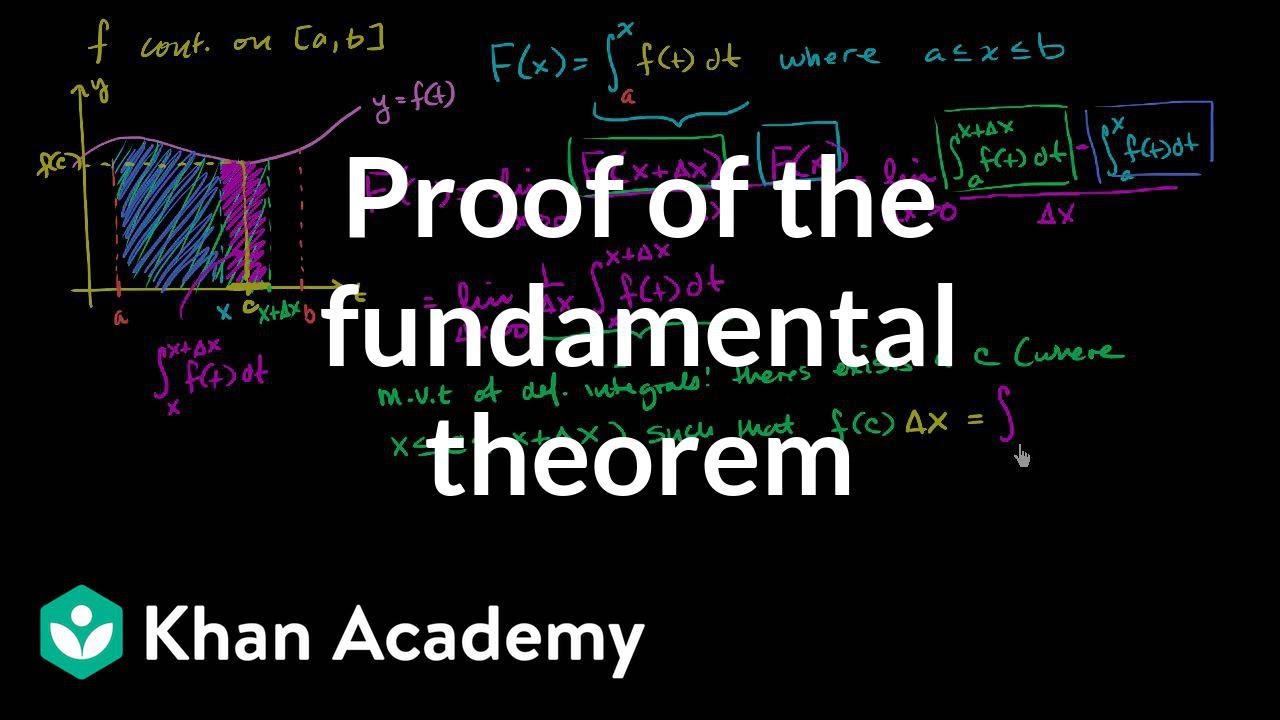
Courses on Khan Academy are always 100% free. Start practicing—and saving your progress—now: https://www.khanacademy.org/math/ap-calculus-ab/ab-integration-new/ab-integration-optional/v/proof-of-fundamental-theorem-of-calculus
The first part of the fundamental theorem of calculus tells us that if we define () to be the definite integral ...
flint summit
hybrid heath
oh, you mean a definite integral
yes
hybrid heath
fundamental theorem is not a trivial proof 
flint summit
i had a lecture on indefinite integrals, but im assuming the logic is the same but with the application of + c to represent infinte solutions of an antiderivative
vital crag
more thorough proof https://math.clarku.edu/~ma120/FTCproof.pdf
flint summit
thank you ill take a look
doing it is easy but i hate not understanding what im doing
vital crag
vital crag
more thorough proof https://math.clarku.edu/~ma120/FTCproof.pdf
yea read every line of Theorem 1 FTC and ask questions if you don't understand
hybrid heath
Intuitively, I just think that the rate of change of area is just equal to the height of the graph, which makes sense to me
flint summit
i mean i can see the relation the more i think about it
how infintely small changes in x * its given slope at that value equals those changes in y
ohhh shit
flint summit
flint summit
how infintely small changes in x * its given slope at that value equals those c...
dy/dx (slash not divison) is bottled up into f(x) since it rerpesents changes at any given moment
therefore if i want to analyze the amount of change and not the instantaneous change i need to antiderive
because the amount of change is infintely represented by the amoutn of instataneous change
hybrid heath
if that helps your intuition, then go for it
hybrid heath
i wouldn't say wrong. It's not mathematically rigorous, but that's okay. Mine isn't either
Just a heuristic to help you visualize it
So there's no wrong way to see it, imo
flint summit
when it gets mathematically rigorous thats when its confusing as fuck
im a phys major ill take my basic understaning of calculus haha
ty
hybrid heath
It's fun. But, disclaimer: you'll need to be pretty good at math. You won't need all the theory, but physics is very math heavy:
- calculus
- complex analysis
- differential equations
- linear algebra
- statistics
And, if you want to get into higher level, you'll need some basic topology, and maybe even abstract algebra
flint summit
fairfair
physics is whats kicking my ass tho, the way my prof has lectures set up is very ezpirmental/theory heavy and not very example heavy
its basically highschool physics but with dimensional analysis and all the barebones frameworks
alot of algebra
hybrid heath
flint summit
physics is whats kicking my ass tho, the way my prof has lectures set up is very...
Yeah that can be hard. I'll give you some advice, that text book will be your best friend. Read it, reread it, and read it often
always be asking questions.
flint summit
thats what my prof says funny enough
hybrid heath
it's the truth of college life
flint summit
i find with math i can get all i need from course notes+ the exercises in there
but physics, my profs lectures are basically him brainfarting on the board how to analyze the dimensions that contribute to the suns pressure and shit so he assuems you have textbook knowledge
im a few lectures behind in terms of review, im gonna catch up this weekend, just doing the easy things(calculus and chem) first
hybrid heath
flint summit
but physics, my profs lectures are basically him brainfarting on the board how t...
in college, the EXPECTATION is that you have read the chapter BEFORE going to class.
I cannot stress that enough
flint summit
seems very true
hybrid heath
It is
flint summit
is there a good spot for practice problems apart tyhe textbook]
any good like websites that have big banks
hybrid heath
the book and your hw should really be sufficient
flint summit
kk tyvm
final saddleBOT
@flint summit Has your question been resolved?
Channel closed
Closed by @flint summit
Use .reopen if this was a mistake.
Available help channel!
Send your question here to claim the channel.
Remember:
• Ask your math question in a clear, concise manner.
• Show your work, and if possible, explain where you are stuck.
• After 15 minutes, feel free to ping <@&286206848099549185>.
• Type the command .close to free the channel when you're done.
• Be polite and have a nice day!
Read #❓how-to-get-help for further information on how to ask a good question, and about conduct in the question channels.
 soft pewter
!help
An agriculturalist must sow his land with corn and soy. He must sow at least 14 km² of his land and at most half of it with corn. Each square kilometer of corn requires 140 kg of seeds and 4 hours of work, and each square kilometer of soy requires 100 kg of seeds and 8 hours of work. The farmer has at most 1840 kg of seeds and at most 104 hours. One square kilometer of corn yields 25 k$ and requires 20 kg of fertilizer, and one square kilometer of soy yields 50 k$ and requires 25 kg of fertilizer.
final saddleBOT
soft pewter
!help
To ask for mathematics help on this server, please open your own help channel or help thread. See #❓how-to-get-help for instructions.
soft pewter
Which area should the farmer sow with each seed type, knowing that he wishes to maximize revenue first and then minimize the amount of fertilizer?
final saddleBOT
@soft pewter Has your question been resolved?
 crude island
how much fertilizer does the farmer have?
As of now I can't see why that's even relevant
soft pewter
yeah i dont think it is
crude island
So you want to maximize profit essentially?
soft pewter
yeah i found some stuff
crude island
Just spam soy ngl
soft pewter
yeah
crude island
reasoning is that
Soy is twice as profitable
so you would expect it to take twice as many resources
but it only takes 2x as many hours and actually requires less fertilizer
soft pewter
wait u mean corn?
crude island
I still don't think this is optimal thought but I do think
you need to use mainly soy
soft pewter
soy is 100 kg corn is 140kg
crude island
he has to sow 14 km^2
so spam soy as much as possible while still reaching that target seems like a good idea
soft pewter
wait why do we need more soy
crude island
I'm pretty convinced that it is
crude island
soft pewter
wait why do we need more soy
it yields twice as much money
crude island
honestly 12 soy 2 corn probably is it
oh wait
at least 14 km^2
so he can do more
lol
nevermind then
it's gonna change
hold up
soft pewter
we gotta start with the inequations i think
crude island
actually nah
I think it might be the same
there's no way to replace any soy with more than 2 corn
so profit will stay the same
the key is prioritizing hours because that is much more limiting
soft pewter
alr
crude island
140c + 100s <= 1840
soft pewter
got that too
crude island
10s 6 c
or 12 s 2c
they work equally as well actually
It's most likely the case that fertilizer
changes things
final saddleBOT
Channel closed
Closed due to timeout
Use .reopen if this was a mistake.
crude island
because otherwise there are multiple solutions
soft pewter
.reopen
final saddleBOT
✅
final saddleBOT
Channel closed
Closed by @soft pewter
Use .reopen if this was a mistake.
Available help channel!
Send your question here to claim the channel.
Remember:
• Ask your math question in a clear, concise manner.
• Show your work, and if possible, explain where you are stuck.
• After 15 minutes, feel free to ping <@&286206848099549185>.
• Type the command .close to free the channel when you're done.
• Be polite and have a nice day!
Read #❓how-to-get-help for further information on how to ask a good question, and about conduct in the question channels.
final saddleBOT
Channel closed
Channel closed due to the original message being deleted.
If you did not intend to do this, please open a new help channel,
as this action is irreversible, and this channel may abruptly lock.
Available help channel!
Send your question here to claim the channel.
Remember:
• Ask your math question in a clear, concise manner.
• Show your work, and if possible, explain where you are stuck.
• After 15 minutes, feel free to ping <@&286206848099549185>.
• Type the command .close to free the channel when you're done.
• Be polite and have a nice day!
Read #❓how-to-get-help for further information on how to ask a good question, and about conduct in the question channels.
 sterile pebble
 final saddleBOT
sterile pebble
sterile pebble
final saddleBOT
sterile pebble
sterile pebble
hlelo
so I dont know which ratios to go for
here
cos W is 9/41
so I have a 9, 40, 41 triangle
wait
do I solve for triangle ADC's ratio via triangle ABC's side lengths/
if I assign DC as 9
and AD as 40
because AC is hypoteneuse of triangle ADC
I get 9/40 as my answer
answer key says 40/9 though
<@&286206848099549185>

Proportions look good
 odd seal
can you find relation between w and z angles?
sterile pebble
no
odd seal
and?
sterile pebble
so they form 90 degrees?
odd seal
well, that just sounds like a random guess
can you support it with maths?
you should look at angles
the angle BCA is common in the triangles ABC as well as ADC right?
and both are right angled triangles
odd seal
do you know the sum of angles for a triangle?
sterile pebble
odd seal
do you know the sum of angles for a triangle?
180
odd seal
sterile pebble
180
yea, use that in both triangles
sum of angles of ABC = sum of angles of ADC
and fill in all the known/labelled angles
sterile pebble
I do not understand how naming all 7 angles of these 3 triangles is going to do anything
odd seal
- two triangles only have 6 angles
- one of them is common, so you are left with only 4
Dude, you are throwing darts in the dark
you are claiming stuff out of nowhere
sterile pebble
odd seal
1. two triangles only have 6 angles
2. one of them is common, so you are left w...
- angle A is cut across 2 triangles within triangle ABC, the 90 degree angle that is split by angles CAD and BAD counts as an angle
odd seal
sterile pebble
1. angle A is cut across 2 triangles within triangle ABC, the 90 degree angle th...
this is not what I am asking you to do
I asked you to find a relation between the angles w and z
and I am telling you how to approach that
by comparing the triangles they are in
final saddleBOT
@sterile pebble Has your question been resolved?
Channel closed
Closed by @sterile pebble
Use .reopen if this was a mistake.
Available help channel!
Send your question here to claim the channel.
Remember:
• Ask your math question in a clear, concise manner.
• Show your work, and if possible, explain where you are stuck.
• After 15 minutes, feel free to ping <@&286206848099549185>.
• Type the command .close to free the channel when you're done.
• Be polite and have a nice day!
Read #❓how-to-get-help for further information on how to ask a good question, and about conduct in the question channels.
 cedar obsidian
If \alpha, \beta \neq 0, \text{ and } f(n) = \alpha^n + \beta^n \text{ and }
\begin{vmatrix}
3 & 1 + f(1) & 1 + f(2) \
1 + f(1) & 1 + f(2) & 1 + f(3) \
1 + f(2) & 1 + f(3) & 1 + f(4)
\end{vmatrix}
= K (1 - \alpha)^2 (1 - \beta)^2 (\alpha - \beta)^2,
\text{ then K is equal to }
(1) \alpha \beta \quad (2) \tfrac{1}{\alpha \beta} \quad (3) 1 \quad (4) -1
final saddleBOT
cedar obsidian
If \alpha, \beta \neq 0, \text{ and } f(n) = \alpha^n + \beta^n \text{ and }
\b...
soft zealotBOT
BlackidoZΣ
Compile Error! Click the  reaction for more information.
(You may edit your message to recompile.)


 modest fog
cedar obsidian
modest fog
cedar obsidian
I don't think so you r supposed to do like this
You should split the determinant in 2 parts
Such that product of both is this determinant
Write that 3 as 1+1+1
cedar obsidian
can you help me with that what will be the first element in both new determinants which are in product now
modest fog
Okk
cedar obsidian
is it | 1 ....| x | 1+1 ....|
modest fog
Lemme grab my copy
cedar obsidian
but it dont make 3
 cedar obsidian
,rotate
soft zealotBOT
 modest fog
Now both the determinants r same
So it becomes squared
Now this will be easier to open
Also we can perform row operations too to do it easier
modest fog
Yes
Now (alpha-1)² is same as (1-alpha)²
Same for beta term too
Now you can compare what they gave
You will get the value of k as 1
modest fog
?
modest fog
cedar obsidian
you got correct idea quickly
Nah man
I did the same q in class
I remember
I first tried what u were doing
cedar obsidian
oh
modest fog
My sir said then do it like this
cedar obsidian
ty
modest fog
It's a pyq ig ?
cedar obsidian
it is in exercise 2
cedar obsidian
cedar obsidian
it is in exercise 2
in my book
modest fog
Clicking unknown links isn't a very good idea
modest fog
cedar obsidian
in my book
Oh I see
Its a pyq also I remember
Jee loves to trap people

Smth a scammer might say
final saddleBOT
Channel closed
Closed by @cedar obsidian
Use .reopen if this was a mistake.
tired walrus
@hearty swift this is not the place to advertise.
hybrid heath
<@&268886789983436800>
final saddleBOT
Available help channel!
Send your question here to claim the channel.
Remember:
• Ask your math question in a clear, concise manner.
• Show your work, and if possible, explain where you are stuck.
• After 15 minutes, feel free to ping <@&286206848099549185>.
• Type the command .close to free the channel when you're done.
• Be polite and have a nice day!
Read #❓how-to-get-help for further information on how to ask a good question, and about conduct in the question channels.
 terse folio
I was trying to find inspiration for my physics project and stumbled upon this expression online, may i ask what is the technical meaning of this?
 final saddleBOT
terse folio
I was trying to find inspiration for my physics project and stumbled upon this e...
final saddleBOT
final saddleBOT
terse folio
I was trying to find inspiration for my physics project and stumbled upon this e...
final saddleBOT
@terse folio Has your question been resolved?
final saddleBOT
@terse folio Has your question been resolved?
 drowsy epoch
terse folio
but just not C^2([0,L) x R+)
drowsy epoch
terse folio
but just not C^2([0,L) x R+)
u is a twice differentiable function on the interval [0,L] x (0,οο) but the codomain is unclear. (Presumbaly to R, maybe) Where did you get this online from?
terse folio
drowsy epoch
u is a twice differentiable function on the interval [0,L] x (0,οο) but the codo...
a university lecture note
terse folio
drowsy epoch
u is a twice differentiable function on the interval [0,L] x (0,οο) but the codo...
do we get "twice differentiable " from the 2 in C^2?
drowsy epoch
Yes
C^n is the function space of functions that are n times continuously differentiable
terse folio
i see
terse folio
drowsy epoch
u is a twice differentiable function on the interval [0,L] x (0,οο) but the codo...
the interval would be 2 dimensional..?
sorry not too well versed in this
drowsy epoch
That's usually what it's supposed to mean, but without further context it could be also something else
drowsy epoch
terse folio
the interval would be 2 dimensional..?
Yeah
terse folio
.close
final saddleBOT
Channel closed
Closed by @terse folio
Use .reopen if this was a mistake.
Available help channel!
Send your question here to claim the channel.
Remember:
• Ask your math question in a clear, concise manner.
• Show your work, and if possible, explain where you are stuck.
• After 15 minutes, feel free to ping <@&286206848099549185>.
• Type the command .close to free the channel when you're done.
• Be polite and have a nice day!
Read #❓how-to-get-help for further information on how to ask a good question, and about conduct in the question channels.
 exotic shale
how can we show this for taylor series
 final saddleBOT
exotic shale
how can we show this for taylor series
final saddleBOT
exotic shale
how can we show this for taylor series
 rain lance
Hey
 desert mantle
differentiate the series n times
exotic shale
desert mantle
differentiate the series n times
hhow
n can be any non negative integer
rain lance
series around a point "a". The series is:
f(x) = Σ cₙ (x-a)ⁿ, where cₙ = fⁿ(a)/n!.
Each coefficient cₙ is the nth derivative of the function at "a", divided by n! (factorial). For convergence, the function must be differentiable or analytic in the interval.
desert mantle
its a polynomial series
those are easy to differentiate
properly speaking do induction but like who cares
tired walrus
i think we're about to get hit with the question of why said differentiation is legitimate
desert mantle
its an obvious induction
differentiate it the first fww times and you'll see the pattern
tired walrus
esp given how i said in an earlier channel the assumption of f having derivatives of all orders is just bookkeeping
exotic shale
desert mantle
differentiate it the first fww times and you'll see the pattern
no i see the pattern
was asking how to show its true for all n
so we use induction for it
ok
one more thing
idk how to ask this
if we can just integrate/differentiate and compare to 1/1-r why do we need taylor series
desert mantle
not everything results from a geometric series...?
exotic shale
desert mantle
not everything results from a geometric series...?
but everything can be written as taylor series?
wait but why is it important that we can write a function as an infinite series
desert mantle
easier to work with in a lot of cases
exotic shale
desert mantle
easier to work with in a lot of cases
so there is some cases
where writting a function as a taylor series
makes it easier to proceed with what we are doing
idk just seems more complicated as a series to me but ill probably understand as i continue and see some examples/problems
anyways thanks for the help take care
.close
final saddleBOT
Channel closed
Closed by @exotic shale
Use .reopen if this was a mistake.
final saddleBOT
Available help channel!
Send your question here to claim the channel.
Remember:
• Ask your math question in a clear, concise manner.
• Show your work, and if possible, explain where you are stuck.
• After 15 minutes, feel free to ping <@&286206848099549185>.
• Type the command .close to free the channel when you're done.
• Be polite and have a nice day!
Read #❓how-to-get-help for further information on how to ask a good question, and about conduct in the question channels.
 magic finch
How do i proove E is the midpoint of DC??
 final saddleBOT
magic finch
How do i proove E is the midpoint of DC??
magic finch
final saddleBOT
magic finch
How do i proove E is the midpoint of DC??
magic finch
(Yes, DC and AB are equal and parallel, and same rules for the other pair of sides)
(AK = 2KE)
tired walrus
let $\ora{AB} = \bd{u}$ and $\ora{AD} = \bd{v}$ and express various vectors in the picture in terms of these two
soft zealotBOT
Ann
 magic finch
is it ok if AB is "a" and AD is b?
tired walrus
sure yeah use whatever names you like
magic finch
anyways ive tried this already and other than knowing BD is b - a, im not really sure how to use it other than that
i cant find a use for AK = 2KE and i also cant come up with a condition for DE being equal to EC
 zenith cedar
Did you try using similarity
magic finch
no?
magic finch
Oh
Well they have parallel sides with DE and AB, AK with KE with known lengths, but what about DB
zenith cedar
magic finch
Well they have parallel sides with DE and AB, AK with KE with known lengths, but...
Are you trying to prove the similarity?
Or finding the lengths
magic finch
The only similarity i see is that one triangle has what seems to be 2x smaller sides than the other
zenith cedar
What are the other similarity criteria
magic finch
Angles? they all match up
zenith cedar
So now what can we conclude from this similarity
magic finch
Vectors made out of them would have equal directions?
other than that the triangles only have a difference in lengths of sides
zenith cedar
magic finch
Vectors made out of them would have equal directions?
Not vectors what can we conclude about the lengths of sides
magic finch
Okay so since the angles are equal then to increase the triangle it would be like multiplying all the sides by a number, and since when we know AK = 2KE, wouldnt that mean that all the sides of the bigger triangle ABK are 2x bigger than DKE's?
zenith cedar
magic finch
Okay so since the angles are equal then to increase the triangle it would be lik...
Yes
magic finch
Ohhhhh and by that logic we can find out DE is just AB/2
thanks so much, i always get stumped on these questiosn because i cant pick up the right direction to follow
Okay well
I guess ill be closing this if you dont have anything to tell me
Ty again
.close
final saddleBOT
Channel closed
Closed by @magic finch
Use .reopen if this was a mistake.
 lone lichen
can someone explain me the steps for solving this question please?

 ornate tree
lone lichen
can someone explain me the steps for solving this question please?
ornate tree
lone lichen
can someone explain me the steps for solving this question please?
Please claim another channel
lone lichen
aight
final saddleBOT
Available help channel!
Send your question here to claim the channel.
Remember:
• Ask your math question in a clear, concise manner.
• Show your work, and if possible, explain where you are stuck.
• After 15 minutes, feel free to ping <@&286206848099549185>.
• Type the command .close to free the channel when you're done.
• Be polite and have a nice day!
Read #❓how-to-get-help for further information on how to ask a good question, and about conduct in the question channels.
 polar owl
 polar owl
I really don’t get the solution
It says the height is 2 right? but it clearly very obviously isn’t 2. So that’s my confusion. GPT is saying something about it being consistent within its scaling system but it isn’t really because it doesn’t correspond to the 1 unit measurement given above
 crude idol
polar owl
It says the height is 2 right? but it clearly very obviously isn’t 2. So that’s ...
crude idol
polar owl
It says the height is 2 right? but it clearly very obviously isn’t 2. So that’s ...
the height of what
if you are wondering where the 2 came from then its the distance between the segments AB and CF
so that the height is divided by that ratio
final saddleBOT
@polar owl Has your question been resolved?
polar owl
crude idol
if you are wondering where the 2 came from then its the distance between the seg...
but it says hence triangle cpf has height 5/8 x 2
why r they multiplying by 2
crude idol
polar owl
why r they multiplying by 2
5/8 is the ratio between the height of the triangle and the distance between AB and CF
and 2 is the distance between AB and CF
polar owl
i thought 5/8 was the scale factor for the sides of the triangles
since triangle APB is 3 units and triangle CPF is 5 units
crude idol
polar owl
i thought 5/8 was the scale factor for the sides of the triangles
the height also scales
with the same ratio
polar owl
crude idol
the height also scales
yes i agree
but why do they choose the number 2 if the height of neither triangle is 2
crude idol
polar owl
but why do they choose the number 2 if the height of neither triangle is 2
the sum of the heights are 2
so the ratio is used to see which one gets which part
final saddleBOT
Channel closed
Closed by @polar owl
Use .reopen if this was a mistake.
polar owl
thank you 👊🏿
crude idol
youre welcome
final saddleBOT
Available help channel!
Send your question here to claim the channel.
Remember:
• Ask your math question in a clear, concise manner.
• Show your work, and if possible, explain where you are stuck.
• After 15 minutes, feel free to ping <@&286206848099549185>.
• Type the command .close to free the channel when you're done.
• Be polite and have a nice day!
Read #❓how-to-get-help for further information on how to ask a good question, and about conduct in the question channels.
soft pewter
!help
final saddleBOT
To ask for mathematics help on this server, please open your own help channel or help thread. See #❓how-to-get-help for instructions.
final saddleBOT
soft pewter
!help
ornate tree
soft pewter
!help
hello, what do you need help with?
soft pewter
An agriculturalist must sow his land with corn and soy. He must sow at least 14 km² of his land and at most half of it with corn. Each square kilometer of corn requires 140 kg of seeds and 4 hours of work, and each square kilometer of soy requires 100 kg of seeds and 8 hours of work. The farmer has at most 1840 kg of seeds and at most 104 hours. One square kilometer of corn yields 25 k$ and requires 20 kg of fertilizer, and one square kilometer of soy yields 50 k$ and requires 25 kg of fertilizer.
Which area should the farmer sow with each seed type, knowing that he wishes to maximize revenue first and then minimize the amount of fertilizer?
soft pewter
ornate tree
hello, what do you need help with?
hey
 craggy plank
soft pewter
An agriculturalist must sow his land with corn and soy. He must sow at least 14 ...
soft pewter
craggy plank
soft pewter
An agriculturalist must sow his land with corn and soy. He must sow at least 14 ...
soft pewter
x: square kilometer of corn
y: square kilometer of soy
x + y >= 14
140x + 100y =< 1840
104 >= 4x + 8y
 junior token
yes
soft pewter
not sure if theres more inequalities
junior token
soft pewter
not sure if theres more inequalities
at most half of his land must have corn
soft pewter
x + y >= 1/2x?
junior token
not really
you can look at it this way
at least half of the land must have soy
so the area of soy is always at least that of corn
junior token
soft pewter
x + y >= 1/2x?
so check this again
junior token
soft pewter
wait half of his land has to be corn then?
no, at most half can be corn
but not more
wait, I’m just realizing an ambiguity in the question
soft pewter
junior token
wait, I’m just realizing an ambiguity in the question
which
junior token
he has to sow at least 14 km^2 of his land, but does it have to be with corn?
I guess we can assume the 14 km^2 doesn’t have to be with corn
junior token
anyway
junior token
junior token
at most half of his land must have corn
how do you write this constraint?
junior token
it’s not 1/2 x
soft pewter
oh wait
junior token
because that would be “half of the area of corn”
junior token
remember to include parentheses
soft pewter
junior token
remember to include parentheses
we didnt learn that yet
junior token

junior token
soft pewter
i mean i got x =< 1/2x + y
this would be “area of soy plus half the area of corn”
soft pewter
junior token
this would be “area of soy plus half the area of corn”
so its wrong then right
junior token
if you put brackets then it’d be correct
soft pewter
it cant be that then cause we didnt see brackets in constraints yet
junior token
well, all I mean is this: x =< 1/2(x+y)
because you halve it after you add the areas of corn and soy
and that would be correct: the area of corn is at most half the total area of both corn and soy
so I assumed that’s what you meant
soft pewter
junior token
well, all I mean is this: x =< 1/2(x+y)
but he only wants half his land to be corn
the rest can be soy
soft pewter
we should find another one to replace that cause i dont think my teacher will allow that
in a real test
junior token
junior token
at least half of the land must have soy
on the other hand, you can simplify the inequality
junior token
yes
soft pewter
1/2x + 1/2y
soft pewter
x =< 1/2x + 1/2y
junior token
junior token
at least half of the land must have soy
Or you can apply this reasoning
junior token
soft pewter
x =< 1/2x + 1/2y
yes
soft pewter
not sure how
junior token
Subtract 1/2x from both sides
junior token
yes
soft pewter
is that the fully simplified version
junior token
No
soft pewter
u sure?
junior token
I’m sure
junior token
Yes
soft pewter
2x =< 2y?
junior token
no, it would be $2 \times \frac 12 x \leq 2 \times \frac 12 y$
soft zealotBOT
soup_norm
 junior token
yes
soft pewter
i see
junior token
(Earlier I outlined another way you could arrive at this conclusion: The area of corn is at most half the total area, So the area of soy is at least half the total area, therefore at least the area of corn. So the area of soy is at least the area of corn)
and that’s all the inequalities
soft pewter
wait is there more because look here
An agriculturalist must sow his land with corn and soy. He must sow at least 14 km² of his land and at most half of it with corn. Each square kilometer of corn requires 140 kg of seeds and 4 hours of work, and each square kilometer of soy requires 100 kg of seeds and 8 hours of work. The farmer has at most 1840 kg of seeds and at most 104 hours. One square kilometer of corn yields 25 k$ and requires 20 kg of fertilizer, and one square kilometer of soy yields 50 k$ and requires 25 kg of fertilizer.
what about ths
junior token
the question asks “Which area should the farmer sow with each seed type, knowing that he wishes to maximize revenue first and then minimize the amount of fertilizer?”
so you first need to maximize revenue
can you find revenue in terms of x and y?
junior token
well you can make the graph first
soft pewter
kk
junior token
you can write revenue in terms of x and y later, but you need to do this eventually
junior token
let’s see, we currently have:
x is the area of corn in km^2
y is the area of soy in km^2
the constraints are:
x + y >= 14
140x + 100y =< 1840
104 >= 4x + 8y
x =< y
soft pewter
yup
junior token
soft pewter
i did the graph
can you send the graph?
soft pewter
its on a paper
junior token
then take a picture
soft pewter
all i did was just 2 lines one vertically and one horizontal
i didnt put anything on it yet
junior token
Oh
soft pewter
yeah
junior token
Then graph the lines for now
junior token
soft pewter
An agriculturalist must sow his land with corn and soy. He must sow at least 14 ...
have you done questions like this before?
soft pewter
yes but i get stuck at the graph part
junior token
oh
junior token
soft pewter
yes but i get stuck at the graph part
do you know how to graph lines?
junior token
soft pewter
what is that
like, if I asked you to graph x + y = 14, could you do it?
soft pewter
nah thats where i get stuck
junior token
soft pewter
like the constraints?
Yes, you need to graph those
junior token
soft pewter
nah thats where i get stuck
oh, I see, have you learned how to do that before?
soft pewter
yes i did some practices but its still a bit difficult
junior token
soft pewter
yes i did some practices but its still a bit difficult
were you able to do it in those practices?
soft pewter
kind of
junior token
what do you mean?
junior token
junior token
let’s see, we currently have:
x is the area of corn in km^2
y is the area of soy...
well, try to graph these constraints, using the methods you learnt
final saddleBOT
Channel closed
Closed by @soft pewter
Use .reopen if this was a mistake.
final saddleBOT
Available help channel!
Send your question here to claim the channel.
Remember:
• Ask your math question in a clear, concise manner.
• Show your work, and if possible, explain where you are stuck.
• After 15 minutes, feel free to ping <@&286206848099549185>.
• Type the command .close to free the channel when you're done.
• Be polite and have a nice day!
Read #❓how-to-get-help for further information on how to ask a good question, and about conduct in the question channels.
soft pewter
!help
final saddleBOT
To ask for mathematics help on this server, please open your own help channel or help thread. See #❓how-to-get-help for instructions.
final saddleBOT
soft pewter
!help
 latent dragon
Why did you use the factoid on yourself?
soft pewter
latent dragon
Why did you use the factoid on yourself?
huh
latent dragon
final saddle
To ask for mathematics help on this server, please open your own help channel or...
this
soft pewter
what is that
latent dragon
sigh nevermind
soft pewter
it said that by itself
latent dragon
soft pewter
it said that by itself
it didn’t, you triggered it by doing !help
soft pewter
yeah thats what u say when u ask a question
latent dragon
Nevermind. Anway, you need help graphing 𝑥 + 𝑦 ≥ 14
 latent dragon
looks right to me
final saddleBOT
Channel closed
Closed by @soft pewter
Use .reopen if this was a mistake.
 final tangle
graphing utilities usually have no issues with stuff like that
final saddleBOT
Available help channel!
Send your question here to claim the channel.
Remember:
• Ask your math question in a clear, concise manner.
• Show your work, and if possible, explain where you are stuck.
• After 15 minutes, feel free to ping <@&286206848099549185>.
• Type the command .close to free the channel when you're done.
• Be polite and have a nice day!
Read #❓how-to-get-help for further information on how to ask a good question, and about conduct in the question channels.
 vague anchor
24
 final saddleBOT
vague anchor
24
vague anchor
final saddleBOT
vague anchor
24
vague anchor
,rccw
soft zealotBOT

 pearl solar
which one?
 light depot
solving the pyqs huh?
vague anchor
Yepp
final saddleBOT
What step are you on?
1. I don't know where to begin.
2. I have begun but got stuck midway.
3. I got an answer but I was told that it's wrong.
4. I got an answer and would like my work checked.
5. I have a question about someone else's work/solution.
6. I have completed the problem and don't need help anymore. Thank you.
7. None of the above
2nd step
vague anchor
light depot
solving the pyqs huh?
JEE?
final saddleBOT
@vague anchor Has your question been resolved?
vague anchor
<@&286206848099549185>
final saddleBOT
vague anchor
2nd step
Show your work, and if possible, explain where you are stuck.
ornate tree
vague anchor
2nd step
Alright, show everything you've done so far
vague anchor
ornate tree
Alright, show everything you've done so far
Ok

@ornate tree
Can u read that
ornate tree
A second
hmm, I'm not capable of solving such problem, might pass it to the next helper

 ivory bear
soft zealot
ivory bear
soft zealot
ans is d?
or maybe i think @vague anchor that you are making significant blunders; recheck your calculations
if needed ill dm the soln
final saddleBOT
Channel closed
Closed by @vague anchor
Use .reopen if this was a mistake.
vague anchor
ivory bear
or maybe i think <@1184081012381204507> that you are making significant blunders...
Yepp
final saddleBOT
Available help channel!
Send your question here to claim the channel.
Remember:
• Ask your math question in a clear, concise manner.
• Show your work, and if possible, explain where you are stuck.
• After 15 minutes, feel free to ping <@&286206848099549185>.
• Type the command .close to free the channel when you're done.
• Be polite and have a nice day!
Read #❓how-to-get-help for further information on how to ask a good question, and about conduct in the question channels.
 sage stirrup
 final saddleBOT
sage stirrup
sage stirrup
final saddleBOT
sage stirrup
sage stirrup
Just a conceptual doubt
vague anchor
Ohk
sage stirrup
How to go from step 1 to 2
vague anchor
Most of the numbers can be represented as the factors of 1 or more no
sage stirrup
so?
 worldly mesa
Are you asking why we can factor a polynomial into linear terms?
vague anchor
We express polynomial in factors
sage stirrup
worldly mesa
Are you asking why we can factor a polynomial into linear terms?
ehhh whatever ya understand like the derivation I am asking
vague anchor
And the no. will be 0 if any of these factors became 0
sage stirrup
vague anchor
We express polynomial in factors
Ok so we express in terms c = a *b where a and b are factors
so where did leading coefficient come from
vague anchor
Let factor be. X-a
So it will be 0 only if x=a
sage stirrup
yes
vague anchor
So it will make the whole polynomial 0
worldly mesa
sage stirrup
so where did leading coefficient come from
You want to match the a at the beggining of the x^n
sage stirrup
worldly mesa
You want to match the a at the beggining of the x^n
ehhh well the bookish answer is infinite polynomials have same roots
but my doubt is why not take B
Yk like ax^2+bx+c , just take b common
why a?
Why leading coeeficient
worldly mesa
You want both to have the same leading coefficent
sage stirrup
worldly mesa
You want both to have the same leading coefficent
y?
worldly mesa
Otherwise they cant be equal
sage stirrup
Ok...... but the same question why not take B common
like we can use the same argument for B
worldly mesa
We can't
sage stirrup
like we want same coefficient for B as well right
worldly mesa
The leading coefficent won't match
sage stirrup
how will the polynomial be equal then
worldly mesa
sage stirrup
like we want same coefficient for B as well right
The roots manage that
sage stirrup
worldly mesa
The roots manage that
Show how
@worldly mesa
Are ya writing lmao?
If ya are keep on
pretend I said nothing
worldly mesa
I am
sage stirrup
and sending
Btw a question
are ya showing for general polynomial or............... quadratic?
worldly mesa
if p is a monic polynomial and it has alpha1,...,alphan
then
p(x) = (x-alpha1)(x-alpha2)...(x-alphan)
worldly mesa
sage stirrup
are ya showing for general polynomial or............... quadratic?
General
sage stirrup
worldly mesa
if p is a **monic** polynomial and it has alpha1,...,alphan
then
p(x) = (x-alph...
roots?
worldly mesa
Yeah
worldly mesa
When p is not monic, with leading coefficient a, then p/a is monic so it can factored like before and then
p(x) = a (x-alpha1)(x-alpha2)...(z-alphan)
Note p and p/a have the same roots
sage stirrup
worldly mesa
Note p and p/a have the same roots
assumption or is there a reason behind it?
worldly mesa
p(x)=0 iff p(x)/a =0
sage stirrup
worldly mesa
When p is not monic, with leading coefficient a, then p/a is monic so it can fac...
agreed
then
you didn't really explain how roots manage terms other than leading coefficient
worldly mesa
If you open coefficients here (x-alpha1)(x-alpha2)...(x-alphan) then the coefficients will be the coefficients of p/a
which are just the coefficients of p(x) divided by a
sage stirrup
hmmm reverse engineering I seee
How are the coefficintes the sam etho
P(x)/a will have same coefficients as P(X)
that makes no sense
worldly mesa
worldly mesa
if p is a **monic** polynomial and it has alpha1,...,alphan
then
p(x) = (x-alph...
Equality here is not just as functions its as polynomials
worldly mesa
sage stirrup
P(x)/a will have same coefficients as P(X)
No!
if p(x)=ax^2+bx+c
then p(x)/a = x^2 + b/a * x + c/a
final saddleBOT
Channel closed
Closed by @sage stirrup
Use .reopen if this was a mistake.
final saddleBOT
Available help channel!
Send your question here to claim the channel.
Remember:
• Ask your math question in a clear, concise manner.
• Show your work, and if possible, explain where you are stuck.
• After 15 minutes, feel free to ping <@&286206848099549185>.
• Type the command .close to free the channel when you're done.
• Be polite and have a nice day!
Read #❓how-to-get-help for further information on how to ask a good question, and about conduct in the question channels.
 native basin
i found this proposition/statement in an exam online (part of the mathematical logic course)
 final saddleBOT
native basin
i found this proposition/statement in an exam online (part of the mathematical l...
native basin
final saddleBOT
native basin
i found this proposition/statement in an exam online (part of the mathematical l...
native basin
and it's negation is somehow:

But we cannot have the quantifier ∀ in a proposition P; in this case, P⇒Q.
 lofty sinew
Why not?
 empty vigil
In general, the negation of "For All x, P" is "There exists x, negation of P"
lofty sinew
Like, some forms of propositional logic don't include quantifiers
But there are absolutely forms of propositional logic that do allow their use
 terse crypt
I find the notation to be quite weird..
 onyx peak
that notation is terrible
lofty sinew
I'll agree to that
terse crypt
It's combining ${\forall x (e^x \geq 1)}$ with ${(x > 0) \implies (e^x \geq 1)}$
soft zealotBOT
k
 onyx peak
Wtf does Ex > 0 -> e^x < 1 mean
native basin
well in this case "For all x > 0" is a whole proposition, not defining where x is in the beginning
onyx peak
onyx peak
Wtf does Ex > 0 -> e^x < 1 mean
Even if they meant Ex: (x > 0 -> e^x < 1), it would be wrong
terse crypt
soft zealot
**k**
i think it's saying that the negative of ${\forall x (e^x \geq 1)}$ is ${\exists x (e^x < 1)}$
soft zealotBOT
k
 terse crypt
soft zealot
**k**
terse crypt
soft zealot
**k**
the latter is the full form of for all
i think the author mixed the shorthand one with the full form
and the result is questionable
onyx peak
where'd the -> come from tho
native basin
What I know is that the negation of (𝑃⇒𝑄) is (P∧¬Q) .
onyx peak
oh wait is that -> used for : (such that)
terse crypt
 lofty sinew
native basin
What I know is that the negation of (𝑃⇒𝑄) is (P∧¬Q) .
lofty sinew
native basin
What I know is that the negation of (𝑃⇒𝑄) is (P∧¬Q) .
It might be more meaningful to say the negation of (𝑃⇒𝑄) is (¬𝑄⇒¬𝑃)
onyx peak
and that -> just separates the quantifier from formula?
lofty sinew
Both are true, but the version I gave keeps the implication around
native basin
that ⇒ is weird, shouldn't we annotate it:
∀x>0, e^x ≥ 1
instead of :
∀x>0 ⇒ e^x ≥ 1
lofty sinew
I agree
terse crypt
Yes
onyx peak
native basin
and it's negation is somehow:
The negation of $\forall{x}(x > 0 \implies e^x \ge 1)$ is $\exists{x}(x > 0 \land e^x < 1)$
soft zealotBOT
MathIsAlwaysRight
 onyx peak
the other possibility would be that they wanted to write sth like this
that'd explain the first ->, but make the 2nd -> wrong
final saddleBOT
@native basin Has your question been resolved?
final saddleBOT
Channel closed
Closed due to timeout
Use .reopen if this was a mistake.
Available help channel!
Send your question here to claim the channel.
Remember:
• Ask your math question in a clear, concise manner.
• Show your work, and if possible, explain where you are stuck.
• After 15 minutes, feel free to ping <@&286206848099549185>.
• Type the command .close to free the channel when you're done.
• Be polite and have a nice day!
Read #❓how-to-get-help for further information on how to ask a good question, and about conduct in the question channels.
 hardy coyote
Can someone explain how to get CB and OC
 final saddleBOT
hardy coyote
Can someone explain how to get CB and OC
final saddleBOT
hardy coyote
Can someone explain how to get CB and OC
 plucky rover
Well what have you done so far
hardy coyote
Only AB
hardy coyote
Im not sure
plucky rover
Well give it a guess
hardy coyote
C divids the segmenr AB ?
hardy coyote
AB
hardy coyote
1/3 AB?
hardy coyote
Its
OB + BC right
hardy coyote
Whats BC?
hardy coyote
So - 1/3 AB?
hardy coyote
So its
b+ -1/3a
But answer is suppozed to be 1/3a + 2/3 b
<@&286206848099549185>
<@&286206848099549185>
 muted prairie
lofty sinew
It might be more meaningful to say the negation of (𝑃⇒𝑄) is (¬𝑄⇒¬𝑃)
muted prairie
lofty sinew
It might be more meaningful to say the negation of (𝑃⇒𝑄) is (¬𝑄⇒¬𝑃)
These are not negations
They are equivalent
lofty sinew
Oh yeah I guess you're right
Probably shouldn't talk about this in this channel right now tho
final saddleBOT
Please only use the <@&286206848099549185> ping once if your question has not been answered for 15 minutes. Please do not ping or DM individual users about your question.
muted prairie
So you subtract 1/3 * a, when you should subtract 1/3 * AB instead
hardy coyote
Huh
Oh soeey that was a texting mistake
I meant AB
-1/3 (b-a)
So OC= OB+BC
So
b+ -1/3 (b-a)
Is that correct?
 final saddleBOT
@hardy coyote Has your question been resolved?
hardy coyote
.close
final saddleBOT
Channel closed
Closed by @hardy coyote
Use .reopen if this was a mistake.
final saddleBOT
Available help channel!
Send your question here to claim the channel.
Remember:
• Ask your math question in a clear, concise manner.
• Show your work, and if possible, explain where you are stuck.
• After 15 minutes, feel free to ping <@&286206848099549185>.
• Type the command .close to free the channel when you're done.
• Be polite and have a nice day!
Read #❓how-to-get-help for further information on how to ask a good question, and about conduct in the question channels.
 golden cave
 final saddleBOT
golden cave
final saddleBOT
golden cave
 winter lava
i think you can drop a perpendicular from B to DC
 severe verge
yea and calculate the short side at the bottom
golden cave
oh
 thin cloud
Have you tried anything?
golden cave
ye
golden cave
idropped a perpendicular from B to DC and named it X and its length is m, same thing wth A to DX and named it m so y-2m=x.
DC
 glossy zephyr
i think i got a crazy trig idea which tbh im kinda stumped to even start to explain
golden cave
lol
thin cloud
which segment is your m?
 winter lava
you don't need to call it m since we know it's x
golden cave
dh
winter lava
oh do you mean XC is m?
golden cave
ye
thin cloud
 golden cave
dh=md?
thin cloud
golden cave
dh=md?
uhh.. there's no point labeled M
winter lava
you should use capital letters for points, it'll be less confusing
glossy zephyr
time to simplify the cursed answer i got
winter lava
y-2m = x
solve for m
golden cave
2sqrt(13)/13
winter lava
it's not what i got
golden cave
glossy zephyr
time to simplify the cursed answer i got
what did u do
golden cave
winter lava
> y-2m = x
solve for m
how
winter lava
add 2m-x to both sides, then divide both sides by 2
glossy zephyr
golden cave
what did u do
3/5, mb, at the end
i can show if you wanna
its basically pulling out x as a proportion of y
winter lava
i got 3/5
glossy zephyr
winter lava
i got 3/5
was it x/y or y/x?
golden cave
huh
thin cloud
glossy zephyr
was it x/y or y/x?
x/y
golden cave
lemme do smth
thin cloud
i got the same
glossy zephyr
oh yeah, mb, did it inverse
glossy zephyr
golden cave
huh
once you find out what "m" is, its pretty easy from there if you know your algebra
soft zealotBOT
glitched-ronin
 golden cave
which factors as $(5x - 3y)(x + y) = 0.$
soft zealotBOT
glitched-ronin
 glossy zephyr
Yes, but theres an easier way using difference of squares
golden cave
$5x = 3y,$
soft zealotBOT
glitched-ronin

 glossy zephyr
given the previous formulas, this is basically trivial
golden cave
?
glossy zephyr
Is this supposed to be the same trapezoid or just another one?
golden cave
another
glossy zephyr
oh ok, yeah, 8 and 9 as lengths there, lmao
golden cave
lol
thin cloud
golden cave
you should try smth first
glossy zephyr
okay i already got a solution based on angles
thin cloud
glossy zephyr
okay i already got a solution based on angles
stop using trig bro 
glossy zephyr
just the general idea, just as a hint, use law of sines
glossy zephyr
thin cloud
stop using trig bro <:opencry:586078614865444865>
no chance
tbh i dont think theres any other way to pull it off either, idk
winter lava
there is another way
golden cave
how
winter lava
dropping the perpendiculars again and doing a bunch of algebra
glossy zephyr
oh yeah i can see how i think
final saddleBOT
@golden cave Has your question been resolved?
winter lava
an isoceles trapezoid is cyclic so you can get AB with ptolemy's theorem
final saddleBOT
Channel closed
Closed due to timeout
Use .reopen if this was a mistake.
Available help channel!
Send your question here to claim the channel.
Remember:
• Ask your math question in a clear, concise manner.
• Show your work, and if possible, explain where you are stuck.
• After 15 minutes, feel free to ping <@&286206848099549185>.
• Type the command .close to free the channel when you're done.
• Be polite and have a nice day!
Read #❓how-to-get-help for further information on how to ask a good question, and about conduct in the question channels.
 urban cedar
i have a question can anyone help me
final saddleBOT
urban cedar
i have a question can anyone help me
 proper dagger
do send the question
urban cedar
x^2+1/x^2 = 27 , find x+1/x
proper dagger
urban cedar
x^2+1/x^2 = 27 , find x+1/x
It is given that $x^2 + \frac{1}{x^2} = 27$. Find $x + \frac{1}{x}$.
urban cedar
yes
soft zealotBOT
fox's directional derivative
 proper dagger
soft zealot
**fox's directional derivative**
urban cedar
soft zealot
**fox's directional derivative**
proper dagger
soft zealot
**fox's directional derivative**
urban cedar
soft zealot
**fox's directional derivative**
yes this is the question
proper dagger
retyped for other helpers
worldly mesa
Now, what have you tried?
 umbral hamlet
try working backwards from x + 1/x, see if you can get to an expression similar to the equation
final saddleBOT
@urban cedar Has your question been resolved?
final saddleBOT
Channel closed
Closed due to timeout
Use .reopen if this was a mistake.
final saddleBOT
Available help channel!
Send your question here to claim the channel.
Remember:
• Ask your math question in a clear, concise manner.
• Show your work, and if possible, explain where you are stuck.
• After 15 minutes, feel free to ping <@&286206848099549185>.
• Type the command .close to free the channel when you're done.
• Be polite and have a nice day!
Read #❓how-to-get-help for further information on how to ask a good question, and about conduct in the question channels.
thin cloud
Given the prism $ABC.A'B'C'$ with an isosceles triangle ABC as the base where $AB=AC=1$ and $\angle BAC=120^{\circ}$. The projection from A' onto the base plane lies on a line that passes through $A$ and is perpendicular to $AC$, knowing that the angle between $CC'$ and the base plane is $\alpha$ and $\tan(\alpha)=\frac{\sqrt{21}}{7}$. Let M be a point on the segment $CC'$ such that $CC'=3CM$ then $BM$ is perpendicular to $AB'$. Find the volume of the prism
final saddleBOT
thin cloud
Given the prism $ABC.A'B'C'$ with an isosceles triangle ABC as the base where $A...
soft zealotBOT
Alexis_Fx
 thin cloud
tbh I help no idea where to start
thin cloud
the fact I also have no clue how to draw a diagram
 abstract bramble
oh
thin cloud
i mean I can draw prism
abstract bramble
can you draw the base
thin cloud
But other info
thin cloud
abstract bramble
can you draw the base
letme try
severe verge
Typical TSA bullshit
 sharp vessel
thin cloud
Given the prism $ABC.A'B'C'$ with an isosceles triangle ABC as the base where $A...
sharp vessel
thin cloud
Given the prism $ABC.A'B'C'$ with an isosceles triangle ABC as the base where $A...
classsssic problem
sharp vessel
soft zealot
**Alexis\_Fx**
draw em first
 final saddleBOT
@thin cloud Has your question been resolved?
final saddleBOT
@thin cloud Has your question been resolved?
thin cloud
.close
final saddleBOT
Channel closed
Closed by @thin cloud
Use .reopen if this was a mistake.
final saddleBOT
Available help channel!
Send your question here to claim the channel.
Remember:
• Ask your math question in a clear, concise manner.
• Show your work, and if possible, explain where you are stuck.
• After 15 minutes, feel free to ping <@&286206848099549185>.
• Type the command .close to free the channel when you're done.
• Be polite and have a nice day!
Read #❓how-to-get-help for further information on how to ask a good question, and about conduct in the question channels.
exotic shale
hello
final saddleBOT
exotic shale
hello
ornate tree
hello, do you have a question?
exotic shale
so for the taylor series representation of a function we have a theorem
where we can use lim Rn = 0

i was told lagrange found a way to calculate the lim Rn
using some formula
can someone tell me about it cause it isnt covered in my source
desert mantle
google taylor series lagrange remainder term
tired walrus
https://en.wikipedia.org/wiki/Taylor's_theorem scroll to "Explicit formulas for the remainder"

In calculus, Taylor's theorem gives an approximation of a
    k


{\textstyle k}
-times differentiable function around a given point by a polynomial of degree
    k


{\textstyle k}
, called the
…
exotic shale
desert mantle
google taylor series lagrange remainder term
this?
 exotic shale
tired walrus
https://en.wikipedia.org/wiki/Taylor%27s_theorem scroll to "Explicit formulas fo...
exotic shale
tired walrus
https://en.wikipedia.org/wiki/Taylor%27s_theorem scroll to "Explicit formulas fo...
these right?
 tired walrus
yup
exotic shale
tired walrus
yup
which the easiest
tired walrus
for what purpose
exotic shale
i wanna see how these were found
exotic shale
tired walrus
for what purpose
proof
exotic shale
only equation i have
tired walrus
bc it is basically a generalization of lagrange MVT for higher order derivs
exotic shale
is f(x) = Tn(x) + Rn(x)
idk anything else about Rn
so i have no clue how we would even be able to find any other formula for it
i thought it cant be done until i was told otherwise
ill first try to use it ig

ok so for example for e^x
@tired walrus is this formula true for every function ?
tired walrus
do you want the direct-and-literal answer or the informative answer
desert mantle
you literally screenshotted the theorem statement
it tells you for which functions its true
exotic shale
oh where
oh the top
its for all the formulas
ok so e^x i can use
when i use this formula
do i use it with any a
desert mantle
how have you defined e^x
exotic shale
or do i pick an a ?
desert mantle
for any a you want
exotic shale
desert mantle
how have you defined e^x
idk why does it make a difference if its the same function
desert mantle
the usual taylor series for e^x that you know is a=0
desert mantle
exotic shale
idk why does it make a difference if its the same function
because if you defined e^x via its taylor series then this is pointless
exotic shale
desert mantle
the usual taylor series for e^x that you know is a=0
yea the example says to try to find it about x=0
ok so in the limit
do i put 0 instead of a
or i can keep a to show its true for all a
tired walrus
you're being unclear what your proof goal is rn
exotic shale
im trying to use the theorem for e^x

this
so i need to calculate lim Rn
but im not sure if i choose a specific a
like a=0
or i just use a
exotic shale
desert mantle
because if you defined e^x via its taylor series then this is pointless
im guessing not
but idk what definitions of e^x there are
desert mantle
look you cant do proofs if you dont have rigorous definitions
its pointless
if you dont know what e^x is then how do you think you can prove a statement about it
a possible definition that you could use is the following: f(x)=e^x is the unique function satisfying f'(x)=f(x), f(0)=1
exotic shale
desert mantle
if you dont know what e^x is then how do you think you can prove a statement abo...
i thought its just like
the 2.71.... number
on the base
and x on the power
desert mantle
but what does something like e^pi mean
exotic shale
desert mantle
a possible definition that you could use is the following: f(x)=e^x is the uniqu...
yea i know that that results onto e^x only
exotic shale
but didnt know we use that as definition
desert mantle
you can define it for rational functions and then by continuity for real numbers. but thats also awful to work with
exotic shale
then whatt do you do
exotic shale
desert mantle
it cant mean "e multiplied with itself pi times"
then what does it mean
exotic shale
ok