#help-36
1 messages · Page 176 of 1
 sinful knoll
 nocturne elbow
how many different PIN codes can you make from four numbers
nocturne elbow
each digit can be from 0 to 9
0000
0001
0002
0003
....
a lot more than 4!
its 10^4
nocturne elbow
its 10^4
you are confusing two different ideas
if i have 4 objects and arrange them
ABCD
sinful knoll
wait wait
nocturne elbow
thats 4!
sinful knoll
lemme think
nocturne elbow
because each time you arent replacing
the difference is with or without replacement
4 options * 3 * 2 * 1
because in an arrangement each time you pick an object you cant pick it again
you are ordering objects
for a pin code, you can re-use each number
so you have 10 options by 10 by 10 by 10
or 10^4
sinful knoll
with replacement we can n^r pincodes
i guess
no ?
so
10 ^ 4
because 10 different options for any position
nocturne elbow
yes
heres another similar idea
if i flip a coin then roll a die, how many different results are possible?
nocturne elbow
right
now what if i roll a die twice in a row
how many different results are possible? (assuming that 1 -->2 is different to 2-->1)
sinful knoll
nocturne elbow
how many different results are possible? (assuming that 1 -->2 is different to 2...
huh
what do u mean
nocturne elbow
1 then 1
1 then 2
1 then 3
4 then 1
etc
how many different results are possible from two subsequent dice rolls
nocturne elbow
it appears to be a communication issue not a math issue
if we go back to your letter boxes question
what you need to understand is it is the same as the PIN code question
you have 6 choices to place each letter
nocturne elbow
and 4 letters
so its identical to the PIN code problem, except instead of the digits 0-9, you have letter boxes 1 to 6
so its 6^4
sinful knoll
yea
sinful knoll
no prob thanks for the help
 final saddleBOT
@sinful knoll Has your question been resolved?
final saddleBOT
Channel closed
Closed due to timeout
Use .reopen if this was a mistake.
 Available help channel!
Send your question here to claim the channel.
Remember:
• Ask your math question in a clear, concise manner.
• Show your work, and if possible, explain where you are stuck.
• After 15 minutes, feel free to ping <@&286206848099549185>.
• Type the command .close to free the channel when you're done.
• Be polite and have a nice day!
Read #❓how-to-get-help for further information on how to ask a good question, and about conduct in the question channels.
 gentle zephyr
,, C \subseteq A \implies B \cap C \subseteq (A \triangle B)^c
 soft zealotBOT
Renato
 gentle zephyr
How do I prove this implication holds?
 tired walrus
do it the honest way and unpack all defns
assertions:
- C ⊆ A
- x ∈ B ∩ C
goals: - x ∈ (A Δ B)^c
gentle zephyr
tired walrus
assertions:
- C ⊆ A
- x ∈ B ∩ C
goals:
- x ∈ (A Δ B)^c
can you elaborate
tired walrus
how to prove an implication + how to prove a set inclusion
to prove (statement P) => (statement Q) you assume P and make a goal to derive Q
to prove a set inclusion S ⊆ T you prove that (x ∈ S) => (x ∈ T)
gentle zephyr
I dont understand implications how does the truth value hold?
tired walrus
you dont understand "if this, then that"?
gentle zephyr
exactly, yes
tired walrus
ok well idk what to tell you then
gentle zephyr
wdym?
like the left hand side is always true, unless left hand side is false then right hand side is false
mmm
I made a mistake i think
tired walrus
gentle zephyr
wdym?
"i do not know what to tell you"
gentle zephyr
 gentle zephyr
tired walrus
your brain is decalibrated
gentle zephyr
tired walrus
your brain is decalibrated
wdym????
is 1pm here, I am alive and completely full of charge
tired walrus
ok well you're thinking in all the wrong ways and somehow manage to confuse yourself so hard you no longer understand what the word "if" means or how to prove an implication.
and i will repeat that i am completely lost for what to tell you.
don't you dare hit me with a 3rd "wdym".
gentle zephyr
.close
final saddleBOT
Channel closed
Closed by @gentle zephyr
Use .reopen if this was a mistake.
final saddleBOT
Available help channel!
Send your question here to claim the channel.
Remember:
• Ask your math question in a clear, concise manner.
• Show your work, and if possible, explain where you are stuck.
• After 15 minutes, feel free to ping <@&286206848099549185>.
• Type the command .close to free the channel when you're done.
• Be polite and have a nice day!
Read #❓how-to-get-help for further information on how to ask a good question, and about conduct in the question channels.
 crystal kelp
Hey can you please help me solve this i dont know where to start and ive been stuck for a long time now
 final saddleBOT
crystal kelp
Hey can you please help me solve this i dont know where to start and ive been st...
soft zealotBOT
final saddleBOT
crystal kelp
Hey can you please help me solve this i dont know where to start and ive been st...
soft zealotBOT
k

 proper dagger
in this case
tired walrus
crystal kelp
Hey can you please help me solve this i dont know where to start and ive been st...
have you seen the slope formula before that @terse crypt just sent you?
crystal kelp
tired walrus
have you seen the slope formula before that <@1008702346307575818> just sent you...
yes
tired walrus
well you're supposed to find two easy points on the line and apply it
crystal kelp
crystal kelp
Hey can you please help me solve this i dont know where to start and ive been st...
is 3,4 good?
proper dagger
what's 3, 4
crystal kelp
crystal kelp
Hey can you please help me solve this i dont know where to start and ive been st...
3 on the y and 4 on the x
proper dagger
just to clarify, could you dot them on the graph?
because if it is how i interpret it, 4 on x is a bit ugly since the line is in the middle of nowhere at x = 4
crystal kelp
 proper dagger
the 3 is good
the 4 is a bit yikes
but you have a good point at x = 3
why not take it?
it crosses a grid intersection
proper dagger
are you taking these two points?

but even if you are, there should not be an x or y there
crystal kelp
nono but i was just thinking about it
proper dagger
ah, but wrong idea
crystal kelp
yes yes
proper dagger
then the other point is point 2
write down the coordinates of both points, then put them into the formula
crystal kelp
Like this
 crystal kelp
proper dagger
on top of that, where did y3 come from
crystal kelp
proper dagger
on top of that, where did y3 come from
The y3 is supposed to be the 3
in the y axis
and 2 is supposed to be the 2 in the y axis
proper dagger
then just put 3 - 2
the y disappears
but the other fundamental problem is
if you pick that second point, what is the x-coordinate?
eyeballing is not accurate
(second point here refers to the one at y = 2)
crystal kelp
proper dagger
(second point here refers to the one at y = 2)
Oh I see well how about these points they look perfect
 crystal kelp
There what do i do now?
 crystal kelp
 proper dagger
there we go
crystal kelp
So i leave as fraction or do i divide
proper dagger
what were you asked for?
crystal kelp
What is the slope of the line
crystal kelp
Okay thank you
proper dagger
nps
final saddleBOT
Channel closed
Closed by @crystal kelp
Use .reopen if this was a mistake.
final saddleBOT
Available help channel!
Send your question here to claim the channel.
Remember:
• Ask your math question in a clear, concise manner.
• Show your work, and if possible, explain where you are stuck.
• After 15 minutes, feel free to ping <@&286206848099549185>.
• Type the command .close to free the channel when you're done.
• Be polite and have a nice day!
Read #❓how-to-get-help for further information on how to ask a good question, and about conduct in the question channels.
 pale vale
A tech exhibition is being held in March 2026. There will be 10 product demos scheduled in single sequence. The demos fall into three categories:
• 3 robotics demos
• 4 AI demos
• 3 green energy demos
a) In how many different ways can all the demos be scheduled in a single lineup?
b) If the demos of the same category must be grouped together (i.e., all robotics together, all AI together, etc), in how many ways can the demos be scheduled?
c) What is the probability that the final schedule has all demos of the same category grouped together?
final saddleBOT
pale vale
A tech exhibition is being held in March 2026. There will be 10 product demos sc...
pale vale
in my opinion this could be factorial
pale vale
10!
 terse crypt
,w (3! * 4! * 3! * 3!)/(10!)
soft zealotBOT


 Requested by nuclearinteraction
proper dagger
Requested by nuclearinteraction
proper dagger
,w 3! x 4! x 3! x 3!
soft zealotBOT

 Requested by hlhl875_hkr
proper dagger
Requested by hlhl875_hkr
proper dagger
didn't intend for those x's to be there, but everything looks good
pale vale
tysm
final saddleBOT
@pale vale Has your question been resolved?
final saddleBOT
Channel closed
Closed due to timeout
Use .reopen if this was a mistake.
Available help channel!
Send your question here to claim the channel.
Remember:
• Ask your math question in a clear, concise manner.
• Show your work, and if possible, explain where you are stuck.
• After 15 minutes, feel free to ping <@&286206848099549185>.
• Type the command .close to free the channel when you're done.
• Be polite and have a nice day!
Read #❓how-to-get-help for further information on how to ask a good question, and about conduct in the question channels.
 wide crescent
Hello when drawing asymptotes
final saddleBOT
wide crescent
Hello when drawing asymptotes
wide crescent
how to tell whether to draw it in a Horizontal way or Vertical way
 jagged flare
wdym?
wide crescent
holon
 frozen turtle
wide crescent
how to tell whether to draw it in a Horizontal way or Vertical way
frozen turtle
wide crescent
how to tell whether to draw it in a Horizontal way or Vertical way
if the asymptote is at an x value, then vertical, if it is at a y value, horizontal (if that's what u mean)
 tired walrus
VAs, broadly speaking, are dictated by the denominator
 severe canyon
Do you know how to draw lines?
Like, would you be able to draw the following lines:
- y = 2x
- y = x - 1
- y = 5
- x = -1
?
So if you have x = -1, for instance, would it be a vertical or a horizontal line?
severe canyon
severe canyon
Do you know how to draw lines?
Like, would you be able to draw the following li...
You don't know this??
That's quite a big trouble
wide crescent
i was absent during the discussion
severe canyon
severe canyon
Do you know how to draw lines?
Like, would you be able to draw the following li...
This doesn't have to do with asymptotes...
wide crescent
severe canyon
This doesn't have to do with asymptotes...
Wait do you mean by graphing each one of them?
tired walrus
abandon rational functions and asymptotes, go review straight lines and their graphs
wide crescent
if its that then yes
tired walrus
for at least a week
severe canyon
wide crescent
Wait do you mean by graphing each one of them?
Yeah sure
wide crescent
but like im thinking of a Slant or smth like this /
severe canyon
wide crescent
if its that then yes
Alright, so is x = -1 a vertical or a horizontal line?
severe canyon
wide crescent
but like im thinking of a Slant or smth like this /
One thing at a time...
wide crescent
severe canyon
Alright, so is x = -1 a vertical or a horizontal line?
horizontal i think
bcs it describes x
severe canyon
...
severe canyon
tired walrus
abandon rational functions and asymptotes, go review straight lines and their gr...
This for sure! @wide crescent
wide crescent
severe canyon
This for sure! <@1063410804617121842>
I would do that if i do have time 😭
but thx for trying to help me ig
wide crescent
severe canyon
...
But like just for future reference what was the answer?
frozen turtle
x= -1 is vertical
wide crescent
huh
severe canyon
wide crescent
But like just for future reference what was the answer?
If it's not horizontal...
frozen turtle
ill show u what it looks like on a graph brb
wide crescent
frozen turtle
ill show u what it looks like on a graph brb
tyvm
frozen turtle
 wide crescent
Oh like that
severe canyon
Try to draw some (for example ten) points that have -1 as x-coordinate
wide crescent
My graphing calculator is showing a different result
 night raft
could you show an image of it?
frozen turtle
x=-1 refers to all coordinates in the form (-1,y), that's just a way of saying that x=-1 contains all points on a graph with an x value of -1
wide crescent
 wide crescent
frozen turtle
x=-1 refers to all coordinates in the form (-1,y), that's just a way of saying t...
wide crescent
frozen turtle
x=-1 refers to all coordinates in the form (-1,y), that's just a way of saying t...
OHh
that is much more understandable
wide crescent
wide crescent
It prob computed when x+1=0
 gritty lantern
wide crescent
gritty lantern
wide crescent
What did you type into it?
night raft
wide crescent
pretty sure you inputted an equation of a line there
frozen turtle
wide crescent
that looks like y=-1 and y = x
severe canyon
wide crescent
that is much more understandable
Fyi, it was to be taken for granted 😬
wide crescent
 frozen turtle
when you are self studying, try using desmos
severe canyon
wide crescent
Can you show your input?
night raft
yes desmos is good
frozen turtle

Desmos
wide crescent
frozen turtle
when you are self studying, try using desmos
Ight ill do that
severe canyon
But yeah use GeoGebra or Desmos @wide crescent
gritty lantern
And also you should be comfortable graphing by hands first, treat graphing calculators as helping hands
final saddleBOT
Channel closed
Closed by @wide crescent
Use .reopen if this was a mistake.
wide crescent
.reopen
final saddleBOT
✅
wide crescent
i am bak with a follow up
wide crescent
frozen turtle
if the asymptote is at an x value, then vertical, if it is at a y value, horizon...
what if we have this
va;{x=3/2}
ha;{y=-2}
do we draw lines for both asymptotes?
since we have a x and a y value
frozen turtle
ye, if a function has both of those asymptotes, then draw dotted lines for them
(or however else u like to draw them, e.g. different colour)
final saddleBOT
Channel closed
Closed by @wide crescent
Use .reopen if this was a mistake.
night raft
frozen turtle
ye, if a function has both of those asymptotes, then draw dotted lines for them
duck is helping 
final saddleBOT
Available help channel!
Send your question here to claim the channel.
Remember:
• Ask your math question in a clear, concise manner.
• Show your work, and if possible, explain where you are stuck.
• After 15 minutes, feel free to ping <@&286206848099549185>.
• Type the command .close to free the channel when you're done.
• Be polite and have a nice day!
Read #❓how-to-get-help for further information on how to ask a good question, and about conduct in the question channels.
jagged flare
- In a group of seven boys and six girls of marriageable age
girl 1 knows boys 1' and 3',
girl 2 knows boys 2' and 3',
girl 3 knows boys 1', 3', 4' and 5',
girl 4 knows boys 2', 4', 6' and 7,
girl 5 knows boys 1' and 5',
girl 6 knows boys 1' and 2'.
Is it possible to find each of the girls a husband (i.e. a different boy for each from
amongst those whom she knows)?
final saddleBOT
jagged flare
2. In a group of seven boys and six girls of marriageable age
girl 1 knows boys ...
jagged flare
im trying to use halls marriage theorem but i cant find anything that would lead to an impossibility
unless im missing something?
1=3
2=2
3=4
4=7
5=5
6=1
aight nvm im dumb all i needed was to just find a working case
.solved
final saddleBOT
Channel closed
Closed by @jagged flare
Use .reopen if this was a mistake.
Available help channel!
Send your question here to claim the channel.
Remember:
• Ask your math question in a clear, concise manner.
• Show your work, and if possible, explain where you are stuck.
• After 15 minutes, feel free to ping <@&286206848099549185>.
• Type the command .close to free the channel when you're done.
• Be polite and have a nice day!
Read #❓how-to-get-help for further information on how to ask a good question, and about conduct in the question channels.
 swift sparrow
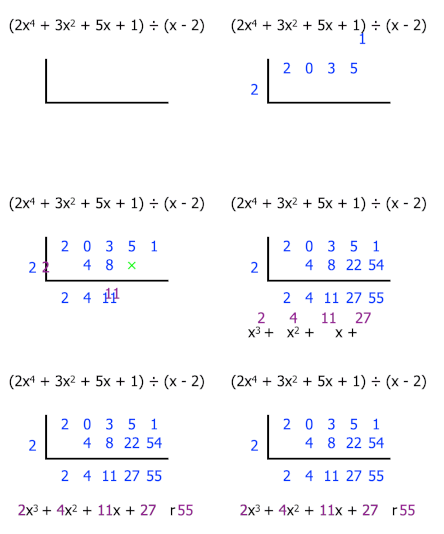
Can i use synthetic division to divide a x²-1 coefficient?
swift sparrow
Or do i need to use long division?
tired walrus
i think you're using the word "coefficient" wrong but no, you should use long division
iirc there is a trick to extend synthetic division to when the divisor isn't linear but it isn't pretty
 cyan kayak
did you mean divisor (the typically smaller value to the left of the long division) or dividend (the typically larger value to the right of the long division)
if you have it written with the / or similar sign, the dividend is the one of the left and the divisor is the one on the right, though
$$\frac{\text{dividend}}{\text{divisor}}$$
soft zealotBOT
OmnipotentEntity
 cyan kayak
$\text{dividend} \div \text{divisor}$
swift sparrow
I meant divisor
soft zealotBOT
OmnipotentEntity

 barren hound
swift sparrow
Can i use synthetic division to divide a x²-1 coefficient?
barren hound
swift sparrow
Can i use synthetic division to divide a x²-1 coefficient?
there's a way to do synthetic division with nonlinear divisors but it's going to be way easier in this case to divide by x+1 then divide by x-1
cyan kayak
or just use long division
barren hound
they probably want you to divide by x+1 and then x-1
swift sparrow
How do i make it so that i can use it to divide the divident?
swift sparrow
barren hound
they probably want you to divide by x+1 and then x-1
How would that work
With x²-1
barren hound
well.... (x+1)(x-1) is equal to x²-1
so if you want to divide by x²-1 then you can divide by (x+1)(x-1) instead
what are you trying to divide?
barren hound
there is a way to do it with nonlinear divisors but it's a really weird thing
i'd recommend just doing it twice
swift sparrow
What does that mean
barren hound
x+1 is linear
x²-1 is nonlinear
swift sparrow
How do i do it then
barren hound
$\polyhornerscheme[x=1, stage=1]{3x^3 - 2x^2 + 6}$
swift sparrow
Can't i just make it into 0,1
soft zealotBOT
〈hay | ley〉
 swift sparrow
Uh
barren hound
do you recognise this setup?
barren hound
yes
barren hound
0,1?
swift sparrow
Yes
barren hound
i don't understand what you mean by that
 barren hound
so it seems you do know how to do this
swift sparrow
barren hound
so it seems you do know how to do this
No
I just found it right now
Isn't that what you meant before?
barren hound
yes, that is the "more difficult, not really worth it" method i alluded to earlier
but if you want, go ahead https://en.wikipedia.org/wiki/Synthetic_division#Expanded_synthetic_division
In algebra, synthetic division is a method for manually performing Euclidean division of polynomials, with less writing and fewer calculations than long division.
It is mostly taught for division by linear monic polynomials (known as Ruffini's rule), but the method can be generalized to division by any polynomial.
The advantages of synthetic div...
barren hound
sure
barren hound
yes, do you see where the 0, 1 came from?
swift sparrow
Yea
barren hound
then you should see where the -3, 2 came from
otherwise yes it's the exact same steps
barren hound
yep
final saddleBOT
Channel closed
Closed by @swift sparrow
Use .reopen if this was a mistake.
final saddleBOT
Available help channel!
Send your question here to claim the channel.
Remember:
• Ask your math question in a clear, concise manner.
• Show your work, and if possible, explain where you are stuck.
• After 15 minutes, feel free to ping <@&286206848099549185>.
• Type the command .close to free the channel when you're done.
• Be polite and have a nice day!
Read #❓how-to-get-help for further information on how to ask a good question, and about conduct in the question channels.
 rotund folio
what expression is equivalent to (5z^2+3z+2)^2
pls help 😭
night raft
rotund folio
what expression is equivalent to (5z^2+3z+2)^2
pls help 😭
do you know how to expand brackets?
(5z^2+3z+2)^2 = (5z^2+3z+2)(5z^2+3z+2)
terse crypt
rotund folio
what expression is equivalent to (5z^2+3z+2)^2
pls help 😭
Any choices?
 devout pasture
 final saddleBOT
@rotund folio Has your question been resolved?
final saddleBOT
Channel closed
Closed due to timeout
Use .reopen if this was a mistake.
Available help channel!
Send your question here to claim the channel.
Remember:
• Ask your math question in a clear, concise manner.
• Show your work, and if possible, explain where you are stuck.
• After 15 minutes, feel free to ping <@&286206848099549185>.
• Type the command .close to free the channel when you're done.
• Be polite and have a nice day!
Read #❓how-to-get-help for further information on how to ask a good question, and about conduct in the question channels.
 wet warren
for a positive integer N with M divisors, you are given 3 positive integers X, A, and B which are supposedly follow these rules
$$X = \sum_{i = 1}^M d_i$$
$$\frac{A}{B} = \sum_{i=1}^M \frac1{d_i}$$
$$\gcd(A,B) = 1$$
where $d_i$ is the $i$th divisor of N
if you are given the 3 positive integers X, A, and B, Can you get the positive integer N. Note that there might not be a Correct N that have the values of X, A, and B. i.e. They might be fake or wrong.
final saddleBOT
wet warren
for a positive integer N with M divisors, you are given 3 positive integers X, A...
soft zealotBOT
Sherif Player
 wet warren
I got to the conclusion that if the 3 positive integers X, A, and B are correct then
$$N = \frac{X \times B}{A}$$
soft zealotBOT
Sherif Player
 wet warren
but how do i know if they are correct numbers.
the only thing that came to my mind is that if X is not divisible by A then then there is no N
final saddleBOT
@wet warren Has your question been resolved?
final saddleBOT
Channel closed
Closed due to timeout
Use .reopen if this was a mistake.
Available help channel!
Send your question here to claim the channel.
Remember:
• Ask your math question in a clear, concise manner.
• Show your work, and if possible, explain where you are stuck.
• After 15 minutes, feel free to ping <@&286206848099549185>.
• Type the command .close to free the channel when you're done.
• Be polite and have a nice day!
Read #❓how-to-get-help for further information on how to ask a good question, and about conduct in the question channels.
 flint obsidian
Problem statement:
Let n be an even integer, and let π:{0,1,…,n/2 − 1}→{0,1,…,n/2 − 1} be an arbitrary permutation. For any indices 0≤i<j<k≤n/2 -1, let σ_i,σ_j,σ_k,τ_i,τ_j,τ_k ∈ {−1,1} be independent random signs.
Prove or disprove that when n > N_0, where N_0 is a finite integer, for any π, there must exist choices of i, j, k, σ_i,σ_j,σ_k,τ_i,τ_j,τ_k such that the equation holds true
Does anyone have idea what techniques could be applied to solve this problem? any general suggestions would be much appreiciated🙏 thanks in advance
 final saddleBOT
flint obsidian
Problem statement:
Let n be an even integer, and let π:{0,1,…,n/2 − 1}→{0,1,…,...
final saddleBOT
flint obsidian
Problem statement:
Let n be an even integer, and let π:{0,1,…,n/2 − 1}→{0,1,…,...
 wraith glen
 shadow marlin
hmmmm what did you try
flint obsidian
I wrote python code to check for small n , and from n>12 (forgot exact value), seems like the statement is true
My attempt was: since the a^2 term would grow very large when n is large, it is very likely to be 0 if the whole equation is 0. So I set the coefficient of a^2 in term D to 0 to reduce the degree of freedom for σ and τ
I wrote python code to check this hypothesis and seems like it works for n>18
Besides that I literally have no idea how to even tackle this problem (e.g. what techniques should I use)
final saddleBOT
@flint obsidian Has your question been resolved?
final saddleBOT
@flint obsidian Has your question been resolved?
flint obsidian
<@&286206848099549185> 🙏
flint obsidian
yeah it is just used for convention
 gusty ravine
shadow marlin
gusty ravine
shadow marlin
I was thinking
maybe we should rewrite this like $ A = \tau_i (\sigma_k (k- a) - \sigma_j (a-j))$
in a way, a-k has the same "distribution" as a
so maybe that simplifies
$ A = \tau_i (\sigma_k (k- a) - \sigma_j (a-j)) $
hmmmmmm
final saddleBOT
@flint obsidian Has your question been resolved?
final saddleBOT
Channel closed
Closed due to timeout
Use .reopen if this was a mistake.
Available help channel!
Send your question here to claim the channel.
Remember:
• Ask your math question in a clear, concise manner.
• Show your work, and if possible, explain where you are stuck.
• After 15 minutes, feel free to ping <@&286206848099549185>.
• Type the command .close to free the channel when you're done.
• Be polite and have a nice day!
Read #❓how-to-get-help for further information on how to ask a good question, and about conduct in the question channels.
 mystic quartz
"Show that for all sets A, and the empty set $\varnothing$, that $\varnothing \subseteq A$"
soft zealotBOT
Pen
 final saddleBOT
mystic quartz
"Show that for all sets A, and the empty set $\varnothing$, that $\varnothing \s...
mystic quartz
final saddleBOT
mystic quartz
"Show that for all sets A, and the empty set $\varnothing$, that $\varnothing \s...
mystic quartz
Is it correct of me to attempt to show it by noting that
mystic quartz
$A^c\capA = {x: x\in A^c$ $and A} = varnothing$
 rocky tusk
$A^c\cap A = {x: x\in A^c ,, \text{and},, A} = \varnothing$
soft zealotBOT
Pen
Compile Error! Click the  reaction for more information.
(You may edit your message to recompile.)
 mystic quartz
ah yes yours looks cleaner
tired walrus
rocky tusk
$A^c\cap A = \{x: x\in A^c \,\, \text{and}\,\, A\} = \varnothing$
\{ and \}
soft zealotBOT
knief
 mystic quartz
oops, yes you guys are right
but by noting this, then per definition of subset, the empty set must be a subset of A^c and A?
tired walrus
empty set is a subset of anything
mystic quartz
Yes, I'm tasked with proving it
rocky tusk
mystic quartz
but by noting this, then per definition of subset, the empty set must be a subs...
this is just not necessary
every element in the empty set is in A
satisfied vacuously
mystic quartz
What does vacuously mean?
rocky tusk
$A \subset B \iff \forall a, a \in A \implies a \in B$
soft zealotBOT
knief
 rocky tusk
mystic quartz
What does vacuously mean?
rocky tusk
mystic quartz
What does vacuously mean?
means the statement is true but the hypothesis is false (F —> T and F —> F) are true statements
mystic quartz
Oh okay, learnt something new
Why is the hypothesis false?
I might be missing something
rocky tusk
because the empty set has no elements
mystic quartz
Does not make the statement false though?
rocky tusk
like if i said every unicorn that farts glitter is an elf this would be a true statement
rocky tusk
mystic quartz
Does not make the statement false though?
no
an implication P —> Q is only false if P is true but Q if false
mystic quartz
rocky tusk
like if i said every unicorn that farts glitter is an elf this would be a true s...
The unicorns belonging to something and being something are not the same, no?
mystic quartz
rocky tusk
an implication P —> Q is only false if P is true but Q if false
Yes
rocky tusk
mystic quartz
The unicorns belonging to something and being something are not the same, no?
i didn’t know you believed in unicorns
mystic quartz
Ah, I am probably in the wrong but need to take a step back
mystic quartz
rocky tusk
i didn’t know you believed in unicorns
Since when did maths care for whether something is real?
Although, I do sometimes wish that unicorns were real
rocky tusk
it doesn’t
mystic quartz
Either way, I'm probably in the wrong, I'll take a step back and take in the new information
Thank you for the help though ❤️
rocky tusk
mystic quartz
Since when did maths care for whether something is real?
it’s the fact that there are no unicorns which makes the hypothesis false. it’s equivalent to saying if U is the set of unicorns who fart glitter and E is the set of elves then U is a subset of E because every unicorn that farts glitter is an elf
there are no unicorns that fart glitter
so it’s true
 swift tapir
mystic quartz
Either way, I'm probably in the wrong, I'll take a step back and take in the new...
swift tapir
mystic quartz
Either way, I'm probably in the wrong, I'll take a step back and take in the new...
@mystic quartz has your question been resolved?
final saddleBOT
@mystic quartz Has your question been resolved?
final saddleBOT
Channel closed
Closed due to timeout
Use .reopen if this was a mistake.
Available help channel!
Send your question here to claim the channel.
Remember:
• Ask your math question in a clear, concise manner.
• Show your work, and if possible, explain where you are stuck.
• After 15 minutes, feel free to ping <@&286206848099549185>.
• Type the command .close to free the channel when you're done.
• Be polite and have a nice day!
Read #❓how-to-get-help for further information on how to ask a good question, and about conduct in the question channels.
 past cargo
I can't provide a question but,
how dafuq am I meant to know which trig identity to use when proving one side is equal to another. What the fuck is this. Sec^2 can be 1+tan^2 and it can be 1/cos^2. Is it just a game of guessing
final saddleBOT
past cargo
I can't provide a question but,
how dafuq am I meant to know which trig identi...
 vivid walrus
I'd suggest starting from the complicated side
night raft
past cargo
I can't provide a question but,
how dafuq am I meant to know which trig identi...
Just takes a lot of practice recognising them
vivid walrus
also when using pythagorean identities can let u done the most of the work
past cargo
So it's basically guessing
vivid walrus
not really
past cargo
night raft
Just takes a lot of practice recognising them
Ah, man dont say i gotta memorise how to use those rules
night raft
night raft
Just takes a lot of practice recognising them
A tip you can do though is that you can work backwards, usually they give you an identity to prove, let's say in the RHS. You can mainpulate the expression of the RHS to get some inspiration
 latent dragon
past cargo
Ah, man dont say i gotta memorise how to use those rules
latent dragon
past cargo
Ah, man dont say i gotta memorise how to use those rules
…you do 
night raft
past cargo
Ah, man dont say i gotta memorise how to use those rules
You can learn how to derive them
the trig identites
well for 1 + tan^2 = sec^2 just comes from manipulating cos^2 + sin^2 = 1
(but yeah generally memorising them is quicker to apply, but you should learn how to derive them so you can understand it)
past cargo
Yh I saw the vid on that, so would you just recommend doing more and more questions
night raft
past cargo
Yh I saw the vid on that, so would you just recommend doing more and more questi...
yeah unfortunately it's just a lot of practice
it's mainly pattern recogniton
night raft
past cargo
A levels is a pain man
oh you're doing a levels?
past cargo
.close
final saddleBOT
Channel closed
Closed by @past cargo
Use .reopen if this was a mistake.
past cargo
night raft
oh you're doing a levels?
Yh
night raft
past cargo
Yh
further maths as well I assume? Also, good luck with them
rotund folio
final saddle
<@981758142088097802> Has your question been resolved?
yes thank you
past cargo
night raft
further maths as well I assume? Also, good luck with them
Nah fuck futhermath, no way in doing that, basically I didn't take the first year seerious so now im locked in, doing physics and cs alongside math
.close
vivid walrus
its already closed
final saddleBOT
Available help channel!
Send your question here to claim the channel.
Remember:
• Ask your math question in a clear, concise manner.
• Show your work, and if possible, explain where you are stuck.
• After 15 minutes, feel free to ping <@&286206848099549185>.
• Type the command .close to free the channel when you're done.
• Be polite and have a nice day!
Read #❓how-to-get-help for further information on how to ask a good question, and about conduct in the question channels.
Channel closed
Closed by @fluid salmon
Use .reopen if this was a mistake.
final saddleBOT
Available help channel!
Send your question here to claim the channel.
Remember:
• Ask your math question in a clear, concise manner.
• Show your work, and if possible, explain where you are stuck.
• After 15 minutes, feel free to ping <@&286206848099549185>.
• Type the command .close to free the channel when you're done.
• Be polite and have a nice day!
Read #❓how-to-get-help for further information on how to ask a good question, and about conduct in the question channels.
 topaz jetty
How do i even start doing gauss elimination
 final saddleBOT
topaz jetty
How do i even start doing gauss elimination
topaz jetty
final saddleBOT
topaz jetty
How do i even start doing gauss elimination
topaz jetty
@sterile condor
 flat seal
Isn't it already in row echelon form
night raft
topaz jetty
<@882316761268113418>
!noping
final saddleBOT
topaz jetty
<@882316761268113418>
Please do not ping individual helpers unprompted.
topaz jetty
flat seal
Isn't it already in row echelon form
 topaz jetty
final saddle
Please do not ping individual helpers unprompted.
topaz jetty
final saddle
Please do not ping individual helpers unprompted.
Oh ok sorry
I guess its time to try a.i
 raven marsh
topaz jetty
I guess its time to try a.i
raven marsh
topaz jetty
I guess its time to try a.i
!nogpt
final saddleBOT
topaz jetty
I guess its time to try a.i
Please do not trust ChatGPT or similar AI tools for mathematical tasks, as they often generate output which "sounds correct" but has numerous factual or logical errors. Use of these AI tools to answer other people's help questions is strictly against server rules (see #rules).
 storm crater
bro you guys are just bullying the kid with factoids now

 static trail
the best way to start is at the simpelest row, in this case the last one
0 0 -4 | 20
you want the first number to be 1, so you should divide the whole row by the same number to make it one, so -4
the row becomes 0 0 1 | -5
storm crater
No sighting of may, she really disappeared
static trail
the other rows stay unchanged during that step
topaz jetty
raven marsh
!nogpt
Ohh ok
topaz jetty
static trail
the other rows stay unchanged during that step
Thks
static trail
now that you have the correct value for z (-5), you can add or subtract this row from the others to eliminate the z factor from the other rows, getting 0 in the third column
this should result in the second row becoming 0 6 0 | 6
and you can do the same thing, make the y factor 1 by dividing the whole row by the same number and add/subtract to get 0's in all the other spots in the second column, resulting in the top row also reducing to the same form, then reduce x to factor 1 too
best thing to avoid mistakes is write down every step carefully
topaz jetty
static trail
best thing to avoid mistakes is write down every step carefully
Thanks gonna close the channel
.close
final saddleBOT
Channel closed
Closed by @topaz jetty
Use .reopen if this was a mistake.
Available help channel!
Send your question here to claim the channel.
Remember:
• Ask your math question in a clear, concise manner.
• Show your work, and if possible, explain where you are stuck.
• After 15 minutes, feel free to ping <@&286206848099549185>.
• Type the command .close to free the channel when you're done.
• Be polite and have a nice day!
Read #❓how-to-get-help for further information on how to ask a good question, and about conduct in the question channels.
 sterile condor
storm crater
No sighting of may, she really disappeared
sterile condor
storm crater
No sighting of may, she really disappeared
I tried to do in my phone notes cause I’m not home 😭
final saddleBOT
sterile condor
I tried to do in my phone notes cause I’m not home 😭
sterile condor
 sterile condor
Kill me
storm crater
.close
sterile condor
.close
final saddleBOT
Channel closed
Closed by @sterile condor
Use .reopen if this was a mistake.
 dense coral

raven marsh

night raft

final saddleBOT
Available help channel!
Send your question here to claim the channel.
Remember:
• Ask your math question in a clear, concise manner.
• Show your work, and if possible, explain where you are stuck.
• After 15 minutes, feel free to ping <@&286206848099549185>.
• Type the command .close to free the channel when you're done.
• Be polite and have a nice day!
Read #❓how-to-get-help for further information on how to ask a good question, and about conduct in the question channels.
 silk fjord
So, a shop has a function to generate a random percentage [0, 1] given 1. the user ID, 2. the item ID, 3. the current hour
I have access to all three of those, so I can easily predict future/past percentages.
Then comes price calculation:
Each item has a basePrice, minPercent, and a maxPercent
random is the current random percentage
Then minPrice is floor(basePrice * minPercent)
maxPrice = ceil(basePrice * maxPercent)
percentRange = maxPercent - minPercent
randomPercent = minPercent + (random * percentRange)
priceMultiplier = randomPercent
randomizedPrice = round(basePrice * priceMultiplier
clampedPrice = max(minPrice, min(maxPrice, randomizedPrice))
Sadly, I do not have access to the basePrice, minPercent, and a maxPercent values.
However, I have begun collecting data.
I now have percent-price pairs.
I realize one way to find basePrice would be to just average all recorded prices. But can't we take into account the percentage too somehow?
And how do I even go about calculating min/max percents?
I feel like this is super easy but my brain is just not working well as the moment.
final saddleBOT
silk fjord
So, a shop has a function to generate a random percentage [0, 1] given 1. the us...
silk fjord
LaTeX version
 final saddleBOT
@silk fjord Has your question been resolved?
 umbral hamlet
wait so it isnt really random right, this is a dynamical system?
unless r isnt the previous percentage
oh wait i totally misread this sorry
okay lets maybe ignore the clamping and rounding for now, then p final is sort of just
pbase * (pmin + r * Rp) = pbase * pmin + pbase * r * Rp
we could do a linear regression of Pfinal against r to get pbase * pmin and pbase * Rp
i dont fully follow the averaging logic, but if we can average to get pbase then that gives us estimates for all of our parameters
swift tapir
What exactly are we trying to calculate?
umbral hamlet
oh thats a good point i thought we were just trying to get all of the missing parameters
silk fjord
That's exactly it, the missing parameters
what is linear regression exactly? I've heard of that before but never used it
silk fjord
silk fjord
That's exactly it, the missing parameters
actually I guess I want the min/max prices, but those are calculated from the parameters so
umbral hamlet
it's basically a line of best fit, you fit a line to a set of data that minimizes the errors between the line predictions and the observed data
in simple linear regression there's a y-intercept and a slope, and performing the regression gives us estimates for those two values, which we can fit lots of models to through rearrangement
silk fjord
oh, so I just graph points of (r, P_final)? and then apply regression? i have a function for this on my calc
umbral hamlet
that was my first thought at least
silk fjord
but then from there how do i find the other info?
umbral hamlet
well there's some caveats here in general 😭
assuming all of the data actually follows this relationship
pfinal = pbase * pmin + pbase * r * Rp
then the y intercept is just pbase * pmin and the slope is just pbase * Rp
but the first issue is that we have 2 equations and 3 variables
pbase, pmin, and Rp, with only 2 values calculated
so we somehow need to extract a third value from the data first to determine our estimates
the other issue is that
pfinal = pbase * pmin + pbase * r * Rp
isnt the actual relationship
we clip the final price, and there's lots of rounding in between (although I think it's okay to ignore the intermediary rounding steps)
but clipping can be a lot more significant
however, the clipped bounds are basically fixed in place
since our parameters dont change presumably, so neither does Pmin or Pmax
so in theory we can just look at our dataset and see if there's any repeated minimum or maximum values
those are most likely gonna be the Pmin and Pmax values
umbral hamlet
oh 😭
umbral hamlet
so you have to estimate all 3 things only off of 3 datapoints?
umbral hamlet
hmm
i think more data would be significantly helpful here but i dont know if theres a downside for you to wait
you can still make intermediary estimates
silk fjord
the only downside would be there is a good deal that i miss out on
umbral hamlet
but they will be extremely high variance
silk fjord
alright, so i think i can prob actually do manual analysis here
i think i just need more data
i do have plenty of time
umbral hamlet
yeah and you can have an ongoing model that incorporates more data and improves its guesses iteratively
silk fjord
for context here is my existing "random" calculations

i think its random enough that waiting wont make me miss out too bad on a deal
umbral hamlet
hmm yeah that does look pretty random
this kind of looks like a good time series domain problem
but i think i need more context for the data
specifically where do u get r from
if r comes from previous time steps, an autoregressive model might be good here
but if r is unpredictable then that wouldn't work
silk fjord
/**
 * Create a high-quality deterministic random number based on user ID, item ID, and hour
 * Uses SHA256 for a high-quality hash (evenly-distributed and has the avalanche effect)
 */
function createHourlyRandom(userId: string, itemId: string, hour: number): number {
  // Create a combined seed string
  const combined = `${userId}-${itemId}-${hour}`;

  // Use SHA256 for a high-quality hash
  // We could use crypto.subtle.digest without importing Node.js 'crypto', but that's async
  const hash = createHash('sha256').update(combined).digest('hex');

  // Convert the first 8 characters of the hash (32 bits) to a number between 0 and 1
  const subHash = hash.substring(0, 8);
  const intHash = parseInt(subHash, 16);
  return intHash / 0xffffffff;
}
this is how r is calculated
sorry if you dont understand code
it uses hashing
umbral hamlet
okay cool so its fully random each day, the price each day is independent of the price any other day?
silk fjord
yeah
to clarify, hour is the number of hours since unix timestamp
its not like 0-23
umbral hamlet
right thats fine
to be honest the data looks bounded enough that you can probably estimate pmax and pmin using the sample min and max
if you can make good estimates for Pmin and Pmax that way, then you have closer estimates to Pbase * pmin and Pbase * pmax
silk fjord
silk fjord
for context here is my existing "random" calculations
wait wait just to clarify this is a graph of r, it does not take into account price & bounds & whatnot
umbral hamlet
oh LOL
oh but yeah of course r is gonna be unpredictable, anything we do would be dependent on knowing r at a given time step
umbral hamlet
umbral hamlet
if you can make good estimates for Pmin and Pmax that way, then you have closer ...
but yeah it makes this method less reliable for the time being
silk fjord
well r is always predicable, since i can manually increase the hour count
its just the final price that isnt
as that needs the 3 params
as a side effect i can currently only calculate if it will be cheap or expensive, not how much it will actually cost
umbral hamlet
right but you're sampling r randomly each time step arent you
using an approximately identical distribution
silk fjord
i dont really know lol
but like if the hour number is the same you can run the function infinite times and it will always be the same
im not sure what this vocab means
umbral hamlet
right of course but we're assuming enough entropy is added to the system by the hashing algorithm
umbral hamlet
that makes sense LOL
okay i guess that's basically the algorithm i have in mind
take the sample min and max price for an item, these are estimates for pbase * pmin and pbase * pmax respectively
regress price over r across all data for an item, use the coefficients to estimate pbase * pmin and pbase * r * (pmax - pmin)
this overdetermines the 3 values, so from there you would have to decide which estimates are more valuable or reliable
ideally over time, the min and max price become way more obvious, giving you more reliable data for those, and you can then try to regress specifically on the data that isn't really close to/concentrated around the min and max, and use those coefficients to give you the third statistic needed to estimate all 3 values
theres definitely more than one way to go about this though
and you can probably look for other strategies too
silk fjord
whats "the sample min and max price for an item"? just like the lowest/highest values i currently have in my data?
umbral hamlet
silk fjord
actually I guess I want the min/max prices, but those are calculated from the pa...
oh but if you really only care about the min and max price, the sample min and max will anyway approach those with enough data
umbral hamlet
silk fjord
whats "the sample min and max price for an item"? just like the lowest/highest v...
yup
silk fjord
ah ok
umbral hamlet
okay actually if you only care about those values, the regression method is a lot more valuable
you get estimates for Pmin and Pmax - Pmin from the intercept and slope immediately
this method is just poor once you get more clipped datapoints, but by then you know exactly what the actual min and max should be
thats bc Pmin = pbase * pmin and Pmax = pbase * pmax, and the y-intercept of the regression is pbase * pmin while the slope of the regression is pbase * Rp = pbase * (pmax - pmin) = Pmax - Pmin
silk fjord

 silk fjord
umbral hamlet
this method is just poor once you get more clipped datapoints, but by then you k...
silk fjord
umbral hamlet
this method is just poor once you get more clipped datapoints, but by then you k...
yeah that makes sense
so this is an example
i have two small datapoints and one large one
umbral hamlet
right okay
so here we would estimate Pmax - Pmin as 187.2941, and Pmin as 1871.228
is that... reasonable, these seem high LOL but idk the data context
silk fjord
its not USD lol
umbral hamlet
ahh ok
silk fjord
you get 16.18 units for each hour you spend computer programming
golden ratio * 10 i think
umbral hamlet
ooh ok
umbral hamlet
oo ok
silk fjord
anyways, i think you've helped a lot here, so thank you
i also think i overthought this lol, prob could've gotten away with manual analysis
but this regression stuff is super useful, so thank you for that
umbral hamlet
yaa ofc this was rlly interesting
final saddleBOT
Channel closed
Closed by @silk fjord
Use .reopen if this was a mistake.
final saddleBOT
Available help channel!
Send your question here to claim the channel.
Remember:
• Ask your math question in a clear, concise manner.
• Show your work, and if possible, explain where you are stuck.
• After 15 minutes, feel free to ping <@&286206848099549185>.
• Type the command .close to free the channel when you're done.
• Be polite and have a nice day!
Read #❓how-to-get-help for further information on how to ask a good question, and about conduct in the question channels.
 pale basin
I went into how they got the solution and it still doesn’t really make sense to me what does it mean by a translation along the directed like segment IF
 final saddleBOT
pale basin
I went into how they got the solution and it still doesn’t really make sense to ...
proper dagger
final saddleBOT
pale basin
I went into how they got the solution and it still doesn’t really make sense to ...
proper dagger
most likely they meant sliding either vertical line along IF
specifically, from I to F, i believe, since the statement says directed
pale basin
So it moves the line with JIK onto the line with fg?
proper dagger
yes
final saddleBOT
Channel closed
Closed by @pale basin
Use .reopen if this was a mistake.
final saddleBOT
Available help channel!
Send your question here to claim the channel.
Remember:
• Ask your math question in a clear, concise manner.
• Show your work, and if possible, explain where you are stuck.
• After 15 minutes, feel free to ping <@&286206848099549185>.
• Type the command .close to free the channel when you're done.
• Be polite and have a nice day!
Read #❓how-to-get-help for further information on how to ask a good question, and about conduct in the question channels.
 dusty jay
 dusty jay
what do i do
proper dagger
sounds like pigeonhole principle
dusty jay
how do i apply
dusty jay
but how do i know which numbers
proper dagger
the sequence is given to you
proper dagger
dusty jay
first, from the listed numbers, there is already one such pair
can you find it?
dusty jay
100 and 4
proper dagger
good
now just raise the lower number by 3 and drop the upper number by 3
since the numbers all differ by 3 anyway
proper dagger
make sure you don't include duplicate pairs though
proper dagger
and when constructing the proof, a reminder that two of the numbers don't have a pair/partner
dusty jay
wait what
proper dagger
yeah. one of them is obvious and currently staring at your face from the paper
the other one you will find out once you start constructing your pairs and realize you need distinct numbers
dusty jay
wdym by dont have a pair
proper dagger
within the sequence, its partner does not exist
proper dagger
that's one of the numbers
dusty jay
what do i overall need to show to get the marks for the proof
proper dagger
you need to show that even in the worst case scenario, picking 19 numbers from the list will guarantee you at least one pair that sums to 104
for that, you need to find out what those pairs are
after you have done that, you should find a couple of numbers that don't have a partner to sum to 104
i think i've given enough hints already
dusty jay
proper dagger
for that, you need to find out what those pairs are
all of them?
proper dagger
all of them.
dusty jay
proper dagger
i think i've given enough hints already
yeah youve been very helpful thank you
proper dagger
nps
final saddleBOT
Channel closed
Closed by @dusty jay
Use .reopen if this was a mistake.
terse crypt
hi :D
 thorn pasture
terse crypt
hi \:D
thorn pasture
terse crypt
hi \:D
Hey
terse crypt
Hey
final saddleBOT
Available help channel!
Send your question here to claim the channel.
Remember:
• Ask your math question in a clear, concise manner.
• Show your work, and if possible, explain where you are stuck.
• After 15 minutes, feel free to ping <@&286206848099549185>.
• Type the command .close to free the channel when you're done.
• Be polite and have a nice day!
Read #❓how-to-get-help for further information on how to ask a good question, and about conduct in the question channels.
 potent cobalt
How to solve a simulations linear equation graphically?
tired walrus
graph the lines representing each equation and look for their intersection.
potent cobalt
tired walrus
graph the lines representing each equation and look for their intersection.
Is it also called coordinate geometry?
@tired walrus
tired walrus
suppose so, though "coordinate geometry" is broader...
why ping me twice in a row when im already here and typing though
final saddleBOT
Channel closed
Closed by @potent cobalt
Use .reopen if this was a mistake.
final saddleBOT
Available help channel!
Send your question here to claim the channel.
Remember:
• Ask your math question in a clear, concise manner.
• Show your work, and if possible, explain where you are stuck.
• After 15 minutes, feel free to ping <@&286206848099549185>.
• Type the command .close to free the channel when you're done.
• Be polite and have a nice day!
Read #❓how-to-get-help for further information on how to ask a good question, and about conduct in the question channels.
 steel shore
im not too sure on this question... i got 29400 and so did AI but the book keeps saying its 11 200 instead :(.
 final saddleBOT
steel shore
im not too sure on this question... i got 29400 and so did AI but the book keeps...
steel shore
final saddleBOT
steel shore
im not too sure on this question... i got 29400 and so did AI but the book keeps...
steel shore
my working is (6C2 x 8C2 x 5C1 x 14C1) ( i think so anyway off the top of my head)
(written in calculator formatting whenr 6C2 is just nCr (n choose r))
 vital surge
the book is correct
vital surge
steel shore
my working is (6C2 x 8C2 x 5C1 x 14C1) ( i think so anyway off the top of my hea...
you cannot simply multiply by 14C1 to introduce the last subject
this imposes an ordering of (5 subjects first) + (1 subject later), which you do not want
proper dagger
i think that you can break this into three cases
vital surge
well ideally they would figure that out on their own
proper dagger
fair
vital surge
knowing why their answer is wrong is enough
steel shore
vital surge
this imposes an ordering of (5 subjects first) + (1 subject later), which you do...
why is the ordering of ^^^ wrong?
would that not still give the subject their 6 subjects and fit the requirements?
tired walrus
steel shore
im not too sure on this question... i got 29400 and so did AI but the book keeps...
!nogpt
final saddleBOT
steel shore
im not too sure on this question... i got 29400 and so did AI but the book keeps...
Please do not trust ChatGPT or similar AI tools for mathematical tasks, as they often generate output which "sounds correct" but has numerous factual or logical errors. Use of these AI tools to answer other people's help questions is strictly against server rules (see #rules).
tired walrus
steel shore
would that not still give the subject their 6 subjects and fit the requirements?
no bc then you introduce unnecessary distinctions
like let's say the subjects are A1, ..., A6, B1, ..., B8 and C1, ..., C5
your count distinguishes the following subject lists:
A1 A2 B1 B2 C1 + A4
A1 A4 B1 B2 C1 + A2
even tho they are the same
so you overcount
and worse, you don't even overcount by a fixed factor that you could correct for
steel shore
ohhh so would it be more like this ? ( 6C3 x8C2 x 5C1 + 6C2 x 8C3....) so i just get the three options of an increased subject and add them together??
ahh thank you!
.close
final saddleBOT
Channel closed
Closed by @steel shore
Use .reopen if this was a mistake.
final saddleBOT
Available help channel!
Send your question here to claim the channel.
Remember:
• Ask your math question in a clear, concise manner.
• Show your work, and if possible, explain where you are stuck.
• After 15 minutes, feel free to ping <@&286206848099549185>.
• Type the command .close to free the channel when you're done.
• Be polite and have a nice day!
Read #❓how-to-get-help for further information on how to ask a good question, and about conduct in the question channels.
topaz jetty
Is ts correct?
 final saddleBOT
topaz jetty
Is ts correct?
final saddleBOT
topaz jetty
Is ts correct?
 dapper hull
topaz jetty
Is ts correct?
dapper hull
topaz jetty
Is ts correct?
!xy
final saddleBOT
topaz jetty
Is ts correct?
Please show the original problem, exactly as it was stated to you, with the entire original context. A picture or screenshot is best. If the original problem is not in English, then post it anyway! The additional context might still be helpful. Do your best to provide a translation.
topaz jetty
final saddle
Please show the original problem, **exactly as it was stated to you**, with the ...
Prove that ln9=2ln3
dapper hull
then yes it looks true (if you meant 3^2 instead of 3^3) unless there is some way out of the blue without using log properties
topaz jetty
dapper hull
then yes it looks true (if you meant 3^2 instead of 3^3) unless there is some wa...
I dont think so,but thanks
.close
final saddleBOT
Channel closed
Closed by @topaz jetty
Use .reopen if this was a mistake.
 shadow urchin
lol
dapper hull
topaz jetty
Is ts correct?
now that i see it, it should be ln3 + ln3 not ln3 . ln3
 ivory bear
if a quantity's differential is zero, then that quantity is a constant? or can it be zero too? (i learnt that it is zero as well as a constant of some sort, if it is wrong elaborate further by your opinions)
ivory bear
ivory bear
if a quantity's differential is zero, then that quantity is a constant? or can i...
<@&286206848099549185>
dapper hull
ivory bear
if a quantity's differential is zero, then that quantity is a constant? or can i...
it is not "open" yet
go to another room
ivory bear
dapper hull
it is not "open" yet
oh mb mate
dapper hull
it's ok
final saddleBOT
Available help channel!
Send your question here to claim the channel.
Remember:
• Ask your math question in a clear, concise manner.
• Show your work, and if possible, explain where you are stuck.
• After 15 minutes, feel free to ping <@&286206848099549185>.
• Type the command .close to free the channel when you're done.
• Be polite and have a nice day!
Read #❓how-to-get-help for further information on how to ask a good question, and about conduct in the question channels.
 zenith cedar
Let ℓ1 and ℓ2 be two parallel lines, a distance of 15 apart. Points A and B lie on ℓ1 while
points C and D lie on ℓ2 such that ∠BAC = 30◦ and ∠ABD = 60◦. The minimum value of AD+BC
is a√b, where a and b are integers and b is square-free. Find a+b.
final saddleBOT
zenith cedar
Let ℓ1 and ℓ2 be two parallel lines, a distance of 15 apart. Points A and B lie ...
zenith cedar
the minimum distance point comes out to be when C and D coincide
but that isnt representable in the form a rootb
 opal plinth
Diagram please
zenith cedar
i will need to draw it
tired walrus
then draw it
tired walrus
why can't you send the image
zenith cedar
nevermind i found my error
i didnt consider the case where the point of intersection was between the lines

 open shore
How do you do the q though
zenith cedar
i am planning to use coordinate geometry for that

something like this
it is hard to write here
is there a better way to do this
final saddleBOT
@zenith cedar Has your question been resolved?
 thin cloud
I think we can write the area of trapezoid in term of AB and DC in two way
thin cloud
thin cloud
I think we can write the area of trapezoid in term of AB and DC in two way
have you tried this?
thin cloud
A=1/2.h.(AB+DC)
also
oh wait
I should write it like this
$A_{ABCD}=A_{ABC}+A_{ADC}$
soft zealotBOT
Alexis_Fx
 thin cloud
sorry we usually use S to represent area in my country
zenith cedar
soft zealot
**Alexis\_Fx**
but with this wont i be minimizing ab and cd
zenith cedar
zenith cedar
but then this would be faster i guess
i guess it is solved then
thanks for the help
.solved
final saddleBOT
Channel closed
Closed by @zenith cedar
Use .reopen if this was a mistake.
 brittle breach
final saddleBOT
Available help channel!
brittle breach
final saddleBOT
Available help channel!
Send your question here to claim the channel.
Remember:
• Ask your math question in a clear, concise manner.
• Show your work, and if possible, explain where you are stuck.
• After 15 minutes, feel free to ping <@&286206848099549185>.
• Type the command .close to free the channel when you're done.
• Be polite and have a nice day!
Read #❓how-to-get-help for further information on how to ask a good question, and about conduct in the question channels.
 solar crest
how do i do this
 final saddleBOT
solar crest
how do i do this
solar crest
final saddleBOT
solar crest
how do i do this
solar crest
whats the antideriv of cos(m^2)???
tired walrus
not expressible in elementary functions
solar crest
i gotta solvw usimg fundamental calc theorem
tired walrus
what does it ask to do?
solar crest
find derivative
tired walrus
solar crest
find derivative
then you dont need to know the antiderivative of cos(m^2).
solar crest
tired walrus
then you dont need to know the antiderivative of cos(m^2).
what
tired walrus
can you tell me what the FTC says
solar crest
tired walrus
can you tell me what the FTC says
like
how do i ty[e the
integral symbol
latent dragon
$\int$
soft zealotBOT
𝙸𝚗𝚏𝚒𝚗𝚒𝚞𝚖³
 latent dragon
or you can copy and paste this ∫
solar crest
if f(x) is continupus then the derivative of the inregral of a to x f(t)d(t) = f(x)
$\int$
soft zealotBOT
cat
 solar crest
how exactly do i prove that tho
tired walrus
you're not supposed to prove it
you're supposed to apply it
$\dv{x} \int_a^x f(t) \dd{t} = f(x)$.
soft zealotBOT
Ann
 tired walrus
note that applying this formula does not require you to know what the integral of f(t) dt is
do you understand that
tired walrus
apply == use
solar crest
so i jusr
solar crest
then how
tired walrus
and also note that your integral is the wrong way around.
$y = \int_x^5 \cos(m^2) \dd{m}$ --- the $x$ is in the bottom and not in the top.
soft zealotBOT
Ann
 tired walrus
do you know how to fix that or is that giving you difficulty
solar crest
huh
solar crest
tired walrus
and also note that your integral is the wrong way around.


it's on the bottom
solar crest
tired walrus
do you know how to fix that or is that giving you difficulty
wdym by fix
tired walrus
... yknow, it's a little bit unsettling how you keep asking me about the meanings of rather basic/common words. it's throwing me a bit off balance trying to help you.
ok then let me be blunt:
$\int_b^a f(x) \dd{x} = -\int_a^b f(x) \dd{x}$. know? not know?
soft zealotBOT
Ann
 solar crest
oh
does x have to be at the top
i have a very poor understanding so far
it's confusing
tired walrus
solar crest
does x have to be at the top
yes, for FTC x does have to be on the top.
solar crest
tired walrus
$y = \int_x^5 \cos(m^2) \dd{m}$ --- the $x$ is in the bottom and not in the top.
can i say flip
 drowsy plover
I’m like 50 percent confident that you can “flip” the top and bottom by putting a negative in front
Let me check
Yeah you can
$\int_{a}^{b} f(x) dx = - \int_{b}^{a} f(x) dx$
soft zealotBOT
Chungus Kahn
 final saddleBOT
@solar crest Has your question been resolved?
solar crest
drowsy plover
I’m like 50 percent confident that you can “flip” the top and bottom by putting ...
yea thanks
idk what happens next tho
like
cuz i thought the thoerem is given so i csn jst do the question in 2 lines or smth
like this
 final saddleBOT
@solar crest Has your question been resolved?
final saddleBOT
Channel closed
Closed due to timeout
Use .reopen if this was a mistake.
Available help channel!
Send your question here to claim the channel.
Remember:
• Ask your math question in a clear, concise manner.
• Show your work, and if possible, explain where you are stuck.
• After 15 minutes, feel free to ping <@&286206848099549185>.
• Type the command .close to free the channel when you're done.
• Be polite and have a nice day!
Read #❓how-to-get-help for further information on how to ask a good question, and about conduct in the question channels.
 coral wedge
How do u know if these are inverses only using these 2 compositions?
 coral wedge
ik I can just do fog and gof, but how do use only those?
tired walrus
if f and g were inverses, what would f o g simplify down to?
tired walrus
what's that =0 doing there
coral wedge
tired walrus
what's that `=0` doing there
Proving they’re inverses?
tired walrus
no i think you're misremembering something
to say $f$ and $g$ are inverses is to say that $f(g(x)) = x$
soft zealotBOT
Ann
 tired walrus
no zeroes in sight
tired walrus
you would expect f(g(7)) = 7 to be true
no you're thinking in the wrong direction again
f(g(x)) = x should be true for ALL x.
is it true in your two cases that you worked out?
yes or no.
coral wedge
tired walrus
"not -1/2" is weird
so because f(g(4)=7 and g(f(-2))=-1/2 it’s not inverse?
final saddleBOT
Channel closed
Closed by @coral wedge
Use .reopen if this was a mistake.
final saddleBOT
Available help channel!
Send your question here to claim the channel.
Remember:
• Ask your math question in a clear, concise manner.
• Show your work, and if possible, explain where you are stuck.
• After 15 minutes, feel free to ping <@&286206848099549185>.
• Type the command .close to free the channel when you're done.
• Be polite and have a nice day!
Read #❓how-to-get-help for further information on how to ask a good question, and about conduct in the question channels.
 graceful mortar
I'm just struggling to figure out and wrap my head around polar curve intersections. I've been trying to use an example I came up with where it's r = theta and r = 2theta. So far I've figured out they intersect at the pole but when I try to solve for other possible intersections I get stumped. Eg. solving for theta = 2(theta + 2kpi) which gives theta = -4kpi, but how would I know that k has to be negative? (I graphed it in desmos to check)
final saddleBOT
graceful mortar
I'm just struggling to figure out and wrap my head around polar curve intersecti...
 serene junco
ok so basically the reason you end up with k being negative is because youre looking for the same point in polar coords and that means you can add multiples of 2pi to the angle but when you solve theta = 2(theta + 2kpi) you get theta = -4kpi so for that to be positive theta youd need k negative otherwise theta comes out negative or zero and it just puts you back at the pole so the only extra intersections happen when you wrap backwards around the circle which is why k has to be negative
graceful mortar
I see, I think that kinda makes sense. I also just realized desmos doesn't completely graph in polar coordinates but only in linear so oopsie
 prime kiln
Hii
serene junco
graceful mortar
I see, I think that kinda makes sense. I also just realized desmos doesn't compl...
ye
graceful mortar
So if I solved for the intersections then it would be (0,0), and (-4kpi,-4kpi), and then (-4kpi-2pi/3, -4kpi-2pi/3)?
serene junco
nice work thinking through it but your listed points arent quite right
theres two ways two polar points can match
same angle and same r
or angles differ by pi and the r values are negatives of each other
for r = theta and r = 2 theta do the algebra both ways
same angle case
set theta1 = theta2 + 2pi n and theta1 = 2 theta2
solve gives theta = 4 pi n
that yields theta values 0 4 pi 8 pi etc which reduce mod 2pi to 0 so the only distinct point in one full rotation from this family is the pole
opposite direction case
set theta1 = theta2 + (2n+1) pi and theta1 = - 2 theta2
solve gives 3 theta1 = 2 (2n+1) pi so theta1 = 2 pi (2n+1) / 3
choose n to get angles in 0 to 2 pi and you get theta = 2pi/3 and theta = 4pi/3
those give r = theta so the two nonzero intersection points in one rotation are at r = 2pi/3 angle = 2pi/3 and r = 4pi/3 angle = 4pi/3
so the distinct intersections in the usual 0 to 2pi range are
the pole 0 0
and the points at 2pi/3 2pi/3 and 4pi/3 4pi/3
your expressions with -4kpi etc come from a different choice of integer sign but you can pick the n values above to produce the same meaningful angles
if you want i can show the algebra step by step with the substitution i used
graceful mortar
Okay okay, that makes sense
But if I was doing all values, including the ones over 2pi, would the same angle case start to apply?
serene junco
so the distinct intersections in like 0 to 2pi are
the pole 0 0
and the points at 2pi/3 2pi/3 and 4pi/3 4pi/3
the -4kpi stuff comes from picking a different sign for the integer n but you can just pick the n i used and get the same angles
if u want i can show the algebra step by step with the substitution i did so u can see why the opposite direction case gives the extra intersections
final saddleBOT
@graceful mortar Has your question been resolved?
Channel closed
Closed by @graceful mortar
Use .reopen if this was a mistake.
Available help channel!
Send your question here to claim the channel.
Remember:
• Ask your math question in a clear, concise manner.
• Show your work, and if possible, explain where you are stuck.
• After 15 minutes, feel free to ping <@&286206848099549185>.
• Type the command .close to free the channel when you're done.
• Be polite and have a nice day!
Read #❓how-to-get-help for further information on how to ask a good question, and about conduct in the question channels.
gentle zephyr
 final saddleBOT
gentle zephyr
gentle zephyr
final saddleBOT
gentle zephyr
gentle zephyr
can I get some help finishing this proof?
$(A - B) \cross C \subseteq (A \cross C) - (B \cross C) \$ Take $x = (x_1, x_2) \in (A - B) \cross C\$ Then $x_1 \in (A - B), x_2 \in C\$ Then, $x_1 \in (A \cap B^c) , x_2 \in C\$ Thus, $x_1 \in A, x_1 \notin B , x_2 \in C\$ It follows that $(x_1, x_2) \in (A \cross C)\$ Since $x_1 \notin B$ then $x \notin (B \cross C)$
soft zealotBOT
Renato
 gentle zephyr
like, x not being in (BxC) can be translated in human language as, (x1 NOT in B) OR (x2 NOT in C)
I am proving the left inclusion
 blissful meadow
Well x is in AxC by virtue of x1 being in A,
x is NOT in BxC by virtue of x1 not being in B.
gentle zephyr
blissful meadow
Well x is in AxC by virtue of x1 being in A,
x is NOT in BxC by virtue of x1 not...
correction, x is in AxC by virtue of x1 being in A and x2 being in C
gentle zephyr
blissful meadow
Well x is in AxC by virtue of x1 being in A,
x is NOT in BxC by virtue of x1 not...
x is NOT in BxC by virtue of x1 not being in B.
exactly, yeah
blissful meadow
Strictly speaking, yes. I didn't mention it since in any case x2 is in C.
gentle zephyr
blissful meadow
Strictly speaking, yes. I didn't mention it since in any case x2 is in C.
ok
I just thought you missed it, srry
blissful meadow
No worries, I should've been more specific.
gentle zephyr
$(A - B) \cross C \subseteq (A \cross C) - (B \cross C) \$ Take $x = (x_1, x_2) \in (A - B) \cross C\$ Then $x_1 \in (A - B), x_2 \in C\$ Then, $x_1 \in (A \cap B^c) , x_2 \in C\$ Thus, $x_1 \in A, x_1 \notin B , x_2 \in C\$ It follows that $(x_1, x_2) \in (A \cross C)\$ Since $x_1 \notin B$ then $x \notin (B \cross C)\$ We conclude $x \in (A \cross C) - (B \cross C)$
swift tapir
gentle zephyr
$(A - B) \cross C \subseteq (A \cross C) - (B \cross C) \\$ Take $x = (x_1, x_2)...
ok bring it home!
soft zealotBOT
Renato
 gentle zephyr
blissful meadow
No worries, I should've been more specific.
gentle zephyr
blissful meadow
No worries, I should've been more specific.
does this proof convince you?
swift tapir
that looks good to me
gentle zephyr
Thanks, I still need to do other inclusion
$(A \cross C) - (B \cross C) \subseteq (A - B) \cross C \$ Take $x = (x_1, x_2) \in (A \cross C) - (B \cross C)\$ Then, $(x_1, x_2) \in (A \cross C)$ and $(x_1, x_2) \notin (B \cross C)\$ Then $(x_1 \in A$ and $x_2 \in C)$ and $(x_1 \notin B$ or $x_2 \notin C)\$
soft zealotBOT
Renato
 gentle zephyr
I need to justify that x is not in BxC because x1 is not in B
and not because x2 not in C
$(A \cross C) - (B \cross C) \subseteq (A - B) \cross C \$ Take $x = (x_1, x_2) \in (A \cross C) - (B \cross C)\$ Then, $(x_1, x_2) \in (A \cross C)$ and $(x_1, x_2) \notin (B \cross C)\$ Then $(x_1 \in A$, $x_2 \in C)$ and $(x_1 \notin B$ or $x_2 \notin C)\$ Since $x_2 \in C$, it follows, $x_1 \in A$, $x_2 \in C$, and $x_1 \notin B\$
Then, $x_1 \in (A \cap B^c)$, and consequently, $x_1 \in (A - B)\$ We conclude $x \in (A - B) \cross C$
soft zealotBOT
Renato
 gentle zephyr
@swift tapir @blissful meadow convincing or no?
 cosmic warren
Seems good to me 
final saddleBOT
Channel closed
Closed by @gentle zephyr
Use .reopen if this was a mistake.
Available help channel!
Send your question here to claim the channel.
Remember:
• Ask your math question in a clear, concise manner.
• Show your work, and if possible, explain where you are stuck.
• After 15 minutes, feel free to ping <@&286206848099549185>.
• Type the command .close to free the channel when you're done.
• Be polite and have a nice day!
Read #❓how-to-get-help for further information on how to ask a good question, and about conduct in the question channels.
 leaden pond
i want help with the second problem and the rest
 final saddleBOT
leaden pond
i want help with the second problem and the rest
proper dagger
final saddleBOT
leaden pond
i want help with the second problem and the rest
proper dagger
what have you tried
final saddleBOT
@leaden pond Has your question been resolved?
leaden pond
proper dagger
what have you tried
mb i was eating
for the first one i substituted 0 and then i got 1 so then i found the point thing for one so its (1,3)
But for the second one i got 5
bc i substituted 6 into f(x) and then i thought the point would be (6,2) and then i input two to get 5
sorry i kinda suck at explaining
proper dagger
leaden pond
for the first one i substituted 0 and then i got 1 so then i found the point thi...
um
so your final limit for question a is, what, 3?
proper dagger
nonono it's fine, let's work through this together
leaden pond
oke thank you
proper dagger
ok my preliminary thoughts for both a and b is that i got DNE for both, but let me double check
 loud sundial
no
1-x^2 has a max at 1
So the limit as x approaches 0 of f(1-x^2) is the limit as x approaches 1 from the left of f(x)
Same idea for b
It’s a one sided limit in disguise
Think about what direction f approaches 2 from as x approaches 6 for b
proper dagger
oh hm that's true
leaden pond
ok u lost me there
proper dagger
makes sense
proper dagger
leaden pond
ok u lost me there
the x^2 term is negative, meaning that 1-x^2 can never go above 1
leaden pond
Oh
proper dagger
so the only way to approach x = 1 using this expression is from the left
leaden pond
How do u know which direction
proper dagger
proper dagger
the x^2 term is negative, meaning that 1-x^2 can never go above 1
because of this
proper dagger
loud sundial
Think about what direction f approaches 2 from as x approaches 6 for b
from this hint i now get a proper answer for b too
leaden pond
proper dagger
because of this
oh from this is it basically like x<1