#help-36
1 messages · Page 174 of 1
 tired walrus
 hollow hedge
[brackets?]
tired walrus
(brackets)
tired walrus
(parentheses), if you want to be formal precise and technical
doesnt fucking matter you can use {these} for all i care
anyway
i think i've seen you come here with a question of exactly this type
vertical asymptotes happen when the denom is zero
so when is x(x-1) = 0?
tired walrus
earlier you said you "don't need the logic" and "just want the procedure to get from problem to answer".
i am confused. do you want to know the why behind it all, or not?
make up your mind once and for all.
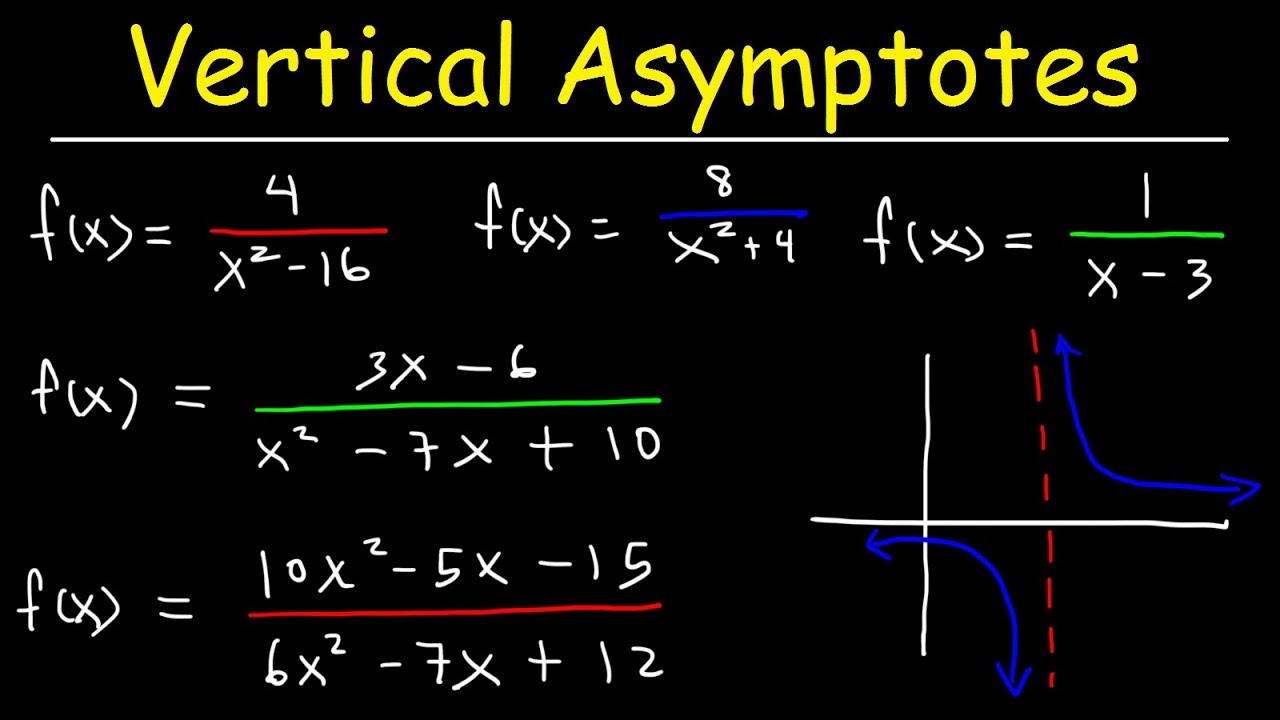
This algebra video tutorial explains how to find the vertical asymptote of a function. It explains how to distinguish a vertical asymptote from a hole and how to factor rational functions in order to identify all vertical asymptotes in a function. This video contains plenty of examples and practice problems for you to master this concept.
Alg...
hollow hedge
tired walrus
i am confused. do you want to know the _why_ behind it all, or not?
i do not care about the why at all
why are you lowkey so passive aggressive😭
its a tutoring server chill out
tired walrus
i am not being passive-aggressive at all.
hollow hedge
lmaoo okay wtv
tired walrus
if you don't give a shit about the why, then why this?

those are not the words of somebody who gives no shits about the why.
hollow hedge
i do not care about the why i just need to be able to solve the equations
math theory is a waste of my time personally
tired walrus
if you truly didn't give a shit about the why, you would just accept "find VAs => simplify then find zeros of denom" as a given
tired walrus
we are not tutors
 iron dagger
you will not be able to reliably solve any of these problems if all you care about is the procedure that may or may not be filled with gaps in logic or explanations
tired walrus
!vol
 final saddleBOT
Helpers are just people volunteering their time to help you. Be polite and patient.
hollow hedge
go away politely
tired walrus
ok off i go then
hollow hedge
thank you
 muted glacier
I think this conversation will take longer than just 11 minutes of a video, that was made for this purpose
iron dagger
iron dagger
you will not be able to reliably solve any of these problems if all you care abo...
example, in the last ticket you made I literally gave you the most dumbed down procedure you could make and you were still struggling to do the exact same type of problem
hollow hedge
holy fuck
im just asking where 0 is applicable like hop off
if you think im dumb and you dont want to help then dont say anything
this shit is so toxic
why are you even typing rn
iron dagger
I gave you the explanation right here
you're getting heated at somebody that's been trying to help you for 2 hours
and no I don't think you're stupid
because I used to be almost exactly like you and only wanted to know how to do a problem and not why it works dawg
hollow hedge
nah your right i wasted 2 hours with people who just cant help me unfortunately
would have been more effective to watch the video 4 times
not saying its your fault just saying this doesnt work for me apparently
.close
final saddleBOT
Channel closed
Closed by @hollow hedge
Use .reopen if this was a mistake.
 opaque ember
i suggest a break before trying the problem again
hollow hedge
nah the problem is easy asf im just confused as to why sometimes 0 is an answer and sometimes its not
the video will answer
opaque ember
its not easy if youre struggling with it
hollow hedge
ive done way harder math than this
in comparison its easy
its just confusing bc everyone here wants to give 20 minute explanations for what should be 2 sentences
but again thats not on them this is just not the answers im looking for
i took stats and ts was SA
opaque ember
you want easy short answers but many times it blocks understanding so you get confused by similar problems
final saddleBOT
 Available help channel!
Send your question here to claim the channel.
Remember:
• Ask your math question in a clear, concise manner.
• Show your work, and if possible, explain where you are stuck.
• After 15 minutes, feel free to ping <@&286206848099549185>.
• Type the command .close to free the channel when you're done.
• Be polite and have a nice day!
Read #❓how-to-get-help for further information on how to ask a good question, and about conduct in the question channels.
 mint orbit
I have an algebra question
final saddleBOT
mint orbit
I have an algebra question
mint orbit
I am trying to work out the 3-term shanks transformation.

 mint orbit
I have the solution, but to be honest I'm not sure I could solve this on my own. How do we go about eliminating the dependence on a and q?
 soft zealotBOT
jan Niku
Compile Error! Click the  reaction for more information.
(You may edit your message to recompile.)
 mint orbit
I tried back-substitution or experimenting with some of these products but its not really clear what is supposed to happen, or what process gave this answer
 faint edge
If you sub that in to any of your given equations I don't see how you'd be able to work your way to a true equality in order to verify it is a solution.
Are you sure there isn't more info on what a and q are?
mint orbit
faint edge
Are you sure there isn't more info on what a and q are?
they are general
The idea is that some sum $\sum ^n a_j =: A_n$ has some transient component described by $aq^n$
soft zealotBOT
jan Niku
 mint orbit
which vanishes in the limit to infinity along n
if its important
but i dont think it is for the algebra
which is what i dont understand 
 gleaming niche
mint orbit
I have the solution, but to be honest I'm not sure I could solve this on my own....
gleaming niche
mint orbit
I have the solution, but to be honest I'm not sure I could solve this on my own....
If u move A and Aj to one side u get $A_j-A = aq^j$, which tells u the sequence $(A_j-A)_j$ is geometric
soft zealotBOT
Bob the Builder
 mint orbit
how does that help for obtaining the given solution for A?
or does it give us access to partial sums
gleaming niche
It gets rid of the dependence of a and q
faint edge
Are they doing that geometric sum trick?
Where you sum all of the equations and do geometric sum memes?
mint orbit
yea but its not a solution in terms of A
mint orbit
faint edge
Are they doing that geometric sum trick?
i dont know, i got curious because my book doesnt explain
i checked wikipedia
but they cite the page in my book

mint orbit
gleaming niche
It gets rid of the dependence of a and q
for some (A_j - A)_j sure
but we want to solve for A
ito not a or q
i guess
maybe im missing your point
soft zealotBOT
jan Niku
 mint orbit

gleaming niche
my point is that a geometric sequence is only defined by the fact that the quotient btwn consecutive terms is constant
so $\frac{A_{n+1}-A}{A_n-A} = \frac{A_{n}-A}{A_{n-1}-A}$
soft zealotBOT
Bob the Builder
 mint orbit
oh, interesting
faint edge
So, you'd solve for A from this?
 bleak granite
,w (a-x)/(b-x)=(b-x)/(c-x), solve for x
soft zealotBOT


 Requested by xxmrfancyu2xx
mint orbit
Requested by xxmrfancyu2xx
mint orbit
huh
@gleaming niche thats fascinating
i didnt even think to use the fact that the transient part was geometric
faint edge
Huh wolfram formula looks pretty close.
mint orbit
everyone here is so much more clever than me 
its the formula
for sure
thats really cool 
new trick in the toolbelt
thank you all
.close
final saddleBOT
Channel closed
Closed by @mint orbit
Use .reopen if this was a mistake.
final saddleBOT
Available help channel!
Send your question here to claim the channel.
Remember:
• Ask your math question in a clear, concise manner.
• Show your work, and if possible, explain where you are stuck.
• After 15 minutes, feel free to ping <@&286206848099549185>.
• Type the command .close to free the channel when you're done.
• Be polite and have a nice day!
Read #❓how-to-get-help for further information on how to ask a good question, and about conduct in the question channels.
 jagged flare
$ABC$ is a triangle on a plane, with $G$ being its centeroid, if $M$ is a random point on the plane prove that $AM^2+BM^2+CM^2=AG^2+BG^2+CG^2+3MG^2$
final saddleBOT
jagged flare
$ABC$ is a triangle on a plane, with $G$ being its centeroid, if $M$ is a random...
soft zealotBOT
skissue.in.a.teacup
 jagged flare

i tried cos rule on AGM, BGM, CGM
that gets $AG\cdot MG\cos(AGM)+BG\cdot MG\cos(BGM)+CG\cdot MG\cos(CGM)=0$
soft zealotBOT
skissue.in.a.teacup

 cyan kayak
Let A, B, C, G, M be vectors. |AG|^2 = |(A-G)|^2 and so on. G = (A+B+C)/3
You can probably do something with this?
jagged flare
vectors 
maybe you can set one of em to be the origin so its cleaner?
M maybe or G?
lets try G
$|a-m|^2+|b-m|^2+|c-m|^2=|a|^2+|b|^2+|c|^2+3|m|^2$
how do you deal with squares of magnitudes
soft zealotBOT
skissue.in.a.teacup
 final saddleBOT
@jagged flare Has your question been resolved?
final saddleBOT
@jagged flare Has your question been resolved?
 severe verge
@jagged flare any problems you're having here?
jagged flare
dunno how to continue
severe verge
you're on the right track
jagged flare
soft zealot
**skissue.in.a.teacup**
got to this but isnt this basically the same as cos rule
severe verge
do the same for the other two
jagged flare
wdym other two
severe verge
since you pick G as the origin, a + b + c = 0
jagged flare
severe verge
since you pick G as the origin, a + b + c = 0
 why
why
severe verge
G is the centroid
severe verge
yes
G is the centroid if and only if GA + GB + GC = 0
@jagged flare do you want me to prove it?
jagged flare
ill just find a proof online
severe verge
it's quite an easy proof
jagged flare
ok sure
severe verge
let M be the midpoint of AB
from the parallelogram rule we have GA + GB = 2GM
but since |GC| = 2|GM| and GM and GC are in opposite directions, 2GM + GC = 0
hence, GA + GB + GC = 0
jagged flare
oh i was thinkung about that but didnt think it will actually work
uhh what do you do with that
severe verge
jagged flare
|a-m|^2=|a|^2+|m|^2-2|a||m|
repeat this with b-m and c-m
jagged flare
i thought like (a+b+c)-2(ab+ac+bc) but this uses magnitude
severe verge
severe verge
repeat this with b-m and c-m
see what you get
jagged flare
severe verge
repeat this with b-m and c-m
it should all cancel out to be $|a| |m|+|b| |m|+|c| |m|=0$
soft zealotBOT
skissue.in.a.teacup
 severe verge
wait you're using magnitude?
jagged flare
how can adding 3 of them be 0 unless all three are 0 (which implies degenerate triangle)
severe verge
it's wrong then
jagged flare
severe verge
wait you're using magnitude?
is that not what |a| means?
severe verge
you don't use magnitude in this case
 severe verge
what you want to use is vec(AM) = vec(GM) - vec(GA)
since you pick G to be the origin then we write vector AM shortly as m - a
and also |AM|^2 = (vec(AM))^2
so |m-a|^2 and (m-a)^2 are the same thing
jagged flare
oh so you can just drop em?
jagged flare
|vector|^2 is a number but vector^2 is another vector is it not?
oh is it some dot product stuff
severe verge
Dot product
soft zealotBOT
skissue.in.a.teacup
 severe verge
you can think of it as multiplying 2 vectors with same length and angle between them being 0
final saddleBOT
Channel closed
Closed by @jagged flare
Use .reopen if this was a mistake.
 vital surge
<@&268886789983436800>
final saddleBOT
Available help channel!
Send your question here to claim the channel.
Remember:
• Ask your math question in a clear, concise manner.
• Show your work, and if possible, explain where you are stuck.
• After 15 minutes, feel free to ping <@&286206848099549185>.
• Type the command .close to free the channel when you're done.
• Be polite and have a nice day!
Read #❓how-to-get-help for further information on how to ask a good question, and about conduct in the question channels.
final saddleBOT
Channel closed
Channel closed due to the original message being deleted.
If you did not intend to do this, please open a new help channel,
as this action is irreversible, and this channel may abruptly lock.
Available help channel!
Send your question here to claim the channel.
Remember:
• Ask your math question in a clear, concise manner.
• Show your work, and if possible, explain where you are stuck.
• After 15 minutes, feel free to ping <@&286206848099549185>.
• Type the command .close to free the channel when you're done.
• Be polite and have a nice day!
Read #❓how-to-get-help for further information on how to ask a good question, and about conduct in the question channels.
final saddleBOT
Channel closed
Channel closed due to the original message being deleted.
If you did not intend to do this, please open a new help channel,
as this action is irreversible, and this channel may abruptly lock.
 dense coral
final saddleBOT
Available help channel!
dense coral
final saddleBOT
Available help channel!
Send your question here to claim the channel.
Remember:
• Ask your math question in a clear, concise manner.
• Show your work, and if possible, explain where you are stuck.
• After 15 minutes, feel free to ping <@&286206848099549185>.
• Type the command .close to free the channel when you're done.
• Be polite and have a nice day!
Read #❓how-to-get-help for further information on how to ask a good question, and about conduct in the question channels.
 timber plume
just had a question
 final saddleBOT
timber plume
just had a question
timber plume
final saddleBOT
timber plume
just had a question
timber plume
does it always have to be sinC
 dusty quarry
no
timber plume
can it be sinA or sinB, given that they are between two sides
dusty quarry
half times two sides, then the angle in between those two sides
final saddleBOT
Channel closed
Closed by @timber plume
Use .reopen if this was a mistake.
final saddleBOT
✅
dusty quarry
look at how h is formed
 lofty sinew
Or... sorry that latter part wasn't quite right
The (a*sinC) in the equation comes from h=(a*sinC)
So you could replace it with h=(c*sinA)
But to use sinB you would have to pick a different base value
dusty quarry
in other words, you'll need a different height
lofty sinew
The three valid combinations are
b*a*sinC, b*c*sinA and *a*c*sinB
Basically, sin of the angle times the lengths of the two neighbouring sides
timber plume
dusty quarry
in other words, you'll need a different height
different height?
lofty sinew
timber plume
just had a question
So this equation is often read as "Half times base times height"
The "h" in the equation would be the height, and the line it's perpendicular to (90 degree angle) is the base, side "b"
 tired walrus
a better way to remember the formula which doesn't rely on specific letters is:
you involve two sides and the angle between them
tired walrus
this way you don't have to tie yourself to specific letters anywhere
timber plume
dusty quarry
these two lines can be heights too
but they are in an inclne
tired walrus
"perpendicular height" is a bit of a pleonasm
timber plume
one dude was saying it cant be perpendicular if its in an incline
tired walrus
and no, seia's diagram is not to scale, but she did mark these things as perpendicular
like you see those little boxes at the ends
those boxes are how you mark a right angle in a diagram
 tired walrus
this looks like it's from a completely unrelated context
timber plume
how so?
tired walrus
well you're talking about an object on an incline
rather than a geometric diagram with lines making angles of 90° or not
AND trollstar even said "doesn't have to be" but you misread that as "can't"
which there's a big difference between these too...
one dude was saying it cant be perpendicular if its in an incline
this is gross misremembrance
or rather it's an extreme over-generalization that only leads to confusion on your part
timber plume
dusty quarry
these two lines can be heights too
so in thhis case, it has to perpendicular
the height from the apex
dusty quarry
yes. otherwise your sines won't work
dusty quarry
timber plume
but they are in an inclne
if that bothers you, just turn the triangle around
timber plume
yup ok
dusty quarry
anything else?
final saddleBOT
@timber plume Has your question been resolved?
final saddleBOT
Channel closed
Closed due to timeout
Use .reopen if this was a mistake.
final saddleBOT
Available help channel!
Send your question here to claim the channel.
Remember:
• Ask your math question in a clear, concise manner.
• Show your work, and if possible, explain where you are stuck.
• After 15 minutes, feel free to ping <@&286206848099549185>.
• Type the command .close to free the channel when you're done.
• Be polite and have a nice day!
Read #❓how-to-get-help for further information on how to ask a good question, and about conduct in the question channels.
 still ruin
Im having difficulties with this question it reads, angle A is 90°, ADEF is a square, AB=6 and AC=10, what's the length of AD?
 final saddleBOT
still ruin
Im having difficulties with this question it reads, angle A is 90°, ADEF is a sq...
still ruin
final saddleBOT
still ruin
Im having difficulties with this question it reads, angle A is 90°, ADEF is a sq...
still ruin
I LITERALLY don't know where to start
I mean is this question even possible with pre highschool knowledge or is it just flat out impossible.
 dapper hull
still ruin
Im having difficulties with this question it reads, angle A is 90°, ADEF is a sq...
dapper hull
still ruin
Im having difficulties with this question it reads, angle A is 90°, ADEF is a sq...
,rccw
soft zealotBOT
 still ruin
dapper hull
,rccw
still ruin
dapper hull
,rccw
Bruh help me😭
severe verge
similar triangles
still ruin
Hold on bot don't autoclose it yet
 dusty quarry
,rccw
soft zealotBOT
 still ruin
DE=EF?
severe verge
yes
still ruin
when 2 triangles are similar and one of each their lengths are the same that means they are congruent am i wrong?
severe verge
but in those two similar triangles DE does NOT correspond to EF
still ruin
severe verge
but in those two similar triangles DE does NOT correspond to EF
Correspond?? What does that mean? Are you sayin that DE corresponds to FC but we have the info that ADEF is a square (maybe a language barrier but in Indonesia square means that all 4 sides have the same lengths)
still ruin
But wha bruh🥀
still ruin
severe verge
correspond in the context of similar triangles
DE/FC=BD/EF?
severe verge
correct
still ruin
DE is still equal to EF btw
severe verge
so?
DE is in the numerator while EF is in the denominator
you can not say FC = BD from there
still ruin
Ok it makes DE²
still ruin
severe verge
you can not say FC = BD from there
Yeah true😔
Bru🥀

DE=AB btw so BA=AD🥀🥀🥀🥀
still ruin
severe verge
DE is in the numerator while EF is in the denominator
Look at that bs😭😭😭
severe verge
what is BD and CF?
 covert tree
still ruin
We already what BA is
covert tree
still ruin
We already what BA is
there are 2 ways to calculate BD, one is to use BA-BD which gives 6-x. And hint for the other way: look at the triangle BDE
still ruin
severe verge
what is BD and CF?
BA-x?
severe verge
yes
still ruin
dude we already know BA=AD
And we KNOW what BA is and it's 6🥀
still ruin
Literally the last image we just saw
covert tree
still ruin
Literally the last image we just saw
BA includes the segment AD
its cant be equal
severe verge
still ruin
Bru🥀
you missed the term DE*BA
still ruin
My ass is somehow autistic to day bruh🥀
Alr i got it

Also how do you fight against the fact that BDE and EFC is congruent
I mean they're similar and they one side with same length?
Idk ts is fucking with me
still ruin
severe verge
you missed the term DE*BA
☝️
severe verge
still ruin
Also how do you fight against the fact that BDE and EFC is congruent
I mean the...

here triangle BHA and BAC are similar
and they share the side BA
but they are NOT congruent
final saddleBOT
@still ruin Has your question been resolved?
Channel closed
Closed by @still ruin
Use .reopen if this was a mistake.
final saddleBOT
Available help channel!
Send your question here to claim the channel.
Remember:
• Ask your math question in a clear, concise manner.
• Show your work, and if possible, explain where you are stuck.
• After 15 minutes, feel free to ping <@&286206848099549185>.
• Type the command .close to free the channel when you're done.
• Be polite and have a nice day!
Read #❓how-to-get-help for further information on how to ask a good question, and about conduct in the question channels.
 nocturne lagoon
Q 22 I have no idea what I'm doing
 final saddleBOT
nocturne lagoon
Q 22 I have no idea what I'm doing
nocturne lagoon
final saddleBOT
nocturne lagoon
Q 22 I have no idea what I'm doing
nocturne lagoon
I got p=qtanA
dapper hull
nocturne lagoon
Q 22 I have no idea what I'm doing
in Q22 you should draw a right angled triangle it would help
dapper hull
nocturne lagoon
Does p^2 + q^2 equal 1
no but sin^2A+cos^2A would
nocturne lagoon
22a?
dapper hull
what did you find for the hypotenuse ?
nocturne lagoon
1
dapper hull
nocturne lagoon
1
no
final saddleBOT
Channel closed
Closed by @nocturne lagoon
Use .reopen if this was a mistake.
nocturne lagoon
.reopen
final saddleBOT
✅
nocturne lagoon
Q22b I'm not sure the triangle is
 dapper hull
nocturne lagoon
Q22b I'm not sure the triangle is
dapper hull
nocturne lagoon
Q22b I'm not sure the triangle is
still the same triangle just use the double angle identities to write sin(2A) and cos(2A) in terms of sin(A) and cos(A)
 dapper hull
nocturne lagoon
Did I do something wrong
dapper hull
nocturne lagoon
Did I do something wrong
you didn't tell what was the hypotenuse still cuz it is not 1
dapper hull
nocturne lagoon
Wait but y did I get the answer
what answer did you get ?
dapper hull
seems right
nocturne lagoon
What was ur hyp
dapper hull
sqrt(p^2+q^2)
nocturne lagoon
Wanna know how I got 1
dapper hull
nocturne lagoon
Wanna know how I got 1
i don't know about that :3
dapper hull
nocturne lagoon
SinA equals p and cosA equals q
not really
sinA might be kp and cosA=kq
dapper hull
nocturne lagoon
But there is no k
at least there isn't but sinA and cosA could be any multiple of p and q
nocturne lagoon
So how'd u get the answer
dapper hull
nocturne lagoon
So how'd u get the answer
same idea just now i know the hypotenuse is sqrt(p^2+q^2) i'd write it as R for simplicity
sinA=p/R and cosA=q/R and then things would work out after adding the fractions and some factoring
nocturne lagoon
Wouldn't u get to P(q^2 + p^2)
dapper hull
nocturne lagoon
Wouldn't u get to P(q^2 + p^2)
/p^2+q^2
which would simplify to p for 22a
nocturne lagoon
But how can u just divide
dapper hull
$q({\frac{p}{R})(\frac{q}{R}})+p(\frac{p}{R})^2$
soft zealotBOT
qimmah
 dapper hull
$\frac{pq^2+p^3}{R}$
soft zealotBOT
qimmah
 nocturne lagoon
Ye
dapper hull
soft zealot
**qimmah**
Factor p and then it’s just R/R
nocturne lagoon
O ic
dapper hull
Same idea for the other question
nocturne lagoon
Alr thanks
dapper hull
Btw @nocturne lagoon
The reason p^2+q^2=1 happens to work it’s because it simplifies in both questions leaving you with just the other expression
nocturne lagoon
.close
final saddleBOT
Channel closed
Closed by @nocturne lagoon
Use .reopen if this was a mistake.
final saddleBOT
Available help channel!
Send your question here to claim the channel.
Remember:
• Ask your math question in a clear, concise manner.
• Show your work, and if possible, explain where you are stuck.
• After 15 minutes, feel free to ping <@&286206848099549185>.
• Type the command .close to free the channel when you're done.
• Be polite and have a nice day!
Read #❓how-to-get-help for further information on how to ask a good question, and about conduct in the question channels.
nocturne lagoon
Q24 I'm not sure what to do
 final saddleBOT
nocturne lagoon
Q24 I'm not sure what to do
nocturne lagoon
final saddleBOT
nocturne lagoon
Q24 I'm not sure what to do
nocturne lagoon
Ye
tired walrus
ok, can you state all the double-angle identities you know
nocturne lagoon
Sin2A=2sinAcosA
Cos2A=Cos^2(A)-Sin^2(A)
Tan2A=(2TanA)/(1-tan^2A) tan(A) cannot equal to + or - 1
tired walrus
missing brackets on that one...
also lots of missing brackets around trig functions but that one's more of a whatever
anyway
have you seen this one? $\cos(2A) = 1 - 2\sin^2(A)$
soft zealotBOT
Ann
 nocturne lagoon
Ye
tired walrus
???
nocturne lagoon
I did Cos(A)=1-Sin(A) idk what I was thinking
nocturne lagoon
I think I was thinking complementary but don’t know where the 1 came from
Thanks for helping sometimes I can’t spot where to use some identities
.close
final saddleBOT
Channel closed
Closed by @nocturne lagoon
Use .reopen if this was a mistake.
nocturne lagoon
.reopen
final saddleBOT
✅
 soft zealotBOT
 nocturne lagoon
Here is what I tried
dapper hull
soft zealot
how about starting with expanding cos(theta+x) and the negative one too
nocturne lagoon
Ye middle right
dapper hull
yes
divide the whole numerator and denom. by costheta cosx
dapper hull
what'd ya get ?
nocturne lagoon
(1-tan theta tanx)/(1+tan theta tanx)
dapper hull
nocturne lagoon
(1-tan theta tanx)/(1+tan theta tanx)
to make our lives easy substitute tantheta and tanx with any variable and try to solve for tanx
dapper hull
dapper hull
to make our lives easy substitute tantheta and tanx with any variable and try to...
seperate ofc
nocturne lagoon
Ok
dapper hull
nocturne lagoon
So like X and y
i reccomend other variables than X
dapper hull
first of tell me your substitution
Or send your work and let me see
 soft zealotBOT
 dapper hull
soft zealot
dapper hull
soft zealot
Remember that it’s equal to A
nocturne lagoon
I got it
dapper hull
Also you are trying to make
B= some expression in A
nocturne lagoon
Good idea to make it more simpler
dapper hull
What'd you got ?
nocturne lagoon
,rotateccw
dapper hull
Write it in terms of B and A cuz it’ll take some time to write
 dapper hull
I saw it dw
soft zealotBOT
 dapper hull
The x axis
left to right
nocturne lagoon
nocturne lagoon
Q24 I'm not sure what to do
Here
dapper hull
As in plane
Could you send the whole question once more
nocturne lagoon
 dapper hull
nocturne lagoon
dapper hull
nocturne lagoon
Yeah a plane we could draw a triangle With points P Q R
final saddleBOT
@nocturne lagoon Has your question been resolved?
nocturne lagoon
.close
final saddleBOT
Channel closed
Closed by @nocturne lagoon
Use .reopen if this was a mistake.
Available help channel!
Send your question here to claim the channel.
Remember:
• Ask your math question in a clear, concise manner.
• Show your work, and if possible, explain where you are stuck.
• After 15 minutes, feel free to ping <@&286206848099549185>.
• Type the command .close to free the channel when you're done.
• Be polite and have a nice day!
Read #❓how-to-get-help for further information on how to ask a good question, and about conduct in the question channels.
 dusky wasp
This is just same as a1 divides b1 and a2 divides b2 right

 terse crypt
,rccw
soft zealotBOT
 dusky wasp
,help
soft zealotBOT
A brief description and guide on how to use me was sent to your DMs!
Please use ,list to see a list of all my commands, and ,help cmd to get detailed help on a command!
dusky wasp
,list
 solemn igloo
dusky wasp
This is just same as a1 divides b1 and a2 divides b2 right
solemn igloo
dusky wasp
This is just same as a1 divides b1 and a2 divides b2 right
!status
final saddleBOT
dusky wasp
This is just same as a1 divides b1 and a2 divides b2 right
What step are you on?
1. I don't know where to begin.
2. I have begun but got stuck midway.
3. I got an answer but I was told that it's wrong.
4. I got an answer and would like my work checked.
5. I have a question about someone else's work/solution.
6. I have completed the problem and don't need help anymore. Thank you.
7. None of the above
2
solemn igloo
Alright, what have you done so far?
 soft zealotBOT
 dusky wasp
The relation is symmetric
So 20 elements so far
I'd like to find an efficient way to solve this problem other than counting every possible solution
!status
final saddleBOT
What step are you on?
1. I don't know where to begin.
2. I have begun but got stuck midway.
3. I got an answer but I was told that it's wrong.
4. I got an answer and would like my work checked.
5. I have a question about someone else's work/solution.
6. I have completed the problem and don't need help anymore. Thank you.
7. None of the above
!help
final saddleBOT
To ask for mathematics help on this server, please open your own help channel or help thread. See #❓how-to-get-help for instructions.
final saddleBOT
What step are you on?
1. I don't know where to begin.
2. I have begun but got stuck midway.
3. I got an answer but I was told that it's wrong.
4. I got an answer and would like my work checked.
5. I have a question about someone else's work/solution.
6. I have completed the problem and don't need help anymore. Thank you.
7. None of the above
6
 tribal jackal
!done
final saddleBOT
If you are done with this channel, please mark your problem as solved by typing .close
dusky wasp
.close
final saddleBOT
Channel closed
Closed by @dusky wasp
Use .reopen if this was a mistake.
Available help channel!
Send your question here to claim the channel.
Remember:
• Ask your math question in a clear, concise manner.
• Show your work, and if possible, explain where you are stuck.
• After 15 minutes, feel free to ping <@&286206848099549185>.
• Type the command .close to free the channel when you're done.
• Be polite and have a nice day!
Read #❓how-to-get-help for further information on how to ask a good question, and about conduct in the question channels.
 tranquil pine
,,\sqrt{1+x^2+y^2+x^2 y^2}+xy\frac{dy}{dx}=0
final saddleBOT
tranquil pine
,,\sqrt{1+x^2+y^2+x^2 y^2}+xy\frac{dy}{dx}=0
soft zealotBOT
!

 solar crest
soft zealot
**!**
solar crest
soft zealot
**!**
do you know how to factorise the expression inside the sqrt
tranquil pine
I sent the xy dy/dx to rhs then squared on both sides
On factoring lhs, we get (1+x^2)(1+y^2)
,,\sqrt{1+x^2+y^2+x^2 y^2}=-xy\frac{dy}{dx}
soft zealotBOT
!
 tranquil pine
,,1+x^2+y^2+x^2 y^2=(xy\frac{dy}{dx})^2
soft zealotBOT
!

 scarlet sequoia
tranquil pine
,,1+x^2+y^2+x^2 y^2=(xy\frac{dy}{dx})^2
scarlet sequoia
tranquil pine
,,1+x^2+y^2+x^2 y^2=(xy\frac{dy}{dx})^2
this might not help a lot
scarlet sequoia
soft zealot
**!**
it is better to keep it in this form
as suggested, try to factor what's inside the square root
and it will inspire you a function sub
tranquil pine
Oh whats that
scarlet sequoia
you just sub something like u = .... in terms of y (possibly x)
tranquil pine
,,\sqrt{(1+x^2)(y^2+1)}=-xy\frac{dy}{dx}
soft zealotBOT
!
 tranquil pine
What now
scarlet sequoia
yes
so now we can technically distribute the square root
$\sqrt{1+x^2}\sqrt{y^2+1}=-xy\frac{dy}{dx}$
soft zealotBOT
Raphaelisius Maximus MMIII
 scarlet sequoia
this is just to make the substitution more obvious
tranquil pine
Oh
scarlet sequoia
make a new function out of y, that will be more interesting to focus on
tranquil pine
Like y2+1=v?
tranquil pine
Then diff v then get dy/dx?
 stone kettle
i think collect dx and x terms and y and dy terms then integrate
scarlet sequoia
and we would like to make the equation as easy as possible
scarlet sequoia
stone kettle
i think collect dx and x terms and y and dy terms then integrate
that's another possibility
some f(y)dy = g(x)dx
tranquil pine
stone kettle
i think collect dx and x terms and y and dy terms then integrate
I did i couldnt the final in proper form given by book
stone kettle
root(1+x^2)/x dx= - y/root(1+y^2) dy
stone kettle
whats ur
soft zealotBOT
!
 tranquil pine
I got smth like this
stone kettle
stone kettle
root(1+x^2)/x dx= - y/root(1+y^2) dy
this
tranquil pine
soft zealot
**!**
I didnt get negative cuz i squared here
scarlet sequoia
tranquil pine
I didnt get negative cuz i squared here
we didn't square in the end remember
stone kettle
^
scarlet sequoia
we kept the sqrts
tranquil pine
But i got back the roots
scarlet sequoia
tranquil pine
But i got back the roots
then that's maybe why you got an incorrect answer xdd
tranquil pine
How😭
scarlet sequoia
you went from a = -b to a^2 = b^2 to a = b
tranquil pine
Wanna listen to how i approached this?
scarlet sequoia
do you get what I'm saying
stone kettle
yes
tranquil pine
scarlet sequoia
you went from a = -b to a^2 = b^2 to a = b
Idk whay u r saying
stone kettle
u wrote "root of something = negative" - complex ????
scarlet sequoia
when you sqrt, you have to consider that there are TWO possible stuff
stone kettle
so thats actually wrong
tranquil pine
Oh
stone kettle
soft zealot
**!**
this
scarlet sequoia
so get rid of the "squaring then taking the root", which just adds possibly unwanted solutions
and just stick with the original roots
tranquil pine
,,\frac{\sqrt{1+x^2}}{x},dx=- \frac{y}{\sqrt{y^2+1}}, dy
soft zealotBOT
!
 tranquil pine
Ok well on integrating b/s
tranquil pine
$LHS=-\frac{1}{2}, \log (y^2+1)$
soft zealotBOT
!
 tranquil pine
Les add c later
stone kettle
yeah
scarlet sequoia
tranquil pine
$LHS=-\frac{1}{2}\, \log (y^2+1)$
not quite?
tranquil pine
,,\sec \theta + \log (\csc \theta - \cot \theta)
soft zealotBOT
!
 tranquil pine
-y/(y^2+1)
scarlet sequoia
so
scarlet sequoia
that's better
soft zealotBOT
!
 soft zealotBOT
!
 tranquil pine
Can u see the img
?
K nvm
Then on integrating i got
,,\sec \theta + \log (\csc \theta - \cot \theta)
soft zealotBOT
!
 tranquil pine
After subbing $\theta$ in terms of x
soft zealotBOT
!
 scarlet sequoia
that seems like a tiresome sub
scarlet sequoia
yeah, so try sqrt(1+x^2) = u
tranquil pine
Oh k
scarlet sequoia
tranquil pine
Few told to sub x= tan theta
mmmmh I don't see the point
tranquil pine
RHS =$\frac{(\sqrt{1+x^2})^3}{3}$
soft zealotBOT
!
 scarlet sequoia
no?
stone kettle
lol
tranquil pine
How
scarlet sequoia
show me your u sub
stone kettle
put x=tan theta
scarlet sequoia
stone kettle
put x=tan theta
not sure this works
tranquil pine
,,u=\sqrt{1+x^2}
soft zealotBOT
!
 stone kettle
scarlet sequoia
not sure this works
stone kettle
scarlet sequoia
not sure this works
it does
scarlet sequoia
I'll show mine and then you can show yours
stone kettle
i find trig substitution easier
tranquil pine
Then $du=\frac{x}{\sqrt{1+x^2}}, dx$
stone kettle
for some others it may vary
scarlet sequoia
close the frac
soft zealotBOT
!
 tranquil pine
Ye mb
scarlet sequoia
yes that's correct
scarlet sequoia
well x doesn't cancel, so what do you get instead
tranquil pine
1/x^2 du
tranquil pine
U^2/x^2 du
scarlet sequoia
alright
scarlet sequoia
yes
tranquil pine
U-1/2 log blah blah 😭
scarlet sequoia
we're now at $\int \left(1-\frac{1}{u^2-1}\right),du$
soft zealotBOT
Raphaelisius Maximus MMIII
 tranquil pine
Ye
scarlet sequoia
tranquil pine
U-1/2 log blah blah 😭
well "log blah blah" is a bit more complicated than that
you gotta split fractions first
and then you can blah blah
tranquil pine
Split what
scarlet sequoia
you know
tranquil pine
U+a/u-a
scarlet sequoia
1/(u^2-1) = A/(u-1) + B/(u+1)
scarlet sequoia
tranquil pine
Use direct formula bruh
what would that be?

 soft zealotBOT
 scarlet sequoia
alright
tranquil pine
We have direct formula instead of actually expanding and solving
scarlet sequoia
if you've been taught about that formula then yes use it
scarlet sequoia
idk what is the idea behind tan sub
but knowing the answer it wouldn't have been pretty
scarlet sequoia
stone kettle
i find trig substitution easier
.
tranquil pine
What does ur name mean
scarlet sequoia
how much can a tan sub can help us if there's no tan in the final answer xd
scarlet sequoia
tranquil pine
What does ur name mean
just pompous form of my original nickname
tranquil pine
scarlet sequoia
how much can a tan sub can help us if there's no tan in the final answer xd
Forget abt the sub, but we can convert the theta terms of x using right angle triangle
tranquil pine
scarlet sequoia
just pompous form of my original nickname
Ye sure sounds
Ok thanks
.close
final saddleBOT
Channel closed
Closed by @gray mica
Use .reopen if this was a mistake.
stone kettle
tranquil pine
1 min
lol 12th class?
tranquil pine
stone kettle
lol 12th class?
Yes 😭
tranquil pine
Me just boards🗿
stone kettle
🫡
solar crest
tranquil pine
Use direct formula bruh
some places dont have direct formula
i use a sec sub here, some use partial frac
final saddleBOT
Available help channel!
Send your question here to claim the channel.
Remember:
• Ask your math question in a clear, concise manner.
• Show your work, and if possible, explain where you are stuck.
• After 15 minutes, feel free to ping <@&286206848099549185>.
• Type the command .close to free the channel when you're done.
• Be polite and have a nice day!
Read #❓how-to-get-help for further information on how to ask a good question, and about conduct in the question channels.
 exotic shale
what does he mean by rearrangement
 final saddleBOT
exotic shale
what does he mean by rearrangement
terse crypt
final saddleBOT
exotic shale
what does he mean by rearrangement
terse crypt
moving numbers around
In mathematics, the Riemann series theorem, also called the Riemann rearrangement theorem, named after 19th-century German mathematician Bernhard Riemann, says that if an infinite series of real numbers is conditionally convergent, then its terms can be arranged in a permutation so that the new series converges to an arbitrary real number, and r...
exotic shale
terse crypt
moving numbers around
wdym moving numbers around
tired walrus
adding up the same sequence of numbers but in a different order.
exotic shale
how can that be different
here it says this

but this isnt really a rearrangement its a completely new sequence
 vital crag
You're taking about two different things
vital crag
exotic shale
here it says this
This is a definition of conditional convergence
vital crag
terse crypt
https://en.wikipedia.org/wiki/Riemann_series_theorem
Read alternating harmonic series
terse crypt
oh
final saddleBOT
@exotic shale Has your question been resolved?
final saddleBOT
@exotic shale Has your question been resolved?
Channel closed
Closed by @exotic shale
Use .reopen if this was a mistake.
final saddleBOT
Available help channel!
Send your question here to claim the channel.
Remember:
• Ask your math question in a clear, concise manner.
• Show your work, and if possible, explain where you are stuck.
• After 15 minutes, feel free to ping <@&286206848099549185>.
• Type the command .close to free the channel when you're done.
• Be polite and have a nice day!
Read #❓how-to-get-help for further information on how to ask a good question, and about conduct in the question channels.
 drowsy epoch
. @dim robin
 dim robin
need to find the exact value , and where do i get help there are like MANY channels
 final saddleBOT
dim robin
need to find the exact value , and where do i get help there are like MANY chann...
drowsy epoch
dim robin
need to find the exact value , and where do i get help there are like MANY chann...
final saddleBOT
dim robin
need to find the exact value , and where do i get help there are like MANY chann...
drowsy epoch
dim robin
need to find the exact value , and where do i get help there are like MANY chann...
This is your channel now
dim robin
oh okay
drowsy epoch
You pick the ones, where there is no name, else it's occupied already
dim robin
okay
how do i solve this
i tried to write the first term which is 1/sin(pie/4) . sin (5pie/12)
i tried multiplying 2 numerator and denominator
drowsy epoch
I was thinking of applying maybe sine addition theorem first
,, \sin(a+b) = \sin(a)\cos(b)+\cos(a)\sin(b)
soft zealotBOT
 drowsy epoch
,, \sum_{k=1}^{13} \textstyle \f{1}{\sin(\pi/4-\pi/6+k\pi /6) \sin(\pi/4 + k \pi/6)}
dim robin
 strange coral
This is jee advanced 2016
strange coral
This is jee advanced 2016
?
soft zealotBOT
 dim robin
okay let me search it up
vital surge
drowsy epoch
. <@1301921207368810529>
you will need to make use of this
sin(x - y) = sin(x)cos(y) - cos(x)sin(y)
strange coral
Multiply and divide by sin(pi/6)
strange coral
strange coral
Hint:- B-A= pi/6
B is the latter angle and A is former
strange coral
Yes
strange coral
dim robin
okay so you just multiplied and divided by sin(A-B)
B-A*
dim robin
strange coral
B-A*
sin(A-B)/ sin A sin B , and does it matter B-A because if we take A first it can come minus but we are also dividing by the same , so minus is gone
and everytime it is -pie/6 or pie/6
the difference*
strange coral
dim robin
sin(A-B)/ sin A sin B , and does it matter B-A because if we take A first it can...
Yeah it works
I was telling you wrt my assumption
dim robin
dim robin
sin(A-B)/ sin A sin B , and does it matter B-A because if we take A first it can...
whats sin(A-B) /sina sinb simplify to
like
cot?
ya
strange coral
Yes
dim robin
so its eaier to sum
strange coral
Just solve and use angle minimization
dim robin
easier*
strange coral
strange coral
Just solve and use angle minimization
And see the magic
dim robin
oh there is symmetry
i tried it on k=1 and k=2
i took 2 out
and the terms cancelling
dim robin
dim robin
yup same for k=3
would it continue till 13th?
strange coral
All terms would cancel out except
strange coral
Mb
strange coral
strange coral
It would be 2(cotpi/4-cot58pi/24)
This is the correct sum
dim robin
29pie/12 = 2pie + 5pie/12
strange coral
It’s done
strange coral
No
dim robin
thanks
dim robin
strange coral
No
huh?
strange coral
It’s a standard submultiple
dim robin
I MESSED UP AT FINAL PART 💀
dim robin
yes 2root3 -2 is 100% ans
dim robin
lets goo thanks
dim robin
.close
final saddleBOT
Channel closed
Closed by @dim robin
Use .reopen if this was a mistake.
final saddleBOT
Available help channel!
Send your question here to claim the channel.
Remember:
• Ask your math question in a clear, concise manner.
• Show your work, and if possible, explain where you are stuck.
• After 15 minutes, feel free to ping <@&286206848099549185>.
• Type the command .close to free the channel when you're done.
• Be polite and have a nice day!
Read #❓how-to-get-help for further information on how to ask a good question, and about conduct in the question channels.
 old quarry
The number of distinct real roots of x4 - 4x3 + 12x2 + x - 1 = 0 is
 tranquil pine
Is this class 11 - 12 standard math?
old quarry
12th yes
tranquil pine
Oh, I am from class 10 nevermind
 ivory vessel
old quarry
ivory vessel
old quarry
||rolles theorem?||
old quarry
ivory vessel
||rolles theorem?||
i havent learnt that properly yet..is that the way to do this? if yes then ill leave it for later
 versed crater
What did differentiating tell you
 finite hinge
Descartes's rule of signs
old quarry
versed crater
What did differentiating tell you
nothing
 magic coyote
Dyk cubic determinant
versed crater
old quarry
nothing
No it always tells you something
old quarry
finite hinge
Descartes's rule of signs
i dont know that
old quarry
magic coyote
Dyk cubic determinant
nope
finite hinge
old quarry
i dont know that
That's the easiest way to get roots
old quarry
versed crater
No it always tells you something
4x^3-12x^2+24x+1=0 what does this tell
old quarry
finite hinge
That's the easiest way to get roots
huh i need to get the roots?
versed crater
That tells you where the critical points of the original quartic are
old quarry
versed crater
That tells you where the critical points of the original quartic are
but i cant find any values of x for which the eqn satisfies
versed crater
In particular, since the coefficient of x⁴ is positive, the starts at inf and ends at inf (on the -inf and +inf part of the x axis)
old quarry
yeah i noticed that
versed crater
Okay well, you just wanna find out how many local minimas there are
versed crater
Well, look at the 2nd derivative and see where the inflection points are
versed crater
The inflection points give you some more info on where the critical values of the cubic might be
Which in turn tells you where the roots of the cubic might be
Which in turn tells you if there are local minimas and where they are
old quarry
versed crater
The inflection points give you some more info on where the critical values of th...
second derivative is
x^2-2x+2=0
versed crater
b² - 4ac seems negative
No roots
No inflection points for the quartic
What does that mean
old quarry
no points in which concavity changes?
versed crater
Yeah so it just goes down and up
Only 1 real root to the first derivative
If you wanna be fancy you can even try newton’s method
old quarry
versed crater
Yeah so it just goes down and up
oh so because it has no roots weve concluded that theres only 1 local minima?
versed crater
So there’s only 1 local minima and you need to find it
Well if there were other critical points
Namely more than 1 minima
old quarry
versed crater
So there’s only 1 local minima and you need to find it
alr alr how do we find it tho? thats an ugly ass cubic
versed crater
You’d need to change concavity to do that
I’m sure there are tricks for it that I don’t know but you could try newtons method
It works pretty well on a set up like this I believe
old quarry
versed crater
I’m sure there are tricks for it that I don’t know but you could try newtons met...
i dont know that one sorry 😔
versed crater
That’s cheating
finite hinge
Ik
old quarry
versed crater
That’s cheating
yeah
if we were allowed to use desmos then why would i even ask the question
finite hinge
You can't do rational root theorem and derivative 🤷🏿
finite hinge
old quarry
if we were allowed to use desmos then why would i even ask the question
I'm just suggesting 💔💔
To see how many roots cuh 💔💔
versed crater
You should know newtons method
It’s very clever

Learn the Newton-Raphson Method in this quick tutorial! 📐 Discover how to solve nonlinear equations efficiently with step-by-step guidance. Perfect for students and math enthusiasts! 🚀
Oh beautiful a yt shorts to teach maths
versed crater
You guess some number
Anything
Really, anything you’d like
And you iteratively get closer to the answer
old quarry
okay lets go with 1
versed crater
I’m pretty sure this isn’t how you’re supposed to do this though
 stone wagon
versed crater
Really, anything you’d like
stone wagon
versed crater
Really, anything you’d like
(assuming the function is nice enough 🤓)
versed crater
But I’m stuck and I haven’t got another idea
old quarry
versed crater
And you iteratively get closer to the answer
but in their case they already knew how the curve looks
versed crater
stone wagon
(assuming the function is nice enough 🤓)
We have a cubic with 1 root here
stone wagon
yeah alr
versed crater
old quarry
but in their case they already knew how the curve looks
You need only to know the tangent line at the initial guess
Which you can find by putting your initial guess into f’
versed crater
Then find the x intercept of this tangent line
That’s your next guess
Then repeat
versed crater
Can you imagine that with some initial guess x = 1 and the given function f(x) you can draw a tangent line at (1, f(1)) with slope f’(1)
old quarry
wait
stone wagon
old quarry
is this a particular method to find the minima?
newton's method but on the derivative xd
versed crater
old quarry
is this a particular method to find the minima?
For finding roots of equations
old quarry
@versed crater f(0) =-1 so we know that the minima will be below the x axis somewhere and graph goes till infinity so from there cant we conclude 2 roots?
so we dont have to actually find the minima
versed crater
versed crater
Can you imagine that with some initial guess x = 1 and the given function f(x) y...
So y - f(1) = f’(1)(x - 1)
old quarry
versed crater
For finding roots of equations
ohh
versed crater
old quarry
<@244390699431100416> f(0) =-1 so we know that the minima will be below the x ax...
You can also do that
But then you’re guessing where on ℝ will f be negative if at all?
It’s great if you can immediately guess it but it mightn’t be obvious
old quarry
versed crater
But then you’re guessing where on ℝ will f be negative if at all?
yeah i agree with ur point..this is actually why i didnt get the answer
versed crater
But you could argue that looking at the coefficient the minima can’t be that far away from 0
But say you try 0 and it doesn’t work
What might you try next
The newton’s method gives you a way to determine what’s a good next guess
 versed crater
I suppose you can also just use the derivative to tell you where to go
The derivative will go from negative to positive
So pick a number to start at
Then find f’(number)
If it’s positive pick a smaller number
If it’s negative pick a bigger number
 marsh glacier
old quarry
marsh glacier
old quarry
u can differentiate and set equal to zero
versed crater
If your derivative changes sign you know the minima is somewhere in the middle of your last 2 guesses
versed crater
old quarry
wont it be way too ugly to solve for
Well we don’t need to solve for it
We just need to know if the minima is negative or positive
marsh glacier
marsh glacier
u can differentiate and set equal to zero
after that use rolle theorem
versed crater
If it’s negative you have 2 real roots
old quarry
versed crater
If it’s positive pick a smaller number
so we are basically finding where the nature of the curve changes and that is our point?
old quarry
yeah okay
versed crater
old quarry
so we are basically finding where the nature of the curve changes and that is ou...
Yeah you guess a point then use the derivative at that point to help you pick a new guess
old quarry
marsh glacier
after that use rolle theorem
i havent learnt that yet..will try once i do tho
versed crater
Since you know the general shape is like U shape
marsh glacier
old quarry
i havent learnt that yet..will try once i do tho
its pretty simple
u just need to find the local maxima and minima
versed crater
New theorems are always simple if you already know them
old quarry
versed crater
Yeah you guess a point then use the derivative at that point to help you pick a ...
okok i think i got it now thanks a lot
old quarry
marsh glacier
u just need to find the local maxima and minima
yes that is our problem brother 😭
versed crater
marsh glacier
u just need to find the local maxima and minima
That’s crazy because this wasn’t easy to do either
marsh glacier
versed crater
That’s crazy because this wasn’t easy to do either
i mean
cubic formula?
versed crater
You’re just being ridiculous now
old quarry
cubic formula is insane
marsh glacier
old quarry
cubic formula is insane
its actually not
versed crater
@old quarry despite this probably not being the solution I suppose it works, I’d say ask ur teacher how you were meant to do it and then ping me and tell me as well 😆
marsh glacier
old quarry
cubic formula is insane
depressed cubics can be slved easily
old quarry
versed crater
<@728482160927047742> despite this probably not being the solution I suppose it ...
alr alr tomorrows the discussion ill lyk
marsh glacier
and x-b/3a can be used to eliminate the x^2 term
versed crater
marsh glacier
depressed cubics can be slved easily
Mate if you let someone use cubic formula
You might as well just send the fucking quartic formula nuke on this problem
Like what
I’m pretty sure that’s not the intended solution
marsh glacier
versed crater
You might as well just send the fucking quartic formula nuke on this problem
i dont know the quartic formula
pretty sure it doesnt exist
old quarry
idk the cubic formula
old quarry
marsh glacier
pretty sure it doesnt exist
it does
versed crater
marsh glacier
its actually not
.
versed crater
marsh glacier
pretty sure it doesnt exist
It’s actually not
marsh glacier
versed crater
.
that was for cubics
cubics aint TOO hard
like they may be a lil hard
versed crater
We have formulas for all polynomials up to but not including quintics
So there is a quartic formula
versed crater
Now you do
marsh glacier
thx for telling