#help-36
1 messages · Page 171 of 1
 dapper hull
 shrewd yew
in the middle of me asking for help i suddenly figure out what i did wrong
shrewd yew
in the middle of me asking for help i suddenly figure out what i did wrong
lowk better than waiting for the help imo
 final saddleBOT
 Available help channel!
Send your question here to claim the channel.
Remember:
• Ask your math question in a clear, concise manner.
• Show your work, and if possible, explain where you are stuck.
• After 15 minutes, feel free to ping <@&286206848099549185>.
• Type the command .close to free the channel when you're done.
• Be polite and have a nice day!
Read #❓how-to-get-help for further information on how to ask a good question, and about conduct in the question channels.
 warm scaffold
I need help with confidence intervals. The confidence interval calculated here is this answer: (95% confident between 0.44 and 0.64). Is this saying that 100% certainty that there is a 95% chance of the mean being within that interval from the sample mean? How can it 100% be the case that: (there is a 95% confident between 0.44 and 0.64) if the sample mean is whats used to calculate that interval (which is just and estimate of the mean) and not the actual mean (because it is uknown)
final saddleBOT
warm scaffold
I need help with confidence intervals. The confidence interval calculated here i...
 final saddleBOT
@warm scaffold Has your question been resolved?
 dense badge
warm scaffold
dense badge
warm scaffold
maybe a rewording will help. if you fix p, then repeating this setup with different new data generated this way like 100 times, you should expect 95 of the 100 interval produced to contain p. That’s what’s guaranteed here. Picture:
 warm scaffold
that makes sense
but just so that I understand this clearly
the answer (there is a 95% confident between 0.44 and 0.64) is just an unbiased estimates, it is not 100% the case that (there is a 95% confident between 0.44 and 0.64), it would only be 100% true that: (there is a 95% confident between 0.44 and 0.64) if the confidence interval was calulated using p and not p hat. BUT the answer (there is a 95% confident between 0.44 and 0.64) is an unbiased estimate
 cyan kayak
dense badge
maybe a rewording will help. if you fix p, then repeating this setup with differ...
cyan kayak
dense badge
maybe a rewording will help. if you fix p, then repeating this setup with differ...
Well, technically not guaranteed. Randomness is a bit of a jerk that way.
dense badge
emphasis on expect
warm scaffold
would it be the case using the law of large numbers?
cyan kayak
It would be almost certain with a large enough sample size to get arbitrarily close to 95%
But yes the confidence interval is typically calculated using an unbiased estimator.
warm scaffold
i dont understand though, wouldnt that only be true if you used the actual standard deviation to calculate the interval and not the sample sd??
warm scaffold
so because the sample sd is ubiased (although not perfect unlike the actual sd) if you were to repeat the calculation with a new sample infinitely many times, 95% of those infinite calculations would contain the mean in its interval
cyan kayak
I guess you can think of this as a Bernoulli random variable. If you have multiple confidence intervals for the same underlying distribution, whether or not the confidence interval contains the mean is a Bernoulli random variable with mean p where p is the confidence interval width (0.95 in our example).
If you draw an infinite number of times from a Bernoulli random variable, you would expect to have about 0.95 of them be successes.
cyan kayak
But, of course, there are always pathological cases.
warm scaffold
aside from dependence bias, if we drawed infinity times it should be exactly 95%
cyan kayak
Like, it is technically possible to always have the the confidence interval not contain the mean simply by random chance
The chance that this happens, to be clear, is 0, but something happening with 0 probability is not always impossible.
So what we say is that it is almost certain that as we draw more and more samples the probability that we are within some epsilon of 0.95 approaches 1.
warm scaffold
your saying its not impossible to have 0 expected intervals contain the mean after infinity draws?
cyan kayak
warm scaffold
your saying its not impossible to have 0 expected intervals contain the mean aft...
Exactly, it is not impossible, just unlikely.
warm scaffold
bruh
 ripe jewel
it's like how if you throw a dart at a target, if you model the needle as 1d, the chance it hits the center is 0
warm scaffold
hmm ok
cyan kayak
In fact, the chance that the dart hits any specific point is 0
warm scaffold
is there like a version of limits we can use for this?
ripe jewel
probabilities
cyan kayak
But of course it has to hit some point, doesn't it?
warm scaffold
like it does converge to something
cyan kayak
Measure theory
warm scaffold
like i agree with your logic, but it must objectivel converge to 95% is what im saying
cyan kayak
Formalizing probability is something you're going to want to do after taking a course in real analysis.
warm scaffold
I went from being confused about the answer from the video to defending it, so I guess Im satisfied
cyan kayak
warm scaffold
like i agree with your logic, but it must objectivel converge to 95% is what im ...
My quibble really is a very technical one, if you're not interested in the details it will probably be easier and almost as good to believe this.
warm scaffold
in some sense it must be true
cyan kayak
Sure
warm scaffold
even if i dont know how to state it formally
cyan kayak
It's just not a "guarantee" because there is a possible sequence of events that can cause what you stated to be untrue.
However, that sequence of events, although possible, is unlikely.
warm scaffold
I think i understand
cyan kayak
So let's say we do this experiment, and draw 95% confidence intervals and test them to see if they contain the mean. Maybe we pull the first 20
TTTTTTTTTTFTTTTTTTTF
We can see that our percentage of F actually happens to be 90%. But that's ok, that's within what we would expect by random chance.
Let's say we continue to draw from this distribution, and what you expect happens, i.e. as we draw more and more we approach 95% more and more closely.
We do this for an infinite number of samples, and find we arrive at exactly 95%, exactly as we drew up.
We have a particular sequence of draws now, what is the probability that we get this exact sequence when doing this draw?
(it's 0)
(which is the same as drawing all F, and also the same as drawing few enough Ts, such as one for every prime number, such that the ratio converges to 0 instead of 0.95)
Hopefully this explains why it's almost certain and not certain.
final saddleBOT
@warm scaffold Has your question been resolved?
Channel closed
Closed by @warm scaffold
Use .reopen if this was a mistake.
warm scaffold
thank you guys
final saddleBOT
Available help channel!
Send your question here to claim the channel.
Remember:
• Ask your math question in a clear, concise manner.
• Show your work, and if possible, explain where you are stuck.
• After 15 minutes, feel free to ping <@&286206848099549185>.
• Type the command .close to free the channel when you're done.
• Be polite and have a nice day!
Read #❓how-to-get-help for further information on how to ask a good question, and about conduct in the question channels.
 wind narwhal
abcd is a parallelogram, e and f are two points on a line parallel to ab. AE, BF and DE,CF intersect at p and q respectively. prove that pq is parallel to ad
final saddleBOT
wind narwhal
abcd is a parallelogram, e and f are two points on a line parallel to ab. AE, BF...
wind narwhal
i drew the diagrams for this question asw
 severe verge
show the diagram

 severe verge
nice diagrams
wind narwhal
but im not sure about it, nor can i identify what triangles to start with, im just thinking if i should go for random triangles until i just get one
wind narwhal
severe verge
nice diagrams
thanks
severe verge
wind narwhal
thanks
Now let's do a bit of analysis
Start with parallelogram ABCD
what properties do you get
wind narwhal
the opposite sides being equal, the opposite angles
severe verge
are the opposite sides parallel?
wind narwhal
yh
wind narwhal
yea i got that
severe verge
so obv there are 3 parallel lines
wind narwhal
i honestly planned to use similarity on the triangle pef, and the smaller triangle above it
wind narwhal
severe verge
so obv there are 3 parallel lines
yeah
wind narwhal
can you tell me which diagram you're using
severe verge
left one for ease
wind narwhal
oh pe/ae = pf/bf
wind narwhal
= ef/ab
wind narwhal
severe verge
you have learnt similar triangles right?
yeah
wind narwhal
ef is parallel to ab right
severe verge
yes
wind narwhal
oh yh alr got it
severe verge
Now answer my question again
wind narwhal
i get the whole thing asw pe/pa = pf/pb
severe verge
no
wind narwhal
the angles pab and pef being equal asw
wind narwhal
smth about similar triangles ?
severe verge
wind narwhal
i get the whole thing asw pe/pa = pf/pb
this is equal to one more ratio
wind narwhal
we're considering the pef triangle and pab triangle
severe verge
yes
I agree that they're similar
but you're missing one ratio that is crucial to solving this
PE/PA = PF/PB = ?
wind narwhal
severe verge
this is equal to one more ratio
do you mean the heights of the triangles being in the same ratio
severe verge
no
wind narwhal
oh the whole thing i think should be equal to ef/ab
wind narwhal
severe verge
PE/PA = PF/PB = ?
this should be equal to ef/ab ?
wind narwhal
oh yeah didnt i initially say that asw ?
oh wait no i considered that equal to pe/ae myf
wind narwhal
ab and cd being equal
severe verge
yes
wind narwhal
i can get a lot of equalities from that
wind narwhal
yeah
severe verge
now let's get to the important part
how do we prove PQ//AD?
one clear problem we can see is that we don't know anything about the angular properties of PQ
wind narwhal
thats what i couldnt figure out, i was planning to somehow arrive at a few equalities involving ratios for which i can use the converse of thales
severe verge
severe verge
one clear problem we can see is that we don't know anything about the angular pr...
nor do we know its length properties
wind narwhal
severe verge
one clear problem we can see is that we don't know anything about the angular pr...
fair
yh true
severe verge
so what do we need to prove here?
wind narwhal
uhhhh something involving the quadrilateral peqf ?
wind narwhal
severe verge
do you know the converse of the intercept theorem
like
if the ratios are equal, then the lines are parallel ?
severe verge
correct
wind narwhal
yeah thats the converse of thales thats what im trying to use, but i cant figure out where
severe verge
now I should mention
wind narwhal
maybe construct a line to get the required triangles with those lines ?
severe verge
severe verge
now I should mention
a common misconception is proving PQ/AD = ED/EQ leads to PQ//AD
severe verge
severe verge
a common misconception is proving PQ/AD = ED/EQ leads to PQ//AD
the problem is there exists a segment not parallel to AD yet still satisfies the equal ratio property
wind narwhal
so i gotta somehow prove the ratio of the sides of triangles aed and peq to be equal
severe verge
yep
wind narwhal
severe verge
the problem is there exists a segment not parallel to AD yet still satisfies the...
okay
severe verge
what ratio should you prove to be equal here?
wind narwhal
severe verge
yep
i think i can arrive at ed/eq = ae/pe from those previous equalities we got
severe verge
ayyyy you got it
wind narwhal
if we consider all of them equal and tinker with them a bit
severe verge
so now the problem is
wind narwhal
the last remaining side
severe verge
how do we get from PE/PA = QE/QD to PE/AE = QE/DE?
try to tinker with the ratios a little
you're almost there
wind narwhal
cold so we get similar triangles
and so we can say
the last remaining sides are parallel asw
severe verge

wind narwhal
thanks man, i couldnt find the appropriate triangles
final saddleBOT
If you are done with this channel, please mark your problem as solved by typing .close
wind narwhal
i was initially thinking of the right triangle to pick but i couldnt figure out the aed and peq triangles
.close
final saddleBOT
Channel closed
Closed by @wind narwhal
Use .reopen if this was a mistake.
final saddleBOT
Available help channel!
Send your question here to claim the channel.
Remember:
• Ask your math question in a clear, concise manner.
• Show your work, and if possible, explain where you are stuck.
• After 15 minutes, feel free to ping <@&286206848099549185>.
• Type the command .close to free the channel when you're done.
• Be polite and have a nice day!
Read #❓how-to-get-help for further information on how to ask a good question, and about conduct in the question channels.
Channel closed
Channel closed due to the original message being deleted.
If you did not intend to do this, please open a new help channel,
as this action is irreversible, and this channel may abruptly lock.
 tight glade
can you help pls🙏🏻🙏🏻

 tired walrus
!msgdel
final saddleBOT
The original post of this help channel has been deleted, and it will abruptly close and possibly lock. (This is irreversible.) Please claim a new channel, and don't delete the first message of any future channel you claim.
 terse crypt
bruh
wind narwhal
tight glade
can you help pls🙏🏻🙏🏻
dont you just have to multiply
do you have the answer ? is it 972 ?
final saddleBOT
Available help channel!
Send your question here to claim the channel.
Remember:
• Ask your math question in a clear, concise manner.
• Show your work, and if possible, explain where you are stuck.
• After 15 minutes, feel free to ping <@&286206848099549185>.
• Type the command .close to free the channel when you're done.
• Be polite and have a nice day!
Read #❓how-to-get-help for further information on how to ask a good question, and about conduct in the question channels.
tight glade
wind narwhal
do you have the answer ? is it 972 ?
it is 1458
final saddleBOT
tight glade
it is 1458
wind narwhal
tight glade
it is 1458
that's weird
terse crypt
tight glade
it is 1458
how did u get that
tight glade
yes plss
terse crypt
Bruh
wind narwhal
tight glade
yes plss
okay so for f(2) if you put 2 instead of x you get ab^2/n = 6
severe verge

wind narwhal
tight glade
can you help pls🙏🏻🙏🏻
and for f(5) if you put 5 instead of x you get ab^5/n
to find f(7) you gotta find possible values of a and b^7/n
lets first work on the b term
if you divide f(5) by f(2) you get ab^5/n over ab^2/n
if you solve this you get b^3/n = 162/6
which is 27
so b^3/n = 27
raise it to the 1/3rd exponent, which will get you b^1/n = 3
and b = 3^n
tight glade
oh I think I got it, thanks a lot 🙏🏻🙏🏻
wind narwhal
tight glade
oh I think I got it, thanks a lot 🙏🏻🙏🏻
yeah js put 1 instead of n to find a possible value of b, and then find the value of a according to that, and then substitute all those for f(7)
which will give you 2 times 3^6
i think
wind narwhal
severe verge
<:sotrue:826971355542192148>
 wut
wut
severe verge
nothin
wind narwhal
severe verge
nothin

wind narwhal
 serene panther
No?
serene panther
No?
yh ik it isnt the answer i made a stupid mistake kinda
wind narwhal
serene panther
B is 3
yeah i got it later
serene panther
Oh ok
final saddleBOT
If you are done with this channel, please mark your problem as solved by typing .close
wind narwhal
@tight glade
tight glade
.close
final saddleBOT
Channel closed
Closed by @tight glade
Use .reopen if this was a mistake.
final saddleBOT
Available help channel!
Send your question here to claim the channel.
Remember:
• Ask your math question in a clear, concise manner.
• Show your work, and if possible, explain where you are stuck.
• After 15 minutes, feel free to ping <@&286206848099549185>.
• Type the command .close to free the channel when you're done.
• Be polite and have a nice day!
Read #❓how-to-get-help for further information on how to ask a good question, and about conduct in the question channels.
 north frigate
my answers seems too wrong idk, am i correct
 final saddleBOT
north frigate
my answers seems too wrong idk, am i correct
north frigate
final saddleBOT
north frigate
my answers seems too wrong idk, am i correct
north frigate
this is the graph clearer
 terse crypt
Cuz they are
north frigate
oh
terse crypt
Well not all of them
 shrewd meadow
you got 4 of 7 incorrect
 dusty quarry
 tired oak
hi guys
tired oak
hi guys
!occupied
final saddleBOT
tired oak
hi guys
Someone else is already using this help channel. If you need help with a question, please open your own help channel/thread (see #❓how-to-get-help for instructions).
shrewd meadow
please read #❓how-to-get-help, @tired oak
shrewd meadow
welcome to mathcord, @dusty quarry! would ya like to help our current helpee?
 dusty quarry
shrewd meadow
welcome to mathcord, <@636092419041132554>! would ya like to help our current he...
dusty quarry
shrewd meadow
welcome to mathcord, <@636092419041132554>! would ya like to help our current he...
wot
tired oak
dusty quarry
but welcome!
thx
shrewd meadow
shrewd meadow
you got 4 of 7 **incorrect**
i would like to amend my count to "4 of 7 correct"
i miscounted and agree with @tired walrus's check
north frigate
tired walrus
ohh
shrewd meadow
dusty quarry
wot
there's a helpee here lol
i was memeing, but you may help him
dusty quarry
shrewd meadow
there's a helpee here lol
i was memeing, but you may help him
yes i know there is, hence why i told the other person to use another channel
north frigate
theres no shaded lines in the y axis of -3
dusty quarry
north frigate
wait so my number 3 is not dne?
f(-3) has no white circle
its value is defined there
shrewd meadow
dusty quarry
yes i know there is, hence why i told the other person to use another channel
i am talking about the helpee in this channel
thx for helping him
north frigate
dusty quarry
f(-3) has no white circle
isn't f(-3) this one?
 dusty quarry
yeah
shrewd meadow
that's f(-3), yea
north frigate
nono, x=-3
shrewd meadow
do you see it now?
dusty quarry
 dusty quarry
ok wait
shrewd meadow
it always counts 😭
dusty quarry
do you know what those circles mean?
north frigate
not really
dusty quarry
those circles indicate that the value at that point is not the value at that circle
aka an exclusion
north frigate
ohh, all i know is shaded circles are included
dusty quarry
but if there's just a normal line there
shrewd meadow
a line going through is equal to a shaded circle
in fact, those "circles" are points
north frigate
 shrewd meadow
you're all clear!
final saddleBOT
Channel closed
Closed by @north frigate
Use .reopen if this was a mistake.
final saddleBOT
Available help channel!
Send your question here to claim the channel.
Remember:
• Ask your math question in a clear, concise manner.
• Show your work, and if possible, explain where you are stuck.
• After 15 minutes, feel free to ping <@&286206848099549185>.
• Type the command .close to free the channel when you're done.
• Be polite and have a nice day!
Read #❓how-to-get-help for further information on how to ask a good question, and about conduct in the question channels.
 untold sail
 final saddleBOT
untold sail
terse crypt
final saddleBOT
untold sail
terse crypt
Oh my gyat
If they have common roots
Then the linear factors of the first equation
Must be in the second equation
I wonder what the linear factors of the first equation expand into
untold sail
Ye like you would try to eliminate x ^2 here and get a linear but we have a cubic now
terse crypt
terse crypt
I wonder what the linear factors of the first equation expand into
.
Hint
untold sail
Can you elaborate
terse crypt
Say the product form of the third equation is
[ (x - \alpha)(x - \beta)(x - \gamma) = 0]
 soft zealotBOT
k
 terse crypt
There is no coefficient in front of the product
Cuz the coefficient in front of x is 1
Now
untold sail
Ye
terse crypt
We know that ${(x-\alpha)(x-\beta) = 0}$ is the solution to the first equation as well
soft zealotBOT
k
 soft zealotBOT
k
 untold sail
But aren't you assuming another root common here
terse crypt
soft zealot
**k**
This.
terse crypt
untold sail
But aren't you assuming another root common here
How so?
untold sail
Alpha and beta
untold sail
It's alr
terse crypt
I think i have an idea
Using quadratic formula, we can find that
[ x = \frac{5 \pm \sqrt{5}}{2}]
Find rational numbers are closed under addition
soft zealotBOT
k
 terse crypt
$\frac{5 \pm \sqrt{5}}{2} + \beta + \gamma = -a\in \mathbb{Q}$ and $\left(\frac{5 \pm \sqrt{5}}{2}\right)\beta\gamma = -5$
Also
[ \left(\frac{5 \pm \sqrt{5}}{2}\alpha\right) + \frac{5 \pm \sqrt{5}}{2}\gamma\right) + \alpha\beta = b \in \mathbb{Q}]
soft zealotBOT
k
Compile Error! Click the  reaction for more information.
(You may edit your message to recompile.)
 terse crypt
Sarin, help me plz
 tribal jackal
untold sail
But aren't you assuming another root common here
tribal jackal
untold sail
But aren't you assuming another root common here
Since one common root is irrational, and irrational roots occur in conjugate pairs, both roots will be common
terse crypt
tribal jackal
Since one common root is irrational, and irrational roots occur in conjugate pai...
Thx
untold sail
tribal jackal
Since one common root is irrational, and irrational roots occur in conjugate pai...
Ye in this case it should work as the a,b are rational
It worked for cubic too tho?
tribal jackal
terse crypt
But what’s gamma
We can use this along with $\alpha \beta \gamma = -d/a$ to find gamma

 tribal jackal
Then use the other 2 relations to get a and b
untold sail
Yo @tribal jackal this works for cubic too?
You know that irrational roots occurs in conjugate pairs
tribal jackal
It should...
untold sail
Ic
tribal jackal
Since you can factor a cubic as a linear factor and a quadratic
terse crypt
Ye it works
untold sail
Alr
tribal jackal
As long as a and b turn out to be rational, this should work. If they are irrational, we have a problem
untold sail
Ye i never knew that could be extended
terse crypt
Both are rational
tribal jackal
Oh its given in the question
terse crypt
tribal jackal
Oh its given in the question
It’s not 😔
It’s ‘root’ not ‘roots’
But u proved its actually true anyway. Thank u for u
(At least in this case - i was running through possible ways to make the thing rational)
tribal jackal
terse crypt
It’s ‘root’ not ‘roots’
But they didn't specify if it was exactly one root. They just said one root was common
terse crypt
Why not ‘at least one root’ ;-;
terse crypt
Bruh
final saddleBOT
@untold sail Has your question been resolved?
final saddleBOT
Channel closed
Closed due to timeout
Use .reopen if this was a mistake.
final saddleBOT
Available help channel!
Send your question here to claim the channel.
Remember:
• Ask your math question in a clear, concise manner.
• Show your work, and if possible, explain where you are stuck.
• After 15 minutes, feel free to ping <@&286206848099549185>.
• Type the command .close to free the channel when you're done.
• Be polite and have a nice day!
Read #❓how-to-get-help for further information on how to ask a good question, and about conduct in the question channels.
 tranquil lake
 final saddleBOT
tranquil lake
tranquil lake
final saddleBOT
tranquil lake
tranquil lake


Is my strategy valid? Like would it work in other cases?
I know I got the right answer, but my method was not the same
They wanted me to see that it was conservative

First I need to prove the del phi is conservative
$\del \phi = (2x,-2y)$
soft zealotBOT
smeagol
 tranquil lake
we can call this vector field f
since we know that it equals the gradient of phi
phi can be the g scalar field
then we can plug in the start and end points
which would be 0-0
So I get what the answer key says
but did my strategy also work or is it just coincidence?
final saddleBOT
@tranquil lake Has your question been resolved?
tranquil lake
tranquil lake
<@&286206848099549185> is this a correct method?
tranquil lake
I broke the curve into 4 parts
each with t 0 to 1

then I found the gradient
and plugged each little c in
and took the dot product with the gradient of each little c
$C_{1}=\int_{0}^{1}\left(0,-2t\right)\cdot\left(0,1\right)dt$
soft zealotBOT
smeagol

 limpid crown
tranquil lake
then I found the gradient
limpid crown
tranquil lake
then I found the gradient
and how did you do that
tranquil lake
gradient is $( \frac{\partial}{\partial x}(x^2-y^2) , \frac{\partial}{\partial y} (x^2 - y^2) ) = (2x, -2y)$
soft zealotBOT
smeagol
 limpid crown
yess its correvt
limpid crown
tranquil lake
its just too many steps?
i wouldnt say so
tranquil lake
cause I should've realized its conservative
final saddleBOT
Channel closed
Closed by @tranquil lake
Use .reopen if this was a mistake.
final saddleBOT
Available help channel!
Send your question here to claim the channel.
Remember:
• Ask your math question in a clear, concise manner.
• Show your work, and if possible, explain where you are stuck.
• After 15 minutes, feel free to ping <@&286206848099549185>.
• Type the command .close to free the channel when you're done.
• Be polite and have a nice day!
Read #❓how-to-get-help for further information on how to ask a good question, and about conduct in the question channels.
 blazing linden
got some math test revision uh its about patterns and stuff im stuck with the part where it asks about rules please help 

 final saddleBOT
blazing linden
got some math test revision uh its about patterns and stuff im stuck with the pa...
blazing linden
final saddleBOT
blazing linden
got some math test revision uh its about patterns and stuff im stuck with the pa...
blazing linden
js ping me if u decide to help me !
 faint fern
blazing linden
js ping me if u decide to help me !
faint fern
blazing linden
js ping me if u decide to help me !
Given a number of posts, how many rails will you need?
that's what it's asking for
blazing linden
faint fern
Given a number of posts, how many rails will you need?
which sheet r u reffering to?
faint fern
oh sorry, the black one
blazing linden
it goes up in threes
so uh
every 2 posts there are you will need three rails
I MEAN 1 POST
im so cooked
🤑
faint fern
so for every post you add, you gain 3 rails (starting with 1 post)
if P is the number of posts, you must have added (P - 1) posts to your initial post
so from that, how many rails does P posts give us?
 faint fern
You start with 1 post, 0 rails
To have say 5 posts in total, you must add 4 posts right?
For each new post, you need 3 rails
so for 5 posts, you need 4 x 3 = 12 rails
blazing linden
ohh i get it
cause every post needs a second one to go with it
which would mean it needs to be a even number of posts
am i right?
faint fern
no
you can have 3 posts
you add 2 new posts to the initial one, that requires 2 x 3 = 6 rails
faint fern
do you see the calculation I'm doing to find the number of rails?
blazing linden
ur using timestables
so what im getting is
you start with 3 posts
you add another two posts
making it 5 posts
and then to connect them all together
i didnt understand from there
brb cause i need to get ready
faint fern
Idk how to make it much clearer. I'm just taking (P - 1) which is the number of extra posts we need to add
1 post + (P - 1) posts = P posts
and multiplying it by 3
3(P-1)
final saddleBOT
@blazing linden Has your question been resolved?
final saddleBOT
Channel closed
Closed due to timeout
Use .reopen if this was a mistake.
Available help channel!
Send your question here to claim the channel.
Remember:
• Ask your math question in a clear, concise manner.
• Show your work, and if possible, explain where you are stuck.
• After 15 minutes, feel free to ping <@&286206848099549185>.
• Type the command .close to free the channel when you're done.
• Be polite and have a nice day!
Read #❓how-to-get-help for further information on how to ask a good question, and about conduct in the question channels.
 strong flax
help
strong flax

can someone explain why
its a negative
-98/16
i thought a negative number raised to the power of 2 will result in a positive number
negative x negative = positive no?
dapper hull
strong flax
+2(49/16) - 2(49/16)
final saddleBOT
Channel closed
Closed by @strong flax
Use .reopen if this was a mistake.
final saddleBOT
Available help channel!
Send your question here to claim the channel.
Remember:
• Ask your math question in a clear, concise manner.
• Show your work, and if possible, explain where you are stuck.
• After 15 minutes, feel free to ping <@&286206848099549185>.
• Type the command .close to free the channel when you're done.
• Be polite and have a nice day!
Read #❓how-to-get-help for further information on how to ask a good question, and about conduct in the question channels.
 golden hollow
help
final saddleBOT
golden hollow
help
golden hollow
i have no idea how to solve this using quotient rule

i get to here (if its even correct) and have no clue where to go next

 bleak granite
it appears you applied quotient rule correctly, beyond that it's just some algebra to simplify...
depending on your instructor they might or might not have you not leave it in that form but it varies 
golden hollow
🥀 no instructor but the book simplifies it to and i have no clue how
 soft zealotBOT
mtt

 whole halo
since $(\sqrt x)'=\frac1{2\sqrt x}$ and $(5x+8)'=5$,
soft zealotBOT
mtt
 whole halo
,,\left(\frac{\sqrt x}{5x+8}\right)'=\frac{\frac1{2\sqrt x}(5x+8)-\sqrt x\cdot 5}{(5x+8)^2}
soft zealotBOT
mtt
 whole halo
golden hollow
i get to here (if its even correct) and have no clue where to go next
whole halo
golden hollow
i get to here (if its even correct) and have no clue where to go next
so other than forgetting the parentheses, this is about as correct as you can get
now you need to simplify it
whole halo
golden hollow
🥀 no instructor but the book simplifies it to and i have no clue how
you can see here in the answer theres a 2 sqrt(x) in the denominator
so you can begin with multiplying the fraction by 2 sqrt(x) / (2 sqrt(x)) and see where that goes
whole halo
,,\frac{\frac1{2\sqrt x}(5x+8)-\sqrt x\cdot 5}{(5x+8)^2}\cdot\frac{2\sqrt x}{2\sqrt x}
soft zealotBOT
mtt
 whole halo
Im multiplying by something over itself, which would simplify to 1 and so would not affect the answer
now go multiply this across and see if you can get closer to the book answer that way
golden hollow
i see i get to this

so the bottom part of the fraction is like the book answer
but i dont understand how the top answer turns into that
 final saddleBOT
@golden hollow Has your question been resolved?
 scenic notch
You forgot to make the whole thing negative
You differentiated -g(x) instead of g(x)
golden hollow
youre right
i still dont understand how it simplifies into that even if it were negative
scenic notch
10x-(5x+8)
golden hollow
OH
i forgot to multiply the 5 sqrtx by 2sqrtx
🫠
i see it now
🙏 thank you all for helping
final saddleBOT
Channel closed
Closed by @golden hollow
Use .reopen if this was a mistake.
Available help channel!
Send your question here to claim the channel.
Remember:
• Ask your math question in a clear, concise manner.
• Show your work, and if possible, explain where you are stuck.
• After 15 minutes, feel free to ping <@&286206848099549185>.
• Type the command .close to free the channel when you're done.
• Be polite and have a nice day!
Read #❓how-to-get-help for further information on how to ask a good question, and about conduct in the question channels.
 waxen bear
did i mess up somewhere? the answer isnt 0...
 final saddleBOT
waxen bear
did i mess up somewhere? the answer isnt 0...
final saddleBOT
waxen bear
did i mess up somewhere? the answer isnt 0...
 atomic moon
 atomic moon
waxen bear
did i mess up somewhere? the answer isnt 0...
atomic moon
waxen bear
did i mess up somewhere? the answer isnt 0...
Suspicious factorisation
atomic moon
Yes
waxen bear
damn... alway up there...
atomic moon
25 Should have been divided by 64 when doing this
atomic moon
The rest is coherant wrt to the mistake
waxen bear
atomic moon
The rest is coherant wrt to the mistake
?
atomic moon
waxen bear
?
Nothing wrong except the final result due to that mistake
In the reasonning i mean
waxen bear
ohhh gotcha
how does that change the arctan?
would it be arctan (x/5/8) || arctan (8x/5)
 delicate sorrel
Can you send the integral
waxen bear
$\lim_{a\to\infty} \frac{1}{64} tan^{-1}(\frac{8x}{5})|_{5/8}^{e^b}$
that didnt work as i wanted
how do you make that line?
after an improper integral
nvm got it
soft zealotBOT
YEET-MA-KNEES
 delicate sorrel
We didnt study that in high school
waxen bear
im in college
delicate sorrel
Ik
waxen bear
?
delicate sorrel
I know
waxen bear
no????
delicate sorrel
Nvm
waxen bear
there wouldnt be a reason for maths in college then
delicate sorrel
Yeah true
waxen bear
waxen bear
how does that change the arctan?
would it be arctan (x/5/8) || arctan (8x/5)
.
delicate sorrel
waxen bear
.
I dont have any idea
waxen bear
soft zealot
**YEET\-MA\-KNEES**
well this, this is what it should be fixed to right?
waxen bear
delicate sorrel
I dont have any idea
i wasnt really asking you.. ToT
delicate sorrel
waxen bear
i wasnt really asking you.. ToT
I know im still not in college
Wait until i go to college and answer u
waxen bear
...

 fair ginkgo
what is the original question?
waxen bear
$\int_{ln\frac{5}{8}}^{\infty} \frac{e^x}{64e^{2x}+25}dx$
soft zealotBOT
YEET-MA-KNEES
 waxen bear
soft zealot
**YEET\-MA\-KNEES**
waxen bear
soft zealot
**YEET\-MA\-KNEES**
original quesiton
fair ginkgo
waxen bear
did i mess up somewhere? the answer isnt 0...
in the second line when you group 64, you leave out the 64 from 25
waxen bear
thats already taken care of
fair ginkgo
should be e^2x + (5/8)^2
waxen bear
waxen bear
how does that change the arctan?
would it be arctan (x/5/8) || arctan (8x/5)
.
delicate sorrel
soft zealot
**YEET\-MA\-KNEES**
Did u try to set y(x)= e^x8 ????
8 not in the exponent
 fair ginkgo
yeah you have to factor the term without x to get to a tan form, yes
you factored the 64, but you should've really factored the 25
soft zealotBOT
YEET-MA-KNEES
 fair ginkgo
exactly, factoring the 64 does nothing for you
you need to get to someting like 1/(alpha^2 + 1)
so to get +1 in the denominator you'd factor the 25 and not the 64
waxen bear
so then, $u = 8e^x$?
soft zealotBOT
YEET-MA-KNEES
 fair ginkgo
that doesn't really matter until later, I would reccomend to do u=e^x as the first substitution and later sub again with another variable
but the best sub would be 8/5 e^x
waxen bear
ah damn a nested sub
fair ginkgo
dont worry about it, just sub twice and you'll get there
if you can u sub once you can easily do it twice lol
waxen bear
true lol
 fair ginkgo
yeah and also e^x should be in the numerator
fair ginkgo
yes
delicate sorrel
In the final result ? Or somewhere else
fair ginkgo
you factor in the deonimator also the e^x, leaving you with 1+(5/(8e^x))
delicate sorrel
Thats what i exactly wrote wdym
fair ginkgo
but when you create its derivative you put 5/(8e^x)
which is not (5/(8e^x))'
so you really shouldn't also factor e^x or you could also multiply by the derivative correctly
delicate sorrel
I think its correct
The derivative of 5/(8ex) is - 5/(8ex) isnt it?
I multiplied by 5 and divide by it and then the - too
fair ginkgo
no e^x is in the denominator
delicate sorrel
And i already have the 8

 final saddleBOT
@waxen bear Has your question been resolved?
waxen bear
how would i solve the arctan thats left?

since arctan x is different than that apparently
fair ginkgo
delicate sorrel
yeah you're right, your approach also works
delicate sorrel
waxen bear
since arctan x is different than that apparently
Man good news it turn out i didnt need to go to college to help u
U dont need to wait
🙂
:)))
waxen bear
you're really helping my inferiority complex : D
delicate sorrel
What does suppsed to mean
That*
Oh
Sory man didnt meant to do that
But i think ur jk
delicate sorrel
Does x go to infinity?
Just replace the arctan expression with x with pi/2 and youre done
waxen bear
waxen bear
since arctan x is different than that apparently
so this isnt true then????
delicate sorrel
waxen bear
so this isnt true then????
X and the expression inside the arctan behave both the same way in infinity so yeah its not true
waxen bear
THEN WHY IS 1 SO DIFFERENT
delicate sorrel
Huh?
waxen bear
arctan (1) is fucking pi/4
delicate sorrel
Because the 1 isnt infinity ig?
waxen bear
so isnt 73/24
delicate sorrel
No
I never talked about that one
Bro
U aplly the limite only in the x expression
Leave the other arctan alone
waxen bear
i wish to say some socially acceptable words
delicate sorrel
By the way i didnt had the same result as you :))
waxen bear
that either means 3 things
fair ginkgo
waxen bear
how would i solve the arctan thats left?
you factored 3 when you really needed to factor 9
also I don't know what kind of multiplication got you 14/24 on line 4
waxen bear
indont remember typing a 14 anywhere
waxen bear
can you circle which you are talking about?
waxen bear
fair ginkgo
also I don't know what kind of multiplication got you 14/24 on line 4
yea no i dont see it
wait you mean the tiny horn at the top of the 17??
delicate sorrel
fair ginkgo
is that a 19?
Yo thinder why he didnt had the same result as me
fair ginkgo
 waxen bear
yea those 17 brodie
fair ginkgo
so the first thing is grouping 3 instead of 9
and how did you get a prime number on the top
you have 1/3 * 3/8 = 1/8
but since you grouped 3 and not 9, you also should have 1/3 * 1/8 = 1/24
delicate sorrel
fair ginkgo
Can i ask you why 1/3 isnt 25=5^2
fair ginkgo
this is a different problem @delicate sorrel
delicate sorrel
fair ginkgo
this is a different problem <@1370020417615429667>
Oooooh thats why
fair ginkgo
waxen bear
how would i solve the arctan thats left?
look at the very top
waxen bear
?
fair ginkgo
are you trying to solve the integral with 64e^(2x) + 25 or 64e^(2x) + 9 in the denominator?
waxen bear
i, somconfused
waxen bear
where did the 25 come prom
fair ginkgo
waxen bear
how would i solve the arctan thats left?
is this exercise number 4?
waxen bear
waxen bear
literally how
you mesn this?.?
since ingot the question wrong it gabe me another question
it jus so happen to have 64 again

 delicate sorrel
Yes sir!!
fair ginkgo
yes that's a 1/9
we group 1/9 to get (something) + 1 in the denominator

we set t=8/3 e^x
t is the same as u sub, but with t
 waxen bear
fuckkkkkkkkkkkk i forgot the 1/9
waxen bear
fair ginkgo
and the second arctan should be of (1) = pi/4
but how would the second one turn into 1?
fair ginkgo
fair ginkgo
x=ln(3/8) gets you 1/24 arctan(1) = pi/4 * 1/24
waxen bear
but shouldnt you change the limits since we did usub?
fair ginkgo
waxen bear
fuckkkkkkkkkkkk i forgot the 1/9
yes but first correct this
and send your work again
waxen bear
fair ginkgo
and send your work again
well i just changed the last line since it only matters then
fair ginkgo
ok that's fine but you also have to correct your arctan
how did you get 13 inside?
or did you sub already?
waxen bear
there are no 13
waxen bear
73/24
waxen bear
waxen bear
back to this now
this one right?
waxen bear
8/3 * 3/8
waxen bear
i seemed to have mathed wrong
OH FUCK
CROSS MULTIPLY IS FOR ADDITION
IM A FUCKING IDIOT
 waxen bear
finalllyyyyy
this fuckass question took me,with my fuckass brain, 5.75 hours to finish.
.close
final saddleBOT
Channel closed
Closed by @waxen bear
Use .reopen if this was a mistake.
final saddleBOT
Available help channel!
Send your question here to claim the channel.
Remember:
• Ask your math question in a clear, concise manner.
• Show your work, and if possible, explain where you are stuck.
• After 15 minutes, feel free to ping <@&286206848099549185>.
• Type the command .close to free the channel when you're done.
• Be polite and have a nice day!
Read #❓how-to-get-help for further information on how to ask a good question, and about conduct in the question channels.
 digital turtle
Hey does a non filled in circle mean it isn't a spot on the graph
 digital turtle
Like for example f(4) doesn't equal 3
 dense coral
indeed, f(4) is undefined
digital turtle
Alright thanks
this is actually summer AP calc homework but I forgot everything
😥
 robust mulch
i like to think of it as placing a piece of spaghetti o the line and if the spaghetti can go through the hole, its undefined
 craggy plank
digital turtle
Hey does a non filled in circle mean it isn't a spot on the graph
craggy plank
digital turtle
Hey does a non filled in circle mean it isn't a spot on the graph
Hi, yes
final saddleBOT
Channel closed
Closed by @digital turtle
Use .reopen if this was a mistake.
Available help channel!
Send your question here to claim the channel.
Remember:
• Ask your math question in a clear, concise manner.
• Show your work, and if possible, explain where you are stuck.
• After 15 minutes, feel free to ping <@&286206848099549185>.
• Type the command .close to free the channel when you're done.
• Be polite and have a nice day!
Read #❓how-to-get-help for further information on how to ask a good question, and about conduct in the question channels.
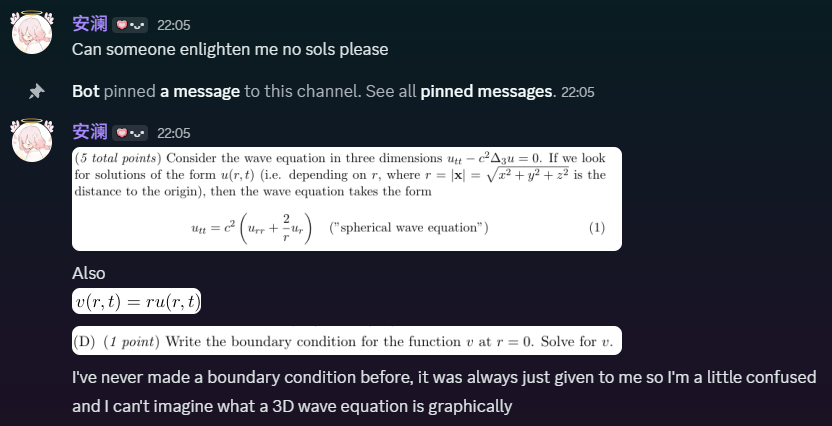
 opaque ember
@wary current
a typical requirement on solutions is regularity aka "nice" behavior
in this case it means no blow ups at r=0
$\lim_{r\to0}u(r,t)$ exists and is finite
soft zealotBOT
ロケット・ジャンプ
 final saddleBOT
@opaque ember Has your question been resolved?
opaque ember
no
 wary current
opaque ember
a typical requirement on solutions is regularity aka "nice" behavior
wary current
opaque ember
a typical requirement on solutions is regularity aka "nice" behavior
intuition tells me v(0,t) = 0
opaque ember
i gave a limit for u, how does it become a limit for v?
wary current
opaque ember
i gave a limit for u, how does it become a limit for v?
I'm sorry I'm just really lost :') Here is what I thought: If limit exists, u(0,t) = 0. v(0,t) = 0*u(0,t) = 0
opaque ember
there should be limits not plugging r=0
wary current
I genuinely have no clue what you are even speaking of :(
I will return to my textbook and do some more reading
Thank you through I'll revisit if I have questions

opaque ember
write $\lim_{r\to0}$ instead of $u(0,t)$
soft zealotBOT
ロケット・ジャンプ
 opaque ember
i started by saying $\lim_{r\to0}u(r,t)$ exists and is finite
soft zealotBOT
ロケット・ジャンプ
 opaque ember
$\lim_{r\to0}v(r,t)=~?$
soft zealotBOT
ロケット・ジャンプ
 final saddleBOT
@opaque ember Has your question been resolved?
final saddleBOT
Channel closed
Closed due to timeout
Use .reopen if this was a mistake.
final saddleBOT
Available help channel!
Send your question here to claim the channel.
Remember:
• Ask your math question in a clear, concise manner.
• Show your work, and if possible, explain where you are stuck.
• After 15 minutes, feel free to ping <@&286206848099549185>.
• Type the command .close to free the channel when you're done.
• Be polite and have a nice day!
Read #❓how-to-get-help for further information on how to ask a good question, and about conduct in the question channels.
 round cedar
hey, is this a good way to show that the limit for XCOS(1/X) exists?
 round cedar
when x=1/t
tired walrus
lim[t->infty] cos(t) does not exist
so no this is not good
the substitution by itself is OK but what you do with it afterwards is a no
round cedar
but cost is between -1 to 1
 lofty sinew
Hmmm... Breaking the limit into both the top and bottom of the fraction might not be a good idea, yea
tired walrus
round cedar
but cost is between -1 to 1
ok then apply squeeze theorem.
don't refer to nonexistent things!
lofty sinew
Talking about how cost is bounded by 1 and dividing by an ever increasing value goes to 0 is solid though
You might wanna also include t -> -infinity, since going to positive infinity is the same as x going to 0 from the positive side
round cedar
lofty sinew
Talking about how cost is bounded by 1 and dividing by an ever increasing value ...
btw i mean showing theres a limit for x-->0 but sry idont mean that x=0 is continuous for this function
so i just need to show that the limit exists
for x--->0
lofty sinew
You don't need to show that the limit is the same regardless of the direction?
tired walrus
i think i have made myself clear but i can repeat myself if anyone wants to
round cedar
lofty sinew
You don't need to show that the limit is the same regardless of the direction?
yep
round cedar
tired walrus
ok then apply squeeze theorem.
thats a good idea
so starting with cosx between -1 and 1 is good?
lofty sinew
Yeah
tired walrus
round cedar
so starting with cosx between -1 and 1 is good?
yes. that's how you put your intuition of cos being bounded into something rigorous
final saddleBOT
@round cedar Has your question been resolved?
round cedar
@tired walrus @lofty sinew do i need to show it for both x--->+-0 ?

 pliant parcel
!noping
final saddleBOT
Please do not ping individual helpers unprompted.
round cedar
pliant parcel
!noping
?
tired walrus
pliant parcel
!noping
n/a here
tired walrus
round cedar
<@183668144404037632> <@196447219484852224> do i need to show it for both x--->+...
yes you do
round cedar
tired walrus
yes you do
ok and then if for both t--->+-∞ its ok then theres a limit for x--->0?
tired walrus
yes
final saddleBOT
Channel closed
Closed by @round cedar
Use .reopen if this was a mistake.
Available help channel!
Send your question here to claim the channel.
Remember:
• Ask your math question in a clear, concise manner.
• Show your work, and if possible, explain where you are stuck.
• After 15 minutes, feel free to ping <@&286206848099549185>.
• Type the command .close to free the channel when you're done.
• Be polite and have a nice day!
Read #❓how-to-get-help for further information on how to ask a good question, and about conduct in the question channels.
round cedar
hey i need to prove limit for x--->0 so i did x=1/t with the squeeze theorem but im having hard time cuz t-->+∞ for +-1/t is +-0..
 final saddleBOT
round cedar
hey i need to prove limit for x--->0 so i did x=1/t with the squeeze theorem but...
tired walrus
final saddleBOT
round cedar
hey i need to prove limit for x--->0 so i did x=1/t with the squeeze theorem but...
tired walrus
±0 is 0...
dapper hull
plus minus 0 finally
final saddleBOT
Channel closed
Closed by @round cedar
Use .reopen if this was a mistake.
final saddleBOT
Available help channel!
Send your question here to claim the channel.
Remember:
• Ask your math question in a clear, concise manner.
• Show your work, and if possible, explain where you are stuck.
• After 15 minutes, feel free to ping <@&286206848099549185>.
• Type the command .close to free the channel when you're done.
• Be polite and have a nice day!
Read #❓how-to-get-help for further information on how to ask a good question, and about conduct in the question channels.
round cedar
i need to show that g is continuous for every x. i proved for x=0 now i need for ≠ 0 . i know that theres a limit for x-->a for 1/x and that polynominals are continuous. is that ok?

 final saddleBOT
round cedar
i need to show that g is continuous for every x. i proved for x=0 now i need for...
final saddleBOT
round cedar
i need to show that g is continuous for every x. i proved for x=0 now i need for...
 marsh temple
i know that theres a limit for x-->a for 1/x
I'm not super thrilled with this wording
but 0 is the only spot you have to concern yourself with
 final saddleBOT
@round cedar Has your question been resolved?
lofty sinew

Mathematics LibreTexts
final saddleBOT
Channel closed
Closed by @round cedar
Use .reopen if this was a mistake.
Available help channel!
Send your question here to claim the channel.
Remember:
• Ask your math question in a clear, concise manner.
• Show your work, and if possible, explain where you are stuck.
• After 15 minutes, feel free to ping <@&286206848099549185>.
• Type the command .close to free the channel when you're done.
• Be polite and have a nice day!
Read #❓how-to-get-help for further information on how to ask a good question, and about conduct in the question channels.
 jade fable
<x1>=1,2,3,4
<x2>=1/2, 1, 3/2, 2.
final saddleBOT
jade fable
<x1>=1,2,3,4
<x2>=1/2, 1, 3/2, 2.
jade fable
Let's say the standard deviation of <x1> is d
 fiery bluff
These are vectors?
jade fable
what is the standard deviation of <x2>
fiery bluff
Hmm... these are probability distributions?
jade fable
just some data set
severe verge
wonder why they gave d?
fiery bluff
And x2 is from scaling down x1, right?
jade fable
severe verge
wonder why they gave d?
because it is not important to calculate the exact value of d?
jade fable
fiery bluff
And x2 is from scaling down x1, right?
yes
fiery bluff
Do you remember the expression for standard deviation
final saddleBOT
Channel closed
Closed by @jade fable
Use .reopen if this was a mistake.
fiery bluff
From there you can figure how it changes when data changes
final saddleBOT
Available help channel!
Send your question here to claim the channel.
Remember:
• Ask your math question in a clear, concise manner.
• Show your work, and if possible, explain where you are stuck.
• After 15 minutes, feel free to ping <@&286206848099549185>.
• Type the command .close to free the channel when you're done.
• Be polite and have a nice day!
Read #❓how-to-get-help for further information on how to ask a good question, and about conduct in the question channels.
golden hollow
i need to find the tangent? (not sure if correct translation) where it goes through the X-axis in a place thats not (0,0) with the function f(x)=x^2+2x-3 and ive got no clue how to go about it
final saddleBOT
golden hollow
i need to find the tangent? (not sure if correct translation) where it goes thro...
 golden hollow
i know when given the value of X but without it im lost
terse crypt
do u know how to find derivative
terse crypt
2x+2
golden hollow
oh yeah oops
terse crypt
ok
let our point of interest be (a,f(a))
so the tangent eq would be
[ y = (2a + 2)(x-a) + f(a)]
right?
soft zealotBOT
k
 golden hollow
yeah
terse crypt
good
for this thing
to pass through the x-axis thats not (0,0)
whats the condition
golden hollow
(2a+2)(x-a)+f(a)=0 while x=/=0
terse crypt
soft zealot
**k**
in other words (x,y) = (0,0) mustnt be a solution to this
since y is linear, it will always cross the x-axis anyway
so
$0 = (2a + 2)(-a) + a^2 + 2a - 3$ should have no solution
soft zealotBOT
k
 terse crypt
@golden hollow
golden hollow
huh now im lost again
terse crypt
soft zealot
**k**
(0,0) mustnt be a solution to this
so if we plug x=0, y=0 in
we shouldnt get an answer, right?
else
if we get an answer, the thing crosses (0,0)
golden hollow
oh okay
terse crypt
soft zealot
**k**
can u find when this has no solution
golden hollow
in almost all cases it has no solution no?
terse crypt
hmm lets see
this simplifies to
$0 = -a^2 - 3$. So the discriminant is ${0^2 - 4(-1)(-3) = -12}$
which is negative...
soft zealotBOT
k
 golden hollow
👍
terse crypt
oh
it never crosses (0,0)
which agrees with our result
i thought the result was wrong lol
@golden hollow it can never cross (0,0)
as our working has suggested lol
deductive reasoning is quite smth
golden hollow
wait holdon this made me realize i looked at the wrong value for this one

in said point X=1
terse crypt
oh
golden hollow
wait holdon let me read over this again im sorry
terse crypt
so (1,0)?
terse crypt
golden hollow
wait holdon let me read over this again im sorry
alrighty
golden hollow
😔 trying to translate while not understanding the maths made me mess up
alright so earlier i had to find line K in point A (1,0) which was Y=4x-4.
the next question goes like this "the graph of F, not only cuts through the X-axis in point A (1,0) but also point C(?,0) . The line M touches f(x)=x^2+2x-3 in point C(?,0) . make the function for line M
terse crypt
im having trouble understanding that
could u put ur question through google translate or smth ;-;
golden hollow
ill do that
The graph of f intersects the x-axis not only at point a but also at point c. Line m touches the graph of f at point c. Write down the equation of m.
point a in this case being (1,0)
terse crypt
any more information abt f?
golden hollow
yep
golden hollow
correct
soft zealotBOT
k
 golden hollow
im ending up on 0=-30
terse crypt
,w simplify (2a+2)(1-a) + a^2 + 2a - 3
soft zealotBOT



 Requested by nuclearinteraction
soft zealotBOT
Requested by nuclearinteraction
soft zealotBOT
k
 terse crypt
a = 1 is the only soln

which agrees with our result
so other than a = 1, the tangent line will not cross the x-aixs at (1,0)
golden hollow
hmm okay
final saddleBOT
Channel closed
Closed by @golden hollow
Use .reopen if this was a mistake.
Available help channel!
Send your question here to claim the channel.
Remember:
• Ask your math question in a clear, concise manner.
• Show your work, and if possible, explain where you are stuck.
• After 15 minutes, feel free to ping <@&286206848099549185>.
• Type the command .close to free the channel when you're done.
• Be polite and have a nice day!
Read #❓how-to-get-help for further information on how to ask a good question, and about conduct in the question channels.
 jagged flare
for all positive integer $n$, $f(n)=\sum_{d\in\bZ, d>0, d\equiv 1 \mod 2, d\mid n}(-1)^{\frac{d-1}{2}}$. Prove that:
final saddleBOT
jagged flare
for all positive integer $n$, $f(n)=\sum_{d\in\bZ, d>0, d\equiv 1 \mod 2, d\mid ...
soft zealotBOT
skissue.in.a.teacup
 jagged flare
for all positive integer $a$ then $f(2^a)=1$
soft zealotBOT
skissue.in.a.teacup
 jagged flare
if $p>2$ is prime and $b$ is a positive integer then $$f(p^a)=\begin{cases}
1+a & \mbox{if}; p\equiv 1\mod 4 \
1 & \mbox{if}; p\equiv 3\mod 4, a\equiv 0\mod 2 \
0 & \mbox{if}; p\equiv 3\mod 4, a\equiv 1\mod 2 \
\end{cases}$$
soft zealotBOT
skissue.in.a.teacup
 jagged flare
if $\gcd(M,N)=1$ then $f(MN)=f(M)f(N)$
soft zealotBOT
skissue.in.a.teacup
 jagged flare
im stuck on the last one
jagged flare
 lime crest
is the question all of these 3
lime crest
is the question all of these 3
part 1,2,3
lime crest
lime crest
gcd = 0???
do you mean = 1 vro
jagged flare
lime crest
do you mean = 1 vro
wdyt
 spring haven
soft zealot
**skissue.in.a.teacup**
spring haven
soft zealot
**skissue.in.a.teacup**
seems like a super convoluted way to write the number of odd factors of a number
jagged flare
odd factor 1 mod 4-odd factor 3 mod 4
lime crest
hmmm
$d = d_Md_N$ with $d_M,d_N$ odd and show that$$\ (-1)^{\frac{d-1}{2}} = (-1)^{\frac{d_M-1}{2}}(-1)^{\frac{d_N-1}{2}}$$
soft zealotBOT
Copter
 final saddleBOT
@jagged flare Has your question been resolved?
jagged flare
soft zealot
**Copter**
what is dM and dN supposed to even represent
lime crest
soft zealot
**skissue.in.a.teacup**
from this thingy
oh my gosh my keyboard is glitching
cya man 😭
final saddleBOT
@jagged flare Has your question been resolved?
 thin remnant
!xy
final saddleBOT
Please show the original problem, exactly as it was stated to you, with the entire original context. A picture or screenshot is best. If the original problem is not in English, then post it anyway! The additional context might still be helpful. Do your best to provide a translation.
thin remnant
if it isn't resolved yet, may I help
dusty quarry
soft zealot
**skissue.in.a.teacup**
the og problem is here
thin remnant
for all positive integer $n$, $f(n)=\sum_{d\in\bZ, d>0, d\equiv 1 \mod 2, d\mid n}(-1)^{\frac{d-1}{2}}$. Prove that: for all positive integer $a$ then $f(2^a)=1$
soft zealotBOT
Ren🍓
 jagged flare
thats part a
jagged flare
soft zealot
**skissue.in.a.teacup**
this is b
thin remnant
oh so you need help proving if gcd(M,N) = 1 then f(MN) = f(M)f(N) ?
jagged flare
yes