#help-36
1 messages · Page 58 of 1
 zealous glen
 quasi plinth
zealous glen
where'd you type that
quasi plinth
zealous glen
where'd you type that
notability for ipad
zealous glen
quasi plinth
notability for ipad
bro pls share your settings


 final saddleBOT
@quasi plinth Has your question been resolved?
Channel closed
Closed by @quasi plinth
Use .reopen if this was a mistake.
final saddleBOT
 Available help channel!
Send your question here to claim the channel.
Remember:
• Ask your math question in a clear, concise manner.
• Show your work, and if possible, explain where you are stuck.
• After 15 minutes, feel free to ping <@&286206848099549185>.
• Type the command .close to free the channel when you're done.
• Be polite and have a nice day!
Read #❓how-to-get-help for further information on how to ask a good question, and about conduct in the question channels.
 chilly wigeon
Hey anyone know what this symbol is? Is it like cartesian product but like up to any dimension?
 final saddleBOT
chilly wigeon
Hey anyone know what this symbol is? Is it like cartesian product but like up to...
final saddleBOT
chilly wigeon
Hey anyone know what this symbol is? Is it like cartesian product but like up to...
@chilly wigeon Has your question been resolved?
final saddleBOT
@chilly wigeon Has your question been resolved?
chilly wigeon
Itm ight just be a rule definiton nvm
final saddleBOT
@chilly wigeon Has your question been resolved?
Channel closed
Closed by @chilly wigeon
Use .reopen if this was a mistake.
Available help channel!
Send your question here to claim the channel.
Remember:
• Ask your math question in a clear, concise manner.
• Show your work, and if possible, explain where you are stuck.
• After 15 minutes, feel free to ping <@&286206848099549185>.
• Type the command .close to free the channel when you're done.
• Be polite and have a nice day!
Read #❓how-to-get-help for further information on how to ask a good question, and about conduct in the question channels.
 wanton mortar

 fast salmon
You might want to try help in #old-network as this is a math server and this doesn't seem like a math question
wanton mortar
fast salmon
You might want to try help in <#406129911992942593> as this is a math server and...
physics server isnt active
final saddleBOT
@wanton mortar Has your question been resolved?
wanton mortar
.close
final saddleBOT
Channel closed
Closed by @wanton mortar
Use .reopen if this was a mistake.
Available help channel!
Send your question here to claim the channel.
Remember:
• Ask your math question in a clear, concise manner.
• Show your work, and if possible, explain where you are stuck.
• After 15 minutes, feel free to ping <@&286206848099549185>.
• Type the command .close to free the channel when you're done.
• Be polite and have a nice day!
Read #❓how-to-get-help for further information on how to ask a good question, and about conduct in the question channels.
 old lichen
- show that if a natural number n is not divisible by 3 then, n²-1 is divisible by 3
- deduce that ab(a²-b²) is divisible by 3 whatever the natural numbers a and b
final saddleBOT
old lichen
1) show that if a natural number n is not divisible by 3 then, n²-1 is divisible...
old lichen
i already did the first one
suppose that
n² -1 is not divisible by 3. This means that
n² -1 is equivalent to 1 modulo 3 (because if n² −1 were equivalent to 0 modulo 3, this would mean that it is divisible by 3).
Now, let's look at quadratic residues modulo 3. The squares of the integers are congruent to 0 or 1 modulo 3. In other words,
n² is congruent to 0 or 1 modulo 3.
If n² is congruent to 0 modulo 3, then
n is divisible by 3, which would contradict our initial hypothesis that
n² is not divisible by 3.
If
n² is congruent to 1 modulo 3, then
n² −1 is congruent to 0 modulo 3, which means that
n² −1 is divisible by 3.
Thus, in both cases, we end up with a contradiction with the hypothesis that
n² −1 is not divisible by 3. Therefore, if
n is not divisible by 3, then
n² −1 is divisible by 3
now can someone help with the second one <@&286206848099549185> but not wiht the modulo method, i need to show that
ab(a² -b² )=n² -1
 tranquil pine
Case 1: a or b is divisble by 3
Case 2: a and b are both not divisible by 3
Then do something smart with what you proved by question 1
final saddleBOT
@old lichen Has your question been resolved?
final saddleBOT
Channel closed
Closed due to timeout
Use .reopen if this was a mistake.
Available help channel!
Send your question here to claim the channel.
Remember:
• Ask your math question in a clear, concise manner.
• Show your work, and if possible, explain where you are stuck.
• After 15 minutes, feel free to ping <@&286206848099549185>.
• Type the command .close to free the channel when you're done.
• Be polite and have a nice day!
Read #❓how-to-get-help for further information on how to ask a good question, and about conduct in the question channels.
old lichen
tranquil pine
Then do something smart with what you proved by question 1
what is the smart thing im supposed to do
final saddleBOT
old lichen
what is the smart thing im supposed to do
old lichen
i tried everything i know so the smart thing im supposed to do must be out of my knowledge which means even if i try to think about it (which i did) i wont be able to find it
tranquil pine
Do you see a similiratie between a^2-b^2 and n^2-1?
old lichen
tranquil pine
Do you see a similiratie between a^2-b^2 and n^2-1?
hmm n² -1²?
old lichen
 queen mica
you are supposed to think a lot
queen mica
you are supposed to think a lot
yeah sorry
tranquil pine
Exactly
old lichen
what do i say? that a² -b² looks like n² -1² therefore i replace it?
queen mica
what are you even doing
old lichen
queen mica
what are you even doing
trying to prove that ab(a² -b² ) is divisivle by 3 by showing that ab(a² -b² ) equals n² -1
tranquil pine
a^2-1 and b^2-1 are both divisible by 3. So their difference must be divisible by 3. Amd what is their difference?
old lichen
why ab divisible by 3?
tranquil pine
Its the other case where a or b is divisible by 3
queen mica
or
old lichen
ohhhh...
uh so i write that there are two cases
how do i end up showin the "="
betwen ab(a² -b² ) and n² -1
tranquil pine
They are both divisible by 3 but definitely not equal
Suppose a=3 and b=2, youll get n^2=31
Which obviously has no solution
old lichen
okay i'll just use the two cases method, write it in a paper and i'll ping u later so you let me know if the presentation of the answer is correct
old lichen
tranquil pine
Case 1: a or b is divisble by 3
here when u say divisible by 3 that means i'll write it as 2k.2k'(4k² -4k'² )
?
tranquil pine
What?
If a or b is divisible by 3 then everything with a factor a or a factor b is divisible by 3
old lichen
tranquil pine
If a or b is divisible by 3 then everything with a factor a or a factor b is div...
so there are 3 cases in total?
a divisible by 3, b divisible by 3, a and b divisible by 3
queen mica
wait wait wait
there are two cases but kinda like this:
- a divisible by 3 OR b divisible by 3
- both not divisible by 3
old lichen
queen mica
1) a divisible by 3 OR b divisible by 3
why "or" and not "and" !
queen mica
because
there's ab in the express
it multiplys a and b
so once one of them is divisble by 3,
it's divisible by 3
old lichen
oh okay i understand
so thats what he meant by everything thats factor by smtg divisible by three, is divisible by three
queen mica
maybe you can solve it now
old lichen
queen mica
maybe you can solve it now
ugh..im stuck at figuring out how to start my answer in paper
"we suppose that a or b is divisible by 3..."
what then
therefore ab(a² -b² ) is divisible by 3 ? it sounds rushed
queen mica
hmm?
if a is divisble by 3, ab is divisible by 3
if b is divisible by 3, ab is divisible by 3
if both are not divisible by 3, (you prove that a^2 - b^2 is divisible by 3)
old lichen
queen mica
if both are not divisible by 3, (you prove that a^2 - b^2 is divisible by 3)
oh and i already proved that
a² -b² =a² -1 -b² +1= a² -b²
right?
queen mica
hmm?
does that make any difference?
wait...
at question a) you proved that n^2 -1 is divisible by 3
so you can use it
old lichen
queen mica
so you can use it
yep if n² -1 divisible by 3 then a² -1 and b² -1 are divisible by 3
so after proving this second case
do i say that ab(a² -b² ) divisible by three
?
queen mica
uh
you should mention question a)
and a and b are both not divisible by 3
and prove it
great
final saddleBOT
Channel closed
Closed by @old lichen
Use .reopen if this was a mistake.
Available help channel!
Send your question here to claim the channel.
Remember:
• Ask your math question in a clear, concise manner.
• Show your work, and if possible, explain where you are stuck.
• After 15 minutes, feel free to ping <@&286206848099549185>.
• Type the command .close to free the channel when you're done.
• Be polite and have a nice day!
Read #❓how-to-get-help for further information on how to ask a good question, and about conduct in the question channels.
 brazen basalt
I'm trying to find the general formula for this sequence, 2, 6, -18, -54. In a way, it is a geometric sequence and I'm having a hard time trying to follow the sign rule. This is what I have found out. I'm just having a hard time applying it/converting it into a formula.
First term: **- **multiplied to **- **is +
Second term: **+ **multiplied to **+ **is +
Third term: **+ **multiplied to - is -
Fourth term: - multiplied to + is -
There are two parts to this sign manipulation. The first part is +,+,-,-,+,+ and so on and the second is the alternating positive and negative. I already have a formula for the second part, but I'm having a hard time turning the first part into an actual formula
final saddleBOT
brazen basalt
I'm trying to find the general formula for this sequence, 2, 6, -18, -54. In a w...
 tired walrus
well let's first clear up the misconception and say that this is not an actual geometric sequence.
brazen basalt
Yes, I understand that
tired walrus
however, the adjacent term ratios do alternate between 3 and -3.
brazen basalt
Yes
final saddleBOT
@brazen basalt Has your question been resolved?
final saddleBOT
@brazen basalt Has your question been resolved?
 final tangle
you can use (-1)^(floor((n-1)/2))
brazen basalt
final tangle
you can use (-1)^(floor((n-1)/2))
floor?
final tangle
the function that rounds the value down to the nearest integer
brazen basalt
final tangle
the function that rounds the value down to the nearest integer
do I jst like write raised to floor((n-1)/2)? not going to lie, I'm not quire familiar with raising it to floor and I don't know if it's appropriate.
Also, I did follow your formula but it's 1, -1, -1, 1 (or am I doing something wrong?). I guess I can just encase it in a negative so it'll become -, +, +, -
final tangle
are you starting your index at 1 or 0
brazen basalt
it starts at 1
final tangle
the you should be getting
1, 1 , -1 , -1 , 1, 1 etc
brazen basalt
final tangle
the you should be getting
1, 1 , -1 , -1 , 1, 1 etc
It does work. But is it appropriate to just raise it to floor? I am fearing that my teacher may not acknowledge it to just write (-1) that's raised to floor((n-1) / 2)
final tangle
yes.
brazen basalt
final tangle
yes.
I see. What made you think that we need to use the floor function and divide it over 2?
final tangle
well normally integers alternate between odd/even
0,1,2,3,4,5 etc
dividing by 2
0, 0.5, 1, 1.5,
etc
the integer parts repeat twice
brazen basalt
final tangle
well normally integers alternate between odd/even
0,1,2,3,4,5 etc
dividing by 2
...
Thank you so much for your help. Not going to lie, I've been stuck on this problem for hours lol
.close
final saddleBOT
Channel closed
Closed by @brazen basalt
Use .reopen if this was a mistake.
final saddleBOT
Available help channel!
Send your question here to claim the channel.
Remember:
• Ask your math question in a clear, concise manner.
• Show your work, and if possible, explain where you are stuck.
• After 15 minutes, feel free to ping <@&286206848099549185>.
• Type the command .close to free the channel when you're done.
• Be polite and have a nice day!
Read #❓how-to-get-help for further information on how to ask a good question, and about conduct in the question channels.
 uneven geyser
Hi
final saddleBOT
uneven geyser
Hi
uneven geyser
Hello guys, can any of you help me solve at least one of the following points.

just an exercise, I don't need more ;c
If you can't give me the answer, no problem, but I would like to know how to solve it on my own if necessary.
.close
final saddleBOT
Channel closed
Closed by @uneven geyser
Use .reopen if this was a mistake.
 wintry forge
i cant read the language its in but
uneven geyser
.reopen
final saddleBOT
✅
wintry forge
the first question needs cross product
uneven geyser
Straight. Calculate the parametric equation of the line that, when intercepted by the line with equation y = x + 3, forms an angle of 30°.
Is the first question in english
uneven geyser
Yes
wintry forge
so you need to have a line with a gradient of 15°
if gradient 1 = 45° gradient 1/3 will be 15°
uneven geyser
How do you know the angle of 45° and how can I propose the line with an angle of 15°
the ecuation in graphs is this
 wintry forge
okay it is 45° with respect to the x axis
so if you create a line with a 15° with respect to the x axis and intersects the the y = x + 3 you will solve the question
say y =(1/3)x + 3
wintry forge
yeap
to be honest it does not matter the the equation of the line is as long as the gradient is 1/3
uneven geyser
something like that?
 uneven geyser
the angle of 15°, is in middle of the lines?
wintry forge
the angle between the 2 lines is 30°
wintry forge
the angle between two lines are not with respect to any axis
they are just between the two lines
uneven geyser
To check the angle can I use this formula?
 wintry forge
im not too familiar with this but it should be so
 uneven geyser
m1 and m2 take the values, of the form: y=mx+b
y=x+3
gradient is m2
and
y=1/3x+3
1/3
the gradien m1
wintry forge
ahh i see erm then i think you can just apply the formula
tan30° = 1 - m1/ 1 + m1
then solve for m1
uneven geyser
m1 is the 1/3 or other?
wintry forge
m1 is the gradient of the line that will produce a 30° angle with your first line
uneven geyser
mmm

the exercise ask me: Calculate the parametric equation of the line, what is the parametric equation.
the line with gradient 1/4, give me a angle of 30° aprox
 uneven geyser
yeh
wintry forge
so is 1/3 the answer?
wintry forge
thats weird
uneven geyser
mmm
I honestly didn't understand my linear algebra teacher about this.
If the gradient is 1/4, the angle is aprox 30°

However, 1/4 is strange compared to the equation
.close
final saddleBOT
Channel closed
Closed by @uneven geyser
Use .reopen if this was a mistake.
final saddleBOT
Available help channel!
Send your question here to claim the channel.
Remember:
• Ask your math question in a clear, concise manner.
• Show your work, and if possible, explain where you are stuck.
• After 15 minutes, feel free to ping <@&286206848099549185>.
• Type the command .close to free the channel when you're done.
• Be polite and have a nice day!
Read #❓how-to-get-help for further information on how to ask a good question, and about conduct in the question channels.
 gusty tide
For k = 1 it is obvious to stand on lilypad 1
But for k>1 I'm not sure how to proceed, is there a solution via markov chains for k=2,3,4,5... ?
final saddleBOT
@gusty tide Has your question been resolved?
gusty tide
<@&286206848099549185>
gusty tide
Anyone help?
final saddleBOT
@gusty tide Has your question been resolved?
final saddleBOT
@gusty tide Has your question been resolved?
final saddleBOT
Channel closed
Closed due to timeout
Use .reopen if this was a mistake.
final saddleBOT
Available help channel!
Send your question here to claim the channel.
Remember:
• Ask your math question in a clear, concise manner.
• Show your work, and if possible, explain where you are stuck.
• After 15 minutes, feel free to ping <@&286206848099549185>.
• Type the command .close to free the channel when you're done.
• Be polite and have a nice day!
Read #❓how-to-get-help for further information on how to ask a good question, and about conduct in the question channels.
 hoary cairn
 final saddleBOT
hoary cairn
hoary cairn
final saddleBOT
hoary cairn
hoary cairn
How do I do question 9
 dawn steppe
,rotate
 soft zealotBOT
 final saddleBOT
@hoary cairn Has your question been resolved?
Channel closed
Closed by @hoary cairn
Use .reopen if this was a mistake.
final saddleBOT
Available help channel!
Send your question here to claim the channel.
Remember:
• Ask your math question in a clear, concise manner.
• Show your work, and if possible, explain where you are stuck.
• After 15 minutes, feel free to ping <@&286206848099549185>.
• Type the command .close to free the channel when you're done.
• Be polite and have a nice day!
Read #❓how-to-get-help for further information on how to ask a good question, and about conduct in the question channels.
 next pagoda
 final saddleBOT
next pagoda
final saddleBOT
next pagoda
 final saddleBOT
@next pagoda Has your question been resolved?
final saddleBOT
@next pagoda Has your question been resolved?
next pagoda
<@&286206848099549185>
final saddleBOT
@next pagoda Has your question been resolved?
Channel closed
Closed by @next pagoda
Use .reopen if this was a mistake.
final saddleBOT
Available help channel!
Send your question here to claim the channel.
Remember:
• Ask your math question in a clear, concise manner.
• Show your work, and if possible, explain where you are stuck.
• After 15 minutes, feel free to ping <@&286206848099549185>.
• Type the command .close to free the channel when you're done.
• Be polite and have a nice day!
Read #❓how-to-get-help for further information on how to ask a good question, and about conduct in the question channels.
 tropic blaze
Could anyone explain to me how unition operator works?
so for example if i say each element of t is an element of exactly 20 elements of x
then how can i find out the number of elements in x?
 final saddleBOT
tropic blaze
Could anyone explain to me how unition operator works?
so for example if i say e...
final saddleBOT
tropic blaze
Could anyone explain to me how unition operator works?
so for example if i say e...
 quaint basin
If t is an element of T, then t has to be an element of at least one of the sets X1 , ... , X50.
Also it has to be an element of at least one of the Y1 up to Yn (because of the equality).
But without further information, that's all we can say about t.
final saddleBOT
@tropic blaze Has your question been resolved?
tropic blaze
quaint basin
But without further information, that's all we can say about t.
lets say there are 6 elements of y in each of T
Also what is the concept of this operator ?
quaint basin
tropic blaze
Also what is the concept of this operator ?
Given two sets A and B, the union operator creates a new set, that contains all elements of A and from B. So just every element fron both sets and join them together to form a new set.
You can also do that for more than 2 sets, this is whats being done here
We have 50 sets X1 , ... , X50 and join them all to a new set, which is U Xi (i=1,...,50)
If you want to calculate the number of elements in T, then you need to account for elements that are in multiple of the subsets. Because if you just add the number of elements |X1| + ... |X50| then you counted them multiple times.
If this is your goal, the maybe what you're looking for is "Inclusion–exclusion principle"
tropic blaze
ok so one more question
so if we take that each xi contain 10 element and
since there are 20 elements of xi in T can i say that
can i say 50*10/20 = 25
is the number of elements of xi in T?
tropic blaze
quaint basin
We have 50 sets X1 , ... , X50 and join them all to a new set, which is U Xi (i...
if i write it like this does this also imply that each of those x1->x50 has the same number of elements in them?
quaint basin
tropic blaze
ok so one more question
so if we take that each xi contain 10 element and
sinc...
So if each of the Xi contains 10 elements, then T could also just consist of 10 elements. This would be true if all the Xi were equal. (Remember that each element of a set is only counted once, so for example the number of elements of {1,1,2,2,3,3} is 3)
tropic blaze
quaint basin
So if each of the Xi contains 10 elements, then T could also just consist of 10 ...
but we have stated that t consist of 20 elements right?
quaint basin
tropic blaze
but we have stated that t consist of 20 elements right?
Not really sure what you mean sorry😅 you mean t or T? t is not necessarily a set.
tropic blaze
quaint basin
Not really sure what you mean sorry😅 you mean t or T? t is not necessarily a s...
T
quaint basin
tropic blaze
ok so one more question
so if we take that each xi contain 10 element and
sinc...
I'm struggling to understand that. You said T has 20 elements and conclude that is has 25?
tropic blaze
quaint basin
I'm struggling to understand that. You said T has 20 elements and conclude that ...
oh im just dumb
tropic blaze
quaint basin
I'm struggling to understand that. You said T has 20 elements and conclude that ...
here is the actual question

i wanted to go in my own step by step manner but ig it would be better this way
quaint basin
Thanks for sharing, but I don't have any advice from the top of my head.
Looks like a puzzle-type question where I think I would try to scribble some examples on paper. So try if you can find an example of sets such that n=1, and all conditions are met. If you can't find one, then n is most likely bigger than 1, then try with n=2 and so on.
Try to see if you can find some pattern, that hints to the value of n.
tropic blaze
quaint basin
Try to see if you can find some pattern, that hints to the value of n.
i did it the way as i mentioned above and got 25 and
for y
the expected no is
5n
and the actual no is 6
since no of elements in each must be equal
5n/6 = 25
=> n= 30
tropic blaze
quaint basin
Try to see if you can find some pattern, that hints to the value of n.
here is the way they did it
 final saddleBOT
@tropic blaze Has your question been resolved?
final saddleBOT
Channel closed
Closed due to timeout
Use .reopen if this was a mistake.
tropic blaze
.reopen
final saddleBOT
✅
final saddleBOT
@tropic blaze Has your question been resolved?
final saddleBOT
Channel closed
Closed due to timeout
Use .reopen if this was a mistake.
final saddleBOT
Available help channel!
Send your question here to claim the channel.
Remember:
• Ask your math question in a clear, concise manner.
• Show your work, and if possible, explain where you are stuck.
• After 15 minutes, feel free to ping <@&286206848099549185>.
• Type the command .close to free the channel when you're done.
• Be polite and have a nice day!
Read #❓how-to-get-help for further information on how to ask a good question, and about conduct in the question channels.
 dreamy verge
Id there anyway someone can help me with physics?
final saddleBOT
dreamy verge
Id there anyway someone can help me with physics?
dreamy verge

 warm ether
there will be 2 components to the acceleration
the centripetal acceleration, and a tangential acceleration
dreamy verge
so would it be tan(90) since it turns 90 degrees ?
warm ether
would what be?
dreamy verge
idk im kind of lost on this question ive been having trouble on it for a few days
warm ether
tan(90) isnt even defined
dreamy verge
I just cant seem to understand
warm ether
whats the centripetal acceleration?
dreamy verge
its an object moving in a circular motion ?
warm ether
yeah, i mean whats the formula for it
dreamy verge
a=v^2/r
warm ether
good, so what value does a have in the question at this instant
warm ether
we only have one value at the instant we are observing
warm ether
no
dreamy verge
oh since thats the constant wed choose 15 ?
warm ether
i dont really like how youre describing that, v is certainly not constant here
but we are just looking at the instant where v=15
dreamy verge
ok so since the question is asking what the acceleration vector is at 15 wed choose that one right ?
warm ether
yes
dreamy verge
then wed square and divide and get 5 right ?
warm ether
,calc 15^2/45
soft zealotBOT
Result:
5
the 22 degrees has nothing to do with the question
at all, its just an example
you need to use the info in the first sentence
warm ether
yes, what does it say about them
dreamy verge
that 15 slows down to 12
warm ether
in how long
dreamy verge
after a second
warm ether
so whats the acceleration
dreamy verge
a=vf-vi/t
warm ether
sure
dreamy verge
so 15-12/1=3m/s^2
dreamy verge
-3m/s^2
warm ether
yes
okay so we have centripetal acceleration 5 and tangential acceleration -3
the next part is gonna require your diagram to be drawn better
i feel you didnt really understand what the question was describing
when you drew it
dreamy verge
Ye i have trouble with word problem
warm ether
at the instant that v=15, the car is moving due north, beginning to curve right
so its at the left side of a curve basically
ill try draw one for you since describing it may not be so clear
dreamy verge
ok thank you i really appreciate it
 dreamy verge
honestly not sure yet this is my first time taking physics
so im still learning the basics
warm ether
ah okay, no problem
if you have two (orthogonal) components, you can use pythagoras to find the resultant, one mo

you can construct a triangle like so
dreamy verge
a^2+b^2=c^2
warm ether
yeah, here we have R^2=5^2+3^2
where R is the magnitude of our resultant acceleration
dreamy verge
so it would be 5.83 ?
warm ether
,calc sqrt(25+9)
soft zealotBOT
Result:
5.8309518948453
seems so
now we only need the angle
thats the alpha in my diagram
how do you think you could find it?
dreamy verge
a=delta W x delta t
warm ether
youre overthinking it
dreamy verge
so wed have to move the w to the other side since we have acceleration
warm ether
warm ether
you dont need anything beyond this image
dreamy verge
opp/adj ?
dreamy verge
so 3/5 ?
dreamy verge
60 degrees ?
ohh so wed have to put that into my calcuator ?
tan^-1(3/5)*180/pi ?
warm ether
i did the 180/pi since it returns stuff in radians so i converted to degrees
you just need to do arctan(3/5) if your calc is in degrees
,w arctan(3/5) *180/pi
soft zealotBOT


 Requested by aldrnari_
dreamy verge
Requested by aldrnari_
dreamy verge
oh so that would be our answer ?
warm ether
not entirely no
still need to describe where that angle is
is it north of east, east of north, etc
warm ether
warm ether
might help to look at my compass
dreamy verge
would we have to31 degrees to north east ?
warm ether
no
dreamy verge
oh south east ?
warm ether
south east would be if our angle was 45
its not
we can say our acceleration is acting 31 degrees 'south of east'
dreamy verge
ohhh ok understood thank your for youre help
warm ether
no worries
dreamy verge
i really appreciate it have a great days thanks again
warm ether
you too
final saddleBOT
@dreamy verge Has your question been resolved?
Channel closed
Closed by @dreamy verge
Use .reopen if this was a mistake.
Available help channel!
Send your question here to claim the channel.
Remember:
• Ask your math question in a clear, concise manner.
• Show your work, and if possible, explain where you are stuck.
• After 15 minutes, feel free to ping <@&286206848099549185>.
• Type the command .close to free the channel when you're done.
• Be polite and have a nice day!
Read #❓how-to-get-help for further information on how to ask a good question, and about conduct in the question channels.
 manic vine
 final saddleBOT
manic vine
final saddleBOT
manic vine
 proud dock
Do you know the sum of all angles in a triangle?
wait, let me show and ask you this: where are you here?
!status
final saddleBOT
What step are you on?
1. I don't know where to begin
2. I have begun but got stuck midway
3. I got an answer but I'm told it's wrong
4. I got an answer and would like my work checked
5. I have a question about someone else's worked solution
6. None of the above
See, here's a fundamental fact that Every. Single. Triangle has.
The sum of all interior angles (all three angles) are equal to 180 degrees.
If you know two angles, a and b, you can find the third angle by doing 180 - a - b.
Did you know that?
manic vine
Yea but i do not know any of the angles
proud dock
Good that you know! I'll ask you about another fundamental idea.
How many degrees does a circle have?
manic vine
360
proud dock
And how many degrees does a half of a circle have?
manic vine
180
proud dock
And 180 degrees resemble a straight line, right? Do you understand why a straight line can resemble 180 degrees?
manic vine
Oh
proud dock
Aha? See the revelation? : DD
manic vine
So we can find 1 angle with 140+x=180
manic vine
But how i find the other ongle i need to be able to do the triangle sum theorem?
And find x
proud dock
hehe, we'll get to that.
But 140+x=180. By finding x here, you'll find the small acute angle next to that 140. u understand that right?
so its 180-140=x
manic vine
X=40
proud dock
Great great!
So we now know one of the three angles to make up 180 degrees.
40 + x1 + x2 = 180
And i'll ask you this: Do you know the three types of triangles that exist?
proud dock
Hehe! So what triangle do you think we are looking at?
manic vine
A isosceles
proud dock
bingo!
proud dock
When two sides are equal (shown by those small "-" striking through two sides), what can you say about the angles of an isosceles triangle?
proud dock
I love how you used that term, congruent, very mathematical i see : D ❤️ xD
But yes!
The angle where "x" is, is equal to the other unknown angle.
So this is true: When you have a triangle that has two equal sides, two of the angles are equal to each other.
Same reason for when a triangle has all three sides equal to each other, all the angles are the same.
So when we have:
40 + x1 + x2 = 180.
We know that x1 and x2 are the same, so x + x = 2x.. and we have...
40 + 2x = 180
you with me btw? @manic vine Let me know if I'm losing you or if there's something you dont understand :3
manic vine
I think i got it
proud dock
whatchu got? :3
manic vine
That x=70
manic vine
Thanks you!
proud dock
❤️ my pleasure, as long as you learned something new here!
manic vine
Btw i have other problem,can u help me?
proud dock
perhaps if they are small yeah, I do need to move on in a minute or two
manic vine
 proud dock
Ahh this is a cool continuation!
Remember what we talked about the sum of all angles in a triangle. You got 2x + 36 = 180.
And also recall what we talked about with straight lines. 180 degrees resemble a straight line too!
manic vine
Oh,its the same with angles
proud dock
yup! those small "-" lines resemble that they are equal
manic vine
So x=72
proud dock
yup! don't get too confused with the "x" that I said recently... that's for one of the unknown angles inside the triangle.
manic vine
I mean
proud dock
Now use that x to find the actual x that they are asking hehe
manic vine
So x equal 108
proud dock
yup!
proud dock
: D
final saddleBOT
@manic vine Has your question been resolved?
final saddleBOT
Channel closed
Closed due to timeout
Use .reopen if this was a mistake.
Available help channel!
Send your question here to claim the channel.
Remember:
• Ask your math question in a clear, concise manner.
• Show your work, and if possible, explain where you are stuck.
• After 15 minutes, feel free to ping <@&286206848099549185>.
• Type the command .close to free the channel when you're done.
• Be polite and have a nice day!
Read #❓how-to-get-help for further information on how to ask a good question, and about conduct in the question channels.
 ionic cape
<@&286206848099549185>
 final saddleBOT
ionic cape
<@&286206848099549185>
final saddleBOT
ionic cape
<@&286206848099549185>
 lethal totem
Impossible to determine by hand
ionic cape
it has to be possible some way
final saddleBOT
@ionic cape Has your question been resolved?
final saddleBOT
@ionic cape Has your question been resolved?
final tangle
have you tried anything yet?
final tangle
you're being silly
 bright epoch
i only ask bc (√5 + √2)²⁰ is just (√5 + √2)(√5 + √2)...(√5 + √2)
would the largest term in that not just be all the √5s multiplied 2gether?
final saddleBOT
@ionic cape Has your question been resolved?
Channel closed
Closed by @ionic cape
Use .reopen if this was a mistake.
Available help channel!
Send your question here to claim the channel.
Remember:
• Ask your math question in a clear, concise manner.
• Show your work, and if possible, explain where you are stuck.
• After 15 minutes, feel free to ping <@&286206848099549185>.
• Type the command .close to free the channel when you're done.
• Be polite and have a nice day!
Read #❓how-to-get-help for further information on how to ask a good question, and about conduct in the question channels.
 stray stump
 final saddleBOT
stray stump
stray stump
final saddleBOT
stray stump
stray stump
How do we show this is open?
 wraith oasis
Try to solve this, without a calculator ((4+19+121)-8)x6/7
wraith oasis
answer is 116.571428571
 grizzled tusk
it's open because the inequality is strict
so you don't have the boundary
consider B = {z in C, Re(az+b) <= 0}, the complement, the point z st Re(az+b) = 0 are the boundary and make it closed
obviously, if it's not considered trivial in your lesson, you should show it using one of your def of open
you could also show that f(z) = Re(az+b) is continuous
which would give the nice proof that f^-1(]0, inf[) is open, and it's A
or you could go back to the very definition of open by taking the usual distance as if you were in R² for metric spaces or whatever definition of open you're using
stray stump
I think I should use the definition of open sets: A subset $D \subseteq \mathbb{C}$ is open if $\forall z \in D, \exists r > 0$ such that $B_r(z) \subset D$.
soft zealotBOT
KN
 grizzled tusk
yes that's the metric space definition I was talking about
that's a way to do it
but you should remember the f^-1 thing too
when you have strict inequalities like that
it's a natural way too
because ]0, inf[ is open
so if f is continuous, f^-1(]0, inf[) too is open
stray stump
I see. I will keep that one in mind when it comes up later.
grizzled tusk
and A = f^-1(]0, inf[) for f(z) = Re(az+b)
stray stump
But if I wanted to use the metric space definition
I need to choose some r right?
I think $r = \Re{az+b} / 2$ works?
soft zealotBOT
KN
 stray stump
Or does that not make sense at all...
grizzled tusk
it definitely does make sense and it's the natural idea I had too, by drawing it in my head, but since your screenshot wasn't saying if a and b were real numbers I had to be careful
grizzled tusk
yes it should work although you still have to prove Br(z) is in A obviously, I think this r should work
stray stump
right. I will try something
grizzled tusk
let z in A
since a and b are real, Re(az+b) = aRe(z)+b > 0
so Re(z) > -b/a
the closest point of the boundary to z is u = -b/a + i*Im(z)
and the distance between z and u is Re(z)+b/a
so r = (Re(z)+b/a)/2 should be a suitable choice if I didn't make mistakes
and then for the proof you just have to use your distance to show that this r works because it will give that Re(z') for z' in Br(z) is > -b/a too
final saddleBOT
@stray stump Has your question been resolved?
final saddleBOT
Channel closed
Closed by @stray stump
Use .reopen if this was a mistake.
Available help channel!
Send your question here to claim the channel.
Remember:
• Ask your math question in a clear, concise manner.
• Show your work, and if possible, explain where you are stuck.
• After 15 minutes, feel free to ping <@&286206848099549185>.
• Type the command .close to free the channel when you're done.
• Be polite and have a nice day!
Read #❓how-to-get-help for further information on how to ask a good question, and about conduct in the question channels.
 eternal wharf
$\int_0^1 \arctan \left ( \frac{x - 1}{x} \right ) \dd{x}$
soft zealotBOT
! Arjunn
 eternal wharf
shortest hints please
final saddleBOT
@eternal wharf Has your question been resolved?
 torn elm
soft zealot
**! Arjunn**
torn elm
soft zealot
**! Arjunn**
integrate by parts
final saddleBOT
@eternal wharf Has your question been resolved?
eternal wharf
torn elm
integrate by parts
Like how?
grizzled tusk
with f = the whole thing and g' = 1
eternal wharf
No idea.
grizzled tusk
do you know integration by parts ?
grizzled tusk
no that's another concept
eternal wharf
Ohh that multiplication thing? Uv?
grizzled tusk
torn elm
eternal wharf
Like how?
 soft zealotBOT
 torn elm
soft zealot
torn elm
soft zealot
derivative of the numerator is 4x -2
so take 1/4 out to make 4x on the numerator
weite 4x as 4x -2 + 2
seperate into 2 fractions with numeraotr;
4x -2 and 2
soft zealotBOT
 eternal wharf
@torn elm
torn elm
soft zealot
highlighted + should be a -

and the other highlighted isnt ln
because numerator isnt derivative of denominator
take the 2 out
and complete the square on the bottom
final saddleBOT
@eternal wharf Has your question been resolved?
eternal wharf
torn elm
highlighted + should be a -
I multiplied it outside minus so+
torn elm
eternal wharf
I multiplied it outside minus so+
ah mb yes
but the integral was wrongly evaluated
final saddleBOT
@eternal wharf Has your question been resolved?
eternal wharf
.close
final saddleBOT
Channel closed
Closed by @eternal wharf
Use .reopen if this was a mistake.
final saddleBOT
Available help channel!
Send your question here to claim the channel.
Remember:
• Ask your math question in a clear, concise manner.
• Show your work, and if possible, explain where you are stuck.
• After 15 minutes, feel free to ping <@&286206848099549185>.
• Type the command .close to free the channel when you're done.
• Be polite and have a nice day!
Read #❓how-to-get-help for further information on how to ask a good question, and about conduct in the question channels.
 harsh gate
how do i convert ms-1 to ms-2
final saddleBOT
harsh gate
how do i convert ms-1 to ms-2
harsh gate
wait lemme recheck the question
harsh gate
 desert mantle
wdym
desert mantle
wdym
this
 desert mantle
acceleration is how the speed changes per second
desert mantle
you can read that from the graph
desert mantle
what is the speed at 12 seconds
harsh gate
15
desert mantle
what is it at 18 seconds?
harsh gate
20
desert mantle
so over 6 seconds the speed changed by 5
harsh gate
yes
desert mantle
so 5 m/s over 6 s
harsh gate
😅
desert mantle
$\frac{5 m/s}{6s}$
soft zealotBOT
Denascite
 harsh gate
is it 5m/6s?
desert mantle
which is $\frac 56 \frac{m}{s^2}$
soft zealotBOT
Denascite
 desert mantle
where did you lose the second s
harsh gate
so the final answer is 5m/6s^2 ?
final saddleBOT
@harsh gate Has your question been resolved?
Channel closed
Closed by @harsh gate
Use .reopen if this was a mistake.
Available help channel!
Send your question here to claim the channel.
Remember:
• Ask your math question in a clear, concise manner.
• Show your work, and if possible, explain where you are stuck.
• After 15 minutes, feel free to ping <@&286206848099549185>.
• Type the command .close to free the channel when you're done.
• Be polite and have a nice day!
Read #❓how-to-get-help for further information on how to ask a good question, and about conduct in the question channels.
 thorn tide
Hello, can you check if I write all of them correctly
final saddleBOT
thorn tide
Hello, can you check if I write all of them correctly
thorn tide

- a) polynomial func d) exponential func c) algebraic func f) logarifmic func e) rational func
- a) rational func b) exponential func c) root func d) power func f)rational func e) root func
final saddleBOT
@thorn tide Has your question been resolved?
final tangle
1e) not a rational function since numerator isn't a polynomial
2d) not a power function due to the +5
thorn tide
others are correct ?
<@&286206848099549185>
@soft zealot
@wet warren
others are correct ?
 leaden mulch
looks like it
final saddleBOT
Channel closed
Closed by @thorn tide
Use .reopen if this was a mistake.
Available help channel!
Send your question here to claim the channel.
Remember:
• Ask your math question in a clear, concise manner.
• Show your work, and if possible, explain where you are stuck.
• After 15 minutes, feel free to ping <@&286206848099549185>.
• Type the command .close to free the channel when you're done.
• Be polite and have a nice day!
Read #❓how-to-get-help for further information on how to ask a good question, and about conduct in the question channels.
 vale saffron
find all values of m for which $\frac{m-1}{m}$ belongs to the interval $[-2;3)$
final saddleBOT
vale saffron
find all values of m for which $\frac{m-1}{m}$ belongs to the interval $[-2;3)$
soft zealotBOT
qathh
 vale saffron
okejj im not too sure how to use latex that well so i'll just write my (incomplete) solution in text
-2 <= (m-1)/(m) < 3
-2m <= m-1 < 3m
-2m <= m-1
m-1 < 3m
m >= 1/3
m > -1/2
Ans.: m ∈ [1/3 ; +inf)
however if I use a value like -1 for m, it still fits but im not sure where i went wrong with this
I assume it has smth to do with the fact that m could be either positive or negative so i cant exactly just multiply the denominator out
<@&286206848099549185>
final tangle
there are issues with your work and the answer provided
in the case you should the work for,
it should be clearly stated that m>0 there
and then take the intersection of m>=1/3 and m>0
which is still m>=1/3
its unclear how you're getting the
m > -1/2
 stone wagon
soft zealot
**qathh**
stone wagon
soft zealot
**qathh**
start from the fact that $\frac{m-1}{m} = 1-\frac{1}{m}$ and you'll get your answer easily
soft zealotBOT
artemetra
 final saddleBOT
Channel closed
Closed by @vale saffron
Use .reopen if this was a mistake.
final tangle
(if it wasn't clear the provided answer was incomplete/wrong)
final saddleBOT
Available help channel!
Send your question here to claim the channel.
Remember:
• Ask your math question in a clear, concise manner.
• Show your work, and if possible, explain where you are stuck.
• After 15 minutes, feel free to ping <@&286206848099549185>.
• Type the command .close to free the channel when you're done.
• Be polite and have a nice day!
Read #❓how-to-get-help for further information on how to ask a good question, and about conduct in the question channels.
 rapid helm
 final saddleBOT
rapid helm
final saddleBOT
rapid helm
What step are you on?
1. I don't know where to begin
2. I have begun but got stuck midway
3. I got an answer but I'm told it's wrong
4. I got an answer and would like my work checked
5. I have a question about someone else's worked solution
6. None of the above
1
stone wagon
rapid helm
1
have you tried using the formula for sin(2 theta)? integration by parts?
rapid helm
stone wagon
have you tried using the formula for sin(2 theta)? integration by parts?
How will that help
stone wagon
idk, i an trying to bring I_2 to look similar to I_1
final saddleBOT
@rapid helm Has your question been resolved?
final saddleBOT
@rapid helm Has your question been resolved?
final saddleBOT
Channel closed
Closed due to timeout
Use .reopen if this was a mistake.
Available help channel!
Send your question here to claim the channel.
Remember:
• Ask your math question in a clear, concise manner.
• Show your work, and if possible, explain where you are stuck.
• After 15 minutes, feel free to ping <@&286206848099549185>.
• Type the command .close to free the channel when you're done.
• Be polite and have a nice day!
Read #❓how-to-get-help for further information on how to ask a good question, and about conduct in the question channels.
 arctic swallow
 final saddleBOT
arctic swallow
arctic swallow
final saddleBOT
arctic swallow
arctic swallow
What am I getting wrong here?
 amber moss
stone wagon
arctic swallow
amber moss
stone wagon
arctic swallow
it's (-4, 0], not (4, 0]
actually, i think it goes from -inf to inf, as crewmate said
arctic swallow
stone wagon
it's (-4, 0], not (4, 0]
Oh
stone wagon
so (-inf, -4) u (-4, +inf)
stone wagon
$(-\infty; -4) \cup (-4; +\infty)$
arctic swallow
Why don't they have arrows
soft zealotBOT
artemetra
 arctic swallow
Oh
stone wagon
there's nothing bounding it past those values
arctic swallow
OH I'M SO DUMB
I used [
Ok tyyyy
Random question could this be -infty and infty

I get why it's NONE
Ok this is unfair I ran out of tries and made a typo 💀💀
 final saddleBOT
@arctic swallow Has your question been resolved?
Channel closed
Closed by @arctic swallow
Use .reopen if this was a mistake.
final saddleBOT
Available help channel!
Send your question here to claim the channel.
Remember:
• Ask your math question in a clear, concise manner.
• Show your work, and if possible, explain where you are stuck.
• After 15 minutes, feel free to ping <@&286206848099549185>.
• Type the command .close to free the channel when you're done.
• Be polite and have a nice day!
Read #❓how-to-get-help for further information on how to ask a good question, and about conduct in the question channels.
 swift ridge
 final saddleBOT
swift ridge
swift ridge
final saddleBOT
swift ridge
swift ridge
how would i do this
 mint orbit
swift ridge
how would i do this
mint orbit
swift ridge
how would i do this
well an x intercept is a root...can you create a polynomial with the given roots?
swift ridge
I can use any x intercept?
mint orbit
huh? any?
mint orbit
i think the problem is asking you to describe this kind of polynomial generally 
so yea
 final saddleBOT
@swift ridge Has your question been resolved?
final saddleBOT
Channel closed
Closed by @swift ridge
Use .reopen if this was a mistake.
Available help channel!
Send your question here to claim the channel.
Remember:
• Ask your math question in a clear, concise manner.
• Show your work, and if possible, explain where you are stuck.
• After 15 minutes, feel free to ping <@&286206848099549185>.
• Type the command .close to free the channel when you're done.
• Be polite and have a nice day!
Read #❓how-to-get-help for further information on how to ask a good question, and about conduct in the question channels.
 gray pelican
Is the first problem correct
 final saddleBOT
gray pelican
Is the first problem correct
final saddleBOT
gray pelican
Is the first problem correct
@gray pelican Has your question been resolved?
final saddleBOT
Channel closed
Closed due to timeout
Use .reopen if this was a mistake.
final saddleBOT
Available help channel!
Send your question here to claim the channel.
Remember:
• Ask your math question in a clear, concise manner.
• Show your work, and if possible, explain where you are stuck.
• After 15 minutes, feel free to ping <@&286206848099549185>.
• Type the command .close to free the channel when you're done.
• Be polite and have a nice day!
Read #❓how-to-get-help for further information on how to ask a good question, and about conduct in the question channels.
 warped rivet
Cyclic groups just cause me confusion when it comes to definition
 warped rivet
By what phi does, we see phi(Z) = a^Z
 trail mango
bad notation?
warped rivet
?
trail mango
why are you using Z here?
warped rivet
Since it says so in the problem. Z as the set of all integers, no?
trail mango
phi(Z) has meaning to me (as the image of Z under phi) but i don't think you care about phi(Z) and saying it equals a^Z doesn't make sense
warped rivet
Presumably, phi(Z) would refer to phi(n), n belonging to Z, mapping into a^n. In this instance, phi(Z) is all n
trail mango
bad notation then
warped rivet
At least that would be my assumption
trail mango
i would just say phi(n) = a^n for any n in Z
warped rivet
Okay
Anyways, I need to show that is is equal to <a>, the cyclic group generated by a
trail mango
wait i'm so sorry i was reading 13
and thought phi(Z) had nothing to do with anything
warped rivet
Oh yeah, I should have specified. My bad
trail mango
lmao
trail mango
ok but still phi(Z) = a^Z doesn't make sense
trail mango
trail mango
phi(Z) has meaning to me (as the image of Z under phi) but i don't think you car...
and like i said here, phi(Z) is the image of Z under phi
warped rivet
Could I define Z as mp+q, such that it results in phi(mp+q)?
With m,p,&q being integers?
trail mango
you don't get to define $Z$ as anything, $\phi(Z)$ is the set $${\phi(0),\phi(1),\phi(-1),\phi(2),\phi(-2),\phi(3),\phi(-3),\ldots}$$
soft zealotBOT
layla
 warped rivet
I see. That makes sense
With that aspect, then the question is asking if every single item in that set may be a generator <a>?
trail mango
not sure what you're asking exactly but i'm gonna say no
also i'm sorry i have to go
warped rivet
Np. I'll ping another help. This was a great start
<@&286206848099549185>

It is question 14 I need help with. 13 is there for context
.close
final saddleBOT
Channel closed
Closed by @warped rivet
Use .reopen if this was a mistake.
Available help channel!
Send your question here to claim the channel.
Remember:
• Ask your math question in a clear, concise manner.
• Show your work, and if possible, explain where you are stuck.
• After 15 minutes, feel free to ping <@&286206848099549185>.
• Type the command .close to free the channel when you're done.
• Be polite and have a nice day!
Read #❓how-to-get-help for further information on how to ask a good question, and about conduct in the question channels.
 rose orbit
Idk what the hell is going on here:
 final saddleBOT
rose orbit
Idk what the hell is going on here:
rose orbit
final saddleBOT
rose orbit
Idk what the hell is going on here:
rose orbit
.close
final saddleBOT
Channel closed
Closed by @rose orbit
Use .reopen if this was a mistake.
Available help channel!
Send your question here to claim the channel.
Remember:
• Ask your math question in a clear, concise manner.
• Show your work, and if possible, explain where you are stuck.
• After 15 minutes, feel free to ping <@&286206848099549185>.
• Type the command .close to free the channel when you're done.
• Be polite and have a nice day!
Read #❓how-to-get-help for further information on how to ask a good question, and about conduct in the question channels.
 kindred timber
 final saddleBOT
kindred timber
kindred timber
final saddleBOT
kindred timber
kindred timber
please help
final saddleBOT
What step are you on?
1. I don't know where to begin
2. I have begun but got stuck midway
3. I got an answer but I'm told it's wrong
4. I got an answer and would like my work checked
5. I have a question about someone else's worked solution
6. None of the above
@kindred timber Has your question been resolved?
kindred timber
.close
final saddleBOT
Channel closed
Closed by @kindred timber
Use .reopen if this was a mistake.
Available help channel!
Send your question here to claim the channel.
Remember:
• Ask your math question in a clear, concise manner.
• Show your work, and if possible, explain where you are stuck.
• After 15 minutes, feel free to ping <@&286206848099549185>.
• Type the command .close to free the channel when you're done.
• Be polite and have a nice day!
Read #❓how-to-get-help for further information on how to ask a good question, and about conduct in the question channels.
 pastel jolt
 final saddleBOT
pastel jolt
pastel jolt
final saddleBOT
pastel jolt
pastel jolt
I just need to make a like chart
Like
Initial velocity
For horizontal and vertical
And delta x
And studf
<@&286206848099549185>
final saddleBOT
@pastel jolt Has your question been resolved?
final saddleBOT
Channel closed
Closed by @pastel jolt
Use .reopen if this was a mistake.
Available help channel!
Send your question here to claim the channel.
Remember:
• Ask your math question in a clear, concise manner.
• Show your work, and if possible, explain where you are stuck.
• After 15 minutes, feel free to ping <@&286206848099549185>.
• Type the command .close to free the channel when you're done.
• Be polite and have a nice day!
Read #❓how-to-get-help for further information on how to ask a good question, and about conduct in the question channels.
 tough sinew
Using the law of simplifcation(#2) can you also conclude that statement implies c. If so how would you solve the full statement
 final saddleBOT
tough sinew
Using the law of simplifcation(#2) can you also conclude that statement implies ...
tough sinew
final saddleBOT
tough sinew
Using the law of simplifcation(#2) can you also conclude that statement implies ...
tough sinew
<@&286206848099549185>
final saddleBOT
@tough sinew Has your question been resolved?
tough sinew
<@&286206848099549185>
final saddleBOT
What step are you on?
1. I don't know where to begin
2. I have begun but got stuck midway
3. I got an answer but I'm told it's wrong
4. I got an answer and would like my work checked
5. I have a question about someone else's worked solution
6. None of the above
- I have a question about someone else's worked
final saddleBOT
@tough sinew Has your question been resolved?
tough sinew
<@&286206848099549185>
tough sinew
<@&286206848099549185> I know I have been pinging so much but it's been over 2 hours
final saddleBOT
@tough sinew Has your question been resolved?
final saddleBOT
Channel closed
Closed due to timeout
Use .reopen if this was a mistake.
final saddleBOT
Available help channel!
Send your question here to claim the channel.
Remember:
• Ask your math question in a clear, concise manner.
• Show your work, and if possible, explain where you are stuck.
• After 15 minutes, feel free to ping <@&286206848099549185>.
• Type the command .close to free the channel when you're done.
• Be polite and have a nice day!
Read #❓how-to-get-help for further information on how to ask a good question, and about conduct in the question channels.
 unique umbra
hi, for this problem, how do I check the sign of the diff eq in the neighborhood of the two critical points (P = 0 and P=a/b)
final saddleBOT
unique umbra
hi, for this problem, how do I check the sign of the diff eq in the neighborhood...
unique umbra
 final saddleBOT
@unique umbra Has your question been resolved?
final saddleBOT
Channel closed
Closed due to timeout
Use .reopen if this was a mistake.
Available help channel!
Send your question here to claim the channel.
Remember:
• Ask your math question in a clear, concise manner.
• Show your work, and if possible, explain where you are stuck.
• After 15 minutes, feel free to ping <@&286206848099549185>.
• Type the command .close to free the channel when you're done.
• Be polite and have a nice day!
Read #❓how-to-get-help for further information on how to ask a good question, and about conduct in the question channels.
 normal juniper
can someone explain how to use the trapezoidal rule to calculate the volume of the following solid
 final saddleBOT
normal juniper
can someone explain how to use the trapezoidal rule to calculate the volume of t...
normal juniper
final saddleBOT
normal juniper
can someone explain how to use the trapezoidal rule to calculate the volume of t...
normal juniper
like this
 final saddleBOT
@normal juniper Has your question been resolved?
normal juniper
<@&286206848099549185>
 severe hawk
first, you want to calculate the area under the curve between x=1 and x=2
thats where you use the trapezoid rule
then you calculate the volume generated by the "donut"
final saddleBOT
@normal juniper Has your question been resolved?
normal juniper
severe hawk
first, you want to calculate the area under the curve between x=1 and x=2
that would be 3
oh nvm thats for a trapezium
the full thing would be 2.885
.close
final saddleBOT
Channel closed
Closed by @normal juniper
Use .reopen if this was a mistake.
Available help channel!
Send your question here to claim the channel.
Remember:
• Ask your math question in a clear, concise manner.
• Show your work, and if possible, explain where you are stuck.
• After 15 minutes, feel free to ping <@&286206848099549185>.
• Type the command .close to free the channel when you're done.
• Be polite and have a nice day!
Read #❓how-to-get-help for further information on how to ask a good question, and about conduct in the question channels.
 keen laurel
Course: Linear algebra For the second line of the proof, why is W the span of those two vectors?
 final saddleBOT
keen laurel
Course: Linear algebra For the second line of the proof, why is W the span of th...
keen laurel
final saddleBOT
keen laurel
Course: Linear algebra For the second line of the proof, why is W the span of th...
keen laurel
Also, the question says find a subspace W of F^4 being the direct sum of U and W
final saddleBOT
@keen laurel Has your question been resolved?
keen laurel
<@&286206848099549185>
final saddleBOT
@keen laurel Has your question been resolved?
keen laurel
.close
final saddleBOT
Channel closed
Closed by @keen laurel
Use .reopen if this was a mistake.
Available help channel!
Send your question here to claim the channel.
Remember:
• Ask your math question in a clear, concise manner.
• Show your work, and if possible, explain where you are stuck.
• After 15 minutes, feel free to ping <@&286206848099549185>.
• Type the command .close to free the channel when you're done.
• Be polite and have a nice day!
Read #❓how-to-get-help for further information on how to ask a good question, and about conduct in the question channels.
 smoky plover
Hello
final saddleBOT
smoky plover
Hello
soft zealotBOT
Adam Chebil

 untold mortar
soft zealot
**Adam Chebil**
untold mortar
soft zealot
**Adam Chebil**
because infinity is not a real number in math we don't consider it
smoky plover
1^n is 1? So 1^inf should also be 1
smoky plover
desert mantle
limits of that form are indeterminate
Yeah when evaluating limits
desert mantle
anything involving the symbol inf as a "number" directly is immediately undefined
well because those limits can quite literally equal anything
smoky plover
1/inf is undefined?
desert mantle
ok let me rephrase, as long as we stick to the real numbers
a limit of the form 1/inf is equal to 0
desert mantle
desert mantle
well because those limits can quite literally equal anything
as an example, you have $\lim_{n\to\infty} \left(1-\frac1n\right)^n = \frac1e$ but $\lim_{n\to\infty} \left(1+\frac1n\right)^n = e$. both are not equal to 1

 desert mantle
yes
smoky plover
soft zealot
**Denascite**
How did u evaluate those limits though
Cause the result seems to be 1 for me
final saddleBOT
Channel closed
Closed by @smoky plover
Use .reopen if this was a mistake.
final saddleBOT
Available help channel!
Send your question here to claim the channel.
Remember:
• Ask your math question in a clear, concise manner.
• Show your work, and if possible, explain where you are stuck.
• After 15 minutes, feel free to ping <@&286206848099549185>.
• Type the command .close to free the channel when you're done.
• Be polite and have a nice day!
Read #❓how-to-get-help for further information on how to ask a good question, and about conduct in the question channels.
 amber rivet
What is a general formula for the det of a matrix?
final saddleBOT
amber rivet
What is a general formula for the det of a matrix?
amber rivet
Like no matter how big
desert mantle
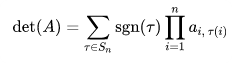
 amber rivet
desert mantle
https://i.imgur.com/Pv8w0qf.png
amber rivet
desert mantle
https://i.imgur.com/Pv8w0qf.png
And how do I use this
desert mantle
you dont
desert mantle
it exists. thats about the only nice thing you can say about it
what kind of proof
desert mantle
what properties of determinants do you know
amber rivet
amber rivet
Proof that the det of an square antisymetrical matrix is zero
It must have an uneven amount of columns and rows
Cuz it's not true for an even amount
amber rivet
desert mantle
what properties of determinants do you know
Uh I assume most of them
But we learned them like last week in a lecture and I haven't rlly learned to use them
I have been going through my textbook trying to get it
amber rivet
amber rivet
Uh I assume most of them
I can list them if you want
amber rivet
desert mantle
can you express det(cA) and det(A^T) in terms of det(A)
Det(A) = det(A^T)
That's what we learned
desert mantle
yes
desert mantle
no
amber rivet
Give me a sec I will try to figure it out
If I can't find it in like 10 min I will ping again if that's OK?
desert mantle
yes
final saddleBOT
Channel closed
Closed by @amber rivet
Use .reopen if this was a mistake.
Available help channel!
Send your question here to claim the channel.
Remember:
• Ask your math question in a clear, concise manner.
• Show your work, and if possible, explain where you are stuck.
• After 15 minutes, feel free to ping <@&286206848099549185>.
• Type the command .close to free the channel when you're done.
• Be polite and have a nice day!
Read #❓how-to-get-help for further information on how to ask a good question, and about conduct in the question channels.
 little python
How can $\sin{\theta}=0$ have 3 principle solutions
final saddleBOT
little python
How can $\sin{\theta}=0$ have 3 principle solutions
soft zealotBOT
!Yajat!
 little python
but principle solutions exist between [0,2π)
so we wont include 2pi right?, if so then there should be 2 principle solutions
 tardy trellis
well if its 3 then obviously it includes 2pi
little python
little python
but principle solutions exist between **[**0,2π**)**
?
tardy trellis
 little python
what aabout this?
tardy trellis
idk but if ur excluding 2pi then its 2
little python
😭
 little python
tardy trellis
idk but if ur excluding 2pi then its 2
little python
tardy trellis
idk but if ur excluding 2pi then its 2
ok, ill consider both correct, ty
.close
final saddleBOT
Channel closed
Closed by @little python
Use .reopen if this was a mistake.
Available help channel!
Send your question here to claim the channel.
Remember:
• Ask your math question in a clear, concise manner.
• Show your work, and if possible, explain where you are stuck.
• After 15 minutes, feel free to ping <@&286206848099549185>.
• Type the command .close to free the channel when you're done.
• Be polite and have a nice day!
Read #❓how-to-get-help for further information on how to ask a good question, and about conduct in the question channels.
Channel closed
Closed due to the original message being deleted
final saddleBOT
Available help channel!
Send your question here to claim the channel.
Remember:
• Ask your math question in a clear, concise manner.
• Show your work, and if possible, explain where you are stuck.
• After 15 minutes, feel free to ping <@&286206848099549185>.
• Type the command .close to free the channel when you're done.
• Be polite and have a nice day!
Read #❓how-to-get-help for further information on how to ask a good question, and about conduct in the question channels.
 hidden kiln
can someone help me with this pls
 final saddleBOT
hidden kiln
can someone help me with this pls
final saddleBOT
hidden kiln
can someone help me with this pls
@hidden kiln Has your question been resolved?
hidden kiln
<@&286206848099549185>
hidden kiln
I know that the total no. of people in favour of the resolution is (x/2)+7
and against is (x/2)-7
and the total no. of people holding both their hands is (0.06)(x/2)+7
final saddleBOT
@hidden kiln Has your question been resolved?
final saddleBOT
@hidden kiln Has your question been resolved?
 jaunty portal
hidden kiln
I know that the total no. of people in favour of the resolution is (x/2)+7
jaunty portal
hidden kiln
I know that the total no. of people in favour of the resolution is (x/2)+7
Hello, are you sure of this? 🤔
What is x in this case
Also, it says that there was a majority of 2 against the resolution
So the number of No was 2 more than the number of Yes
N = Y+2
final saddleBOT
Channel closed
Closed due to timeout
Use .reopen if this was a mistake.
Available help channel!
Send your question here to claim the channel.
Remember:
• Ask your math question in a clear, concise manner.
• Show your work, and if possible, explain where you are stuck.
• After 15 minutes, feel free to ping <@&286206848099549185>.
• Type the command .close to free the channel when you're done.
• Be polite and have a nice day!
Read #❓how-to-get-help for further information on how to ask a good question, and about conduct in the question channels.
 cold basin
 final saddleBOT
cold basin
cold basin
final saddleBOT
cold basin
cold basin
How can I solve this using matrices?
of course i can get it too
1 1 -2 4
-6 0 5 -6
-3 3 -1 6
but im not rlly sure how im supposed to make the values waht theyre supposed to be
 languid slate
a matrix is solved whenever it is in row reduced echelon form. You can add rows together to get rid of coefficients. For example 6 times Row 1 + Row 2 = 0 6 -7 18.
Keep doing this until its in row reduced echelon form.
see this youtube video for a more indepth explantion:

This precalculus video tutorial provides a basic introduction into the gauss jordan elimination which is a process used to solve a system of linear equations by converting the system into an augmented matrix and using elementary row operations to convert the 3x3 matrix into its reduced row echelon form. You can easily determine the answers once...
final saddleBOT
Channel closed
Closed by @cold basin
Use .reopen if this was a mistake.
Available help channel!
Send your question here to claim the channel.
Remember:
• Ask your math question in a clear, concise manner.
• Show your work, and if possible, explain where you are stuck.
• After 15 minutes, feel free to ping <@&286206848099549185>.
• Type the command .close to free the channel when you're done.
• Be polite and have a nice day!
Read #❓how-to-get-help for further information on how to ask a good question, and about conduct in the question channels.
 peak zinc
can someone help me with this?
 final saddleBOT
peak zinc
can someone help me with this?
final saddleBOT
peak zinc
can someone help me with this?
 keen nacelle
!status
final saddleBOT
What step are you on?
1. I don't know where to begin.
2. I have begun but got stuck midway.
3. I got an answer but I was told that it's wrong.
4. I got an answer and would like my work checked.
5. I have a question about someone else's work/solution.
6. I have completed the problem and don't need help anymore. Thank you.
7. None of the above
3
This is what I got, but the answers are -0.085 and -0.014

ah wait wrong picture

<@&286206848099549185>
 unkempt moon
If no one does this I’ll do it first thing in the morning (gmt+1)
peak zinc
unkempt moon
If no one does this I’ll do it first thing in the morning (gmt+1)
ok then, make sure to @ or message me so i see it
ill msg you if someone else does it
unkempt moon
👌
final saddleBOT
@peak zinc Has your question been resolved?
peak zinc
<@&286206848099549185>
peak zinc
peak zinc
help with this
im not sure what i did wrong, but the answers are -0.085 and -0.014
peak zinc
peak zinc
can someone help me with this?
heres the question
why did you ask what i needed help with then?
final saddleBOT
@peak zinc Has your question been resolved?
Channel closed
Closed by @peak zinc
Use .reopen if this was a mistake.
final saddleBOT
Available help channel!
Send your question here to claim the channel.
Remember:
• Ask your math question in a clear, concise manner.
• Show your work, and if possible, explain where you are stuck.
• After 15 minutes, feel free to ping <@&286206848099549185>.
• Type the command .close to free the channel when you're done.
• Be polite and have a nice day!
Read #❓how-to-get-help for further information on how to ask a good question, and about conduct in the question channels.
 thorn fern
I get the proof for why a perfect square is not congruent to 2 (mod 3) but i dont understand why this solutions says it needs to have 3 cases for 0 mod (3) and 1 mod (3) why isnt it enough to just prove 2 mod(3)?
 final saddleBOT
thorn fern
I get the proof for why a perfect square is not congruent to 2 (mod 3) but i don...
final saddleBOT
thorn fern
I get the proof for why a perfect square is not congruent to 2 (mod 3) but i don...
 barren hound
it's a bit silly but it's because the directions say to prove it by contrapositive
thorn fern
???
so proving that it is not congruent to 2 mod 3 requires you to prove for all the numbers from 2 to 0?
🤔
thorn fern
barren hound
it's a bit silly but it's because the directions say to prove it by contrapositi...
in case 3 it proves its not equal to 2 (mod 3) so i dont see why cases 1 and 2 are even necessary
🤔
barren hound
n is a perfect square, so it's equal to m^2 for some m
we don't know anything about this m
but we know that m is either equivalent to 0, 1, or 2 (mod 3)
and if we try each of those, then we find that in every case, n is not equal to 2 (mod 3)
thorn fern
how do you know that it is equivilenct to 0 1 or 2?
barren hound
well, because it's an integer
and those are the only things it can be equal to (mod 3)
it's like saying a number is either even or odd
thorn fern
wait so why are you not trying 3 (mod 3) is my question i guess
barren hound
3 (mod 3) is the same as 0
barren hound
0, 3, 6, 9, 12, ... those are all equivalent to 0 (mod 3)
thorn fern
so as long as you check 0 1 2 you cover all possible congruences
barren hound
yep
thorn fern
since anything more will just be a repeat of 0 1 2
ok i didnt even see it was proving for m
barren hound
oh yeah n and m are different
final saddleBOT
Channel closed
Closed by @thorn fern
Use .reopen if this was a mistake.
Available help channel!
Send your question here to claim the channel.
Remember:
• Ask your math question in a clear, concise manner.
• Show your work, and if possible, explain where you are stuck.
• After 15 minutes, feel free to ping <@&286206848099549185>.
• Type the command .close to free the channel when you're done.
• Be polite and have a nice day!
Read #❓how-to-get-help for further information on how to ask a good question, and about conduct in the question channels.