#help-36
1 messages · Page 31 of 1
 normal hill
 sonic crystal
 final saddleBOT
@sonic crystal Has your question been resolved?
final saddleBOT
Channel closed
Closed due to timeout
Use .reopen if this was a mistake.
final saddleBOT
 Available help channel!
Send your question here to claim the channel.
Remember:
• Ask your math question in a clear, concise manner.
• Show your work, and if possible, explain where you are stuck.
• After 15 minutes, feel free to ping <@&286206848099549185>.
• Type the command .close to free the channel when you're done.
• Be polite and have a nice day!
Read #❓how-to-get-help for further information on how to ask a good question, and about conduct in the question channels.
 void igloo
I was considering doing the discriminant to answer this question
 fierce orchid
That would be the way to go.
void igloo
ok but I want to ask a question about the mark scheme
fierce orchid
Ok
void igloo
I will send it in a sec
fierce orchid
void igloo
ok but I want to ask a question about the mark scheme
warning: I don’t know what a mark scheme is
void igloo
wait sorry I think I understood the mark scheme
sorry for wasting time
lmao
.close
final saddleBOT
Channel closed
Closed by @void igloo
Use .reopen if this was a mistake.
void igloo
sorry
final saddleBOT
Available help channel!
Send your question here to claim the channel.
Remember:
• Ask your math question in a clear, concise manner.
• Show your work, and if possible, explain where you are stuck.
• After 15 minutes, feel free to ping <@&286206848099549185>.
• Type the command .close to free the channel when you're done.
• Be polite and have a nice day!
Read #❓how-to-get-help for further information on how to ask a good question, and about conduct in the question channels.
 stray stump
 final saddleBOT
stray stump
stray stump
final saddleBOT
stray stump
stray stump
For (1), the forward direction is easy to show
The backwards direction, assume (S2n) converges.
 silk saddle
it seems like you have got it down
stray stump
lol no, i'm kinda stuck
final saddleBOT
Show your work, and if possible, explain where you are stuck.
silk saddle
(It is obvious, but you need to show it anyway)
for the reverse consider cauchy condensation test
stray stump
the forward direction is easy, since (S2n) is a subsequence of Sn, and we know Sn converge. Hence (S2n) also converges
that does use a result we proved in lecture
For the backwards direction
hm
silk saddle
silk saddle
for the reverse consider cauchy condensation test
.
wait actually that might not work
bleh
stray stump
im not familiar with that one
silk saddle
ooh try contradiction
stray stump
Assume (S2n) diverges.
silk saddle
wrong assumption
silk saddle
do you want to SHOW?
stray stump
that would be the contradiction, wouldnt it?
silk saddle
do you think that's how proof by contradiction works?
stray stump
Well, I thought you assume not(thing you want to prove), then derive a contradiction
so we want to show (Sn) converge, so we assume it diverges
stray stump
ah ok
silk saddle
it should already be in your assumptions when proving by contradiction
stray stump
i see
Well, we were given the limit of an goes to 0
i wonder if we can argue using something like (Sn) = (S2n) + (S2n+1)
Or like
$S_{2n+1}$
 soft zealotBOT
KN
 soft zealotBOT
KN
 stray stump
taking the limit of that, since $a_{n}$ and $a_{2n+1}$ are coming from the same sequence, they should both go to 0.
soft zealotBOT
KN
 stray stump
so just take the limit
final saddleBOT
Channel closed
Closed by @stray stump
Use .reopen if this was a mistake.
Available help channel!
Send your question here to claim the channel.
Remember:
• Ask your math question in a clear, concise manner.
• Show your work, and if possible, explain where you are stuck.
• After 15 minutes, feel free to ping <@&286206848099549185>.
• Type the command .close to free the channel when you're done.
• Be polite and have a nice day!
Read #❓how-to-get-help for further information on how to ask a good question, and about conduct in the question channels.
 left solstice
How did the sin(x)(1+cos(0)/1-cos^20 change to sin0(1+cos0)/sin^20
 left solstice
still dont get it
final saddleBOT
@left solstice Has your question been resolved?
left solstice
That’s because it isn’t ur question
final saddleBOT
Channel closed
Closed due to timeout
Use .reopen if this was a mistake.
Available help channel!
Send your question here to claim the channel.
Remember:
• Ask your math question in a clear, concise manner.
• Show your work, and if possible, explain where you are stuck.
• After 15 minutes, feel free to ping <@&286206848099549185>.
• Type the command .close to free the channel when you're done.
• Be polite and have a nice day!
Read #❓how-to-get-help for further information on how to ask a good question, and about conduct in the question channels.
 supple mantle
Hmm
Could you show a specific example/problem?
Deep?
Okay
Lol
Oh you just change the cube root into a power
Then you
Integrate using power rule

final saddleBOT
Channel closed
Closed by @open thicket
Use .reopen if this was a mistake.
 pine root
testing your powers huh
final saddleBOT
Available help channel!
Send your question here to claim the channel.
Remember:
• Ask your math question in a clear, concise manner.
• Show your work, and if possible, explain where you are stuck.
• After 15 minutes, feel free to ping <@&286206848099549185>.
• Type the command .close to free the channel when you're done.
• Be polite and have a nice day!
Read #❓how-to-get-help for further information on how to ask a good question, and about conduct in the question channels.
 vale python
For number 10, what field should I be drawing scalars from to demonstrate scalar multiplication is closed?
 final saddleBOT
vale python
For number 10, what field should I be drawing scalars from to demonstrate scalar...
vale python
final saddleBOT
vale python
For number 10, what field should I be drawing scalars from to demonstrate scalar...
vale python
Would it be F, or F^n, or something else??
 vital crag
Doesn't say to identify the subspaces, just show they are subspaces
Use the definition of subspace
vale python
Hmmm what if the definition of subspace in the book contains mention of the field for which it is a subspace over?
 vital crag
Yea so check addition and scalar multiplication for W1
The sentence after the definition should immediately tell you why W2 isn't a subspace
vale python
Right I know for sure why W2 is not a subspace! To check scalar multiplication tho, don’t we need a scalar from the field for which W1 is a subspace over?
vital crag
F is the scalar field
final saddleBOT
Channel closed
Closed by @vale python
Use .reopen if this was a mistake.
Available help channel!
Send your question here to claim the channel.
Remember:
• Ask your math question in a clear, concise manner.
• Show your work, and if possible, explain where you are stuck.
• After 15 minutes, feel free to ping <@&286206848099549185>.
• Type the command .close to free the channel when you're done.
• Be polite and have a nice day!
Read #❓how-to-get-help for further information on how to ask a good question, and about conduct in the question channels.
vale python
Wait, I’ve gotten much help on this problem 10 already but I’m still having trouble. To show W1 is closed under addition, we check that two vectors of W1, like u and v, when added together are in W1. How would I show this though?
 final saddleBOT
vale python
Wait, I’ve gotten much help on this problem 10 already but I’m still having trou...
vale python
final saddleBOT
vale python
Wait, I’ve gotten much help on this problem 10 already but I’m still having trou...
vale python
Like if I have u=(b1,b2,…,bn) and v=(c1,c2,…,cn), then u+v =(b1+c1,…,bn+cn), but how do I show this is an element of W1?
vale python
Wait, how would I show the components add to zero though?
Cuz if I have b1c1+…+bncn=0, where could I go from there? I can’t factor b1+…+bn directly out of that
final saddleBOT
@vale python Has your question been resolved?
final saddleBOT
Channel closed
Closed by @vale python
Use .reopen if this was a mistake.
Available help channel!
Send your question here to claim the channel.
Remember:
• Ask your math question in a clear, concise manner.
• Show your work, and if possible, explain where you are stuck.
• After 15 minutes, feel free to ping <@&286206848099549185>.
• Type the command .close to free the channel when you're done.
• Be polite and have a nice day!
Read #❓how-to-get-help for further information on how to ask a good question, and about conduct in the question channels.
 vocal atlas
hello
final saddleBOT
vocal atlas
hello
vocal atlas

i just found this rule for first time
what is this called?
its same as quotient rule or?
there is special for if its constant?
.close
final saddleBOT
Channel closed
Closed by @vocal atlas
Use .reopen if this was a mistake.
final saddleBOT
Available help channel!
Send your question here to claim the channel.
Remember:
• Ask your math question in a clear, concise manner.
• Show your work, and if possible, explain where you are stuck.
• After 15 minutes, feel free to ping <@&286206848099549185>.
• Type the command .close to free the channel when you're done.
• Be polite and have a nice day!
Read #❓how-to-get-help for further information on how to ask a good question, and about conduct in the question channels.
 high geode
Given a triangle with A(-3, 1), B(3, 7) and C(-1, -5), find the equation of the circle that passes through A, B and C
final saddleBOT
high geode
Given a triangle with A(-3, 1), B(3, 7) and C(-1, -5), find the equation of the ...
high geode
Anyone have any idea how to do this 😭
 gritty solar
There are a couple ways you could do it
high geode
What would be the simplest one
gritty solar
high geode
What would be the simplest one
You can assume some circle $(x - h)^2 + (y - k)^2 = r^2$ and put those points in, you'll have a system of equations which you can solve
soft zealotBOT
NEONPerseus
 gritty solar
If you think it would be hella laborious, then you should:
- Find two midpoint of the line segment joining any two points
- Get the equation of the lines perpendicular to those segments
- Find their point of intersection
This will give you the center of the triangle's circumcircle. Find the distance of this point from any of the three given in the question; that would be the radius, and you can form the equation of the circle
final saddleBOT
@high geode Has your question been resolved?
final saddleBOT
Channel closed
Closed due to timeout
Use .reopen if this was a mistake.
Available help channel!
Send your question here to claim the channel.
Remember:
• Ask your math question in a clear, concise manner.
• Show your work, and if possible, explain where you are stuck.
• After 15 minutes, feel free to ping <@&286206848099549185>.
• Type the command .close to free the channel when you're done.
• Be polite and have a nice day!
Read #❓how-to-get-help for further information on how to ask a good question, and about conduct in the question channels.
 charred tiger
did i do 31 & 33 right?

 final saddleBOT
charred tiger
did i do 31 & 33 right?
final saddleBOT
charred tiger
did i do 31 & 33 right?
 hidden bough
charred tiger
did i do 31 & 33 right?
hidden bough
charred tiger
did i do 31 & 33 right?
the antiderivative of sin x is -cos x not cos x
33 is correct
charred tiger
hidden bough
the antiderivative of sin x is -cos x not cos x

is this right? also i'm not sure if 27 is right
 dim plaza
what is 27
charred tiger
dim plaza
what is 27
 hidden bough
charred tiger
hidden bough
charred tiger
yup that looks right
hidden bough
charred tiger
ah i dont know how to solve those antiderivatives yet
maybe someone else can help
charred tiger
hidden bough
ah i dont know how to solve those antiderivatives yet
i think it's same as the problems we just did just not multiply by (1/b-a)
iduno tho
charred tiger
dim plaza
it's wrong
where did i go wrong?
charred tiger
 tulip coyote
Don’t forget the range of arctan
tulip coyote
Don’t forget the range of arctan
wut is it 😅😅
tulip coyote
charred tiger
wut is it 😅😅
Arctan spits out values between -pi/2 and pi/2 exclusive
charred tiger
oh ok
tulip coyote
,w plot arctan(x)
soft zealotBOT


 Requested by chartbit#3171
dim plaza
Requested by chartbit#3171
dim plaza
 tulip coyote

charred tiger

dim plaza
you cannot take all branches of tan, invert them and call it a function
final saddleBOT
@charred tiger Has your question been resolved?
tulip coyote
@mellow cedar 
 mellow cedar
tulip coyote
<@942843959783333890> <:catlove:920698762932920370>
mellow cedar
tulip coyote
<@942843959783333890> <:catlove:920698762932920370>
@tulip coyote
mellow cedar
tulip coyote
Welcome back <:catlove:920698762932920370>
you too
seems you didn't sleep yet


 mellow cedar

final saddleBOT
Channel closed
Closed due to timeout
Use .reopen if this was a mistake.
mellow cedar
tulip coyote
Lol well I did… for less than 3 hours <:KEK:586240877358350341>
good for health 
where is @charred tiger?
final saddleBOT
Available help channel!
Send your question here to claim the channel.
Remember:
• Ask your math question in a clear, concise manner.
• Show your work, and if possible, explain where you are stuck.
• After 15 minutes, feel free to ping <@&286206848099549185>.
• Type the command .close to free the channel when you're done.
• Be polite and have a nice day!
Read #❓how-to-get-help for further information on how to ask a good question, and about conduct in the question channels.
charred tiger
mellow cedar
where is <@286244149873606657>?
oka yes i figured it out
final saddleBOT
charred tiger
oka yes i figured it out
charred tiger
.close
final saddleBOT
Channel closed
Closed by @charred tiger
Use .reopen if this was a mistake.
final saddleBOT
Available help channel!
Send your question here to claim the channel.
Remember:
• Ask your math question in a clear, concise manner.
• Show your work, and if possible, explain where you are stuck.
• After 15 minutes, feel free to ping <@&286206848099549185>.
• Type the command .close to free the channel when you're done.
• Be polite and have a nice day!
Read #❓how-to-get-help for further information on how to ask a good question, and about conduct in the question channels.
 alpine kraken
 final saddleBOT
alpine kraken
final saddleBOT
final saddleBOT
alpine kraken
final saddleBOT
Channel closed
Closed by @alpine kraken
Use .reopen if this was a mistake.
Available help channel!
Send your question here to claim the channel.
Remember:
• Ask your math question in a clear, concise manner.
• Show your work, and if possible, explain where you are stuck.
• After 15 minutes, feel free to ping <@&286206848099549185>.
• Type the command .close to free the channel when you're done.
• Be polite and have a nice day!
Read #❓how-to-get-help for further information on how to ask a good question, and about conduct in the question channels.
 timber patio
 final saddleBOT
timber patio
soft zealotBOT
final saddleBOT
timber patio
soft zealotBOT
Shockshwat
 gritty solar
It's been a while since I've solved stuff like this
Maybe similarity between PQR and STR
timber patio
Basically its asking to prove the formula of area of trapezium
timber patio
soft zealot
**Shockshwat**
I get this by doing that
Height for the big triangle = H + h
Area of big triangle = 1/2(b(H+h))
Area of small triangle = 1/2(a(H))
Subtracting Area of small from big
taking 1/2 common
1/2(b(H+h)-aH))
1/2(bH+bh-aH)
timber patio
soft zealot
**Shockshwat**
which is this...
 robust mulch
use similar triangles, there are some ratios that would work
timber patio
robust mulch
use similar triangles, there are some ratios that would work
H/h+H = a/b
robust mulch
not quite
timber patio
i thought about using similiar triangles but didnt really got far with that
robust mulch
the lower height is not h]
timber patio
ah yes my bad
timber patio
H+h = $\frac{bH}{a}$
soft zealotBOT
Shockshwat
 timber patio
$b(H+h)-aH$
soft zealotBOT
Shockshwat
 timber patio
$b(\frac{bh}{a}) - aH$
soft zealotBOT
Shockshwat
 robust mulch
ok lemme figure out whats wrong
soft zealotBOT
Shockshwat
 timber patio
$b(\frac{bh}{a}) - a\frac{a(H+h)}{b}$
soft zealotBOT
Shockshwat
 robust mulch
wait no
robust mulch
soft zealot
**Shockshwat**
from here, multiply by b
timber patio
$bH=a(H+h)$
soft zealotBOT
Shockshwat
 final saddleBOT
Channel closed
Closed by @timber patio
Use .reopen if this was a mistake.
Available help channel!
Send your question here to claim the channel.
Remember:
• Ask your math question in a clear, concise manner.
• Show your work, and if possible, explain where you are stuck.
• After 15 minutes, feel free to ping <@&286206848099549185>.
• Type the command .close to free the channel when you're done.
• Be polite and have a nice day!
Read #❓how-to-get-help for further information on how to ask a good question, and about conduct in the question channels.
 chrome cove
👋  I'm back again
final saddleBOT
chrome cove
👋 <:happy:908558103992225822> I'm back again
soft zealotBOT
Nonna
 chrome cove
Same integral as yesterday, I found it in a list of exercises on math stackexchange to practice feynman's trick
I wasn't able to find any useful way to parametrize (or simplify) the integral
All my attempts led to worse integrals. My main focuses were to remove the x inside the ln or to add an x to the numerator, but they both turned out to be useless and worse steps
chrome cove
chrome cove
All my attempts led to worse integrals. My main focuses were to remove the x ins...
Also trying to cancel out the denominator as a whole doesn't seem to work
chrome cove
Now I'm trying to do a substitution that somebody suggested yesterday, x = tan u
 abstract monolith
I mean
if x = tan theta
we have dx = sec^2 x dtheta
then we have ln(1+tan theta +tan^2theta)
idk how to proceed
chrome cove
abstract monolith
we have dx = sec^2 x dtheta
do you mean sec^2(theta) d(theta)?
 Yeah, I think you are right
 final saddleBOT
@chrome cove Has your question been resolved?
chrome cove
This is as far as I can get
soft zealotBOT
Nonna
 chrome cove
But then in I'(a) I get the integral of e^{-ax²} and I don't know how to integrate it
Oh maybe euler's identity
Actually I think I found a way 
 It doesnt work
Everything was going so smoothly
chrome cove
chrome cove
do you mean sec^2(theta) d(theta)?
I started again from this,
But I don't think I can integrate this

I'll do one last attempt
If it goes wrong I'll keep this for when I'll get better with feynman's trick
It didn't work
Well, very hard integral, I didn't expect it
Thanks to everyone who tried to help!
I really enjoy feynman's trick, it's such a neat method
.close
final saddleBOT
Channel closed
Closed by @chrome cove
Use .reopen if this was a mistake.
Available help channel!
Send your question here to claim the channel.
Remember:
• Ask your math question in a clear, concise manner.
• Show your work, and if possible, explain where you are stuck.
• After 15 minutes, feel free to ping <@&286206848099549185>.
• Type the command .close to free the channel when you're done.
• Be polite and have a nice day!
Read #❓how-to-get-help for further information on how to ask a good question, and about conduct in the question channels.
 tribal tartan
When is the position of the structure equal to y(t) = 4?
Y(t) = 10e^t/2.Cos(2t)
Using the fixed point method start from x0 = 2 and stop iterating when you find the same value twice
final saddleBOT
tribal tartan
When is the position of the structure equal to y(t) = 4?
Y(t) = 10e^t/2.Cos(2t)...
@tribal tartan Has your question been resolved?
final saddleBOT
@tribal tartan Has your question been resolved?
final saddleBOT
Channel closed
Closed due to timeout
Use .reopen if this was a mistake.
final saddleBOT
Available help channel!
Send your question here to claim the channel.
Remember:
• Ask your math question in a clear, concise manner.
• Show your work, and if possible, explain where you are stuck.
• After 15 minutes, feel free to ping <@&286206848099549185>.
• Type the command .close to free the channel when you're done.
• Be polite and have a nice day!
Read #❓how-to-get-help for further information on how to ask a good question, and about conduct in the question channels.
 oak kraken

https://www.patreon.com/ProfessorLeonard
Calculus 1 Lecture 1.2: Properties of Limits. Techniques of Limit Computation
final saddleBOT
oak kraken
https://youtu.be/VSqOZNULRjQ?t=7890
oak kraken
I don't understand this substitution technique being used...
u = 2x
(Link is at the timestamp, 2:11:30)
 worldly vale
what dont you understand about it
worldly vale
you know that $\lim_{u \to 0} \frac{\sin(u)}{u} = 1$
soft zealotBOT
ΣAC
 oak kraken
worldly vale
you know that $\lim_{u \to 0} \frac{\sin(u)}{u} = 1$
oak kraken
worldly vale
you know that $\lim_{u \to 0} \frac{\sin(u)}{u} = 1$
Squeeze Theorem Identity?
worldly vale
well yes prof leonard proves it in that same video
oak kraken
Oh you have watched it? 🙂
worldly vale
no i just skipped to the middle where i assumed he would have proved it
oak kraken
Alright so if this identity is true for x
it's also true for 2x, 3x, x/4, etc?
so long as trig argument is the same as the denominator
worldly vale
yeah its true for whatever you want to call the variable
oak kraken
interesting..
 grand bronze
i think there is some limitations there, pretty sure if $u=\frac{1}{x}$ then the limit is not 1
soft zealotBOT
Duh Hello
 grand bronze
since you get $x\sin\left(\frac{1}{x}\right)$ and i feel like i remember proving that is 0
soft zealotBOT
Duh Hello

 tranquil pine
$\lim_{x\to 0} (1+ x)^{\frac{1}{x}} = \lim_{t\to \infty} (1 + \frac{1}{t})^t = e$ after a substitution of $t = \frac 1x$
soft zealotBOT
Lixera
 tranquil pine
its helpful
worldly vale
soft zealot
**Duh Hello**
that is 1, as x goes to inf
grand bronze
ye but going to zero its still on the form $$\frac{\sin(u)}{u}$$ with $u=\frac{1}{x}$
soft zealotBOT
Duh Hello
 oak kraken
grand bronze
i think there is some limitations there, pretty sure if $u=\frac{1}{x}$ then the...
oak kraken
grand bronze
i think there is some limitations there, pretty sure if $u=\frac{1}{x}$ then the...
so as long as x is not in the denominator of the sin argument, anything else is allowed
worldly vale
grand bronze
ye but going to zero its still on the form $$\frac{\sin(u)}{u}$$ with $u=\frac{1...
if you sub u = 1/x, when x was going to zero, u will be going to inf
tranquil pine
^
grand bronze
ahh, yeah nvm im dumb 
tranquil pine
soft zealot
**Lixera**
exactly what happened here for example
oak kraken
all good, I don't even understand what's being said
grand bronze
ok dont listen to me
oak kraken
so i can literally have anything in the sin() argument
just so long as denominator is the same
and this Squeeze Theorem Identity of 1 is still valid
@worldly vale truth or blasphemy?
worldly vale
as long as the "anything" is going to zero
oak kraken
 oak kraken
worldly vale
as long as the "anything" is going to zero
oak kraken
worldly vale
as long as the "anything" is going to zero
you mean the x -> 0 part of the identity?
worldly vale
i mean the stuff in the sin and the denominator, it doesnt have to match the limit variable
for example the very question you asked about
$\lim_{x\to 0}\frac{\sin(2x)}{2x} = 1$
soft zealotBOT
ΣAC
 worldly vale
because 2x goes to 0 as x does, the identity still holds
proof? exactly the substitution
oak kraken
worldly vale
because 2x goes to 0 as x does, the identity still holds
because 2x is 2 * 0?
are we using double angle trig here for anything/
2x is like Θ+Θ
worldly vale
oak kraken
because 2x is 2 * 0?
i dont think you wrote what you mean because what you wrote is nonsense
we're not doing any double angle identities
you could if you wanted, but no need to bother
oak kraken
worldly vale
i dont think you wrote what you mean because what you wrote is nonsense
as x approaches zero
I'm replacing x with 0
worldly vale
yeah i know what you mean but writing "2x is 2*0" is nonsense
oak kraken
worldly vale
yeah i know what you mean but writing "2x is 2*0" is nonsense
hmmm, I should have written it 0 + 0?
worldly vale
the issue is not with how you write 2*0 its with your use of the word "is"
oak kraken
worldly vale
2*1 = 2
where is the 1 coming from? haha sorry I don't see it
oak kraken
sin(0) = 0
hmmm
oh sorry, the squeeze identity
right right
I'm too focused on the inside stuff
it's the overall identity that equals 1
worldly vale
yes, a lot of the time trying to plug in the limit value will give you undefined expressions
thats why there are elaborate proof for some limits t hat get around this problem
"0/0", "inf/inf", "0*inf" etc
oak kraken
yeah, 0/0 just means there is a hole. keep plugging away at it to find the limit.. is that correct?
worldly vale
no idea what you mean by keep plugging away
worldly vale
well sure but you might not always be able to
worldly vale
soft zealot
**ΣAC**
like here
oak kraken
hmmmm
worldly vale
which is precisely why its proved by squeeze
worldly vale
yeah any limit hes circled in a bubble you probably wanna memorise
 worldly vale
yes, good ones to know
oak kraken
alright I will keep an eye on them.. I can't assume they are 0/0
I take it "u" substitution will work the same way for all 3 identities?
worldly vale
indeed
also note there is nothing special about the letter u
just a commonly used one
tranquil pine
here is a fun exercise for you after this conversation
show why $\lim_{x\to \infty} x\sin(\frac 1x ) = 1$
soft zealotBOT
Lixera
 final saddleBOT
@oak kraken Has your question been resolved?
final saddleBOT
Channel closed
Closed due to timeout
Use .reopen if this was a mistake.
Available help channel!
Send your question here to claim the channel.
Remember:
• Ask your math question in a clear, concise manner.
• Show your work, and if possible, explain where you are stuck.
• After 15 minutes, feel free to ping <@&286206848099549185>.
• Type the command .close to free the channel when you're done.
• Be polite and have a nice day!
Read #❓how-to-get-help for further information on how to ask a good question, and about conduct in the question channels.
 main moss
 main moss
how to do part A
tulip coyote
Are you at least familiar with e.g. the "special" angles from 0 to pi/2 by any chance? And CAST diagrams?
main moss
uhh
i know the unit circle
mostly well i can usually figure out values from memory
cast diagrams = the sign of each ratio?
yep i know it
tulip coyote
Yea that
Wait actually are you given a calculator before I start going down that road?
[either way, not too hard to learn without one!]
main moss
nope we're not
tulip coyote
Ah fair, cool cool, no worries! 
Anyways, from there, would you be able to find at least one angle theta [between 0 and 2pi] such that cos(theta) = -sqrt{2}/2?
tulip coyote
[that gives you +sqrt{2}/2]
tulip coyote
You're basically done lol
They ask for the angles between 0 and 2pi and you've found both of them!
final saddleBOT
Channel closed
Closed by @main moss
Use .reopen if this was a mistake.
Available help channel!
Send your question here to claim the channel.
Remember:
• Ask your math question in a clear, concise manner.
• Show your work, and if possible, explain where you are stuck.
• After 15 minutes, feel free to ping <@&286206848099549185>.
• Type the command .close to free the channel when you're done.
• Be polite and have a nice day!
Read #❓how-to-get-help for further information on how to ask a good question, and about conduct in the question channels.
oak kraken
 final saddleBOT
oak kraken
oak kraken
final saddleBOT
oak kraken
oak kraken
How do you know where a limit declaration starts and stops?
Would this top line be the exact same statement as the bottom?
Or would the top line be like saying the limit of the first fraction, then add second fraction to it?
 slender oyster
more like context-dependent but usually if they were to add more terms after the limit, they would take the limit in parenthesises I think
or at least express the limit with natural language
slender oyster
I guess
oak kraken
Hmmmm 🤔
mellow cedar
the bottom is the bad form i guess
worldly vale
the top is generally considered to just be the limit of the first term, but it is bad form to leave it ambiguous
oak kraken
mellow cedar
the bottom is the bad form i guess
The bottom is perfect
Nothing wrong with it
oak kraken
mellow cedar
the bottom is the bad form i guess
Wdymbt?
mellow cedar
oak kraken
Wdymbt?
if the origin limit was the first one
oak kraken
But they equal
mellow cedar
not always
oak kraken
If you think of brackets around the top line
oak kraken
mellow cedar
not always
This is how Professor Leonard is teaching it.. equal 🟰 wth haha..
Now I’m confused
mellow cedar
for example :
[\lim_{x \to 0} \frac{1}{x} - \frac{1}{x} \ne \lim_{x \to 0} \frac{1}{x} - \lim_{x \to 0} \frac{1}{x} ]
soft zealotBOT
Mehdi_Moulati
 oak kraken
Hmmmm
Lemme check my notes

Maybe they have to be different if he labeled them f and g
mellow cedar
there is a condition which is the limit of them are defined
oak kraken
mellow cedar
there is a condition which is the limit of them are defined
I'm not following, sorry
 vital crag
oak kraken
vital crag
oak kraken
there are assumptions to this identity you're leaving out
oak kraken
like what?
vital crag

The first two limit laws were stated in Two Important Limits and we repeat them here. These basic results, together with the other limit laws, allow us ...
mellow cedar
take this for example

let's say that :
- the limit of** f(x)** when x tend to a is **+infinity **
- the limit of** g(x)** when x tend to a is **+infinity **
could you calculate the limit of f(x)/g(x) when x tend to +infinity using your note @oak kraken ?
final saddleBOT
@oak kraken Has your question been resolved?
final saddleBOT
Channel closed
Closed due to timeout
Use .reopen if this was a mistake.
Available help channel!
Send your question here to claim the channel.
Remember:
• Ask your math question in a clear, concise manner.
• Show your work, and if possible, explain where you are stuck.
• After 15 minutes, feel free to ping <@&286206848099549185>.
• Type the command .close to free the channel when you're done.
• Be polite and have a nice day!
Read #❓how-to-get-help for further information on how to ask a good question, and about conduct in the question channels.
final saddleBOT
Available help channel!
Send your question here to claim the channel.
Remember:
• Ask your math question in a clear, concise manner.
• Show your work, and if possible, explain where you are stuck.
• After 15 minutes, feel free to ping <@&286206848099549185>.
• Type the command .close to free the channel when you're done.
• Be polite and have a nice day!
Read #❓how-to-get-help for further information on how to ask a good question, and about conduct in the question channels.
 toxic tree
The Law of Simplification / Conjunction Elimination says:
toxic tree
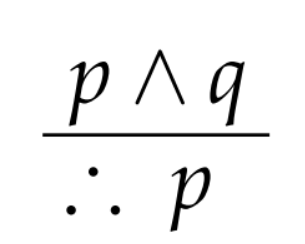
But the Law of Addition / Disjunction Introduction says this:
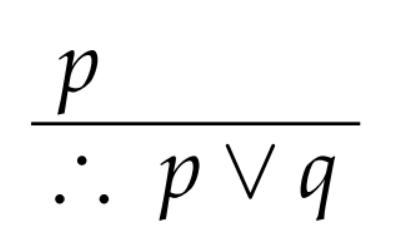
How is it possible for these both to be true? Sry if this is a stupid question 🙃
like is it possible to say p or q therefore p and q?
 fluid sky
toxic tree
like is it possible to say p or q therefore p and q?
fluid sky
toxic tree
like is it possible to say p or q therefore p and q?
no just coz one of p or q is true, both of them dont have to be true
toxic tree
thats what im thinking
fluid sky
you are odie or there exist unicorns, therefore you are odie and there exist unicorns
toxic tree
so how come both of these rules are true?
fluid sky
toxic tree
https://gyazo.com/7fb65a775ba6941f0a0617b056735369.png
here, (you are odie and i am silversoldier), therefore you are odie
fluid sky
toxic tree
https://gyazo.com/c1e73fa06b48c3c8ba7ae7b2e45d1986.png
here, you are odie, therefore, you are odie or there exist unicorns
fluid sky
fluid sky
here, (you are odie and i am silversoldier), therefore you are odie
when both of the statements are true, you can say one of them is true
fluid sky
fluid sky
here, you are odie, therefore, you are odie or there exist unicorns
here the first one is true, so that one, OR anything else is true coz the first one is already true
toxic tree
ah ok, so you can logically deduce p V q from p ^ q but not the other way around, right?
fluid sky
toxic tree
ah ok, so you can logically deduce p V q from p ^ q but not the other way around...
yeah, p ^ q => p v q
final saddleBOT
Channel closed
Closed by @toxic tree
Use .reopen if this was a mistake.
Available help channel!
Send your question here to claim the channel.
Remember:
• Ask your math question in a clear, concise manner.
• Show your work, and if possible, explain where you are stuck.
• After 15 minutes, feel free to ping <@&286206848099549185>.
• Type the command .close to free the channel when you're done.
• Be polite and have a nice day!
Read #❓how-to-get-help for further information on how to ask a good question, and about conduct in the question channels.
 marble terrace
 final saddleBOT
@marble terrace Has your question been resolved?
final saddleBOT
@marble terrace Has your question been resolved?
final saddleBOT
Channel closed
Closed due to timeout
Use .reopen if this was a mistake.
Available help channel!
Send your question here to claim the channel.
Remember:
• Ask your math question in a clear, concise manner.
• Show your work, and if possible, explain where you are stuck.
• After 15 minutes, feel free to ping <@&286206848099549185>.
• Type the command .close to free the channel when you're done.
• Be polite and have a nice day!
Read #❓how-to-get-help for further information on how to ask a good question, and about conduct in the question channels.
 inner wind
 final saddleBOT
inner wind
robust mulch
final saddleBOT
inner wind
robust mulch
you cant log both sides with different values
tranquil pine
inner wind
id bring down the powers using exponentials
(maybe theres an easier approach though)
inner wind
robust mulch
you cant log both sides with different values
i tried breaking them into powers but with 6 and 10 you cant
inner wind
tranquil pine
id bring down the powers using exponentials
so take log of both sides like in the picture?
is my algebra wrong perhaps?
robust mulch
you will have an irrational value
tranquil pine
inner wind
so take log of both sides like in the picture?
like e^((4x-6)ln(6))
inner wind
robust mulch
you will have an irrational value
so whts a good approach if you can recommend any?
inner wind
tranquil pine
like e^((4x-6)ln(6))
so start by taking ln of both sides?
tranquil pine
well like
do
e^ln(EXPRESSION)
then you can bring down the power of the expression
makes it 100x easier to solve imo
 final saddleBOT
Channel closed
Closed by @inner wind
Use .reopen if this was a mistake.
final saddleBOT
Available help channel!
Send your question here to claim the channel.
Remember:
• Ask your math question in a clear, concise manner.
• Show your work, and if possible, explain where you are stuck.
• After 15 minutes, feel free to ping <@&286206848099549185>.
• Type the command .close to free the channel when you're done.
• Be polite and have a nice day!
Read #❓how-to-get-help for further information on how to ask a good question, and about conduct in the question channels.
tranquil pine
Let $V$ be a vector space over $\mathbb{F}$ and let $V^{\times}$ denote the vector space of all linear functionals on $V$ (i.e. linear maps from $V$ to $\mathbb{F}$) Let $\lambda \in V^\times$, let $n \in \bN$ and let $\lambda_k \in V^\times (1 \leq k \leq n)$
\vspace{4 mm}
Prove that the following statements are equivalent:
\vspace{3 mm}
(a) $\lambda$ is a linear combination of the functionals $\lambda_1, \hdots \lambda_n;$
\vspace{3 mm}
(b) ker $\lambda \supseteq \bigcap_{k =1}^n$ ker $\lambda_k$
final saddleBOT
tranquil pine
Let $V$ be a vector space over $\mathbb{F}$ and let $V^{\times}$ denote the vect...
soft zealotBOT
Lixera
 tranquil pine
this should be quite easy but i dont see it, any hints?
For a => b, lets assume a.
Now what does mean for a vector v to be in kernel of lambda_k?
tranquil pine
tranquil pine
For a => b, lets assume a.
Now what does mean for a vector v to be in kernel of...
my main point of confusion too
do you know the definition of a kernel?
tranquil pine
tranquil pine
do you know the definition of a kernel?
the linear subspace of the domain of the map which is mapped to the zero vector?
exactly
so if
$v \in$ ker $\lambda_k$
soft zealotBOT
rbit ✨
 tranquil pine
then what is lambda_k of v?
OH WAIT I THINK IT JUST CLICKED
thank you so much i think i will be able to continue off from here
.close
final saddleBOT
Channel closed
Closed by @hoary musk
Use .reopen if this was a mistake.
Available help channel!
Send your question here to claim the channel.
Remember:
• Ask your math question in a clear, concise manner.
• Show your work, and if possible, explain where you are stuck.
• After 15 minutes, feel free to ping <@&286206848099549185>.
• Type the command .close to free the channel when you're done.
• Be polite and have a nice day!
Read #❓how-to-get-help for further information on how to ask a good question, and about conduct in the question channels.
tranquil pine
 final saddleBOT
tranquil pine
final saddleBOT
tranquil pine
 severe dawn
tranquil pine
how do i know which is which since they are using absolute values
severe dawn
tranquil pine
how do i know which is which since they are using absolute values
the conditions never overlap though?
alas, |-0.5| would hit the first condition, 0,5 too, but |-4| and 6 would hit the second
final saddleBOT
@tranquil pine Has your question been resolved?
tranquil pine
severe dawn
alas, \|-0.5\| would hit the first condition, 0,5 too, but \|-4\| and 6 would hi...
where are you getting these numbers
final saddleBOT
Channel closed
Closed due to timeout
Use .reopen if this was a mistake.
final saddleBOT
Available help channel!
Send your question here to claim the channel.
Remember:
• Ask your math question in a clear, concise manner.
• Show your work, and if possible, explain where you are stuck.
• After 15 minutes, feel free to ping <@&286206848099549185>.
• Type the command .close to free the channel when you're done.
• Be polite and have a nice day!
Read #❓how-to-get-help for further information on how to ask a good question, and about conduct in the question channels.
 fiery rose
Why is (1-r^n) ignored at the end ?
 final saddleBOT
fiery rose
Why is (1-r^n) ignored at the end ?
final saddleBOT
fiery rose
Why is (1-r^n) ignored at the end ?
 amber holly
r^n -> 0 as n -> inf for |r| < 1
final saddleBOT
Channel closed
Closed by @fiery rose
Use .reopen if this was a mistake.
Available help channel!
Send your question here to claim the channel.
Remember:
• Ask your math question in a clear, concise manner.
• Show your work, and if possible, explain where you are stuck.
• After 15 minutes, feel free to ping <@&286206848099549185>.
• Type the command .close to free the channel when you're done.
• Be polite and have a nice day!
Read #❓how-to-get-help for further information on how to ask a good question, and about conduct in the question channels.
 heavy laurel
How would I solve part b and D?
 final saddleBOT
heavy laurel
How would I solve part b and D?
final saddleBOT
heavy laurel
How would I solve part b and D?
 dry light
heavy laurel
How would I solve part b and D?
dry light
heavy laurel
How would I solve part b and D?
What's the top bound for A
 frigid briar
dry light
What's the top bound for A
frigid briar
dry light
What's the top bound for A
possibly x
dry light
Im hoping it is
frigid briar
because A is a function of x, and the x is absent in it's role in the whole function
dry light
heavy laurel
How would I solve part b and D?
Well if you want, find A'(x)
It would be funny if it was something like 2x for whatever reason
frigid briar
dry light
It would be funny if it was something like 2x for whatever reason
c'mon dude, you are making suspense lmao
heavy laurel
dry light
What's the top bound for A
x?
I mean, it says that the function A(x) = integral 0 to x
heavy laurel
dry light
It would be funny if it was something like 2x for whatever reason
Not sure what you mean.
heavy laurel
frigid briar
because A is a function of x, and the x is absent in it's role in the whole func...
So how would I find A'(x)?
frigid briar
heavy laurel
So how would I find A'(x)?
at first, compute the area under the curve f(t)
for those specific values
then, find that derivative
heavy laurel
frigid briar
at first, compute the area under the curve f(t)
So find the derivative of the values I get in Part A?
frigid briar
heavy laurel
So find the derivative of the values I get in Part A?
yes you can
heavy laurel
frigid briar
yes you can
So for instance, A'(x) for 0 is 0, and for 1 it would still be 0?
frigid briar
heavy laurel
So for instance, A'(x) for 0 is 0, and for 1 it would still be 0?
from 0 to 1, it will be some negative value
look the graph carefully
heavy laurel
frigid briar
from 0 to 1, it will be some negative value
Wait, are you on part A or B?
heavy laurel
frigid briar
from 0 to 1, it will be some negative value
For part A, I got A(x) = 0,0,1.5,3,3.5, and 3 respectively.
I'm just stuck on part B, for finding the derivative..
frigid briar
heavy laurel
For part A, I got A(x) = 0,0,1.5,3,3.5, and 3 respectively.
you forgot to multiply it with x
it will be: 0,0,x,5x,3x,3.5x,3x
heavy laurel
frigid briar
it will be: 0,0,x,5x,3x,3.5x,3x
This is for part A?
Or Part B? I thought Part A would just be values, not variables since we're asked to compute for A(x), not A'(x)..
frigid briar
heavy laurel
This is for part A?
part A
because you are asked to evaluate the integral for those limit values
heavy laurel
frigid briar
because you are asked to evaluate the integral for those limit values
So would Part B just be 0,0,1.5,3,3, and 3.5?
frigid briar
heavy laurel
So would Part B just be 0,0,1.5,3,3, and 3.5?
yesh
heavy laurel
frigid briar
because you are asked to evaluate the integral for those limit values
Are you sure? I thought I was supposed to be calculating the area nder the curve between the intervals..
frigid briar
why not?
heavy laurel
frigid briar
why not?
I'm just confused on why that might be. Why are we adding variables here??
heavy laurel
frigid briar
that was the result of the integration
I'm confused. Aren't we just trying to find area between each pair of intervals?
frigid briar
heavy laurel
I'm confused. Aren't we just trying to find area between each pair of intervals?
what do you think? if that was it the it will be explicitly mentioned Compute A'(1)
and vice versa
heavy laurel
frigid briar
what do you think? if that was it the it will be explicitly mentioned Compute A'...
What do you mean?
frigid briar
heavy laurel
What do you mean?
if you are to compute for a closed interval
then they will explicitly tell: A'(1)
like that
heavy laurel
frigid briar
if you are to compute for a closed interval
How about this, why do we add the x after each value for Part A?
frigid briar
because the integration sign says so
heavy laurel
frigid briar
because the integration sign says so
For part D, would I have to perform some arithmetic?
frigid briar
heavy laurel
For part D, would I have to perform some arithmetic?
no
just mention (2,2) as the maxima
and no minimas
heavy laurel
frigid briar
and no minimas
Wouldn't there have to be a minima here? Isn't it like the lowest ordered pair?
frigid briar
heavy laurel
Wouldn't there have to be a minima here? Isn't it like the lowest ordered pair?
No
also, you can notice from the property we got
it is a linear value
and discontinous
heavy laurel
frigid briar
No
Thanks, and lastly, between [0.5,2], A(x) is increasing, but between the intervals [0, 0.5] and [4,5], A(x) is decreasing?
frigid briar
heavy laurel
Thanks, and lastly, between [0.5,2], A(x) is increasing, but between the interva...
just use the linear equation joining two point and then express it in y=mx+c form
then determine the value of 'm'
if m +ve, then it is increasing
final saddleBOT
@heavy laurel Has your question been resolved?
final saddleBOT
Channel closed
Closed due to timeout
Use .reopen if this was a mistake.
Available help channel!
Send your question here to claim the channel.
Remember:
• Ask your math question in a clear, concise manner.
• Show your work, and if possible, explain where you are stuck.
• After 15 minutes, feel free to ping <@&286206848099549185>.
• Type the command .close to free the channel when you're done.
• Be polite and have a nice day!
Read #❓how-to-get-help for further information on how to ask a good question, and about conduct in the question channels.
 eternal valley
 final saddleBOT
eternal valley
tranquil pine
final saddleBOT
eternal valley
tranquil pine
express it in a different form
 lilac stratus
You should rationalize first I guess
The denominators gonn turn out 1 then
And a telescoping series might form thereby
eternal valley
oh wow true
also from a legality perspective
can i swear in this discord
because i saw people
lilac stratus
Yes
eternal valley
and dont want to get banned
ok cool
so then it would be
root 1 - root 2 - root 2 - root 3 ... root 15 - root 16
no
tranquil pine
how can yoy rationalize the denominators from $\frac{1}{\sqrt{n} + \sqrt{n+1}}$
lilac stratus
Should be root 2 - root 1 at starting (if you do right way)
soft zealotBOT
Jester
 eternal valley
oh right
so its 2 - 1 + 3 - 2
true
nah ur right matye
so you will have -1 and 16?
i think thats right
bc the rest all have both +-
lilac stratus
eternal valley
so its 2 - 1 + 3 - 2
There is root on it
lilac stratus
Root 16 - root 1 should be the end result
lilac stratus
eternal valley
so isnt that just 3
I didn't want to say direct answer so I left that for you
eternal valley
ok cool
can i post another question here
about surds and stuff
or should i close and reopen
lilac stratus
eternal valley
can i post another question here
Fresh vegetables are always better
Better close and reopen. I'd do that if I were you. Personal preferences though.
eternal valley
fair
but if its probably u helping me eihter way
seems easier to just stay here
lilac stratus
eternal valley
but if its probably u helping me eihter way
I was just lucky here
But yeah considering the standard of question you asked, I'll be probably help you in that as well
final saddleBOT
Channel closed
Closed by @eternal valley
Use .reopen if this was a mistake.
final saddleBOT
Available help channel!
Send your question here to claim the channel.
Remember:
• Ask your math question in a clear, concise manner.
• Show your work, and if possible, explain where you are stuck.
• After 15 minutes, feel free to ping <@&286206848099549185>.
• Type the command .close to free the channel when you're done.
• Be polite and have a nice day!
Read #❓how-to-get-help for further information on how to ask a good question, and about conduct in the question channels.
 weary lantern
can someone help explain recurrence relations?
final saddleBOT
weary lantern
can someone help explain recurrence relations?
weary lantern
I'm confused as to what they mean or how to even begin solving them
(I'm revising past papers)
 proud fern
In mathematics, a recurrence relation is an equation according to which the nth term of a sequence of numbers is equal to some combination of the previous terms
you can see it on wiki
abstract monolith
weary lantern
I'm confused as to what they mean or how to even begin solving them
You mean something like the fibonacci sequence?
weary lantern
abstract monolith
You mean something like the fibonacci sequence?
Im sure it is one, but i'm doing high school easier stuff 
weary lantern
proud fern
In mathematics, a recurrence relation is an equation according to which the nth ...
Okay thanks
.close
final saddleBOT
Channel closed
Closed by @weary lantern
Use .reopen if this was a mistake.
Available help channel!
Send your question here to claim the channel.
Remember:
• Ask your math question in a clear, concise manner.
• Show your work, and if possible, explain where you are stuck.
• After 15 minutes, feel free to ping <@&286206848099549185>.
• Type the command .close to free the channel when you're done.
• Be polite and have a nice day!
Read #❓how-to-get-help for further information on how to ask a good question, and about conduct in the question channels.
 somber abyss
can someone help
 final saddleBOT
somber abyss
can someone help
final saddleBOT
somber abyss
can someone help
 cloud zephyr
!status
final saddleBOT
What step are you on?
1. I don't know where to begin
2. I have begun but got stuck midway
3. I got an answer but I'm told it's wrong
4. I got an answer and would like my work checked
5. I have a question about someone else's worked solution
6. None of the above
1
 round lava
20 days taken by 12 machines
each machine takes 20×12 =240 days
now since 8 machines were used for nine days, days worth of work done = 8×9=72
days worth of work left = 240 -72 = 168
bro why do i think im doing something wrong
 kindred wing
you are pretty sure lol
round lava
no.
explain me
For the first 9 days, only 8 machines were used, so the factory produced (8/12)9 = 6 days' worth of pens.
From day 10 onwards, all 12 machines were used, so the factory produced (12/12)(20-9) = 11 days' worth of pens.
Therefore, the total number of days taken to make the batch of pens is 6 + 11 = 20 days.
find the mistake
this is what chat gpt said
final saddleBOT
@somber abyss Has your question been resolved?
final saddleBOT
Channel closed
Closed due to timeout
Use .reopen if this was a mistake.
Available help channel!
Send your question here to claim the channel.
Remember:
• Ask your math question in a clear, concise manner.
• Show your work, and if possible, explain where you are stuck.
• After 15 minutes, feel free to ping <@&286206848099549185>.
• Type the command .close to free the channel when you're done.
• Be polite and have a nice day!
Read #❓how-to-get-help for further information on how to ask a good question, and about conduct in the question channels.
 vital zinc
how to ping helpers
vital zinc
.close
final saddleBOT
Channel closed
Closed by @vital zinc
Use .reopen if this was a mistake.
Available help channel!
Send your question here to claim the channel.
Remember:
• Ask your math question in a clear, concise manner.
• Show your work, and if possible, explain where you are stuck.
• After 15 minutes, feel free to ping <@&286206848099549185>.
• Type the command .close to free the channel when you're done.
• Be polite and have a nice day!
Read #❓how-to-get-help for further information on how to ask a good question, and about conduct in the question channels.
 dense oracle
whats the condition for a function to be integrable on [a,b]?
dense oracle
were doing riemann sums and the teacher is asking us to find if a function f(x) is integrable over an interval
i have no idea bruh
its not like derivatives where it has to be continuous right
continuity isnt the problem is it
 quaint sail
it is
dense oracle
what why
quaint sail
how would you find the area enclosed under a graph if it's not continuous
dense oracle
oh
good point
so im given this question

and im thinking i can just write
if x is an element of [0,1], x is either an element of Q or an element of R\Q
because Q U R\Q is just R
then the domain is all real numbers in [0,1] which means its continuous on [0,1]
so it should be integrable?
but then he wants us to use this property

bro what
 quaint basin
dense oracle
then the domain is all real numbers in [0,1] which means its continuous on [0,1]
quaint basin
dense oracle
then the domain is all real numbers in [0,1] which means its continuous on [0,1]
Why would f be continuous just because its domain is [0,1]? There are certainly functions defined on [0,1] that are discontinuous.
dense oracle
quaint basin
Why would f be continuous just because its domain is [0,1]? There are certainly ...
oh
i didnt think of that
final saddleBOT
@dense oracle Has your question been resolved?
final saddleBOT
Channel closed
Closed due to timeout
Use .reopen if this was a mistake.
Available help channel!
Send your question here to claim the channel.
Remember:
• Ask your math question in a clear, concise manner.
• Show your work, and if possible, explain where you are stuck.
• After 15 minutes, feel free to ping <@&286206848099549185>.
• Type the command .close to free the channel when you're done.
• Be polite and have a nice day!
Read #❓how-to-get-help for further information on how to ask a good question, and about conduct in the question channels.
 quartz spade
This is the question I am having an issue with.
 final saddleBOT
quartz spade
This is the question I am having an issue with.
quartz spade
final saddleBOT
quartz spade
This is the question I am having an issue with.
quartz spade
This is what I've tried

I may be interpreting the definition of an explicit solution incorrectly, but my book doesn't have any examples, just generic formulas.
proud fern
lemme see
quartz spade
That seems to be the case with this specific book. No examples, just formulas.
 quartz spade
Oh yeah
quartz spade
I don't think I actually carried it down to the next step
quartz spade
I think I just automatically wrote it cuz it was above
proud fern
yes
mind
"brain is something when you need but it will run away" -Tsun Tzu the art of maths
quartz spade
Indeed.
It may also be a WebAssign formatting issue, but I only have one try left lol
quartz spade
It's ok if I don't get this one correct. It's the last question on this specific problem set.
So it'll still be an A
quartz spade
Well I have 3 more sections + reading assignments + quizzes, but yeah
quartz spade
Luckily, my quizzes are one or two questions each
proud fern
ohh
quartz spade
But that also means I need to know exactly what the subject is
proud fern
experience++
quartz spade
It could be any question from the homework
proud fern
yup
quartz spade
And this homework set was a struggle, because I haven't taken a math class in 4 years
And I never actually took trig
proud fern
"if you defeated the boss make sure you can defeat the boss again"
in your exams(final levels of game)
quartz spade
That's what the mini quizzes are for.
I'm probably just going to skip this question and go to the next set though. I don't have very much time.
I appreciate the assistance though!
.close
final saddleBOT
Channel closed
Closed by @quartz spade
Use .reopen if this was a mistake.
final saddleBOT
Available help channel!
Send your question here to claim the channel.
Remember:
• Ask your math question in a clear, concise manner.
• Show your work, and if possible, explain where you are stuck.
• After 15 minutes, feel free to ping <@&286206848099549185>.
• Type the command .close to free the channel when you're done.
• Be polite and have a nice day!
Read #❓how-to-get-help for further information on how to ask a good question, and about conduct in the question channels.
dense oracle
i actually just cant do this question

 final saddleBOT
dense oracle
i actually just cant do this question
dense oracle
final saddleBOT
dense oracle
i actually just cant do this question
dense oracle
i have no idea what im doing
this is what ive tried so far

but i dont think thats it
i want to say that the slope is this so the function is continuous

 rare cradle
dense oracle
this is what ive tried so far
rare cradle
dense oracle
this is what ive tried so far
You can't really list all rational numbers like that
rare cradle
dense oracle
i want to say that the slope is this so the function is continuous
Because here there are infinitely many rational numbers between Q_n and Q_n+1
Take any sub interval of [0,1] and think about the inf and sup of f over that interval
Bc that's how the riemann integral of defined
I'm assuming you're working with the riemann integral
final saddleBOT
@dense oracle Has your question been resolved?
dense oracle
rare cradle
Take any sub interval of [0,1] and think about the inf and sup of f over that in...
the what-
i think were learning riemann integral but i have no idea what inf and sup are
dense oracle
rare cradle
Because here there are infinitely many rational numbers between Q_n and Q_n+1
wait then does my drawing not work
rare cradle
dense oracle
i think were learning riemann integral but i have no idea what inf and sup are
How do u define if a function is riemann integrable
rare cradle
dense oracle
wait then does my drawing not work
Yes
dense oracle
rare cradle
How do u define if a function is riemann integrable
i dont know i think it just has to be continous
the teacher didnt say anything i dont think
dense oracle
wtf
rare cradle
There are functions that are not continuous and still integrable
dense oracle
deez
 rare cradle
dense oracle
i dont know i think it just has to be continous
rare cradle
dense oracle
i dont know i think it just has to be continous
If you don't know what it means for a function to be integrable then you just can't do this question
dense oracle
rare cradle
If you don't know what it means for a function to be integrable then you just ca...
i knoww thats the issue but the teacher said nothingg
dense oracle
rare cradle
There are functions that are not continuous and still integrable
do i have to do what you said with inf and sup or is there another way ?
dense oracle
uh ok
rare cradle
In this context they're p much the same
dense oracle
rare cradle
Take any sub interval of [0,1] and think about the inf and sup of f over that in...
well in this case the inf is 0 and the sup is 1?
dense oracle
ohhh
rare cradle
Since they are not equal, the function is not integrable
dense oracle
dense oracle
i want to say that the slope is this so the function is continuous
ok i can only understand that if i use my drawing
cuz when i visualize in my head
the inf rectangles just dont have a height and the sup rectangles are with height 1
but you said my drawing doesnt work
rare cradle
dense oracle
i want to say that the slope is this so the function is continuous
I mean yes cuz what's in between
It's a bit more complicated
Rational and irrational are intertwined
dense oracle
yeah you can always put more things in between i guess
rare cradle
They're in between each other
dense oracle
frick
this is a bit unrelated but i watched a video recently that said that rationals are countably infinite but reals(irrationals) are not countable infinity
does this have nothing to do with the problem here
rare cradle
Not really
dense oracle
ok i see
rare cradle
But yea there are a lot more irrationals then rational
dense oracle
burh 💀
this property makes no sense
its like as if there are an equal amount of rationals and irrationals if there are always more in between each other
but no
so what i can do for this problem, can i write that delta x is always the same? or does delta x not stay constant
rare cradle
I think you should learn about the riemann integral
rare cradle
rare cradle
Since they are not equal, the function is not integrable
This is the whole argument for this example tho
rare cradle
Ok np
final saddleBOT
Channel closed
Closed due to timeout
Use .reopen if this was a mistake.
final saddleBOT
Available help channel!
Send your question here to claim the channel.
Remember:
• Ask your math question in a clear, concise manner.
• Show your work, and if possible, explain where you are stuck.
• After 15 minutes, feel free to ping <@&286206848099549185>.
• Type the command .close to free the channel when you're done.
• Be polite and have a nice day!
Read #❓how-to-get-help for further information on how to ask a good question, and about conduct in the question channels.
 oak arrow
 oak arrow
I need help with 32, but before we do that one i just want to check my answer for 30 since they're pretty similar
 stuck temple
Is that a math problem?
oak arrow
it's discrete math
so i said for 30 I can walk only if my leg is not broken. Does that work?
please @ me if anyone responds
 jagged seal
@oak arrow do you have any idea what the thing on the right says
oak arrow
jagged seal
<@431982008412012554> do you have any idea what the thing on the right says
im not sure what you mean. Like on the right side of the image?
jagged seal
My bad, the rhs of q 32
oak arrow
jagged seal
My bad, the rhs of q 32
Q is true if and only if not p is true
right?
so that means my leg is broken only if I cannot walk, right?
is anyone there?
.close
final saddleBOT
Channel closed
Closed by @oak arrow
Use .reopen if this was a mistake.
final saddleBOT
Available help channel!
Send your question here to claim the channel.
Remember:
• Ask your math question in a clear, concise manner.
• Show your work, and if possible, explain where you are stuck.
• After 15 minutes, feel free to ping <@&286206848099549185>.
• Type the command .close to free the channel when you're done.
• Be polite and have a nice day!
Read #❓how-to-get-help for further information on how to ask a good question, and about conduct in the question channels.
 zinc slate
 final saddleBOT
zinc slate
zinc slate
final saddleBOT
zinc slate
zinc slate
where does the sin x come from? on RHS
cos pi/2 = 0
$cos(pi/2 - x) = cos(pi/2) + cos(x)$
soft zealotBOT
yomiko
 zinc slate
cos x turns into sin x???
final saddleBOT
@zinc slate Has your question been resolved?

 grim badger
 final saddleBOT
@zinc slate Has your question been resolved?
final saddleBOT
Channel closed
Closed by @zinc slate
Use .reopen if this was a mistake.
Available help channel!
Send your question here to claim the channel.
Remember:
• Ask your math question in a clear, concise manner.
• Show your work, and if possible, explain where you are stuck.
• After 15 minutes, feel free to ping <@&286206848099549185>.
• Type the command .close to free the channel when you're done.
• Be polite and have a nice day!
Read #❓how-to-get-help for further information on how to ask a good question, and about conduct in the question channels.
tranquil pine
help with 7a pleae

 final saddleBOT
tranquil pine
help with 7a pleae
tranquil pine
final saddleBOT
tranquil pine
help with 7a pleae
tranquil pine
tag me when responding please
tranquil pine
tranquil pine
help with 7a pleae
what part are you stuck with
i think i solved it
wait
how do i find h?
h(x) ?
yes
its just gonna be top - bottom
ah ok
or right - left right
yeah
ok ty imma keep working
@tranquil pine having issues with 9

what do u have rn

why did you change to f(y)
wym
why wouldnt it be in terms of y?
would it not just be ((2-x)-x^2)
the rectangle is horizontal so shouldnt it be in terms of y
why horizontal rectangle
oh wait i messed up
lol
shell method differential element should be parallel to axis of rotation
your axis is a vertical line so your rectangles should also be vertical
i see let me try again

@tranquil pine this is what i did for the set up but its still wrong
bounds are 0 to 1
i think anyways
oh yeah it is
final saddleBOT
@tranquil pine Has your question been resolved?
final saddleBOT
Channel closed
Closed due to timeout
Use .reopen if this was a mistake.
final saddleBOT
Available help channel!
Send your question here to claim the channel.
Remember:
• Ask your math question in a clear, concise manner.
• Show your work, and if possible, explain where you are stuck.
• After 15 minutes, feel free to ping <@&286206848099549185>.
• Type the command .close to free the channel when you're done.
• Be polite and have a nice day!
Read #❓how-to-get-help for further information on how to ask a good question, and about conduct in the question channels.
 jolly viper
 final saddleBOT
jolly viper
jolly viper
final saddleBOT
jolly viper
jolly viper
bro how tf u do this
dry light
$\log_a(b) = \frac{\ln(b)}{\ln(a)}$
soft zealotBOT
Umbraleviathan
 final saddleBOT
@jolly viper Has your question been resolved?
final saddleBOT
Channel closed
Closed due to timeout
Use .reopen if this was a mistake.
Available help channel!
Send your question here to claim the channel.
Remember:
• Ask your math question in a clear, concise manner.
• Show your work, and if possible, explain where you are stuck.
• After 15 minutes, feel free to ping <@&286206848099549185>.
• Type the command .close to free the channel when you're done.
• Be polite and have a nice day!
Read #❓how-to-get-help for further information on how to ask a good question, and about conduct in the question channels.
 white crypt
Wouldnt this be true if x decreases?
 final saddleBOT
white crypt
Wouldnt this be true if x decreases?
final saddleBOT
white crypt
Wouldnt this be true if x decreases?
 warm ether
,w graph sec(x)
soft zealotBOT

 warm ether
since 56 is closer to 90 then 49, sec56>sec49 as you can see on the graph
white crypt
But x would decrease?
warm ether
wdym?
final saddleBOT
Channel closed
Closed by @white crypt
Use .reopen if this was a mistake.
 pulsar tartan
Cos value goes from 1 to 0 in first quadrant. Therefore
cos 56 < cos 49
And
Sec 56 > sec 49
@white crypt
final saddleBOT
Available help channel!
Send your question here to claim the channel.
Remember:
• Ask your math question in a clear, concise manner.
• Show your work, and if possible, explain where you are stuck.
• After 15 minutes, feel free to ping <@&286206848099549185>.
• Type the command .close to free the channel when you're done.
• Be polite and have a nice day!
Read #❓how-to-get-help for further information on how to ask a good question, and about conduct in the question channels.
Please don't occupy multiple help channels.
final saddleBOT
Channel closed
Closed by @dry light
Use .reopen if this was a mistake.
final saddleBOT
Available help channel!
Send your question here to claim the channel.
Remember:
• Ask your math question in a clear, concise manner.
• Show your work, and if possible, explain where you are stuck.
• After 15 minutes, feel free to ping <@&286206848099549185>.
• Type the command .close to free the channel when you're done.
• Be polite and have a nice day!
Read #❓how-to-get-help for further information on how to ask a good question, and about conduct in the question channels.
quartz spade
 final saddleBOT
quartz spade
quartz spade
final saddleBOT
quartz spade
quartz spade
This is the problem I am having an issue with.
This is what I've tried

I am confused on how to find g(x)
Both sides have a 2xy/(x+y) so I can take that out, but does g(x) then equal -x^2+y^2/(x+y)+2x?
 magic sparrow

