#help-36
1 messages · Page 25 of 1
 paper zodiac
 unique vapor
paper zodiac
unique vapor
paper zodiac
Line CB -Line DB = Line CD
paper zodiac
I think that's it
 final saddleBOT
Channel closed
Closed by @unique vapor
Use .reopen if this was a mistake.
 Available help channel!
Send your question here to claim the channel.
Remember:
• Ask your math question in a clear, concise manner.
• Show your work, and if possible, explain where you are stuck.
• After 15 minutes, feel free to ping <@&286206848099549185>.
• Type the command .close to free the channel when you're done.
• Be polite and have a nice day!
Read #❓how-to-get-help for further information on how to ask a good question, and about conduct in the question channels.
 pseudo socket
If you have a 6 period schedule and 3 elective classes. How many schedule arrangements are possible where you have at least 2 elective classes in a row?
final saddleBOT
pseudo socket
If you have a 6 period schedule and 3 elective classes. How many schedule arrang...
@pseudo socket Has your question been resolved?
final saddleBOT
Channel closed
Closed due to timeout
Use .reopen if this was a mistake.
Available help channel!
Send your question here to claim the channel.
Remember:
• Ask your math question in a clear, concise manner.
• Show your work, and if possible, explain where you are stuck.
• After 15 minutes, feel free to ping <@&286206848099549185>.
• Type the command .close to free the channel when you're done.
• Be polite and have a nice day!
Read #❓how-to-get-help for further information on how to ask a good question, and about conduct in the question channels.
 faint zealot
for this i think i need to use
d/dx( f + g ) = d/dx(f) + d/dx(g)
but how would i identify what if f and what is g?
from the sin(t^3)? or from the upper and lower limit?
 final saddleBOT
faint zealot
for this i think i need to use
d/dx( f + g ) = d/dx(f) + d/dx(g)
but how woul...
faint zealot
final saddleBOT
faint zealot
for this i think i need to use
d/dx( f + g ) = d/dx(f) + d/dx(g)
but how woul...
faint zealot
sry idek what that means
;-;
never heard my prof mention that
he skips too many steps
and scream at the class when we ask questions
 strange shore
maybe try to integrate ?
 tulip coyote
strange shore
fundamental theorem of calculus ?
tulip coyote
strange shore
fundamental theorem of calculus ?
Isn't there a version that deals with cases like this?
strange shore
idk
tulip coyote
 faint zealot
the f(b) and f(a) is basically setting the upper and lower limit for one or the other to 0 while keep the other the same?
for example for this
lower limit 0, upper limit x^2
then
lower limit 2x, upper limit 0

and those two different ones would be the f(a) and f(b)?
so basically like this???

or no?
and then i find F'(x) for that
by substituting in the 2x for t in the first one, and the x^2 into the t in the second one?

@tulip coyote umm sry for ping but would those steps be right?
strange shore
faint zealot
so basically like this???
just do like in the pic he sends, what r u doin
tulip coyote
faint zealot
so basically like this???
Hmm, well that does work to be fair! And with the first integral you can swap the limits around
tulip coyote
strange shore
just do like in the pic he sends, what r u doin
Think they’re trying to see why it’s true, unless I’m being slow?
strange shore
 tulip coyote
Well, you can literally just use this
 strange shore
$F'(x) = \sin(x^6) \times 6x^5 - \sin(8x^3) \times 24x^2$
 soft zealotBOT
Herels
 strange shore
a(x) is 2x and b(x) = x^2 in your expression
faint zealot
for the b'(x)
sry if its confusing im new to calc 1
so idk how to write most of the things properly
faint zealot
faint zealot
for the b'(x)
@strange shore
strange shore
basically :
$\frac{d}{dx}\int_{a(x)}^{b(x)} f(t) dt= F'(b(x)) - F'(a(x))$
soft zealotBOT
Herels
 strange shore
where $F'(x) = f(x)$
soft zealotBOT
Herels
 strange shore
basically :
$\frac{d}{dx}\int_{a(x)}^{b(x)} f(t) dt= \frac{d}{dx} \left(F(b(x)) - F(a(x)) \right) = F'(b(x)) - F'(a(x))$
soft zealotBOT
Herels
 strange shore
and $F'(b(x)) - F'(a(x)) = b'(x)f(b(x)) - a'(x)f(a(x))$
soft zealotBOT
Herels
 faint zealot
nvm im lost now
faint zealot
faint zealot
so sin( (x^2)^3 ) * 2x - sin( (2x)^3 ) * 2
so this isnt the correct way of doing it?
but it has the [ f( b(x) ) * b'(x) ] - [ f( a(x) ) * a'(x) ]
???
isnt that all i need to find the F'(x)
strange shore
faint zealot
so this isnt the correct way of doing it?
no its not
faint zealot
k
strange shore
faint zealot
but it has the [ f( b(x) ) * b'(x) ] - [ f( a(x) ) * a'(x) ]
thats sin(x^6) you differentiate
with chain rule and shit
well not sin(x^6) but there is a chain rule here
faint zealot
ye the chain rule i did and got 2x
after i got that i made the (x^2)^3 into x^6
???
the 2x goes outside in front of sin
strange shore
thats x^6 you differentiate, not x^2
strange shore
No
faint zealot
?
strange shore
I said its 6x^5 sin(x^6)
faint zealot

wait but....
if its b'(x) y would i apply the ^3 first and then find the b'(x)
wouldnt i need to find the b'(x) from b(x) before doing the step with ^3
nvm im stupid, tysm for the help.
.close
final saddleBOT
Channel closed
Closed by @faint zealot
Use .reopen if this was a mistake.
final saddleBOT
Available help channel!
Send your question here to claim the channel.
Remember:
• Ask your math question in a clear, concise manner.
• Show your work, and if possible, explain where you are stuck.
• After 15 minutes, feel free to ping <@&286206848099549185>.
• Type the command .close to free the channel when you're done.
• Be polite and have a nice day!
Read #❓how-to-get-help for further information on how to ask a good question, and about conduct in the question channels.
 worthy dagger
 final saddleBOT
worthy dagger
worthy dagger
final saddleBOT
worthy dagger
worthy dagger
Anyone that can help me out to start of? I seam to get a grasp on how I am suppose to start :/
final saddleBOT
@worthy dagger Has your question been resolved?
final saddleBOT
@worthy dagger Has your question been resolved?
final saddleBOT
@worthy dagger Has your question been resolved?
Channel closed
Closed by @worthy dagger
Use .reopen if this was a mistake.
final saddleBOT
Available help channel!
Send your question here to claim the channel.
Remember:
• Ask your math question in a clear, concise manner.
• Show your work, and if possible, explain where you are stuck.
• After 15 minutes, feel free to ping <@&286206848099549185>.
• Type the command .close to free the channel when you're done.
• Be polite and have a nice day!
Read #❓how-to-get-help for further information on how to ask a good question, and about conduct in the question channels.
 maiden current
What would a suitable change of variables be to solve this integral?
 final saddleBOT
maiden current
What would a suitable change of variables be to solve this integral?
final saddleBOT
final saddleBOT
maiden current
What would a suitable change of variables be to solve this integral?
final saddleBOT
@maiden current Has your question been resolved?
maiden current
<@&286206848099549185>
final saddleBOT
@maiden current Has your question been resolved?
final saddleBOT
@maiden current Has your question been resolved?
 terse dagger
Culinder but elliptic
maiden current
terse dagger
Culinder but elliptic
why not spherical?
terse dagger
You can try both i dont know for sure which is best
maiden current
understandable
well then I feel a bit more confident im on the right track
.close
final saddleBOT
Channel closed
Closed by @maiden current
Use .reopen if this was a mistake.
final saddleBOT
Available help channel!
Send your question here to claim the channel.
Remember:
• Ask your math question in a clear, concise manner.
• Show your work, and if possible, explain where you are stuck.
• After 15 minutes, feel free to ping <@&286206848099549185>.
• Type the command .close to free the channel when you're done.
• Be polite and have a nice day!
Read #❓how-to-get-help for further information on how to ask a good question, and about conduct in the question channels.
 small inlet
 final saddleBOT
small inlet
small inlet
final saddleBOT
small inlet
small inlet
anyone able to find the derivative of the equation?
 fickle crater
sup dr senku
small inlet
yo whats up 🤣
 tranquil pine
nah
just look at i
it
you need to use
the uh
chain rule if
you make a substituion that
2.6 times square x = 0
t*
small inlet
i dont understand
tranquil pine
you know how the chain rule works right
small inlet
yes
final saddleBOT
@small inlet Has your question been resolved?
final saddleBOT
Channel closed
Closed due to timeout
Use .reopen if this was a mistake.
final saddleBOT
Available help channel!
Send your question here to claim the channel.
Remember:
• Ask your math question in a clear, concise manner.
• Show your work, and if possible, explain where you are stuck.
• After 15 minutes, feel free to ping <@&286206848099549185>.
• Type the command .close to free the channel when you're done.
• Be polite and have a nice day!
Read #❓how-to-get-help for further information on how to ask a good question, and about conduct in the question channels.
 topaz siren
 final saddleBOT
topaz siren
topaz siren
final saddleBOT
topaz siren
topaz siren
How can I show these are equal?
 royal gust
Can always just compute each side separately and show they simplify to the same thing
royal gust
Sure! Any method that can take down a 3x3 really
I like this one, it's worth knowing.
 final saddleBOT
@topaz siren Has your question been resolved?
final saddleBOT
Channel closed
Closed due to timeout
Use .reopen if this was a mistake.
Available help channel!
Send your question here to claim the channel.
Remember:
• Ask your math question in a clear, concise manner.
• Show your work, and if possible, explain where you are stuck.
• After 15 minutes, feel free to ping <@&286206848099549185>.
• Type the command .close to free the channel when you're done.
• Be polite and have a nice day!
Read #❓how-to-get-help for further information on how to ask a good question, and about conduct in the question channels.
 spring violet
 final saddleBOT
spring violet
spring violet
final saddleBOT
spring violet
spring violet
Did I get the right equation for this ?
tranquil pine
,w maclaurin of sin(ax)
soft zealotBOT


 Requested by ♡LexQa♡#5050
tranquil pine
Requested by ♡LexQa♡#5050
tranquil pine
Ding ding!
tranquil pine
Oh what do you mean?
spring violet
Ahh you’ve helped me a few times just saying hey
Always appreciate it. Thank you !
tranquil pine
Oh yeah ahaha I am just chilling, I am mainly done with calculus, I am kind of stressed out with discrete math stuff instead now ahaha
 spring violet
That’s me next semester! Got 2 discrete math courses gonna be spinning I think haha
tranquil pine
strange shore
what kind of discrete maths
Graph theory, a lot of counting, combinatrics
Etc
spring violet
Proving shit to death !
tranquil pine
spring violet
That’s me next semester! Got 2 discrete math courses gonna be spinning I think ...
Good luck I find them so so much harder than calculus
strange shore
tranquil pine
Graph theory, a lot of counting, combinatrics
ive never had a course on graph theory ;-;
spring violet
I had a python lab using a graph that's as deep as i've gone, hopefully it clicks for you !
.close
final saddleBOT
Channel closed
Closed by @spring violet
Use .reopen if this was a mistake.
tranquil pine
strange shore
ive never had a course on graph theory ;-;
Oh happy you
tranquil pine
spring violet
I had a python lab using a graph that's as deep as i've gone, hopefully it click...
Thank youu
final saddleBOT
Available help channel!
Send your question here to claim the channel.
Remember:
• Ask your math question in a clear, concise manner.
• Show your work, and if possible, explain where you are stuck.
• After 15 minutes, feel free to ping <@&286206848099549185>.
• Type the command .close to free the channel when you're done.
• Be polite and have a nice day!
Read #❓how-to-get-help for further information on how to ask a good question, and about conduct in the question channels.
 slate girder
What did I do wrong? Answer should be -2i
final saddleBOT
slate girder
What did I do wrong? Answer should be -2i
slate girder

 fiery bluff
what is C
final saddleBOT
Channel closed
Closed by @slate girder
Use .reopen if this was a mistake.
final saddleBOT
Available help channel!
Send your question here to claim the channel.
Remember:
• Ask your math question in a clear, concise manner.
• Show your work, and if possible, explain where you are stuck.
• After 15 minutes, feel free to ping <@&286206848099549185>.
• Type the command .close to free the channel when you're done.
• Be polite and have a nice day!
Read #❓how-to-get-help for further information on how to ask a good question, and about conduct in the question channels.
 full mango
Is the answer 518.4
 full mango
<@&286206848099549185>
tulip coyote
full mango
<@&286206848099549185>
!15m
final saddleBOT
full mango
<@&286206848099549185>
Please only use the <@&286206848099549185> ping once if your question has not been answered for 15 minutes. Please do not ping or DM individual users about your question.
full mango
tulip coyote
!15m
I forgot
tulip coyote
full mango
I forgot
Don't worry about it
Could you please also close the other channel you have open (20) too?
full mango
Sorry my bad
tulip coyote
It's all good, thank you 
How did you get your [£]518.4, if you don't mind me asking?
tulip coyote
Hmmm I don't think I agree with what I think you're trying
If I decrease something by, say, 30%, then increase what I get from that by 30%, would I get my original number back?
final saddleBOT
Channel closed
Closed by @full mango
Use .reopen if this was a mistake.
final saddleBOT
Available help channel!
Send your question here to claim the channel.
Remember:
• Ask your math question in a clear, concise manner.
• Show your work, and if possible, explain where you are stuck.
• After 15 minutes, feel free to ping <@&286206848099549185>.
• Type the command .close to free the channel when you're done.
• Be polite and have a nice day!
Read #❓how-to-get-help for further information on how to ask a good question, and about conduct in the question channels.
 mystic quartz
Did I setup the integral below correctly? By drawing the region, it's clear that $ 0 \leq \theta \leq 2\pi$ and letting $x = r\cos(\theta)$, $y = r\sin(\theta)$, $D$ becomes $1 \leq r^2 \leq 4$ which is the same as $1 \leq r \leq 2$, therefore the new integral is $\int^{2\pi}{0}{\int{2}^{1}{r^3\cos(\theta)\ln(r^2) dr}d\theta}$
final saddleBOT
mystic quartz
Did I setup the integral below correctly? By drawing the region, it's clear that...
soft zealotBOT
Chippotle Maths
 mystic quartz

Just wondering if I setted up the integral correctly since I'm unsure if I did some mistake integrating or if I described the region wrong
final saddleBOT
@mystic quartz Has your question been resolved?
final saddleBOT
@mystic quartz Has your question been resolved?
Channel closed
Closed by @mystic quartz
Use .reopen if this was a mistake.
Available help channel!
Send your question here to claim the channel.
Remember:
• Ask your math question in a clear, concise manner.
• Show your work, and if possible, explain where you are stuck.
• After 15 minutes, feel free to ping <@&286206848099549185>.
• Type the command .close to free the channel when you're done.
• Be polite and have a nice day!
Read #❓how-to-get-help for further information on how to ask a good question, and about conduct in the question channels.
 lament eagle
heyy
final saddleBOT
lament eagle
heyy
 maiden canopy
well you never know lot about maths
maiden canopy
hmm
 karmic lark
shes into me
 fossil geyser
@lament eagle Did you have a question? Because I'm kind of afraid of what this channel is about to turn into
final saddleBOT
@lament eagle Has your question been resolved?
final saddleBOT
Channel closed
Closed due to timeout
Use .reopen if this was a mistake.
Available help channel!
Send your question here to claim the channel.
Remember:
• Ask your math question in a clear, concise manner.
• Show your work, and if possible, explain where you are stuck.
• After 15 minutes, feel free to ping <@&286206848099549185>.
• Type the command .close to free the channel when you're done.
• Be polite and have a nice day!
Read #❓how-to-get-help for further information on how to ask a good question, and about conduct in the question channels.
 random niche
 final saddleBOT
random niche
random niche
final saddleBOT
random niche
random niche
what that
 rare quarry
what platform is that question on
random niche
ya it says mylab
rare quarry
mymathlab and mastering
random niche
yup
rare quarry
so go ahead and tell me what ur struggling on
rare quarry
v and w are the vectors defined there
random niche
i tried just multiplying them together like with foil and it said wrong
rare quarry
and i and j are just part of the definition of a vector
so first of all, do you know what a vector is?
rare quarry
ok so i would recommend getting that down first
what's a vector?
and then come back to the question
random niche
line with arrow
rare quarry
do you have a book?
random niche
direction?
rare quarry
random niche
line with arrow
uh yeah so thats the graphical representation of a vector
what class is this
random niche
precalc
rare quarry
do you have a textbook? or does your teacher assign you videos
random niche
assigns us online textbook but its very convoluted and doesnt get to the point in a way i understand
final saddleBOT
Channel closed
Closed by @random niche
Use .reopen if this was a mistake.
Available help channel!
Send your question here to claim the channel.
Remember:
• Ask your math question in a clear, concise manner.
• Show your work, and if possible, explain where you are stuck.
• After 15 minutes, feel free to ping <@&286206848099549185>.
• Type the command .close to free the channel when you're done.
• Be polite and have a nice day!
Read #❓how-to-get-help for further information on how to ask a good question, and about conduct in the question channels.
 gloomy fossil
Graphing cos and sine fucntions, I have a problem but am stuck on graphic the phase shift
final saddleBOT
gloomy fossil
Graphing cos and sine fucntions, I have a problem but am stuck on graphic the ph...
gloomy fossil
Should I send the problem in here
final saddleBOT
@gloomy fossil Has your question been resolved?
gloomy fossil

I have gotten fsr in the equation but am confused on how the phase shift comes into play here
Aka my D or C value
final saddleBOT
Channel closed
Closed due to timeout
Use .reopen if this was a mistake.
Available help channel!
Send your question here to claim the channel.
Remember:
• Ask your math question in a clear, concise manner.
• Show your work, and if possible, explain where you are stuck.
• After 15 minutes, feel free to ping <@&286206848099549185>.
• Type the command .close to free the channel when you're done.
• Be polite and have a nice day!
Read #❓how-to-get-help for further information on how to ask a good question, and about conduct in the question channels.
 heavy crystal
I need help with this integral
 final saddleBOT
heavy crystal
I need help with this integral
heavy crystal
final saddleBOT
heavy crystal
I need help with this integral
heavy crystal
more specifically how they get to this cos

I understand the other stuff but i cant for the life of me get to the cos
 rain crane
Weierstrass t formulas
heavy crystal
could you elaborate if you dont mind
do you mean the weierstrass theorem?
i dont really see how its gonna help here tho
heavy crystal
rain crane
Weierstrass t formulas
Holy shit
I legit did not know that existed
I dont remember learning this though
yeah we didnt learn this as a proper formula
but i managed to deduce it

.close
final saddleBOT
Channel closed
Closed by @heavy crystal
Use .reopen if this was a mistake.
final saddleBOT
Available help channel!
Send your question here to claim the channel.
Remember:
• Ask your math question in a clear, concise manner.
• Show your work, and if possible, explain where you are stuck.
• After 15 minutes, feel free to ping <@&286206848099549185>.
• Type the command .close to free the channel when you're done.
• Be polite and have a nice day!
Read #❓how-to-get-help for further information on how to ask a good question, and about conduct in the question channels.
 jolly spear
 final saddleBOT
jolly spear
jolly spear
final saddleBOT
jolly spear
jolly spear
19 pls!
This unit kinda confused me. but so far I have <1,1,1> for one vector and <2,3,-1> for the other, then to my understanding I need to metricize them (?) giving me a final vector of <2,,-1,5>
then I used points from my original point giving me 2(x-3)-1(y+1)+5(z-1)
@ me so I get the notification pls
it was a matrix error
.close
.close
final saddleBOT
Channel closed
Closed by @jolly spear
Use .reopen if this was a mistake.
Available help channel!
Send your question here to claim the channel.
Remember:
• Ask your math question in a clear, concise manner.
• Show your work, and if possible, explain where you are stuck.
• After 15 minutes, feel free to ping <@&286206848099549185>.
• Type the command .close to free the channel when you're done.
• Be polite and have a nice day!
Read #❓how-to-get-help for further information on how to ask a good question, and about conduct in the question channels.
 dusty harbor
 final saddleBOT
dusty harbor
dusty harbor
final saddleBOT
dusty harbor
dusty harbor
why is this true?
 sweet summit
do you ever look at your more advanced mathematics work and think "we've gone too far?"
sweet summit
what class is this for?
 rare cradle
Never seen that notation
dusty harbor
linear algebra
sweet summit
wut
sweet summit
ah we didn't get to this in our LA course
dusty harbor
means conjugate transpose
rare cradle
Is L a matrix
dusty harbor
yes
rare cradle
Or linear map
dusty harbor
a linear map is a matrix
L is an operator
so its a linear map from dim n to dim n
nxn matrix
rare cradle
dusty harbor
a linear map is a matrix
Almost but not quite
dusty harbor
not?
rare cradle
Cuz with a matrix you need to specify a basis
dusty harbor
what do you mean exactly
do you mean as in L is not necessarily a matrix but [L]_epsilon is?
rare cradle
Yea what does the epsilon mean
And what does G mean
I'd say let's just say that L is a matrix for simplicity
rare cradle
Damn forgot what that was
Isn't it for specifying the basis for a dot product
Or smth
dusty harbor
sort of yeah
 final saddleBOT
Channel closed
Closed by @dusty harbor
Use .reopen if this was a mistake.
Available help channel!
Send your question here to claim the channel.
Remember:
• Ask your math question in a clear, concise manner.
• Show your work, and if possible, explain where you are stuck.
• After 15 minutes, feel free to ping <@&286206848099549185>.
• Type the command .close to free the channel when you're done.
• Be polite and have a nice day!
Read #❓how-to-get-help for further information on how to ask a good question, and about conduct in the question channels.
 shell scroll
Did I draw the reimann sum properly?This is the homework for an introductory lesson on Reimann sums

 final saddleBOT
shell scroll
Did I draw the reimann sum properly?This is the homework for an introductory les...
final saddleBOT
shell scroll
Did I draw the reimann sum properly?This is the homework for an introductory les...
@shell scroll Has your question been resolved?
shell scroll
<@&286206848099549185>
final saddleBOT
@shell scroll Has your question been resolved?
 viral belfry
looks like it to me
final saddleBOT
Channel closed
Closed by @shell scroll
Use .reopen if this was a mistake.
Available help channel!
Send your question here to claim the channel.
Remember:
• Ask your math question in a clear, concise manner.
• Show your work, and if possible, explain where you are stuck.
• After 15 minutes, feel free to ping <@&286206848099549185>.
• Type the command .close to free the channel when you're done.
• Be polite and have a nice day!
Read #❓how-to-get-help for further information on how to ask a good question, and about conduct in the question channels.
 formal flicker
Is there such a concept of $$\frac{d}{dx}!$$ There is some sort of fractional derivative (many definitions, but none are "right"). Does such a thing exist too?
final saddleBOT
formal flicker
Is there such a concept of $$\frac{d}{dx}!$$ There is some sort of fractional de...
soft zealotBOT
ohNoiAmHere

 vital crag
Not universally defined
formal flicker
is there something like fractional ones that arent universally defined either?
vital crag
Fractional what
Oh derivatives
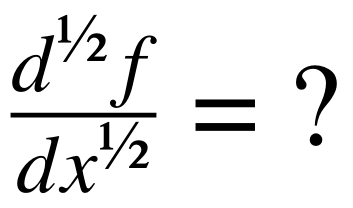
Medium
“A paradox from which one day useful consequences will be drawn.” ~Gottfried Leibniz
formal flicker
yea, theres nothing like that for factorials
cause theres many fractional derivatives
and theyre usually defined off integration
is there a sort of thing for the factorial too?
final saddleBOT
@formal flicker Has your question been resolved?
Channel closed
Closed by @formal flicker
Use .reopen if this was a mistake.
Available help channel!
Send your question here to claim the channel.
Remember:
• Ask your math question in a clear, concise manner.
• Show your work, and if possible, explain where you are stuck.
• After 15 minutes, feel free to ping <@&286206848099549185>.
• Type the command .close to free the channel when you're done.
• Be polite and have a nice day!
Read #❓how-to-get-help for further information on how to ask a good question, and about conduct in the question channels.
 noble mist
are these right
 final saddleBOT
noble mist
are these right
final saddleBOT
noble mist
are these right
 grim badger
noble mist
are these right
grim badger
noble mist
are these right
Definitely not 4
noble mist
2x + 8 = 28?
grim badger
Same process that you did for the other problems
Except this time, you don't have x, it's 2x + 8
noble mist
quick question
how do I know which order to put the sides in
to solve for the missing side
grim badger
How did you do it for the other problems?
noble mist
tbh
I could barley do those
cheated on 1
and for 2 and 3
I just got help but they didnt really help tbh
they just kinda told me the equation
grim badger

This math video tutorial discusses similar triangles and how to use proportions to find the missing side and solve for x. This video contains plenty of examples and practice problems.
Pre-Algebra Video Playlist:
https://www.youtube.com/watch?v=WJqw-cxvKgo&list=PL0o_zxa4K1BVoTlaXWFcFZ7fU3RvmFMMG
Algebra Online Course:
https://www.udemy.com/alg...
Here's a video that should help
noble mist
ty
final saddleBOT
@noble mist Has your question been resolved?
 grim badger
Looks right
 final saddleBOT
Channel closed
Closed due to timeout
Use .reopen if this was a mistake.
grim badger
.reopen
final saddleBOT
✅
noble mist
hi
grim badger
Because 14 * 32 is not 768
final saddleBOT
@noble mist Has your question been resolved?
noble mist
@grim badger

looking back on number 2
wouldnt it be this?
it looks wrong but
arnt the angles equal this way
isnt HU = FH
final saddleBOT
Channel closed
Closed due to timeout
Use .reopen if this was a mistake.
noble mist
.reopen
final saddleBOT
✅
 slow tapir
noble mist
<@485903210272391178>
slow tapir
noble mist
<@485903210272391178>
m8 dont ping people
slow tapir
noble mist
isnt HU = FH
how
they literally gave the measures of HF(84) and HU(45)
84 is not equal to 45
slow tapir
noble mist
he was previously helping me
ik but dont ping ppl
noble mist
slow tapir
ik but dont ping ppl
ight
noble mist
slow tapir
84 is not equal to 45
and yeha I just realized but
im watching this video
idk its confusing me

like
these should be correct then right
slow tapir
idu what u r saying
slow tapir
noble mist
look at the triangles
noble mist
u myb
slow tapir
FGH ~ TUH
noble mist
yea
 final saddleBOT
@noble mist Has your question been resolved?
 final saddleBOT
Channel closed
Closed due to timeout
Use .reopen if this was a mistake.
noble mist
.reopen
final saddleBOT
✅
final saddleBOT
@noble mist Has your question been resolved?
final saddleBOT
Channel closed
Closed due to timeout
Use .reopen if this was a mistake.
Available help channel!
Send your question here to claim the channel.
Remember:
• Ask your math question in a clear, concise manner.
• Show your work, and if possible, explain where you are stuck.
• After 15 minutes, feel free to ping <@&286206848099549185>.
• Type the command .close to free the channel when you're done.
• Be polite and have a nice day!
Read #❓how-to-get-help for further information on how to ask a good question, and about conduct in the question channels.
tranquil pine
 final saddleBOT
tranquil pine
tranquil pine
final saddleBOT
tranquil pine
tranquil pine
really confused on D
there is no difference right?
The area u gave in part d of the question?
Heh
yeah that was a typo in the question
confuses me even more
wtf do i write for this question
Well the thing is
The integral kind of minuses out the negative part of the graph
So it is not the true "area"
You need to split up the integral and take the absolute value of the negative part and add it up to get the actual "area"
Or u can just multiply by 2 since that's cos which the negative part is symmetrical to the positive one
thank you
I'm just learning about integrals so still a lil confused
but u helped
Yeah so the integral kind of subtracts the thing under the graph so to get the area
You should write:
[
\text{Area = } \int_{-\frac{\pi}{2}}^{\frac{\pi}{2}}f(x) dx+ \abs{\int_{\frac{\pi}{2}}^{\frac{3\pi}{2}}f(x)dx}
]
Painnn
damn
also what ???
soft zealotBOT
♡LexQa♡
 final saddleBOT
Channel closed
Closed by @heady comet
Use .reopen if this was a mistake.
Available help channel!
Send your question here to claim the channel.
Remember:
• Ask your math question in a clear, concise manner.
• Show your work, and if possible, explain where you are stuck.
• After 15 minutes, feel free to ping <@&286206848099549185>.
• Type the command .close to free the channel when you're done.
• Be polite and have a nice day!
Read #❓how-to-get-help for further information on how to ask a good question, and about conduct in the question channels.
 dusk canyon
Find the measure of angle z.
help with this problem
 final saddleBOT
dusk canyon
Find the measure of angle z.
help with this problem
final saddleBOT
dusk canyon
Find the measure of angle z.
help with this problem
 vital comet
 oblique portal
yeah thats what i would do
dunno why they gave u those x y w and v angles you dont need em
final saddleBOT
@dusk canyon Has your question been resolved?
Channel closed
Closed by @dusk canyon
Use .reopen if this was a mistake.
final saddleBOT
Available help channel!
Send your question here to claim the channel.
Remember:
• Ask your math question in a clear, concise manner.
• Show your work, and if possible, explain where you are stuck.
• After 15 minutes, feel free to ping <@&286206848099549185>.
• Type the command .close to free the channel when you're done.
• Be polite and have a nice day!
Read #❓how-to-get-help for further information on how to ask a good question, and about conduct in the question channels.
tranquil pine
ahm
final saddleBOT
tranquil pine
ahm
 sturdy cypress
it's yours
tranquil pine
is it acc???
sturdy cypress
it's even called chubby
tranquil pine
omd
sturdy cypress
christmas magics
tranquil pine
nah acc what’s going on
tranquil pine
sturdy cypress
christmas magics
thats mental
anyways back to the question that i was posing like 50times
is there a quick easy way for me to know when to use tan and when tan inverse?
im solving some polar coordinates problems and getting confused by this point
come on my chubbys help me i got quiz tmrw
sturdy cypress
tan works on angles
and doesn't give an angle
and arctan gives an angle and doesn't work on angles
and it's the same idea as with sine and cos, the "basic" function with a shorter name is the one that works on angles
ok i've no idea, maybe there's something called tan inverse and it's not what i think
tranquil pine
sturdy cypress
and it's the same idea as with sine and cos, the "basic" function with a shorter...
oh that’s something new
thats the tan inverse im talking about

it got mince one above it
ALSO that question

i never get the same answer as (which is 0.714) in the question even tho im putting the same values in my calculator
i got 0.0124
and tan inverse give me ≈35°
OHHHH wait i think they just use tan inverse in these questions, they got 216° cos they added 180° to 35° which u should do
vital crag
tranquil pine
thats the tan inverse im talking about
arctan and inverse tan are the same thing
tranquil pine
vital crag
arctan and inverse tan are the same thing
oh, yh i thought so but he said that tan inverse may be smth diff
vital crag
common awful math notation/jargon 
tranquil pine
lol gotta be having a meaning behind it but still
vital crag
doesn't make it not awful
 tranquil pine
vital crag
doesn't make it not awful
tranquil pine
vital crag
doesn't make it not awful
Mathematician arent the best at naming stuff as we can see
s
vital crag
indeed
tranquil pine
thats acc really lovely that i have my own channels ima be posing questions all the time no one can say nothing
vital crag
with great power, comes great responsibility
final saddleBOT
@tranquil pine Has your question been resolved?
vital crag
tranquil pine
is the answer a?
no
calculate the magnitude of all the vectors using the equation for R = sqrt(...) above
tranquil pine
waaiiittt
tranquil pine
vital crag
no
IS IT C??
vital crag
tranquil pine
IS IT C??
did you show it by using the equation for R?
tranquil pine
vital crag
did you show it by using the equation for R?
yess i square rooted 5
soft zealotBOT
Result:
2.2360679774998
urm bcs they wanted the magnitude and to find it u have to square root the given number, and since i have one component i dont have to do any operations
tranquil pine
vital crag
,calc sqrt(5)
wait what, well i think i didn’t really get the question then
tranquil pine
soft zealot
Result:
```
2.2360679774998
```
thanks mr. bot
vital crag
you still have something to plug into the right side
 tranquil pine
thats stupid it cant be that hard to get
tranquil pine
vital crag
you still have something to plug into the right side
should i be having two components?
bcs on the 3rd option we just got one
which well be z (which they should have added to their role)
tranquil pine
tranquil pine
bcs on the 3rd option we just got one
oh even the 2nd
final saddleBOT
@tranquil pine Has your question been resolved?
tranquil pine
can u stop asking me that question and let me have my channel on peace?
vital crag
vital crag
you still have something to plug into the right side
$R = \sqrt{R_x^2 + R_y^2 + R_z^2}$
soft zealotBOT
riemann
 vital crag
don't know why your book only gave the formula for two components
vital crag
tranquil pine
Here,
Avec = [Ax, Ay, Az] = [2, 5, 0]
Bvec = [Bx, By, Bz] = [0, -3, 0]
Cvec = [Cx, Cy, Cz] = [0, 0, 5]
vital crag
soft zealot
**riemann**
use this formula to find magnitude of each Avec, Bvec, Cvec
tranquil pine
vital crag
Here,
Avec = [Ax, Ay, Az] = [2, 5, 0]
Bvec = [Bx, By, Bz] = [0, -3, 0]
Cvec = [...
ahh yess thats exactly how it should be, so when the components isn’t mentioned it’ll be 0
tranquil pine
vital crag
use this formula to find magnitude of each Avec, Bvec, Cvec
it will still be Cvec right? bcs they said which of the following their magnitude vector equals the component itself so itll be C as the answer
tranquil pine
vital crag
don't know why your book only gave the formula for two components
i think it depends in their mood bcs sometimes they don’t mention on other formulas as well even tho they should
vital crag
tranquil pine
it will still be Cvec right? bcs they said which of the following their magnitud...
you've still yet to show any calculation
the way you describe it sounds like you haven't calculated anything
tranquil pine
there u go
 final saddleBOT
Channel closed
Closed due to timeout
Use .reopen if this was a mistake.
final saddleBOT
Available help channel!
Send your question here to claim the channel.
Remember:
• Ask your math question in a clear, concise manner.
• Show your work, and if possible, explain where you are stuck.
• After 15 minutes, feel free to ping <@&286206848099549185>.
• Type the command .close to free the channel when you're done.
• Be polite and have a nice day!
Read #❓how-to-get-help for further information on how to ask a good question, and about conduct in the question channels.
 grim nebula
<@&268886789983436800>
 tribal condor
Dead
 stable kraken
.close
final saddleBOT
Channel closed
Closed by @stable kraken
Use .reopen if this was a mistake.
Available help channel!
Send your question here to claim the channel.
Remember:
• Ask your math question in a clear, concise manner.
• Show your work, and if possible, explain where you are stuck.
• After 15 minutes, feel free to ping <@&286206848099549185>.
• Type the command .close to free the channel when you're done.
• Be polite and have a nice day!
Read #❓how-to-get-help for further information on how to ask a good question, and about conduct in the question channels.
 cosmic dawn
If f : [a,b] to R is riemann integrable, is g : [a,b] to R also riemann integrable?
final saddleBOT
cosmic dawn
If f : [a,b] to R is riemann integrable, is g : [a,b] to R also riemann integrab...
 dry light
r and g seem independent of each other
vital crag
cosmic dawn
If f : [a,b] to R is riemann integrable, is g : [a,b] to R also riemann integrab...
need more information. see ^
final saddleBOT
@cosmic dawn Has your question been resolved?
cosmic dawn
If f is riemann integrable on some interval, is g riemann integrable on the exact same interval? It is unknown if f=g, but it is possible.
vital crag
can you just screenshot or take a picture of the problem
cosmic dawn
I'm just saying in general. Are two functions, (let's just say that they are different), RI on the same interval if one of the functions is?
final saddleBOT
Channel closed
Closed by @cosmic dawn
Use .reopen if this was a mistake.
final saddleBOT
Available help channel!
Send your question here to claim the channel.
Remember:
• Ask your math question in a clear, concise manner.
• Show your work, and if possible, explain where you are stuck.
• After 15 minutes, feel free to ping <@&286206848099549185>.
• Type the command .close to free the channel when you're done.
• Be polite and have a nice day!
Read #❓how-to-get-help for further information on how to ask a good question, and about conduct in the question channels.
heavy crystal
Need help with this improper integral
 final saddleBOT
heavy crystal
Need help with this improper integral
final saddleBOT
final saddleBOT
heavy crystal
Need help with this improper integral
final saddleBOT
@heavy crystal Has your question been resolved?
final saddleBOT
@heavy crystal Has your question been resolved?
 fluid sky
try the substitution u = 2 - arctan(x)
final saddleBOT
Channel closed
Closed due to timeout
Use .reopen if this was a mistake.
Available help channel!
Send your question here to claim the channel.
Remember:
• Ask your math question in a clear, concise manner.
• Show your work, and if possible, explain where you are stuck.
• After 15 minutes, feel free to ping <@&286206848099549185>.
• Type the command .close to free the channel when you're done.
• Be polite and have a nice day!
Read #❓how-to-get-help for further information on how to ask a good question, and about conduct in the question channels.
 pearl wraith
How did they pick the interval [0,250] in this optimization problem?

 dry light
It would be really funny if the fence had a length of -100
It's gotta make sense
You can't have negative length
Or rather negative area
pearl wraith
why [0,250] instead of (0,250)
dry light
Because you have 0 area
And also makes critical points easier
Since you can include endpoints
And so those are also candidates
You won't have to fret whether the best option are the endpoints or not
pearl wraith
oh okay
final saddleBOT
@pearl wraith Has your question been resolved?
final saddleBOT
Channel closed
Closed due to timeout
Use .reopen if this was a mistake.
Available help channel!
Send your question here to claim the channel.
Remember:
• Ask your math question in a clear, concise manner.
• Show your work, and if possible, explain where you are stuck.
• After 15 minutes, feel free to ping <@&286206848099549185>.
• Type the command .close to free the channel when you're done.
• Be polite and have a nice day!
Read #❓how-to-get-help for further information on how to ask a good question, and about conduct in the question channels.
 stray stump
 final saddleBOT
stray stump
final saddleBOT
stray stump
 sinful folio
what have you tried?
sinful folio
do you have any other ideas?
 sinful folio
thats one way of doing it yeah
final saddleBOT
Channel closed
Closed by @stray stump
Use .reopen if this was a mistake.
Available help channel!
Send your question here to claim the channel.
Remember:
• Ask your math question in a clear, concise manner.
• Show your work, and if possible, explain where you are stuck.
• After 15 minutes, feel free to ping <@&286206848099549185>.
• Type the command .close to free the channel when you're done.
• Be polite and have a nice day!
Read #❓how-to-get-help for further information on how to ask a good question, and about conduct in the question channels.
 timid furnace
(x-h)^3-x^3
final saddleBOT
timid furnace
(x-h)^3-x^3
timid furnace
Is expanding the cubic (x-h)^3 the fastest way to do it
I expanded everything
And then factored everything by h
.close
final saddleBOT
Channel closed
Closed by @timid furnace
Use .reopen if this was a mistake.
Available help channel!
Send your question here to claim the channel.
Remember:
• Ask your math question in a clear, concise manner.
• Show your work, and if possible, explain where you are stuck.
• After 15 minutes, feel free to ping <@&286206848099549185>.
• Type the command .close to free the channel when you're done.
• Be polite and have a nice day!
Read #❓how-to-get-help for further information on how to ask a good question, and about conduct in the question channels.
 proud sage
Having trouble with question C, some help would be appreciated
 final saddleBOT
proud sage
Having trouble with question C, some help would be appreciated
final saddleBOT
proud sage
Having trouble with question C, some help would be appreciated
@proud sage Has your question been resolved?
 manic elm
Partial sum of first 5 terms is simply the sum of the first 5 terms of the sequence. If you've figured out the common ratio r, and are able to find the 6th term, then finding the sum of the first 5 terms should follow
It's called a partial sum because the entire sequence is infinite in terms, and you're only choosing to evaluate the first finite number of terms
final saddleBOT
Channel closed
Closed due to timeout
Use .reopen if this was a mistake.
Available help channel!
Send your question here to claim the channel.
Remember:
• Ask your math question in a clear, concise manner.
• Show your work, and if possible, explain where you are stuck.
• After 15 minutes, feel free to ping <@&286206848099549185>.
• Type the command .close to free the channel when you're done.
• Be polite and have a nice day!
Read #❓how-to-get-help for further information on how to ask a good question, and about conduct in the question channels.
 muted pelican
If Sin(theta) < 0 and tan(theta) = 5/3, 0<=theta<360, then theta, correct to the nearest whole angle must be
final saddleBOT
muted pelican
If Sin(theta) < 0 and tan(theta) = 5/3, 0<=theta<360, then theta, correct to the...
muted pelican
<@&286206848099549185>
muted pelican
<@&286206848099549185>
 thorny tendon
muted pelican
If Sin(theta) < 0 and tan(theta) = 5/3, 0<=theta<360, then theta, correct to the...
thorny tendon
muted pelican
If Sin(theta) < 0 and tan(theta) = 5/3, 0<=theta<360, then theta, correct to the...
Do you have a screenshot of the original problem? θ can’t be < 0 and > 360. You made a typo
thorny tendon
What have you tried?
thorny tendon
Do you know the unit circle and what these trig functions mean?
final saddleBOT
Channel closed
Closed by @muted pelican
Use .reopen if this was a mistake.
muted pelican
lolol
final saddleBOT
Available help channel!
Send your question here to claim the channel.
Remember:
• Ask your math question in a clear, concise manner.
• Show your work, and if possible, explain where you are stuck.
• After 15 minutes, feel free to ping <@&286206848099549185>.
• Type the command .close to free the channel when you're done.
• Be polite and have a nice day!
Read #❓how-to-get-help for further information on how to ask a good question, and about conduct in the question channels.
 next pagoda
f(x)= 1/x
final saddleBOT
next pagoda
f(x)= 1/x
next pagoda
Why would this be a odd function ?
 cold gorge
Because $f(x) \neq f(-x)$
soft zealotBOT
What the hell am I doing here?
 tranquil pine
because f(x)= -f(-x)
next pagoda
I'm getting two different answers
cold gorge
The answers aren't different when you properly look at them.
tranquil pine
cold gorge
The answers aren't different when you properly look at them.
not even function does not imply odd function
final saddleBOT
Channel closed
Closed by @next pagoda
Use .reopen if this was a mistake.
Available help channel!
Send your question here to claim the channel.
Remember:
• Ask your math question in a clear, concise manner.
• Show your work, and if possible, explain where you are stuck.
• After 15 minutes, feel free to ping <@&286206848099549185>.
• Type the command .close to free the channel when you're done.
• Be polite and have a nice day!
Read #❓how-to-get-help for further information on how to ask a good question, and about conduct in the question channels.
 slim cove
Hello, i have a problem with a polynomal division and how to get to the result.
final saddleBOT
slim cove
Hello, i have a problem with a polynomal division and how to get to the result.
 slim cove
so it would be like x^3(x-1) so i can cancel out to x^3/(x(2x-1)) = x^2/(2x-1) ?
tranquil pine
yup!!!
slim cove
and this simplified term i need to use for the polynomal division to find the y for the asymptote?
I think i got it now. I did overlook the fact to use the simplified term for the division. Thank you.
.close
final saddleBOT
Channel closed
Closed by @slim cove
Use .reopen if this was a mistake.
Available help channel!
Send your question here to claim the channel.
Remember:
• Ask your math question in a clear, concise manner.
• Show your work, and if possible, explain where you are stuck.
• After 15 minutes, feel free to ping <@&286206848099549185>.
• Type the command .close to free the channel when you're done.
• Be polite and have a nice day!
Read #❓how-to-get-help for further information on how to ask a good question, and about conduct in the question channels.
 broken dove
I need help setting this up
 final saddleBOT
broken dove
I need help setting this up
tranquil pine
final saddleBOT
broken dove
I need help setting this up
tranquil pine
radians is for 2-D angle measurement
broken dove
but what goes in the integrand is confusing me
yeah, isn't that necessary for surface area?
tranquil pine
yes
broken dove
would I use spherical coordinates as well?
tranquil pine
I'm not familiar with this, someone else will help you
broken dove
set up like this, right?

So what would go in the integrand?
<@&286206848099549185> give me a hand here
final saddleBOT
@broken dove Has your question been resolved?
 robust sedge
We have that z = f(x, y) = sqrt(4 - x^2 - y^2) = sqrt(4 - r^2) .
We need to calculate sqrt((f_x)^2 + (f_y)^2 + 1) then calculate
 final saddleBOT
@broken dove Has your question been resolved?
final saddleBOT
Channel closed
Closed due to timeout
Use .reopen if this was a mistake.
Available help channel!
Send your question here to claim the channel.
Remember:
• Ask your math question in a clear, concise manner.
• Show your work, and if possible, explain where you are stuck.
• After 15 minutes, feel free to ping <@&286206848099549185>.
• Type the command .close to free the channel when you're done.
• Be polite and have a nice day!
Read #❓how-to-get-help for further information on how to ask a good question, and about conduct in the question channels.
 distant breach
can someone help me with this:
 final saddleBOT
distant breach
can someone help me with this:
distant breach
final saddleBOT
distant breach
can someone help me with this:
distant breach
im confused on where to start atm
 supple mantle
You see how the function is a fraction?
supple mantle
Yep
If you divide by 0, the function becomes undefined
So you basically find all the x values that make the function not work basically
tranquil pine
assume that a function's domain is $\bR$ and then chop off the points that dont match that
soft zealotBOT
♡LexQa♡
 tranquil pine
aka when 1/0 for example
distant breach
so from what im getting/understanding, domain should be (-infinity, -1) U (-1,1) U (1, infinity)
tranquil pine
inbetween -1 and 1? 
supple mantle
The x values are correct but the condition needs some tweaking
supple mantle
Yep
distant breach
then x = -1 and x = 1 are my vertical asymptotes too
supple mantle
Yep
tranquil pine
yes
distant breach
how would i find intercepts?
supple mantle
What about the horizontal ones?
distant breach
o
tranquil pine
distant breach
then x = -1 and x = 1 are my vertical asymptotes too
x = 1 isnt a vertical asymptote
distant breach
oh
tranquil pine
it is removeable
distant breach
wdym by removable
tranquil pine
because
supple mantle
Damn
tranquil pine
[
\lim_{x \to -1} (\frac{x^2 -x}{x^2 -1}) = \text{DNE}
]
[
\lim_{x \to 1} (\frac{x^2 -x}{x^2 -1}) = \frac{1}{2}
]
supple mantle
Ok so
soft zealotBOT
♡LexQa♡
 distant breach
so if i plug it in?
supple mantle
Limits basically is an operation to find how the function behaves at certain points
supple mantle
If they approach a certain value or not
distant breach
oh ok
supple mantle
Sometimes they go to infinity
tranquil pine
distant breach
wdym by removable
its a removeable discontinuity
supple mantle
Sometimes they don't approach anything
tranquil pine
anyways i will go back to the Fourier shit
supple mantle
Limits make this possible
supple mantle
tranquil pine
anyways i will go back to the Fourier shit

distant breach
so how do ik when ones a vert asymptote or horizontal asymptote?
is it based off limits?
distant breach
ok so
distant breach
soft zealot
**♡LexQa♡**
how do i do this without calculator and stuff..
do i plug in -1 and 1 to x?
tranquil pine
[f(x) = 0 \text{ (tells you x intercept) }]
[x = 0 \text{ (tells you y intercept)}]
[\lim_{x \to C} f(x) \text{ (tells you vertical asymptotes for any}]
[\text{non removable infinite discontinuty C) }]
[\lim_{x \to \pm \infty} f(x) \text{ (tells you horizontal asymptotes) }]
supple mantle

soft zealotBOT
♡LexQa♡
 distant breach
then after factoring?
supple mantle
Yep now works
supple mantle
distant breach
then after factoring?
If you have a value, then the limit exists
distant breach
soft zealot
**♡LexQa♡**
o
distant breach
supple mantle
If you have a value, then the limit exists
wdym by value..
distant breach
yeah
distant breach
im kind of lost still..
supple mantle
Let's try the limit when x approaches-1
distant breach
ok
supple mantle
$$\lim_{x\rightarrow -1} \frac{x^2 - x}{x^2 - 1}$$
soft zealotBOT
VulcanOne
 supple mantle
We factored it right?
distant breach
yes
supple mantle
$$\lim_{x\rightarrow -1} \frac{x(x-1)}{(x-1)(x+1)}$$
soft zealotBOT
VulcanOne
 distant breach
mhm
tranquil pine
there are two types of removable discontinuities
distant breach
o
supple mantle
We can cancel x-1 right?
distant breach
yes we can
supple mantle
Now we are left with this
distant breach
x/x+1
supple mantle
$$\lim_{x\rightarrow -1} \frac{x}{x+1}$$
soft zealotBOT
VulcanOne
 supple mantle
Here we stop
distant breach
and then what do we do
tranquil pine
There are two types of removable discontinuities I believe, one where the limit is finite but the function is undefined, and second when the limit is finite but the value of that function at that point is not the same as the limit's.
You are having the first case with x = 1
supple mantle
We need to see if the value from the right equals the value from the left
distant breach
tranquil pine
There are two types of removable discontinuities I believe, one where the limit ...
o
distant breach
supple mantle
We need to see if the value from the right equals the value from the left
how do we do that..?
distant breach
yeah
supple mantle
So we need to see if we added a sign to 0
Will the function behave the same or not
distant breach
wdym by a sign
supple mantle
-0 and +0
distant breach
oh ok
supple mantle
If we made 0 negative, the function goes to + infinity
And if we made the 0 positive
The function goes to - infinity
Now here does the limit from the left equal the limit on the right?
distant breach
im sorry about this again..
but how do yk it'll go to positive
infinity
and negative infinity
supple mantle
We add signs to the zero
distant breach
yeah
supple mantle
$$\lim_{x \rightarrow -1} \frac{x}{x+1} = \frac{-1}{-1+1}$$
soft zealotBOT
VulcanOne
 distant breach
oh
supple mantle
$$\frac{-1}{0}$$
soft zealotBOT
VulcanOne
 supple mantle
We're gonna be unsure about the behavior of the function if we kept the zero with a sign
So we take the limit from the left
distant breach
ok..
supple mantle
Seeing a zero on the denominator should be a red flag to you
distant breach
o like that
supple mantle
Yep
You should expect 2 things
It either becomes (infinity or negative infinity)
Or the limit doesn't exist
distant breach
ok ok..
supple mantle
The limit does not exist when
You have 2 different values from the left and from the right
 distant breach
o
distant breach
mhm..
supple mantle
From the left, it goes down
distant breach
yeah
supple mantle
Yep
distant breach
but how would ik if its horizontal or vertical?
supple mantle
You take the limit of x at a finite number
That's vertical
But when you take the limit for x at infinity
That's horizontal
distant breach
is there another way to figure it out..
i really dont remember doing this in class
supple mantle

You need to solve more limits to understand it
Because 1 class isn't enough
Lemme give you an example
supple mantle
$\lim_{x\rightarrow \infty} \frac{x^2 -x}{x^2 - 1}$
soft zealotBOT
VulcanOne
 supple mantle
Yep
distant breach
can i send u an example that my prof did?
 distant breach
 supple mantle
The dotted line is the horizontal asymptote
 distant breach
🥲
supple mantle
He didn't explain why this works
distant breach
not rly
supple mantle
All of that works through limits
distant breach
oh
supple mantle
Ok don't worry about it
You can take the limit by going super close to the value
Like
$$\lim_{x\rightarrow -1} \frac{x^2 - x}{x^2 - 1} = \frac{(-1.001)^2 - (-1.001)}{(-1.001)^2 - 1}$$
distant breach
o
soft zealotBOT
VulcanOne
 supple mantle
If this worked
Then you try from the other side
$$\lim_{x\rightarrow -1} \frac{x^2 - x}{x^2 - 1} = \frac{(-0.999)^2 - (-0.999)}{(-0.999)^2 - 1}$$
soft zealotBOT
VulcanOne
 supple mantle
The highest powers of the numerator and denominator
distant breach
and the reason it works is because of limits?
supple mantle
Yep
When you have this for example
$$\lim_{x\rightarrow \infty} \frac{x^2 - x}{x^2 - 1}$$
soft zealotBOT
VulcanOne
 distant breach
o
supple mantle
Now 1 compared 1000000^2 is like comparing an ant to the sky
In size
Same thing for 1000000 compared to 1000000^2
So you take only x with the highest powers from the numerator and denominator
And the coefficients do the job for you
1 minute brb
distant breach
ok
supple mantle
Oki I'm back
That's the reason why taking the highest powers works
There is also something else relating to how fast functions approach infinity
Which is called "the list"
That's something else you'll take in the future
Anyways
distant breach
o
supple mantle

supple mantle
Damn
 distant breach
yeppp..
distant breach
uh
supple mantle
For studies and time?
supple mantle
Wow
distant breach
:') yep
supple mantle
Are you sure you can pull it off?
supple mantle
Wait don't
distant breach
i need a 62% to pass the class on this final.
supple mantle
You're gonna hopefully pass
distant breach
supple mantle
Wait don't
too late, been doing it from week 1 😭
distant breach
supple mantle
You're gonna hopefully pass
honestly im scared
 cobalt lodge
there's always scaling
distant breach
cobalt lodge
~~there's always scaling~~
wuts that
supple mantle
You'll do good I'm sure
He means taking the grade of the highest performing person and scaling all the others based off on that score
distant breach
my prof would never do that