 Available help channel!
#help-36
1 messages · Page 1 of 1 (latest)
 final saddleBOT
Available help channel!
final saddleBOT
final saddleBOT
Available help channel!
final saddleBOT
 royal gust
a² = b?
 silver dew
{1,a,b} is cyclic group of order 3 under multiplication
royal gust
I am convinced
silver dew
?
silver dew
So it’s generated by , say x, either a=x, b=x^2, or a=x^2, b=x, either case a^2=b
Because x^4=x
final saddleBOT
Channel closed
Closed by @deep cosmos
Use .reopen if this was a mistake.
Available help channel!
Send your question here to claim the channel.
Remember:
• Ask your math question in a clear, concise manner.
• Show your work, and if possible, explain where you are stuck.
• After 15 minutes, feel free to ping <@&286206848099549185>.
• Type the command .close to free the channel when you're done.
• Be polite and have a nice day!
Read #❓how-to-get-help for further information on how to ask a good question, and about conduct in the question channels.
 split crown
 final saddleBOT
split crown
final saddleBOT
final saddleBOT
split crown
final saddleBOT
@split crown Has your question been resolved?
 mint orbit
split crown
what is a power function end behavior model
mint orbit
split crown
what is a power function end behavior model
the end behavior, i believe
split crown
i figured out the end behavior
it approaches 0 on both sides
but what would i put as the answer
 split crown
yea im' confused
mint orbit
thats not gonna fit the signs is it
split crown
can u explain to me why it's that

 soft zealotBOT
jan Niku
 mint orbit
here is your function
split crown
yep
mint orbit
the first thing youll do is say
well x is gonna be really really large
in magnitude
itll be some really positive or really negative number
point being
split crown
🤔
mint orbit
if you take some really positive or really negative number right
i mean were talking end behavior here
say x= a million
split crown
yea
split crown
yea ik
mint orbit
$\frac{x}{3x^2+2x}$
soft zealotBOT
jan Niku
 mint orbit
lets just ignore the constants
now, you reapply the argument
well if x=a million
a million squared is an enormous number
split crown
it's gonna be like 0 ik
soft zealotBOT


 Requested by jan Niku#2119
mint orbit
Requested by jan Niku#2119
mint orbit
this number is big compared to a million
mint orbit
thats fine
split crown
so it becomes 1/mil
mint orbit
we just say this
split crown
which is around 0
mint orbit
$3x^2 +2x \approx 3x^2$
soft zealotBOT
jan Niku
 mint orbit
for really large x
split crown
mhm
mint orbit
okay, so lets replace
mint orbit
yup
mint orbit
yea 
mint orbit
np
split crown
.close
final saddleBOT
Channel closed
Closed by @split crown
Use .reopen if this was a mistake.
Available help channel!
Send your question here to claim the channel.
Remember:
• Ask your math question in a clear, concise manner.
• Show your work, and if possible, explain where you are stuck.
• After 15 minutes, feel free to ping <@&286206848099549185>.
• Type the command .close to free the channel when you're done.
• Be polite and have a nice day!
Read #❓how-to-get-help for further information on how to ask a good question, and about conduct in the question channels.
 worldly furnace
 final saddleBOT
worldly furnace
worldly furnace
final saddleBOT
worldly furnace
worldly furnace
could I get some help with this?
final saddleBOT
@worldly furnace Has your question been resolved?
 fossil geyser
You still here? @worldly furnace
The problem says that the interest is calculated every day but isn't added until the end of the month.
June has 30 days. It looks like for the first 21 days, the account had a balance of $900, and for the final 9 days, it had a balance of $600.
(I think. The $900 is a little hard to read)
From the annual rate of 17%, you can calculate a daily rate. Just divide it by 365.
That should let you find the interest owed for each day. 21 days at a balance of $900, 9 days at a balance of $600.
Then just add it all up
final saddleBOT
@worldly furnace Has your question been resolved?
final saddleBOT
Channel closed
Closed due to timeout
Use .reopen if this was a mistake.
final saddleBOT
Available help channel!
Send your question here to claim the channel.
Remember:
• Ask your math question in a clear, concise manner.
• Show your work, and if possible, explain where you are stuck.
• After 15 minutes, feel free to ping <@&286206848099549185>.
• Type the command .close to free the channel when you're done.
• Be polite and have a nice day!
Read #❓how-to-get-help for further information on how to ask a good question, and about conduct in the question channels.
 tranquil pine
 final saddleBOT
tranquil pine
final saddleBOT
tranquil pine
 chrome cove
What did you try? where did you get stuck?
 grim badger
Product rule
chrome cove
Yes it's a product rule, but it's quite messy
tip: at the beginning, it's easier if you write cos³x as (cosx)³, so you don't loose any chain rules
grim badger
By using product rule
tranquil pine
would i seperate into (4cos^3x)(sinx)
grim badger
Yeah, you can do that
final saddleBOT
Channel closed
Closed by @grim garnet
Use .reopen if this was a mistake.
Available help channel!
Send your question here to claim the channel.
Remember:
• Ask your math question in a clear, concise manner.
• Show your work, and if possible, explain where you are stuck.
• After 15 minutes, feel free to ping <@&286206848099549185>.
• Type the command .close to free the channel when you're done.
• Be polite and have a nice day!
Read #❓how-to-get-help for further information on how to ask a good question, and about conduct in the question channels.
tranquil pine

 final saddleBOT
tranquil pine
final saddleBOT
final saddleBOT
tranquil pine
final saddleBOT
@tranquil pine Has your question been resolved?
final saddleBOT
Channel closed
Closed due to timeout
Use .reopen if this was a mistake.
Available help channel!
Send your question here to claim the channel.
Remember:
• Ask your math question in a clear, concise manner.
• Show your work, and if possible, explain where you are stuck.
• After 15 minutes, feel free to ping <@&286206848099549185>.
• Type the command .close to free the channel when you're done.
• Be polite and have a nice day!
Read #❓how-to-get-help for further information on how to ask a good question, and about conduct in the question channels.
 thin leaf
I need help with absolute value equations
final saddleBOT
thin leaf
I need help with absolute value equations

 worn mortar
do you know at least how to approach 17)?
thin leaf
Yes
However
25
Is kicking my ass
Is it distributing?
Is it +
Is it 2n together?
Wtf?!?
worn mortar
ok before doing 25) were u able to do 22)

 wary helm
thin leaf
<@&286206848099549185>
wary helm
thin leaf
<@&286206848099549185>
- is correct
r=9 or r=-7
wary helm
You have
2|n-5|=20
wary helm
Ok so
2|n-5|=20
thin leaf
yes
wary helm
The absolute value is like a parentheses, so the 2 multiplies both n and -5
thin leaf
WHAAAAAAAAAAAAAAT
wary helm
It's like having 2(|n+5|)=20
worn mortar
how would you solve for n if there was no absolute sign so 2(n+5)=20
wary helm
https://youtu.be/_cHbhzQVd7Y
You should watch this short video to understand how absolute value equations work before attempting to solve these equations
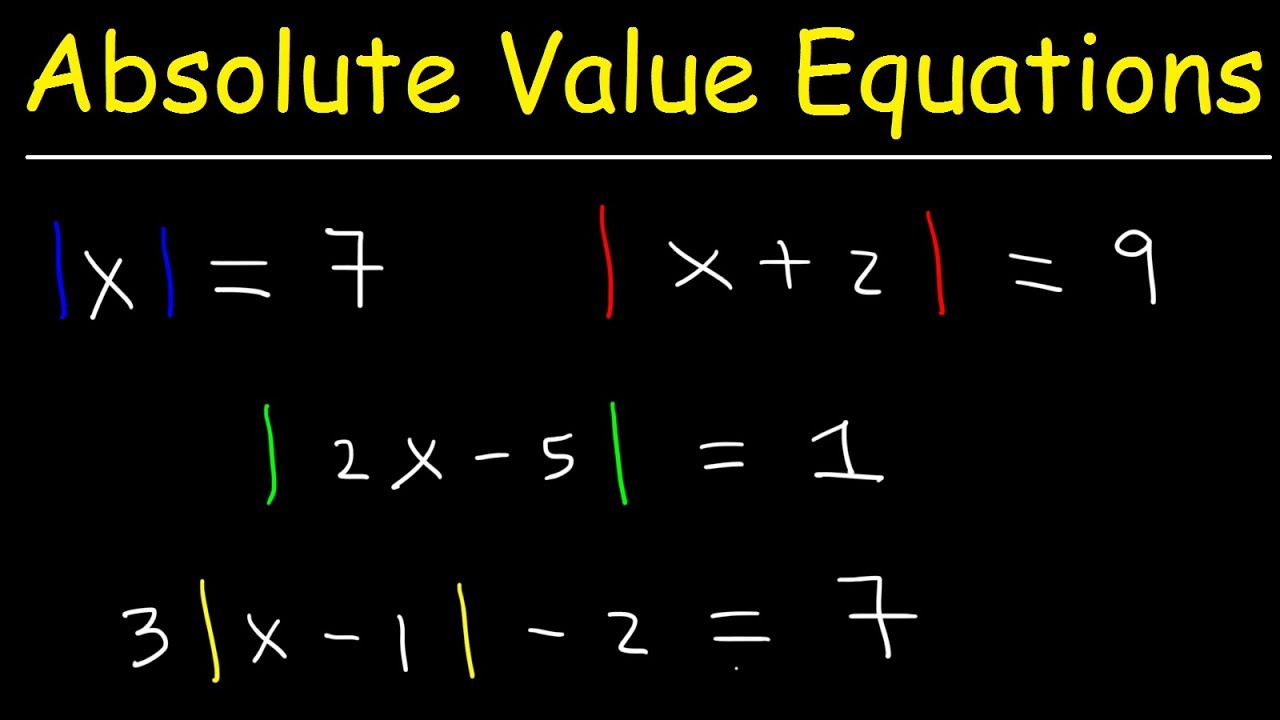
This algebra video tutorial provides a basic introduction into absolute value equations. it explains how to solve absolute value equations the easy way. It contains plenty of examples and practice problems for you to learn the concept.
New Algebra Playlist:
https://www.youtube.com/watch?v=nTn9gVqRfKY&list=PL0o_zxa4K1BUeF2o-MlNpbRiS-oE2Kn6J&...
 wary helm
thin leaf
Grade plz
wary helm
thin leaf
Grade plz
Correct
final saddleBOT
@thin leaf Has your question been resolved?
Channel closed
Closed by @thin leaf
Use .reopen if this was a mistake.
Available help channel!
Send your question here to claim the channel.
Remember:
• Ask your math question in a clear, concise manner.
• Show your work, and if possible, explain where you are stuck.
• After 15 minutes, feel free to ping <@&286206848099549185>.
• Type the command .close to free the channel when you're done.
• Be polite and have a nice day!
Read #❓how-to-get-help for further information on how to ask a good question, and about conduct in the question channels.
 alpine kraken
 final saddleBOT
alpine kraken
alpine kraken
final saddleBOT
alpine kraken
alpine kraken
Find the values of the variable x for which the difference of the expressions 5x + 3 and 9x+3 is equal to 2?
wary helm
Try to rewrite all of that in an equation
alpine kraken
like together?
wary helm
wary helm
Try to rewrite all of that in an equation
The difference means it's a subtraction between two things, which are the two expressions given
wary helm
alpine kraken
like together?
Yes, just one equation
wary helm
It's 5x²
alpine kraken
ohh yes
wary helm
And it tells you the difference is 2, not the sum
alpine kraken
so um
wary helm
wary helm
And it tells you the **difference** is 2, not the sum
The difference between (5x²+3) and (9x+3) is 2
alpine kraken
i have no idea where to start
alpine kraken
yes
wary helm
You know the difference between them is 2
You want to put everything into a single equation to solve for x
alpine kraken
ok
wary helm
wary helm
You know the difference between them is 2
The difference means a subtraction, so you should subtract one expression from the other, right?
alpine kraken
okay
wary helm
And the problem tells you the result of that subtraction is 2
If you have m and n and want to find the difference between them, you do m-n. Here you don't have single variables or numbers, but short expressions. That doesn't change anything though, it works in the same way as a normal subtraction
alpine kraken
so then 5x(squared) + 3 - 9x +3?
wary helm
wary helm
So it becomes 5x²+3-9x**-**3, not +3
I'm talking about the second 3
alpine kraken
wary helm
So it becomes 5x²+3-9x**-**3, not +3
little bit lost here, why it becomes -
wary helm
If you subtract 9x+3 from 5x²+3, you're doing
(5x²+3) - (9x+3), right?
alpine kraken
yeah
wary helm
That minus sign changes the sign of 9x and 3, not just 9x
So it becomes 5x²+3-9x-3, not 5x²+3-9x+3
alpine kraken
oh alright
wary helm
Ok, then it tells you that the difference is equal to 2
wary helm
wary helm
So it becomes 5x²+3-9x-3, not 5x²+3-9x+3
Actually you can simplify that first
5x²+3-9x-3 becomes just 5x²-9x
alpine kraken
ok
wary helm
That difference is equal to 2, right?
alpine kraken
yeah
wary helm
So do you know what's the next step?
wary helm
alpine kraken
we should find x
Yes
wary helm
alpine kraken
by dividing
But no
You can't really find x right now, you just have 5x²-9x
alpine kraken
ok
wary helm
You know that 5x²-9x is the difference between the two expressions though
And you know that difference is equal to 2
So you should try to write an equation knowing those two things
alpine kraken
like x=?
wary helm
Not necessarily x=?, just something=something else
Think about what you've found so far
And what the problem tells you
alpine kraken
5x²-9x from this i should make equation?
wary helm
Yes, with that and 2, which is the difference
wary helm
alpine kraken
5x²-9x from this i should make equation?
What's 5x²-9x?
In the context of the problem
What does it represent
wary helm
Go back reading how you found it and where you started from
alpine kraken
expression?
wary helm
This was your problem:
"Find the values of the variable x for which the difference of the expressions 5x² + 3 and 9x+3 is equal to 2?"
"the difference of the expressions 5x² + 3 and 9x+3 is equal to 2"
We found the difference of those two expressions before, right?
We did (5x²+3)-(9x+3) before, that's the difference between those two expressions
wary helm
Write here what you were thinking, it's not a problem if you get it wrong
alpine kraken
idk to be honest what to do
wary helm
wary helm
We did (5x²+3)-(9x+3) before, that's the difference between those two expression...
Then we simplified this btw, so we remained with 5x²-9x
alpine kraken
yeah
wary helm
wary helm
Then we simplified this btw, so we remained with 5x²-9x
Do you know what the 5x²-9x represents in the context of the problem now, after going through it again?
alpine kraken
difference?
wary helm
Wdym by 2 differences?
wary helm
wary helm
"**the difference of the expressions 5x² + 3 and 9x+3 is equal to 2**"
.
5x²-9x is the difference between 5x²+3 and 9x+3, right?
wary helm
wary helm
5x²-9x is the difference between 5x²+3 and 9x+3, right?
That's what it means in the context of the problem
Do you understand why?
wary helm
wary helm
5x²-9x is the difference between 5x²+3 and 9x+3, right?
@alpine kraken
wary helm
Where do you get stuck?
alpine kraken
wary helm
Do you understand why?
ok, could you simply explain
wary helm
What do I need to explain?
We didn't get to the solution yet, we're trying to understand what the problem is asking to find the solution
alpine kraken
alright, can u give hint what i should do next?
wary helm
wary helm
This was your problem:
"Find the values of the variable x for which the differen...
Follow step by step and tell me where you first encounter something you don't understand.
wary helm
alpine kraken
alright, can u give hint what i should do next?
If you haven't understood what we've done so far it's hard to understand what to do next
I'm trying to make sure everything we did is clear
wary helm
Yes
wary helm
wary helm
"**the difference of the expressions 5x² + 3 and 9x+3 is equal to 2**"
The problem tells you that difference, 5x²-9x, is equal to 2, right?
alpine kraken
yes
wary helm
So if 5x²-9 is equal to 2 and you want to write that as an equation to solve for x, what do you do?
wary helm
a is equal to 2. write that as an equation
alpine kraken
a?
wary helm
It's an example
To help you understand what to do
You know a variable called a is equal to 2. How do you write that as an equation?
alpine kraken
a = 2 ?
wary helm
Yes
wary helm
wary helm
So if 5x²-9 is equal to 2 and you want to write that as an equation to solve for...
Same thing here. You know 5x²-9x is equal to 2. Write that as an equation
wary helm
Yes, 5x²-9x=2
alpine kraken
right, sorry
wary helm
Btw a good idea would be to go through this problem again making sure you understand well why we did what we did in each step of the solution
alpine kraken
wary helm
Btw a good idea would be to go through this problem again making sure you unders...
i kinda understand everything now (i hope)
wary helm
,w 5x^2-9x-2=0
soft zealotBOT

 Requested by Andrea276#3928
wary helm
alpine kraken
41
Requested by Andrea276#3928
wary helm
alpine kraken
41
You should get two solutions
wary helm
Then?
wary helm
alpine kraken
b2 - 4ac
Find D first
soft zealotBOT
Andrea276
 wary helm
Find D first
wary helm
wary helm
Find D first
What's the value of D?
alpine kraken
alpine kraken
-b
i tryed to say that but idk how to write those symbols xD here
soft zealotBOT
Andrea276
 wary helm
alpine kraken
i tryed to say that but idk how to write those symbols xD here
wary helm
alpine kraken
i tryed to say that but idk how to write those symbols xD here
Not a problem
alpine kraken
wary helm
What's the value of D?
41?
alpine kraken
yeah
alpine kraken
ohh
wary helm
You have 5x²-9x-2=0
alpine kraken
ye ye
wary helm
ax²+bx+c=0
5x²-9x-2=0
alpine kraken
i got it
wary helm
alpine kraken
i got it
I know, but that's how you find a,b,c
wary helm
wary helm
ax²+bx+c=0
5x²-9x-2=0
.
alpine kraken
121?
wary helm
Yes
alpine kraken
wary helm
I know, but that's how you find a,b,c
yeah, thank you
wary helm
√121=11
wary helm
soft zealot
**Andrea276**
Now you can apply this

 alpine kraken
do i subtract or sum
wary helm
Both, you'll find two solutions since it's a quadratic equation. You add first and find the first solution, then subtract to find the second
alpine kraken
ohhh right
soft zealotBOT
Andrea276
 alpine kraken
now i need to write this all in my exercise book xd
sir, thank you so much, I really appreciate your kindness, patience
wary helm
You're welcome : )
alpine kraken
you are smart]
wary helm
I just really enjoy doing math, so I practice it more. It's fun for me
With enough practice you can become really good at math
wary helm
Sorry, it's almost midnight here so I was about to go to bed... Try to do them by yourself, and in case you need help you can always open another help channel here and someone will come to help
final saddleBOT
Channel closed
Closed by @alpine kraken
Use .reopen if this was a mistake.
Available help channel!
Send your question here to claim the channel.
Remember:
• Ask your math question in a clear, concise manner.
• Show your work, and if possible, explain where you are stuck.
• After 15 minutes, feel free to ping <@&286206848099549185>.
• Type the command .close to free the channel when you're done.
• Be polite and have a nice day!
Read #❓how-to-get-help for further information on how to ask a good question, and about conduct in the question channels.
tranquil pine
 final saddleBOT
tranquil pine
tranquil pine
final saddleBOT
tranquil pine
tranquil pine
Stuck on this one
 desert mantle
ok so the "unique" in the question gives you a hint
cause usually you would expect there to be several solutions
tranquil pine
Mhm
desert mantle
if P(x) gets slightly smaller then Q(y) could get slightly smaller and it works out again
however what happens when Q(y) can't get smaller
tranquil pine
desert mantle
cause usually you would expect there to be several solutions
28×1,14×2,7×4....
And as they did not comment about x and y i would think the combinations could be infinite
desert mantle
more like 7*4, 7.01*3.99.. and so on
tranquil pine
desert mantle
if P(x) gets slightly smaller then Q(y) could get slightly smaller and it works ...
🤔
tranquil pine
It is the least at its vertex
tranquil pine
tranquil pine
It is the least at its vertex
Cant get any smaller than that
,w 4x²+6x+4


 tranquil pine
And here at 16
desert mantle
ok so the two minimums are 7/4 and 16. can't get smaller than that
so what is the absolute minimum that P(x)*Q(y) can be
desert mantle
and for which x,y do we have that?
tranquil pine
7/4 ,16
desert mantle
no that's P(x) and Q(y)
desert mantle
but not the x,y
tranquil pine
-3/4,3/2
desert mantle
good so for (x,y)=(-3/4, 3/2) we have P(x)*Q(y)=28
what happens if we take any other x or y
tranquil pine
desert mantle
what happens if we take any other x or y
I dont think there will be any other x or y
desert mantle
and why not?
desert mantle
yes so if we have any other x or y then we have P(x)*Q(y) > 28
tranquil pine
Ooh yes!
But what if
Q(y)=-4y²-12y+25
🤔
Then there would be infinite possibilities?
tranquil pine
Ohh yes i gett it now
desert mantle
oh hmm
there could actually be a problem if the signs don't match
for example if P(x) is always positive and Q(y) is always negative
it's not in this case but it could be
tranquil pine
,w -4y²-12y+25
tranquil pine
desert mantle
for example if P(x) is always positive and Q(y) is always negative
I dont think qy is always negative


 desert mantle
which is why I said there could be a problem but in this case it's fine
tranquil pine
So all i have to think while dealing with these questions is the minimum value
tranquil pine
desert mantle
well not all
Is there's any other way of looking at problems like this?
desert mantle
I don't know atm but in general I don't like agreeing to statements of the form "all I have to do everytime and it will always work"
there could always be some weird counterexample
tranquil pine
Understandable
Anyways thanks for your help and time!
Really appriciate it ❤️
.close
final saddleBOT
Channel closed
Closed by @thorn thunder
Use .reopen if this was a mistake.
Available help channel!
Send your question here to claim the channel.
Remember:
• Ask your math question in a clear, concise manner.
• Show your work, and if possible, explain where you are stuck.
• After 15 minutes, feel free to ping <@&286206848099549185>.
• Type the command .close to free the channel when you're done.
• Be polite and have a nice day!
Read #❓how-to-get-help for further information on how to ask a good question, and about conduct in the question channels.
 glacial shadow
How does one write a system of differential equations in polar form?
final saddleBOT
glacial shadow
How does one write a system of differential equations in polar form?
glacial shadow
Actually, I might've asked in the wrong channel. I don't particularly want help for a problem, just help understanding a process.
.close
final saddleBOT
Channel closed
Closed by @glacial shadow
Use .reopen if this was a mistake.
final saddleBOT
Available help channel!
Send your question here to claim the channel.
Remember:
• Ask your math question in a clear, concise manner.
• Show your work, and if possible, explain where you are stuck.
• After 15 minutes, feel free to ping <@&286206848099549185>.
• Type the command .close to free the channel when you're done.
• Be polite and have a nice day!
Read #❓how-to-get-help for further information on how to ask a good question, and about conduct in the question channels.
 edgy wyvern
 final saddleBOT
edgy wyvern
edgy wyvern
final saddleBOT
edgy wyvern
edgy wyvern
How do I do this
 stoic mural
i would advise to just guess
i mean, you want to guess a such that P(a)=0
good guesses are always divisors of the constant, in this case it is 3
final saddleBOT
@edgy wyvern Has your question been resolved?
edgy wyvern
@stoic mural nah like i dont know how to do it all bro
i completely forgot synthetic division and how to even start factoring this
can you run through it with me in a discord call?
stoic mural
lets just do it here
edgy wyvern
alright
stoic mural
my first step would be to factor out the 2
this makes it not that pretty but having the leading coefficient be 1 is always nice imo
so we get
2(x^3-2.5x^2-2x+1.5)
edgy wyvern
ah ok
stoic mural
now we want to factorize the polynomial in the brackets
edgy wyvern
right
edgy wyvern
$2x^3-5x^2-4x+3$
soft zealotBOT
illusion
 stoic mural
divisors of 3 are:
-3,-1,1,3
edgy wyvern
yes
edgy wyvern
ok
soft zealotBOT
illusion
 edgy wyvern
one sec
final saddleBOT
Channel closed
Closed due to timeout
Use .reopen if this was a mistake.
edgy wyvern
 stoic mural
.reopen
final saddleBOT
✅
 stoic mural
this is how i do it
 edgy wyvern
remainder is 0
edgy wyvern
so that means (x-3) is a root bc we have 0 remainder?
stoic mural
yes
edgy wyvern
ok i see
stoic mural
also, we already showed that 3 is a root by showing that P(3)=0
as you calculated, you got 2, 1, -2, 0
so we end up with
(x-3)(2x^2+x-1)
edgy wyvern
2, 1, -1, 0
stoic mural
now on to factorize this polynomial
stoic mural
in this example it is easy, if it isn't we can always use complete the square
but in this case we can see that -1 works
soft zealotBOT
illusion
 edgy wyvern
what if we're just given this ^
stoic mural
here we can see a root already
edgy wyvern
we're not given any other info
stoic mural
and if that is not obvious, we should first of always try divisors of the constant
which is 16
so we have:
-16,-8,-4,-2,-1,1,2,4,8,16
edgy wyvern
oh
stoic mural
although this seems tedious, with a bit of practice you will be able to do it quickly
lets say we try out number a
edgy wyvern
so now we have our root, which would be (x-1)
stoic mural
once you have some practice you will e able to tell if a need to be bigger or smaller
correct
well
edgy wyvern
now what would we do
stoic mural
yes
 soft zealotBOT
illusion
 stoic mural
uhm
edgy wyvern
did i do something wrong
edgy wyvern
oh right
oh
ok
yea
i see now
ty
yo martin, you know for the first question, $2x^3-5x^2-4x+3$
soft zealotBOT
illusion
 edgy wyvern
how did you know you needed to plug in the 3 into P(3)=0?
edgy wyvern
so our constant just goes in there
stoic mural
-3,-1,1,3
stoic mural
yes
stoic mural
with a constant like 32 this becomes annoying
edgy wyvern
lol
stoic mural
but you will get good with it and be able to tell if the number should get higher or lower
for example
if we ahve
x^2-16
we know that x^2 has to be big
nevermind bad example
ok i cant think of a good example
just trust me that you will get a feeling for it haha
edgy wyvern
lol ok
im just gonna take down notes from this channel and then close
ty for your help
@stoic mural you're a legend
.close
final saddleBOT
Channel closed
Closed by @edgy wyvern
Use .reopen if this was a mistake.
Available help channel!
Send your question here to claim the channel.
Remember:
• Ask your math question in a clear, concise manner.
• Show your work, and if possible, explain where you are stuck.
• After 15 minutes, feel free to ping <@&286206848099549185>.
• Type the command .close to free the channel when you're done.
• Be polite and have a nice day!
Read #❓how-to-get-help for further information on how to ask a good question, and about conduct in the question channels.
 hasty fossil
 final saddleBOT
hasty fossil
hasty fossil
final saddleBOT
hasty fossil
hasty fossil
for 34. can someone help me find the equation i can use for using summation
final saddleBOT
@hasty fossil Has your question been resolved?
final saddleBOT
Channel closed
Closed by @hasty fossil
Use .reopen if this was a mistake.
Available help channel!
Send your question here to claim the channel.
Remember:
• Ask your math question in a clear, concise manner.
• Show your work, and if possible, explain where you are stuck.
• After 15 minutes, feel free to ping <@&286206848099549185>.
• Type the command .close to free the channel when you're done.
• Be polite and have a nice day!
Read #❓how-to-get-help for further information on how to ask a good question, and about conduct in the question channels.
 cunning ledge
How would I find the domain of this equation?
 final saddleBOT
cunning ledge
How would I find the domain of this equation?
cunning ledge
final saddleBOT
cunning ledge
How would I find the domain of this equation?
cunning ledge
for context, here is full question
 grim badger
Literally tells you what to do
 final saddleBOT
Channel closed
Closed by @cunning ledge
Use .reopen if this was a mistake.
Available help channel!
Send your question here to claim the channel.
Remember:
• Ask your math question in a clear, concise manner.
• Show your work, and if possible, explain where you are stuck.
• After 15 minutes, feel free to ping <@&286206848099549185>.
• Type the command .close to free the channel when you're done.
• Be polite and have a nice day!
Read #❓how-to-get-help for further information on how to ask a good question, and about conduct in the question channels.
tranquil pine
 final saddleBOT
tranquil pine
tranquil pine
final saddleBOT
tranquil pine
tranquil pine
From these points I have to write the equation in standard form
They said this answer is wrong though
I got -59/9 by using the calculator

this is what i get when i try the other points
nvm ig ot it
.close\
.close
final saddleBOT
Channel closed
Closed by @radiant shale
Use .reopen if this was a mistake.
final saddleBOT
Available help channel!
Send your question here to claim the channel.
Remember:
• Ask your math question in a clear, concise manner.
• Show your work, and if possible, explain where you are stuck.
• After 15 minutes, feel free to ping <@&286206848099549185>.
• Type the command .close to free the channel when you're done.
• Be polite and have a nice day!
Read #❓how-to-get-help for further information on how to ask a good question, and about conduct in the question channels.
 hazy path
find an equation of the line through the intersection of the lines
x + 2y + 3 = 0
3x + 4y + 7 = 0
and making equal intercepts on the axes.
final saddleBOT
hazy path
find an equation of the line through the intersection of the lines
x + 2y + 3 = ...
hazy path
I know the l : l1 + kl2 formula but what does equal intercepts on the axes mean?
 near spoke
means y at x=0 is equal to x at y=0
or u can use the slope intercept form, x/a+y/a=1
u just need to find a,
put the intersection point to find a
 spark kettle
near spoke
means y at x=0 is equal to x at y=0
spark kettle
near spoke
means y at x=0 is equal to x at y=0
Isnt that line only -x + b?
hazy path
Ok so when I get the required equation with the variable k in it, I put x as 0 for the y intercept and y as 0 for the x intercept.
Then I make an equation using those 2 equations?
I'll do it on paper so you can understand it easily
near spoke
hazy path
Ok so when I get the required equation with the variable _k_ in it, I put x as 0...
yea
you can find k by using that equation and put it in L1+kL2 to get the equation of line
hazy path


So as for equal intercepts on the axes.
Let me talk about it a bit more to see if I understand the concept correctly...
So... the points (for example)
(3, 0) and (0, 3) on a graph would be called making equal intercepts on the axes?
near spoke
and k=-3/7 can also give a possible line
near spoke
hazy path
So... the points (for example)
(3, 0) and (0, 3) on a graph would be called maki...
yea
near spoke
near spoke
and k=-3/7 can also give a possible line
idk maybe not cause the intercepts are 0 in length and the case is probably excluded
final saddleBOT
Channel closed
Closed by @hazy path
Use .reopen if this was a mistake.
final saddleBOT
Available help channel!
Send your question here to claim the channel.
Remember:
• Ask your math question in a clear, concise manner.
• Show your work, and if possible, explain where you are stuck.
• After 15 minutes, feel free to ping <@&286206848099549185>.
• Type the command .close to free the channel when you're done.
• Be polite and have a nice day!
Read #❓how-to-get-help for further information on how to ask a good question, and about conduct in the question channels.
 ocean roost
 final saddleBOT
ocean roost
ocean roost
final saddleBOT
ocean roost
ocean roost
For b do I use all the numbers from a and b to find the angle between a and b
 loud sundial
ocean roost
For b do I use all the numbers from a and b to find the angle between a and b
loud sundial
ocean roost
For b do I use all the numbers from a and b to find the angle between a and b
If you mean using the given vectors, yes.
You can use the cross product to solve for the sine of the angle
loud sundial
?
 final saddleBOT
Channel closed
Closed by @ocean roost
Use .reopen if this was a mistake.
final saddleBOT
Available help channel!
Send your question here to claim the channel.
Remember:
• Ask your math question in a clear, concise manner.
• Show your work, and if possible, explain where you are stuck.
• After 15 minutes, feel free to ping <@&286206848099549185>.
• Type the command .close to free the channel when you're done.
• Be polite and have a nice day!
Read #❓how-to-get-help for further information on how to ask a good question, and about conduct in the question channels.
 upper sonnet
Is it 40 degrees ?
 final saddleBOT
@upper sonnet Has your question been resolved?
Channel closed
Closed by @upper sonnet
Use .reopen if this was a mistake.
Available help channel!
Send your question here to claim the channel.
Remember:
• Ask your math question in a clear, concise manner.
• Show your work, and if possible, explain where you are stuck.
• After 15 minutes, feel free to ping <@&286206848099549185>.
• Type the command .close to free the channel when you're done.
• Be polite and have a nice day!
Read #❓how-to-get-help for further information on how to ask a good question, and about conduct in the question channels.
 sterile maple
 final saddleBOT
sterile maple
final saddleBOT
sterile maple
 celest crane
They are supplementary angles, therefore both angles must sum to 180 degrees.
final saddleBOT
Channel closed
Closed by @sterile maple
Use .reopen if this was a mistake.
Available help channel!
Send your question here to claim the channel.
Remember:
• Ask your math question in a clear, concise manner.
• Show your work, and if possible, explain where you are stuck.
• After 15 minutes, feel free to ping <@&286206848099549185>.
• Type the command .close to free the channel when you're done.
• Be polite and have a nice day!
Read #❓how-to-get-help for further information on how to ask a good question, and about conduct in the question channels.
 whole remnant
 final saddleBOT
whole remnant
whole remnant
final saddleBOT
whole remnant
whole remnant
i dont know why but i am confused on how to do this
i know 105km/h=110min
75km/h=t?
then t-110min should be the answer correct?
nvm i figured it out
.close
final saddleBOT
Channel closed
Closed by @whole remnant
Use .reopen if this was a mistake.
Available help channel!
Send your question here to claim the channel.
Remember:
• Ask your math question in a clear, concise manner.
• Show your work, and if possible, explain where you are stuck.
• After 15 minutes, feel free to ping <@&286206848099549185>.
• Type the command .close to free the channel when you're done.
• Be polite and have a nice day!
Read #❓how-to-get-help for further information on how to ask a good question, and about conduct in the question channels.
fossil geyser
Do you want the factors to have integer coefficients?
 paper galleon
yes
so let’s say i was factoring a quadratic that has 71x^2 as the leading term
ik the factored pair would be
(71x + something)(x+something)
but how can i easily find out what the something is
fossil geyser
the "something"s would have to be a factor pair for the constant term
paper galleon
is there any way you could give an example?
fossil geyser
Yeah sure
soft zealotBOT
tatpoj
 fossil geyser
Like you said it must be of the form $(71x+a)(x+b)$
soft zealotBOT
tatpoj
 fossil geyser
If it's factorable at all, that is.
paper galleon
yep
fossil geyser
And that's because (71x)(x) is the only way to make 71x^2 with integer coefficients
The same logic applies to the 24
a*b must equal 24
fossil geyser
Well, there are only so many factor pairs for 24
It shouldn't take too long to try them all
fossil geyser
That's what I would do, yes
If none of them work, then it's not factorable with integers
paper galleon
👍
final saddleBOT
Channel closed
Closed due to the original message being deleted
final saddleBOT
Available help channel!
Send your question here to claim the channel.
Remember:
• Ask your math question in a clear, concise manner.
• Show your work, and if possible, explain where you are stuck.
• After 15 minutes, feel free to ping <@&286206848099549185>.
• Type the command .close to free the channel when you're done.
• Be polite and have a nice day!
Read #❓how-to-get-help for further information on how to ask a good question, and about conduct in the question channels.
 random wigeon
I need to express one vector as a sum of 3 non-coplanar vectors. How do I solve for the right coefficients? How this topic is called? I study in other language, can't find the theme in English. Thanks!
 final saddleBOT
random wigeon
I need to express one vector as a sum of 3 non-coplanar vectors. How do I solve ...
final saddleBOT
random wigeon
I need to express one vector as a sum of 3 non-coplanar vectors. How do I solve ...
 void crest
vector addition?
final saddleBOT
@random wigeon Has your question been resolved?
Channel closed
Closed by @random wigeon
Use .reopen if this was a mistake.
final saddleBOT
Available help channel!
Send your question here to claim the channel.
Remember:
• Ask your math question in a clear, concise manner.
• Show your work, and if possible, explain where you are stuck.
• After 15 minutes, feel free to ping <@&286206848099549185>.
• Type the command .close to free the channel when you're done.
• Be polite and have a nice day!
Read #❓how-to-get-help for further information on how to ask a good question, and about conduct in the question channels.
Channel closed
Closed due to the original message being deleted
Available help channel!
Send your question here to claim the channel.
Remember:
• Ask your math question in a clear, concise manner.
• Show your work, and if possible, explain where you are stuck.
• After 15 minutes, feel free to ping <@&286206848099549185>.
• Type the command .close to free the channel when you're done.
• Be polite and have a nice day!
Read #❓how-to-get-help for further information on how to ask a good question, and about conduct in the question channels.
 halcyon imp
i have to negate this. I. get not r but the answer is wrong why is that?
 final saddleBOT
halcyon imp
i have to negate this. I. get not r but the answer is wrong why is that?
halcyon imp
final saddleBOT
halcyon imp
i have to negate this. I. get not r but the answer is wrong why is that?
halcyon imp

 quaint ivy
Let's first see why it's wrong
If "not this formula" is "not r", then the formula is equivalent to r
however, if p is true, then the formula is true. So clearly the formula can't just be r.
quaint ivy
Ok, so now let me check your calculation
Ah, it's on the last line, you didn't put parenthesis.
$(a\wedge b)\vee c\neq a\wedge(b\vee c)$
soft zealotBOT
Blaxapate
 halcyon imp
ohh the parenthesis has to be from the other p to r right?
quaint ivy
Last line should be $(\neg (p\vee q))\wedge((p\vee q)\vee \neg r)$
soft zealotBOT
Blaxapate
 quaint ivy
Now you can distribute, one term will cancel, but something more than not r will remain
final saddleBOT
Channel closed
Closed by @halcyon imp
Use .reopen if this was a mistake.
Available help channel!
Send your question here to claim the channel.
Remember:
• Ask your math question in a clear, concise manner.
• Show your work, and if possible, explain where you are stuck.
• After 15 minutes, feel free to ping <@&286206848099549185>.
• Type the command .close to free the channel when you're done.
• Be polite and have a nice day!
Read #❓how-to-get-help for further information on how to ask a good question, and about conduct in the question channels.
 abstract tapir
Hi is this answer correct?
 final saddleBOT
abstract tapir
Hi is this answer correct?
final saddleBOT
abstract tapir
Hi is this answer correct?
 harsh cove
define invertible
abstract tapir
harsh cove
define invertible
Inverse of the function
harsh cove
Ohhh I see
well isn’t any trigonometric function inversible over it’s entire domain?
There’s no chance for a hole or asymptote here
Can you select all 4?
 brisk charm
harsh cove
well isn’t any trigonometric function inversible over it’s entire domain?
brisk charm
harsh cove
well isn’t any trigonometric function inversible over it’s entire domain?
No
brisk charm
abstract tapir
Hi is this answer correct?
Do you know what the graph of the function looks like? I think drawing the graph out is the best way to do it
final saddleBOT
@abstract tapir Has your question been resolved?
tranquil pine
brisk charm
Do you know what the graph of the function looks like? I think drawing the graph...
I think he needs to find the period first
and then see what of this options have the same length as the period if I am not wrong
brisk charm
No, sine is not invertible over its period
Graphing the function (which you can do fairly easily by hand) is the easiest way to do this question
tranquil pine
ah right you are correct
abstract tapir
brisk charm
Do you know what the graph of the function looks like? I think drawing the graph...
 tranquil pine
abstract tapir
tranquil pine
abstract tapir
yeah it's inversible in the option A
brisk charm
No there's no length where the interval being that length guarantees it is invertible
brisk charm
abstract tapir
yes and what does it look like graphically if the function is invertible in the interval [0, pi/2]
final saddleBOT
@abstract tapir Has your question been resolved?
final saddleBOT
Channel closed
Closed due to timeout
Use .reopen if this was a mistake.
Available help channel!
Send your question here to claim the channel.
Remember:
• Ask your math question in a clear, concise manner.
• Show your work, and if possible, explain where you are stuck.
• After 15 minutes, feel free to ping <@&286206848099549185>.
• Type the command .close to free the channel when you're done.
• Be polite and have a nice day!
Read #❓how-to-get-help for further information on how to ask a good question, and about conduct in the question channels.
 plush holly
 final saddleBOT
plush holly
plush holly
final saddleBOT
plush holly
plush holly
Hey quick question, to solve question 9, would I have to set up a table and plug in numbers that get close to 9? Just wanna know if I'm on the right track
Like 8.9,8.99,8.999 and then 9.1,9.01,9.001 and plug in for each of those
final saddleBOT
@plush holly Has your question been resolved?
 sharp herald
Ping helpers they will help you
plush holly
<@&286206848099549185>
 eternal quest
not a helper but u can approach the limit from the left side to find negative absolute and approach the limit from the right to find the positive absolute
actually i would use LH but a good mathematician would call it overkill just wait for a helper to answer
but if the limit when u approach it from right to left is equal then the limit x tends to 9 exists u cant find the value of the limit tho without using LH rule , might be wrong eager to hear what someone else has to say
final saddleBOT
@plush holly Has your question been resolved?
plush holly
eternal quest
not a helper but u can approach the limit from the left side to find negative ab...
That's what I was thinking
plush holly
eternal quest
actually i would use LH but a good mathematician would call it overkill just wai...
I still don't understand lh myself, we were "taught" a simple version of lh but I think it's completely different and I don't think that helps here
final saddleBOT
Channel closed
Closed by @plush holly
Use .reopen if this was a mistake.
Available help channel!
Send your question here to claim the channel.
Remember:
• Ask your math question in a clear, concise manner.
• Show your work, and if possible, explain where you are stuck.
• After 15 minutes, feel free to ping <@&286206848099549185>.
• Type the command .close to free the channel when you're done.
• Be polite and have a nice day!
Read #❓how-to-get-help for further information on how to ask a good question, and about conduct in the question channels.
 lone parrot
hello
final saddleBOT
lone parrot
hello
lone parrot
can someone help me to détermine the nature of this séries :
$\sum tan(\dfrac{1}{n})sin(n)$
soft zealotBOT
Pako
 final saddleBOT
@lone parrot Has your question been resolved?
Channel closed
Closed by @lone parrot
Use .reopen if this was a mistake.
Available help channel!
Send your question here to claim the channel.
Remember:
• Ask your math question in a clear, concise manner.
• Show your work, and if possible, explain where you are stuck.
• After 15 minutes, feel free to ping <@&286206848099549185>.
• Type the command .close to free the channel when you're done.
• Be polite and have a nice day!
Read #❓how-to-get-help for further information on how to ask a good question, and about conduct in the question channels.
 timber turret
Hello. I have an issue understanding what this sheet titles "The Tangent and Velocity Problems". When we learned this concept in class, we were given an equation first (in this case y(x) = x^2 - 4 at x = 2). The next step is to "Pick an interval containing 2", which I don't really understand fully what that means or how to do it. From there, you find the average rate of change between two numbers substituting for x (like 2 and 2.1), then shrink that interval and repeat until you get a clear idea as to where the instant rate of change is approximately. In this case, having 2 and 2.1 would give 4.1, having 2 and 2.01 would give 4.01, having 2 and 2.001 would give 4.001, and so on.
The problem I'm having an issue with now that I'm doing homework on my own is with this equation: s = 2 sin(𝜋t) + 4 cos(𝜋t), where t is measured in seconds. I am then given 4 intervals, [1,2], [1,1.1], [1,1.01], and [1,1.001]. I need to find the average rate of change for these intervals, and then estimate the instantaneous velocity of the particle when t=1.
All answers are expected in cm/s, as well as being rounded to two decimal places. I believe I am particularly having issues picking intervals but the intervals are given so it's more than that obviously. So for the first interval, we have [1,2]. Plugging 2 into the equation first since it's the second value gives me 4.194, and plugging in 1 gives me 4.1035. Subtracting these gives me 0.0912. Then we need the bottom part of the rate of change formula, so 2-1, which is 1. Meaning my answer should be 0.09 cm/s when rounded, but the computer system says that I am incorrect. Where is my mistake?
final saddleBOT
timber turret
Hello. I have an issue understanding what this sheet titles "The Tangent and Vel...
 jagged seal
final saddleBOT
jagged seal
final saddleBOT
Channel closed
Closed by @timber turret
Use .reopen if this was a mistake.
Available help channel!
Send your question here to claim the channel.
Remember:
• Ask your math question in a clear, concise manner.
• Show your work, and if possible, explain where you are stuck.
• After 15 minutes, feel free to ping <@&286206848099549185>.
• Type the command .close to free the channel when you're done.
• Be polite and have a nice day!
Read #❓how-to-get-help for further information on how to ask a good question, and about conduct in the question channels.
 near hollow
Write an equation for a function that has the given graph. (Give the equation and its domain. Let x be the independent variable and y be the dependent variable.)
Line segment connecting
(−2, 6)
and
(0, −4)
final saddleBOT
near hollow
Write an equation for a function that has the given graph. (Give the equation an...
 supple copper
near hollow
Write an equation for a function that has the given graph. (Give the equation an...
supple copper
near hollow
Write an equation for a function that has the given graph. (Give the equation an...
find the slope first
then use y = mx+b and plug in the slope for m and a point for x and y
and find b
are you familiar with that?
near hollow
yes ill do rn
ok i got -5 as the slope then plugged in -2, and 6 and got y=-5x+16 for the equation
supple copper
slope is right, but can you show your work for finding b?
near hollow
 supple copper
your slope was -5
near hollow
ohhh ok so now my equation is y=-5x-4
supple copper
yup looks right to me
also I just realized the y-intercept was given in the question lol
(0, -4)
supple copper
yep
near hollow
ok hold on ima submit
final saddleBOT
@near hollow Has your question been resolved?
Channel closed
Closed by @near hollow
Use .reopen if this was a mistake.
Available help channel!
Send your question here to claim the channel.
Remember:
• Ask your math question in a clear, concise manner.
• Show your work, and if possible, explain where you are stuck.
• After 15 minutes, feel free to ping <@&286206848099549185>.
• Type the command .close to free the channel when you're done.
• Be polite and have a nice day!
Read #❓how-to-get-help for further information on how to ask a good question, and about conduct in the question channels.
 dull drum
i know this is math server but any1 heree very good at physics
dull drum
physics is math in the end many of the concepts learned in math apply to physics for example cal 1 and kinematics, waves and optics need cal 1, and e & m need cal 2
so if some1 is good @ me and ill send me question
dull drum
 pine root
just ask the physics server?
pine root
just ask the physics server?
is there a physics server
final saddleBOT
@dull drum Has your question been resolved?
final saddleBOT
Channel closed
Closed due to timeout
Use .reopen if this was a mistake.
Available help channel!
Send your question here to claim the channel.
Remember:
• Ask your math question in a clear, concise manner.
• Show your work, and if possible, explain where you are stuck.
• After 15 minutes, feel free to ping <@&286206848099549185>.
• Type the command .close to free the channel when you're done.
• Be polite and have a nice day!
Read #❓how-to-get-help for further information on how to ask a good question, and about conduct in the question channels.
 compact belfry
Hi please help me with that
 final saddleBOT
compact belfry
Hi please help me with that
final saddleBOT
compact belfry
Hi please help me with that
@compact belfry Has your question been resolved?
final saddleBOT
Channel closed
Closed due to timeout
Use .reopen if this was a mistake.
final saddleBOT
Available help channel!
Send your question here to claim the channel.
Remember:
• Ask your math question in a clear, concise manner.
• Show your work, and if possible, explain where you are stuck.
• After 15 minutes, feel free to ping <@&286206848099549185>.
• Type the command .close to free the channel when you're done.
• Be polite and have a nice day!
Read #❓how-to-get-help for further information on how to ask a good question, and about conduct in the question channels.
 night bramble
I need to solve this using the quadratic formula,
 final saddleBOT
night bramble
I need to solve this using the quadratic formula,
night bramble
final saddleBOT
night bramble
I need to solve this using the quadratic formula,
night bramble
I placed the 1 on the other side so it made 1/1
made the common denominator 18, then multiplied the whole thing by 18 to cancel them out
left with this
 chrome cove
It's not correct, how did the 1 become a 0 on the right side?
Also, as common denominator 18 will work, but why not 6?
 night bramble
chrome cove
It's not correct, how did the 1 become a 0 on the right side?
Also, as common de...
night bramble
chrome cove
It's not correct, how did the 1 become a 0 on the right side?
Also, as common de...
because i moved it to the left side and made it a -1
night bramble
night bramble
this is what i eventually got
is this correct?
 ivory pivot
Hi
X both sides b 6
X squares - 12x - 2- - 6 = 6
X squared - 14x + 6 = 6
X squares - 14x
Factor out x so you get x(x-14) = 0
X is 0 or 14
@night bramble don’t know what u did tbh
final saddleBOT
@night bramble Has your question been resolved?
night bramble
still a bit confused on what my error is'
i made the common denominator 18
then multiplied the whole thing by 18
to cancel
then i used quadratic formula
18*18 = 324
idk
.close
final saddleBOT
Channel closed
Closed by @night bramble
Use .reopen if this was a mistake.
Available help channel!
Send your question here to claim the channel.
Remember:
• Ask your math question in a clear, concise manner.
• Show your work, and if possible, explain where you are stuck.
• After 15 minutes, feel free to ping <@&286206848099549185>.
• Type the command .close to free the channel when you're done.
• Be polite and have a nice day!
Read #❓how-to-get-help for further information on how to ask a good question, and about conduct in the question channels.
supple copper
 final saddleBOT
supple copper
final saddleBOT
supple copper
 distant hawk
supple copper
did my teacher mess up lol?
distant hawk
supple copper
did my teacher mess up lol?
Could be 😂
supple copper
I didn't miss something right
is b=-4?
oh you're trying to find the a and b values to make it continuous btw
ig thats obvious
distant hawk
supple copper
is b=-4?
Seems to me yes 🙂
Well if you understand the concept then it should be fine to not struggle for the actual figure on your teacher’s example. 😂
final saddleBOT
Channel closed
Closed by @supple copper
Use .reopen if this was a mistake.
Available help channel!
Send your question here to claim the channel.
Remember:
• Ask your math question in a clear, concise manner.
• Show your work, and if possible, explain where you are stuck.
• After 15 minutes, feel free to ping <@&286206848099549185>.
• Type the command .close to free the channel when you're done.
• Be polite and have a nice day!
Read #❓how-to-get-help for further information on how to ask a good question, and about conduct in the question channels.
 hardy ledge
How do you write $\sqrt{2}$ as an exponent of 2?
final saddleBOT
hardy ledge
How do you write $\sqrt{2}$ as an exponent of 2?
soft zealotBOT
Tiger Asp

 thorny peak
2^1/2
final saddleBOT
Channel closed
Closed by @hardy ledge
Use .reopen if this was a mistake.
Available help channel!
Send your question here to claim the channel.
Remember:
• Ask your math question in a clear, concise manner.
• Show your work, and if possible, explain where you are stuck.
• After 15 minutes, feel free to ping <@&286206848099549185>.
• Type the command .close to free the channel when you're done.
• Be polite and have a nice day!
Read #❓how-to-get-help for further information on how to ask a good question, and about conduct in the question channels.
 earnest cave
 final saddleBOT
earnest cave
distant hawk
earnest cave
final saddleBOT
earnest cave
distant hawk
earnest cave
$\textit{distance} = \textit{speed} \times \textit{time}$
soft zealotBOT
jimmy1234
 distant hawk
Simply makes good use on this rule, then you can solve your problem.
final saddleBOT
@earnest cave Has your question been resolved?
earnest cave
.close
final saddleBOT
Channel closed
Closed by @earnest cave
Use .reopen if this was a mistake.
Available help channel!
Send your question here to claim the channel.
Remember:
• Ask your math question in a clear, concise manner.
• Show your work, and if possible, explain where you are stuck.
• After 15 minutes, feel free to ping <@&286206848099549185>.
• Type the command .close to free the channel when you're done.
• Be polite and have a nice day!
Read #❓how-to-get-help for further information on how to ask a good question, and about conduct in the question channels.
tranquil pine
 final saddleBOT
tranquil pine
tranquil pine
final saddleBOT
tranquil pine
tranquil pine
How should i proceed solving questions like this
final saddleBOT
@tranquil pine Has your question been resolved?
 final saddleBOT
@tranquil pine Has your question been resolved?
final saddleBOT
Channel closed
Closed due to timeout
Use .reopen if this was a mistake.
Available help channel!
Send your question here to claim the channel.
Remember:
• Ask your math question in a clear, concise manner.
• Show your work, and if possible, explain where you are stuck.
• After 15 minutes, feel free to ping <@&286206848099549185>.
• Type the command .close to free the channel when you're done.
• Be polite and have a nice day!
Read #❓how-to-get-help for further information on how to ask a good question, and about conduct in the question channels.
 true basin
how do I write this using rational exponents?
 final saddleBOT
true basin
how do I write this using rational exponents?
true basin
final saddleBOT
true basin
how do I write this using rational exponents?
true basin
.close
final saddleBOT
Channel closed
Closed by @true basin
Use .reopen if this was a mistake.
Available help channel!
Send your question here to claim the channel.
Remember:
• Ask your math question in a clear, concise manner.
• Show your work, and if possible, explain where you are stuck.
• After 15 minutes, feel free to ping <@&286206848099549185>.
• Type the command .close to free the channel when you're done.
• Be polite and have a nice day!
Read #❓how-to-get-help for further information on how to ask a good question, and about conduct in the question channels.
 final saddleBOT
tranquil pine
final saddleBOT
tranquil pine
 tranquil pine
 icy karma
I found the answer but...
icy karma
I found the answer but...
 but we gotta find all the possible no of ordered pairs
icy karma
I think there is something related to factors
 lucid marsh
!15mi
final saddleBOT
Please only use the <@&286206848099549185> ping once if your question has not been answered for 15 minutes. Please do not ping or DM individual users about your question.
tranquil pine
lucid marsh
!15mi
15 mins has been passed
lucid marsh
tranquil pine
15 mins has been passed
ONCE
tranquil pine
lucid marsh
ONCE
Once every 15 mins?
tranquil pine
lucid marsh
the entire time
tranquil pine
lucid marsh
the entire time
But no one answering
final saddleBOT
@tranquil pine Has your question been resolved?
final saddleBOT
Channel closed
Closed by @thorn thunder
Use .reopen if this was a mistake.
Available help channel!
Send your question here to claim the channel.
Remember:
• Ask your math question in a clear, concise manner.
• Show your work, and if possible, explain where you are stuck.
• After 15 minutes, feel free to ping <@&286206848099549185>.
• Type the command .close to free the channel when you're done.
• Be polite and have a nice day!
Read #❓how-to-get-help for further information on how to ask a good question, and about conduct in the question channels.
 jovial ermine
Hi, is there anything special about the Maclaurin series compared to the taylor series. I understand that both are used to approximate functions centered around any point. And that the distinction between the 2 is that Maclaurin is for when the function is centered around 0.
My question is why is it so special when the function is centered around 0 for it to be given a new name (i.e maclaurin series)?
final saddleBOT
jovial ermine
Hi, is there anything special about the Maclaurin series compared to the taylor ...
@jovial ermine Has your question been resolved?
jovial ermine
<@&286206848099549185>
lucid marsh
jovial ermine
<@&286206848099549185>
because mathematicians said so
there's no good answer
jovial ermine
i feel its more common to use maclaurin series for cos and sin. (at least thats what i've seen from my classes) Is there any particular reason for this? <@&286206848099549185>
final saddleBOT
Channel closed
Closed by @jovial ermine
Use .reopen if this was a mistake.
Available help channel!
Send your question here to claim the channel.
Remember:
• Ask your math question in a clear, concise manner.
• Show your work, and if possible, explain where you are stuck.
• After 15 minutes, feel free to ping <@&286206848099549185>.
• Type the command .close to free the channel when you're done.
• Be polite and have a nice day!
Read #❓how-to-get-help for further information on how to ask a good question, and about conduct in the question channels.
 warm summit
 final saddleBOT
warm summit
warm summit
final saddleBOT
warm summit
warm summit
For this I got -21 and -15
-15 isn't greater than 0
So it would be -21 since it's less than or equal to 0 right?
 terse dagger
f(x) is different when x is smaller than or equal to 0