#help-33
1 messages · Page 237 of 1
 buoyant jetty
 marsh citrusBOT
@buoyant jetty Has your question been resolved?
 marsh citrusBOT
Channel closed
Closed by @buoyant jetty
Use .reopen if this was a mistake.
marsh citrusBOT
 Available help channel!
Send your question here to claim the channel.
Remember:
• Ask your math question in a clear, concise manner.
• Show your work, and if possible, explain where you are stuck.
• Do not immediately ping people or roles. After 15 minutes, feel free to ping <@&286206848099549185> once.
• Type the command .close to free the channel when you're done.
• Be polite and have a nice day!
Read #❓how-to-get-help for further information on how to ask a good question, and about conduct in the question channels.
 zealous sapphire
It is required to seat 5 men and 3 women in a row so that the women occupy the even places. How many such arrangements are possible?
marsh citrusBOT
zealous sapphire
It is required to seat 5 men and 3 women in a row so that the women occupy the e...
zealous sapphire
is it 7200 or 2880?

M represents the seats where men can seat
will the last seat not be counted?
 topaz narwhal
there seems to be 10 seats in consideration here when there are only 8 people (and therefore, presumably, 8 seats).

 stoic saddle
ok wait hold on tho...
the seats are obviously numbered 1-8
of these, the girls can sit only in 2, 4, 6, 8 -- four seating options not five
topaz narwhal
if I may add, you also only have three girls to consider, not four.
zealous sapphire
oh
alright
i thought the last would be considered because it would be 10th seat
topaz narwhal
you only have 8 people to consider, and thus 8 seats.
marsh citrusBOT
Channel closed
Closed by @zealous sapphire
Use .reopen if this was a mistake.
zealous sapphire
.reopen
marsh citrusBOT
✅ Original question: #help-33 message
zealous sapphire
Find the number of different words that can be formed from the letters of the word ‘TRIANGLE’, so that no vowels are together.
in this question we have to consider 6 places right for vowels
11 total places?
marsh citrusBOT
@zealous sapphire Has your question been resolved?
marsh citrusBOT
Channel closed
Closed due to timeout
Use .reopen if this was a mistake.
Available help channel!
Send your question here to claim the channel.
Remember:
• Ask your math question in a clear, concise manner.
• Show your work, and if possible, explain where you are stuck.
• Do not immediately ping people or roles. After 15 minutes, feel free to ping <@&286206848099549185> once.
• Type the command .close to free the channel when you're done.
• Be polite and have a nice day!
Read #❓how-to-get-help for further information on how to ask a good question, and about conduct in the question channels.
 ripe valve
!occupied
marsh citrusBOT
Someone else is already using this help channel. If you need help with a question, please open your own help channel/thread (see #❓how-to-get-help for instructions).
marsh citrusBOT
ripe valve
!occupied
ripe valve
@everyone I need help!
in a maths question!
!
!
!
!leave
!disoocupied
!occupied
marsh citrusBOT
Someone else is already using this help channel. If you need help with a question, please open your own help channel/thread (see #❓how-to-get-help for instructions).
ripe valve
zealous sapphire
Find the number of different words that can be formed from the letters of the wo...
!occupied
marsh citrusBOT
zealous sapphire
Find the number of different words that can be formed from the letters of the wo...
Someone else is already using this help channel. If you need help with a question, please open your own help channel/thread (see #❓how-to-get-help for instructions).
marsh citrusBOT
@ripe valve Has your question been resolved?
 indigo nest
Bruh just ask your question
 lone pecan
@ripe valve do you have a question"?
marsh citrusBOT
If you are done with this channel, please mark your problem as solved by typing .close
lone pecan
do you have another question? @ripe valve
indigo nest
.solved
marsh citrusBOT
Channel closed
Closed by @indigo nest
Use .reopen if this was a mistake.
indigo nest
Reopen or claim another channel if you have a question
marsh citrusBOT
Available help channel!
Send your question here to claim the channel.
Remember:
• Ask your math question in a clear, concise manner.
• Show your work, and if possible, explain where you are stuck.
• Do not immediately ping people or roles. After 15 minutes, feel free to ping <@&286206848099549185> once.
• Type the command .close to free the channel when you're done.
• Be polite and have a nice day!
Read #❓how-to-get-help for further information on how to ask a good question, and about conduct in the question channels.
 silent igloo
I'm not sure if this is the right place to ask this question. But I have the opportunity to take two selection exams to maybe get a spot in the national team of my country for the IMO. But I'm not sure if I'm able to solve question like the ones in these exams in just 240 minutes. I'd like to get some idea of things I should know before I take these exams, i still have 2 weeks to prepare.
marsh citrusBOT
silent igloo
I'm not sure if this is the right place to ask this question. But I have the opp...
 odd agate
you could ask here, but I think the community over at #competition-math could help you out better with those
silent igloo
odd agate
you could ask here, but I think the community over at <#433980473367330826> coul...
thanks, asked there didnt know there was such a channel 🙂
.close
marsh citrusBOT
Channel closed
Closed by @silent igloo
Use .reopen if this was a mistake.
marsh citrusBOT
Available help channel!
Send your question here to claim the channel.
Remember:
• Ask your math question in a clear, concise manner.
• Show your work, and if possible, explain where you are stuck.
• Do not immediately ping people or roles. After 15 minutes, feel free to ping <@&286206848099549185> once.
• Type the command .close to free the channel when you're done.
• Be polite and have a nice day!
Read #❓how-to-get-help for further information on how to ask a good question, and about conduct in the question channels.
 dusty kite
What does ø symbol mean ?
marsh citrusBOT
dusty kite
What does ø symbol mean ?
dusty kite
Not diameter but in
 normal atlas
Empty set
dusty kite
linear inequalities
dusty kite
normal atlas
Empty set
I mean linear inequalities
Bruh “l
You’ve studied math so long
And you don’t know this
normal atlas
normal atlas
Do you mean something like x ε Φ
When you write the solution of an inequality
marsh citrusBOT
@dusty kite Has your question been resolved?
dusty kite
What is inequality
marsh citrusBOT
@dusty kite Has your question been resolved?
marsh citrusBOT
Channel closed
Closed due to timeout
Use .reopen if this was a mistake.
marsh citrusBOT
Available help channel!
Send your question here to claim the channel.
Remember:
• Ask your math question in a clear, concise manner.
• Show your work, and if possible, explain where you are stuck.
• Do not immediately ping people or roles. After 15 minutes, feel free to ping <@&286206848099549185> once.
• Type the command .close to free the channel when you're done.
• Be polite and have a nice day!
Read #❓how-to-get-help for further information on how to ask a good question, and about conduct in the question channels.
ripe valve
!occupied
marsh citrusBOT
Someone else is already using this help channel. If you need help with a question, please open your own help channel/thread (see #❓how-to-get-help for instructions).
marsh citrusBOT
ripe valve
!occupied
 calm harbor
yeah, just post
ripe valve
Wait
calm harbor

ripe valve
In a triangle ABC,
sin A = 3/5 and sin B = 5/13.
If the side opposite to A is a = 9,
find the area of the triangle in terms of its perimeter p.
@calm harbor
indigo nest
ripe valve
In a triangle ABC,
sin A = 3/5 and sin B = 5/13.
If the side opposite to A is a ...
 ripe valve
Okay dude!
 marsh trench
ripe valve
In a triangle ABC,
sin A = 3/5 and sin B = 5/13.
If the side opposite to A is a ...
marsh trench
ripe valve
In a triangle ABC,
sin A = 3/5 and sin B = 5/13.
If the side opposite to A is a ...
Try the sine identity sin A / a = sin B / b
calm harbor

ripe valve
calm harbor
Right, what have you tried?
I used the Law of Sines first.
ripe valve
marsh trench
Try the sine identity sin A / a = sin B / b
Yoo! Thanks for the help!
I have one more question
If sin A + sin B + sin C = 0 and cos A + cos B + cos C = 0,
prove that triangle ABC is equilateral and find each angle.
@calm harbor
@marsh trench
 plain trellis
ripe valve
If sin A + sin B + sin C = 0 and cos A + cos B + cos C = 0,
prove that triangle ...
plain trellis
ripe valve
If sin A + sin B + sin C = 0 and cos A + cos B + cos C = 0,
prove that triangle ...
what have you tried?
ripe valve
calm harbor
<a:yescat:693307359165939753>
Is your name the fast checkmate tactic? i know i have tried too
ripe valve
plain trellis
what have you tried?
I cannot prove it i tried simplyfying it
plain trellis
are you sure there is no typo?
plain trellis
cuz if its equilateral, then cos A + cos B + cos C = $ 3 \times 0.5$ = 1.5
calm harbor
ripe valve
If sin A + sin B + sin C = 0 and cos A + cos B + cos C = 0,
prove that triangle ...
The triangle is never going to be equilateral if sinA + sinB + sinC = 0
ripe valve
calm harbor
The triangle is never going to be equilateral if sinA + sinB + sinC = 0
AYOO IT IS IN MY ASSIGNMENTS DUDE
calm harbor
ripe valve
Direct from book!
Could you take a screenshot of your book?
ripe valve
calm harbor
Could you take a screenshot of your book?
It's a pdf btw
I can give you wait for a while
calm harbor
No, take a screenshot
ripe valve
calm harbor
No, take a screenshot
Yea I'll do that only
calm harbor
Alright 
ripe valve
you can check the first question
 calm harbor
Right, I’ll help disprove the statement so that you can understand why it is wrong.
marsh trench
ripe valve
you can check the first question
No question 1 is not possible in Euclidean geometry
calm harbor
Do you know the property of an equilateral triangle?
ripe valve
Okay dude if its happen then I'm going to principal lol
ripe valve
calm harbor
Do you know the property of an equilateral triangle?
Yea all sides and angle are equal!
calm harbor
ripe valve
Yea all sides and angle are equal!
That is correct, what’s the magnitude of those angles?
ripe valve
All medians, altitudes, angle bisectors, and perpendicular bisectors are the same line
so if you proof it just send it here in anything i'll go with a proof tommorow
He ain't livin' tmmr
ripe valve
calm harbor
You can explain it to the teacher yourself honestly.
I
Msged him
bout this
he saw it rn
..
Sir , I checked that question again — it seems wrong because sin A + sin B + sin C = 0 and cos A + cos B + cos C = 0 can’t hold true for real triangle angles. That condition is impossible, so the question itself isn’t valid.
I wrote this
You’re right, that condition isn’t possible for a real triangle. It’s a theoretical case, not a valid question. Good observation! We’ll discuss this with the other students tomorrow. @calm harbor he wrote this.
calm harbor
Cool, anything else?
ripe valve
K bro My doubts are solved man!
Thanks for helping me to gain aura
in front of my teachers
calm harbor
no worries
marsh citrusBOT
If you are done with this channel, please mark your problem as solved by typing .close
ripe valve
.close
marsh citrusBOT
Channel closed
Closed by @ripe valve
Use .reopen if this was a mistake.
Available help channel!
Send your question here to claim the channel.
Remember:
• Ask your math question in a clear, concise manner.
• Show your work, and if possible, explain where you are stuck.
• Do not immediately ping people or roles. After 15 minutes, feel free to ping <@&286206848099549185> once.
• Type the command .close to free the channel when you're done.
• Be polite and have a nice day!
Read #❓how-to-get-help for further information on how to ask a good question, and about conduct in the question channels.
 heavy blade
did i do partial fractions correct?
 marsh citrusBOT
heavy blade
did i do partial fractions correct?
marsh citrusBOT
heavy blade
did i do partial fractions correct?
 stone pelican
Why is the denominator x-2 instead of x+2 in the second line
stoic saddle
yeah that's a sign error right there
heavy blade
stone pelican
Why is the denominator x-2 instead of x+2 in the second line
ohhh omg i didnt see that lol
marsh citrusBOT
Channel closed
Closed by @heavy blade
Use .reopen if this was a mistake.
Available help channel!
Send your question here to claim the channel.
Remember:
• Ask your math question in a clear, concise manner.
• Show your work, and if possible, explain where you are stuck.
• Do not immediately ping people or roles. After 15 minutes, feel free to ping <@&286206848099549185> once.
• Type the command .close to free the channel when you're done.
• Be polite and have a nice day!
Read #❓how-to-get-help for further information on how to ask a good question, and about conduct in the question channels.
 patent sandal
An infinite sequence (x_n) is defined by its first term x_1 > 1, which is a rational number, and the relation x_(n+1) = x_n + 1/ ⌊x_n⌋ for all positive integers n. Prove that this sequence contains an integer.
marsh citrusBOT
patent sandal
An infinite sequence (x_n) is defined by its first term x_1 > 1, which is a rati...
patent sandal
i found that the necessary condition for x_n+1 being an integer is that (if x_n = p/q) floor(x_n) | q
also its a strictly increasing sequence
 hexed ledge
hi
marsh citrusBOT
@patent sandal Has your question been resolved?
patent sandal
<@&286206848099549185>
patent sandal
any ideas are appreciated
 fair pond
patent sandal
An infinite sequence (x_n) is defined by its first term x_1 > 1, which is a rati...
fair pond
patent sandal
An infinite sequence (x_n) is defined by its first term x_1 > 1, which is a rati...
From some examples, it appears that whenever
x_n = k + (k - 1)/k (for some natural number k),
the next term x_(n+1) is an integer. This seems to be both a necessary and sufficient condition for the sequence to produce an integer value (not 100% sure).
I haven’t had time to look into a full proof, but I expect you would start by writing x_n = p_n / q_n in lowest terms and analysing modulo both k_n = floor(p_n / q_n) and q_n.
patent sandal
fair pond
From some examples, it appears that whenever
x_n = k + (k - 1)/k (for some nat...
yeah i did analyse
hm the conjecture is a stronger version of my condition
fair pond
I haven’t the time now, but I’ll be back in maybe 20 minutes..

 patent sandal
if q>k then floor(x_n+1) is more than floor(x_n)
marsh citrusBOT
@patent sandal Has your question been resolved?
fair pond
patent sandal
if q>k then floor(x_n+1) is more than floor(x_n)
Isn't q = k?
Oh wait I'm thinking of something else
No, that's right: we can deduce q = k for x_n
Yeah, that should give you the 'why' k + (k-1)/k works
For proving that it has to occur, the key idea is to look at how the fractional part of x_n evolves within each block where the integer part (floor) stays fixed at some k.
marsh citrusBOT
@patent sandal Has your question been resolved?
marsh citrusBOT
Channel closed
Closed due to timeout
Use .reopen if this was a mistake.
Available help channel!
Send your question here to claim the channel.
Remember:
• Ask your math question in a clear, concise manner.
• Show your work, and if possible, explain where you are stuck.
• Do not immediately ping people or roles. After 15 minutes, feel free to ping <@&286206848099549185> once.
• Type the command .close to free the channel when you're done.
• Be polite and have a nice day!
Read #❓how-to-get-help for further information on how to ask a good question, and about conduct in the question channels.
 plush sorrel
 marsh citrusBOT
plush sorrel
plush sorrel
marsh citrusBOT
plush sorrel
plush sorrel
man i just can't wrap my head around these conceps of the 4 subspaces
lmk if my reasoning is right, but we know the first choice is true because the dimension of null space of A + dimension of column space of A must be equal to n, and null space spans r^n
 elfin cairn
what are the dimensions of A
plush sorrel
oh it's clicked for me
marsh citrusBOT
@plush sorrel Has your question been resolved?
marsh citrusBOT
Channel closed
Closed due to timeout
Use .reopen if this was a mistake.
Available help channel!
Send your question here to claim the channel.
Remember:
• Ask your math question in a clear, concise manner.
• Show your work, and if possible, explain where you are stuck.
• Do not immediately ping people or roles. After 15 minutes, feel free to ping <@&286206848099549185> once.
• Type the command .close to free the channel when you're done.
• Be polite and have a nice day!
Read #❓how-to-get-help for further information on how to ask a good question, and about conduct in the question channels.
marsh citrusBOT
Channel closed
Channel closed due to the original message being deleted.
If you did not intend to do this, please open a new help channel,
as this action is irreversible, and this channel may abruptly lock.
Available help channel!
Send your question here to claim the channel.
Remember:
• Ask your math question in a clear, concise manner.
• Show your work, and if possible, explain where you are stuck.
• Do not immediately ping people or roles. After 15 minutes, feel free to ping <@&286206848099549185> once.
• Type the command .close to free the channel when you're done.
• Be polite and have a nice day!
Read #❓how-to-get-help for further information on how to ask a good question, and about conduct in the question channels.
 civic sedge
Can anyone help me with understand trigonometric identities and tips to solve quicker
marsh citrusBOT
civic sedge
Can anyone help me with understand trigonometric identities and tips to solve qu...
 main idol
help channels are for specific math questions/problems so just post one. you can go to #study-discussion for the latter
marsh citrusBOT
@civic sedge Has your question been resolved?
marsh citrusBOT
@civic sedge Has your question been resolved?
 humble osprey
civic sedge
Can anyone help me with understand trigonometric identities and tips to solve qu...
humble osprey
civic sedge
Can anyone help me with understand trigonometric identities and tips to solve qu...
you should specify a few identities at a time, or an exercise you want help with, and ppl will help you in this channel. but a question like that, you may as well search it on google. its too general
marsh citrusBOT
@civic sedge Has your question been resolved?
Channel closed
Closed by @civic sedge
Use .reopen if this was a mistake.
Available help channel!
Send your question here to claim the channel.
Remember:
• Ask your math question in a clear, concise manner.
• Show your work, and if possible, explain where you are stuck.
• Do not immediately ping people or roles. After 15 minutes, feel free to ping <@&286206848099549185> once.
• Type the command .close to free the channel when you're done.
• Be polite and have a nice day!
Read #❓how-to-get-help for further information on how to ask a good question, and about conduct in the question channels.
 strong dagger
mmm
marsh citrusBOT
strong dagger
mmm
strong dagger
could someone give me a small hint for this
I need to prove $| |x| - |y| | \leq |x - y|$
 elfin berryBOT
Branshi (Hints only plz)
 strong dagger
it makes sense intuitively once I drew it out
but im trying to get the proof and its just not adding up
the triangle inequality is just turning everything positive
could someone give me the first small step starting from the left side
or maybe a different way to view the problem
 serene briar
u will have to prove two inequalities, on one side and on the other side, in order to then conclude on the inequality of the absolute value
idk if u see what i mean by that
strong dagger
mm so suppose x > y and x < y?
strong dagger
ill give it a go
serene briar
or simply translate the inequality on the absolute value of |x|-|y| into two inequalities on the right and left
(ping me if u reply pls)
marsh citrusBOT
@strong dagger Has your question been resolved?
strong dagger
I was able to get it thanks
marsh citrusBOT
Channel closed
Closed by @strong dagger
Use .reopen if this was a mistake.
Available help channel!
Send your question here to claim the channel.
Remember:
• Ask your math question in a clear, concise manner.
• Show your work, and if possible, explain where you are stuck.
• Do not immediately ping people or roles. After 15 minutes, feel free to ping <@&286206848099549185> once.
• Type the command .close to free the channel when you're done.
• Be polite and have a nice day!
Read #❓how-to-get-help for further information on how to ask a good question, and about conduct in the question channels.
 analog latch
im just confused on what this question is asking for
 marsh citrusBOT
analog latch
im just confused on what this question is asking for
analog latch
marsh citrusBOT
analog latch
im just confused on what this question is asking for
analog latch
not sure what to do with the two equations
 fringe nacelle
analog latch
not sure what to do with the two equations
fringe nacelle
analog latch
not sure what to do with the two equations
these describe curves with points (x,y) = (x(t), y(t))
fringe nacelle
the slope of a tangent line to a curve is still dy/dx
except you might find it more useful to use the form
(dy/dt)/(dx/dt)
dy/dx=(dy/dt)/(dx/dt) follows from implicit differentiation
analog latch
fringe nacelle
dy/dx=(dy/dt)/(dx/dt) follows from implicit differentiation
unsure how to get the equation exactly
analog latch
analog latch
i got 2/square root of 2
got this from plugging pi/4 in both
i could just be walked through how to do one of the questions and probably do the rest myself
fringe nacelle
analog latch
i could just be walked through how to do one of the questions and probably do th...
suppose you have the curve
x(t) = 5 sec(t)
y(t) = 2 tan(t) - 4
then dy/dx = (dy/dt) / (dx/dt),
dy/dt = 2 sec^2 (t)
dx/dt = 5 sec(t)tan(t)
and you just divide
analog latch
so 2cost/-2sint
fringe nacelle
well first, what's dy/dx at the specific t you're interested in?
analog latch
-1
fringe nacelle
cool
so the point slope form of a line is\
y-y1 = m(x-x1)
your x1 and y1 will be x(pi/4) and y(pi/4)
m is the slope, which is -1
 fringe nacelle
youre using y'(t) and x'(t) instead of y(t) and x(t)
analog latch
am i meant to derive it at the end?
cause im assuming tangent means derivative
y = -x + 4/square root 2
 fringe nacelle
that's the book's answer, right?
analog latch
no the answer key said y = -x + 2(square root 2)
fringe nacelle
analog latch
cause im assuming tangent means derivative
that's taken care of by the slope part
fringe nacelle
analog latch
no the answer key said y = -x + 2(square root 2)
that's the same
fringe nacelle
mm-hm
analog latch
ok makes sense
marsh citrusBOT
@analog latch Has your question been resolved?
Channel closed
Closed by @analog latch
Use .reopen if this was a mistake.
Available help channel!
Send your question here to claim the channel.
Remember:
• Ask your math question in a clear, concise manner.
• Show your work, and if possible, explain where you are stuck.
• Do not immediately ping people or roles. After 15 minutes, feel free to ping <@&286206848099549185> once.
• Type the command .close to free the channel when you're done.
• Be polite and have a nice day!
Read #❓how-to-get-help for further information on how to ask a good question, and about conduct in the question channels.
marsh citrusBOT
Please don't occupy multiple help channels.
Channel closed
Channel closed due to the original message being deleted.
If you did not intend to do this, please open a new help channel,
as this action is irreversible, and this channel may abruptly lock.
Available help channel!
Send your question here to claim the channel.
Remember:
• Ask your math question in a clear, concise manner.
• Show your work, and if possible, explain where you are stuck.
• Do not immediately ping people or roles. After 15 minutes, feel free to ping <@&286206848099549185> once.
• Type the command .close to free the channel when you're done.
• Be polite and have a nice day!
Read #❓how-to-get-help for further information on how to ask a good question, and about conduct in the question channels.
 halcyon mirage

 marsh citrusBOT
halcyon mirage
halcyon mirage
marsh citrusBOT
halcyon mirage
halcyon mirage
Is my process right? If so how do I further continue because I'm stuck here
Correction, costheta(d theta/dt)
Nvm I got it, gotta treat z as a constant
.close
marsh citrusBOT
Channel closed
Closed by @halcyon mirage
Use .reopen if this was a mistake.
marsh citrusBOT
Available help channel!
Send your question here to claim the channel.
Remember:
• Ask your math question in a clear, concise manner.
• Show your work, and if possible, explain where you are stuck.
• Do not immediately ping people or roles. After 15 minutes, feel free to ping <@&286206848099549185> once.
• Type the command .close to free the channel when you're done.
• Be polite and have a nice day!
Read #❓how-to-get-help for further information on how to ask a good question, and about conduct in the question channels.
 vital dragon
Can someone check this question? I can't figure out why the mark scheme for b and c is that, it looks wrong to me. Thanks in advance
 marsh citrusBOT
vital dragon
Can someone check this question? I can't figure out why the mark scheme for b an...
vital dragon
vital dragon
Can someone check this question? I can't figure out why the mark scheme for b an...
marsh citrusBOT
vital dragon
Can someone check this question? I can't figure out why the mark scheme for b an...
vital dragon
vital dragon
Can someone check this question? I can't figure out why the mark scheme for b an...
Surely if the radius is 5 and the y is -5 it only touches the axis once?
 cinder folio
vital dragon
Surely if the radius is 5 and the y is -5 it only touches the axis once?
cinder folio
vital dragon
Surely if the radius is 5 and the y is -5 it only touches the axis once?
W fmhy, and yes there's errors in part b and c
marsh citrusBOT
Channel closed
Closed by @vital dragon
Use .reopen if this was a mistake.
marsh citrusBOT
Available help channel!
Send your question here to claim the channel.
Remember:
• Ask your math question in a clear, concise manner.
• Show your work, and if possible, explain where you are stuck.
• Do not immediately ping people or roles. After 15 minutes, feel free to ping <@&286206848099549185> once.
• Type the command .close to free the channel when you're done.
• Be polite and have a nice day!
Read #❓how-to-get-help for further information on how to ask a good question, and about conduct in the question channels.
 cloud halo
Did i do this correctly?
 marsh citrusBOT
cloud halo
Did i do this correctly?
calm harbor
marsh citrusBOT
cloud halo
Did i do this correctly?
calm harbor
,rccw
elfin berryBOT
 topaz narwhal
hm, is there a reason why the sqrt(11) and 125 are not cancelled off?
cloud halo
Mb its been a long day and im in a bit of a rush
cloud halo
topaz narwhal
hm, is there a reason why the sqrt(11) and 125 are not cancelled off?
I kept following the process too much and i forgot
cloud halo
topaz narwhal
hm, is there a reason why the sqrt(11) and 125 are not cancelled off?
Daym u right, haha just noticed it
.close
marsh citrusBOT
Channel closed
Closed by @cloud halo
Use .reopen if this was a mistake.
marsh citrusBOT
Available help channel!
Send your question here to claim the channel.
Remember:
• Ask your math question in a clear, concise manner.
• Show your work, and if possible, explain where you are stuck.
• Do not immediately ping people or roles. After 15 minutes, feel free to ping <@&286206848099549185> once.
• Type the command .close to free the channel when you're done.
• Be polite and have a nice day!
Read #❓how-to-get-help for further information on how to ask a good question, and about conduct in the question channels.
 fast geyser
l
marsh citrusBOT
fast geyser
l
odd agate
?
stoic saddle
fast geyser
l
hello and welcome to the server. you have just opened a help channel.
do you have a math question to ask?
marsh citrusBOT
@fast geyser Has your question been resolved?
marsh citrusBOT
Channel closed
Closed due to timeout
Use .reopen if this was a mistake.
Available help channel!
Send your question here to claim the channel.
Remember:
• Ask your math question in a clear, concise manner.
• Show your work, and if possible, explain where you are stuck.
• Do not immediately ping people or roles. After 15 minutes, feel free to ping <@&286206848099549185> once.
• Type the command .close to free the channel when you're done.
• Be polite and have a nice day!
Read #❓how-to-get-help for further information on how to ask a good question, and about conduct in the question channels.
fast geyser
stoic saddle
hello and welcome to the server. you have just opened a help channel.
oh sorry I accidentally typed something
marsh citrusBOT
fast geyser
oh sorry I accidentally typed something
fast geyser
I will not type anything now
 cinder fern
type .close to close the channel
marsh citrusBOT
Channel closed
Closed by @cobalt sedge
Use .reopen if this was a mistake.
Available help channel!
Send your question here to claim the channel.
Remember:
• Ask your math question in a clear, concise manner.
• Show your work, and if possible, explain where you are stuck.
• Do not immediately ping people or roles. After 15 minutes, feel free to ping <@&286206848099549185> once.
• Type the command .close to free the channel when you're done.
• Be polite and have a nice day!
Read #❓how-to-get-help for further information on how to ask a good question, and about conduct in the question channels.
 willow rampart
10th one please
I think the answer is 1 but it's 2 how

 warm forum
can anyone help what is partial derivative
odd agate
warm forum
can anyone help what is partial derivative
!occupied, sorry
marsh citrusBOT
warm forum
can anyone help what is partial derivative
Someone else is already using this help channel. If you need help with a question, please open your own help channel/thread (see #❓how-to-get-help for instructions).
 cobalt sedge
willow rampart
10th one please
I think the answer is 1 but it's 2 how
cobalt sedge
willow rampart
10th one please
I think the answer is 1 but it's 2 how
can you tell what are sets of points P and Q? like the how do you describe those?
willow rampart
P looks like circumcentre
cobalt sedge
that is one of the points
there are many such points, one such example is midpoint of BC
willow rampart
cobalt sedge
there are many such points, one such example is midpoint of BC
Yea
Agree
Go ahead
cobalt sedge
well, you go ahead. You still havent answered what I asked
take a pen and paper, draw it out, and try to identify what is so special about those sets of points
willow rampart
Ik what it is
They form a line perpendicular to BC
Whose every point is equidistant from B and C
cobalt sedge
yes, thats almost correct for P, more specifically, it is the perpendicular bisector of BC
willow rampart
It arises from midpoint BC
stoic saddle
P is the perp-bisector of segment BC and Q is the angle bisector of angle A
cobalt sedge
Now what about Q?
stoic saddle
and the answer is 2... says who exactly?
stoic saddle
cobalt sedge
Now what about Q?
ah shit i spoiled it didnt i
or no
am i missing sth here 
cobalt sedge
stoic saddle
ah shit i spoiled it didnt i
yea I was gonna say thats uncharaacteristic
stoic saddle
i think either im wrong about what Q is or op's book is wrong about this answer
cobalt sedge
stoic saddle
i think either im wrong about what Q is or op's book is wrong about this answer
nahh, its right
willow rampart
Q
I DIDN'T KNEW THAT ITS WAS ANGLE BISECTOR
cobalt sedge
willow rampart
Q
I DIDN'T KNEW THAT ITS WAS ANGLE BISECTOR
it is an angle bisector, but that doesnt mean its gonna be only one line
willow rampart
cobalt sedge
it is an angle bisector, but that doesnt mean its gonna be only one line
Wdym
cobalt sedge
angle bisector can be a line for an internal angle as well as an external angle
and both those qualify for contributing to Q
marsh citrusBOT
Channel closed
Closed by @willow rampart
Use .reopen if this was a mistake.
marsh citrusBOT
Available help channel!
Send your question here to claim the channel.
Remember:
• Ask your math question in a clear, concise manner.
• Show your work, and if possible, explain where you are stuck.
• Do not immediately ping people or roles. After 15 minutes, feel free to ping <@&286206848099549185> once.
• Type the command .close to free the channel when you're done.
• Be polite and have a nice day!
Read #❓how-to-get-help for further information on how to ask a good question, and about conduct in the question channels.
 simple root
I have such a quick and easy question but is e^inf indeterminate? And if not why is 1^inf indeterminate
marsh citrusBOT
simple root
I have such a quick and easy question but is e^inf indeterminate? And if not why...
 frail obsidian
simple root
I have such a quick and easy question but is e^inf indeterminate? And if not why...
frail obsidian
simple root
I have such a quick and easy question but is e^inf indeterminate? And if not why...
$e^x\to\infty$ as $x\to\infty$
elfin berryBOT
Donkey
 elfin berryBOT
Donkey

 lime rose
It's going to 1
frail obsidian
in calculus we usually mean smn like base approaches 1 and power approaches infty
 nimble prairie
1^x = 1 for all x
 sweet pawn
As a non trivial example consider x^(1/x) near zero
Nvm
That's another interesting limit but not 1^inf
Uh
The limit for e itself IS actually 1^inf
(1+1/x)^x
sweet pawn
Yeah but it's a limit IN THE FORM of 1^inf
nimble prairie
Sure
Though usually in settings where we actually care about doing operations like 1^infty, then we think of 1 being constant. Same thing with 0*infty = 0 in measure theoretical settings.
1^infty can also be interpreted combinatorially, as the # of functions from say the naturals to a set with one element.
There’s only one such function
But this is probably not what OP is concerned about and is asking about the forms of a limit or whatever it’s called
nimble prairie
sweet pawn
The limit for e itself IS actually 1^inf
So this is a good answer for that @simple root
marsh citrusBOT
@simple root Has your question been resolved?
marsh citrusBOT
Channel closed
Closed due to timeout
Use .reopen if this was a mistake.
Available help channel!
Send your question here to claim the channel.
Remember:
• Ask your math question in a clear, concise manner.
• Show your work, and if possible, explain where you are stuck.
• Do not immediately ping people or roles. After 15 minutes, feel free to ping <@&286206848099549185> once.
• Type the command .close to free the channel when you're done.
• Be polite and have a nice day!
Read #❓how-to-get-help for further information on how to ask a good question, and about conduct in the question channels.
 feral lagoon
how?
 marsh citrusBOT
feral lagoon
how?
feral lagoon
marsh citrusBOT
feral lagoon
how?
feral lagoon

 glossy flint
If you had to differentiate (1+cosθ)⁴, what/how would you do it?
glossy flint
Exactly
feral lagoon
i swear these elementary tricks never show up again in lecture notes
stoic saddle
this is not really an "elementary trick" imo
feral lagoon
well high school
glossy flint
feral lagoon
i swear these elementary tricks never show up again in lecture notes
Wdym? It's just a u-substitution. If they chose not to show the full steps is probably because they considered quite easy or taken for granted
There's no trick here, at all
feral lagoon
u sub never appeared in any step in my multivar integration lecture ppt
but its in tutorial answers just sayin
glossy flint
feral lagoon
u sub never appeared in any step in my multivar integration lecture ppt
What? Are you doing single var or multivar calculus?
feral lagoon
multi
glossy flint
Ohh then u-substitution is, of course, taken for granted from single var calc, that's why they didn't show the step
marsh citrusBOT
Channel closed
Closed by @feral lagoon
Use .reopen if this was a mistake.
marsh citrusBOT
Available help channel!
Send your question here to claim the channel.
Remember:
• Ask your math question in a clear, concise manner.
• Show your work, and if possible, explain where you are stuck.
• Do not immediately ping people or roles. After 15 minutes, feel free to ping <@&286206848099549185> once.
• Type the command .close to free the channel when you're done.
• Be polite and have a nice day!
Read #❓how-to-get-help for further information on how to ask a good question, and about conduct in the question channels.


 marsh citrusBOT
 dusty mortar
dusty mortar
dusty mortar
Its not fully complete
marsh citrusBOT
@dusty mortar Has your question been resolved?
 cunning fiber
dusty mortar
cunning fiber
dusty mortar
why is this a + sign
 marsh citrusBOT
@dusty mortar Has your question been resolved?
marsh citrusBOT
Channel closed
Closed by @dusty mortar
Use .reopen if this was a mistake.
marsh citrusBOT
Available help channel!
Send your question here to claim the channel.
Remember:
• Ask your math question in a clear, concise manner.
• Show your work, and if possible, explain where you are stuck.
• Do not immediately ping people or roles. After 15 minutes, feel free to ping <@&286206848099549185> once.
• Type the command .close to free the channel when you're done.
• Be polite and have a nice day!
Read #❓how-to-get-help for further information on how to ask a good question, and about conduct in the question channels.
 stone fulcrum
Can someone explain to me what he did for part d please?


 indigo nest
You already have a general expression for the amount of anaesthetic after a certain amount of time
Now you want to find out the time when there's 12mg left
stone fulcrum
I see but why did he do 10e^-0.2 (t-2) I don’t get the t-2?
indigo nest
Because an additional dose of 10 was given 2 hours after the first
So that part is accounting for that dose
stone fulcrum
Because the second dose is given in the second hour when we’re at 4 hours from dose 1
Im so confused wokvjsjcjsc thanks for the help btw
indigo nest
It's okay it's okay
indigo nest
stone fulcrum
Because the second dose is given in the second hour when we’re at 4 hours from d...
Okay let's see it this way
At time t, how many hours has it been since dose 1
stone fulcrum
No dose?
indigo nest
What's your native language? I could see if there's someone who speaks it
stone fulcrum
I speak English well I’m just tired cus it’s kinda late here idk I speak Italian too?
 zealous trench
It might just be because your tired
Take a rest and look at the problem again with a fresh mindset
indigo nest
Ah yeah you might just be tired
zealous trench
If you still dont understand right now
stone fulcrum
You sure you cant help me now? My test is in the morning so I need to understand this 🙁
indigo nest
I can try, but it seems to be too much for you rn
Essentially here's the idea
Let's use concrete numbers
The first dose is given at the start, t = 0
The second dose is given 2 hours after the first, t = 2
At some time t, how long has it been since the first dose?
And how long has it been since the second dose?
indigo nest
We aren't giving a concrete time
Just some time t in the future
So the answer must involve t
stone fulcrum
Is it t-2 cus it will always have been 2 hours later than the first dose?
marsh citrusBOT
Channel closed
Closed by @stone fulcrum
Use .reopen if this was a mistake.
stone fulcrum
I will thanks 🙂
Hi I don’t know if you’re still there or if anyone is but could u pls help me (I can’t sleep anyway lol)
zealous trench
stone fulcrum
Hi I don’t know if you’re still there or if anyone is but could u pls help me (I...
With?
stone fulcrum


It’s loading but idk where’d they get the 90 degrees from?
It’s only part a that I did btw
marsh citrusBOT
Available help channel!
Send your question here to claim the channel.
Remember:
• Ask your math question in a clear, concise manner.
• Show your work, and if possible, explain where you are stuck.
• Do not immediately ping people or roles. After 15 minutes, feel free to ping <@&286206848099549185> once.
• Type the command .close to free the channel when you're done.
• Be polite and have a nice day!
Read #❓how-to-get-help for further information on how to ask a good question, and about conduct in the question channels.
 noble harbor
what is $\int xdF_{\theta}(x)$?
marsh citrusBOT
noble harbor
what is $\int xdF_{\theta}(x)$?
elfin berryBOT
mq
 noble harbor
it's used in my math stats book
serene briar
mr avignon is back
noble harbor
i was about to say lol
serene briar
do u have a picture of it?
noble harbor

 tight furnace
oh god measure theory
serene briar
noble harbor
yeah that’s what i thought it’s the expectancy
idk how we say in english
noble harbor
blud i haven't done measure theory
serene briar
serene briar
yeah that’s what i thought it’s the expectancy
(after using the transfert theorem to it)
noble harbor
why the fuck is my prof using this notation none of us know measure theory it's literally not possible take this course before measure theory
tight furnace
For a discrete space, this is the sum of x*P(X=k)
noble harbor
tight furnace
For a discrete space, this is the sum of x*P(X=k)
so it's the integral of the x * density function ?
tight furnace
noble harbor
so it's the integral of the x * density function ?
That's the dF_theta part
Yeah
Integral of x*density in calc 1 terms
noble harbor
ohhh and F_theta(x) is just the cumulative distribution function ?
noble harbor
thanks
tight furnace
Ok maybe it's not measure theory
F_theta is uh
Integral of the density
Right
So dF_theta/dx = density function
So to convert from this weird notation to normal stuff you replace dF_theta with density*dx
tight furnace
The set of distributions with finite expected value I guess?
marsh citrusBOT
Channel closed
Closed by @noble harbor
Use .reopen if this was a mistake.
tight furnace
Np
marsh citrusBOT
Available help channel!
Send your question here to claim the channel.
Remember:
• Ask your math question in a clear, concise manner.
• Show your work, and if possible, explain where you are stuck.
• Do not immediately ping people or roles. After 15 minutes, feel free to ping <@&286206848099549185> once.
• Type the command .close to free the channel when you're done.
• Be polite and have a nice day!
Read #❓how-to-get-help for further information on how to ask a good question, and about conduct in the question channels.
 hushed tapir
I took the m from the origional equation (in y = mx + b format), so the slope should be 0.5, then i multiplied by 4 bc that's the x number in the point I'm suposed to have the line go through, and then i subtracted the number (2) from the y aces to get the y- intercept. I got y=0.5x+1
 marsh citrusBOT
hushed tapir
I took the m from the origional equation (in y = mx + b format), so the slope sh...
marsh citrusBOT
hushed tapir
I took the m from the origional equation (in y = mx + b format), so the slope sh...
 bright mason
hushed tapir
I took the m from the origional equation (in y = mx + b format), so the slope sh...
bright mason
hushed tapir
I took the m from the origional equation (in y = mx + b format), so the slope sh...
the equation of the line is perpendicular to y = 0.5x - 2 right? so the slope of the line must be m2 = -1/m1
bright mason
then just use point slope form
hushed tapir
I got y=2x-5, but that's not right.
--y is math not mathing--
aah
-2, not 2x
so y=-2x+11
TY SO MUCH!
.close
marsh citrusBOT
Channel closed
Closed by @hushed tapir
Use .reopen if this was a mistake.
marsh citrusBOT
Available help channel!
Send your question here to claim the channel.
Remember:
• Ask your math question in a clear, concise manner.
• Show your work, and if possible, explain where you are stuck.
• Do not immediately ping people or roles. After 15 minutes, feel free to ping <@&286206848099549185> once.
• Type the command .close to free the channel when you're done.
• Be polite and have a nice day!
Read #❓how-to-get-help for further information on how to ask a good question, and about conduct in the question channels.
 flat gale
What is like the difference between
x and x0 in quadratic equations?
flat gale
Both lead to equation being 0…
plain trellis
could you provide the question in the context of which you're having this doubt?

 iron marlin
flat gale
In 23. I had two different x and in 25 I had x0 = -2…
iron marlin
flat gale
In 23. I had two different x and in 25 I had x0 = -2…
Yeah repeated roots vs distinct roots
 wary lichen
,rccw
elfin berryBOT
 iron marlin
Since you can factor as A(x-a)(x-b) and it could be that a=b
flat gale
iron marlin
Yeah repeated roots vs distinct roots
So what’s the difference
What did I do wrong?

@iron marlin
Smh…
iron marlin
There's two roots right
flat gale
Where
iron marlin
flat gale
Where
Nonzero discriminant
flat gale
flat gale
What did I do wrong?
But can you tell me how i did this incorrectly
iron marlin
flat gale
But can you tell me how i did this incorrectly
Correct discriminant, forgot to write other root
flat gale
Photo math told me to multiply everything by 4 to remove the fraction…
But that isn’t needed
iron marlin
also forgot to put a in the denominator
flat gale
Wdym where
iron marlin
flat gale
Wdym where
Recall quadratic formula
flat gale
iron marlin
-b/2a?
That’s only when Delta = 0
iron marlin
Then when delta is nonzero?
flat gale
iron marlin
Then when delta is nonzero?
If it’s above 0
iron marlin
If it's above zero (sorry didnt completely register you were only doing real roots)
flat gale
Ok this is correct

But how do I remove the fraction?
Idk how I do that
<@&286206848099549185>
Hello?
Sisters?
.close
marsh citrusBOT
Channel closed
Closed by @flat gale
Use .reopen if this was a mistake.
cinder folio
flat gale
Ok this is correct
simplify the fraction?
multiply the numerator and denominator by 4 if you're confused about division
or ideally simplify 2/4 to 1/2 and then multiply the numerator and denominator by 2
marsh citrusBOT
Available help channel!
Send your question here to claim the channel.
Remember:
• Ask your math question in a clear, concise manner.
• Show your work, and if possible, explain where you are stuck.
• Do not immediately ping people or roles. After 15 minutes, feel free to ping <@&286206848099549185> once.
• Type the command .close to free the channel when you're done.
• Be polite and have a nice day!
Read #❓how-to-get-help for further information on how to ask a good question, and about conduct in the question channels.
 final cobalt
 marsh citrusBOT
final cobalt
final cobalt
marsh citrusBOT
final cobalt
final cobalt
Well I checked my answer for this problem it was A,C and D but I have no idea how to do the option D?
<@&286206848099549185>
Help to figure this out
.close
marsh citrusBOT
Channel closed
Closed by @final cobalt
Use .reopen if this was a mistake.
marsh citrusBOT
Available help channel!
Send your question here to claim the channel.
Remember:
• Ask your math question in a clear, concise manner.
• Show your work, and if possible, explain where you are stuck.
• Do not immediately ping people or roles. After 15 minutes, feel free to ping <@&286206848099549185> once.
• Type the command .close to free the channel when you're done.
• Be polite and have a nice day!
Read #❓how-to-get-help for further information on how to ask a good question, and about conduct in the question channels.
 sweet sparrow
Make a recurrence formula and calculate I_n
 marsh citrusBOT
sweet sparrow
Make a recurrence formula and calculate I_n
sweet sparrow
marsh citrusBOT
sweet sparrow
Make a recurrence formula and calculate I_n
sweet sparrow
dont really get what I have to do here
main idol
Integrate by parts for the first one
sweet sparrow
like from a) i get $I_{n} = x^n \cdot e^x - n \cdot I_{n-1}$
elfin berryBOT
(De)Carbonized
 sweet sparrow
i think i should not hope to get a nice closed-form answer for this
sweet sparrow
I tried repeating IBP and get
$$I_{n} = n! \cdot e^x \cdot \sum_{k=0}^{n} \frac{x^{k}(-1)^{n-k}}{k!}$$
elfin berryBOT
(De)Carbonized
 sweet sparrow
if there's really no nice closed form of this then i dont get the point of this problem at all
marsh citrusBOT
@sweet sparrow Has your question been resolved?
cunning fiber
sweet sparrow
I tried repeating IBP and get
$$I_{n} = n! \cdot e^x \cdot \sum_{k=0}^{n} \frac{...


Mathematics Stack Exchange
How can I solve this indefinite integral for an arbitrary integer $n>0$?
$$ \int{x^n e^x dx}$$
I could partially integrate it for small $n$, but that's not really a solution.
Edit: (TB) This
checks out 
I mean it is kinda nice
sweet sparrow
so why the actual fuck do i have to create a recurrece formula for this???
sweet sparrow
will leave this for later
marsh citrusBOT
@sweet sparrow Has your question been resolved?
marsh citrusBOT
Channel closed
Closed by @sweet sparrow
Use .reopen if this was a mistake.
marsh citrusBOT
Available help channel!
Send your question here to claim the channel.
Remember:
• Ask your math question in a clear, concise manner.
• Show your work, and if possible, explain where you are stuck.
• Do not immediately ping people or roles. After 15 minutes, feel free to ping <@&286206848099549185> once.
• Type the command .close to free the channel when you're done.
• Be polite and have a nice day!
Read #❓how-to-get-help for further information on how to ask a good question, and about conduct in the question channels.
 compact crescent
marsh citrusBOT
compact crescent
compact crescent
compact crescent
marsh citrusBOT
compact crescent
compact crescent
I cannot really do them like I used to
calm harbor
Do you have any question?
 ocean prawn
i think it's just practice and pattern recognition
 ocean prawn
just do it on paper with steps and everything
 turbid mica
compact crescent
I get stuck again
turbid mica
compact crescent
I get stuck again
move 1 to 59
110 + 60
ocean prawn
eventually throught practice you'll learn to do it in your head
compact crescent
I wonder how fast can you guys do this
turbid mica
compact crescent
- 693 + 7 =700 = 7 * 100
693 = 7 * 99 - 174 + 144 =144 + 144 + 30 = 288 + 30 = 318
it is just pattern recognition
thats the key to mental math of this sort
compact crescent
Aaaaaaaa
turbid mica
it's all about moving small values around to make it an easy problem
marsh citrusBOT
Channel closed
Closed by @compact crescent
Use .reopen if this was a mistake.
compact crescent
I have to open a new one
marsh citrusBOT
Available help channel!
Send your question here to claim the channel.
Remember:
• Ask your math question in a clear, concise manner.
• Show your work, and if possible, explain where you are stuck.
• Do not immediately ping people or roles. After 15 minutes, feel free to ping <@&286206848099549185> once.
• Type the command .close to free the channel when you're done.
• Be polite and have a nice day!
Read #❓how-to-get-help for further information on how to ask a good question, and about conduct in the question channels.
 pseudo flax
Let $f(x)=x^{2}+\frac{1}{x^{2}}$ and $g(x)=x-\frac{1}{x}$, $x\in\mathbb{R}-\left{-1,0,1 \right}$ if $h(x)=\frac{f(x)}{g(x)}$ then find the local minimum value of $h(x)$.
marsh citrusBOT
pseudo flax
Let $f(x)=x^{2}+\frac{1}{x^{2}}$ and $g(x)=x-\frac{1}{x}$, $x\in\mathbb{R}-\left...
elfin berryBOT
T&C
 pseudo flax
finding the minima of h(x) directly with the help of the first or second derivative tests, leads me to solve a 6 degree polynomial equation. so i thought the minima of h(x) would be where f(x) is minimum and g(x) is maximum. now f(x) is minimum at x=1,-1 and its minimum value is 2, but g(x) is an increasing function throughout its domain. also g is not defined at x=-1,1
idk what to do after this
note, im not allowed to use any graphing calculators and such
 proud basin
$h(x)=\frac{f(x)}{g(x)}=\frac{x^2+\frac{1}{x^2}}{x-\frac{1}{x}}=\frac{(x-\frac{1}{x})^2+2}{x-\frac{1}{x}}$
elfin berryBOT
ihave<skissue>
 proud basin
thats my hint
marsh citrusBOT
Channel closed
Closed by @pseudo flax
Use .reopen if this was a mistake.
marsh citrusBOT
Available help channel!
Send your question here to claim the channel.
Remember:
• Ask your math question in a clear, concise manner.
• Show your work, and if possible, explain where you are stuck.
• Do not immediately ping people or roles. After 15 minutes, feel free to ping <@&286206848099549185> once.
• Type the command .close to free the channel when you're done.
• Be polite and have a nice day!
Read #❓how-to-get-help for further information on how to ask a good question, and about conduct in the question channels.
 dawn fable
prove that
marsh citrusBOT
dawn fable
prove that
dawn fable
cosA=cot^2A*cosA=(cosA/1-cosA)^2
 proud ice
!xy
marsh citrusBOT
Please show the original problem, exactly as it was stated to you, with the entire original context. A picture or screenshot is best. If the original problem is not in English, then post it anyway! The additional context might still be helpful. Do your best to provide a translation.
@dawn fable Has your question been resolved?
dawn fable
 lavish pelican
cos A = cot^2A cos A?
lavish pelican
cos A = cot^2A cos A?
?
dawn fable
lavish pelican
cos A = cot^2A cos A?
ya
lavish pelican
dawn fable
ya
do u realize that dosent make sense
dawn fable
lavish pelican
do u realize that dosent make sense
um
lavish pelican
proud ice
!xy
@dawn fable
dawn fable
ya
lavish pelican
send the original question pls
 lavish pelican
how do u prove cos theta = cot theta into cos theta?
marsh citrusBOT
@dawn fable Has your question been resolved?
marsh citrusBOT
Channel closed
Closed due to timeout
Use .reopen if this was a mistake.
marsh citrusBOT
Available help channel!
Send your question here to claim the channel.
Remember:
• Ask your math question in a clear, concise manner.
• Show your work, and if possible, explain where you are stuck.
• Do not immediately ping people or roles. After 15 minutes, feel free to ping <@&286206848099549185> once.
• Type the command .close to free the channel when you're done.
• Be polite and have a nice day!
Read #❓how-to-get-help for further information on how to ask a good question, and about conduct in the question channels.
 lavish kestrel
 marsh citrusBOT
lavish kestrel
lavish kestrel
marsh citrusBOT
lavish kestrel
lavish kestrel
do i put this in polar coords
rn i have the double integral of (1-5x)dA
idk what to do for the bounds

<@&286206848099549185>
<@&286206848099549185> i am so confused please someone
marsh citrusBOT
@lavish kestrel Has your question been resolved?
 fervent rampart
do you have a picture of what the region looks like?
marsh citrusBOT
Channel closed
Closed due to timeout
Use .reopen if this was a mistake.
marsh citrusBOT
Available help channel!
Send your question here to claim the channel.
Remember:
• Ask your math question in a clear, concise manner.
• Show your work, and if possible, explain where you are stuck.
• Do not immediately ping people or roles. After 15 minutes, feel free to ping <@&286206848099549185> once.
• Type the command .close to free the channel when you're done.
• Be polite and have a nice day!
Read #❓how-to-get-help for further information on how to ask a good question, and about conduct in the question channels.
 quaint sky
something is wrong with my math but im not sure what
 marsh citrusBOT
quaint sky
something is wrong with my math but im not sure what
marsh citrusBOT
quaint sky
something is wrong with my math but im not sure what
 azure ivy
marsh citrusBOT
azure ivy
marsh citrusBOT
@quaint sky Has your question been resolved?
quaint sky
haha i just wanted to make sure the math is correct
does the math look right tho or am i wrong
cobalt sedge
your intensity I is related to distance by inverse square law
so weaker intensity would mean you are farther away (larger r)
cobalt sedge
quaint sky
does the math look right tho or am i wrong
your math seems to relate them directly
so it looks wrong
marsh citrusBOT
Channel closed
Closed due to timeout
Use .reopen if this was a mistake.
quaint sky
.reopen
marsh citrusBOT
✅ Original question: #help-33 message
quaint sky
how should i fix it?
cobalt sedge
you can just directly write the general equation as
[I = \frac{k}{r^2} \implies \frac{I_1}{I_2} = \frac{r_2^2}{r_1^2}]
and then put in the values and solve
elfin berryBOT
βαχτϵρ10Φρ4γ
 marsh citrusBOT
@quaint sky Has your question been resolved?
quaint sky
What is k/r^2 how did you develop this equation
cobalt sedge
it is literally the inverse square relationship
quaint sky
I see and how did you develop i1/i2 = r2/r1?
cobalt sedge
wdym develop?
quaint sky
Like why is i2 denominator and r 2 numerator
cobalt sedge
its the ratio of two equations
equation 1 from I1 and r1
equation 2 from I2 and r2
quaint sky
Yeah but how did we mix the two equations together to produce that one equation
quaint sky
Can you show me
cobalt sedge
there is nothing to show 😭
I didnt skip any steps there
$I_1 = \frac{k}{r_1^2} \
I_2 = \frac{k}{r_2^2} \
\implies \frac{I_1}{I_2} = \frac{r_2^2}{r_1^2}$
elfin berryBOT
βαχτϵρ10Φρ4γ
 marsh citrusBOT
@quaint sky Has your question been resolved?
Channel closed
Closed by @quaint sky
Use .reopen if this was a mistake.
Available help channel!
Send your question here to claim the channel.
Remember:
• Ask your math question in a clear, concise manner.
• Show your work, and if possible, explain where you are stuck.
• Do not immediately ping people or roles. After 15 minutes, feel free to ping <@&286206848099549185> once.
• Type the command .close to free the channel when you're done.
• Be polite and have a nice day!
Read #❓how-to-get-help for further information on how to ask a good question, and about conduct in the question channels.
 fringe bobcat
A ship N₁ is sailing north with a velocity V. At some instant, a ship N2 is located at a distance d northeast of N1. The ship N₂ can sail with a velocity U. Here U < V < √2U. If the ship N₂ moves to catch up with N1, show that there are two directions in which the ship N2 can sail and find the angle between those two directions. Find the difference in the times taken to catch up with the ship moving in those two directions
i have trouble drawing the velocity triangle, we have to draw a velocity triangle with all the info in here and use trigonometry on it to solve these but im having trouble drawing.it would be a big help if someone can help me
marsh citrusBOT
fringe bobcat
A ship N₁ is sailing north with a velocity V. At some instant, a ship N2 is loca...
frail obsidian
fringe bobcat
A ship N₁ is sailing north with a velocity V. At some instant, a ship N2 is loca...
observe that $\bar vt - \bar ut = \bar{N_1N_2}$
elfin berryBOT
Donkey
 fringe bobcat
can you show me how the triangle is drawn
frail obsidian
try it yourself once, I'll help
first can you draw the relative positions of N1 and N2?
 frail obsidian
fringe bobcat
is it smt like this
frail obsidian
fringe bobcat
is it smt like this
pretty much exact 💀
 frail obsidian
yeah
note that the lengths are vt and ut for the lines btw
and the position vector magnitude is d ofc
marsh citrusBOT
Channel closed
Closed by @fringe bobcat
Use .reopen if this was a mistake.
Available help channel!
Send your question here to claim the channel.
Remember:
• Ask your math question in a clear, concise manner.
• Show your work, and if possible, explain where you are stuck.
• Do not immediately ping people or roles. After 15 minutes, feel free to ping <@&286206848099549185> once.
• Type the command .close to free the channel when you're done.
• Be polite and have a nice day!
Read #❓how-to-get-help for further information on how to ask a good question, and about conduct in the question channels.
 delicate aspen
 marsh citrusBOT
delicate aspen
delicate aspen
marsh citrusBOT
delicate aspen
delicate aspen
 sweet pawn
Numberater is smaller than denominator
delicate aspen
sweet pawn
Numberater is smaller than denominator
Thank yuo
delicate aspen
sweet pawn
Numberater is smaller than denominator
Is it because of x^3 dominates? expression goes to 0
stoic saddle
sweet pawn
Numberater is smaller than denominator
numberater 💀
 rich isle
delicate aspen
rich isle
delicate aspen
change the limits to a new variable h which is equal to 1 upon x then place this new variable simplify and get the answer or l hosp whichll cost a lot of time
 winged tundra
delicate aspen
winged tundra
delicate aspen
0
stoic saddle
delicate aspen
Is it because of x^3 dominates? expression goes to 0
the dominant term on the top is x^(5/2) but on the bottom it's x^3
and x^3 wins
stoic saddle
winged tundra
0
!nosols
marsh citrusBOT
winged tundra
0
As a helper, please do not give out answers that could be copied as a homework solution. Have the student work through the problem themselves and guide them along the way.
stoic saddle
rich isle
change the limits to a new variable h which is equal to 1 upon x then place this...
congratulations, you suggested a method which you yourself admit is time-consuming and difficult
rich isle
stoic saddle
congratulations, you suggested a method which you yourself admit is time-consumi...
l hosp is difficult here
winged tundra
delicate aspen
its because the bottom has a higher power polynomial
therefore the bottom will significantly grow faster for large x
stoic saddle
rich isle
l hosp is difficult here
ok and it is also not necessary. so why suggest it at all.
rich isle
fine fine continue
delicate aspen
stoic saddle
the dominant term on the top is x^(5/2) but on the bottom it's x^3
This is what I thought, so is this enough to guess a limit and test with epsilon delta proof?
So if lim x⟶∞, notice top or bottom dominant and then function either goes to infinity or 0?
Thank you for your help @stoic saddle @winged tundra @rich isle @sweet pawn
stoic saddle
delicate aspen
This is what I thought, so is this enough to guess a limit and test with epsilon...
they're forcing you to do epsilon-delta on this?
delicate aspen
stoic saddle
they're forcing you to do epsilon-delta on this? <:bleak:877093280905592842>
"formalise"
stoic saddle
can you maybe post the entire exercise
i wanna know what was written to maybe get some idea of what's expected of you
delicate aspen
stoic saddle
can you maybe post the entire exercise
It's for BSc mathematics calculus I./analysis, we are learning epsilon delta definition and limits
 stoic saddle
and it's absolutely mandatory, under threat of [insert punishment here], that you do it with the full epsilon-delta formalism and nothing else is ever good enough?
delicate aspen
stoic saddle
and it's absolutely mandatory, under threat of [insert punishment here], that yo...
I don't know, but for example another exercise is:

Which says "use epsilon delta"
stoic saddle
can you confirm from a reliable source whether epsilon-delta is also expected for #4
or #5 or whatever that other one of yours was
delicate aspen
I also want to learn to be able to fluently think in this formal language, so
rich isle
stoic saddle
and it's absolutely mandatory, under threat of [insert punishment here], that yo...
isnt epsilon delta more cumbersome imo
delicate aspen
stoic saddle
can you confirm from a reliable source whether epsilon-delta is also expected fo...
Sure, why are you curious about this, it matters?
stoic saddle
i want to know whether i have an excuse to disengage from this mess
 main parrot
stoic saddle
main parrot
stoic saddle
if e-d is not absolutely strictly legally required then i can do sth
stoic saddle
main parrot
wrong channel
delicate aspen
stoic saddle
if e-d is not absolutely strictly legally required then i can do sth
As I understand so far it's like find the limit in any way and test with epsilon delta, or maybe some other formal way. Are there other formal ways?
For me formal is logical, showing the path from premises to conclusion, maybe
delicate aspen
stoic saddle
if e-d is not absolutely strictly legally required then i can do sth
It's not required, do you know other solution?
stoic saddle
sure i do. divide numerator and denominator by x^(5/2)
get that $\frac{3x^{5/2} - 5x^2 + 10}{x^3 - x^{1/3} - 2} = \frac{3 - 5x^{-1/2} + 10x^{-5/2}}{x^{+1/2} - x^{-13/6} - 2x^{-5/2}}$
elfin berryBOT
Ann
 stoic saddle
x^(+1/2) goes to infinity. 3 is just 3. all that other shit is negative powers of x and so goes to 0.
you get 3/(something that goes to +∞), and that -> 0.
delicate aspen
stoic saddle
you get 3/(something that goes to +∞), and that -> 0.
Thanks, I found a similar solution factorising x^{5/2} from top
and x^3 from bottom
and see terms tend to what
x^{5/2}/x^3 ⋅ (entre parenthèses) = x^{-1/2} ⋅ A(x)/B(x)
A(x)=3 − 5 x^{-1/2} + 10 x^{-5/2} → 3 lorsque x→∞.
B(x)=1 − x^{-8/3} − 2 x^{-3} → 1 lorsque x→∞.
A(x)/B(x) → 3/1 = 3
x^{-1/2} ⋅ (A/B) → 0 ⋅ 3 = 0.
marsh citrusBOT
@delicate aspen Has your question been resolved?
delicate aspen
I'm wondering this factoring solution we create sequences and see limit of each and how they combine? What does the factoring do?
f(x) = (3√x⁵ − 5x² +10)/(x³ − x^{1/3} −2)
divide by x^{5/2}:
→ f(x) = x⁻¹ᐟ² ⋅ g(x),
→ g(x) = (3 − 5 x⁻¹ᐟ² + 10 x⁻⁵ᐟ²)/(x¹ᐟ² − x⁻¹³ᐟ⁶ − 2 x⁻⁵ᐟ²)
-
if xₙ → ∞, then xₙ⁻¹ᐟ² → 0
by lemmaif xₙ→∞, then xₙ^α→∞ for α>0, xₙ^α→0 for α<0. -
g(xₙ) → 3
by monotone bound:∀x ≥ X₀, |g(x)| ≤ M finite -
f(xₙ) = xₙ⁻¹ᐟ² g(xₙ) → 0
by limit of product:if aₙ→0 and bₙ→L finite ⇒ aₙ bₙ → 0·L = 0
∴ ∀xₙ→∞, f(xₙ)→0 ⇒ limₓ→∞ f(x) = 0
marsh citrusBOT
@delicate aspen Has your question been resolved?
marsh citrusBOT
Channel closed
Closed due to timeout
Use .reopen if this was a mistake.
marsh citrusBOT
Available help channel!
Send your question here to claim the channel.
Remember:
• Ask your math question in a clear, concise manner.
• Show your work, and if possible, explain where you are stuck.
• Do not immediately ping people or roles. After 15 minutes, feel free to ping <@&286206848099549185> once.
• Type the command .close to free the channel when you're done.
• Be polite and have a nice day!
Read #❓how-to-get-help for further information on how to ask a good question, and about conduct in the question channels.
 scarlet ether
Hey guys! I'm a high schooler and I might need help with this problem! Not a difficult one , but I want someone to explain it to me in a clear way
 marsh citrusBOT
scarlet ether
Hey guys! I'm a high schooler and I might need help with this problem! Not a dif...
marsh citrusBOT
scarlet ether
Hey guys! I'm a high schooler and I might need help with this problem! Not a dif...
 spiral lily
scarlet ether
Hey guys! I'm a high schooler and I might need help with this problem! Not a dif...
spiral lily
scarlet ether
Hey guys! I'm a high schooler and I might need help with this problem! Not a dif...
im a 9th grader so i dont know if my advice will be good enough but i think you need to do it one by one
or another option might be make the x2 +2x+1 into (x+1)squared and then divide like that
 amber birch
https://www.youtube.com/watch?v=_FSXJmESFmQ
I suggest you watch this
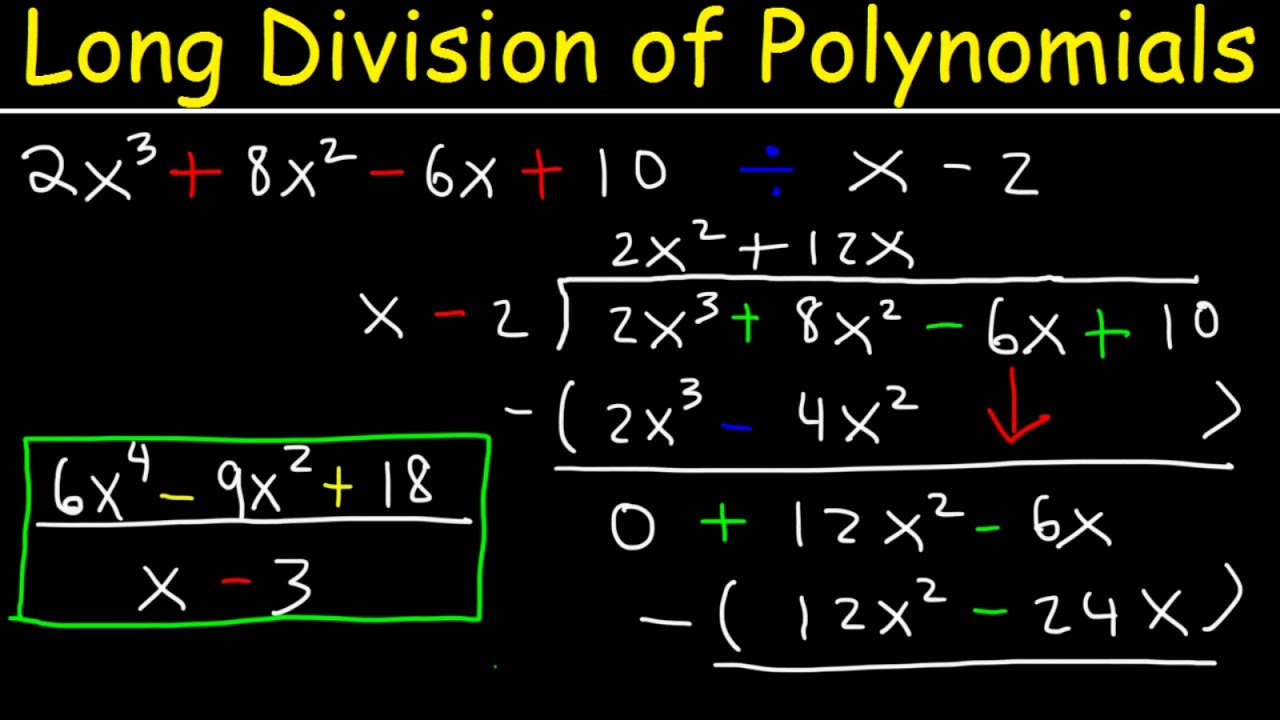
This video tutorial explains how to perform long division of polynomials with remainder and with missing terms.
Algebra Review: https://www.youtube.com/watch?v=i6sbjtJjJ-A
Join My Newsletter:
https://bit.ly/4jUXp6M
Algebra - Free Formula Sheets:
https://www.video-tutor.net/formula-sheets.html...
scarlet ether
Is it possible if anyone can break it down for me?
amber birch
which step do you need broken down?
stoic saddle
also do you know how long division works for regular numbers @vague cipher
!occupied
marsh citrusBOT
Someone else is already using this help channel. If you need help with a question, please open your own help channel/thread (see #❓how-to-get-help for instructions).
amber birch
!help
marsh citrusBOT
To ask for mathematics help on this server, please open your own help channel or help thread. See #❓how-to-get-help for instructions.
spiral lily
ooooooooooooo
 paper stirrup
You don't 'ooooo'
spiral lily
my bad
paper stirrup
Np
 pastel fable
 stoic saddle
pastel fable
stoic saddle
pastel fable
!occupied
marsh citrusBOT
pastel fable
Someone else is already using this help channel. If you need help with a question, please open your own help channel/thread (see #❓how-to-get-help for instructions).
pastel fable
Can anyone do this please
scarlet ether
stoic saddle
also do you know how long division works for regular numbers <@37240612095577294...
Yeah , but this seems a bit confusing.
scarlet ether
amber birch
which step do you need broken down?
Do we have to turn that number (x^2+2x+1) into a+b whole squared form?
stoic saddle
ok so you know how your idea when doing long division on numbers is to subtract as big a multiple of the divisor as you can from the dividend?
scarlet ether
Yeah?
stoic saddle
e.g. if you were dividing 3887 by 7 your first move would be to subtract 3500, or to put it another way subtract 35 from the first two digits
right so the idea with polynomial division is pretty similar, only it's actually a bit clearer how much to subtract -- you always do that in a way that kills the leading term
scarlet ether
Wait , I'm getting the hang of it. Lemme try solving
stoic saddle
ok
scarlet ether
Looks like I got the remainder for the 9th question , is it -2x-2?
amber birch
,w (2x^3+3x^2-2x-3)/(x^2+2x+1) quotient and remainder
elfin berryBOT


 amber birch
nice work
scarlet ether
Ye my answer was right! Thanks for the help!
Soo , does the bot close the math help channel or I will have to close the help channel?
stoic saddle
scarlet ether
Soo , does the bot close the math help channel or I will have to close the help ...
you have to type .close yourself
if you just let it sit, the bot will eventually ping you with "Has your question been resolved?" and offer you to react with ✅ or ❌ -- if you click ✅ it closes, and if you click ❌ it keeps open
amber birch
(we can type .close as helpers but it's more satisfying if you do it)
stoic saddle
if you don't do anything for enough time it'll close by timeout
amber birch
(don't want to ruin the fun)
stoic saddle
also yeah helpfuls (green names) can also .close anybody's channel
if you have closed the channel but you have more shit to ask related to your question, you can .reopen it while it still bears your name
scarlet ether
.close
marsh citrusBOT
Channel closed
Closed by @scarlet ether
Use .reopen if this was a mistake.
Available help channel!
Send your question here to claim the channel.
Remember:
• Ask your math question in a clear, concise manner.
• Show your work, and if possible, explain where you are stuck.
• Do not immediately ping people or roles. After 15 minutes, feel free to ping <@&286206848099549185> once.
• Type the command .close to free the channel when you're done.
• Be polite and have a nice day!
Read #❓how-to-get-help for further information on how to ask a good question, and about conduct in the question channels.
 fickle shell
 marsh citrusBOT
fickle shell
fickle shell
marsh citrusBOT
fickle shell
fickle shell
I got mixed up in my notes I lost which one this is the definition for
I think its for x -> c where the limit is -infinity right?
Like x -> c from both sides not left or right
amber birch
fickle shell
Like x -> c from both sides not left or right
yep!
because |x - c| < delta is the interval (c - delta, c + delta)
so that approaches x = c from both sides
fickle shell
amber birch
yep!
Ok awesome!
And if it was infinity instead of -infinity it would be m > 0 and f(x) > m, right?
Those would be the only changes to the definition?
amber birch
fickle shell
And if it was infinity instead of -infinity it would be m > 0 and f(x) > m, righ...
yep!
well I mean the 0 is actually arbitrary
marsh citrusBOT
Channel closed
Closed by @fickle shell
Use .reopen if this was a mistake.
amber birch
m < 0 implies that the range of the function is at least (-infinity, 0]
amber birch
fickle shell
Thank you!
so you need to adjust what the 0 is based on the range of your specific function
marsh citrusBOT
Available help channel!
Send your question here to claim the channel.
Remember:
• Ask your math question in a clear, concise manner.
• Show your work, and if possible, explain where you are stuck.
• Do not immediately ping people or roles. After 15 minutes, feel free to ping <@&286206848099549185> once.
• Type the command .close to free the channel when you're done.
• Be polite and have a nice day!
Read #❓how-to-get-help for further information on how to ask a good question, and about conduct in the question channels.
 solid crest
Hi, i need help with this integral.
marsh citrusBOT
solid crest
Hi, i need help with this integral.
solid crest
,,\int \ln(y) \mathrm d y
elfin berryBOT
dream
 patent sandal
integration by parts
patent sandal
i think integration by parts works once again, given that you know the integral of ln y
elfin berryBOT
dream
 solid crest
patent sandal
i think integration by parts works once again, given that you know the integral ...
solid crest
patent sandal
i think integration by parts works once again, given that you know the integral ...
oh okai
stoic saddle
yeah it'll take two IBPs
odd agate
(fsr I read that as "I'll take two IBPs")
patent sandal
i think you can calculate a formula for (ln x)^n like this
marsh citrusBOT
@solid crest Has your question been resolved?
marsh citrusBOT
Channel closed
Closed due to timeout
Use .reopen if this was a mistake.
Available help channel!
Send your question here to claim the channel.
Remember:
• Ask your math question in a clear, concise manner.
• Show your work, and if possible, explain where you are stuck.
• Do not immediately ping people or roles. After 15 minutes, feel free to ping <@&286206848099549185> once.
• Type the command .close to free the channel when you're done.
• Be polite and have a nice day!
Read #❓how-to-get-help for further information on how to ask a good question, and about conduct in the question channels.
lavish kestrel
fervent rampart
do you have a picture of what the region looks like?
well, on desmos
marsh citrusBOT
lavish kestrel
well, on desmos

 rustic field
well its perimeter of the region
rustic field
You can try the arc lenght formula
lavish kestrel
in the integral?
what do i do for the bounds
my prof was putting them into polar coords for these questions, but i dont know what my r bounds would be
since its not a constant radius
so maybe i wouldnt do polar coords
main idol
Plot the two graphs and find the intersection
marsh citrusBOT
@lavish kestrel Has your question been resolved?
lavish kestrel
main idol
Plot the two graphs and find the intersection
it it is just regular dy dx integration
okay
marsh citrusBOT
@lavish kestrel Has your question been resolved?
marsh citrusBOT
Channel closed
Closed due to timeout
Use .reopen if this was a mistake.
marsh citrusBOT
Available help channel!
Send your question here to claim the channel.
Remember:
• Ask your math question in a clear, concise manner.
• Show your work, and if possible, explain where you are stuck.
• Do not immediately ping people or roles. After 15 minutes, feel free to ping <@&286206848099549185> once.
• Type the command .close to free the channel when you're done.
• Be polite and have a nice day!
Read #❓how-to-get-help for further information on how to ask a good question, and about conduct in the question channels.
zealous sapphire
The coefficients of three consecutive terms in the expansion of (1+a)^n are in the ratio 1:7:42 . Find n.
marsh citrusBOT
zealous sapphire
The coefficients of three consecutive terms in the expansion of (1+a)^n are in t...
zealous sapphire
what should i assume the 3 consecutive terms to be?
 dreamy mountain
Yup kinda
Dont need the exact terms
Just write the general term and replace r with r+1 and r+2 to get next two terms
marsh citrusBOT
@zealous sapphire Has your question been resolved?
marsh citrusBOT
Channel closed
Closed due to timeout
Use .reopen if this was a mistake.
Available help channel!
Send your question here to claim the channel.
Remember:
• Ask your math question in a clear, concise manner.
• Show your work, and if possible, explain where you are stuck.
• Do not immediately ping people or roles. After 15 minutes, feel free to ping <@&286206848099549185> once.
• Type the command .close to free the channel when you're done.
• Be polite and have a nice day!
Read #❓how-to-get-help for further information on how to ask a good question, and about conduct in the question channels.
 hearty forge
anyone know what is meant by is there a solution for g(x) = 3/4 where 1> x <2? obviously there is a solution, but the khan academy explanation reasons that because g(1) =1 and g(2)=1/2 the intermediate value theorem applies and thus the solution exists, but is g(x) = 3/4 for any value x? I don't understand what khan academy is trying to say
marsh citrusBOT
hearty forge
anyone know what is meant by is there a solution for g(x) = 3/4 where 1> x <2? ...
Please show the original problem, exactly as it was stated to you, with the entire original context. A picture or screenshot is best. If the original problem is not in English, then post it anyway! The additional context might still be helpful. Do your best to provide a translation.

 still temple
hearty forge
anyone know what is meant by is there a solution for g(x) = 3/4 where 1> x <2? ...
still temple
hearty forge
anyone know what is meant by is there a solution for g(x) = 3/4 where 1> x <2? ...
 hearty forge
oh wait
still temple
there exists one value
hearty forge
i was looking at the equation
still temple
for that
marsh citrusBOT
Channel closed
Closed by @hearty forge
Use .reopen if this was a mistake.
marsh citrusBOT
Available help channel!
Send your question here to claim the channel.
Remember:
• Ask your math question in a clear, concise manner.
• Show your work, and if possible, explain where you are stuck.
• Do not immediately ping people or roles. After 15 minutes, feel free to ping <@&286206848099549185> once.
• Type the command .close to free the channel when you're done.
• Be polite and have a nice day!
Read #❓how-to-get-help for further information on how to ask a good question, and about conduct in the question channels.
humble osprey
,tex
hello hello. so if i wanna find what the sum of all odd naturals up to the nth number equals to, can i just set it equal to the sum of all naturals up to n, minus the sum of all even naturals up to n? and then i find that the sum of all evens is equal to (1+ sum of all numbers up to n)/2 and i put it in our original equation to find the sum of the odds? sorry for explaining in words lol
marsh citrusBOT
humble osprey
,tex
hello hello. so if i wanna find what the sum of all odd naturals up to the ...
elfin berryBOT
fijokazż

 elfin berryBOT
 humble osprey
it feels a bit wrong idk tho
paper stirrup
You mean the sum of n odd numbers starting at 1?
paper stirrup
It's sum(2k-1) from k=1 to n like you wrote
humble osprey
i also forgot a /2 there but yeah
paper stirrup
Which is 2sum(k)-n
But you know sum(k) from 1=n
Simplifying you should get 2sum(k)=n(n+1)
So n(n+1)-n=n^2 is that what you got
humble osprey
huh
paper stirrup
Which step are you confused on?