#help-33
1 messages · Page 209 of 1
 novel juniper
I have all 4
 tired oxide
which 4
novel juniper
product, quotient, sum ,, difference
tired oxide
yeah, but you don't have it for x^k where k is an integer
and this is where induction is used
because x^k = x^(k-1) x
tired oxide
okay great
novel juniper
I suppose I could write an induction proof
tired oxide
and then you need to show this for sums of arbitrary length given that you have it for a sum of two terms
but that is also induction
you can just say "a similar induction argument shows this"
if you want to
novel juniper
We start of with the base case , which is $\lim(x_n) \to x$.By the inductive hypothesis, we have $\lim{x_n^m) \to x^m$. then $x_n^{m} \cdot x = x_n^{m+1}$ by the product rule of limits, and we're done
 elfin berryBOT
ƒ( wai ina teacup)= I don't know
Compile Error! Click the  reaction for more information.
(You may edit your message to recompile.)
 tired oxide
novel juniper
We start of with the base case , which is $\lim(x_n) \to x$.By the inductive hyp...
tired oxide
novel juniper
We start of with the base case , which is $\lim(x_n) \to x$.By the inductive hyp...
i mean you could clean it up a bit if you were trying to write a really formal inductive proof but like yeah that's the idea
like the wording is a bit weird
are you really not at a point where you would just write "by induction on the degree, x_i^k -> x^k"?
and like they give you full credit?
novel juniper
I could yeah
I only have this course in my 3rd sem, so I'll surely be at that point by then
tired oxide
oh i see, this is self-study
novel juniper
yeah
tired oxide
tbh, i know that some people are gonna get mad at me for saying this, but i really don't think you ought to be so formal with proofs like this. the main thing that you want to be focusing on is "what facts do my assertions use? i should be citing the reasoning either from things i have already proved, or things that someone else has proved, or things that i could easily prove using [X, Y, Z principle, induction, X fact]
because you're just self-studying it
novel juniper
fair,yeah
Tbh, I'm also doing it early so that I can study multi var from shifrin
Atleast need knowledge of open sets, closed sets etc to study shifrin
thanks
.close
 marsh citrusBOT
Channel closed
Closed by @novel juniper
Use .reopen if this was a mistake.
marsh citrusBOT
 Available help channel!
Send your question here to claim the channel.
Remember:
• Ask your math question in a clear, concise manner.
• Show your work, and if possible, explain where you are stuck.
• After 15 minutes, feel free to ping <@&286206848099549185>.
• Type the command .close to free the channel when you're done.
• Be polite and have a nice day!
Read #❓how-to-get-help for further information on how to ask a good question, and about conduct in the question channels.
 tepid hound
The question is asking for the value of dy/dx
 marsh citrusBOT
tepid hound
The question is asking for the value of dy/dx
tepid hound
marsh citrusBOT
tepid hound
The question is asking for the value of dy/dx
tepid hound
All options are constant numbers
 pseudo flax
tepid hound
The question is asking for the value of dy/dx
pseudo flax
tepid hound
The question is asking for the value of dy/dx
differentiate both expressions w.r.t t and find the ratio
tepid hound
pseudo flax
differentiate both expressions w.r.t t and find the ratio
I can't find a way to cancel out
The nominator and demon should be same
Living some constant behind
 main idol
tepid hound
I can't find a way to cancel out
main idol
tepid hound
I can't find a way to cancel out
Show your whole work
tepid hound


 tepid hound
main idol
Show your whole work
tepid hound
main idol
Show your whole work
.
tepid hound
tepid hound
This is my final answer
tepid hound
 fathom ridge
you should substitute t = tan u
fathom ridge
you should substitute t = tan u
Still stuck
tepid hound
I get arcsin(tan2x) and arctan(sin2x)
fathom ridge
hmm
marsh citrusBOT
@tepid hound Has your question been resolved?
marsh citrusBOT
Channel closed
Closed due to timeout
Use .reopen if this was a mistake.
Available help channel!
Send your question here to claim the channel.
Remember:
• Ask your math question in a clear, concise manner.
• Show your work, and if possible, explain where you are stuck.
• After 15 minutes, feel free to ping <@&286206848099549185>.
• Type the command .close to free the channel when you're done.
• Be polite and have a nice day!
Read #❓how-to-get-help for further information on how to ask a good question, and about conduct in the question channels.
 buoyant jetty
 marsh citrusBOT
@buoyant jetty Has your question been resolved?
 night dew
buoyant jetty
night dew
buoyant jetty
Can you translate it into English?
It looks like we have a line and 2 planes
But I don't see an L2
buoyant jetty
buoyant jetty
Let L = ..., Π1 = ..., Π2 = ... find lines L1, L2 such that
night dew
So we just need any line L1 in Π1?
night dew
Mmhmm
buoyant jetty
 night dew
Okay so to find L1, we need a point in the plane, and a direction vector in the plane
Any point will do, so let's just set x = 0, y = 0
Then we have 2z = 8
So z = 4
buoyant jetty
direction can be a multiple of (1,3,2) maybe
night dew
So (0, 0, 4) is in the plane
buoyant jetty
night dew
Any point will do, so let's just set x = 0, y = 0
L1 ∩ L have a non empty intersection
night dew
We haven't finished yet
The equation of the plane includes a vector normal to the plane
In other words, (1, 3, 2) is normal to the plane
To be in the plane, we need to be tangent to the plane
buoyant jetty
the normal of the plane. is parallel to all the vectors residing in the plane
night dew
Which means perpendicular to the normal
night dew
buoyant jetty
the normal of the plane. is parallel to all the vectors residing in the plane
perpendicular*
buoyant jetty
the direction of L1 has to be perpendicular to the normal of Pi1
buoyant jetty
night dew
perpendicular*
yeah, sorry
buoyant jetty
buoyant jetty
direction can be a multiple of (1,3,2) maybe
for direction vector of L1
night dew
So we need the dot product with the normal vector to be 0
buoyant jetty
(a,b,c).(1,3,2)=0
(a,b,c) is direction of L1
we get a subspace of vectors orthogonal to the normal vector of Pi1
a+3b+2c=0
buoyant jetty
buoyant jetty
a+3b+2c=0
I was thinking of finding the intersection of L and this plane
but idk
night dew
Why?
L is just another line
We're finding a different line L1
There are an infinite number of options though
But we just need to make sure the one we choose is valid, so we need a point in the plane and a vector in the plane
The point in the plane can be found by substituting values into the plane equation
And the vector needs to be perpendicular to the normal vector
Those are the conditions we need to satisfy
So we have L1: r = (0, 0, 4) + λ(1, -1, 1)
Does that make sense?
buoyant jetty
sure
night dew
We don't have enough information to specify a single line
buoyant jetty
direction vector of L1 has to be orthogonal to normal vector of Pi1
we need L1 and L to intersect aswell and we need
L1 to be parallel to L2, I am trying
 night dew
I was doing them as separate questions mb
buoyant jetty
yeah is my bad I didnt translated properly
night dew
Okay then so we need L1 to be in Π1, L2 to be in Π2, L1 needs to be parallel to L2, and L1 and L2 need to intersect with L
Okay so if L1 is in Π1, the direction vector of the line is perpendicular to the normal vector of the plane
Right?
buoyant jetty
ye
is a multiple of (1,3,2)
problem is what does L1 parallel L2 mean
they never intersect
yet they have same direction
night dew
It's not a multiple
The normal vector of the plane points out of the plane
We need a vector in the plane
So that is perpendicular to the normal vector
buoyant jetty
okay a vector that is orthogonal to the normal vector
buoyant jetty
night dew
So that is perpendicular to the normal vector
yeah
(x,y,z).(1,3,2)=0
(x,y,z) is the direction of L1
night dew
We don't need that any more
If L1 is parallel to L2, then they both have the same direction vector
Right?
elfin berryBOT


 Requested by 938c2cc0dcc05f2b68c4287040cfcf71
buoyant jetty
night dew
Right?
Requested by 938c2cc0dcc05f2b68c4287040cfcf71
buoyant jetty
night dew
Right?
I see what you mean now
night dew
Right so L1 and L2 both have the same direction vector
Which is perpendicular to the normal of both planes
Aka cross product time
Which is what you did there
buoyant jetty
what about non empty intersection L1∩L and L2∩L
night dew
So now we have the direction vector of L1 and L2
buoyant jetty
while they being parallel
night dew
But we need a starting point for each
buoyant jetty
yeah
night dew
We need L1 to obey the equation for Π1 and also L
And we need L2 to obey the equation for Π2 and also L
Yep that would work
buoyant jetty
L : X = k(2,0,1) + (0,2,5)
(2k,2,k+5) =(x,y,z)
x+3y+2z=8
2k+6+2k+10=8
4k=-8
k=-2
L1 : X = k(11,-9,8) + (-2(2,0,1)+(0,2,5))
L1 : X = λ(11,-9,8)+(-4,2,3)
buoyant jetty
Π2 : -3x-y+3z=4
-6k-2+3k+15=4
13-4=3k
9/3=k=3
(2k,2,k+5)=(6,2,8)
L2: X = λ(11,-9,8) + (6,2,8)
 buoyant jetty
yeah
the course I bought made a mistake, is a course taught by undergrads from same university
should be different scalar
night dew
Do you have answers for this btw?
buoyant jetty
using same λ means they are the same and they are not
night dew
It's not terrible to do that
buoyant jetty
night dew
Do you have answers for this btw?
yeah, our stuff is correct
night dew
But it's not ideal
Okay then all good
If we didn't have answers it would be helpful to check our conditions
So for condition 1, we can sub in L1 into Π1 and L2 into Π2 and check they obey the equations
Condition 2 is easy since it just means the direction vectors are the same
buoyant jetty
being parallel also mean we need to show they dont intersect
night dew
If they have the same direction vector, they won't intersect
buoyant jetty
they could intersect at one point if they are perpendicular (same direction vector so they are perpendicular directions, no?)
night dew
No
buoyant jetty
,w (1,2,3).(1,2,3)
night dew
The direction vector of a line tells us the direction the line goes in
So the two lines are going in exactly the same direction
So they are parallel
Planes have normal vectors that are perpendicular to the plane. Lines have direction vectors that are parallel to the line
If the direction vectors are equal, then the lines are parallel
The only other option is that they are the same line
buoyant jetty
yeah
night dew
So we could check that they aren't
But I don't think that's necessary here
We're just checking our work
The direction vectors being the same is enough
For condition 3, we need to show that L1 and L intersect, so we could just put the equation of L1 into L and make sure it works, and similar for L2
But we have answers to check with here so maybe we don't need that
All good now?
marsh citrusBOT
@buoyant jetty Has your question been resolved?
marsh citrusBOT
Channel closed
Closed due to timeout
Use .reopen if this was a mistake.
Available help channel!
Send your question here to claim the channel.
Remember:
• Ask your math question in a clear, concise manner.
• Show your work, and if possible, explain where you are stuck.
• After 15 minutes, feel free to ping <@&286206848099549185>.
• Type the command .close to free the channel when you're done.
• Be polite and have a nice day!
Read #❓how-to-get-help for further information on how to ask a good question, and about conduct in the question channels.
 patent fjord
@still temple
marsh citrusBOT
patent fjord
<@456226577798135808>
 limber hearth
,w henrycavillbutfat
elfin berryBOT
Wolfram Alpha doesn't understand your query!
Perhaps try rephrasing your question?
Click here to refine your query online
 Requested by yakubros
patent fjord
Requested by yakubros
patent fjord
That isn’t like 1 the sum as you pointed out the function has finite discontinuities is the key
marsh citrusBOT
@patent fjord Has your question been resolved?
marsh citrusBOT
Channel closed
Closed due to timeout
Use .reopen if this was a mistake.
Available help channel!
Send your question here to claim the channel.
Remember:
• Ask your math question in a clear, concise manner.
• Show your work, and if possible, explain where you are stuck.
• After 15 minutes, feel free to ping <@&286206848099549185>.
• Type the command .close to free the channel when you're done.
• Be polite and have a nice day!
Read #❓how-to-get-help for further information on how to ask a good question, and about conduct in the question channels.
 compact crescent
Can I interpret logistic curve as a graph that grows and decrease exponentially and has a inflection point.
marsh citrusBOT
compact crescent
Can I interpret logistic curve as a graph that grows and decrease exponentially ...
@compact crescent Has your question been resolved?
marsh citrusBOT
@compact crescent Has your question been resolved?
 glacial hedge
It converges at an exponential speed towards both asymptotes
Increasing/decreasing exponentially sounds like the limit is infinite, not finite
marsh citrusBOT
Channel closed
Closed due to timeout
Use .reopen if this was a mistake.
Available help channel!
Send your question here to claim the channel.
Remember:
• Ask your math question in a clear, concise manner.
• Show your work, and if possible, explain where you are stuck.
• After 15 minutes, feel free to ping <@&286206848099549185>.
• Type the command .close to free the channel when you're done.
• Be polite and have a nice day!
Read #❓how-to-get-help for further information on how to ask a good question, and about conduct in the question channels.
 honest creek
f(2x - 6) is a horizontal compression by a factor of 2 and a shift right of 3 units right?
marsh citrusBOT
honest creek
f(2x - 6) is a horizontal compression by a factor of 2 and a shift right of 3 un...
honest creek
and this is the logic i used for that^:
h(x) = f(2x) then h(x - 3) = f(2x - 6)
but then why is this wrong, starting with a shift of 6 units and then compression of factor of 2:
h(x) = f(x - 6) then h(2x) = f(2x - 6)
 odd orchid
by order of operations was how i was taught
addition and subtractions
then multiplications and divisions
so translations before stretches
honest creek
okay but where am i going wrong?
honest creek
honest creek
f(2x - 6) is a horizontal compression by a factor of 2 and a shift right of 3 un...
also uh this is right
i'm pretty sure
and so this:
h(x) = f(2x) then h(x - 3) = f(2x - 6)``` is probably right tooi just why a similar argument doesn't work for this:
h(x) = f(x - 6) then h(2x) = f(2x - 6)```@honest creek Has your question been resolved?
marsh citrusBOT
@honest creek Has your question been resolved?
honest creek
.close
marsh citrusBOT
Channel closed
Closed by @honest creek
Use .reopen if this was a mistake.
marsh citrusBOT
Available help channel!
Send your question here to claim the channel.
Remember:
• Ask your math question in a clear, concise manner.
• Show your work, and if possible, explain where you are stuck.
• After 15 minutes, feel free to ping <@&286206848099549185>.
• Type the command .close to free the channel when you're done.
• Be polite and have a nice day!
Read #❓how-to-get-help for further information on how to ask a good question, and about conduct in the question channels.
 elfin forge
Hey
marsh citrusBOT
elfin forge
Hey
elfin forge
I need help
integration
I have this equation
IDK how to express it but
The intrgral notation with unknown letter b over 2 (3e^x+6e^-2x)=0
odd orchid
$\int_2^b 3e^x + 6e^{-2x} dx = 0$
elfin berryBOT
ashy!
 odd orchid
evaluate the integral
elfin forge
I know
odd orchid
elfin forge
How do you do it
latex 🙏
elfin forge
e^x remains the same
odd orchid
elfin forge
I know
show your working
odd orchid
yup
elfin forge
okay so
odd orchid
now evaluate it at the bounds
elfin forge
3eb -3e^-2b-3e^2+3e^-4
odd orchid
$3e^b -3e^{-2b}-3e^2+3e^{-4} = 0$
elfin forge
yes
elfin berryBOT
ashy!
 elfin forge
then what do you do?
odd orchid
first i would divide through by 3
elfin forge
wait
odd orchid
$e^{3b} -e^{2b}(e^2+e^{-4})-1= 0$
elfin forge
where did u get e
odd orchid
-1 i meant
elfin berryBOT
ashy!
 elfin forge
u make x^2=e^1/5?
elfin berryBOT
ashy!
 elfin forge
yeah?
elfin forge
wait what
odd orchid
elfin berry
**ashy!**
you are solving for b?
odd orchid
the integral is 0
elfin forge
why
odd orchid
so the bounds are the same
marsh citrusBOT
@elfin forge Has your question been resolved?
marsh citrusBOT
Channel closed
Closed due to timeout
Use .reopen if this was a mistake.
Available help channel!
Send your question here to claim the channel.
Remember:
• Ask your math question in a clear, concise manner.
• Show your work, and if possible, explain where you are stuck.
• After 15 minutes, feel free to ping <@&286206848099549185>.
• Type the command .close to free the channel when you're done.
• Be polite and have a nice day!
Read #❓how-to-get-help for further information on how to ask a good question, and about conduct in the question channels.
elfin forge
hey
marsh citrusBOT
elfin forge
hey
elfin forge
Hello
so I have this integral AGAIN
and
Snake b over 3 (2x-6) dx=36
how do we find b
 devout mauve
can you integrate 2x-6?
devout mauve
$\int_2^b (2x-6)^2 dx = 36$ ?
elfin berryBOT
Denascite
 elfin forge
yes
devout mauve
do you know u subs?
devout mauve
do you mean $\frac{(2x-6)^3}{2}$ or $(2x-6)^{3/2}$?
elfin berryBOT
Denascite
 elfin forge
first one
devout mauve
good
elfin forge
okay I found the answer but
but
I have another equstion
Question
on another integral
sin^2 x times sin^x
What is its integral
devout mauve
$\int \sin^2(x)\cdot \sin(x) dx$ this?
elfin berryBOT
Denascite
 elfin forge
sin^x squared too
i mean AAAA
Sin^2x times cos^2x
this one
Sorry I'm just tired
devout mauve
$\int \sin^2(x)\cdot\cos^2(x) dx$?
elfin berryBOT
Denascite
 devout mauve
use a few trig identities
elfin forge
like
odd orchid
sin double angle
marsh citrusBOT
@elfin forge Has your question been resolved?
odd orchid
$(a+b)^2 = a^2 + 2ab + b^2$
elfin berryBOT
ashy!
 elfin forge
ok wait
odd orchid
if u call that an identity
elfin forge
bruh it's easier than I thought
Okay
and now
my other question
snake ln2 over 0 (1/(1+e^x)
How do you find x?????????
odd orchid
$\int_0^{\ln2} \frac{1}{1 + e^x} dx$
elfin berryBOT
ashy!
 elfin forge
yea
odd orchid
u sub
elfin forge
what do you mean
odd orchid
do a substitution
elfin forge
pls Show
elfin forge
wha?
odd orchid
ok scratch that
marsh citrusBOT
Channel closed
Closed due to timeout
Use .reopen if this was a mistake.
odd orchid
i thought of a faster way
elfin forge
ok
marsh citrusBOT
Available help channel!
Send your question here to claim the channel.
Remember:
• Ask your math question in a clear, concise manner.
• Show your work, and if possible, explain where you are stuck.
• After 15 minutes, feel free to ping <@&286206848099549185>.
• Type the command .close to free the channel when you're done.
• Be polite and have a nice day!
Read #❓how-to-get-help for further information on how to ask a good question, and about conduct in the question channels.
elfin forge
uh
marsh citrusBOT
elfin forge
uh
odd orchid
add e^x and subtract it from the numerator
$\int_0^{\ln2} \frac{1 + e^x - e^x}{1 + e^x} dx$
elfin berryBOT
ashy!

 proud arch
$\int_0^{\ln2} 1 - \frac{ e^x}{1 + e^x} dx$
odd orchid
and now u = 1 + e^x
elfin berryBOT
lex.in.a.teacup

 velvet cedar
$\int_0^{ln2} \frac{e^{-x}}{e^{-x} + 1} dx$
elfin forge
then you reverse chain rule
elfin berryBOT
StrangeQuarkAL
 elfin forge
right?
proud arch
$\int_0^{\ln2} 1 dx - \int_0^{\ln2}\frac{ e^x}{1 + e^x} dx$
elfin berryBOT
lex.in.a.teacup
 odd orchid
yes
proud arch
Ye
marsh citrusBOT
@elfin forge Has your question been resolved?
marsh citrusBOT
Channel closed
Closed due to timeout
Use .reopen if this was a mistake.
Available help channel!
Send your question here to claim the channel.
Remember:
• Ask your math question in a clear, concise manner.
• Show your work, and if possible, explain where you are stuck.
• After 15 minutes, feel free to ping <@&286206848099549185>.
• Type the command .close to free the channel when you're done.
• Be polite and have a nice day!
Read #❓how-to-get-help for further information on how to ask a good question, and about conduct in the question channels.
marsh citrusBOT
 rotund violet
I will just start off by saying that this is a pretty stupid question
Like they literally invent functions for how the ball moves in time which just don’t follow the rules of physics at all
Regardless let’s do this
Ok so first
It takes 1 second to go from 2 to 10 meters right
And then at the same speed
It goes down to 1 meter
So
Well it should be 1.125
9/8
Ok
Next it goes from 1 m to 5 meters
So it goes 4 meters up
Via a square root curve (which is stupid as gravity isn’t dependent on speed and it should be linear)
So this means that in order to go up a distance of t, it will take ct^2 time, where c is some constant
We know however
That if it goes a distance of 2 meters up, this will take 1 second however
Can you use this to determine c?
A constant is just a number
Basically it isn’t a variable which changes
It’s always the same
yeah, except it is now, every certain amount of meters = (a certain amount of time squared) times something
and im asking for what is that something
okay another way to think about this
if it takes 1 second to go up 2 meters
along a square root curve
how long will it take to go up 4 meters?
4
yes
so in total
it takes 1+1.125+4 seconds
right?
marsh citrusBOT
Channel closed
Channel closed due to the original message being deleted.
If you did not intend to do this, please open a new help channel,
as this action is irreversible, and this channel may abruptly lock.
Available help channel!
Send your question here to claim the channel.
Remember:
• Ask your math question in a clear, concise manner.
• Show your work, and if possible, explain where you are stuck.
• After 15 minutes, feel free to ping <@&286206848099549185>.
• Type the command .close to free the channel when you're done.
• Be polite and have a nice day!
Read #❓how-to-get-help for further information on how to ask a good question, and about conduct in the question channels.
 cold bloom
 marsh citrusBOT
cold bloom
marsh citrusBOT
cold bloom
 cold bloom
how can i be sure
cold bloom
rotund violet
you are correct
this might cost me a mark on my exma tomorrow sir arnavutkoy
rotund violet
i mean you did the steps right? idk what else to say
im sure its correct. im just assuming by option c you mean the 3rd option rather than what is actually labeled as "c"
cold bloom
oh
yeah
why is it b d c e
ok 1 last hting

these are relatively easy
am i correct on these
 pliant maple
25 is wrong
 pliant maple
think about how you determine where a function has veritcal asymptotes
cold bloom
pliant maple
think about how you determine where a function has veritcal asymptotes
where the denominator of a function is equal to 0?
pliant maple
alright
cold bloom
so that must mean it has x+3 and x-1
pliant maple
yes
pliant maple
it's c
read d a little more closely
d isn't x+3 and x-1, but x-3 and x+1 instead
which is incorrect
cold bloom
oh cz the vertical asymptotes arent
yeah
sir 1 last problem pls

these questions r easily solved online but i wanna know how to solve them myself
also cause chatgpt is saying d and other classmates solved it as a
pliant maple
$\frac{\frac{a}{b}}{\frac{c}{d}} = \frac{ad}{cb}$
elfin berryBOT
890s
 pliant maple
my goal is to help you understand the process to solving it
i want you to know yourself if it's a or d without me telling you
pliant maple
elfin berry
**890s**
how can you use this information to help you solve the problem? ^^^
cold bloom
im not sure sir
pliant maple
let's look at the expression in the problem
it's a fraction of fractions
using the property i showed above
we can assign each part of the expression to a,b,c,or d
cold bloom
so we flip the fracitons
pliant maple
yep
cold bloom
andcross multiply
pliant maple
not cross, just multiply
cold bloom
sorry
pliant maple
but yea
pliant maple
and before you do foil and all that
i'd say factorize each of them
and try to cancel out common factors
cold bloom
at that point wouldnt there be no reason for foil
cause factoring and canceling
are done
pliant maple
you might have to foil at the end if you have leftover factors
like if you had (x-3)(x+1)/(x-5)
cold bloom
im doing of fuck this shit
sit
sir
would u perhaps tell me the answer
cause ive been sitting at mybtable solving this 80 question worksheet since like 1 pm
and its 10pm
marsh citrusBOT
cold bloom
would u perhaps tell me the answer
The purpose of this server is to help you learn, not to hand out answers. Do not ask someone to give you the answer directly.
cold bloom
marsh citrus
The purpose of this server is to help you learn, not to hand out answers. Do not...
the guy is edging me
 spark siren
ignoring the servers rules is the best way to get help from volunteers. not.
marsh citrusBOT
@cold bloom Has your question been resolved?
marsh citrusBOT
Channel closed
Closed due to timeout
Use .reopen if this was a mistake.
marsh citrusBOT
Available help channel!
Send your question here to claim the channel.
Remember:
• Ask your math question in a clear, concise manner.
• Show your work, and if possible, explain where you are stuck.
• After 15 minutes, feel free to ping <@&286206848099549185>.
• Type the command .close to free the channel when you're done.
• Be polite and have a nice day!
Read #❓how-to-get-help for further information on how to ask a good question, and about conduct in the question channels.
 finite scroll
I need help with finding the derivatives! And what's chain rule and product rule and when to choose which one to use?
marsh citrusBOT
finite scroll
I need help with finding the derivatives! And what's chain rule and product rule...

 red nimbus
finite scroll
I need help with finding the derivatives! And what's chain rule and product rule...
red nimbus
finite scroll
I need help with finding the derivatives! And what's chain rule and product rule...
You use the chain rule if you have a composition of functions (that means something like f(g(x)) one function is in the other). Product rule you use if you multiply two functions basically
finite scroll
red nimbus
You use the chain rule if you have a composition of functions (that means someth...
Got it! I know it may sound a bit stupid but How do I know myself that the equation is going to be multiply two functions ?
red nimbus
f(x) * g(x)
for example
y = ln(x) * x²
f(x) = ln(x) and g(x) = x²
here you multiply ln(x) with x²
finite scroll
Alright thx
One more thing, my doctor wrote = cos (u) at beginning why?
 limber hearth
To show the formula
Cos(u) where u is a function
d/dx that badboy gives - u' * sin(u)
marsh citrusBOT
@finite scroll Has your question been resolved?
marsh citrusBOT
Channel closed
Closed due to timeout
Use .reopen if this was a mistake.
marsh citrusBOT
Available help channel!
Send your question here to claim the channel.
Remember:
• Ask your math question in a clear, concise manner.
• Show your work, and if possible, explain where you are stuck.
• After 15 minutes, feel free to ping <@&286206848099549185>.
• Type the command .close to free the channel when you're done.
• Be polite and have a nice day!
Read #❓how-to-get-help for further information on how to ask a good question, and about conduct in the question channels.
 still temple
 marsh citrusBOT
still temple
still temple
marsh citrusBOT
still temple
still temple

Could someone please check it
Also for d ,I didn't quite understand what they meant by linear combination for columns
And as for g, I know it's false but not sure how to prove it
Oh I was wondering who math rocks was
novel juniper
It's wai
still temple
novel juniper
fofr d they mean b lies in the span of the column vectors
Could you rephrase that
are they saying b is a column vector ?
novel juniper
let the column vectors be v_1, v_2,\dots, v_n$
\
then $b = \sum_{i=1}^{n} a_i v_i$
for $a_i \in \R$
elfin berryBOT
math_rocks

math_rocks
Compile Error! Click the reaction for more information.
(You may edit your message to recompile.)
 still temple
novel juniper
(l) required C to be invertibel
still temple
novel juniper
(l) required C to be invertibel
I assumed it to be invertible
So that we can multiply with C inverse on both sides
novel juniper
Can you do tha 
still temple
Lol no
 still temple
1 min
still temple
It's false
marsh citrusBOT
Channel closed
Closed by @ionic jewel
Use .reopen if this was a mistake.
marsh citrusBOT
Available help channel!
Send your question here to claim the channel.
Remember:
• Ask your math question in a clear, concise manner.
• Show your work, and if possible, explain where you are stuck.
• After 15 minutes, feel free to ping <@&286206848099549185>.
• Type the command .close to free the channel when you're done.
• Be polite and have a nice day!
Read #❓how-to-get-help for further information on how to ask a good question, and about conduct in the question channels.
red nimbus
Say we have two groups $G$ and $H$ such that $a \in G$ generates $G$ and $b \in H$ generates $H.\$
Does that imply that $(a,b) \in G \times H$ generates $G \times H$?
marsh citrusBOT
red nimbus
Say we have two groups $G$ and $H$ such that $a \in G$ generates $G$ and $b \in ...
elfin berryBOT
𝔸dωn𝓲²s
 red nimbus
Probably $(a,b)$ can be expressed as $(g^n, h^m)$ where $n,m \in \mathbb{Z}$
elfin berryBOT
𝔸dωn𝓲²s

 copper raven
red nimbus
Say we have two groups $G$ and $H$ such that $a \in G$ generates $G$ and $b \in ...
copper raven
red nimbus
Say we have two groups $G$ and $H$ such that $a \in G$ generates $G$ and $b \in ...
no
devout mauve
what have you seen for Z2xZ2 ?
elfin berryBOT
𝔸dωn𝓲²s
 red nimbus
I have a stupid idea
elfin berryBOT
𝔸dωn𝓲²s
 red nimbus
If a+b=2 then n=5x+6y = 120 we get (x,y) = (0,20) hence there must exist a pair (a,b) with order 120?
 lucid zenith
i shall be borrowing that notation for the modular arithmetic 
red nimbus
I am kinda on the Schlauch right now arghhh
lucid zenith
red nimbus
If a+b=2 then n=5x+6y = 120 we get (x,y) = (0,20) hence there must exist a pair ...
why does n=120 mean that the order of the element is 120?
copper raven
red nimbus
If a+b=2 then n=5x+6y = 120 we get (x,y) = (0,20) hence there must exist a pair ...
can you give us a pair with order 120 then ?
red nimbus
😭
red nimbus
lucid zenith
why does n=120 mean that the order of the element is 120?
I wanted to find an element where it takes at least 120 additions withitself that lead to the neutral element
To show only the existence of a generator
lucid zenith
but the order could be any factor of 120, not just 120
copper raven
yeah no reason the order can't be lower than 120
copper raven
aight
 copper raven
red nimbus
Before you spoiler
copper raven
red nimbus
Before you spoiler
then you spoiler yourself 
red nimbus
elfin berry
**𝔸dωn𝓲²s**
So one group is cyclic the other isn't so they cannot be isomorphic
copper raven
elfin berry
**𝔸dωn𝓲²s**
well yeah if we start with your thing, take an n such that n=0 mod 10 and n=0 mod 12, then you can guarantee n(a,b) = 0 whatever (a,b) are
i.e. all the orders are n or less
and the smallest such n is lcm(10,12)
60
red nimbus
copper raven
well yeah if we start with your thing, take an n such that n=0 mod 10 and n=0 mo...
so basically since 1 generates Z_10 and Z_12 we would see if (1,1) would also generate Z_10 x Z_12
lucid zenith
red nimbus
but how would you prove this
copper raven
essentially with the same argument I made above
copper raven
red nimbus
so basically since 1 generates Z_10 and Z_12 we would see if (1,1) would also ge...
well you might have another generator who knows, just checking (1, 1) is very light
copper raven
copper raven
i.e. all the orders are n or less
here you cover all you bases, nothing can ever generate the whole group on its own
marsh citrusBOT
@red nimbus Has your question been resolved?
red nimbus
copper raven
here you cover all you bases, *nothing* can ever generate the whole group on its...
I tried to prove it but I think I am missing something important
elfin berryBOT
𝔸dωn𝓲²s
 red nimbus
I just claim that n = lcm
copper raven
you're just saying stuff you're not proving anything yeah
red nimbus
but like there are 2 cases which lcm covers all. That is ord(g) = k * ord(h) or gcd(ord(g),ord(h)) = 1
copper raven
elfin berry
**𝔸dωn𝓲²s**
ok but it still doesn't prove this
ord(g) = k * ord(h)
why so?
red nimbus
either this or ord(h) = ord(g) * l
I should have said with out loss of generality
(g,h)^n = (g^n, h^n) = (g^ord(g), h^ord(h)) = e
n = ord(g) = ord(h) implies they are equal but suppose they weren't
then n must be a multiple of ord(g) and ord(h)
n = ord(g)ord(h)
Ok I need also the condition that n should be minimal
therefore we take n = lcm(ord(g),ord(h))
copper raven
that's better yeah
copper raven
copper raven
well yeah if we start with your thing, take an n such that n=0 mod 10 and n=0 mo...
pretty much what I did here
red nimbus
so what I did rn should suffice
copper raven
yea
red nimbus
copper raven
yea
Is this fine now?
elfin berryBOT
𝔸dωn𝓲²s
 red nimbus
I think the proof is shit
 red nimbus
g^n = g^ord(g)
h^n = h^ord(h)
there fore I thought n = ord(g) and n = ord(h)
I think I am being too rash and dont overthink which is badd
copper raven
(g^n, h^n) = e, means that g^n = e and h^n = e
therefore ... [what can you say about n from these two equalities ?]
n = ord(g) is too restrictive for example
red nimbus
n is a multiple of ord(g) and n is a multiple of ord(h)
copper raven
yea
copper raven
tfw n=n^2 always
copper raven
red nimbus
n is a multiple of ord(g) and n is a multiple of ord(h)
well n is a common multiple of ord(g) and ord(h) then
copper raven
yea
copper raven
eh we all get stuck in weird proof ideas sometimes it's fine
marsh citrusBOT
Channel closed
Closed by @red nimbus
Use .reopen if this was a mistake.
marsh citrusBOT
Available help channel!
Send your question here to claim the channel.
Remember:
• Ask your math question in a clear, concise manner.
• Show your work, and if possible, explain where you are stuck.
• After 15 minutes, feel free to ping <@&286206848099549185>.
• Type the command .close to free the channel when you're done.
• Be polite and have a nice day!
Read #❓how-to-get-help for further information on how to ask a good question, and about conduct in the question channels.
 wheat trench
I don't understand the definition of this line function. Isn't the result a set with a single point inside it?
 marsh citrusBOT
wheat trench
I don't understand the definition of this line function. Isn't the result a set ...
devout mauve
marsh citrusBOT
wheat trench
I don't understand the definition of this line function. Isn't the result a set ...
devout mauve
why do you think there would only be a single point in the set?
wheat trench
I see an addition of a point and a vector, which yields a single point.
 regal coral
You get a different point for each t

 devout mauve
lots of ways to write the same thing
comma is unusual but its clear from context what its supposed to be
: and | are more common
marsh citrusBOT
Channel closed
Closed by @wheat trench
Use .reopen if this was a mistake.
wheat trench
.reopen
marsh citrusBOT
✅
wheat trench
Just want to mention that my confusion was because I interpreted that as saying something like "A point + a scaled vector, where the vector's scalar can be any number".
That syntax is ambiguous, and a ":" or "|" would have been better.
.close
marsh citrusBOT
Channel closed
Closed by @wheat trench
Use .reopen if this was a mistake.
marsh citrusBOT
Available help channel!
Send your question here to claim the channel.
Remember:
• Ask your math question in a clear, concise manner.
• Show your work, and if possible, explain where you are stuck.
• After 15 minutes, feel free to ping <@&286206848099549185>.
• Type the command .close to free the channel when you're done.
• Be polite and have a nice day!
Read #❓how-to-get-help for further information on how to ask a good question, and about conduct in the question channels.
marsh citrusBOT
 burnt abyss
why
 still light
Just post the question
 wary kite
<@&268886789983436800>
marsh citrusBOT
Channel closed
Channel closed due to the original message being deleted.
If you did not intend to do this, please open a new help channel,
as this action is irreversible, and this channel may abruptly lock.
Available help channel!
Send your question here to claim the channel.
Remember:
• Ask your math question in a clear, concise manner.
• Show your work, and if possible, explain where you are stuck.
• After 15 minutes, feel free to ping <@&286206848099549185>.
• Type the command .close to free the channel when you're done.
• Be polite and have a nice day!
Read #❓how-to-get-help for further information on how to ask a good question, and about conduct in the question channels.
 oak fog
Anyone know's how to do this question
 marsh citrusBOT
oak fog
Anyone know's how to do this question
oak fog
marsh citrusBOT
oak fog
Anyone know's how to do this question
oak fog
I need it done in this exact way
 modern wigeon
try setting y = 2^x
oak fog
modern wigeon
try setting y = 2^x
gimme a sec
I have a very simular one already done

almost the same
modern wigeon
if you set y = 2^x you can rewrite it in the form a y^2 + by + c = 0 and solve for y
ah, yes, this is what you did here with t = 2^x
oak fog
i need it done in the same way though
oak fog
modern wigeon
ah, yes, this is what you did here with t = 2^x
yeah..
modern wigeon
ok, so set t = 2^x and rewrite the equation in terms of t
modern wigeon
the only thing to figure out is how to rewrite 2^{2x - 1} in terms of t
oak fog
would you be able to do the steps
modern wigeon
what is 2^{2x} in terms of t, if t = 2^x?
oak fog
what 😭
modern wigeon
do you understand the solution to the other problem that you're mimicking?
oak fog
oak fog
Anyone know's how to do this question
this
oak fog
oak fog
I have a very simular one already done
and in my note book i found tihs
which is almost to same
But i dont understand math at all
modern wigeon
yes, they are almost exactly the same
oak fog
especially in english
I just need someone to do the first question like the question that was done in the notebook
my proffesor has a specific way of doing steps
and if i do them any other way
modern wigeon
do you understand these steps from the notebook:
- 2^{2x} - 10 * 2^x + 16 = 0
- 2^x = t
- t^2 - 10t + 16 = 0
oak fog
it would not count
oak fog
modern wigeon
do you understand these steps from the notebook:
- 2^{2x} - 10 * 2^x + 16 = 0
- ...
uhm
kinda
modern wigeon
2^{2x} - 10 * 2^x + 16 = 0 is a quadratic in disguise because 2^{2x} = (2^x)^2
so if we create a new variable t = 2^x, then we can substitute t and get t^2 - 10 t + 16 = 0
oak fog
okay
modern wigeon
in the new problem, you almost have the same thing, except now instead of 2^{2x} it's 2^{2x - 1}. so first you want to rewrite it into the form a * 2^{2x}. do you see how to do that?
oak fog
modern wigeon
in the new problem, you almost have the same thing, except now instead of 2^{2x}...
okay
i just tried
to do the question
but im confused withsomething
2^2x -5 * 2^x(what happend to the +1 here)
@modern wigeon
modern wigeon
hint: 2^{2x - 1} = 2^{2x} * 2^{-1}
oak fog
 oak fog
modern wigeon
hint: 2^{2x - 1} = 2^{2x} * 2^{-1}
oak fog
modern wigeon
hint: 2^{2x - 1} = 2^{2x} * 2^{-1}
I dont understand
why =
there's no = on the first
modern wigeon
how did you get that?
modern wigeon
the second line in the first question is wrong
oak fog
oak fog
I have a very simular one already done
here?
modern wigeon
Here is a worked solution to the first question:
- We start with: 2^{2x} - 5 * 2 ^{x + 1} + 16 = 0.
- Since 2^{x + 1} = 2 * 2^x, we can rewrite the left-hand side: 2^{2x} - 5 * 2 * 2^{x} + 16 = 0.
- Simplifying: 2^{2x} - 10 * 2^{x} + 16 = 0
- Now note that 2^{2x} = (2^x)^2.
- So if we set t = 2^x, then we have t^2 - 10 + 16 = 0.
- Factoring, we find that (t - 2)(t - 8) = 0.
- Hence t = 2 or t = 8.
- Substituting back, we have 2^x = 2 or 2^x = 8.
- Hence x = 1 or x = 3.
 proud ice
modern wigeon
Here is a worked solution to the first question:
- We start with: 2^{2x} - 5 * ...
proud ice
modern wigeon
Here is a worked solution to the first question:
- We start with: 2^{2x} - 5 * ...
!nosols
marsh citrusBOT
modern wigeon
Here is a worked solution to the first question:
- We start with: 2^{2x} - 5 * ...
As a helper, please do not give out answers that could be copied as a homework solution. Have the student work through the problem themselves and guide them along the way.
modern wigeon
proud ice
!nosols
This is not a solution to his question. It's a correction of the notebook solution he linked.
proud ice
modern wigeon
This is not a solution to his question. It's a correction of the notebook soluti...
I retract my !nosols then 
modern wigeon
yes
modern wigeon
once you understand this solution, you should be able to solve the new problem easily
oak fog
im
proud ice
modern wigeon
This is not a solution to his question. It's a correction of the notebook soluti...
Btw, sorry for the trigger-happy !nosols, I just have to be wary with new members. But I'm seeing your other posts and you seem to be acclimating here very well.
So allow me to reset, and say welcome to the server.
limber hearth
Can't wait to see his name in green
oak fog
modern wigeon
Here is a worked solution to the first question:
- We start with: 2^{2x} - 5 * ...
i got
root68
but i cant get root from 48
68*
modern wigeon
I don't think that's correct
if you look a bit more closely, you will see that your practice exam problem is extremely similar to the notebook problem
oak fog
 modern wigeon
everything looks good until 2^x = t. then you didn't substitute correctly
oak fog
Its as clear as it can be
 warm umbra
What s the goal ?
warm umbra
oak fog
Its as clear as it can be
Maam im trying to help lol
oak fog
warm umbra
What s the goal ?
x = 1, x= 3
warm umbra
i did
oak fog
oak fog
I have a very simular one already done
need it done same as done in here
warm umbra
oak fog
my bad
Lol i didnt see this one
oak fog
warm umbra
Lol i didnt see this one
my badd
oak fog
oh lol
warm umbra
Anw waait
oak fog
i got
Root68
when im not supposted to
so idk what
uhh
@modern wigeon
helo
i think i got it
modern wigeon
as I said before, the mistake is in going from
2^(2x) * 2^(-1) - 5 * 2^x + 8 = 0
to
t^2 - 5 * t + 8 = 0
oak fog
c needs to be 16not 8
modern wigeon
you can't just change c to 16 lol
modern wigeon
how did you get from 2^(2x) * 2^(-1) - 5 * 2^x + 8 = 0 to t^2 - 5 * t + 8 = 0
you need to understand the steps to spot the problem
warm umbra
I found 1 and 3
modern wigeon
will you have your notebook for the exam?
warm umbra
 oak fog
modern wigeon
will you have your notebook for the exam?
oak fog
modern wigeon
will you have your notebook for the exam?
probbobly
modern wigeon
warm umbra
!nosols
marsh citrusBOT
warm umbra
As a helper, please do not give out answers that could be copied as a homework solution. Have the student work through the problem themselves and guide them along the way.
warm umbra
Flip it using ur phone haha
oak fog
im on pc 😭
 warm umbra
Lol nw
marsh citrusBOT
@oak fog Has your question been resolved?
 marsh citrusBOT
Channel closed
Closed due to timeout
Use .reopen if this was a mistake.
Available help channel!
Send your question here to claim the channel.
Remember:
• Ask your math question in a clear, concise manner.
• Show your work, and if possible, explain where you are stuck.
• After 15 minutes, feel free to ping <@&286206848099549185>.
• Type the command .close to free the channel when you're done.
• Be polite and have a nice day!
Read #❓how-to-get-help for further information on how to ask a good question, and about conduct in the question channels.
 lavish granite
Is my solution correct for x?
 marsh citrusBOT
lavish granite
Is my solution correct for x?
marsh citrusBOT
lavish granite
Is my solution correct for x?
 frosty thicket
seems right
marsh citrusBOT
Channel closed
Closed by @lavish granite
Use .reopen if this was a mistake.
Available help channel!
Send your question here to claim the channel.
Remember:
• Ask your math question in a clear, concise manner.
• Show your work, and if possible, explain where you are stuck.
• After 15 minutes, feel free to ping <@&286206848099549185>.
• Type the command .close to free the channel when you're done.
• Be polite and have a nice day!
Read #❓how-to-get-help for further information on how to ask a good question, and about conduct in the question channels.
red nimbus
Hi, I am kinda hard stuck
marsh citrusBOT
red nimbus
Hi, I am kinda hard stuck
elfin berryBOT
𝔸dωn𝓲²s
 red nimbus
I literally have no idea how to disprove it
main idol
you can probably contradict Phi(0) must be (0, 0)
 upbeat sable
Derive an expression for $\phi (p/q)$ in terms of $p,q\in \mathbb Z$ and $\phi(1)$
elfin berryBOT
4573r01d|)d357r0y3r 45²
 marsh citrusBOT
@red nimbus Has your question been resolved?
elfin berryBOT
4573r01d|)d357r0y3r 45²
 regal coral
you can find an element of Q that generates both x and y but there's no element in QXQ that generates both (1,0) and (0,1)
upbeat sable
Yeah this is basically a basis argument
red nimbus
but i would then treat them as vector spaces, not groups
upbeat sable
Treat them as groups
glacial hedge
The argument is that a Q morphism is in fact Q-linear
red nimbus
wtf
glacial hedge
elfin berry
**4573r01d\|)d357r0y3r 45²**
Did you read this?
red nimbus
no
upbeat sable
elfin berry
**4573r01d\|)d357r0y3r 45²**
I wrote this because its similar to cauchys func equation which you have probably seen
glacial hedge
"if f: R -> R is continuous and verifies f(x+y) = f(x) + f(y), then f(x) = f(1)x"
red nimbus
elfin berry
**4573r01d\|)d357r0y3r 45²**
How do we know Phi is linear?
upbeat sable
red nimbus
How do we know Phi is linear?
Because it is a homomorphism
red nimbus
huh
red nimbus
no
upbeat sable
Yes
glacial hedge
The proof lies in the 3 lines of latex there
red nimbus
a homomorphism only shows that the operations are presevered of the structures
it's not necessarily a linear map
upbeat sable
Oh i see your issue
glacial hedge
red nimbus
it's not necessarily a linear map
Which is why we prove it here
elfin berryBOT
4573r01d|)d357r0y3r 45²
 red nimbus
ok i see sory
upbeat sable
elfin berry
**4573r01d\|)d357r0y3r 45²**
Yeah so after that you are pretty much done since p/q * phi(1) has a one dim range while QxQ is 2 dimensional
That is what Axe said by "you can find elements of Q that generate both x and y but nothing in QxQ that generates (1,0) and (0,1). "
Indeed say if x=m/n and y=r/s then z=1/ns generates both x and y. But there is definitely nothing in QxQ that generates (1,0) and (0,1)
red nimbus
elfin berry
**4573r01d\|)d357r0y3r 45²**
Can you explain please how the 3rd line implies it's not surjective?
upbeat sable
phi(1) is a single vector in QxQ, so its span={ p/q * phi(1)} = range of phi is atmost 1 dim
While QxQ is 2 dim
As spaces over Q
upbeat sable
upbeat sable
That is what Axe said by "you can find elements of Q that generate both x and y ...
Honestly this is much more straightforward you should read this too
regal coral
upbeat sable
That is what Axe said by "you can find elements of Q that generate both x and y ...
then $(1,0)=\phi(x)=\phi\left(\frac{ms}{ns}\right)=ms\phi(z)$ and $(0,1)=\phi(y)=\phi\left(\frac{nr}{ns}\right)=nr\phi(z)$
elfin berryBOT
Axe
 regal coral
letting $(z_1,z_2)=\phi(z)$ we have $(msz_1,msz_2)=(1,0)$ so $z_2=0$. but then $nr\phi(z)=(nrz_1,0)=(0,1)$
elfin berryBOT
Axe
 upbeat sable
~~ => 1=0~~
regal coral
yeah it's a contradiction
upbeat sable
Im sure there are a few more ways to do this apart from these two
 spark otter
have you seen (1,0) = phi(p1/q1) and (0,1) = phi(p2/q2), then (p2q1,-p1q2) = p2q1phi(p1/q1) - p1q2phi(p2/q2) = phi(0) = (0,0)
marsh citrusBOT
@red nimbus Has your question been resolved?
red nimbus
spark otter
have you seen (1,0) = phi(p1/q1) and (0,1) = phi(p2/q2), then (p2q1,-p1q2) = p2...
guess that's what riemann meant, was too stupid to see it
limber hearth
upbeat sable
~~ => 1=0~~
||who said it was a contradiction afterall ||
||
red nimbus
limber hearth
||who said it was a contradiction afterall<:catshrug:563818735085944843>||
real 1 = 0 mod 1
limber hearth
Thats the math i like
red nimbus
spark otter
have you seen (1,0) = phi(p1/q1) and (0,1) = phi(p2/q2), then (p2q1,-p1q2) = p2...
but then I think we should say p1,p2 in Z\{0} and q1,q2 in N
I guess I am gonna close this, thanks to everybody for the help!
.close
marsh citrusBOT
Channel closed
Closed by @red nimbus
Use .reopen if this was a mistake.
marsh citrusBOT
Available help channel!
Send your question here to claim the channel.
Remember:
• Ask your math question in a clear, concise manner.
• Show your work, and if possible, explain where you are stuck.
• After 15 minutes, feel free to ping <@&286206848099549185>.
• Type the command .close to free the channel when you're done.
• Be polite and have a nice day!
Read #❓how-to-get-help for further information on how to ask a good question, and about conduct in the question channels.
 surreal hatch
Hello
marsh citrusBOT
surreal hatch
Hello
surreal hatch
Hi I had a doubt in Jordan Normal Form theorem can you please surprise explain the proof of this theorem with voice clip
marsh citrusBOT
@surreal hatch Has your question been resolved?
 hollow glen
"surprise"
 gloomy merlin
how does one "surprise explain" something
marsh citrusBOT
Channel closed
Closed due to timeout
Use .reopen if this was a mistake.
marsh citrusBOT
Available help channel!
Send your question here to claim the channel.
Remember:
• Ask your math question in a clear, concise manner.
• Show your work, and if possible, explain where you are stuck.
• After 15 minutes, feel free to ping <@&286206848099549185>.
• Type the command .close to free the channel when you're done.
• Be polite and have a nice day!
Read #❓how-to-get-help for further information on how to ask a good question, and about conduct in the question channels.
 neat grove
yo guys
marsh citrusBOT
neat grove
yo guys
neat grove
i have my mocks starting in a week
give me study advice please 😂😂 how do u guys cram for hard maths in a aeek
proud ice
neat grove
give me study advice please 😂😂 how do u guys cram for hard maths in a aeek
Read your book and work on problems. Identify where you struggle and study at those points
neat grove
proud ice
Read your book and work on problems. Identify where you struggle and study at th...
not just pastpaper questions?
proud ice
That's a start too, but you'll have a bias towards the problems you've already encountered.
marsh citrusBOT
@neat grove Has your question been resolved?
Channel closed
Closed by @neat grove
Use .reopen if this was a mistake.
Available help channel!
Send your question here to claim the channel.
Remember:
• Ask your math question in a clear, concise manner.
• Show your work, and if possible, explain where you are stuck.
• After 15 minutes, feel free to ping <@&286206848099549185>.
• Type the command .close to free the channel when you're done.
• Be polite and have a nice day!
Read #❓how-to-get-help for further information on how to ask a good question, and about conduct in the question channels.
still temple
Hi, happy new year. Just a little help if I may:
marsh citrusBOT
still temple
Hi, happy new year. Just a little help if I may:
still temple

The graph shows a line going into the negatives
but I'm failing to understand how this function can ever be negative
because the absolute value will mean that for any x, the function will yield a positive result.
so |-8-1| + 1 = 10 for example.
What am I misunderstanding please?
 cunning fiber
still temple
The graph shows a line going into the negatives
cunning fiber
still temple
The graph shows a line going into the negatives
Where?
still temple
 cunning fiber
still temple
because the absolute value will mean that for any x, the function will yield a p...
cunning fiber
still temple
because the absolute value will mean that for any x, the function will yield a p...
Also, as a correction, absolute values return non-negative values, not necessarily positive (the absolute value of 0 is 0)
cunning fiber
still temple

2-x is negative for x>2
but the domain for the 2-x "part" is x<1, which doesn't include any part of x>2
still temple
I see, just gonna take a sec to process that
Sorry yeah I still don't get it, I get this part:
still temple
cunning fiber
2-x is negative for x>2
This makes sense
cunning fiber

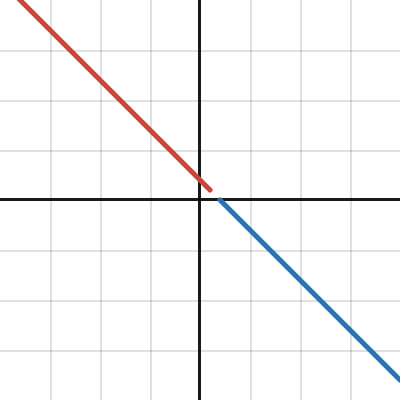
Desmos
the red part is the part that's included in the graph
the blue part is where 2-x starts being negative
As I said earlier, none of that blue part is part of our original graph because of the domain restrictions
still temple
I see yeah
ooooooh
wait
Ooooh
I get it
yep its not negative, I was seeing it wrong
for g(-1) = 3
correct me if I'm wrong
that makes sense I think yeah
@cunning fiberThanks 🙏
.close
marsh citrusBOT
Channel closed
Closed by @woven sinew
Use .reopen if this was a mistake.