#help-33
1 messages · Page 204 of 1
 tacit elm
 marsh citrusBOT
Channel closed
Closed by @tacit elm
Use .reopen if this was a mistake.
marsh citrusBOT
 Available help channel!
Send your question here to claim the channel.
Remember:
• Ask your math question in a clear, concise manner.
• Show your work, and if possible, explain where you are stuck.
• After 15 minutes, feel free to ping <@&286206848099549185>.
• Type the command .close to free the channel when you're done.
• Be polite and have a nice day!
Read #❓how-to-get-help for further information on how to ask a good question, and about conduct in the question channels.
 humble river
Hi
marsh citrusBOT
humble river
Hi

 elfin berryBOT
 elfin berryBOT
Result:
1.21645731782e-7
uh
 desert dirge
,calc (1.633 * 10^-18)/(6.626 * 10 ^ -34)
elfin berryBOT
Result:
2.4645336552973e+15
 desert dirge
why do you write if a=bc then a/c = b c/c, you can just go straight to a/c = b you know, will make things a lot simpler
desert dirge
,calc (2.998 * 10^8)/( 2.465 * 10^15)
elfin berryBOT
Result:
1.2162271805274e-7
you must have just made a calculation error
humble river
what the
desert dirge
10^8/10^15 in no way is going to give you 10^23
 desert dirge
you need brackets
humble river
O
desert dirge
you wrote a * b / c * d
its seeing it as a * (b/c) * d
 lone heart
humble river
lone heart
humble river
Fyi, ti-84 has a button that does x 10^ so you can use that instead
If you press 2nd, "," (button above 7), it's the blue EE
That's the notation for x10^
marsh citrusBOT
@humble river Has your question been resolved?
marsh citrusBOT
Channel closed
Closed due to timeout
Use .reopen if this was a mistake.
marsh citrusBOT
Available help channel!
Send your question here to claim the channel.
Remember:
• Ask your math question in a clear, concise manner.
• Show your work, and if possible, explain where you are stuck.
• After 15 minutes, feel free to ping <@&286206848099549185>.
• Type the command .close to free the channel when you're done.
• Be polite and have a nice day!
Read #❓how-to-get-help for further information on how to ask a good question, and about conduct in the question channels.
 glass quiver
I just had a question about derivatives and critical points.
If I have a graph of f'(x) then I know when f'(x) = 0, so where the graph crosses the x-axis are critical points for f(x), but when the graph has a vertical tangent or there is a sharp corner, would that also be considered where a critical point is for f(x)?
 marsh citrusBOT
glass quiver
I just had a question about derivatives and critical points.
If I have a graph o...
marsh citrusBOT
glass quiver
I just had a question about derivatives and critical points.
If I have a graph o...
 vernal mantle
No
 split elm
glass quiver
I just had a question about derivatives and critical points.
If I have a graph o...
split elm
glass quiver
I just had a question about derivatives and critical points.
If I have a graph o...
it really depends on what you define as "critical point". most of the time in calc class they will refer to critical points as when the slope is equal to 0, but you can just as easily argue that when you have a vertical tangent that its also a critical point.
however for the sharp corner, the derivative would not be continuous, which means its not differentiable at that point
vernal mantle
split elm
it really depends on what you define as "critical point". most of the time in ca...
Isn't this a graph of f'
And not f
glass quiver
its f'
glass quiver
and i know like a crtical point is when f'= 0 or f' is undefined
vernal mantle
split elm
oh my bad
Just clarify ig
vernal mantle
glass quiver
and i know like a crtical point is when f'= 0 or f' is undefined
But in this case f' is defined
it's only some parts where f'', the second derivative is not defined
glass quiver
so since its defined, then it isn't a critical point?
vernal mantle
glass quiver
so since its defined, then it isn't a critical point?
Yes
glass quiver
it would be a possibly inflection point instead of second deriv?
but that would be for a corner, but the vertical tangent would be considered a critical point since its still undefined?
vernal mantle
No the derivative is undefined when there's a sharp corner in f not f'
glass quiver
what about the vertical tangent?
vernal mantle
Tbh it might depend
If there's a vertical tangent at a certain point in f'(x) then f'(x) might not be defined at that point
Because like there might be a discontinutity
glass quiver
for this since its a graph of f'(x) and theres like a gap at x = 1, then would be that mean theres a critical point at x=1 on f(x)
 split elm
just looked it up and did an example, for the vertical tangent in f', f would have a cusp/sharp bend, so f is not continuous at that point
vernal mantle
Yea I guess so
glass quiver
split elm
just looked it up and did an example, for the vertical tangent in f', f would ha...
so would that mean it would be a critical point for f(x) since f'(x) is not defined there?
split elm
glass quiver
so would that mean it would be a critical point for f(x) since f'(x) is not defi...
uhhh technically yes.. i guess so
but it is a sharp bend
when f'(x) is vertical
glass quiver
so its a corner?
split elm
yes its a corner
glass quiver
then doesn't that mean its a critical point if going off the definition of critical points are when f' = 0 or undefined
split elm
glass quiver
for this since its a graph of f'(x) and theres like a gap at x = 1, then would b...
this graph of f' represents a corner in f also right?
glass quiver
yeah since its undefined
split elm
glass quiver
yeah since its undefined
think of the vertical tangent like the gap, only its infinitesimally small
so in that case, yeah its a critical point
split elm
split elm
think of the vertical tangent like the gap, only its infinitesimally small
its the length of however long the graph is vertical*
glass quiver
so if given a graph of f' then critical points of f(x) would be when it touches xaxis, vertical tangents, and discontinuity in the graph?
split elm
yeah
marsh citrusBOT
Channel closed
Closed by @glass quiver
Use .reopen if this was a mistake.
marsh citrusBOT
Available help channel!
Send your question here to claim the channel.
Remember:
• Ask your math question in a clear, concise manner.
• Show your work, and if possible, explain where you are stuck.
• After 15 minutes, feel free to ping <@&286206848099549185>.
• Type the command .close to free the channel when you're done.
• Be polite and have a nice day!
Read #❓how-to-get-help for further information on how to ask a good question, and about conduct in the question channels.
 buoyant jetty
For what base-$6$ digit $d$ is $2dd5_6$ divisible by the base $10$ number $11$? (Here $2dd5_6$ represents a base-$6$ number whose first digit is $2$, whose last digit is $5$, and whose middle two digits are both equal to $d$).
marsh citrusBOT
buoyant jetty
For what base-$6$ digit $d$ is $2dd5_6$ divisible by the base $10$ number $11$? ...
elfin berryBOT
938c2cc0dcc05f2b68c4287040cfcf71
 marsh citrusBOT
@buoyant jetty Has your question been resolved?
marsh citrusBOT
@buoyant jetty Has your question been resolved?
 devout mauve
marsh citrusBOT
devout mauve
marsh citrusBOT
Channel closed
Closed due to timeout
Use .reopen if this was a mistake.
Available help channel!
Send your question here to claim the channel.
Remember:
• Ask your math question in a clear, concise manner.
• Show your work, and if possible, explain where you are stuck.
• After 15 minutes, feel free to ping <@&286206848099549185>.
• Type the command .close to free the channel when you're done.
• Be polite and have a nice day!
Read #❓how-to-get-help for further information on how to ask a good question, and about conduct in the question channels.
 still temple
how would i go about doing this?
 marsh citrusBOT
still temple
how would i go about doing this?
marsh citrusBOT
still temple
how would i go about doing this?
 late geode
partial fractions
still temple
does the coefficient of x has to be zero to apply partial fractions?
why am i asking this here when i can google this smh
thanks for your help
.close
marsh citrusBOT
Channel closed
Closed by @green kindle
Use .reopen if this was a mistake.
marsh citrusBOT
Available help channel!
Send your question here to claim the channel.
Remember:
• Ask your math question in a clear, concise manner.
• Show your work, and if possible, explain where you are stuck.
• After 15 minutes, feel free to ping <@&286206848099549185>.
• Type the command .close to free the channel when you're done.
• Be polite and have a nice day!
Read #❓how-to-get-help for further information on how to ask a good question, and about conduct in the question channels.
 lime inlet
 marsh citrusBOT
lime inlet
marsh citrusBOT
lime inlet
 stoic slate
lime inlet
stoic slate
lime inlet
Factor numerator and denominator in left side
 lapis atlas
lime inlet
how do i factor the numerator
lapis atlas
lime inlet
how do i factor the numerator
take tan common in the denominator
stoic slate
$a^2-b^2$
lapis atlas
youll get sin -1
elfin berryBOT
Samuel
 lapis atlas
and on the top (sin + 1)(sin-1)
lime inlet
ohhh
lapis atlas
oh haha
lime inlet
.close
marsh citrusBOT
Channel closed
Closed by @lime inlet
Use .reopen if this was a mistake.
marsh citrusBOT
Available help channel!
Send your question here to claim the channel.
Remember:
• Ask your math question in a clear, concise manner.
• Show your work, and if possible, explain where you are stuck.
• After 15 minutes, feel free to ping <@&286206848099549185>.
• Type the command .close to free the channel when you're done.
• Be polite and have a nice day!
Read #❓how-to-get-help for further information on how to ask a good question, and about conduct in the question channels.
 grand smelt
"One of the angles in a triangle is a right angle. Show that the other two angles are complementary."
how am i supposed to show that the other two angles are complementary
marsh citrusBOT
grand smelt
"One of the angles in a triangle is a right angle. Show that the other two angle...
grand smelt
i asked chatgpt and he said 90 + A + B = 180
but isnt complementary limited to 90
i thought that was supplementary
 sharp ivy
sum of all 3 angles of a triangle is constant.
well, you move the 90 to right side, to find A+B.
grand smelt
well yes but im getting a little confused with complementary in this context
sharp ivy
complementary=sum of them is 90.
You have to show A+ B add up to 90, when C is 90.
This one time, I can say chatgpt did a pretty good job.
grand smelt
if a question asks "One of the angles in a triangle is 120, show the other two angles are complementary" is this question asking me the right thing or is it asking for a supplementary
sharp ivy
The question is asking you to use whatever properties you can, to show that the other 2 angles are complementary (= their meausures add up to 90).
It only works if 1 angle is 90 though.
If it said 120, like in your last comment, it would be impossible to show.
lone heart
grand smelt
if a question asks "One of the angles in a triangle is 120, show the other two a...
That's not valid because complementary means they add to 90 so if (a + b) = 90 but you have 120, then the sum is 210, which is more then 180
grand smelt
so complementary is 90 + 90, supplementary is 180 + 180?
sharp ivy
no...
grand smelt
??
lone heart
grand smelt
??
 sharp ivy
the property we use to show they're complementary is a different 1.
grand smelt
oh okay
sharp ivy
are you familiar with property of the 3 angles in a triangle that they add up to 180?
grand smelt
the existing right angle confused me
grand smelt
sharp ivy
are you familiar with property of the 3 angles in a triangle that they add up to...
yes ofc
sharp ivy
well...you just use that.
lone heart
grand smelt
the existing right angle confused me
Because it's a triangle, you have 3 angles in a triangle, and it gave you one of them
sharp ivy
It's asking you only about THE OTHER 2.
so, you substract the 90 from both sides...and get a+b=90. definition of complementary.
lone heart
You're using that info to prove that (a + b) = 90
marsh citrusBOT
Channel closed
Closed by @grand smelt
Use .reopen if this was a mistake.
marsh citrusBOT
Available help channel!
Send your question here to claim the channel.
Remember:
• Ask your math question in a clear, concise manner.
• Show your work, and if possible, explain where you are stuck.
• After 15 minutes, feel free to ping <@&286206848099549185>.
• Type the command .close to free the channel when you're done.
• Be polite and have a nice day!
Read #❓how-to-get-help for further information on how to ask a good question, and about conduct in the question channels.
marsh citrusBOT

 rotund violet
this is the same as showing that $3$ isn't an eigenvalue of $A^2-2A$ right?
elfin berryBOT
Arnavutköy

 rotund violet
An eigenvalue of matrix $M$ is any value $\lambda$ such that $\det(M-\lambda I)=0$.
elfin berryBOT
Arnavutköy
 rotund violet
Have you seen this definition of an eigenvalue?
 small stream
I know this, but i still don't understand why is this q related to ew
I just want to know why the method I used is invalid
rotund violet
well im confused in your solution what $E$ is exactly, and why any inverse would be of the form $aA+bE$.
elfin berryBOT
Arnavutköy
 small stream
Wait just noticed a typo, it's I not E
small stream
small stream
Wait just noticed a typo, it's I not E
.
rotund violet
moreover, if you do define $E$, then how do you prove your statement?
elfin berryBOT
Arnavutköy
 rotund violet
oh
how do we know that this matrix has an inverse which isn't of the form $aA+bI$?
elfin berryBOT
Arnavutköy
 rotund violet
small stream
That's my question
rotund violet
small stream
That's my question
well your proof assumes this question's answer
it assumes that if you just show that there is no inverse of the form $aA+bI$, then there is no inverse at all
elfin berryBOT
Arnavutköy
 rotund violet
and thus is not invertible
small stream
Ye so what form it should be
rotund violet
yeah wait also if there are no solutions this is showing that it is NOT invertible
rotund violet
small stream
Ye so what form it should be
it can be any arbitrary matrix the same size as A
marsh citrusBOT
Channel closed
Closed by @small stream
Use .reopen if this was a mistake.
marsh citrusBOT
Available help channel!
Send your question here to claim the channel.
Remember:
• Ask your math question in a clear, concise manner.
• Show your work, and if possible, explain where you are stuck.
• After 15 minutes, feel free to ping <@&286206848099549185>.
• Type the command .close to free the channel when you're done.
• Be polite and have a nice day!
Read #❓how-to-get-help for further information on how to ask a good question, and about conduct in the question channels.
 novel juniper
Let $x,y,z,w$ be elements of a group $G$
\
solve for $y$
(a) $xyz^{-1}w=1$
marsh citrusBOT
novel juniper
Let $x,y,z,w$ be elements of a group $G$
\\
solve for $y$
(a) $xyz^{-1}w=1$
elfin berryBOT
ƒ(Why am. I here)=I don't Know
 novel juniper
Would it simply be $y=x^{-1}w^{-1}z$
elfin berryBOT
ƒ(Why am. I here)=I don't Know
 novel juniper
I can show my working
rotund violet
Yes
novel juniper
Yes show my working?
rotund violet
novel juniper
Yes show my working?
as in yes that is correct
marsh citrusBOT
Channel closed
Closed by @novel juniper
Use .reopen if this was a mistake.
novel juniper
I suppose I should have written this as $y=(wx)^{-1}z$
elfin berryBOT
ƒ(Why am. I here)=I don't Know
 rotund violet
That also works but isn't neccessary
 slate yarrow
elfin berry
**ƒ(Why am. I here)=I don't Know**
slate yarrow
elfin berry
**ƒ(Why am. I here)=I don't Know**
both are the same lol
novel juniper
I know
Thanks everyone!
Suppose $xyz=1$ does it follow that $yzx=1$. I follows that $yz=x^{-1}$ and subsequently $yzx=1$ so yes
elfin berryBOT
ƒ(Why am. I here)=I don't Know
 slate yarrow
elfin berry
**ƒ(Why am. I here)=I don't Know**
slate yarrow
elfin berry
**ƒ(Why am. I here)=I don't Know**
xyz=1 does not mean yzx=1
still temple
Lol
marsh citrusBOT
✅
slate yarrow
novel juniper
it does
it does if its commutative ig
novel juniper
$xyz =1 \implies yz=x^{-1}$
\
I now post multiply both sides by $x$ to get
\
$yzx=x^{-1}x=1$
elfin berryBOT
ƒ(Why am. I here)=I don't Know
 rotund violet
oh yes it does. $xyz=1$ does imply that $yzx=-1$
elfin berryBOT
Arnavutköy
 rotund violet
sorry $1$ not $-1
slate yarrow
ah alright
elfin berryBOT
Arnavutköy
Compile Error! Click the  reaction for more information.
(You may edit your message to recompile.)
 elfin berryBOT
ƒ(Why am. I here)=I don't Know
 novel juniper
I suspect not
oh nvm
it does
$xyz =1 \implies y = z^{-1}x^{-1} \implies yx=z^{-1} \implies yxz = 1$
elfin berryBOT
ƒ(Why am. I here)=I don't Know

 keen mist
shouldnt this second bit be the other way round
 novel juniper
why
keen mist
you multiply both sides on the left by x^-1 then on the right by z^-1
keen mist
probably not
marsh citrusBOT
Channel closed
Closed by @novel juniper
Use .reopen if this was a mistake.
marsh citrusBOT
Available help channel!
Send your question here to claim the channel.
Remember:
• Ask your math question in a clear, concise manner.
• Show your work, and if possible, explain where you are stuck.
• After 15 minutes, feel free to ping <@&286206848099549185>.
• Type the command .close to free the channel when you're done.
• Be polite and have a nice day!
Read #❓how-to-get-help for further information on how to ask a good question, and about conduct in the question channels.
 wise oxide
 marsh citrusBOT
wise oxide
wise oxide
marsh citrusBOT
wise oxide
wise oxide
I do integral test for all of these?
wise oxide
 odd orchid
evalute the integral normally
odd orchid
evalute the integral normally
So if it equal any number that’s not inf its convergent ?
wise oxide
odd orchid
if the integrand is undefined at one of the bounds
So how do I know if it converges or not
odd orchid
let the problematic bound be t
set a limit as t approaches the bound
evaluate the integral
evaluate the limit
wise oxide
odd orchid
evaluate the limit
Yeah so if the answer is any number it converge?
odd orchid
yes
 odd orchid
partial fractions probably
wise oxide
So do I keep my denominator like that
wise oxide
So how am I suppose to do partial fraction
marsh citrusBOT
@wise oxide Has your question been resolved?
marsh citrusBOT
Channel closed
Closed due to timeout
Use .reopen if this was a mistake.
Available help channel!
Send your question here to claim the channel.
Remember:
• Ask your math question in a clear, concise manner.
• Show your work, and if possible, explain where you are stuck.
• After 15 minutes, feel free to ping <@&286206848099549185>.
• Type the command .close to free the channel when you're done.
• Be polite and have a nice day!
Read #❓how-to-get-help for further information on how to ask a good question, and about conduct in the question channels.
 vernal herald
I don't get why the alternating series test doesn't work. The limit to infinity of the non-alternating term is zero, and it's decreasing...? So why doesn't it converge absolutely?
 marsh citrusBOT
vernal herald
I don't get why the alternating series test doesn't work. The limit to infinity ...
marsh citrusBOT
vernal herald
I don't get why the alternating series test doesn't work. The limit to infinity ...
 rugged spindle
it converges absolutely if $\sum_{n=1}^{\infty}\left \lvert\frac{(-1)^n}{2n} \right \lvert$ converges
elfin berryBOT
fish
 vernal herald
rugged spindle
it converges absolutely if $\sum_{n=1}^{\infty}\left \lvert\frac{(-1)^n}{2n} \ri...
vernal herald
rugged spindle
it converges absolutely if $\sum_{n=1}^{\infty}\left \lvert\frac{(-1)^n}{2n} \ri...
huh... I though it would be absolute for some reason as the root and ratio tests depict absolute convergence
rugged spindle
it converges, but to converge conditionally means that it only converges because it's an alternating series and would otherwise not converge if it isn't alternating
vernal herald
are you an alternating series because you converge or do you converge because you're an alternating series?
.close
marsh citrusBOT
Channel closed
Closed by @vernal herald
Use .reopen if this was a mistake.
marsh citrusBOT
Available help channel!
Send your question here to claim the channel.
Remember:
• Ask your math question in a clear, concise manner.
• Show your work, and if possible, explain where you are stuck.
• After 15 minutes, feel free to ping <@&286206848099549185>.
• Type the command .close to free the channel when you're done.
• Be polite and have a nice day!
Read #❓how-to-get-help for further information on how to ask a good question, and about conduct in the question channels.
 fierce kite
Need some help w complex numbers
marsh citrusBOT
fierce kite
Need some help w complex numbers
 desert dirge
or write stuff in exponential/polar form, speedy
 tight furnace
god no don't do that
desert dirge

marsh citrusBOT
@fierce kite Has your question been resolved?
Channel closed
Closed by @fierce kite
Use .reopen if this was a mistake.
Available help channel!
Send your question here to claim the channel.
Remember:
• Ask your math question in a clear, concise manner.
• Show your work, and if possible, explain where you are stuck.
• After 15 minutes, feel free to ping <@&286206848099549185>.
• Type the command .close to free the channel when you're done.
• Be polite and have a nice day!
Read #❓how-to-get-help for further information on how to ask a good question, and about conduct in the question channels.
 last hound
How to solve the second question pls
 marsh citrusBOT
last hound
How to solve the second question pls
last hound
marsh citrusBOT
last hound
How to solve the second question pls
last hound
Like show that A³ = A?
 void elm
that would suffice
though it might be easier (less computationally painful) to simply let take a vector v in R^4, and compute f^3(v)
which you can do by computing A^3v
last hound
void elm
though it might be easier (less computationally painful) to simply let take a ve...
Okay and then the next question, should I calculate the eigenvalue or like how I can deduce it?
void elm
last hound
Okay and then the next question, should I calculate the eigenvalue or like how I...
characteristic polynomial of A
compute it, and find the roots
those will be the eigenvalues of f
last hound
Alright Roger
void elm
last hound
Alright Roger
actually, there's a better way to do it 
if $f^3(v) = f(v)$, then $f^3(v) - f(v) = 0$
elfin berryBOT
higher!
 void elm
then you can factor
that'll instantly get you the eigenvalues when you split it into linear factors
much less painful than the char poly
last hound
void elm
then you can factor
Oh yeah
So
We get lambda(lambda-1)(lambda+1) = 0
And then get
Lambda= 0, 1, -1??
void elm
last hound
Oh yeah
So
We get lambda(lambda-1)(lambda+1) = 0
And then get
Lambda= 0, 1, -1...
well, not lambda
last hound
The eigenvalues
void elm
,, 0 = f^3(v) - f(v) = f(v)(f^2(v) - I(v)) = f(v)(f(v) - I(v))(f(v) + I(v))
elfin berryBOT
higher!
 void elm
so either $f(v) = 0, f(v) = I(v) = v$, or $f(v) = -I(v) = -v$
elfin berryBOT
higher!
 void elm
these correspond to eigenvalues 0, 1, and -1, respectively
last hound
void elm
these correspond to eigenvalues 0, 1, and -1, respectively
Yeah that exactly I mean 😅
 last hound
void elm
does that answer your question? <:EB_EeveeHappy:1036363517445545995>
last hound
void elm
does that answer your question? <:EB_EeveeHappy:1036363517445545995>
Yes sir 🫡 thanks you so much

 last hound
void elm
if you're done here, you may close the channel <:thumbsupanimegirl:1203420374243...
last hound
void elm
if you're done here, you may close the channel <:thumbsupanimegirl:1203420374243...
Yes yes, I forget about that
!close
close
void elm
it's . 
last hound
.close
marsh citrusBOT
Channel closed
Closed by @last hound
Use .reopen if this was a mistake.
void elm
marsh citrusBOT
Available help channel!
Send your question here to claim the channel.
Remember:
• Ask your math question in a clear, concise manner.
• Show your work, and if possible, explain where you are stuck.
• After 15 minutes, feel free to ping <@&286206848099549185>.
• Type the command .close to free the channel when you're done.
• Be polite and have a nice day!
Read #❓how-to-get-help for further information on how to ask a good question, and about conduct in the question channels.
 still current
I'm stuck on this and I don't remember when I learned to so I don't really know where to start
 marsh citrusBOT
still current
I'm stuck on this and I don't remember when I learned to so I don't really know ...
still current
marsh citrusBOT
still current
I'm stuck on this and I don't remember when I learned to so I don't really know ...
still current
the first part of ftc?
still current
so 5 + second integral?
desert dirge
keep it as an integral, lets call the value of the integral we want 'Z' or something
then int [f'g] + int[fg']=5+Z
see what can be done on the left
desert dirge
sorry i meant ftc 2 not part 1
still current
ok
desert dirge
remember i said the product rule is relevant, in reverse
on the left we have the integral of [ f'g + fg' ]
which is what
still current
5+z?
the product rule in reverse thing is throwing me off
youre not talking about by parts right
desert dirge
derivative of, yeah
still current
oh yeah
desert dirge
so you can apply the ftc now and find Z
still current
wait but if i integrated f'g + fg' it would be f(x)g(x) so it would be f(x)g(x) from 0 to 1 = 5+ Z?
desert dirge
yeah
marsh citrusBOT
Channel closed
Closed by @still current
Use .reopen if this was a mistake.
marsh citrusBOT
Available help channel!
Send your question here to claim the channel.
Remember:
• Ask your math question in a clear, concise manner.
• Show your work, and if possible, explain where you are stuck.
• After 15 minutes, feel free to ping <@&286206848099549185>.
• Type the command .close to free the channel when you're done.
• Be polite and have a nice day!
Read #❓how-to-get-help for further information on how to ask a good question, and about conduct in the question channels.
 rough ingot
This probably isn't the clearest diagram, but how would I find what Theta 1 and 2 are in this diagram?
 marsh citrusBOT
rough ingot
This probably isn't the clearest diagram, but how would I find what Theta 1 and ...
marsh citrusBOT
rough ingot
This probably isn't the clearest diagram, but how would I find what Theta 1 and ...
 odd orchid
probably a derivation of the sin addition formula
rough ingot
And what is that?
odd orchid
sin a+b = sin a cos b + sinb cos a
marsh citrusBOT
Channel closed
Closed by @rough ingot
Use .reopen if this was a mistake.
Available help channel!
Send your question here to claim the channel.
Remember:
• Ask your math question in a clear, concise manner.
• Show your work, and if possible, explain where you are stuck.
• After 15 minutes, feel free to ping <@&286206848099549185>.
• Type the command .close to free the channel when you're done.
• Be polite and have a nice day!
Read #❓how-to-get-help for further information on how to ask a good question, and about conduct in the question channels.
 sweet quarry
I dont understand what im doing wrong, it said that the answer is partially correct

 marsh citrusBOT
sweet quarry
I dont understand what im doing wrong, it said that the answer is partially corr...
sweet quarry
marsh citrusBOT
sweet quarry
I dont understand what im doing wrong, it said that the answer is partially corr...
sweet quarry
(-3,-1) and (5,-1) are the local maximums
sweet quarry
but theres 2 highest
 shadow flame
theres one
shadow flame
sweet quarry
(-3,-1) and (5,-1) are the local maximums
no?
ok do you have the graph?
like do you know how to get the graph
cause after that, you have to look at the domain
it says from [0,2pi]
so theres only one local max
 shadow flame
hold on, whats ur question, for cos or for csc?
sweet quarry
csc
shadow flame
yea so the graph should look like this
sweet quarry
so yea there is only one cause thge other isnt in the 0, 2pi range

 shadow flame
sweet quarry
so yea there is only one cause thge other isnt in the 0, 2pi range
shadow flame
sweet quarry
so yea there is only one cause thge other isnt in the 0, 2pi range
yup you got it!
marsh citrusBOT
Channel closed
Closed by @sweet quarry
Use .reopen if this was a mistake.
marsh citrusBOT
Available help channel!
Send your question here to claim the channel.
Remember:
• Ask your math question in a clear, concise manner.
• Show your work, and if possible, explain where you are stuck.
• After 15 minutes, feel free to ping <@&286206848099549185>.
• Type the command .close to free the channel when you're done.
• Be polite and have a nice day!
Read #❓how-to-get-help for further information on how to ask a good question, and about conduct in the question channels.
 soft oar
3-7x4
marsh citrusBOT
soft oar
3-7x4
soft oar
Is it possible
 brave marsh
What?
 wary kite
soft oar
Is it possible
wary kite
soft oar
Is it possible
no, it’s way too hard
soft oar
Uh
odd orchid
,calc 3-7*4
elfin berryBOT
Result:
-25
Uh
odd orchid
👏
soft oar
I think is (7X4)-3
wary kite
sir were you born after 2011
wary kite
just curious
marsh citrusBOT
Channel closed
Closed by @soft oar
Use .reopen if this was a mistake.
marsh citrusBOT
Available help channel!
Send your question here to claim the channel.
Remember:
• Ask your math question in a clear, concise manner.
• Show your work, and if possible, explain where you are stuck.
• After 15 minutes, feel free to ping <@&286206848099549185>.
• Type the command .close to free the channel when you're done.
• Be polite and have a nice day!
Read #❓how-to-get-help for further information on how to ask a good question, and about conduct in the question channels.
still temple
wary kite
sir were you born after 2011
.smart
wary kite
 marsh citrusBOT
Channel closed
Closed by @wary kite
Use .reopen if this was a mistake.
shadow flame
wary kite
oh lol
whyd u proceed to dm him about this....
wary kite
shadow flame
whyd u proceed to dm him about this....
i didn’t dm him
wary kite


 wary kite
shadow flame
that sure looks like a dm
wary kite
shadow flame
that sure looks like a dm
well aren’t you sharp
wary kite
what
wary kite
shadow flame
thats quite the random first message
hence why i responded with "what"
wary kite
marsh citrusBOT
Available help channel!
Send your question here to claim the channel.
Remember:
• Ask your math question in a clear, concise manner.
• Show your work, and if possible, explain where you are stuck.
• After 15 minutes, feel free to ping <@&286206848099549185>.
• Type the command .close to free the channel when you're done.
• Be polite and have a nice day!
Read #❓how-to-get-help for further information on how to ask a good question, and about conduct in the question channels.
marsh citrusBOT
Channel closed
Channel closed due to the original message being deleted.
If you did not intend to do this, please open a new help channel,
as this action is irreversible, and this channel may abruptly lock.
Available help channel!
Send your question here to claim the channel.
Remember:
• Ask your math question in a clear, concise manner.
• Show your work, and if possible, explain where you are stuck.
• After 15 minutes, feel free to ping <@&286206848099549185>.
• Type the command .close to free the channel when you're done.
• Be polite and have a nice day!
Read #❓how-to-get-help for further information on how to ask a good question, and about conduct in the question channels.
novel juniper
Determine if $G=GL_n(\C)$ is a subgroup of $H=GL_n(\R)$
elfin berryBOT
ƒ(Why am. I here)=I don't Know
 novel juniper
oops, yes
 static quarry
what do you need to check in general to see if something is a subgroup of another group?
novel juniper
I suspect it is
novel juniper
static quarry
what do you need to check in general to see if something is a subgroup of anothe...
Closure, identity and inverse must be present
novel juniper
Identity (I) is present and the inverse of a real matrix is real, so both are present
The product of two real matrices is real, so it's closed under compsition too
static quarry
yep
could even just say, GLn(R) is a group and it's a a subset of GLn(C) with the same identity and group operation
so it's a subgroup
marsh citrusBOT
Channel closed
Closed by @novel juniper
Use .reopen if this was a mistake.
marsh citrusBOT
Available help channel!
Send your question here to claim the channel.
Remember:
• Ask your math question in a clear, concise manner.
• Show your work, and if possible, explain where you are stuck.
• After 15 minutes, feel free to ping <@&286206848099549185>.
• Type the command .close to free the channel when you're done.
• Be polite and have a nice day!
Read #❓how-to-get-help for further information on how to ask a good question, and about conduct in the question channels.
 vapid oar
can someone please help me with iii)
 marsh citrusBOT
vapid oar
can someone please help me with iii)
vapid oar
marsh citrusBOT
vapid oar
can someone please help me with iii)
vapid oar
The most work I could get up to is just showing that RT is just OT-OR, and then SU is just OU - OS
but after that i'm unsure what to do
<@&286206848099549185>
also, ive found that the length of rt or |RT| is just |OT-OR| and likewise |SU| is just |OU - OS|
<@&286206848099549185>
.close
marsh citrusBOT
Channel closed
Closed by @vapid oar
Use .reopen if this was a mistake.
Available help channel!
Send your question here to claim the channel.
Remember:
• Ask your math question in a clear, concise manner.
• Show your work, and if possible, explain where you are stuck.
• After 15 minutes, feel free to ping <@&286206848099549185>.
• Type the command .close to free the channel when you're done.
• Be polite and have a nice day!
Read #❓how-to-get-help for further information on how to ask a good question, and about conduct in the question channels.
vapid oar
help with iii) please
 marsh citrusBOT
vapid oar
help with iii) please
vapid oar
marsh citrusBOT
vapid oar
help with iii) please
vapid oar
ive only managed to identify that RT = OT - OR and vice versa with SU = OU - OS
marsh citrusBOT
@vapid oar Has your question been resolved?
vapid oar
.close
marsh citrusBOT
Channel closed
Closed by @vapid oar
Use .reopen if this was a mistake.
marsh citrusBOT
Available help channel!
Send your question here to claim the channel.
Remember:
• Ask your math question in a clear, concise manner.
• Show your work, and if possible, explain where you are stuck.
• After 15 minutes, feel free to ping <@&286206848099549185>.
• Type the command .close to free the channel when you're done.
• Be polite and have a nice day!
Read #❓how-to-get-help for further information on how to ask a good question, and about conduct in the question channels.
 undone surge
Help with this

 vale jacinth
undone surge
Help with this
vale jacinth
undone surge
Help with this
use sin, cos
undone surge
Is BD: 5.0 and CD: 8.1?
 raw hawk
undone surge
Is BD: 5.0 and CD: 8.1?
raw hawk
undone surge
Is BD: 5.0 and CD: 8.1?
Yes 5 and 8
undone surge
@raw hawk what about this?
 marsh citrusBOT
undone surge
<@1043973524961902612> what about this?
marsh citrusBOT
undone surge
<@1043973524961902612> what about this?
What step are you on?
1. I don't know where to begin.
2. I have begun but got stuck midway.
3. I got an answer but I was told that it's wrong.
4. I got an answer and would like my work checked.
5. I have a question about someone else's work/solution.
6. I have completed the problem and don't need help anymore. Thank you.
7. None of the above
3
raw hawk
undone surge
3
So to find BC use pythagoras's theorem
raw hawk
undone surge
or 38?
√38
raw hawk
undone surge
I got 21.3 for angle C, is that right?
Yes
raw hawk
undone surge
So the other one is 68.7 right
Yes
marsh citrusBOT
Channel closed
Closed by @undone surge
Use .reopen if this was a mistake.
marsh citrusBOT
Available help channel!
Send your question here to claim the channel.
Remember:
• Ask your math question in a clear, concise manner.
• Show your work, and if possible, explain where you are stuck.
• After 15 minutes, feel free to ping <@&286206848099549185>.
• Type the command .close to free the channel when you're done.
• Be polite and have a nice day!
Read #❓how-to-get-help for further information on how to ask a good question, and about conduct in the question channels.
 sand wind
Hi
marsh citrusBOT
sand wind
Hi

 normal moss
Do you know how to calculate the slope of a line?
sand wind
No
I am like
Really bad at math
Like really bad at it
But I am trying to re learn it
normal moss
Okay, so if you have two points on a line the slope can be calculated via a formula.
sand wind
Formula is the fancy F thing right?
normal moss
It's just an expression you can plug in numbers in this context to get out another number.
sand wind
I see
normal moss
Gimme a sec

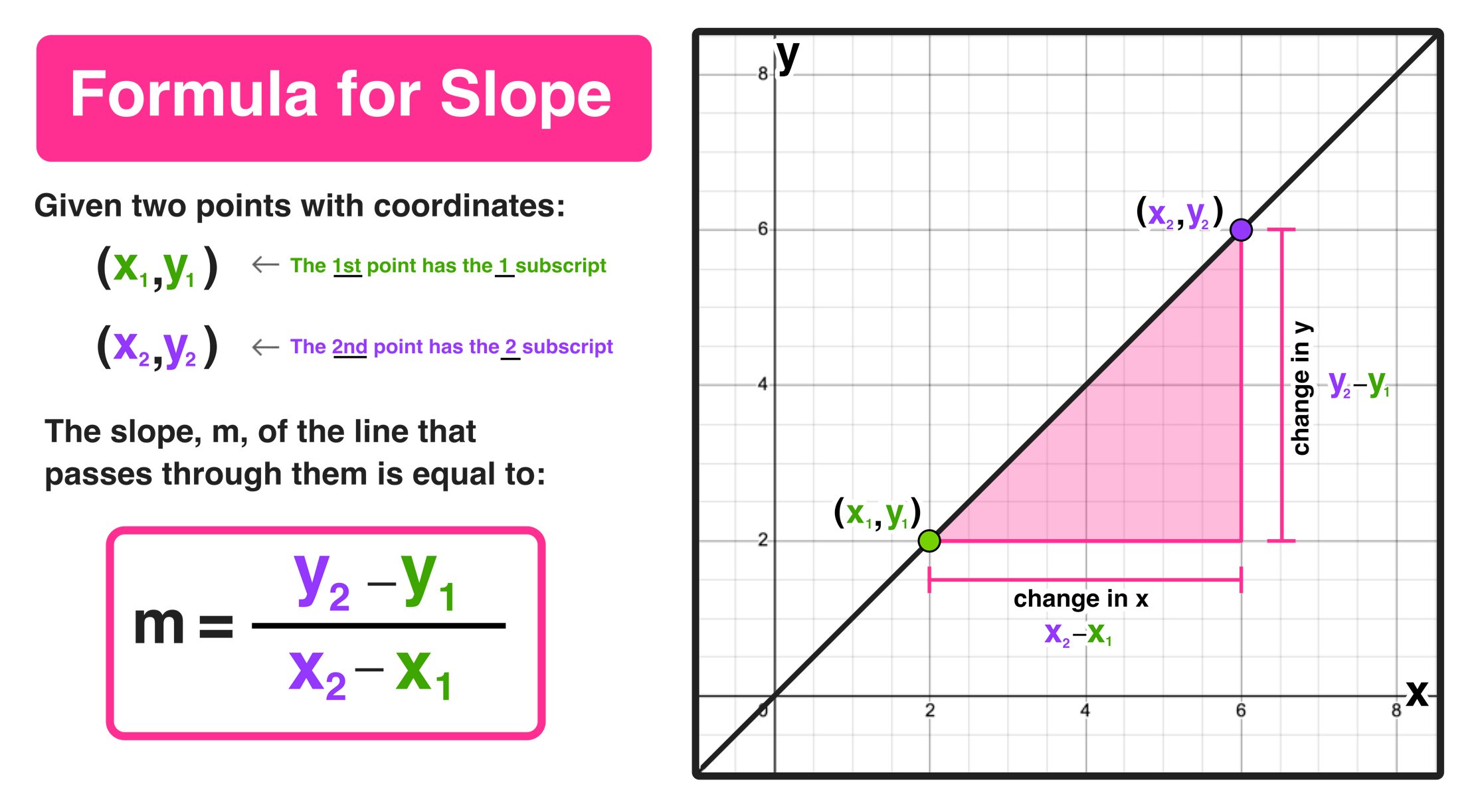
Here is a formula for calculating the slope of a line if you know two points on the line.
sand wind
What's a subscript? is that like the first location?
sand wind
normal moss
Here is a formula for calculating the slope of a line if you know two points on ...
And then you divide them both?
normal moss
A subscript is a little symbol you put below another symbol
A superscript is a little symbol you put above another symbol
sand wind
Is it like
normal moss
Like when you write $x^2$ the 2 is a subscript
elfin berryBOT
DootDooter
 sand wind
A power?
normal moss
Oops
normal moss
Sorry the 2 is a superscript
 buoyant pond
sand wind
What's a subscript? is that like the first location?
buoyant pond
sand wind
What's a subscript? is that like the first location?
the subscripts denote the two points
normal moss
Subscripts are the same idea but you put them at the bottom right of the symbol rather than the top
Yes the subscripts are used here because there are two points
sand wind
So what significance do they bring?
normal moss
So they are using the subscripts to distinguish between the two points
normal moss
normal moss
Gimme a sec
The point here is if you have two points you can plug their x,y values into this formula to get back the slope m
sand wind
Can you elaborate more on that or give an example?
normal moss
sand wind
I need help with this
Here you have the graph of the line. So you can use this picture to find two points on your line. For example (1,1) is on the line and (0,-1) is on the line.
So you can plug these values into the formula for slope I posted and it should give you 2.
normal moss
Say $(x_1,y_1)=(0,-1)$ and $(x_2,y_2)=(1,1)$. Then $m=\frac{y_2-y_1}{x_2-x_1}=\frac{1-(-1)}{1-0}=2$.
elfin berryBOT
DootDooter
 sand wind
So if I divide these numbers I should get 2
We have to divide them correct?
I'm understanding this weirdly
normal moss
Yeah there is a division in the formula.
People sometimes call this the rise over the run.
sand wind
Can we swear on this server?
normal moss
Just don't say slurs and stuff
sand wind
I see
Ok what the fuck I put it on the calc and it showed me 2
This is so trippy bruh
Math so trippy
normal moss
Wdym?
sand wind
I mean it works
normal moss
It should give you 2 that is the correct slope lmao
sand wind
Yeah it gave me 2
normal moss
So like the reason they call it the rise over the run is that you divide the amount the curve rises by the amount the curve runs by
normal moss
In the m formula?
normal moss
There are x's and y's in the slope formula
sand wind
Let's say the formula changes instead of x it's y, the same rule still applies but it's y that changes correct?
sand wind
normal moss
There are x's and y's in the slope formula
Yeah I know
Ok wow
This helped
normal moss
sand wind
Let's say the formula changes instead of x it's y, the same rule still applies b...
Mmm no I wouldn't think of it this way
The y's go on top and the x's go on the bottom.
sand wind
So it's always the x then?
normal moss
The point is the slope of the line IS the rise over the run. The rise is a measurement of how much the line changes along the y axis.
The run is a measurement of how much the curve changes along the x axis.
sand wind
I see
normal moss
The m is like the rste of change the line makes per unit.
sand wind
rste?
normal moss
Like if we measured the y axis in miles and the x axis in hours m would be an amount in miles per hour for example.
normal moss
Probably for now it is best not to think too hard on that.
The slope formula is just a formula you can use when you know two points on a line. You plug in the values from the points into the formula correctly and you get out the slope of the line.
sand wind
I am like a 1 GPA student and I have to study math for an entrance exam to go to the #2 university in my country, I can get in if I pass the entrance exam the only issue there is math 😭
I might ask more help in this server tho
sand wind
normal moss
The slope formula is just a formula you can use when you know two points on a li...
Got it thanks man
marsh citrusBOT
@sand wind Has your question been resolved?
Channel closed
Closed by @sand wind
Use .reopen if this was a mistake.
Available help channel!
Send your question here to claim the channel.
Remember:
• Ask your math question in a clear, concise manner.
• Show your work, and if possible, explain where you are stuck.
• After 15 minutes, feel free to ping <@&286206848099549185>.
• Type the command .close to free the channel when you're done.
• Be polite and have a nice day!
Read #❓how-to-get-help for further information on how to ask a good question, and about conduct in the question channels.
 modest mantle
see my method is simple alright its to find max and min value of complex no
if i have been give an expression suppose |z-1| =2 and an ecpression whose max and min you tryna find suppose |z-(3+4i)| now we should try creating z-1 in that other expression so you will get |(z-1) - (2+4i)| and now we get max min by, (z-1)^2 + whole root(x^2+y^2) xand y being 2 and 4 now with that method solve this question
 marsh citrusBOT
modest mantle
see my method is simple alright its to find max and min value of complex no
if i...
marsh citrusBOT
modest mantle
see my method is simple alright its to find max and min value of complex no
if i...
@modest mantle Has your question been resolved?
modest mantle
<@&286206848099549185>
marsh citrusBOT
@modest mantle Has your question been resolved?
 unkempt orbit
modest mantle
see my method is simple alright its to find max and min value of complex no
if i...
unkempt orbit
modest mantle
see my method is simple alright its to find max and min value of complex no
if i...
Well, first you need to understand what the first statement was trying to say
marsh citrusBOT
Channel closed
Closed due to timeout
Use .reopen if this was a mistake.
Available help channel!
Send your question here to claim the channel.
Remember:
• Ask your math question in a clear, concise manner.
• Show your work, and if possible, explain where you are stuck.
• After 15 minutes, feel free to ping <@&286206848099549185>.
• Type the command .close to free the channel when you're done.
• Be polite and have a nice day!
Read #❓how-to-get-help for further information on how to ask a good question, and about conduct in the question channels.
 rocky lark
Hi
marsh citrusBOT
rocky lark
Hi
marsh citrusBOT
To ask for mathematics help on this server, please open your own help channel or help thread. See #❓how-to-get-help for instructions.
rocky lark
I did the procedure
unkempt orbit
What exactly did you try?
elfin berryBOT


 Requested by sofficino9188
rocky lark
Requested by sofficino9188
rocky lark
It's like the first one
 wide citrus
Hi
rocky lark
Hi
wide citrus
rocky lark
I used a gauss surface
But still wrong
What
Its gauss not gas
I had a vision
I'll try this one
.close
marsh citrusBOT
Channel closed
Closed by @rocky lark
Use .reopen if this was a mistake.
marsh citrusBOT
Available help channel!
Send your question here to claim the channel.
Remember:
• Ask your math question in a clear, concise manner.
• Show your work, and if possible, explain where you are stuck.
• After 15 minutes, feel free to ping <@&286206848099549185>.
• Type the command .close to free the channel when you're done.
• Be polite and have a nice day!
Read #❓how-to-get-help for further information on how to ask a good question, and about conduct in the question channels.
wise oxide
 marsh citrusBOT
wise oxide
wise oxide
marsh citrusBOT
wise oxide
wise oxide
Is this correct to find integral of (1+4x) times cos(2x)
marsh citrusBOT
@wise oxide Has your question been resolved?
marsh citrusBOT
Channel closed
Closed due to timeout
Use .reopen if this was a mistake.
marsh citrusBOT
Available help channel!
Send your question here to claim the channel.
Remember:
• Ask your math question in a clear, concise manner.
• Show your work, and if possible, explain where you are stuck.
• After 15 minutes, feel free to ping <@&286206848099549185>.
• Type the command .close to free the channel when you're done.
• Be polite and have a nice day!
Read #❓how-to-get-help for further information on how to ask a good question, and about conduct in the question channels.
 fleet fossil
 marsh citrusBOT
fleet fossil
fleet fossil
marsh citrusBOT
fleet fossil
fleet fossil
My teacher gave me this problem in 10th grade trig. She said we havent learnt how to solve this but I really want to figure out how
 silk sable
,rotate ccw
elfin berryBOT

 mossy turret
fleet fossil
couldnt it be different values?
mossy turret
fleet fossil
couldnt it be different values?
yeah mb
fleet fossil
also i forgot to mention, 60 degrees was the only angle that was defined except for the right angles
mossy turret
mossy turret
for both B and E
isosoles right angle triangle i was referring to but itt dont seem like it
side lengths equal mean they are 45 each
if one is 90
 mossy turret
oh
mossy turret
see if you look there is a small one and a big one
fleet fossil
oh i know now
mossy turret
fleet fossil
what do you mean by scale it?
B to E and B to A
seem to be the same
ish¨
but different size
they should have the same
angles then
mossy turret
They are if you look at it
mossy turret
fleet fossil
or is it just assumed
nah
i did this exact question before
and you solved it using that method
fleet fossil
okay
mossy turret
fleet fossil
could i use the perpendicular bisector theorem?
idk tbh
dont think it would be useful here
mossy turret
you can use trig here too
mossy turret
maybe try it
fleet fossil
i cant use sine law, cosine law, nor soh cah toa i dont think
mossy turret
B should be 60 degrees
CEA are the same side lengths so using one of the laws we know that CE which is 30 is equal to EA which should also be thrity
180 - 60 is 120
E is 120
180-120 gives EC
180 - 120 gives B?
thats how i would solve it
fleet fossil
which law did you use?
mossy turret
the law where when the side lengths are equal
then both angles are equal
hold up
lemme find it
fleet fossil
isocoles triangle theorem?
mossy turret
"Isosceles triangle theorem states that, if two sides of an isosceles triangle are equal then the angles opposite to the equal sides will also have the same measure."
yeah
CEA
EA = EC
are equal in length
fleet fossil
i see
mossy turret
tho
wait
idk if its correct
im just giving my solution
since we dont have the answer sheet we wont know
fleet fossil
ill ask my teacher tomorrow if this is right
im unsure since this had no trig and she said that we learn about this in grade 11 even tho we learnt about ITT like last year
but the solution does make snese
mossy turret
fleet fossil
but the solution does make snese
yeah those are laws you gotta know
when dealing with this¨
there are more
"u v + = 180°
Side angles
w v =
Vertical angles
L1 intersects two parallel lines
L2 and L3
v w =
Corresponding angles
u w =
Alternate angles
Angle sum
in an n-sided polygon:
S n = (n - 2) * 180°"
mossy turret
yeah they teach u that in ur grade
you prob have it on ur
or that classes
formula sheet
years
marsh citrusBOT
@fleet fossil Has your question been resolved?
Channel closed
Closed by @fleet fossil
Use .reopen if this was a mistake.
marsh citrusBOT
Available help channel!
Send your question here to claim the channel.
Remember:
• Ask your math question in a clear, concise manner.
• Show your work, and if possible, explain where you are stuck.
• After 15 minutes, feel free to ping <@&286206848099549185>.
• Type the command .close to free the channel when you're done.
• Be polite and have a nice day!
Read #❓how-to-get-help for further information on how to ask a good question, and about conduct in the question channels.
wise oxide
 marsh citrusBOT
wise oxide
wise oxide
marsh citrusBOT
wise oxide
wise oxide
How u do this
 main idol
In this section we will use partial fractions to rewrite integrands into a form that will allow us to do integrals involving some rational functions.
wise oxide
main idol
see example 3
https://tutorial.math.lamar.edu/Classes/CalcII/PartialFractions.as...
X^2(x^2+1+ 3/x^2)?
main idol
i don't know what you're asking
wise oxide
wary kite
factor u^2 + u + 3
I can’t factor it
They did this in the answer sheet but I still have no idea what’s going on
 wary kite
bruh
you should’ve gave more context
evaluating this integral is probably really ugly actually
,w \int_0^{\infty} \frac{2x^2+9x-2}{x^4+x^2+3}
elfin berryBOT


 regal coral
it looks like they didn't evaluate (a), they just showed it converges
wary kite
wise oxide
I can’t factor it
yea i know but i was suggesting you find the zeros
but honestly that’s just ugly
yep
wise oxide
wise oxide
They did this in the answer sheet but I still have no idea what’s going on
Ok well I have no idea how this works
 main idol
wary kite
you should’ve gave more context
main idol
wary kite
you should’ve gave more context
giving context about what the question is requires 0 math knowledge
regal coral
actually it says "direct comparison test" idk if that's different than "standard comparison test"
wise oxide
regal coral
Yeah but I don’t get the split integrals and then idk what they’re even comparing it to
regal coral
i think they split it because it goes negative near 0
the comparison test requires it to be non-negative
wise oxide
regal coral
i think they split it because it goes negative near 0
What
For the third question they didn’t split it
And it’s also 0

Although I have no idea how they got any of these
regal coral
it's positive on (0,1)

red is finite
blue converges because green+blue converges
therefore red+blue converges
wise oxide
regal coral
I don’t get split integrals thing tho
Like how they split it and why they just ignore some
Or any of it actually
regal coral
how they split it?
do you mean how they chose the bounds?
how they chose to split at x=1?
wise oxide
regal coral
how they split it?
They changed it to 2 equations with different bounds
elfin berryBOT
Axe
 wise oxide
regal coral
$\int_a^{c}f(x)dx=\int_a^{b}f(x)dx+\int_b^{c}f(x)dx$ with $a<b<c$
wise oxide
regal coral
$\int_a^{c}f(x)dx=\int_a^{b}f(x)dx+\int_b^{c}f(x)dx$ with $a<b<c$
So why didn’t they also for the third question
 regal coral
you can split it in order to apply the comparison test on just part of the interval in which the functions are positive
wise oxide
regal coral
you can split it in order to apply the comparison test on just part of the inter...
But the third one they also did comparison but didn’t split it
Bruh is there any easier way
marsh citrusBOT
@wise oxide Has your question been resolved?
regal coral
the third one is positive on (0,1) like i said
but besides that
$\int_0^{a}\frac{2x^2+9x}{x^4}$ diverges
elfin berryBOT
Axe
 regal coral
we want to use this function for its behavior at infinity, not at 0
marsh citrusBOT
Channel closed
Closed due to timeout
Use .reopen if this was a mistake.
marsh citrusBOT
Available help channel!
Send your question here to claim the channel.
Remember:
• Ask your math question in a clear, concise manner.
• Show your work, and if possible, explain where you are stuck.
• After 15 minutes, feel free to ping <@&286206848099549185>.
• Type the command .close to free the channel when you're done.
• Be polite and have a nice day!
Read #❓how-to-get-help for further information on how to ask a good question, and about conduct in the question channels.
 fiery root
 marsh citrusBOT
fiery root
fiery root
marsh citrusBOT
fiery root
fiery root
did i do this right
 spark mason
you know you can check your work yourself
fiery root
how
 upbeat sable
fiery root
upbeat sable
fiery root
At x=0 the value of the function is incorrect
spark mason
select a point on the graph like (0, 2) and put y=2 and x=0 to original equation
to see if it checks
do it with another point and if both check, then you’re good to go
upbeat sable
Well it doesnt check at (0,2) so it isnt correct just by that
 honest sage
fiery root
honest sage
fiery root
no this is not right. Start with the point 4, -1
and then use the slope which is rise over run
to graph the next point
marsh citrusBOT
@fiery root Has your question been resolved?
marsh citrusBOT
Channel closed
Closed due to timeout
Use .reopen if this was a mistake.
Available help channel!
Send your question here to claim the channel.
Remember:
• Ask your math question in a clear, concise manner.
• Show your work, and if possible, explain where you are stuck.
• After 15 minutes, feel free to ping <@&286206848099549185>.
• Type the command .close to free the channel when you're done.
• Be polite and have a nice day!
Read #❓how-to-get-help for further information on how to ask a good question, and about conduct in the question channels.
 limpid bison
 marsh citrusBOT
limpid bison
limpid bison
marsh citrusBOT
limpid bison
limpid bison
FOr part c
I wasn't 100 percent sure if I could just integrate the curve c equation with the bounds of 0 to 5
or I needed to equate hte line l with the curve equation
still temple
no need to equate mate
limpid bison
thats what the mark scheme does tho
still temple
the formula for the area enclosed between two fnctions is just
area enclosed by line on top - area enclosed by line on bottom
limpid bison
oh
still temple
They are subtracting them
Lemme give you a nice graphic for this


I have two functions f(x) = x^2 and g(x) = x^3
when you subtract the area of the curve on top (f(x) = x^2)
from the area of the curve on the bottom
g(x) = x^3
you are left with the area enclosed between them
limpid bison
i think i get that
but in that question
they are not subtracting an area
but the equation of the line
oh yh
ok ill delete that
thx
novel juniper
Cool
 limpid bison
still temple
Lemme give you a nice graphic for this
limpid bison
still temple
Lemme give you a nice graphic for this
can u do one with a straight line equation
rather than a curve pls
nvm sry i think i got it
thanks
.close
marsh citrusBOT
Channel closed
Closed by @limpid bison
Use .reopen if this was a mistake.
marsh citrusBOT
Available help channel!
Send your question here to claim the channel.
Remember:
• Ask your math question in a clear, concise manner.
• Show your work, and if possible, explain where you are stuck.
• After 15 minutes, feel free to ping <@&286206848099549185>.
• Type the command .close to free the channel when you're done.
• Be polite and have a nice day!
Read #❓how-to-get-help for further information on how to ask a good question, and about conduct in the question channels.
 vast tide
limpid bison
theyre subtracting
vast tide
limpid bison
theyre subtracting
Так делают, потому что площадь, в определении определенного интеграла, можно разбить на множество прямоугольников. Смысл в том, что эта разность даёт высоту столбиков, на которые разбивается эта фигура
marsh citrusBOT
vast tide
Так делают, потому что площадь, в определении определенного интеграла, можно раз...
vast tide
.close
marsh citrusBOT
Channel closed
Closed by @vast tide
Use .reopen if this was a mistake.
marsh citrusBOT
Available help channel!
Send your question here to claim the channel.
Remember:
• Ask your math question in a clear, concise manner.
• Show your work, and if possible, explain where you are stuck.
• After 15 minutes, feel free to ping <@&286206848099549185>.
• Type the command .close to free the channel when you're done.
• Be polite and have a nice day!
Read #❓how-to-get-help for further information on how to ask a good question, and about conduct in the question channels.
 trail gulch
 marsh citrusBOT
trail gulch
trail gulch
marsh citrusBOT
trail gulch
trail gulch
How do you setup part a, i keep getting the wrong answer (answer is 0.89%)
 vital oracle
trail gulch
How do you setup part a, i keep getting the wrong answer (answer is 0.89%)
vital oracle
trail gulch
How do you setup part a, i keep getting the wrong answer (answer is 0.89%)
They’re asking for the rate of growth per year
367000000/33900000 is the growth over all 9 years, to split that into one year you do ^(1/9)
so you have to calculate (36700000/33900000)^(1/9) instead
trail gulch
vital oracle
They’re asking for the rate of growth per year
367000000/33900000 is the growth ...
Omg thank you
.close
marsh citrusBOT
Channel closed
Closed by @trail gulch
Use .reopen if this was a mistake.
marsh citrusBOT
Available help channel!
Send your question here to claim the channel.
Remember:
• Ask your math question in a clear, concise manner.
• Show your work, and if possible, explain where you are stuck.
• After 15 minutes, feel free to ping <@&286206848099549185>.
• Type the command .close to free the channel when you're done.
• Be polite and have a nice day!
Read #❓how-to-get-help for further information on how to ask a good question, and about conduct in the question channels.
 fair gate
Yo
marsh citrusBOT
fair gate
Yo


 amber birch
The denominator must have x - 1
There must also be (x - 1/3)/(x - 1/3)
Multiply this function by some constant k and sub in x = 1/3 to the cancelled equation, and y = -2
You can thus find k
 proud ice
fair gate
I need help with b)
proud ice
fair gate
I need help with b)
How I would do it is choose $p(x)=Ax+B$ and $q(x)=Cx+D$, and find the $A,B,C,D$ that satisfy the conditions
elfin berryBOT
SWR
 fair gate
Huh?
P means the top
And q means bottom
So we plug in 2 for both the top and bottom?
Im not sure
U think u can write it down?
proud ice
fair gate
P means the top
correct
proud ice
fair gate
And q means bottom
correct
proud ice
You want $p(2)=0$, so you can solve $0=2A+B$. You're still left with an unknown, but you get just a little bit closer, imo
elfin berryBOT
SWR
 fair gate
I see
Ok but the first equation is: f(x) = 4(3x-1)/3(3x-1)(x-1)
So...
What do we do now?
fair gate
fair gate
Ok but the first equation is: f(x) = 4(3x-1)/3(3x-1)(x-1)
Part a btw
proud ice
fair gate
What do we do now?
I think the hole gives us some good info
proud ice
We want $f(x)$ to satisfy $\lim_{x\to\frac15}f(x)=\frac56$. Let's say there was no hole. Then we want $\frac{p(x)}{q(x)}=\frac56$ when $x=\frac15$. You can use the linear equations $p(x)=Ax+B$ and $q(x)=Cx+D$ to solve for another variable
elfin berryBOT
SWR
 proud ice
fair gate
If u want lmao
proud ice
fair gate
If u want lmao
This is one of those problems where I know exactly what to do, but explaining it is really hard without having to ramble on for a very long time
fair gate
So do it 😭
proud ice
fair gate
So do it 😭
We do not hand out answers here
fair gate
Damn 💀
elfin berryBOT
SWR
 fair gate
yea
proud ice
which means it is the ratio of two polynomial functions, which we are calling $p(x)$ and $q(x)$.
elfin berryBOT
SWR
 proud ice
What am I doing first is starting at the simplest possible case: $p$ and $q$ are two linear functions.
elfin berryBOT
SWR
 proud ice
Although, I suppose, the simplest case would be that they are each constant functions.
It might be easier to do this a different way though.
What's the simples rational function you can think of that has a vertical asymptote of $x=2$?
elfin berryBOT
SWR
 proud ice
yup
So let's start with $\frac{1}{x-2}$. So, for now, we would have $p(x)=1$ and $q(x)=x-2$. Note that $q(2)=0$. However, $p(2)\ne 0$. Any idea what we could do here?
elfin berryBOT
SWR
 fair gate
No idea what we can do here
proud ice
fair gate
No idea what we can do here
Recall that $p(x)$ must be a polynomial function. So, if $p(2)=0$, that is saying that $p(x)$ has some root $x=2$, and therefore has a factor $(x-2)$. We can write $p(x)$ in terms of some other polynomial function $r(x)$, $p(x)=(x-2)r(x)$
elfin berryBOT
SWR
 proud ice
Now, regardless of what $r(2)$ is, we would get $p(2)=0$, as we want
elfin berryBOT
SWR
 fair gate
This isn't helping tbh 💀