#help-33
1 messages · Page 177 of 1
 near pecan
OK
That sounds frustrating. So, I have two questions:
- What has your overall experience with this math class been like?
- Would you like to explain (briefly) why I brought up the focus on vectors having directions, but not lines?
 dreamy lintel
overall my experience in the class is fine
I understood nothing from the first 4 modules on the test until like the night before looking at the steps for solving the problems
examples I mean
and then applied those steps to the test
and did very well despite not understanding much theory
I'm kind of behind actually
I didnt learn this module in lecture because I was absent
near pecan
did very well despite not understanding much theory
Congrats!
I'm kind of behind actually
That can be challenging. Math is very cumulative.
I didnt learn this module in lecture because I was absent
I'm sorry to hear
dreamy lintel
basically my goal right now is to just learn the steps in solving these problems on this homework assignment
I also have a quiz on it tomorrow
near pecan
Sounds good
At some point you might want to understand the theory and catch up. If there's something from the past you've not understood, it will likely catch up with you.
So, let's go through this a bit faster OK?
dreamy lintel
yeah I'd definitely like to learn the theory but at the moment Im a bit crunched on time
sounds good to me
near pecan
But please dive in deeper later
dreamy lintel
will do
near pecan

The one on the right is the correct one
Vector V is the same vector in both. It has a single direction and length
The projection is supposed to make a right angle with the line.
The line goes on forever
dreamy lintel
gotcha thats really simple
near pecan
Cool
dreamy lintel
weird that i missed that
near pecan
All g.
near pecan
Only the direction of the vector matters
dreamy lintel
right
dreamy lintel
sounds good
near pecan
It'll be different than your work, but we'll go over the concept quickly
dreamy lintel
sure
near pecan


OK.
Picture 1: we have two vectors C and D
2: We make D negative (literally reverse its direction)
- We can move -D. -D=-D regardless of where it is.
- C-D = C + (-D)
- We can move the vector C-D around too
dreamy lintel
gotcha
near pecan
That should help w question 2, right?
dreamy lintel
yes it adds context
near pecan
Actually, can you post the questions again?
dreamy lintel
yes lol

so its c - the projkc
but isnt it already in both directions because its a line?
near pecan
ProjKC is not a line. K is. ProjKC is a vector that's the shadow of C on the (infinite) line K
near pecan
Hold on. More drawings incoming
dreamy lintel
gotcha
near pecan
Yes. You could, but look at picture 5. Shortcut for vector subtraction
C-D = from tip of D to tip of C
dreamy lintel
right
so we just create a parallel k at the tip of c going in the inverse direction?
near pecan
 dreamy lintel
so just inverse the green line at the tip of c?
near pecan
If you mean what I think you mean, then yes
dreamy lintel
so how do we use that to solve the problem?
is it just an explaination or is there math to solve?
dreamy lintel
right
near pecan
New drawing incoming
dreamy lintel
gotcha
near pecan

OK. If we project C onto D, we get proj_dC
I just moved it down a little so it's not on top of D
Good?
dreamy lintel
gotcha
near pecan
Note that D is on a line (this is called a span, but you don't have to know that)
We can measure the length of this projection
the dot product of c and d is the length of the projection times the length of d
dreamy lintel
what is the dot product
near pecan
in your question it says (c-proj) * [1, 2]
dreamy lintel
gotcha thats dot prod form?
near pecan
that's (c-proj) dot [1, 2]
yes
it's a way of multiplying vectors that results in a scalar
dreamy lintel
gotcha
dreamy lintel
so thats the length?
near pecan
Not quite. Technically, it's the product of the length of the projection with the length of the other vector
dreamy lintel
I see
near pecan
Hold on
dreamy lintel
sure]
near pecan

If you project a vector onto itself, it's the perfect noon shadow. You get the vector back
So, proj_cC = C
then the length of that projection times the length of c is
the length of C * the length of C
But that's the dot product of C with C!
In general dot product is a measure of how aligned vectors are and their lengths
Good video here: https://www.youtube.com/watch?v=LyGKycYT2v0&list=PLZHQObOWTQDPD3MizzM2xVFitgF8hE_ab&index=9
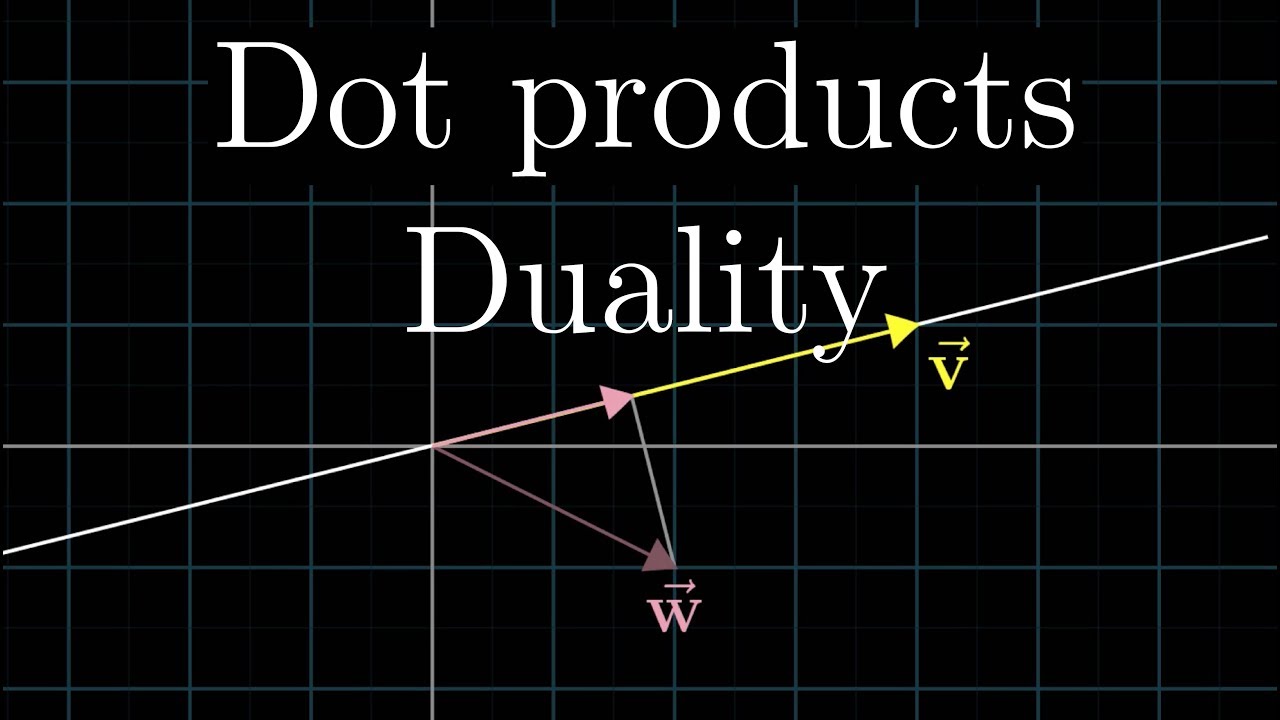
Why the formula for dot products matches their geometric intuition.
Help fund future projects: https://www.patreon.com/3blue1brown
An equally valuable form of support is to simply share some of the videos.
Home page: https://www.3blue1brown.com/
Dot products are a nice geometric tool for understanding projection. But now that we know about lin...
OK
dreamy lintel
so how do I do the subtraction
dreamy lintel
right but what are the measurements
near pecan
It doesn't matter
dreamy lintel
when I look on chegg it has weird calculations and stuff
near pecan
They're asking you to draw it
dreamy lintel

it says "What should it be"
bit of a vague question lol
like
theoretically? mathematically?
near pecan
Hold on. Lemme review this
dreamy lintel
sure
dreamy lintel
the chegg?
near pecan
No. Sorry it's all right. They're good. I misread the question
dreamy lintel
oh ok
near pecan
OK. That makes sense
dreamy lintel
gotcha
near pecan
C = (1,3), right?
dreamy lintel
yes
near pecan
OK. Yeah. The projection of c onto K is 7/5K, not 7/5C. They are wrong
near pecan
There'a a formula for the vector projection. It would be (c dot k)/(k dot k) all times k
But it's not necessary
The question asks you about c - projkc, right?
That's the orthogonal projection
Yeah. Don't worry about measurements. I think I did read it correctly.
Check this out. This should be the last drawing then we'll review
dreamy lintel
ok
near pecan
 dreamy lintel
no shadow?
near pecan
Note that the projection of purple vector onto the blue (or any vector along blue)
Yes. Has no shadow
That should be all you need
Do you have a text book?
dreamy lintel
I understood like the concept of the inversion of projkc since its negative
but thats all
dreamy lintel
sure
near pecan
I'm not sure if this works in this room
dreamy lintel
yeah its a text room only i think
near pecan
OK. You get that a projection will be positive if the two vectors point the same way?
And negative if they point in opposite ways
dreamy lintel
yes
near pecan
What's between positive and negative? 0
So if they are perpendicular, the projection is 0
dreamy lintel
and no shadow
near pecan
Exactly
near pecan
The book is trying to get you to derive the orthogonal projection
dreamy lintel
how do i derive it?
dreamy lintel
 near pecan
OK. A few notes. Your first drawing was (almost) perfect:

That dark arrow under C is the projection of C onto K
(almost)
But the angle is a little wide. projc should be longer so that the shadow makes a right triangle
dreamy lintel
it just needles to be straight yeah
dreamy lintel
right
dreamy lintel
yep
near pecan
so c - projc goes from the tip of projc to the tip of c
it's the right angle of that triangle
does that make sense?
(we're just doing the subtraction)
near pecan
So to correct this drawing.
- Make it a bit bigger to give yourself more space.
- That black arrow is (almost perfect), just make it have a right angle

(not like the one on the left)
Show me that much, even a rough sketch and you'll be well on your way
This is the (almost) correct drawing:
 dreamy lintel
 near pecan
Almost!
It looks like that arrow is going from C. We want it to go to C
Unless I'm seeing it incorrectly
But still, that's great
dreamy lintel
I thought it comes off the k line in the direction 1,3?
so I did 1,3 on 1,0 where k starts
near pecan
No. I'm not talking about C
dreamy lintel
oh
near pecan
That's perfect
Please add labels too!
It might help to move the label of K away since the line should be looooong
dreamy lintel
ok just did
near pecan
OK. Nice!
dreamy lintel
now what
 dreamy lintel
yes
near pecan
Turquoise is?
dreamy lintel
c?
dreamy lintel
K
dreamy lintel
projkc
dreamy lintel
projcc?
near pecan
Nope
dreamy lintel
-projkc?
 dreamy lintel
oh ok so its c-d
near pecan
Well in our case, we don't have d
dreamy lintel
so what do we call it?
dreamy lintel
still c-d even though we dont have a d?
dreamy lintel
c-projkc
near pecan
Exactly!
near pecan
it's ok. take a break after this and congratulate yourself, you're literally trying to learn vector addition, subtraction, scalar multiplication, dot products, parameterized lines and projections in one night.
Last part is: what's the shadow of c-projkc on the line containing (1,2)?
 dreamy lintel
ahhh ok so the answer is to just say that it is a vector that casts no shadow?
near pecan
If you want. Your teacher might have a different metaphor or explanation. They might prefer saying that the vectors are perpendicular so the dot product is 0. Or that cos(pi/2) = 0. But the gist is the same
Once you establish that, your last question is asking you to solve an equation set to zero.
Let the first parts sink in, take a break, and you should be able to get the last one.
near pecan
Nice. Go chill for a bit, then review and try the last problem.
near pecan
Well, we've reviews a lot of concepts:
- What is a vector in space?
- Subtraction: C-D is the vector from the tip of D to the tip of C
- Vector projection: The shadow of one vector onto the line containing another (line connecting should be perpendicular)
- Dot product: the length of the vector projection of C onto D times the length of D. Also a number that relates how much two vectors point in the same direction (positive means similar, negative means opposite, zero means perpendicular)
- Orthogonal projection (orthogonal also means perpendicular)
dreamy lintel
yeah I do feel like im studying at the same time
which is good for the quiz tomorrow\
Im ready for the next one when you are
near pecan
I gotta drop soon. But please give your mind a rest. A short break will do you good
dreamy lintel
near pecan
I gotta drop soon. But please give your mind a rest. A short break will do you g...
oh gotcha how long you have left?
near pecan
Just a few minutes
dreamy lintel
oh ok
Well I appreciate the help, definitely one of the more dedicated sessions I've had on here
wayyy better than the net tutors as well
near pecan
No problem!
near pecan
Thanks
Take care! Also, if you missed a whole module, you might want to ask your teacher for more time to catch up. And they might say "no" in which case, you might want go above their head
Ciao!
dreamy lintel
You too thank you
 marsh citrusBOT
@dreamy lintel Has your question been resolved?
marsh citrusBOT
Channel closed
Closed due to timeout
Use .reopen if this was a mistake.
 Available help channel!
Send your question here to claim the channel.
Remember:
• Ask your math question in a clear, concise manner.
• Show your work, and if possible, explain where you are stuck.
• After 15 minutes, feel free to ping <@&286206848099549185>.
• Type the command .close to free the channel when you're done.
• Be polite and have a nice day!
Read #❓how-to-get-help for further information on how to ask a good question, and about conduct in the question channels.
 humble lichen
Looking for some help with this question, my steps to get here were:
 marsh citrusBOT
humble lichen
Looking for some help with this question, my steps to get here were:
humble lichen
marsh citrusBOT
humble lichen
Looking for some help with this question, my steps to get here were:
humble lichen

 naive stump
humble lichen
naive stump
humble lichen
it is a bit hard to read your handwriting from a small image but here is what i would do
rewrite it as
x dy/dx - y = 8xlnx
which turns into
dy/dx - y/x = 8lnx
turning into
d/dx (ylnx) = 8lnx
then integrate both sides iwth respect to x
ylnx = 8(xlnx -x), i did integration of lnx by inspection because it is a common integral to do but u can do it by parts just to make sure
so therefore ylnx = 8xlnx -8x + c
 amber birch
humble lichen
Looking for some help with this question, my steps to get here were:
amber birch
humble lichen
Looking for some help with this question, my steps to get here were:
your integrating factor should be $e^{\int -1/x \ dx}$
 elfin berryBOT
higher's secret brother
 naive stump
oh i also made that mistake
amber birch
oh ok you got that
humble lichen
yea I could try to take a better image but after integration my rho(x) is e^-lnx which I said simplified to 1/x
I did xy` = y + 8xlnx
y' = y/x + 8xlnx
y' - y/x = 8xlnx
rho(x) = e^integral(-1/x) = e^-lnx = 1/x
y/x = 8*intregral(lnx) + c
y/x = 8xlnx - x + c
y = 8x^2 lnx - x^2 + cx
Initial condition is y(1) = 8 so
8 = 8ln(1) - 1 + c
8 = -1 +c
c = 9
y = 8x^2 lnx - x^2 + 9x
marsh citrusBOT
@humble lichen Has your question been resolved?
humble lichen
Hmm, I realized that I should have distributed the 8, corrected it, and it's still wrong 🫠
.close
marsh citrusBOT
Channel closed
Closed by @humble lichen
Use .reopen if this was a mistake.
marsh citrusBOT
Available help channel!
Send your question here to claim the channel.
Remember:
• Ask your math question in a clear, concise manner.
• Show your work, and if possible, explain where you are stuck.
• After 15 minutes, feel free to ping <@&286206848099549185>.
• Type the command .close to free the channel when you're done.
• Be polite and have a nice day!
Read #❓how-to-get-help for further information on how to ask a good question, and about conduct in the question channels.
 stiff yarrow
4x + 10 = -26
marsh citrusBOT
stiff yarrow
4x + 10 = -26
stiff yarrow
i dont how to algebra at all i started a month late
 grand radish
subtract 10 in both LHS and RHS
stiff yarrow
what does that mean
grand radish
isolating variables and numbers
so you subtract 10 from both sides
4x +10 -10 = -26 -10
stiff yarrow
oh
grand radish
4x = -36
stiff yarrow
-4?
stiff yarrow
i keep forgetting negatives 😭
grand radish
np
stiff yarrow
.close
marsh citrusBOT
Channel closed
Closed by @stiff yarrow
Use .reopen if this was a mistake.
marsh citrusBOT
Available help channel!
Send your question here to claim the channel.
Remember:
• Ask your math question in a clear, concise manner.
• Show your work, and if possible, explain where you are stuck.
• After 15 minutes, feel free to ping <@&286206848099549185>.
• Type the command .close to free the channel when you're done.
• Be polite and have a nice day!
Read #❓how-to-get-help for further information on how to ask a good question, and about conduct in the question channels.
 frail violet
 marsh citrusBOT
frail violet
frail violet
marsh citrusBOT
frail violet
frail violet
im so confused how am i supposed to get exact points or zeros from this
 sand fable
frail violet
im so confused how am i supposed to get exact points or zeros from this
sand fable
frail violet
im so confused how am i supposed to get exact points or zeros from this
you kind of can't, so what i would do is assume the roots are integers and use visual inspection to find them in accordance with the fact that you know the locations of two points with x-coordinates 0 and 2
marsh citrusBOT
@frail violet Has your question been resolved?
Channel closed
Closed by @frail violet
Use .reopen if this was a mistake.
Available help channel!
Send your question here to claim the channel.
Remember:
• Ask your math question in a clear, concise manner.
• Show your work, and if possible, explain where you are stuck.
• After 15 minutes, feel free to ping <@&286206848099549185>.
• Type the command .close to free the channel when you're done.
• Be polite and have a nice day!
Read #❓how-to-get-help for further information on how to ask a good question, and about conduct in the question channels.
 hazy dragon
difference between
- $Mat_{m \cross n} (\mathbb{F})$
and - $\mathbb{F} ^ {m \cross n}$
is nonexistent?
 marsh citrusBOT
hazy dragon
difference between
1. $Mat_{m \cross n} (\mathbb{F})$
and
2. $\mathbb{F} ^ {m \...
marsh citrusBOT
hazy dragon
difference between
1. $Mat_{m \cross n} (\mathbb{F})$
and
2. $\mathbb{F} ^ {m \...
 devout mauve
the first one is very false
elfin berryBOT
Ayanokoji (ALWAYS PING ME)
 devout mauve
ok now its the same
hazy dragon
devout mauve
ok now its the same
so just notation?
devout mauve
yes
marsh citrusBOT
Channel closed
Closed by @hazy dragon
Use .reopen if this was a mistake.
Available help channel!
Send your question here to claim the channel.
Remember:
• Ask your math question in a clear, concise manner.
• Show your work, and if possible, explain where you are stuck.
• After 15 minutes, feel free to ping <@&286206848099549185>.
• Type the command .close to free the channel when you're done.
• Be polite and have a nice day!
Read #❓how-to-get-help for further information on how to ask a good question, and about conduct in the question channels.
 still temple
 marsh citrusBOT
still temple
still temple
marsh citrusBOT
still temple
still temple
<@&286206848099549185>
 slate yarrow
!15mins
marsh citrusBOT
Please only use the <@&286206848099549185> ping once if your question has not been answered for 15 minutes. Please do not ping or DM individual users about your question.
 cunning oak
is (x-a) multiplied with (x-b)(x-c)?
slate yarrow
hint a^3+b^3+c^3-3abc=0,iff a+b+c=0
slate yarrow
still temple
but i dont know how to
||a+b+c=3x ||
||(a-x)+(b-x)+(c-x)=0||
slate yarrow
still temple
how it is zero
do you know how subraction works?
slate yarrow
yeah so i can write 3x=x+x+x right
still temple
ok
still temple
ok
slate yarrow
slate yarrow
hint a^3+b^3+c^3-3abc=0,iff a+b+c=0
now use this
still temple
the answer is zero
slate yarrow
yes
marsh citrusBOT
@still temple Has your question been resolved?
marsh citrusBOT
Channel closed
Closed due to timeout
Use .reopen if this was a mistake.
marsh citrusBOT
Available help channel!
Send your question here to claim the channel.
Remember:
• Ask your math question in a clear, concise manner.
• Show your work, and if possible, explain where you are stuck.
• After 15 minutes, feel free to ping <@&286206848099549185>.
• Type the command .close to free the channel when you're done.
• Be polite and have a nice day!
Read #❓how-to-get-help for further information on how to ask a good question, and about conduct in the question channels.
 near elbow
Hi guys, how to solve 4cos^2 x = 1? I’m new to this topic
 vernal forge
isolate cos^2(x) first
near elbow
vernal forge
isolate cos^2(x) first
What is isolate? Is it making cos^2(x) = 1/4?
vernal forge
yep
vernal forge
now notice that cos(x) is either +1/2 or -1/2
near elbow
Ohhh we can move the squares?
near elbow
vernal forge
now notice that cos(x) is either +1/2 or -1/2
Yess
 spark otter
after that all you need to do is solve cos(x) = 1/2 and cos(x) = -1/2
(important values of trig circle can help)
near elbow
Ohhhh
near elbow
spark otter
after that all you need to do is solve cos(x) = 1/2 and cos(x) = -1/2
Okayyy thank you so much
near elbow
vernal forge
now notice that cos(x) is either +1/2 or -1/2
Thank youuu so much
marsh citrusBOT
@near elbow Has your question been resolved?
marsh citrusBOT
Channel closed
Closed due to timeout
Use .reopen if this was a mistake.
marsh citrusBOT
Available help channel!
Send your question here to claim the channel.
Remember:
• Ask your math question in a clear, concise manner.
• Show your work, and if possible, explain where you are stuck.
• After 15 minutes, feel free to ping <@&286206848099549185>.
• Type the command .close to free the channel when you're done.
• Be polite and have a nice day!
Read #❓how-to-get-help for further information on how to ask a good question, and about conduct in the question channels.
 snow plank
In part(c) it says to find tanACB which should be -8/15, but the answer is 15/8?
 marsh citrusBOT
snow plank
In part(c) it says to find tanACB which should be -8/15, but the answer is 15/8?
snow plank
marsh citrusBOT
snow plank
In part(c) it says to find tanACB which should be -8/15, but the answer is 15/8?
snow plank
The answer

 agile iron
The answer in the textbook is correct, Check the steps carefully again.
marsh citrusBOT
@snow plank Has your question been resolved?
marsh citrusBOT
Channel closed
Closed due to timeout
Use .reopen if this was a mistake.
Available help channel!
Send your question here to claim the channel.
Remember:
• Ask your math question in a clear, concise manner.
• Show your work, and if possible, explain where you are stuck.
• After 15 minutes, feel free to ping <@&286206848099549185>.
• Type the command .close to free the channel when you're done.
• Be polite and have a nice day!
Read #❓how-to-get-help for further information on how to ask a good question, and about conduct in the question channels.
 floral tide
Why am I getting two different answers?


 marsh citrusBOT
floral tide
Why am I getting two different answers?
floral tide
marsh citrusBOT
floral tide
Why am I getting two different answers?
floral tide
I put the answer from my physical calculator first and got it right, but when I used the calculator on my phone I got 8/3 instead of 1/24
naive stump
floral tide
Why am I getting two different answers?
your phone is being dumb
it did multiply instead of divide
marsh citrusBOT
Channel closed
Closed by @floral tide
Use .reopen if this was a mistake.
marsh citrusBOT
Available help channel!
Send your question here to claim the channel.
Remember:
• Ask your math question in a clear, concise manner.
• Show your work, and if possible, explain where you are stuck.
• After 15 minutes, feel free to ping <@&286206848099549185>.
• Type the command .close to free the channel when you're done.
• Be polite and have a nice day!
Read #❓how-to-get-help for further information on how to ask a good question, and about conduct in the question channels.
 novel juniper
if $W_1$ and $W_2$ are vector subspaces of $V$ show that $W_1+W_2$ is a vector subspace of $V$
marsh citrusBOT
novel juniper
if $W_1$ and $W_2$ are vector subspaces of $V$ show that $W_1+W_2$ is a vector s...
elfin berryBOT
Veni, vidi, perii is not f(wai)
 novel juniper
I'm having trouble proving closure under addition
like $v_1 \in W_1$ and $v_2\in W_2$ from that how do I conclude that $v_1+v_2 \in W_1 + W_2$
elfin berryBOT
Veni, vidi, perii is not f(wai)
 devout mauve
by definition of what W_1+W_2 means
but just considering v_i in W_i is not enough to show closure
novel juniper
devout mauve
but just considering v_i in W_i is not enough to show closure
yeah, $v_1 \in W_1 + W_2$ too
elfin berryBOT
Veni, vidi, perii is not f(wai)
 naive stump
elfin berry
**Veni, vidi, perii is not f(wai)**
naive stump
elfin berry
**Veni, vidi, perii is not f(wai)**
try to find au + v in W_1 + W_2
ie:
Let u be element of (W_1 + W_2), then scalar multiplication au is still element of W_1 + W_2
Then there exists u1 in W_1 and u2 in W_2 s.t. u1+u2 = au
then do the same for v where v1 element of W_1 and v2 element of W_2
since subspaces are closed under addition, then we know au1 + v1 element of W_1, au2 + v2 element of W_2, then au1 + v1 + au2 + v2 = a(u1+u2) + (v1+v2) = au + v is element of W_1+W_2
im not sure if what i said is rigorous because my textbook im studiyng off didnt come with written solution for exercises
i did a similar exercise from a few weeks ago
novel juniper
Thanks!
devout mauve
you dont have to bring any closure under scalar multiplication in here
novel juniper
I was thinking of something along the lines , by definition the sum of two subspaces is the set of the linear cobination of every vector in W_1 with every vector in W_2
So as of now in our course,we're only dealing with $R^n$
elfin berryBOT
Veni, vidi, perii is not f(wai)
 elfin berryBOT
Veni, vidi, perii is not f(wai)
 elfin berryBOT
Veni, vidi, perii is not f(wai)
 devout mauve
what you want to say is that if x is in W_1, then x=(x_1,...,x_n) for some x_i in R
novel juniper
so $W_1+W_2 = { (x_1+y_2 , x_2+y_2 \dots , x_n+y_n \ | x_i, y_i \in \ R}$
devout mauve
which is really just W_1 subset R^n rephrased
elfin berryBOT
Veni, vidi, perii is not f(wai)
 novel juniper
so $v_1+v_2 \in W_1+W_2$
elfin berryBOT
Veni, vidi, perii is not f(wai)
 novel juniper
Atleast for $R^n$ vector spaces
elfin berryBOT
Veni, vidi, perii is not f(wai)
 devout mauve
you have shown that R^n + R^n = R^n
novel juniper
how come, depending on the subspaces, some of $y_i$ for instance, can always be zero
elfin berryBOT
Veni, vidi, perii is not f(wai)
 devout mauve
your notation doesnt reflect that at all
naive stump
naive stump
try to find au + v in W_1 + W_2
ie:
Let u be element of (W_1 + W_2), then scala...
actually reminds me i skipped 0 vector
novel juniper
devout mauve
your notation doesnt reflect that at all
How do I make my notation reflect that?
devout mauve
you basically just dont
restricting yourself to R^n doesnt help here
it makes you try things which lead you down wrong paths
naive stump
also denascite, if u dont mind writing a more rigorous proof if u have spare time that would be appreciated as well, im self learning off textbooks because sitll in highschool so i dont really have a grasp of whats considered sufficient
there aren't solutions to most of the exercise questions either with the textbook
devout mauve
open your own channel
naive stump
i think i wll just follow the conversation in this channel
sry for botheirng above, that was not appropirate in hindsight
devout mauve
I mean I can help you, I would just prefer it if you opened your own channel
you will have different questions than wai
better to separate it
novel juniper
If this question comes in the exam, I will HAVE to restrict myself ot R^n as we haven't done arbitrary vector spaces in class
devout mauve
the point is the following: thinking that all vectors have to look like x=(x1,..,xn) and trying to work with that representation will not help
at least not in the way you tried
it is very much enough to just leave the vector called x and work with only that
x can still be in R^n
novel juniper
okay, sure
$x \in W_1, y \in W_2$, by definition $X+W$ contains $x+y$ thus $x+y \in W_1+W_2$
devout mauve
ok, but to show that W_1+W_2 is closed under addition you need to take x,y in W_1+W_2 and show that x+y is in W_1+W_2
novel juniper
I just have
elfin berryBOT
Veni, vidi, perii is not f(wai)
 devout mauve
novel juniper
I just have
devout mauve
novel juniper
I just have
no you didnt
novel juniper
devout mauve
ok, but to show that W_1+W_2 is closed under addition you need to take x,y in W_...
But this shows $x+y \in W_1+W_2$, right
elfin berryBOT
Veni, vidi, perii is not f(wai)
 devout mauve
but x isnt a general element of W_1+W_2
novel juniper
x+0 does , so it does
devout mauve
x is a very special element of W_1+W_2 is what I meant
it is an element of W_1+W_2, sure
but not every element of W_1+W_2 looks like that
novel juniper
So what am I missing
devout mauve
take an arbitrary element from W_1+W_2
not one that is already in W_1
similarly for y
and then show x+y is in W_1+W_2
marsh citrusBOT
Channel closed
Closed by @novel juniper
Use .reopen if this was a mistake.
Available help channel!
Send your question here to claim the channel.
Remember:
• Ask your math question in a clear, concise manner.
• Show your work, and if possible, explain where you are stuck.
• After 15 minutes, feel free to ping <@&286206848099549185>.
• Type the command .close to free the channel when you're done.
• Be polite and have a nice day!
Read #❓how-to-get-help for further information on how to ask a good question, and about conduct in the question channels.
 gilded ember

 knotty trellis
u should either stick to your previous channel or close it btw
marsh citrusBOT
@gilded ember Has your question been resolved?
marsh citrusBOT
@gilded ember Has your question been resolved?
marsh citrusBOT
Channel closed
Closed due to timeout
Use .reopen if this was a mistake.
Available help channel!
Send your question here to claim the channel.
Remember:
• Ask your math question in a clear, concise manner.
• Show your work, and if possible, explain where you are stuck.
• After 15 minutes, feel free to ping <@&286206848099549185>.
• Type the command .close to free the channel when you're done.
• Be polite and have a nice day!
Read #❓how-to-get-help for further information on how to ask a good question, and about conduct in the question channels.
near elbow
Guys im stuck
 marsh citrusBOT
near elbow
Guys im stuck
marsh citrusBOT
near elbow
Guys im stuck
 red nimbus
near elbow
Guys im stuck
red nimbus
near elbow
Guys im stuck
very neat work btw
you came so far
dont let that quadratic make you give up
near elbow
red nimbus
dont let that quadratic make you give up
Alrighty
Imma try quadratic formula  😭😭😭
😭😭😭
marsh citrusBOT
@near elbow Has your question been resolved?
near elbow
Guys i think im doing it wrong

 glass silo

 glass silo
(seems you got the numerical value right actually  )
)
Oh, actually  here too
  seems like for the value of x, you used the wrong one, but the numerical line above it is fine
 near elbow
Yesss i got the correct answer alreadyy
near elbow
glass silo
Oh, actually <:Ehehe:1116912840176050177> here too <:SparkleGiggle:6895249629434...
Thank you soso much!!
near elbow
red nimbus
dont let that quadratic make you give up
Thank youuu
glass silo
Well done 
 near elbow
 tawdry rampart
hey dino
tawdry rampart
hey dino
Hii
I have another question 
Is sin^2(x)/cos^2(x) = tan^2(x)?
Since tan x = sin x/ cos x 😀
Okayyy thankyouuuu
Gonna close this channel
Thanku sm everyone!!
.close
marsh citrusBOT
Channel closed
Closed by @near elbow
Use .reopen if this was a mistake.
red nimbus
near elbow
Thanku sm everyone!!
The dino didn't go extinct after
marsh citrusBOT
Available help channel!
Send your question here to claim the channel.
Remember:
• Ask your math question in a clear, concise manner.
• Show your work, and if possible, explain where you are stuck.
• After 15 minutes, feel free to ping <@&286206848099549185>.
• Type the command .close to free the channel when you're done.
• Be polite and have a nice day!
Read #❓how-to-get-help for further information on how to ask a good question, and about conduct in the question channels.
 chrome coral
 marsh citrusBOT
chrome coral
chrome coral
marsh citrusBOT
chrome coral
chrome coral
 cold pecan
you can take 3 common in numerator
cold pecan
you can take 3 common in numerator
Ohh alright tysm!
cold pecan

marsh citrusBOT
@chrome coral Has your question been resolved?
marsh citrusBOT
Channel closed
Closed due to timeout
Use .reopen if this was a mistake.
marsh citrusBOT
Available help channel!
Send your question here to claim the channel.
Remember:
• Ask your math question in a clear, concise manner.
• Show your work, and if possible, explain where you are stuck.
• After 15 minutes, feel free to ping <@&286206848099549185>.
• Type the command .close to free the channel when you're done.
• Be polite and have a nice day!
Read #❓how-to-get-help for further information on how to ask a good question, and about conduct in the question channels.
 flat bear
How does one solve this? No matter how if i do the determinant the ordinary way or do gauss elimination before getting the determinant do i get an expression i can solve? Any tips/solutions? 🙂
 marsh citrusBOT
flat bear
How does one solve this? No matter how if i do the determinant the ordinary way ...
marsh citrusBOT
flat bear
How does one solve this? No matter how if i do the determinant the ordinary way ...
 copper raven
just compute these two dets, whatever way you want to
then you'll get two polynomials on both sides
flat bear
like this i get using the ordinary method

like how does one solve that? you cant move stuff between the left and righthand as that might break the inequality right?
copper raven
you completely can
as long you just do additions or substractions it doesn't break the inequality in any way
flat bear
really?
I can get to this top step then but how does one get to the factorization below?

How do i know what the factors will look like?
or is there a better way to solve it
than factoring it
copper raven
flat bear
really?
yea I tried finding a proof of that online, but I found nothing interesting :/
copper raven
flat bear
How do i know what the factors will look like?
there's the rational root theorem that can help you factor
flat bear
copper raven
yea I tried finding a proof of that online, but I found nothing interesting :/
Thx for looking 🙂
flat bear
copper raven
there's the rational root theorem that can help you factor
ok will look that up
marsh citrusBOT
@flat bear Has your question been resolved?
Channel closed
Closed by @flat bear
Use .reopen if this was a mistake.
marsh citrusBOT
Available help channel!
Send your question here to claim the channel.
Remember:
• Ask your math question in a clear, concise manner.
• Show your work, and if possible, explain where you are stuck.
• After 15 minutes, feel free to ping <@&286206848099549185>.
• Type the command .close to free the channel when you're done.
• Be polite and have a nice day!
Read #❓how-to-get-help for further information on how to ask a good question, and about conduct in the question channels.
 unreal fern
Anyone knows how to do this? Can you show me the ways pls?


 unreal fern
<@&286206848099549185>
 whole panther
For the first one A will be 17
marsh citrusBOT
@unreal fern Has your question been resolved?
unreal fern
<@&286206848099549185>
 crisp folio
unreal fern
<@&286206848099549185>
crisp folio
unreal fern
<@&286206848099549185>
what?
marsh citrusBOT
Channel closed
Closed due to timeout
Use .reopen if this was a mistake.
marsh citrusBOT
Available help channel!
Send your question here to claim the channel.
Remember:
• Ask your math question in a clear, concise manner.
• Show your work, and if possible, explain where you are stuck.
• After 15 minutes, feel free to ping <@&286206848099549185>.
• Type the command .close to free the channel when you're done.
• Be polite and have a nice day!
Read #❓how-to-get-help for further information on how to ask a good question, and about conduct in the question channels.
 queen swan
 marsh citrusBOT
queen swan
queen swan
marsh citrusBOT
queen swan
queen swan
Some help on this would be appreciated
marsh citrusBOT
@queen swan Has your question been resolved?
 lofty gyro
queen swan
Some help on this would be appreciated
lofty gyro
queen swan
Some help on this would be appreciated
did you try to draw it out?
queen swan
lofty gyro
did you try to draw it out?
Yes I just don’t understand bearings in general
lofty gyro
queen swan
Yes I just don’t understand bearings in general
oh i see
for bearings, it's always start from 0° as the North, and the angle will become larger and larger going clockwise, until i reaches back the North
lofty gyro
queen swan
Yes I just don’t understand bearings in general
can you show it here?
marsh citrusBOT
@queen swan Has your question been resolved?
marsh citrusBOT
Channel closed
Closed due to timeout
Use .reopen if this was a mistake.
Available help channel!
Send your question here to claim the channel.
Remember:
• Ask your math question in a clear, concise manner.
• Show your work, and if possible, explain where you are stuck.
• After 15 minutes, feel free to ping <@&286206848099549185>.
• Type the command .close to free the channel when you're done.
• Be polite and have a nice day!
Read #❓how-to-get-help for further information on how to ask a good question, and about conduct in the question channels.
 humble river
periodic table is needeD?
 marsh citrusBOT
humble river
periodic table is needeD?
marsh citrusBOT
humble river
periodic table is needeD?

 unique basin
They said
humble river
wait atomic number
unique basin
Titanium
 marsh citrusBOT
Channel closed
Closed by @humble river
Use .reopen if this was a mistake.
marsh citrusBOT
Available help channel!
Send your question here to claim the channel.
Remember:
• Ask your math question in a clear, concise manner.
• Show your work, and if possible, explain where you are stuck.
• After 15 minutes, feel free to ping <@&286206848099549185>.
• Type the command .close to free the channel when you're done.
• Be polite and have a nice day!
Read #❓how-to-get-help for further information on how to ask a good question, and about conduct in the question channels.
 fossil badger
Can someone check what I am doing wrong?

 marsh citrusBOT
fossil badger
Can someone check what I am doing wrong?
marsh citrusBOT
marsh citrusBOT
fossil badger
Can someone check what I am doing wrong?
marsh citrusBOT
Channel closed
Closed by @fossil badger
Use .reopen if this was a mistake.
Available help channel!
Send your question here to claim the channel.
Remember:
• Ask your math question in a clear, concise manner.
• Show your work, and if possible, explain where you are stuck.
• After 15 minutes, feel free to ping <@&286206848099549185>.
• Type the command .close to free the channel when you're done.
• Be polite and have a nice day!
Read #❓how-to-get-help for further information on how to ask a good question, and about conduct in the question channels.
still temple
question 1:
How to find the coordinates of the circumcentre? Coordinates of vertices are given.
Question 2: How to find the circumradius? Length of sides are given.
Question 3: How to find the coordinates of the orthocenter? Again, the coordinates of the vertices are given.
marsh citrusBOT
still temple
question 1:
How to find the coordinates of the circumcentre? Coordinates of vert...
 still temple
yah
grand radish
and the condition for perpendicularity is m1*m2 = -1
both are slopes
say AB is perp. to CD
find the slopes
we have m1 (slope of AB) and you have to find m2(slope of CD)
once you get slope find the equation of line (CD)
Repeat this process for AC perp. to BF
you will get two equations of line
Solve those two equations of line in terms of x and y to get the coordinate of orthocentre
Circumcenter is easy to find. Circumcenter is equidistant to all the three vertices of a triangle

you can use OA = OB = OC
distance formula
you can find just two for the coordinates
marsh citrusBOT
@still temple Has your question been resolved?
marsh citrusBOT
Channel closed
Closed due to timeout
Use .reopen if this was a mistake.
Available help channel!
Send your question here to claim the channel.
Remember:
• Ask your math question in a clear, concise manner.
• Show your work, and if possible, explain where you are stuck.
• After 15 minutes, feel free to ping <@&286206848099549185>.
• Type the command .close to free the channel when you're done.
• Be polite and have a nice day!
Read #❓how-to-get-help for further information on how to ask a good question, and about conduct in the question channels.
 velvet yarrow
 marsh citrusBOT
velvet yarrow
velvet yarrow
marsh citrusBOT
velvet yarrow
velvet yarrow
a
spark otter
velvet yarrow
a
treat the 7 pieces of card as separate things first, how many ways can you pick 4 cards out of those?
velvet yarrow
7C4
spark otter
yes
velvet yarrow
btw order doesnt matter in part a
spark otter
yup
spark otter
like
we already said each piece of card is a separate unique piece
(at least we treat it that way)
velvet yarrow
wdym each pice of card?
spark otter
 velvet yarrow
ok
spark otter
we can call them cards instead of pieces of card
you have 7 different cards
so if you tell me you got the letters M I N U
does that tell me which cards you picked exactly?
velvet yarrow
oh right
so each M isn the same
i thought what whole point of the q was that we remove any choicse like MMII
also i think 7C4 is wrong
spark otter
velvet yarrow
also i think 7C4 is wrong
why?
velvet yarrow
cause that doesnt account for repetitions?
velvet yarrow
so 2 Ms are not the same?
spark otter
picking cards 1 2 3 4
is not the same as picking cards 2 3 4 5
even though you get the letters MINI for both
we treat each card as a unique card
velvet yarrow
so thats 3 choices for an M, 2 choice for I and 1 for N and 1 for U
3 * 2 * 1 * 1
= 6
velvet yarrow
so we get 6/35
answer meant to be 1/11 tho
its written at the bottom
the first number on the bottom right
spark otter
wait
velvet yarrow
yeah so like 7C4 double counts, cause choosing an M, not matter what M should just be 1
i think?
spark otter
but that doesn't really make sense
still temple
grand radish
Solve those two equations of line in terms of x and y to get the coordinate of o...
thank you very much @grand radish
spark otter
because each letter configuration has a different probability
spark otter
no but like
velvet yarrow
its shoudnt be that bad
velvet yarrow
wdym exercise correction
spark otter
velvet yarrow
wdym exercise correction
I understand how one can think 1/11 is the answer
velvet yarrow
spark otter
I understand how one can think 1/11 is the answer
how
spark otter
out of the 11 possible "4-letter configurations"
only one has each letter different
M I N U
so you would think the answer is 1/11
spark otter
velvet yarrow
i dont reall yunderstand wahts wrong with 7C4
me neither
I'm trying to explain how one MIGHT come to the conclusion
velvet yarrow
so 7 C 4 is just saying choose any 4 letters from the 7 right
spark otter
I'm not saying said conclusion is correct
spark otter
velvet yarrow
so 7 C 4 is just saying choose any 4 letters from the 7 right
choose any 4 cards from the 7
spark otter
yep
velvet yarrow
right so 7 C 4 accounts for M1 M2 I1 I 2 and M2 M3 I1 I2
rghjt?
but we conisder the Ms to be the same
so thats a double count?
7 C4 thinks they are all different
spark otter
not in our possibility space
velvet yarrow
but in really they are not
spark otter
like the EFFECT will be the same
velvet yarrow
wdym
spark otter
but if you number the cards 1 to 7
spark otter
velvet yarrow
wdym
think about this:
two dice are rolled
fair dice
we wanna know the probability the sum is 7
velvet yarrow
right
spark otter
even though
there are 11 possible sums
2 to 12
it doesn't mean
the probability you roll sum 7
is 1/11
spark otter
well
spark otter
even though M I N U is one of 11 possible letter configurations
velvet yarrow
uhuh
spark otter
there are actually 6 instances where you get M I N U
M1 I1 N U
M2 I1 N U
M3 I1 N U
etc...
spark otter
nooooo
velvet yarrow
so all those 6 instances are teh same
velvet yarrow
u just need M I N U
spark otter
it's like you number them
spark otter
think smaller example
velvet yarrow
all that matters are the letters
velvet yarrow
seperate doesnt mean didfferent
spark otter
what's the probability of picking an M?
velvet yarrow
2/3
velvet yarrow
yeah u have 3 things altogether
velvet yarrow
ok ok no
how many ways can u arragen them
if all Ms are the same
thats all its asking
velvet yarrow
spark otter
"but the Ms are the same"
just cause they are the same doesnt mean they are one thing
velvet yarrow
spark otter
it's asking the PROBABILITY
u just put that number over the total
spark otter
velvet yarrow
just cause they are the same doesnt mean they are one thing
exactly
spark otter
velvet yarrow
so all those 6 instances are teh same
so
 autumn agate
What class is this?
velvet yarrow
M I N U is one thing
spark otter
it is EXACTLY like that
velvet yarrow
the cards arent numbers
autumn agate
Is this statistics?
spark otter
velvet yarrow
the cards arent numbers
do you wanna go back to the previous example?
velvet yarrow
perms and coms
velvet yarrow
and we pick 2 distinct cards
spark otter
why the probability of picking an M is 2/3 and not 1/2
velvet yarrow
spark otter
why though?
thats a smaller version of the quetsion
u get I M
theres only 1 way
assuming order doesnt matetr
If u have a clone
spark otter
so the probability of picking M would be 1/2?
velvet yarrow
are u two teh same ppl or different
velvet yarrow
spark otter
so the probability of picking M would be 1/2?
no in ur case its 2/3
how is it 1/2
spark otter
velvet yarrow
no in ur case its 2/3
why though?
spark otter
velvet yarrow
how is it 1/2
And I'm asking how is THE PROBABILITY 1/11 in your original problem
velvet yarrow
probability its how many ways can u get what yu want/ total choices
velvet yarrow
spark otter
And I'm asking how is THE PROBABILITY 1/11 in your original problem
im assuming there are 11 different ways to pick 4 cards out of 7
in total
M I N U is one
I I M N or U
spark otter
BUT
spark otter
is every letter combination with the same probability?
velvet yarrow
M M M I or U or N
spark otter
let me give you an example here
velvet yarrow
spark otter
is every letter combination with the same probability?
no these are sepcific cases
of ways tottal ways to arrange
spark otter
yes
so you agree
that this doesn't mean each way to arrange has the same probability
velvet yarrow
no bro ur misundertanding the probability part
its just ways to get different/total ways
ur thinking about th eprobabiilty too much
spark otter
no.
spark otter
(number of ways that work)/(total number of ways) only works when each way has the same probability of happening
spark otter
please listen
velvet yarrow
o go on
spark otter
for a quick moment
what 1/11 IS, is the number of letter choices that give different letters (only MINU), divided by the total amount of letter choices
that I agree
what I DON'T AGREE on
is that 1/11 is the PROBABILITY
of getting different letters
velvet yarrow
just in words, how do u suggest we find the probability
whats like ur oevrall plan
spark otter
if you want to get the probability
you need to find a way to describe the problem
so that each outcome has the same chance of happening
this way, the formula
"(number of ways that work)/(total number of ways)"
WILL give you the probability
and guess what
spark otter
velvet yarrow
so we get 6/35
we get this
velvet yarrow
spark otter
you need to find a way to describe the problem
thats why for the cases we set some letter in stone
and only look at the probabilty of 1 letter
which all haev equal chance
spark otter
ok but do you agree that in real life
the probability will not be "setting letters in stone"
velvet yarrow
no thats how we think about it to solve the problem
most of maths hs thinking "not nreal life"
spark otter
velvet yarrow
no thats how we think about it to solve the problem
what I'm telling you is that your exercise is wrong
at least I'm 99% sure about it
now take what you will
velvet yarrow
im telling u taht there there is only on way to get M I N U
should we get third part
i just wanetd to understand why 7C4 was wrong 
spark otter
I'm telling you 7C4 isn't wrong...
I'm telling you the exercise is wrong
1/11 is wrong
velvet yarrow
 spark otter
yeah it's wrong
velvet yarrow
do u agree that thats all the possible cases we can get
we can get all differnet
2 Is
2 Ms
3 Ms
spark otter
okokok listen
velvet yarrow
or 2Ms and 2Is
spark otter
remember the 2 dice rolls problem
wanting to find probability of the sum being 7
even though there are 11 cases for the sum
velvet yarrow
yeah tehre are differnet distinct sums
spark otter
doesn't mean the probability is 1/11
velvet yarrow
for the two die problem u dont look at sum u want/a ll possibble sums
u dont look at sums
spark otter
look. I don't know why you're fixated on saying your solution is correct. I'm telling you that what they computed is NOT the probability
velvet yarrow
u look at outcomes
velvet yarrow
spark otter
look. I don't know why you're fixated on saying your solution is correct. I'm te...
no its is correct
but i want to know why 7C4 is wrong
spark otter
it's not. It's not a probability
velvet yarrow
how is not a probability
spark otter
ok
spark otter
let's go past this and just go general
spark otter
probability means
if I repeat the experiment a near infinite amount of times
what's the proportion, on average, of the times it did work the way I wanted
right
velvet yarrow
yh
spark otter
so If I'm asking what's the probability the sum is 7 on two dice rolls
I'm asking
If I repeat my two dice rolls infinitely
how many times on average will the sum be 7
spark otter
no. that's not the same thing
velvet yarrow
go on
spark otter
ok, imagine something else
There are two events that could happen:
- either nothing happens
- or a plane crashes into my house
there are two cases here
velvet yarrow
yh
spark otter
Does that mean that if I repeat the experiment an infinite amount of times
that half of those times a plane is gonna crash into my house?
velvet yarrow
depends on the probability of plane crashign
spark otter
exactly
spark otter
okok so follow me for a sec
just because there is 1 case where a plane crashes into my house
and there are 2 cases in total
doesn't mean the probability a plane crashes into my house is 1/2
velvet yarrow
yes
spark otter
ok
so, do you understand
that just because there are k cases that work in my favour
and there are n cases in total
doesn't mean the probability that it works in my favour is k/n
spark otter
it depends on the probability of each case right?
velvet yarrow
yeah
spark otter
ok
so
just because there is one case where all letters are different (M I N U)
and there are 11 cases in total
doesn't mean the probability that all letters are different is 1/11
it depends on the probability of each case
velvet yarrow
is that no the theoretical probaility
spark otter
so just one last thing to recap
velvet yarrow
we didnt do the experiemtn
spark otter
velvet yarrow
is that no the theoretical probaility
it's not even the theoretical probability
either it's the probability or it isn't
what your solution computed
I will agree that 1/11 is (cases that work)/(total number of cases)
but this is NOT a probability
velvet yarrow
spark otter
I will agree that 1/11 is (cases that work)/(total number of cases)
is that not he definiton of aprobaility
on average
spark otter
no
spark otter
I'm telling you
if you do the experiment as stated
meaning pick 4 letters at random out of your 7 letter bag
velvet yarrow
yes
spark otter
and you repeat the process an infinite number of times
I guarantee you
the number of times you get M I NU
is not gonna be 1/11
velvet yarrow
spark otter
what's the proportion, on average, of the times it did work the way I wanted
this the def right
spark otter
velvet yarrow
this the def right
this is the "definition" that applies everytime
 fleet fossil
I agree with rafilou btw.
You have 3*2*1*1 combinations of cards to draw that give MINU, in 4! Different orders. That divided by the total number of arrangements you could draw (7*6*5*4) is 6/35
velvet yarrow
so why is the solutio wrong
spark otter
velvet yarrow
so why is the solutio wrong
are you asking why the reasoning is wrong or are you asking "how could my teacher ever ever be wrong"?