#help-33
1 messages · Page 167 of 1
 hazy lion
and f is a function that undoes the inverse
so if you have something ilke $f\qty[ f^{-1} (x)]$
 elfin berryBOT
jan Niku

 wise obsidian
oh yeah u said they cancel
hazy lion
they do
wise obsidian
so 7 = f(x_7)?
hazy lion
it does

 wise obsidian
just trying to understand the x_7 part
hazy lion
if its not immediately clear don't worry about it
im just trying to think of things to try to explain it
when you see, $f^{-1}(7)$, you should think "this is the $x$ that gives $f(x) = 7$ is the point
elfin berryBOT
jan Niku
 wise obsidian
if the assignment wasn't due I'd sleep on it and I'm sure I would understand everything ur saying I'm just burnt out rn so my brain is functioning at 0.25x speed
hazy lion

i did my best
what i did is flip the y and the x axis
if you are in a hurry and lucky, this is now the graph of f inverse and g inverse
what is $f^{-1} (7)$ according to the graph?
elfin berryBOT
jan Niku
 hazy lion
you already know the answer, just follow me
wise obsidian
I forgot how to inverse lemme think
hazy lion
don't think, just read the graph
the blue line, when the image is flipped like this, is the graph of f inverse
thats x on the horizontal axis, and f^-1 (x) on the vertical
wise obsidian
so 5
 wise obsidian
7
hazy lion
hamburger?
wise obsidian
nvm lol just a joke
hazy lion
its unfortunate, you can't just rotate it, you need to mirror it
hazy lion
but its fine
wise obsidian
okay so where are we exactly
hazy lion
i am attempting to convince you that $f \qty[ f^{-1} (7) ] = 7$
elfin berryBOT
jan Niku
 hazy lion
do you feel convinced
wise obsidian
I do
hazy lion
okay
then you are here
\begin{align*}
f\qty[ f^{-1} (-7) ]
&= f \qty[ -f^{-1} (7) ] \
&= -f \qty[ f^{-1} (7) ] \
&= -7
\end{align*}
elfin berryBOT
jan Niku
 hazy lion
this is a fantastic amount of progress, the problem is pretty straightforward from here
wise obsidian
g(1- -7)
hazy lion
yea
wise obsidian
so all that YAP just cancels out to -7
 wise obsidian
😂
hazy lion
math is easy once u believe it
wise obsidian
so final answer is 4
 wise obsidian

 wise obsidian
well I still have three more problems to do
hazy lion
a b c?
wise obsidian
those
hazy lion
or 3 more 
wise obsidian
and 3 other ones lol
hazy lion
well
you got it
if you need more help you should open another channel
people have a preference for newer help channels
wise obsidian
idk how to do any of those either hopefully I can figure it out. I have 3 hours before it's gg
hazy lion
youll get more eyes
hazy lion
no problem good luck
 marsh citrusBOT
Channel closed
Closed by @wise obsidian
Use .reopen if this was a mistake.
 Available help channel!
Send your question here to claim the channel.
Remember:
• Ask your math question in a clear, concise manner.
• Show your work, and if possible, explain where you are stuck.
• After 15 minutes, feel free to ping <@&286206848099549185>.
• Type the command .close to free the channel when you're done.
• Be polite and have a nice day!
Read #❓how-to-get-help for further information on how to ask a good question, and about conduct in the question channels.
 quasi pulsar
Hey
marsh citrusBOT
quasi pulsar
Hey
quasi pulsar
Pretty simple but apparently I screwed it up - Need notes

I got BD by getting the square root of AB squared and BD squared
Then, to calculate ABC the angle - I used sin ABD = AD/BD
Then to get AC, I used sin ABC = AC/AB
I got 30.96 instead of 30.91
And 2.95 instead of 3.05

I feel like the logic was pretty correct and that I just don't know how to operate a calculator
Thanks
 mystic minnow
gonna guess it's probably rounding error.
marsh citrusBOT
Channel closed
Closed by @quasi pulsar
Use .reopen if this was a mistake.
Available help channel!
Send your question here to claim the channel.
Remember:
• Ask your math question in a clear, concise manner.
• Show your work, and if possible, explain where you are stuck.
• After 15 minutes, feel free to ping <@&286206848099549185>.
• Type the command .close to free the channel when you're done.
• Be polite and have a nice day!
Read #❓how-to-get-help for further information on how to ask a good question, and about conduct in the question channels.
Please don't occupy multiple help channels.
 main idol
.close
marsh citrusBOT
Channel closed
Closed by @main idol
Use .reopen if this was a mistake.
marsh citrusBOT
Available help channel!
Send your question here to claim the channel.
Remember:
• Ask your math question in a clear, concise manner.
• Show your work, and if possible, explain where you are stuck.
• After 15 minutes, feel free to ping <@&286206848099549185>.
• Type the command .close to free the channel when you're done.
• Be polite and have a nice day!
Read #❓how-to-get-help for further information on how to ask a good question, and about conduct in the question channels.
 past shadow
 marsh citrusBOT
past shadow
past shadow
marsh citrusBOT
past shadow
past shadow
not exactly a hw problem but does anyone know how i can find the surface area of this thing i modelled
rn its made using a bunch of simple parametric equations
marsh citrusBOT
@past shadow Has your question been resolved?
 quaint elm
what's going on at the "faces" of your volcano?
past shadow
there is technically no face rn since theyre just lines
quaint elm
yeah that's why I'm asking you to define that 
past shadow
but the face should be the minimum surface area that connects all the points ig
quaint elm
this is called a minimal surface and it's a partial differential equation that will generally require numerical (approximate) methods to get an answer
past shadow
hmm
quaint elm
however
past shadow
im just worried cuz i need to write a lil essay on this and numerical approaches are probably not very ideal
quaint elm
i think you can get somewhere by sweeping the bottom edge to the top along the paths, continuously deforming it as you do
see if you can come up with a parametric equation for one of the "ribs" of the volcano
past shadow
lemme try
 past shadow
yee
quaint elm
you can test it by putting it in desmos and moving the slider to move it up and down
and then you can integrate that to get your surface area
it doesn't have to be perfect just convincing enough
past shadow
might work might work
quaint elm
i think the purple one will be easier
past shadow
yeah
this'll take some time to model so i'll close the channel
thx for the suggestion hahaha
.close
marsh citrusBOT
Channel closed
Closed by @past shadow
Use .reopen if this was a mistake.
marsh citrusBOT
Available help channel!
Send your question here to claim the channel.
Remember:
• Ask your math question in a clear, concise manner.
• Show your work, and if possible, explain where you are stuck.
• After 15 minutes, feel free to ping <@&286206848099549185>.
• Type the command .close to free the channel when you're done.
• Be polite and have a nice day!
Read #❓how-to-get-help for further information on how to ask a good question, and about conduct in the question channels.
 open seal

 frank oxide
Noooo
open seal
that is what I tried
 weary karma
The power of x here is -3
frank oxide
1/(x)^3 is (x)^-3
frank oxide
-3-1
 opal parcel
Yes that’s correct
marsh citrusBOT
Channel closed
Closed by @open seal
Use .reopen if this was a mistake.
Available help channel!
Send your question here to claim the channel.
Remember:
• Ask your math question in a clear, concise manner.
• Show your work, and if possible, explain where you are stuck.
• After 15 minutes, feel free to ping <@&286206848099549185>.
• Type the command .close to free the channel when you're done.
• Be polite and have a nice day!
Read #❓how-to-get-help for further information on how to ask a good question, and about conduct in the question channels.
 limber hearth
marsh citrusBOT
limber hearth
marsh citrusBOT
Channel closed
Channel closed due to the original message being deleted.
If you did not intend to do this, please open a new help channel,
as this action is irreversible, and this channel may abruptly lock.
marsh citrusBOT
Available help channel!
Send your question here to claim the channel.
Remember:
• Ask your math question in a clear, concise manner.
• Show your work, and if possible, explain where you are stuck.
• After 15 minutes, feel free to ping <@&286206848099549185>.
• Type the command .close to free the channel when you're done.
• Be polite and have a nice day!
Read #❓how-to-get-help for further information on how to ask a good question, and about conduct in the question channels.
 normal bough
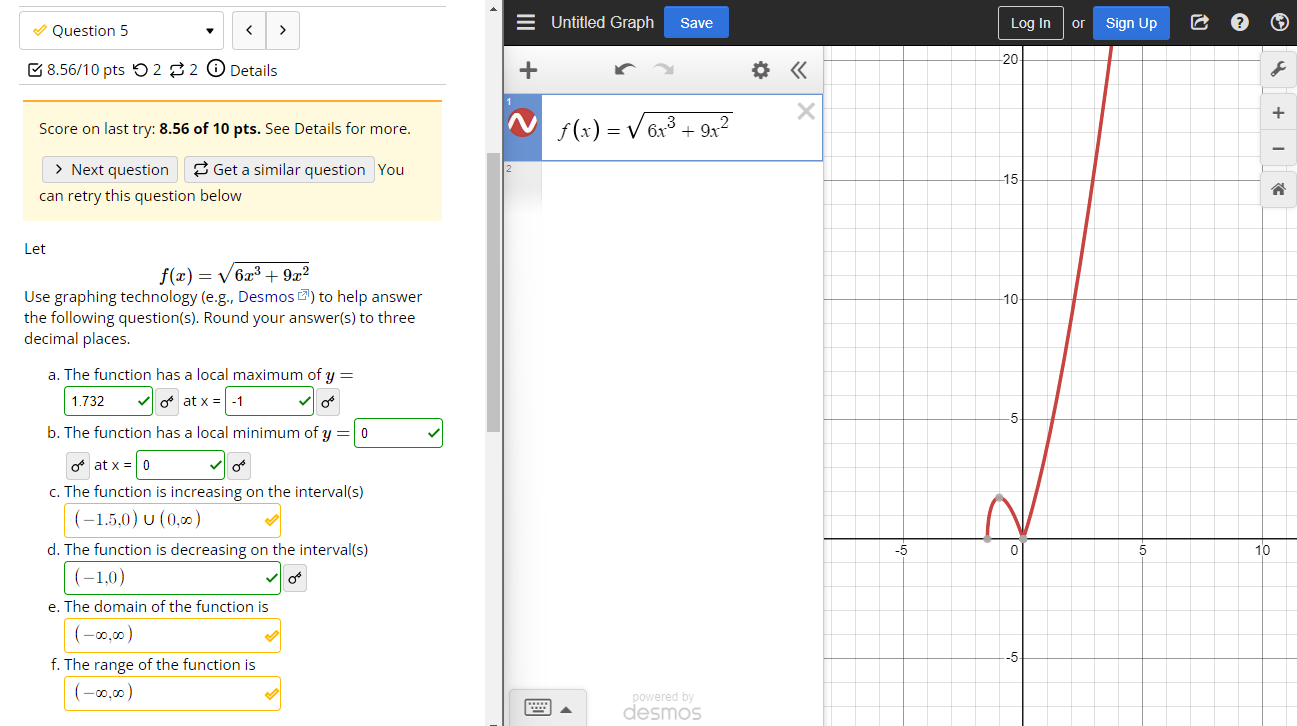
Where did I go wrong?
https://i.gyazo.com/df72984dc6c2f751ba4a16b14191e711.png
 marsh citrusBOT
normal bough
Where did I go wrong?
https://i.gyazo.com/df72984dc6c2f751ba4a16b14191e711.png
normal bough
marsh citrusBOT
normal bough
Where did I go wrong?
https://i.gyazo.com/df72984dc6c2f751ba4a16b14191e711.png
normal bough
Perhaps a bit confused on range,
I think domain should have been as (-1.5, ♾️ )
Not sure whats wrong with C actually, since Im a bit rusty after not having to do this
.close
marsh citrusBOT
Channel closed
Closed by @normal bough
Use .reopen if this was a mistake.
marsh citrusBOT
Available help channel!
Send your question here to claim the channel.
Remember:
• Ask your math question in a clear, concise manner.
• Show your work, and if possible, explain where you are stuck.
• After 15 minutes, feel free to ping <@&286206848099549185>.
• Type the command .close to free the channel when you're done.
• Be polite and have a nice day!
Read #❓how-to-get-help for further information on how to ask a good question, and about conduct in the question channels.
 crisp sigil
Can someone check my work for this q


 marsh citrusBOT
crisp sigil
Can someone check my work for this q
marsh citrusBOT
marsh citrusBOT
crisp sigil
Can someone check my work for this q
marsh citrusBOT
@crisp sigil Has your question been resolved?
 night lion
crisp sigil
Can someone check my work for this q
night lion
crisp sigil
Can someone check my work for this q
try gauss jordan eliminination
more simpler than solving 3 siml eqn manually
crisp sigil
night lion
try gauss jordan eliminination
i havent learned that yet
night lion
crisp sigil
i havent learned that yet
u learnt matrices?
crisp sigil
yes but my teacher said to solve this quesiton using system of equatiosn
night lion
crisp sigil
yes but my teacher said to solve this quesiton using system of equatiosn
i guess then u are cool.
didnt check tho too long 😭
 crisp sigil
night lion
i guess then u are cool.
crisp sigil
night lion
i guess then u are cool.
Can you check this possibly? its much shorter
night lion
i suck at probability
marsh citrusBOT
@crisp sigil Has your question been resolved?
marsh citrusBOT
@crisp sigil Has your question been resolved?
marsh citrusBOT
Channel closed
Closed due to timeout
Use .reopen if this was a mistake.
marsh citrusBOT
Available help channel!
Send your question here to claim the channel.
Remember:
• Ask your math question in a clear, concise manner.
• Show your work, and if possible, explain where you are stuck.
• After 15 minutes, feel free to ping <@&286206848099549185>.
• Type the command .close to free the channel when you're done.
• Be polite and have a nice day!
Read #❓how-to-get-help for further information on how to ask a good question, and about conduct in the question channels.
 hearty dust
 marsh citrusBOT
hearty dust
hearty dust
marsh citrusBOT
hearty dust
hearty dust
where is the mistake?

sorry this is the updated image*
where is the mistake in this
hearty dust
 still temple
-1/x+1 integrated is wrong
still temple
-1/x+1 integrated is wrong
how so
hearty dust
still temple
whats the definite integral of 1/x?
i know we can turn it into natural log
but why is the method I used wrong also
?
still temple
because thats just not how it works
hearty dust
still temple
because thats just not how it works
why?
hearty dust
?
 whole thorn
hearty dust
whole thorn
hearty dust
there's a -1+1 in the denominator you're dividing by 0
still temple
also that
marsh citrusBOT
Channel closed
Closed by @hearty dust
Use .reopen if this was a mistake.
whole thorn
when you try do $$ \int x^n \dd{x} = \frac{x^{n+1}}{n+1} $$ with $$ n=-1 $$ you get a problem which is why you need log
elfin berryBOT
mayer-vietorUs
 marsh citrusBOT
Available help channel!
marsh citrusBOT
Available help channel!
Send your question here to claim the channel.
Remember:
• Ask your math question in a clear, concise manner.
• Show your work, and if possible, explain where you are stuck.
• After 15 minutes, feel free to ping <@&286206848099549185>.
• Type the command .close to free the channel when you're done.
• Be polite and have a nice day!
Read #❓how-to-get-help for further information on how to ask a good question, and about conduct in the question channels.
marsh citrusBOT
@cinder aspen Has your question been resolved?
Channel closed
Closed by @cinder aspen
Use .reopen if this was a mistake.
Available help channel!
Send your question here to claim the channel.
Remember:
• Ask your math question in a clear, concise manner.
• Show your work, and if possible, explain where you are stuck.
• After 15 minutes, feel free to ping <@&286206848099549185>.
• Type the command .close to free the channel when you're done.
• Be polite and have a nice day!
Read #❓how-to-get-help for further information on how to ask a good question, and about conduct in the question channels.
Channel closed
Channel closed due to the original message being deleted.
If you did not intend to do this, please open a new help channel,
as this action is irreversible, and this channel may abruptly lock.
Available help channel!
Send your question here to claim the channel.
Remember:
• Ask your math question in a clear, concise manner.
• Show your work, and if possible, explain where you are stuck.
• After 15 minutes, feel free to ping <@&286206848099549185>.
• Type the command .close to free the channel when you're done.
• Be polite and have a nice day!
Read #❓how-to-get-help for further information on how to ask a good question, and about conduct in the question channels.
 limpid zealot
The following is known about a function f:
the tangent at f at the turning point(2|yturningpoint) has the equation 3x+2y=7
The Tangent at f at the point R(-3|yr) has the equation 2y-x=0
The tangent at the high point H(4|yh) has the equation y-6=0
give 7 condition for the function f!
marsh citrusBOT
limpid zealot
The following is known about a function f:
the tangent at f at the turning poin...
limpid zealot
should i just give 7 more tangents on random points and their equations?
marsh citrusBOT
@limpid zealot Has your question been resolved?
limpid zealot
.close
marsh citrusBOT
Channel closed
Closed by @limpid zealot
Use .reopen if this was a mistake.
Available help channel!
Send your question here to claim the channel.
Remember:
• Ask your math question in a clear, concise manner.
• Show your work, and if possible, explain where you are stuck.
• After 15 minutes, feel free to ping <@&286206848099549185>.
• Type the command .close to free the channel when you're done.
• Be polite and have a nice day!
Read #❓how-to-get-help for further information on how to ask a good question, and about conduct in the question channels.
 wet parrot
How can i simplify this summation: 1^2/(13)+2^2/(35)+3^2/(5*7)+...+n^2/((2n-1)(2n+1)) ?
marsh citrusBOT
wet parrot
How can i simplify this summation: 1^2/(1*3)+2^2/(3*5)+3^2/(5*7)+...+n^2/((2n-1)...
 eager tinsel
wet parrot
How can i simplify this summation: 1^2/(1*3)+2^2/(3*5)+3^2/(5*7)+...+n^2/((2n-1)...
eager tinsel
wet parrot
How can i simplify this summation: 1^2/(1*3)+2^2/(3*5)+3^2/(5*7)+...+n^2/((2n-1)...
you mean $\sum_{n=1}^{k} \frac{n^2}{(2n-1)(2n+1)}$
wet parrot
Yes.
elfin berryBOT
77²
 eager tinsel
wet parrot
Yes.
eager tinsel
wet parrot
Yes.
HINT: Expand the denominator and then perform polynomial division
wet parrot
Do you mean do polynomial division on 4n^2 - 1?
eager tinsel
wet parrot
Do you mean do polynomial division on 4n^2 - 1?
ig
what I exactly mean is that make something like {Constant}/{expression with n}
eager tinsel
wet parrot
I don't know how i can get rid of the n^2 though.
you can multiply by 4 in the numerator
so you'll get 4n^2 on the numerator too
then you can subtract a 1 and add a 1 in the numerator
wet parrot
Ah, i see.
Thank you.
It works out perfectly.
Although do you have any advice on how i can simplify any sum like these and those that have exponential terms and factorials in general?
eager tinsel
wet parrot
Although do you have any advice on how i can simplify any sum like these and tho...
generally sums with factorial things makes telescoping series, so look for those
dis-associating the expression is a nice thing in general to figure out the nature of whole expression
if it doesn't solve the problem, it at least gives some idea to solve it
wet parrot
Thank you so much for your help. I have been stuck on this specific problem and it seemed that i couldn't notice this specific route you have provided me.
I am closing this tab.
.close
marsh citrusBOT
Channel closed
Closed by @wet parrot
Use .reopen if this was a mistake.
marsh citrusBOT
Available help channel!
Send your question here to claim the channel.
Remember:
• Ask your math question in a clear, concise manner.
• Show your work, and if possible, explain where you are stuck.
• After 15 minutes, feel free to ping <@&286206848099549185>.
• Type the command .close to free the channel when you're done.
• Be polite and have a nice day!
Read #❓how-to-get-help for further information on how to ask a good question, and about conduct in the question channels.
 queen horizon
Hello, I'd be grateful if someone checked that this proof is valid:
Explanation of notation bc this course apparently has unusual notation:
𝓛 is the set of all sentences in propositional logic.
𝓟 is the set of all atomic sentences A∈𝓛.
A truth assignment 𝓐⊆𝓟 contains all true atomic sentences A∈L (and 𝓟\𝓐 all the false ones).
A truth assignment 𝓐 is a model of a sentence φ∈𝓛: 𝓐⊨φ.
A truth assignment 𝓐 is a model of a set of sentences Σ⊆𝓛: 𝓐⊨Σ.
A sentence φ∈𝓛 is a logical entailment of a set of sentences Σ⊆𝓛: Σ⊨φ
The set of all logical entailments of a set of sentences Σ⊆𝓛: Cn(Σ)
Ask me to clarify if I missed something and you're unsure of the meaning.
I'm asked to prove this: Σᵢ⊆Σⱼ ⇒ Cn(Σᵢ)⊆Cn(Σⱼ)
Ok here's my attempt:
Suppose Σᵢ⊆Σⱼ and Cn(Σᵢ)⊈Cn(Σⱼ)

Explicitly:
∀Σᵢ⊆𝓛(∀Σⱼ⊆𝓛(Σᵢ⊆Σⱼ ⇒ ∃φ∈𝓛(Σᵢ⊨φ and Σⱼ⊨¬φ)))
i.e. for all sets of sentences Σᵢ and Σⱼ, if Σᵢ is a subset of Σⱼ,
then there's a sentence φ such that Σᵢ entails φ but Σⱼ entails ¬φ.

But consider the case Σᵢ=Σⱼ:
Now Σᵢ⊆Σⱼ but for all φ∈𝓛: Σⱼ⊨¬φ iff Σᵢ⊨¬φ.
But this contradicts our assumption. Therefore:

∀Σᵢ⊆𝓛(∀Σⱼ⊆𝓛(Σᵢ⊆Σⱼ ⇒ ∀φ∈𝓛(Σᵢ⊨φ ⇒ Σⱼ⊨φ)))
Meaning given sets of sentences Σᵢ and Σⱼ such that Σᵢ⊆Σⱼ,
Σᵢ⊨φ ⇒ Σⱼ⊨φ for all sentences φ∈𝓛.

Σᵢ⊨φ ⇒ Σⱼ⊨φ ⇐⇒ Cn(Σᵢ)⊆Cn(Σⱼ)
Does this seem right to you? There's probably easier ways to prove it which I would also like to hear about but I'm also interested if this is a valid proof or not.
marsh citrusBOT
queen horizon
Hello, I'd be grateful if someone checked that this proof is valid:
Explanation...
queen horizon
Hmm no it doesn't work bc even though Σᵢ=Σⱼ leads to a contradiction, I can't conclude that ∀Σᵢ⊆𝓛(∀Σⱼ⊆𝓛(Σᵢ⊆Σⱼ ⇒ ∀φ∈𝓛(Σᵢ⊨φ ⇒ Σⱼ⊨φ))). Oops
marsh citrusBOT
@queen horizon Has your question been resolved?
Channel closed
Closed by @queen horizon
Use .reopen if this was a mistake.
Available help channel!
Send your question here to claim the channel.
Remember:
• Ask your math question in a clear, concise manner.
• Show your work, and if possible, explain where you are stuck.
• After 15 minutes, feel free to ping <@&286206848099549185>.
• Type the command .close to free the channel when you're done.
• Be polite and have a nice day!
Read #❓how-to-get-help for further information on how to ask a good question, and about conduct in the question channels.
 little locust
how do i prove that for all n, 3 divides n(n+1)(2n+1) using the properties of modular congruence only ?
marsh citrusBOT
little locust
how do i prove that for all n, 3 divides n(n+1)(2n+1) using the properties of mo...
little locust
i cant think of an approach since the properties i thought of dont have reciprocals
 echo radish
little locust
i cant think of an approach since the properties i thought of dont have reciproc...
echo radish
little locust
i cant think of an approach since the properties i thought of dont have reciproc...
What have you tried so far?
 royal sable
Try substituting n = 3k, 3k + 1, 3k + 2
echo radish
royal sable
Try substituting n = 3k, 3k + 1, 3k + 2
I actually had a completely different approach in mind, but that works too I suppose.
little locust
royal sable
Try substituting n = 3k, 3k + 1, 3k + 2
But that means that 3 divides n in the first place, were talking about all n
 long osprey
little locust
But that means that 3 divides n in the first place, were talking about all n
long osprey
little locust
But that means that 3 divides n in the first place, were talking about all n
It does not
3 only divides n = 3k
long osprey
3k, 3k+1, or 3k+2 yes
Which are the three cases of being a multiple of 3, one more than a multiple of 3, or two more
marsh citrusBOT
@little locust Has your question been resolved?
little locust
Is there a way to prove this ?
little locust
long osprey
Which are the three cases of being a multiple of 3, one more than a multiple of ...
I decomposed it as 3k+1=(2k+1)+k and 3k+2=(2(k+1))+k=2k'+k knowing that every number can be written in the form of either 2k+1 or 2k but i have an extra k for both
Im so stupid bro
Im so so stupid
@long osprey @echo radish @royal sable n(n+1)(2n+1) is 6 times the sum of squares to n
Of course 3 divides it
Oh my god how did i not see it earlier i did exercices involving the exact same type of series solution like 4 times before easily
royal sable
yes but there're multiple ways to prove the same statement
Proving the sum of squares is not faster than checking the remainders
But assuming you have the formula proved yeah, it's a neat observation
little locust
No but this is so obvious and it should be to me because i did ex of the same type just before easily
Yea but its assumed in the lesson idk why i didnt use it when i did before
royal sable
little locust
No but this is so obvious and it should be to me because i did ex of the same ty...
Oh right if you did such ex before then it's obvious
little locust
And proving it is straighrforward to me i did it like 3 times before by induction
I must be tired
royal sable
little locust
Yea but its assumed in the lesson idk why i didnt use it when i did before
Probably because the task stated "use modular arithmetic"
echo radish
little locust
<@365017527484416001> <@551720541464166410> <@301295716066787332> n(n+1)(2n+1) i...
That works, you can also see that mod 3 the statement is the same as -n(n+1)(n-1), which is also obviously divisble by 3
Many ways to get there
royal sable
little locust
And proving it is straighrforward to me i did it like 3 times before by inductio...
It still takes more time than checking remainders
but yeah
case closed
little locust
True
little locust
echo radish
That works, you can also see that mod 3 the statement is the same as -n(n+1)(n-1...
Wait how
echo radish
(2n+1) = -n+1 mod3
little locust
echo radish
(2n+1) = -n+1 mod3
Cuz you "substract" 3n using properties of mod. Congruence right ?
echo radish
little locust
Cuz you "substract" 3n using properties of mod. Congruence right ?
Yeah precisely, you can add any multiple of 3 (and therefore subtract)
It might seem like a trivial thing, but I also stumbled around for a minute or two before seeing this was the case.
echo radish
That makes sense, I have also done 200 or so hours of exercises with modular arithmatic, these things take time.
I hope you dont feel too demotivated, you can do it!
little locust
True thx
marsh citrusBOT
@little locust Has your question been resolved?
marsh citrusBOT
Channel closed
Closed due to timeout
Use .reopen if this was a mistake.
queen horizon
Ok, new try:
Hello, I'd be grateful if someone checked that this proof is valid:
Explanation of notation bc this course apparently has unusual notation:
𝓛 is the set of all sentences in propositional logic.
𝓟 is the set of all atomic sentences A∈𝓛.
A truth assignment 𝓐⊆𝓟 contains all true atomic sentences A∈L (and 𝓟\𝓐 all the false ones).
A truth assignment 𝓐 is a model of a sentence φ∈𝓛: 𝓐⊨φ.
A truth assignment 𝓐 is a model of a set of sentences Σ⊆𝓛: 𝓐⊨Σ.
A sentence φ∈𝓛 is a logical entailment of a set of sentences Σ⊆𝓛: Σ⊨φ
The set of all logical entailments of a set of sentences Σ⊆𝓛: Cn(Σ)
Ask me to clarify if I missed something and you're unsure of the meaning.
I'm asked to prove this: Σᵢ⊆Σⱼ ⇒ Cn(Σᵢ)⊆Cn(Σⱼ)
Here's my attempt:
Suppose Σᵢ⊆Σⱼ and Cn(Σᵢ)⊈Cn(Σⱼ)
⇐⇒ Σᵢ⊆Σⱼ and ∃φ∈𝓛(Σᵢ⊨φ and Σⱼ⊨¬φ)

For 𝓐 to be a model of Σⱼ, it also needs to be a model of Σᵢ:
𝓐⊨Σⱼ ⇒ 𝓐⊨Σᵢ
Proof:
Suppose 𝓐⊭Σᵢ
Σᵢ⊆Σⱼ ⇐⇒ ∀ψ∈𝓛(ψ∈Σᵢ ⇒ ψ∈Σⱼ)
𝓐⊭Σᵢ ⇐⇒ ∃ψ∈𝓛(ψ∈Σᵢ and 𝓐⊭ψ)
      ⇒ ∃ψ∈𝓛(ψ∈Σⱼ and 𝓐⊭ψ)
     ⇐⇒ 𝓐⊭Σⱼ
So 𝓐⊭Σᵢ ⇒ 𝓐⊭Σⱼ which by contraposition: 𝓐⊨Σⱼ ⇒ 𝓐⊨Σᵢ
(Also if no truth assignment is a model of Σⱼ i.e. ⊭Σⱼ, then
Cn(Σⱼ)=𝓛 and the statement follows trivially.)

Edit: this is wrong. Skip this paragraph.
Now from the initial assumption: ∃φ∈𝓛(Σⱼ⊨¬φ)
⇐⇒ ∃φ∈𝓛(∀𝓐⊆𝓟(𝓐⊨Σⱼ ⇒ 𝓐⊨¬φ))
 ⇒ ∃φ∈𝓛(∀𝓐⊆𝓟(𝓐⊨Σᵢ ⇒ 𝓐⊨¬φ))
⇐⇒ ∃φ∈𝓛(Σᵢ⊨¬φ)

Edit: Continue from here
Now from the initial assumption: ∃φ∈𝓛(Σⱼ⊨¬φ)
⇐⇒ ∃φ∈𝓛(∀𝓐⊆𝓟(𝓐⊨Σⱼ ⇒ 𝓐⊨¬φ))
 ⇒ ∃φ∈𝓛(∀𝓐⊆𝓟(𝓐⊨Σⱼ ⇒ 𝓐⊨Σᵢ and 𝓐⊨¬φ))

Since Σᵢ⊨φ i.e. ∀𝓐⊆𝓟(𝓐⊨Σᵢ ⇒ 𝓐⊨φ) and Σⱼ⊨¬φ ⇒ ∀𝓐⊆𝓟(𝓐⊨Σⱼ ⇒ 𝓐⊨Σᵢ and 𝓐⊨¬φ), there's a contradiction because the latter says there are models that satisfy Σᵢ and ¬φ (viz. models of Σⱼ) but the initial assumption also demands that all models of Σᵢ must be models of φ.

Contradiction with the initial assumption.
Therefore:
Σᵢ⊈Σⱼ or ∀φ∈𝓛(Σᵢ⊭φ or Σⱼ⊨φ)
i.e. Σᵢ⊆Σⱼ ⇒ ∀φ∈𝓛(Σᵢ⊨φ ⇒ Σⱼ⊨φ)
i.e. Σᵢ⊆Σⱼ ⇒ Cn(Σᵢ)⊆Cn(Σⱼ)
Send your question here to claim the channel.
Remember:
• Ask your math question in a clear, concise manner.
• Show your work, and if possible, explain where you are stuck.
• After 15 minutes, feel free to ping <@&286206848099549185>.
• Type the command .close to free the channel when you're done.
• Be polite and have a nice day!
Read #❓how-to-get-help for further information on how to ask a good question, and about conduct in the question channels.
queen horizon
The above question
marsh citrusBOT
queen horizon
The above question
@queen horizon Has your question been resolved?
queen horizon
There's a much shorter proof now that I think about it:
Suppose Σᵢ⊆Σⱼ and Σᵢ⊨φ
Because Σᵢ⊆Σⱼ and Σⱼ⊆Cn(Σⱼ), we have:
Σᵢ⊆Cn(Σⱼ)

This means Σⱼ⊨Σᵢ and by transitivity: Σⱼ⊨φ
By generalization: Σⱼ⊨Cn(Σᵢ) meaning Cn(Σᵢ)⊆Cn(Σⱼ).
Now I wanna know if either of these is correct.
queen horizon
queen horizon
Ok, new try:
Hello, I'd be grateful if someone checked that this proof is valid...
I'm pretty sure there's something wrong with the second to last paragraph here because similar reasoning gives the wrong result with the "direct version" of this proof.
Yeah this doesn't work, right?:
⇐⇒ ∃φ∈𝓛(∀𝓐⊆𝓟(𝓐⊨Σⱼ ⇒ 𝓐⊨¬φ))
 ⇒ ∃φ∈𝓛(∀𝓐⊆𝓟(𝓐⊨Σᵢ ⇒ 𝓐⊨¬φ))
I could only really say:
⇐⇒ ∃φ∈𝓛(∀𝓐⊆𝓟(𝓐⊨Σⱼ ⇒ 𝓐⊨¬φ))
 ⇒ ∃φ∈𝓛(∀𝓐⊆𝓟(𝓐⊨Σⱼ ⇒ 𝓐⊨Σᵢ and 𝓐⊨¬φ))
But at least to me, it's not obvious that I could use that for anything useful.
queen horizon
Actually since Σᵢ⊨φ i.e. ∀𝓐⊆𝓟(𝓐⊨Σᵢ ⇒ 𝓐⊨φ) but apparently Σⱼ⊨¬φ leads to ∀𝓐⊆𝓟(𝓐⊨Σⱼ ⇒ 𝓐⊨Σᵢ and 𝓐⊨¬φ), there's a contradiction because the latter says there are models that satisfy Σᵢ and ¬φ (viz. models of Σⱼ) but the earlier assumption demands that all models of Σᵢ must be models of φ.
marsh citrusBOT
@queen horizon Has your question been resolved?
marsh citrusBOT
@queen horizon Has your question been resolved?
marsh citrusBOT
Channel closed
Closed due to timeout
Use .reopen if this was a mistake.
Available help channel!
Send your question here to claim the channel.
Remember:
• Ask your math question in a clear, concise manner.
• Show your work, and if possible, explain where you are stuck.
• After 15 minutes, feel free to ping <@&286206848099549185>.
• Type the command .close to free the channel when you're done.
• Be polite and have a nice day!
Read #❓how-to-get-help for further information on how to ask a good question, and about conduct in the question channels.
 scenic mulch
how would I simplify I know how to simplify without the number on the outside and I dont know how to simplify when the even exponent is above 2
 marsh citrusBOT
scenic mulch
how would I simplify I know how to simplify without the number on the outside an...
scenic mulch
marsh citrusBOT
scenic mulch
how would I simplify I know how to simplify without the number on the outside an...
scenic mulch
I am sorry but I don't really understand how the letters and parenthesisies work...
 stark trail
If you have two numbers, a and b, being multiplied inside of the square root, it is the same as the square root of the two numbers individually, being multiplied together
For example
$\sqrt{5\cdot 7}=\sqrt{5}\cdot \sqrt{7}$
elfin berryBOT
Austin
 stark trail
Do you understand now?
scenic mulch
I think it was just TeXit not simplifying your answer
stark trail
elfin berry
**Austin**
Alright well use this rule on your problem above
scenic mulch
I do know how to simplify stuff like

I just dont understand how it works with exponents above 2
 meager badger
scenic mulch
I do know how to simplify stuff like
meager badger
scenic mulch
I do know how to simplify stuff like
U can write sqrt45 as sqrt9*5
Then take out a 3
3sqrt5
And then (x^3)^1/2
scenic mulch
I was saying I do know how to simplify stiff like that, I just know know how it would work with larger exponents
like x^6
scenic mulch
I dont think TeXit is working
meager badger
Oh idk how to use that bot 😓
marsh citrusBOT
Channel closed
Closed by @scenic mulch
Use .reopen if this was a mistake.
 marsh citrusBOT
Available help channel!
marsh citrusBOT
Available help channel!
Send your question here to claim the channel.
Remember:
• Ask your math question in a clear, concise manner.
• Show your work, and if possible, explain where you are stuck.
• After 15 minutes, feel free to ping <@&286206848099549185>.
• Type the command .close to free the channel when you're done.
• Be polite and have a nice day!
Read #❓how-to-get-help for further information on how to ask a good question, and about conduct in the question channels.
 tiny tulip
help
 marsh citrusBOT
tiny tulip
help
tiny tulip
marsh citrusBOT
tiny tulip
help
tiny tulip
help
 blissful stream
since the top has more and the bottom has less, the bigger one is subtraced from the smaller one
well, this is the first step, simplifying
tiny tulip
ok so on the left side top x is larger and bottom y is larger
so would i go like that
blissful stream
yes
blissful stream
when simplifying i guess they are separate
tiny tulip
even the 10 from x
blissful stream
yes
tiny tulip
but 4 and 10 dont matter right they jsut turn into .4
i dont have to go from larger to smaller
blissful stream
its like combining like terms
blissful stream
tiny tulip
i dont have to go from larger to smaller
yes
just simplify the fraction
tiny tulip
why is that
tiny tulip
becomes 2^2
blissful stream
16/4
tiny tulip
mhm
blissful stream
4
makes sence why the same thing will happen for x^4/x^2?
and if its 2^2/2^4
4/16
1/4
1/2^2
tiny tulip
oh so its basically larger / smaller and reciprocal of that right
blissful stream
i dont think so
 sinful hinge
tiny tulip
why is that
sinful hinge
tiny tulip
why is that
Because y^2/y^4 is the same as y^2-4, which is y^-2 which can then be rewritten as 1/y^2 to get the - out
 sinful hinge
My english isnt that good so i cant explain it well but i hope you understand😔
blissful stream
you explained it perfectly
sinful hinge

tiny tulip
ok so left side is .4x^6 1/y^4 ?
blissful stream
tiny tulip
help
not .4, 2/5
blissful stream
do the same thing
blissful stream
no
tiny tulip
what did i get wrong
blissful stream
what you did to the x^-1
tiny tulip
so it would cancel the x out
blissful stream
no
that was a bad example
sorry
here is a better one
x^2/x^-4
turns into
x^6
tiny tulip
how
blissful stream
since 1/x^-4 equals x^4
tiny tulip
so doesnt that mean x^-1 = 1/x
blissful stream
yes
blissful stream
sinful hinge
this
sinful hinge
tiny tulip
help
To solve this easier you can try to first just add the two equations together 😭 so what do you get when you do the first one times the other just write down the answer to that before simplifying
blissful stream
sinful hinge
To solve this easier you can try to first just add the two equations together 😭...
you're right
why didn't i ever think of that
you'd add all the exponents values and then multiply all the numbers, then simplify
sinful hinge
After that you can try crossing out any x's or y's that you find. So for example if there's y^2 on top and y^5 on the bottom, your top y basically turns into a 1, and your bottom y turns into y^3 because y^5-y^2 = a leftover y^3 for the bottom

For clarificarion ^
sinful hinge
blissful stream
why didn't i ever think of that
Its ok ur method works too but i just find what i did simpler
@tiny tulip is it still unclear?? im sorry if it is
blissful stream
i think they went to do something
sinful hinge
Ooh
tiny tulip
o im back
blissful stream
sinful hinge
Ooh
what is your highest math education
tiny tulip
what do u mean by adding the two equation
tiny tulip
x^5
blissful stream
yes
blissful stream
tiny tulip
what do u mean by adding the two equation
example
2x^2y^3/4x^1y^2 times 4x/2x^-1y^3
get rid of the negative first
so the second equation turns into 4x^2/y^3
blissful stream
tiny tulip
i can do( 4/10x^6 1/y^4 )(7x)
how did you get this?
tiny tulip
the left side is 4/10x^6 1/y^4
and 7x is the numerator of right fraction
so i could multiply the two and then its just one big fraction
blissful stream
now you are confusing me
tiny tulip
 tiny tulip
oh i just wrote them further
they should be together
but im just confused about how 7x multiplies with 1/y^4
or does that leave it alone?
sinful hinge
tiny tulip
Honestly this works, yeah. Just add them all together now
blissful stream
 sinful hinge
tiny tulip
but im just confused about how 7x multiplies with 1/y^4
sinful hinge
tiny tulip
but im just confused about how 7x multiplies with 1/y^4
How come?
tiny tulip
why does the x^6 go up
blissful stream
because x^7/x^1 = x^6
tiny tulip
what determines whether a exponent stays or moves
sinful hinge
Don't forget x^7/x^1 = x^7-1
blissful stream
tiny tulip
what determines whether a exponent stays or moves
2^4/2^2
youd get 16/4
or 4
blissful stream
or instead, you can go from 2^4/2^2 to 2^2
sinful hinge
Okay so when you do exponents times eachother, like let's say y^4 × y^2, you basically do y^4+2. Now if you do y^4/y^2, you get y^4-2, which is y^2
So that kind of determines what happens to your exponent
blissful stream
tiny tulip
what determines whether a exponent stays or moves
2^4/2^2
youd get 16/4
or 4
tiny tulip
ok so i got to (14x^8/5y^4)/5y
now im too confused and dont understand how to divide this
blissful stream
you're not supposed to get a division problem
tiny tulip
 blissful stream
your just supposed to multiply the bottom of one fraction by the bottom of the other
blissful stream
yes
blissful stream
sinful hinge
Yes
can you tell me if i got a trig question right or wrong
tiny tulip
thanks for the help
blissful stream
np
sinful hinge
blissful stream
can you tell me if i got a trig question right or wrong
Man i suck at trig but i'll look at it
sinful hinge
tiny tulip
thanks for the help
blissful stream
tiny tulip
thanks for the help
dont forget to close the channel if you dont have anymore questions
tiny tulip
.close
marsh citrusBOT
Channel closed
Closed by @tiny tulip
Use .reopen if this was a mistake.
Available help channel!
Send your question here to claim the channel.
Remember:
• Ask your math question in a clear, concise manner.
• Show your work, and if possible, explain where you are stuck.
• After 15 minutes, feel free to ping <@&286206848099549185>.
• Type the command .close to free the channel when you're done.
• Be polite and have a nice day!
Read #❓how-to-get-help for further information on how to ask a good question, and about conduct in the question channels.
 chilly dove
 marsh citrusBOT
chilly dove
chilly dove
marsh citrusBOT
chilly dove
chilly dove
hi Can someone help me with this question i have to find the symmetry of the function algebraically
I’m not sure how to find symmetry it when there are fractions
marsh citrusBOT
@chilly dove Has your question been resolved?
sinful hinge
Shouldn't you just plug in f(-x) and see if your functions have changed in any way? So replace all the x's with (-x) and see which ones start to change
chilly dove
tried doing that but it didn’t give me the same function
and i put it into desmos and the graph was even
chilly dove
sinful hinge
Shouldn't you just plug in f(-x) and see if your functions have changed in any w...
do i need to simplify anything?
sinful hinge
chilly dove
and i put it into desmos and the graph was even
It's even?? I thought the function wasn't symmetric, sorry😭
chilly dove
sinful hinge
It's even?? I thought the function wasn't symmetric, sorry😭
i think soo
this is the graph

actually i might be stupid i think it is neither
sinful hinge
chilly dove
actually i might be stupid i think it is neither
I'm thinking it's neither too😭
chilly dove
are you supposed to like look at each term individually
sinful hinge
chilly dove
are you supposed to like look at each term individually
What do you mean by that? Do you mean like the -7x^5 and then the fractions?
chilly dove
like find whether the numerators and denominators are symmetrical
sinful hinge
If so, then yes, you should see if any of the +/- signs have changed in any way
chilly dove
but how can i be sure it cant be rewritten to be the same fucntion?
sinful hinge
chilly dove
but how can i be sure it cant be rewritten to be the same fucntion?
So you plug in (-x) in every x possible, numerator and denominator, then simplify the equation. I can show you how I did it (take it with a grain of salt, I haven't done this in a while 😭)
chilly dove
sinful hinge
So you plug in (-x) in every x possible, numerator and denominator, then simplif...
no worries 😭
sinful hinge

You can see how this equation doesn't look like the original one, meaning it's not even
And to prove it's odd I think you had to put -f(x)? Which from the top off my head didnt work either so its not odd
chilly dove
but since its kind of complex sometimes looks can be deceiving and it can be like rewritten to the same thing
or is that a bad way of thinking idk?
 sinful hinge
I don't think you'll ever be able to rewrite that 7x^5 into it's original shape, so i'd give up on that
sinful hinge
chilly dove
I think with this you could try it?? But with the one youre on rn def not
chilly dove
sinful hinge
I think with this you could try it?? But with the one youre on rn def not
why not?
because of the 7x?
chilly dove
but it still has a chance of being odd no?
sinful hinge
For odd yes? I think. Not sure😓its been so long sorry. But for the even one it would cancel out
Cause -x^3/-x^5 would revert back to its original form x^3/x^5
chilly dove

like for this one if i do odd/even
the function should be odd i think
ok i think i understand
thanks @sinful hinge 🙏
.close
marsh citrusBOT
Channel closed
Closed by @chilly dove
Use .reopen if this was a mistake.
marsh citrusBOT
Available help channel!
Send your question here to claim the channel.
Remember:
• Ask your math question in a clear, concise manner.
• Show your work, and if possible, explain where you are stuck.
• After 15 minutes, feel free to ping <@&286206848099549185>.
• Type the command .close to free the channel when you're done.
• Be polite and have a nice day!
Read #❓how-to-get-help for further information on how to ask a good question, and about conduct in the question channels.
 peak spindle
Help
marsh citrusBOT
peak spindle
Help
peak spindle
How does this make any sense

Top frame btw
I do not get how this got simplified
marsh citrusBOT
Please only use the <@&286206848099549185> ping once if your question has not been answered for 15 minutes. Please do not ping or DM individual users about your question.
 sharp harness
...is there a particular step in the simplification that you don't understand?

 wraith sun
peak spindle
wraith sun
peak spindle
They just distributed the minus and then collected the 4² and distributed the 16
All steps are just distribution of products
peak spindle
Bro I don't know if my brain is tripping today but I do not understand still
peak spindle
wraith sun
They just distributed the minus and then collected the 4² and distributed the 16
Wdym by collect/
?
wraith sun
peak spindle
Wdym by collect/
$$ ab + ac = a(b+c) $$
elfin berryBOT
Anurag.[UdayS]
 wraith sun
Reversing distributive
Nvm that's not what they did
They did 16 × 4² = 16 × 16 = 16²
peak spindle
Why isn't the 16 negative tho if it would be 16 x -16
wraith sun
peak spindle
Why isn't the 16 negative tho if it would be 16 x -16
What do you mean
peak spindle
How did it become a (16)^2 instead of a (-16)^2

 thin bronze
peak spindle
How did it become a (16)^2 instead of a (-16)^2
thin bronze
peak spindle
How did it become a (16)^2 instead of a (-16)^2
because 16 is the common factor
youre still subtracting the (4t+16)
marsh citrusBOT
@peak spindle Has your question been resolved?
sharp harness
peak spindle
How did it become a (16)^2 instead of a (-16)^2
i'm not sure where you'd expect to get (-16)^2 from, but also that is actually the same as 16^2
marsh citrusBOT
Channel closed
Closed due to timeout
Use .reopen if this was a mistake.
marsh citrusBOT
Available help channel!
Send your question here to claim the channel.
Remember:
• Ask your math question in a clear, concise manner.
• Show your work, and if possible, explain where you are stuck.
• After 15 minutes, feel free to ping <@&286206848099549185>.
• Type the command .close to free the channel when you're done.
• Be polite and have a nice day!
Read #❓how-to-get-help for further information on how to ask a good question, and about conduct in the question channels.
 stray raven
Suppose a point P is on a circle with radius 10cm and ray OP is rotating with angular speed $\frac{\pi}{18}$ radians per second. Find the (a) angle generated by P in 6 seconds, (b) distance traveled by P in time T from part a, and linear speed of P.
 marsh citrusBOT
stray raven
Suppose a point P is on a circle with radius 10cm and ray OP is rotating with an...
elfin berryBOT
marsh citrusBOT
stray raven
Suppose a point P is on a circle with radius 10cm and ray OP is rotating with an...
elfin berryBOT
snooze
 stray raven
i need some help with part b
marsh citrusBOT
@stray raven Has your question been resolved?
marsh citrusBOT
@stray raven Has your question been resolved?
marsh citrusBOT
Channel closed
Closed due to timeout
Use .reopen if this was a mistake.
Available help channel!
Send your question here to claim the channel.
Remember:
• Ask your math question in a clear, concise manner.
• Show your work, and if possible, explain where you are stuck.
• After 15 minutes, feel free to ping <@&286206848099549185>.
• Type the command .close to free the channel when you're done.
• Be polite and have a nice day!
Read #❓how-to-get-help for further information on how to ask a good question, and about conduct in the question channels.
 lean badger
I have no idea how to approach a limit going to all real numbers
 lean badger
Or I’m not sure if that’s what that E symbol even means because I have never seen it before
 clever spade
the e symbol means that the letter a is a part of the set R+, that is the set of all positive reals
so a must be positive and a real number
lean badger
Oh
lean badger
clever spade
the e symbol means that the letter a is a part of the set R+, that is the set of...
So in order to prove that lhoptal would work where would I start? Because I can’t find the limit of the numerator and the limit of the denominator because there’s no actual value
 eternal grail
lean badger
So in order to prove that lhoptal would work where would I start? Because I can’...
eternal grail
lean badger
So in order to prove that lhoptal would work where would I start? Because I can’...
u can, by substituting x with a, bth numerator and denominator have limit of 0
so u should use lhopital
a is just a constant, x is the variable here
lean badger
eternal grail
u can, by substituting x with a, bth numerator and denominator have limit of 0
Ohh
Thanks
lean badger
eternal grail
u can, by substituting x with a, bth numerator and denominator have limit of 0
wait but after that do i have to prove anything else
in order to prove that lhopital works
eternal grail
eternal grail
u can, by substituting x with a, bth numerator and denominator have limit of 0
just this
is enuf
lean badger
ok thanks
marsh citrusBOT
@lean badger Has your question been resolved?
Channel closed
Closed by @lean badger
Use .reopen if this was a mistake.
Available help channel!
Send your question here to claim the channel.
Remember:
• Ask your math question in a clear, concise manner.
• Show your work, and if possible, explain where you are stuck.
• After 15 minutes, feel free to ping <@&286206848099549185>.
• Type the command .close to free the channel when you're done.
• Be polite and have a nice day!
Read #❓how-to-get-help for further information on how to ask a good question, and about conduct in the question channels.
 thorn pecan
 marsh citrusBOT
thorn pecan
thorn pecan
marsh citrusBOT
thorn pecan
thorn pecan
How do i simplify this
 hollow oracle
u wanna just look at a complex fraction step by step resolving each fraction
in this case look at the numbers atop the big fraction bar and try to get common denominator
marsh citrusBOT
@thorn pecan Has your question been resolved?
Channel closed
Closed by @thorn pecan
Use .reopen if this was a mistake.
marsh citrusBOT
Available help channel!
Send your question here to claim the channel.
Remember:
• Ask your math question in a clear, concise manner.
• Show your work, and if possible, explain where you are stuck.
• After 15 minutes, feel free to ping <@&286206848099549185>.
• Type the command .close to free the channel when you're done.
• Be polite and have a nice day!
Read #❓how-to-get-help for further information on how to ask a good question, and about conduct in the question channels.
 hazy fox
How many roots of the equation 3x^4 + 6x³ + x²+6x+3=0 are real?
 rancid geode
find f'(x)
rancid geode
set to zero
hmm
will be hard to solve tho
take another derivative
the trick i'd use is to find how many times the sign changes
 lucid zenith
you can solve this equation directly
lucid zenith
hazy fox
How many roots of the equation 3x^4 + 6x³ + x²+6x+3=0 are real?
notice how the coefficients of the terms are symmetric about the middle
hazy fox
 unique basin
That's probably the easiest way?
unique basin
That's probably the easiest way?
Hm?
lucid zenith
i.e the coefficient of x^4 and the constant is the same, and the coefficient of x^3 and x is the same
this is a special form which u can directly solve
rancid geode
lucid zenith
notice how the coefficients of the terms are symmetric about the middle
i tried, it gives non-integer solutions
lucid zenith
so?
hazy fox
there i got 2 cases right, one with 2 neg zeros and 2 imag zero and 4 neg zeros and 0 imag zer9s
So i dont think descartes rule of sign will help distinguish the two
hazy fox
lucid zenith
this is a special form which u can directly solve
Oooh so what do we do here
lucid zenith
divide the equation by x^2 (as x=0 is not a root)
then you can substitute t = x + 1/x, which will give you a quadratic in t
unique basin
Ooohhh very cool
unique basin
Works for any "symmetric coefficient" polynomial?
hazy fox
Thanks a lot @lucid zenith
lucid zenith
unique basin
Works for any "symmetric coefficient" polynomial?
well, yes
but it's most useful in quartics
since you just get a quadratic
unique basin
Ahh yea makes sense
lucid zenith
hazy fox
Thanks a lot <@799480350292049940>
nw
lucid zenith
with t = x + 1/x the range that t can take if x is real will be (-inf, -2] U [2, inf)
the quadratic will have two roots
unique basin
You can still figure out whether x is real or not
lucid zenith
considering one of the roots, if the root lies in this range then that will correspond to two real values of x and if it doesn't lie in that range then there will be no real values of x
if t=2 or t=-2 is a root of the quadratic then you will have a repeated root of x=1 or x=-1 respectively
there is also a Ferrari's method for solving a general quartic equation
if you are interested
marsh citrusBOT
@hazy fox Has your question been resolved?
hazy fox
lucid zenith
there is also a Ferrari's method for solving a general quartic equation
Oh whats that
Im interested
Always open to new math ideas
hazy fox
.close
marsh citrusBOT
Channel closed
Closed by @hazy fox
Use .reopen if this was a mistake.
marsh citrusBOT
Available help channel!
Send your question here to claim the channel.
Remember:
• Ask your math question in a clear, concise manner.
• Show your work, and if possible, explain where you are stuck.
• After 15 minutes, feel free to ping <@&286206848099549185>.
• Type the command .close to free the channel when you're done.
• Be polite and have a nice day!
Read #❓how-to-get-help for further information on how to ask a good question, and about conduct in the question channels.
still temple
Can I use the nth derivative formula of (ax+b)^m here?
 marsh citrusBOT
still temple
Can I use the nth derivative formula of (ax+b)^m here?
marsh citrusBOT
still temple
Can I use the nth derivative formula of (ax+b)^m here?
 glossy flint
What do you think?
still temple
I thought of doing it this way:
(ax+b) * (cx + d)^-1 then apply the formula
marsh citrusBOT
@still temple Has your question been resolved?
marsh citrusBOT
Channel closed
Closed due to timeout
Use .reopen if this was a mistake.
Available help channel!
Send your question here to claim the channel.
Remember:
• Ask your math question in a clear, concise manner.
• Show your work, and if possible, explain where you are stuck.
• After 15 minutes, feel free to ping <@&286206848099549185>.
• Type the command .close to free the channel when you're done.
• Be polite and have a nice day!
Read #❓how-to-get-help for further information on how to ask a good question, and about conduct in the question channels.
 low mica

 cobalt sedge
instead of keeping it in this form, you might want to keep it all on the numerator side by combining the powers
low mica
wdym combining the powers
cobalt sedge
1/sqrt(x^3-2) = (x^3-2)^-0.5, and use it together with (x^3-2)^2
low mica
$(x^3-2)^2 \cdot (x^3-2)^{-\frac{1}{2}}$
cobalt sedge
since both have (x^3-2)
elfin berryBOT
pixel
 cobalt sedge
yep
low mica
ahhh
$(x^3-2)^{\frac{3}{2}} \ \ \text{Let u = } x^3-2 \ \frac{du}{dx} = 3x^2 \ \ \frac{dy}{du} = \frac{3}{2}u^{\frac{1}{2}} \ \ \frac{3}{2}(x^3-2)^{\frac{1}{2}} \cdot 3x^2$
cobalt sedge
and then use x^n form
elfin berryBOT
pixel
 low mica
cobalt sedge
and then use x^n form
low mica
cobalt sedge
and then use x^n form
wdm
cobalt sedge
the exact stuff that you just did
low mica
$\therefore \frac{dy}{dx} = \frac{9}{2}x^2(x^3-2)^{\frac{1}{2}}$
elfin berryBOT
pixel
 low mica

can u check my answer for this
@cobalt sedge deriving this
i got
$-\frac{1}{2}(x+1)^{-\frac{3}{2}}$
elfin berryBOT
pixel
 cobalt sedge
looks good
 inner knoll
 marsh citrusBOT
@low mica Has your question been resolved?
Channel closed
Closed by @low mica
Use .reopen if this was a mistake.
marsh citrusBOT
Available help channel!
Send your question here to claim the channel.
Remember:
• Ask your math question in a clear, concise manner.
• Show your work, and if possible, explain where you are stuck.
• After 15 minutes, feel free to ping <@&286206848099549185>.
• Type the command .close to free the channel when you're done.
• Be polite and have a nice day!
Read #❓how-to-get-help for further information on how to ask a good question, and about conduct in the question channels.
 neat urchin
how do u find A
 marsh citrusBOT
neat urchin
how do u find A
marsh citrusBOT
neat urchin
how do u find A
 vernal forge
for 5, consider the quadratic equation x^2 + 2ax + a = 0. when does it have a root?
answer: || when its discriminant is >= 0, so go off of this||
for 6, plot the unit circle. for what values of x does the circle not exist?
neat urchin
vernal forge
for 5, consider the quadratic equation x^2 + 2ax + a = 0. when does it have a ro...
so like this?
 vernal forge
yes, well done!
neat urchin
vernal forge
yes, well done!
tyyyy
and for 6 do i just draw a circle and call it a day? 😭
vernal forge
well sorta
neat urchin
nothing else?
vernal forge
this is the unit circle. can x ever be 2?
 neat urchin
nope cus x+y=1 so they can only be 1
elfin berryBOT
artemetra
 vernal forge
$= A$
elfin berryBOT
artemetra
 vernal forge
that's the answer
neat urchin
о супер дякую)
vernal forge
ти з України?
vernal forge
neat urchin
файне місто львів 😔
якщо в тебе нема більше питань, напиши ".close"
neat urchin
vernal forge
якщо в тебе нема більше питань, напиши ".close"
чекай а як оцю фігню робити
 vernal forge
ееееее,,,,,
vernal forge
neat urchin
чекай а як оцю фігню робити
чесно не знаю навіть про що питання
vernal forge
навзаєм)
neat urchin
.close
marsh citrusBOT
Channel closed
Closed by @neat urchin
Use .reopen if this was a mistake.
vernal forge
.reopen
marsh citrusBOT
✅
vernal forge
neat urchin
чекай а як оцю фігню робити
взагалі якщо підставити A в функцію f отримаєш
 0    -5    -5
-5     0    -5
-5    -5     0
але я хз як до цього дійти. можливо, гарною ідею було б знайти множники цього многочлена
хоча ні, там факторизація така собі..
neat urchin
vernal forge
взагалі якщо підставити A в функцію f отримаєш
0 -5 -5
-5 0 ...
а як то зробити 😭
я попробую просто замість х підставити матрицю і так робити якось
vernal forge
я так і зробив, просто на компʼютері ахах
neat urchin
аой 😭
neat urchin
vernal forge
взагалі якщо підставити A в функцію f отримаєш
0 -5 -5
-5 0 ...
то така відповідь має бути по суті?
vernal forge
так
neat urchin
дякуююю 😭🙏
vernal forge
без проблем!
marsh citrusBOT
@neat urchin Has your question been resolved?
Channel closed
Closed by @neat urchin
Use .reopen if this was a mistake.
marsh citrusBOT
Available help channel!
Send your question here to claim the channel.
Remember:
• Ask your math question in a clear, concise manner.
• Show your work, and if possible, explain where you are stuck.
• After 15 minutes, feel free to ping <@&286206848099549185>.
• Type the command .close to free the channel when you're done.
• Be polite and have a nice day!
Read #❓how-to-get-help for further information on how to ask a good question, and about conduct in the question channels.
 latent wing
For which value of k does the polynomial function p(x)=8x3−12x2−2x+k have two opposite zero values?
marsh citrusBOT
latent wing
For which value of k does the polynomial function p(x)=8x3−12x2−2x+k have two op...
 mellow kraken
By "two opposite zero values", do you mean p(+a) = 0 and p(-a) = 0?
marsh citrusBOT
@latent wing Has your question been resolved?
latent wing
For which value of k does the polynomial function p(x)=8x3−12x2−2x+k have two opposite roots?
marsh citrusBOT
@latent wing Has your question been resolved?
marsh citrusBOT
@latent wing Has your question been resolved?
marsh citrusBOT
Channel closed
Closed due to timeout
Use .reopen if this was a mistake.
Available help channel!
Send your question here to claim the channel.
Remember:
• Ask your math question in a clear, concise manner.
• Show your work, and if possible, explain where you are stuck.
• After 15 minutes, feel free to ping <@&286206848099549185>.
• Type the command .close to free the channel when you're done.
• Be polite and have a nice day!
Read #❓how-to-get-help for further information on how to ask a good question, and about conduct in the question channels.
 solemn inlet
in a rhomboid ABCD, AC=30 and BM=9 where M is the midpoint of CD, calculate the maximum value of AD
marsh citrusBOT
solemn inlet
in a rhomboid ABCD, AC=30 and BM=9 where M is the midpoint of CD, calculate the ...
marsh citrusBOT
Channel closed
Closed by @solemn inlet
Use .reopen if this was a mistake.
marsh citrusBOT
Available help channel!
Send your question here to claim the channel.
Remember:
• Ask your math question in a clear, concise manner.
• Show your work, and if possible, explain where you are stuck.
• After 15 minutes, feel free to ping <@&286206848099549185>.
• Type the command .close to free the channel when you're done.
• Be polite and have a nice day!
Read #❓how-to-get-help for further information on how to ask a good question, and about conduct in the question channels.
 low aurora
Can't get this last one:
 marsh citrusBOT
low aurora
Can't get this last one:
low aurora
marsh citrusBOT
low aurora
Can't get this last one:
low aurora
I have no idea what they are asking for in the last one at the bottom
 lilac siren
low aurora
I have no idea what they are asking for in the last one at the bottom
lilac siren
low aurora
I have no idea what they are asking for in the last one at the bottom
how would you calculate this term

given that

which is fully independent of a
low aurora
5+sqrt(5-5) which is 5 + 0?
low aurora
Oh, okay that works
Now I am trying to solve this. Not sure if I'm supposed to make close and then open a new channel though:

Nvm I got it.
Really wish our professor went over this:
 lilac siren
low aurora
Now I am trying to solve this. Not sure if I'm supposed to make close and then o...
lilac siren
low aurora
Now I am trying to solve this. Not sure if I'm supposed to make close and then o...
these two answers

rule each other out
because first you say f(-5) is undefined
then you say f(-5) is finite
meaning it's defined
low aurora
So we want infinite, so "not finite"
low aurora
Okay, not sure.
Limit doesn't exist though since it goes in both positive and negative infinity from the graph I picked
 fresh oyster
low aurora
So we want infinite, so "not finite"
fresh oyster
low aurora
So we want infinite, so "not finite"
infinite is ill defined over numbers
low aurora
I don't understand
lilac siren
low aurora
Okay, not sure.
Limit doesn't exist though since it goes in both positive and n...
don't relate it to infinities, the function is undefined for f(-5)
you can't calulcate f(-5)
fresh oyster
low aurora
I don't understand
it doesnt make much sense
lilac siren
is the point
low aurora
Yes, I know
lilac siren
kk
thereby f(-5) can't be finite
as it'd need to be defined
to be finite
or infinite
(if you include infinites in your real set, e.g. using R U {inf, -inf})
low aurora
but the lim from the left, and the lim from the right, are infinity though, in different directions
but the overall limit is DNE because they aren't the same
lilac siren
low aurora
but the lim from the left, and the lim from the right, are infinity though, in d...
firstly, is the above point clear?
that if f(x) is undefined, it can't be finite
the limit can be finite
but f(x) can't be
low aurora
No. I just know that it's not defined
lilac siren
The distinction between limit and the value of the function must be clear, since the limit doesn't represent the value of the function at that point
low aurora
ok
lilac siren
if the limit of f(0) is 3 for instance (regardless of left or right side)
then that doesn't mean
f(0) = 3
f(0) could be undefined
meaning it has no existing value
the limit just tells you which value you get to if you approach x = 0
without ever hitting it
you just get infinitely close to it
from either left or right side
low aurora
Yes, I get that
lilac siren
k, regarding the first point
which should be the remaining one that's unclear

your limits are +inf and -inf
so neither finite nor equal
lilac siren
low aurora
but the lim from the left, and the lim from the right, are infinity though, in d...
from the left you get -inf
low aurora
Yes, that's why I picked it
lilac siren
from the right you get +inf
low aurora
I know
lilac siren
low aurora
Nvm I got it.
Really wish our professor went over this:
oh I completely overread the first sentence here, you got it 😄
low aurora
Yes, haha
lilac siren
lol 🦇
low aurora
Now I'm trying to figure this out:

f(-3) is definied in this piece-wise function, so that ruled out the 4th answer
and the lim from left and right are not equal, but they are infinite so it rules out the 3rd answer
and the lim overall does not exist since left/right don't match so it can't be the 2nd
low aurora
1st has to be the answer no?
lilac siren
low aurora
1st has to be the answer no?
nop 5th
low aurora
I did that, it was wrong
lilac siren
low aurora
and the lim overall does not exist since left/right don't match so it can't be t...
you just explained why 1 can't be
low aurora
 low aurora
That worked

I am confused with this.
7 would be DNE
-9 would be DNE
I guess it calls under a rational function and is still continous? Just removeable disconts?
.close
marsh citrusBOT
Channel closed
Closed by @low aurora
Use .reopen if this was a mistake.
marsh citrusBOT
Available help channel!
Send your question here to claim the channel.
Remember:
• Ask your math question in a clear, concise manner.
• Show your work, and if possible, explain where you are stuck.
• After 15 minutes, feel free to ping <@&286206848099549185>.
• Type the command .close to free the channel when you're done.
• Be polite and have a nice day!
Read #❓how-to-get-help for further information on how to ask a good question, and about conduct in the question channels.
 pale tiger
I am currently using Thomas’ Calculus to self-study AP Calculus BC (Calculus I and II). As I read each lesson, I complete the accompanying lesson exercises, which can sometimes be long and tedious. I have committed myself to doing only the odd problems in the chapter, but even that is quite much.
I was wondering if anyone had a set of homework questions for each lesson in the book that you would be able to share with me. If not, would you mind suggesting to me a pattern that I could use for completing the lesson exercises and practice problems so it doesn't feel overwhelming to me but still gets the idea done of understanding and demonstrating the concepts.
marsh citrusBOT
pale tiger
I am currently using Thomas’ Calculus to self-study AP Calculus BC (Calculus I ...
 wispy forge
So based
pale tiger
<@&286206848099549185>
main idol
pale tiger
I am currently using Thomas’ Calculus to self-study AP Calculus BC (Calculus I ...
this really isn't a math problem
just do the easy problems
otherwise, ask in #discussion or #calculus
marsh citrusBOT
Channel closed
Closed by @pale tiger
Use .reopen if this was a mistake.
marsh citrusBOT
Available help channel!
Send your question here to claim the channel.
Remember:
• Ask your math question in a clear, concise manner.
• Show your work, and if possible, explain where you are stuck.
• After 15 minutes, feel free to ping <@&286206848099549185>.
• Type the command .close to free the channel when you're done.
• Be polite and have a nice day!
Read #❓how-to-get-help for further information on how to ask a good question, and about conduct in the question channels.
 velvet root
Where did I go wrong here? The correct answer is 32/3 but my calculation gives 32/3 times somethin else
 marsh citrusBOT
velvet root
Where did I go wrong here? The correct answer is 32/3 but my calculation gives 3...
main idol
velvet root
Where did I go wrong here? The correct answer is 32/3 but my calculation gives 3...
marsh citrusBOT
velvet root
Where did I go wrong here? The correct answer is 32/3 but my calculation gives 3...
main idol
velvet root
Where did I go wrong here? The correct answer is 32/3 but my calculation gives 3...
,w int -2 to 14 1/(x+2)^(1/4)
elfin berryBOT


 main idol
velvet root
Where did I go wrong here? The correct answer is 32/3 but my calculation gives 3...
main idol
velvet root
Where did I go wrong here? The correct answer is 32/3 but my calculation gives 3...
You plugged in the lower limit incorrectly
velvet root
Ah thx
marsh citrusBOT
@velvet root Has your question been resolved?
marsh citrusBOT
Channel closed
Closed due to timeout
Use .reopen if this was a mistake.
Available help channel!
Send your question here to claim the channel.
Remember:
• Ask your math question in a clear, concise manner.
• Show your work, and if possible, explain where you are stuck.
• After 15 minutes, feel free to ping <@&286206848099549185>.
• Type the command .close to free the channel when you're done.
• Be polite and have a nice day!
Read #❓how-to-get-help for further information on how to ask a good question, and about conduct in the question channels.
 bitter terrace
 marsh citrusBOT
bitter terrace
bitter terrace
marsh citrusBOT
bitter terrace
bitter terrace
have no idea what to do/where to start
 boreal rose
SHOOO
bitter terrace
yoyoyoyo
boreal rose
what's Q(m) and Q(n)

 bitter terrace
ohhh cause they the same
bitter terrace
and m+n = -b/a
marsh citrusBOT
Channel closed
Closed by @bitter terrace
Use .reopen if this was a mistake.
Available help channel!
Send your question here to claim the channel.
Remember:
• Ask your math question in a clear, concise manner.
• Show your work, and if possible, explain where you are stuck.
• After 15 minutes, feel free to ping <@&286206848099549185>.
• Type the command .close to free the channel when you're done.
• Be polite and have a nice day!
Read #❓how-to-get-help for further information on how to ask a good question, and about conduct in the question channels.
 supple whale
So I’ve figured out parts a and b but I’m stuck on c
I tried a geometric approach but it hasn’t gotten me far, I think there’s supposed to be an algebraic or calculus based approach for it but I’m not sure what to do/where to go

 marsh citrusBOT
supple whale
So I’ve figured out parts a and b but I’m stuck on c
I tried a geometric approac...
marsh citrusBOT
supple whale
So I’ve figured out parts a and b but I’m stuck on c
I tried a geometric approac...
@supple whale Has your question been resolved?
supple whale
No but I have biology in 2 minutes so- bleh
marsh citrusBOT
Channel closed
Closed by @supple whale
Use .reopen if this was a mistake.
marsh citrusBOT
Available help channel!
Send your question here to claim the channel.
Remember:
• Ask your math question in a clear, concise manner.
• Show your work, and if possible, explain where you are stuck.
• After 15 minutes, feel free to ping <@&286206848099549185>.
• Type the command .close to free the channel when you're done.
• Be polite and have a nice day!
Read #❓how-to-get-help for further information on how to ask a good question, and about conduct in the question channels.
 spiral bramble
How do I simplify this? (trig identities)
1 - secx / (secx - 1/secx)
marsh citrusBOT
spiral bramble
How do I simplify this? (trig identities)
1 - secx / (secx - 1/secx)
wraith sun
spiral bramble
How do I simplify this? (trig identities)
1 - secx / (secx - 1/secx)
$$ \frac{1 - sec(x)}{sec(x) - \frac{1}{sec(x)}} $$
This?
elfin berryBOT
Anurag.[UdayS]
 spiral bramble
No. (secx-1)/(secx) in the denominator
spiral bramble
What would that look like in this case
spiral bramble
In the denominator?
meager badger
No in one line
spiral bramble
wdym
 spiral bramble
Oh yeah I did that
meager badger
Ok yea
spiral bramble
So it simplifies to 1 - (1/secx)
spiral bramble
Yes, so it's 1 / cosx
meager badger
Ok yea
spiral bramble
Shoot I should've said this before, i'm verifying that it equals -sec x
meager badger
Oh ok wait gimme a sec
 cloud field
$$ \frac{1 - sec(x)}{\frac{sec(x) - 1}{sec(x)}} $$
elfin berryBOT
Shioshi
 cloud field
well technically you can simplify everything to sin and cos
but if you know how to clear those complex fractions then its super simple
cloud field
spiral bramble
Shoot I should've said this before, i'm verifying that it equals -sec x
.
marsh citrusBOT
@spiral bramble Has your question been resolved?
marsh citrusBOT
Channel closed
Closed due to timeout
Use .reopen if this was a mistake.
Available help channel!
Send your question here to claim the channel.
Remember:
• Ask your math question in a clear, concise manner.
• Show your work, and if possible, explain where you are stuck.
• After 15 minutes, feel free to ping <@&286206848099549185>.
• Type the command .close to free the channel when you're done.
• Be polite and have a nice day!
Read #❓how-to-get-help for further information on how to ask a good question, and about conduct in the question channels.
 swift bronze
what is the difference between undefined and indeterminant
 crystal lintel
indeterminant has different meanings in different contexts
quaint elm
undefined = the limit does not have a value. sometimes this is used for limits that are infinity as well.
indeterminate = the limit (probably) has a value, but direct substitution didn't work. you'll need to try something else.
crystal lintel
(not an answer to the question, just saying)
marsh citrusBOT
@swift bronze Has your question been resolved?
Channel closed
Closed by @swift bronze
Use .reopen if this was a mistake.
Available help channel!
Send your question here to claim the channel.
Remember:
• Ask your math question in a clear, concise manner.
• Show your work, and if possible, explain where you are stuck.
• After 15 minutes, feel free to ping <@&286206848099549185>.
• Type the command .close to free the channel when you're done.
• Be polite and have a nice day!
Read #❓how-to-get-help for further information on how to ask a good question, and about conduct in the question channels.
marsh citrusBOT
Channel closed
Channel closed due to the original message being deleted.
If you did not intend to do this, please open a new help channel,
as this action is irreversible, and this channel may abruptly lock.
marsh citrusBOT
Available help channel!
Send your question here to claim the channel.
Remember:
• Ask your math question in a clear, concise manner.
• Show your work, and if possible, explain where you are stuck.
• After 15 minutes, feel free to ping <@&286206848099549185>.
• Type the command .close to free the channel when you're done.
• Be polite and have a nice day!
Read #❓how-to-get-help for further information on how to ask a good question, and about conduct in the question channels.
 lyric kelp
 marsh citrusBOT
lyric kelp
marsh citrusBOT
lyric kelp
 fervent rampart
yes