#help-33
1 messages · Page 138 of 1
 leaden monolith
 marsh citrusBOT
 Available help channel!
Send your question here to claim the channel.
Remember:
• Ask your math question in a clear, concise manner.
• Show your work, and if possible, explain where you are stuck.
• After 15 minutes, feel free to ping <@&286206848099549185>.
• Type the command .close to free the channel when you're done.
• Be polite and have a nice day!
Read #❓how-to-get-help for further information on how to ask a good question, and about conduct in the question channels.
 earnest sundial
Given a function $f: \mathbb{R}^3\to\mathbb{R}, f(x,y,z)=x^2+y^2-z^2$ and an $a\in\mathbb{R}\setminus{0}$
Show that $f^{-1}(a)$ is a $C^\infty$ submanifold of $\mathbb{R}^3$ with dimension 2.
marsh citrusBOT
earnest sundial
Given a function $f: \mathbb{R}^3\to\mathbb{R}, f(x,y,z)=x^2+y^2-z^2$ and an $a\...
earnest sundial
How would I even begin to prove something like this?
 elfin berryBOT
Bob Goldham
 earnest sundial
I understand why it'd be 2dimensional I think? As soon as we fix 2 of {x,y,z} the third one is then determined by our value of a, so we really only have 2 "degrees of freedom"
How do I show that we're even dealing with a submanifold at all, let alone that it is C^infty
marsh citrusBOT
@earnest sundial Has your question been resolved?
earnest sundial
inserting numbers from the definition we use gives me a definition along the lines of
 devout ridge
Hm
earnest sundial
earnest sundial
inserting numbers from the definition we use gives me a definition along the lin...
A subset $M\subseteq \mathbb{R}^3$ is called a 2dimensional $C^\infty$ submanifold if for any $p\in M$ there exists an open neighborhood $V\subseteq \mathbb{R}^3$, an open subset $U\subseteq\mathbb{R}^2$ and a $C^\infty$ immersion $F: U\to \mathbb{R}^3$, which homeomorphically maps U onto the open subset $F(U)=(V\cap M)$ of $M$.
How would I prove any of that
elfin berryBOT
Bob Goldham
 earnest sundial
this is basically a verbatim copy of how we defined a submanifold
with the 2, 3 and infinity plugged into the relevant places
... can we just apply the implicit function theorem here?
earnest sundial
earnest sundial
I understand why it'd be 2dimensional I think? As soon as we fix 2 of {x,y,z} th...
I actually don't understand why it's necessarily 2d anymore
fix x and y
you then get z²= x²+y²-a
which for fixed x,y has 2 real solutions z
couldn't we be dealing with 2 parallel planes?
nvm we're dealing with dimensions of manifolds, it "behaves like a 2dimensional space around any point a" because we'd have to "jump" to get to the "second plane" even if it existed
okay I understand that part again
marsh citrusBOT
@earnest sundial Has your question been resolved?
 slender folio
@earnest sundial haven't u seen any result about the preimage of a function
being a submanifold?
earnest sundial
Someone suggested that the implicit function theorem combined with the fact that the gradient of f is never 0 for any such a should be sufficient to prove this, but I don't really see how.
Is that at all correct?
slender folio
If u want an abstract way of why f^-1(a) being a 2 dimensionnal submanifold makes sense, we could tell that in a given neighborhood of any point of M, the function behaves like it's total derivative, which is a linear map from R^3 -> R which has rank 1 everywhere excepted in (0,0,0). Therefore f^-1(a) is equivalent to the 'kernel' of this map which has dimension 2
slender folio
earnest sundial
Someone suggested that the implicit function theorem combined with the fact that...
This is actually True but it's not that easy to show i think
earnest sundial
slender folio
If u want an abstract way of why f^-1(a) being a 2 dimensionnal submanifold mak...
isn't that true for any function by definition of what a total derivative is?
slender folio
Intuitively yes , but u need to make assomptions on the regularity of the function in order to get cool results
U should actually take a look at the constant rank theorem
This is the key theorem to prove this result
With that, i feel like u should be able to prove it, but without this theorem, good luck ah ah
earnest sundial
slender folio
U should actually take a look at the constant rank theorem
isn't that just the implicit function theorem in more general terms?
I don't think we've covered the constant rank theorem, but according to Wikipedia "The inverse function theorem (and the implicit function theorem) can be seen as a special case of the constant rank theorem, which states that a smooth map with constant rank near a point can be put in a particular normal form near that point."
So I'd assume the IFT is just the special case we care about here?
slender folio
I don't remember exactly the proof given in my course but it seemed to me that we did use the constant rank theorem and not the IFT
Let me check
earnest sundial
earnest sundial
Someone suggested that the implicit function theorem combined with the fact that...
also is the gradient being non-zero just required so that an inverse exists for purposes of the implicit function or is there some sort of deeper reasoning to it?
earnest sundial
slender folio
I don't remember exactly the proof given in my course but it seemed to me that w...
well if you can prove it using IFT, then you can definitely also prove it using a generalization of that
slender folio
Oh okay my bad, i just realised that in my course, we did not use the same definition of a manyfold, we used a more restrictive one, which explains why we needed the constant rank theorem
Sorry
slender folio
earnest sundial
also is the gradient being non-zero just required so that an inverse exists for ...
No i would say this is the main reason to it's use given your definition
earnest sundial
so would it be correct to assume that "if the IFT applies we're always dealing with a C^infinity manifold"?
marsh citrusBOT
@earnest sundial Has your question been resolved?
marsh citrusBOT
@earnest sundial Has your question been resolved?
marsh citrusBOT
Channel closed
Closed due to timeout
Use .reopen if this was a mistake.
Available help channel!
Send your question here to claim the channel.
Remember:
• Ask your math question in a clear, concise manner.
• Show your work, and if possible, explain where you are stuck.
• After 15 minutes, feel free to ping <@&286206848099549185>.
• Type the command .close to free the channel when you're done.
• Be polite and have a nice day!
Read #❓how-to-get-help for further information on how to ask a good question, and about conduct in the question channels.
 wary hawk
I need help with the fundamentals of TQF, I'm confused on how this equation under the root becomes positive
marsh citrusBOT
wary hawk
I need help with the fundamentals of TQF, I'm confused on how this equation unde...
wary hawk


 vernal forge
what does -4 * -4.9 equal to?
wary hawk
19.6
sorry C is meant to be negative
@vernal forge
so you end up getting -2352
and then 8^2 + -2352 is -2288
 fickle compass
wary hawk
and then 8^2 + -2352 is -2288
fickle compass
wary hawk
and then 8^2 + -2352 is -2288
wait waita iwat
are u solving a quadratic?
vernal forge
wary hawk
sorry C is meant to be negative
C?
wary hawk
im doing a physics problem involving TQF
wary hawk
yes
i know how to get the right answer, its just the essence of it confuses me
how does this equation end up becoming positive
i dont understand the logic
the answer under the square is 2416
vernal forge
show the equation
wary hawk
-4.9x^2+8x-120
fickle compass
wary hawk
-4.9x^2+8x-120
is it equal to 0
wary hawk
fickle compass
is it equal to 0
yes
vernal forge
wary hawk
how does this equation end up becoming positive
it doesn't
wary hawk
but it does
vernal forge
it is -2288 under the square roor which means there are no solutions
vernal forge
 vernal forge
wary hawk
the answer to the equation under the root is 2416
vernal forge
wary hawk
the answer to the equation under the root is 2416
then the resource you are following has a typo somewhere
vernal forge
wary hawk
the answer to the equation under the root is 2416
that would be the case for +120, not -120
wary hawk
i think i see where i went wrong
@fickle compass was right
i made the equation so
0 = ax^2+bx+c
instead of ax^2+bx+c=0
i think that might've done it
wary hawk
okay hold up
@fickle compass @vernal forge are you guys familiar with kinematikcs
kinematics*
fickle compass
kinda
wary hawk
i can just send the problem here so its easier for you to understand what im saying
fickle compass
yeah thats beter
wary hawk
im using TQF to solve for time
A helicopter is ascending vertically with a speed of 8.0 m/s; at a height of 120 m above the earth, a
package is dropped from a window. How much time does it take for the package to reach the
ground? [5.8s]
5.8 seconds is right and it is one of the answers i get when the equation under the root is equal to 2416
fickle compass
ok wait
fickle compass
what kinematical eq did u use
wary hawk
@fickle compass

in the way i did it; your quadratic equation ends up being -4.9t^2+8t-120
wary hawk
i even consulted chatgpt on ts and it got the same answer as my answer key
wary hawk
no, 4.9t^2 can't be positive because its negative acceleration
fickle compass
wouldnt vt be negative
wary hawk
no, v1 is positive because the helicopter is initially moving upwards at 8m/s
if you use the equation i gave you
you'll get the same thing as me
wary hawk
fickle compass
hmm yeah thats the eq ur getting
do you wanna work it out and tell me what you get
if ur up for it
because 5.8 seconds is the answer
fickle compass
wary hawk
because 5.8 seconds is the answer
u said u got root2416 in one of the answers right>?
fickle compass
then isnt that the answer
fickle compass
oh
wary hawk

this should be negative
but im missing something clearly because it isnt
like its just my understanding of TQF thats causing the issue
fickle compass
maybe the q is wrong?
wary hawk
q?
fickle compass
there might be some wrong sign conventions
cuz the roots cant be imaginary
s is obv positive
u is also positive
aka v1
and g is negative
wary hawk
yea
so this is what im confused ab
where am i going wrong
if you organize it with that motion equation you'll get the same answer i did @fickle compass
wary hawk
fickle compass
they put the d negative 💀
dawg what
what i did to get a positive answer
is i just did
64 - (-2416)
or sorry
-2352**
so 64 - (-2352)
because i was thinking that the -4 within TQF was still constant and needed to be applied to the equation
@fickle compass
fickle compass
how is a simple kinematics eq so tuff dang ;-;
wary hawk
its just the quadratic formula bro
worst thing ever made
like theoretically i could just plug 5.8 or whatever numbers i get out of tqf into another motion equation to see if it gives me the same value as a variable i already have to begin with
but im just so lost with how TQF works in this, because it shouldn't
wary hawk
<@&286206848099549185>
if any of you guys are familiar with physics could you please help me?
im really stumped on this
 still temple
with what ?
wary hawk
fickle compass
im just dumb
i appreciate the help tho
still temple
this ?
Image
fickle compass
A helicopter is ascending vertically with a speed of 8.0 m/s; at a height of 120 m above the earth, a
package is dropped from a window. How much time does it take for the package to reach the
ground? [5.8s]
still temple
bruh i didnt send correctly
fickle compass
this q
still temple
fickle compass
A helicopter is ascending vertically with a speed of 8.0 m/s; at a height of 120...
ahh makes sence
wait this is really ez ?
wary hawk
its not
still temple
isnt this like o levels ?
wary hawk
because TQF works so weirdly with this
still temple
pardon ? whats the TQF
wary hawk
you need to use TQF to solve for time
wary hawk
still temple
pardon ? whats the TQF
quadratic formula
still temple
hmm in my country its diff
you mean -b + or minus ?
or the basic one
where you factorise ?
wary hawk
 wary hawk
@still temple
 still temple
isnt that wrong ?
wary hawk
this is what your equation should look like under the root
wary hawk
but i just dont understand because that equation under the root
still temple
lemme do it by myself
wary hawk
gives you a negative
still temple
yeah
but it always gives u two answers
the answer which is positive
is the right one ?
wary hawk
but i tried it another way where i did 64 - (-2352) and i got the correct answer
wary hawk
still temple
the answer which is positive
yeah
still temple
wary hawk
yeah
are they both negative
wary hawk
the number under the square should = 2416
still temple
so u js miscounted ?
wary hawk
no
still temple
ight lemme work from where u told me to go
wary hawk
if you can i would just work out the problem
i can send you the equation that i used
@still temple
still temple
is it this ? Where a = 4.9 , b = -8.0 , and c = -120 .
 still temple
ight ill do it quite quickly then
wary hawk
because the velocity is upwards
b is positive
@still temple make sure you consider b to be positive
its v1
still temple
yeah i get it
mate
:/
i got the correct answer
there are 2 possibilities
5.83
wary hawk
yes
still temple
or -4.2
wary hawk
i know
still temple
so b was positive ?
wary hawk
yes
still temple
hmm ok
wary hawk
because v1t is = to 8(t)
still temple
let me work around it rq
wary hawk
1/2(a)(t)^2 is = -4.9
wary hawk
because a is -9.8
wary hawk
still temple
u used this right ?
yes
still temple
but
wouldnt
it be (-9.8)t to the power of 2 ?
that means the t would be positive
:/
wary hawk
still temple
it be (-9.8)t to the power of 2 ?
that would mean t^2 is 96.04
you dont square -9.8
still temple
so the formulae u have at this point should be $ -120 = 8.0 t + \frac{1}{2} (-9.8) t^2$
oops made a gap
mb
$-120 = 8.0 t + \frac{1}{2} (-9.8) t^2$
elfin berryBOT
Exornion
 wary hawk
why is your d negative
still temple
but mate
wary hawk
the helicopter isnt underground
still temple
hol up yeah your right
still temple
16 year old or 17 year old ?
wary hawk
16
still temple
there is 17-18 which is a level
wary hawk
gr11 physics
 true folio
I have a 10th grade entrance exam and i cant find this question on google, can anyone help?
still temple
ahh makes sence
wary hawk
true folio
I have a 10th grade entrance exam and i cant find this question on google, can a...
open up another forum
true folio
wha, how?
wary hawk
still temple
ahh makes sence
okay but do you understand the issue that im getting at
still temple
true folio
I have a 10th grade entrance exam and i cant find this question on google, can a...
not in this chat pls go to #help-1
still temple
wary hawk
okay but do you understand the issue that im getting at
wait lemme try to explain why the displacement is negative
true folio
thank you
wary hawk
its dropped
still temple
np
wary hawk
dude
still temple
i was boutta paste this
ong
us physicists keep messing up our plusses and minuses
wary hawk
i hate when teachers dont give extra context like this
still temple
ong
wary hawk
its so bad
still temple
it was hidden
bcz it says it was "dropped" i noticed it bcz ive been doing this for so long
wary hawk
these questions are literally meant to trick you into giving a wrong answer
still temple
for an average student it would be rly hard
wary hawk
still temple
bcz it says it was "dropped" i noticed it bcz ive been doing this for so long
yea just memory
this is exam review
from our first unit
still temple
yeh
A helicopter is ascending vertically with a speed of 8.0 m/s; at a height of 120 m above the earth, a
package is dropped from a window. How much time does it take for the package to reach the
ground? [5.8s]
still temple
tbh tho
this isnt the type of question
you get
in the exam
its alot simpler
idfk why you all got this
wary hawk
i already know that theres a question that involves TQF
still temple
yeah but not with hidden clauses
wary hawk
every time you have to find time in one of these problems you need TQF
still temple
its very VERY rare
wary hawk
still temple
yeah but not with hidden clauses
to be honest id rather be overprepared than underprepared
this review is forcing me to read super carefully
still temple
wary hawk
to be honest id rather be overprepared than underprepared
i suppose so
wary hawk
theres so many really weird trick questions
still temple
js dont waste too much time on overdoing yourself
the examns require a lot of other stuff as well
still temple
wary hawk
theres so many really weird trick questions
thats true
wary hawk
i didnt understand potential and kinetic energy well
still temple
i hated energy
wary hawk
did you ever get a roller coaster
still temple
wary hawk
i didnt understand potential and kinetic energy well
oof
wary hawk
question
wary hawk
i had one like that on a test and it was just purely deriving one formula
and it was so confusing
still temple
;-;
wary hawk
thanks for the help @still temple
marsh citrusBOT
Channel closed
Closed by @wary hawk
Use .reopen if this was a mistake.
marsh citrusBOT
Available help channel!
Send your question here to claim the channel.
Remember:
• Ask your math question in a clear, concise manner.
• Show your work, and if possible, explain where you are stuck.
• After 15 minutes, feel free to ping <@&286206848099549185>.
• Type the command .close to free the channel when you're done.
• Be polite and have a nice day!
Read #❓how-to-get-help for further information on how to ask a good question, and about conduct in the question channels.
 exotic marsh
how do I approach this
 marsh citrusBOT
exotic marsh
how do I approach this
elfin berryBOT
marsh citrusBOT
exotic marsh
how do I approach this
elfin berryBOT
TheRuleOfEngineering
 exotic marsh
idk where to go from there
 latent coral
do you know the specific points for triangle ABC, or are we assuming it's some generic (a, b, c)?
latent coral
surprisingly the normal vector is one thing you don't need
exotic marsh
oh
exotic marsh
anything is appreciated
latent coral
the idea was to draw a line from the origin through the three vertices of the triangle to their respective intersections with the plane
something about scaling the vector (a,b,c) to get the points on the plane
so something like p * (a,b,c), then x = pa, y = pb, z = pc
exotic marsh
so if A = (a,b,c)
then we have the vector <a,b,c> going from the origin through A through the projection of A
i see
latent coral
then since x + 7z + z = 32, p(a + 7b + c) = 32 so p = 32 / (a + 7b + c)
but then you want (x,y,z) which you know is (pa, pb, pc)
and you just found an expression for p
in terms of only a, b, and c
but i think there might be something wrong with this approach, i don't feel too confident
exotic marsh
so 32a/(a+b+c) and so on
exotic marsh
latent coral
but i think there might be something wrong with this approach, i don't feel too ...
well its something to start so ill look into it
latent coral
exotic marsh
so 32a/(a+b+c) and so on
32a / (a + 7b + c), and so on
exotic marsh
yeah mb 7b
latent coral
hope that helps but i honestly haven't seen this kind of problem before
exotic marsh
me either
this couse was all about double and triple integrals
and somehow im here now
latent coral
and i think there might be an assumption there about the vertices being equidistant from the light and about the plane being oriented parallel to the triangle
exotic marsh
ok so your approach IS promising
we land at
$\bar A = (\frac{32a}{a+7b+c}, \frac{32b}{a+7b+c}, \frac{32c}{a+7b+c})$
elfin berryBOT
TheRuleOfEngineering
 exotic marsh
theres no "one correct answer" for this i think
because how
just random values of a,b,c that match a+7b+c=32
one such set could be 2,4,2
wait no
elfin berryBOT
TheRuleOfEngineering
 exotic marsh
so $t = \frac {32}{x_0+7y_0+z_0}$

 exotic marsh
yeah idk
marsh citrusBOT
@exotic marsh Has your question been resolved?
marsh citrusBOT
@exotic marsh Has your question been resolved?
Channel closed
Closed by @exotic marsh
Use .reopen if this was a mistake.
Available help channel!
Send your question here to claim the channel.
Remember:
• Ask your math question in a clear, concise manner.
• Show your work, and if possible, explain where you are stuck.
• After 15 minutes, feel free to ping <@&286206848099549185>.
• Type the command .close to free the channel when you're done.
• Be polite and have a nice day!
Read #❓how-to-get-help for further information on how to ask a good question, and about conduct in the question channels.
 mighty pagoda
I was doing an exercise with radicans and ran into a curious scenario i think im just being silly but.
we have an exercise:
$5\sqrt{2}*\left( \frac{\sqrt{ 2 }}{2} \right)$
Now nothing special here really.
I solved the problem with 2 methods.
but the first method makes me quesiton my understanding even if i got the right answer.
method 1. (something fishy here)
$5\sqrt{2}*\left( \frac{\sqrt{ 2 }}{2} \right)$
Combine the terms:
$\frac{5\sqrt{ 2 }\sqrt{ 2 }}{2}$
Since $\sqrt{ a }\sqrt{ a }=a$
$\frac{52}{2}= 5$
**Here is my question **
if $5\sqrt 2$ can be written as
$(\sqrt{ 2 })(\sqrt{ 2 })(\sqrt{ 2 })(\sqrt{ 2 })(\sqrt{ 2 })*(\sqrt{ 2 })$
we have a curious case since this is equal to 8 not 10.
and thus the previous example should give answer = 4
I got a second more reliable method of calculating this but im just wondering is there some radical rule im missing here or is it simply fundamentally wrong?
marsh citrusBOT
mighty pagoda
I was doing an exercise with radicans and ran into a curious scenario i think im...
elfin berryBOT
HydroH
 mighty pagoda
Sorry for the horrible syntax
 tired oxide
$5\sqrt 2$ can’t be written as
$(\sqrt{ 2 })(\sqrt{ 2 })(\sqrt{ 2 })(\sqrt{ 2 })(\sqrt{ 2 })*(\sqrt{ 2 })$
elfin berryBOT
smaysurable set
 mighty pagoda
yea because the last sqrt 2 cant be interpeted as 6\sqrt 2 i think i just realised this...?
elfin berryBOT
smaysurable set
 mighty pagoda
yea pardon the extra was related to the exercise
tired oxide
with the correct number of sqrt 2’s
like the exercise is just fine
the beginning part is indeed correct and has correct reasoning
what we can say about $5\sqrt2$ is that it’s $\sqrt2+\hdots\sqrt2$
elfin berryBOT
smaysurable set
 tired oxide
it won’t be multiplication of 5 sqrt 2’s together
mighty pagoda
oh
tired oxide
which can’t really be simplified as much
as you might have suspected
or maybe not, which is also fine
 midnight folio
sqrt 2 / 2 can be simplified to 1 / sqrt 2
tired oxide
that as well
mighty pagoda
so just to be clear since $5\sqrt{ 2}=\sqrt{ 2}+\sqrt{ 2}+\sqrt{ 2}+\sqrt{ 2}+\sqrt{ 2}$
the radican rule $\sqrt{ a }\sqrt{ a }=a$ wont be applicable
elfin berryBOT
HydroH

 main frost
elfin berry
**HydroH**
main frost
elfin berry
**HydroH**
what the sigma 💀
tired oxide
it will after you distribute out the product over the addition
main frost
sorry for the brainrot
mighty pagoda
main frost
what the sigma 💀
i dont understand
tired oxide
but you can just leave it as $5\sqrt 2$
elfin berryBOT
smaysurable set
 tired oxide
and trust that it works out if you wanted
main frost
mighty pagoda
i dont understand
let sqrt(2) be equal to x
now 5*sqrt(2) = 5x
you can also write 5x as x+x+x+x+x AND NOT AS 5*5*5*5*5
its not your fault tho i too do silly stuff like this when im brain fatigued
midnight folio
main frost
let sqrt(2) be equal to x
now 5*sqrt(2) = 5x
you can also write 5x as x+x+x+x+x ...
Bro wrote it before me
Couldve told me to not waste time
main frost
midnight folio
Bro wrote it before me
idk i just saw a silly porblem and wrote a silly answer
i guess he got confused due to the root sign so i simplified it into a variable
midnight folio
I love you (platonically)
main frost
midnight folio
I love you (platonically)
i love you too bro (platonically)
midnight folio
5 x 6 = 6 + 6 + 6 + 6 + 6
Sinilarly
5 x sqrt 2 = sqrt 2 + sqrt 2 + sqrt 2 + sqrt 2 + sqrt 2
tired oxide
the computation to show that it work either way is to EITHER: do it the way you did in your image (which was perfectly acceptable) or write out
$$
(\sqrt2+\hdots+\sqrt2)(\frac\sqrt22)= \frac{\sqrt2\sqrt2}2+\hdots+\frac{\sqrt2\sqrt2}2= 1+\hdots +1$$
elfin berryBOT
smaysurable set
Compile Error! Click the  reaction for more information.
(You may edit your message to recompile.)
 marsh citrusBOT
Channel closed
Closed by @mighty pagoda
Use .reopen if this was a mistake.
marsh citrusBOT
Available help channel!
Send your question here to claim the channel.
Remember:
• Ask your math question in a clear, concise manner.
• Show your work, and if possible, explain where you are stuck.
• After 15 minutes, feel free to ping <@&286206848099549185>.
• Type the command .close to free the channel when you're done.
• Be polite and have a nice day!
Read #❓how-to-get-help for further information on how to ask a good question, and about conduct in the question channels.
 tough monolith
Im having problems understanding whats being done in this table
 tough monolith
i can send full question if needed, its using euclidean algorithm to work out gcd
midnight folio
tough monolith
Im having problems understanding whats being done in this table
Its finding the GCD
Hope this helped
tough monolith
i know it is lol
thats not what im confused about
ij ust dont understand whats actually going on in that table
 vital oracle
tough monolith
Im having problems understanding whats being done in this table
vital oracle
tough monolith
Im having problems understanding whats being done in this table
do you have a screenshot of the sequence of remainders in regular order
 tough monolith

i htought it was just, i take the 1 sub it in, 2nd line is 6 and i just keep feeding in each number and getting new result
but then i scrolled down adn thats not how you do it
so im kinda confused
vital oracle
tough monolith
i htought it was just, i take the 1 sub it in, 2nd line is 6 and i just keep fee...
dont know what you mean by that and I dont see a 6 anywhere
youre trying to look for two amounts of m and n where adding 324m + 149n is 1
in other words youre trying to see how many 324s and 149s you add/subtract to get 1
tough monolith
tough monolith
Im having problems understanding whats being done in this table
ohhh wait
so the last number is just whatever u multiply the other number by so it equals 1
i think i get it now okay
thank you
vital oracle
np
marsh citrusBOT
@tough monolith Has your question been resolved?
Channel closed
Closed by @tough monolith
Use .reopen if this was a mistake.
Available help channel!
Send your question here to claim the channel.
Remember:
• Ask your math question in a clear, concise manner.
• Show your work, and if possible, explain where you are stuck.
• After 15 minutes, feel free to ping <@&286206848099549185>.
• Type the command .close to free the channel when you're done.
• Be polite and have a nice day!
Read #❓how-to-get-help for further information on how to ask a good question, and about conduct in the question channels.
still temple
hi! Can someone walk me through this quesiton please
marsh citrusBOT
still temple
hi! Can someone walk me through this quesiton please
still temple
tan2x + tanx = 0 for 0<=x<=180
marsh citrusBOT
@still temple Has your question been resolved?
 unkempt herald
hmmm..
 ivory turtle
Use tan=sin/cos and double angle identity?
unkempt herald
maybe try considering a right angle triangle and draw a angle bisector
still temple
unkempt herald
maybe try considering a right angle triangle and draw a angle bisector
the question shouldnt need that
still temple
ivory turtle
Use tan=sin/cos and double angle identity?
sorry you want the (2tanX)/(1-tan^2X)
identity/
?
i did that andit gets me nowhere
 tired knoll
I would analyze the function tan(x) + tan(2x) in each of those 4 intervals :
0° <= x < 45°
45° < x < 90°
and so on
(assuming 180 means 180 degrees above)
And you should be able to deal with each parts, for example, between 0 and 45 degrees, the function is strictly increasing
still temple
tired knoll
I would analyze the function tan(x) + tan(2x) in each of those 4 intervals :
0°...
what do you mean by analyse
tired knoll
Is it increasing? decreasing?
still temple
in the first part its positive
still temple
tired knoll
Is it increasing? decreasing?
like you mean using a graphing calculator?
still temple
oh by logic ok
tired knoll
you already know how does the function tan behave, right?
still temple
bit foggy but yeah
0 and 45 its increasing and +ve
45 to 90 its increasing gbut -ve
tired knoll
What is the value of tan(x) + tan(2x) when x approaches 90° from below? for example, when x = 89.99°
still temple
tired knoll
What is the value of tan(x) + tan(2x) when x approaches 90° from below? for exam...
infinity?
tired knoll
Yes
tired knoll
And what about when x is just above 45°?
marsh citrusBOT
Channel closed
Closed due to timeout
Use .reopen if this was a mistake.
still temple
.reopen
marsh citrusBOT
✅
still temple
45 to 90 is increasing but +ve
0 to 45 is decreasing but +ve
still temple
tired knoll
And what about when x is just above 45°?
negative
tired knoll
still temple
45 to 90 is increasing but +ve
0 to 45 is decreasing but +ve
No, it is wrong
Between 0 and 45 degrees, the function is also increasing
still temple
oh
tired knoll
still temple
negative
Correct
tired knoll
For example, between 0 and 45 degrees
tan(0) + tan(2*0) = 0
and f(x) = tan(x) + tan(2x) is strictly increasing
meaning there is only one solution in the interval [0, 45 degrees[
Now in the interval ]45 degrees, 90 degrees[, it is strictly increasing, and it approaches -infinity close of 45, and approaches +infinity close of 90
Meaning there must be one (and only one) solution
This is called the intermediate value theorem, it is quite an intuitive result
midnight folio
ivory turtle
Use tan=sin/cos and double angle identity?
This should work
 rocky kettle
for equations involving trigonometric functions, you should always look for a possible substitution to make your life easier
marsh citrusBOT
Channel closed
Closed by @past sequoia
Use .reopen if this was a mistake.
marsh citrusBOT
Available help channel!
Send your question here to claim the channel.
Remember:
• Ask your math question in a clear, concise manner.
• Show your work, and if possible, explain where you are stuck.
• After 15 minutes, feel free to ping <@&286206848099549185>.
• Type the command .close to free the channel when you're done.
• Be polite and have a nice day!
Read #❓how-to-get-help for further information on how to ask a good question, and about conduct in the question channels.
still temple
I need help with this question, are the value wrong or am I doing it wrong?
 marsh citrusBOT
still temple
I need help with this question, are the value wrong or am I doing it wrong?
still temple
marsh citrusBOT
still temple
I need help with this question, are the value wrong or am I doing it wrong?
still temple
blue and red lines are the tangents
those two points are where they are supposed to touch the parabola
no such parabola can ever exist?

 south smelt
It doesn't want you to find lines tangent to that parabola, it only tells you that the slope of said parabola at 3,2 and 2,3 are 31 and 14. So you know the derivative there is equal to those
that'll help you find the constants
still temple
Thank u
But but when you eliminate the constants
the parabola you find doesnt even satisfy the two points
(3,2) and (2,3)?
Idk if the question is wrong
marsh citrusBOT
@still temple Has your question been resolved?
marsh citrusBOT
@still temple Has your question been resolved?
marsh citrusBOT
Channel closed
Closed due to timeout
Use .reopen if this was a mistake.
marsh citrusBOT
Available help channel!
Send your question here to claim the channel.
Remember:
• Ask your math question in a clear, concise manner.
• Show your work, and if possible, explain where you are stuck.
• After 15 minutes, feel free to ping <@&286206848099549185>.
• Type the command .close to free the channel when you're done.
• Be polite and have a nice day!
Read #❓how-to-get-help for further information on how to ask a good question, and about conduct in the question channels.
 worthy obsidian
iss thiss all good or im missing something?
 marsh citrusBOT
worthy obsidian
iss thiss all good or im missing something?
ivory turtle
marsh citrusBOT
worthy obsidian
iss thiss all good or im missing something?
ivory turtle
,rotate
elfin berryBOT
 marsh citrusBOT
@worthy obsidian Has your question been resolved?
marsh citrusBOT
Channel closed
Closed due to timeout
Use .reopen if this was a mistake.
Available help channel!
Send your question here to claim the channel.
Remember:
• Ask your math question in a clear, concise manner.
• Show your work, and if possible, explain where you are stuck.
• After 15 minutes, feel free to ping <@&286206848099549185>.
• Type the command .close to free the channel when you're done.
• Be polite and have a nice day!
Read #❓how-to-get-help for further information on how to ask a good question, and about conduct in the question channels.
 rigid kelp
 marsh citrusBOT
Channel closed
Channel closed due to the original message being deleted.
If you did not intend to do this, please open a new help channel,
as this action is irreversible, and this channel may abruptly lock.
rigid kelp
.close
marsh citrusBOT
Available help channel!
Send your question here to claim the channel.
Remember:
• Ask your math question in a clear, concise manner.
• Show your work, and if possible, explain where you are stuck.
• After 15 minutes, feel free to ping <@&286206848099549185>.
• Type the command .close to free the channel when you're done.
• Be polite and have a nice day!
Read #❓how-to-get-help for further information on how to ask a good question, and about conduct in the question channels.
 cinder lion
My answer is not close to the mark scheme, they have different measurements on the lengths of the triangles. Have I done something stupid?


 marsh citrusBOT
cinder lion
My answer is not close to the mark scheme, they have different measurements on t...
elfin berryBOT
marsh citrusBOT
cinder lion
My answer is not close to the mark scheme, they have different measurements on t...
elfin berryBOT
 marsh citrusBOT
@cinder lion Has your question been resolved?
marsh citrusBOT
@cinder lion Has your question been resolved?
 mild knoll
 marsh citrusBOT
@cinder lion Has your question been resolved?
 tacit marsh
Bruh just use quadratic equation
mild knoll
tacit marsh
Bruh just use quadratic equation
I already did xd
marsh citrusBOT
Channel closed
Closed due to timeout
Use .reopen if this was a mistake.
marsh citrusBOT
Available help channel!
Send your question here to claim the channel.
Remember:
• Ask your math question in a clear, concise manner.
• Show your work, and if possible, explain where you are stuck.
• After 15 minutes, feel free to ping <@&286206848099549185>.
• Type the command .close to free the channel when you're done.
• Be polite and have a nice day!
Read #❓how-to-get-help for further information on how to ask a good question, and about conduct in the question channels.
 tranquil sparrow
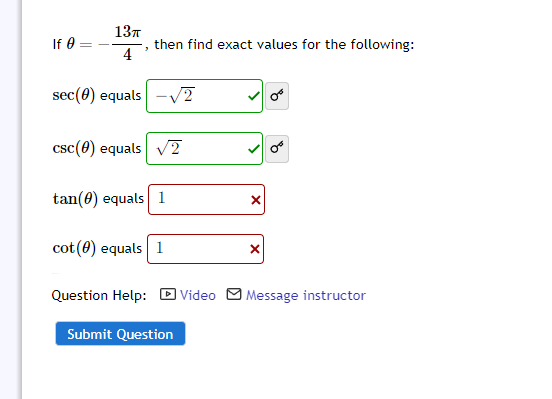
https://gyazo.com/242191f13b41bb8fc5fad8b860c5567c how is csc not negative as well also how is tan and cot wrong?
 marsh citrusBOT
tranquil sparrow
https://gyazo.com/242191f13b41bb8fc5fad8b860c5567c how is csc not negative as we...
tranquil sparrow
marsh citrusBOT
tranquil sparrow
https://gyazo.com/242191f13b41bb8fc5fad8b860c5567c how is csc not negative as we...
tranquil sparrow

 winged pier
Csc is 1/sin(x) right
tranquil sparrow
yes
winged pier
The way you visualize the angle is wrong
Remember that theta is negative
So you’re doing a negative rotation
tranquil sparrow
omg
winged pier
2 pi is 8pi/4 lol
winged pier
not your fault
wait 3 rotations?
It’s 3 half rotations
NEGATIVE rotations
And a negative pi/4 rotation
winged pier
np
marsh citrusBOT
@tranquil sparrow Has your question been resolved?
marsh citrusBOT
Channel closed
Closed due to timeout
Use .reopen if this was a mistake.
Available help channel!
Send your question here to claim the channel.
Remember:
• Ask your math question in a clear, concise manner.
• Show your work, and if possible, explain where you are stuck.
• After 15 minutes, feel free to ping <@&286206848099549185>.
• Type the command .close to free the channel when you're done.
• Be polite and have a nice day!
Read #❓how-to-get-help for further information on how to ask a good question, and about conduct in the question channels.
 torpid marlin
 marsh citrusBOT
torpid marlin
marsh citrusBOT
torpid marlin
What step are you on?
1. I don't know where to begin.
2. I have begun but got stuck midway.
3. I got an answer but I was told that it's wrong.
4. I got an answer and would like my work checked.
5. I have a question about someone else's work/solution.
6. I have completed the problem and don't need help anymore. Thank you.
7. None of the above

tangent
toa
no info on hypotenuse
so
tan 18 = x/12
x is on top so we multiple
so x = 12 tan 18
but I get a negative
 trim quest
Make sure your calculator is in degrees
 trim quest
on that calculator Idk
torpid marlin
I tried doing this
on my phone calculator
but
I do 12
the tan
and it calculates tan 12
doesn't let me finish the euation on phone
torpid marlin
ok
trim quest
and then multiply by 12
torpid marlin
3.9
trim quest
Looks good 👍 Maybe 3.90 since it says two decimal places
torpid marlin
trim quest
Looks good 👍 Maybe 3.90 since it says two decimal places
ok
trim quest
but yeah that's right
trim quest
np 👍
torpid marlin
.close
marsh citrusBOT
Channel closed
Closed by @torpid marlin
Use .reopen if this was a mistake.
Available help channel!
Send your question here to claim the channel.
Remember:
• Ask your math question in a clear, concise manner.
• Show your work, and if possible, explain where you are stuck.
• After 15 minutes, feel free to ping <@&286206848099549185>.
• Type the command .close to free the channel when you're done.
• Be polite and have a nice day!
Read #❓how-to-get-help for further information on how to ask a good question, and about conduct in the question channels.
 feral scaffold
Hey guys, this is a question for people familiar with NCERT books and isn't exactly a question about a specific math problem, rather about understanding what the textbook is trying to say. I am currently doing class 9 chapter 2.4 after finishing exercise 2.2, the topic before 2.4 was 2.3, finding zeros of a polynomial, which i understood with no issues, now it starts referring to some example 10 above which hasnt come up yet and also starts talking remainder theorem, which also havent been mentioned yet, and now i am really confused as to what's happening as its just going on about a topic that it expects me to know but it never mentioned up until now. Is this an error on their end or am I just tripping, what can I do about this, thanks. You can see the chapter here: https://ncert.nic.in/textbook.php?iemh1=2-15
marsh citrusBOT
feral scaffold
Hey guys, this is a question for people familiar with NCERT books and isn't exac...
@feral scaffold Has your question been resolved?
 shadow ibex
Looks like they messed up.
This looks like a preview page, so maybe they mixed pages from more than one edition
marsh citrusBOT
Channel closed
Closed due to timeout
Use .reopen if this was a mistake.
Available help channel!
Send your question here to claim the channel.
Remember:
• Ask your math question in a clear, concise manner.
• Show your work, and if possible, explain where you are stuck.
• After 15 minutes, feel free to ping <@&286206848099549185>.
• Type the command .close to free the channel when you're done.
• Be polite and have a nice day!
Read #❓how-to-get-help for further information on how to ask a good question, and about conduct in the question channels.
feral scaffold
shadow ibex
Looks like they messed up.
This looks like a preview page, so maybe they mixed p...
what do you mean? that is the full chapter from the official website
marsh citrusBOT
feral scaffold
what do you mean? that is the full chapter from the official website
feral scaffold
it isn't a preview
marsh citrusBOT
@feral scaffold Has your question been resolved?
shadow ibex
feral scaffold
what do you mean? that is the full chapter from the official website
B.c. of the watermark
Ok, but it still looks like an error. I couldn't find a reference to example 10 or a q(t) that has a factor 2t+1
Unless it's referring to the previous section...which it should have said if that was the case
feral scaffold
I can confirm it is indeed an error on their end
pretty silly from a government organization
but it is what it is
feral scaffold
shadow ibex
B.c. of the watermark
that's there for the online copies, it's still the full textbook though
shadow ibex
Gotta make that textbook $$$
shadow ibex
Also
The remainder theorem
iirc, it just says that a linear expression divides a polynomial if the remainder is 0
If only there was a quick way for me to be sure...
feral scaffold
the chapter doesn't mention anything abt dividing polynomials either
shadow ibex
No
feral scaffold
they've just removed some major parts from the textbook
 feral scaffold
I still don't understand 😕
the textbook is just missing pretty important information the topic before this was perfectly fine, it appears they removed some information between these 2 topics without patching it up
but thanks for helping, my peanut brain just can't comprehend this stuff 😂
hopefully this gets resolved
shadow ibex
Under division by a binomial (specifically, and more usefully, an expression of the form x-a), a polynomial p(x) has a remainder of p(a)
Here's an example of what that means
feral scaffold
so how would you divide a polynomial by a binomial?
shadow ibex
Say you have the polynomial
feral scaffold
alright
shadow ibex
p(x) = x^3 - 4x^2 - 7x + 10
feral scaffold
alright
shadow ibex
Evaluate this at 2
feral scaffold
meaning?
shadow ibex
p(2) = -12
feral scaffold
ohh
shadow ibex
Meaning plug in 2
feral scaffold
yep
feral scaffold
so p(2)/(2-2)?
shadow ibex
We should still get a (constant part) remainder of -12
shadow ibex
feral scaffold
so p(2)/(2-2)?
No
feral scaffold
shadow ibex
p(x) = x^3 - 4x^2 - 7x + 10
this entire polynomial
divided by (x/2)?
is that right?
feral scaffold
Mb I meant x-2
shadow ibex
I'm going to use synthetic division b.c. it is fast
feral scaffold
alright
 shadow ibex
If (x-2) had been a factor, the last number would have been 0, but it was -12, so we write it over the divisor x-2
shadow ibex
That's good
shadow ibex
np
marsh citrusBOT
Channel closed
Closed by @feral scaffold
Use .reopen if this was a mistake.
marsh citrusBOT
Available help channel!
Send your question here to claim the channel.
Remember:
• Ask your math question in a clear, concise manner.
• Show your work, and if possible, explain where you are stuck.
• After 15 minutes, feel free to ping <@&286206848099549185>.
• Type the command .close to free the channel when you're done.
• Be polite and have a nice day!
Read #❓how-to-get-help for further information on how to ask a good question, and about conduct in the question channels.
 reef trout
is r/q equal to sin y°?
 marsh citrusBOT
reef trout
is r/q equal to sin y°?
marsh citrusBOT
reef trout
is r/q equal to sin y°?
 warm goblet
reef trout
is r/q equal to sin y°?
warm goblet
reef trout
is r/q equal to sin y°?
sin y degrees will be perpendicular/ hypotenuse...
which in this case is r/q
hence, yes r/q is equal to sin y°
marsh citrusBOT
@reef trout Has your question been resolved?
marsh citrusBOT
Channel closed
Closed due to timeout
Use .reopen if this was a mistake.
Available help channel!
Send your question here to claim the channel.
Remember:
• Ask your math question in a clear, concise manner.
• Show your work, and if possible, explain where you are stuck.
• After 15 minutes, feel free to ping <@&286206848099549185>.
• Type the command .close to free the channel when you're done.
• Be polite and have a nice day!
Read #❓how-to-get-help for further information on how to ask a good question, and about conduct in the question channels.
 deft nova
 marsh citrusBOT
@deft nova Has your question been resolved?
marsh citrusBOT
@deft nova Has your question been resolved?
Channel closed
Closed by @deft nova
Use .reopen if this was a mistake.
Available help channel!
Send your question here to claim the channel.
Remember:
• Ask your math question in a clear, concise manner.
• Show your work, and if possible, explain where you are stuck.
• After 15 minutes, feel free to ping <@&286206848099549185>.
• Type the command .close to free the channel when you're done.
• Be polite and have a nice day!
Read #❓how-to-get-help for further information on how to ask a good question, and about conduct in the question channels.
 novel juniper
There is someone in the freshman class who doesn’t have a room-mate.
The negation would be everyone in the freshman class has a room mate
marsh citrusBOT
novel juniper
There is someone in the freshman class who doesn’t have a room-mate.
The negatio...
novel juniper
is this right?
 void elm
yes.
void elm
hm?
novel juniper
how do you negate statements like this , wwhere multiple intereprtations exist ?
Like I could say there's noone in the freshman class who does have a room mate
void elm
oh. I hate those questions
void elm
novel juniper
Like I could say there's noone in the freshman class who does have a room mate
yeah see, it's better to put things in quantifers then negate for this reason
"there is someone" => there exists
"everyone" => for all
void elm
so the original statement is
∃x such that P
and the negation is
∀x we have not P
where x is a classmate and P is not having a roommate
marsh citrusBOT
Channel closed
Closed by @novel juniper
Use .reopen if this was a mistake.
void elm

leaden monolith
void elm
so the original statement is
∃x such that P
and the negation is
∀x we have n...
@novel juniper this is generally how negations get "pushed through" quantifiers
the for all's turn into existence, the exist's turn into for all
and the statement gets negated
void elm
yes, I should've said that
my mistake
but you should convert English sentences to logical statements before negation still
novel juniper
got it
void elm
it's just less ambiguous that way
marsh citrusBOT
Available help channel!
Send your question here to claim the channel.
Remember:
• Ask your math question in a clear, concise manner.
• Show your work, and if possible, explain where you are stuck.
• After 15 minutes, feel free to ping <@&286206848099549185>.
• Type the command .close to free the channel when you're done.
• Be polite and have a nice day!
Read #❓how-to-get-help for further information on how to ask a good question, and about conduct in the question channels.
 dark crypt
Hello, I got a question, so in this question do i need to find f(t) and then solve f(2)?
 marsh citrusBOT
dark crypt
Hello, I got a question, so in this question do i need to find f(t) and then so...
marsh citrusBOT
dark crypt
Hello, I got a question, so in this question do i need to find f(t) and then so...
 brave marsh
Considering they want you to estimate the amount of solid, it's likely that they want you to compute the derivative at t=2 and use the tangent line there as an approximation for t=3
dark crypt
Alrighty, so f'(2) would be equal to
-24 right?
brave marsh
Yeah that looks good
dark crypt
ok so now do i plug in t=3?
brave marsh
Well get the equation of the tangent line first
dark crypt
brave marsh
Well get the equation of the tangent line first
So this means y-y_0=m(x-x_0) right?
brave marsh
Yeah
dark crypt
so now i'm a bit confused,
how would i find the equation of the tangent line then?
brave marsh
You have m, that is the derivative at t=2.
You also know that the tangent line goes through (2,2) since that's where you computed the derivative
dark crypt
ok so our m value is =-24
dark crypt
brave marsh
You also know that the tangent line goes through (2,2) since that's where you co...
oh and (2,2) because its 2 grams of solid at 2 seconds right?
brave marsh
Yep
dark crypt
ok so out y_0 value is 2?(and our x value)?
dark crypt
brave marsh
Yep
so our equation is gonna be y-2=-24(x-2)?
dark crypt
because m= -24
brave marsh
Yeah but like, physically this is the mass of solid inside the beaker
dark crypt
ok so lemme just send in my working
so this is our equation, and we find out slope right?

do i plug in for t then?121/60?
dark crypt
brave marsh
This represents one second past 2 min
so i'd get -24.30083...
now i plug this back into the equation of the tangent line formula?
brave marsh
No. you don't need to compute the tangent line again
dark crypt
oh mb
brave marsh
You can use the old one
dark crypt
brave marsh
No. you don't need to compute the tangent line again
so y =-24(24.3008-2)+2?
dark crypt
brave marsh
You can use the old one
im still getting a negative number guh
OH MY GOD WAIT
nvm i still got it wrong its so joeover
dark crypt
brave marsh
You can use the old one
so now
y= 24.3008(3-2)+2 would be the way tofind out new y right?
brave marsh
No. y = -24(121/60 - 2) + 2
dark crypt
brave marsh
No. y = -24(121/60 - 2) + 2
HOLY HECK THANK YOU I WILL NAME MY FIRST BORN AFTER YOU
.close
marsh citrusBOT
Channel closed
Closed by @dark crypt
Use .reopen if this was a mistake.
marsh citrusBOT
Available help channel!
Send your question here to claim the channel.
Remember:
• Ask your math question in a clear, concise manner.
• Show your work, and if possible, explain where you are stuck.
• After 15 minutes, feel free to ping <@&286206848099549185>.
• Type the command .close to free the channel when you're done.
• Be polite and have a nice day!
Read #❓how-to-get-help for further information on how to ask a good question, and about conduct in the question channels.
still temple

 marsh citrusBOT
still temple
still temple
marsh citrusBOT
still temple
still temple
need some help
i dont understand the algebra steps
how did they isolate f so nicely
very frustrating been stuck on this for 45 min

 marsh citrusBOT
@still temple Has your question been resolved?
marsh citrusBOT
Channel closed
Closed due to timeout
Use .reopen if this was a mistake.
Available help channel!
Send your question here to claim the channel.
Remember:
• Ask your math question in a clear, concise manner.
• Show your work, and if possible, explain where you are stuck.
• After 15 minutes, feel free to ping <@&286206848099549185>.
• Type the command .close to free the channel when you're done.
• Be polite and have a nice day!
Read #❓how-to-get-help for further information on how to ask a good question, and about conduct in the question channels.
 frigid lintel
 marsh citrusBOT
frigid lintel
frigid lintel
marsh citrusBOT
frigid lintel
frigid lintel
anyone able to help real quick? need some sleep
tired oxide
why would you expect there to be any relationship between ABC and PQR at all
tired oxide
frigid lintel
that's what i was thinking
the transitive property doesn’t guarantee what they’re claiming
elfin berryBOT
The current time for smayday is 04:23 AM (EDT) on Wed, 26/06/2024.
tired oxide
lol
tired oxide
frigid lintel
1:23 for me
get some rest before it gets to 4 am
marsh citrusBOT
Channel closed
Closed by @frigid lintel
Use .reopen if this was a mistake.
marsh citrusBOT
Available help channel!
Send your question here to claim the channel.
Remember:
• Ask your math question in a clear, concise manner.
• Show your work, and if possible, explain where you are stuck.
• After 15 minutes, feel free to ping <@&286206848099549185>.
• Type the command .close to free the channel when you're done.
• Be polite and have a nice day!
Read #❓how-to-get-help for further information on how to ask a good question, and about conduct in the question channels.
 limpid bison
 marsh citrusBOT
limpid bison
marsh citrusBOT
limpid bison
 ivory turtle
!status
marsh citrusBOT
What step are you on?
1. I don't know where to begin.
2. I have begun but got stuck midway.
3. I got an answer but I was told that it's wrong.
4. I got an answer and would like my work checked.
5. I have a question about someone else's work/solution.
6. I have completed the problem and don't need help anymore. Thank you.
7. None of the above
 still light
Did you do a)
limpid bison
erm the turning point is at -1,13
it cuts through the middle of the graph
at x = -1 tho
so its that
still light
Right
marsh citrusBOT
Channel closed
Closed by @limpid bison
Use .reopen if this was a mistake.
marsh citrusBOT
Available help channel!
Send your question here to claim the channel.
Remember:
• Ask your math question in a clear, concise manner.
• Show your work, and if possible, explain where you are stuck.
• After 15 minutes, feel free to ping <@&286206848099549185>.
• Type the command .close to free the channel when you're done.
• Be polite and have a nice day!
Read #❓how-to-get-help for further information on how to ask a good question, and about conduct in the question channels.
 rocky steppe
How am I supposed to know which graph is correct? I know that it is VERTICALLY stretched by a factor of 2 but I can’t tell the difference between any of them? I know the y axis is changing (some of them are at y = 2) but idk which is the right answer
 marsh citrusBOT
rocky steppe
How am I supposed to know which graph is correct? I know that it is VERTICALLY s...
marsh citrusBOT
rocky steppe
How am I supposed to know which graph is correct? I know that it is VERTICALLY s...
@rocky steppe Has your question been resolved?
marsh citrusBOT
Channel closed
Closed due to timeout
Use .reopen if this was a mistake.
marsh citrusBOT
Available help channel!
Send your question here to claim the channel.
Remember:
• Ask your math question in a clear, concise manner.
• Show your work, and if possible, explain where you are stuck.
• After 15 minutes, feel free to ping <@&286206848099549185>.
• Type the command .close to free the channel when you're done.
• Be polite and have a nice day!
Read #❓how-to-get-help for further information on how to ask a good question, and about conduct in the question channels.
 wet laurel
I can't figure out how to do the required line integral in this question. I know how to do the Stokes' theorem part, but I can't figure out how to do the parametrization for the given region.
 marsh citrusBOT
wet laurel
I can't figure out how to do the required line integral in this question. I know...
marsh citrusBOT
wet laurel
I can't figure out how to do the required line integral in this question. I know...
@wet laurel Has your question been resolved?
wet laurel
.close
marsh citrusBOT
Channel closed
Closed by @wet laurel
Use .reopen if this was a mistake.
marsh citrusBOT
Available help channel!
Send your question here to claim the channel.
Remember:
• Ask your math question in a clear, concise manner.
• Show your work, and if possible, explain where you are stuck.
• After 15 minutes, feel free to ping <@&286206848099549185>.
• Type the command .close to free the channel when you're done.
• Be polite and have a nice day!
Read #❓how-to-get-help for further information on how to ask a good question, and about conduct in the question channels.
 rain walrus
Hi everyone. I'm French and I want to improve my english for my studies and I need help in a math problem. I have a project and if someone are interested to correspond with me, that could be nice for me. Thanks 🙂
marsh citrusBOT
rain walrus
Hi everyone. I'm French and I want to improve my english for my studies and I ne...
 tender lily
what do you need help with
 lucid turret
!2ada
ivory turtle
!da2a
marsh citrusBOT
No need to ask “Can I ask…?” or “Does anyone know about…?”—it’s faster for everyone if you just ask your question! See https://dontasktoask.com/
lucid turret
!2adt
ivory turtle
almost meolve
ivory turtle
you'll get there eventually :)
marsh citrusBOT
@rain walrus Has your question been resolved?
marsh citrusBOT
Channel closed
Closed due to timeout
Use .reopen if this was a mistake.
Available help channel!
Send your question here to claim the channel.
Remember:
• Ask your math question in a clear, concise manner.
• Show your work, and if possible, explain where you are stuck.
• After 15 minutes, feel free to ping <@&286206848099549185>.
• Type the command .close to free the channel when you're done.
• Be polite and have a nice day!
Read #❓how-to-get-help for further information on how to ask a good question, and about conduct in the question channels.
 exotic walrus
 marsh citrusBOT
exotic walrus
ivory turtle
marsh citrusBOT
exotic walrus
ivory turtle
!status
marsh citrusBOT
What step are you on?
1. I don't know where to begin.
2. I have begun but got stuck midway.
3. I got an answer but I was told that it's wrong.
4. I got an answer and would like my work checked.
5. I have a question about someone else's work/solution.
6. I have completed the problem and don't need help anymore. Thank you.
7. None of the above
2
ivory turtle
what do you have so far
exotic walrus
I find slope
of both lines cuz paralle
then i try to put slope intercept form cuz reciprocal intercepts
ivory turtle
!show
marsh citrusBOT
Show your work, and if possible, explain where you are stuck.
ivory turtle
which question?
ivory turtle
or is it multiple choice?
exotic walrus
yup that one
tacit marsh
What even is a reciprocal intercept
exotic walrus
exotic walrus
x/1/a + y /1/a
.
i think
ya guys any progress
<@&286206848099549185>
exotic walrus
exotic walrus
.
 dire wagon
tacit marsh
What even is a reciprocal intercept
dire wagon
tacit marsh
What even is a reciprocal intercept
I dont even know
Though the answer is between a and b
Since they have same slope
Aka parallel
 finite glacier
i would assume recipricol intercepts mean that x intercept is the recipricol of y intercept
you can just find the intercepts of A and B to see if the have this property
since C and D are not parellel to the original equation
marsh citrusBOT
@exotic walrus Has your question been resolved?
finite glacier
exotic walrus
you are saying i put x/a and y/1/a
im suggesting to literally find the intercepts of each of the 2 equations
like for example A has x intercept at +-2 and y intercept at +-1
these arent inverses so this isnt the answer
and continue
exotic walrus
.close
marsh citrusBOT
Channel closed
Closed by @exotic walrus
Use .reopen if this was a mistake.
 little oriole
exotic walrus
you are saying i put x/a and y/1/a
little oriole
exotic walrus
you are saying i put x/a and y/1/a
reciprocal intercepts means that x.y = 1. So you can evaluate each option. the way to evaluate is to find the intercepts. The intercept in x is when y is zero and the intercept in y is when x = 0. If you evaluate them you will find x and y, and the product of these two values should be equal to 1. After you find that you need to evaluate if the slope is the same as the given line (that means that both are parallel)
marsh citrusBOT
Available help channel!
Send your question here to claim the channel.
Remember:
• Ask your math question in a clear, concise manner.
• Show your work, and if possible, explain where you are stuck.
• After 15 minutes, feel free to ping <@&286206848099549185>.
• Type the command .close to free the channel when you're done.
• Be polite and have a nice day!
Read #❓how-to-get-help for further information on how to ask a good question, and about conduct in the question channels.
still temple
 marsh citrusBOT
still temple
still temple
marsh citrusBOT
still temple
still temple
the reference angle i get is 20 degrees
but like their is no similar triangle for 20 degrees
any other way of doing this?
marsh citrusBOT
@still temple Has your question been resolved?
still temple
.close
marsh citrusBOT
Channel closed
Closed by @karmic sable
Use .reopen if this was a mistake.
Available help channel!
Send your question here to claim the channel.
Remember:
• Ask your math question in a clear, concise manner.
• Show your work, and if possible, explain where you are stuck.
• After 15 minutes, feel free to ping <@&286206848099549185>.
• Type the command .close to free the channel when you're done.
• Be polite and have a nice day!
Read #❓how-to-get-help for further information on how to ask a good question, and about conduct in the question channels.
still temple
HELP
marsh citrusBOT
still temple
HELP
 ivory turtle
So maybe it cannot be determined then?