#help-33
1 messages · Page 117 of 1
 marsh citrusBOT
@proud zealot Has your question been resolved?
 glass silo
 proud zealot
please tag me if you answer
proud zealot
please tag me if you answer
Coefficient of z^0 is 1, coefficient of z^n for any strictly positive integer n must be zero

From there and comparing, see the sum goes from -infty to -1 only
So a(n) is only 2 for strictly negative n
marsh citrusBOT
Channel closed
Closed due to timeout
Use .reopen if this was a mistake.
 Available help channel!
Send your question here to claim the channel.
Remember:
• Ask your math question in a clear, concise manner.
• Show your work, and if possible, explain where you are stuck.
• After 15 minutes, feel free to ping <@&286206848099549185>.
• Type the command .close to free the channel when you're done.
• Be polite and have a nice day!
Read #❓how-to-get-help for further information on how to ask a good question, and about conduct in the question channels.
 next phoenix
 marsh citrusBOT
next phoenix
next phoenix
marsh citrusBOT
next phoenix
next phoenix
In qs 4 why does E1 have 1/6E2 term
Shouldn't it be just 1/6 coz that's the probability it will end
Bruh
marsh citrusBOT
@next phoenix Has your question been resolved?
next phoenix
<@&286206848099549185> pls look at qs above
marsh citrusBOT
@next phoenix Has your question been resolved?
next phoenix
<@&286206848099549185> <@&286206848099549185> someone
marsh citrusBOT
@next phoenix Has your question been resolved?
 white breach
next phoenix
In qs 4 why does E1 have 1/6E2 term
white breach
next phoenix
In qs 4 why does E1 have 1/6E2 term
its actually E5
same reason for E1 to have 2/6 because its E1 and E6
marsh citrusBOT
Channel closed
Closed due to timeout
Use .reopen if this was a mistake.
Available help channel!
Send your question here to claim the channel.
Remember:
• Ask your math question in a clear, concise manner.
• Show your work, and if possible, explain where you are stuck.
• After 15 minutes, feel free to ping <@&286206848099549185>.
• Type the command .close to free the channel when you're done.
• Be polite and have a nice day!
Read #❓how-to-get-help for further information on how to ask a good question, and about conduct in the question channels.
 sterile harness
what is trivial solution in linear algebra in matrixes ?
 still temple
sterile harness
what is trivial solution in linear algebra in matrixes ?
still temple
sterile harness
what is trivial solution in linear algebra in matrixes ?
For 3 sets of questions
a1x+b1y+c1z=0
a2x+b2y+c2z=0
a3x+b3y+c3z=0
x=0,y=0,z=0 is a trivial solution
and inorder to have a non trivial solution det of coefficients should be 0
marsh citrusBOT
@sterile harness Has your question been resolved?
marsh citrusBOT
Channel closed
Closed due to timeout
Use .reopen if this was a mistake.
Available help channel!
Send your question here to claim the channel.
Remember:
• Ask your math question in a clear, concise manner.
• Show your work, and if possible, explain where you are stuck.
• After 15 minutes, feel free to ping <@&286206848099549185>.
• Type the command .close to free the channel when you're done.
• Be polite and have a nice day!
Read #❓how-to-get-help for further information on how to ask a good question, and about conduct in the question channels.
 vivid wharf
what am i doing wrong - solving the 4th no
 marsh citrusBOT
vivid wharf
what am i doing wrong - solving the 4th no
vivid wharf
marsh citrusBOT
vivid wharf
what am i doing wrong - solving the 4th no
vivid wharf
logic for ease :
ab = bc(given) so <a = <b = 45 deg .
<h = 90deg and <b = 45deg so <hdb = 45 too, so hd = hb.
ac is root3 so bc is root 3 too bcos <a = <b.
So bd = root3 - 1.
And we here
marsh citrusBOT
@vivid wharf Has your question been resolved?
marsh citrusBOT
@vivid wharf Has your question been resolved?
vivid wharf
.close
marsh citrusBOT
Channel closed
Closed by @vivid wharf
Use .reopen if this was a mistake.
Available help channel!
Send your question here to claim the channel.
Remember:
• Ask your math question in a clear, concise manner.
• Show your work, and if possible, explain where you are stuck.
• After 15 minutes, feel free to ping <@&286206848099549185>.
• Type the command .close to free the channel when you're done.
• Be polite and have a nice day!
Read #❓how-to-get-help for further information on how to ask a good question, and about conduct in the question channels.
 red minnow
Given the bases S = v₁,v₂ and T = w₁, w₂. V = R² with:
v₁ = -3w₁ + 9w₂ and v₂ = 8w₁ - 4w₂
Calculate the determinant of the base change matrix from base S to base T. (Note: Carry out the calculations and provide the result in decimal form with 5 decimal places).
marsh citrusBOT
red minnow
Given the bases S = v₁,v₂ and T = w₁, w₂. V = R² with:
v₁ = -3w₁ + 9w₂ and v₂ = ...
@red minnow Has your question been resolved?
marsh citrusBOT
Channel closed
Closed by @red minnow
Use .reopen if this was a mistake.
marsh citrusBOT
Available help channel!
Send your question here to claim the channel.
Remember:
• Ask your math question in a clear, concise manner.
• Show your work, and if possible, explain where you are stuck.
• After 15 minutes, feel free to ping <@&286206848099549185>.
• Type the command .close to free the channel when you're done.
• Be polite and have a nice day!
Read #❓how-to-get-help for further information on how to ask a good question, and about conduct in the question channels.
 crisp sigil
can someone check if this is right
 marsh citrusBOT
crisp sigil
can someone check if this is right
marsh citrusBOT
crisp sigil
can someone check if this is right
 undone bane
yeah, its correct
 broken dome
 undone bane
idk why you calculated y(1) tho
broken dome
You can always check these things with Desmos
crisp sigil
undone bane
idk why you calculated y(1) tho
wdym/
undone bane
crisp sigil
wdym/
 crisp sigil
oh i di that to see which one is the top and which one is bottom
undone bane
ahh
crisp sigil
yea bc my teacher doesnt allow us to use calc on test so i do the hw without calc
broken dome
you don't have to do that I think
you'll just get the negative answer but the absolute value will be the same
crisp sigil
this one i need help with
 broken dome
you should get -72 if you reverse them

Ye is good
you can use the calculator to check your work is what I meant
crisp sigil
oh really? i did it right?
broken dome
If the answer is right then the process is usually right too with integrals
assuming the formula is correct
yes
crisp sigil
ok cooll and ik i can use desmos but do u think i should make this graph look better or is this fine
 broken dome
Depends on what your teacher wants, that sketch is very inaccurate given dimensions, but it's correct in terms of shape
They wouldn't intersect at the x axis
crisp sigil
@broken dome How’s this?
 broken dome
Much better
marsh citrusBOT
@crisp sigil Has your question been resolved?
crisp sigil
broken dome
Much better
could anythig be improvid
broken dome
I mean, if you really wanted to you could mark the points they cross and write which coordinates they are
and like hatch the area that you're calculating
add axis notation
marsh citrusBOT
Channel closed
Closed due to timeout
Use .reopen if this was a mistake.
Available help channel!
Send your question here to claim the channel.
Remember:
• Ask your math question in a clear, concise manner.
• Show your work, and if possible, explain where you are stuck.
• After 15 minutes, feel free to ping <@&286206848099549185>.
• Type the command .close to free the channel when you're done.
• Be polite and have a nice day!
Read #❓how-to-get-help for further information on how to ask a good question, and about conduct in the question channels.
still temple
Hello, so I was just wondering if when doing questions like e-i i should take whatever is out of the bracket out of the integration because I saw in a video some rule i dont know when to apply it as he did not give an example. I am pretty sure you dont take it out so could you give me an example of when that rule applies.

 marsh citrusBOT
still temple
Hello, so I was just wondering if when doing questions like e-i i should take wh...
marsh citrusBOT
still temple
Hello, so I was just wondering if when doing questions like e-i i should take wh...
 limber marsh
You can only factor things out if they're constants
E.g. they're unaffected by x
still temple
.close
marsh citrusBOT
Channel closed
Closed by @marble schooner
Use .reopen if this was a mistake.
marsh citrusBOT
Available help channel!
Send your question here to claim the channel.
Remember:
• Ask your math question in a clear, concise manner.
• Show your work, and if possible, explain where you are stuck.
• After 15 minutes, feel free to ping <@&286206848099549185>.
• Type the command .close to free the channel when you're done.
• Be polite and have a nice day!
Read #❓how-to-get-help for further information on how to ask a good question, and about conduct in the question channels.
 uneven vector
I need help with question 8. d)
 marsh citrusBOT
uneven vector
I need help with question 8. d)
marsh citrusBOT
uneven vector
I need help with question 8. d)
 upper timber
uneven vector
i dont know how to go abt it honestly
upper timber
uneven vector
i dont know how to go abt it honestly
You need to know that $log(ab)=log(a)+log(b)$
 elfin berryBOT
coak
 upper timber
Then the problem tells you that the logs are in an arithmetic sequence
uneven vector
yes
upper timber
So let their common difference be d
Then log(p)-log(27) = log(p/27)=d
And same with the rest
So p/27 = q/p = 125/q = 8^d
See?
uneven vector
ohh
i see
so thats enough for 8 d
and now i just solvev for p and q
with this
p/27 = q/p
or wait
marsh citrusBOT
@uneven vector Has your question been resolved?
marsh citrusBOT
Channel closed
Closed due to timeout
Use .reopen if this was a mistake.
Available help channel!
Send your question here to claim the channel.
Remember:
• Ask your math question in a clear, concise manner.
• Show your work, and if possible, explain where you are stuck.
• After 15 minutes, feel free to ping <@&286206848099549185>.
• Type the command .close to free the channel when you're done.
• Be polite and have a nice day!
Read #❓how-to-get-help for further information on how to ask a good question, and about conduct in the question channels.
 finite folio
( U+
 copper raven
V+
marsh citrusBOT
Channel closed
Closed due to timeout
Use .reopen if this was a mistake.
Available help channel!
Send your question here to claim the channel.
Remember:
• Ask your math question in a clear, concise manner.
• Show your work, and if possible, explain where you are stuck.
• After 15 minutes, feel free to ping <@&286206848099549185>.
• Type the command .close to free the channel when you're done.
• Be polite and have a nice day!
Read #❓how-to-get-help for further information on how to ask a good question, and about conduct in the question channels.
 supple dirge
We have a sequence defined by:
Un = ((n-2) / (n)) × Un-1 - ((n-3) / (n(n-1))) × Un-2
U0 = 1 and U1 = 2
how much is the following amount worth:
Sn = (U0 / U1) + (U1 / U2) +...+ (U2023 / U2024)
Thanks
marsh citrusBOT
supple dirge
We have a sequence defined by:
Un = ((n-2) / (n)) × Un-1 - ((n-3) / (n(n-1))) ...
 earnest sundial
you're missing a ) somewhere. where's that supposed to go?
supple dirge
that's it, thank you
elfin berryBOT
Bob Goldham
 earnest sundial
what does that ratio equal in the general case?
 marsh citrusBOT
Channel closed
Closed by @supple dirge
Use .reopen if this was a mistake.
marsh citrusBOT
Available help channel!
Send your question here to claim the channel.
Remember:
• Ask your math question in a clear, concise manner.
• Show your work, and if possible, explain where you are stuck.
• After 15 minutes, feel free to ping <@&286206848099549185>.
• Type the command .close to free the channel when you're done.
• Be polite and have a nice day!
Read #❓how-to-get-help for further information on how to ask a good question, and about conduct in the question channels.
 vivid horizon
Can someone help me with either of these questions pls thank u!

 vivid horizon
how to get started or what rules I need to know
marsh citrusBOT
@vivid horizon Has your question been resolved?
marsh citrusBOT
@vivid horizon Has your question been resolved?
vivid horizon
.close
marsh citrusBOT
Channel closed
Closed by @vivid horizon
Use .reopen if this was a mistake.
Available help channel!
Send your question here to claim the channel.
Remember:
• Ask your math question in a clear, concise manner.
• Show your work, and if possible, explain where you are stuck.
• After 15 minutes, feel free to ping <@&286206848099549185>.
• Type the command .close to free the channel when you're done.
• Be polite and have a nice day!
Read #❓how-to-get-help for further information on how to ask a good question, and about conduct in the question channels.
 signal nebula
 marsh citrusBOT
signal nebula
signal nebula
marsh citrusBOT
signal nebula
signal nebula
can someone confirm whether the notation is done properly?
and I use a lot of steps, which could I omit?
 turbid mica
lasso notation 😭
signal nebula
what is that
turbid mica
ur integrals look like a lasso
elfin berryBOT
penguin

 ivory latch
why does it say +4c at the end lol
 swift wedge
vivid horizon
Can someone help me with either of these questions pls thank u!
swift wedge
vivid horizon
Can someone help me with either of these questions pls thank u!
In 15 write 1 = n/n to get (1+i)^4/n^4, put inside the other n to get n^5, expand (1+i)^4 using Pascal triangle, you will get 5 terms with coeficients 1,4,6,4,1. Not, use them to get 5 sums, all are basics like \sum i or \sum i^2. Do the limit
signal nebula
its just + c
signal nebula
turbid mica
d(2x - 1)
its to show I substituted
should it not be there at that point?
turbid mica
uh if thats how ur teacher wants it ok but that seems weird
signal nebula
I dont fully understand the dx syntax to begin with
ik d(...) means derivative of whatever is inside
swift wedge
vivid horizon
Can someone help me with either of these questions pls thank u!
In 4 only evaluate to get 0 - 1 + sin(pi/3) = -1 + sqrt(3)/2 = (sqrt 3 - 2) / 2. You can compute sin(pi/3) using euler identity exp(i x) = cos(x) + i sin(x)
signal nebula
but no clue why I can just omit the whole * dx/d() once I start to get the primitive
marsh citrusBOT
@signal nebula Has your question been resolved?
Channel closed
Closed by @signal nebula
Use .reopen if this was a mistake.
Available help channel!
Send your question here to claim the channel.
Remember:
• Ask your math question in a clear, concise manner.
• Show your work, and if possible, explain where you are stuck.
• After 15 minutes, feel free to ping <@&286206848099549185>.
• Type the command .close to free the channel when you're done.
• Be polite and have a nice day!
Read #❓how-to-get-help for further information on how to ask a good question, and about conduct in the question channels.
 chrome swift
Small theoric question from me
marsh citrusBOT
chrome swift
Small theoric question from me
chrome swift
Say a matrix that has n euginics values.
Their eugian values per eugian values form a basis together? or they have to be split from each numbers?

For example these three vectors
(1,1,1), (-3,0,1) and (1,2,0).
Do they form a basis of R3?
Or it's only (1,1,1) that is a basis of R3
 obsidian trail
yeah they do form a basis of R³
chrome swift
Oh, so I have to combine all of them?
obsidian trail
yep that's correct
 spark otter
When your matrix is diagonalizable, you have to combine the vectors of EACH eigenspace
chrome swift
So a Matrix of 5x5 that has 5 eugianvalues.
All of these vectors together will form a basis.
of R5
Not only from one.
spark otter
1 vector per eigenspace/eigenvalue, yes you will get 5 vectors that form a basis of R5
obsidian trail
there can be a 3×3 matrix which is not diagonizable (meaning it doesn't form a basis of R³)
obsidian trail
det(A-kI) is to find eigenvalues
spark otter
that just means k is not an eigenvalue
chrome swift
Ah woops.
Let me recitify
Say for a matrix of 2x3
if
P(x) = x^2 - (a11 + a22)x + det(A)
can't ever be = 0, then it doesn't have eigenvalues.
spark otter
a non-square matrix has no eigenvalues
spark otter
chrome swift
if
P(x) = x^2 - (a11 + a22)x + det(A)
can't ever be = 0, then it doesn't have ei...
it's a polynomial, it always has eigenvalues
no one said it had to be real ones
chrome swift
Ok gotcha.
Similar question before I finally tackle the diagonalisation.
d) is the one I'm looking at.

how would I ive a matrix D
Hold on let me give you the basis according to a calculator

How would I build a matrix with these three vectors?
I just place them side by side?
spark otter
chrome swift
how would I ive a matrix D
bon parlons en francais alors
La matrice D est diagonale et contient les valeurs propres associées à chaque vecteur propre de la base sur sa diagonale
chrome swift
Oh vous êtes français! Cool.
Le problème n'était pas de savoir si c'était une matrice diagonale
Mais comment obtenir cette matrice à partir de la base.
J'ai l'impression que je pourrais donner n'importe quoi
Comme ceci :
 spark otter
disons que ta base c'est e1 = (1 2 1), e2 = (1 0 1) et e3= (-1 1 0)
c'est tes vecteurs propres, aucun problème jusque là?
chrome swift
Non, aucun problème.
spark otter
ok
chrome swift
Ils font une base de R3 ensemble.
chrome swift
Ah ok je fais juste les joindre bout à bout?
spark otter
c'est les coordonnées de T(ei) dans la nouvelle base
spark otter
chrome swift
Ah ok je fais juste les joindre bout à bout?
nonon
$D = \begin{pmatrix}a&b&c\d&e&f\g&h&k\end{pmatrix}$
où
elfin berryBOT
rafilou2003
 spark otter
$T(e_1) = ae_1 + de_2 + ge_3$
elfin berryBOT
rafilou2003
 spark otter
$T(e_2) = be_1 + ee_2 + he_3$
elfin berryBOT
rafilou2003
 spark otter
etc...
c'est comme ça que tu es sensé obtenir les coefficients de D
Ce serait hyper long sans indication
mais là coup de bol
chrome swift
Eh boy.
elfin berryBOT
rafilou2003
 chrome swift
Ah attend, le A est la matrice associée à la transformation linéaire?
Donc une fonction prenant trois arguments (bu que c'est la base canonique)?
spark otter
chrome swift
Ah attend, le A est la matrice associée à la transformation linéaire?
A majuscule c'est la matrice de T dans la base canonique
chrome swift
Genre toute la méga opérations de cette transformation se ferait en résoudant cette matrice
Un peu comme les rotations dans les transformations géométriques?
spark otter
Oui en fait A décrit intégralement T
chrome swift
Aaaah ok.
spark otter
Si tu sais comment se comportent les images de chaque vecteur d'une base, alors tu sais comment se comporte la transformation dans son intégralité
parce que la transformation est linéaire
chrome swift
Ok donc pour résumé
On a une fonction qui fait une multiude de opérations à un vecteur quelconque
qui peut se résumer à une opération matricielle de vce vecteur avec la matrice A
Genre
spark otter
oui T(X) = AX
spark otter
si X est le vecteur colonne (x y z) de R^3 alors T(X) se résume à multiplier A avec X
chrome swift
R^3 c'est pas supposé être des matrices 3x3?
spark otter
R^3 c'est l'ensemble des vecteurs à 3 coordonnées réelles
l'ensemble des matrices 3x3 c'est $\mathcal{M}_3(\bR)$
elfin berryBOT
rafilou2003
 spark otter
ou encore $\bR^{3\times 3}$
chrome swift
Donc fau tjuste que j'aie une ligne ou une colonne de 3 max
elfin berryBOT
rafilou2003
 chrome swift
Ehh boy va falloir que je corrige cela dans ma tête ahah. merci de cette correction.
Ok ce qui est donné dans la fonction fait plus de sens.
spark otter
par convention les vecteurs de R^n sont associées au matrices n*1
chrome swift
Je donne 3 valeurs à la transformation.
Il se passe quelque chose qui es défini par la matrice A
qui englobe toutes les opérations effectuées.
Jpourrais par exemple avec une rotation avec une dilatation dans cette matrice là.
Je commence à faire des liens
attends je fais un petit gribouilli

Voici ce que la transformation ferait.
Et ce quelque chose est dans R3.
Ce qui n'est psa intéressant, car ce n,est pas ce que l'on cherche. Mais ça fait beaucoup de sens ou de liens. je comprends mieux la présentation et ce que l'on fait.
Puis là on prend la matrice A, et on le décortique avec le polynôme caractéristique, etc.
Jusque là, est-ce que je me plante ou je pédale avec 4 roues? 😄
spark otter
alors c'est quasiment ça
chrome swift
Ah oops.
Merci de la correction
Ok good
Donc là on prend A, et on l'a décomposé pour trouver une base.
Revoici l'exemple de tantôt

Il se passe quoi ici? Est-ce que l'on obtient un nouvel A plus facile à calculer?
Ou encore, prenons la symétrie orthogonale avec X pour une matrice R2

Deux vecteurs archi simple.
Que serait D dans ce cas super simple.
spark otter
chrome swift
Que serait D dans ce cas super simple.
en fait D est la même matrice
tu as pris une matrice déjà diagonale
chrome swift
Ah oops. Pasun bon exemple alors.
spark otter
ce qui rend le principe de la "diagonalisation".... un peu futile
 spark otter
oui pourquoi pas
et donc tu obtiens une nouvelle matrice D = diag(-1,1)
pourquoi on cherche des matrices diagonales ?
Parce que les matrices diagonales ça représente le "scaling" qui est très facile à calculer
et ce que la diagonalisation te dit, c'est que ta matrice, si tu la regardes avec la bonne base, bah elle fait juste du scaling
chrome swift
Ah je vois
Et coment vous avez obtenu diag(-1,1)?
Je me souviens que je dois faire T quelque chose.
spark otter
elfin berry
**rafilou2003**
en fait théoriquement il faut passer par là
spark otter
elfin berry
**rafilou2003**
mais ayant une base de vecteurs propres
on sait que T((-1 2)) = -1(-1 2)
et T((1 0)) = 1(1 0)
chrome swift
Ahh on fait juste plugger les vecteurs propres dans les arguments de la transformation?
spark otter
c'est plus que ça
spark otter
spark otter
on sait que T((-1 2)) = -1(-1 2)
quand on regarde la transformation T avec la nouvelle base de vecteurs propres
disons e1 = (-1 2) et e2 = (1 0)
et D la matrice de T dans la base (e1, e2)
et bien que fait T?
elle scale e1 par un facteur -1
et elle scale e2 par un facteur 1
donc D = diag(-1, 1)
on sait que D c'est une matrice diagonale, avec pour coefficients diagonaux les valeurs propres
ligne 1 colonne 1, c'est la valeur propre de e1
ligne 2 colonne 2, valeur propre de e2
etc...
et en dehors de la diagonale, des 0
chrome swift
Ah ok on fait juste mettre les valeurs propres là-dedans.
je m'Excuse d'être un peu têtu à ce sujet, mais ça m'aide à comprendre.
As-tu juste plugger les valeurs propres là où ya un processus mathématique derrière un peu comme ce que j'avais pensé...?

J'arrive juste pas à voir le lien direct entre D et l'espace vectoriel.
Le plus proche que je crois avoir c'est ci-dessus.
spark otter
chrome swift
je m'Excuse d'être un peu têtu à ce sujet, mais ça m'aide à comprendre.
As-tu j...
attends déjà plusieurs problèmes
on en avait déjà parlé, la multiplication matricielle c'est A * (x y z) et pas l'inverse
ensuite
chrome swift
éAh j'ai oublié de inverer cela
J'avais compris cela j,ai juste pas corrigé sur word.
spark otter
quand tu écris T(1,2,1) = col1, col1 refère à quoi selon toi ?
chrome swift
col1 refère à la colonne1 que l'on obtiendrait de la matrice D
Mais ça ne ferait pas de sens
Car je pourrais changer l'ordre de mes "appels de fonction" et chier mon idée.
spark otter
col1 c'est pas exactement T(1,2,1), c'est les COORDONNEES de T(1,2,1) dans la base de vecteurs propres
bon j'écris (1 2 1) = e1, etc...
si T(e1) = a*e1 + b*e2 + c*e3
alors sur la première colonne de D, on voit les coeffs a,b,c
Or
On sait que e1 est vecteur propre
donc T(e1) = lambda1*e1
donc sur la première colonne de D, on lit "lambda1", puis "0", puis "0"
on répète le procédé pour chaque colonne
on se rend compte que la matrice est bien diagonale
 spark otter
oui


 spark otter
oui
bah effectivement, T(1,2,1) = 5*(1,2,1)
c'est du scaling
idem pour les autres vecteurs
chrome swift
Ah c'est pour ça que ça se multiplie par la valeur propre.
Je viens de réaliser.. Est-ce simplement un changement de base ici pour obtenir D?
 spark otter
Oui techniquement
chrome swift
Oh well ça ne semble pas décrire l'obtention d'une matrice unique.
Ah attends
c'es tplus loin
Donc faut prendre la base canonique et la base avec mes vecteurs
et faut faire quelque chose avec ça
Je crois que je vais reprendre demain. Je suis brûlé. un gros merci d'avoir essayé de me dépogner. J'ai fait beaucoup de lien malgré ce mur actuel.
Je suis tellement proche de comprendre je le sens.
.close
marsh citrusBOT
Channel closed
Closed by @chrome swift
Use .reopen if this was a mistake.
marsh citrusBOT
Available help channel!
Send your question here to claim the channel.
Remember:
• Ask your math question in a clear, concise manner.
• Show your work, and if possible, explain where you are stuck.
• After 15 minutes, feel free to ping <@&286206848099549185>.
• Type the command .close to free the channel when you're done.
• Be polite and have a nice day!
Read #❓how-to-get-help for further information on how to ask a good question, and about conduct in the question channels.
 rain mirage
could someone explain why for L2 we can use (4,0) for the max value but cant use (0,2) for the min value?
marsh citrusBOT
rain mirage
could someone explain why for L2 we can use (4,0) for the max value but cant use...
 quaint elm
because f is a quadratic function on L2, and the minimum is at its vertex
rain mirage
quaint elm
because f is a quadratic function on L2, and the minimum is at its vertex
alright so when there's a second degree equation, the min will always be found by -b/2a?
rain mirage
quaint elm
if it's pointing down that's the maximum
so there's always either one of the two points that i can directly use to calculate one of the values right?
quaint elm
yes, for quadratics
generally you'd just check all three though -- each endpoint as well as the vertex, if it's in the relevant area
quaint elm
quest-ce que le forme canonique? $a(x-h)^2 + k$?
elfin berryBOT
هايلي
 rain mirage
quaint elm
quest-ce que le forme canonique? $a(x-h)^2 + k$?
rain mirage
quaint elm
quest-ce que le forme canonique? $a(x-h)^2 + k$?
oui c'est celui-là
quaint elm

it's not hard to do, so you might as well
you need to if you want to find the vertex
rain mirage
hmm i found what i assume to be the vertex, which is the (3/2, 7/8) point, by using the second degree equation so i think its not necessary from what i understand
anyways
thanks a lot
.close
marsh citrusBOT
Channel closed
Closed by @rain mirage
Use .reopen if this was a mistake.
marsh citrusBOT
Available help channel!
Send your question here to claim the channel.
Remember:
• Ask your math question in a clear, concise manner.
• Show your work, and if possible, explain where you are stuck.
• After 15 minutes, feel free to ping <@&286206848099549185>.
• Type the command .close to free the channel when you're done.
• Be polite and have a nice day!
Read #❓how-to-get-help for further information on how to ask a good question, and about conduct in the question channels.
 main nest
can someone plz help me solve these
 marsh citrusBOT
main nest
can someone plz help me solve these
marsh citrusBOT
main nest
can someone plz help me solve these
 indigo talon
use cosine rule
 spark swallow
ye
for a
you given that the sides are congruent
so you know all of the sides
and for b
i think you would want to try to find the angle adjacent to the one you are solving for
and its right angle trig so its not that bad
indigo talon
spark swallow
i think you would want to try to find the angle adjacent to the one you are solv...
yeah find the adjacent angle to be 180 - theta and use tan to find it
main nest
indigo talon
use cosine rule
but how do you know which one is the adjacent and hypotenuse in this?
indigo talon
main nest
but how do you know which one is the adjacent and hypotenuse in this?
do you know what cosine rule is?
main nest
indigo talon
do you know what cosine rule is?
isnt it a/h?
indigo talon
no
main nest
oh 😭
indigo talon
it is true that cos(theta) = a/h but thats not cosine rule
main nest
then idk what the rule is
indigo talon
use this rule to figure it out
 marsh citrusBOT
Channel closed
Closed by @main nest
Use .reopen if this was a mistake.
marsh citrusBOT
Available help channel!
Send your question here to claim the channel.
Remember:
• Ask your math question in a clear, concise manner.
• Show your work, and if possible, explain where you are stuck.
• After 15 minutes, feel free to ping <@&286206848099549185>.
• Type the command .close to free the channel when you're done.
• Be polite and have a nice day!
Read #❓how-to-get-help for further information on how to ask a good question, and about conduct in the question channels.
 chilly mica
 marsh citrusBOT
chilly mica
chilly mica
marsh citrusBOT
chilly mica
chilly mica
im struggling for a), don't really have any ideas on where to start
 small vector
here's a visual on how p^a rotates you around the unit circle as you vary a
https://www.geogebra.org/calculator/mgsgcu6f
chilly mica
oh oops meant b)
marsh citrusBOT
@chilly mica Has your question been resolved?
Channel closed
Closed by @chilly mica
Use .reopen if this was a mistake.
Available help channel!
Send your question here to claim the channel.
Remember:
• Ask your math question in a clear, concise manner.
• Show your work, and if possible, explain where you are stuck.
• After 15 minutes, feel free to ping <@&286206848099549185>.
• Type the command .close to free the channel when you're done.
• Be polite and have a nice day!
Read #❓how-to-get-help for further information on how to ask a good question, and about conduct in the question channels.
 thin island
 marsh citrusBOT
thin island
thin island
marsh citrusBOT
thin island
thin island
need help understanding whats going here
oohh
wait
they just got antiderivative?
can someone please help explain how
-1/2 *cos(2x) became -1/2 * 1/2 *(sin(2x))
 near meteor
That’s just how you integrate cosine
integration of cos becomes sin, and you divide by the derivative of whatever’s in the cos which is 2
marsh citrusBOT
@thin island Has your question been resolved?
thin island
near meteor
That’s just how you integrate cosine
im still abit confused
isnt cos(2x) antiderivative sin(2x)?
then where is the additional 1/2 from?
and what about the -1/2? wouldnt it become (-1/2)x same as the term on the very left?
 brazen aspen
thin island
isnt cos(2x) antiderivative sin(2x)?
then where is the additional 1/2 from?
brazen aspen
thin island
isnt cos(2x) antiderivative sin(2x)?
then where is the additional 1/2 from?
no antiderivative of cos(kx) where k is a constant is sinx/k
near meteor
thin island
isnt cos(2x) antiderivative sin(2x)?
then where is the additional 1/2 from?
You need to divide by the derivative of what’s inside the function
near meteor
That’s just a constant so it stays the same
near meteor
You can take the 1/2 out of the integral
So it would become 1/2 * integral of 1-cos(2x)

 brazen aspen
why is the integral there you already got the antiderivative
thin island
.close
marsh citrusBOT
Channel closed
Closed by @thin island
Use .reopen if this was a mistake.
marsh citrusBOT
Available help channel!
Send your question here to claim the channel.
Remember:
• Ask your math question in a clear, concise manner.
• Show your work, and if possible, explain where you are stuck.
• After 15 minutes, feel free to ping <@&286206848099549185>.
• Type the command .close to free the channel when you're done.
• Be polite and have a nice day!
Read #❓how-to-get-help for further information on how to ask a good question, and about conduct in the question channels.
main nest
anyone know how to solve this plz?
 marsh citrusBOT
main nest
anyone know how to solve this plz?
main nest
marsh citrusBOT
main nest
anyone know how to solve this plz?
main nest
 sleek lake
this is pythagoras theorem
sleek lake
this is pythagoras theorem
ik but which one would you use
like for the diagonal one i would assume the hypotenuse is 3.6cm?
so the elevation/angle is 45 degrees
but what side would i solve for?
if that makes sense 😭
then after i get that i would add with the original 3.6
i just dont know which one to do idk if that makes sense
sleek lake
you;re right, it's 2 different answers
straight or 2 steps added
i don't know
i would probably guess the shorter one, where you go straight
main nest
omg wait i got it
i just realised
the other side would also be 3.6
so u would just to phythag
and that answer you would add with the original 3.6
sleek lake
no
i would do the other way wghere you get a smaller answer
i would know i'm guessing
and it could be wrong
main nest
isnt it 8.69cm?
sleek lake
8.69 is the larger one, i would say 8.05
main nest
sleek lake
8.69 is the larger one, i would say 8.05
ohh ok thx
thanks fr ur help
.close
marsh citrusBOT
Channel closed
Closed by @main nest
Use .reopen if this was a mistake.
marsh citrusBOT
Available help channel!
Send your question here to claim the channel.
Remember:
• Ask your math question in a clear, concise manner.
• Show your work, and if possible, explain where you are stuck.
• After 15 minutes, feel free to ping <@&286206848099549185>.
• Type the command .close to free the channel when you're done.
• Be polite and have a nice day!
Read #❓how-to-get-help for further information on how to ask a good question, and about conduct in the question channels.
still temple
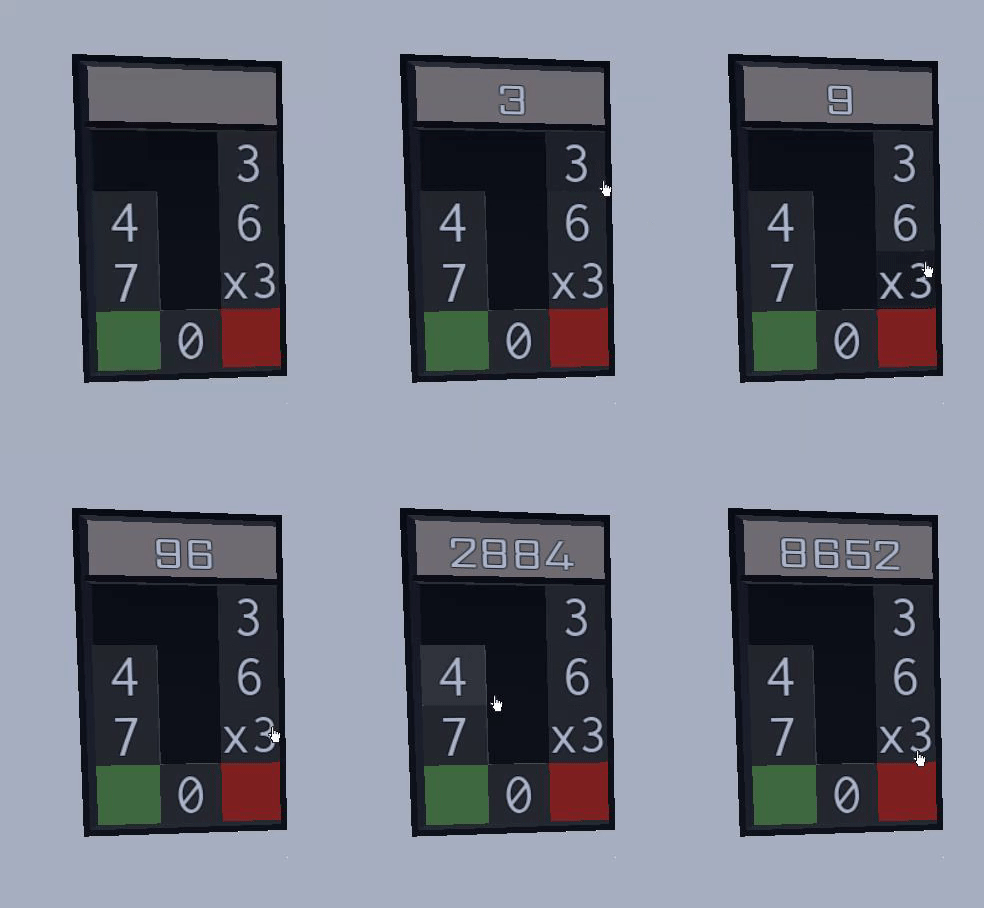
Is there a way to find out how I can make 3819 using only 5 digits and multiplying by 3
marsh citrusBOT
still temple
Is there a way to find out how I can make 3819 using only 5 digits and multiplyi...
limber marsh
Not entirely sure what you're asking
still temple
limber marsh
Not entirely sure what you're asking
sorry if the question seems confusing
i need to
limber marsh
Are you asking if there are integers a,b,c,d,e such that
abcde*3 =3819?
limber marsh
limber marsh
Are you asking if there are integers a,b,c,d,e such that
a*b*c*d*e*3 =3819?
Answer to that is yes btw
still temple
didn't know you could answer that
but
its more like
the integers are 3, 6, 4, 7, 0
and the only mathematical operation you can use
is multiplying by 3.
you can set up the numbers in any way
like
you can start with 36
then do 36*3 which gives
,calc 36*3
elfin berryBOT
Result:
108
108
and then you can add any integer at the end
lets say 0,
so it becomes 1080
i'll make a video hold on
so its easier to visualize

if that makes sense
still temple
 cyan parcel
Its pretty easy if u reverse engineering it
cyan parcel
Its pretty easy if u reverse engineering it
yea
i guess you can do like
3819/3
to get 1273
and then try to get 1273
from there
but its still pretty hard trying to get 1273 unless theres a way to find numbers that cant give 3 in the ones position when multiplied by 3
cyan parcel
So 12 (73)
still temple
then u add on 7 and 3
cyan parcel
12 = 4 * 3
cyan parcel
👍
still temple
.close
marsh citrusBOT
Channel closed
Closed by @quick sun
Use .reopen if this was a mistake.
still temple
great help brother
cyan parcel
lmao
marsh citrusBOT
✅
limber marsh
Do you still have a question?
still temple
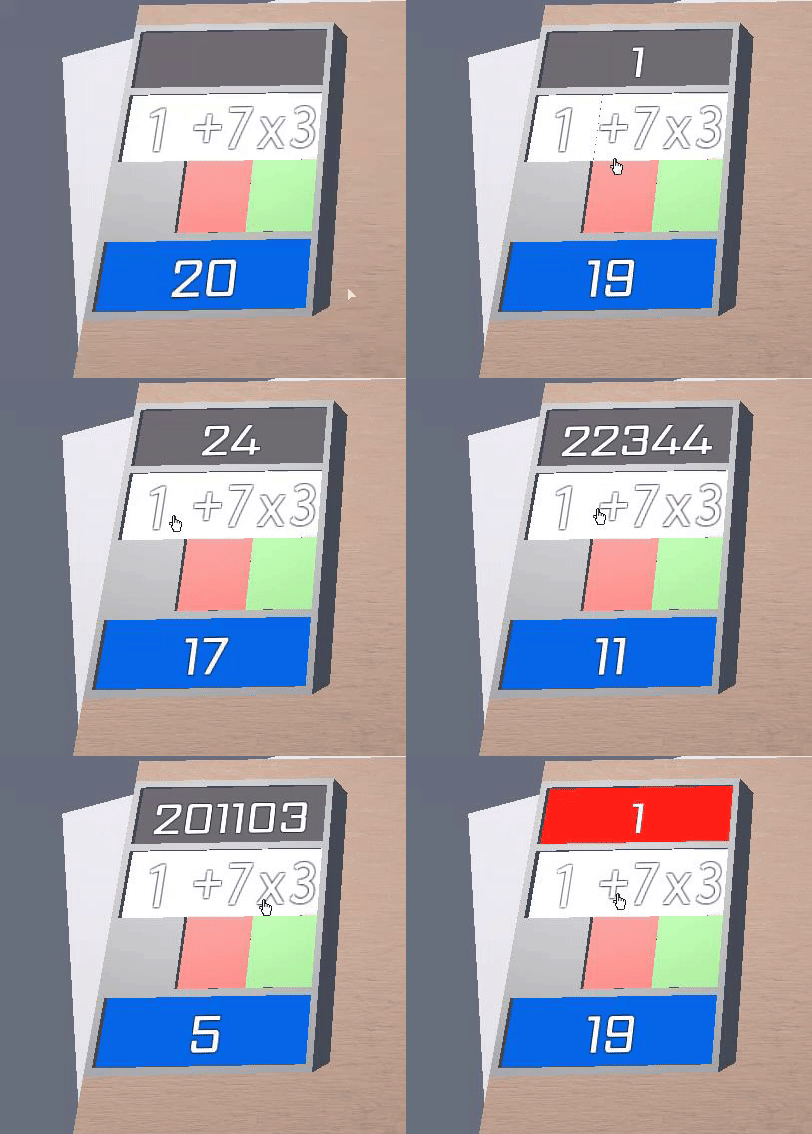
is reverse engineering/ figuring out how you get 3819 using only the number 1, and the mathematical operations +7 and *3 possible
yep
cyan parcel
Should be
still temple
okay, the only rule is you can only input 20 things
as in like 1 sec i'll make a gif
limber marsh
Since both functions increase the number,
There's a finite amount of things you can do anyways
 still temple
kind of LOOl
i'm not that good with math i'm only up to like
maybe completing the square
i assume you still need to get 1273 here
actually
3819
3819/3
1273
1273-7
1266
1266/3
422
maybe


 limber marsh
You can't subtract 7 though
still temple
limber marsh
Here's one way I think
wait
cyan parcel
So -1 become 1
still temple
i think this was the solution
limber marsh
limber marsh
Here's one way I think
This works
still temple

howd 10 become 101?
i'll share my solution hold on
here cuz discord messes it up
 limber marsh
still temple
howd 10 become 101?
limber marsh
still temple
howd 10 become 101?
You use the 1 button to add it at the end?
still temple
ohh
limber marsh
There's a lot of ways you can do this one
still temple
Yeah that'd work
im trying to bruteforce this one now
i guess it was a little easier before because it was only plus and division
now
you have to find 3819 using +201, +234, and -141
you start off at 0
still temple
still temple
you have to find 3819 using +201, +234, and -141
in strictly 24 moves
so you can't just add 201 19 times
nvm solved it
okay i'm stuck
is there a way to reverse engineer getting 3819 from;
+1
*2
+3
where you can multiply by 2 eight times
and you have a maximum of 18 turns
figured it out ^-^
marsh citrusBOT
@still temple Has your question been resolved?
still temple
sorrey .
how would you go by finding 1410535
starting with 1
where you can multiply by 2 variables
the variables value both start at 1 and can be increased only by adding one onto another
so, lets say you have 2 variables, a and b
both are = 1
increasing the value of a means adding b onto a
so a + b (1 + 1) = 2 which means a = 2 now
then u can add a onto b so on and so forth
til you get 1410535
but liek idk how.
sorry if it's confusing ^-^
still temple
still temple
where you can multiply by 2 variables
you can only multiply once
for each variable
still temple
no fuck th question actually
the question just asks for
xy = 1410535
the answer is 1055 and 1337
the problem is
how would you get 1055 and 1337 using only adding x and y togethr
 sick needle
that's a lot of messages
still temple
sick needle
that's a lot of messages
plez help .
sick needle
holy
still temple
i still need help
still temple
😭
sick needle
dw
marsh citrusBOT
@still temple Has your question been resolved?
marsh citrusBOT
@still temple Has your question been resolved?
marsh citrusBOT
Channel closed
Closed due to timeout
Use .reopen if this was a mistake.
Available help channel!
Send your question here to claim the channel.
Remember:
• Ask your math question in a clear, concise manner.
• Show your work, and if possible, explain where you are stuck.
• After 15 minutes, feel free to ping <@&286206848099549185>.
• Type the command .close to free the channel when you're done.
• Be polite and have a nice day!
Read #❓how-to-get-help for further information on how to ask a good question, and about conduct in the question channels.
 knotty trellis
finding the solutions is simple
but as there are infinitely many of them, writing them down might not be so easy
especially given that z^2 = 1 is probably the best way to describe them
are you supposed to put them on graph?
hmm okay
what do they mean by solve?
in what form do they want the solutons
there are infinitely many of them
small vector
i guess you could say if $z = a+bi$ then $\sqrt{a^2 + b^2} = 1$
knotty trellis
alright
elfin berryBOT
b
 knotty trellis
oh wait
ye thats right
it has no complex solutions
or no complex solutions that arent real
because z=1 is complex itself
it has just those 2 solutions
you can factorize it like this
z^2 = 1
z^2 - 1 = 0
(z-1)(z+1) = 0
so z=-1 or z=1
the imaginary component is 0
yep
marsh citrusBOT
@still temple Has your question been resolved?
marsh citrusBOT
Channel closed
Closed due to timeout
Use .reopen if this was a mistake.
marsh citrusBOT
Available help channel!
Send your question here to claim the channel.
Remember:
• Ask your math question in a clear, concise manner.
• Show your work, and if possible, explain where you are stuck.
• After 15 minutes, feel free to ping <@&286206848099549185>.
• Type the command .close to free the channel when you're done.
• Be polite and have a nice day!
Read #❓how-to-get-help for further information on how to ask a good question, and about conduct in the question channels.
 white plover
help
marsh citrusBOT
white plover
help

 warm cargo
first rewrite equation in vertex form which will be
g(x) = A(x + h)^2 + k
then substitue given vertex into the equation
g(x) = A(x - (-2))^2 + d
and the equation also passes through point 2.183,-5 so we can also substitue that into equation
-5 = A(2.183 - (-2))^2 + d
and do the same for point N which is x,-5
-5 = A(x - (-2))^2 + d
since we need the Y coordinate of -5 for point N this means we have the same equation as for point M so they are on the same parabolic curve and then solve for A and d using the equation we used for point M
-5 = A(2.183 + 2)^2 + d
since both points are on the same parabola and have the same y coordinate of -5 their x coordinates will be about the vertex which is -2
so this means that if the distance between M and the vertex is 4.183 units (2.183-(-2)=4.183) then the x coordinate of point n will be
x = -2 - 4.183
which is -6.183
so the value of x for when the y coordinate is -5 will be -6.183
(-6.183 , -5 )
white plover
:0
marsh citrusBOT
@white plover Has your question been resolved?
Channel closed
Closed by @white plover
Use .reopen if this was a mistake.
Available help channel!
Send your question here to claim the channel.
Remember:
• Ask your math question in a clear, concise manner.
• Show your work, and if possible, explain where you are stuck.
• After 15 minutes, feel free to ping <@&286206848099549185>.
• Type the command .close to free the channel when you're done.
• Be polite and have a nice day!
Read #❓how-to-get-help for further information on how to ask a good question, and about conduct in the question channels.
Channel closed
Channel closed due to the original message being deleted.
If you did not intend to do this, please open a new help channel,
as this action is irreversible, and this channel may abruptly lock.
 dusty forum
.close
marsh citrusBOT
Available help channel!
Send your question here to claim the channel.
Remember:
• Ask your math question in a clear, concise manner.
• Show your work, and if possible, explain where you are stuck.
• After 15 minutes, feel free to ping <@&286206848099549185>.
• Type the command .close to free the channel when you're done.
• Be polite and have a nice day!
Read #❓how-to-get-help for further information on how to ask a good question, and about conduct in the question channels.
 long cape
Cross product
marsh citrusBOT
long cape
Cross product
 dapper socket
long cape
What does the following formula find?
dapper socket
long cape
What does the following formula find?
cross product of position vector of (a,b,c) and (x,y,z) ?
long cape
a(x-x0) + b(y-y0) + c(z-z0) = 0
This formula finds something but what is it?
The cross product is also considered the normal vector right? Does that mean the cross product always has a length of 1?
dapper socket
long cape
The cross product is also considered the normal vector right? Does that mean the...
you mean magnitude not length right?
long cape
oh maybe
dapper socket
yes we get a vector with cross product
long cape
I thought they kinda mean the same thing length and magnitude and distance
dapper socket
long cape
a(x-x0) + b(y-y0) + c(z-z0) = 0
this formula is for a,b,c vector perpendicular to a plane where x0,y0,z0 is a point on the plane
dapper socket
long cape
I thought they kinda mean the same thing length and magnitude and distance
wait
they both are same but yes mostly in vectors it is termed magnitude
long cape
Cross prod always has a magnitude of 1?
We always call cross product the n vector?
n as in norm
long cape
long cape
a(x-x0) + b(y-y0) + c(z-z0) = 0
So what sort of question would I use this formula for? How would the question be worded
dapper socket
long cape
Cross prod always has a magnitude of 1?
nope only the maginitude of cross product of unit vector is 1
long cape
Ah OK
dapper socket
long cape
We always call cross product the n vector?
yes because cross product is normal to the plane formed by two vectors
for example there are two vectors one along x and other along y
long cape
And to find norm of vector I divide each entry by magnitude of the vector? Sqrt(a^2+b^2+c^2)
dapper socket
then their cross product has the direction in +z is X cross Y or -z if Y cross X
long cape
dapper socket
yes because cross product is normal to the plane formed by two vectors
“Normal” vector is different in this context? Not referring to magnitude of 1?
dapper socket
long cape
So what sort of question would I use this formula for? How would the question be...
well you use this to like find a vector in the direction of a,b,c or you can say normal to the given plane
dapper socket
long cape
“Normal” vector is different in this context? Not referring to magnitude of 1?
\ normal as in perpendicular
long cape
So there is normal as in perpendicular
And there is norm as in magnitude of 1
Both are different terms
I should not get them confused
dapper socket
long cape
So there is normal as in perpendicular
And there is norm as in magnitude of 1
no norm means magnitude or length of a vector
dapper socket
long cape
“Find the norm”
If it said find the unit vector then you may want to find the vector in that direction with magnitude/length = 1
long cape
To find the unit vector you divide by the norm right
dapper socket
long cape
To find the unit vector you divide by the norm right
yes that is correct
long cape
long cape
a(x-x0) + b(y-y0) + c(z-z0) = 0
Tyty
Sorry still confused what a question might ask where I need to use this formula? Is the formula finding a plane? Values that you plug in after? A vector? A scalar? A point?
dapper socket
long cape
Tyty
Sorry still confused what a question might ask where I need to use this for...
a plane.
long cape
And what would the question be asking
Where I should use this formula
Given only a point and a vector
Find the plane?
Plane where point passes through
Plane of the vector I guess?
dapper socket
question will ask you to find a plane passing through (x0,y0,z0) and then in the direction of a vector n which is (a,b,c)
long cape
Oh wow
long cape
dapper socket
question will ask you to find a plane passing through (x0,y0,z0) and then in the...
What does direction mean in this question?
How do you know the vector is a cross product vector to begin with?
The question stated that?
dapper socket
long cape
What does direction mean in this question?
direction of a vector?
dapper socket
long cape
How do you know the vector is a cross product vector to begin with?
the vector doesn't need to be a cross product
long cape
Oh ok
dapper socket
tbh this formula is quite useful in many scenarios let me try to list some
to make it more clear
long cape
Tyvm
dapper socket
-
Determining the equation of a plane passing through a specific point with a given normal vector
-
Finding the intersection of two planes
-
Defining the orientation of a plane in 3D space relative to a reference point
do you have some exercise book with questions? if yes then maybe try seeing the ones that uses this formula since it can be used in too many ways
dapper socket
see the vector passing through (a,b,c) can be any vector
a cross product of two vectors
simply a normal vector to a plane
both are possible
since when you cross product two vectors you also kind of visualize the resultant vector to be perpendicular to the plane formed by those two vectors in the space
dapper socket
long cape
Tyvm!
you're most welcome
long cape
.close
marsh citrusBOT
Channel closed
Closed by @long cape
Use .reopen if this was a mistake.
marsh citrusBOT
Available help channel!
Send your question here to claim the channel.
Remember:
• Ask your math question in a clear, concise manner.
• Show your work, and if possible, explain where you are stuck.
• After 15 minutes, feel free to ping <@&286206848099549185>.
• Type the command .close to free the channel when you're done.
• Be polite and have a nice day!
Read #❓how-to-get-help for further information on how to ask a good question, and about conduct in the question channels.
 buoyant blade
if x=2^1/3 -2^-1/3 then 2x^3 + 6x =?
marsh citrusBOT
buoyant blade
if x=2^1/3 -2^-1/3 then 2x^3 + 6x =?
 serene spoke
Hii
 late geode
!status
marsh citrusBOT
What step are you on?
1. I don't know where to begin.
2. I have begun but got stuck midway.
3. I got an answer but I was told that it's wrong.
4. I got an answer and would like my work checked.
5. I have a question about someone else's work/solution.
6. I have completed the problem and don't need help anymore. Thank you.
7. None of the above
.
buoyant blade
 late geode
you're violating the order of operations in the third line in multiple ways
you're seem to be trying to do
a(b+c)^n→(ab + ac)^n
which is invalid since exponentiation takes priority
and then also
pq^n → (pq)^n
which again is invalid for the same reason
buoyant blade
yeah i bro i need a clear explanation how exponents work with addition subractiona multiplication division cuz i just completed 10th
buoyant blade
late geode
you're seem to be trying to do
a(b+c)^n→(ab + ac)^n
which is invalid since expo...
so
late geode
its a bit more convenient to use the cubic expansion identity with the $-$ \
$$(a-b)^3 = a^3 - b^3 -3ab(a-b)$$
here your
$$a = 2^{\frac13}, b = 2^{-\frac13}$$
elfin berryBOT
ℝαμΩℕωⅤ
 late geode
do you have access to a list of exponent laws
marsh citrusBOT
@buoyant blade Has your question been resolved?
Channel closed
Closed by @buoyant blade
Use .reopen if this was a mistake.
marsh citrusBOT
Available help channel!
Send your question here to claim the channel.
Remember:
• Ask your math question in a clear, concise manner.
• Show your work, and if possible, explain where you are stuck.
• After 15 minutes, feel free to ping <@&286206848099549185>.
• Type the command .close to free the channel when you're done.
• Be polite and have a nice day!
Read #❓how-to-get-help for further information on how to ask a good question, and about conduct in the question channels.
 wanton shale
 marsh citrusBOT
wanton shale
wanton shale
marsh citrusBOT
wanton shale
wanton shale
can someone tell me why we need to find A'(t) and not simply A(t). I know it's the right answer but it doesn't make sense to me that l(t) and w(t) multiply to give A(t) but we need to find A'(t). isn't the first derivative only taken to find the speed of a rate of change?
broken dome
You need to find the rate at which it is increasing
Not the ammount it is
A(t) is the function of the area in a given moment with unit cm
A'(t) is the rate of change of the area in a given moment with unit cm/s
You are given the rate of change of the sides
So you are given l'(t) = 5 cm/s and w'(t) = 4 cm/s
They don't multiply to A'(t) however
A'(t) should come out to be l'(t) * w(t) + w'(t) * l(t)
Where w(t) is width in a moment and l(t) length in a moment
wanton shale
thanks that makes things clear. i'm also curious as to why they assumed we should find A'(t) at t=0 when it wasn't explicitly stated in the question.
is it because the equations of l(t) = 12+5t and w(t) = 10+4t are based on when the time is zero?
broken dome
I don't have the full question sheet, so I don't know, in this case you're not given the time, you're given the dimension, so you need to find the moment in time from the given dimensions, but since the rate of change is constant it doesn't matter anyway
If the rate of change is constant then it doesn't change with time, hence t doesn't matter
broken dome
wanton shale
thanks that makes things clear. i'm also curious as to why they assumed we shoul...
Given those functions, yes
marsh citrusBOT
@wanton shale Has your question been resolved?
marsh citrusBOT
Channel closed
Closed due to timeout
Use .reopen if this was a mistake.
Available help channel!
Send your question here to claim the channel.
Remember:
• Ask your math question in a clear, concise manner.
• Show your work, and if possible, explain where you are stuck.
• After 15 minutes, feel free to ping <@&286206848099549185>.
• Type the command .close to free the channel when you're done.
• Be polite and have a nice day!
Read #❓how-to-get-help for further information on how to ask a good question, and about conduct in the question channels.
 exotic wolf
Hello. I have a question about Partial Fraction Decomposion

 exotic wolf
I dont understand what you mean
if we put x = 2
then Q(x) = 0
so we divide with 0
 frosty linden
What is Q(x)
exotic wolf
(x-2)(x-3)
frosty linden
Ok what is P(x)
exotic wolf
x+4
frosty linden
I didn't get that for me when you have your expression multiply both side by your denominator and evaluate on the roots
And you get your A and B
exotic wolf
i dont understand
frosty linden
You will have like x+4 = A(x-3) + B(x-2)
And you evaluate on Roots which are 3 and 2 to get A and B
marsh citrusBOT
Channel closed
Closed by @exotic wolf
Use .reopen if this was a mistake.
Available help channel!
Send your question here to claim the channel.
Remember:
• Ask your math question in a clear, concise manner.
• Show your work, and if possible, explain where you are stuck.
• After 15 minutes, feel free to ping <@&286206848099549185>.
• Type the command .close to free the channel when you're done.
• Be polite and have a nice day!
Read #❓how-to-get-help for further information on how to ask a good question, and about conduct in the question channels.
 toxic lily
Anyone know how to prove this
 marsh citrusBOT
toxic lily
Anyone know how to prove this
toxic lily
marsh citrusBOT
toxic lily
Anyone know how to prove this
toxic lily
Tried induction for a while did not reach far
marsh citrusBOT
@toxic lily Has your question been resolved?
marsh citrusBOT
@toxic lily Has your question been resolved?
toxic lily
.close
marsh citrusBOT
Channel closed
Closed by @toxic lily
Use .reopen if this was a mistake.
marsh citrusBOT
Available help channel!
Send your question here to claim the channel.
Remember:
• Ask your math question in a clear, concise manner.
• Show your work, and if possible, explain where you are stuck.
• After 15 minutes, feel free to ping <@&286206848099549185>.
• Type the command .close to free the channel when you're done.
• Be polite and have a nice day!
Read #❓how-to-get-help for further information on how to ask a good question, and about conduct in the question channels.
 modern heron
can u help me if its okay? i had to check the uniform convergence
 marsh citrusBOT
modern heron
can u help me if its okay? i had to check the uniform convergence
marsh citrusBOT
modern heron
can u help me if its okay? i had to check the uniform convergence
@modern heron Has your question been resolved?
modern heron
<@&286206848099549185>
marsh citrusBOT
@modern heron Has your question been resolved?
marsh citrusBOT
@modern heron Has your question been resolved?
marsh citrusBOT
@modern heron Has your question been resolved?
marsh citrusBOT
Channel closed
Closed due to timeout
Use .reopen if this was a mistake.
marsh citrusBOT
Available help channel!
Send your question here to claim the channel.
Remember:
• Ask your math question in a clear, concise manner.
• Show your work, and if possible, explain where you are stuck.
• After 15 minutes, feel free to ping <@&286206848099549185>.
• Type the command .close to free the channel when you're done.
• Be polite and have a nice day!
Read #❓how-to-get-help for further information on how to ask a good question, and about conduct in the question channels.
 rain hare
How do i interpret and solve this?
 marsh citrusBOT
rain hare
How do i interpret and solve this?
marsh citrusBOT
rain hare
How do i interpret and solve this?
 next raft
try drawing a table
 dusky viper
follow the same theme for the other 2 equations
u should have an equation for lead and an equation for manganese
marsh citrusBOT
@rain hare Has your question been resolved?
marsh citrusBOT
Channel closed
Closed due to timeout
Use .reopen if this was a mistake.
marsh citrusBOT
Available help channel!
Send your question here to claim the channel.
Remember:
• Ask your math question in a clear, concise manner.
• Show your work, and if possible, explain where you are stuck.
• After 15 minutes, feel free to ping <@&286206848099549185>.
• Type the command .close to free the channel when you're done.
• Be polite and have a nice day!
Read #❓how-to-get-help for further information on how to ask a good question, and about conduct in the question channels.
 hasty wasp
The part that's been bothering me for this question is the text in the 2nd picture


 marsh citrusBOT
hasty wasp
The part that's been bothering me for this question is the text in the 2nd pictu...
hasty wasp
marsh citrusBOT
hasty wasp
The part that's been bothering me for this question is the text in the 2nd pictu...
hasty wasp
B is a random variable for the mass of each biscuit
P1 is a random variable for the mass of each packet containing 25 biscuits
P2 is a random variable for the mass of each packet containing 26 biscuits
X is a random variable for the mass of each box filled with packets containing 25 biscuits
The problem I'm dealing with is interpreting the text in the 2nd pic
I thought it was P(P1>P2) but when I calculated it out it was not the right answer
The answer is actually 0.0385
How do you interpret this text as is to get the probability?
marsh citrusBOT
@hasty wasp Has your question been resolved?
hasty wasp
<@&286206848099549185>
hasty wasp
<@&286206848099549185>
marsh citrusBOT
@hasty wasp Has your question been resolved?
hasty wasp
<@&286206848099549185>
hasty wasp
<@&286206848099549185> this is urgent btw I don't wanna wait on this forever
 ivory sundial
Divide the variance by 25
elfin berryBOT
Max
 hasty wasp
ivory sundial
Divide the variance by 25
hasty wasp
ivory sundial
Divide the variance by 25
Why
ivory sundial
If you do a hypothesis test:
Suppose in one test you sample 100 items.
And in another you sample just 25 items.
Clearly the bigger sample is more significant, but without changing the variance you would get the same probabilities out for equal sample means.
Decreasing the variance by a factor of n just accounts for that.
hasty wasp
This is about probability ditributions not sampling and estimations
If my knowledge in that is void (which it is) how would I've known it in the first place when confronting the question
<@&286206848099549185>
<@&286206848099549185>
<@&286206848099549185> urgent but is there another way to do this question in its own concept
sick needle
No idea
next phoenix
Bruh
indigo talon
hasty wasp
This is about probability ditributions not sampling and estimations
are you sure?
it seems to be a sampling proportions question
hasty wasp
indigo talon
are you sure?
I mean

All of these are involving random variables and probability distributions
Even the previous chapters were about probabilities
The next chapter is sampling and estimation
How would I know a thing that is without no preview of the next chapter?
@indigo talon
indigo talon
alr ill talk a look at the problem
its been a bit since ive done normal distributions and stuff so give me sum time
hasty wasp
Kewl
indigo talon

so we have to find the distribution of the total mass of biscuits
what do u think the mean of this new distribution is gonna be
@hasty wasp


 hasty wasp
B is a random variable for the mass of each biscuit
P1 is a random variable for...
hasty wasp
hasty wasp
B is a random variable for the mass of each biscuit
P1 is a random variable for...
Reference
indigo talon
indigo talon
are we solving this question here?
hasty wasp
hasty wasp
The problem I'm dealing with is interpreting the text in the 2nd pic
Question in the 2nd pic
I'm only posting pics of the questions as a whole just fyi
The ones I've written saying "Confused by subquestion/part of question" is what I struggled finding with
I mean if someone took time to look around sure they'd catch on
<@&286206848099549185>
<@&286206848099549185>
hasty wasp
<@&286206848099549185>
<@&286206848099549185>
<@&286206848099549185>
<@&286206848099549185> just one question PLEASE
Thank me that I havent gotten unhinged today
 sleek shadow
you’ve phoned helpers like 34 times bro
hasty wasp
 fallow roost
my notification is full of your massages
fallow roost
my notification is full of your massages
Maybe if someone were to actually solve my question then sure I wouldnt get cranky
sleek shadow
hasty wasp
Maybe if someone were to actually solve my question then sure I wouldnt get cran...
everyone in america was sleeping
still temple
is this the question u need to answer?

for the first question (the 598g to 606g)
Since the sample is random the masses of the 25 biscuits will be independent of each other
the distribution of the total mass willl be normal
hasty wasp
hasty wasp
The problem I'm dealing with is interpreting the text in the 2nd pic
2nd pic
2nd pic
still temple
ah
hasty wasp
Some say it is a sampling question
still temple
is that the second question of 26? the "ten packets of biscuits are placed in a box" one?
hasty wasp
 still temple
ahh ok
hasty wasp
This
still temple
so
If X is the mass of the biscuit in packet containing 25 buiscuits then we already know that X is
N(600,90.25)
 molten moss
hasty wasp
The part that's been bothering me for this question is the text in the 2nd pictu...
molten moss
hasty wasp
The part that's been bothering me for this question is the text in the 2nd pictu...
ye i think a lot of the basic work has already been done correctly in the third screenshot here
hasty wasp
still temple
If X is the mass of the biscuit in packet containing 25 buiscuits then we alread...
I'd call it P1 but yeah
still temple
If we say Y is the mass of buiscut in a packet containing 26 buiscuits then Y is normally distributed with mean 26 x24=624g and variance 26 x 1.9^2=93.86
molten moss
i haven't looked up the values but i'm wondering why the result is so high
still temple
hasty wasp
I'd call it P1 but yeah
man im helping u and that is enough so pls
the difference Y-X is normally distributed with mean = equalling 624-600
or 24 g
variance is 184.11
and standard dev is 13.57
molten moss
0.2236 is the answer that you came up with, right? just intuitively that sounds crazy high, so maybe something went wrong with selecting that Z-value 0.760
still temple
thus z=(0-24)/(13.57)=-1.769
hence the probability is 1-0.9615
aka 0.0385
i think that is the best any1 can help u here
people arent always jumping to help u so be patient
this may not always be the quickest most efficient method of answer finding
or even help finding at that
molten moss
ye just a thought, i was scared of even starting this question b/c there were like 200 messages after the original question
still temple
FR!
molten moss
it can help to restate what the actual question is at that point, b/c it looks like maybe there's already been some progress
tho i guess in this case there wasn't necessarily
still temple
i open discord and instantly get compounded with 200+ messages
anyways i gtg i have school 😭, just a few days till middle school is over 4 me
hasty wasp
still temple
aka 0.0385
omg thank you so much
Not used to waiting 4 hours for a question I want to be answered before I sleep and have to reopen
still temple
np! i got you
hasty wasp
I guess I'll evolve to being patient so yeah
still temple
that would help...
hasty wasp
Sorry for the pings too
still temple
np for me.. cant say the same for every1 else
hasty wasp
True
still temple
well if that answers ur questions ill be on my way
hasty wasp
It does