#help-33
1 messages · Page 89 of 1
 brazen jungle
 ebon depot
If I choose the first one then I’d have first 5 choices, then 4 and finally 3
543= 60 choices
But that does not include all possible combinations of the other letters
 jagged relic
ebon depot
If I choose the first one then I’d have first 5 choices, then 4 and finally 3
jagged relic
ebon depot
If I choose the first one then I’d have first 5 choices, then 4 and finally 3
Unfortunately that's wrong because the A's are indistinguishable
jagged relic
ebon depot
But that does not include all possible combinations of the other letters
The possible arrangements of the other letters is just 4!, you even said so yourself: #help-30 message
jagged relic
ebon depot
I have three As
A1,A2 and A3
But you don't count C A1 R A2 M B A3 and C A2 R A1 M B A3 as different solutions
ebon depot
I get that
jagged relic
That's the reason permutations and combinations are different
P(5,3) = 5! 4! 3! = 60
That's what you did
C(5,3) = [5! 4! 3!] / 3! = 10
ebon depot
Yes because that is only because I remember doing another where I just divide by the factorial of all letters that are the same
3As result in 3! In denominator
It has nothing with me understanding why
jagged relic
ebon depot
Yes because that is only because I remember doing another where I just divide by...
That's right, that's why the 3! is there
ebon depot
I want to be able to utilize the formula
jagged relic
Oh okay hold on
ebon depot
But I can’t distinguish between them
jagged relic
If you arrange the letters like CARAMBA, but count each A as different (like you said, A1, A2, A3)
then you use permutations
but since the A's aren't different
you need to divide by the number of ways you can arrange A1, A2, A3
It can be A1, A2, A3, or A2, A1, A3, or A2, A3, A1, ...
That's 3! arrangements
They all count as the same solution
ebon depot
Yes
jagged relic
So what exactly don't you understand?
jagged relic

ebon depot
A1,A2,A3 A2,A1,A3 = 2
A1,A2,A3 A2,A1,A3 = 1
So the above is combinations
And bottom permutations
What does n and what does k stand for infor combinations and permutations?
jagged relic
The other way around, assuming you meant 6 instead of 2...
ebon depot
No I meant 2 and 1
jagged relic
Then that makes no sense
ebon depot
Then I don’t understand?
Like I can’t think as quick as you are professors
I need a structured way to actually understand
jagged relic
If you have 3 different objects, there are just 3! different ways to order them
If you have 3 identical objects, there is only one way to order them
ebon depot
Yes
jagged relic
Well, in CARAMBA, you have 4 different consonants and 3 identical vowels
You can order the consonants in 4! different ways, and you can order the vowels in only one way
The rest is determining how to place the vowels such that they don't touch each other
For that, you need to think about what it means for the vowels not to touch each other
It means there is at least one consonant in between
ebon depot
Yes
jagged relic
In other words, you can place only one vowel between two consecutive consonants
(or zero)
There are 3 places you can insert a vowel between two consonants, and also 2 places at the ends (between a consonant and nothing)
So there are 5 places where you can insert one or zero vowels
You have 3 vowels to insert
So you need to choose 3 places out of the 5
That's literally what combinations are used for: choosing k things among n
ebon depot
I'm so sorry Nel but i'm reading it over and over but i just don't get it
I assumed since this was a question about permutations or combinations i'd have to choose one of them
and then just utilize the formula based of n and k
jagged relic
Not sure what to tell you, maths is not about applying one specific formula every time
 sleek mantle

 marsh citrusBOT
Channel closed
Closed by @ebon depot
Use .reopen if this was a mistake.
 Available help channel!
Send your question here to claim the channel.
Remember:
• Ask your math question in a clear, concise manner.
• Show your work, and if possible, explain where you are stuck.
• After 15 minutes, feel free to ping <@&286206848099549185>.
• Type the command .close to free the channel when you're done.
• Be polite and have a nice day!
Read #❓how-to-get-help for further information on how to ask a good question, and about conduct in the question channels.
 kind perch
please say this isn't as complicated as it looks
 marsh citrusBOT
kind perch
please say this isn't as complicated as it looks
kind perch
marsh citrusBOT
kind perch
please say this isn't as complicated as it looks
kind perch
starting on part (a)
 past frigate
It isn't
kind perch
phew which do i do first integrate or partial fraction it?
past frigate
As final ans?
 elfin berryBOT
sealpup321
 kind perch
past frigate
As final ans?
kind perch
past frigate
As final ans?
I cant see how to turn this into a partial fraction?
as its not a fraction with a polynomial denominator
past frigate
For partial fraction you need the degree of denominator to be greater than that of numerator
So try long division first
past frigate
What did you get
kind perch
$x^2+3x+6+(2/x-1)$
elfin berryBOT
sealpup321
 kind perch
what do you mean?
past frigate
elfin berry
**sealpup321**
What is this equal to
kind perch
kind perch
please say this isn't as complicated as it looks
when you do polynomial long division on part (a)
$(x^3+2x^2+3x-4)/(x-1)$
elfin berryBOT
sealpup321
 past frigate
elfin berry
**sealpup321**
past frigate
elfin berry
**sealpup321**
$(x^3+2x^2+3x-4)/(x-1) = \frac{{(x^2 + 3x + 6)}{(x-1)} + 2}{x-1}$
elfin berryBOT
Lorentz
 kind perch
yes
elfin berryBOT
Lorentz
 kind perch
yup
kind perch
elfin berry
**sealpup321**
then integrated to get this
past frigate
One of the terms should be in form of ln tho
kind perch
past frigate
One of the terms should be in form of ln tho
why?
past frigate
The 2/(x-1) term
kind perch
I mean you are right but I am confused
kind perch
past frigate
The 2/(x-1) term
ah because i wasn't sure what to do with it i turned it into $2x^{-1}-2$
elfin berryBOT
sealpup321
 kind perch
ye i did to get 2-2x
elfin berryBOT
Lorentz
 past frigate
And we have this
kind perch
past frigate
Integration of 1/x is ln(x)
oh thanks
kind perch
so how would i use that then?
past frigate
elfin berry
**Lorentz**
You have x-1 in the denominator here
kind perch
so $ln|1/2 * x-1|$
elfin berryBOT
sealpup321
 kind perch
?
past frigate
No wait that 2 is a constant, it would be multiplied with the ln thing
past frigate
elfin berry
**Lorentz**
The 2 here I mean
kind perch
or $2ln|x-1|$
elfin berryBOT
sealpup321
 past frigate
Yes that
kind perch
cool 🙂
alright so once i have this new number how do i turn it into a partial fraction?
past frigate
Which new number?
kind perch
$(1/3)x^3+(3/2)x^2+6x+2ln|x-1|$
elfin berryBOT
sealpup321
 past frigate
That's your final answer
kind perch
huh?
kind perch
do i not need to do the whole A/x-1 + B/x-1 +C/x-1
or whatever the numerator and denominator would be in this case
past frigate
I thought so too, but after using long division the denominator of 2/(x-1) was a direct integration
kind perch
past frigate
I thought so too, but after using long division the denominator of 2/(x-1) was a...
sorry can you explain what a direct integration means?
past frigate
I mean like you can directly integrate 1/x to ln x
Instead of some partial fractions thing
kind perch
past frigate
I mean like you can directly integrate 1/x to ln x
so you dont need to turn in into partial fractions...
strange... thanks 🙂
kind perch
yup checked and its correct thanks for all the help
past frigate
Coz for partial fracs the degree of denominator should be more than numerator
So I didn't know any other way
marsh citrusBOT
Channel closed
Closed by @kind perch
Use .reopen if this was a mistake.
Available help channel!
Send your question here to claim the channel.
Remember:
• Ask your math question in a clear, concise manner.
• Show your work, and if possible, explain where you are stuck.
• After 15 minutes, feel free to ping <@&286206848099549185>.
• Type the command .close to free the channel when you're done.
• Be polite and have a nice day!
Read #❓how-to-get-help for further information on how to ask a good question, and about conduct in the question channels.
 gusty sorrel
Where did condition 2 and 3 come from?
 marsh citrusBOT
gusty sorrel
Where did condition 2 and 3 come from?
marsh citrusBOT
gusty sorrel
Where did condition 2 and 3 come from?
@gusty sorrel Has your question been resolved?
gusty sorrel
.close
marsh citrusBOT
Channel closed
Closed by @gusty sorrel
Use .reopen if this was a mistake.
marsh citrusBOT
Available help channel!
Send your question here to claim the channel.
Remember:
• Ask your math question in a clear, concise manner.
• Show your work, and if possible, explain where you are stuck.
• After 15 minutes, feel free to ping <@&286206848099549185>.
• Type the command .close to free the channel when you're done.
• Be polite and have a nice day!
Read #❓how-to-get-help for further information on how to ask a good question, and about conduct in the question channels.
 muted grail
need some help with this question
 marsh citrusBOT
muted grail
need some help with this question
muted grail
marsh citrusBOT
muted grail
need some help with this question
muted grail
Someone pointed out that we can define a function g(x) = f(x) - x and since both f(x) and x are continuous functions then so is g(x).
then we can use the fact that f(x) is a bounded function to look at two values a and b such that a > b
and g(a) and g(b) have opposite signs
this would imply the existence of a g(c) = 0, according to the bolzano's theorem.
this is the part I'm confused about.
how does the fact that g(x) is bounded (due to f(x) being bounded) and continuous (due to both f(x) and x being continuous) imply that there exists values a and b such that g(a) and g(b) have opposite signs?
<@&286206848099549185>
 spark siren
as f is bounded there are values m and n such that m < f(x) < n for all x. now think about what does this mean for g.
muted grail
hmm
it would just mean that g is bounded too
right?
wait actually
if g(x) = f(x) - x
regardless of if f(x) is bounded or not, the x isn't bounded
which would mean that g is not bounded
right?
spark siren
take an x between m and n.
spark siren
muted grail
which would mean that g is not bounded
for x large enough f(x)-x < n-x < 0 -> g(x) < 0
for x small enough (which means x< 0, and |x| large enough) f(x)-x > 0, which means g(x) > 0, so you know that a and b with the claimed conditions exist.
muted grail
spark siren
for x large enough f(x)-x < n-x < 0 -> g(x) < 0
for x small enough (which means ...
ok lemme think this through
muted grail
spark siren
for x large enough f(x)-x < n-x < 0 -> g(x) < 0
for x small enough (which means ...
x is not bounded correct? It's just like the identity function
"for x large enough f(x)-x < n-x < 0 -> g(x) < 0" so in this line, we are essentially taking the largest possible f(x) which is n, and we take a value x, and since x isn't bounded, it can be any real number
so we take x such that n - x < 0 -> g(x) < 0
spark siren
no, not the largest possinle. thsi would be infinity. just an x which is > n.
muted grail
but it wouldn't be infinity
as f(x) is bounded?
said bounds being n and m
right?
spark siren
if x > n then also x+1, so a largest x cant exist.
muted grail
i said largest possible f(x)
x is unbounded. there isn't a largest x right?
we can select x however we like
spark siren
we take an x which is > n.
muted grail
ok got it
which proves the exictence of a negative g(x)
and then do the same to prove the exictence of a positive g(x) value
spark siren
yes
muted grail
and then since it is continuous
we have proven that there exists a g(x) = 0
the we have 0 = f(x) - x => f(x) = x
which proves part i
spark siren
yes
muted grail
spark siren
as f is bounded there are values m and n such that m < f(x) < n for all x. now t...
shouldn't this be m =< f(x) =< n
muted grail
spark siren
the boundary could be asymptotic
i don't know what that means
aympstotic boundries
spark siren
arctan is bounded, what is m and n if you think there should be an "=" in m<=f(x)<=n?
muted grail
f(x)
spark siren
take f(x) = arctan (x), say what is m and n such that m <= f(x) <= n, and for what x is f(x) = m and for what x is f(x) = n?
muted grail
idk how arctan behaves at different values
spark siren
you do not know the function arctan?
muted grail
i know the function
spark siren
is ir bounded?
muted grail
yes
spark siren
what is the upper bound?
muted grail
ik how it looks like
muted grail
spark siren
what is the upper bound?
I dont knw
one radian
I don't remember honestly
arctan was the function that took lengths as arguments and gave degrees right?
that's literally all I know about it
and how it looks like
spark siren
anyway, if a function is bounded this only means, that there are upper and lower bounds. that does not mean, that the function reaches the bounds. and ix k is an upper bound then also k+1, k+2, k+3, ---
muted grail
ok got it
marsh citrusBOT
@muted grail Has your question been resolved?
marsh citrusBOT
Channel closed
Closed due to timeout
Use .reopen if this was a mistake.
Available help channel!
Send your question here to claim the channel.
Remember:
• Ask your math question in a clear, concise manner.
• Show your work, and if possible, explain where you are stuck.
• After 15 minutes, feel free to ping <@&286206848099549185>.
• Type the command .close to free the channel when you're done.
• Be polite and have a nice day!
Read #❓how-to-get-help for further information on how to ask a good question, and about conduct in the question channels.
 jaunty pelican
what is the easiest way to solve a system of linear equations
 zenith python
it depends on how many equations you have?
jaunty pelican
just 2
zenith python
my favorite method is reduction
jaunty pelican

 shell ether
maybe gauss jordan method
jaunty pelican
how would you do that
 main idol
jaunty pelican
how would you do that
main idol
jaunty pelican
how would you do that
If you don't know it, say so
jaunty pelican
I don't
main idol
You can just use algebra
There are many ways, one could be multiply one equation by a number so that when you add them you eliminate a variable
Like the first eqn by 3
shell ether
or replacement
main idol
Or second equation by -4
jaunty pelican
where did you get -4 from?
main idol
Try it all 3, none are better than the other
main idol
jaunty pelican
where did you get -4 from?
-4 + 4 = ?
jaunty pelican
0
shell ether
jaunty pelican
where did you get -4 from?
4x
x
4x
-4x
So we can erase this shit
Like add first equation to second
And we'll get rid of x
jaunty pelican
add everything?
shell ether
And we'll be able to solve y
Yes
But
First of all
Multiply second equation by -4
All second equation
And then addition
jaunty pelican
im still confused where your getting the -4 from
jaunty pelican
but there is no -4 in the equation
shell ether
So we can do 4x+(-4x) and got 0
shell ether
jaunty pelican
but there is no -4 in the equation
But we can multiply all second equation to -4
main idol
jaunty pelican
but there is no -4 in the equation
-4 = (-1) * 4
jaunty pelican
ok
shell ether
multiply second by -4
shell ether
well as i said
main idol
main idol
-4 = (-1) * 4
Do you understand this
shell ether
We can multiply our equation by any number
jaunty pelican
shell ether
We can multiply our equation by any number
oh so we can mutiply it by and number?
any
so 4 (10)
would that work
or does it have to be 0
jaunty pelican
cause you said we can mutiply our equation by any number
shell ether
You can't replace x
shell ether
jaunty pelican
cause you said we can mutiply our equation by any number
Yep
you can do (x-3y=7)×(-4)
shell ether
shell ether
So add the first equation to second
replace your second equation with this result and keep the first equation in the same place
jaunty pelican
but 12y+y = 12y^2?
jaunty pelican
is it because theres a 1 infront of y?
shell ether
Yes
jaunty pelican
y=1
shell ether
You found y
jaunty pelican
do i replace y for 1?
shell ether
x=(15-y)/4
Hope you can do it
And then replace
so the answer isn't 5
Oops
14/4
Solve it
shell ether
well
You know that
Bro
I'm confused that you don't know basics
x+y=0
Solve for x
jaunty pelican
😕
jaunty pelican
x=-5
jaunty pelican
cause you subtracted
shell ether
Sooo
shell ether
shell ether
x=(15-y)/4
What happened here
jaunty pelican
ok lemme go back
we solved for y and got 1
so we have to plug that into our first equation 4x+y=15
?
jaunty pelican
and to solve for x we divide?
jaunty pelican
15/4 is a decimal
shell ether
yes but
You have -y
(15-y)/4
because you first substract
By y
Both sides
And then divide by 4
jaunty pelican
ohhhhhhh i get it now i was overcomplicating it
jaunty pelican
4?
jaunty pelican
14/4
jaunty pelican
thats another decimal
jaunty pelican
yea into a decimal
shell ether
Do it
jaunty pelican
3.5
jaunty pelican
3.5 and 1?
shell ether
yes
Good
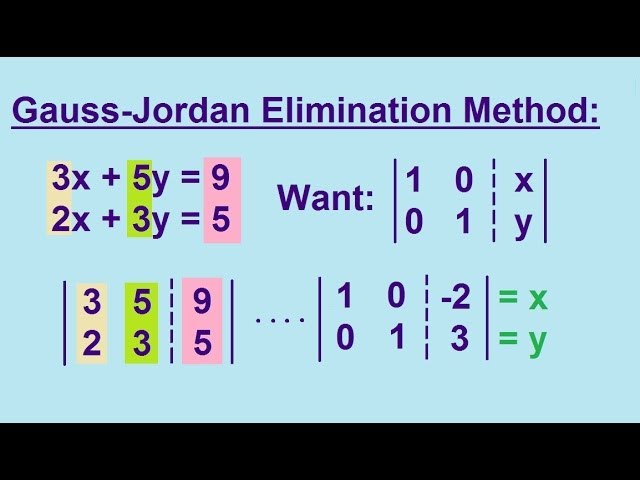
Visit http://ilectureonline.com for more math and science lectures!
In this lecture series I'll show you how to solve for multiple variables simultaneously using the technique called: the Gauss-Jordan Method of Elimination.
Problem Text:
3x + 5y = 9
2x + 3y = 5
Recommend you this cheat method
Cause it's much easier
jaunty pelican
the method im learning is complicated
shell ether
jaunty pelican
the method im learning is complicated
Everything is complicated when you are struggling with basics
you should first learn how to do simple/medium/hard linear equations
Not even systems
Anyway I'll go
marsh citrusBOT
@jaunty pelican Has your question been resolved?
Channel closed
Closed by @jaunty pelican
Use .reopen if this was a mistake.
Available help channel!
Send your question here to claim the channel.
Remember:
• Ask your math question in a clear, concise manner.
• Show your work, and if possible, explain where you are stuck.
• After 15 minutes, feel free to ping <@&286206848099549185>.
• Type the command .close to free the channel when you're done.
• Be polite and have a nice day!
Read #❓how-to-get-help for further information on how to ask a good question, and about conduct in the question channels.
 dusk meadow
A hen knows how to count. We put it in front of a packet of 2024 eggs. She counts the eggs from the first packet and places them in a second packet. Each time she has counted 4 eggs, she lays an egg which she places in the packet of those she still has to count.
How many eggs will the hen count in total?
marsh citrusBOT
dusk meadow
A hen knows how to count. We put it in front of a packet of 2024 eggs. She count...
dusk meadow
<@&286206848099549185>
 stoic slate
Wasn’t this solved yesterday?
dusk meadow
yeah but i have a problem
im getting another answer
my original answer was 2698
but then i got 2695
help plz
<@&286206848099549185>
anyone
marsh citrusBOT
@dusk meadow Has your question been resolved?
marsh citrusBOT
Channel closed
Closed by @dusk meadow
Use .reopen if this was a mistake.
Available help channel!
Send your question here to claim the channel.
Remember:
• Ask your math question in a clear, concise manner.
• Show your work, and if possible, explain where you are stuck.
• After 15 minutes, feel free to ping <@&286206848099549185>.
• Type the command .close to free the channel when you're done.
• Be polite and have a nice day!
Read #❓how-to-get-help for further information on how to ask a good question, and about conduct in the question channels.
 honest current
Hello
marsh citrusBOT
honest current
Hello
 marsh citrusBOT
@honest current Has your question been resolved?
honest current
<@&286206848099549185>
 lethal cairn
gosiogiusdg
marsh citrusBOT
@honest current Has your question been resolved?
marsh citrusBOT
Channel closed
Closed due to timeout
Use .reopen if this was a mistake.
Available help channel!
Send your question here to claim the channel.
Remember:
• Ask your math question in a clear, concise manner.
• Show your work, and if possible, explain where you are stuck.
• After 15 minutes, feel free to ping <@&286206848099549185>.
• Type the command .close to free the channel when you're done.
• Be polite and have a nice day!
Read #❓how-to-get-help for further information on how to ask a good question, and about conduct in the question channels.
 lyric kelp
 marsh citrusBOT
lyric kelp
marsh citrusBOT
lyric kelp
 gleaming pecan
lyric kelp
at the end of the second line
gleaming pecan
lyric kelp
at the end of the second line
this form C was chosen to make the answer look nicer = more convenient for possible further calculations
lyric kelp
so it doesnt matter correct?
gleaming pecan
but it doesn't matter at all, really
marsh citrusBOT
Channel closed
Closed by @lyric kelp
Use .reopen if this was a mistake.
marsh citrusBOT
Available help channel!
Send your question here to claim the channel.
Remember:
• Ask your math question in a clear, concise manner.
• Show your work, and if possible, explain where you are stuck.
• After 15 minutes, feel free to ping <@&286206848099549185>.
• Type the command .close to free the channel when you're done.
• Be polite and have a nice day!
Read #❓how-to-get-help for further information on how to ask a good question, and about conduct in the question channels.
 flat grail
I'm trying to compute $$\lim_{n \to \infty} {(3^n + 1)^\frac {1}{n}}$$ by the squeeze theorem. is it ok to use $$(3^n)^\frac{1}{n} \leq (3^n + 1) ^\frac{1}{n} \leq (3^{n+1})^\frac {1}{n} $$
marsh citrusBOT
flat grail
I'm trying to compute $$\lim_{n \to \infty} {(3^n + 1)^\frac {1}{n}}$$ by the sq...
 fathom ridge
well you do get the right answer so
elfin berryBOT
lewis_f04
 flat grail
I'm not sure if it is ok to say that $$(3^n + 1) ^\frac{1}{n} \leq (3^{n+1})^\frac {1}{n} $$ without proof as it isn't trivial
elfin berryBOT
lewis_f04

 paper raptor
couldn't you say that for sufficiently large $n$, $3^n+1\leq 3^{n+1}\implies (3^n+1)^{\frac{1}{n}}\leq (3^{n+1})^{\frac {1}{n}} $
elfin berryBOT
PajamaMamaLlama
 flat grail
for sure, I've just never got feedback from my lecturer on how exactly this is to be done, and my exam is tomorrow
if thats how you'd do it, I'll use that
thanks for the help
paper raptor
I'd probably ask someone else but that seems sufficient
marsh citrusBOT
@flat grail Has your question been resolved?
marsh citrusBOT
Channel closed
Closed due to timeout
Use .reopen if this was a mistake.
marsh citrusBOT
Available help channel!
Send your question here to claim the channel.
Remember:
• Ask your math question in a clear, concise manner.
• Show your work, and if possible, explain where you are stuck.
• After 15 minutes, feel free to ping <@&286206848099549185>.
• Type the command .close to free the channel when you're done.
• Be polite and have a nice day!
Read #❓how-to-get-help for further information on how to ask a good question, and about conduct in the question channels.
 whole jetty
Given the following functions find the image of 0, and 2 in each case, and the antiimage of –3, 0.
 marsh citrusBOT
whole jetty
Given the following functions find the image of 0, and 2 in each case, and the a...
marsh citrusBOT
whole jetty
Given the following functions find the image of 0, and 2 in each case, and the a...
@whole jetty Has your question been resolved?
marsh citrusBOT
@whole jetty Has your question been resolved?
marsh citrusBOT
Channel closed
Closed due to timeout
Use .reopen if this was a mistake.
marsh citrusBOT
Available help channel!
Send your question here to claim the channel.
Remember:
• Ask your math question in a clear, concise manner.
• Show your work, and if possible, explain where you are stuck.
• After 15 minutes, feel free to ping <@&286206848099549185>.
• Type the command .close to free the channel when you're done.
• Be polite and have a nice day!
Read #❓how-to-get-help for further information on how to ask a good question, and about conduct in the question channels.
 cerulean oxide
 marsh citrusBOT
cerulean oxide
cerulean oxide
marsh citrusBOT
cerulean oxide
cerulean oxide
how do i do this?
marsh citrusBOT
@cerulean oxide Has your question been resolved?
cerulean oxide
<@&286206848099549185>
marsh citrusBOT
Channel closed
Closed due to timeout
Use .reopen if this was a mistake.
Available help channel!
Send your question here to claim the channel.
Remember:
• Ask your math question in a clear, concise manner.
• Show your work, and if possible, explain where you are stuck.
• After 15 minutes, feel free to ping <@&286206848099549185>.
• Type the command .close to free the channel when you're done.
• Be polite and have a nice day!
Read #❓how-to-get-help for further information on how to ask a good question, and about conduct in the question channels.
cerulean oxide
how do i do this?
 marsh citrusBOT
cerulean oxide
how do i do this?
cerulean oxide
marsh citrusBOT
cerulean oxide
how do i do this?
cerulean oxide
Not sure how to procede
 deft apex
Do you have any working for anything at all?
cerulean oxide
deft apex
Do you have any working for anything at all?
what?
what does that mean?
stoic slate
cerulean oxide
what does that mean?
It means if you tried anything to solve the problem or you did nothing so far
cerulean oxide
i think you have to think the values of lambda
i found them to be:
"3, -1 + 2sqrt(2), -1 - 2sqrt(2)"
for A

that is what i've done so far
marsh citrusBOT
@cerulean oxide Has your question been resolved?
cerulean oxide
stoic slate
It means if you tried anything to solve the problem or you did nothing so far
so?
<@&286206848099549185>
 final skiff
cerulean oxide
so?
final skiff
cerulean oxide
so?
find the eigenvectors corresponding to each eigenvalue
marsh citrusBOT
@cerulean oxide Has your question been resolved?
stoic slate
cerulean oxide
so?
So nothing, I’m just explaining what he was asking cause you said “what does that mean?” Referring to him, and that meant you didn’t understand him
cerulean oxide
final skiff
find the eigenvectors corresponding to each eigenvalue
how do i do that
sorry i am a bit lost on this part of linalg
(A-lambdaI)*x=0, right
cerulean oxide
final skiff
find the eigenvectors corresponding to each eigenvalue

this woul be it, right
main idol
cerulean oxide
Did you write this
cerulean oxide
main idol
Did you write this
yes
main idol
Where did 3 come from
main idol
cerulean oxide
Oh here?
main idol
Looks right
Find a vector v such that Av = 3v
You can arbitrarily pick the one of the components of v to be 1

 cerulean oxide
main idol
Find a vector v such that Av = 3v
cerulean oxide
main idol
Find a vector v such that Av = 3v
that is sort of what i tried here
 marsh citrusBOT
Channel closed
Closed due to timeout
Use .reopen if this was a mistake.
main idol
.reopen
marsh citrusBOT
✅
main idol
cerulean oxide
that is sort of what i tried here
That's not how you find eigenvectors
cerulean oxide
i tried to do:
(A-lambda*i)*x=0
main idol
cerulean oxide
that is sort of what i tried here
There's no x here
cerulean oxide
yeah i wasnt rly sure what x should be
cerulean oxide
x = -y -z:
x= -y
z is a free variable
right


@main idol is this what you meant
main idol
cerulean oxide
I don't know what you're doing here
main idol
main idol
Find a vector v such that Av = 3v
Just do this
cerulean oxide
(A-lambda*i)x=0
yeah, that is also what i've done
we are essentially solving (A-3I)*v=0
 hardy slate
yeah so you have one of them
(1, -1, 0) is an eigenvector with eigenvalue 3
now get the other ones
cerulean oxide
hardy slate
yeah so you have one of them
ok, 1 sec
cerulean oxide
hardy slate
(1, -1, 0) is an eigenvector with eigenvalue 3

agree?

"So the three eigenvalues are: $\begin{bmatrix} 1 \ -1 \ 0 \end{bmatrix}$, $\begin{bmatrix} 1 \ 1 \ 1 \end{bmatrix}$, and $\begin{bmatrix} 1 \ 1 \ 1 \end{bmatrix}$."
elfin berryBOT
// mav
 cerulean oxide
@hardy slate after i've found these, what am i supposed to do
hardy slate
sorry one sec
the way you work it out is different to what i'm used to
this shouldn't be right
like ok
you're saying A (1, 1, 1)^T = (-1 - 2sqrt(2)) (1, 1, 1)^T
and A (1, 1, 1)^T = (-1 + 2sqrt(2)) (1, 1, 1)^T ?
hardy slate
yeah that's impossible
cerulean oxide
ill use a comptuer to what it gets
hardy slate
you should probably learn how to solve systems of linear equations
that's pretty important
hardy slate
well, you gotta learn how to do it correctly then
cerulean oxide
it is correct
hardy slate
it's not
cerulean oxide
i am aware its because i did it for the wrong matrix
so my eigenvalues are wrong
everything is wrong
hardy slate
that'll do it
cerulean oxide
give me 5 min
wow yeah
the eigenvalues are now -3,3,3
which makes it a lot easier

how do i even write up an answer for this
cerulean oxide
hardy slate
that'll do it
idk how to write an answer for it tho
hardy slate
so any vector st. x+y+z = 0 will be an eigenvector with eigenvalue 3
so you can just take any vector that isn't 0
so like, (1, 1, -2)
actually you want two eigenvectors for 3
so you want to find a second orthogonal eigenvector to that
to make the matrix orthogonal
cerulean oxide
hardy slate
so you want to find a second orthogonal eigenvector to that
wdym
cerulean oxide
hardy slate
so any vector st. x+y+z = 0 will be an eigenvector with eigenvalue 3

this would be correct, right
hardy slate
cerulean oxide
this would be correct, right
no
for L = -3
you need x = y + z
but 2 != 1 + 0
hardy slate
!= means 'not equals'
but anyway yeah that would work
ok
so you have two eigenvectors, one for 3 and one for -3
now you just need another eigenvector for 3
it should be orthogonal to the other two
wait actually hmm
the problem now is that (1, 1, -2) isn't orthogonal to (2, 1, 1)
so
we could do (0, 1, -1) instead and that would work
and then we'd need one more
cerulean oxide
for L=-3?
hardy slate
?
ok so essentially
for L = -3, you need x = y + z and x = 2y
2 constraints
so there's only sorta 1 dimension of possibility
but for L = 2 you only need x + y + z = 0
1 constraint
so there's 2 dimensions of possibilities
a whole plane of possible eigenvectors
you want to find 2 orthogonal eigenvectors in that plane
we already have (0, 1, -1) so we need another one
hardy slate
so you want x + y + z = 0, and it needs to be orthogonal to (0, 1, -1) as well
think about it
cerulean oxide
mhh idk then
hardy slate
ok
cerulean oxide
(1,1,1) is orthogonal to (0,1,-1) tho
cerulean oxide
yh
hardy slate
so
cerulean oxide
bit too high
hardy slate
how do you tell if something is orthogonal to (0, 1, -1)
cerulean oxide
dot product =0
cerulean oxide
y-z?
cerulean oxide
y-z=0 just meanst y=z
hardy slate
yes
cerulean oxide
so i hae x=-2y
hardy slate
yes
cerulean oxide
1,-2,-2
cerulean oxide
-2,1,-2
hardy slate
bruh
 hardy slate
but you need y = z
cerulean oxide
no no
cerulean oxide
how is thatn ot correct
hardy slate
pick any z
cerulean oxide
ok
hardy slate
that isn't 0
cerulean oxide
48
hardy slate
ok
cerulean oxide
lets go with 1
hardy slate
z = 48
cerulean oxide
yes
hardy slate
so it needs to be (-2, 1, 1)
cerulean oxide
which is what i wrote like 800 years ago
 hardy slate
ok
cerulean oxide
and everyone is very happy
hardy slate
so what you've ended up with is three eigenvectors, all of which are orthogonal to each other
so now you just put them in a matrix next to each other and you have an orthogonal matrix P
done
cerulean oxide
does the order matter
hardy slate
no
 cerulean oxide
what?
cerulean oxide
what mistake did we make
cerulean oxide
hardy slate
you solved the linear equations wrong!
i didnt
i checked with computer
 cerulean oxide
on the right, its supposed to be [1,0,-1] top
hardy slate
right.
 hardy slate
ok
cerulean oxide
x=z
hardy slate
so what's the eigenvector here
hardy slate
ok
cerulean oxide
x=z=y=1=1=1
hardy slate
ok
so let's see

yeah so all of the columns of this are orthogonal now
so it works
finally
hardy slate
ok so i explains this ages ago
basically alright so
you have Av = Lv for each of the eigenvectors v
like ok
Av_1 = L_1 v_1
Av_2 = L_2 v_2
Av_3 = L_3 v_3
right?
 hardy slate
Av_1 = L_1 v_1
Av_2 = L_2 v_2
Av_3 = L_3 v_3
hardy slate
hardy slate
Av_1 = L_1 v_1
Av_2 = L_2 v_2
Av_3 = L_3 v_3
do you agree that this is true
cerulean oxide
yes
hardy slate
right
so then we can take like A(v_1 v_2 v_3)
AP
and this will be the same thing as PD
where D is a diagonal matrix with L_1, L_2, L_3 as the diagonal entries
so we have AP = PD
so P^-1 AP = D
so you're done, see
 hardy slate
$A \begin{pmatrix} v_1 & v_2 & v_3 \end{pmatrix} = \begin{pmatrix} \lambda_1 v_1 & \lambda_2v_2 & \lambda_3 v_3 \end{pmatrix} = \begin{pmatrix} v_1^T \ v_2^T \ v_3^T \end{pmatrix} \begin{pmatrix} \lambda_1 & 0 & 0 \ 0 & \lambda_2 & 0 \ 0 & 0 & \lambda_3 \end{pmatrix}$
elfin berryBOT
Kaisheng21
 hardy slate
well ok this doesn't even work
you need the eigenvectors to all be unit length
but then it works
cerulean oxide
yeah but it works by just computing it
hardy slate
oh it does? sick
anyway i gtg now
in conclusion, you gotta get more reliable at solving systems of linear equations
cerulean oxide
hardy slate
in conclusion, you gotta get more reliable at solving systems of linear equation...
no lol
i just didnt know how to compute P
if i knew that then its somewhat just boring algebra
hardy slate
yeah obviously you didn't know wtf was going on
but also you need to get better at systems of linear equations because you kept making the most basic errors, like holy
that wasted a lot of time
cerulean oxide
it wasnt to do wit that, sadly
it is me looking at my paper
and typing it onto the computer
and then putting wrong values
like misstyping
xd
marsh citrusBOT
@cerulean oxide Has your question been resolved?
marsh citrusBOT
Channel closed
Closed due to timeout
Use .reopen if this was a mistake.
Available help channel!
Send your question here to claim the channel.
Remember:
• Ask your math question in a clear, concise manner.
• Show your work, and if possible, explain where you are stuck.
• After 15 minutes, feel free to ping <@&286206848099549185>.
• Type the command .close to free the channel when you're done.
• Be polite and have a nice day!
Read #❓how-to-get-help for further information on how to ask a good question, and about conduct in the question channels.
 mystic minnow
what have you tried
 unique basin
You have an optimization problem at hand here
Maximize or Minimize something
Subject to certain constraint(s)
The constraint is the fact that xy = c^2
Normally to maximize something you take the first derivative and set = 0
But because you have 2 variables in
ax + by
You cant do that easily
Use the known constraint to replace one of the unknowns
if you know xy = c^2 must be true
Then you can solve for x or y
And turn it into a 1 variable
Thats what i would do to start probably
You should be able to solve for x or y in terms of a, b, c
Then solve for y in terms of a, b, c
Treat a, b, c like constants
x = (c^2)/y
From the constraint
Plug that into the other expression
a * [(c^2)/y] + by
Take derivative of that with respect to y
And set = 0
 idle ridge
.close
marsh citrusBOT
Channel closed
Closed by @idle ridge
Use .reopen if this was a mistake.
unique basin
Oh np xD
marsh citrusBOT
Available help channel!
Send your question here to claim the channel.
Remember:
• Ask your math question in a clear, concise manner.
• Show your work, and if possible, explain where you are stuck.
• After 15 minutes, feel free to ping <@&286206848099549185>.
• Type the command .close to free the channel when you're done.
• Be polite and have a nice day!
Read #❓how-to-get-help for further information on how to ask a good question, and about conduct in the question channels.
 jovial mulch
Weird question,
Something like
v= 2t +2t^2 +2
A. Distance of Q from origin , when t =5
B. Total distance travelled of Q from origin in the first 5 seconds
marsh citrusBOT
jovial mulch
Weird question,
Something like
v= 2t +2t^2 +2
A. Distance of Q from origin , ...
 vernal forge
jovial mulch
Weird question,
Something like
v= 2t +2t^2 +2
A. Distance of Q from origin , ...
vernal forge
jovial mulch
Weird question,
Something like
v= 2t +2t^2 +2
A. Distance of Q from origin , ...
A. integrate with bounds 0 and 5
jovial mulch
whats the difference
jovial mulch
vernal forge
A. integrate with bounds 0 and 5
yep did that
vernal forge
jovial mulch
Weird question,
Something like
v= 2t +2t^2 +2
A. Distance of Q from origin , ...
are you sure you wrote it correctly?
in your case there is no difference
 dusky viper
one is displacement one is distance i'd assume
vernal forge
but in general A is displacement and B is distance
jovial mulch
The distance of Q from O, when t=5
The total distance travelled by Q in the first 5 seconds
Thats the exact wording
vernal forge
yes
vernal forge
vernal forge
but in general A is displacement and B is distance
^
jovial mulch
Ah ok
vernal forge
vernal forge
are you sure you wrote it correctly?
i was asking about the equation
jovial mulch
Yeah
vernal forge
ah okay
jovial mulch
 vernal forge
well basically
vernal forge
$\int_{\text{start}}^{\text{end}} v(t) dt$ - displacement \
$\int_{\text{start}}^{\text{end}} |v(t)| dt$ - distance \
elfin berryBOT
artemetra
 vernal forge
yeah well you got lucky the object was not going backwards at any point in time
 velvet cairn
jovial mulch
I got it correct
velvet cairn
jovial mulch
I got it correct
||both will be same in this case as t²+t+1 is always >0||
vernal forge
yep
jovial mulch
so if it was -t^2
vernal forge
jovial mulch
so if it was -t^2
then that would've been very different
velvet cairn
Then u will have to find where the value is negative and integrate seperately
And then add the magnitudes
vernal forge
 vernal forge
#desmos4life
jovial mulch
seriously amazed tho
welp thats it hehe
need to finish it
Thank youuu both
.close
marsh citrusBOT
Channel closed
Closed by @jovial mulch
Use .reopen if this was a mistake.
Available help channel!
Send your question here to claim the channel.
Remember:
• Ask your math question in a clear, concise manner.
• Show your work, and if possible, explain where you are stuck.
• After 15 minutes, feel free to ping <@&286206848099549185>.
• Type the command .close to free the channel when you're done.
• Be polite and have a nice day!
Read #❓how-to-get-help for further information on how to ask a good question, and about conduct in the question channels.
jovial mulch
vernal forge
Mr cuttlefish
marsh citrusBOT
jovial mulch
Mr cuttlefish
jovial mulch
Could you teach me how to use this
I understand everything you put in
How would I put in t= 5
[To find the distance]
vernal forge
jovial mulch
How would I put in t= 5
huh?
do you know how to do definite integrals?
like the ones with the bounds?
$\int_1^3 x^2 dx$
elfin berryBOT
artemetra
 vernal forge
can you solve this?
vernal forge
you sure?
jovial mulch
8
vernal forge
bruh
jovial mulch
oh wait
vernal forge
no
vernal forge
integrate it first
vernal forge
no that's derivative
vernal forge

jovial mulch
Yes
elfin berryBOT
artemetra
 jovial mulch
x^3/3
vernal forge
is this doable
jovial mulch
and then whatever that gets
vernal forge
$\int_1^3 x^2 dx$
elfin berryBOT
artemetra
 vernal forge
$=\frac{x^3}{3} \mid_1^3$
elfin berryBOT
artemetra
 vernal forge
jovial mulch
26/3
vernal forge
jovial mulch
26/3
yes
