#help-33
1 messages · Page 69 of 1
 marsh citrusBOT
Channel closed
Closed by @summer trench
Use .reopen if this was a mistake.
 summer trench
thanks
marsh citrusBOT
 Available help channel!
Send your question here to claim the channel.
Remember:
• Ask your math question in a clear, concise manner.
• Show your work, and if possible, explain where you are stuck.
• After 15 minutes, feel free to ping <@&286206848099549185>.
• Type the command .close to free the channel when you're done.
• Be polite and have a nice day!
Read #❓how-to-get-help for further information on how to ask a good question, and about conduct in the question channels.
 whole jetty
 marsh citrusBOT
whole jetty
marsh citrusBOT
whole jetty
 cunning jackal
marsh citrusBOT
cunning jackal
marsh citrusBOT
Channel closed
Closed by @whole jetty
Use .reopen if this was a mistake.
Available help channel!
Send your question here to claim the channel.
Remember:
• Ask your math question in a clear, concise manner.
• Show your work, and if possible, explain where you are stuck.
• After 15 minutes, feel free to ping <@&286206848099549185>.
• Type the command .close to free the channel when you're done.
• Be polite and have a nice day!
Read #❓how-to-get-help for further information on how to ask a good question, and about conduct in the question channels.
 serene egret
the answer of Q:25 should be 28 right?
 marsh citrusBOT
serene egret
the answer of Q:25 should be 28 right?
marsh citrusBOT
serene egret
the answer of Q:25 should be 28 right?
 sleek lake
i get 28
marsh citrusBOT
@serene egret Has your question been resolved?
Channel closed
Closed by @serene egret
Use .reopen if this was a mistake.
Available help channel!
Send your question here to claim the channel.
Remember:
• Ask your math question in a clear, concise manner.
• Show your work, and if possible, explain where you are stuck.
• After 15 minutes, feel free to ping <@&286206848099549185>.
• Type the command .close to free the channel when you're done.
• Be polite and have a nice day!
Read #❓how-to-get-help for further information on how to ask a good question, and about conduct in the question channels.
marsh citrusBOT
 elfin berryBOT
🌐
What's a good integral to compare this to?
$\int_1^\infty \frac{e^{-x}}{x} \mathrm{d}x$
 marsh citrusBOT
Channel closed
Closed due to the original message being deleted
 still temple
What's a good integral to compare this to?
elfin berryBOT
🌐

 main idol
still temple
What's a good integral to compare this to?
main idol
still temple
What's a good integral to compare this to?
!msgdel
marsh citrusBOT
still temple
What's a good integral to compare this to?
The original post of this help channel has been deleted, and it will abruptly close and possibly lock. (This is irreversible.) Please claim a new channel, and don't delete the first message of any future channel you claim.
still temple
.close
marsh citrusBOT
Available help channel!
Send your question here to claim the channel.
Remember:
• Ask your math question in a clear, concise manner.
• Show your work, and if possible, explain where you are stuck.
• After 15 minutes, feel free to ping <@&286206848099549185>.
• Type the command .close to free the channel when you're done.
• Be polite and have a nice day!
Read #❓how-to-get-help for further information on how to ask a good question, and about conduct in the question channels.
summer trench
,, \log_{\frac{a}{b}} x = \frac{1}{b} \log_{a} x
marsh citrusBOT
summer trench
,, \log_{\frac{a}{b}} x = \frac{1}{b} \log_{a} x
summer trench
this is correct right?
elfin berryBOT
!Yajat!
 summer trench
@ me
 rigid sequoia
No
 vernal forge
summer trench
this is correct right?
vernal forge
summer trench
this is correct right?
no
summer trench
wait, there some some identity like this
i cant remember it
do you guys have any idea?
rigid sequoia
It's for a^b
rigid sequoia
Yes
vernal forge
$\log_{\frac{1}{b}} (x) = -\log_{b} (x)$
elfin berryBOT
artemetra
 summer trench
,, \log_{a^b} m = \frac{1}{b} \log_{a} m
elfin berryBOT
!Yajat!
 summer trench
i was talking about this one
vernal forge
elfin berry
**!Yajat!**
yes
summer trench
but nvm, got it
vernal forge
this is correct
rigid sequoia
elfin berry
**!Yajat!**
If you do a^b instead of a/b in LHS it will become correct
rigid sequoia
elfin berry
**!Yajat!**
Yes
 marsh citrusBOT
Channel closed
Closed by @summer trench
Use .reopen if this was a mistake.
Available help channel!
Send your question here to claim the channel.
Remember:
• Ask your math question in a clear, concise manner.
• Show your work, and if possible, explain where you are stuck.
• After 15 minutes, feel free to ping <@&286206848099549185>.
• Type the command .close to free the channel when you're done.
• Be polite and have a nice day!
Read #❓how-to-get-help for further information on how to ask a good question, and about conduct in the question channels.
 mint sonnet
the original paper size is 11*8.5 11 being lenght and 8.5 being width, if i made 1.5in cut on the four corners, what would the volume be?
 marsh citrusBOT
mint sonnet
the original paper size is 11*8.5 11 being lenght and 8.5 being width, if i made...
marsh citrusBOT
mint sonnet
the original paper size is 11*8.5 11 being lenght and 8.5 being width, if i made...
@mint sonnet Has your question been resolved?
marsh citrusBOT
Channel closed
Closed due to timeout
Use .reopen if this was a mistake.
marsh citrusBOT
Available help channel!
Send your question here to claim the channel.
Remember:
• Ask your math question in a clear, concise manner.
• Show your work, and if possible, explain where you are stuck.
• After 15 minutes, feel free to ping <@&286206848099549185>.
• Type the command .close to free the channel when you're done.
• Be polite and have a nice day!
Read #❓how-to-get-help for further information on how to ask a good question, and about conduct in the question channels.
 jovial ingot
new and improved
i can solve with the help of others but i’m still lost this topic is new to me 
in the other help channel i made we defined what the variables are and what they stand for
w=total weight
t= amount of tshirts
 marsh citrusBOT
jovial ingot
new and improved
i can solve with the help of others but i’m still lost this t...
jovial ingot
marsh citrusBOT
jovial ingot
new and improved
i can solve with the help of others but i’m still lost this t...
jovial ingot
 sorry to inconvenience and make 2 channels
 lyric moon
np
 burnt abyss
meir💀
jovial ingot
Hi
burnt abyss
sup
 burnt abyss
i think you just have to plug in a random value of t shirts
jovial ingot
OK.
burnt abyss
wait
jovial ingot
for #2 wat should i do tho
jovial ingot
Yis
burnt abyss
meh
jovial ingot
We solve for T on that one
burnt abyss
i guess for #1 plug in values for t and solve for W
jovial ingot
Ok
marsh citrusBOT
@jovial ingot Has your question been resolved?
jovial ingot
<@&286206848099549185> 


marsh citrusBOT
@jovial ingot Has your question been resolved?
marsh citrusBOT
Channel closed
Closed due to timeout
Use .reopen if this was a mistake.
Available help channel!
Send your question here to claim the channel.
Remember:
• Ask your math question in a clear, concise manner.
• Show your work, and if possible, explain where you are stuck.
• After 15 minutes, feel free to ping <@&286206848099549185>.
• Type the command .close to free the channel when you're done.
• Be polite and have a nice day!
Read #❓how-to-get-help for further information on how to ask a good question, and about conduct in the question channels.
marsh citrusBOT
Channel closed
Closed due to the original message being deleted
Available help channel!
Send your question here to claim the channel.
Remember:
• Ask your math question in a clear, concise manner.
• Show your work, and if possible, explain where you are stuck.
• After 15 minutes, feel free to ping <@&286206848099549185>.
• Type the command .close to free the channel when you're done.
• Be polite and have a nice day!
Read #❓how-to-get-help for further information on how to ask a good question, and about conduct in the question channels.
summer trench
 marsh citrusBOT
summer trench
summer trench
marsh citrusBOT
summer trench
summer trench
i get a different answer, when i find the magniture of F vector and for r vector, and then multiply them
is that a wrong method?
hmhmhm why?
of scalar product
but why is my method wrong?
i read your name as 'giant monkey' lol
 marble glacier
why do you have hats on J and K
marble glacier
agreed
So if we assume the co-effs of the 2nd vector is all 1
than you are correct
How?

summer trench
oh ok, got it thanks
marsh citrusBOT
Channel closed
Closed by @summer trench
Use .reopen if this was a mistake.
marsh citrusBOT
Available help channel!
Send your question here to claim the channel.
Remember:
• Ask your math question in a clear, concise manner.
• Show your work, and if possible, explain where you are stuck.
• After 15 minutes, feel free to ping <@&286206848099549185>.
• Type the command .close to free the channel when you're done.
• Be polite and have a nice day!
Read #❓how-to-get-help for further information on how to ask a good question, and about conduct in the question channels.
still temple
I’m just wondering if I just needed to use quadratic equation set to 200
 marsh citrusBOT
still temple
I’m just wondering if I just needed to use quadratic equation set to 200
still temple
marsh citrusBOT
still temple
I’m just wondering if I just needed to use quadratic equation set to 200
still temple
Would I just need to use the quadratic formula on that equation?
Or do I have to set 200 equal to an equation
marsh citrusBOT
@still temple Has your question been resolved?
 marsh citrusBOT
@still temple Has your question been resolved?
 maiden meteor
still temple
I’m just wondering if I just needed to use quadratic equation set to 200
maiden meteor
still temple
I’m just wondering if I just needed to use quadratic equation set to 200
yep
set y = 200, then subtract 200 from both sides to get one side equal to 0
then you can use quadratic formula to solve for x
still temple
maiden meteor
yep
Omg thanks
maiden meteor
np
still temple
maiden meteor
np
So -1000x^2+1100x-202.5=0
maiden meteor
looks good to me
still temple
.close
marsh citrusBOT
Channel closed
Closed by @pseudo hawk
Use .reopen if this was a mistake.
Available help channel!
Send your question here to claim the channel.
Remember:
• Ask your math question in a clear, concise manner.
• Show your work, and if possible, explain where you are stuck.
• After 15 minutes, feel free to ping <@&286206848099549185>.
• Type the command .close to free the channel when you're done.
• Be polite and have a nice day!
Read #❓how-to-get-help for further information on how to ask a good question, and about conduct in the question channels.
 bronze sky
i dont understand how they figured it was only two solutions or no solutions
 marsh citrusBOT
bronze sky
i dont understand how they figured it was only two solutions or no solutions
marsh citrusBOT
bronze sky
i dont understand how they figured it was only two solutions or no solutions
 final skiff
bronze sky
i dont understand how they figured it was only two solutions or no solutions
final skiff
bronze sky
i dont understand how they figured it was only two solutions or no solutions
They got that it is always two real solutions. When the discriminant is positive that implies 2 real solutions
For all values of b, b^2-8b+44 is positive
That is the simplified discriminant
bronze sky
so if b is positive theres two solutions and else there none?>
final skiff
bronze sky
so if b is positive theres two solutions and else there none?>

Any value of b is 2 solutions
bronze sky
final skiff
how can you tell that its always positive
final skiff
You can plot the discriminant and it becomes clear
bronze sky
wdym it becomes clear i still dont see it
final skiff
bronze sky
wdym it becomes clear i still dont see it
The parabola is always over the x axis
 bronze sky
if its over the axis isnt that mean no solutions cuz its not touching the line
@final skiff if its over the axis isnt that mean no solutions cuz its not touching the line though
i need someone else halp D:::::::::
final skiff
bronze sky
<@280588750373912576> if its over the axis isnt that mean no solutions cuz its ...
This is the graph of the discriminant
Not the original function
bronze sky
final skiff
This is the graph of the discriminant
well then how do you know the orignal function would have the two solutions i dont udnerstand
final skiff
bronze sky
well then how do you know the orignal function would have the two solutions i do...
When the discriminant is greater than 0, it means there are 2 solutions
If you look at the quadratic formula
You will see that sqrt(b^2-4ac) comes after the plus minus
If b^2-4ac is negative, you are taking the square root of a negative, so clearly the solutions must be complex (in this case that means no solutions)
If it is 0, then adding 0 and subtracting 0 gives the same value, so there is only 1 solution
If it is greater than 0 then you get 2 different values so there must be 2 solutions
Using this fact we plug in the values of a,b,c in b^2-4ac, and after simplifying we get b^2-8b+44
That is the discriminant of the original function
Knowing that b^2-8b+45 is always positive from the graph I showed, we can conclude that it is always positive, hence for any value of b, the discriminant is positive, hence for any value of b, there is 2 solutions
marsh citrusBOT
@bronze sky Has your question been resolved?
marsh citrusBOT
Channel closed
Closed due to timeout
Use .reopen if this was a mistake.
Available help channel!
Send your question here to claim the channel.
Remember:
• Ask your math question in a clear, concise manner.
• Show your work, and if possible, explain where you are stuck.
• After 15 minutes, feel free to ping <@&286206848099549185>.
• Type the command .close to free the channel when you're done.
• Be polite and have a nice day!
Read #❓how-to-get-help for further information on how to ask a good question, and about conduct in the question channels.
 nocturne niche
how can u determine these without graphing?
 marsh citrusBOT
nocturne niche
how can u determine these without graphing?
marsh citrusBOT
nocturne niche
how can u determine these without graphing?
 misty dust
nocturne niche
misty dust
nocturne niche
yep
nocturne niche
so it has to be zero?
that means for a. its points d, e
oh ok i get it ty!!
.close
marsh citrusBOT
Channel closed
Closed by @nocturne niche
Use .reopen if this was a mistake.
 nocturne niche
ok thanks!
marsh citrusBOT
Available help channel!
Send your question here to claim the channel.
Remember:
• Ask your math question in a clear, concise manner.
• Show your work, and if possible, explain where you are stuck.
• After 15 minutes, feel free to ping <@&286206848099549185>.
• Type the command .close to free the channel when you're done.
• Be polite and have a nice day!
Read #❓how-to-get-help for further information on how to ask a good question, and about conduct in the question channels.
 last turtle
Hi can someone help me with question 44
 marsh citrusBOT
last turtle
Hi can someone help me with question 44
main idol
marsh citrusBOT
last turtle
Hi can someone help me with question 44
main idol
,rotate
elfin berryBOT
 main idol
Set the imaginary part of the second number to zero
Would probably want to multiply by the conjugate and write it as a single fraction
last turtle
 last turtle
main idol
Would probably want to multiply by the conjugate and write it as a single fracti...
last turtle
main idol
Would probably want to multiply by the conjugate and write it as a single fracti...
I did it but quite not sure what to do after the conjugate is done
main idol
main idol
Would probably want to multiply by the conjugate and write it as a single fracti...
Second half of this
last turtle
Oh single fraction?
Alright
@main idol like this?

Ahh if the set of those equation is real, then um the imaginary part is nothing or equal to 0?
And if I want to write the i to the fraction of the right side, the i must be on the top right?
main idol
Yea check your answer by plugging k into the original equation
You probably have a mistake somewhere since your last equation implies k=0
last turtle
Oh alright
last turtle
main idol
You probably have a mistake somewhere since your last equation implies k=0
The answer is 10? Since imaginary part is equal to 0
elfin berryBOT
Result:
1 + 4i
Oh I typo d
last turtle
main idol
Oh I typo d
How it become 1+4i?
ki/(4+2i)+2i
Things resolved ty @main idol
,done
How do I umm
marsh citrusBOT
@last turtle Has your question been resolved?
Channel closed
Closed by @last turtle
Use .reopen if this was a mistake.
marsh citrusBOT
Available help channel!
Send your question here to claim the channel.
Remember:
• Ask your math question in a clear, concise manner.
• Show your work, and if possible, explain where you are stuck.
• After 15 minutes, feel free to ping <@&286206848099549185>.
• Type the command .close to free the channel when you're done.
• Be polite and have a nice day!
Read #❓how-to-get-help for further information on how to ask a good question, and about conduct in the question channels.
 high thorn
this might be a dumb question but if i have something like
 desert socket
what is the least value of |x| for real x?
high thorn
desert socket
what is the least value of |x| for real x?
lmao my bad
high thorn
high thorn
1< |x| < 7
this^^
high thorn
and combine?
desert socket
1<|x| AND |x|<7
Solve for each inequality separately and then take intersection of the intervals
high thorn
desert socket
Solve for each inequality separately and then take intersection of the intervals
makes sense
thanks for clarifying
.close
marsh citrusBOT
Channel closed
Closed by @high thorn
Use .reopen if this was a mistake.
Available help channel!
Send your question here to claim the channel.
Remember:
• Ask your math question in a clear, concise manner.
• Show your work, and if possible, explain where you are stuck.
• After 15 minutes, feel free to ping <@&286206848099549185>.
• Type the command .close to free the channel when you're done.
• Be polite and have a nice day!
Read #❓how-to-get-help for further information on how to ask a good question, and about conduct in the question channels.
 rotund burrow
can someone explain how 2^3/2 = 2 root 2
 marsh citrusBOT
rotund burrow
can someone explain how 2^3/2 = 2 root 2
marsh citrusBOT
rotund burrow
can someone explain how 2^3/2 = 2 root 2
 rancid prism
!status
marsh citrusBOT
What step are you on?
1. I don't know where to begin.
2. I have begun but got stuck midway.
3. I got an answer but I was told that it's wrong.
4. I got an answer and would like my work checked.
5. I have a question about someone else's work/solution.
6. I have completed the problem and don't need help anymore. Thank you.
7. None of the above
write 2^(3/2) as (2^3)^(1/2)
then you have $\sqrt{2\cdot 2\cdot 2}$
clear so far?
elfin berryBOT
daniGhost
 rotund burrow
yes
rancid prism
any idea on how to proceed?
rotund burrow
make it 2 root 2?
rotund burrow
because like its root 2^3 and u take out the 2^2 to beomce 2 root 2
marsh citrusBOT
Channel closed
Closed by @rotund burrow
Use .reopen if this was a mistake.
Available help channel!
Send your question here to claim the channel.
Remember:
• Ask your math question in a clear, concise manner.
• Show your work, and if possible, explain where you are stuck.
• After 15 minutes, feel free to ping <@&286206848099549185>.
• Type the command .close to free the channel when you're done.
• Be polite and have a nice day!
Read #❓how-to-get-help for further information on how to ask a good question, and about conduct in the question channels.
Channel closed
Channel closed due to the original message being deleted.
If you did not intend to do this, please open a new help channel,
as this action is irreversible, and this channel may abruptly lock.
Available help channel!
Send your question here to claim the channel.
Remember:
• Ask your math question in a clear, concise manner.
• Show your work, and if possible, explain where you are stuck.
• After 15 minutes, feel free to ping <@&286206848099549185>.
• Type the command .close to free the channel when you're done.
• Be polite and have a nice day!
Read #❓how-to-get-help for further information on how to ask a good question, and about conduct in the question channels.
 hidden radish
 marsh citrusBOT
hidden radish
marsh citrusBOT
hidden radish

 stoic saddle
@hidden radish might wish to remove the obviously racist slur from your pronoun field ngl
hidden radish
uhhhh but its just my discord profile
stoic saddle
hidden radish
uhhhh but its just my discord profile
so you think being racist in your profile is ok? or what.
hidden radish
bro chillout its not racist yous are making it racist it doesnt mean anything its just a word
im not saying its ok but i only did it as a joke i dont actually have anything against them
stoic saddle
hidden radish
bro chillout its not racist yous are making it racist it doesnt mean anything it...
don't call me bro.
also it's a shitty joke. it's both offensive and decidedly unfunny.
hidden radish
chill out ok my bad im sorry
marsh citrusBOT
@hidden radish Has your question been resolved?
marsh citrusBOT
Channel closed
Closed due to timeout
Use .reopen if this was a mistake.
Available help channel!
Send your question here to claim the channel.
Remember:
• Ask your math question in a clear, concise manner.
• Show your work, and if possible, explain where you are stuck.
• After 15 minutes, feel free to ping <@&286206848099549185>.
• Type the command .close to free the channel when you're done.
• Be polite and have a nice day!
Read #❓how-to-get-help for further information on how to ask a good question, and about conduct in the question channels.
 river oasis
 marsh citrusBOT
river oasis
marsh citrusBOT
river oasis
 lapis steppe
Ye disregard my previous answer, my bad
river oasis
In the case of Steve is happy, then the "and" suggests that Steve cannot be happy due to contradiction, therefore George is not happy?
Or am I just being dumb
And that would apply in the reverse order
I don't understand how both can be happy
lapis steppe
Well yes that is the implication, but that fact is only relevant for evaluating the "truthyness" of the expression, as in, the expression is true when one of them is happy and the other is sad
They are both allowed to be happy or sad, that just means the total expression isn't true if they have the same state
river oasis
i'm confused
river oasis
lapis steppe
Well yes that is the implication, but that fact is only relevant for evaluating ...
don't we want to evaluate the truth always?
premises + conclusion should be true for a valid proof right
lapis steppe
Yes we're evaluating it either way, but getting a 0/false isn't intrinsically bad
You can make a truth table for the whole thing and see how it behaves easily enough
river oasis
I don't even know what a truth table is lol I just got started with proofs
lapis steppe
Think of the expression as a check for "are steve and george in different moods", yes or no
 river oasis
let's say in the case S & not S, that's a contradiction, in other words, that would not evaluate to not s
right
river oasis
so contradiction
lapis steppe
Just not possible really
Anyways i have to run, class in 15 minutes, the wikipedia page on boolean algebra is pretty good if you want something extra to read as reference
river oasis
Ok thanks for the help, I really appreciate it 👍
marsh citrusBOT
@river oasis Has your question been resolved?
Channel closed
Closed by @river oasis
Use .reopen if this was a mistake.
marsh citrusBOT
Available help channel!
Send your question here to claim the channel.
Remember:
• Ask your math question in a clear, concise manner.
• Show your work, and if possible, explain where you are stuck.
• After 15 minutes, feel free to ping <@&286206848099549185>.
• Type the command .close to free the channel when you're done.
• Be polite and have a nice day!
Read #❓how-to-get-help for further information on how to ask a good question, and about conduct in the question channels.
 silk halo
How do I find a pattern in (i+1)(i+2)(i+3)... and so on?
I need a formula for the output dependant on the number of terms (example (i+1)(i+2) would be 2 terms)
marsh citrusBOT
silk halo
How do I find a pattern in (i+1)(i+2)(i+3)... and so on?
I need a formula for th...
 cloud iron
I think product notation would help here if you're familiar with it
marsh citrusBOT
@silk halo Has your question been resolved?
silk halo
cloud iron
I think product notation would help here if you're familiar with it
That's where I got the question but I dont know how to solve further
It'd be product from n = 1 to N of (i+n)
and i'm trying to find this interms of N
 brittle vessel
the question is not clear to me, what do you want to achieve exactly?
silk halo
Specifically to find a general formula for
(i+1)(i+2)(i+3) ... (i+N) interms of N
Something like this but written fully algebraically
 brittle vessel
what is i here?
silk halo
The imaginary unit, sqrt(-1)
silk halo
Anything works honestly aslong as its easily computable for larger values of N
brittle vessel
maybe use the trig form of them
silk halo
brittle vessel
maybe use the trig form of them
Trig form of i? As in, cos(pi/2) + isin(pi/2)?
brittle vessel
the lengths will be nice(kinda), and if we can somehow add up the angles we would be done, right?
silk halo
arctan(1) + arctan (1/2) ... arctan( 1/N) I assume would give the angle of our number?
As when 2 complex numbers are multiplied the angle is added iirc
brittle vessel
yea
silk halo
That makes things significantly easier then
I think I understand the rest from here
Thank you for the help!
Much appreciated
.close
marsh citrusBOT
Channel closed
Closed by @silk halo
Use .reopen if this was a mistake.
Available help channel!
Send your question here to claim the channel.
Remember:
• Ask your math question in a clear, concise manner.
• Show your work, and if possible, explain where you are stuck.
• After 15 minutes, feel free to ping <@&286206848099549185>.
• Type the command .close to free the channel when you're done.
• Be polite and have a nice day!
Read #❓how-to-get-help for further information on how to ask a good question, and about conduct in the question channels.
 bronze locust
the car stationary in front of a red traffic light. As the light turns green. A truck goes past a constant velocity of 10m/s. At the same moment. the car begins to accelerate at 2.5m/s^2 when it reaches 30 m/s, the car continues at this velocity. When does the car pass the truck? How far they gone from the traffic light at that time?
My teacher said the answer is 9 seconds but i get -9 seconds
marsh citrusBOT
bronze locust
the car stationary in front of a red traffic light. As the light turns green. A ...
cloud iron
A lot of time in some problems like this you'll end up with negative distance or area which doesn't really make sense in context
You likely just had a sign mistake somewhere; do you have your work?
bronze locust
cloud iron
You likely just had a sign mistake somewhere; do you have your work?
yes sending
 marsh citrusBOT
@bronze locust Has your question been resolved?
marsh citrusBOT
@bronze locust Has your question been resolved?
marsh citrusBOT
Channel closed
The owner is missing!
Available help channel!
Send your question here to claim the channel.
Remember:
• Ask your math question in a clear, concise manner.
• Show your work, and if possible, explain where you are stuck.
• After 15 minutes, feel free to ping <@&286206848099549185>.
• Type the command .close to free the channel when you're done.
• Be polite and have a nice day!
Read #❓how-to-get-help for further information on how to ask a good question, and about conduct in the question channels.
 solemn nymph
 marsh citrusBOT
solemn nymph
marsh citrusBOT
solemn nymph
 tight meteor
Have you tried prime factorizing it?
solemn nymph
.close
marsh citrusBOT
Channel closed
Closed by @solemn nymph
Use .reopen if this was a mistake.
Available help channel!
Send your question here to claim the channel.
Remember:
• Ask your math question in a clear, concise manner.
• Show your work, and if possible, explain where you are stuck.
• After 15 minutes, feel free to ping <@&286206848099549185>.
• Type the command .close to free the channel when you're done.
• Be polite and have a nice day!
Read #❓how-to-get-help for further information on how to ask a good question, and about conduct in the question channels.
 robust cairn
This type of questions, how do you come up to the solution, ive figured out what theta is but other than that im stuck.
 marsh citrusBOT
robust cairn
This type of questions, how do you come up to the solution, ive figured out what...
robust cairn
marsh citrusBOT
robust cairn
This type of questions, how do you come up to the solution, ive figured out what...
robust cairn
I mean tan(o)=5/15
Im quite unsure but should you evalute it like this --> x^2+y^2=c^2, and derivate it and later you get new distance of the triangle
and then take tan again?
Pretty confused
 wise lance
so
$$\theta = \arctan(\frac{5000}{x})$$
As x is the horizontal distance between the plane and the radar
You want the rate of change
Which means you need to take the derivative of that theta with respect to x
elfin berryBOT
Sherif Player

 violet glacier
when tan(a) = 1/3
wise lance
You know how to take the derivative of an inverse tan function right?
robust cairn
Yeah is it not 1/x^2+1 ?
wise lance
Yeah but you are dealing with a function of x here not just x
So it would be
$$\frac{d}{d x} (\arctan[f(x)]) = \frac{f'(x)}{1+f^2(x)}$$
elfin berryBOT
Sherif Player
 wise lance
Which would be this
$$\frac{d}{dx} [\arctan(\frac{5000}{x})] = \frac{-5000x^{-2}}{1+5000^2x^{-2}}$$
elfin berryBOT
Sherif Player
 wise lance
No
$$f(x) = \frac{5000}{x} = 5000x^{-1}$$
$$f'(x) = -5000x^{-2}$$
elfin berryBOT
Sherif Player
 wise lance
So now you know the fromula of rate of change of theta
You just substitute x = 15 in that new formula and you will get the answer
wise lance
elfin berry
**Sherif Player**
Actually this can be simplified to this
$$\frac{-5000}{x^2+5000^2}$$
elfin berryBOT
Sherif Player
 wise lance
Yeah this
robust cairn
Thank u so much for the help. Never thought about the formula
wise lance
Wait a bit
 wise lance
Oh I never thought about the speed of the plane
wise lance
Oh when you multiply the speed by time what would you get
marsh citrusBOT
Channel closed
Closed by @robust cairn
Use .reopen if this was a mistake.
marsh citrusBOT
Available help channel!
Send your question here to claim the channel.
Remember:
• Ask your math question in a clear, concise manner.
• Show your work, and if possible, explain where you are stuck.
• After 15 minutes, feel free to ping <@&286206848099549185>.
• Type the command .close to free the channel when you're done.
• Be polite and have a nice day!
Read #❓how-to-get-help for further information on how to ask a good question, and about conduct in the question channels.
 limber harbor
how did they simplify this function?
 marsh citrusBOT
limber harbor
how did they simplify this function?
marsh citrusBOT
limber harbor
how did they simplify this function?
@limber harbor Has your question been resolved?
marsh citrusBOT
Channel closed
Closed due to timeout
Use .reopen if this was a mistake.
Available help channel!
Send your question here to claim the channel.
Remember:
• Ask your math question in a clear, concise manner.
• Show your work, and if possible, explain where you are stuck.
• After 15 minutes, feel free to ping <@&286206848099549185>.
• Type the command .close to free the channel when you're done.
• Be polite and have a nice day!
Read #❓how-to-get-help for further information on how to ask a good question, and about conduct in the question channels.
 abstract niche
I have to prove that limit using the definition but idk what to do next
 marsh citrusBOT
abstract niche
I have to prove that limit using the definition but idk what to do next
marsh citrusBOT
abstract niche
I have to prove that limit using the definition but idk what to do next
 azure sky
Try dividing numerator and denominator by n^2
Then you get an excess 1/n factor and you can use that to make the expression small
Oh, sorry, there is an easier way. You can try remoing terms from the numerator to make it bigger and remove terms from the denominator to make it smaller.
marsh citrusBOT
@abstract niche Has your question been resolved?
abstract niche
I can't remove terms from the denominator, right? If it gets smaller the "<" thing could become false
It should be easy but I don't know what to do
<@&286206848099549185>
marsh citrusBOT
@abstract niche Has your question been resolved?
marsh citrusBOT
@abstract niche Has your question been resolved?
azure sky
abstract niche
I can't remove terms from the denominator, right? If it gets smaller the "<" thi...
Actually, you can. Remember, you don't know that your expression is less than epsilon, you want to prove it. (Hence your arrows should be pointing in the opposite way). The idea is to make the expression larger and then show that it still can be made less than epsilon.
marsh citrusBOT
@abstract niche Has your question been resolved?
marsh citrusBOT
Channel closed
Closed due to timeout
Use .reopen if this was a mistake.
marsh citrusBOT
Available help channel!
Send your question here to claim the channel.
Remember:
• Ask your math question in a clear, concise manner.
• Show your work, and if possible, explain where you are stuck.
• After 15 minutes, feel free to ping <@&286206848099549185>.
• Type the command .close to free the channel when you're done.
• Be polite and have a nice day!
Read #❓how-to-get-help for further information on how to ask a good question, and about conduct in the question channels.
 simple gull
We started Riemann sums a while ago and i dont really understand, does someone have a good video to explain it
marsh citrusBOT
simple gull
We started Riemann sums a while ago and i dont really understand, does someone h...
simple gull
what we have seen are subdivisions over and under estimation
but i dont really get them
.close
marsh citrusBOT
Channel closed
Closed by @simple gull
Use .reopen if this was a mistake.
Available help channel!
Send your question here to claim the channel.
Remember:
• Ask your math question in a clear, concise manner.
• Show your work, and if possible, explain where you are stuck.
• After 15 minutes, feel free to ping <@&286206848099549185>.
• Type the command .close to free the channel when you're done.
• Be polite and have a nice day!
Read #❓how-to-get-help for further information on how to ask a good question, and about conduct in the question channels.
 rotund walrus
 marsh citrusBOT
rotund walrus
marsh citrusBOT
rotund walrus
 proud ice
How'd you arrive at either a or c?
rotund walrus
i just pictured the graph in my head and that the graph looked like it was negative
proud ice
looked like 
Do you have a better mathematical way of describing it?
Also, do you know the distinction of even and odd polynomial functions?
proud ice
a fraction?
proud ice
Not sure where you got fraction from then
rotund walrus
no because the graph of a fraction is 2 seperate lines
wait nvm
lol
well
how would you know if the degree is even or odd in this case
proud ice
consider the end behavior. Polynomial functions will eventually become dominated by their largest exponent.
So think of the end behavior of basic polynomials like x^4, x^5, x^7, etc.
proud ice
Okay, like, what is $\lim_{x\rightarrow\infty}x^n$?
elfin berryBOT
SWR
 proud ice
idk how to make it simpler
Calculate $\lim_{x\rightarrow\infty}x^n$ for some integer $n>0$
elfin berryBOT
SWR
 rotund walrus
what do u want me to find
 tight nymph
proud ice
Do you have a better mathematical way of describing it?
Also, do you know the di...
tight nymph
proud ice
Do you have a better mathematical way of describing it?
Also, do you know the di...
I’m just going to interject that even and odd degrees and even and odd functions are two different things
proud ice
right
tight nymph
The degree is the largest power of x, so even and odd degrees means you only look at the largest power of x
But for even and odd functions you have to look at the whole thing
for example, x^2-4x+4 has an even degree, but it’s not an even function
anyway continue
proud ice
rotund walrus
what do u want me to find
Find $\lim_{x\rightarrow\infty}x^2$
elfin berryBOT
SWR
 marsh citrusBOT
@rotund walrus Has your question been resolved?
proud ice
How'd you get 1?
proud ice
Not really. Tell me what you know about limits so far
rotund walrus
Ye
proud ice
So what's the limit?
 rotund walrus
X—>inf y—->inf, x—>-inf y—->inf
proud ice
Correct, more or less.
rotund walrus
Mhm
proud ice
and now?
 rotund walrus
X—->inf y—->inf, x—->-inf y—->-inf
proud ice
yup
rotund walrus
Nice
proud ice
That's the primary difference from even and odd degree
proud ice
✅
rotund walrus
So c?
But
How do u determine the coefficient
Like if it’s negative or positive
proud ice
Look how it changes when you change the coefficient
 marsh citrusBOT
Channel closed
Closed by @rotund walrus
Use .reopen if this was a mistake.
Available help channel!
Send your question here to claim the channel.
Remember:
• Ask your math question in a clear, concise manner.
• Show your work, and if possible, explain where you are stuck.
• After 15 minutes, feel free to ping <@&286206848099549185>.
• Type the command .close to free the channel when you're done.
• Be polite and have a nice day!
Read #❓how-to-get-help for further information on how to ask a good question, and about conduct in the question channels.
rotund walrus
 marsh citrusBOT
rotund walrus
rotund walrus
marsh citrusBOT
rotund walrus
rotund walrus
so do I graph all of the answers and then see which one corrolates to g(x)
@proud ice
<@&286206848099549185>
marsh citrusBOT
@rotund walrus Has your question been resolved?
marsh citrusBOT
Channel closed
Closed due to timeout
Use .reopen if this was a mistake.
Available help channel!
Send your question here to claim the channel.
Remember:
• Ask your math question in a clear, concise manner.
• Show your work, and if possible, explain where you are stuck.
• After 15 minutes, feel free to ping <@&286206848099549185>.
• Type the command .close to free the channel when you're done.
• Be polite and have a nice day!
Read #❓how-to-get-help for further information on how to ask a good question, and about conduct in the question channels.
 vague ocean
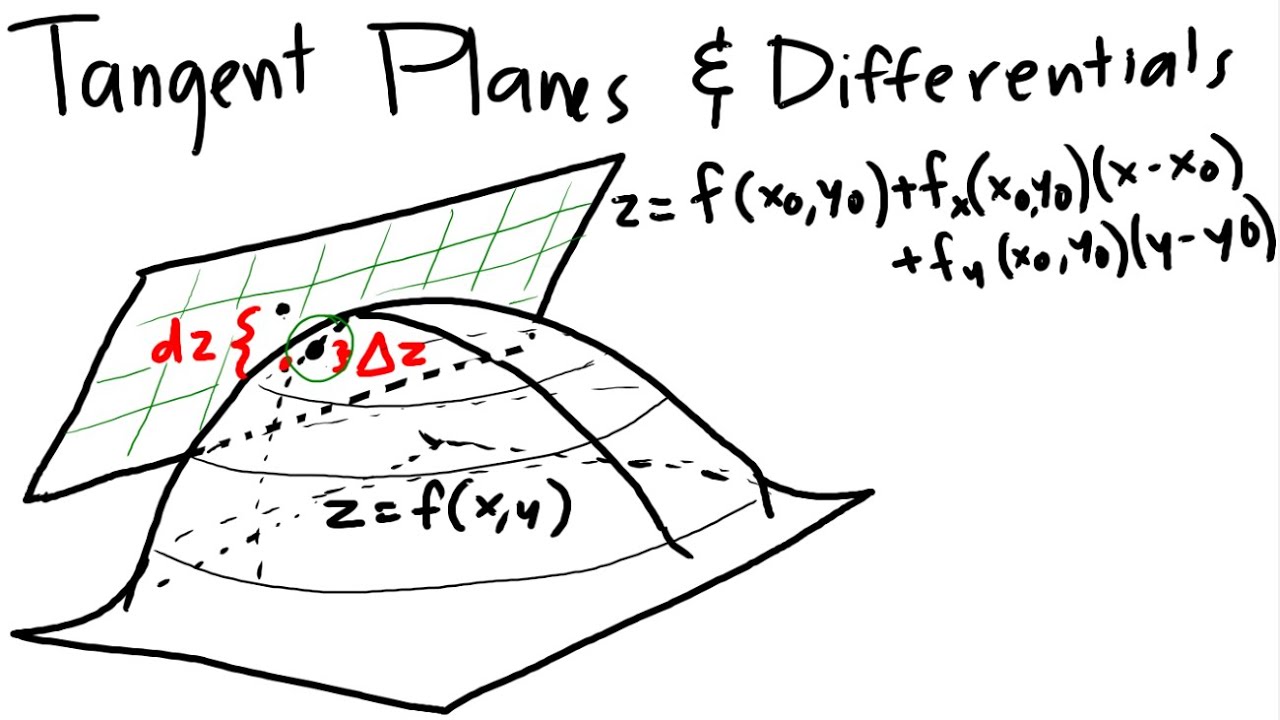
To approximate something using linearization, we just need the tangent line / plane, and then plug in the difference in the points. ?
And for differentials, the change of a function can be measured by the partial derivative of each variable times the change in that variable, and then added together?
marsh citrusBOT
vague ocean
To approximate something using linearization, we just need the tangent line / pl...
still temple
vague ocean
To approximate something using linearization, we just need the tangent line / pl...
for linearization u just plug in some x,y u want to approximate into L(x,y) = f(x0,y0) + fx(x0,y0) (x-x0) + fy(x0,y0)(y-y0)
still temple
vague ocean
To approximate something using linearization, we just need the tangent line / pl...
for ur 2nd q, just apply chain rule to figure it out based on the question itself
vague ocean
still temple
for linearization u just plug in some x,y u want to approximate into L(x,y) = f(...
Cool
vague ocean
still temple
for ur 2nd q, just apply chain rule to figure it out based on the question itsel...
Why chain rule?

No frieaking way. Jones @ asu
Yea probably. U have exam tmrw?
Tmrw
still temple
gl bro
vague ocean
still temple
gl bro
U too.
vague ocean
still temple
gl bro
Sorry man I got one more.
vague ocean


When finding equation of a tangent plane, we don’t need to compute the partial with respect to z?
Was wondering if you knew if it’s the same thing if we did the equation in the first pic
still temple
nah equation of tangent is just
z-z0 = fx(x0, y0)(x-x0) + fy(x0,y0)(y-y0)
and z0 is just f(x0, y0) --- The function evaluated at x0, y0
so z - z0 = partial x * (x-x0) + partial y * (y-y0)
@vague ocean ur in 267 right? not like the other calc 3 classes?
if so use this playlist
https://www.youtube.com/watch?v=Tp8RcFzkUBg&list=PLeJgpYT2EN4QbcsP1gJyN49Edv5OPIpSE
this is the video u want I think https://www.youtube.com/watch?v=kKWEoRS6OOc&list=PLeJgpYT2EN4QbcsP1gJyN49Edv5OPIpSE&index=14
 vague ocean
still temple
so z - z0 = partial x * (x-x0) + partial y * (y-y0)
vague ocean
still temple
so z - z0 = partial x * (x-x0) + partial y * (y-y0)
Ohk gotcha. Yea 267
vague ocean
still temple
this is the video u want I think https://www.youtube.com/watch?v=kKWEoRS6OOc&lis...
Awesome thanks man boutta watch that
still temple
yea, watch the video he explains it super well
Hes been carrying calc 3 for me lmao
marsh citrusBOT
@vague ocean Has your question been resolved?
vague ocean
still temple
Hes been carrying calc 3 for me lmao
YouTube carrying me. I have like 4 calc 3 playlists saved. Idk why I need it to be explained over and over to understand it
still temple
the calc 3 playlists on youtube suck
i found this one to be the only good one cuz it explains stuff we go over in class
vague ocean
It’s different for me than calc 2. Cause calc 2 the explanations were always pretty easy but I had to do so many problems to get it down
But partial derivatives and double integrals are just calc 1 pretty much once you can visualize
vague ocean
still temple
the calc 3 playlists on youtube suck
This one is good super good for example problems. He just goes through solutions pretty much.
 marsh citrusBOT
Channel closed
Closed by @vague ocean
Use .reopen if this was a mistake.
still temple
you too
marsh citrusBOT
Available help channel!
Send your question here to claim the channel.
Remember:
• Ask your math question in a clear, concise manner.
• Show your work, and if possible, explain where you are stuck.
• After 15 minutes, feel free to ping <@&286206848099549185>.
• Type the command .close to free the channel when you're done.
• Be polite and have a nice day!
Read #❓how-to-get-help for further information on how to ask a good question, and about conduct in the question channels.
still temple
I need help
marsh citrusBOT
still temple
I need help
 marsh citrusBOT
@still temple Has your question been resolved?
 vast moat
still temple
vast moat
still temple
whats the starting value?
when no one gave money, how much does she have?
marsh citrusBOT
Channel closed
Closed due to timeout
Use .reopen if this was a mistake.
marsh citrusBOT
Available help channel!
Send your question here to claim the channel.
Remember:
• Ask your math question in a clear, concise manner.
• Show your work, and if possible, explain where you are stuck.
• After 15 minutes, feel free to ping <@&286206848099549185>.
• Type the command .close to free the channel when you're done.
• Be polite and have a nice day!
Read #❓how-to-get-help for further information on how to ask a good question, and about conduct in the question channels.
 weary apex
 marsh citrusBOT
weary apex
weary apex
marsh citrusBOT
weary apex
weary apex
im so stuck on this problem where do i even start 😭
final skiff
weary apex
im so stuck on this problem where do i even start 😭
You are given slopes at different points, so clearly you need to use the derivative somehow.
 chilly mica
Well start of with f’(x)
We know it’s linearalso the points (1,7) and (-1,-13)
Then you can easily form using point gradient
And using that, you can integrate and since it passed through 2,16, you can calculate the constant
final skiff
Dont think integration is needed
chilly mica
True you can simply differentiate y
And subbing in the points, you get a system of equations in terms of a and b which then you can find the value of
weary apex
i just figured it out idek how
first i derivate of y when x = -1 and 1
then used systems of equations and canceled them out
which first gave me A and then i plugged that back in one of my deriviative equations to get B and then I got C by plugging all of that stuff back into the main equation
.close
marsh citrusBOT
Channel closed
Closed by @weary apex
Use .reopen if this was a mistake.
marsh citrusBOT
Available help channel!
Send your question here to claim the channel.
Remember:
• Ask your math question in a clear, concise manner.
• Show your work, and if possible, explain where you are stuck.
• After 15 minutes, feel free to ping <@&286206848099549185>.
• Type the command .close to free the channel when you're done.
• Be polite and have a nice day!
Read #❓how-to-get-help for further information on how to ask a good question, and about conduct in the question channels.
 lethal bridge
 marsh citrusBOT
lethal bridge
marsh citrusBOT
lethal bridge

 olive sandal
The length between line x and the start of the garden
lethal bridge
what like this?
 olive sandal
yes
lethal bridge
hm okay
olive sandal
no problem
lethal bridge
so I need help with part a how should I start with that
 floral linden
lethal bridge
so I need help with part a how should I start with that
floral linden
lethal bridge
so I need help with part a how should I start with that
find the area of the garden in terms of x and y
lethal bridge
so its (y -1) * (x-1) isnt it
 floral linden
yeah
lethal bridge
so (y-1)(x-2) = 50
floral linden
yep
lethal bridge
floral linden
yep
so for this one my thought is that the area is a minimum when its derivative is equal to 0 but not sure what im differentiatingh
 floral linden
lethal bridge
so for this one my thought is that the area is a minimum when its derivative is ...
floral linden
lethal bridge
so for this one my thought is that the area is a minimum when its derivative is ...
what's the area of the path?
in terms of x and y
lethal bridge
y = 50/(x-2) + 1 as from part a
lethal bridge
ohhhh
floral linden
lethal bridge
this?
that's for area of the garden
isnt the path just the big rectangle - the garden?
floral linden
lethal bridge
its x*y - garden
yep, so that's xy-50
and you have y in terms of x
so write the whole thing in terms of x
lethal bridge
how do I do that? dont I need xy - 50 equal to something in order to do that
like xy - 50 by itself doesnt rlly have meaning
and I cant do much on that i dont think
unless its equal to something
floral linden
lethal bridge
how do I do that? dont I need xy - 50 equal to something in order to do that
A = xy - 50
lethal bridge
okay
floral linden
but first write the y in terms of x and convert A into terms of x
lethal bridge
so then xy = A + 50
x = (A + 50)/y
floral linden
what
no
use
A = xy - 50
y = 50/(x-2) + 1 as from part a
so A = x(50/(x-2) + 1) - 50
isnt it?
lethal bridge
floral linden
A = xy - 50
wait wut u said it was -50 before
floral linden
lethal bridge
wait wut u said it was -50 before
typo typo it's -50
lethal bridge
okay wait restart im gonna try fix
floral linden
lethal bridge
okay wait restart im gonna try fix
A = xy - 50
now the question wants
A = f(x)
lethal bridge
okay
lethal bridge
ill sub my y value in?
floral linden
lethal bridge
so A = 50x/x-2 - 49
you sure?
lethal bridge
y...y...yes
ye-s?
wait
no
i missed
brackets
misinput
50x/x-2 + x -50 = A
there we go
thats the f(x)
lethal bridge
so we do A' = 0 right?
floral linden
yes
lethal bridge
so after the derivatives I get a quadratic with x^2 - 4x - 96 = 0
so then
x = 12 or x = -8
negative area doesnt make sense so Im assuming the only correct minimum is 12?
floral linden
i think your question only asked for the x-value tho right
lethal bridge
yeah only x
also if you dont mind with one more question im not sure how to approach this one

my thought is
if the length of y = x^2 is L
then L/a^2 maybe??
floral linden
lethal bridge
also if you dont mind with one more question im not sure how to approach this on...
x^2/a^2 = (x/a)^2 which is just a stretching of the graph of x^2 by 'a' times
so it will be c
you can try it on desmos or something
lethal bridge
wait
floral linden
draw x^2, x^2/4 and x^2/9 just to see the pattern
floral linden
lethal bridge
how did (x/a)^2 cancel out
it didnt cancel anything, im saying that (x/a)^2 is the same as x^2 just that x -> x/a, which means that x^2/a^2 is just a horizontally stretched version of the y = x^2 graph
stretched by a factor of 'a'
lethal bridge
example if a = 4
 floral linden
lethal bridge
example if a = 4
floral linden
lethal bridge
example if a = 4
yep see it just stretches horizontally by a factor of a
lethal bridge
yeah or 1/a technicaly
floral linden
so the length would also stretch by a factor of a
floral linden
lethal bridge
yeah or 1/a technicaly
no, it stretches by a
lethal bridge
why not L/a?
lethal bridge
floral linden
no, it stretches by a
how come?
floral linden
lethal bridge
why not L/a?
the length increases, even visually it makes sense
lethal bridge
if we have x^2/a^2 thats the same thing as x^2 * 1/a^2
so its stretched by 1/a isnt it
its vertically stretched by 1/a
floral linden
lethal bridge
how come?
let's take the point where x = 2 on y = x^2. The point is (2, 4) on. After making the transformation to x^2/a^2, the point at x = 2 is not (2, 4/a). If we take a = 2 just as an example, the point is now (2,2) instead of (2,4), so the graph stretched by a factor of a because it moves outward from it's regular position to a position 'a' times its previous position
lethal bridge
wait
is if we had y =x^2 and y= x^2/a^2 right
if we are looking at vertical stretching then its being vertically stretched by a factor of 1/a^2
right
but horizontally it will be by a factor of a^2
?
floral linden
it isn't being vertically stretched
well ig you could think of it that way
but that's weird to think of
well at least you get the point
lethal bridge
ok for a more simple example like
2x^2 = y
thats vertically stretched
by a factor of 2
all the y values of y =x^2 are now doubled because of the 2
and a horizontal would be like
floral linden
the red graph is x^2, the black is x^2/3^2. clearly, the black one is wider than the red one, meaning it has been stretched horizontally. Additionally, if you see the distance between the intersection points of the line y = 4 and x^2 compared to y = 4 and x^2/9, you can see the distance is bigger in x^2/9

out of the options you gave, the only option that increases length is aL
lethal bridge
wait but I feel like there is still vertical dilation
x^2/a^2 = x^2 * 1/a^2 does it not
so its being vertically dilated by 1/a^2
floral linden
it does and i mentioned you can think of it that way, but looking at the vertical transformation doesnt help with the question
cause the question is asking horizontal distance
marsh citrusBOT
@lethal bridge Has your question been resolved?
marsh citrusBOT
Channel closed
Closed due to timeout
Use .reopen if this was a mistake.
Available help channel!
Send your question here to claim the channel.
Remember:
• Ask your math question in a clear, concise manner.
• Show your work, and if possible, explain where you are stuck.
• After 15 minutes, feel free to ping <@&286206848099549185>.
• Type the command .close to free the channel when you're done.
• Be polite and have a nice day!
Read #❓how-to-get-help for further information on how to ask a good question, and about conduct in the question channels.
 raw robin
hi
marsh citrusBOT
raw robin
hi
raw robin
(had to claim the channel)
please can someone explain how SUVAT equations link to graphs?
marsh citrusBOT
@raw robin Has your question been resolved?
marsh citrusBOT
@raw robin Has your question been resolved?
marsh citrusBOT
@raw robin Has your question been resolved?
raw robin
.close
marsh citrusBOT
Channel closed
Closed by @raw robin
Use .reopen if this was a mistake.
Available help channel!
Send your question here to claim the channel.
Remember:
• Ask your math question in a clear, concise manner.
• Show your work, and if possible, explain where you are stuck.
• After 15 minutes, feel free to ping <@&286206848099549185>.
• Type the command .close to free the channel when you're done.
• Be polite and have a nice day!
Read #❓how-to-get-help for further information on how to ask a good question, and about conduct in the question channels.
 simple quiver
Need help on 6
marsh citrusBOT
simple quiver
Need help on 6

 quaint elm
yeah I think so

 willow bison
simple quiver
willow bison
simple quiver
are you familiar with how to find inverse functions
you basically swap the positions of x and y, then solve for y
so for example y = cosx + 3x
we swap
x = cosy + 3y
actually wait fuck nvm
marsh citrusBOT
@simple quiver Has your question been resolved?
simple quiver
<@&286206848099549185>
simple quiver
<@&286206848099549185>
simple quiver
<@&286206848099549185>
marsh citrusBOT
Channel closed
Closed by @simple quiver
Use .reopen if this was a mistake.
Available help channel!
Send your question here to claim the channel.
Remember:
• Ask your math question in a clear, concise manner.
• Show your work, and if possible, explain where you are stuck.
• After 15 minutes, feel free to ping <@&286206848099549185>.
• Type the command .close to free the channel when you're done.
• Be polite and have a nice day!
Read #❓how-to-get-help for further information on how to ask a good question, and about conduct in the question channels.
 hallow kettle
Can someone help with a real analysis problem? Asked to find lim sup [0,cos x] for x=1,2,3….
marsh citrusBOT
hallow kettle
Can someone help with a real analysis problem? Asked to find lim sup [0,cos x] f...
hallow kettle
Cos x is bounded above here by 1 and below by -1
My guess would be that lim sup = [0,1] and lim inf = [-1,0] but there’s merely a guess
Breaking it down by the fact lim inf an = an,eventually, I’d guess that lim inf = {0}
And lim sup an = an, infinitely often I’d guess that well, the values in (-1,1) occur infinitely often
Could someone clarify this for me please? Any and all help greatly appreciated
marsh citrusBOT
@hallow kettle Has your question been resolved?
 young owl
lim sup should be 1, lim inf -1, by argument of density
hallow kettle
young owl
lim sup should be 1, lim inf -1, by argument of density
Could you possibly elaborate?
young owl
since {cos(n) | n in Z} is dense in [-1, 1], you can always find integers n such that cos(n) is closer and closer to 1, and also integers n such that cos(n) is closer and closer to -1
hallow kettle
Oh really, how come this doesn’t align with like the definition of lim sup an being defined as an infinitely often, or that of lim inf an being defined as an eventually
young owl
Idk which definition you're referring to, but no matter your definition, you should be able to deduce that lim sup is the supremum of the set of accumulation points, and lim inf is the infimum of the set of accumulation points
since -1 and 1 are accumulation points of cos(n), and that they also bound cos(n), they are respectively lim inf and lim sup
(and the fact that -1 and 1 are accumulation points comes from the fact that cos(n) is dense in [-1, 1])
hallow kettle
young owl
(and the fact that -1 and 1 are accumulation points comes from the fact that cos...
Yeah I get that much, I see exactly what you mean, just wondering how I wasn’t aware that lim sup is the supremum of the set of accumulation points
I think it must have been presented in a different manner in class, nevertheless thank you very much!
hallow kettle
.close
marsh citrusBOT
Channel closed
Closed by @hallow kettle
Use .reopen if this was a mistake.
Available help channel!
Send your question here to claim the channel.
Remember:
• Ask your math question in a clear, concise manner.
• Show your work, and if possible, explain where you are stuck.
• After 15 minutes, feel free to ping <@&286206848099549185>.
• Type the command .close to free the channel when you're done.
• Be polite and have a nice day!
Read #❓how-to-get-help for further information on how to ask a good question, and about conduct in the question channels.
 thorny jungle
In the context of real analysis, is it true that R complement is the empty set?
marsh citrusBOT
thorny jungle
In the context of real analysis, is it true that R complement is the empty set?
proud ice
thorny jungle
In the context of real analysis, is it true that R complement is the empty set?
If your universal set is R, then yea
thorny jungle
Ok. I need to show the empty set is both open and closed.
I already shown R is open and closed
So I can use the fact that R complement is empty set
Then basicially say that empty set is both open and closed.
thanks
.close
marsh citrusBOT
Channel closed
Closed by @thorny jungle
Use .reopen if this was a mistake.
Available help channel!
Send your question here to claim the channel.
Remember:
• Ask your math question in a clear, concise manner.
• Show your work, and if possible, explain where you are stuck.
• After 15 minutes, feel free to ping <@&286206848099549185>.
• Type the command .close to free the channel when you're done.
• Be polite and have a nice day!
Read #❓how-to-get-help for further information on how to ask a good question, and about conduct in the question channels.
Channel closed
Channel closed due to the original message being deleted.
If you did not intend to do this, please open a new help channel,
as this action is irreversible, and this channel may abruptly lock.
 quaint sky

ok so the answer to this is d, due to ratios, but here's where my question lies
how do we know that they are using ratios in this problem, and how we know when they are not using ratios in the problem.
marsh citrusBOT
Available help channel!
Send your question here to claim the channel.
Remember:
• Ask your math question in a clear, concise manner.
• Show your work, and if possible, explain where you are stuck.
• After 15 minutes, feel free to ping <@&286206848099549185>.
• Type the command .close to free the channel when you're done.
• Be polite and have a nice day!
Read #❓how-to-get-help for further information on how to ask a good question, and about conduct in the question channels.
quaint sky
hi
marsh citrusBOT
quaint sky
hi
quaint sky
question is above
 quartz plank
quaint sky
how do we know that they are using ratios in this problem, and how we know when ...
quartz plank
quaint sky
how do we know that they are using ratios in this problem, and how we know when ...
well
usually the way to know if you have to use ratios is if you have something like a/b = some constant
and you dont have any other equations with a and b
marsh citrusBOT
Channel closed
Closed by @quaint sky
Use .reopen if this was a mistake.
Available help channel!
Send your question here to claim the channel.
Remember:
• Ask your math question in a clear, concise manner.
• Show your work, and if possible, explain where you are stuck.
• After 15 minutes, feel free to ping <@&286206848099549185>.
• Type the command .close to free the channel when you're done.
• Be polite and have a nice day!
Read #❓how-to-get-help for further information on how to ask a good question, and about conduct in the question channels.
quaint sky
this one is a little confusing
 marsh citrusBOT
quaint sky
this one is a little confusing
quaint sky
marsh citrusBOT
quaint sky
this one is a little confusing
quaint sky
the answer is a but im not sure why
like the way they formatted the question is confusing
quartz plank
quaint sky
this one is a little confusing
ok lets use l for length and w for width
with the original rectangle the area is l*w
what will the area be if the length is increased by x percent and the width is decreased by x percent
quaint sky
is it 20*-20
and 40*-40
hence quantity a will have a greater number because its a smaller neg value
quartz plank
quaint sky
is it 20*-20
well
20 percent is really 0.2
increasing the length by 20 percent will mean that the length will be 1.2*l
decreasing the width by 20 percent will mean that the width will be 0.8*w
quaint sky
OH
so the way we are thinking about it, is the fact that it is 100% and we will add 20 percent or subtract is by 20%
quartz plank
quaint sky
so the way we are thinking about it, is the fact that it is 100% and we will add...
yeah
so how do we get the area of the x=20 canvas in terms of the original area (which is l*w)
quaint sky
1.2*.8?
Which is ,96
The other one is 1.4 * 0.6
Which is .84
Hence 20% is largee
could you help me with this?
 quartz plank
quaint sky
could you help me with this?
quartz plank
quaint sky
could you help me with this?
ok so
if you drive 50 miles per hour for 2 hours how far do you go
quaint sky
100 miles
quartz plank
yeah
quartz plank
and what is the shortest distance between 2 points
quartz plank
quaint sky
Bc its 140
how did you get htat
quartz plank
shortest distance between two points is a straight line right
quaint sky
Yes
quartz plank
so how do you solve this
 quartz plank
yes
quaint sky
Okay thank you. I will close this channel for now, I will come back in a few minutes if I have another question. Tysm!
.close
marsh citrusBOT
Channel closed
Closed by @quaint sky
Use .reopen if this was a mistake.
Available help channel!
Send your question here to claim the channel.
Remember:
• Ask your math question in a clear, concise manner.
• Show your work, and if possible, explain where you are stuck.
• After 15 minutes, feel free to ping <@&286206848099549185>.
• Type the command .close to free the channel when you're done.
• Be polite and have a nice day!
Read #❓how-to-get-help for further information on how to ask a good question, and about conduct in the question channels.
 vagrant gull
 marsh citrusBOT
vagrant gull
vagrant gull
marsh citrusBOT
vagrant gull
vagrant gull
!status
marsh citrusBOT
What step are you on?
1. I don't know where to begin.
2. I have begun but got stuck midway.
3. I got an answer but I was told that it's wrong.
4. I got an answer and would like my work checked.
5. I have a question about someone else's work/solution.
6. I have completed the problem and don't need help anymore. Thank you.
7. None of the above
1
 vagrant gull
still temple
vagrant gull
still temple
!occupied
marsh citrusBOT
still temple
Someone else is already using this help channel. If you need help with a question, please open your own help channel/thread (see #❓how-to-get-help for instructions).
summer trench
those 2 students just like me fr
okay so
you need to let 2 things here, what do you think it should be
vagrant gull
ill show you my idea hold on
summer trench
k
vagrant gull
summer trench
k
Please do not say that to me because it's rude
here's my idea that my teacher uses, im putting the numbers right?
 summer trench
vagrant gull
Please do not say that to me because it's rude
summer trench
vagrant gull
Please do not say that to me because it's rude
oh, how?
vagrant gull
did i do right for the chart?
summer trench
yes
summer trench
vagrant gull
I did x-2 because there are 2 peoples?
more like there are 2 ppl that are not contributing
vagrant gull
$\frac{576}{x-2} - \frac{576}{x} = 4$
elfin berryBOT
Akira 🍇
 vagrant gull
is this right
summer trench
what is your logic behind this btw
vagrant gull
[\left(\frac{\text{Actual}}{\text{payers}}\right) - \left(\frac{\text{Expectation}}{\text{payers}}\right) = 4]
elfin berryBOT
Akira 🍇
 elfin berryBOT
!Yajat!
 vagrant gull
like this
summer trench
ig
vagrant gull
no
summer trench
i dont know about that
vagrant gull
;-;
[\left(\frac{\text{Actual}}{\text{$/payers}}\right) - \left(\frac{\text{Expectation}}{\text{$/payers}}\right) = 4]
elfin berryBOT
Akira 🍇
Compile Error! Click the  reaction for more information.
(You may edit your message to recompile.)
 vagrant gull
elfin berry
**Akira 🍇**
vagrant gull
elfin berry
**Akira 🍇**
just "$/payers" for both here
vagrant gull
elfin berry
**Akira 🍇**
so it's like this now
summer trench
what make you think thier difference would be 4?
vagrant gull
because it says "paid had to pay extra 4" no?
 white lion
They paid an extra 4 but the total is still the same
Maybe it'd be less confusing if you were to use two variables
summer trench
also dont you think the expectation term should be first
vagrant gull
it would
white lion
I mean the result you'll get by solving is correct
vagrant gull
my teacher taught that way
 white lion
I mean the result you'll get by solving is correct
white lion
white lion
I mean the result you'll get by solving is correct
But the method seems very restrictive
vagrant gull
yeah so now the equation i did right here?
vagrant gull
white lion
Yes but i'm not sure you understood what you did
I used what my teacher taught me
summer trench
i mean this method is right too
vagrant gull
vagrant gull
here's my idea that my teacher uses, im putting the numbers right?
by using that chart
white lion
summer trench
i mean this method is right too
Yea it stems from the fact that if you have a mean and then add a value x to every value in that mean the mean also gets added x
vagrant gull
this is type of rational expression so ik how he solved these questions above

same thing i did
vagrant gull
vagrant gull
my teacher taught that way
chart + this thingy
vagrant gull
summer trench
i mean this method is right too
what's the right method then?
you're making me curios rn
summer trench
to solve with 2 variables
white lion
vagrant gull
what's the right method then?
There's no right method
What you did is correct
You had two average
did the difference and solved
The other method is just a system
vagrant gull
oh right
last question for number 4
since it says three people should i write x-3?
to the reality section
white lion
$\left{ \begin{array}{cl}
n \times x= 576 \
(n-2) \times(x+4) = 576
\end{array} \right.$
elfin berryBOT
Azenx
 vagrant gull
whats that
white lion
A system of two equation
x is the price per person
and n is the number a person
x*n gives you the total
vagrant gull
i want it into rational expression
summer trench
elfin berry
**Azenx**
this was exactly i wanted to tell you how, but do it in the way your teacher told you to
white lion
Yea better for grades if you do it how the teacher told u
just wanted to show you the second method
vagrant gull
summer trench
this was exactly i wanted to tell you how, but do it in the way your teacher tol...
how that rational expression equation tho?
white lion
You take the two situations
The first tells you that if everyone paid an amount x the total would be 576
However if two people don't pay ( n-2) then everyone would pay 4$ more (x+4)
idk if that's what you call rational expression
vagrant gull
elfin berry
**Azenx**
how would you make it into rational expression by using this method?
vagrant gull
vagrant gull
this is type of rational expression so ik how he solved these questions above
I did same thing for number 4 as it's my last one

so my equation for that is
$\frac{280}{x-3} - \frac{280}{x} = 12$
elfin berryBOT
Akira 🍇
 white lion
yep
vagrant gull
I can handle the whole thing since im familiar with rational expression
white lion
vagrant gull
how that rational expression equation tho?
You don't cuz that's a different method
vagrant gull
so it's not my thingy im asking for
summer trench
btw what do you mean by this rational expression
white lion
fraction of two polynomials
summer trench
oh
vagrant gull
vagrant gull
this is type of rational expression so ik how he solved these questions above
right here
vagrant gull
summer trench
oh
it's basically algebra 2 based in canada
vagrant gull
elfin berry
**Azenx**
according to this they don't taught it until university
white lion
🤨
vagrant gull
yeah it's useless math lol
white lion
no math is useless 🧐
vagrant gull
everything until uni