#help-33
1 messages · Page 47 of 1
 hearty reef
 marsh citrusBOT
Channel closed
Closed by @hearty reef
Use .reopen if this was a mistake.
 Available help channel!
Send your question here to claim the channel.
Remember:
• Ask your math question in a clear, concise manner.
• Show your work, and if possible, explain where you are stuck.
• After 15 minutes, feel free to ping <@&286206848099549185>.
• Type the command .close to free the channel when you're done.
• Be polite and have a nice day!
Read #❓how-to-get-help for further information on how to ask a good question, and about conduct in the question channels.
 pulsar latch
 marsh citrusBOT
pulsar latch
marsh citrusBOT
marsh citrusBOT
pulsar latch
marsh citrusBOT
What step are you on?
1. I don't know where to begin
2. I have begun but got stuck midway
3. I got an answer but I'm told it's wrong
4. I got an answer and would like my work checked
5. I have a question about someone else's worked solution
6. None of the above
 elfin berryBOT
Køter
 pulsar latch

 rugged cobalt
first we know that the area we want is 5/2
pulsar latch
so b must be 5/2
elfin berryBOT
Køter
 elfin berryBOT
Køter
 rugged cobalt
in words this means. the area under the curve e^2x bounded by x=0 and x=C is 5/2
pulsar latch
ohh
rugged cobalt
make sense?
rugged cobalt
also keep in mind that we are not interested in $\int_C^0 e^{2x} dx=5/2$ becuase C is a positive numer
elfin berryBOT
Køter
 rugged cobalt
do you know how to find definite integrals?
F(b)-F(a)
where F(x) is the antiderivative
pulsar latch
in this case the antider= 2e^2x?
rugged cobalt
if you can find the derivative
you just do the reverse
like what is the derivative of 1/2 * e^(2x)?
pulsar latch
e^2x/2 ?
rugged cobalt
yes the derivative of that
 rugged cobalt
i think youre just confusing them
what you are doing is using the chain rule when finding a derivative
d/dx e^(2x) = d/dx 2x * e^(2x) = 2e^(2x)
rugged cobalt
nono im just saying what to do
so the derivative of e^(2x) is 2e^(2x)
which means the antiderivative of 2e^(2x) is e^(2x)
because they mean the opposite
pulsar latch
sorry, i just struggle very much  ur great at explaining but i just sux at math
i understand wym now
rugged cobalt
ok, so antiderivative of e^(2x) is?
pulsar latch
1/2e^2x
rugged cobalt
yup
this would be also + constant
usually called C but its confusing cause its a different C from your problem
pulsar latch
1/2e^2x + C
rugged cobalt
1/2e^2x+C
no the dx dissappears with the integral
and in definite integral like ours
the C cancels
because we do F(b)-F(a)
$\int_C^0 e^{2x} dx=F(C)-F(0)=5/2$
elfin berryBOT
Køter
 rugged cobalt
$\int_0^C e^{2x} dx=F(C)-F(0)=1/2e^{2C}+K-(1/2e^{2(0)}+K)=1/2e^{2C}-1/2e^{2(0)}=5/2$
i called them K instead to not confuse you
with the C
adn you can see they cancel
so in definite integrals the +C always disappears aswell
K-K
pulsar latch
👍
elfin berryBOT
Køter
 rugged cobalt
and i plugged in C and 0
for F(x) which was our anti derivative
now its just an equation and you solve for C
pulsar latch
so 5/2+1/2e^2(0)=1/2e^2(C) ?
rugged cobalt
2C
and +1/2e^(2(0)) if you move it to the other side
cause its already negative
yes
just simplify and isolate C
pulsar latch
When they say C is a positive real constant do they mean C must be a real number?
rugged cobalt
yes
and positive
oh i turned the integrals the wrong way around here
$\int_0^C e^{2x} dx=F(C)-F(0)=1/2e^{2C}+K-(1/2e^{2(0)}+K)=1/2e^{2C}-1/2e^{2(0)}=5/2$
elfin berryBOT
Køter
 rugged cobalt
pulsar latch
so 5/2+1/2e^2(0)=1/2e^2(C) ?
rugged cobalt
pulsar latch
so 5/2+1/2e^2(0)=1/2e^2(C) ?
do you need help solving this equation? or are you still working on it
pulsar latch
rugged cobalt
do you need help solving this equation? or are you still working on it
I keep getting a decimal number. pls help
rugged cobalt
it is a decimal number
you multiply both sides by 2
5+e^0=e^(2C)
6=e^(2C)
and then take ln both sides
ln(6)=ln(e^(2C))
you know ln and e^ are inverses no?
so they cancel
ln(6)=2C
ln(6)/2=C
,calc log(6)/2
elfin berryBOT
Result:
0.89587973461403
oh this part is where I need to revise
rugged cobalt
hmm is like solving equations like
7^x=5
you take log with base 7 both sides
log_7(7^x)=log_7(5)
x=log_7(5)
they cancel
and log with base e is called ln
log_e(x)=ln(x)
pulsar latch
then is 1/x = In(x)
pulsar latch
thanks a lot, this will def help during trials 
rugged cobalt
np you should revise logarithms though 💀
watch a youtube vid or smth
or if you dont really care about understanding
just remember that ln and e^ cancels eachother
so you can solve equations like e^x=15
pulsar latch
youtube vid might help a lot but sometimes u need help with that one specific ques but they dont have
Like this one and its even diff becuz our teacher dont give answers
But thank you for your help, and sry for taking up your time
.close
marsh citrusBOT
Channel closed
Closed by @pulsar latch
Use .reopen if this was a mistake.
Available help channel!
Send your question here to claim the channel.
Remember:
• Ask your math question in a clear, concise manner.
• Show your work, and if possible, explain where you are stuck.
• After 15 minutes, feel free to ping <@&286206848099549185>.
• Type the command .close to free the channel when you're done.
• Be polite and have a nice day!
Read #❓how-to-get-help for further information on how to ask a good question, and about conduct in the question channels.
 gritty lintel
How did the system get 12 here
 marsh citrusBOT
gritty lintel
How did the system get 12 here
gritty lintel
marsh citrusBOT
gritty lintel
How did the system get 12 here
gritty lintel
its not a test its practice i just wanna know it got 12
 vast shoal
$\frac{x}{2} + y = 1$
elfin berryBOT
ColdTee
 vast shoal
Two intercept form
gritty lintel
Why =1
vast shoal
,w intercept form
elfin berryBOT


 Requested by ColdTee#6459
vast shoal
gritty lintel
Why =1
Requested by ColdTee#6459
vast shoal
gritty lintel
Why =1
That's just how the equation is written
But if you want the derivation
You can search on google or try deriving it yourself as well
marsh citrusBOT
@gritty lintel Has your question been resolved?

 median quiver
can someone show me how to solve this on a calculator

 twilit grove
median quiver
can someone show me how to solve this on a calculator
twilit grove
median quiver
can someone show me how to solve this on a calculator
read #❓how-to-get-help
median quiver
my bad
twilit grove
gritty lintel
they give you the y-intercept and you're "told" the slope because it is parallel to the other line
gritty lintel
How did -16 become 11
twilit grove
it doesn't; -16 is the y-intercept for line R
marsh citrusBOT
Channel closed
Closed due to timeout
Use .reopen if this was a mistake.
marsh citrusBOT
Available help channel!
Send your question here to claim the channel.
Remember:
• Ask your math question in a clear, concise manner.
• Show your work, and if possible, explain where you are stuck.
• After 15 minutes, feel free to ping <@&286206848099549185>.
• Type the command .close to free the channel when you're done.
• Be polite and have a nice day!
Read #❓how-to-get-help for further information on how to ask a good question, and about conduct in the question channels.
marsh citrusBOT
Channel closed
Closed due to the original message being deleted
 red pecan
marsh citrusBOT
Available help channel!
red pecan
marsh citrusBOT
Available help channel!
Send your question here to claim the channel.
Remember:
• Ask your math question in a clear, concise manner.
• Show your work, and if possible, explain where you are stuck.
• After 15 minutes, feel free to ping <@&286206848099549185>.
• Type the command .close to free the channel when you're done.
• Be polite and have a nice day!
Read #❓how-to-get-help for further information on how to ask a good question, and about conduct in the question channels.
Channel closed
Closed due to the original message being deleted
Available help channel!
Send your question here to claim the channel.
Remember:
• Ask your math question in a clear, concise manner.
• Show your work, and if possible, explain where you are stuck.
• After 15 minutes, feel free to ping <@&286206848099549185>.
• Type the command .close to free the channel when you're done.
• Be polite and have a nice day!
Read #❓how-to-get-help for further information on how to ask a good question, and about conduct in the question channels.
 buoyant scaffold
I am attempting to find the local minimums of $f(x)=xsin(x), 0\leq x \leq 4\pi$, I don't really know how.
marsh citrusBOT
buoyant scaffold
I am attempting to find the local minimums of $f(x)=xsin(x), 0\leq x \leq 4\pi$,...
elfin berryBOT
KooKoo
 marsh citrusBOT
What step are you on?
1. I don't know where to begin
2. I have begun but got stuck midway
3. I got an answer but I'm told it's wrong
4. I got an answer and would like my work checked
5. I have a question about someone else's worked solution
6. None of the above
I have put it into online apps and gotten minimums at x=4.913,11.086. I don't care about the y values, but I would wish to express the x values in terms of something exact and not estimations
I do not know if this is possible, btw. It is entirely possible that it is not.
This is to demonstrate something in a grad school level paper so it is fairly high-powered
 runic temple
derivatives
elfin berryBOT
KooKoo
 buoyant scaffold
and this seems very difficult to do
runic temple
!show
marsh citrusBOT
Show your work, and if possible, explain where you are stuck.
buoyant scaffold
I just did
runic temple
show how you got there
buoyant scaffold
I cannot derive $x= arccos(-\frac{sin(x)}{x})$
elfin berryBOT
KooKoo
 buoyant scaffold
and this is pretty basic how I got here, I just took derivative, set it equal to 0, isolate x
 still temple
,w sin(x)+xcos(x)=0


 still temple
buoyant scaffold
This is to demonstrate something in a grad school level paper so it is fairly hi...
still temple
buoyant scaffold
This is to demonstrate something in a grad school level paper so it is fairly hi...
if its grad level, you are probably allowed to do it numerically
runic temple
best i can get you is -x=tan(x)
buoyant scaffold
Yeah but how do we turn that into something exact
buoyant scaffold
still temple
if its grad level, you are probably allowed to do it numerically
It's for a paper I'm writing and I want it to be exact
still temple
what makes you think that that number is algebraic
buoyant scaffold
Wdym?
still temple
there's a nonzero chance that the solutions is transcendental
runic temple
whats the original problem you need it for?
still temple
just pick your favourite numerical method and roll with it
still temple
link doi
runic temple
fundamental theorem of what
buoyant scaffold
Algebra
But I realize that's for polynomials
Shit
I think it's fair to assume this isn't rational
runic temple
its possible it isnt even algebraic
still temple
elfin berry
solution doesnt look complex 
runic temple
(more or less)
still temple
still temple
buoyant scaffold
Yeah haven't heard that notation before
you probably have seen it, its a big part of the fundamental theorem of algebra
buoyant scaffold
Oh yeah root finding algorithms are different
How would I prove or disprove that it can be written as an exact number?
still temple
define 'exact'
I dont think proving something is rational is usually easy
similarly, algebraic
runic temple
what do you need this for anyway?
still temple
buoyant scaffold
Basically I'm writing a paper referencing gradient descent
And I'm trying to use the function f(x)=xsin(x) to show an example of how gradient descent can become stuck at local minimas
runic temple
an estimate would work just fine then
it can be shown (visually, or with some epsilon-delta) that the point never gets closer to what you wantn
buoyant scaffold
ok
marsh citrusBOT
@buoyant scaffold Has your question been resolved?
marsh citrusBOT
Channel closed
Closed due to timeout
Use .reopen if this was a mistake.
marsh citrusBOT
Available help channel!
Send your question here to claim the channel.
Remember:
• Ask your math question in a clear, concise manner.
• Show your work, and if possible, explain where you are stuck.
• After 15 minutes, feel free to ping <@&286206848099549185>.
• Type the command .close to free the channel when you're done.
• Be polite and have a nice day!
Read #❓how-to-get-help for further information on how to ask a good question, and about conduct in the question channels.
 marble glacier
Any physicist in this discord?
marsh citrusBOT
marble glacier
Any physicist in this discord?
marble glacier

need help with this
A piece of magnetically permeable material is placed so that the point at which you have evaluated the magnitudes of both of the magnetic fields lies within it. If the relative magnetic permeability of the medium is 107.1, calculate new values for the two fields (express the magnetic flux density in mT):

and this

and mu_r = 107.1
 main idol
#old-network for physics server
marble glacier
main idol
<#406129911992942593> for physics server
im aware
taking my chances in here too tho
main idol
almost none of your question has math in it
marble glacier
main idol
almost none of your question has math in it
this is a very valid point
ill take it down in like 15 mins if no one answers
still temple
marble glacier
this is a very valid point
What are the values of the two magnetic fields that you calculated before the permeable material was added (the problem refers to those)?
marble glacier
still temple
What are the values of the two magnetic fields that you calculated before the pe...
so youre thinking its based on my previous questions
hm

However
the bottom one is at twice the distance as the top one
If what your saying is true
this is possible
but why would it be 8 marks
still temple
For the first field, wouldn't the answer just be $$\left|\vec B_{1,\text{new}}\right| = \mu_0 \cdot 107.1 \cdot 98.90,\mathrm{Am}^{-1}$$
marble glacier
Yea
it'd be the same

I just wasnt too sure if thats how the question was intepreted
still temple
For the second field, it would be $$\left|\vec B_{2,\text{new}}\right| = 107.1 \cdot 10.36,\mathrm{\mu T}$$

 marsh citrusBOT
Channel closed
Closed by @marble glacier
Use .reopen if this was a mistake.
Available help channel!
Send your question here to claim the channel.
Remember:
• Ask your math question in a clear, concise manner.
• Show your work, and if possible, explain where you are stuck.
• After 15 minutes, feel free to ping <@&286206848099549185>.
• Type the command .close to free the channel when you're done.
• Be polite and have a nice day!
Read #❓how-to-get-help for further information on how to ask a good question, and about conduct in the question channels.
 trim lodge
thanks ahead of time
marsh citrusBOT
trim lodge
thanks ahead of time
trim lodge
find the general solution to the trig equation: (2cos theta-1)(tan theta + 1) =0
I just want another pair of eyes going through and making sure its all okay

 marsh citrusBOT
@trim lodge Has your question been resolved?
marsh citrusBOT
Channel closed
Closed due to timeout
Use .reopen if this was a mistake.
marsh citrusBOT
Available help channel!
Send your question here to claim the channel.
Remember:
• Ask your math question in a clear, concise manner.
• Show your work, and if possible, explain where you are stuck.
• After 15 minutes, feel free to ping <@&286206848099549185>.
• Type the command .close to free the channel when you're done.
• Be polite and have a nice day!
Read #❓how-to-get-help for further information on how to ask a good question, and about conduct in the question channels.
 wind mural
Hello! I'd like help on a, c, and e. I don't know how to confront c and e due to the higher orders, and I would just like someone to look over my work for a since I'm getting an absolute value sign around the x that I feel like isn't supposed to be there.
Thanks!
 marsh citrusBOT
wind mural
Hello! I'd like help on a, c, and e. I don't know how to confront c and e due to...
wind mural
marsh citrusBOT
wind mural
Hello! I'd like help on a, c, and e. I don't know how to confront c and e due to...
wind mural
Heres my work:
 marsh citrusBOT
@wind mural Has your question been resolved?
wind mural
<@&286206848099549185> help pls 
marsh citrusBOT
@wind mural Has your question been resolved?
marsh citrusBOT
@wind mural Has your question been resolved?
Channel closed
Closed by @wind mural
Use .reopen if this was a mistake.
Available help channel!
Send your question here to claim the channel.
Remember:
• Ask your math question in a clear, concise manner.
• Show your work, and if possible, explain where you are stuck.
• After 15 minutes, feel free to ping <@&286206848099549185>.
• Type the command .close to free the channel when you're done.
• Be polite and have a nice day!
Read #❓how-to-get-help for further information on how to ask a good question, and about conduct in the question channels.
still temple
 marsh citrusBOT
still temple
still temple
marsh citrusBOT
still temple
still temple
confused what this proof is saying
 sterile vapor
3.1415926535897
marsh citrusBOT
@still temple Has your question been resolved?
main idol
still temple
confused what this proof is saying
Which part exactly
marsh citrusBOT
@still temple Has your question been resolved?
main idol
still temple
tbh
Look just ask a question
Read one sentence at a time and ask when something doesn't make sense
still temple
So p_xy is the prob that theres a noninfinite hitting time
starting at x and ending at y
right?
main idol
There's nothing to explain
main idol
still temple
So p_xy is the prob that theres a noninfinite hitting time
Is that defined in the text? Show its definition
still temple

it is
basically the total probability that it hits y again
so
$\rho_xy = \sum_{paths} P(path)$?
elfin berryBOT
! matthewzz
 still temple
also

Also im concerned between the difference in notation here
The book uses the period of a state, and $I_x$ interchangibly, but then talks about $I_n (n\in \mathbb{N})$ (eg: $I_0$), im confused what $I_x$ vs $I_n$ is?
elfin berryBOT
! matthewzz
 still temple
.close
marsh citrusBOT
Channel closed
Closed by @twin pier
Use .reopen if this was a mistake.
Available help channel!
Send your question here to claim the channel.
Remember:
• Ask your math question in a clear, concise manner.
• Show your work, and if possible, explain where you are stuck.
• After 15 minutes, feel free to ping <@&286206848099549185>.
• Type the command .close to free the channel when you're done.
• Be polite and have a nice day!
Read #❓how-to-get-help for further information on how to ask a good question, and about conduct in the question channels.
 heavy phoenix
hello, i'm not sure how to go about this
 marsh citrusBOT
heavy phoenix
hello, i'm not sure how to go about this
heavy phoenix
marsh citrusBOT
heavy phoenix
hello, i'm not sure how to go about this
heavy phoenix
i understand i am to use an augmented matrix, but what entries do i use
 whole sleet
Good question before anything, what is the dimension of the space? That is, how many basis members should we expect to find?
heavy phoenix
3
whole sleet
So R³ does have dimension 3, but we have 1 limiting equation on our space. So you'll actually get 3 - 1 = 2
heavy phoenix
where does the 1 come from?
heavy phoenix
is that the "x_1 - x_2 + 3x_3"?
whole sleet
One way to think of this - we should expect to describe a plane in 3-space. The equation of the plane is right there
Ye ye. x1 - x2 + 3x3 = 0 is our plane
 shadow ibex
 heavy phoenix
i see
whole sleet
And our basis will be from members of that plane! We need 2 basis members to describe the 2D space
whole sleet
Your 2D space! The one that will be your answer
shadow ibex
(For example)
heavy phoenix
but the vector space specified is 3. what's a plane?
whole sleet
So R³ does have dimension 3, but we have 1 limiting equation on our space. So you'll actually get 3 - 1 = 2
shadow ibex
heavy phoenix
but the vector space specified is 3. what's a plane?
Are you sure you are in a Are you in a Linear Algebra course?
heavy phoenix
shadow ibex
~~Are you sure you are in a~~ Are you in a Linear Algebra course?
indeed, i am
oh, cartesian
the cartesian plane?
shadow ibex
Point, line, and plane, together with set, are the undefined terms that provide the starting place for geometry. When we define words, we ordinarily use simpler
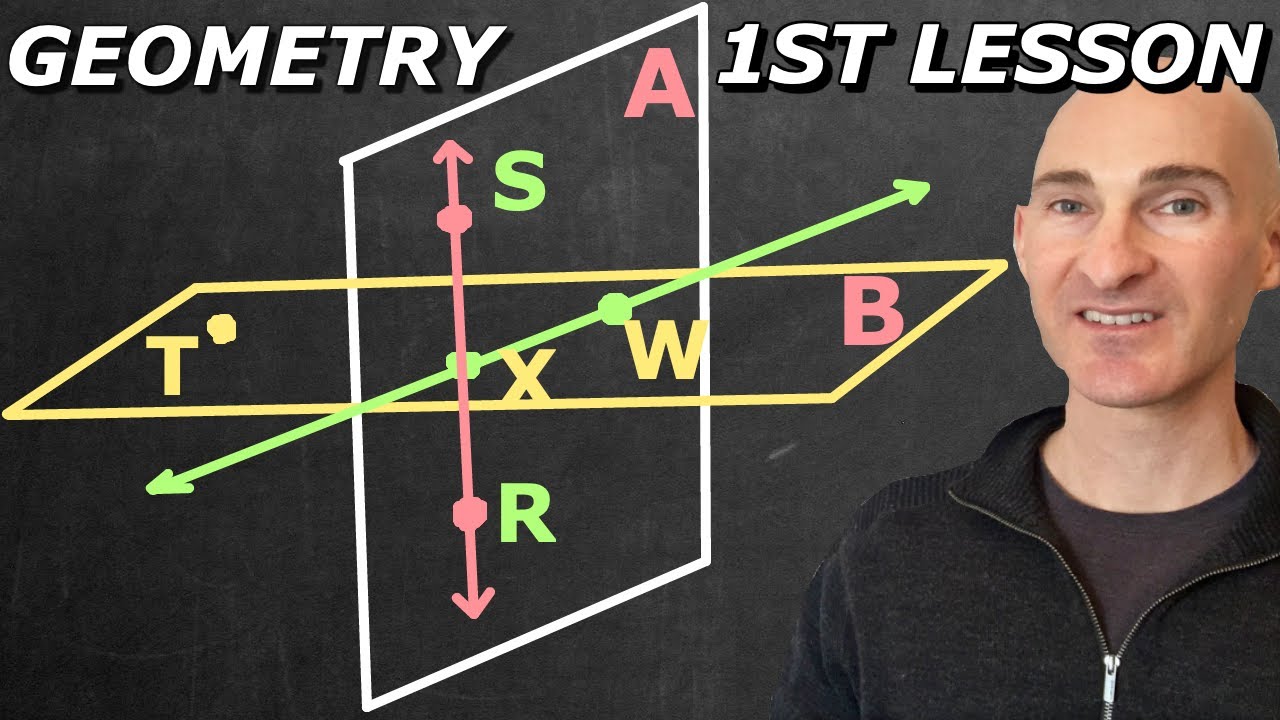
Learn one of the first lessons usually covered in a typical geometry class. We will discuss points, lines, and planes. We will also discuss the notation for points, lines, planes, rays, and segments. We will go through 13 practice problems asking students to name:
- Point
- Line
- Segment
- Ray
- Pair of Opposite Rays
- Plane
- Ano...
heavy phoenix
thanks. i have now watched up to the plane part
heavy phoenix
whole sleet
Ye ye. x1 - x2 + 3x3 = 0 is our plane
i think i'm getting bothered by the fact x1, x2 and x3 aren't numbers, like i'm used to
whole sleet
Is it easier to think of it as
x - y + 3z = 0?
Same idea. I'll use that for simplicity.
Anyway, we are done when we find two basis vectors. Let's do that!
These facts are true:
x = y - 3z
y = y
z = z
But that's the same as this vector equation:
(x) (1) (-3)
(y) = (1)y + ( 0)z
(z) (0) ( 1)
And hey, that's our space described as the span of two linearly independent vectors. A basis.
@heavy phoenix
marsh citrusBOT
@heavy phoenix Has your question been resolved?
heavy phoenix
oh-
(x) (1) (-3) why 1? why not -1? y is originally negative
(1,1,0) and (-3,0,1)
this is what my friend has
heavy phoenix
it's all good
whole sleet
-1 for y? Notice I rearranged the equation to get the result that I did. That might explain the sign flip
heavy phoenix
ok, i see that
but what about
y = y
z = z??
are you making y and z subjects? it doesn't seem so, so how
whole sleet
Basically, those two lines are obviously true
One way to describe this is by "creating free variables". Two basis members, two obvious lines
I let y and z be free. So they each get a line like that. x is then determined by y and z. So it gets the top line
Ultimately the goal was to write
x =
y =
z =
And include our one equation somewhere
@heavy phoenix
heavy phoenix
i'm here!
whole sleet
Sorry I keep disappearing haha
heavy phoenix
i'm trying to get as much help as i can, so ig i am too. it's no biggie
marsh citrusBOT
@heavy phoenix Has your question been resolved?
heavy phoenix
i'll have another in a min. guess, i'll close this and open another chat when i'm ready
yh, you did. thank youuu
.close
marsh citrusBOT
Channel closed
Closed by @heavy phoenix
Use .reopen if this was a mistake.
Available help channel!
Send your question here to claim the channel.
Remember:
• Ask your math question in a clear, concise manner.
• Show your work, and if possible, explain where you are stuck.
• After 15 minutes, feel free to ping <@&286206848099549185>.
• Type the command .close to free the channel when you're done.
• Be polite and have a nice day!
Read #❓how-to-get-help for further information on how to ask a good question, and about conduct in the question channels.
 pulsar coral
I’m trying to calculate pesticide effectiveness over time. Once a pesticide is applied, the pest population is halved after 2 days. After a week, the pesticide effectiveness goes to 0. The pest population is updated (pop = pop * some scaling factor) hourly. How would I go about figuring out that scaling factor? Mostly just looking for methods/buzzwords to look into, I’m working on a personal project so doing some independent math research would help me grow as a programmer.
marsh citrusBOT
pulsar coral
I’m trying to calculate pesticide effectiveness over time. Once a pesticide is a...
@pulsar coral Has your question been resolved?
marsh citrusBOT
@pulsar coral Has your question been resolved?
 wild zodiac
pulsar coral
I’m trying to calculate pesticide effectiveness over time. Once a pesticide is a...
wild zodiac
pulsar coral
I’m trying to calculate pesticide effectiveness over time. Once a pesticide is a...
at a glance, looks like you could apply the half-life formulas to this? 'halving every interval' seems pretty reminiscent of this
you just would stop at t=7 days
 marsh citrusBOT
Channel closed
Closed due to timeout
Use .reopen if this was a mistake.
Available help channel!
Send your question here to claim the channel.
Remember:
• Ask your math question in a clear, concise manner.
• Show your work, and if possible, explain where you are stuck.
• After 15 minutes, feel free to ping <@&286206848099549185>.
• Type the command .close to free the channel when you're done.
• Be polite and have a nice day!
Read #❓how-to-get-help for further information on how to ask a good question, and about conduct in the question channels.
 lost hound
Can someone help explain these answers to me (basic statistics)

 lost hound
<@&286206848099549185>
marsh citrusBOT
@lost hound Has your question been resolved?
marsh citrusBOT
Channel closed
Closed due to timeout
Use .reopen if this was a mistake.
Available help channel!
Send your question here to claim the channel.
Remember:
• Ask your math question in a clear, concise manner.
• Show your work, and if possible, explain where you are stuck.
• After 15 minutes, feel free to ping <@&286206848099549185>.
• Type the command .close to free the channel when you're done.
• Be polite and have a nice day!
Read #❓how-to-get-help for further information on how to ask a good question, and about conduct in the question channels.
 wispy grotto
 marsh citrusBOT
wispy grotto
wispy grotto
marsh citrusBOT
wispy grotto
wispy grotto
I have no idea how to solve
 winter meteor
do you not know how to integrate?
 cobalt spindle
use newton leibniz theorem
looks like this

so by doing this you can get the derivative of f(x)
so from there you can either kind of check by eye which graph suits more
or you can integrate it
 cobalt spindle
wispy grotto
cobalt spindle
wispy grotto
where did you get this from
cobalt spindle
wispy grotto
that last formula isnt even the same theorem
its just definite integration
newton leibniz theorem is for the case when the limits of the definite integration is a function itself
marsh citrusBOT
@wispy grotto Has your question been resolved?
marsh citrusBOT
Channel closed
Closed due to timeout
Use .reopen if this was a mistake.
Available help channel!
Send your question here to claim the channel.
Remember:
• Ask your math question in a clear, concise manner.
• Show your work, and if possible, explain where you are stuck.
• After 15 minutes, feel free to ping <@&286206848099549185>.
• Type the command .close to free the channel when you're done.
• Be polite and have a nice day!
Read #❓how-to-get-help for further information on how to ask a good question, and about conduct in the question channels.
 wary bluff
 marsh citrusBOT
wary bluff
whole sleet
marsh citrusBOT
wary bluff
whole sleet
It works out well if you do
wary bluff
and then cancel bottom (cos^2020(x)) with the one outside to be left with sin(x)^2020 * cos(x) dx ?
whole sleet
ye
winter meteor
where
whole sleet
u = sin(x)
whole sleet
Oof that's getting complicated
marsh citrusBOT
Channel closed
Closed by @wary bluff
Use .reopen if this was a mistake.
wary bluff
.reopen
 marsh citrusBOT
✅
wary bluff
for this im guessin that I shound use the ratio test on (sin(1/3^n))
whole sleet
The (-2)ⁿ will ensure that the terms blow up
whole sleet
It is alternating, but you still need the limit to go to 0
Since that doesn't happen, divergent
wary bluff
ye but I still dont get how this is similiar to that
like how does (-2)^n tell that
oh is it coz of the 2?
elfin berryBOT
Result:
1024
And the sin doesn't do anything to reduce these terms
whole sleet
Fair point, didn't consider that. I lied right at you
 drifting nimbus
$\lim_{n \to \infty } \left| \frac{\left( -2 \right)^{n+1}\sin{\frac{1}{3^{n+1}}}}{\left( -2 \right)^{n}\sin{\frac{1}{3^{n}}}} \right| = 2 \cdot\lim_{n \to \infty } \left| \frac{\sin{\frac{1}{3^{n+1}}}}{\sin{\frac{1}{3^{n}}}} \right| = 2 \cdot\lim_{n \to \infty } \left| \frac{\frac{1}{3^{n+1}}}{\frac{1}{3^{n}}} \right| = \frac{2}{3}$
elfin berryBOT
Unaty498
 drifting nimbus
so the ratio < 1
marsh citrusBOT
@wary bluff Has your question been resolved?
drifting nimbus
because $\sin{x}\sim x$ (as $x \to 0$)
elfin berryBOT
Unaty498
 wary bluff
drifting nimbus
$\lim_{n \to \infty } \left| \frac{\left( -2 \right)^{n+1}\sin{\frac{1}{3^{n+1}}...
wary bluff
drifting nimbus
$\lim_{n \to \infty } \left| \frac{\left( -2 \right)^{n+1}\sin{\frac{1}{3^{n+1}}...
ooooo
so it converges
drifting nimbus
yep
drifting nimbus
just remember that sin is a tricky bastard around 0
wary bluff
(-2)(-2)^n / (-2)^n. when u pulled out the -2
it turned poisitive
coz of the absolute?
drifting nimbus
yep
drifting nimbus
when the limit of the inner term is 0
drifting nimbus
absolutely
drifting nimbus
for cos it's 1-x^2/2
for more info : https://en.wikipedia.org/wiki/Series_expansion

In mathematics, a series expansion is a technique that expresses a function as an infinite sum, or series, of simpler functions. It is a method for calculating a function that cannot be expressed by just elementary operators (addition, subtraction, multiplication and division).The resulting so-called series often can be limited to a finite numbe...
In mathematical analysis, asymptotic analysis, also known as asymptotics, is a method of describing limiting behavior.
As an illustration, suppose that we are interested in the properties of a function f (n) as n becomes very large. If f(n) = n2 + 3n, then as n becomes very large, the term 3n becomes insignificant compared to n2. The function f(...
marsh citrusBOT
Channel closed
Closed due to timeout
Use .reopen if this was a mistake.
marsh citrusBOT
Available help channel!
Send your question here to claim the channel.
Remember:
• Ask your math question in a clear, concise manner.
• Show your work, and if possible, explain where you are stuck.
• After 15 minutes, feel free to ping <@&286206848099549185>.
• Type the command .close to free the channel when you're done.
• Be polite and have a nice day!
Read #❓how-to-get-help for further information on how to ask a good question, and about conduct in the question channels.
 azure trench
Part d isn’t clear to me straight away
 marsh citrusBOT
azure trench
Part d isn’t clear to me straight away
marsh citrusBOT
marsh citrusBOT
azure trench
Part d isn’t clear to me straight away
marsh citrusBOT
Channel closed
Closed by @azure trench
Use .reopen if this was a mistake.
Available help channel!
Send your question here to claim the channel.
Remember:
• Ask your math question in a clear, concise manner.
• Show your work, and if possible, explain where you are stuck.
• After 15 minutes, feel free to ping <@&286206848099549185>.
• Type the command .close to free the channel when you're done.
• Be polite and have a nice day!
Read #❓how-to-get-help for further information on how to ask a good question, and about conduct in the question channels.
marsh citrusBOT
 unkempt sorrel
bruh
unkempt sorrel
unkempt sorrel
bruh
unkempt sorrel
can someone please explain me this it has never been done in my school.
 drifting nimbus
sum of angles in a triangle is always 180°
marsh citrusBOT
Channel closed
Closed by @unkempt sorrel
Use .reopen if this was a mistake.
Available help channel!
Send your question here to claim the channel.
Remember:
• Ask your math question in a clear, concise manner.
• Show your work, and if possible, explain where you are stuck.
• After 15 minutes, feel free to ping <@&286206848099549185>.
• Type the command .close to free the channel when you're done.
• Be polite and have a nice day!
Read #❓how-to-get-help for further information on how to ask a good question, and about conduct in the question channels.
wary bluff
 marsh citrusBOT
wary bluff
drifting nimbus
marsh citrusBOT
wary bluff
drifting nimbus
i'd say from 0 to 12 (and divide by 12) but yeah
elfin berryBOT
Calc II Victim
 wary bluff
but this is confusing me

do I just
set the integral equal
to the orignal equation
and solve
drifting nimbus
yep
marsh citrusBOT
Channel closed
Closed by @wary bluff
Use .reopen if this was a mistake.
Available help channel!
Send your question here to claim the channel.
Remember:
• Ask your math question in a clear, concise manner.
• Show your work, and if possible, explain where you are stuck.
• After 15 minutes, feel free to ping <@&286206848099549185>.
• Type the command .close to free the channel when you're done.
• Be polite and have a nice day!
Read #❓how-to-get-help for further information on how to ask a good question, and about conduct in the question channels.
azure trench
How can I find area of R if I have points A and B
 marsh citrusBOT
azure trench
How can I find area of R if I have points A and B
marsh citrusBOT
azure trench
How can I find area of R if I have points A and B
 leaden monolith
Depends on what techniques you have
 merry pivot
azure trench
How can I find area of R if I have points A and B
merry pivot
azure trench
How can I find area of R if I have points A and B
Distance formula from point A to B
azure trench
ur treating AB as the base?
merry pivot
👍
marsh citrusBOT
Channel closed
Closed by @azure trench
Use .reopen if this was a mistake.
Available help channel!
Send your question here to claim the channel.
Remember:
• Ask your math question in a clear, concise manner.
• Show your work, and if possible, explain where you are stuck.
• After 15 minutes, feel free to ping <@&286206848099549185>.
• Type the command .close to free the channel when you're done.
• Be polite and have a nice day!
Read #❓how-to-get-help for further information on how to ask a good question, and about conduct in the question channels.
azure trench
How can u do this with no points
 marsh citrusBOT
azure trench
How can u do this with no points
marsh citrusBOT
azure trench
How can u do this with no points
@azure trench Has your question been resolved?
 pliant maple
you can use the definition of a tangent line to disprove this as a tangent line of a circle is always perpendicular to the radius
marsh citrusBOT
@azure trench Has your question been resolved?
azure trench
They’ve said there’s a point B outside and this forms a right angled triangle
Don’t really see that uh
.close
marsh citrusBOT
Channel closed
Closed by @azure trench
Use .reopen if this was a mistake.
Available help channel!
Send your question here to claim the channel.
Remember:
• Ask your math question in a clear, concise manner.
• Show your work, and if possible, explain where you are stuck.
• After 15 minutes, feel free to ping <@&286206848099549185>.
• Type the command .close to free the channel when you're done.
• Be polite and have a nice day!
Read #❓how-to-get-help for further information on how to ask a good question, and about conduct in the question channels.
 flat junco
Linear programming problem
 marsh citrusBOT
flat junco
Linear programming problem
flat junco
marsh citrusBOT
flat junco
Linear programming problem
flat junco
Can someone help me with a constraints and objective function?
What I did up to now:
- Assigned an orientation to each edge, because input graph is undirected.
- I added constraints that for each vertex hold sum of incoming edges = sum of outcoming edges
- for all edge values holds x >= 1 (from 1 <= d(x,0))
- for all edge values holds r - 1 -x >= 0 (from r-1 >= d(x,0))
marsh citrusBOT
@flat junco Has your question been resolved?
flat junco
<@&286206848099549185>
marsh citrusBOT
@flat junco Has your question been resolved?
marsh citrusBOT
@flat junco Has your question been resolved?
marsh citrusBOT
Channel closed
Closed by @flat junco
Use .reopen if this was a mistake.
Available help channel!
Send your question here to claim the channel.
Remember:
• Ask your math question in a clear, concise manner.
• Show your work, and if possible, explain where you are stuck.
• After 15 minutes, feel free to ping <@&286206848099549185>.
• Type the command .close to free the channel when you're done.
• Be polite and have a nice day!
Read #❓how-to-get-help for further information on how to ask a good question, and about conduct in the question channels.
 muted crystal
 marsh citrusBOT
muted crystal
muted crystal
marsh citrusBOT
muted crystal
muted crystal
I really don't know what to do, ivee tried pythagoras theorem but I don't know what to sub into it
still temple
,rotate
elfin berryBOT

 stark salmon
The other two angles will be 45 degrees. So sin(45)= ac/ab=ac/sqrt50
 celest wyvern
well pythagoras should work too
muted crystal
stark salmon
The other two angles will be 45 degrees. So sin(45)= ac/ab=ac/sqrt50
if you dont mind me asking how did you get the 45 degrees?
celest wyvern
have a known side and two X length sides then solve
stark salmon
Sum of angles= 180. In an isosceles triangle, two of the angles are identical. So 180=90+2x
celest wyvern
in a triangle when two sides have same length the opposite angles are also the same
because u can split them in two and then are symmetrical by nature so yeah..
muted crystal
oh okay thanks
stark salmon
And like shah says, pythagoras works as well. 50=a^2+b^2, where a=b. So 50=2a^2
marsh citrusBOT
Channel closed
Closed by @muted crystal
Use .reopen if this was a mistake.
marsh citrusBOT
Available help channel!
Send your question here to claim the channel.
Remember:
• Ask your math question in a clear, concise manner.
• Show your work, and if possible, explain where you are stuck.
• After 15 minutes, feel free to ping <@&286206848099549185>.
• Type the command .close to free the channel when you're done.
• Be polite and have a nice day!
Read #❓how-to-get-help for further information on how to ask a good question, and about conduct in the question channels.
 wraith agate
For d) why is 0.9999=1 false
 marsh citrusBOT
wraith agate
For d) why is 0.9999=1 false
marsh citrusBOT
wraith agate
For d) why is 0.9999=1 false
 lucid zenith
how is it true
celest wyvern
multiply both by 10000
if u are willing to make that trade with me it might be right
u are probably confused with something like 0.9999999......
the dots at the end indicate an infinite sequence
that indeed is equal to 1
but 0.999999999999999999999
is not
this might help out
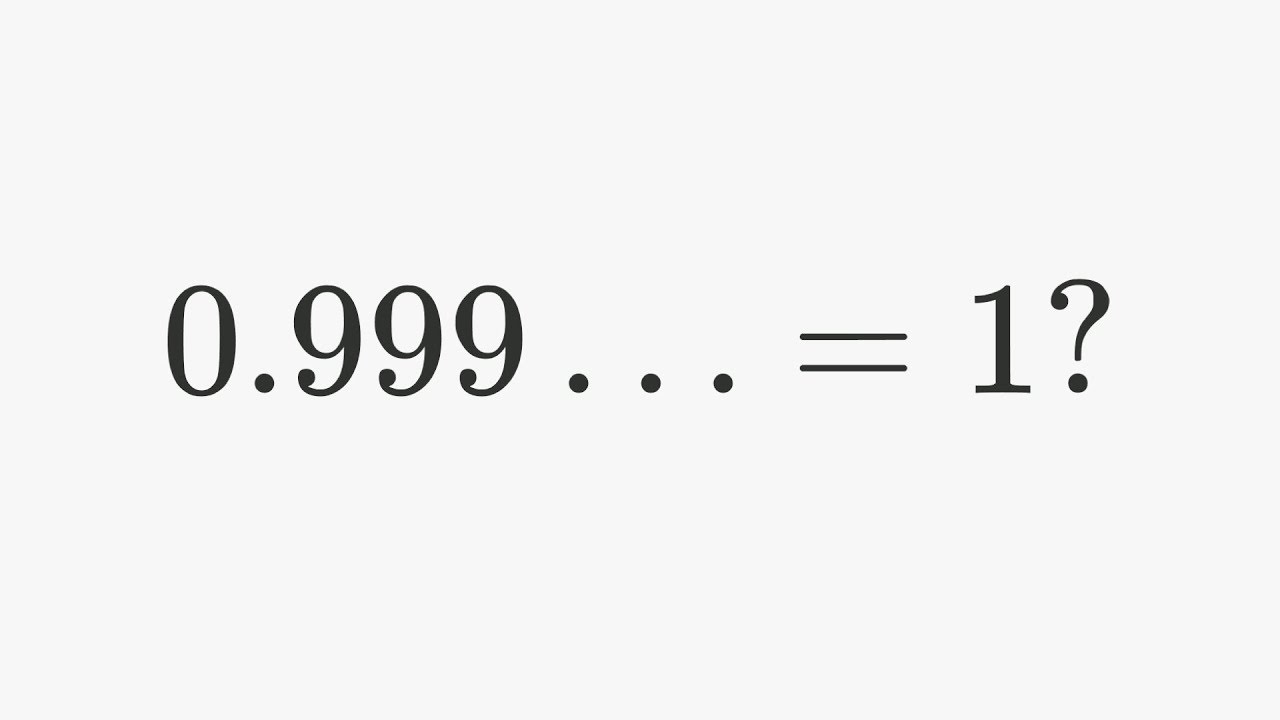
True or false: 0.999....=1?
We'll examine the number line and use an algebraic proof to explain the answer. If you need more convincing, find a thorough proof at https://brilliant.org/0999equals1.
Subscribe for weekly math and science videos that'll explore challenging problems, common misconceptions, and intriguing concepts.
FIND US ON:
Webs...
marsh citrusBOT
Channel closed
Closed by @wraith agate
Use .reopen if this was a mistake.
Available help channel!
Send your question here to claim the channel.
Remember:
• Ask your math question in a clear, concise manner.
• Show your work, and if possible, explain where you are stuck.
• After 15 minutes, feel free to ping <@&286206848099549185>.
• Type the command .close to free the channel when you're done.
• Be polite and have a nice day!
Read #❓how-to-get-help for further information on how to ask a good question, and about conduct in the question channels.
 dawn sand
General question
marsh citrusBOT
dawn sand
General question
dawn sand
for a trigonometry problem, tanx/2 + cotx/2 = 2cscx, I see options for tan x/2 but I don't see options for cot x/2. Am I supposed to manipulate another problem to get to cot x/2?
$\tan x/2 + cot x/2 = 2cscx$
elfin berryBOT
zesty&festyII

 bright jay
What exactly do you mean by seeing options?
dawn sand
This is a proof, so I need to manipulate one side, so I chose the left side.
I can use the half angle formula for tan x/2, but I'm not seeing other identity or formula options for cot x/2
bright jay
You can change the terms of tan/cot into terms of sin/cos
dawn sand
Ok so I would want to change cot (x/2) to cosx/sinx but what do I do with the 2 in denominator?
bright jay
It just follows, like tan(x/2) = sin(x/2)/cos(x/2)
dawn sand
So then I'd want to do a half angle formula for cot = cos x/2 / sin x/2
bright jay
I haven't done it myself so not sure
dawn sand
gotcha, OK thank you.
bright jay
bright jay
You can change the terms of tan/cot into terms of sin/cos
This was just a suggestion I had since most problems, you convert tan/cot to terms of sin/cos
dawn sand
Thank you, got it, that is actually helpful.
marsh citrusBOT
@dawn sand Has your question been resolved?
dawn sand
.close
marsh citrusBOT
Channel closed
Closed by @dawn sand
Use .reopen if this was a mistake.
Available help channel!
Send your question here to claim the channel.
Remember:
• Ask your math question in a clear, concise manner.
• Show your work, and if possible, explain where you are stuck.
• After 15 minutes, feel free to ping <@&286206848099549185>.
• Type the command .close to free the channel when you're done.
• Be polite and have a nice day!
Read #❓how-to-get-help for further information on how to ask a good question, and about conduct in the question channels.
still temple
if a function is differentiable, does that imply continuity? what about vice versa?
marsh citrusBOT
still temple
if a function is differentiable, does that imply continuity? what about vice ver...
 knotty trellis
yes, it implies. Vice versa isnt true
marsh citrusBOT
Channel closed
Closed by @zealous flint
Use .reopen if this was a mistake.
marsh citrusBOT
Available help channel!
Send your question here to claim the channel.
Remember:
• Ask your math question in a clear, concise manner.
• Show your work, and if possible, explain where you are stuck.
• After 15 minutes, feel free to ping <@&286206848099549185>.
• Type the command .close to free the channel when you're done.
• Be polite and have a nice day!
Read #❓how-to-get-help for further information on how to ask a good question, and about conduct in the question channels.
 ashen flicker
 marsh citrusBOT
ashen flicker
ashen flicker
marsh citrusBOT
ashen flicker
ashen flicker
do not understand the step
 full orchid
n! is the same as n * (n-1)!, right?
ashen flicker
yes
full orchid
you can expand that out further to n*(n-1)*(n-2)*(n-3)!
at which point you can simplify
marsh citrusBOT
Channel closed
Closed by @ashen flicker
Use .reopen if this was a mistake.
Available help channel!
Send your question here to claim the channel.
Remember:
• Ask your math question in a clear, concise manner.
• Show your work, and if possible, explain where you are stuck.
• After 15 minutes, feel free to ping <@&286206848099549185>.
• Type the command .close to free the channel when you're done.
• Be polite and have a nice day!
Read #❓how-to-get-help for further information on how to ask a good question, and about conduct in the question channels.
 rotund walrus
whats the lcd of x^2-2x-3, 3-x, x+1
marsh citrusBOT
rotund walrus
whats the lcd of x^2-2x-3, 3-x, x+1
marsh citrusBOT
Channel closed
Closed by @rotund walrus
Use .reopen if this was a mistake.
Available help channel!
Send your question here to claim the channel.
Remember:
• Ask your math question in a clear, concise manner.
• Show your work, and if possible, explain where you are stuck.
• After 15 minutes, feel free to ping <@&286206848099549185>.
• Type the command .close to free the channel when you're done.
• Be polite and have a nice day!
Read #❓how-to-get-help for further information on how to ask a good question, and about conduct in the question channels.
winter meteor
How do i solve this??
 marsh citrusBOT
winter meteor
How do i solve this??
marsh citrusBOT
winter meteor
How do i solve this??
 jovial star
Just put it in tha calculator 
marsh citrusBOT
@winter meteor Has your question been resolved?
winter meteor
jovial star
Just put it in tha calculator <:trollge:1019657333737017424>

Is this true?

 fair fulcrum
winter meteor
Is this true?
fair fulcrum
winter meteor
Is this true?
79 is prime
winter meteor
fair fulcrum
79 is prime
and?
fair fulcrum
are both sides divisible by 79
fair fulcrum
bc the right, as it's 81*80*79*78... is definitely divisible by 79

 fair fulcrum
wha
winter meteor
何!!!!
fair fulcrum
mod(a, b) = a mod b
winter meteor
そうですね
jovial star
fair fulcrum
79 is prime
Easier would be to count the number of times 5 apears in the factors
Its obviously different as soon as you start counting
winter meteor
fair fulcrum
guess they figured it out
I didn't
fair fulcrum
jovial star
Easier would be to count the number of times 5 apears in the factors
Its obviou...
disagree on the easyness thing
jovial star
winter meteor
Desmos says no
How is that no ?
Mod 79 means it is divisible
jovial star
fair fulcrum
disagree on the easyness thing
It might be longer but more natural place to start
fair fulcrum
fair
marsh citrusBOT
@winter meteor Has your question been resolved?
marsh citrusBOT
@winter meteor Has your question been resolved?
marsh citrusBOT
Channel closed
Closed by @winter meteor
Use .reopen if this was a mistake.
Available help channel!
Send your question here to claim the channel.
Remember:
• Ask your math question in a clear, concise manner.
• Show your work, and if possible, explain where you are stuck.
• After 15 minutes, feel free to ping <@&286206848099549185>.
• Type the command .close to free the channel when you're done.
• Be polite and have a nice day!
Read #❓how-to-get-help for further information on how to ask a good question, and about conduct in the question channels.
 untold gust
 marsh citrusBOT
untold gust
marsh citrusBOT
untold gust
 sharp lantern
Do you know how to represent a complex number in polar form?
untold gust
<@&286206848099549185>?
sharp lantern
@untold gust ?
sharp lantern
How?
untold gust
rcox(theta), rsin(theta)*i
sharp lantern
untold gust
r*cox(theta), r*sin(theta)*i
It is coordinate or complex number?
@untold gust you ther?
sharp lantern
untold gust
r*cox(theta), r*sin(theta)*i
But you put , instead of i here
sharp lantern
sharp lantern
Which is rcos theta+r sin theta *i
Whatever..do you know this form?
sharp lantern
untold gust
i do know this form
You can represent any complex number with that form
What are "r" and "theta" here?
sharp lantern
In general
sharp lantern
untold gust
5pi/12 would be theta
How?
sharp lantern
Yep
sharp lantern
Does it mean you got the answer?
sharp lantern
untold gust
i already knew this
So what's your doubt?
untold gust
i don't know what to do from here
sharp lantern
You know why is zbar right?
untold gust
conjugate
untold gust
is that the best way?
i will get v, w, and z
can you tell me if they are right?
?
sharp lantern
untold gust
is that the best way?
Or you can find in general what is z×zbar .. then just put the appropriate value
sharp lantern
untold gust
can you tell me if they are right?
Okie
untold gust
ok so i got the values
v = 3(sqrt(6)-sqrt(2))/4 + i*3(sqrt(6)+sqrt(2))/4
w = -sqrt(2) + i*sqrt(2)
z = sqrt(2)+sqrt(6) + i*(sqrt(2)-sqrt(6))
are those right?
@sharp lantern
sharp lantern
untold gust
v = 3(sqrt(6)-sqrt(2))/4 + i*3(sqrt(6)+sqrt(2))/4
how do you find cos(5pi/12) value?
sharp lantern
untold gust
(sqrt(6)-sqrt(2))/4
I don't know the exact value .. but if that's what the value is then it is right
untold gust
yea i think that's it
sharp lantern
v= 3cos(3 pi/12)+i 3 sin(3pi/12)
sharp lantern
untold gust
how
you got this much right?
untold gust
i do'nt know where u got pi/4 from
sharp lantern
untold gust
i do'nt know where u got pi/4 from
what pi/4?
untold gust
3pi/12
sharp lantern
untold gust
3pi/12
sry it's 5pi/12
untold gust
yea
sharp lantern
you got that w and z too right?
sharp lantern
untold gust
like shouldn't it be 4*?
oh man, i made lot of careless mistakes
untold gust
all good
sharp lantern
anyway. now find conjugate of each
sharp lantern
btw how you get the values of cos and sin for that values?
sharp lantern
untold gust
ok so v*conjugate v = 9
wait
sharp lantern
untold gust
ok so v*conjugate v = 9
yeah
sharp lantern
untold gust
w*conjugate w = 4
yep
marsh citrusBOT
Channel closed
Closed by @untold gust
Use .reopen if this was a mistake.
Available help channel!
Send your question here to claim the channel.
Remember:
• Ask your math question in a clear, concise manner.
• Show your work, and if possible, explain where you are stuck.
• After 15 minutes, feel free to ping <@&286206848099549185>.
• Type the command .close to free the channel when you're done.
• Be polite and have a nice day!
Read #❓how-to-get-help for further information on how to ask a good question, and about conduct in the question channels.
 shell hill
hello that's the graph of : -\frac{1}{2}x^{2}+3x-x\ln\left(x\right)+\left(\ln\left(x\right)\right)^{2}
and im trying to find the limits and derivative of f(e^-x) without any calculation
 marsh citrusBOT
shell hill
hello that's the graph of : -\frac{1}{2}x^{2}+3x-x\ln\left(x\right)+\left(\ln\le...
shell hill
marsh citrusBOT
shell hill
hello that's the graph of : -\frac{1}{2}x^{2}+3x-x\ln\left(x\right)+\left(\ln\le...
shell hill
any one to help...
shell hill
yeah
 opaque yacht
No one gonna be online
shell hill
the best time to do maths
shell hill
ok
opaque yacht
I can't find urs
oh eait
wait
nvm im here
k
only reason im up so early is cos i wanna do some maths lmao
before skool
shell hill
you got a test?.
opaque yacht
,w -\frac{1}{2}x^{2}+3x-x\ln\left(x\right)+\left(\ln\left(x\right)\right)^{2}
still temple
opaque yacht
I think its too early in the morning
timezones:
elfin berryBOT

 Requested by 🥶💀🍷cold??#1875
opaque yacht
shell hill
you got a test?.
Requested by 🥶💀🍷cold??#1875
opaque yacht
shell hill
you got a test?.
no
opaque yacht
still temple
timezones:
im in the uk
still temple
You are, yes
opaque yacht
elfin berry
this solves the indefinite integral
shell hill
still temple
*You* are, yes
and u?
still temple
shell hill
and u?
💪🇫🇷🥖
shell hill
algeria
opaque yacht
k
this is the inegral indefinitive
pretty sure
,w -\frac{1}{2}x^{2}+3x-x\ln\left(x\right)+\left(\ln\left(x\right)\right)^{2}
elfin berryBOT
 Requested by 🥶💀🍷cold??#1875
still temple
Requested by 🥶💀🍷cold??#1875
still temple
Algeria? More like... More like...
I don't know, there isn't much to say about Algeria
Alright I'm done clogging up this channel, good luck with your integral!
shell hill
still temple
Algeria? More like... More like...
I don't know, there isn't much to say about A...
man ur from france u know where Algeria is
shell hill
opaque yacht
<@610211392212959303> did i lose you?
no i'm here
 still temple
shell hill
man ur from france u know where Algeria is
still temple
shell hill
man ur from france u know where Algeria is
I do, there just aren't much jokes that can be made about the country
opaque yacht
algeria more like algi
ha ha ''ha''
yo did i kill the vibe?
man i dont know how to do this im only in yr 8
the best i can do is this:
,w -\frac{1}{2}x^{2}+3x-x\ln\left(x\right)+\left(\ln\left(x\right)\right)^{2}
elfin berryBOT
 Requested by 🥶💀🍷cold??#1875
shell hill
Requested by 🥶💀🍷cold??#1875
shell hill
not trying to find the integral
shell hill
still temple
I do, there just aren't much jokes that can be made about the country
and just to tell you because of your country i have to learn a large book of history to pass my exam 
still temple
$-\frac{1}{2}x^{2}+3x-x\ln\left(x\right)+\left(\ln\left(x\right)\right)^{2}$
elfin berryBOT
Labyrinth
 shell hill
still temple
$-\frac{1}{2}x^{2}+3x-x\ln\left(x\right)+\left(\ln\left(x\right)\right)^{2}$
shell hill
still temple
$-\frac{1}{2}x^{2}+3x-x\ln\left(x\right)+\left(\ln\left(x\right)\right)^{2}$
yeah
still temple
shell hill
and just to tell you because of your country i have to learn a large book of his...
No need to thank us
Just doing what we were born for
opaque yacht
lmao
shell hill
still temple
No need to thank us
nonono 
still temple
So you said you wanted to find the derivative of f(e^-x)
Therefore let's just plug that in and follow the basic rules of derivation
$-\frac{1}{2}\left(e^{-x}\right)^{2}+3e^{-x}-e^{-x}\ln\left(e^{-x}\right)+\left(\ln\left(e^{-x}\right)\right)^{2}$
elfin berryBOT
Labyrinth
 shell hill
still temple
Therefore let's just plug that in and follow the basic rules of derivation
shell hill
still temple
Therefore let's just plug that in and follow the basic rules of derivation
yeah it's -e^-xf'(e^-x)
still temple
elfin berry
**Labyrinth**
So we have this, do you know how to find its derivative?
shell hill
still temple
So we have this, do you know how to find its derivative?
i know
but you're not able to use it
just in the graph ..
still temple
shell hill
but you're not able to use it
...Why not?
shell hill
still temple
...Why not?
it's not me it's the problem
still temple
shell hill
it's not me it's the problem
Did they explicitly tell you "You cannot use the derivative of the function"?
shell hill
still temple
Did they explicitly tell you "You cannot use the derivative of the function"?
yeah using it is calculating..
wait lemme show you some of the correction ..
still temple
shell hill
yeah using it is calculating..
What do they define as "calculation" 
shell hill
still temple
What do they define as "calculation" <:hmmCat:831508801646755850>
finding the derivative manually

 stoic saddle
is the original problem statement written in arabic or french
shell hill
arabic french untill the university
still temple
shell hill
finding the derivative manually
It seems that all they want is the sign of the derivative
stoic saddle
arabic french? is that like french written in the arabic alphabet? 
or did you mean "arabic; [we get problems in] french until university"
shell hill
stoic saddle
arabic french? is that like french written in the arabic alphabet? <:opencry:586...
noo arabic is used in highschools french in universities
shell hill
stoic saddle
arabic french? is that like french written in the arabic alphabet? <:opencry:586...
btw you can do that 
shell hill
still temple
It seems that all they want is the sign of the derivative
yeah
any idea?
@still temple
@stoic saddle
still temple
Bro be enumerating his contacts
shell hill
still temple
Bro be enumerating his contacts
man just help me solving this shit i wanna sleep
still temple
Me too but I just don't know how to do this
Come to think of it, why does everyone have the need to stay up late to do homework?
Why is it that schools literally kill if you don't do it?
Sleep is a thousand times more important and beneficial to you and your learning
shell hill
i wish that it was a homework i'm studying for a final exam that will determine the rest of my life soo ..
still temple
o shit
shell hill
and this problem is from a bac
still temple
I recommend you close this channel and open a new one entirely
@shell hill Ey?
Anyways I need to go
shell hill
still temple
<@610211392212959303> Ey?
Anyways I need to go
Ok man bye et passez une bonne journée !!
stoic saddle
still temple
Why is it that schools literally kill if you don't do it?
it's how the ruling class ensures that children grow up overworked so they don't ever know they are overworked and incite a revolution
shell hill
stoic saddle
it's how the ruling class ensures that children grow up overworked so they don't...
More like brainwashed..
Let's just try to solve my problem please... Forget brainwashing my brain is already washed....
stoic saddle
so you're given the graph of a function, y = f(x), and asked to describe the monotony of f(e^x) without calculating its derivative explicitly?
shell hill
what is monotony..
stoic saddle
where the function is increasing and where it is decreasing
shell hill
yeah
stoic saddle
uh huh
shell hill
yeah exactly
stoic saddle
and are you given the coordinates of the extreme points of f itself
shell hill
yes
 long arch
e^x =/= 0
shell hill
stoic saddle
well then, let g(x) = f(e^x), then you have g'(x) = e^x f'(e^x)
it's e^-x
stoic saddle
then g(x) := f(e^-x) thus g'(x) = -e^(-x) f'(e^-x)
the sign of g(x) is the opposite to that of f(e^-x)
stoic saddle
shell hill
hello that's the graph of : -\frac{1}{2}x^{2}+3x-x\ln\left(x\right)+\left(\ln\le...
what are the coords of the extreme points of this?
shell hill
stoic saddle
what are the coords of the extreme points of this?
(0.5; 2.18) (2; 3.09)
 stoic saddle
ah, their k is my g...
shell hill
yeah
stoic saddle
k
well in that case
we know f is decreasing from 0 to 1/2, increasing from 1/2 to 2, and decreasing again from 2 to +infty
shell hill
stoic saddle
k
so how do we get the monotony of k(x) from f'(x) that's the main goal
stoic saddle
stoic saddle
the sign of g(x) is the opposite to that of f(e^-x)
this is how

 stoic saddle
why write alpha and not 1/2
stoic saddle
shell hill
they should change
yeah of course they should
shell hill
cuz 0.5<alpha<0.6
stoic saddle
thought you said it was equal to 0.5?
e^-x in (0, 1/2) => e^x in (2, +infty) => x in (log(2), +infty)
shell hill
stoic saddle
thought you said it was equal to 0.5?
the same thing ;}
shell hill
stoic saddle
alpha=0.5 and 0.5<alpha<0.6 are mutually exclusive statements
yeah yeah
shell hill
stoic saddle
e^-x in (0, 1/2) => e^x in (2, +infty) => x in (log(2), +infty)
i didn't got a thing..
stoic saddle
$e^{-x} < \frac12 \implies e^x > 2 \implies x > \ln(2)$
elfin berryBOT
Ann
 shell hill
stoic saddle
$e^{-x} < \frac12 \implies e^x > 2 \implies x > \ln(2)$
shell hill
stoic saddle
$e^{-x} < \frac12 \implies e^x > 2 \implies x > \ln(2)$
yeah now i get it so -log(2)<x<-log(alpha)
$-\log\left(2\right)<x<-\log\left(\alpha\right)$
elfin berryBOT
RulzerFly.
 shell hill
like that @stoic saddle ?
btw i'm going to sleep now thank you so much @stoic saddle for help , and have a good day
stoic saddle
yes...
marsh citrusBOT
@shell hill Has your question been resolved?
marsh citrusBOT
Channel closed
Closed due to timeout
Use .reopen if this was a mistake.
marsh citrusBOT
Available help channel!
Send your question here to claim the channel.
Remember:
• Ask your math question in a clear, concise manner.
• Show your work, and if possible, explain where you are stuck.
• After 15 minutes, feel free to ping <@&286206848099549185>.
• Type the command .close to free the channel when you're done.
• Be polite and have a nice day!
Read #❓how-to-get-help for further information on how to ask a good question, and about conduct in the question channels.
 rustic rain
 marsh citrusBOT
rustic rain
drifting nimbus
marsh citrusBOT
rustic rain
drifting nimbus
because length of arc = r × θ
rustic rain
what's the difference between q a and c
drifting nimbus
the angle
twilit grove
rustic rain
what's the difference between q a and c
for c you have to add the length of segment AB
 green sky
drifting nimbus
the angle
green sky
drifting nimbus
the angle
I mean in degree or rad?