#help-33
1 messages · Page 42 of 1
 soft tangle
 spark otter
And we correctly wrote this at some point
 spark otter
yes!
soft tangle
I don't get how we get that in cross multiplication at all ngl

It’s not working
Not sure what to do
spark otter
soft tangle
why did you change? this was correct

 spark otter
ok, now that we finished this, it will be easier to answer each question
spark otter
soft tangle
look at the right hand side here
spark otter
soft tangle
try to find which right hand side fits the most
soft tangle

Middle one
(Cos^2(t) + sin^2(t))/sin(t)
I got it
There is a third part😭
I GOT IT
FINISHED IT
spark otter
congrats!
soft tangle
I AM SO SORRY
For the hassle
It just wasn’t clicking
And i’m running off of like 3/4 hours of sleep
Can I get your help on another way easier problem
spark otter
alright
soft tangle
 spark otter
@soft tangle bring it on
spark otter
can you take a better pic pls?
 spark otter
great
soft tangle
Cool
Alrifht
Alright
So i’m trying to identify an identity i can sue on the first one
spark otter
let's start with the first one
soft tangle
Ok
spark otter
if you write $y = sec(x)$, the first expression writes itself as $\frac{4y^2 + 4y+1}{2y+1}$
 elfin berryBOT
rafilou2003
 soft tangle
Ohhhh yeah
spark otter
can you factor the numerator?
spark otter
soft tangle
I think we exclude that
you can do a long division
soft tangle
No good???
 soft tangle
spark otter
you can do a long division
soft tangle
spark otter
you can do a long division
Is that where you draw lines and then do something with the x’s
 elfin berryBOT
 spark otter
You know how to do polynomial division right?
soft tangle
I am rusty but I can easily remember
Can you help me tho
I don’t really remember it
spark otter
Ok
Basically, in it's easiest form it's something like ax^2 + bx + c divided by x+d
We always start by getting rid of the highest term in x
So we have to get rid of ax²
So we take (ax²+bx+c) - ax(x+d) to get rid of all the x²
Then we're left with terms in x, so we have to get rid of them as well, etc...
 main idol
soft tangle
Can you show me the whole procedure of the division so I can understand it
main idol
soft tangle
Can you show me the whole procedure of the division so I can understand it
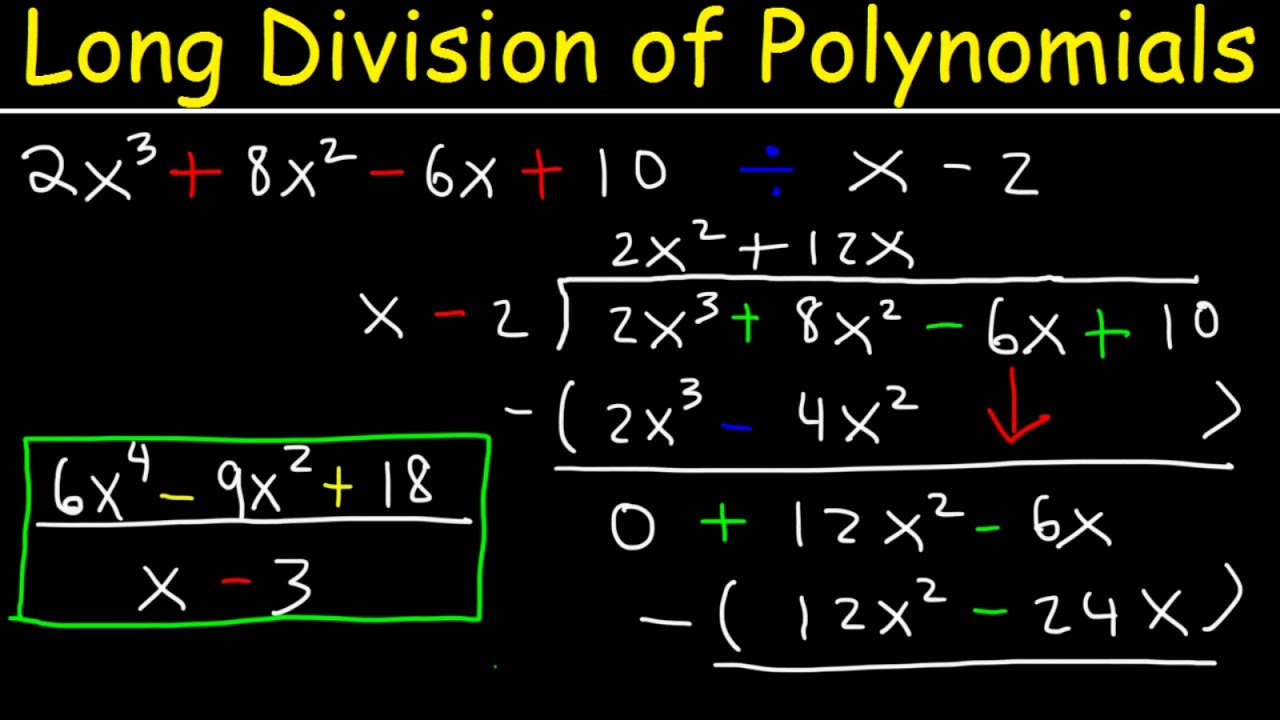
This video tutorial explains how to perform long division of polynomials with remainder and with missing terms. It's explains how to do long division easily and it provides the step by step process to get it done. Basically, there are 3 steps that you have to repeat. 1. Divide 2. Multiply 3. Subtract This video contains plenty of ex...
 marsh citrusBOT
@soft tangle Has your question been resolved?
Channel closed
Closed by @soft tangle
Use .reopen if this was a mistake.
 Available help channel!
Send your question here to claim the channel.
Remember:
• Ask your math question in a clear, concise manner.
• Show your work, and if possible, explain where you are stuck.
• After 15 minutes, feel free to ping <@&286206848099549185>.
• Type the command .close to free the channel when you're done.
• Be polite and have a nice day!
Read #❓how-to-get-help for further information on how to ask a good question, and about conduct in the question channels.
Channel closed
Closed due to the original message being deleted
marsh citrusBOT
Available help channel!
Send your question here to claim the channel.
Remember:
• Ask your math question in a clear, concise manner.
• Show your work, and if possible, explain where you are stuck.
• After 15 minutes, feel free to ping <@&286206848099549185>.
• Type the command .close to free the channel when you're done.
• Be polite and have a nice day!
Read #❓how-to-get-help for further information on how to ask a good question, and about conduct in the question channels.
 wise jackal
 marsh citrusBOT
wise jackal
wise jackal
marsh citrusBOT
wise jackal
wise jackal

I get how they got this but
why does integrating from 0 to 2pi
and then dividing by 3
result in 2pi / 3?
cuz im thinking u can just find the total area of the 3 petals
and then divide by 3 to get one
marsh citrusBOT
@wise jackal Has your question been resolved?
Channel closed
Closed by @wise jackal
Use .reopen if this was a mistake.
✅
wise jackal
<@&286206848099549185>
marsh citrusBOT
@wise jackal Has your question been resolved?
marsh citrusBOT
Channel closed
Closed by @wise jackal
Use .reopen if this was a mistake.
wise jackal
.reopen
marsh citrusBOT
✅
wise jackal
basically all i don’t get is like
why do u integrate from 0 to pi
and not 2pi
OH THE PERIOD FOR ODD PETALS IS PI
.close
marsh citrusBOT
Channel closed
Closed by @wise jackal
Use .reopen if this was a mistake.
 opaque wolf
yeah
marsh citrusBOT
Available help channel!
Send your question here to claim the channel.
Remember:
• Ask your math question in a clear, concise manner.
• Show your work, and if possible, explain where you are stuck.
• After 15 minutes, feel free to ping <@&286206848099549185>.
• Type the command .close to free the channel when you're done.
• Be polite and have a nice day!
Read #❓how-to-get-help for further information on how to ask a good question, and about conduct in the question channels.
 lusty basalt
Integral of x*e^(x)^2
marsh citrusBOT
lusty basalt
Integral of x*e^(x)^2
lusty basalt
What form of integration is required and how do I approach
 marsh peak
Have you tried substitution?
marsh peak
Yes
marsh peak
lusty basalt
The x is to the power of 3 sorry
Hm? So it's $xe^{x^3}$?
elfin berryBOT
A Lonely Bean
 lusty basalt
Correct
lusty basalt
Me too lol
It would’ve been easy if it was to the power of 2
But 3makes it confusing
 knotty trellis
do you know gamma function?
knotty trellis
this doesnt have closed form solution
lusty basalt
What doesn’t?
knotty trellis
the integral
 nocturne vale
You can try by parts apart from that it's not possible to integrate
 novel juniper
lusty basalt
What can you recommend
novel juniper
lusty basalt
What can you recommend
Have you tried wolfram to check if it has a closed form?
marsh citrusBOT
@lusty basalt Has your question been resolved?
marsh citrusBOT
Channel closed
Closed due to timeout
Use .reopen if this was a mistake.
Available help channel!
Send your question here to claim the channel.
Remember:
• Ask your math question in a clear, concise manner.
• Show your work, and if possible, explain where you are stuck.
• After 15 minutes, feel free to ping <@&286206848099549185>.
• Type the command .close to free the channel when you're done.
• Be polite and have a nice day!
Read #❓how-to-get-help for further information on how to ask a good question, and about conduct in the question channels.
 main bolt
 main bolt
how i do this one?
 stoic saddle
!status
marsh citrusBOT
What step are you on?
1. I don't know where to begin
2. I have begun but got stuck midway
3. I got an answer but I'm told it's wrong
4. I got an answer and would like my work checked
5. I have a question about someone else's worked solution
6. None of the above
i forgot how to do limits and im trying to remember how to do them
stoic saddle
multiply & divide by the conjugate
marsh citrusBOT
Channel closed
Closed by @main bolt
Use .reopen if this was a mistake.
marsh citrusBOT
Available help channel!
Send your question here to claim the channel.
Remember:
• Ask your math question in a clear, concise manner.
• Show your work, and if possible, explain where you are stuck.
• After 15 minutes, feel free to ping <@&286206848099549185>.
• Type the command .close to free the channel when you're done.
• Be polite and have a nice day!
Read #❓how-to-get-help for further information on how to ask a good question, and about conduct in the question channels.
 trim pulsar
when finding the radius of convergence and interval do u always use the ratio test?
marsh citrusBOT
trim pulsar
when finding the radius of convergence and interval do u always use the ratio te...
trim pulsar
where the lim n-> inf abs for an+1 / an?
and for the case of alternating series
does the absolute term get rid of (-1)^n?
like i can disregard it/consider as 1^n?
 devout mauve
abs((-1)^n)=1 so yes you can just ignore that
well you use the ratio test when it works
sometimes it will be pretty impossible to calculate the limit you get
or you can do it and it gives 1, then you have to search for another test
trim pulsar
devout mauve
or you can do it and it gives 1, then you have to search for another test
so its like the convergence tests where it may become a case of trial and error with the alternating sreies, comparison, etc?
devout mauve
ratio test is a convergence test
trim pulsar
do u have any tips on recognizing what tests i should use when testing for convergence in general?
ye i get that ratio is one of them
devout mauve
well if stuff will cancel from a_(n+1)/a_n then its probably a good start
classic example being eg factorials
trim pulsar
ah ok
devout mauve
with time you get a bit of a feeling for what tests might work
marsh citrusBOT
Channel closed
Closed by @trim pulsar
Use .reopen if this was a mistake.
marsh citrusBOT
Available help channel!
Send your question here to claim the channel.
Remember:
• Ask your math question in a clear, concise manner.
• Show your work, and if possible, explain where you are stuck.
• After 15 minutes, feel free to ping <@&286206848099549185>.
• Type the command .close to free the channel when you're done.
• Be polite and have a nice day!
Read #❓how-to-get-help for further information on how to ask a good question, and about conduct in the question channels.
 still temple
Hi. I actually asked how I could solve this same problem yesterday. However, I'm stuck in how I am supposed to find when does P = -1. The idea is to solve this only using high-school math, so thankfully someone can help me, not using modular arithmetic and that kind of stuff. Someone provided me an explanation that you could match up "mod" and arguments, but technically there is a way to solve these having 0 idea about modular arithmetic, or in general, more advanced math than the one that is taught in high-school. Maybe you need to use implicitly the concept of "mod" without knowing what does that mean? I am not sure. Anyways, as you can see, the explanation and the step by step doesn't have to be that rigorous. Thank you

 marsh citrusBOT
still temple
Hi. I actually asked how I could solve this same problem yesterday. However, I'm...
still temple
marsh citrusBOT
still temple
Hi. I actually asked how I could solve this same problem yesterday. However, I'm...
still temple
Probably the exercise could led to the use of complex numbers, as the way taught in high-school (Euler identity and related I guess, not sure tho). Sorry if my English sounds kind of unusual. I am using a translator.
I just realized the multiplication by a vertex and its conjugate is equal to |z|^2, which is always a real positive number. Maybe there's one way to start solving the problem using that fact, somehow matching up the product of the moduli to be equal to 1. By inspection I could say that [ 1/2 times (√2)^2 ] ^ integer have always modulus 1, which would be equivalent to the product of V1, V4, V3 or V6 with (V2 or V5)^2. However, I'm not sure if this is the right way to proceed. I feel somehow you have to use the fact that the hexagon is centrally symmetric
marsh citrusBOT
@still temple Has your question been resolved?
still temple
<@&286206848099549185>
marsh citrusBOT
@still temple Has your question been resolved?
marsh citrusBOT
@still temple Has your question been resolved?
marsh citrusBOT
@still temple Has your question been resolved?
marsh citrusBOT
@still temple Has your question been resolved?
marsh citrusBOT
Channel closed
Closed due to timeout
Use .reopen if this was a mistake.
Available help channel!
Send your question here to claim the channel.
Remember:
• Ask your math question in a clear, concise manner.
• Show your work, and if possible, explain where you are stuck.
• After 15 minutes, feel free to ping <@&286206848099549185>.
• Type the command .close to free the channel when you're done.
• Be polite and have a nice day!
Read #❓how-to-get-help for further information on how to ask a good question, and about conduct in the question channels.
 orchid oracle
Differential equations. Im stuck
 marsh citrusBOT
orchid oracle
Differential equations. Im stuck
orchid oracle
marsh citrusBOT
orchid oracle
Differential equations. Im stuck
orchid oracle
What step is next? I substituted y’ , but idk if thats right
 proud ice
Distribute y^2

 proud ice
orchid oracle
Differential equations. Im stuck
proud ice
orchid oracle
Differential equations. Im stuck
I meant in your step 2 here
proud ice
orchid oracle
Oh you kinda did here. You forgot to square your whole x term
proud ice
orchid oracle
Where did the ^2 go in your y' here?
orchid oracle
Ah, forgot it indeed
But im still stuck 😂
After substitution, I shouldnt have any y's left, Only x's and C's
Atleast, thats what my book says
proud ice
!show
marsh citrusBOT
Show your work, and if possible, explain where you are stuck.
orchid oracle
Can't really show much more than this ^
The book takes the derivative of the general solution (like I did), but solves it for y.y', and I solved it for y'
And I dont know when to solve for what
Or do I just guess and see
proud ice
orchid oracle
Show me your corrections
 proud ice
Distribute the y^2 now, yes
You'll be left with your original equation, which was given
So that suffices your proof
 orchid oracle
proud ice
So that suffices your proof
orchid oracle
proud ice
So that suffices your proof
Ah so its correct too, okay
Much simpler than my book
What about finding a particular solution? Normally you just pick a value for C at random right?
Nvm, all checks out, thx
.close
marsh citrusBOT
Channel closed
Closed by @orchid oracle
Use .reopen if this was a mistake.
Available help channel!
Send your question here to claim the channel.
Remember:
• Ask your math question in a clear, concise manner.
• Show your work, and if possible, explain where you are stuck.
• After 15 minutes, feel free to ping <@&286206848099549185>.
• Type the command .close to free the channel when you're done.
• Be polite and have a nice day!
Read #❓how-to-get-help for further information on how to ask a good question, and about conduct in the question channels.
 slow dock
how do i solve this i have no clue
 marsh citrusBOT
slow dock
how do i solve this i have no clue
marsh citrusBOT
slow dock
how do i solve this i have no clue
 fathom ridge
Did you try multiplying and dividing by the conjugate
slow dock
can you elaborate
fathom ridge
"rationalize the numerator"
Multiply and divide with $\sqrt{x^2 - 2x} + \sqrt{x^2 + 2x}$
elfin berryBOT
NEONPerseus
 slow dock
i mean -4x
fathom ridge
I'll help you with the positive infinity part you'll be able to do the negative one by yourself
slow dock
sure
fathom ridge
$\lim_{x \to \infty} \frac{-4x}{\sqrt{x^2 - 2x} + \sqrt{x^2 + 2x}}$
elfin berryBOT
NEONPerseus
 fathom ridge
@slow dock this is what you have right?
I might have to leave in a bit
So I'm just ask you to factor an x^2 out of each square root and cancel it from the numerator
That should land you with an answer
 obsidian shard
did you do as NEON instructed?
obsidian shard
elfin berry
**NEONPerseus**
Looks almost done, just divide numerator and denominator by x
slow dock
i did sqrt(x^2 -2x) + sqrt(x^2 +2x) = sqrt(x (x -2) + sqrt(x (x +2)
then i factor out sqrt(x)
obsidian shard
oh, if want to take common, then take x^2 as common not x
slow dock
can you explain
obsidian shard
notice that $x = \sqrt{x^2}$
elfin berryBOT
numbpy
 obsidian shard
slow dock
can you explain
obsidian shard
slow dock
can you explain
If you have difficulty understanding taking common, then I suggest just dividing by x above and below
lemme give an example
$\sqrt{x^2 + x} = \sqrt{x^2 (1 + \frac1x)} = x \sqrt{1 + \frac1x}$
elfin berryBOT
numbpy
 obsidian shard
does this help @slow dock
marsh citrusBOT
@slow dock Has your question been resolved?
marsh citrusBOT
Channel closed
Closed due to timeout
Use .reopen if this was a mistake.
Available help channel!
Send your question here to claim the channel.
Remember:
• Ask your math question in a clear, concise manner.
• Show your work, and if possible, explain where you are stuck.
• After 15 minutes, feel free to ping <@&286206848099549185>.
• Type the command .close to free the channel when you're done.
• Be polite and have a nice day!
Read #❓how-to-get-help for further information on how to ask a good question, and about conduct in the question channels.
 shy urchin
 marsh citrusBOT
shy urchin
marsh citrusBOT
shy urchin
 lucid bridge
divide numerator and denominator with k^1/3
shy urchin
My main issue is with the denim
Denominator**
After simplification, it would be k^(3/2)+k^(1/2)+sqrt(3)
Correct?
lucid bridge
shy urchin
After simplification, it would be k^(3/2)+k^(1/2)+sqrt(3)
they should all be on the same square root instead of seperately
shy urchin
so the top goes to 1
the denominator is now
sqrt(k^3+4k+3)/k^(1/3)
is that correct?
lucid bridge
yep now get it inside of the sqrt
shy urchin
wasnt that this tho
lucid bridge
not even close to that
shy urchin
oh
lucid bridge
how did you magically pull other stuff out of sqrt
anyway you shouldnt try to divide all of the stuff by k^1/3 , only divide k^3 by it since it has the highest power
lucid bridge
shy urchin
our bottom is (k^3+4k+3)^1/2
distribute 1/k^3 in it
it should become 1/k^6 inside of the square root
my bad
 lucid bridge
1/k^2/3
shy urchin
correct?
lucid bridge
yes
multiply the exponent by 2 while getting 1/k^1/3 inside of the sqrt so you get 1/k^2/3
shy urchin
dont u mean 1/2
?
cuz i thought sqrt of x = x^(1/2)
so wouldnt we multiply everything in the root by 1/2?
lucid bridge
|x|=sqrt(x²)
lucid bridge
shy urchin
cuz i thought sqrt of x = x^(1/2)
this is not true for every x
shy urchin
right but for now the numerator of the denominator can be simplified as (k^3+4k+3)^1/2
no?
 lucid bridge
so highest variable in terms of k on the numerator is k^1/3 right, and on the numerator its k^3 but its in square root, if you eliminate every other terms it becomes k^3/2
you can just k^(1/3)/k^(3/2) then pick (bn) as that
lucid bridge
shy urchin
that is very cursed you cant eliminate square root like that
shy urchin
oh you cant?
shy urchin
oops so then we can just use k^1/3 / k^3/2
lucid bridge
 shy urchin
ok i follow what you did here
lucid bridge
sqrt(a).sqrt(b)= sqrt(a.b) so you are good now
shy urchin
mhm so you can multiply it right theough and get sqrt (k^3+4k+1)/sqrt(k^2/6)
lucid bridge
2/6 instead of 2/5 and its right
lucid bridge
highest term of k, after division inside of sqrt
lucid bridge
shy urchin
oops so then we can just use k^1/3 / k^3/2
which will be same as this
shy urchin
right
k^3/2 holds more power than k^1/3
so youd compare it with that correct?
huh?
lucid bridge
my brain was lagging because im looking after my dog at the same time
yeah go on from there
shy urchin
lol
lucid bridge
so after you evaluate that, take bn as that value
lucid bridge
yeah
well if im being honest you dont need to evaluate, you can just take bn as that
and apply LCT
shy urchin
mhm
got it!
thanks so much for your help and patience lol
i appreciate it
.close
marsh citrusBOT
Channel closed
Closed by @shy urchin
Use .reopen if this was a mistake.
Available help channel!
Send your question here to claim the channel.
Remember:
• Ask your math question in a clear, concise manner.
• Show your work, and if possible, explain where you are stuck.
• After 15 minutes, feel free to ping <@&286206848099549185>.
• Type the command .close to free the channel when you're done.
• Be polite and have a nice day!
Read #❓how-to-get-help for further information on how to ask a good question, and about conduct in the question channels.
 thorny iris
 marsh citrusBOT
thorny iris
marsh citrusBOT
marsh citrusBOT
thorny iris
marsh citrusBOT
@thorny iris Has your question been resolved?
 late geode
have you drawn a diagram yet?
marsh citrusBOT
@thorny iris Has your question been resolved?
thorny iris
late geode
have you drawn a diagram yet?
yeah
thorny iris
hello?
 sleek lake
it should be clear from your diagram

you're looking for the green length, you just find the angle from cosine
there's a right triangle
oh that's arccos
marsh citrusBOT
@thorny iris Has your question been resolved?
Channel closed
Closed by @thorny iris
Use .reopen if this was a mistake.
Available help channel!
Send your question here to claim the channel.
Remember:
• Ask your math question in a clear, concise manner.
• Show your work, and if possible, explain where you are stuck.
• After 15 minutes, feel free to ping <@&286206848099549185>.
• Type the command .close to free the channel when you're done.
• Be polite and have a nice day!
Read #❓how-to-get-help for further information on how to ask a good question, and about conduct in the question channels.
 hard stratus
how do i find the area for this
 marsh citrusBOT
hard stratus
how do i find the area for this
marsh citrusBOT
hard stratus
how do i find the area for this
 severe hound
surround area or surround and surface?
hard stratus
no the area
 stark trail
That is a 3D object, it doesn't have an area
It has a volume, and it has a surface area
hard stratus
the surface area
severe hound
Should be 2πrh+2πr^2
stark trail
Please send a picture of your original question
hard stratus
hard stratus
how do i find the area for this
it’s here
stark trail
That is just a picture of a shape, it doesn't state a question
hard stratus
it said determine the area of the following solids
stark trail
It did not say that, because solids don't have area
hard stratus
 hard stratus
no
stark trail
Surface area is just the area that makes up the outsides of a shape
for example if you take a simple cube
the surface area, is the area of all the square faces of that cube
hard stratus
ok
stark trail
So what are the different faces on the cylinder that you sent
hard stratus
1 rectangle?
stark trail
Where do you see a rectangle on the cylinder ? :o
hard stratus
what idk
stark trail
If the surface area, like we said earlier, is the area of the faces that make up the outside of a shape, to find the surface area for the cylinder you have to identify what its faces are
For example, what shape is on top and bottom of the cylinder
those would be two of its faces
stark trail
The top and bottom yes, just two circles
and then the only remaining face is the side of the cylinder
do you have any idea how you could find the area of that?
hard stratus
1x2.8 and 4x0.2
stark trail
Hint: Imagine taking the cylinder and unrolling it so that the side becomes a rectangle, what would the base and height of this rectangle be? The base would be ||the length of the circumference of the top circle that we unrolled|| and the height would be ||the height of the cylinder|| So the area of this side of the cylinder, or the unraveled rectangle, would be ||circumfrence * height||
So now you have identified the 3 sides of the cylinder: 1. top circle 2. bottom circle 3. the side. To find the surface area, find the area of these 3 sides and add them up.
hard stratus
0.2x2.8?
hard stratus
what is circumference * height
stark trail
The length of the circumference of the cylinder, multiplied by the height of the cylinder
Do you know what the circumference is?
hard stratus
stark trail
The length of the circumference of the cylinder, multiplied by the height of the...
the length is 2.8 and the height is 0.2?
stark trail
No
The height of that cylinder is 2.8m, and the radius of that cylinder is 0.2m
Again I'll ask, do you what the circumference is?
hard stratus
no
stark trail
The circumference is the length around the outside of the circle
Length of the circumference = 2 * pi * length of the radius
hard stratus
ok
stark trail
So can you tell me what the 3 shapes are that we need to find the area of, in order to find the surface area of this cylinder?
hard stratus
what
stark trail
The surface area is the area of all the sides of the shape. What are the 3 sides of this cylinder?
(we figured this out already earlier)
hard stratus
2 circles and 1 rectangle
stark trail
Sort of, the rectangle isn't really a rectangle though right?
You recognize that it is just the curved side of the cylinder, yes or no?
hard stratus
yes
stark trail
Okay perfect
So we need to find the area of the 2 circles, and the area of the "rectangle"
Do you know the formula for the area of a circle?
hard stratus
pie symbol and x2
elfin berryBOT
AustinU
 stark trail
Does that seem familiar?
hard stratus
the dot is where the number goes in?
stark trail
The dot is multiplication
stark trail
What grade are you in?
hard stratus
8
stark trail
Okay, well I can't continue to help you find the surface area of this cylinder if you are unable to find the area of a circle. It seems like you are missing a lot of background knowledge needed to solve this problem. I can direct you to a video to learn

Welcome to How to Find the Area of a Circle with Mr. J! Need help with finding the area of a circle? You're in the right place!
Whether you're just starting out, or need a quick refresher, this is the video for you if you're looking for how to calculate the area of a circle. Mr. J will go through area of a circle examples and explain the steps...

Welcome to How to Find the Surface Area of a Cylinder with Mr. J! Need help with finding the surface area of a cylinder? You're in the right place!
Whether you're just starting out, or need a quick refresher, this is the video for you if you're looking for help with cylinder surface area. Mr. J will go through calculating surface area examples ...
I'd watch both of those in order, and then you should be able to figure this out
stark trail
It is 6 minutes long, and I sent it 1 minute ago, how have you already watched it?
hard stratus
nvm what do i do now
stark trail
stop interrupting other people's channels, I directed you to read #❓how-to-get-help and #rules already
stark trail
hard stratus
nvm what do i do now
Watch the videos, otherwise I can't continue to help
hard stratus
stark trail
Watch the videos, otherwise I can't continue to help
i did
marsh citrusBOT
@hard stratus Has your question been resolved?
marsh citrusBOT
Channel closed
Closed due to timeout
Use .reopen if this was a mistake.
Available help channel!
Send your question here to claim the channel.
Remember:
• Ask your math question in a clear, concise manner.
• Show your work, and if possible, explain where you are stuck.
• After 15 minutes, feel free to ping <@&286206848099549185>.
• Type the command .close to free the channel when you're done.
• Be polite and have a nice day!
Read #❓how-to-get-help for further information on how to ask a good question, and about conduct in the question channels.
 modest root
 marsh citrusBOT
modest root
modest root
marsh citrusBOT
modest root
modest root
Can anyone help me how subspace scalers are converted into matrixes
marsh citrusBOT
@modest root Has your question been resolved?
marsh citrusBOT
@modest root Has your question been resolved?
marsh citrusBOT
Channel closed
Closed due to timeout
Use .reopen if this was a mistake.
Available help channel!
Send your question here to claim the channel.
Remember:
• Ask your math question in a clear, concise manner.
• Show your work, and if possible, explain where you are stuck.
• After 15 minutes, feel free to ping <@&286206848099549185>.
• Type the command .close to free the channel when you're done.
• Be polite and have a nice day!
Read #❓how-to-get-help for further information on how to ask a good question, and about conduct in the question channels.
 arctic gorge
ive tried everything but the most i can get is QR = asinB/2
i knw thatnearly all of these triangles are isoceles so BQ and QC have to equal a/2 im just not sure where to go from there or how cos gets squared

 marsh citrusBOT
arctic gorge
ive tried everything but the most i can get is QR = asinB/2
i knw thatnearly all...
marsh citrusBOT
arctic gorge
ive tried everything but the most i can get is QR = asinB/2
i knw thatnearly all...
@arctic gorge Has your question been resolved?
marsh citrusBOT
@arctic gorge Has your question been resolved?
 steel mountain
sorry no one answered you
arctic gorge
T-T
steel mountain
uh
arctic gorge
i tried to big brain it out but now i have to go to school lol
steel mountain
oof
uhh
well you're working with an icoselies trangle
right?
do you have a diagram??
Ok
I mae it
you need to use the cos rule
and the sin rule
marsh citrusBOT
@arctic gorge Has your question been resolved?
marsh citrusBOT
Channel closed
Closed due to timeout
Use .reopen if this was a mistake.
Available help channel!
Send your question here to claim the channel.
Remember:
• Ask your math question in a clear, concise manner.
• Show your work, and if possible, explain where you are stuck.
• After 15 minutes, feel free to ping <@&286206848099549185>.
• Type the command .close to free the channel when you're done.
• Be polite and have a nice day!
Read #❓how-to-get-help for further information on how to ask a good question, and about conduct in the question channels.
 olive agate
Hello! this is calculus so i’m not fully sure if i’m allowed to post this here but anyone please just let me know but anyways i need to find this using L’Hôpital’s Rule and i’m stumped on it! Help is appreciated 😊
 marsh citrusBOT
olive agate
Hello! this is calculus so i’m not fully sure if i’m allowed to post this here b...
marsh citrusBOT
olive agate
Hello! this is calculus so i’m not fully sure if i’m allowed to post this here b...
@olive agate Has your question been resolved?
marsh citrusBOT
@olive agate Has your question been resolved?
olive agate
.close
marsh citrusBOT
Channel closed
Closed by @olive agate
Use .reopen if this was a mistake.
Available help channel!
Send your question here to claim the channel.
Remember:
• Ask your math question in a clear, concise manner.
• Show your work, and if possible, explain where you are stuck.
• After 15 minutes, feel free to ping <@&286206848099549185>.
• Type the command .close to free the channel when you're done.
• Be polite and have a nice day!
Read #❓how-to-get-help for further information on how to ask a good question, and about conduct in the question channels.
 rotund walrus
just a quick question
marsh citrusBOT
rotund walrus
just a quick question
rotund walrus
when you have x^2-2x+8/9=0
can u multiply the whole equation by 9 to get rid of 8/9
 bright jay
Is that $\frac{x^2-2x+8}{9} = 0$ or $x^2-2x+ \frac{8}{9} = 0$?
rotund walrus
?
elfin berryBOT
dldh06
 bright jay
Yes you can multiply by 9 if you wanted to
 twilit arrow
note there’d also be a 9 in front of the two other terms
twilit arrow
yes
bright jay
Don't forget the = 0
marsh citrusBOT
Channel closed
Closed by @rotund walrus
Use .reopen if this was a mistake.
marsh citrusBOT
Available help channel!
Send your question here to claim the channel.
Remember:
• Ask your math question in a clear, concise manner.
• Show your work, and if possible, explain where you are stuck.
• After 15 minutes, feel free to ping <@&286206848099549185>.
• Type the command .close to free the channel when you're done.
• Be polite and have a nice day!
Read #❓how-to-get-help for further information on how to ask a good question, and about conduct in the question channels.
 marsh citrusBOT
 twilit quiver
What step are you on?
1. I don't know where to begin
2. I have begun but got stuck midway
3. I got an answer but I'm told it's wrong
4. I got an answer and would like my work checked
5. I have a question about someone else's worked solution
6. None of the above
Show your work, and if possible, explain where you are stuck.
@twilit quiver Has your question been resolved?
 shadow ibex
@twilit quiver https://stattrek.com/estimation/confidence-interval-mean
How to construct a confidence interval around a sample mean. Includes sample problem with clear, step-by-step solution.
If you wanna show your work I might be able to see where you messed up
Probably something with alpha


 marsh citrusBOT
Channel closed
Closed due to timeout
Use .reopen if this was a mistake.
twilit quiver
.reopen
marsh citrusBOT
✅
marsh citrusBOT
@twilit quiver Has your question been resolved?
shadow ibex
Sorry I'm running errands, haven't looked yet
n = 25, N = 500
xbar = 25.7,
s = 7.8
I guess we have to do a correction factor since n is only 5% of N
fac = 1.5220227022657792307
twilit quiver
shadow ibex
fac = 1.5220227022657792307
I don’t get how u got this?
shadow ibex
It's the formula on your page
I was just driving so I didn't multiply by the t value yet
p* = .995, df = n-1 =24
Using a t-table or calculator, that value is...
twilit quiver
can I write the full working out pls if that’s okay
shadow ibex
Oh, using df =24 and alpha = 1 - .99 = .01
shadow ibex
I'll do that in a second if thus works
T-Value (right-tailed): 2.351635
T-Value (two-tailed): +/- 2.609228
https://goodcalculators.com/student-t-value-calculator/
© 2015-2023 goodcalculators.com
Use this T-Value Calculator to calculate the Student's t-value based on the significance level and the degrees of freedom
I think we want the two-tailed?
Multiply that by the fac
twilit quiver
yes I think
twilit quiver
twilit quiver
lmao but look at the options
shadow ibex
...which is not even close
shadow ibex
If thr mean weight is 25.7g, how can we have a confidence interval for the "total weight of the population" that is between like 10 and 15? 🤨🤨🤨
OH!
twilit quiver
uh oh
shadow ibex
This is orders of magnitude larger
twilit quiver
wdym
shadow ibex
Multiply by 500/25?
twilit quiver
umm
shadow ibex
Doesn't seem like enough though
Or by 500
Yeah
Let's see
I don't have my scientific, what's the min if we do that?
twilit quiver
I don’t get what u mean haha
shadow ibex
Well...if we do that, the min is kinda close to the fourth option
Not very though
Not by scientific standards
shadow ibex
Me neither
Because you don't show your formulas
You have the notes from the professor, amd I assume the values are supposed to match those
twilit quiver
Yes
shadow ibex
But you don't show the t-value computations
500(25.7+-2.351635)
crunch that really quick
twilit quiver
Oh
 flat raft
shadow ibex
500(25.7+-2.351635)
flat raft
shadow ibex
500(25.7+-2.351635)
and no
there seems to be a mistake in the question
I don't think it's the sample standard deviation, but rather the standard deviation of the sample mean
shadow ibex
Yeah, my vocabulary is trash
For example, "fac" I was using is actually called "Standard Error" or SE
Everything after +- is the Error Margin (Margin of Error), ME
Can you show the critical value computation?
And was your df 499?
flat raft
why is this related to a t distribution? am I missing something
shadow ibex
Oh!
I was using the population size and not the sample size
df = n-1
Not N-1
Thank you
flat raft
what does this have to do with a t-distribution though
shadow ibex
It's part of the confidence interval formula?
flat raft
not really
that's only if your estimator / test statistic is t-distributed
in this case, the sample mean is approximately normally distributed
and your estimate of the total weight is just the sample mean times 500 is it not?
twilit quiver
I’m confused lol
flat raft
the sample mean has a standard deviation of approximately 1.6, so if you multiply the whole thing by 500, I guess that gives you a whole thing standard deviation of 780
twilit quiver
can someone work it out
flat raft
a 99% confidence interval for a normal distribution is everything within 2.575829 standard deviations of the mean
and the mean of the estimate of the total weight is 500 * 25.7 = 12850
shadow ibex
flat raft
the sample mean has a standard deviation of approximately 1.6, so if you multipl...
Where did you get 1.6?
They gave a sample standard deviation of 7.8
flat raft
7.8 divided by sqrt(25)
shadow ibex
flat raft
and the mean of the estimate of the total weight is 500 * 25.7 = 12850
We got the times 500 thing
flat raft
or rather, an unbiased estimate of the variance of the weight of each individual item is 7.8^2, and the variance of the sample mean is 7.8^2/25
shadow ibex
flat raft
7.8 divided by sqrt(25)
Ah.
flat raft
hmm maybe you do have to take into account that the standard deviation is not perfectly estimated
but you can't really I think
or rather, it's annoying to do
shadow ibex
Well there is that long bit that ^ @shell inlet has here
In the fomrula
The SE calculated differently b.c. the sample is <= 5% of the population size
...I think
flat raft
well, suppose you consider the test statistic t = (sample mean - 25.7)/7.8 grams; maybe that's t-distributed
yeah but why would it be a t-distribution
the sample mean is assumed to be normally distributed
flat raft
oh there's a finite population correction
shadow ibex
Oh...
flat raft
okay that makes sense
shadow ibex
I used the wrong value
flat raft
I get an answer similar to the last choice now
flat raft
the uncorrected sample standard deviation is 7.8 grams, but applying the finite population correction, one gets an estimate of approx 7.61 grams for the population standard deviation
I still don't know why y'all are doing anything with a t distribution
shadow ibex
Makes the rest work out as it does in OP's notes
flat raft
why is anything t-distributed
shadow ibex
flat raft
why is anything t-distributed
🤷
flat raft
hmm maybe it's because of the estimated standard deviation
yeah
that gives the second choice
okay it all makes sense now
so basically, we claim that the value (25.7 - true mean) / (7.8*FPC) is t-distributed, and then a 99% confidence interval for this is something; this lets you compute a confidence interval for the sample mean
and then if you multiply it by 500, you get the second answer
marsh citrusBOT
@twilit quiver Has your question been resolved?
twilit quiver
wait can someone write out the working on paper step by step pls, I’m new to this
twilit quiver
flat raft
and then if you multiply it by 500, you get the second answer
wait can someone write out the working on paper step by step pls, I’m new to this
flat raft
I think the easiest way to explain this is probably by referencing your prof's slides
find a 99% CI for the sample mean
then just multiply the thing by 500
 flat raft
so you know the population mean is 0.5 and the population variance can be calculated as p(1-p)
twilit quiver
yes
I used the zscore table to find the values and then I calculated it but I didn’t get the answer lol
flat raft
can you elaborate more on what you did?
twilit quiver
so I found the zscores that correspond to 0.05 since it’s symetrical then it is -1.65 and 1.65

So that one is the lower bound value
is the wrong?
@flat raft
twilit quiver
Yea but the answer is wrong apparently lol
flat raft
well it says four decimal places, so maybe you rounded a little early
actually at four decimal places, you might even have to do a continuity correction ew
 flat raft
I get 0.4418 with more exact arithmetic
but nah there's definitely a continuity correction here
twilit quiver
wait what’s that again?
flat raft
basically the sample percentage comes in multiples of 1/200 = 0.005
twilit quiver
yep
flat raft
so when you approximate the sample percentage with a normal
since it's a scaled binomial
you have to do some silly shit where you add 1/400 or something
idk how I would even answer this question without at least saying something about whether the limits are inclusive or exclusive
I'll just assume the limits are inclusive
twilit quiver
ahh i see haha,, do u know how I would do the next missing blank
flat raft
waitI can't actually see the entire question for that one
 flat raft
I think it's just 0.5 - lower limit
but it might also be asking for percentage error, in which case it's (0.5 - lower limit)/0.5
twilit quiver
flat raft
I think it's just 0.5 - lower limit
Can u explain why?
flat raft
well if you say that it's contained within [lower limit, upper limit]
isn't that just the same thing as saying it's contained within (0.5-lower limit) of 0.5?
marsh citrusBOT
@twilit quiver Has your question been resolved?
marsh citrusBOT
Channel closed
Closed due to timeout
Use .reopen if this was a mistake.
marsh citrusBOT
Available help channel!
Send your question here to claim the channel.
Remember:
• Ask your math question in a clear, concise manner.
• Show your work, and if possible, explain where you are stuck.
• After 15 minutes, feel free to ping <@&286206848099549185>.
• Type the command .close to free the channel when you're done.
• Be polite and have a nice day!
Read #❓how-to-get-help for further information on how to ask a good question, and about conduct in the question channels.
 humble walrus
If a is an integer and 7|4a, then 7|a.
Proof. Suppose a is an integer and 7|4a. That means 4a=7b for some integer b. The only way this is true is if they are both multiples of 28. Thus 4a=28c for some integer c. So a=7c, and 7|a, by definition of divisibility. |||
Is this proof valid?
marsh citrusBOT
humble walrus
If a is an integer and 7|4a, then 7|a.
Proof. Suppose a is an integer and 7|4a. ...
 open shale
"The only way this is true is if they are both multiples of 28"
Why?
 glacial hedge
They must be multiples of their lcm
 wild sinew
Because they are coprime
open shale
That is not an axiom
glacial hedge
glacial hedge
They must be multiples of their lcm
Arguably that's by definition of the lcm
Otherwise it's an exercice in and of itself
wild sinew
You can just use that if p|a*b, then p|a or p|b, if p is a prime
And 7 doesn't divide 4 so it must divide a
open shale
yeah
humble walrus
glacial hedge
They must be multiples of their lcm
so can I use this argument?
glacial hedge
Depends on what you already know
marsh citrusBOT
@humble walrus Has your question been resolved?
glacial hedge
If you know it you can use it no ?
marsh citrusBOT
Channel closed
Closed due to timeout
Use .reopen if this was a mistake.
Available help channel!
Send your question here to claim the channel.
Remember:
• Ask your math question in a clear, concise manner.
• Show your work, and if possible, explain where you are stuck.
• After 15 minutes, feel free to ping <@&286206848099549185>.
• Type the command .close to free the channel when you're done.
• Be polite and have a nice day!
Read #❓how-to-get-help for further information on how to ask a good question, and about conduct in the question channels.
 nova quail
quick question: what do you write when an integral isn't continous betwenn two bornes?
marsh citrusBOT
nova quail
quick question: what do you write when an integral isn't continous betwenn two b...
glacial hedge
Assuming it's defined (i.e. not going to infinity, otherwise it gets more tricky to say the least) and there's finitely many discontinuities, nothing special as integrals are naturally also defined for such functions
nova quail
.close
marsh citrusBOT
Channel closed
Closed by @nova quail
Use .reopen if this was a mistake.
Available help channel!
Send your question here to claim the channel.
Remember:
• Ask your math question in a clear, concise manner.
• Show your work, and if possible, explain where you are stuck.
• After 15 minutes, feel free to ping <@&286206848099549185>.
• Type the command .close to free the channel when you're done.
• Be polite and have a nice day!
Read #❓how-to-get-help for further information on how to ask a good question, and about conduct in the question channels.
 near blade
hii
marsh citrusBOT
near blade
hii
near blade

i have dirichlet function
and i have to say
if the functions below are continous and in what ranges
 marsh citrusBOT
@near blade Has your question been resolved?
marsh citrusBOT
@near blade Has your question been resolved?
marsh citrusBOT
Channel closed
Closed due to timeout
Use .reopen if this was a mistake.
Available help channel!
Send your question here to claim the channel.
Remember:
• Ask your math question in a clear, concise manner.
• Show your work, and if possible, explain where you are stuck.
• After 15 minutes, feel free to ping <@&286206848099549185>.
• Type the command .close to free the channel when you're done.
• Be polite and have a nice day!
Read #❓how-to-get-help for further information on how to ask a good question, and about conduct in the question channels.
 eager sapphire
hi
marsh citrusBOT
eager sapphire
hi
eager sapphire
is there a way to prove these 2 smaller triangles created from that perpendicular are similar?
 eager sapphire
wait i just realized
 leaden monolith
that perpendicular line splits the original right angle into 2 angles
eager sapphire
since that first angle is 90 the other 2 have to add up to 90
eager sapphire
thanks that makes sense, is this true when you make a perpendicular to any right angle in a triangle?
leaden monolith
this doens't
 eager sapphire
is that perpendicular going to the right angle
marsh citrusBOT
@eager sapphire Has your question been resolved?
Channel closed
Closed by @eager sapphire
Use .reopen if this was a mistake.
marsh citrusBOT
Available help channel!
Send your question here to claim the channel.
Remember:
• Ask your math question in a clear, concise manner.
• Show your work, and if possible, explain where you are stuck.
• After 15 minutes, feel free to ping <@&286206848099549185>.
• Type the command .close to free the channel when you're done.
• Be polite and have a nice day!
Read #❓how-to-get-help for further information on how to ask a good question, and about conduct in the question channels.
 willow lagoon
A husband and wife 6km apart start walking towards each other. The husband walks at a speed of 4km per hour while the wife walks 3km per hour. A fly starts from the husbands forehead at the instant he starts walking and flies towards the wife towards the speed of 5km per hour. when it reaches the wife, it suddenly turns back and flies towards the husband. It continues to fly back and forth until the husband and wife meet. After that, what is the total distance the fly has flown?
marsh citrusBOT
willow lagoon
A husband and wife 6km apart start walking towards each other. The husband walks...
@willow lagoon Has your question been resolved?
willow lagoon
.close
marsh citrusBOT
Channel closed
Closed by @willow lagoon
Use .reopen if this was a mistake.
marsh citrusBOT
Available help channel!
Send your question here to claim the channel.
Remember:
• Ask your math question in a clear, concise manner.
• Show your work, and if possible, explain where you are stuck.
• After 15 minutes, feel free to ping <@&286206848099549185>.
• Type the command .close to free the channel when you're done.
• Be polite and have a nice day!
Read #❓how-to-get-help for further information on how to ask a good question, and about conduct in the question channels.
 vital swan
what are some examples of trivial isomorphism functions
marsh citrusBOT
vital swan
what are some examples of trivial isomorphism functions
vital swan
like 2 groups are clearly the same, but I can't think of a function
marsh citrusBOT
@vital swan Has your question been resolved?
vital swan
.close
marsh citrusBOT
Channel closed
Closed by @vital swan
Use .reopen if this was a mistake.
Available help channel!
Send your question here to claim the channel.
Remember:
• Ask your math question in a clear, concise manner.
• Show your work, and if possible, explain where you are stuck.
• After 15 minutes, feel free to ping <@&286206848099549185>.
• Type the command .close to free the channel when you're done.
• Be polite and have a nice day!
Read #❓how-to-get-help for further information on how to ask a good question, and about conduct in the question channels.
 full venture
just a question
marsh citrusBOT
full venture
just a question
 lucid zenith
?
full venture
i mean i feel like i can solve any sides just with sine and tan
and just add pythagoreas theorem on some
 ruby yarrow
You need the length of two sides, or the length of one side and the measure of an acute angle
full venture
ruby yarrow
You need the length of two sides, or the length of one side and the measure of a...
what
ruby yarrow
you can use trig ratios to find missing sides
marsh citrusBOT
Channel closed
Closed by @full venture
Use .reopen if this was a mistake.
Available help channel!
Send your question here to claim the channel.
Remember:
• Ask your math question in a clear, concise manner.
• Show your work, and if possible, explain where you are stuck.
• After 15 minutes, feel free to ping <@&286206848099549185>.
• Type the command .close to free the channel when you're done.
• Be polite and have a nice day!
Read #❓how-to-get-help for further information on how to ask a good question, and about conduct in the question channels.
 thorny jungle
I'm not sure how to proceed here
 marsh citrusBOT
thorny jungle
I'm not sure how to proceed here
thorny jungle
marsh citrusBOT
thorny jungle
I'm not sure how to proceed here
thorny jungle
B(n) is bells number
main idol
thorny jungle
B(n) is bells number
Show equation 5.3
 sterile rock
thorny jungle
I'm not sure how to proceed here
sterile rock
thorny jungle
I'm not sure how to proceed here
ive seen this b4
but forgot how to do it
main idol
and try using the formula for binomial coefficient in terms of factorials
thorny jungle
sterile rock
but forgot how to do it
me on exams
shadow ibex
main idol
Show equation 5.3
@thorny jungle
main idol
main idol
and try using the formula for binomial coefficient in terms of factorials
if you're still stuck, n is a constant with respect to the summation and you can do a substitution on i
 elfin berryBOT
KN
 thorny jungle
Im not sure how to produce (n+1)!
<@&286206848099549185>
Ok nvm that was so dumb
I think I got it
.close
marsh citrusBOT
Channel closed
Closed by @thorny jungle
Use .reopen if this was a mistake.
Available help channel!
Send your question here to claim the channel.
Remember:
• Ask your math question in a clear, concise manner.
• Show your work, and if possible, explain where you are stuck.
• After 15 minutes, feel free to ping <@&286206848099549185>.
• Type the command .close to free the channel when you're done.
• Be polite and have a nice day!
Read #❓how-to-get-help for further information on how to ask a good question, and about conduct in the question channels.
 agile yarrow
where does two concentric circles have radical axis?
marsh citrusBOT
agile yarrow
where does two concentric circles have radical axis?
marsh citrusBOT
Channel closed
Closed by @agile yarrow
Use .reopen if this was a mistake.
Available help channel!
Send your question here to claim the channel.
Remember:
• Ask your math question in a clear, concise manner.
• Show your work, and if possible, explain where you are stuck.
• After 15 minutes, feel free to ping <@&286206848099549185>.
• Type the command .close to free the channel when you're done.
• Be polite and have a nice day!
Read #❓how-to-get-help for further information on how to ask a good question, and about conduct in the question channels.
 jade parcel
Hello, how can I prove that the limit of this function as n goes to infinity is 1/sqrt(e)
marsh citrusBOT
jade parcel
Hello, how can I prove that the limit of this function as n goes to infinity is ...
jade parcel
$cos\left(\frac{1}{n}\right)^{n^2}$
elfin berryBOT
Mathu_lmn
 jade parcel
.close
marsh citrusBOT
Channel closed
Closed by @jade parcel
Use .reopen if this was a mistake.
Available help channel!
Send your question here to claim the channel.
Remember:
• Ask your math question in a clear, concise manner.
• Show your work, and if possible, explain where you are stuck.
• After 15 minutes, feel free to ping <@&286206848099549185>.
• Type the command .close to free the channel when you're done.
• Be polite and have a nice day!
Read #❓how-to-get-help for further information on how to ask a good question, and about conduct in the question channels.
 fleet leaf
x^2+3x-6=0
fleet leaf
dont know what to do next
lucid zenith
what stage are you at
lucid zenith
I told you how to write the second term as a square
lucid zenith
$(x+\frac{3}{2})^2-(\frac{\sqrt{33}}{2})^2=0$
elfin berryBOT
kheerii
 elfin berryBOT
kheerii
 fleet leaf
yes I told u
wait
so
ohhh
so
(x+3/2)^2-(sqrt33/2)^2 = (x+3/2+sqrt33/2)(x+3/2-sqrt33/2)
lucid zenith
correct
fleet leaf
how do u do x+3/2+sqrt33/2
lucid zenith
you don't need to
lucid zenith
you got $(x+\frac{3+\sqrt{33}}{2})(x+\frac{3-\sqrt{33}}{2})=0$
elfin berryBOT
kheerii
 lucid zenith
when a product is equal to 0, you need to consider each term to be equal to 0 one by one
lucid zenith
I just combined the fractions
main idol
x+c = 0 means x=-c
fleet leaf
so i get
the opposite
of each bracket
like for the first one
(-3+sqrt33/2)
and 2nd (3+sqrt33/2)
fleet leaf
what about that
lucid zenith
you just put a bracket around the whole expression
that doesn't help
$-3+\frac{\sqrt{33}}{2}$ is what you have written
fleet leaf
brackets where
elfin berryBOT
kheerii
 lucid zenith
you just reiterated what you wrote the previous time
(-3+sqrt33)/2
is what I expected
fleet leaf
oh ok
lucid zenith
but your second answer is wrong
fleet leaf
which
lucid zenith
fleet leaf
and 2nd (3+sqrt33/2)
.
lucid zenith
nope
lucid zenith
$x+\frac{3+\sqrt{33}}{2}=0\implies x=\frac{-3-\sqrt{33}}{2}$
elfin berryBOT
kheerii
 lucid zenith
$x+\frac{3-\sqrt{33}}{2}=0\implies x=\frac{-3+\sqrt{33}}{2}$
elfin berryBOT
kheerii
 fleet leaf
oh ok
lucid zenith
try being easier to work with next time
fleet leaf
what have I done
lucid zenith
be obnoxious
fleet leaf
i just didnt understnad
main idol
fleet leaf
what have I done
Entitled, don't answer questions we ask
fleet leaf
maybe bcs I dont know the answer
fleet leaf
lucid zenith
try being easier to work with next time
do I leave it like that @lucid zenith
main idol
Those aren't excuses for being entitled or ignoring us
Hundreds of people ask questions here without being difficult
lucid zenith
fleet leaf
do I leave it like that <@799480350292049940>
yes
you can't simplify the answers further


 main idol
,calc (3+sqrt(33))/2
elfin berryBOT
Result:
4.372281323269
Channel closed
Closed by @fleet leaf
Use .reopen if this was a mistake.
fleet leaf
.reopen
marsh citrusBOT
✅
marsh citrusBOT
Channel closed
Closed by @fleet leaf
Use .reopen if this was a mistake.
main idol
!help
marsh citrusBOT
Please read #❓how-to-get-help
marsh citrusBOT
Available help channel!
Send your question here to claim the channel.
Remember:
• Ask your math question in a clear, concise manner.
• Show your work, and if possible, explain where you are stuck.
• After 15 minutes, feel free to ping <@&286206848099549185>.
• Type the command .close to free the channel when you're done.
• Be polite and have a nice day!
Read #❓how-to-get-help for further information on how to ask a good question, and about conduct in the question channels.
 wooden grotto
Can someone help me with this?
 marsh citrusBOT
wooden grotto
Can someone help me with this?
marsh citrusBOT
wooden grotto
Can someone help me with this?
 mystic minnow
can't you just integrate it? u-sub with u = sin(x)
wooden grotto
mystic minnow
can't you just integrate it? u-sub with u = sin(x)
Its asking for integration?
wooden grotto
mystic minnow
yeah, you're given y'
To solve the initial value problem, we need to integrate the given differential equation with respect to t:
∫dy = ∫9t dt
y = (9/2)t^2 + C
where C is the constant of integration.
To find the value of C, we use the initial condition given for each problem:
A. y(0) = 6
6 = (9/2)(0)^2 + C
C = 6
Therefore, the solution to the initial value problem is:
y = (9/2)t^2 + 6
When t = 0, y = 6.
B. y(0) = 1
1 = (9/2)(0)^2 + C
C = 1
Therefore, the solution to the initial value problem is:
y = (9/2)t^2 + 1
When t = 0, y = 1.
 mystic minnow
i agree with that solution
and again, you were given y', the general solution is y. So you integrate y'
wooden grotto
mystic minnow
i agree with that solution
y= 6 and y=1?
mystic minnow
y is a function of t
y(0) = 6 is evaluating the function y at the value t=0
so once you integrate, you get y = (some function of t) + c
knowing y(0) = 6 let's you solve what that constant of integration c is
wooden grotto
I get it. 🙂
marsh citrusBOT
@wooden grotto Has your question been resolved?
wooden grotto
mystic minnow
y is a function of t
Okay wait for this problem, I got part A: To solve the initial-value problem, we integrate both sides of the differential equation with respect to t:
∫dy = ∫e^(9t) dt
y = (1/9)e^(9t) + C
where C is the constant of integration.
To find the value of C, we use the initial condition y(0) = 5:
y(0) = (1/9)e^(9*0) + C = 5
Simplifying, we get:
C = 5 - (1/9) = 44/9
Therefore, the solution to the initial-value problem is:
y = (1/9)e^(9t) + 44/9...but im getting b wrong..
 wooden grotto
mystic minnow
so once you integrate, you get y = (some function of t) + c
knowing y(0) = 6 let...
wooden grotto
mystic minnow
so once you integrate, you get y = (some function of t) + c
knowing y(0) = 6 let...
To find the time at which y increases to 100, we can set y = 100 in the solution we found:
100 = (1/9)e^(9t) + 44/9
Subtracting 44/9 from both sides and multiplying by 9, we get:
56 = e^(9t)
Taking the natural logarithm of both sides, we get:
ln(56) = 9t
Solving for t, we get:
t = (1/9)ln(56) ≈ 0.7985
Therefore, y increases to 100 at approximately t = 0.7985.
To find the time at which y drops to 1, we can set y = 1 in the solution we found:
1 = (1/9)e^(9t) + 44/9
Subtracting 44/9 from both sides and multiplying by 9, we get:
-35 = e^(9t)
Taking the natural logarithm of both sides, we get:
ln(-35) = 9t, but that's not right answer....
wooden grotto
<@&286206848099549185>
wooden grotto
.close
marsh citrusBOT
Channel closed
Closed by @wooden grotto
Use .reopen if this was a mistake.
Available help channel!
Send your question here to claim the channel.
Remember:
• Ask your math question in a clear, concise manner.
• Show your work, and if possible, explain where you are stuck.
• After 15 minutes, feel free to ping <@&286206848099549185>.
• Type the command .close to free the channel when you're done.
• Be polite and have a nice day!
Read #❓how-to-get-help for further information on how to ask a good question, and about conduct in the question channels.