#help-28
1 messages · Page 311 of 1
 lapis frigate
 light sonnet
Like if to did 179 divided by 7 and it doesn't go into the first number
So you have to then use the next number
lapis frigate
yeah
light sonnet
Which is 17
light sonnet
Does that solve your issue now?
light sonnet
You can .close if you're done
 full forumBOT
Channel closed
Closed by @lapis frigate
Use .reopen if this was a mistake.
 Available help channel!
Send your question here to claim the channel.
Remember:
• Ask your math question in a clear, concise manner.
• Show your work, and if possible, explain where you are stuck.
• After 15 minutes, feel free to ping <@&286206848099549185>.
• Type the command .close to free the channel when you're done.
• Be polite and have a nice day!
Read #❓how-to-get-help for further information on how to ask a good question, and about conduct in the question channels.
 mortal musk
Hi, I am asked to find coordinates B and C of an isosceles triangle if A(-4,-2), d: 3x+y=26 is the height (the perpendicular to the oppose side passing by B idk if it’s the same word in English and Surface of ABC is 120u^2
full forumBOT
mortal musk
Hi, I am asked to find coordinates B and C of an isosceles triangle if A(-4,-2),...
mortal musk
So here I am trying to find point C

So I found out that the height from B is just the same thing as BC and therefore AC is the perpendicular to that line
If we try to find their intersection that should give us C as per my drawing?
However apparently the intersection of this point has nothing to do with c and is a distant point H where AC =2AH
I have no idea where this comes from and this makes no sense to me can someone please explain why the intersection of those two lines is not the point c
full forumBOT
@mortal musk Has your question been resolved?
full forumBOT
Channel closed
Closed due to timeout
Use .reopen if this was a mistake.
mortal musk
.reopen
full forumBOT
✅
mortal musk
<@&286206848099549185>
full forumBOT
@mortal musk Has your question been resolved?
full forumBOT
Channel closed
Closed due to timeout
Use .reopen if this was a mistake.
Available help channel!
Send your question here to claim the channel.
Remember:
• Ask your math question in a clear, concise manner.
• Show your work, and if possible, explain where you are stuck.
• After 15 minutes, feel free to ping <@&286206848099549185>.
• Type the command .close to free the channel when you're done.
• Be polite and have a nice day!
Read #❓how-to-get-help for further information on how to ask a good question, and about conduct in the question channels.
 fierce bronze
Hii! Can anyone tell me the difference between baye's theorem and total law of probability? I am unable to differentiate them
full forumBOT
fierce bronze
Hii! Can anyone tell me the difference between baye's theorem and total law of p...
 gritty rose
fierce bronze
Hii! Can anyone tell me the difference between baye's theorem and total law of p...
gritty rose
fierce bronze
Hii! Can anyone tell me the difference between baye's theorem and total law of p...
Look at their formulas and compare carefully
Then do example problems using each of them
fierce bronze
I wanna understand it conceptually what it says
You know integration by parts?@gritty rose
I read your status
gritty rose
Khan academy has great content on each of those topics you mentioned
Calculate probabilities based on conditional events
full forumBOT
@fierce bronze Has your question been resolved?
full forumBOT
Channel closed
Closed by @fierce bronze
Use .reopen if this was a mistake.
Available help channel!
Send your question here to claim the channel.
Remember:
• Ask your math question in a clear, concise manner.
• Show your work, and if possible, explain where you are stuck.
• After 15 minutes, feel free to ping <@&286206848099549185>.
• Type the command .close to free the channel when you're done.
• Be polite and have a nice day!
Read #❓how-to-get-help for further information on how to ask a good question, and about conduct in the question channels.
 stark matrix
The concentration of a drug, in parts per million, in a patient’s blood x hours after the drug is administered is given by the function f (x) = -x^4 + 12x^3 – 58x^2 + 132x. How many hours after the drug is administered will it be eliminated from the bloodstream?
full forumBOT
stark matrix
The concentration of a drug, in parts per million, in a patient’s blood x hours ...
stark matrix
what theorem should i use to solve for this question?
stark matrix
uhh i dunno
 torn jolt
the concentration in parts per million would be ____?
 late marsh
For example if someone has a paracetamol, a drug is added to the body. Then after some time its effects fade away, so they may take one again after some time to help with pain relief.
So in this question, it is asking about how many hours it takes for some drug to be removed from the body. the function is there to tell you about how much drug is in the body after x hours
if you plug in 0, you get 0 as the function output, so there is zero drug at 0 hours
late marsh
well after the drug is added I would expect its concentration in the body to increase
then decrease again like in the paracetamol example
The question is asking about when it becomes zero again
stark matrix
oh
late marsh
so you want to find the zeroes of the function
one is at x = 0
others might be at other values of x
stark matrix
how do i find the zeroes of the function
late marsh
do you know how to find roots of a function?
You can take a factor of x out to get x(-x^3 + 12x + 132). this would result in a 3rd order polynomial
I mean you still have a 4th order polynomial but since you already know one of the roots
you would now need to find the roots of -x^3 + 12x + 132
I made a typo but its fixed now
 late marsh
It's close to 6 according to wolfram alpha

wait I think I made a mistake, I was using the wrong function
For this function:
f (x) = -x^4 + 12x^3 – 58x^2 + 132x
f(x) = x(-x^3 + 12x^2 -58x + 132)
One of the zeroes is at x = 0
The others are found by solving
-x^3 + 12x^2 -58x + 132 = 0
Does that make sense?

And you're right
it should be 6
sorry
full forumBOT
@stark matrix Has your question been resolved?
stark matrix
its okay thank you so much
full forumBOT
Channel closed
Closed by @stark matrix
Use .reopen if this was a mistake.
Available help channel!
Send your question here to claim the channel.
Remember:
• Ask your math question in a clear, concise manner.
• Show your work, and if possible, explain where you are stuck.
• After 15 minutes, feel free to ping <@&286206848099549185>.
• Type the command .close to free the channel when you're done.
• Be polite and have a nice day!
Read #❓how-to-get-help for further information on how to ask a good question, and about conduct in the question channels.
torn jolt
My answer was all numbers
 full forumBOT
torn jolt
My answer was all numbers
torn jolt
full forumBOT
torn jolt
My answer was all numbers
torn jolt
Or infinity
Is this right
but x-floor(x) lies in [0,1)
so 5(x-floor(x)) lies in [0,5)
so ceil(5(x-floor(x)) lies in {0,1,2,3,4,5}

i see 6 numbers
 kind jay
 glossy valveBOT


 Requested by Grubert#2374
torn jolt
torn jolt
but x-floor(x) lies in [0,1)
so 5(x-floor(x)) lies in [0,5)
so ceil(5(x-floor(x)...
Requested by Grubert#2374
torn jolt
torn jolt
but x-floor(x) lies in [0,1)
so 5(x-floor(x)) lies in [0,5)
so ceil(5(x-floor(x)...
Oh ceiling
Hmm
torn jolt
torn jolt
but x-floor(x) lies in [0,1)
so 5(x-floor(x)) lies in [0,5)
so ceil(5(x-floor(x)...
Ah
But what about dividing by 5
.close
full forumBOT
Channel closed
Closed by @slender hare
Use .reopen if this was a mistake.
Available help channel!
Send your question here to claim the channel.
Remember:
• Ask your math question in a clear, concise manner.
• Show your work, and if possible, explain where you are stuck.
• After 15 minutes, feel free to ping <@&286206848099549185>.
• Type the command .close to free the channel when you're done.
• Be polite and have a nice day!
Read #❓how-to-get-help for further information on how to ask a good question, and about conduct in the question channels.
 empty prism
incase someone comes around and knows some physics who could possibly help (the other science discords are completely dead)
full forumBOT
empty prism
incase someone comes around and knows some physics who could possibly help (the ...
empty prism
if you have an electron trapped in an infinite well between -L and L and let's say you wanna know the probability its trapped between -L/2 and L/2
would the correct way to find this be to move your axis to 0 .. L and calculate the probability its between L/4 and 3L/4 ? or how else would u approach it
as the formula i'd use is used between 0 and L so i guess the normalization constant is diff
full forumBOT
@empty prism Has your question been resolved?
 hollow herald
empty prism
if you have an electron trapped in an infinite well between -L and L and let's s...
hollow herald
empty prism
if you have an electron trapped in an infinite well between -L and L and let's s...
Let me know if my understanding is totally wrong:
Electron is trapped between x = -L and +L, the infinite well is, say an infinite half-cylinder x² + y² = L², z < 0?
And you need the probability that this electron is trapped between -L/2, L/2?
empty prism
the problem is in 1D, sorry
one sec

like this
but it's an infinite well instead of a finite one
the thing is, the formula we're given in our textbook is for the case "imagine you have a box from x=0 to x=L, if you wanna find the probability it's from a to b you can use

however, in this problem the electron is in a box between -a and a so i thought of just moving it to 0 to L and since -a/2 to a/2 on the axis of -a -> a is the like the center (average of -a and 0, and a and 0) so i extended that but this time using
0 to L so average of 0 and L/2 = L/4, average of L/2 and L = 3L/4
and then use the same formula, however i don't think i got the right answer
but if i just assume i don't know the constant A yet (sqrt(2)/L) in this case, and solve for A where the box is -L to L then i can just use that
(the quantum number n is 3 in this example)
since A is the normalization constant the function integrated over entire domain has to be 1

and with this i get something different than what i did before
full forumBOT
@empty prism Has your question been resolved?
Channel closed
Closed by @empty prism
Use .reopen if this was a mistake.
Available help channel!
Send your question here to claim the channel.
Remember:
• Ask your math question in a clear, concise manner.
• Show your work, and if possible, explain where you are stuck.
• After 15 minutes, feel free to ping <@&286206848099549185>.
• Type the command .close to free the channel when you're done.
• Be polite and have a nice day!
Read #❓how-to-get-help for further information on how to ask a good question, and about conduct in the question channels.
 dim compass
 full forumBOT
dim compass
hollow herald
full forumBOT
dim compass
hollow herald
Review how long division method works 👀
 vast fossil
You should've put 0 there
hollow herald
well, uhh if only I could latex a long division
 silent tapir
 dim compass
Why do we put 0?
light sonnet
dim compass
361 divided by 4 gives 9.25??
You forget to check 01 divided by 4
silent tapir
dim compass
Why do we put 0?
1 / 4 = 0 reminder 1
 tulip marlin
3/4 aint 9 and a bit
dim compass
silent tapir
1 / 4 = 0 reminder 1
1/4 is 0?
light sonnet
Well, if you did long division, how many times does 4 go into 1?
light sonnet
dim compass
0.25 times
0 times with a remainder of 1
It doesn't go in cleanly and result with a whole number
dim compass
light sonnet
0 times with a remainder of 1
Well isn't it the same thing?
light sonnet
You're skipping the fact that 4 goes into 1, zero times
light sonnet
So then you need to pull down that zero to make 10

I colored where the 0 comes from
dim compass
Wow thanks
light sonnet
Because you forgot the fact that 4 goes into 1 zero times
dim compass
Why did you write 361 as 361.00 though?
light sonnet
Because that's how it's done
light sonnet
That's after the fact of check 1, you have no more digits so you have to do into the decimal range
dim compass
I see
light sonnet
dim compass
I didn't know about this!
So then how have you been learning long division?
dim compass
I didn't use it
light sonnet
If you did 11 divided by 4, how would you do that?
light sonnet
Here's an entire video for long division
https://www.youtube.com/watch?v=GiiuZ8sfw00&ab_channel=TheOrganicChemistryTutor

This long division math youtube video tutorial explains how to divide big numbers the easy way. It explains how to perform long division with 2-digit divisors with remainders. This video contains plenty of examples and practice problems. It's useful for beginners and for kids in 4th grade or 3rd grade. My recommendation is to make a list of ...
dim compass
light sonnet
Here's an entire video for long division
https://www.youtube.com/watch?v=GiiuZ8s...
Thanks I'll watch it!
light sonnet
Around 11 minute mark is when decimals come into play
dim compass
Alright
I remember that when you pull twice the number down you add a 0
Maybe the same concept is used here. I'll close the channel then!
light sonnet
dim compass
I remember that when you pull twice the number down you add a 0
This isn't true, I think
dim compass
light sonnet
This isn't true, I think
Can you say why?you pulled 1 and 0 there so you added 0 there
light sonnet
Like this
 dim compass
Y3s
light sonnet
I pulled down a 0 and that's more than twice
So conceptually, you shouldn't use that "rule"
full forumBOT
Channel closed
Closed by @dim compass
Use .reopen if this was a mistake.
full forumBOT
Available help channel!
Send your question here to claim the channel.
Remember:
• Ask your math question in a clear, concise manner.
• Show your work, and if possible, explain where you are stuck.
• After 15 minutes, feel free to ping <@&286206848099549185>.
• Type the command .close to free the channel when you're done.
• Be polite and have a nice day!
Read #❓how-to-get-help for further information on how to ask a good question, and about conduct in the question channels.
 patent willow
.close
full forumBOT
Channel closed
Closed by @patent willow
Use .reopen if this was a mistake.
Available help channel!
Send your question here to claim the channel.
Remember:
• Ask your math question in a clear, concise manner.
• Show your work, and if possible, explain where you are stuck.
• After 15 minutes, feel free to ping <@&286206848099549185>.
• Type the command .close to free the channel when you're done.
• Be polite and have a nice day!
Read #❓how-to-get-help for further information on how to ask a good question, and about conduct in the question channels.
 viral zenith
Hello!
viral zenith
I am trying to find the range of this function and diagram
I’m not really sure what to write
 light sonnet
viral zenith
light sonnet
viral zenith
Don't open multiple channels
viral zenith
Sorry, I closed the other one!
 meager dew
range would just be all reals, no?
 cosmic fjord
viral zenith
I am trying to find the range of this function and diagram
cosmic fjord
viral zenith
I am trying to find the range of this function and diagram
what does range even mean
viral zenith
Like what values of y are possible
 fading steeple
it's the set of all possible values of f
viral zenith
Yeah
meager dew
meager dew
range would just be all reals, no?
?
cosmic fjord
fading steeple
it's the set of all possible values of f
(that was a prompt question for her)
viral zenith
I'm just not sure how to write it out
cosmic fjord
viral zenith
Like what values of y are possible
so what is the function of f
it's a natural log function right
viral zenith
ln(y-x)
viral zenith
Yeah that's where I'm struggling
meager dew
viral zenith
I'm just not sure how to write it out
whaddya mean by this
cosmic fjord
have you seen a log function graphed recently
viral zenith
Just now I have again
cosmic fjord

what can you tell me about the range of this boi
(assume that lower part goes to negative inf)
glossy valveBOT

 Requested by a disappointing son#0540
meager dew
Requested by a disappointing son#0540
meager dew
wolfie knows all
meager dew
you just wanted the range, yeah?
viral zenith
Yup
meager dew
of ln(y-x)?
viral zenith
When I write it
cosmic fjord
do you know set notation
cosmic fjord
can you ever mark down where an infinity is
meager dew
( )
cosmic fjord
therefore it's not included
viral zenith
Thank you
cosmic fjord
so it's ()
meager dew
viral zenith
I think it's curved
correcto with this
viral zenith
Did you guys get a chance to look at this question?

I'm not sure what to write for c and d
viral zenith
So I got this

But my answer in the calc is 5
Which I think is wrong because the true answer is like 0.98
gritty rose
$120(z+1)^{-6}$ is your 4th derivative?
glossy valveBOT
riemann
 full forumBOT
@viral zenith Has your question been resolved?
full forumBOT
Channel closed
Closed by @viral zenith
Use .reopen if this was a mistake.
full forumBOT
Available help channel!
Send your question here to claim the channel.
Remember:
• Ask your math question in a clear, concise manner.
• Show your work, and if possible, explain where you are stuck.
• After 15 minutes, feel free to ping <@&286206848099549185>.
• Type the command .close to free the channel when you're done.
• Be polite and have a nice day!
Read #❓how-to-get-help for further information on how to ask a good question, and about conduct in the question channels.
torn jolt

 glossy valveBOT
bryanz
 torn jolt
$\frac{\partial V}{\partial y}=-E_y=-Axy^6-Bz^6\cos\left(yz^6\right)\rightarrow V=-\frac{A}{7}xy^7z-B\sin\left(yz^6\right)+C\left(x,z\right)$
glossy valveBOT
bryanz
 torn jolt
$\frac{\partial V}{\partial z}=-E_z=-xy^7-54z^cy\cos\left(yz^6\right)\rightarrow V=-xy^7z-???+C\left(x,y\right)$
glossy valveBOT
bryanz
 torn jolt
so i matched the coefficeint A, but im having trouble doing the same for B and C because of the complicated integral
as you can see, A must = 7
ok i got it after guess and check
but wtf...
hollow herald
glossy valve
**bryanz**
also you don't really need to finish writing all the terms.. comparing stuff across all the functions should be good enough
full forumBOT
@torn jolt Has your question been resolved?
full forumBOT
Channel closed
Closed due to timeout
Use .reopen if this was a mistake.
full forumBOT
Available help channel!
Send your question here to claim the channel.
Remember:
• Ask your math question in a clear, concise manner.
• Show your work, and if possible, explain where you are stuck.
• After 15 minutes, feel free to ping <@&286206848099549185>.
• Type the command .close to free the channel when you're done.
• Be polite and have a nice day!
Read #❓how-to-get-help for further information on how to ask a good question, and about conduct in the question channels.
 bitter osprey
I have a question.
full forumBOT
bitter osprey
I have a question.
bitter osprey
If I have a class of students with 25 people and 2 of them are going to be chosen to represent the class, how do I solve the amount of combinations that the students can be chosen?
bitter osprey
I've most likely heard of it, our books don't sadly have a lot of information about it that's why I asked the initial question 😄
gritty rose
,w binomial coefficient
glossy valveBOT

 Requested by riemann#2529
bitter osprey
Requested by riemann#2529
bitter osprey
I tried using this formula but I get too many values.

25 * 24 * 23 * 22 * 21 ........ / (2 * 23 * 22 * 21 * 20 * 19 .......)
How would I go about solving the initial question?
gritty rose

Simplifying a fraction means reducing a fraction to its simplest form. A fraction is in its simplest form if its numerator and denominator have no common factors other than 1. Learn about simplifying fractions with Cuemath.
e.g. $\frac{5 \cdot 4 \cdot 3\cdot 2\cdot1}{2 \cdot 3\cdot 2\cdot1 } = \frac{5 \cdot 4}{2}$
glossy valveBOT
riemann
 bitter osprey
Thanks, I see you gotta cross out both the top and the bottom of the division. I.e. if the bottom has a 2 you cross out the 2 on the top as well
gritty rose
correct
bitter osprey
I see, I landed with 25 * 24 / 2 = 300 which is the answer. Thank you!
I have another question.
A family of 6 are about to eat. Their table has 8 chairs, how many ways can the family sit down?
gritty rose
does the order matter?
gritty rose
,w permutation
glossy valveBOT
 Requested by riemann#2529
gritty rose
Requested by riemann#2529
gritty rose
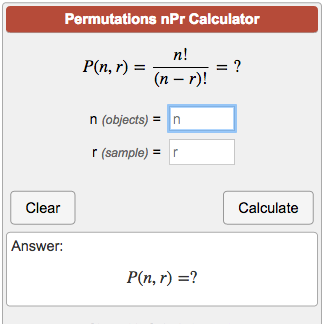
CalculatorSoup
Find the number of ways of getting an ordered subset of r elements from a set of n elements as nPr (or nPk). Permutations calculator and permutations formula. Free online permutations calculator.
The number of ways to choose a sample of r elements from a set of n distinct objects where order does matter and replacements are not allowed. When n = r this reduces to n!, a simple factorial of n.
,w 8 permutation 6
glossy valveBOT
 Requested by riemann#2529
gritty rose
bitter osprey
no
Requested by riemann#2529
gritty rose
bitter osprey
no
the order does matter
bitter osprey
sry i missunderstod my question
gritty rose
all good
bitter osprey
What formula did u use?
gritty rose
gritty rose
i think you want https://www.calculatorsoup.com/calculators/discretemathematics/...
permutations here
gritty rose
gritty rose
> The number of ways to choose a sample of r elements from a set of n distinct o...
defined here
bitter osprey
Alright thanks for your help, I think I'll manage on my own. Have a great day!
full forumBOT
@bitter osprey Has your question been resolved?
Channel closed
Closed by @bitter osprey
Use .reopen if this was a mistake.
full forumBOT
Available help channel!
Send your question here to claim the channel.
Remember:
• Ask your math question in a clear, concise manner.
• Show your work, and if possible, explain where you are stuck.
• After 15 minutes, feel free to ping <@&286206848099549185>.
• Type the command .close to free the channel when you're done.
• Be polite and have a nice day!
Read #❓how-to-get-help for further information on how to ask a good question, and about conduct in the question channels.
 stiff musk
What's the context? Topology? Could be the closure of D?
Could be closure of D. Are you able to paste the whole sentence or paragraph?
Yeah, I think it means the closure of D, which is the set consisting of D along with all of its limit points.
So, a is in D, or a is a limit point of D, or both
hollow herald
 full forumBOT
Channel closed
Closed by @quartz flare
Use .reopen if this was a mistake.
Available help channel!
Send your question here to claim the channel.
Remember:
• Ask your math question in a clear, concise manner.
• Show your work, and if possible, explain where you are stuck.
• After 15 minutes, feel free to ping <@&286206848099549185>.
• Type the command .close to free the channel when you're done.
• Be polite and have a nice day!
Read #❓how-to-get-help for further information on how to ask a good question, and about conduct in the question channels.
 winged dew
Anyone available to help me?
full forumBOT
winged dew
Anyone available to help me?
Please don't occupy multiple help channels.
hollow herald


 hollow herald
the blurriness ... none can't even comprehend-

 earnest frigate
winged dew
i dont understand c, d, and e
earnest frigate
winged dew
i dont understand c, d, and e
O will be (S) and (U)
Since there is only two options for municipal to be
As oil industry is fixed to be successful
And I guess sane holds for M too
full forumBOT
@winged dew Has your question been resolved?
full forumBOT
@winged dew Has your question been resolved?
full forumBOT
Channel closed
Closed due to timeout
Use .reopen if this was a mistake.
full forumBOT
Available help channel!
Send your question here to claim the channel.
Remember:
• Ask your math question in a clear, concise manner.
• Show your work, and if possible, explain where you are stuck.
• After 15 minutes, feel free to ping <@&286206848099549185>.
• Type the command .close to free the channel when you're done.
• Be polite and have a nice day!
Read #❓how-to-get-help for further information on how to ask a good question, and about conduct in the question channels.
 gleaming reef
full forumBOT
gleaming reef
full forumBOT
Channel closed
Closed by @gleaming reef
Use .reopen if this was a mistake.
Available help channel!
Send your question here to claim the channel.
Remember:
• Ask your math question in a clear, concise manner.
• Show your work, and if possible, explain where you are stuck.
• After 15 minutes, feel free to ping <@&286206848099549185>.
• Type the command .close to free the channel when you're done.
• Be polite and have a nice day!
Read #❓how-to-get-help for further information on how to ask a good question, and about conduct in the question channels.
 strong grove
Hey!
full forumBOT
strong grove
Hey!
strong grove
for any integer n>=1 we have: 1+2+3…(n-2)+(n-1)+n.
It wants to know what the big O notation would be
And I’m a little confused by the wording of the question. I figured it was N operations.
My second guess would be nlogn but I don’t understand how that would make sense
tulip marlin
what does big O mean to you
In fact is this big O of the expression
or the computation
strong grove
Well that’s what I’m confused with. Since it’s not really an algorithm as it doesn’t have any steps
It’s just an expression
tulip marlin
well yes
so what does big O mean to you
how is it defined
if u dont know, you should look up the mathematical definition
strong grove
It’s the limit of a function towards an infinite amount of data that it can read
tulip marlin
yh... that isnt what you want here i think
that aside, you will first want to simplify that expression
strong grove
Yeah I’m not really sure what discord would be adequate for this question
Since it relates to discrete math a little bit
tulip marlin
Lookup the formula for triangle numbers
and lookup how big O is defined mathematically
strong grove
Yeah i can understand the complexity when given a step by step algorithm but when given a simple expression it doesn’t make sense to me
But I appreciate the help
!close
full forumBOT
@strong grove Has your question been resolved?
full forumBOT
Channel closed
Closed due to timeout
Use .reopen if this was a mistake.
Available help channel!
Send your question here to claim the channel.
Remember:
• Ask your math question in a clear, concise manner.
• Show your work, and if possible, explain where you are stuck.
• After 15 minutes, feel free to ping <@&286206848099549185>.
• Type the command .close to free the channel when you're done.
• Be polite and have a nice day!
Read #❓how-to-get-help for further information on how to ask a good question, and about conduct in the question channels.
 slate kelp
is 38 true if yes the explanation is correct?
 full forumBOT
slate kelp
is 38 true if yes the explanation is correct?
gritty rose
full forumBOT
slate kelp
is 38 true if yes the explanation is correct?
gritty rose
true. explanation is garbage
slate kelp
@gritty rose would you please explain why it is true?
I didn't even understand what the question want from me
gritty rose
Take derivatives of both of the functions give the integrand
slate kelp
🙆♂️ @gritty rose Thank you got it. sometimes silly questions become struggling xD
.close
full forumBOT
Channel closed
Closed by @slate kelp
Use .reopen if this was a mistake.
Available help channel!
Send your question here to claim the channel.
Remember:
• Ask your math question in a clear, concise manner.
• Show your work, and if possible, explain where you are stuck.
• After 15 minutes, feel free to ping <@&286206848099549185>.
• Type the command .close to free the channel when you're done.
• Be polite and have a nice day!
Read #❓how-to-get-help for further information on how to ask a good question, and about conduct in the question channels.
 warm flare
Hello
full forumBOT
warm flare
Hello
 full forumBOT
@warm flare Has your question been resolved?
full forumBOT
@warm flare Has your question been resolved?
Channel closed
Closed by @warm flare
Use .reopen if this was a mistake.
Available help channel!
Send your question here to claim the channel.
Remember:
• Ask your math question in a clear, concise manner.
• Show your work, and if possible, explain where you are stuck.
• After 15 minutes, feel free to ping <@&286206848099549185>.
• Type the command .close to free the channel when you're done.
• Be polite and have a nice day!
Read #❓how-to-get-help for further information on how to ask a good question, and about conduct in the question channels.
 little swift
 full forumBOT
little swift
little swift
full forumBOT
little swift
little swift
I have tried several times but my answer changed every time
light sonnet
little swift
I have tried several times but my answer changed every time
Post work
 light sonnet
Can you clearly show work for $(f \circ g) (x)$?
glossy valveBOT
dldh06
 little swift
that is the working tho
light sonnet
So first, where exactly is that + 2 coming from?
light sonnet
Do you understand what (f o g) (x) means?
light sonnet
What?
light sonnet
So the functions are written backwards?
little swift
I just mixed up the functions
light sonnet
little swift
Trying to understand how you went from 15x + 9... To 7 + y...
little swift
i just switched the sides
so i can group all x with each other
and factorize the x out
divide it and get only the x
full forumBOT
@little swift Has your question been resolved?
Channel closed
Closed by @little swift
Use .reopen if this was a mistake.
full forumBOT
Available help channel!
Send your question here to claim the channel.
Remember:
• Ask your math question in a clear, concise manner.
• Show your work, and if possible, explain where you are stuck.
• After 15 minutes, feel free to ping <@&286206848099549185>.
• Type the command .close to free the channel when you're done.
• Be polite and have a nice day!
Read #❓how-to-get-help for further information on how to ask a good question, and about conduct in the question channels.
torn jolt
@sullen wren
torn jolt
full forum
It's for him.
 sullen wren
im in channel five, please help
sullen wren
i am. sorry if you feel like you have been disrespected
torn jolt
.close
full forumBOT
Channel closed
Closed by @proper sparrow
Use .reopen if this was a mistake.
Available help channel!
Send your question here to claim the channel.
Remember:
• Ask your math question in a clear, concise manner.
• Show your work, and if possible, explain where you are stuck.
• After 15 minutes, feel free to ping <@&286206848099549185>.
• Type the command .close to free the channel when you're done.
• Be polite and have a nice day!
Read #❓how-to-get-help for further information on how to ask a good question, and about conduct in the question channels.
 proven lotus
data set has five values. The 45th and the 55th percentile are both 16. The largest value is 64, and the geometric mean is 16.
What is the mean?
full forumBOT
proven lotus
data set has five values. The 45th and the 55th percentile are both 16. The larg...
proven lotus
So the values given are. 16,16 ,x, 64?

I dont underatand how to find the values ngl
<@&286206848099549185>
full forumBOT
@proven lotus Has your question been resolved?
Channel closed
Closed by @proven lotus
Use .reopen if this was a mistake.
Available help channel!
Send your question here to claim the channel.
Remember:
• Ask your math question in a clear, concise manner.
• Show your work, and if possible, explain where you are stuck.
• After 15 minutes, feel free to ping <@&286206848099549185>.
• Type the command .close to free the channel when you're done.
• Be polite and have a nice day!
Read #❓how-to-get-help for further information on how to ask a good question, and about conduct in the question channels.
 river mica
I am wondering if anyone here has MatLab experience and would be able to help me out?
I have created a 49x49 matrix using "rand(49)" but i want it to be of rank 47 instead of 49. I am having trouble finding a solution to my problem online, does anyone know how to approach this problem?
full forumBOT
river mica
I am wondering if anyone here has MatLab experience and would be able to help me...
 hollow wyvern
I mean, one solution could be to just zero out two of the columns
river mica
i thought of that too but the issue is that the full question reads as follows.
"Create a 49x49 matrix with rank 47. The matrix may not contain any elements that are zero nor any parallell colons"
hollow wyvern
Ah wonderful
Well I guess after doing that, you can do a similarity transform
Which makes it look different but presevres the rank
river mica
similarity transform? is that a built in command with matlab?
hollow wyvern
Maybe there is I'm not sure. But it's simple - a matrix X is 'similar' to any matrix of the form U X U^-1
Where U is any invertible matrix of the same size
river mica
So i have my matrix X which is 49x49 and youre saying i need to set two rows as 0 and then invert it?
hollow wyvern
Ah no
Try making a new matrix, 49x49 and invertible
Call that U
Then premultiply with U and post multiply with U^-1
river mica
ah i see what youre saying but that would net me a matrix with the rank 47?
i could try it
hollow wyvern
river mica
ah i see what youre saying but that would net me a matrix with the rank 47?
Yeah, and it should also look fairly different. If it still has zero columns, try again but start with coincident columns instead of zero columns
I'm not entirely sure if this'll work but it's an educated guess haha
river mica
Alright, i will try it out. Thanks man
hollow wyvern
np
full forumBOT
@river mica Has your question been resolved?
Channel closed
Closed by @river mica
Use .reopen if this was a mistake.
Available help channel!
Send your question here to claim the channel.
Remember:
• Ask your math question in a clear, concise manner.
• Show your work, and if possible, explain where you are stuck.
• After 15 minutes, feel free to ping <@&286206848099549185>.
• Type the command .close to free the channel when you're done.
• Be polite and have a nice day!
Read #❓how-to-get-help for further information on how to ask a good question, and about conduct in the question channels.
 astral river
This is a very quick question
full forumBOT
astral river
This is a very quick question
astral river
How can I differ from a function f(x) and f'(x), just by looking at undefined funcitons from an image

Like in general, just brought an example with me to learn from
 rocky vale
Where f(x) is increasing, f'(x) is positive. Where f(x) is decreasing, f'(x) is negative
In your picture, I can easily find spots where A is decreasing, but B is positive. so B is definitely not the derivative of A
astral river
rocky vale
Where f(x) is increasing, f'(x) is positive. Where f(x) is decreasing, f'(x) is ...
For some reason, I can't comprehend it
rocky vale
It takes a little practice honestly
astral river
I may be stupid, but isn't it the opposite here?:
astral river
rocky vale
A is the derivative of B.
I've figured that out, but I don't understand why

Like I can't see the correlation - they are doing the exact opposite
Where A is negative, B as f'(x) is positive

 flat mesa
rocky vale
flat mesa
rocky vale
In the first section, A is positive, and B is increasing.
In the second section, A is negative, and B is decreasing.
In the third section, A is positive, and B is increasing
astral river
So do I need to look at it mirrored then
rocky vale
At the points where A crosses the x-axis (in other words, when A is equal to 0), B has a slope of 0
That happens at the points where I put the black lines in
astral river
rocky vale
In the first section, A is positive, and B is increasing.
In the second section,...
Oh, I think I get it. I just need to look at the increase/decrease in Y-value?
astral river
rocky vale
In the first section, A is positive, and B is increasing.
In the second section,...
So for the second section, it's decreasing due to the Y-value of A being negative, right?
rocky vale
Right. The value of A determines the slope of B
astral river
Like the slope where its marked with blue, would still be negative then?

For the red graph / graph A
rocky vale
It's negative there because the function is literally negative
As in below the x-axis
astral river
Yeah, that's what I mean
astral river
rocky vale
It's negative there because the function is literally negative
Understand it now - was just confused by the slopes going different directions. Didn't take in account the Y-axis and its importance here, to differ the graphs
Appreciate the help 😄
@rocky vale
rocky vale
Sure thing. Calculus can be hard to wrap your head around the first time you see it
astral river
I can apply some calculus, just refreshing it. Right now I was just reading up on, why calculus is how it is. Like understanding the derivative function, etc.
astral river
rocky vale
Sure thing. Calculus can be hard to wrap your head around the first time you see...
But yeah, Calculus is definitely not the most friendly thing when encountering it, should be good once I've wrapped my head around the principles
.close
full forumBOT
Channel closed
Closed by @astral river
Use .reopen if this was a mistake.
Available help channel!
Send your question here to claim the channel.
Remember:
• Ask your math question in a clear, concise manner.
• Show your work, and if possible, explain where you are stuck.
• After 15 minutes, feel free to ping <@&286206848099549185>.
• Type the command .close to free the channel when you're done.
• Be polite and have a nice day!
Read #❓how-to-get-help for further information on how to ask a good question, and about conduct in the question channels.
 dim pagoda
Hey can someone help with this
full forumBOT
dim pagoda
Hey can someone help with this
dim pagoda

 hollow geode
what's a as a column vector?
hollow geode
not quite
dim pagoda
-4
3
hollow geode
yes
so a=[-4,3]^T ([]^T means column vector)
b is a vector in the same direction but twice the length
what is b as a scalar multiple of a then?
dim pagoda
So would I do -4 x2 and 3x2 ?
dim pagoda
So -8
6
hollow geode
yes
full forumBOT
@dim pagoda Has your question been resolved?
Channel closed
Closed by @dim pagoda
Use .reopen if this was a mistake.
Available help channel!
Send your question here to claim the channel.
Remember:
• Ask your math question in a clear, concise manner.
• Show your work, and if possible, explain where you are stuck.
• After 15 minutes, feel free to ping <@&286206848099549185>.
• Type the command .close to free the channel when you're done.
• Be polite and have a nice day!
Read #❓how-to-get-help for further information on how to ask a good question, and about conduct in the question channels.
 cloud kestrel
 full forumBOT
cloud kestrel
full forumBOT
full forumBOT
cloud kestrel
full forumBOT
@cloud kestrel Has your question been resolved?
 static rain
can someone help me
gritty rose
This channel's occupied. #❓how-to-get-help
full forumBOT
@cloud kestrel Has your question been resolved?
full forumBOT
@cloud kestrel Has your question been resolved?
full forumBOT
@cloud kestrel Has your question been resolved?
full forumBOT
Channel closed
Closed due to timeout
Use .reopen if this was a mistake.
full forumBOT
Available help channel!
Send your question here to claim the channel.
Remember:
• Ask your math question in a clear, concise manner.
• Show your work, and if possible, explain where you are stuck.
• After 15 minutes, feel free to ping <@&286206848099549185>.
• Type the command .close to free the channel when you're done.
• Be polite and have a nice day!
Read #❓how-to-get-help for further information on how to ask a good question, and about conduct in the question channels.
 primal gust
if a function is constant on an interval of positive length, are all of its derivatives (f', f'', f''', etc.) 0 in that interval?
full forumBOT
primal gust
if a function is constant on an interval of positive length, are all of its deri...
 eager violet
If a function is constant, aka, it doesn't increase or decrease, what does that tell you about the derivative, which measures how much the function increases or decreases?
primal gust
it is 0
eager violet
Yes. And if f'(x) = 0, what about f''(x)?
full forumBOT
@primal gust Has your question been resolved?
Channel closed
Closed by @primal gust
Use .reopen if this was a mistake.
Available help channel!
Send your question here to claim the channel.
Remember:
• Ask your math question in a clear, concise manner.
• Show your work, and if possible, explain where you are stuck.
• After 15 minutes, feel free to ping <@&286206848099549185>.
• Type the command .close to free the channel when you're done.
• Be polite and have a nice day!
Read #❓how-to-get-help for further information on how to ask a good question, and about conduct in the question channels.
 cold dagger
 full forumBOT
cold dagger
cold dagger
full forumBOT
cold dagger
cold dagger
how is it 20?
cold dagger
f(g(x))
torn jolt
right
torn jolt
so if we start off with f(g(3))
we can simplify it piece by piece given what we know about g and f
the thing mentioned g(3) = 7 right
so f(g(3)) = f(7)
@cold dagger I think you can figure it out from there! :)
full forumBOT
Channel closed
Closed by @cold dagger
Use .reopen if this was a mistake.
Available help channel!
Send your question here to claim the channel.
Remember:
• Ask your math question in a clear, concise manner.
• Show your work, and if possible, explain where you are stuck.
• After 15 minutes, feel free to ping <@&286206848099549185>.
• Type the command .close to free the channel when you're done.
• Be polite and have a nice day!
Read #❓how-to-get-help for further information on how to ask a good question, and about conduct in the question channels.
 sinful raven
verify cos(3x)/cos(x) = 1-4sin^2(x)
full forumBOT
sinful raven
verify cos(3x)/cos(x) = 1-4sin^2(x)
torn jolt
sinful raven
verify cos(3x)/cos(x) = 1-4sin^2(x)
what have you tried so far?
torn jolt
that's a good instinct, I would definitely try to get the cos(3x) in terms of cos(x) and sin(x)
Would seeing cos(3x) written as cos(2x + x) help?
sinful raven
Oh so now just use sum and difference formulas?
torn jolt
yeah
sinful raven
Alr I’ll try that
torn jolt
also fun thing you might know already, do you know a nice trick to quickly re-derive those sum/difference formulas, and even generalized versions of them?
you can use rotation matrices, of which the products and inverses are not too tough to work out
sinful raven
What are those?
torn jolt
Just to not overwhelm ya, are you familiar with linear algebra?
torn jolt
ok that's fine, maybe that tip isn't so helpful then lol
but once you do you won't have to memorize those formulas anymore haha
sinful raven
Interesting, sounds cool
torn jolt
some stuff with complex numbers instead of linear algebra also gives you the same formulas quickly
but anyway yeah good idea give it a try with the sum formulas for simplifying cos(3x)
full forumBOT
Channel closed
Closed by @sinful raven
Use .reopen if this was a mistake.
Available help channel!
Send your question here to claim the channel.
Remember:
• Ask your math question in a clear, concise manner.
• Show your work, and if possible, explain where you are stuck.
• After 15 minutes, feel free to ping <@&286206848099549185>.
• Type the command .close to free the channel when you're done.
• Be polite and have a nice day!
Read #❓how-to-get-help for further information on how to ask a good question, and about conduct in the question channels.
 spring abyss
I am trying to prove whether the sequence is divergent or convergent. I do not know how to do mathematical notations on discord, but it is an infinite sum of (1/2n).
The sequence goes 1 + 1/2 + 1/4 + 1/6 + .. + 1/2n
full forumBOT
spring abyss
I am trying to prove whether the sequence is divergent or convergent. I do not k...
meager dew
$\sum_{n=1}^{\infty}\frac{1}{2n}$
glossy valveBOT
a disappointing son
 meager dew
?
spring abyss
exactly
meager dew
have you tried any tests yet
spring abyss
I am confused as to how I can prove that the sequence is divergent
Yes, I said that the first term = 1/2. The 2nd and the 3rd term > 1/2. The next 4 terms are > 1/2. The next 8 terms are > 1/2
so if you keep adding 1/2, and there are an infinite amount of terms, it is divergent... but idk if it is true
spring abyss
What do you mean?
 shadow parcel
isn't your series just 1/2(1 + 1/2 + 1/3 + 1/4 +...)
meager dew
unless i'm going insane
glossy valveBOT
sucka mah
 meager dew
n=1 is not 1
spring abyss
you will get 1/2 + 1/4 + 1/6 + .. + 1/2n
 shadow parcel
isn't your series just 1/2(1 + 1/2 + 1/3 + 1/4 +...)
shadow parcel
shadow parcel
isn't your series just 1/2(1 + 1/2 + 1/3 + 1/4 +...)
ok but we know this diverges
meager dew
do you know any convergence or divergence tests?
spring abyss
no that is the issue. I know their definitions, but I do not know how to confirm if a series is one or the other
or how to 'prove' it.
meager dew
hm that's unfortunate

This calculus 2 video tutorial provides a basic introduction into the divergence test for series. To perform the divergence test, take the limit as n goes to infinity for the sequence An. If the limit doesn't equal, then the series diverges. If the limit equals 0, the series may converge or it may divergence. Examples and practice problems in...
here's a nice man
spring abyss
ah the organic chemistry tutor
you know what, ill go watch it and come back if I didn't learn anything
which is very unlikely
meager dew
specifically you're looking for the p-series test
spring abyss
alright mate, well thanks a lot
meager dew
👍
 meager dew
you too friend
spring abyss
.close
full forumBOT
Channel closed
Closed by @spring abyss
Use .reopen if this was a mistake.
Available help channel!
Send your question here to claim the channel.
Remember:
• Ask your math question in a clear, concise manner.
• Show your work, and if possible, explain where you are stuck.
• After 15 minutes, feel free to ping <@&286206848099549185>.
• Type the command .close to free the channel when you're done.
• Be polite and have a nice day!
Read #❓how-to-get-help for further information on how to ask a good question, and about conduct in the question channels.
 hushed tendon
Hey guys!
full forumBOT
hushed tendon
Hey guys!
hushed tendon
I have a question with this info:
There's a parallelogram with the dots; A (3,1), B(7,-3), C (12,4).
I need to find the equation of a straight line (y=mx+b) of the diagonal line, and the equation of a straight line of AD.
Thing is I'm not strong at all in this topic so I struggle to know what am I doing
 shadow parcel
which are the sides of the parallelogram
hushed tendon
shadow parcel
which are the sides of the parallelogram
Not sure I understood what you meant
hushed tendon
I believe we need to find somehow AD in order to make sure it is, otherwise we can't guess
it's either AC or BC
torn jolt
hushed tendon
where do u think will point D be at?
hushed tendon
torn jolt
where do u think will point D be at?
Honestly i've no idea 🤦♂️
Oh
Okay
I think I know
torn jolt
go ahead
shadow parcel
probably there
 torn jolt
hushed tendon
AB should be parallel to CD
torn jolt
hushed tendon
AB should be parallel to CD
u mean AB should be parallel to CD?
hushed tendon
torn jolt
u mean AB should be parallel to CD?
yes, edited
 shadow parcel
probably there
shadow parcel
shadow parcel
probably there
@hushed tendon is this right? then AC is the diagonal
hushed tendon
shadow parcel
<@!177175445106720768> is this right? then AC is the diagonal
i don't know haha
shadow parcel
tf
hushed tendon
i struggle to understand it myself
shadow parcel
why would they make it ambiguous
 torn jolt
they told u to find the equation of AD right oof, I was mistaken somewhere u dont need all this
Just find where point D will be
to do this you need to find the displacement between AB
Do u get this
 hushed tendon
shadow parcel
probably there
hushed tendon
shadow parcel
probably there
btw i think its wrong because it gives us a rectangle
hushed tendon
torn jolt
Do u get this
not sure, how did you get to 16,0?
torn jolt
Its Point D
hushed tendon
you used AC's distance?
hushed tendon
torn jolt
they told u to find the equation of AD right oof, I was mistaken somewhere u don...
And by the way, they also wanted the equation of the diagonal line, which is probably AC
hushed tendon
shadow parcel
you assume D = A + (B-A) + (C-A)
I think he used the feature that says all two opposite sides in the parallel are equal to each other
torn jolt
let the red dot be A
let the blue dot be B
let the green dot be C
let the black dot be D
AC and BD are parallel
that means their gradients are the same
displacement from A to C = (7,-3) - (3,1) = (4,-4)
so displacement from C to D should be the same
(12,4) + (4,-4) = (16,0) -> point D
hushed tendon
okay, makes sense
how does it helps me now to understand the straight line of the diagonal line?
shadow parcel
 hushed tendon
.
shadow parcel
D can still go to the lower left or right
hushed tendon
shadow parcel
D can still go to the lower left or right
i know they're all parallelograms, but if they wanted a different shape they would've asked for it
thats what i think at least
shadow parcel
i think if u get it wrong its their fault for being ambiguous
or maybe u misread the question
hushed tendon
there are more questions on the page
and they ask there for different shapes when they really want
such as rectangle, a triangle and etcv
etc*
so it really should be a parallelogram from what I see
shadow parcel
D can go in one of 3 spots to form the parallelogram
that gives 3 different equations for the diagonal line
hushed tendon
At the beginning of the question, they wrote, 3 dots of the parallelogram ABCD is - (the info i gave you)
shadow parcel
you didn't say that at all
now i suspect the parallelogram is counterclockwise in that order
hushed tendon
hushed tendon
I have a question with this info:
There's a parallelogram with the dots; A (3,1...
👀
shadow parcel
shadow parcel
probably there
as drawn here
you didn't say parallelogram ABCD, you said these points are on it
hushed tendon
hm
shadow parcel
there are 3 parallelograms with those, but only one with them in counterclockwise order
shadow parcel
ABCD
hushed tendon
so it's important to add it as a detail, got it for the next time 🥶
hollow herald
then diagonal is AC and BD
I have a question with this info:
There's a parallelogram with the dots; A (3,1), B(7,-3), C (12,4).
I need to find the equation of a straight line (y=mx+b) of the diagonal line, and the equation of a straight line of AD.
Thing is I'm not strong at all in this topic so I struggle to know what am I doing
"equation of straight line of AD" so equation of one side of the parallelogram and the equations of the diagonals
ACtually, can you just rather share a pic or something of the actual question?
hushed tendon
its written in a different language
hollow herald
no worries
hollow herald
google does XD
hushed tendon
they didn't draw anything
hushed tendon
שלושה מקודקודי מקבילית הם: A (3,1), B (7,-3), C(12,4)
א) מצא את משוואת אלכסוניה של המקבילית
ב) מצא את משוואת הצלע AD
thats the exercise
hollow herald
okay it's just the parallelogram ABCD then
And you've been asked equation for diagonals AC, BD and equation for side AD


 hushed tendon
hollow herald
And you've been asked equation for diagonals AC, BD and equation for side AD
hushed tendon
hollow herald
And you've been asked equation for diagonals AC, BD and equation for side AD
For both AC and BD?
shadow parcel
like this ^
hollow herald
hushed tendon
For both AC and BD?
Yeah
hushed tendon
So we need to find D in order to do that, don't we?
hushed tendon
is there a formula for that?
shadow parcel
its like what @torn jolt said
hushed tendon
like with the jumps
shadow parcel
ok for now how about finding the equation of diagonal AC
hushed tendon
D stands for (8,8)
hushed tendon
shadow parcel
ok for now how about finding the equation of diagonal AC
I will try to find the M first
if im not wrong
shadow parcel
looks good
shadow parcel
this is line AC
hushed tendon
right
shadow parcel
that looks good
but
its easier to use point form
y=mx
in this form the line intersects the origin
so all u need to do is shift the origin over
(y-y_0)=m(x-x_0)
hushed tendon
shadow parcel
so all u need to do is shift the origin over
im not sure i understood this way
can you show it with the info given?
shadow parcel
shadow parcel
(y-y_0)=m(x-x_0)
point (x_0,y_0) will be intersected
shadow parcel
hushed tendon
can you show it with the info given?
u should do that
but u should know why it works
shadow parcel
its just another variable
shadow parcel
theres no /0
hushed tendon
so what the _ stands for
shadow parcel
sorry
subscript
it just to make a new variable
(y-b)=m(x-a) will intersect point (a,b)
ye
hushed tendon
and whats my a and b here o-o
hushed tendon
so for AC we got y=1/3x+b
shadow parcel
yup
shadow parcel
oh i didn't notice that lol
the line intersects the origin
or it would if it was allowed to extend that far
but forget about that
solve for b like usual
shadow parcel
sure
hushed tendon
lol ive no idea whats going on
shadow parcel
i was hoping u would mess up so u would learn
put brackets when u type math
u mean (1/3)x
hushed tendon
lol
shadow parcel
but youre wondering how (1/3)x = x/3 ??
hushed tendon
ye
hushed tendon
ye
shadow parcel
go for it
shadow parcel
continue
hushed tendon
so we found BD's straight equation and AC's straight equation
now we need to find AD's
shadow parcel
linear equations
shadow parcel
hushed tendon
now we need to find AD's
im pretty sure u got it
shadow parcel
maybe stop saying M
hushed tendon
it helps xd
shadow parcel
its the slope or gradient that youre finding here
which you call m in the equation y=mx+b
at least say lowercase m
hushed tendon
ye im used to capitals
shadow parcel
then it could be confused with a point in this context
hushed tendon
i understand
so the slope is
8-1/8-3=7/5
which gives us 1 2/5
does it makes any sense?
shadow parcel
what does it give you?
hushed tendon
i got b = -3.2
hushed tendon
the answers say the equation is 5y - 7x + 16 = 0, i don't understand how they got to it
hushed tendon
shadow parcel
i hope ur getting more confident
ye, you helped me alot with this topic
im starting to understand it slowly xd
shadow parcel
hushed tendon
the answers say the equation is 5y - 7x + 16 = 0, i don't understand how they go...
its the same thing
your answer is fine in the form y=mx+b
leave it like that
hushed tendon
ye, but where did they get the 16 from
shadow parcel
they multiplied by 5 and then subtracted everything on right hand side
hushed tendon
why tho
shadow parcel
either to obscure the answer or make it nicer
either way doesn't matter
your answer is correct
hushed tendon
ye
shadow parcel
is that everything?
shadow parcel
np
hushed tendon
.close
full forumBOT
Channel closed
Closed by @hushed tendon
Use .reopen if this was a mistake.
Available help channel!
Send your question here to claim the channel.
Remember:
• Ask your math question in a clear, concise manner.
• Show your work, and if possible, explain where you are stuck.
• After 15 minutes, feel free to ping <@&286206848099549185>.
• Type the command .close to free the channel when you're done.
• Be polite and have a nice day!
Read #❓how-to-get-help for further information on how to ask a good question, and about conduct in the question channels.
 dusty portal
I just finished a test and couldn't complete this exercises
dusty portal
Simply the following Expressions without using a calculator
sin(½ • arctan (2•sqrt(5)))
tulip marlin
trig identity and double angle?
you can find half angle by solving equation for double
tulip marlin
then give up lol
its not super complex, its just tedious algebra
sensibly make a substitution just so u write less on your page
dusty portal
cos(arctan (2sqrt(5)))
Can this be simplified?
Cause i get it with the half angle formula
dusty portal
tulip marlin
then give up lol
That's what I did on my test lol
tulip marlin
ofc trig identity.
 jolly wharf
Drawing a relevant right-angled triangle helps
full forumBOT
Channel closed
Closed by @dusty portal
Use .reopen if this was a mistake.
full forumBOT
Available help channel!
Send your question here to claim the channel.
Remember:
• Ask your math question in a clear, concise manner.
• Show your work, and if possible, explain where you are stuck.
• After 15 minutes, feel free to ping <@&286206848099549185>.
• Type the command .close to free the channel when you're done.
• Be polite and have a nice day!
Read #❓how-to-get-help for further information on how to ask a good question, and about conduct in the question channels.
torn jolt
Can someone prove the theorem stating that if two triangles are similar, then the ratio of their areas equals the square of the ratio of their corresponding sides?
full forumBOT
torn jolt
Can someone prove the theorem stating that if two triangles are similar, then th...
glossy valveBOT
Chromium

 full thicket
and suppose the base, height of triangle 1 are $b, h$
glossy valveBOT
Chromium
 full thicket
then the base, height of triangle 2 are $kb, kh$
glossy valveBOT
Chromium
 full thicket
the area will be $\frac{1}{2} (kb) (kh) = \frac{1}{2} bh k^2$