#help-28
1 messages · Page 283 of 1
 full forumBOT
Please show the original problem, exactly as it was stated to you, with the entire original context. A picture or screenshot is best. If the original problem is not in English, then post it anyway! The additional context might still be helpful. Do your best to provide a translation.
 thick hedge
 queen gull
Mabye its xy...
queen gull
Mabye its xy...
probably is
 lapis holly
a is 3 and b is -5
full forumBOT
@lime rover Has your question been resolved?
 hidden belfry
Isn’t there a formula used to solved cubics without a x^2 term?
 robust slate
 [
[

Wolfram|Alpha brings expert-level knowledge and capabilities to the broadest possible range of people—spanning all professions and education levels.
hidden belfry
Is that what the cardano formula is?
hidden belfry
robust slate
<:opencry:586078614865444865> [https://www.wolframalpha.com/input/?i=x%5E3%2B3x%...
;-;
 lime rover
No way.
lime rover
hidden belfry
Isn’t there a formula used to solved cubics without a x^2 term?
There is an easy formula but before you use it you must make the cubic equation depressed.
hidden belfry
lime rover
There is an easy formula but before you use it you must make the cubic equation ...
How do you make a cubic equation regret its life decisions?
lime rover
Well the full one looks like this:
ax³+bx²+cx+d=0
And you have to use other constants like p and q
To simplify it down to x³+xy+b=0
And thats the hard part
hidden belfry
(It was a joke)
😊
full forumBOT
@lime rover Has your question been resolved?
Channel closed
Closed by @lime rover
Use .reopen if this was a mistake.
 Available help channel!
Send your question here to claim the channel.
Remember:
• Ask your math question in a clear, concise manner.
• Show your work, and if possible, explain where you are stuck.
• Do not immediately ping people or roles. After 15 minutes, feel free to ping <@&286206848099549185> once.
• Type the command .close to free the channel when you're done.
• Be polite and have a nice day!
Read #❓how-to-get-help for further information on how to ask a good question, and about conduct in the question channels.
 robust gorge
could anyone help me on this
 full forumBOT
robust gorge
could anyone help me on this
robust gorge
full forumBOT
robust gorge
could anyone help me on this
robust gorge
i forgor how to do it
 quartz flare
Do you remember what slope of the tangent line is
robust gorge
yo whats up cool
quartz flare
Or I should say how to find it in general
robust gorge
quartz flare
Do you remember what slope of the tangent line is
slope of tangent is ?
quartz flare
robust gorge
yo whats up cool
heyy
robust gorge
m formula?
quartz flare
robust gorge
slope of tangent is ?
(the ||derivative||)
robust gorge
quartz flare
(the ||derivative||)
oh ok
this lesson is based off of derivative
so its still tackling basics
quartz flare
That's what one of the big things of calculus is remembering/learning all of the alternative definitions of the derivative
Derivative = slope at a point = slope of tangent line = a few other things probably
quartz flare
robust gorge
so its still tackling basics
So you'll likely need to use the limit definition to calculate this derivative if you haven't learned the rules yet
But you have done this limit before so I'm pretty sure you can do it
robust gorge
quartz flare
But you have done this limit before so I'm pretty sure you can do it
like this problem?
quartz flare
Yes a limit like what this derivative will be
Do you remember the limit definition of derivative
robust gorge
i dont think we studied that yet
quartz flare
How are you supposed to calculate the derivative then o.o
Okay have you learned something called power rule yet
quartz flare
quartz flare
Derivative = slope at a point = slope of tangent line = a few other things proba...
.
robust gorge
my bad
quartz flare
Unless they taught you a different way to calculate the slope of a tangent line
robust gorge
they didnt connect the tangent line slope = derivative thing yet in lessons
wait i see a lesson video on it
imma go watch that
robust gorge
alright imma close the channel to not keep u waiting
robust gorge
gif?
quartz flare
Yeah it's one I use for derivative/tangent relationship
robust gorge
lets see it
quartz flare
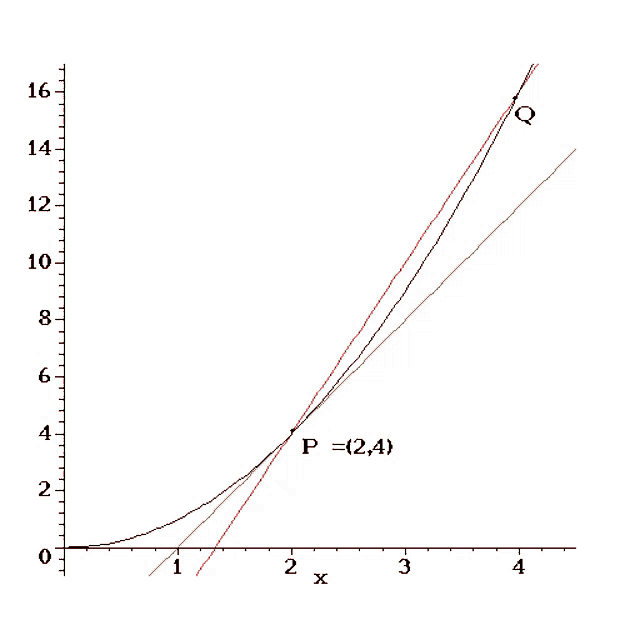
There it is
It'll make more sense once why this describes it you watch the video I'm sure
quartz flare
But for a short summary slope is y2-y1/x2-x1, as we move the points P and Q closer together (a limit!) we approach a single slope, that's the derivative
quartz flare
robust gorge
the straighter the line
Yes, essentially
quartz flare
robust gorge
alright imma close the channel to not keep u waiting
Sounds good
full forumBOT
Channel closed
Closed by @robust gorge
Use .reopen if this was a mistake.
Available help channel!
Send your question here to claim the channel.
Remember:
• Ask your math question in a clear, concise manner.
• Show your work, and if possible, explain where you are stuck.
• Do not immediately ping people or roles. After 15 minutes, feel free to ping <@&286206848099549185> once.
• Type the command .close to free the channel when you're done.
• Be polite and have a nice day!
Read #❓how-to-get-help for further information on how to ask a good question, and about conduct in the question channels.
 summer creek
 full forumBOT
summer creek
full forumBOT
summer creek
 onyx glen
!status
full forumBOT
What step are you on?
1. I don't know where to begin.
2. I have begun but got stuck midway.
3. I got an answer but I was told that it's wrong.
4. I got an answer and would like my work checked.
5. I have a question about someone else's work/solution.
6. I have completed the problem and don't need help anymore. Thank you.
7. None of the above
1
onyx glen
do you need explanation for any of the financial terminology or no
onyx glen
ok so let x be the initial sum borrowed on e.g. Jan 1
summer creek
107.5x/100 and we will pay 5547
onyx glen
work out the remaining balance on:
- jun 30 (5547 INR paid, interest not applied)
- jul 1 (interest applied now)
- dec 31 (second 5547 payment)
quartz flare
I like how this question came up relying on the formula being asked about in another help channel at the same time
What ann said 
summer creek
Which channel?
quartz flare
The guy posted a section from their textbook (I assume? but they said they were writing it) on compound interest
Featuring, naturally, the formula for compound interest that they're trying to work on
summer creek
If I borrow x amount on jan1 then after 6 months i have to pay
107.5x/100-5547×107.5x/100-5547
summer creek
But ann declined above
quartz flare
Because it wasn't right when you did it above
quartz flare
Put in the parentheses first
Then ask how much money will be left on the loan after you pay it off completely
summer creek
 quartz flare
No
summer creek
Then?
quartz flare
Start back at the steps ann told you
I just noticed that interest is applied the day after the payment not before based on what she said
summer creek
I didn't get it properly actually
Could you make it easy?
How may I calculate it?
7.5x/100-5547?
quartz flare
Do like she said, let x be the initial amount of money, then figure out the balance on jun 30, all you've done is paid 5547
 quartz flare
If I started with x, and took away 5547, how much do I have
onyx glen
summer creek
i literally said DON'T apply interest on jun 30
onyx glen
onyx glen
work out the remaining balance on:
* jun 30 (5547 INR paid, interest not applied...
.
jun 30 balance is just (x-5547) only
summer creek
x-5547
onyx glen
🥀
summer creek
Hmm
summer creek
(x-5547)1.075 july 1
summer creek
(x-5547)1.075-5547 again?
onyx glen
yes, then that should be 0 bc you pay off by then
summer creek
,w (x-5547)1.075-5547=0 again?
 glossy valveBOT


 Requested by popkingghj
summer creek
Requested by popkingghj
summer creek
,w 5547×2-10707
glossy valveBOT
 Requested by popkingghj
summer creek
Requested by popkingghj
summer creek
What if we do the question with formula?
onyx glen
then you shall have to supply the formula
summer creek
 onyx glen
!noai
full forumBOT
Please do not trust ChatGPT or similar AI tools for mathematical tasks, as they often generate output which "sounds correct" but has numerous factual or logical errors. Use of these AI tools to answer other people's help questions is strictly against server rules (see #rules).
onyx glen
however it seems that this presupposes that the interest kicks in before you pay off the first installment
summer creek
onyx glen
however it seems that this presupposes that the interest kicks in before you pay...
Hmm
onyx glen
which is a very frustrating and notorious place to get fucked up
onyx glen
because nobody fucking knows how the fuck the timing of payments vs interest applications works
onyx glen
summer creek
I meant it will grow each day no?
not each day unless it says DAILY COMPOUNDING in the question
summer creek
Compounding after 6 months mean...they will charge over interest too
6 months no charge
Okay so I asked someone and told me the step where we clash were correct in terms of Ann's place... but here it is wrong
The initial amount is p
(1.075p-5547)×1.075-5547=0
,w (1.075p-5547)×1.075-5547=0
glossy valveBOT
 Requested by popkingghj
onyx glen
Requested by popkingghj
onyx glen
ok so in fact interest is applied first
in other words the MOMENT you walk out of the bank with the money then you already owe them 7.5% more
QUADRILLIONS IN DEBT FOR EVERY HUMAN BEING ON PLANET EARTH SINCE BIRTH
full forumBOT
@summer creek Has your question been resolved?
summer creek
Suppose ann if I borrow x money on Jan 1 with half yearly interest rate 7.5%
so if I pay you 5547 on 30 june
matter is closed?
I don't think this is a good way to lend money because anyone on the planet can borrow millions of money and pay it before one day and they will have to pay nothing
In indian terms
Simple interest term mean they will not charge any extra interest on the internet earned annually
For compound interest they will charge interest over interest after given time period what interest how applied
So if they borrow x amount then after 6 months complete i have to pay 1.075x amount to you, i cannot pay before one day,two day....
Happy to discussion
.close
full forumBOT
Channel closed
Closed by @summer creek
Use .reopen if this was a mistake.
full forumBOT
Available help channel!
Send your question here to claim the channel.
Remember:
• Ask your math question in a clear, concise manner.
• Show your work, and if possible, explain where you are stuck.
• Do not immediately ping people or roles. After 15 minutes, feel free to ping <@&286206848099549185> once.
• Type the command .close to free the channel when you're done.
• Be polite and have a nice day!
Read #❓how-to-get-help for further information on how to ask a good question, and about conduct in the question channels.
 eager sphinx
I want to simplify
$\frac{2}{(5-\sqrt{3})(2+\sqrt{3})}$
glossy valveBOT
botou

 hoary fable
What have you tried?
glossy valveBOT
botou
 eager sphinx
am I correct so far?
 sudden chasm
thats good. now you can either end here or rationalize the expression
eager sphinx
no I need to rationalise and hence
hoary fable
eager sphinx
am I correct so far?
Yes, you are
eager sphinx
I multiplied the top and bottom by 7 - root 3
for the numerator I got 14 -6 root 3
for the denominator I got 7 + 3 root 3
hoary fable
eager sphinx
for the denominator I got 7 + 3 root 3
(7+3sqrt(3))(7-3sqrt(3))
Think about that
What does it look like
sudden chasm
eager sphinx
for the denominator I got 7 + 3 root 3
it will be a difference of squares, a^2-b^2
hoary fable
Is there a common factor between the numerator and denominator?
sudden chasm
eager sphinx
14-6root3 /22?
or, (7-3root3)/11
hoary fable
eager sphinx
2?
Yes
hoary fable
sudden chasm
or, (7-3root3)/11
Factor that out of the numerator and divide, you get this
eager sphinx
so tje final answer is this?
hoary fable
Yep, you got it
full forumBOT
Channel closed
Closed by @eager sphinx
Use .reopen if this was a mistake.
eager sphinx
.reopen
full forumBOT
✅ Original question: #help-28 message
eager sphinx
Simplify $\frac{3-2\sqrt{5}}{\sqrt{5}-1}$ in the form $p + q \sqrt{5}$
I don’t understand thenform part
glossy valveBOT
botou
 sudden chasm
again, here we have to multiply the numerator and the denominator with the conjugate of the denominator
 brittle steeple
they want you to write it like that, but where p and q are specific numbers
onyx glen
eager sphinx
Simplify $\frac{3-2\sqrt{5}}{\sqrt{5}-1}$ in the form $p + q \sqrt{5}$
your answer needs to be a fraction times sqrt(5) plus another fraction
eager sphinx
brittle steeple
they want you to write it like that, but where p and q are specific numbers
How can I do
That wouldn’t it be p/q
sudden chasm
sudden chasm
again, here we have to multiply the numerator and the denominator with the conju...
it will be if you try this
eager sphinx
ikay let me try solve it as I would normally
brittle steeple
That should work
eager sphinx
I got root 5 -7 / 4
brittle steeple
,w (sqrt(5)-1)(sqrt(5)-7)/4 = 3-2sqrt(5)
glossy valveBOT


 eager sphinx
brittle steeple
Do you know what p and q would be here
eager sphinx
brittle steeple
Do you know what p and q would be here
hmmm
yes
p would be 1/4 q would be -7
?
brittle steeple
-7/4 = q
brittle steeple
eager sphinx
I got root 5 -7 / 4
Also you should have used parentheses here
brittle steeple
the root 5 is on the 1/4
eager sphinx
huhhhh
brittle steeple
you got $\f{\sqrt{5}-7}4$, right
glossy valveBOT
Dreyuk
 eager sphinx
yes
sudden chasm
$\frac{a \pm b\sqrt{c}}{d}=\frac{a}{d} \pm \frac{b\sqrt{c}}{d}$
glossy valveBOT
T&C
 eager sphinx
brittle steeple
Do you know how to split this into two different fractions?
eager sphinx
brittle steeple
Do you know how to split this into two different fractions?
Root 5/4 and -7 / 4
brittle steeple
right
sudden chasm
now let a/d = p and b/d = q
eager sphinx
sudden chasm
now let a/d = p and b/d = q
no let’s not do that
too many letters
can we keep it simple guys
sudden chasm
eager sphinx
can we keep it simple guys
we're just distributing the denominator to each term of the numerator
brittle steeple
The form it wants is some rational + another rational times sqrt(5)
sudden chasm
to get a p+q root form
brittle steeple
Thinking of the rationals as your coefficients
brittle steeple
Right
eager sphinx
is that not my final answer
eager sphinx
huh hahaha what
brittle steeple
the sqrt(5) was divided by 4, how did it end up being multiplied by -7/4
sudden chasm
what?
brittle steeple
I have no idea what that means
brittle steeple
ok where are we now
brittle steeple
glossy valve
**Dreyuk**
Here still?
eager sphinx
I’m not sure
brittle steeple
Right
sudden chasm
u need to find the values of p and q right?
eager sphinx
yeah
brittle steeple
ok so one of these things is our constant and the other is something times sqrt(5)
sudden chasm
eager sphinx
Root 5/4 and -7 / 4
then compare this expression with p+q root5
eager sphinx
brittle steeple
ok so one of these things is our constant and the other is something times sqrt(...
yeah so we need to somehow get rid of that sqrt 5?
but why isn’t q just 1/4 then
as it’s multplilyimg with root 5
brittle steeple
It is
sudden chasm
eager sphinx
but why isn’t q just 1/4 then
its correct
sudden chasm
it wasn't making sense b4, in the way u said it unfortunately
brittle steeple
Where?
eager sphinx
sudden chasm
it wasn't making sense b4, in the way u said it unfortunately
okayokayoakay
thank you guys
!!
.close
full forumBOT
Channel closed
Closed by @eager sphinx
Use .reopen if this was a mistake.
brittle steeple
no problem
full forumBOT
Available help channel!
Send your question here to claim the channel.
Remember:
• Ask your math question in a clear, concise manner.
• Show your work, and if possible, explain where you are stuck.
• Do not immediately ping people or roles. After 15 minutes, feel free to ping <@&286206848099549185> once.
• Type the command .close to free the channel when you're done.
• Be polite and have a nice day!
Read #❓how-to-get-help for further information on how to ask a good question, and about conduct in the question channels.
 dusky hedge
Why the order of the cycle is the length of it
full forumBOT
dusky hedge
Why the order of the cycle is the length of it
 muted flare
 grave elm
dusky hedge
Why the order of the cycle is the length of it
grave elm
dusky hedge
Why the order of the cycle is the length of it
by definition of order
we define order to be that
dusky hedge
grave elm
by definition of order
Bruh
 foggy vapor
dusky hedge
Why the order of the cycle is the length of it
foggy vapor
dusky hedge
Why the order of the cycle is the length of it
If you shift elements in a circle of size m, you must shift them m times to get them back to the start
dusky hedge
I ask why bro
dusky hedge
foggy vapor
If you shift elements in a circle of size m, you must shift them m times to get...
Ik
grave elm
dusky hedge
I ask why bro
Why do we call trees "tree"? Because we gave them that name
dusky hedge
But is there a proof to that
grave elm
there is really no deep reason, you dont need a proof to define stuff
 maiden vapor
dusky hedge
But is there a proof to that
maiden vapor
dusky hedge
But is there a proof to that
Follows directly from definition of order
grave elm
How do you define order (of a cycle)?

 civic bay
dusky hedge
But is there a proof to that
civic bay
dusky hedge
But is there a proof to that

Mathematics Stack Exchange
Let $\sigma$ be a cycle with length $n$ where $\sigma \in S_m$.
How do i prove that $|\langle \sigma \rangle |$ is $n$?
full forumBOT
@dusky hedge Has your question been resolved?
Channel closed
Closed by @dusky hedge
Use .reopen if this was a mistake.
Available help channel!
Send your question here to claim the channel.
Remember:
• Ask your math question in a clear, concise manner.
• Show your work, and if possible, explain where you are stuck.
• Do not immediately ping people or roles. After 15 minutes, feel free to ping <@&286206848099549185> once.
• Type the command .close to free the channel when you're done.
• Be polite and have a nice day!
Read #❓how-to-get-help for further information on how to ask a good question, and about conduct in the question channels.
 sour shore
Let two lines be L1 and L2 . Number of lines in a family of lines (all lines passing through the intersection of L1 and L2) that are at a fixed distance from given point can be at max ?
full forumBOT
sour shore
Let two lines be L1 and L2 . Number of lines in a family of lines (all lines pas...
sour shore
2?
 brittle sun
What does it even mean for a line to be at a fixed distance from a point
onyx glen
sour shore
Let two lines be L1 and L2 . Number of lines in a family of lines (all lines pas...
!xy
full forumBOT
sour shore
Let two lines be L1 and L2 . Number of lines in a family of lines (all lines pas...
Please show the original problem, exactly as it was stated to you, with the entire original context. A picture or screenshot is best. If the original problem is not in English, then post it anyway! The additional context might still be helpful. Do your best to provide a translation.
brittle sun
Beat me to it lol
sour shore
Perpendicular distance between a point and a line?
sour shore
onyx glen
!xy
There's no ques. This is js a conceptual doubt.
 twilit leaf
well the intersection of L1 and L2 is a point
sour shore
Let two lines $L_1$ and $L_2$ intersect at a point $O$. Consider the family of all lines passing through $O$. What is the maximum number of lines in this family that are at a fixed perpendicular distance $D$ from a given point $P$?
I suppose this is better worded
twilit leaf
so what youre really asking is if you have a point P1 and a second point P2 which is the center of a circle of radius r, how many tangents to that circle go through P1
brittle sun
sour shore
Let two lines $L_1$ and $L_2$ intersect at a point $O$. Consider the family of a...
Oh you're fixing the distance too?
In that case the first part doesn't matter
It's just asking, we have a point. How many lines exist such that the perpendicular distance from the point is x
sour shore
twilit leaf
so what youre really asking is if you have a point P1 and a second point P2 whic...
I get it....a lil bit
twilit leaf
tangents are perpendicular to the radius at that point
so perpendicular distance being the same is like have a tangent to a circle
sour shore
brittle sun
It's just asking, we have a point. How many lines exist such that the perpendicu...
Thtd be infinite...
brittle sun
And that's correct
sour shore
@twilit leaf can u maybe explain with these variables?
sour shore
brittle sun
And that's correct
Idts
twilit leaf
what do you want to call the fixed perpendicular distance
sour shore
Let's say D
twilit leaf
ok
glossy valveBOT
ch3rry
 twilit leaf
so you have a line going through O that needs to have a perpendicular distance D away from P
onyx glen
don't these lines form a cone
brittle sun
sour shore
Idts
Oh wait I'm stupid sorry
sour shore
Yep
onyx glen
what are the roles of L1 and L2 here
brittle sun
All yours garlic
twilit leaf
are we in 3d or 2d
twilit leaf
yes, and that would form a cone
but anyway
what we can do is draw a circle with radius D at P
sour shore
Okok i got it i think
Only 0,1,2 no. Of lines r possible ryt?
2 for external point, 1 for point on circle, and 0 for internal point?
full forumBOT
Channel closed
Closed by @sour shore
Use .reopen if this was a mistake.
Available help channel!
Send your question here to claim the channel.
Remember:
• Ask your math question in a clear, concise manner.
• Show your work, and if possible, explain where you are stuck.
• Do not immediately ping people or roles. After 15 minutes, feel free to ping <@&286206848099549185> once.
• Type the command .close to free the channel when you're done.
• Be polite and have a nice day!
Read #❓how-to-get-help for further information on how to ask a good question, and about conduct in the question channels.
 indigo frost
 full forumBOT
indigo frost
indigo frost
full forumBOT
indigo frost
indigo frost
I don't know how to find the expressions for p and q
 zenith kernel
For example
(2p+3q)^e_1
Other than (2p)^e_1 and (3q)^e_1, all other terms are divided by pq
Two terms left, same for the second equation
indigo frost
I don't quite get what ur saying
 zenith kernel
(2p+3q)^e binomial expansion, any term other than (2p)^e, (3q)^e has a pq in it
indigo frost
I see
indigo frost
zenith kernel
So this should be the end result ?
I.e there's no way to improve it ig
zenith kernel
I guess

Further step might be this
But it might not further improve the calculation
indigo frost
I see thx
indigo frost
zenith kernel
Btw this have nothing to do with p,q being primes
zenith kernel
Yeah
indigo frost
I mean it works for any integers
zenith kernel
Yeah
full forumBOT
Channel closed
Closed by @indigo frost
Use .reopen if this was a mistake.
full forumBOT
Available help channel!
Send your question here to claim the channel.
Remember:
• Ask your math question in a clear, concise manner.
• Show your work, and if possible, explain where you are stuck.
• Do not immediately ping people or roles. After 15 minutes, feel free to ping <@&286206848099549185> once.
• Type the command .close to free the channel when you're done.
• Be polite and have a nice day!
Read #❓how-to-get-help for further information on how to ask a good question, and about conduct in the question channels.
 feral forum
What’s wrong in my approach for part c

 full forumBOT
feral forum
What’s wrong in my approach for part c
feral forum
full forumBOT
feral forum
What’s wrong in my approach for part c
feral forum
…
 lone berry
I believe your mistake is at the end, you multiply a 3x1 matrix with another 3x1. If my knowledge of matrices is correct, that's not allowed
onyx glen
that is intended as a dot product not a matrix product
feral forum
lone berry
I believe your mistake is at the end, you multiply a 3x1 matrix with another 3x1...
What Ann said
lone berry
yus, my matrices knowledge has been severly depleted, my bad haha
 bitter star
feral forum
What’s wrong in my approach for part c
bitter star
feral forum
What’s wrong in my approach for part c
looks conceptually correct and i dont really see any mistakes in your calculations, 14/9 seems to be the right answer
bitter star
but arent we using BC in part c?
bitter star
feral forum
What’s wrong in my approach for part c
the only thing i can think of is you didnt calculate the length but ig you just didnt include that part in the picture cause this was your mistake
lone berry
I mean apart from using C as their point in the L_BC, that gets you the 5. I don't see anything wrong.
Also, is the red notation the correction?
bitter star
feral forum
What’s wrong in my approach for part c
i am guessing your teacher or whoever checked it might have used line CB and point C when finding OX which would lead them to get -5/9 not realising that the point X would remain the same
full forumBOT
@feral forum Has your question been resolved?
feral forum
bitter star
the only thing i can think of is you didnt calculate the length but ig you just ...
The value of lambda is wrong
-5/9 is the correct value
feral forum
bitter star
i am guessing your teacher or whoever checked it might have used line CB and poi...
But I believe the value of lambda should turn out to be the same no matter if i do that?
feral forum
onyx glen
BA = [-2, -1, **+**2] by the looks of it (from part a)
Idts, if you flip the signs from part a
bitter star
feral forum
But I believe the value of lambda should turn out to be the same no matter if i ...
no lambda will be different but the point x will remain same
try solving the question with line CB or point C just a different configuration from the one you did
you will get different lambda
but the point X would remain the same
try with line CB and point C and find OX, you will see that it will remain same
full forumBOT
@feral forum Has your question been resolved?
full forumBOT
Channel closed
Closed due to timeout
Use .reopen if this was a mistake.
Available help channel!
Send your question here to claim the channel.
Remember:
• Ask your math question in a clear, concise manner.
• Show your work, and if possible, explain where you are stuck.
• Do not immediately ping people or roles. After 15 minutes, feel free to ping <@&286206848099549185> once.
• Type the command .close to free the channel when you're done.
• Be polite and have a nice day!
Read #❓how-to-get-help for further information on how to ask a good question, and about conduct in the question channels.
 night musk
how could we ever choose an N_2(P) that would work then
 night musk
also for the geometric aspect why is he not including that red line I added for p since that is where the functions y value is at the bounds of A

 uneven birch
There may never be a N2 that works for all N1
as the sentence just before suggests, N2 depends on N1 (usually)
 lime ether
night musk
how could we ever choose an N_2(P) that would work then
lime ether
night musk
how could we ever choose an N_2(P) that would work then
not sure i understand your question? you first choose N_1 then are able to find an N_2 based on that N_1, of course if N_1 was chosen differently the N_2 might not still satisfy it is what they are saying
lime ether
night musk
also for the geometric aspect why is he not including that red line I added for ...
because it’s outside of the neighborhood of p so we don’t care about it
we care about the images of points within neighborhoods of p
 slender onyx
as a concrete example, if N2 works for N1 then N2 also works for 2N1 but might not work for 0.5N1
night musk
lime ether
not sure i understand your question? you first choose N_1 then are able to find ...
so he says that if N_2(P) works for an N_1(A) then it will work for a greater N_1(A) which makes sense since our original N_2(P) will be part of the new N_2(P). But then he says if we choose a smaller N_1(A) it may not work. Shouldn't the answer be that it never works. Because by saying it may not work that implies that there could be an example where it does but I can't think of any
night musk
slender onyx
as a concrete example, if N2 works for N1 then N2 also works for 2N1 but might n...
why might not shouldnl't always be not
lime ether
yes because N_2 might not be contained in a smaller choice of N_1
slender onyx
take f to be a constant function
lime ether
that doesn’t mean that if we chose N_1 smaller we still couldn’t find a corresponding N_2
slender onyx
then for all N1 any N2 works
night musk
ok I see because any neighberhood of x values will always have the same output
lime ether
night musk
ok I see because any neighberhood of x values will always have the same output
for the constant function yea
night musk
lime ether
because it’s outside of the neighborhood of p so we don’t care about it
but isn't the P part of the neighberhood determined by all the y values in N_1(A)?
shouldn't this y value be part of our neighborhood?
 slender onyx
the definition of limit only cares about points inside N1
night musk
night musk
shouldn't this y value be part of our neighborhood?
shoudn't it be similar to this?
 lime ether
you don’t care about finding the largest such neighborhood around p, just find a neighborhood around p
slender onyx
not all functions look like sqrt
night musk
I understand that the p neigberhood here is decided by all x that give the y values in the a neighberhood
lime ether
i wouldn’t say the p neighborhood
night musk
slender onyx
the definition of limit only cares about points inside N1
isn't any point why the corresponding y value in that neigberhood?
 slender onyx
the def of limit only requires ‘if x in N2 (x!=p) then f(x) in N1’
lime ether
sure you can find larger open set of points around p that map into N_1 but you don’t care about doing that
slender onyx
there is nothing required to be satisfied if x is not in N2
lime ether
the point of the limit is that you can always find some neighborhood around p that maps into it
night musk
ok so any of these neigberhoods are good if they provided y values in N_1(A)
night musk
lime ether
i wouldn’t say *the* p neighborhood
why not?
lime ether
because there isn’t just one neighborhood
night musk
slender onyx
the def of limit only requires ‘if x in N2 (x!=p) then f(x) in N1’
but the x for N_2 are determied by what we choose N1 to be
lime ether
if you take any open interval with radius delta > 0 around p that works then all positive numbers less than delta also work and provide neighborhoods of p
slender onyx
night musk
but the x for N_2 are determied by what we choose N1 to be
this doesnt contradict anything in the definition
night musk
ok
slender onyx
again for a concrete example take f to be constant
for all N1 pick N2 to be radius 1
then f(x) is in N1 for all x in N2
sure it holds for all x in R but we only care about N2 to satisfy the def of limit
slender onyx
np
night musk
.solved
full forumBOT
Channel closed
Closed by @night musk
Use .reopen if this was a mistake.
full forumBOT
Available help channel!
Send your question here to claim the channel.
Remember:
• Ask your math question in a clear, concise manner.
• Show your work, and if possible, explain where you are stuck.
• Do not immediately ping people or roles. After 15 minutes, feel free to ping <@&286206848099549185> once.
• Type the command .close to free the channel when you're done.
• Be polite and have a nice day!
Read #❓how-to-get-help for further information on how to ask a good question, and about conduct in the question channels.
 torn jolt
maybe im too tired to thik properley
 full forumBOT
torn jolt
maybe im too tired to thik properley
torn jolt
full forumBOT
torn jolt
maybe im too tired to thik properley
torn jolt
but can anyone tell me what is 10c) actually saying
 rapid rain
if m = 4n-1 is composite, then there exists p = 4k-1 prime that divides m
 somber violet
with p prime, yes
torn jolt
rapid rain
if m = 4n-1 is composite, then there exists p = 4k-1 prime that divides m
ah ok
 slate violet
You can deduce c) entirely from a) and b)
full forumBOT
@torn jolt Has your question been resolved?
torn jolt
ah ok thanks i was to lazy to do b) that's uh
full forumBOT
Channel closed
Closed by @austere bison
Use .reopen if this was a mistake.
torn jolt
my faulty
full forumBOT
Available help channel!
Send your question here to claim the channel.
Remember:
• Ask your math question in a clear, concise manner.
• Show your work, and if possible, explain where you are stuck.
• Do not immediately ping people or roles. After 15 minutes, feel free to ping <@&286206848099549185> once.
• Type the command .close to free the channel when you're done.
• Be polite and have a nice day!
Read #❓how-to-get-help for further information on how to ask a good question, and about conduct in the question channels.
 plucky pagoda
guys idk if this is more of a math question or coding question but im just wondering if this python syntax is correct? its suppost to be a calculus AI
full forumBOT
plucky pagoda
guys idk if this is more of a math question or coding question but im just wonde...
quartz flare
From a syntax standpoint just looking it looks like it should run
No guarantees about if it'll actually do what you want and without running it I can't actually say that it'll run
But at first glance it looks fine
uneven birch
You can always try to make it run and see if it works
plucky pagoda
uneven birch
You can always try to make it run and see if it works
ok, because idk if the AI works and if it can do all types or just answare special prompts
uneven birch
Ai can be useful in computer science, but always double check what it does and see if it works/does what you want it to
plucky pagoda
ok
uneven birch
By looking at it there are no syntax errors i can spot, however whether it gives a coherent answer or not, you can try it and see if it works
Or I can look at it closer but it'll take more time
plucky pagoda
uneven birch
Ai can be useful in computer science, but always double check what it does and s...
im kinda new to python, but i have experience in other coding languages like C++, html, assembly etc
plucky pagoda
uneven birch
Or I can look at it closer but it'll take more time
sure
uneven birch
what im saying is, can you at least try to see if it works first 😅 and if it doesnt i can help you
uneven birch
plucky pagoda
im kinda new to python, but i have experience in other coding languages like C++...
well as i said, the syntax looks good so there shouldnt be any problems with syntax per se
plucky pagoda
uneven birch
what im saying is, can you at least try to see if it works first 😅 and if it do...
i runs but idk if it can do the math correctly
thats kinda the main problem
aight
.close
full forumBOT
Channel closed
Closed by @plucky pagoda
Use .reopen if this was a mistake.
full forumBOT
Available help channel!
Send your question here to claim the channel.
Remember:
• Ask your math question in a clear, concise manner.
• Show your work, and if possible, explain where you are stuck.
• Do not immediately ping people or roles. After 15 minutes, feel free to ping <@&286206848099549185> once.
• Type the command .close to free the channel when you're done.
• Be polite and have a nice day!
Read #❓how-to-get-help for further information on how to ask a good question, and about conduct in the question channels.
 waxen raven
why can you multiply by dx in u sub?
full forumBOT
waxen raven
why can you multiply by dx in u sub?
 modest obsidian
what do you mean by why
 warped frost
you mean why we can do stuff like
u = 2x
=> du/dx = 2
=> du = 2 dx
?
modest obsidian
its because that's how we get the differential
waxen raven
say int (3x+1)² dx
with u = 3x+1, you get du/dx = 3
so du = 3 dx
why can I multiply by dx like that?
waxen raven
modest obsidian
its because that's how we get the differential
yes but du/dx isn't a fraction
modest obsidian
df/dx=f' so $\Delta f = f' \mathrm{d}x+\xi$
waxen raven
also what is the mathematical definition of dx as a differential?
warped frost
so if you have never heard of it being stated this way
glossy valveBOT
parabolicinsanity
 warped frost
d{whatever variable} refers to an infinitestimally small change in that variable
warped frost
so when you do things like dy/dx, what you're actually saying is that it is the ratio of an infinitesimally small change in y to an infinitestimally small change in x
modest obsidian
glossy valve
**parabolicinsanity**
i hate epsilon so i used xi but this is the real reason for "multiplying by dx"
waxen raven
glossy valve
**parabolicinsanity**
hang on sorry can we start with $\lim_{\delta x \rightarrow 0}\frac{\delta y}{\delta x} = f'$
glossy valveBOT
Moonful
 waxen raven
warped frost
so when you do things like dy/dx, what you're actually saying is that it is the ...
waxen raven
warped frost
so when you do things like dy/dx, what you're actually saying is that it is the ...
I know how that works but I'm looking for uhh
modest obsidian
uhh okay, this means that in a vaccum, you can say what i wrote $\delta y = f' \delta x +\xi$
glossy valveBOT
parabolicinsanity
 waxen raven
I suppose I'm looking for a rigorous proof
modest obsidian
from the definition
waxen raven
glossy valve
**parabolicinsanity**
but where did the limit disappear?
modest obsidian
or ξ in my case
waxen raven
so then how do you go from delta y to dy and delta x to dx?
modest obsidian
then the ξ will disappear once you approach the point
modest obsidian
waxen raven
so then how do you go from delta y to dy and delta x to dx?
its whats called "a linear approximation"
thats how they formalise df=f'dx
as coming from the linear approximation or first order taylor expansion
waxen raven
wait sorry
is a linear approximation not just using the increments formula to approximate the height of f?
modest obsidian
just know that $f'(x) \mathrm{d}x + \xi = f'(x)\Delta x$
glossy valveBOT
parabolicinsanity
 modest obsidian
waxen raven
is a linear approximation not just using the increments formula to approximate t...
modest obsidian
waxen raven
is a linear approximation not just using the increments formula to approximate t...
i think you're referring to something else
waxen raven
the increments formula is $\delta y \approx \frac{dy}{dx} \delta x$ when x is small
say you have y = f(x)
then $\delta y \approx f'(x) \delta x$
now if you want to approximate the value of f at x=a+k given you have f(a), then $f(a+k) \approx f(a) + \delta y \approx f(a) + f'(a)*e$
say you want it at some x given f(a)
then $f(x) \approx f(a) + \delta y = f(a) + f'(a)(x-a)$
glossy valveBOT
Moonful
 waxen raven
glossy valve
**parabolicinsanity**
waxen raven
glossy valve
**parabolicinsanity**
okay so this makes sense
modest obsidian
i'd rather use $\xi$ than $\approx$, its more formal
glossy valveBOT
parabolicinsanity
 waxen raven
glossy valve
**parabolicinsanity**
waxen raven
glossy valve
**parabolicinsanity**
from here how do you use the linear approximation to go from delta y to dy and delta x to dx
waxen raven
glossy valve
**Moonful**
sorry idk why I wrote *e there i meant to write *k
modest obsidian
waxen raven
from here how do you use the linear approximation to go from delta y to dy and d...
yes
then the error term disappears
and you get your differential
waxen raven
modest obsidian
yes
sorry how do you do that
modest obsidian
??? just say $\lim_{x \to x_0}\xi =0$
waxen raven
modest obsidian
??? just say $\lim_{x \to x_0}\xi =0$
as x goes to 0?
modest obsidian
no, as x approaches a point say x=x_0
glossy valveBOT
parabolicinsanity
 modest obsidian
hope that made sense why we multiply by dx
waxen raven
so you're also saying that $\lim_{x \to x_0}\delta y =dy$?
glossy valveBOT
Moonful
 modest obsidian
erm in a vaccum yes but that in particular isn't rigourous
waxen raven
what is the rigour behind it?
modest obsidian
dy in a vaccum is not rigourously defined
because like without the quotient its meaningless
that is why we habe delta y = f' delta x + epsilon first
waxen raven
modest obsidian
dy in a vaccum is not rigourously defined
this is the problem im having
how can we use it if its not rigorously defined
onyx glen
it's a symbolic device to keep things straight when doing the integration equivalent of the chain rule
have you ever had it explained to you in the general case
waxen raven
the int f'(g(x)) g'(x) dx = int f'(u) du?
waxen raven
that makes sense but now suddenly what happens when you get int x(x+1)⁹ dx
with u=x+1 it becomes trivial but it's not in the form f'(g) g'
onyx glen
but it is
just not obviously so
u-sub lets you not worry about form any more than is needed
you get $\int (u-1)u^9 \dd{u}$
glossy valveBOT
Ann
 waxen raven
so its straight up a substitution and nothing else
onyx glen
substitution with "extra steps" vis-à-vis a purely algebraic one, but yeah
waxen raven
onyx glen
du = g'(x) dx is bookkeeping, and little more
then why does du = g'(x) dx even work if it means nothing
onyx glen
int f'(g(x)) g'(x) dx = int f'(u) du
waxen raven
oh wait I see
hang on im still a little bit confused tho how do I answer someone when they ask "why can you go from du/dx = 3x to du = 3 dx"?
onyx glen
3x dx, not 3 dx
waxen raven
sorry yes
onyx glen
anyway like... du = (du/dx) dx
 tired kite
waxen raven
hang on im still a little bit confused tho how do I answer someone when they ask...
tired kite
waxen raven
hang on im still a little bit confused tho how do I answer someone when they ask...
You're just solving for du; so you can multiply dx onto the other side to get 3x dx.
onyx glen
where du/dx is to be understood as the derivative in the usual sense, written leibniz style
waxen raven
tired kite
You're just solving for du; so you can multiply dx onto the other side to get 3x...
I understand that but du/dx isn't a fraction so why can you treat it like one
onyx glen
tired kite
You're just solving for du; so you can multiply dx onto the other side to get 3x...
the problem is "multiplying by dx" is not rigorous
tired kite
True.
waxen raven
onyx glen
anyway like... du = (du/dx) dx
what does this mean? like I get it's the chain rule but what does du and dx mean by themselves (besides small change in)
waxen raven
ah
onyx glen
like really there is nothing to explain here rigor-wise\
thats just how the notation works
waxen raven
it feels so circular reasoned though idk why
tired kite
It makes more sense with practice in my opinion.
I feel like most teachers don't go super technical with it either; hence the confusion can exist.
waxen raven
of course I have lots of practice
im way past integration by substitution, and i understood easily why you solve for dx, but I never understood why that's even correct
 timber veldt
do you know implicit differentiation?
onyx glen
its a historical holdover of notation thats what it is
onyx glen
¯_(ツ)_/¯
timber veldt
i misread the question my bad
every answer is right funnily enough. but it's true du is simply defined as (du/dx) dx where dx is a one form
timber veldt
a linear functional, or something that maps a vector (not simply the geometric vectors you might be used to, but any element of a vector space) to a scalar
timber veldt
basically, for $u(x)$ being a differentiable function: fix a point x. take a small change $h$ at the input and consider the resulting change in output. as you should be aware, the derivative can create a line that linearly approximates that function around the neighborhood in x. that infinitesimal change $h$ can be mapped to the actual change in output, aka $h \mapsto u'(x) h$. this mapping is the differential du. $du(h) = u'(x) h$
glossy valveBOT
Misanthrope
 waxen raven
we define $\int_a^b f(x) dx = \sum_{n=1}^{\infty} f(x_i) \delta x_i$ right?
glossy valveBOT
Moonful
 timber veldt
glossy valve
**Misanthrope**
timber veldt
glossy valve
**Misanthrope**
dx is simply h in this case.
waxen raven
glossy valve
**Misanthrope**
I seee
waxen raven
glossy valve
**Moonful**
yes I'm also aware of the riemann integral
its definition with the partitions and the darboux sums
full forumBOT
@waxen raven Has your question been resolved?
full forumBOT
Channel closed
Closed due to timeout
Use .reopen if this was a mistake.
Available help channel!
Send your question here to claim the channel.
Remember:
• Ask your math question in a clear, concise manner.
• Show your work, and if possible, explain where you are stuck.
• Do not immediately ping people or roles. After 15 minutes, feel free to ping <@&286206848099549185> once.
• Type the command .close to free the channel when you're done.
• Be polite and have a nice day!
Read #❓how-to-get-help for further information on how to ask a good question, and about conduct in the question channels.
 hoary ember
 full forumBOT
hoary ember
hoary ember
full forumBOT
hoary ember
hoary ember
im stuck on b
so i have 3 ideas:
a. have a list of 1225 steps of like either its the +1, or /2, and have the end equal tk 1
b. for a number, write in base 2, then find something that gets you the jolliness of the number
c. from 1, try to reverse the process of +1 and /2, so that you do -1 and ×2 instead, and repeat 1225 times and find how many diffrent numbers it goes to
for idea a, you cant have two of +1 back to back, so you can think of selecting objects (which of the steps are +1) from the 1225 objects (steps), and that the objects arent adjacent. if im not mistaken the formula is the nth fibbonanci number. theres a few tricky things though, like i think (?) the last two must be a /2 and /2, but that just becomes the 1223th fibbonanci number and i doubt thats the answer
for idea b, ive been trying things, and im guessing it has something to do with adding the length in base 2 to some variable? idk i havent been able to find something that can find the jolliness from it
for c, honestly im abit iffy on what to do here, like from 1, it has to be a ×2 and ×2 im p sure, ok actually while writing this, its just idea a but flipped so nvm
any pointers?
zenith kernel
I think you directly calculating {(f^n)(1225): n} till it reaches 1 isn’t hard
And comments on your ideas:
a) didn’t get it
b) might work
c) doesn’t work I think since f is not injective, f(2k-1)=2k=f(4k)
hoary ember
zenith kernel
I think you directly calculating {(f^n)(1225): n} till it reaches 1 isn’t hard
A...
wdym {f^n(1225): n}
you need to do this by hand btw
zenith kernel
Yeah and it won’t be long
hoary ember
whats {f^n(1225): n}
hoary ember
whats f?
civic bay
why would you apply the iteration to the number 1225? you want to count the number of integers that reach 1 after 1225 applications of the iteration, not what happens to 1225 itself
zenith kernel
hoary ember
whats f?
f: N->N
f(2k-1)=2k
f(2k)=k
Notice that (f^2)(m)<=max {(m+1)/2, (m/2)+1}=(m+2)/2. thus you twice operation roughly make the value half
So it really isn’t a long list
civic bay
how would that help solve the problem? the goal isn't to trace the number of iterations it takes for 1225 to reach 1
zenith kernel
1225 is close to 1024 , so you do roughly 20 times you can obtain 1
zenith kernel
civic bay
how would that help solve the problem? the goal isn't to trace the number of ite...
The number of steps I know
And it won’t be long.
 bright bronze
zenith kernel
The number of steps I know
bright bronze
zenith kernel
The number of steps I know
no its not
civic bay
zenith kernel
The number of steps I know
that's not what we're trying to find
hoary ember
hoary ember
for idea a, you cant have two of +1 back to back, so you can think of selecting ...
for clarificarion, like let a town that has jolliness 1225 be represented as ADDADADADDDADADDDD... (theres 1225), with A standing for a +1 operation, and D standing for a /2 operation. for example 5 is represented as ADADD. i think (?) the last two of the sequence must be a DD, and there cant be adjacent A's, so i think its the 1223 fibbonanci number (tho im kinda doubting this works)
bright bronze
the question is how many numbers x exist such that f^1225(x) = 1
 blissful sail
civic bay
blissful sail
civic bay
if you let A_n be the set of numbers that first reach 1 after n steps, can you find a way to write this in terms of A_{n-1}?
zenith kernel
Yeah A_n={2a: a in A_n-1} union {b-1: even b in A_n-1}
civic bay
right, based on the way the function is applied, undoing it is a matter of either doubling or subtracting 1
this is kind of the approach you were suggesting in c, but instead of doing it 1225 times which isn't feasible, you can find a recurrence
 civic bay
zenith kernel
Yeah A_n={2a: a in A_n-1} union {b-1: even b in A_n-1}
civic bay
zenith kernel
Yeah A_n={2a: a in A_n-1} union {b-1: even b in A_n-1}
does this statement make sense?
civic bay
in words, the numbers that reach 1 in n steps are either twice the numbers that reach 1 in n-1 steps (in which case the n/2 rule was applied) or one less than the even numbers that reach 1 in n-1 steps (in which case the n+1 rule was applied)
civic bay
zenith kernel
Yeah A_n={2a: a in A_n-1} union {b-1: even b in A_n-1}
so consider cardinalities, we ultimately want to find |A_1225|
we know that {2a: a in A_n-1} and {b-1: even b in A_n-1} are disjoint, do you see why?
zenith kernel
Oh , find |A_1225|. I thought find A_1225. This becomes very clear then
hoary ember
yeah, for an odd element in A_(n-1), it must come from a /2 in A_n (the first bit), and for an even element in A_(n-1), it can either come from a /2, or a +1 (repreaented by both the first and second)
zenith kernel
You will have a 2 by 2 matrix, you can let s(n)=number of odd elements of A_n, t(n)=number of even elements of A_n. x(n)=(s(n), t(n))^t, you will end up with x(n+1)=Mx(n) for some matrix M. Power of M use canonical form of M
civic bay
it's actually even easier than that lol, the matrix won't be necessary cause you'll recognize the recurrence
hoary ember
we basically need to find the number of even things in A_i right?
civic bay
civic bay
so consider cardinalities, we ultimately want to find |A_1225|
we know that {2a...
since A_n={2a: a in A_n-1} union {b-1: even b in A_n-1}, and those two sets are disjoint (the first contains even elements and the second contains odd ones), we know that |A_n| = |{2a: a in A_n-1}| + |{b-1: even b in A_n-1}|
civic bay
civic bay
since A\_n={2a: a in A\_n-1} union {b-1: even b in A\_n-1}, and those two sets a...
what's the cardinality of that first set?
civic bay
right, so |A_n| = |A_n-1| + |{b-1: even b in A_n-1}|
hoary ember
the second one is A_(n-2)?
civic bay
mmhm, the only even elements in A_n-1 come from some unique element from A_n-2
so |A_n| = |A_n-1| + |A_n-2|
could you find some initial values for |A_n|, like |A_1| and |A_2|?
civic bay
right
hoary ember
wait, so A_n is just the nth fibbonanci number right?
civic bay
mmhm
civic bay
coefficients?
hoary ember
zenith kernel
You need to find the coefficients
of?
zenith kernel
|A_n|=u x^n+v y^n where x,y= (1+/-sqrt(5))/2 plug in two n to find u,v
civic bay
we wanted to find |A_1225|, we know |A_n| = |A_n-1| + |A_n-2|, and we know |A_1| = |A_2| = 1. so |A_n| = F_n where n is the nth fibonacci
zenith kernel
Oh the initial terms match the Fibonacci, sorry
hoary ember
ohh hold on bruh what
the number of ways to select n objects so that no two are adjacent is F_(n+2)
zenith kernel
If you want a specific expression you can plug in finding out u,v are 1/sqrt(5), -1/sqrt(5). but sure if the question takes F_n as answer won’t need to
zenith kernel
hoary ember
the number of ways to select n objects so that no two are adjacent is F_(n+2)
What do you mean
civic bay
the number of length n binary strings without consecutive 1s is F_{n+2}, yes
civic bay
hoary ember
the number of ways to select n objects so that no two are adjacent is F_(n+2)
idk about the "no two are adjacent" claim
hoary ember
civic bay
idk about the "no two are adjacent" claim
arent they the same
but yea thats what i meant
zenith kernel
No two 1 are adjacent you meant?
civic bay
hoary ember
arent they the same
well 0s are allowed to be adjacent in the example i gave, for example 0000 is a valid string of length 4 but 0011 isn't
zenith kernel
Yeah 0x
1x
1x cases further divided to 10y and 11y sub cases
hoary ember
hoary ember
for clarificarion, like let a town that has jolliness 1225 be represented as ADD...
but fuck so theres 1223 left, so it should be the (1223+2)th fibbonanci number of 1225 fobbpnanci number
ok a shouldve worked D:
civic bay
yes there is a way to frame this in terms of binary representations and use the F_{n+2} thing
hoary ember
civic bay
well 0s are allowed to be adjacent in the example i gave, for example 0000 is a ...
oh yeah
civic bay
civic bay
yes there is a way to frame this in terms of binary representations and use the ...
i think the set approach is nicer imo so you don't have to worry about mapping back and forth between binary strings and town routes
full forumBOT
Channel closed
Closed by @hoary ember
Use .reopen if this was a mistake.
zenith kernel
I don’t think they are the same though, different recursion
0 x : a(n-1)
1 0 y: a(n-2)
1 1 y: 2^(n-2)
it will be of the form ux^n+vy^n+2^n
Nothing, having no adjacent 1… I thought having adjacent 1…
hoary ember
zenith kernel
I don’t think they are the same though, different recursion
0 x : a(n-1)
1 0 y:...
huh?
full forumBOT
Available help channel!
Send your question here to claim the channel.
Remember:
• Ask your math question in a clear, concise manner.
• Show your work, and if possible, explain where you are stuck.
• Do not immediately ping people or roles. After 15 minutes, feel free to ping <@&286206848099549185> once.
• Type the command .close to free the channel when you're done.
• Be polite and have a nice day!
Read #❓how-to-get-help for further information on how to ask a good question, and about conduct in the question channels.
night musk
Can someone explain what is this N(p) he is reffering to when he says that N_2(p) subset N(p) and how that rellates to G. Also for the inequality it says that any g(x) is between 0 and h(x) so any input is either the same as h is smallerl meaning as close as h is to 0 or less but how does relate to values of g(x) getting closer to 0 as x get closer to p?
 full forumBOT
night musk
Can someone explain what is this N(p) he is reffering to when he says that N_2(p...
night musk
full forumBOT
night musk
Can someone explain what is this N(p) he is reffering to when he says that N_2(p...
night musk
Why can we assume that it is a subset of N(p)?
night musk
i don't see it
zenith kernel
lim G(x)=0 is proven by definition
lim t(x)->0 means any neighborhood N1(0) of 0, there exists neighborhood N2(p) of p such that t(N2(p)) is contained in N1(0) (then obviously any open subset of N2, like N2 intersection N, image of under t is still contained in N1(0))
Now G(N2(p)) is contained in H(N2(p)) is contained in N1(0). Done
night musk
zenith kernel
lim G(x)=0 is proven by definition
lim t(x)->0 means any neighborhood N1(0) of 0...
G?
zenith kernel
If you prefer G
Any N1 there exists open N2 such that G(N2) is contained in N1
is equivalent to
Any N1 there exists an open N3 being contained in N such that G(N3) is contained in N1
night musk
zenith kernel
If you prefer G
Any N1 there exists open N2 such that G(N2) is contained in N1
i...
I htought it was H
zenith kernel
Any function, whatever letter you prefer
zenith kernel
zenith kernel
If you prefer G
Any N1 there exists open N2 such that G(N2) is contained in N1
i...
Former->latter: the N2 in the former, let N3=N2 intersection N
Latter-> former: the N3 in the latter, simply let N2=N3
night musk
zenith kernel
lim G(x)=0 is proven by definition
lim t(x)->0 means any neighborhood N1(0) of 0...
how did you get this step
night musk
ok maybe this is a bad question but how do we know that it is the N2(p) points. is it because x is just any general point
if that is the case I can see if we say that the only points we are looking at are p in N2(p) then all of g(N2(p)) < H(N2(p)) and am I right to say that since g's outputs are less then they can be just as close to 0 as h. But then where does N2(p) subset of N(p) come in?
zenith kernel
zenith kernel
You can replace N2 with N2 intersection N
^
night musk
I still don't see how that connects to what I said above
full forumBOT
@night musk Has your question been resolved?
full forumBOT
Channel closed
Closed due to timeout
Use .reopen if this was a mistake.
Available help channel!
Send your question here to claim the channel.
Remember:
• Ask your math question in a clear, concise manner.
• Show your work, and if possible, explain where you are stuck.
• Do not immediately ping people or roles. After 15 minutes, feel free to ping <@&286206848099549185> once.
• Type the command .close to free the channel when you're done.
• Be polite and have a nice day!
Read #❓how-to-get-help for further information on how to ask a good question, and about conduct in the question channels.
 rotund pebble
can someone please explain to me contour integrals and Cauchy's residue theorem
full forumBOT
rotund pebble
can someone please explain to me contour integrals and Cauchy's residue theorem
@rotund pebble Has your question been resolved?
rotund pebble
😢
 drowsy finch
do you mean conceptually (what they are) orr how to compute with them?
full forumBOT
@rotund pebble Has your question been resolved?
rotund pebble
drowsy finch
do you mean conceptually (what they are) orr how to compute with them?
i know a bit of both but i'd like a proper explanation if possible
 quaint prawn
rotund pebble
i know a bit of both but i'd like a proper explanation if possible
quaint prawn
rotund pebble
i know a bit of both but i'd like a proper explanation if possible
If you ask a more specific question about them I can help
rotund pebble
quaint prawn
If you ask a more specific question about them I can help
well maybe about the use cases of the residue theorem and how it can help making integration easier, and also if you could give me an integral to try and use it on
drowsy finch
contour integrals don’t measure area or distance they measure how singularities twist the function
the residue theorem says: add up those twists multiply by 2πi and you’re done
if that makes sense
they're mainly useful for hard real integrals, especially $\int_{-\infty}^{\infty} f(x),dx$
rational functions like $\frac{1}{x^2+a^2}$ or $\frac{x^2}{x^4+1}$
integrals with $e^{ix}$, $\sin x$, or $\cos x$ (rewrite using complex exponentials)
glossy valveBOT
anflo
 rotund pebble
drowsy finch
contour integrals don’t measure area or distance they measure how singularities ...
rotund pebble
drowsy finch
contour integrals don’t measure area or distance they measure how singularities ...
but then we have integral of - inf to inf of 1/1+x^2 is equal to pi but multiplying the sum of singularities (which are in this case i and -i) by 2ipi gives us 0 which is not true since the integral is equal to pi
i don't undertand how
drowsy finch
you don’t sum all singularities you only sum the singularities inside the contour you chose
for $\int_{-\infty}^{\infty} \frac{dx}{1+x^2}$ you don’t integrate around the whole plane you close the contour with a semicircle in the upper half plane
glossy valveBOT
anflo
 drowsy finch
the poles are at $z=i$ and $z=-i$, but $z=i$ is inside the contour and$z=-i$ is outside the contour so only one residue contributes
glossy valveBOT
anflo
 rotund pebble
so multiplying 2ipi by i which is inside the contour still gives us -2pi which is different from the wanted result
why so
drowsy finch
you don’t multiply by the location of the pole ($i$) you multiply by the residue at the pole
glossy valveBOT
anflo
 rotund pebble
glossy valve
**anflo**
rotund pebble
glossy valve
**anflo**
how do i get the residue at the pole
drowsy finch
for a simple pole at $z=z_0$, the residue is $\text{Res}(f,z_0)=\lim_{z\to z_0}(z-z_0)f(z)$
glossy valveBOT
anflo
 drowsy finch
so at $z=i$: $\text{Res}(f,i)=\lim_{z\to i}\frac{z-i}{(z-i)(z+i)}=\frac{1}{2i}$
glossy valveBOT
anflo
 rotund pebble
drowsy finch
so at $z=i$: $\text{Res}(f,i)=\lim_{z\to i}\frac{z-i}{(z-i)(z+i)}=\frac{1}{2i}$
rotund pebble
drowsy finch
so at $z=i$: $\text{Res}(f,i)=\lim_{z\to i}\frac{z-i}{(z-i)(z+i)}=\frac{1}{2i}$
ohhhh so it basically goes back to evaluating a limit
oh so now i understand
thanks so much for your help @drowsy finch !
.close
full forumBOT
Channel closed
Closed by @rotund pebble
Use .reopen if this was a mistake.
drowsy finch
rotund pebble
ohhhh so it basically goes back to evaluating a limit
yep exactly for simple poles computing residues is literally just evaluating a limit
rotund pebble
drowsy finch
yep exactly for simple poles computing residues is literally just evaluating a l...
what does simple pole mean
there's different types of poles ?
.reopen
full forumBOT
✅ Original question: #help-28 message
drowsy finch
oh no 😭
drowsy finch
rotund pebble
there's different types of poles ?
yes
a simple pole is a singularity where the function blows up like $\frac{1}{z-z_0}$ (first order)
glossy valveBOT
anflo
 drowsy finch
more generally if $f(z)\sim \frac{1}{(z-z_0)^n}$ near $z_0$ then it’s a pole of order $n$
glossy valveBOT
anflo
 rotund pebble
but the residue theorem still applies the same way no matter the degree of the pole right ?
 steel solar
I would suggest a problem set giving the contour to you
full forumBOT
@rotund pebble Has your question been resolved?
 glass niche
we good?
rotund pebble
oh i actually went to do something urgent and forgot to reply and close the channel
thanks guys for helping me especially you anflo
.close
full forumBOT
Channel closed
Closed by @rotund pebble
Use .reopen if this was a mistake.
Available help channel!
Send your question here to claim the channel.
Remember:
• Ask your math question in a clear, concise manner.
• Show your work, and if possible, explain where you are stuck.
• Do not immediately ping people or roles. After 15 minutes, feel free to ping <@&286206848099549185> once.
• Type the command .close to free the channel when you're done.
• Be polite and have a nice day!
Read #❓how-to-get-help for further information on how to ask a good question, and about conduct in the question channels.
 neon yoke
"The system is in multiuser state if and only if it is operating normally."$$m \leftrightarrow n$$"If the system is operating normally, the kernel is functioning."$$n \rightarrow k$$"The kernel is not functioning or the system is in interrupt mode."$$\neg k \lor i$$"If the system is not in multiuser state, then it is in interrupt mode."$$\neg m \rightarrow i$$"The system is not in interrupt mode."$$\neg i$$
 full forumBOT
neon yoke
"The system is in multiuser state if and only if it is operating normally."$$m \...
glossy valveBOT
full forumBOT
neon yoke
"The system is in multiuser state if and only if it is operating normally."$$m \...
glossy valveBOT
Sean [Ping On Reply Please!]
 neon yoke
Can I use the rules of inference to do this one
I got m, not k, and not n by using the last one in the middle three propositions
 upbeat knot
neon yoke
Can I use the rules of inference to do this one
upbeat knot
neon yoke
Can I use the rules of inference to do this one
yes
upbeat knot
neon yoke
I got m, not k, and not n by using the last one in the middle three propositions
you got m and not n
not n <-> not m from (1)
m and not m, thus inconsistent
neon yoke
upbeat knot
you got m and not n
not n <-> not m from (1)
m and not m, thus inconsistent
alright
neon yoke
upbeat knot
you got m and not n
not n <-> not m from (1)
m and not m, thus inconsistent
btw in this one, does it make sense to conclude that the first two professors do not want coffee and the third one does

is it the opposite
upbeat knot
if the first professor doesnt want coffee, what would he have replied instead
onyx glen
it is in fact the opposite
neon yoke
onyx glen
it is in fact the opposite
cool
alright that makes sense
what about this one
 onyx glen
do you know the "one guard tells the truth the other only lies" story
neon yoke
onyx glen
do you know the "one guard tells the truth the other only lies" story
haha no
but im thinking its gonna be like 'suppose this path leads to the jungle, and if i ask you if it is a jungle, would you say yes'
zenith kernel
neon yoke
but im thinking its gonna be like 'suppose this path leads to the jungle, and if...
I think yours won’t work. Either case they answer yes
upbeat knot
neon yoke
but im thinking its gonna be like 'suppose this path leads to the jungle, and if...
hmm ideally you want to force the same answer out of the lier and truth teller, which can be done with a double truth / double lie, i.e. the back 2/3s of this statement
but the first 1/3 of the statement needs to be tweaked to relate directly to the current fork and not a imaginary fork
rapid rain
zenith kernel
I think yours won’t work. Either case they answer yes
and more damning, this doesn't answer whether the path you pointed indeed goes to the jungle
zenith kernel
Yeah
rapid rain
which is what you wanted to know
zenith kernel
upbeat knot
hmm ideally you want to force the same answer out of the lier and truth teller, ...
Can you explain more about this double true double lie idea? Or do you have other examples
rapid rain
neon yoke
what about this one
I think that in order to grasp the answer to that puzzle
you can start looking at the guards puzzle, which might somehow give you more incentive as to how to solve it
You are a prisoner in a room with 2 doors and 2 guards. One of the doors will guide you to freedom and behind the other is a hangman–you don't know which is which, but the guards do know.
One of the guards always tells the truth and the other always lies. You don't know which one is the truth-teller or the liar either. However both guards know each other.
You have to choose and open one of these doors, but you can only ask a single question to one of the guards.
What do you ask to find the door leading to freedom?
The key thing that isn't explicitely said in the original puzzle is that ||you have access to both a truth teller and a liar, even if you don't know which is which||
upbeat knot
wait i might have a solution:
if i ask you if i am walking towards the ruins, would you say yes?
rapid rain
upbeat knot
wait i might have a solution:
if i ask you if i am walking towards the ruins, w...
Unless you already know where the ruins are
that doesn't help you
The truth teller will say the correct path to the ruins
and the liar will lie to you
upbeat knot
Case 1: walking towards ruins
Truth-teller says yes
Lier would lie to first part of question, "no", then respond "yes" to lie for second part of qn
no matter what, resonse is yes
upbeat knot
rapid rain
and the liar will lie to you
the trick is that the lier must lie to both parts of the qn
upbeat knot
Part 1: I ask you if I am walking towards ruins
Part 2: Would you say yes
lier would have to lie to both parts
neon yoke
If I ask you to tell me if this is the path to the jungle, are you gonna say yes
wat abt this one?
upbeat knot
neon yoke
If I ask you to tell me if this is the path to the jungle, are you gonna say yes
thats basically the same as my qn, WLOG on jungle and ruins
neon yoke
upbeat knot
thats basically the same as my qn, WLOG on jungle and ruins
whats wlog
rapid rain
ok yes that works
upbeat knot
wlog means without loss of generality
never mind, for simplicity, your qn is identical to my qn
rapid rain
someone saying the truth about something they said that was true is the same value as someone lying about something they said that was false
upbeat knot
rapid rain
someone saying the truth about something they said that was true is the same val...
yeah, that's a double truth vs double lie
in logic terms
A == not(not(A))
zenith kernel
Oh oh || I ask them “is the statement “if I ask you whether this path leads to the jungle, you would say yes” true?”||
upbeat knot
zenith kernel
Oh oh || I ask them “is the statement “if I ask you whether this path leads to t...
unfortunately adding the "true?" at the last part results in different answers for truth teller vs lier
rapid rain
upbeat knot
unfortunately adding the "true?" at the last part results in different answers f...
nono that's still a hidden double truth vs double lie
zenith kernel
zenith kernel
Oh oh || I ask them “is the statement “if I ask you whether this path leads to t...
I think same answer
rapid rain
you would think at first hand with the way it's worded there are "3 statements" in a chain
but you're still inquiring about whether they would have said yes to "does this path lead to the jungle"
zenith kernel
zenith kernel
I think same answer
|| if this leads to jungle they both say “yes”. If this doesn’t lead jungle they both say “no”||
rapid rain
I had a different answer, more inspired from the 2 guards, but it's a similar logic approach
you used the fact that even if you don't know whether you have a "truth" or "lie" gate
applying the same gate twice gives you a "truth" gate always
I tried to use the fact that if you have both a truth and a lie gate, but you don't know which is which
then combining them give you a lie gate
zenith kernel
I somehow completed a always true gate
upbeat knot
zenith kernel
I somehow completed a always true gate
same
rapid rain
So "Had I asked someone that replies the opposite truth value from you "....", would they have said" ..."?"
but it's too inspired from 2 guards
and instead if you just added a lie gate to that, you would get back to truth gate
zenith kernel
Is this well defined though, which step switch answer. They might never halt, keep switching answers in their heads
neon yoke
what's going on 💔
zenith kernel
We have answers we are exploring other ideas
neon yoke
I dont want the answer anymore, this question too hard
upbeat knot
rapid rain
So "Had I asked someone that replies the opposite truth value from you "....", w...
ooo that is neat
by inquiring them about their opposite truth identifier
rapid rain
zenith kernel
Is this well defined though, which step switch answer. They might never halt, ke...
Well define it by "lies if you always tell the truth, says the truth if you always lie"
neon yoke
- Break down the statements into logicLet's assign variables to each person to represent them telling the truth:$B$ = Butler$C$ = Cook$G$ = Gardener$H$ = HandymanNow, translate the clues:"If the butler is telling the truth then so is the cook"$B \rightarrow C$"The cook and the gardener cannot both be telling the truth"If $G$ is true, $C$ must be false (and vice versa).$G \rightarrow$ not $C$"The gardener and the handyman are not both lying"At least one of them is telling the truth.$G$ OR $H$"If the handyman is telling the truth then the cook is lying"$H \rightarrow$ not $C$
 glossy valveBOT
Sean [Ping On Reply Please!]
 neon yoke
can we do this one
zenith kernel
But you need to specific layer, like switch answer of the statement starting from the third/second if kind of things
neon yoke
can i do . close if yall dont mind
rapid rain
neon yoke
1. Break down the statements into logicLet's assign variables to each person to ...
We can talk about this don't worry
We'll banter in another help channel
neon yoke
"If the butler is telling the truth then so is the cook"$B \rightarrow C$"The cook and the gardener cannot both be telling the truth"If $G$ is true, $C$ must be false (and vice versa).$G \rightarrow$ not $C$"The gardener and the handyman are not both lying"At least one of them is telling the truth.$G$ OR $H$"If the handyman is telling the truth then the cook is lying"$H \rightarrow$ not $C$
glossy valveBOT
Sean [Ping On Reply Please!]
 rapid rain
neon yoke
1. Break down the statements into logicLet's assign variables to each person to ...
upbeat knot
rapid rain
neon yoke
1. Break down the statements into logicLet's assign variables to each person to ...
upbeat knot
B -> C
not(C and G)
not(not G and not H)
H -> not C
neon yoke
Why is not the both lying one an exclusive OR?
rapid rain
neon yoke
Why is not the both lying one an exclusive OR?
because they can both be telling the truth
that would also mean they're not both lying
because neither is lying
neon yoke
rapid rain
because they can both be telling the truth
it says cannot both be telling the truth
zenith kernel
rapid rain
Well define it by "lies if you always tell the truth, says the truth if you alwa...
Specify which layer might work. If I ask you to switch your answer to the opposite in my following statement starting from the second “if” I say, if … if … would you …. Kind of thing
neon yoke
the cook and gardener
rapid rain
but it's not the cook and gardener which are said "cannot both be lying"
it's the handyman and gardener
neon yoke
 rapid rain
so "G or H", with the or being inclusive
rapid rain
it's not a xor either
they're said that they can't both tell the truth
nothing is said about them not both being able to lie
so it's not(G) OR not(H)
with the or being inclusive too
neon yoke
rapid rain
nothing is said about them not both being able to lie
they CAN lie at the same time?
rapid rain
if you only take this statement into account, yes
the statement "they can't both tell the truth" is exactly "at least one of them lies"
rapid rain
zenith kernel
Specify which layer might work. If I ask you to switch your answer to the opposi...
||I mean to explain it logically: if M is your villager (a logic gate that either always tells the truth or always lies), you can define M composited with a lie gate (a "not" gate). If there's no problem asking questions like "If I asked M whether ....", there should be no problem asking questions like "If I asked not(M) whether ..."||
||But again it joins back to my analysis of overcomplicating the ruins problem. While in the 2 guards problem you're inclined to ask questions like that, in the villager problem you had to resort to creating that "anti villager" which is just more complicated than the other answer||
Careful Tom tom, even if spoilered it's not a good idea to show the entire solution like that
@neon yoke where are you at in the problem now?
Did you manage to convert every statement correctly into logic?
rapid rain
rapid rain
the statement "they can't both tell the truth" is exactly "***at least*** one of...
Using the insight previously given
neon yoke
rapid rain
Did you manage to convert every statement correctly into logic?
Can you give me a case, for which exclusive or becomes inaccurate
like maybe some truth values or smth
I understand that cannot both be truth means at least one is lying
but why is exclusive or unsuitable here
rapid rain
neon yoke
I understand that cannot both be truth means at least one is lying
So if the statement is "at least one is lying"
then when both are lying
rapid rain
neon yoke
in case of XOR isnt it also true
xor means "exactly one is lying"
if both are lying
neon yoke
0 XOR 0 is 1?
rapid rain
the xor makes it false
zenith kernel
rapid rain
||But again it joins back to my analysis of overcomplicating the ruins problem. ...
Got it
rapid rain
neon yoke
0 XOR 0 is 1?
we're talking about them lying, not about them telling the truth
neon yoke
both are lying then both are false, F XOR F is false
rapid rain
so not(0) xor not(0)
rapid rain
when both are lying
zenith kernel
zenith kernel
I think I found three solutions though
||B, C: F, F but I found out G, H: TT, TF, FT all three cases work||
rapid rain
1 xor 1 = 0
so using xor makes it false
but not(0) or not(0) = 1 or 1 = 1
which is the correct truth value
neon yoke
rapid rain
so not(0) xor not(0)
I am doing the 'cook and gardener cant both be telling the truth'
I did:
c XOR g
this means that only one of them is telling the truth
rapid rain
but why couldn't both of them lie
none are telling the truth in that case
so they're also not both telling the truth
neon yoke
so you are saying that the proposition should evaluate to true when both are false?
rapid rain
once again, "C and G aren't both telling the truth" is the same as "at least one of C and G lies"
neon yoke
rapid rain
once again, "C and G aren't both telling the truth" is the same as "at least one...
so not C OR not G?
rapid rain
exactly
neon yoke
alright
rapid rain
you can also interpret original statement as not(C and G)
as in 'it's not the case that both C and G tell the truth"
so when you remember your De Morgan laws
neon yoke
okay now we have
b implies c
not c or not g
g or h
h implies not c
rapid rain
not(C and G) = not(C) or not(G)
neon yoke
rapid rain
you can also interpret original statement as not(C and G)
nice
this one is more intuitive
neon yoke
neon yoke
okay now we have
b implies c
not c or not g
g or h
h implies not c
where to go after this
rapid rain
there are many ways to do this, maybe for now we could do some case by case to see what could work and what doesn't
neon yoke
rapid rain
there are many ways to do this, maybe for now we could do some case by case to s...
i assumed that b is true
that means c is also true
zenith kernel
Exact opposite I think