#help-28
1 messages · Page 281 of 1
 twin wolf
 knotty grail
an x direction is to help you locate
 olive saffron
the "x axis" is simply an infinitely long 'line' that you can define
 covert heath
btw @olive saffron for the record, OE replied to this and explained stuff really well until he had to go for a lecture
olive saffron
in 3D space you can choose any straight line and call this the x-axis
 austere cove
lecture was cancelled, no one showed up but me.
 valid nimbus
olive saffron
the "x axis" is simply an infinitely long 'line' that you can define
valid nimbus
olive saffron
the "x axis" is simply an infinitely long 'line' that you can define
yes, but where would you place it? in which direction?
keep in mind here, that the object a has to decide which direction it should go, to it there's infinitely many directions. and which directions should it consider x, y and z for it to navigate properly
knotty grail
holy moly
covert heath
Hi OE!
austere cove
hi!
covert heath
welcome back
austere cove
I'm back
olive saffron
valid nimbus
yes, but where would you place it? in which direction?
keep in mind here, that ...
Any direction. Doesn't matter.
 wary condor
olive saffron
Any direction. Doesn't matter.
wary condor
olive saffron
Any direction. Doesn't matter.
this is what everyone has been explaining for the past 5 hours.
olive saffron
I see
valid nimbus
olive saffron
Any direction. Doesn't matter.
but if the object A places x and y and z axis at random directions that it wishes to
wouldn't it end up in the wrong place
most likely
olive saffron
Well there is little to be gained with a running meta-narrative on what has happened in this channel
covert heath
valid nimbus
but if the object A places x and y and z axis at random directions that it wishe...
what
valid nimbus
when the object b is already placed
austere cove
so first off, "x" direction is leading, you don't even need the directions to be orthonormal, just independent. Your space might not have a well defined notation of the "x" direction as we generally think of it.
olive saffron
valid nimbus
but if the object A places x and y and z axis at random directions that it wishe...
What is object A, B, etc.? Why do you have objects in the first place?
You can create a 3D space without any objects in it whatsoever
austere cove
however, for any euclidean space we can choose an orthonormal set of vectors that span it.
wary condor
olive saffron
You can create a 3D space without any objects in it whatsoever
-# here comes the direction of the axes matter.
valid nimbus
olive saffron
What is object A, B, etc.? Why do you have objects in the first place?
well an empty space with nothing wouldn't require anything, a line is also an object, a point is also an object. and in a 3d space, for there to be 2d/1d objects... well u need to have construction of objects right?
olive saffron
Sure, you can consider a line to be an object in some sense
austere cove
Well, I did explain how to construct a line previously.
olive saffron
Likewise for a point
valid nimbus
olive saffron
Sure, you can consider a line to be an object in some sense
okay now how would u construct a line between 2 already existing points/objects?
if u take x, y, z axis to be in any direction
u have have multiples of co ordinates and equations
that lead to the same line
olive saffron
Define "construct"
covert heath
valid nimbus
okay now how would u construct a line between 2 already existing points/objects?
OE explained this too previously.
valid nimbus
olive saffron
Define "construct"
a mathematical equation of the line
valid nimbus
hmm well
austere cove
covert heath
it's like a broken record
please be constructive
olive saffron
Again, the meta-narrative doesn't help
austere cove
ok, so there are two separate things going on here. First, you have a space, and second, you have some set of coordinate systems.
covert heath
austere cove
please be constructive
I'm just pointing out how he either doesn't well formed questions or is just... not in good faith?
Because... it was answered, right?
austere cove
covert heath
I'm just pointing out how he either doesn't well formed questions or is just... ...
I'm assuming good faith plus confusion
covert heath
Anyway if you're fine reexplaining I'm not complaining
austere cove
Any coordinate system you define can address any point uniquely in the space with a ordered triple
olive saffron
One must assume good faith until given good reason to assume otherwise
austere cove
And the same point can have different addresses when different coordinate systems are in use.
covert heath
but maybe one can just go back and reread and ask follow up questions?
rather than the same thing again
covert heath
austere cove
I'm assuming good faith plus confusion
alrighty
austere cove
covert heath
rather than the same thing again
I understand that you are frustrated. But please don't interrupt, because it just makes everything more busy and confused as a result.
So circling back (no pun intended), we have a space, and we have points in that space, and we have multiple ways of specifying how to get to points in that space (coordinate systems)
valid nimbus
currently, my confusion just lies in this;
there's set 2 points, from point a u have to reach point b via a line, but if someone says just any co ordinates such as 5,0,0 for point b and point a to be 0,0,0.
then u can take numerous directions as x, y and z axis, u would have numerous answers, but only one of them is correct.
My question is, what tells the point a which one is the correct representation in relative directions of point a
austere cove
any coordinate system is equal to any other, in the sense that if we construct things like lines, etc using the coordinate systems, the lines will always be the same.
even if the numbers we use to represent the points are different between coordinate systems, the points themselves are the same points.
valid nimbus
well yes
austere cove
congrats by the way, we've argued about this enough that you've gotten active 
valid nimbus
5,0,0 with x axis being in one direction and so and so, could be the same as 0,10,6384 with another representation of x axis
austere cove
exactly.
valid nimbus
But
olive saffron
There is a mathematical concept of "changing basis" which you seem to be kinda hitting on without necessarily realising it
valid nimbus
austere cove
exactly.
if we have a situation where we have no other information as to which direction we should represent x, y and z axis towards to get to the right point B
 onyx glen
austere cove
congrats by the way, we've argued about this enough that you've gotten active <:...
onyx glen
austere cove
congrats by the way, we've argued about this enough that you've gotten active <:...
active role speedrun strats crankery timeskip
valid nimbus
valid nimbus
if we have a situation where we have no other information as to which direction ...
how would we know that? assuming we don't know the set up already, then how would we reach the correct position
austere cove
valid nimbus
if we have a situation where we have no other information as to which direction ...
That information is in the coordinate system itself.
valid nimbus
hmmmmmmmmmmmmmmmmm
valid nimbus
austere cove
That information is in the coordinate system itself.
suppose we have 2 humans, one controlling point b's placement, another point a's movement.
their task was to make point a reach point b,
And human 2 who kept the point b's position, said human 1 that it's at 5,0,0 when point a is at 0,0,0
but then their connection broke off
austere cove
For instance, you are correct that there are multiple (infinite really!) coordinate systems such that point A is at (5, 0, 0)
valid nimbus
before human 2 could specify the x, y and z by a map
now how would human 1 navigate?
austere cove
without more information, we can't figure out which coordinate system is in use just from this
austere cove
without more information
you need to give the coordinate system. Alternatively, you can give the locations of 4 points
(noncoplanar)
valid nimbus
what really bothers me is, how can 3 dimensional objects even realize something so small
i mean
austere cove
I don't understand what you mean by "realize" here
valid nimbus
austere cove
I don't understand what you mean by "realize" here
point out something that small in area (0) Without error
Also
austere cove
we are dealing with math, if I say a point is at (pi, e, -1) then it is precisely there.
error is its own can of worms
valid nimbus
austere cove
we are dealing with math, if I say a point is at (pi, e, -1) then it is precisel...
what prevents 3 dimensional objects from being infinite
covert heath
3d space is infinite.
valid nimbus
I mean it in actual size
3d objects
Because
we can be infinities but bigger and smaller right?
just like the set of natural no.s
austere cove
even "finite" objects tend to be comprised of infinite sets of points. A sphere is every point that is within a certain distance of another.
valid nimbus
and rational numbers
valid nimbus
austere cove
even "finite" objects tend to be comprised of infinite sets of points. A sphere...
well yes 3 is certainly finite
but
austere cove
natural numbers and rational numbers are both the same size infinity, for the record. But let's not confuse things by introducing new topics.
valid nimbus
i dont see the limitation of 3d masses
being finite
I don't see the limitation that I see for numbers like 3
austere cove
I don't understand what you mean by "masses" here.
valid nimbus
austere cove
I don't understand what you mean by "masses" here.
3d objects
3d objects being, 3 meters square or 5 meters cube
 proud dirge
Why would there be a limitation
valid nimbus
valid nimbus
3d objects being, 3 meters square or 5 meters cube
is all in all, just measurement of its surrounding right?
austere cove
valid nimbus
well yes 3 is certainly finite
like the points inside of a sphere are infinite though.
valid nimbus
a meter cube that we measured couple also be infinite
austere cove
it has a finite volume, but the points themselves are infinite.
valid nimbus
but this object is like rational numbers, and more infinite than a meter cube of object
valid nimbus
austere cove
like the points inside of a sphere are infinite though.
well yes
a sphere could be infinite
proud dirge
valid nimbus
but this object is like rational numbers, and more infinite than a meter cube of...
This doesn't make sense
austere cove
every sphere has infinite points inside of them.
austere cove
so what do you mean by infinite here? What I'm trying to get you to do is make what you're talking about precise.
 restive geyser
That is, these words have meanings already; so if you're going to use a differing meaning, it's your job to explain what they are.
valid nimbus
valid nimbus
how about u see a thought experiment first
imagine that, just like our universe, another exact copy of the universe is present in our 3d space,
But this copy universe, is soo small in diameter.
as in; if we take a scale of one quark to this entire universe, the copy universe would be like that quark, to an actual our quark
austere cove
because it is my thought that maybe the reason you're getting so confused over things is that you are being imprecise, and then tripping over yourself when you attempt to use imprecise things to reason.
valid nimbus
valid nimbus
imagine that, just like our universe, another exact copy of the universe is pres...
and we can go on forever, while all of them having same thing as perceptions really
exact same perceptions
but different sizes
wouldn't this be able to be possible
and we be infinite, really
just like set of natural numbers
and rational numbers
we differ in sizes
but are infinite
how about this?
proud dirge
valid nimbus
we differ in sizes
They don't
austere cove
If you shrink the entire universe down to a point, and then ask "what happens if I explore within this point"? No. If you shrink it to a point, then it ceases to be 3d. Points are definitionally 0d.
restive geyser
It's really difficult to read and parse through
austere cove
anything larger than a point, and it wouldn't matter.
valid nimbus
austere cove
If you shrink the entire universe down to a point, and then ask "what happens if...
right right but, the copy universe in the thought experiment, wouldn't be an actual point, but would be so small that we can never notice
austere cove
we just have a different set of coordinates to deal with the small scales involved.
valid nimbus
and in that copy universe, there would be another copy universe
same exact idea
and so and so
making us infinite
so mass could be infinite right
austere cove
you're confusing several concepts here
valid nimbus
valid nimbus
so mass could be infinite right
and only be measurable on similar infinites like our scales
valid nimbus
austere cove
you're confusing several concepts here
like I don't push my idea too far
austere cove
we're not talking about the "universe" or "mass" or anything do to with physics. We are still talking purely mathematics, yes?
valid nimbus
but I just wanna know why mass isn't infinite like this
valid nimbus
austere cove
we're not talking about the "universe" or "mass" or anything do to with physics....
yeah purely maths I know
 jade pebble
what is the original question?
valid nimbus
but consider this a thought experiment of maths
why would mass be limited here
I mean.. 3d objects
jade pebble
well, what was.
valid nimbus
whyd they be finite here
austere cove
mathematically speaking what is "mass"? Mass is typically a physical quantity of objects in physics. Not in mathematics.
 maiden vapor
jade pebble
well, what was.
maiden vapor
jade pebble
well, what was.
NORTH! Get ouf of here!
jade pebble
maiden vapor
NORTH! Get ouf of here!
what??
austere cove
What do you mean by finite and infinite?
proud dirge
jade pebble
what??
Leave before it's too late
valid nimbus
austere cove
What do you mean by finite and infinite?
well, u can divide 3d objects infinitely into smaller and actual 3d chunks
if u couldn't do that infinitely without breaking down into 0 of each
austere cove
valid nimbus
well, u can divide 3d objects infinitely into smaller and actual 3d chunks
if they are not point objects, then yes.
valid nimbus
then that would be finite
valid nimbus
valid nimbus
well, u can divide 3d objects infinitely into smaller and actual 3d chunks
and so, why would 3d objects not be infinite then
austere cove
any 3d object that consists of infinitely many points, such as lines, circles, discs, squares, balls, etc, would be infinite in this framework
valid nimbus
austere cove
any 3d object that consists of infinitely many points, such as lines, circles, d...
but
it isn't just points tho
it's infinitely many actual 3d objects
not just 0d points
actual 3d objects
so that would make it infinite right
austere cove
define what an "actual 3d object" is, please.
valid nimbus
length width breadth
covert heath
length width breadth is an object?
austere cove
a pyramid doesn't have a single length width and breadth?
valid nimbus
covert heath
length width breadth is an object?
one that has non zero, positive length width breadth
austere cove
would you consider a tetrahedron to be a 3d object?
valid nimbus
austere cove
a pyramid doesn't have a single length width and breadth?
Yes
but it's non zero and positive
jade pebble
A point in an n dimensional space can be described as a list of n values.
covert heath
also why are we talking about infinities now
i mean sure we can talk about infinities
but did you figure how lines work, yet
valid nimbus
austere cove
would you consider a tetrahedron to be a 3d object?
What's a
Tetrahedrpn
covert heath
are we gish galloping
austere cove
I think what you're saying is roughly, and correct me if I am wrong: "a 3d object is a set of points for which the smallest rectangular prism that contains all of the points is not degenerate (i.e. has a non-zero volume)"
jade pebble
jade pebble
A point in an n dimensional space can be described as a list of n values.
@valid nimbus
austere cove
is this what you are trying to define?
valid nimbus
austere cove
I think what you're saying is roughly, and correct me if I am wrong: "a 3d objec...
it's not a set of points
points have no width, no length no breadth
even if u place 2 points together
it would form no length no width
no breadth
covert heath
valid question
valid nimbus
and
that's why I argue 3d objects essentially have to be infinite
because there's nothing that makes them up finitely
u have infinitely smaller 3d "objects" that make them up
like numbers of a set
covert heath
'numbers of a set'?
valid nimbus
well, bad analogy maybe
covert heath
analogy?
proud dirge
valid nimbus
it's not a set of points
It's an infinite set of points.
jade pebble
moderators, please don't purge this channel, let this be historic site.
covert heath
why bring up analogies
 split hatch
Why must a "3d object" be infinite? Take any 5 vertices that form a square pyramid, then this set of 5 points is surely 3-dimensional?
valid nimbus
proud dirge
It's an infinite set of points.
it's not an infinite set of points
covert heath
valid nimbus
it's not an infinite set of points
it definitely is
valid nimbus
a point has 0 width
proud dirge
So what
austere cove
@valid nimbus take a cube, and consider any vertex. This vertex is joined to 3 others. Now remove the entire cube except for the three lines that join these 4 vertices. Is this object a "3d object"?
valid nimbus
proud dirge
So what
if u have 5 points ,let alone infinite points
it would be 0 width
proud dirge
No
valid nimbus
wouldn't be able to touch positive
jade pebble
A point in an n dimensional space can be described as a list of n values.
proud dirge
You have infinite points
jade pebble
A point in an n dimensional space can be described as a list of n values. @valid nimbus
austere cove
or topology yeah
valid nimbus
austere cove
<@1396468020276367520> take a cube, and consider any vertex. This vertex is joi...
hold on
covert heath
welp
 covert heath
this would end so much quicker if he heeded any of our advice to 'just pick up a book'
austere cove
valid nimbus
would be 2d
3 lines are each 1d separately
proud dirge
jade pebble
moderators, please don't purge this channel, let this be historic site.
this
valid nimbus
something doesn't feel right
jade pebble
A POINT IN AN N DIMENSIONAL SPACE IS A LIST OF N VALUES, AN OBJECT IN AN N DIMENSIONAL SPACE IS A COLLECTION OF SUCH POINTS, OR LISTS.
covert heath
wha
proud dirge
what
austere cove
sorry, but that question is nonsensical
valid nimbus

well u see here
those 3 lines
are one dimensional
but the intersection, if it is 3 dimensional, that means it's made up of infinite points
but it should be just one point
of really small lwb
austere cove
so I would define an "object" in 3d space as I defined it before. it's a set of points for which the smallest rectangular prism that contains all the points has a non-zero volume. For some precise definition of smallest (infinum)
valid nimbus
hmm
austere cove
by that definition, not all 3d objects have infinite numbers of points.
but most common 3d objects that you care about do
proud dirge
This whole conversation is the reason why definitions are important in mathematics
austere cove
note that you shouldn't conflate the notion of infinite amounts of points with infinite volume
valid nimbus
sorry I don't understand something here
jade pebble
valid nimbus
sorry I don't understand something here
finally a revolution
austere cove
jade pebble
finally a revolution
please be nice
valid nimbus
valid nimbus
sorry I don't understand something here
why is it that there's not be able to be more than 1 points at a point?
jade pebble
austere cove
please be nice
i am not even nice to myself how am i supposed to be nice to people.
valid nimbus
I'd understand why not for something like a 1/2/3d object
but not a 0d object
that shares no space
jade pebble
i am trying my best ok
proud dirge
valid nimbus
why is it that there's not be able to be more than 1 points at a point?
Because it's a point
And a point is a point
jade pebble
jade pebble
A POINT IN AN N DIMENSIONAL SPACE IS A LIST OF N VALUES, AN OBJECT IN AN N DIMEN...
why did this get 4 sobs
austere cove
How would you distinguish two points from each other, if they are located in the same spot?
two objects in math are the same if every feature that we care about is the same, right?
the only features a point has is its location
proud dirge
austere cove
How would you distinguish two points from each other, if they are located in the...
Tfw the space is not T1
valid nimbus
austere cove
How would you distinguish two points from each other, if they are located in the...
How can you distinguish a point at all with respect to 1/2/3d space/objects
covert heath
what?
austere cove
I can define a point by simply taking my coordinate system, and then identifying it using the coordinate system
My point is at (0, 0, 5) for instance
now you say that I have "infinitely many" points at (0, 0, 5), but how can you tell?
there certainly is a point at (0, 0, 5)
If there are infinitely many points at some coordinates but not others how would you distinguish between the two cases?
(heck if there are 2 points at a point instead of just 1 how would you tell?)
@valid nimbus you still with us?
jade pebble
archive this channel as a historical site and create a new help 28 channel.
 full forumBOT
@valid nimbus Has your question been resolved?
valid nimbus
austere cove
now you say that I have "infinitely many" points at (0, 0, 5), but how can you t...
Hmm
jade pebble
he's back
covert heath
he has!
valid nimbus
well you'd be right kind of
valid nimbus
austere cove
<@1396468020276367520> you still with us?
but where would the NEXT point to it be?
austere cove
there is no next point
valid nimbus
5.00000...1?, 0,0
valid nimbus
austere cove
there is no next point
well just like 5,0,0
why can't u
make
another one
Beside it
austere cove
this is a feature not of our coordinate system, but of any numbering system that is "dense"
The rationals, for instance, are dense.
Let's say I define a number, let's call it x
and then I say that the next number is y
but then I can construct a new number between them
valid nimbus
Hm
austere cove
we have y > x, so y-x is positive
then I consider the number x + (y-x)/2
this number is strictly between x and y
so there is no "next" number
proud dirge
I don't think bringing more concepts into the conversation is a good idea 😭
restive geyser
-# Unfortunately, there's looking to be little alternative
valid nimbus
austere cove
so there is no "next" number
but in a 3 dimensional world, wouldn't there be another point beside it
proud dirge
No
covert heath
no
austere cove
valid nimbus
but in a 3 dimensional world, wouldn't there be another point beside it
no, why would there be
valid nimbus
hmmm
well
okay, how do u categorize masses then? if they're made up of infinitely small points, how many infinitely small points is 1 unit?
austere cove
So you're asking a lot of questions that require more learning on your part to understand the answers.
Specifically, as mentioned I think half a dozen times so far, you're looking for "measure theory"
valid nimbus
Hmm
jade pebble
austere cove
Specifically, as mentioned I think half a dozen times so far, you're looking for...
"pre-university math"
proud dirge
Learning measure theory in 9th grade would be wild
 azure onyx
if the helper is asking questions that demand knowledge of particular fields, I think it's better to be honest than to tell them, "you'll get it later".
austere cove
but I'll try to boil it down
azure onyx
helpee*, sorry.
austere cove
so let's ignore 3d for a moment
jade pebble
azure onyx
helpee*, sorry.
editing messages is better
austere cove
let's instead take an easier case of 1d.
valid nimbus
hmm
austere cove
now we can define a measure of 1 as all of the real numbers on the interval of (0, 1)
so if we have a line segment from (-2, 3) then that line segment has a measure of 5
we start asking questions about what happens if we start removing points, how does this change the measure?
valid nimbus
Hm
austere cove
we can actually remove infinite sets points without changing the measure
but formalizing this is the key
we can also have finite sets of points with 0 measure.
but again, which sets matter, and formalizing it is the key
what I'm trying to get at is you're asking good questions, but the answers to your questions are complicated and depend on mathematics that you probably won't encounter for a good 5+ years.
valid nimbus
hmm
austere cove
we generally deal with "nice" sets
so if your set of points is "nice" for some precise definition of nice
then we can say that the measure (which in 3d space we typically refer to as a volume) is a particular limiting process that involves counting up tiny cube volumes and defining the volume of each cube to the its side length cubed.
valid nimbus
i see
austere cove
but there are stranger spaces we can work in than simple 3d euclidean space, and different notions of volume we can use, and the key is all of this needs to be defined.
nothing is "for free" in math, we have to be very careful how we import our intuitions
valid nimbus
austere cove
but there are stranger spaces we can work in than simple 3d euclidean space, and...
hmm all of this needs to be defined
wait for some reason this brings me back to that idea
if you wanna form a line between two points, you have to specify the x axis, y axis and z axis direction, which is usually given by the co ordinate system
But if direction is a line
Like axis would be depicted as,
Then you need to define that x axis, y axis and z axis's directions
in the form of a line
but to generate that line
you need to specify the axis you're using
while doing so, you form lines of direction
and it continues
valid nimbus
yeah
valid nimbus
Ok
austere cove
I grab a point, I don't know where it is in this space, but I say "Ok, this point, I will name O, and I will say this point is (0, 0, 0)"
austere cove
I grab a second point, I don't know where it is in this space, but I will say, "This point is A, and I will say this point is at (1, 0, 0)"
austere cove
I grab a third point, I don't know where it is, but I will say "This point is B, and I will say this point is at (0, 1, 0)" but only after I test to make sure this point isn't in on the line OA
if it is on that line, I just grab a different point at random until it's not on that line
I can make the line OA because I already have O and A
valid nimbus
Hmm
you can
but
u need an equation
to do so
us drawing it isn't perfect like us saying oa
an equation, that shows all points of a set is what we need
right?
austere cove
What I'm saying is I can identify if two points are the same point by seeing if they're the same point in the space.
so if I have B and I have the line OA then these are both sets, and I can take the set intersection
if this intersection is empty then B is a valid third point, if it's not then I choose a different point
valid nimbus
valid nimbus
right?
but with this equation, we need to know about which direction x, y and z axis that the equation operates from, but the problem is, this equation literally would be for showing which direction x, y and z axis for our current line is
valid nimbus
austere cove
What I'm saying is I can identify if two points are the same point by seeing if ...
well yes
valid nimbus
austere cove
so if I have B and I have the line OA then these are both sets, and I can take t...
well yes
u can get a point where it's not in oa line
valid nimbus
austere cove
if this intersection is empty then B is a valid third point, if it's not then I ...
well yes
valid nimbus
valid nimbus
but with this equation, we need to know about which direction x, y and z axis th...
but, how can u really construct an oa line
it seems self contradictary
or paradoxical
valid nimbus
covert heath
why foes it seeem self contradictory
well, u need a y = mx + b equation to depict the oa line right? let's suppose for simple case, o is 0,0,0
right now
you need to define the directions of x, y and z axis
covert heath
no you dont
austere cove
you're thinking about lines in terms of equations
valid nimbus
austere cove
you're thinking about lines in terms of equations
yes that's how they're perfectly formed
austere cove
but you don't need to think about lines in this way, you can think about this in terms of sets of points that satisfy some property
valid nimbus
sets of points
restive geyser
But that's not the only way you can define a line
valid nimbus
austere cove
but you don't need to think about lines in this way, you can think about this in...
well yes that property is the equation
austere cove
valid nimbus
well yes that property is the equation
that's one way to define it, but not the only way
austere cove
I could just say, "here is an infinite bag of points" and it just so happens that each point in this infinite bag has that property
valid nimbus
austere cove
I could just say, "here is an infinite bag of points" and it just so happens tha...
mathematically how would you define that property
austere cove
I just did
covert heath
he has
austere cove
Formally, this would be something like ${ P \mid P \in \overline{OA} }$
 glossy valveBOT
OmnipotentEntity
 austere cove
this is perfectly valid
valid nimbus
austere cove
I just did
I can say too that, in my mirror universe, there is a bag that has infinite points and follows the same property that omnipo entity described for his bag, but it follows a property that doesn't count as an actual property yet is a property with all mathematical rigour that exists and disturbs his logic but it would count as the same bag for some odd reason, that follows all axioms properly but disturbs it and contradicts it while being rigorously accepted by actual mathematics
covert heath
austere cove
this is perfectly valid
but whats OA /gen
valid nimbus
austere cove
this is perfectly valid
well, that's only perfectly valid until u imagine logics/properties that disturb your thesis while not having to be considered as a different property bag, but still disturbing it
I'm not sure how or when or where
but in English, I can just say like that
valid nimbus
valid nimbus
well, that's only perfectly valid until u imagine logics/properties that disturb...
, that could be a property too
disturbing your logic, but still having to get counted as the same bag with properties
austere cove
covert heath
but whats OA /gen
the unique line that passes through both O and A
valid nimbus
how would u say this then?
austere cove
(we are assuming euclidean space, so there is a unique line)
valid nimbus
austere cove
the unique line that passes through both O and A
but
u need to speak in terms of an equation
covert heath
austere cove
the unique line that passes through both O and A
isnt that what were defining in the first place
(im fine thinking of other definitions)
austere cove
Let's talk about the Greeks. The Greeks did geometry of the plane without coordinates
we can construct a line via two points and a straight edge.
valid nimbus
the greeks drew pencil lines that mathematically wouldn't be counted as perfect lines
austere cove
no equation necessary
covert heath
valid nimbus
well, that's only perfectly valid until u imagine logics/properties that disturb...
what are logics
valid nimbus
valid nimbus
the greeks drew pencil lines that mathematically wouldn't be counted as perfect ...
because it wasn't rigorous enough to define what the actual lines are and what are not the actual lines
restive geyser
valid nimbus
the greeks drew pencil lines that mathematically wouldn't be counted as perfect ...
So? The maths still holds, because an equation of a line is not how we mathematically define a line.
austere cove
valid nimbus
the greeks drew pencil lines that mathematically wouldn't be counted as perfect ...
they certainly didn't have pencils.
valid nimbus
restive geyser
So? The maths still holds, _because an equation of a line is not how we mathemat...
yes, I agree that, those set of dots can also be lines
but isn't mathematically rigorous enough
to differentiate if my nose
is different than those
why can't my nose, 3000 years later
restive geyser
Write a full sentence, THEN press enter, ffs
covert heath
(ftr i still wanna know wht logics are)
valid nimbus
covert heath
(ftr i still wanna know wht logics are)
forget logics, I was talking about properties back then
austere cove
So in order to define a line, we need to define a few things about our space and about distance
valid nimbus
austere cove
So in order to define a line, we need to define a few things about our space and...
alright
austere cove
which means we need to define our metric
covert heath
valid nimbus
forget logics, I was talking about properties back then
no you were doing word salad
austere cove
and now we're getting kind of into the weeds a bit.
covert heath
dont do thst.
valid nimbus
austere cove
which means we need to define our metric
yeah
valid nimbus
austere cove
and now we're getting kind of into the weeds a bit.
hmm I see
austere cove
So our space is equipped with a notion of distance
jade pebble
if this entire conversation was spent explaining measure theory, @valid nimbus would have a phd by now.
valid nimbus
austere cove
So our space is equipped with a notion of distance
yeah
austere cove
for any two points in our space we can define a function d(x, y) to give us back a number that represents the distance between these two points.
knotty grail
jade pebble
if this entire conversation was spent explaining measure theory, <@1396468020276...
he should have had very active realistically
valid nimbus
austere cove
for any two points in our space we can define a function d(x, y) to give us back...
something doesn't fit right
I thought distance was relative to human units like a metre, a football field, a kilometre, 17 hamburgers, etc..
how do u define absolute distancw
covert heath
units
valid nimbus
without taking into consideration of relative units
valid nimbus
covert heath
units
that's relative tho
austere cove
to what?
covert heath
no its not
jade pebble
 valid nimbus
austere cove
to what?
valid nimbus
austere cove
to what?
if u take oa as 1 unit of oa
austere cove
sure
valid nimbus
then it's relative to oa
covert heath
no its not
valid nimbus
covert heath
no its not
how many units is oa then
if u say 10 units why can't I say 10039 units then?
that's why it's relative
austere cove
may I ask a favor of you
valid nimbus
yeah
austere cove
can I get you to read a thing?
covert heath
valid nimbus
if u say 10 units why can't I say 10039 units then?
you can
covert heath
valid nimbus
that's why it's relative
foesnt make it relative
austere cove
valid nimbus
what is it?
give me a moment, I need to locate it online
valid nimbus
covert heath
you can
then how would we define an absolute distance unit that we both agree upon
covert heath
a unit is whatever i say it is
valid nimbus
I can say a unit is whatever I say it is
covert heath
valid nimbus
I can say a unit is whatever I say it is
yep
knotty grail
valid nimbus
and how do we mathematically, convey the true distance between a and be is
why?
valid nimbus
Actually
covert heath
valid nimbus
and how do we mathematically, convey the true distance between a and be is
'true distance' isnt a thing
its the distance in units
austere cove
valid nimbus
and how do we mathematically, convey the true distance between a and be is
there is no true distance between a and b
valid nimbus
Hmm
austere cove
I can't find it
but essentially, you're mistaking the map for the place
our space is the place, our units and metrics and so on are just a map
valid nimbus
covert heath
its the distance in units
I think the more important question is, why do u need to define oa in any units at all?
austere cove
the maps should agree with the place, but they are not themselves the place.
covert heath
valid nimbus
I think the more important question is, why do u need to define oa in any units ...
OA is not in units
valid nimbus
I mean, distance between a and b
covert heath
distance (a measure) is in units
covert heath
actually not sure im using measure correctly
valid nimbus
valid nimbus
why do u need to say they're in so and so units?
The space between them*
covert heath
no.
valid nimbus
no? why else the necessity of those units then
u just measure the distance for what?
covert heath
for MEASURES
again not sure im using the word correctly.
but.
lengths areas volumes allat
austere cove
I mean, yes, honestly, we can define and translate between different measures, and we commonly call these units of different sorts to distinguish them
the idea is there is some correspondence to any consistent set of measures and units that you can choose that all agree with each other.
valid nimbus
covert heath
for MEASURES
is that not USELESS
valid nimbus
when is measuring a distance between 2 points useful?
restive geyser
valid nimbus
is that not USELESS
An entire field of mathematics would like to have a word with you
valid nimbus
are u playing "who's bigger"
covert heath
valid nimbus
when is measuring a distance between 2 points useful?
i dunno mate
valid nimbus
or are u playing "I'm stronger"
austere cove
Stop taking pot shots please
valid nimbus
Alright
austere cove
if you're interested in learning, we're here to help
covert heath
i cant imagine why MEASURING STUFF is important
valid nimbus
austere cove
if you're interested in learning, we're here to help
but, what would you do with measuring so and so in x units
I won't criticise doing it
but like why.. what next
austere cove
we can measure distances
how we choose to measure them isn't important, the exact units aren't important
austere cove
and the reason why it's not important is because any other metric that describe the same space will have to give results that agree
valid nimbus
austere cove
we can measure distances
but why would maths need to care for that? I thought maths doesn't care about relative systems like human needs
and this distances seems like human needs to me
covert heath
nobody said its relative.
austere cove
When I say distance, it has a lot of baggage in your brain that you've imported from the outside world.
covert heath
arbitrary \neq relative
valid nimbus
covert heath
nobody said its relative.
well forget the relative word
austere cove
but I'm not referring to any of that.
distance as it exists in the world of mathematics is just a function
it takes two input points, returns a positive value, and it has to satisfy the triangle inequality property, symmetry, and the fact that the distance from a point to itself is 0
any function that satisfies these properties is a metric.
restive geyser
(I'd rather something easier to digest than Wikipedia for this, tbh)
valid nimbus
austere cove
distance as it exists in the world of mathematics is just a function
but something seems troubling to me that distance is an actual real function, because distance in our real world is just useful for needs, and I don't see it being abstract.
If you do consider it abstract (don't ask me the meaning of abstract pls) and mathematical, then wouldnt u have a lot of usele- I mean, a lot of unsolicited functions just like distance as well?
For example, the number of 3d objects in a system could be a function, the edges of shapes in a 3d/2d/1d system could be a function
covert heath
(in case any of this is confusing, well... yes. it is.)
restive geyser
valid nimbus
but something seems troubling to me that distance is an actual real function, be...
Do you know what a "function" MEANS? /genuine
austere cove
good point, what does a function mean to you?
valid nimbus
restive geyser
Do you know what a "function" MEANS? /genuine
perhaps, the number of lines of width x between two objects, where x is the number* of units of the distance
this is something mathematically possible to create a formula of
right?
restive geyser
In general, what is a function?
austere cove
nope
covert heath
hooboy
austere cove
valid nimbus
this is something mathematically possible to create a formula of
this is too restrictive
valid nimbus
austere cove
this is too restrictive
what makes u think distance is something not restrictive and an abstract concept that maths should make a whole theory of?
covert heath
(something something sets)
covert heath
valid nimbus
what makes u think distance is something not restrictive and an abstract concept...
nope
restive geyser
You're jumping around again
covert heath
tell us what a function is
covert heath
covert heath
are we gish galloping
.
valid nimbus
valid nimbus
perhaps, the number of lines of width x between two objects, where x is the numb...
I could write 1000 pages on this, all with mathematically profound concepts but they're kinda useless if u ask someone
why care about measure theory and distance then
restive geyser
-# If they were useless [assuming you mean by this that no one can understand what you mean by these], then they weren't profound to begin with
austere cove
@valid nimbus a function is any way of mapping values from an input set (called a domain) to an output set (called a codomain). Any method you can define to do this is valid, you don't need a formula.
covert heath
austere cove
<@1396468020276367520> a function is any way of mapping values from an input set...
well certainly not any way
austere cove
covert heath
a function is a bijective relation between two sets.
doesn't need to be bijective
austere cove
covert heath
well certainly not *any* way
any method that actually defines it is valid
covert heath
wait ofc not
valid nimbus
restive geyser
-# If they were useless [assuming you mean by this that no one can understand wh...
what makes u think knowing distance is useful? what makes u think to be able to do something makes something useful? for all we care, we can't do anything about big bang, but it's useful. maybe we can generate some laws with it, but there's somethings that we can't do anything but are considered useful and theres not a mathematical definition for useful
covert heath
apologies for being dumb
just any relation that doesnt map one preimage(?) to 2 images
or whatever the fuck the terms are
valid nimbus
austere cove
<@1396468020276367520> a function is any way of mapping values from an input set...
hmm
covert heath
11th grade math is wasted on me
covert heath
(jee nahi hoga omg jaa raha hoon kuye mein koodne)
restive geyser
You could write a thousand pages, but if your premise is wrong (like the definition you'd given for a function), then the rest of your paper, I'm sorry to have to tell you this the hard way, would be bullshit.
valid nimbus
valid nimbus
perhaps, the number of lines of width x between two objects, where x is the numb...
wait hold on, how is this not a function then?
this seems like a perfectly fine function then
restive geyser
valid nimbus
wait hold on, how is this not a function then?
Because what are your inputs?
covert heath
what set does it map from
austere cove
In set theory, we can define a function as a set of ordered pairs (input, output) such that in the set each value of the input set only appears once.
valid nimbus
restive geyser
Because what are your inputs?
just like how u have inputs for distance, for example, the light rays absent to your eyes between 2 points, the length of those together
covert heath
i need to get chocolate to stop being dumb
covert heath
the input is a distance?
 steel veldt
Is this still going on??????
valid nimbus
valid nimbus
u get the distance, u get the area of the 2 objects
and then u map out the domain or something, by seeing how many lines of width x units can pass through those 2 objects (objects, not points here) in whole numbers/integers if u want
valid nimbus
covert heath
the input is a distance?
I just gave an example
of random functions id consider useless
not necessarily distance that's required here
see my idea
restive geyser
You see, that's not what a distance metric is
valid nimbus
why do we specialize distance as a function
austere cove
distance is required to set up a euclidean space
valid nimbus
and not those ideas
valid nimbus
austere cove
distance is required to set up a euclidean space
Hmm
restive geyser
A distance metric is a type of function whose OUTPUT is called a distance
Not the INPUT(S)
valid nimbus
restive geyser
Not the INPUT(S)
yeah
austere cove
if we use a different idea of distance then we get spaces with different properties and different notions of a line
valid nimbus
If u read what I said properly
valid nimbus
valid nimbus
and then u map out the domain or something, by seeing how many lines of width x ...
.
these are outputs
austere cove
only a euclidean space has the same idea of a line that we're used to
covert heath
'map out the domain'
valid nimbus
austere cove
if we use a different idea of distance then we get spaces with different propert...
Hmm
valid nimbus
austere cove
only a euclidean space has the same idea of a line that we're used to
I see
well so what do u do with this distance then
u use it to define a line?
Or
u use it to describe the line
a quality of the line
austere cove
So let's say we have two points O and A which define a line
valid nimbus
yeah
covert heath
valid nimbus
u use it to define a line?
...no
covert heath
valid nimbus
a quality of the line
...maybe??
valid nimbus
austere cove
So let's say we have two points O and A which define a line
a line that starts at O and ends at A
covert heath
not the word id use
valid nimbus
valid nimbus
a line that starts at O and ends at A
how would u make this rigorous tho
austere cove
then for any point on the line, let's call it S, we have either d(S, O) = d(S, A) + d(A, O) or some permutation of this
valid nimbus
I mean
valid nimbus
austere cove
then for any point on the line, let's call it S, we have either d(S, O) = d(S, A...
yeah
austere cove
and none of these equations are true if S is not on the line
valid nimbus
that would give all possible points
and yes
if any point is not holding true
then it's not a part of line
hmm
austere cove
so now we have defined a line using only our distance metric
valid nimbus
I see
austere cove
not appealing to any particular coordinate system
valid nimbus
well
it is kinda disappointing, because without co ordinates, you can't specify those 2 points/objects to be in 3 dimensional space or any space at all
or CAN you?
austere cove
the idea is we are building a coordinate system from scratch
valid nimbus
hmm
from scratch
so, what is our next step?
after determining that, we have a line and 2 points
austere cove
to review, we picked O, said it's (0, 0, 0)
valid nimbus
valid nimbus
after determining that, we have a line and 2 points
or two particles or two objects if I may
austere cove
then we picked A, said it's (1, 0, 0)
valid nimbus
austere cove
to review, we picked O, said it's (0, 0, 0)
hmmm
austere cove
next, we pick B, check if it's on the line OA (which we determine using our metric), if it's not on this line, we call it (0, 1, 0)
valid nimbus
alright
austere cove
Now we pick C, we determine if it's not on the plane OAB
valid nimbus
finally we enter relative directions now
austere cove
we can still do this using the metric
valid nimbus
never mind I mistook u
valid nimbus
austere cove
next, we pick B, check if it's on the line OA (which we determine using our metr...
hmm ok
austere cove
if it's not on the plane, we say it's (0, 0, 1)
covert heath
valid nimbus
or two particles or two objects if I may
no particles.
valid nimbus
austere cove
Now we pick C, we determine if it's not on the plane OAB
hmm okay
covert heath
no words that have meanings in the real world.
theyre points.
this is not physics
austere cove
now we have a complete definition of the coordinate system
but it's not "nice"
it's not orthonormal
our right angles are not right angles, etc.
valid nimbus
so essentially
austere cove
d(O, A) could be like a million or an irrational number
valid nimbus
you just defined basis vectors
austere cove
yes
and once we have a set of basis vectors, we can use them along with our metric to define a set of orthonormal basis vectors.
austere cove
and once we have that, we have just a regular set of x, y, z axis that you're normally dealing with
valid nimbus
valid nimbus
how do u make it nice now
because our 3d world is kinda nice
if we ignore relativity
and we end up here with a different
valid nimbus
austere cove
and once we have that, we have just a regular set of x, y, z axis that you're no...
hmm
austere cove

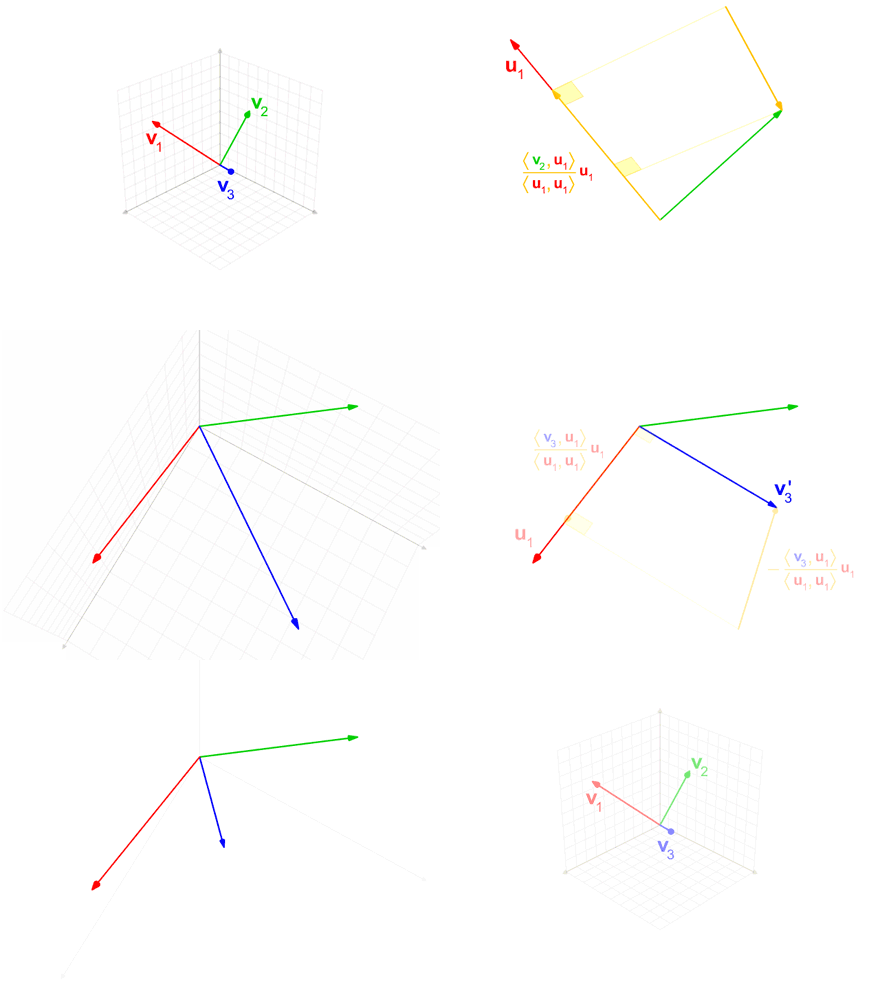
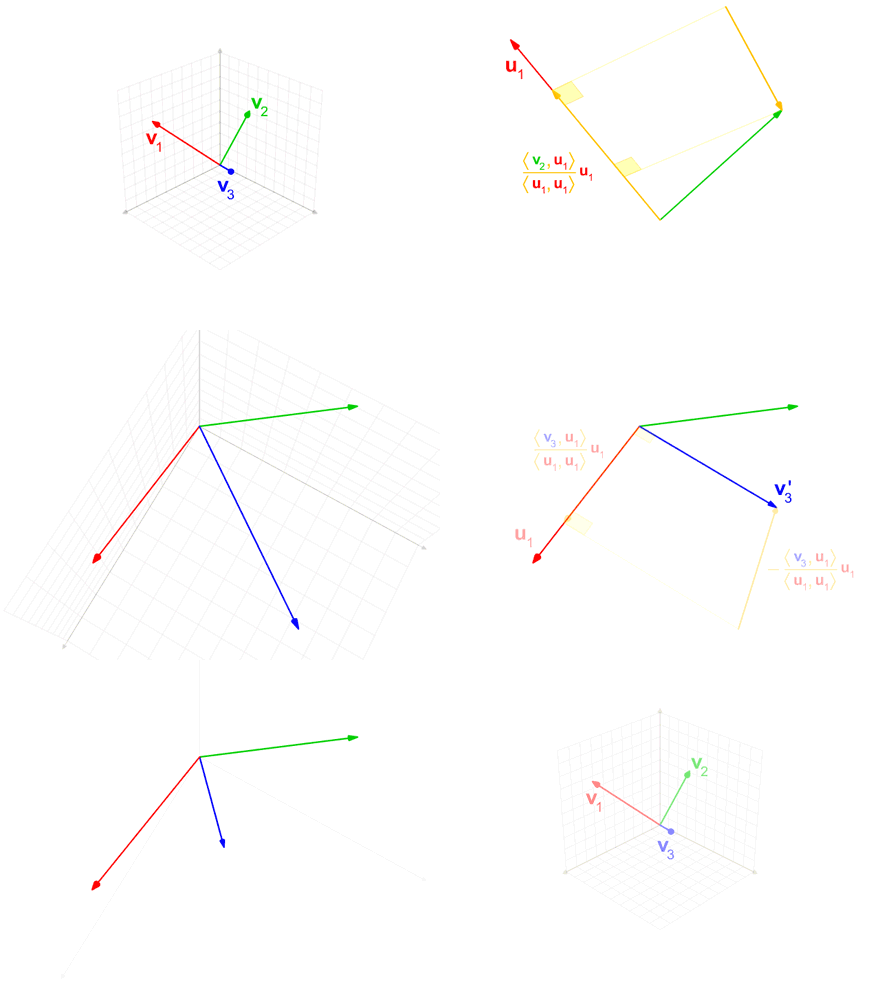
In mathematics, particularly linear algebra and numerical analysis, the Gram–Schmidt process or Gram-Schmidt algorithm is a way of finding a set of two or more vectors that are perpendicular to each other.
By technical definition, it is a method of constructing an orthonormal basis from a set of vectors in an inner product space, most commonly...
This is how ^
valid nimbus
is there a way that u convert these
valid nimbus
austere cove
https://en.wikipedia.org/wiki/Gram%E2%80%93Schmidt_process
I see
austere cove
 austere cove
Note, once you do this, you will have a coordinate system that agrees with your metric, but you can have different equivalent metrics for your space
valid nimbus
hold on
austere cove
This all depends on your notion of distance. And this is a choice you need to make.
valid nimbus
something is not hitting me here
you defined basis vectors
by oa
distance, cool, cool everything is cool
but
if u were to take
another object or a point
at any arbitrary location
how do you plot it's location?
you're not just seeing the imaginary graph and saying it's at that location right? I mean.. theres a lot of error with that
is there a function that gives u like the exact position of it
austere cove
So we can do so with OABC directly, each point in space is some linear combination of these vectors
valid nimbus
of the vector perhaps
yeah
but how do u know
what the combination is
I mean.. it's really hard to guess
austere cove
it can be, yeah
covert heath
valid nimbus
if we ignore relativity
stop talking about relativity!!
valid nimbus
austere cove
it can be, yeah
then is there a process
that gives the precise exact answer
it seems impossible to guess
austere cove
so one thing you seem to need to get comfortable with is a non-constructive proof
valid nimbus
austere cove
so one thing you seem to need to get comfortable with is a non-constructive proo...
non constructive proof hmmm
what is that
austere cove
I can prove to you that every point can be given by a unique combination of vectors, but that doesn't necessarily mean that I can give you a recipe for making each point.
just some combination exists, we don't know what it is apriori
valid nimbus
austere cove
I can prove to you that every point can be given by a unique combination of vect...
well yes I'm not really uhm, destroying your system because u haven't given me a way to locate things
valid nimbus
austere cove
just some combination exists, we don't know what it is apriori
are u saying that there's no correct / rigorous way to locate things?
austere cove
ok let's say that you have a nice set of orthonormal axes.
valid nimbus
we just have to do so by guessing?
austere cove
let's not fuss with how you got them
how would you located the point R using your axes?
This is the first time I mentioned R to you, and you don't know anything else about R.
valid nimbus
austere cove
ok let's say that you have a nice set of orthonormal axes.
orthonormal as in, the arbitary, kinda disturbed basis vectors that u took instead of the nice ones that we see on graphs of lab notebooks?
valid nimbus
austere cove
let's not fuss with how you got them
Alright
austere cove
ortho meaning perpendicular, normal meaning of length 1.
valid nimbus
austere cove
This is the first time I mentioned R to you, and you don't know anything else ab...
hmm
well to me as a human
I would
well I mean u have to show me the point and I would numerically try to narrow it down by removing chunks of area around it
I would cut and narrow it down into a point
visually
and calculate it numerically
with a scale
in regards to the basis vectors
austere cove
sure, that's a process that you could do, and you could estimate the point.
I could do something similar with my basis vectors.
austere cove
sure, but without knowing more about R, that's as good as you can do
austere cove
you can get an arbitrarily small region around R
valid nimbus
yeah
austere cove
there is some coordinate, but we might not be able to know precisely what that coordinate is.
valid nimbus
yeah
austere cove
and that's OK
austere cove
in the sense that it's as good as you can do for any coordinate system, if this is your process.
valid nimbus
austere cove
in the sense that it's as good as you can do for any coordinate system, if this ...
yeah but
every answer is like 99.9999...% innacurate tho
austere cove
the key is that you can take the limit of this process.
valid nimbus
valid nimbus
every answer is like 99.9999...% innacurate tho
no matter how small we narrow it down
austere cove
to get the exact answer.
valid nimbus
austere cove
the key is that you can take the limit of this process.
oh
I see
wait there's
an actual process to cutting smaller circles?
I can guess it yeah but like
covert heath
now we're gonna talk about calculus are we
austere cove
just like we can say that pi is just pi, or we can try to numerically approximate it by saying it's 3.141592653589793238...
covert heath
blud is gonna get very active any time now
valid nimbus
and has like a shape
valid nimbus
valid nimbus
and has like a shape
u have to define something in ur limit that would stop when we reach the shape
 cinder thorn
NO WAY 
valid nimbus
for a point we can just narrow it down a lot
covert heath
valid nimbus
u have to define something in ur limit that would stop when we reach the shape
no we're not talking about calculus IN THE SAME CHANNEL
valid nimbus
for a shape, we have to stop at some point
valid nimbus
austere cove
just like we can say that pi is just pi, or we can try to numerically approximat...
hmm well yeah
austere cove
I actually need to go soon
austere cove
I mean, it's christmas, I'm alone at home, I have no car and absolutely nothing better to do, sure, I can spend several hours on this I guess.
But I do need to go shower.
knotty grail

covert heath
just keep it alive for another hour or so until OE comes back
how long has it been already
blud is def getting VA
austere cove
more than 3 hours so far
proud dirge
hi
 foggy vapor
austere cove
I mean, it's christmas, I'm alone at home, I have no car and absolutely nothing ...
foggy vapor
austere cove
I mean, it's christmas, I'm alone at home, I have no car and absolutely nothing ...
What does having a car have to do with this 
valid nimbus
valid nimbus
for a shape, we have to stop at some point
I think I need to learn how we would make equations/ functions that would reduce it to the exact position of the point/object
knotty grail
covert heath
just keep it alive for another hour or so until OE comes back
literally a battle at this point lmfao
covert heath
valid nimbus
I think I need to learn how we would make equations/ functions that would reduce...
equations/functions
valid nimbus
well functions
covert heath
theyre not the same thing
covert heath
points and objects are also not the same
valid nimbus
well they're kinda same over here
u need to find position of a point
u need to find position of an object
valid nimbus
well yeah
I spoke about the weird shape these basis vectors have
even though they're all 1,0,0 etc..
why do u take everything so literally
restive geyser
This is the literal subject where nuance seldom has room to exist
wary condor
you now know more math than me @valid nimbus ! and you achevied all of that in one day!
I commend your endurance.
cinder thorn
How many times did we tell you that you need to be precise in your definitions
valid nimbus
wary condor
you now know more math than me <@1396468020276367520> ! and you achevied all of ...
well it's kinda fascinating when you go deep into concepts
thank you
wary condor
valid nimbus
well it's kinda fascinating when you go deep into concepts
right?! my deepest concept is... time-releated problems. you literally know more math than me 😔
valid nimbus
cinder thorn
How many times did we tell you that you need to be precise in your definitions
well hey, sometimes I'm not defining and referring to some things
wary condor
valid nimbus
thank you
you might've also set a record for the fastest person to ever get the active role.
valid nimbus
but alright
valid nimbus
wary condor
you might've also set a record for the fastest person to ever get the active rol...
lol
restive geyser
sometimes I'm not defining
is precisely the problem, since you're using words whose actual definitions differ to what you MEAN
wary condor
I'm really impressed how OE was able to do all of this!!!!!!
covert heath
wary condor
I'm really impressed how OE was able to do all of this!!!!!!
well
valid nimbus
covert heath
and never say 'logics' again
well I underestimated that y'all would know what logics actually mean
valid nimbus
instead of the usual idea of what's right
covert heath
valid nimbus
well I underestimated that y'all would know what logics actually mean
...what?
valid nimbus
restive geyser
> sometimes I'm not defining
is precisely the problem, since you're using words ...
Alright
covert heath
'Logics' is not a word.
restive geyser
It's more that you're using philosophically loaded words that DO NOT MATCH WHAT YOU MEAN
covert heath
There's Logic.
wary condor
valid nimbus
well I underestimated that y'all would know what logics actually mean
girl 😭
valid nimbus
covert heath
Which is not related
yeah but usually, when you say "logically and logic", what u mean is what I was referring
I know philosophical logics are something different even though kinda same
covert heath
i dont say logically.
valid nimbus
but yeah
covert heath
valid nimbus
I know philosophical logics are something different even though kinda same
LOGICS IS NOT A WORD!!
valid nimbus
alright why don't we accept I was at fault and move on!
covert heath
it's Logic!!
wary condor
valid nimbus
arguing here
PEACE AT LAAAAAST (for you)
austere cove
be nice
austere cove
foggy vapor
What does having a car have to do with this <:xd:1087388248101355520>
In most of the US "I don't have a car" means "I literally cannot go anywhere, because every destination is several miles from where I live."
wary condor
austere cove
In most of the US "I don't have a car" means "I literally cannot go anywhere, be...
cars are amazing people. you should get to know one!
knotty grail
but really huge respect for standing on your own for a third of a day against 10-20 people
austere cove
I know one, they're sick 🙁
foggy vapor
austere cove
In most of the US "I don't have a car" means "I literally cannot go anywhere, be...
Sadye
covert heath
hopefully he got something out of this
austere cove
I think he did
proud dirge
Can this chat be saved as a memorial
knotty grail
🫡
covert heath
i swear to fucking hell if i hear another 'how do we get coordinates'
wary condor
austere cove
I know one, they're sick 🙁
you did an amazing job 😭 I'm honestly so impressed with your patience
covert heath
ill just ping OE.
wary condor
90% of the helpfuls did crashout like 20 minutes in. (not-not-not discluding myself.)
austere cove
oh one thing I didn't mention @valid nimbus sorry about the ping.
I mentioned that the choice of metric is a choice, you can also just change the metric, once you have OABC, you can just define a new one based off of the natural coordinates they represent. In other words, OABC is an orthonormal set of basis vectors in the metric you defined based on the coordinates they give.
covert heath
im not crashing out i just dont wanna be asked the same blood thing like i could come up with a different answer this time
also the word salad
austere cove
if this seems strange to you, this is because you're not yet comfortable with the idea that space can be deformed by a linear transform and remains exactly the same afterwards.
anyway, I need to go AFK for a bit again
valid nimbus
austere cove
oh one thing I didn't mention <@1396468020276367520> sorry about the ping.
I me...
yeah I mean.. just like how u took b or c and decide if it was on the line or not, u could do the same and get a lot more
but
I thought the major problem now is locating something with that astronomically hard and weird basis vectors
that I don't think we would have an intuition of
austere cove
valid nimbus
I thought the major problem now is locating something with that astronomically h...
no, this isn't actually a problem.
locating anything with any basis vectors (without knowledge of exactly where it is a priori) is the hard part
but once you know exactly where something is, you can easily and rapidly construct coordinates for it in any basis
valid nimbus
 valid nimbus
austere cove
locating anything with any basis vectors (without knowledge of exactly where it ...
valid nimbus
austere cove
locating anything with any basis vectors (without knowledge of exactly where it ...
yeah that's what I'm talking about
valid nimbus
valid nimbus
if u see here
that mushroom is really hard to know the exact co ordinates of
u said something called functions and limits would get me a good answer
knowing those functions would be hard tho I'm assuming
austere cove
Here's a procedure you can take
Consider a bounding box around your point, you located it to a region that has coordinates about (a, b, c) to (a', b', c')
covert heath
valid nimbus
im sorry whats the mushroom cloud for
austere cove
the mushroom is the object lol
valid nimbus
covert heath
im sorry whats the mushroom cloud for
an object that u are given to locate
covert heath
ah
covert heath
really disturbing imagery lol
austere cove
let a > a', b > b', and c > c'
valid nimbus
austere cove
Consider a bounding box around your point, you located it to a region that has c...
hmm
austere cove
so we have a point in the middle of this box, ((a + a')/2, (b + b')/2, (c + c')/2) right
valid nimbus
austere cove
let a > a', b > b', and c > c'
wait a, b, c and a' b' c' are just points tho
how is it a bounding box
austere cove
yes, but they define the opposite corners of a box
valid nimbus
Oh
Opposite corners
wait lemme get the imagery of this

so
u have a box
inside that is the object btw
valid nimbus
valid nimbus
now u have a pink, lime, white and purple corner
austere cove
or nd in the general case
valid nimbus
and tell me for the first rectangle
austere cove
anyway
valid nimbus
which corner
and second rectangle
which corner
then it's pretty easy to imagine the box
austere cove
you have a point in the center of the box
austere cove
your object is composed of many points, so you would need to do this procedure for each individual point
valid nimbus
now if that's a, b, c
valid nimbus
austere cove
your object is composed of many points, so you would need to do this procedure f...
I mean.. we can ignore the many points
for now
austere cove
sure, let's talk about a single point
austere cove
we don't know where in the box this point is
valid nimbus
valid nimbus
now if that's a, b, c
Where is a', b ' and c'
austere cove
(a, b, c) is the top left front corner of the box, and (a', b', c') is the bottom right back corner
valid nimbus
austere cove
(a, b, c) is the top left front corner of the box, and (a', b', c') is the botto...
top left and bottom right
ohh yeah
austere cove
for relevant definitions of left front etc.
austere cove
so you choose some point in the box, and then you can use this point to make 8 smaller boxes inside of the box.
valid nimbus
austere cove
(a, b, c) is the top left front corner of the box, and (a', b', c') is the botto...
it's kinda confusing a bit tho cause... the box literally acts as the hidden object, how would u know the boundaries of the box, doesn't it have like infinite points?
valid nimbus
austere cove
so you choose some point in the box, and then you can use this point to make 8 s...
yeah
hmmm