#help-28
1 messages · Page 272 of 1
 signal solar
confusing
 queen crater
They are just decomposing the numerator and the denominator
2^n is a product of n terms, all 2s
n! is a product of n terms, those terms being 1,2,3, and so on
 full forumBOT
@signal solar Has your question been resolved?
full forumBOT
Channel closed
Closed due to timeout
Use .reopen if this was a mistake.
full forumBOT
 Available help channel!
Send your question here to claim the channel.
Remember:
• Ask your math question in a clear, concise manner.
• Show your work, and if possible, explain where you are stuck.
• Do not immediately ping people or roles. After 15 minutes, feel free to ping <@&286206848099549185> once.
• Type the command .close to free the channel when you're done.
• Be polite and have a nice day!
Read #❓how-to-get-help for further information on how to ask a good question, and about conduct in the question channels.
 azure burrow
Im a bit confused again
 full forumBOT
azure burrow
Im a bit confused again
azure burrow
full forumBOT
azure burrow
Im a bit confused again
azure burrow
this is what I have

I know it converges uniformly for 0 < a < 1
but im having trouble proving it

So from my scratchwork I have |x^n - 0| = x^n < a^n
but I need to get rid of this n right
hmm
goal is to get that less than epsilon and right now im just trying to find N in terms of epsilon so that when n > N we have x^n < epsilon
oh
.solved
full forumBOT
Channel closed
Closed by @azure burrow
Use .reopen if this was a mistake.
Available help channel!
Send your question here to claim the channel.
Remember:
• Ask your math question in a clear, concise manner.
• Show your work, and if possible, explain where you are stuck.
• Do not immediately ping people or roles. After 15 minutes, feel free to ping <@&286206848099549185> once.
• Type the command .close to free the channel when you're done.
• Be polite and have a nice day!
Read #❓how-to-get-help for further information on how to ask a good question, and about conduct in the question channels.
 cerulean parcel
Hello, I'm requesting help with a polynomial factoring problem, please!
I'm trying to solve using the formula for factoring the difference of cubes
x^3 - y^3 = (x-y)(x^2 + xy + y^2)
I factored out 3, giving me
3(r^3 + 4^3)
I identified x = r and y = 4
giving me
3(r-4)(r^2 + 4r + 16)
which was marked incorrect
 full forumBOT
cerulean parcel
Hello, I'm requesting help with a polynomial factoring problem, please!
I'm tryi...
full forumBOT
cerulean parcel
Hello, I'm requesting help with a polynomial factoring problem, please!
I'm tryi...
 gritty rose
3 does not factor into 64
cerulean parcel
lol true
 thorny bluff
cerulean parcel
Hello, I'm requesting help with a polynomial factoring problem, please!
I'm tryi...
thorny bluff
cerulean parcel
Hello, I'm requesting help with a polynomial factoring problem, please!
I'm tryi...
can you do anything with 27r^3?
cerulean parcel
I can factor 3 out?
cerulean parcel
does that mean the x term is actually 9r
thorny bluff
$27r^3 = 3^3r^3 = (3r)^3$
 glossy valveBOT
c2b7
 cerulean parcel
it makes sense but I'm a bit lost, I think my brain is tired
thorny bluff
but, once you have (3r)^3 - 64, do you see a way to factor?
 hollow sonnet
cerulean parcel
Hello, I'm requesting help with a polynomial factoring problem, please!
I'm tryi...
hollow sonnet
cerulean parcel
Hello, I'm requesting help with a polynomial factoring problem, please!
I'm tryi...
3r^3 - 4^3 = (3r-4)(3r^2+3r.4+4^2)
thorny bluff
hollow sonnet
3r^3 - 4^3 = (3r-4)(3r^2+3r.4+4^2)
this is wrong
thorny bluff
thorny bluff
but, once you have (3r)^3 - 64, do you see a way to factor?
@cerulean parcel
thorny bluff
hollow sonnet
the second bracket is a quadratic
you put 3r^2 instead of (3r)^2, and the second term is wrong
hollow sonnet
thorny bluff
you put 3r^2 instead of (3r)^2, and the second term is wrong
TT just for convinience
thorny bluff
and even if it was correct, you shouldnt just put the answer
hollow sonnet
thorny bluff
and even if it was correct, you shouldnt just put the answer
ow sorry man , new here , should i explain it too
cerulean parcel
3(9r^2 + 4^3)
x = 9r and y = 4
thorny bluff
glossy valve
**c2b7**
no, go back to this
the problem says to factor using sum/differences of cubes
what is 27? what is 64?
hollow sonnet
the roots of quadratic are coming out to be complex
cerulean parcel
3^3 and 4^3
hollow sonnet
thorny bluff
the problem says to factor using sum/differences of cubes
we used difference of cubes , didnt we?
thorny bluff
cerulean parcel
3^3 and 4^3
yes, what can you do with that?
you can combine 3^3 * r^3, right?
thorny bluff
hollow sonnet
we used difference of cubes , didnt we?
just shut up bro
cerulean parcel
cerulean parcel
3(9r^2 + 4^3)
x = 9r and y = 4
typo, I meant 3(9r^3 + 4^3)
thorny bluff
cerulean parcel
typo, I meant 3(9r^3 + 4^3)
what is 4^3?
4 * 4 *4
= 16 * 4
= 64
cerulean parcel
right
thorny bluff
so it would be
$27r^3 - 64\Longrightarrow 3^3 r^3 - 4^3$
right?
glossy valveBOT
c2b7
 thorny bluff
then $(3r)^3 - 4^3$
glossy valveBOT
c2b7
 cerulean parcel
formula for difference of cubes
x^3 - y^3 = (x-y)(x^2 + xy + y^2)
thorny bluff
yeah, so plug in x=3r, y=4, right?
cerulean parcel
so our terms are x = 3r and y = 4 then
that was very different than the tutorial I was shown
cerulean parcel
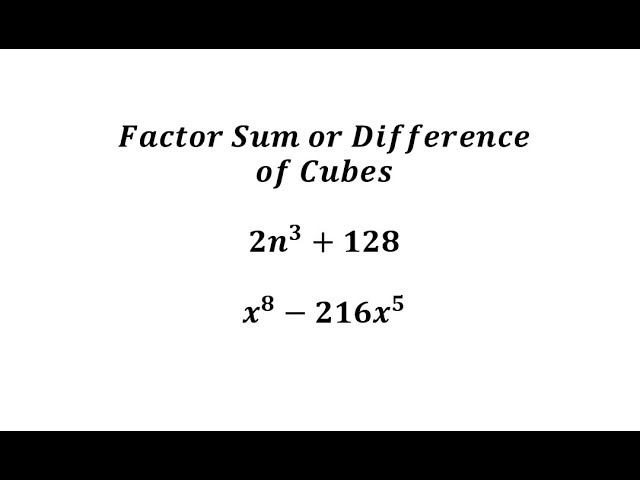
This video explains how to factor a sum or difference of cubes that also requires factoring out the greatest common factor.
http://mathispower4u.com
the first example in the video is more similar to this problem despite the example being sum of cubes, so I was mostly going off of that
thorny bluff
the difference here is that problem had coefficients of 2 and 128, while this problem has 27 and 64
27 and 64 are both perfect cubes, so you do not need to factor out
cerulean parcel
ah
thorny bluff
2 and 128 you can factor out 2 to get 1 and 64, which are then perfect cubes
 slate violet
yes here they are not asking you to factor out a constant first
cerulean parcel
I found a more relevant tutorial to this exact type of problem, I'll give it a look. thanks very much for giving me some direction!
slate violet
this is a different skill where you have to compare 27r^3 - 64 = x^3 - y^3
27r^3 = x^3, cube rooting both sides gives 3r = x
same for 64 = y^3 --> 4 = y
cerulean parcel
right, the first tutorial got me looking at it wrong
full forumBOT
Channel closed
Closed by @cerulean parcel
Use .reopen if this was a mistake.
full forumBOT
Available help channel!
Send your question here to claim the channel.
Remember:
• Ask your math question in a clear, concise manner.
• Show your work, and if possible, explain where you are stuck.
• Do not immediately ping people or roles. After 15 minutes, feel free to ping <@&286206848099549185> once.
• Type the command .close to free the channel when you're done.
• Be polite and have a nice day!
Read #❓how-to-get-help for further information on how to ask a good question, and about conduct in the question channels.
 snow mural
B looks so confusing
 full forumBOT
snow mural
B looks so confusing
full forumBOT
full forumBOT
snow mural
B looks so confusing
full forumBOT
@snow mural Has your question been resolved?
Channel closed
Closed due to timeout
Use .reopen if this was a mistake.
Available help channel!
Send your question here to claim the channel.
Remember:
• Ask your math question in a clear, concise manner.
• Show your work, and if possible, explain where you are stuck.
• Do not immediately ping people or roles. After 15 minutes, feel free to ping <@&286206848099549185> once.
• Type the command .close to free the channel when you're done.
• Be polite and have a nice day!
Read #❓how-to-get-help for further information on how to ask a good question, and about conduct in the question channels.
full forumBOT
Channel closed
Channel closed due to the original message being deleted.
If you did not intend to do this, please open a new help channel,
as this action is irreversible, and this channel may abruptly lock.
Available help channel!
Send your question here to claim the channel.
Remember:
• Ask your math question in a clear, concise manner.
• Show your work, and if possible, explain where you are stuck.
• Do not immediately ping people or roles. After 15 minutes, feel free to ping <@&286206848099549185> once.
• Type the command .close to free the channel when you're done.
• Be polite and have a nice day!
Read #❓how-to-get-help for further information on how to ask a good question, and about conduct in the question channels.
 frank elm
 frank elm
doubt in the second part
this thing would have like an infinite number of cases
like it can oscillare bw (2,4) and (3,3) for a long time then just go to (6,0)
full forumBOT
@frank elm Has your question been resolved?
full forumBOT
Channel closed
Closed due to timeout
Use .reopen if this was a mistake.
frank elm
.reopen
full forumBOT
✅ Original question: #help-28 message
full forumBOT
Please only use the <@&286206848099549185> ping once if your question has not been answered for 15 minutes. Please do not ping or DM individual users about your question.
@frank elm Has your question been resolved?
frank elm
!15m
full forumBOT
Please only use the <@&286206848099549185> ping once if your question has not been answered for 15 minutes. Please do not ping or DM individual users about your question.
full forumBOT
Please only use the <@&286206848099549185> ping once if your question has not been answered for 15 minutes. Please do not ping or DM individual users about your question.
 harsh jewel
!15m
full forumBOT
Please only use the <@&286206848099549185> ping once if your question has not been answered for 15 minutes. Please do not ping or DM individual users about your question.
 tall onyx
Bruh what
 slate glacier
Guys there's no reason to send !15m; op, you can @ helpers 15 minutes after nobody helps you out
"!15m" is for when somebody @'s helpers before 15 minutes, no point in sending it here, I just sent it so that he gets that he has to send it after a 15 minute interval
 burnt grotto
na what
full forumBOT
@frank elm Has your question been resolved?
full forumBOT
Channel closed
Closed due to timeout
Use .reopen if this was a mistake.
Available help channel!
Send your question here to claim the channel.
Remember:
• Ask your math question in a clear, concise manner.
• Show your work, and if possible, explain where you are stuck.
• Do not immediately ping people or roles. After 15 minutes, feel free to ping <@&286206848099549185> once.
• Type the command .close to free the channel when you're done.
• Be polite and have a nice day!
Read #❓how-to-get-help for further information on how to ask a good question, and about conduct in the question channels.
signal solar
how do i apply lhopital rule to these unique examples idek
 signal solar
doesnt it only work for fractions
 leaden ermine
glossy valveBOT
leaden ermine
glossy valveBOT

 keen vector
signal solar
doesnt it only work for fractions
keen vector
signal solar
doesnt it only work for fractions
yes but in many examples you can convert the expression inside the limit into a fraction
 onyx glen
signal solar
how do i apply lhopital rule to these unique examples idek
onyx glen
signal solar
how do i apply lhopital rule to these unique examples idek
is applying l'hop required or no
signal solar
onyx glen
is applying l'hop required or no
yes, how else?
 coral torrent
algebraic manipulation
onyx glen
at least for the first one i think there might be a more lightweight method
keen vector
epsilon-delta /hj
 grave elm
signal solar
ah yes lets use the definition
grave elm
signal solar
ah yes lets use the definition
good luck
onyx glen
taylor expansion after collecting the fractions into one tbh
signal solar
joking
full forumBOT
@signal solar Has your question been resolved?
full forumBOT
Channel closed
Closed due to timeout
Use .reopen if this was a mistake.
full forumBOT
Available help channel!
Send your question here to claim the channel.
Remember:
• Ask your math question in a clear, concise manner.
• Show your work, and if possible, explain where you are stuck.
• Do not immediately ping people or roles. After 15 minutes, feel free to ping <@&286206848099549185> once.
• Type the command .close to free the channel when you're done.
• Be polite and have a nice day!
Read #❓how-to-get-help for further information on how to ask a good question, and about conduct in the question channels.
 obtuse schooner
Hello, can someone help me with this problem?
 obtuse schooner
I need to find x, y, z
randomly, I had the idea of trying some random numbers, I found out that (2, 2, 2) work
I'm trying to get more into olympiad problems and I don't really think I'm supposed just to guess 😭
I had the idea of trying to write x as 6-y-z and plug in the values in the 2nd equation, but it gets way to long
and I don't really know if I can get somewhere useful
 wise tartan
well theres some standard tricks
 spiral forum
Try getting x^2 + y^2 + z^2
wise tartan
yeah that
spiral forum
obtuse schooner
I had the idea of trying to write x as 6-y-z and plug in the values in the 2nd e...
Don't try to break symmetry in such questions
obtuse schooner
spiral forum
Try getting x^2 + y^2 + z^2
soo like not (x+y+z)^2 = 6^2?
obtuse schooner
how can I get all 3 squared
spiral forum
You wrote not lol
spiral forum
obtuse schooner
soo like not (x+y+z)^2 = 6^2?
You know the expansion of this?
obtuse schooner
ohhhh
wait
I thought you only said x, y and z and completely forget about +2xy +2yz + zx
obtuse schooner
spiral forum
You know the expansion of this?
yea!!!
so we have x^2 + y^2 + z^2 + 2xy + 2yx + 2zx = 36
spiral forum
Yes now you can get sum of all three squared
Now do you know what x^2 + y^2 + z^2 - xy - yz - zx is?
obtuse schooner
x^2 + y^2 + z^2 + 2xy + 2yx + 2zx = 36
we can subtract the double of the second equation and it gets us x^2+y^2+z^2 = 12, right?
spiral forum
Yes
spiral forum
spiral forum
Now do you know what x^2 + y^2 + z^2 - xy - yz - zx is?
You know this identity?
obtuse schooner
not really
spiral forum
I'll help you derive it then
Split x^2 as (x^2)/2 + (x^2)/2 and similarly with y and z
spiral forum
 worthy badge
(x+y+z)^2
worthy badge
(x+y+z)^2
No dude
obtuse schooner
shouldn't there be 2xy+2yz+2zx if it was ^2
spiral forum
That one has 2xy and all that
spiral forum
spiral forum
Split x^2 as (x^2)/2 + (x^2)/2 and similarly with y and z
After this try to express the expression as sum of 3 squares
See if you can do it I'll help if not
 spiral forum
obtuse schooner
spiral forum
obtuse schooner
Yes
obtuse schooner
soo I need to write this expression as a sum of 3 squares
what I'm looking for from now?
spiral forum
Try making whole squares
If it helps write xy as 2 * xy/2 and similarly for the rest 2
obtuse schooner

I never tried to build a squre so I'm kind of slow
I'm not really sure how I should do it and what to look for
spiral forum
What is x^2 + y^2 + 2xy
obtuse schooner
(x+y)^2
spiral forum
Now divide it by 2
spiral forum
obtuse schooner
Dude there's minus sign btw after xy, yz and zx
 obtuse schooner

 pseudo cape
The last two + should be -
spiral forum
pseudo cape
The last two + should be -
Yes I missed that
 spiral forum
Yes
Now put the values you have in the question
You will get x^2 + y^2 + z^2 - xy - yz - zx = 0
Which would eventually mean you're getting sum of 3 squares as 0
What can you conclude from that?
obtuse schooner
if the sum of squares are 0 means the numbers are 0, right?
spiral forum
Yes
This means x-y = 0, y-z =0, and z-x = 0
And hence x=y=z
Now I think you can solve after this
obtuse schooner
3x = 6 => x=2
spiral forum
Yes
obtuse schooner
ohhhh, I get it now
spiral forum
And that is the only solution
obtuse schooner
so that's the whole demonstration
spiral forum
Yes
obtuse schooner
but, if you were at an olympiad, for example
and just guess the numbers
would they give you score
spiral forum
For such a problem I don't think so
Because it's one of the easier problems of olympiad
Maybe 1 mark if they're feeling generous
spiral forum
Dw it comes with practice
obtuse schooner
you were right about not breaking symmetry
is this the way all problems are thought?
spiral forum
I couldn't solve such 1-2 years back or so
spiral forum
obtuse schooner
is this the way all problems are thought?
Yea try to relate with identities you know
Like if you see xy yz and zx then think of these processes
Try to set aim on what you want to get
obtuse schooner
thank you very much for helping me, it means a lot
spiral forum
Don't randomly jump into the problem
spiral forum
obtuse schooner
thank you very much for helping me, it means a lot
Np
obtuse schooner
yea, but since they imply just logical thinking rather than maybe using a formula
it's harder to
I'm not really sure of what I'm looking for
spiral forum
Yea it comes with practice only
If you can't solve a problem see it's solution and try to understand how you could've reached the solution
Then remember that method for future similar problems
That way you will get the intuition on what to do
obtuse schooner
spiral forum
If you can't solve a problem see it's solution and try to understand how you cou...
I tried asking gpt but he drives me in a totally weird direction
also the one I mentioned
trying to write x as 6-y-z
and using x like this in the whole expression
spiral forum
Yea gpt overcomplicates the problem
obtuse schooner
thanks a lot!!!
spiral forum
Np
obtuse schooner
have a great day!
spiral forum
Lol it's night over here
spiral forum
Almost 9 pm
Dude I gtg now I have 3% charge in phone and I'm travelling outside right now
 charred carbon
The problem has a pretty cool solution using derivative lol, too bad ig you're not allowed to use it, right?
obtuse schooner
I don't think someone can stop you
how can you use derivatives in order to solve this?
spiral forum
charred carbon
The problem has a pretty cool solution using derivative lol, too bad ig you're n...
You're allowed to use it generally isn't required in a problem
charred carbon
So
spiral forum
What did you do
charred carbon
x+y+z=6
xy+yz+zx=12
xyz=d
this's vieta for cubic
x^3-6x^2+12x+d
take the derivative, we have 3x^2-12x+12 which is always positive
Hence the cubic is increasing
So there're only 1 solution
That mean x=y=z
spiral forum
Yea that works as well
obtuse schooner
unfortunately I don't know very much about derivatives, just some basic formulas, but its interesting
thank you very much for all the help!
❤️❤️
.close
full forumBOT
Channel closed
Closed by @obtuse schooner
Use .reopen if this was a mistake.
full forumBOT
Available help channel!
Send your question here to claim the channel.
Remember:
• Ask your math question in a clear, concise manner.
• Show your work, and if possible, explain where you are stuck.
• Do not immediately ping people or roles. After 15 minutes, feel free to ping <@&286206848099549185> once.
• Type the command .close to free the channel when you're done.
• Be polite and have a nice day!
Read #❓how-to-get-help for further information on how to ask a good question, and about conduct in the question channels.
 crimson igloo
 full forumBOT
crimson igloo
crimson igloo
full forumBOT
crimson igloo
crimson igloo
so ik my solution is 3/2e^-t - 1/2e^-3t
but the problem is , how am i supposed to know how that graph looks liek
 languid junco
how did you get that solution? I think you got your roots incorrect
either way, if your solution is purely exponential and has no sin or cos, there shouldn't be any "wavy" movement going on
crimson igloo
languid junco
either way, if your solution is purely exponential and has no sin or cos, there ...
but if it is exponential , the solutions are wavy
roots are -2 +- sqrt 3
full forumBOT
@crimson igloo Has your question been resolved?
full forumBOT
Channel closed
Closed due to timeout
Use .reopen if this was a mistake.
Available help channel!
Send your question here to claim the channel.
Remember:
• Ask your math question in a clear, concise manner.
• Show your work, and if possible, explain where you are stuck.
• Do not immediately ping people or roles. After 15 minutes, feel free to ping <@&286206848099549185> once.
• Type the command .close to free the channel when you're done.
• Be polite and have a nice day!
Read #❓how-to-get-help for further information on how to ask a good question, and about conduct in the question channels.
 vocal cove
Why do we substitute x = tanh(u)?
I thought we only substitute using tanh in expressions like root(a^2 - x^2)
 full forumBOT
vocal cove
Why do we substitute x = tanh(u)?
I thought we only substitute using tanh in exp...
vocal cove
full forumBOT
vocal cove
Why do we substitute x = tanh(u)?
I thought we only substitute using tanh in exp...
vocal cove
neither of the functions are squared and there's no subtraction in the numerator
coral torrent
I'm not familiar with hyperbolic trigs but try rationalizing the denominator.
vocal cove
so it becomes root(1-x^2)/1-x
 wheat fjord
sa
coral torrent
vocal cove
so it becomes root(1-x^2)/1-x
1+x / root(1-x^2)
subbing in cosine for x gives a nice solution for me
vocal cove
would tanh not work
vocal cove
oh sorry I tried cosine and I was able to solve it
i just had to rationalize the denominator like you said
full forumBOT
@vocal cove Has your question been resolved?
Channel closed
Closed by @vocal cove
Use .reopen if this was a mistake.
full forumBOT
Available help channel!
Send your question here to claim the channel.
Remember:
• Ask your math question in a clear, concise manner.
• Show your work, and if possible, explain where you are stuck.
• Do not immediately ping people or roles. After 15 minutes, feel free to ping <@&286206848099549185> once.
• Type the command .close to free the channel when you're done.
• Be polite and have a nice day!
Read #❓how-to-get-help for further information on how to ask a good question, and about conduct in the question channels.
 iron sand
how to find a principal part of laurent series of [f(x)=\frac{1}{z\sin z}] at an open neighbourhood of 0?
full forumBOT
iron sand
how to find a principal part of laurent series of \[f(x)=\frac{1}{z\sin z}\] at ...
glossy valveBOT
Slowaq
 full forumBOT
@iron sand Has your question been resolved?
iron sand
<@&286206848099549185>
 green cairn
iron sand
how to find a principal part of laurent series of \[f(x)=\frac{1}{z\sin z}\] at ...
green cairn
iron sand
how to find a principal part of laurent series of \[f(x)=\frac{1}{z\sin z}\] at ...
take derivative
iron sand
green cairn
take derivative
wdym?
 signal peak
do you know what the order of the pole at 0 is?
iron sand
signal peak
do you know what the order of the pole at 0 is?
at points n\pi where n is whole number without zero it should have 1st order poles if im no tmisteaken
signal peak
I think you're mistaken... if it had first order poles, then z*f(z) would be holomorphic at those points
oh sorry you said without 0
yea
so at 0?
signal peak
if it has a second order pole, then you know that z^2 * f is holomorphic at 0
you know how to determine the series coefficients of a holomorphic function right?
iron sand
signal peak
if it has a second order pole, then you know that z^2 * f is holomorphic at 0
yes i see
iron sand
signal peak
you know how to determine the series coefficients of a holomorphic function righ...
im afraid not
signal peak
it's just Taylor expansion, so you take the k-th derivative and divide by k! for the k-th coefficient :)
iron sand
aahh i forgor
so i just find taylor expansion of z^2f(z) and divide it by z^2 to get laurent series of f(z) ?
signal peak
yep 👍
iron sand
alright thanks a lot im gonna do it:)
iron sand
signal peak
yep 👍
wait but the first term in taylor at 0 is 0/sin0 and thats not defined
signal peak
so since z^2 f(z) is bounded near z=0, it can be extended to a holomorphic function at that point, by setting the value at that point to be the limit
iron sand
signal peak
so since z^2 f(z) is bounded near z=0, it can be extended to a holomorphic funct...
alright that makes sense
ive got it now
so thatnks a lot for your help

.close
full forumBOT
Channel closed
Closed by @iron sand
Use .reopen if this was a mistake.
full forumBOT
Available help channel!
Send your question here to claim the channel.
Remember:
• Ask your math question in a clear, concise manner.
• Show your work, and if possible, explain where you are stuck.
• Do not immediately ping people or roles. After 15 minutes, feel free to ping <@&286206848099549185> once.
• Type the command .close to free the channel when you're done.
• Be polite and have a nice day!
Read #❓how-to-get-help for further information on how to ask a good question, and about conduct in the question channels.
 daring jasper
any tips
 full forumBOT
daring jasper
any tips
full forumBOT
daring jasper
any tips
 sonic stratus
Have you found your curve, just to start with
daring jasper
no im struggling with that part
i was thinkinhg of setting the sphere equation and the plane equal to each other and that the set of all solutions would be the path
that i could then parametrize
sonic stratus
yes, that is the case.
daring jasper
ok i got the sphere (x-1/2)^2 +(y-1/2)^2 + (z-1/2)^2=7/4
sonic stratus
You should already see a problem with this idea
daring jasper
right, i need path and my solution is a 3d object
sonic stratus
Not that,
Knowing that we have the intersection of a plane and a sphere, you should know a really basic geometry fact already
daring jasper
ok i see the intersection is a circle
which is my path
however im stuck at this point coming up with a parametrization for it
sonic stratus
Well, what do you know about that circle?
daring jasper
radius of 1
and at all points of the circle x+y+z=0
i guess if z=-x -y can i parametrize it as r cos theta, r sin theta, -rcostheta -rsintheta
full forumBOT
@daring jasper Has your question been resolved?
full forumBOT
Channel closed
Closed due to timeout
Use .reopen if this was a mistake.
full forumBOT
Available help channel!
Send your question here to claim the channel.
Remember:
• Ask your math question in a clear, concise manner.
• Show your work, and if possible, explain where you are stuck.
• Do not immediately ping people or roles. After 15 minutes, feel free to ping <@&286206848099549185> once.
• Type the command .close to free the channel when you're done.
• Be polite and have a nice day!
Read #❓how-to-get-help for further information on how to ask a good question, and about conduct in the question channels.
 delicate torrent
Find $m \in \mathbb R$ such that $x^2 - (m + 1)x + m + 3 = 0$ has 2 roots $x_1$ and $x_2$ that represents 2 sides of a right triangle with a hypotenuse of $5$
 full forumBOT
delicate torrent
Find $m \in \mathbb R$ such that $x^2 - (m + 1)x + m + 3 = 0$ has 2 roots $x_1$ ...
glossy valveBOT
full forumBOT
delicate torrent
Find $m \in \mathbb R$ such that $x^2 - (m + 1)x + m + 3 = 0$ has 2 roots $x_1$ ...
glossy valveBOT
1 divided by 0 equals Infinity
 delicate torrent
so in this problem, should i split into 2 cases that
\begin{enumerate}
\item The equation has a root $x = 5$
\item $\begin{cases}
x_1, x_2 > 0\
x_1^2 + x_2^2 = 5
\end{cases}$
\end{enumerate}?
 lime trellis
have u done vieta's formula
aka sum and product of roots in terms of the coefficients of the quadratics
glossy valveBOT
1 divided by 0 equals Infinity
 delicate torrent
glossy valve
**1 divided by 0 equals Infinity**
delicate torrent
glossy valve
**1 divided by 0 equals Infinity**
should i split into 2 cases like this?
delicate torrent
lime trellis
have u done vieta's formula
didn't write the vieta's formula out
delicate torrent
glossy valve
**1 divided by 0 equals Infinity**
im confused on should i split into these 2 cases
delicate torrent
glossy valve
**1 divided by 0 equals Infinity**
...
delicate torrent
glossy valve
**1 divided by 0 equals Infinity**
the question asks for $x_1$ and $x_2$ represents the 2 sides of a right triangle with a hypotenuse of $5$
glossy valveBOT
1 divided by 0 equals Infinity

 nova briar
it means the two undefined sides
glossy valveBOT
1 divided by 0 equals Infinity
 lime trellis
the constraints on x1 and x2 are:
- they are the roots of the equation
- they form a right angle triangle with the hypotenuse of length 5
have i understood it correctly?
delicate torrent
lime trellis
the constraints on x1 and x2 are:
1. they are the roots of the equation
2. they ...
for 2. it just says that $x_1$ and $x_2$ are the sides of a right triangle with a hypotenuse of 5
glossy valveBOT
1 divided by 0 equals Infinity
 nova briar
delicate torrent
they didn't specify that
nova briar
delicate torrent
they didn't specify that
You should infer that the two sides which haven't been declared are the two roots you are being asked to find
delicate torrent
glossy valve
**1 divided by 0 equals Infinity**
for number 2, $x_1^2 + x_2^2 = 25$ btw
glossy valveBOT
1 divided by 0 equals Infinity
 lime trellis
yes that is the correct implication of the constraint
u should find two values of m (due to sqrt, later in ur working) and pick one that maintains positive length for both roots
if that is what u mean by splitting into cases^
full forumBOT
Channel closed
Closed by @delicate torrent
Use .reopen if this was a mistake.
full forumBOT
Available help channel!
Send your question here to claim the channel.
Remember:
• Ask your math question in a clear, concise manner.
• Show your work, and if possible, explain where you are stuck.
• Do not immediately ping people or roles. After 15 minutes, feel free to ping <@&286206848099549185> once.
• Type the command .close to free the channel when you're done.
• Be polite and have a nice day!
Read #❓how-to-get-help for further information on how to ask a good question, and about conduct in the question channels.
snow mural
Do I choose the highest and lowest within the interquartile range or the highest and lowest of whiskers for average speed
 full forumBOT
snow mural
Do I choose the highest and lowest within the interquartile range or the highest...
snow mural
full forumBOT
snow mural
Do I choose the highest and lowest within the interquartile range or the highest...
snow mural
 hot herald
becuase those indicate the min/max values
hot herald
becuase those indicate the min/max values
But it says average speed
Difference of highest and lowest
hot herald
yes
so you use the highest and lowest
which are where the min and max are on your box whisker plot
if you're using values around the box, those aren't the min/max or lowest/highst
average speed comes from d/t
hot herald
the part indicates where most of the data is located
and can be useful in identifying outliers
look into IQR
snow mural
Ok
full forumBOT
@snow mural Has your question been resolved?
full forumBOT
Channel closed
Closed due to timeout
Use .reopen if this was a mistake.
Available help channel!
Send your question here to claim the channel.
Remember:
• Ask your math question in a clear, concise manner.
• Show your work, and if possible, explain where you are stuck.
• Do not immediately ping people or roles. After 15 minutes, feel free to ping <@&286206848099549185> once.
• Type the command .close to free the channel when you're done.
• Be polite and have a nice day!
Read #❓how-to-get-help for further information on how to ask a good question, and about conduct in the question channels.
snow mural
I don’t understand iii)
 full forumBOT
snow mural
I don’t understand iii)
snow mural
full forumBOT
snow mural
I don’t understand iii)
snow mural
And why do we include 250 300 etc the sign shows < that means it’s not equal to
onyx glen
distance is a continuous quantity
when breaking the range up into intervals for histogram purposes, the intervals are always half-open
slate violet
do you understand the idea that the width on the histogram is the distance?
onyx glen
i.e. < on one end and ≤ on the other
slate violet
the height is the height, and the frequency is the area
onyx glen
next: when drawing a histogram, the height of every bar is proportional to the frequency density on the corresponding interval.
full forumBOT
@snow mural Has your question been resolved?
onyx glen
let's wait for OP to come back
full forumBOT
Channel closed
Closed due to timeout
Use .reopen if this was a mistake.
Available help channel!
Send your question here to claim the channel.
Remember:
• Ask your math question in a clear, concise manner.
• Show your work, and if possible, explain where you are stuck.
• Do not immediately ping people or roles. After 15 minutes, feel free to ping <@&286206848099549185> once.
• Type the command .close to free the channel when you're done.
• Be polite and have a nice day!
Read #❓how-to-get-help for further information on how to ask a good question, and about conduct in the question channels.
 signal wasp
For every natural number n>2,
$a_{n+1} = n*a_{n} + (n-1)a_{n-1},
a_{1}=a_{2}=1. Find a_{n}$
full forumBOT
signal wasp
For every natural number n>2,
$a_{n+1} = n*a_{n} + (n-1)a_{n-1},
a_{1}=a_{2...
What step are you on?
1. I don't know where to begin.
2. I have begun but got stuck midway.
3. I got an answer but I was told that it's wrong.
4. I got an answer and would like my work checked.
5. I have a question about someone else's work/solution.
6. I have completed the problem and don't need help anymore. Thank you.
7. None of the above
Valar Morghulis
 signal wasp
full forum
```
What step are you on?
1. I don't know where to begin.
2. I have begun but go...
signal wasp
full forum
```
What step are you on?
1. I don't know where to begin.
2. I have begun but go...
2
<@&286206848099549185>
slate glacier
!15m
full forumBOT
Please only use the <@&286206848099549185> ping once if your question has not been answered for 15 minutes. Please do not ping or DM individual users about your question.
slate glacier
whoops
signal wasp
It's been 14
 chrome canyon
signal wasp
2
chrome canyon
signal wasp
2
!show
full forumBOT
signal wasp
2
Show your work, and if possible, explain where you are stuck.
signal wasp
It was in rough copy so it's all messy
But basically I tried to use generating function
And I didn't get anything
chrome canyon
signal wasp
But basically I tried to use generating function
replace n by n-1 n try to manipulate it smhow
signal wasp
$a_{n}=(n-1)a_{n-1} + (n-2)a_{n-2}$
glossy valveBOT
Valar Morghulis
 chrome canyon
signal wasp
Now what?
chrome canyon
signal wasp
Now what?
oh mb mate left u hanging
now compar it with the original eqn n then solve it using different values of n
signal wasp
?
chrome canyon
signal wasp
?
what isnt clear?
signal wasp
chrome canyon
what isnt clear?
What do you mean by compare it with original equation
chrome canyon
signal wasp
What do you mean by compare it with original equation
find a_n from the original eqn then comapre it with the eqn for a_n u found after replacing n by n-1
signal wasp
$a_{n+1}=(n-1)(n+1)a_{n-1} + n(n-2)a_{n-2}$
glossy valveBOT
Valar Morghulis
 chrome canyon
wait im solving it
full forumBOT
@signal wasp Has your question been resolved?
signal wasp
chrome canyon
wait im solving it
Got it yet?
chrome canyon
signal wasp
Got it yet?
it aint possible to find a_n's value
it should b a converging series for that to b possible
signal wasp
I opened a channel yesterday and someone gave an answer using wolfram alpha, so it should be possible right?
chrome canyon
signal wasp
I opened a channel yesterday and someone gave an answer using wolfram alpha, so ...
show that doubt if possible
signal wasp
Yes it was
chrome canyon
signal wasp
Yes it was
go on man i wont b able to assist u further
grave elm
it apparently satisfies this recurrence, which is pretty similar to our recurrence
 grave elm
it could certainly be proved via induction
grave elm
 tough salmon
!n is derangement bro
tough salmon
!n is derangement bro
 grave elm
derangement is how u arrange the set, subfactorial is the number of derangements it seems
tough salmon
here in india we call number of derangements by !n only or we just say derangement
grave elm
Well, if u multiply both sides of
a(n) = (n-1)a(n-1) + (n-2)a(n-2) by n, we get
na(n) = n(n-1)a(n-1) + n(n-2)a(n-2)
Now define b(n) := na(n) and it simplifies to
b(n) = nb(n-1) + nb(n-2)
tough salmon
how dis help us tho
tough salmon
!n = n!/e
grave elm
tough salmon
!n = n!/e
round it and its fine (for n >= 1), but this is false
grave elm
grave elm
> b(n) = nb(n-1) + nb(n-2)
This is just !(n+1)
this is because
!(n+1) = n(!n + !(n-1)), so its practically identical recurrence (and u can check that b(1) and b(2) match as well)
therefore na(n) = b(n) = !(n+1) and a(n) = !(n+1) / n
signal wasp
The given answer is sum (-1)^k * (n-1)Ck * (n-k)! From k=0 to n-1
grave elm
thats just another way to express it
is there some more context to the question?
does this come from a combinatorics question?
signal wasp
grave elm
does this come from a combinatorics question?
Yes
grave elm
 grave elm
signal wasp
Yes
grave elm
signal wasp
Yes
then maybe u werent supposed to solve it by using that recurrence lol
signal wasp
grave elm
is there some more context to the question?
The question was something else I just boiled it down to the recurrance
grave elm
U probably shouldve just used inclusion-exclusion
grave elm
yeah, thats certainly easier
full forumBOT
Channel closed
Closed by @signal wasp
Use .reopen if this was a mistake.
full forumBOT
Available help channel!
Send your question here to claim the channel.
Remember:
• Ask your math question in a clear, concise manner.
• Show your work, and if possible, explain where you are stuck.
• Do not immediately ping people or roles. After 15 minutes, feel free to ping <@&286206848099549185> once.
• Type the command .close to free the channel when you're done.
• Be polite and have a nice day!
Read #❓how-to-get-help for further information on how to ask a good question, and about conduct in the question channels.
 night musk
When calculating averages we say it is the sum divided by the amount of terms. Now mean is the first moment of a probability function. Moments are defined as $\int_a^b x^n p(x),dx$ but this doesn't align with averaging. For a continous average wouldn't it be equivalent to an average value of a function which is $\frac{1}{b-a}\int_a^b f(x),dx$
full forumBOT
night musk
When calculating averages we say it is the sum divided by the amount of terms. N...
night musk
Sorry auto correct
glossy valveBOT
BigBen
 night musk
No. Some context on where this arose. I was reading about average value in my calculus book and then he started saying it's applications in phsyics in probability. He referred to it as moments. Which then lead me to my current question
onyx glen
aight wait so do i understand correctly that you simply dont have any probability theory knowledge
like the formal underpinnings of it rather than just cards/dice/combi/whatever
night musk
Almost no probability knowledge besides very fundamental stuff
onyx glen
the thing is that $\int_{-\infty}^{\infty} x^n p_X(x) \dd{x}$ is not exactly the same kind of integral as for the ``averaging'' viewpoint --- or rather it's an integral over a completely different domain than the one you'd average over.
glossy valveBOT
Ann
 onyx glen
night musk
Almost no probability knowledge besides very fundamental stuff
onyx glen
night musk
Almost no probability knowledge besides very fundamental stuff
yeah so its gonna be hard to explain the connection to you then sorry
maybe if you show what your calc book said
night musk
Ok I'll send it


ok so is it this then. Because say in physics the first moment of intertia doesn't tell us anything (at least I don't see what its physical interpretation is) but if you divide by the integral of its density you get an average. So likewise for the mean then? But that doesn't make the mean the first moment in the literal sense because it is then based off the first moment
onyx glen
right ok
so the probability theory angle of this is that the denominator is just the integral of the probability density function, but that's always 1 so it's not written
 fast peak
if you have a uniform distribution on the interval [a,b], then the density p(x) is 1/(b-a) and therefore int x p(x) dx = 1/(b-a) int x dx which is indeed the average of the function x
so the first moment is the average in that sense
the key is that the distribution is uniform
night musk
fast peak
the key is that the distribution is uniform
Why unfirom then? Isn't the area always one for probability density functions?
fast peak
sure but that area doesnt have to be distributed equally
its really just the generalization of weighted averages
the weights always add to 1
(or can be made to add to 1 by just dividing by the total sum)
but they still mean that certain values get weighted more for the average
same thing for probability density functions
total area is 1 but that can be distributed in different ways meaning that some parts of the function get weighted more
full forumBOT
Channel closed
Closed by @night musk
Use .reopen if this was a mistake.
Available help channel!
Send your question here to claim the channel.
Remember:
• Ask your math question in a clear, concise manner.
• Show your work, and if possible, explain where you are stuck.
• Do not immediately ping people or roles. After 15 minutes, feel free to ping <@&286206848099549185> once.
• Type the command .close to free the channel when you're done.
• Be polite and have a nice day!
Read #❓how-to-get-help for further information on how to ask a good question, and about conduct in the question channels.
 stuck fiber
 full forumBOT
stuck fiber
stuck fiber
full forumBOT
stuck fiber
stuck fiber
Sorry for the low quality image for some reason discord desktop wont let me upload images
5a, why does the limit exist?
There is not limit on the lhs, right?
So left limit != right limit
coral torrent
it's only asking for the right handed limit
indicated by the plus sign
c part right?
coral torrent
that's the function
coral torrent
f(-1) means the function value at x=-1
5b talks about the limit
right handed limit
coral torrent
it's defined at that point
 sudden chasm
stuck fiber
But wait why is it continuous then
sudden chasm
stuck fiber
But wait why is it continuous then
for the left end point of an interval we only need to check the right hand limit and if the function is defined at that end point
full forumBOT
Channel closed
Closed by @stuck fiber
Use .reopen if this was a mistake.
full forumBOT
Available help channel!
Send your question here to claim the channel.
Remember:
• Ask your math question in a clear, concise manner.
• Show your work, and if possible, explain where you are stuck.
• Do not immediately ping people or roles. After 15 minutes, feel free to ping <@&286206848099549185> once.
• Type the command .close to free the channel when you're done.
• Be polite and have a nice day!
Read #❓how-to-get-help for further information on how to ask a good question, and about conduct in the question channels.
 grim copper
 full forumBOT
grim copper
hot herald
full forumBOT
grim copper
hot herald
did you watch the video guide? what did you try?
 rapid laurel
grim copper
rapid laurel
grim copper
right, do you comprehend what the question is asking for? what have you tried?
grim copper
Yes
I Found the perimeter of the square minus one side plus the perimeter of the semicircle
rapid laurel
grim copper
I Found the perimeter of the square minus one side plus the perimeter of the se...
what'd you get?
 bright bronze
ok, then whats the side of the square? how did you calculate that?
grim copper
@rapid laurel 75.7
rapid laurel
grim copper
<@591172745778429962> 75.7
this appears to be correct, wheres the issue with the problem then?
grim copper
@bright bronze 16.5. I got it by rearranging the formula for the circumference
bright bronze
yea, your answer should be correct
rapid laurel
grim copper
<@591172745778429962> Sparx keeps telling me that I'm wro
whats the answer it provided?
grim copper
@it didn't provide any
bright bronze
its fine, honestly, you should ignore that and move on to next problems
rapid laurel
perhaps you're supposed to write it with pi or without rounding up? the problem isnt you, its the site
hot herald
take it up with the teacher
bright bronze
if its graded, talk to your teacher
grim copper
@bright bronze I already have
But it's due tomorrow
@hot herald I will
Thank you so much for your help guys
I appreciate it
.close
full forumBOT
Channel closed
Closed by @grim copper
Use .reopen if this was a mistake.
 mild flame
grim copper
mild flame
grim copper
circumference equals to 2πR, meaning the circumference of the arc would be 2πR / 2=πR
so πR=26 and R=26 / π
the side of the square is made up of a diameter of what the full circle would be, so if a is side of the square, then it is a=2R=2 * 26 / π=52 / π
then the perimeter is 3 sides of the square + the length of the arc, which is 3 * 52 / π+26=156 / π+26=26(6 / π+1).
idk what d.p. is, I'm not a native speaker
yo why is my text messed up like that
slate violet
mild flame
circumference equals to 2πR, meaning the circumference of the arc would be 2πR /...
d.p. = decimal places
also if you have multiple asterisks (*) the text gets formatted like that
mild flame
ya I figured
mild flame
slate violet
d.p. = decimal places
ty
mild flame
mild flame
circumference equals to 2πR, meaning the circumference of the arc would be 2πR /...
75,6 ig, because the answer is 75,656...
full forumBOT
Available help channel!
Send your question here to claim the channel.
Remember:
• Ask your math question in a clear, concise manner.
• Show your work, and if possible, explain where you are stuck.
• Do not immediately ping people or roles. After 15 minutes, feel free to ping <@&286206848099549185> once.
• Type the command .close to free the channel when you're done.
• Be polite and have a nice day!
Read #❓how-to-get-help for further information on how to ask a good question, and about conduct in the question channels.
full forumBOT
Please don't occupy multiple help channels.
Channel closed
Channel closed due to the original message being deleted.
If you did not intend to do this, please open a new help channel,
as this action is irreversible, and this channel may abruptly lock.
full forumBOT
Available help channel!
Send your question here to claim the channel.
Remember:
• Ask your math question in a clear, concise manner.
• Show your work, and if possible, explain where you are stuck.
• Do not immediately ping people or roles. After 15 minutes, feel free to ping <@&286206848099549185> once.
• Type the command .close to free the channel when you're done.
• Be polite and have a nice day!
Read #❓how-to-get-help for further information on how to ask a good question, and about conduct in the question channels.
 harsh elk
help?
 full forumBOT
harsh elk
help?
glossy valveBOT
full forumBOT
harsh elk
help?
glossy valveBOT


 harsh elk
 twilit heart
it has 3 turning points
twilit heart
it has 3 turning points
correct
twilit heart
at most a cubic function has 2 turning points
and look at the 0 at the very left side
where it hugs the-x-axis
harsh elk
yes?
twilit heart
that means that zero has a multiplicity that is ODD and GREATHER THAN 1
if its 3, than the zero on the right is 1 and the left zero would be 2, meaning it would bounce off the x-axis
harsh elk
twilit heart
if its 3, than the zero on the right is 1 and the left zero would be 2, meaning ...
im confused
twilit heart
harsh elk
im confused
alr wait
look at the parent function for x^3
it has one zero with multiplicity 3

and it hugs the x axis
harsh elk
yes
twilit heart
do you know the multiplicty rules?
harsh elk
if its 2 it bounces
twilit heart
like what to infer based on the behavior of a function at/near the x-axis
twilit heart
harsh elk
if its 2 it bounces
if its EVEN it bounces
harsh elk
oh
twilit heart
harsh elk
if its 3 it hugs
if its ODD it hugs, but ODD and greater than one
harsh elk
so if multiplcity if even it bounces
twilit heart
if its ONE then it goes straight through
harsh elk
twilit heart
if its ODD it hugs, but ODD and greater than one
example like x^3 vs 2x^3?
they both hug
twilit heart

the zero on the left has multiplicity one, so it goes straight through
the one on the right is 2, (even) so it bounces off.
we know that the degree is 3 because the equation is given
add the multiplicities and we get three
harsh elk
twilit heart
add the multiplicities and we get three
so my equation is 4th degree?
twilit heart
yes
harsh elk
so 2=a(x+1)^3(x-2)
twilit heart
because when you add two odd numbers (bc its both odd multiplicites, 1 and whatever the left one is, we get and even number)
twilit heart
y=a(x+1)^3(x-2)
harsh elk
which form is that?
harsh elk
ur all good
twilit heart

so yea ig something like that
now just solve for a by plugging in 0 for x and using the output based on the graph youre given
fix your multiplicitiees too,
twilit heart
harsh elk
wait how many turning points does it have? 2?
a quadratic has one turning point at most
a quartic (degree 4) has 3 turning points at most
harsh elk
.close
full forumBOT
Channel closed
Closed by @harsh elk
Use .reopen if this was a mistake.
Available help channel!
Send your question here to claim the channel.
Remember:
• Ask your math question in a clear, concise manner.
• Show your work, and if possible, explain where you are stuck.
• Do not immediately ping people or roles. After 15 minutes, feel free to ping <@&286206848099549185> once.
• Type the command .close to free the channel when you're done.
• Be polite and have a nice day!
Read #❓how-to-get-help for further information on how to ask a good question, and about conduct in the question channels.
 maiden trout
So I have a homework sheet, and I tried to pay attention during the class, but I fell behind a barely have any idea of what to do its Algebra 2 Regents class on logarithms.
full forumBOT
maiden trout
So I have a homework sheet, and I tried to pay attention during the class, but I...
 drowsy niche
maiden trout
So I have a homework sheet, and I tried to pay attention during the class, but I...
drowsy niche
maiden trout
So I have a homework sheet, and I tried to pay attention during the class, but I...
What is your question though?
maiden trout
This atm

 queen flame
maiden trout
This atm
queen flame
maiden trout
This atm
,rotate
glossy valveBOT

 sacred yarrow
glossy valve
queen flame
sacred yarrow
glossy valve
queen flame
Hmm.. where you stuck?
maiden trout
its less stuck more over all help I have no idea what Im doing atm 🥲
queen flame
You know asymptode?
maiden trout
The line that the log doesnt touch on a graph
queen flame
y asymptode
 stone meteor
queen flame
You know asymptode?
stone meteor
queen flame
You know asymptode?
asymptote
queen flame
Mb ma grammar is trash
stone meteor
that's spelling not grammar
queen flame
Whatever
stone meteor
your best bet may be to just graph the function out
and see if there are any invisible lines that it gets near but never touches
queen flame
maiden trout
x → +∞
Mm.. yes and check to the other side
stone meteor
ultimately, you just have $f(x) = \frac{5}{\ln(2)}\ln(x-8)$
glossy valveBOT
holo_morph
 stone meteor
scaling up ln won't change asymptotes at all
but the horizontal shift induced by (x-8) will
queen flame
maiden trout
stops at 8
K, for function given in q
maiden trout
dont start hurting my head
maiden trout
queen flame
K, for function given in q
q?
maiden trout
go down?
maiden trout
so answer would be (1) It has a ver asymptote of X=8
queen flame
Yes
maiden trout
ok
queen flame
Others seem incorrect
maiden trout
One Im working on next
 full forumBOT
Channel closed
Closed by @maiden trout
Use .reopen if this was a mistake.
Available help channel!
Send your question here to claim the channel.
Remember:
• Ask your math question in a clear, concise manner.
• Show your work, and if possible, explain where you are stuck.
• Do not immediately ping people or roles. After 15 minutes, feel free to ping <@&286206848099549185> once.
• Type the command .close to free the channel when you're done.
• Be polite and have a nice day!
Read #❓how-to-get-help for further information on how to ask a good question, and about conduct in the question channels.
 solid wind
Struggling to see where I should go in demonstrating an inequality, my progress so far is:
Assuming h² ≤ 2ʰ ( calling this "def. h" )
Prove (h + 1)² ≤ 2ʰ⁺¹
h² + 2h + 1 ≤ 2ʰ . 2 [ def. of powers & distributive property ]
h² + 2h + 1 ≤ 4ʰ [ Aritmetic ]
h² ≤ 4ʰ - 2h - 1 [ Compatibility of the product with equality ]
h² ≤ 2ʰ ≤ 4ʰ - 2h - 1 [ "def. h" ]
h² - 2ʰ ≤ 0 ≤ 2ʰ - 2h - 1 [ Compatibility of addition with equality ]
h² - 2ʰ ≤ 0 ≤ h² ≤ 2ʰ - 2h - 1 [ "def. h" ]
Those two last steps are where I'm mostly stabbing in the dark, I guess the more general question I have is what am I aiming for when proving an inequality?
full forumBOT
solid wind
Struggling to see where I should go in demonstrating an inequality, my progress ...
onyx glen
$2^h\cdot 2 \neq 4^h$
glossy valveBOT
Ann
 solid wind
Got it, but where should I go from that product ?
onyx glen
what else is known about h?
stone meteor
onyx glen
$2^h\cdot 2 \neq 4^h$
can u just use calculus for this
wait
bro is this even true
 tender nacelle
This is an induction question, can't use calculus
onyx glen
it sounds like you are doing induction, so maybe h is known to be a natural number?
onyx glen
stone meteor
bro is this even true
don't call me "bro"
solid wind
h > 3 h belongs to naturals
onyx glen
inequality proofs by induction usually don't look like doing algebra on an inequality at all
stone meteor
onyx glen
don't call me "bro"
mb I naturally do that
onyx glen
stone meteor
mb I naturally do that
habit worth breaking etc
solid wind
It is induction btw
onyx glen
anyway im off sorry
solid wind
It's okay Ann thanks for the help, what should I be doing to prove this here?
stone meteor
(h+1)^2 = h^2 + 2h + 1
tender nacelle
Start by formalizing your argument. Do you even know why proving Prove (h + 1)² ≤ 2ʰ⁺¹ is sufficient to prove h² ≤ 2ʰ?
stone meteor
so prove that h^2 + 2h + 1 < 2^n * 2
solid wind
tender nacelle
Start by formalizing your argument. Do you even know why proving Prove (h + 1)² ...
It should work by induction
tender nacelle
Yes, and induction requires a base case to begin the "chain"
tender nacelle
Has he shown the base case holds?
stone meteor
base case is very important
solid wind
tender nacelle
Yes, and induction requires a base case to begin the "chain"
Ah yes, used h = 4 for the base case. but the base case isn't directly involved with the later part of the proof right
Brb
stone meteor
so just start with 4 that'll be good
solid wind
Back
stone meteor
solid wind
Ah yes, used h = 4 for the base case. but the base case isn't directly involved ...
it actually will be
solid wind
The way I'm taught to do induction is to prove a valid base case, assume that it holds for n and use that to prove it holds for h + 1
Broadly speaking since I'm not using complete induction
tender nacelle
Not directly, but it is a constraint (you don't need to worry about values of h less than 3). Once you show that the base case holds (2^h is greater than or equal to h^2), you assume the statement is true, than show that it holds for h + 1.
solid wind
h just being a stand in for n for readability purposes
Ooh so should I also be directly using the h > 3 constraint?
tender nacelle
Thus you want to show $2^{h+1} \geq (h+1)^{2}$
glossy valveBOT
Stitches
 solid wind
Yeah, any reason in particular to write it with ≥ instead of ≤?
stone meteor
ok I pretty much figured it out
h^2 <= 2^h
then 2h^2 <= 2^(h+1)
so now we just have to show
h^2 + 2h + 1 < 2h^2
in other words
2h + 1 < h^2
h^2-2h+1>=0
the above follows from basic algebra stuff
like finding the vertex etc.
so in summary
oh wait
wtv
im stil lright
h^2 -2h -1
but that is true
after 3
so all good
solid wind
stone meteor
then 2h^2 <= 2^(h+1)
Sorry where does 2h^2 come from here? Would it not be (h + 1)²?
stone meteor
yo ima formalize it for you in a sec
solid wind
Sure, it would help, thanks
tender nacelle
$2^{h+1} = 2 * 2^h$
glossy valveBOT
Stitches
 tender nacelle
$2*2^h \geq 2h^2$ by the inductive hypothesis
glossy valveBOT
Stitches
 tender nacelle
Now, if you are able to show that $2h^2 \geq (h+1)^2$ through algebra (consider subtracting the two equations, this is where the h > 3 constraint is important), you can conclude that $2*2^h \geq (h+1)^2$
stone meteor
for h > 3, it is easy to see that $h^{2}-2h-1 \geq 0.$ This implies that $h^2 \geq 2h + 1 \implies 2h^2 \geq h^2 + 2h + 1 \implies 2h^2 \geq (h+1)^2$. Also, our assumption $h^2 \leq 2^h \implies 2h^2 \leq 2^{h+1}$. Since $(h+1)^2 \leq 2h^2$, we conclude that $(h+1)^2 \leq 2h^2 \leq 2^{h+1}$

 stone meteor
if you want justification from the parabola you can find the zeros or use calculus or what not
or actually
no need for all of that
h(h-2) -1 > 0 clearly
if h > 3
so yeah there ya go
solid wind
glossy valve
**Stitches**
This is what I was looking for, I'm terribly rusty in proving inequalities though, what should I actually be looking for to prove an inequality, sometimes it's obvious but what Is the actual condition i should be looking for?
tender nacelle
solid wind
This is what I was looking for, I'm terribly rusty in proving inequalities thoug...
Are you referring to the inequality I posed to you or inequalities in general?
stone meteor
2h^2 - h^2 - 2h -1 = h^2 -2h -1
solid wind
In general, I haven't had to do these in a while
stone meteor
= h(h-2) - 1
if h > 3
then h-2 factor is greater than 1
and h is greater than 2
so its very obvious why this is true
tender nacelle
There is no closed-form condition you can universally use to prove an inequality, and it mostly comes with experience. The best advice I can give is that you should try to always "reduce" your inequality to something that is possible to rigorously prove. For example, we have no tools to compare 2^n (two to the power of something) and n^2 (something squared), so directly trying to show 2 * 2^n > (n+1)^2 is difficult. We need the intermediate step of reapplying our inductive hypothesis to reduce 2 * 2^n to 2n^2 so that we can compare 2n^2 (something squared) to (n+1)^2 (something else squared).
solid wind
I think I've got it, i should generally try to get both sides in a form that is easier to compare, using intermediate inequalities from the inductive hypothesis?
tender nacelle
Yeah, it's feasible to compare an^2 to bn^2, or even to (b+n)^2, but not to 2^n
People tend to forget about the inductive hypothesis often. In an induction problem, the "n-case" will almost certainly reappear when you're proving the "n+1 case"
tender nacelle
glossy valve
**Stitches**
ie here
 fallow remnant
 tender nacelle
!occupied
full forumBOT
Someone else is already using this help channel. If you need help with a question, please open your own help channel/thread (see #❓how-to-get-help for instructions).
solid wind
tender nacelle
People tend to forget about the inductive hypothesis often. In an induction prob...
Well yeah usually the +1 I'd the first thing you get rid of to apply the inductive hypothesis
Thanks, I believe I can close this now and try again
Thanks holo_morph too
.close
full forumBOT
Channel closed
Closed by @solid wind
Use .reopen if this was a mistake.
full forumBOT
Available help channel!
Send your question here to claim the channel.
Remember:
• Ask your math question in a clear, concise manner.
• Show your work, and if possible, explain where you are stuck.
• Do not immediately ping people or roles. After 15 minutes, feel free to ping <@&286206848099549185> once.
• Type the command .close to free the channel when you're done.
• Be polite and have a nice day!
Read #❓how-to-get-help for further information on how to ask a good question, and about conduct in the question channels.
 proper trail
Please help me I'm stuck it's 2am I got exam in 5hours help I'm cooked

 fierce cedar
what's the question??
Solve this?
Ur writing is unclear
are those roots in the root
??
But besides that we can see that all the numbers are able to go into the form 2 ^x
And from that we can use simple indicie rules to simplify
fierce cedar
proper trail
Please help me I'm stuck it's 2am I got exam in 5hours help I'm cooked
Try it again doing what I just said
 little steppe
!original
full forumBOT
Please show the original problem, exactly as it was stated to you, with the entire original context. A picture or screenshot is best. If the original problem is not in English, then post it anyway! The additional context might still be helpful. Do your best to provide a translation.
fierce cedar
rs
proper trail
fierce cedar
are those roots in the root
Hi 1 sec lemme write them again
fierce cedar
proper trail
Hi 1 sec lemme write them again
I'm on a plane and it's about to take off lol so I need to go on airplane mode
Quick quickkk
thorny bluff
proper trail
Please help me I'm stuck it's 2am I got exam in 5hours help I'm cooked
rewrite 16^(-3/4)
fierce cedar
thorny bluff
rewrite 16^(-3/4)
stop
let him do it first
I legit just told him a clue
proper trail
fierce cedar
I'm on a plane and it's about to take off lol so I need to go on airplane mode
 thorny bluff
oh i thought he was the one who was on a plane lmao
so i was trying to give it quickly
my bad
proper trail
Alright lemme try to solve
fierce cedar
thorny bluff
oh i thought he was the one who was on a plane lmao
LOL
fierce cedar
proper trail
Alright lemme try to solve
wait I gtg now I'm taking off
proper trail
fierce cedar
wait I gtg now I'm taking off
Beautiful
fierce cedar
thorny bluff
oh i thought he was the one who was on a plane lmao
Can u help this guy
proper trail
😂😂
 proper trail
fierce cedar
Sorry 😂
proper trail
fierce cedar
Sorry 😂
Np, what does 2 ^x mean btw
fierce cedar
The roots are the same as a power of 1/2
fierce cedar
U should make it all to the base of 2 and then from there use the division indices rule
proper trail
fierce cedar
U should make it all to the base of 2 and then from there use the division indic...
What is division indices rule 💀
thorny bluff
proper trail
Me english bad sir
16 = 2^4, right?
fierce cedar
thorny bluff
not going to dox obv
it's in gold coast airport lol
thorny bluff
fierce cedar
it's in gold coast airport lol
yeah thats what i thought
fierce cedar
thorny bluff
16 = 2^4, right?
Ok please help this guy we taking off now
thorny bluff
but @proper trail 16 = 2^4, so what is 16^(-3/4)?
proper trail
 proper trail
proper trail
proper trail
I solved it until this
proper trail
Uhm rad2 × 1/8?
proper trail
thorny bluff
you have 2^(1/2) * 2^(-3) on the bottom, right
It's hard for me to read this can you somehow show me the signs?
proper trail
thorny bluff
you mean -5/2 right
I meant to say -2.5
thorny bluff
yeah same thing
proper trail
2 ^5
glossy valveBOT
c2b7
 thorny bluff
right?
proper trail
Now we make radical fractions and using the forje rules we make the forjes equal?
proper trail
thorny bluff
right?
Yup
thorny bluff
proper trail
Now we make radical fractions and using the forje rules we make the forjes equal...
what is power rule for division
proper trail
thorny bluff
what is power rule for division
We subtract them
proper trail
2 ^ 20/6
thorny bluff
can you simplify?
proper trail
Wait wait how
thorny bluff
so 8 * cube root of 2 is final answer
full forumBOT
@proper trail Has your question been resolved?
full forumBOT
Channel closed
Closed due to timeout
Use .reopen if this was a mistake.
Available help channel!
Send your question here to claim the channel.
Remember:
• Ask your math question in a clear, concise manner.
• Show your work, and if possible, explain where you are stuck.
• Do not immediately ping people or roles. After 15 minutes, feel free to ping <@&286206848099549185> once.
• Type the command .close to free the channel when you're done.
• Be polite and have a nice day!
Read #❓how-to-get-help for further information on how to ask a good question, and about conduct in the question channels.
 sterile torrent
How many pairs of sets of natural numbers (A;B) with a cardinality greater than or equal to 2 can be created such that A+B={0; 1; 2; 3; ...; n}?
full forumBOT
sterile torrent
How many pairs of sets of natural numbers (A;B) with a cardinality greater than ...
 rare dock
- meaning union?
sterile torrent
no the sum of two sets A and B is the sum of their elements A+B={a+b where a is an element of A and b of B }
rare dock
oh
sterile torrent
Its too hard that chat gpt started yapping abt how its possible and its impossible at the same time
rare dock
it what
sterile torrent
the question
rare dock
i was being silly saying like “it started doing what?”
it seems pretty tuff to write a nice expression for
where is the problem for?
 naive burrow
sterile torrent
no the sum of two sets A and B is the sum of their elements A+B={a+b where a is...
naive burrow
sterile torrent
no the sum of two sets A and B is the sum of their elements A+B={a+b where a is...
is it supposed to be worded like that
sterile torrent
A+B={a+b / a\in A,b\in B}
stone meteor
maybe start with simpler cases
and look for a pattern
like
{0, 1, 2}, n = 2
then we have
{0,1}, {0,1}
rare dock
no
stone meteor
oh right