#help-28
1 messages · Page 268 of 1
 slate violet
 delicate torrent
First off, freak/freaky can be used if someone focuses on the SMALLEST detail. Secondly, you are a freak and you are freaky. Thirdly, if you can't help and still continues to harass me in this channel then I'll have to call the mods
 keen vector
go on
delicate torrent
slate violet
equation 1 - equation 2 is (x + y)(x - y) + 2z(y - x) = 0
But this method is more efficient
delicate torrent
delicate torrent
But this method is more efficient
You can factor out x-y here
 narrow mica
because they did 4,4,1
instead of 4,4,4
like the answers of each of the equations are not the same
that sucks
delicate torrent
slate violet
equation 1 - equation 2 is (x + y)(x - y) + 2z(y - x) = 0
But look at this, you can factor out a x-y here
slate violet
you mean (x - y) but yep
delicate torrent
slate violet
you mean (x - y) but yep
My bad
slate violet
also I'll tell you in advance that x = y has no solutions
 full forumBOT
@narrow mica Has your question been resolved?
full forumBOT
Channel closed
Closed due to timeout
Use .reopen if this was a mistake.
 Available help channel!
Send your question here to claim the channel.
Remember:
• Ask your math question in a clear, concise manner.
• Show your work, and if possible, explain where you are stuck.
• Do not immediately ping people or roles. After 15 minutes, feel free to ping <@&286206848099549185> once.
• Type the command .close to free the channel when you're done.
• Be polite and have a nice day!
Read #❓how-to-get-help for further information on how to ask a good question, and about conduct in the question channels.
 cinder terrace
 full forumBOT
cinder terrace
cinder terrace
full forumBOT
cinder terrace
cinder terrace
.close
full forumBOT
Channel closed
Closed by @cinder terrace
Use .reopen if this was a mistake.
full forumBOT
Available help channel!
Send your question here to claim the channel.
Remember:
• Ask your math question in a clear, concise manner.
• Show your work, and if possible, explain where you are stuck.
• Do not immediately ping people or roles. After 15 minutes, feel free to ping <@&286206848099549185> once.
• Type the command .close to free the channel when you're done.
• Be polite and have a nice day!
Read #❓how-to-get-help for further information on how to ask a good question, and about conduct in the question channels.
 fallen ivy
Problem 1 (10 points)
Compute the zeros, the vertex, the y-intercept, and the equation of the axis of symmetry for the parabola
y = -x^2 - 4x + 5.
Then draw the parabola in a coordinate system and justify that it is a function.
⸻
Problem 2 (5 points)
Justify that the parabola in Problem 1 is a function.
⸻
Answer to Problem 2
The parabola from Problem 1 is a function because every x-value corresponds to exactly one y-value.
If you draw a vertical line (the vertical line test), it will intersect the parabola at most once for any x-coordinate.
Since no vertical line hits the graph more than once, the graph represents a function.
 full forumBOT
fallen ivy
Problem 1 (10 points)
Compute the zeros, the vertex, the y-intercept, and the e...
fallen ivy
full forumBOT
fallen ivy
Problem 1 (10 points)
Compute the zeros, the vertex, the y-intercept, and the e...
fallen ivy
Why did I only get 5 points for problem 2?
delicate torrent
Damn
delicate torrent
fallen ivy
Problem 1 (10 points)
Compute the zeros, the vertex, the y-intercept, and the e...
Huh...
delicate torrent
fallen ivy
Problem 1 (10 points)
Compute the zeros, the vertex, the y-intercept, and the e...
I think it's because it ||does not cover all of the cases|| and ||your explanation is too broad||
 delicate torrent
fallen ivy
It only goes through one time
delicate torrent
fallen ivy
It only goes through one time
Your explanation is too broad and does not go into details
fallen ivy
If you draw a vertical line (the vertical line test), it will intersect the parabola at most once for any x-coordinate.
Since no vertical line hits the graph more than once, the graph represents a function….
How is it broad?
delicate torrent
delicate torrent
Your explanation is too broad and does not go into details
As i said, it's too broad
fallen ivy
Then how would you word it?
delicate torrent
fallen ivy
Then how would you word it?
I would use the algebraic method
fallen ivy
And show me it
delicate torrent
Oh wait nvm
delicate torrent
fallen ivy
Problem 1 (10 points)
Compute the zeros, the vertex, the y-intercept, and the e...
The reason you got 5 points is because the maximum points you can get for the question is 5 
I just noticed that when im trying to explain to ya
slate violet
Icelandic, huh
fallen ivy
Omg I’m so dumb
delicate torrent
fallen ivy
Omg I’m so dumb
fallen ivy
Omg I have 67 battery
 delicate torrent
six seven
delicate torrent
fallen ivy
Omg I have 67 battery
Fabian, look carefully next time
fallen ivy
.close
full forumBOT
Channel closed
Closed by @fallen ivy
Use .reopen if this was a mistake.
fallen ivy
y = -x^2-4x+5
full forumBOT
Available help channel!
Send your question here to claim the channel.
Remember:
• Ask your math question in a clear, concise manner.
• Show your work, and if possible, explain where you are stuck.
• Do not immediately ping people or roles. After 15 minutes, feel free to ping <@&286206848099549185> once.
• Type the command .close to free the channel when you're done.
• Be polite and have a nice day!
Read #❓how-to-get-help for further information on how to ask a good question, and about conduct in the question channels.
 neon rivet
 full forumBOT
neon rivet
neon rivet
full forumBOT
neon rivet
neon rivet
I need some help with this question
delicate torrent
okay
so probability of smth
is just
$\frac{\text{The number of cases that satisfies the condition}}{\text{The total of cases}}$
 glossy valveBOT
1 divided by 0 equals Infinity
 delicate torrent
so to figure out the denominator, it's obvious
and to figure out the numerator, you need to count how many cases that satisfies the question
for example, in question c), you would need to count how many even numbers are there in a die
neon rivet
What I did 1/6 *2, giving me 1/3
 knotty grail
glossy valve
**1 divided by 0 equals Infinity**
knotty grail
glossy valve
**1 divided by 0 equals Infinity**
note that this is only when every possible outcome is equally likely
which is not true in this case
delicate torrent
oh...
knotty grail
since we dont know the chance of getting a one
say probability of landing a 1 is p
and the probability of not landing a 1 is 1-p (since those are the only options)
the question has stated that p = 2(1-p)
P(getting a one) = 2 x P(not getting a one)
neon rivet
why 1 is p
neon rivet
I’ll come back to this question since it’s a bit challenging but I want to really understand combinations and permutations
knotty grail
sure
neon rivet
I watched few videos but the concept looks difficult for me to understand
knotty grail
well do you understand the die questions without any modifications
like just finding the probability of rolling an even number on a fair die
that kind of questions
neon rivet
I should be able to
knotty grail
then the next tier would be questions like these
where you have a biased coin or die
it would be easier if you are given the probabilities
neon rivet
Are you referring to the original post
Or getting me to understand combinations/ permutations
I’ll open a new channel because I want to come back to this question
.close
full forumBOT
Channel closed
Closed by @neon rivet
Use .reopen if this was a mistake.
full forumBOT
Available help channel!
Send your question here to claim the channel.
Remember:
• Ask your math question in a clear, concise manner.
• Show your work, and if possible, explain where you are stuck.
• Do not immediately ping people or roles. After 15 minutes, feel free to ping <@&286206848099549185> once.
• Type the command .close to free the channel when you're done.
• Be polite and have a nice day!
Read #❓how-to-get-help for further information on how to ask a good question, and about conduct in the question channels.
 steep shoal
Hello, can I perform two different operations in gauss elimination in one step?
full forumBOT
steep shoal
Hello, can I perform two different operations in gauss elimination in one step?
steep shoal
Is there a higher chance of an error then? Also can I perform two same operations in one step?
 foggy vapor
steep shoal
Hello, can I perform two different operations in gauss elimination in one step?
foggy vapor
steep shoal
Hello, can I perform two different operations in gauss elimination in one step?
As long as the combined effect is equivalent to a sequence of elementary row operations
slate violet
steep shoal
Is there a higher chance of an error then? Also can I perform two same operation...
from experience, you're super likely to make a mistake this way
even though you can mathematically
and these mistakes are also super hard to find yourself
foggy vapor
In reality gaussian elimination is multiplying a sequence of elementary matrices like this [
E_kE_{k-1}\cdots E_1A
]
So mathematically nothing changes if you decide on combining some of those matrices together when multiplying
glossy valveBOT
 slate violet
(matrix multiplication is associative)
steep shoal
slate violet
and these mistakes are also super hard to find yourself
Yeah this is killing me😭
I genuinely dont know what im doing wrong but I've been trying to get these right fir hours now
Im solving it the correct way (I think) cause in the end my answer IS in standard echelon form but the variables answers just dont match
foggy vapor
Just show the problem and your work
steep shoal
Wait up ill solve another one and share it here (if I get the wrong ans again, which is most likely)
?? What am I doing wrong, the last columns value is incorrect :(((( I've been trying

Nvm I wrote 37 instead of 27💀
.close
full forumBOT
Channel closed
Closed by @steep shoal
Use .reopen if this was a mistake.
full forumBOT
Available help channel!
Send your question here to claim the channel.
Remember:
• Ask your math question in a clear, concise manner.
• Show your work, and if possible, explain where you are stuck.
• Do not immediately ping people or roles. After 15 minutes, feel free to ping <@&286206848099549185> once.
• Type the command .close to free the channel when you're done.
• Be polite and have a nice day!
Read #❓how-to-get-help for further information on how to ask a good question, and about conduct in the question channels.
 sturdy valve
 full forumBOT
sturdy valve
full forumBOT
sturdy valve
 restive sapphire
C10 + c11 = 2^1
C20 + c21 + c22 = 2^2
And it continues
So u have 2^n/n!
That’s on b
sturdy valve
i said only a part
restive sapphire
It’s only a part
sturdy valve
.
restive sapphire
Ur far far away from the awnser still with my tips
 rapid rain
sturdy valve
i meant i need help only with the (a) summation
rapid rain
sturdy valve
i meant i need help only with the (a) summation
Do you know a formula for nC2
sturdy valve
rapid rain
Do you know a formula for nC2
uh no
but if u could help me derive one ill be sure to remember that
restive sapphire
This looks like a low Olympiad question ngl
rapid rain
restive sapphire
C22 = 1
look at the computed values to get an idea
restive sapphire
Not so hard but it’s sketchy
rapid rain
or like just
sturdy valve
restive sapphire
This looks like a low Olympiad question ngl
no its jee mains question
rapid rain
use factorial formula
restive sapphire
Whats jee
sturdy valve
rapid rain
look at the computed values to get an idea
to get an idea of what
sturdy valve
restive sapphire
Whats jee
entrance exam for colleges
 onyx imp
sturdy valve
no its jee mains question
onyx imp
sturdy valve
no its jee mains question
JEE ahhh, do you even know how we compute nCk w/o caculator
rapid rain
The objective is to get nC2 in terms of n
sturdy valve
rapid rain
The objective is to get nC2 in terms of n
oh ok
restive sapphire
N!/(p!(n-p)!)
sturdy valve
so how do we do that
restive sapphire
That’s ur ncp formula
sturdy valve
onyx imp
JEE ahhh, do you even know how we compute nCk w/o caculator
why the word "even" here? seems insulting
sturdy valve
what prompted that i dont know how to calculate nCk..
onyx imp
sturdy valve
why the word "even" here? seems insulting
It's kind of an expression of how hateful I am for the JEE, but anyway you guys should have known the formula nCk right?
sturdy valve
onyx imp
It's kind of an expression of how hateful I am for the JEE, but anyway you guys ...
yes. what do i do with that
restive sapphire
sturdy valve
yes. what do i do with that
Compute the values
And see if there’s a progression
sturdy valve
bro
restive sapphire
And how to converge it
sturdy valve
ur giving very general instructions..
restive sapphire
It’s not
Compute c22
C32
C42
( I already did it for u just scroll up )
Then u see if there’s a progression that converges
sturdy valve
1 + 1/3! + 3/4! + 6/5!....
restive sapphire
Yeah
sturdy valve
ye so next what
restive sapphire
See if it converges
sturdy valve
it will obviously converge they wont expect an answer as infinity
restive sapphire
Then see how it converges
sturdy valve
how do i do that
restive sapphire
U should study that topic a bit more for that question
It goes a bit deep into series from my understanding
sturdy valve
;/
restive sapphire

 sour shore
There's formulae for binomial series.....
restive sapphire
sour shore
There's formulae for binomial series.....
Pls share it I’m curious
But that’s calc 2 🤔
Isn’t that a college entrance exam? Or do u guys study that in hs
sturdy valve
sour shore
There's formulae for binomial series.....
what is the formula
restive sapphire
sturdy valve
what is the formula
Search binomial series in google
First thing that pops up
sturdy valve
but that is not the series we have here right
sour shore
Acc I'll need to look into it which i cant rn
sturdy valve
for one thing ours starts from 3!
sour shore
Maybe try writing the general form?
 random totem
sturdy valve
random totem
sturdy valve
Ignore the first term
The general term of a should be nC2/(n+1)! Right
Now nC2 = (n²-n)/2
So general term will be (n²-n)/(n+1)! Ignoring the 2 in denominator for now
Now spilit the fraction
n²/(n+1)! - n/(n+1)!
Now add and subtract 1
Ig it should work
sour shore
sturdy valve
summation r C 2/ (r+1)!
Simplify
sturdy valve
random totem
Ignore the first term
The general term of a should be nC2/(n+1)! Right
Now nC2...
ok i followed till here
sturdy valve
random totem
Now add and subtract 1
add and subtract 1?
random totem
(n²-1)/(n+1)! + 1/(n+1)! -(n+1)/(n+1)! + 1/(n+1)!
(n-1)/n! + 2/(n+1)! -1/n!
1/(n-1)! - 2/n! + 2/(n+1)!
Like this
random totem
sturdy valve
add and subtract 1?
In numerator
random totem
random totem
(n²-1)/(n+1)! + 1/(n+1)! -(n+1)/(n+1)! + 1/(n+1)!
(n-1)/n! + 2/(n+1)! -1/n!
1/...
I'm pretty sure i did a mistake while writing this, but i think you get what i did
full forumBOT
Channel closed
Closed by @sturdy valve
Use .reopen if this was a mistake.
full forumBOT
Available help channel!
Send your question here to claim the channel.
Remember:
• Ask your math question in a clear, concise manner.
• Show your work, and if possible, explain where you are stuck.
• Do not immediately ping people or roles. After 15 minutes, feel free to ping <@&286206848099549185> once.
• Type the command .close to free the channel when you're done.
• Be polite and have a nice day!
Read #❓how-to-get-help for further information on how to ask a good question, and about conduct in the question channels.
 lost topaz
Hello
full forumBOT
lost topaz
Hello
lost topaz
we meet again since the last school year
 sonic stratus
Just send the question
lost topaz
yeah, i need help to understand what did my friend do here

i understand the thing in blue
i have no idea what she did next
or maybe what would you do here cause i dont know what should I do and if i should do the same as her
 forest trail
lost topaz
forest trail
lost topaz
Hi! If you understand the blue bit, then essentially the strategy is to split up the integral in two, then evaluate each integral. The bottom left portion bit evaluates one integral, so now you have to evaluate the other one.
 lost topaz
yeah i figured that
forest trail
forest trail
Hi! If you understand the blue bit, then essentially the strategy is to split up...
I think your friend was unsuccessful in evaluating the second one - how would you evaluate this integral?
lost topaz
but i dont know how
forest trail
lost topaz
but i dont know how
Hmmmm well
lost topaz
hollup
let me think what i couldve done
ohhhhhhhhhhhhhhh
should i put it into
(fraction)^-1?
oh nono
cause i cant get the derivative out
its 2x+2
forest trail
I'll leave this hint again: How would you integrate? [ \int \frac{1}{1 + x^2} , dx ]
glossy valveBOT
Redfern Station
 lost topaz
its arctan(x)
forest trail
lost topaz
its arctan(x)
Perfect :)
forest trail
forest trail
Hi! If you understand the blue bit, then essentially the strategy is to split up...
Try think about how this integral is related to my hint.
lost topaz
you want me to find an arctan?
forest trail
glossy valve
**Redfern Station**
Or at least, convert your question into an integral similar to this form.
 robust slate
forest trail
Or at least, convert your question into an integral similar to this form.
robust slate
forest trail
Or at least, convert your question into an integral similar to this form.
orz u 
forest trail
lost topaz
x^2 + 2x +4 +1?
Perfect
forest trail
robust slate
orz u <:happy:908558103992225822>
Hi Pigeon
forest trail
lost topaz
arctan(Sqrt(x^2+2x+4))?
Ummm not quite
forest trail
lost topaz
x^2 + 2x +4 +1?
You split it up right yes,
lost topaz
could you please send a sheet if you know one of integrals of arctan arccos and arcsen?
forest trail
But you are missing some things
lost topaz
cause i dont know the actual formula on how to get arctan
wait if i split up i can find the roots?
forest trail
lost topaz
could you please send a sheet if you know one of integrals of arctan arccos and ...
If you don't know trig sub, the one integral that you need to know is this one
 forest trail
lost topaz
wait if i split up i can find the roots?
forest trail
lost topaz
wait if i split up i can find the roots?
Wellll the roots are imaginary, so unless you want to work in the complex field, probably not a good idea.
lost topaz
oh right
forest trail
forest trail
If you don't know trig sub, the one integral that you need to know is this one
You want to try and use this formula in order to evaluate your integral
forest trail
forest trail
Hi! If you understand the blue bit, then essentially the strategy is to split up...
That means the first thing you actually need to do is rewrite this fraction
lost topaz
forest trail
If you don't know trig sub, the one integral that you need to know is this one
yeah i dont even have this formula in spreadsheet my teacher gave me
forest trail
You need to tell me what exactly the new fraction is
forest trail
lost topaz
yeah i dont even have this formula in spreadsheet my teacher gave me
Interesting
lost topaz
forest trail
Interesting
i have 1 instead of a, and 1 instead of a^2
forest trail
lost topaz
i have 1 instead of a, and 1 instead of a^2
Hold on
lost topaz
and it gives arctan(x)
lost topaz
whats that supposed to mean
forest trail
lost topaz
whats that supposed to mean

You specifically need something that is squared
lost topaz
ok
forest trail
x^2 + 2x + 4 isn't a 'square'
forest trail
Sure, but its more of an algebraic thing
Remember your denominator is x^2 + 2x + 5
How do we usually turn expressions like these into squares?
forest trail
lost topaz
using sqrt?
Nope
There's a specific process
That allows us to get squares
forest trail
Nope
forest trail
lost topaz
The hint is that your friend actually attempted this strategy
You can see in their working out that they actually used some strategy to get a square.
lost topaz
yeah no idea what are these 1/2 1/2
forest trail
Dw about that bit, look below
Look at the denominator - how did you friend get that?
lost topaz
ok i see some part of it
she gets the x^2 + 2x + 1 roota
roots
now these roots + 4 = no idea
forest trail
Wait, wdym by 'roots'?
 forest trail
Perfect, yeah - that's what I meant by finding a square
lost topaz
like simplifying the formula
forest trail
(x + 1)^2 is a square, and the exact one I am looking for
lost topaz
why
forest trail
lost topaz
arent they called roots in english?
Officially, this method is called 'completing the square', since we are getting a square out of a quadratic
forest trail
lost topaz
why
Well because that's what the formula wants!

We need something that is squared.
lost topaz
forest trail
Officially, this method is called 'completing the square', since we are getting ...
no wait im talking like
x^2-1=0
x= +1, -1
these things^
forest trail
Yeah but
We want specifically an expression that has the same roots
So we can write it as (x + a)^2
That specifically is called completing the square
Like when you are solving for the roots, you need to complete the square
forest trail
 lost topaz
omg
forest trail
 lost topaz
so its 1/2*arctg((x+1)/2)+c?
 forest trail
lost topaz
forest trail
lost topaz
I was going to say, I think this is the method your friend was leading up to

Basically if you didnt know the formula for arctan generally, but you did know that the integral of 1/(1 + x^2) is arctan(x),
You can directly write it in that form
lost topaz
oh
forest trail
forest trail
I was going to say, I think this is the method your friend was leading up to
The trick is the factor out 4 from the denominator.
That way you get the first integral at the bottom
Then you just use reverse chain rule
lost topaz
oh
forest trail
lost topaz
so its 1/2*arctg((x+1)/2)+c?
You get the exact same result, just with a little extra steps
forest trail
lost topaz
thank you so much
My pleasure :)
Unfortunately I only tutor on my own country (which is Australia)! Unless that was just a question out of curiosity :)
lost topaz
forest trail
My pleasure :)
Unfortunately I only tutor on my own country (which is Australia)...
are you active here?
forest trail
lost topaz
are you active here?
Well I come here every once in a while when I get bored so I'd say so yeah
Sometimes I just watch other people solve. It's kind of interesting sometimes
full forumBOT
Channel closed
Closed by @lost topaz
Use .reopen if this was a mistake.
full forumBOT
Available help channel!
Send your question here to claim the channel.
Remember:
• Ask your math question in a clear, concise manner.
• Show your work, and if possible, explain where you are stuck.
• Do not immediately ping people or roles. After 15 minutes, feel free to ping <@&286206848099549185> once.
• Type the command .close to free the channel when you're done.
• Be polite and have a nice day!
Read #❓how-to-get-help for further information on how to ask a good question, and about conduct in the question channels.
 valid spear
 full forumBOT
valid spear
valid spear
full forumBOT
valid spear
valid spear
Hello, is anyone able yo check if i have done part C correct?

Excuse the tipex at tge top, i missed out a step lol
 restive geyser
,rccw
glossy valveBOT
 restive geyser
valid spear
restive geyser
valid spear
Almost: careful here:

 glossy valveBOT
 valid spear
This better?
 full forumBOT
Channel closed
Closed by @valid spear
Use .reopen if this was a mistake.
full forumBOT
Available help channel!
Send your question here to claim the channel.
Remember:
• Ask your math question in a clear, concise manner.
• Show your work, and if possible, explain where you are stuck.
• Do not immediately ping people or roles. After 15 minutes, feel free to ping <@&286206848099549185> once.
• Type the command .close to free the channel when you're done.
• Be polite and have a nice day!
Read #❓how-to-get-help for further information on how to ask a good question, and about conduct in the question channels.
 drifting fog
I was given the equation (x-2)^2 + (y-3)^2 = 9. I have to apply a vertical stretch about the x-axis by a factor of 2 and determine the equation of the conic in standard form. How would I go about doing this?
full forumBOT
drifting fog
I was given the equation (x-2)^2 + (y-3)^2 = 9. I have to apply a vertical stret...
 viral jasper
drifting fog
I was given the equation (x-2)^2 + (y-3)^2 = 9. I have to apply a vertical stret...
viral jasper
drifting fog
I was given the equation (x-2)^2 + (y-3)^2 = 9. I have to apply a vertical stret...
Try doing the stretch on just the important points of the ellipse
drifting fog
viral jasper
Try doing the stretch on just the important points of the ellipse
mb i just got the answer while i was waiting for a response lol
thanks for the help
.close
full forumBOT
Channel closed
Closed by @drifting fog
Use .reopen if this was a mistake.
full forumBOT
Available help channel!
Send your question here to claim the channel.
Remember:
• Ask your math question in a clear, concise manner.
• Show your work, and if possible, explain where you are stuck.
• Do not immediately ping people or roles. After 15 minutes, feel free to ping <@&286206848099549185> once.
• Type the command .close to free the channel when you're done.
• Be polite and have a nice day!
Read #❓how-to-get-help for further information on how to ask a good question, and about conduct in the question channels.
full forumBOT
Channel closed
Channel closed due to the original message being deleted.
If you did not intend to do this, please open a new help channel,
as this action is irreversible, and this channel may abruptly lock.
Available help channel!
Send your question here to claim the channel.
Remember:
• Ask your math question in a clear, concise manner.
• Show your work, and if possible, explain where you are stuck.
• Do not immediately ping people or roles. After 15 minutes, feel free to ping <@&286206848099549185> once.
• Type the command .close to free the channel when you're done.
• Be polite and have a nice day!
Read #❓how-to-get-help for further information on how to ask a good question, and about conduct in the question channels.
 torn jolt
hi can someone explain this to me
 full forumBOT
torn jolt
hi can someone explain this to me
full forumBOT
torn jolt
hi can someone explain this to me
 maiden vapor
torn jolt
hi can someone explain this to me
maiden vapor
torn jolt
hi can someone explain this to me
The intuition is that you’re distributing n identical items into m boxes. A multiset selection is the same as deciding how many balls go in each box… That division is done by placing m-1 separators among n+m-1 slots. That’s why the formula is \binom{n+m-1}{m-1}.
Example with n = 7, m = 4:
so we have 7 identical things * to distribute into 4 different boxes.
**|****| |*
This is one such arrangement.
torn jolt
maiden vapor
The intuition is that you’re distributing n identical items into m boxes. A mult...
can you please give an example
oh thanks
torn jolt
maiden vapor
Example with n = 7, m = 4:
so we have 7 identical things * to distribute into 4 ...
and where does the countint multiset happens
maiden vapor
You can look up a more concrete example by searching stars and bars combinatorics.
torn jolt
maiden vapor
You can look up a more concrete example by searching *stars and bars combinatori...
thanks
maiden vapor
torn jolt
and where does the countint multiset happens
It just represents the number of ways to choose which positions out of n+m-1 total positions will be the bars. We have n stars (the items). We have m-1 bars (the separators). So in total we have n + m - 1 slots to fill. If you choose which m-1 slots contain bars, the rest must be stars.
That is why the given expression is also equal to.
[wrb{binom{n+m-1}{m-1} \overset{\catthink}=binom{n+m-1}n}]
glossy valveBOT
クーリー
 torn jolt
maiden vapor
It just represents the number of ways to choose which positions out of n+m-1 tot...
torn jolt
maiden vapor
It just represents the number of ways to choose which positions out of n+m-1 tot...
but the problem is im stuck on what it means to have those options to choose from
full forumBOT
@torn jolt Has your question been resolved?
full forumBOT
Channel closed
Closed due to timeout
Use .reopen if this was a mistake.
Available help channel!
Send your question here to claim the channel.
Remember:
• Ask your math question in a clear, concise manner.
• Show your work, and if possible, explain where you are stuck.
• Do not immediately ping people or roles. After 15 minutes, feel free to ping <@&286206848099549185> once.
• Type the command .close to free the channel when you're done.
• Be polite and have a nice day!
Read #❓how-to-get-help for further information on how to ask a good question, and about conduct in the question channels.
 near jewel
I only need the profit. 
 full forumBOT
near jewel
I only need the profit. <:sadcatthumbsup:932362879624163338>
full forumBOT
near jewel
I only need the profit. <:sadcatthumbsup:932362879624163338>
Please don't repeatedly close and claim a new channel with the exact same question. This erases all previous progress made towards your problem and is confusing for helpers, making it more difficult to help you. Please be patient, even if your channel has not received much attention.
 stoic sundial
near jewel
I only need the profit. <:sadcatthumbsup:932362879624163338>
stoic sundial
near jewel
I only need the profit. <:sadcatthumbsup:932362879624163338>
do you know the formula for the profit?
@near jewel
near jewel
I think it's Profit = total revenue – total cost.
stoic sundial
near jewel
I think it's Profit = total revenue – total cost.
you almost get it right
stoic sundial
near jewel
I think it's Profit = total revenue – total cost.
so yk how to calculate the revenue?
the total revenue
near jewel
I have no clue that's why I came here lol
stoic sundial
near jewel
I have no clue that's why I came here lol
If we want to find the Total Revenue first, what is the basic formula for Revenue in any business?
Give it a guess
@near jewel
near jewel
total Revenue = price per unit × quantity sold
stoic sundial
near jewel
total Revenue = price per unit × quantity sold
yes
now apply it to profit = tr - tc
you will get the result
@near jewel
now you only need to find the ATC curve and its value
full forumBOT
Channel closed
Closed by @near jewel
Use .reopen if this was a mistake.
stoic sundial
near jewel
<@1330792641754828822> u still here?
im here
sorry
i was busy
we can talk more in dms
@near jewel
full forumBOT
Available help channel!
Send your question here to claim the channel.
Remember:
• Ask your math question in a clear, concise manner.
• Show your work, and if possible, explain where you are stuck.
• Do not immediately ping people or roles. After 15 minutes, feel free to ping <@&286206848099549185> once.
• Type the command .close to free the channel when you're done.
• Be polite and have a nice day!
Read #❓how-to-get-help for further information on how to ask a good question, and about conduct in the question channels.
 lean rock
 sour shore
maiden vapor
You can look up a more concrete example by searching *stars and bars combinatori...
sour shore
maiden vapor
You can look up a more concrete example by searching *stars and bars combinatori...
yesss thts the name for tht gap method
lean rock
sour shore
is tht dot product.....?
nice, how do you see dot product in this?
lean rock
sour shore
is tht dot product.....?
this is a general product a × b, so maybe dot product has the same pattern
 sour shore
i ddont think I've studied thht yet
lean rock
maybe dot product just has similar name, I don't yet know
lean rock
sour shore
dot product is scalar product of vectors
so it is multiplication and addition?
eg, v•w has multiplicatoin [v₁w₁, v₂w₂,…]
and addition v₁w₁ + v₂w₂,…
I think the multiplication part has this pattern from the diagram
each v₁w₁, v₂w₂,… is v₁ × w₁, or a × b
and the additions are co-products a + b which have I think the dual drawing, where you reverse all the arrows
lean rock
sour shore
is it functions nd stuff?
yes
look, every arrow is going the other direction for +
 sour shore
welp hvnt studied tht
lean rock
sour shore
is it functions nd stuff?
this is category theory, and these arrows are more abstract/general than functions, they morphisms, or simply arrows
functions are arrows, but not all arrows are functions
as far as I know functions map sets, arrows, morphisms can map all sorts of things,
sour shore
i hv no idea TT you could ping helpers naybe
full forumBOT
@lean rock Has your question been resolved?
 grand hatch
lean rock
grand hatch
lean rock
what are supposed to show here?
are you given that the diagram commutes and they want you to arrive at that equation?
because if yes then there is nothing to do
use the fact that there are two ways to go from d to a and two ways to go from d to b and the fact that <p,q> is unique
full forumBOT
@lean rock Has your question been resolved?
lean rock
grand hatch
are you given that the diagram commutes and they want you to arrive at that equa...
I think maybe the point is to show the universal arrow exists
from given the outer arrows show there is the dashed arrow commutes with h
given f∘h and g∘h, there is this common <f,g>∘h, I guess
thanks for helping with this @grand hatch
lean rock
sour shore
is tht dot product.....?
also @grand hatch do you know by any chance if this is the product pattern of the multiplication part of dot product? I tried to draw it
and the additon part of it
oh this isn't
because it's first multiply then sum

$$
v_1 w_1 \xrightarrow{\iota_1} \bigoplus_i v_i w_i \xleftarrow{\iota_2} v_2 w_2 \quad \dots \quad \xleftarrow{\iota_n} v_n w_n
$$
glossy valveBOT
kytsu
 lean rock
v × w ──⊗──► [v₁w₁, v₂w₂,…] ──Σ──► ℝ
stoic sundial
lean rock
v × w ──⊗──► [v₁*w₁, v₂*w₂,…] ──Σ──► ℝ
how do you even type these symbols
full forumBOT
@lean rock Has your question been resolved?
lean rock
stoic sundial
how do you even type these symbols
wit TikZ, and Latex https://tikz.dev/

Full online version of the documentation of PGF/TikZ, the TeX package for creating graphics.
stoic sundial
lean rock
wit TikZ, and Latex https://tikz.dev/
thanks
lean rock
stoic sundial
thanks
and computer agent
v × w ──⊗──► [v₁w₁, v₂w₂,…] ──Σ──► ℝ
this is unicode,
and you can create shortcuts with espanso
lean rock
stoic sundial
how do you even type these symbols
also, computer agent writes stuff when you copy its message it is formatted latex
 stoic sundial
lean rock
also, computer agent writes stuff when you copy its message it is formatted lat...
stoic sundial
lean rock
also, computer agent writes stuff when you copy its message it is formatted lat...
interesting
lean rock
stoic sundial
interesting
 lean rock
stoic sundial
arent we still use latex to build these?
lean rock
stoic sundial
arent we still use latex to build these?
yes
 stoic sundial
yeah seems like it
full forumBOT
@lean rock Has your question been resolved?
full forumBOT
Channel closed
Closed due to timeout
Use .reopen if this was a mistake.
Available help channel!
Send your question here to claim the channel.
Remember:
• Ask your math question in a clear, concise manner.
• Show your work, and if possible, explain where you are stuck.
• Do not immediately ping people or roles. After 15 minutes, feel free to ping <@&286206848099549185> once.
• Type the command .close to free the channel when you're done.
• Be polite and have a nice day!
Read #❓how-to-get-help for further information on how to ask a good question, and about conduct in the question channels.
 thick hedge
 full forumBOT
thick hedge
thick hedge
full forumBOT
thick hedge
thick hedge
I've asked this before, but I'm still sort of confused
We have $X= \ln\left(\frac{1}{\sqrt{Y}}\right)$?
 onyx glen
capital X and capital Y
glossy valveBOT
wai
 thick hedge
so $0<\ln\left(\frac{1}{\sqrt{y}}\right)< \infty$, right?
glossy valveBOT
wai
 thick hedge
so $1>√y>0 \implies 1>y>0$?
glossy valveBOT
wai
 onyx glen
yes
thick hedge
okay, so the density function simply is $e^{ln(y) }+ \frac{1}{2} e^{ln(√y)}$
glossy valveBOT
wai
 thick hedge
which is y+ √y/2
onyx glen
thick hedge
okay, so the density function simply is $e^{ln(y) }+ \frac{1}{2} e^{ln(√y)}$
incorrect and also 2 counts of badtex
thick hedge
onyx glen
incorrect and also 2 counts of badtex
don't I simply sub into the original pdf now
onyx glen
find the cdf of X, THEN you can sub in (and even so you need to be careful with inequalities)
 fast peak
you will have in your script some theorem which tells you exactly the formula to use
thick hedge
onyx glen
find the cdf of X, THEN you can sub in (and even so you need to be careful with ...
I find the cdf, sub in and then differentiate
fast peak
use that
 full forumBOT
Channel closed
Closed by @thick hedge
Use .reopen if this was a mistake.
full forumBOT
Available help channel!
Send your question here to claim the channel.
Remember:
• Ask your math question in a clear, concise manner.
• Show your work, and if possible, explain where you are stuck.
• Do not immediately ping people or roles. After 15 minutes, feel free to ping <@&286206848099549185> once.
• Type the command .close to free the channel when you're done.
• Be polite and have a nice day!
Read #❓how-to-get-help for further information on how to ask a good question, and about conduct in the question channels.
 golden shore
Hello
full forumBOT
golden shore
Hello
golden shore
Given y=-4x and y=3^x intersecting at (a,b) then what is the intersection of y=-(x/8) and y=log_9(x)

I have ran into some contradiction
I dk where I did wrong
Do not be shy
It is a easy one
Just some manipulation of logarithm
knotty grail
golden shore
i think you loved the idea of substitution a bit too much
its invalid substituting x = -1/4 3^x
thats only true at (a, b)
not for all x
golden shore
knotty grail
its invalid substituting x = -1/4 3^x
For real. Why
It is math operation
knotty grail
you can substitute like that either if its an identity or you're solving for an intersection point where that graph is involved too
knotty grail
no its not
 frigid carbon
golden shore
It is math operation
frigid carbon
golden shore
It is math operation
domain of log matters here
knotty grail
both graphs intersect at a fixed point
golden shore
knotty grail
both graphs intersect at a fixed point
Why I can do what I did
Could you explain
frigid carbon
golden shore
(a,b) is an intersection point
a and b are constants
knotty grail
golden shore
Why
thats only true at a single point that has been given to you
not at the point you need to find
golden shore
I’m so bad at it.
knotty grail
you equate them both only when you need to find their intersection point
knotty grail
it cant be found
full forumBOT
Channel closed
Closed by @golden shore
Use .reopen if this was a mistake.
knotty grail
its a very weird point
golden shore
I’m too sad
knotty grail
you probably need to find the new point in terms of (a, b)
 golden shore
.reopen
full forumBOT
✅ Original question: #help-28 message
knotty grail
id suggest doing 9^ for the second eqn
frigid carbon
lmao wym

 neon basin
golden shore
It is a easy one
neon basin
golden shore
It is a easy one
an*
knotty grail
golden shore
ok please just dont try involving both sets of equations together
frigid carbon
golden shore
That’s legal
still illegal
golden shore
frigid carbon
still illegal
Why
frigid carbon
 frigid carbon
golden shore
Why
frigid carbon
golden shore
Why
try not to use substitution
golden shore
frigid carbon
still illegal
I have to my best to follow the law of logarithm
frigid carbon
golden shore
Isn’t it the best way
not every time
golden shore
frigid carbon
not every time
How do you tell
Is there anything special about this one
frigid carbon
the point of intersection is not same
golden shore
frigid carbon
the point of intersection is not same
Got u
knotty grail
just say
the first two equations they gave and the other two
please do not involve them together
whenever you equate two equations you indirectly find intersection points in questions like these
so the first two and the next two are two separate sets
the question setter on the other hand just wants you to find some clever way of representing the second set of equations such that it resembles the first set of equations
full forumBOT
@golden shore Has your question been resolved?
golden shore
knotty grail
the question setter on the other hand just wants you to find some clever way of ...
That helps a lot
I will try this way
 kind prism
!done
full forumBOT
If you are done with this channel, please mark your problem as solved by typing .close
full forumBOT
@golden shore Has your question been resolved?
full forumBOT
Channel closed
Closed due to timeout
Use .reopen if this was a mistake.
full forumBOT
Available help channel!
Send your question here to claim the channel.
Remember:
• Ask your math question in a clear, concise manner.
• Show your work, and if possible, explain where you are stuck.
• Do not immediately ping people or roles. After 15 minutes, feel free to ping <@&286206848099549185> once.
• Type the command .close to free the channel when you're done.
• Be polite and have a nice day!
Read #❓how-to-get-help for further information on how to ask a good question, and about conduct in the question channels.
 dim gyro
 dim gyro
so is this.... like | |x| - |y| |
thats the norm of x - norm of y right lets call it z
then |z| is the abs value?
sour shore
dim gyro
so is this.... like | |x| - |y| |
thats the norm of x - norm of y right lets c...
I think so
full forumBOT
Channel closed
Closed by @dim gyro
Use .reopen if this was a mistake.
full forumBOT
Available help channel!
Send your question here to claim the channel.
Remember:
• Ask your math question in a clear, concise manner.
• Show your work, and if possible, explain where you are stuck.
• Do not immediately ping people or roles. After 15 minutes, feel free to ping <@&286206848099549185> once.
• Type the command .close to free the channel when you're done.
• Be polite and have a nice day!
Read #❓how-to-get-help for further information on how to ask a good question, and about conduct in the question channels.
 plush socket
 full forumBOT
plush socket
full forumBOT
plush socket
 static bramble
plush socket
static bramble
plush socket
<@&286206848099549185>
 brittle sun
Dude you literally got asked smth, at least answer that
plush socket
Bruh I didn’t know if that was me or not
I can’t even try. I’m so stuck on this concept I have no idea what to do
 gritty rose
plush socket
I can’t even try. I’m so stuck on this concept I have no idea what to do
gritty rose
plush socket
I can’t even try. I’m so stuck on this concept I have no idea what to do
What do you think f(-1) means in words?
plush socket
My boyfriend helped me with that before he had to hang up. From what I understood, basically since -3,0 was plotted it was negative.
Idk I barley understood 😭😭
full forumBOT
@plush socket Has your question been resolved?
full forumBOT
Channel closed
Closed due to timeout
Use .reopen if this was a mistake.
Available help channel!
Send your question here to claim the channel.
Remember:
• Ask your math question in a clear, concise manner.
• Show your work, and if possible, explain where you are stuck.
• Do not immediately ping people or roles. After 15 minutes, feel free to ping <@&286206848099549185> once.
• Type the command .close to free the channel when you're done.
• Be polite and have a nice day!
Read #❓how-to-get-help for further information on how to ask a good question, and about conduct in the question channels.
 tulip kettle
i dont understand this
 full forumBOT
tulip kettle
i dont understand this
full forumBOT
tulip kettle
i dont understand this
 unreal wren
tulip kettle
i dont understand this
unreal wren
tulip kettle
i dont understand this
In the picture, the intersection of the two lines are in which quadrant?
tulip kettle
4
 gritty rose
Can you find similar triangles
tulip kettle
yes
gritty rose
What do you get from similar side lengths
tulip kettle
im not really sure
gritty rose
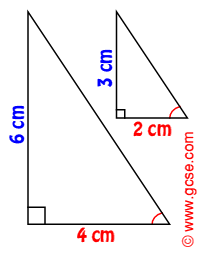
It'll be something like this
https://www.gcse.com/maths/images/similar.gif
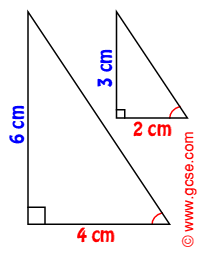
Do you see the proportions of side lengths are equal
tulip kettle
oh yes
full forumBOT
@tulip kettle Has your question been resolved?
gritty rose
tulip kettle
oh yes
What are you stuck on still
frigid carbon
tulip kettle
the answers are in fractions
You know similar triangles?
Ratio of sides is constant
gritty rose
tulip kettle
the answers are in fractions
Yes
gritty rose
gritty rose
It'll be something like this
https://www.gcse.com/maths/images/similar.gif
Use this
,calc 3/8
glossy valveBOT
Result:
0.375
,calc 8/3
glossy valveBOT
Result:
2.6666666666667
,calc 4/5
glossy valveBOT
Result:
0.8
You should be comfortable converting fractions to decimals
tulip kettle
i think the answers 8/3
gritty rose
tulip kettle
i think the answers 8/3
Explain
 burnt turret
tulip kettle
the answers are in fractions
burnt turret
tulip kettle
the answers are in fractions
If the answers are in fractions, then try to solve in fractions
full forumBOT
@tulip kettle Has your question been resolved?
full forumBOT
Channel closed
Closed due to timeout
Use .reopen if this was a mistake.
full forumBOT
Available help channel!
Send your question here to claim the channel.
Remember:
• Ask your math question in a clear, concise manner.
• Show your work, and if possible, explain where you are stuck.
• Do not immediately ping people or roles. After 15 minutes, feel free to ping <@&286206848099549185> once.
• Type the command .close to free the channel when you're done.
• Be polite and have a nice day!
Read #❓how-to-get-help for further information on how to ask a good question, and about conduct in the question channels.
 forest quail
Why do i have to found some weird find x looks like this:

 sour shore
forest quail
Why do i have to found some weird find x looks like this:
sour shore
forest quail
Why do i have to found some weird find x looks like this:
Whts the zero before the comma..?
Are those coordinates or smth
frigid carbon
sour shore
Whts the zero before the comma..?
typo maybe
 eternal terrace
I imagine it’s 1/5 in decimal
neon basin
It's 0.2
forest quail
ye
neon basin
Serbia uses , for decimals
sour shore
neon basin
Serbia uses , for decimals
Oh
neon basin
If I assumed this is in Serbia!
onyx glen
forest quail
Why do i have to found some weird find x looks like this:
did you come here to complain or do you need help solving this
!1q
full forumBOT
It is suggested that you limit yourself to one question per help channel, opening a new one once your original question is answered and your original channel has been closed. This is to make your channel easier to follow for potential helpers and can bring attention to the fact that your question has changed.
forest quail
i need help solving this
neon basin
Well I see two unrelated questions
onyx glen
ok so do you want the equation first, or the angle thing first
forest quail
the equation
neon basin
Eat soup with a fork instead of a knife
onyx glen
do you know how to work with ratios generally? @forest quail
my suggestion will be to simplify the ratio 0.2 : (1 1/5) as your first step
sour shore
Simplify the mixed fraction
full forumBOT
@forest quail Has your question been resolved?
full forumBOT
Channel closed
Closed due to timeout
Use .reopen if this was a mistake.
full forumBOT
Available help channel!
Send your question here to claim the channel.
Remember:
• Ask your math question in a clear, concise manner.
• Show your work, and if possible, explain where you are stuck.
• Do not immediately ping people or roles. After 15 minutes, feel free to ping <@&286206848099549185> once.
• Type the command .close to free the channel when you're done.
• Be polite and have a nice day!
Read #❓how-to-get-help for further information on how to ask a good question, and about conduct in the question channels.
 spiral parcel
(9. Find value/s of ‘a’ such that the linear system: 2x + 5y = 16; 3x + ay = 11, has unique solution.
10. Consider each of the following systems in unknowns x, y, z:
i) x – 2y = 1, x – y + az = 2, ay + 9z = b.
ii) x + 2y + 2z = 1, x + ay + 3z = 3, x + 11y + az = b.
iii) x + y + az = 1, x + ay + z = 4, ax + y + z = b.
A) For what values of a does the system have a unique solution, and for which pairs of value (a, b) does the system have more than one solution?
B) The value of b does not have any effect on whether the system has a unique solution. Justify.
11. Solve the following system of equations and interpret it geometrically.
i) x + y = 3, 2x – y = 5
ii) x + y = 3, 4x + 4y = 12
iii) x + y = 3, x + y = 5
iv) x + y + z = 6, 2x + y + z = 9
v) x + 2y + 3z = 0, 2x + 3y + 4z = 0, 4x + 7y + 10z = 0
vi) x + 2z = 0, y + z = 0)
full forumBOT
spiral parcel
(9. Find value/s of ‘a’ such that the linear system: 2x + 5y = 16; 3x + ay = ...
 sinful prism
let's start at the top with 9
spiral parcel
okay
sinful prism
we have a linear system:
2x + 5y = 16
3x + ay = 11
they ask you to find value(s) of a such that there is only 1 pair of x and y that makes this true.
spiral parcel
ohh okay
sinful prism
If you want to solve such a system, disregarding the variable a, what steps would you take?
spiral parcel
matrix?
 unborn ore
spiral parcel
matrix?
unborn ore
spiral parcel
matrix?
yes AX=B
sinful prism
How i would tackle it is to try to make a single formula out of it. As we don't know what a is, we can multiply the first formula by 3 and the second formula by 2 and get
6x + 15y = 48
6x + 2ay = 22
Can you do something with this?
@spiral parcel a matrix would also be good, do you know how you would put these values in one?
unborn ore
sinful prism
<@1418625789854748792> a matrix would also be good, do you know how you would pu...
its only good for bigger equations or more equations
i dont think its feasible to do it in smaller equations
sinful prism
unborn ore
its only good for bigger equations or more equations
it's also fine for smaller equations. You just have a small matrix to find the reduced echelon form of.
unborn ore
sinful prism
it's also fine for smaller equations. You just have a small matrix to find the r...
true
unborn ore
sinful prism
How i would tackle it is to try to make a single formula out of it. As we don't ...
its easier to do in this method then
sinful prism
unborn ore
its easier to do in this method then
technically this is exactly that but without formatting it in a proper matrix ^.^
delicate torrent
sinful prism
we have a linear system:
2x + 5y = 16
3x + ay = 11
why a matrix for this one
unborn ore
sinful prism
technically this is exactly that but without formatting it in a proper matrix ^....
fr 😭
delicate torrent
sinful prism
we have a linear system:
2x + 5y = 16
3x + ay = 11
a linear eq can only have 1 unique sol, no sols or inf sols
delicate torrent
delicate torrent
*a linear eq can only have 1 unique sol, no sols or inf sols*
why do you need a matrix 😭😭😭
sinful prism
delicate torrent
*why do you need a matrix 😭😭😭*
not saying it's the best way, but it is a reliable way
and if you're comfortable with a method that works all the time, even if it's not the best method, it's worth it to use it in my opinion.
delicate torrent
sinful prism
and if you're comfortable with a method that works all the time, even if it's no...
Alr
sinful prism
I would love to hear how you think it should be solved though, i'm here to learn after all. (though this is not my help channel, might have to move to discussion)
full forumBOT
@spiral parcel Has your question been resolved?
full forumBOT
Channel closed
Closed due to timeout
Use .reopen if this was a mistake.
Available help channel!
Send your question here to claim the channel.
Remember:
• Ask your math question in a clear, concise manner.
• Show your work, and if possible, explain where you are stuck.
• Do not immediately ping people or roles. After 15 minutes, feel free to ping <@&286206848099549185> once.
• Type the command .close to free the channel when you're done.
• Be polite and have a nice day!
Read #❓how-to-get-help for further information on how to ask a good question, and about conduct in the question channels.
thick hedge
 thick hedge
I may be having a brainfart here, but can I have a hint
this is the method I'm using

soay, so X=U;V=X+2Y
full forumBOT
@thick hedge Has your question been resolved?
Channel closed
Closed by @thick hedge
Use .reopen if this was a mistake.
full forumBOT
Available help channel!
Send your question here to claim the channel.
Remember:
• Ask your math question in a clear, concise manner.
• Show your work, and if possible, explain where you are stuck.
• Do not immediately ping people or roles. After 15 minutes, feel free to ping <@&286206848099549185> once.
• Type the command .close to free the channel when you're done.
• Be polite and have a nice day!
Read #❓how-to-get-help for further information on how to ask a good question, and about conduct in the question channels.
 shadow furnace
In linear algebra, when solving a system of differential equations, we can use the eigenvalue method, thus finding the eigenvalues, eigenvectors and then find the general solution for the system. However, often I notice that my approach looks like the answer, but is not 100% alike.
In the book for example, they used this approach where they didn't multiply the first row with (1/2). This causes my free variables in my general solution to not be 100% alike, does this matter, or is the solution still correct?
 full forumBOT
shadow furnace
In linear algebra, when solving a system of differential equations, we can use t...
shadow furnace
full forumBOT
shadow furnace
In linear algebra, when solving a system of differential equations, we can use t...
shadow furnace
This is the solution of the book, while my solution was
[x;y] = (3/5) * [2;-3] * exp(4t) + (4/5) * (1;1) * exp(-t)

 astral sinew
 shadow furnace
So each free variable, it doesn't matter what we set it as, the solution is still the same?
full forumBOT
@shadow furnace Has your question been resolved?
Channel closed
Closed by @shadow furnace
Use .reopen if this was a mistake.
full forumBOT
Available help channel!
Send your question here to claim the channel.
Remember:
• Ask your math question in a clear, concise manner.
• Show your work, and if possible, explain where you are stuck.
• Do not immediately ping people or roles. After 15 minutes, feel free to ping <@&286206848099549185> once.
• Type the command .close to free the channel when you're done.
• Be polite and have a nice day!
Read #❓how-to-get-help for further information on how to ask a good question, and about conduct in the question channels.
 heavy escarp
 full forumBOT
heavy escarp
sour shore
full forumBOT
heavy escarp
sour shore
translation?
delicate torrent
sour shore
translation?
i thought you are having a sleep for your chem test
you were lying this whole time
sour shore
sleep didn't arrive
delicate torrent
lel
sour shore
😭
full forumBOT
@heavy escarp Has your question been resolved?
 full whale
before translating, first state which question it is you need help with, I suppose
there are like 7 questions here, subquestions not included
full forumBOT
Channel closed
Closed due to timeout
Use .reopen if this was a mistake.
Available help channel!
Send your question here to claim the channel.
Remember:
• Ask your math question in a clear, concise manner.
• Show your work, and if possible, explain where you are stuck.
• Do not immediately ping people or roles. After 15 minutes, feel free to ping <@&286206848099549185> once.
• Type the command .close to free the channel when you're done.
• Be polite and have a nice day!
Read #❓how-to-get-help for further information on how to ask a good question, and about conduct in the question channels.
heavy escarp
actually nvm thx guys
full forumBOT
heavy escarp
actually nvm thx guys
 delicate imp
heavy escarp
delicate imp
heavy escarp
Oh a malay one
 warped frost
heavy escarp
actually nvm thx guys
warped frost
heavy escarp
actually nvm thx guys
!done
full forumBOT
heavy escarp
actually nvm thx guys
If you are done with this channel, please mark your problem as solved by typing .close
full forumBOT
If you are done with this channel, please mark your problem as solved by typing .close
heavy escarp
.close
full forumBOT
Channel closed
Closed by @heavy escarp
Use .reopen if this was a mistake.
Available help channel!
Send your question here to claim the channel.
Remember:
• Ask your math question in a clear, concise manner.
• Show your work, and if possible, explain where you are stuck.
• Do not immediately ping people or roles. After 15 minutes, feel free to ping <@&286206848099549185> once.
• Type the command .close to free the channel when you're done.
• Be polite and have a nice day!
Read #❓how-to-get-help for further information on how to ask a good question, and about conduct in the question channels.
 thin lark
can someone explain why rank(A) of a matrix A is the order of the biggest none 0 sub-determinant
full forumBOT
thin lark
can someone explain why rank(A) of a matrix A is the order of the biggest none 0...
kind prism
$$\text{rank}(A) = \text{dimension of the column space of } A = \text{dimension of the row space of } A$$
glossy valveBOT
Steven0925
 kind prism
@thin lark
This means $\text{rank}(A)$ is the maximum number of linearly independent columns (or rows) in the matrix $A$.
glossy valveBOT
Steven0925
 thin lark
glossy valve
**Steven0925**
thin lark
glossy valve
**Steven0925**
this is the definition no?
rank(A) is the maximum number of linearly independent columns
thats how my professor ddefined it in his notes
kind prism
let me see
thin lark
kind prism
let me see

8.1.1 is the def
and 8.1.3 is the sub- determinant
its in greek
full forumBOT
@thin lark Has your question been resolved?
full forumBOT
Channel closed
Closed due to timeout
Use .reopen if this was a mistake.
Available help channel!
Send your question here to claim the channel.
Remember:
• Ask your math question in a clear, concise manner.
• Show your work, and if possible, explain where you are stuck.
• Do not immediately ping people or roles. After 15 minutes, feel free to ping <@&286206848099549185> once.
• Type the command .close to free the channel when you're done.
• Be polite and have a nice day!
Read #❓how-to-get-help for further information on how to ask a good question, and about conduct in the question channels.
thick hedge
kind of confused here
 full forumBOT
thick hedge
kind of confused here
thick hedge
full forumBOT
thick hedge
kind of confused here
thick hedge
like unsure of how to setup the bounds
It's the region bound by y=x^2 and 1≤x+y≤2?
because the bounds are quite weird
 spice knot
are you allowed to graph the regions?
full forumBOT
@thick hedge Has your question been resolved?
thick hedge
spice knot
are you allowed to graph the regions?
I did
spice knot

non-integer intersection point is from x^2 = 1 - x
your integral just needs to be in this shaded region

@thick hedge
thick hedge
spice knot
your integral just needs to be in this shaded region
Yea, I just thought the bounds were weird
liks surds
spice knot
what intersection point did you get
thick hedge
(1,1) and ((√5-1)/2, (3-√5/2)
thick hedge
you can see why I thought that's werid
like really strange coords for something to be done by hand
spice knot
then again there arent very many integer coordinates that are usable here
thick hedge
fair enough
spice knot
every integer coordinate the region intersects with has already been used
thick hedge
tq
spice knot
np
full forumBOT
Channel closed
Closed by @thick hedge
Use .reopen if this was a mistake.
full forumBOT
Available help channel!
Send your question here to claim the channel.
Remember:
• Ask your math question in a clear, concise manner.
• Show your work, and if possible, explain where you are stuck.
• Do not immediately ping people or roles. After 15 minutes, feel free to ping <@&286206848099549185> once.
• Type the command .close to free the channel when you're done.
• Be polite and have a nice day!
Read #❓how-to-get-help for further information on how to ask a good question, and about conduct in the question channels.
 tame bobcat
Let (F,+, x ) be a (commutative) field and V an F-Vectorspace and U a subspace of V and T a subspace of U.
Denote by V/U the factorspace, that is the set of equivalence classes of v in V w.r.t. U. We call v equiv to w, w.r.t. U , for v,w in V iff v-w is in U. Denote this by v~w
now I want to show that (V/T) / (U/T) is isomorphic to (V/U).
In principal I know how isomorphisms work and what equivalance classes and factor structures are, mainly from graph theory. But here I heavily lack intuition and have no real clue what such an isomorphism could look like.
Does anyone have hints or thoughts that could be useful?
full forumBOT
tame bobcat
Let (F,+, x ) be a (commutative) field and V an F-Vectorspace and U a subspace o...
tame bobcat
my main problem is that I have no good image of these two structures in my head, ig
fast peak
pick a basis for T, extend to basis for U and then basis for V
then think about what happens with all of those basis vectors in all of the various spaces
tame bobcat
fast peak
pick a basis for T, extend to basis for U and then basis for V
thanks a lot, I will try to check this out, though I should probably mention that we havent been introduced to the basis of a vectorspace yet. Only very basic stuff
fast peak
well its not needed here
just gives some intuition
but quotient spaces before basis is certainly a decision
full forumBOT
@tame bobcat Has your question been resolved?
tame bobcat
fast peak
but quotient spaces before basis is certainly a decision
lol
yeah the course structure is quite interesting
full forumBOT
@tame bobcat Has your question been resolved?
Channel closed
Closed by @tame bobcat
Use .reopen if this was a mistake.
Available help channel!
Send your question here to claim the channel.
Remember:
• Ask your math question in a clear, concise manner.
• Show your work, and if possible, explain where you are stuck.
• Do not immediately ping people or roles. After 15 minutes, feel free to ping <@&286206848099549185> once.
• Type the command .close to free the channel when you're done.
• Be polite and have a nice day!
Read #❓how-to-get-help for further information on how to ask a good question, and about conduct in the question channels.
 livid rapids
 full forumBOT
livid rapids
livid rapids
full forumBOT
livid rapids
livid rapids
the rhs is the ques
 unique cloud
you have to solve the integral? sorry I didn't get what you mean by rhs is the ques its very "vague" haha
unique cloud
gotcha, I understand that, but you want to prove the equality yes? that the lhs = rhs?
livid rapids
 livid rapids
unique cloud
gotcha, I understand that, but you want to prove the equality yes? that the lhs ...
livid rapids
unique cloud
gotcha, I understand that, but you want to prove the equality yes? that the lhs ...
yep
i dunno wot to do
unique cloud
good ideas on there, but $sin^2x + cos^2x = 1$ you can set that, from there, solve the straight forward integral of $cos2x$
livid rapids
do u think there might be smthn wrong with the question
glossy valveBOT
PinkPurpleBlue
 unique cloud
and then that should be like sin2x/2 = 2sinxcosx/2 and then keep simplifying, wait let me actually try on paper
unique cloud
the rhs is -(cot x + tan x) or is that a multiplication/
livid rapids
unique cloud
the rhs is -(cot x + tan x) or is that a multiplication/
that is right
unique cloud
its a sum?
livid rapids
yep
unique cloud
gotcha I'm trying it, essentially its proving that sin2x/2 is equal to -(cotx + tanx) by moving things around, idk even if its true I'm trying it out
aah okay $sin2x/2 = sinxcosx$ however,$-(cotx + tanx) = -(1/(sinx cosx))$ they are not equal
glossy valveBOT
PinkPurpleBlue
 unique cloud
yeah -1/(RHS) should be the correct one where RHS means the current RHS
see $$(cotx + tanx) = \frac{cosx}{sinx} + \frac{sinx}{cosx} = \frac{sin^2x + cos^2x}{sinx cosx} = 1/sinxcosx$$ hence $$-(cotx + tanx) = \frac{-1}{sinxcosx}$$ but the integral simplifies to $$\frac{sin2x}{2} = sinx cosx$$
glossy valveBOT
PinkPurpleBlue
 unique cloud
do you understand why the itnegral simplifies to that?
unique cloud
livid rapids
the ques might be a bit wrong then
Indeed.
livid rapids
yep
unique cloud
cool
livid rapids
thanks
unique cloud
you're welcome
full forumBOT
@livid rapids Has your question been resolved?
Channel closed
Closed by @livid rapids
Use .reopen if this was a mistake.
full forumBOT
Available help channel!
Send your question here to claim the channel.
Remember:
• Ask your math question in a clear, concise manner.
• Show your work, and if possible, explain where you are stuck.
• Do not immediately ping people or roles. After 15 minutes, feel free to ping <@&286206848099549185> once.
• Type the command .close to free the channel when you're done.
• Be polite and have a nice day!
Read #❓how-to-get-help for further information on how to ask a good question, and about conduct in the question channels.
 white roost
can someone explain chain rule for derivatives to me?
white roost
i dont get it at all
 peak shale
How to use it or what do you want to know
white roost
i study derivatives using chatgpt -ik not the best decision but i dont have much time and i need simple calc- and it says
if
f(x)=g(h(x)),
then
f′(x)=g′(h(x))⋅h′(x)
but here how are we supposed to calculate the g(h(x)) one
white roost
peak shale
How to use it or what do you want to know
i didnt understand anything abt the rule tbh
white roost
white roost
i study derivatives using chatgpt -ik not the best decision but i dont have much...
bc like here we would need to do it again and again so it'd go forever no?
 slate glacier
Like derivative of sin(2x) would be derivative of sin(2x)* derivative of (2x)
peak shale
Okay so what they mean is that if you have a composition of functions
ex could be cos(2x+1) The chain rule tells you how to deffirentiate it
slate glacier
So here sin function is f(x) and 2x is g(x), so derivative of f(g(x)) is f'(g(x))*g'(x)
white roost
chatgpt gave these examples

how is the exponiental one have 2 functions? or the ln one?
slate glacier
Do you know you can apply chain rule in normal derivative too
slate glacier
Like derivative of e^x is derivative of e^x* derivative of x (which is just 1 so we ignore it)
So what's shown is, you have f(g(x)) as e^(3x + 5), and g(x) as (3x + 5), so when you differentiate it, you firstly differentiate it like normal (like e^(3x + 5) is just e^(3x + 5)), but then you multiply the derivative of g(x) to it too
white roost
so e is another function?
slate glacier
now g'(x) is 3, so we simply multiply 3 to the derivative of our original function
peak shale
yes e^x is the "outer" function
slate glacier
white roost
so e is another function?
Yes basically, e is a separate function and (3x + 5) is another function
white roost
then why do we have another rule for exponiental if we have chain rule?
for x^3x+5 for example
which rule am i supposed to do?
the exp. one or the chain rule?
both are quite different
slate glacier
IG you can do this by chain rule too, what's the exponential rule again?
slate glacier
white roost
for x^3x+5 for example
Oh this cannot be done like that, it has x in power
white roost
but we have e here in the example and why do we use chain rule?
isnt it the same
its an unknown anyways like
i feel like ur judging me so much on the inside rn 😭
sorry if my questions dont make any sense
slate glacier
No see there's a difference, you can't compare x^x and e^x, in cases of x^x it is entirely different and we use a more complex version of the power rule
slate glacier
white roost
i feel like ur judging me so much on the inside rn 😭
I'm not
slate glacier
So in cases like e^g(x), log(g(x)), sin(g(x)), etc, we use chain rule
In cases of x^(any constant), we use power rule
white roost
whats the special thing with e? what function is that
slate glacier
In cases of x^(g(x)), we use an advanced version of the power rule which you shouldn't be taught yet
white roost
peak shale
Its okay to not understand at first
didnt take calc in hs. did pre calc. took a gap year then. now im an econ major. so yeah i suck at it 🥲
slate glacier
white roost
whats the special thing with e? what function is that
exponential function, e is euler's number
white roost
slate glacier
exponential function, e is euler's number
oh
slate glacier
e is kinda known because e^x is among the only functions out there whose derivative is the same as the original function (e^x), so you encounter it a lot in calculus
peak shale
you can look up like a cheat sheat of diffrent derivatives.
here is an example

But it is generally a good idea to get an understanding of these derivatives
I get that it is hard to remember but learning the ideas behind something is always better than just remembering everything
slate glacier
Yes, initially it feels like a chore but once you get the idea it all starts feeling basic
white roost
when we do the chain rule we do like this. now if you look at the highlighted part we must redo the chain rule over and over and over again based on the formula

im not asking this for e but for like other examples
like for me to calculate the derivative of f(g(x)) i must find the derivative of f(g(x))?
peak shale
no
white roost
how is that supposed to work
white roost
but it has 2 functions so dont we use chain rule?
isnt d/dx ( f(g(x)) the same as that
peak shale
so d/dx = f'(g(x))*g'(x) that is the chain rule
So you would differentiate f(x) and g(x) seperatly and insert g(x) into f'(x)
peak shale
well for those functions the composite would be
3(5x+6)+4=15x+20 so you wouldn't use the chain rule
white roost
we use chain rule for e and ln only?
gpt says we use chain rule when we got 2 functions but here u say we dont use it
for this question
peak shale
We can use it for any composite function that cant be reduced too a simpler term
so the example you gave you can reduce to a linear equation which is easier
e^(2x+4) can be reduced to be easier
peak shale
yes
white roost
peak shale
e^(2x+4) can be reduced to be easier
if it can be reduced to be easier then we cant use it for chain rule
but we just did
peak shale
its proberlly the best rule their is
white roost
peak shale
its proberlly the best rule their is
damn
peak shale
white roost
if it can be reduced to be easier then we cant use it for chain rule
how would you reduce e^(2x+4)
white roost
peak shale
e^(2x+4) can be reduced to be easier
.
peak shale
well mb then
white roost
oh it was a typo?
peak shale
what i ment was in that case you would use the chain rule cause it can't be reduced
white roost
by can't be reduced what kind of things are included in it? like functions with x^2 ? are they included?
3x^2+3x+5
lets say
peak shale
What is the composite functions
for that you would use the power rule and the addition rule (not sure if thats the english name)
white roost
peak shale
for that you would use the power rule and the addition rule (not sure if thats t...
alr thx
full forumBOT
@white roost Has your question been resolved?
Channel closed
Closed by @white roost
Use .reopen if this was a mistake.
full forumBOT
Available help channel!
Send your question here to claim the channel.
Remember:
• Ask your math question in a clear, concise manner.
• Show your work, and if possible, explain where you are stuck.
• Do not immediately ping people or roles. After 15 minutes, feel free to ping <@&286206848099549185> once.
• Type the command .close to free the channel when you're done.
• Be polite and have a nice day!
Read #❓how-to-get-help for further information on how to ask a good question, and about conduct in the question channels.
thick hedge
If $A$ is open or closed, show $\partial int(A)= \varnothing$
thick hedge
AT LAST
 queen gull
$\partial A = \bar{A} \backslash \mathrm{int}(A)$
glossy valveBOT
wai
 glossy valveBOT
ExpertEsquieESQUIE
 thick hedge

 split swift
that's a different question from what you wrote
thick hedge
I realised I kept making typos 😭
split swift
your ordering just isn't true
but anyway
if A is open, then int(A) = A
so del(A) = clos(A) \ A
suppose this is nonempty so there is some open set U in the boundary
then look at the neighbourhoods of all the points of U
thick hedge
I'm typing an answer