#help-28
1 messages · Page 232 of 1
 stone mortar
 full forumBOT
Please only use the <@&286206848099549185> ping once if your question has not been answered for 15 minutes. Please do not ping or DM individual users about your question.

 spiral vigil
what else is on that page
stone mortar
 stone mortar
spiral vigil
what else is on that page
stone mortar
spiral vigil
what else is on that page
spiral vigil
wow look an explanation of how to do the problem
stone mortar
i dont understand how in the 6th line, LHS = RHS
spiral vigil
it lets us convert the tilted surface integral to an integral on the ground (x and y)
stone mortar
is that some theorem?
if so why
therefore, the statement
and not
according to the theorem, the statement
stone mortar
 elder birch
which part do you not understand?
elder birch
which part do you not understand?
how did the above 5 steps implied step 6
spiral vigil
you're projecting the vector n onto the k direction
elder birch
do you understand up to here?
 stone mortar
yes
elder birch
do you understand how surface integral with dot product (flux type integral) works?
stone mortar
elder birch
do you see how gradient of the plane is normal to the plane?
actually i also have a confusion at this, cuz differentiating a line gives tangent but for a surface, its normal
 glossy valveBOT
reverileo
 elder birch
actually let me ask this first
given a plane with an equation
[ a(x-x_0)+b(y-y_0)+c(z-z_0)=0 ]
do you see why the vector $(a,b,c)$ is normal to the plane?
glossy valveBOT
reverileo
 stone mortar
no
stone mortar
but still can you explain why is this so
elder birch
elder birch
have you seen this equation?
.
stone mortar
yes
elder birch
do you understand how it's derived?
elder birch
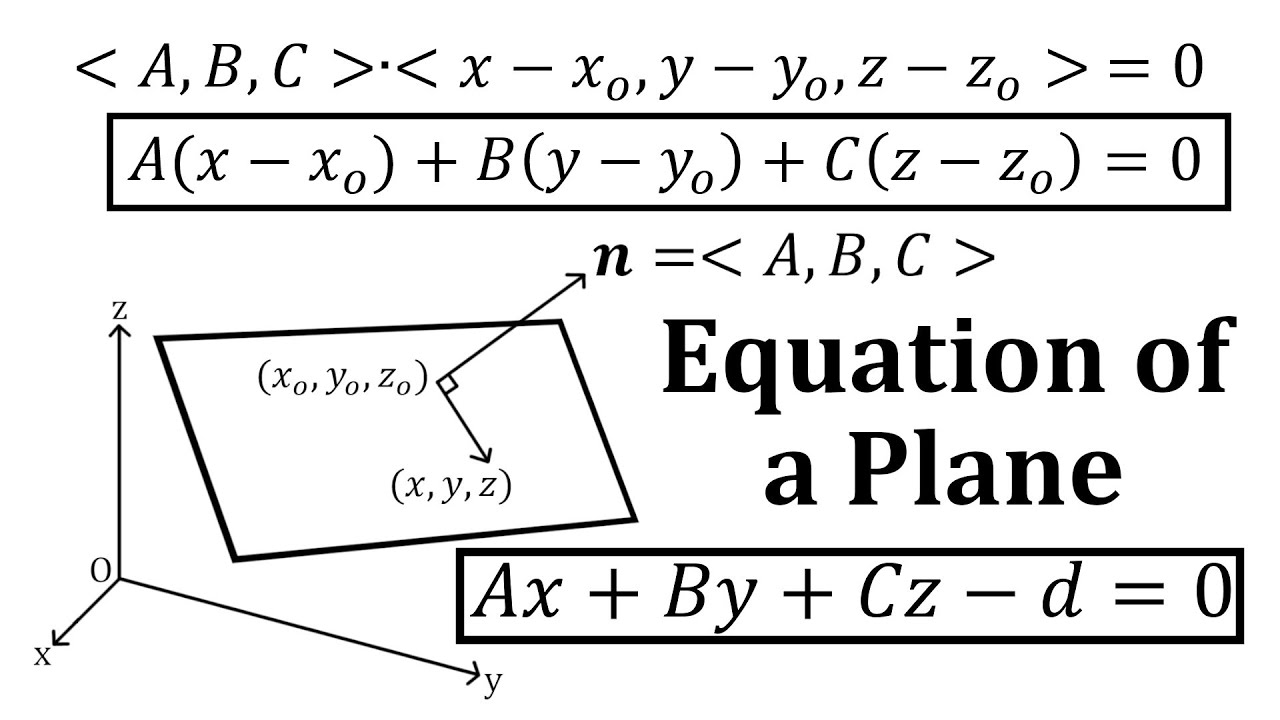
In this video I go over the equation of a plane and derive it by using the Dot Product. A plane is a flat set of points in 3D. If we draw a vector parallel to it and another vector perpendicular (or normal) to the plane, then the resulting dot product of these 2 vectors must equal 0. This can then be used to derive the equation of a plane. I wri...
could you watch this video and come back
it's really short
stone mortar
yes sure
elder birch
equation of plane is hard to explain without visualization
elder birch
glossy valve
**reverileo**
now do you see this?
stone mortar
yes
elder birch
in fact, for this question, you don't even need gradient to find normal vector
since the surface is already a plane
do u still want me to explain why gradient is normal to the tangent plane or no?
elder birch
u good?
stone mortar
yup
elder birch
alright so do u see how we can just take the coefficients of x, y, z of the equation of the plane
and get the normal vector right away
stone mortar
it will be left with A+B+C... which is perpendiculatr soo
stone mortar
elder birch
and get the normal vector right away
yes
elder birch
elder birch
do you understand up to here?
now you understand up to these steps, right?

 elder birch
because you want to scale down infinitesimal areas
stone mortar
ahhhh.........
elder birch
i'm trying to think how to explain this well
do you see how dS would be different from dx dy?
because the surface is sorta inclined
stone mortar
yes
elder birch
that's why you need a scaling factor
elder birch
they skipped steps but do you see why $\dd S=\frac{1}{\cos\theta},\dd A=\frac{1}{\cos\theta}\dd{x}\dd{y}$?
glossy valveBOT
reverileo
 elder birch
where $\theta$ is the angle between $\vu{k}$ and $\vu{n}$
glossy valveBOT
reverileo
 elder birch
essentially you want to scale based on how slanted (or inclined) the surface is compared to the xy-plane
do you see that?
elder birch
$\vu{k}\vdot\vu{n}=\norm{\vu{k}}\norm{\vu{n}}\cos\theta$
glossy valveBOT
reverileo
 glossy valveBOT
reverileo
 stone mortar
ohhhhhhhhh yes
elder birch
that's why you divide by k dot n
elder birch
yeah np

 full forumBOT
Channel closed
Closed by @stone mortar
Use .reopen if this was a mistake.
full forumBOT
 Available help channel!
Send your question here to claim the channel.
Remember:
• Ask your math question in a clear, concise manner.
• Show your work, and if possible, explain where you are stuck.
• After 15 minutes, feel free to ping <@&286206848099549185>.
• Type the command .close to free the channel when you're done.
• Be polite and have a nice day!
Read #❓how-to-get-help for further information on how to ask a good question, and about conduct in the question channels.
 stuck fiber
 full forumBOT
stuck fiber
stuck fiber
full forumBOT
stuck fiber
stuck fiber
Part (d)
 honest hill
stuck fiber
honest hill
stuck fiber
Been a while since you hit me with the otter
I got some weird numbers
First we want the y intercept
so cos(2[0]) + sin(3[0] + pi/3)
cos(0) + sin(pi/3)
So 1 + sqrt(3)/2
Which is already a weird number
honest hill
why?
stuck fiber
like im guessing im going to have to sub this back into sin or cos at some point
And sin(1 + sqrt(3)/2) isnt going to work out nicely
Same with cos
honest hill
stuck fiber
like im guessing im going to have to sub this back into sin or cos at some point
no?
honest hill
y
stuck fiber
Ah yeye
So (0, 1 + sqrt(3)/2)
We then want to get the slope of the tangent
at this point
So we get the derivative of cos(2x) + sin(3x + pi/3)
Which is -2sin(2x) + 3cos(3x + pi/3)
Then sub in x = 0
-2sin(0) + 3cos(0 + pi/3)
3(1/2)
=3/2
So thats the slope
We now have the line y = 3x/2 + (1 + sqrt(3)/2)
sub in y = 0
0 = 3x/2 + (1 + sqrt(3)/2)
3x/2 = -(1 + sqrt(3)/2)
x = -2(1 + sqrt(3)/2)/3
x = -2/3 - sqrt(3)/3
Yep thats what they wanted!! 😄

Thank you!
❤️
.close
full forumBOT
Channel closed
Closed by @stuck fiber
Use .reopen if this was a mistake.
full forumBOT
Available help channel!
Send your question here to claim the channel.
Remember:
• Ask your math question in a clear, concise manner.
• Show your work, and if possible, explain where you are stuck.
• After 15 minutes, feel free to ping <@&286206848099549185>.
• Type the command .close to free the channel when you're done.
• Be polite and have a nice day!
Read #❓how-to-get-help for further information on how to ask a good question, and about conduct in the question channels.
 gleaming solstice
help
full forumBOT
gleaming solstice
help
gleaming solstice
Let $\mathcal{V}$ be the $\mathbb{R}$-vector space of all functions $f : \mathbb{N} \to \mathbb{R}^n$, where $\mathbb{N} = {1,2, \dots}$. Here the addition of functions $f,g \in \mathcal{V}$ is defined as $(f+g)(k) = f(k) + g(k)$ for all $k \in \mathbb{N}$, while scalar multiplication is defined as $(af)(k) = af(k)$ for $a \in \mathbb{R}$ and $f \in \mathcal{V}$. In this exercise we will consider the set
[
\mathcal{S} := { f \in \mathcal{V} \mid f(k+1) = T(f(k)) , \forall k \in \mathbb{N} },
]
where $T : \mathbb{R}^n \to \mathbb{R}^n$ is a linear operator.
\begin{itemize}
\item[(a)] Prove that $\mathcal{S}$ is a subspace of $\mathcal{V}$.
\item[(b)] Let $x \in \mathbb{R}^n$. Show that $f$, defined by $f(k) = T^{k-1}(x)$ for all $k \in \mathbb{N}$, is in $\mathcal{S}$.
\item[(c)] Find a basis for $\mathcal{S}$. Motivate your answer.
\end{itemize}
glossy valveBOT
Emmaaaaa
 gleaming solstice
Here is the problem
(a) $T$ is linear implies that $T$ preserves both homogeneity and additivity, since homogeneity preserves $\mathbf{0}$ element in its image showing ${0}\subset \mathcal{S}$, and since $T$ preserves the additivity and homogeneity, $\mathcal{S}$ preserves these property, hence $\mathcal{S}$ is a subspace of $\mathcal{V}$.
(b) $f(k)=T^{k-1}(x)$ which implies that $T(f(k-1))=T^{k-1}(x)$ this implies $T^k(x)=T[T(f(k-1))]=T[f(k)]=f(k+1)\in \mathcal{S}$
Conversely $x\in \mathbb{R}^n$ we have $x=T^{1-k}f(k)=T^{-k}f(k+1)=f(1)$ this implies $T^k(x)=T^k[f(1)]=f(k+1)\in\mathcal{S}$
But this we have demonstrated that for every $k\in \mathbb{N}_{\geq{1}}$ we have $f(k)\in \mathcal{{S}}$
(c):
Let $\beta_{i,j}=\bigg{f_{i,j}: f(k)=\begin{cases}
e_j,\ \ \text{if } k=i\
0, \ \ \text{if } k\neq i
\end{cases} \ \ \text{for } i,j\in \mathbb{N},\text{and }j\leq{n}\bigg}$ be a infinite dimensional basis for vector space $\mathcal{V}$ then for the subspace of $\mathcal{S}$ of $\mathcal{V}$ then basis of $\mathcal{S}$ can be represented by $\beta_{j}={f_{j}(k):T^{1-k}f(k)=e_j:j=1,2,3,...,n}$
My answer
glossy valveBOT
Emmaaaaa
 gleaming solstice
I know it’s a bit redundant but I am no good with linear algebra so I don’t know if converse is needed to be proven
And I actually don’t know if I can just write answer for a just like that since it’s just a few sentence and bcs of T is linear verification isn’t that necessary I felt but I don’t know
@leaden ermine help me this is very much more elementary compared to analysis
I made a mistake T might not be invertible
@leaden ermine do I have to show converse direction for B, I will use change of basis matrix then
 leaden ermine
gleaming solstice
<@587715738484211754> do I have to show converse direction for B, I will use ch...
leaden ermine
gleaming solstice
<@587715738484211754> do I have to show converse direction for B, I will use ch...
you are probably 99 % right (no guarantees)
gleaming solstice
Let $Tx = Ax$ where $A$ is the transformation matrix
Let $\beta$ be a nonstandard basis and a constant matrix $C=[\beta_1,…,\beta_n]$ and clearly $C$ is invertible such that $[x]_\beta=C^{-1}x$
Then $T[x]=AC^{-1}[x]beta$ this follows $[T[x]]\beta=CAC^{-1}[x]_\beta \in S$
glossy valveBOT
Emmaaaaa
 gleaming solstice
leaden ermine
you are probably 99 % right (no guarantees)
gleaming solstice
leaden ermine
you are probably 99 % right (no guarantees)
I actually feel these day out of 10 problem I try rarely I got one right though
Unfortunately
 kindred grove
gleaming solstice
<@587715738484211754> do I have to show converse direction for B, I will use ch...
kindred grove
gleaming solstice
<@587715738484211754> do I have to show converse direction for B, I will use ch...
no you don't have to, not for b) at least
of course it's nice for c) if you know explicitly what's in S
gleaming solstice
kindred grove
of course it's nice for c) if you know explicitly what's in S
This simple question cost me a day
gleaming solstice
Yes I actually only manage to figure out the basis for S after figuring out what it means for (b)
Is (a) okay
I am thinking maybe it’s too brief
kindred grove
gleaming solstice
I am thinking maybe it’s too brief
also my thinking
like if you're just trying to convince yourself in your head sure
gleaming solstice
kindred grove
also my thinking
The point is, whether this argument is considered rigorous. T due to homogeneity does preserve (0)
the left is just homogenous and additive properties
But it’s not a pain to do verification though
kindred grove
gleaming solstice
The point is, whether this argument is considered rigorous. T due to homogeneity...
sounds alright to me
it's really the 2 other that aren't super trivial to see
gleaming solstice
Just to be certain, I will use standard method verifying it instead of this..
It’s not hard to just explicitly demonstrate the additive and homogeneous properties
Is the basis correct
I am a bit scared to ask since I didn’t feel like I am entirely sure
The V should be infinite dimensional
Which I eventually figured
And then it’s just some basis in R^n
kindred grove
well your c) seems pretty off yes
gleaming solstice
I just don’t know if it’s right 😭
But I feel like logically it kinda make sense
kindred grove
well question b) is here to instill in you the idea that maybe every f in V is of the form f(k) = T^(k-1)(x) for some x (which you kinda remarked already)
gleaming solstice
yes
kindred grove
so if you can show that f(k) = T^(k-1)(f(1)) for all k, you win
base case k=1 there's nothing to show
then for the induction case, you use f(k+1) = T(f(k)) from the def of S
full forumBOT
@gleaming solstice Has your question been resolved?
full forumBOT
Channel closed
Closed due to timeout
Use .reopen if this was a mistake.
full forumBOT
Available help channel!
Send your question here to claim the channel.
Remember:
• Ask your math question in a clear, concise manner.
• Show your work, and if possible, explain where you are stuck.
• After 15 minutes, feel free to ping <@&286206848099549185>.
• Type the command .close to free the channel when you're done.
• Be polite and have a nice day!
Read #❓how-to-get-help for further information on how to ask a good question, and about conduct in the question channels.
 mortal kraken
I want to verify my answer on this assignment my answer is (A) and I did it by u sub of u=1-y/eps
 full forumBOT
mortal kraken
I want to verify my answer on this assignment my answer is (A) and I did it by u...
mortal kraken
full forumBOT
mortal kraken
I want to verify my answer on this assignment my answer is (A) and I did it by u...
mortal kraken
Is the picture too blury
full forumBOT
@mortal kraken Has your question been resolved?
full forumBOT
@mortal kraken Has your question been resolved?
 robust slate
mortal kraken
I want to verify my answer on this assignment my answer is (A) and I did it by u...
robust slate
mortal kraken
I want to verify my answer on this assignment my answer is (A) and I did it by u...
Yes it’s A
full forumBOT
Channel closed
Closed due to timeout
Use .reopen if this was a mistake.
Available help channel!
Send your question here to claim the channel.
Remember:
• Ask your math question in a clear, concise manner.
• Show your work, and if possible, explain where you are stuck.
• After 15 minutes, feel free to ping <@&286206848099549185>.
• Type the command .close to free the channel when you're done.
• Be polite and have a nice day!
Read #❓how-to-get-help for further information on how to ask a good question, and about conduct in the question channels.
 plain sand

 full forumBOT
plain sand
plain sand
full forumBOT
plain sand
plain sand
could anyone tell me if my answer in red ink will get all 3 marks according to the MS
 plain sand
what does SAS mean.
robust slate
plain sand
what does SAS mean.

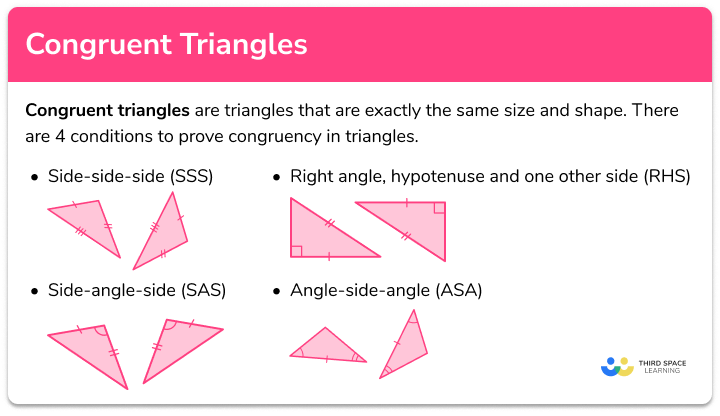
Third Space Learning
Free congruent triangles GCSE maths revision guide, including step by step examples, exam questions and free Congruent Triangles worksheet.
plain sand
so in words i should just say that SAS has been proven
robust slate
Sure ig
full forumBOT
If you are done with this channel, please mark your problem as solved by typing .close
full forumBOT
Channel closed
Closed by @plain sand
Use .reopen if this was a mistake.
 full forumBOT
Available help channel!
full forumBOT
Available help channel!
Send your question here to claim the channel.
Remember:
• Ask your math question in a clear, concise manner.
• Show your work, and if possible, explain where you are stuck.
• After 15 minutes, feel free to ping <@&286206848099549185>.
• Type the command .close to free the channel when you're done.
• Be polite and have a nice day!
Read #❓how-to-get-help for further information on how to ask a good question, and about conduct in the question channels.
stone mortar
not exactly mathamatics but stillllllll

 full forumBOT
stone mortar
not exactly mathamatics but stillllllll
full forumBOT
stone mortar
not exactly mathamatics but stillllllll
 full forumBOT
Channel closed
Closed by @stone mortar
Use .reopen if this was a mistake.
full forumBOT
Available help channel!
Send your question here to claim the channel.
Remember:
• Ask your math question in a clear, concise manner.
• Show your work, and if possible, explain where you are stuck.
• After 15 minutes, feel free to ping <@&286206848099549185>.
• Type the command .close to free the channel when you're done.
• Be polite and have a nice day!
Read #❓how-to-get-help for further information on how to ask a good question, and about conduct in the question channels.
 tall ridge
can someone help me solve this question I was using the formula F = integral from a to b (density * length * depth) dy
 full forumBOT
tall ridge
can someone help me solve this question I was using the formula F = integral fro...
tall ridge
full forumBOT
tall ridge
can someone help me solve this question I was using the formula F = integral fro...
tall ridge
and to get the length I drew a line horizontal line inside the triangle
and im trying to get the slope of it however I dont know what points to use
 torn gust
the points would be width zero 7 meters down and width 7 2 meters down
tall ridge
torn gust
the points would be width zero 7 meters down and width 7 2 meters down
and then my depth would be 7-y?
@torn gust
torn gust
uh people do it a bunch of different ways as long as the rest of the integral make sense yea do that
full forumBOT
@tall ridge Has your question been resolved?
full forumBOT
Channel closed
Closed due to timeout
Use .reopen if this was a mistake.
Available help channel!
Send your question here to claim the channel.
Remember:
• Ask your math question in a clear, concise manner.
• Show your work, and if possible, explain where you are stuck.
• After 15 minutes, feel free to ping <@&286206848099549185>.
• Type the command .close to free the channel when you're done.
• Be polite and have a nice day!
Read #❓how-to-get-help for further information on how to ask a good question, and about conduct in the question channels.
 upbeat terrace
hi.. does anyone does do corepetitions?
full forumBOT
upbeat terrace
hi.. does anyone does do corepetitions?
 unique wagon
maybe, do you have a particular question to ask about a competition?
 placid oak
!da2a
full forumBOT
No need to ask “Can I ask…?” or “Does anyone know about…?”—it’s faster for everyone if you just ask your question! See https://dontasktoask.com/
@upbeat terrace Has your question been resolved?
full forumBOT
Channel closed
Closed due to timeout
Use .reopen if this was a mistake.
Available help channel!
Send your question here to claim the channel.
Remember:
• Ask your math question in a clear, concise manner.
• Show your work, and if possible, explain where you are stuck.
• After 15 minutes, feel free to ping <@&286206848099549185>.
• Type the command .close to free the channel when you're done.
• Be polite and have a nice day!
Read #❓how-to-get-help for further information on how to ask a good question, and about conduct in the question channels.
 vapid parcel
Can someone confirm my answer for this?
full forumBOT
vapid parcel
Can someone confirm my answer for this?
vapid parcel
full forumBOT
vapid parcel
Please post images (such as PNGs or JPGs) of the question rather than other filetypes such as PDFs which have to be downloaded. Non-image downloads can potentially contain viruses or other security risks.
 full forumBOT
@vapid parcel Has your question been resolved?
full forumBOT
@vapid parcel Has your question been resolved?
full forumBOT
Channel closed
Closed due to timeout
Use .reopen if this was a mistake.
full forumBOT
Available help channel!
Send your question here to claim the channel.
Remember:
• Ask your math question in a clear, concise manner.
• Show your work, and if possible, explain where you are stuck.
• After 15 minutes, feel free to ping <@&286206848099549185>.
• Type the command .close to free the channel when you're done.
• Be polite and have a nice day!
Read #❓how-to-get-help for further information on how to ask a good question, and about conduct in the question channels.
 quaint rune
help
full forumBOT
quaint rune
help
quaint rune
is this an example of a graph with 2 different Eulerian cycles?

- v1, v2, v3, v1, v5, v4, v1
- v1, v5, v4, v1, v2, v3, v1
and that all vertices have even degrees
full forumBOT
@quaint rune Has your question been resolved?
Channel closed
Closed by @quaint rune
Use .reopen if this was a mistake.
Available help channel!
Send your question here to claim the channel.
Remember:
• Ask your math question in a clear, concise manner.
• Show your work, and if possible, explain where you are stuck.
• After 15 minutes, feel free to ping <@&286206848099549185>.
• Type the command .close to free the channel when you're done.
• Be polite and have a nice day!
Read #❓how-to-get-help for further information on how to ask a good question, and about conduct in the question channels.
 lime valve
Find the gradient/point at which perfectly splits the area between the curve and line in the lower region and upper region in half
equation of curve = -2x^2 + 4x
Equation of line = y=mx (need to find m)
 full forumBOT
lime valve
Find the gradient/point at which perfectly splits the area between the curve and...
full forumBOT
lime valve
Find the gradient/point at which perfectly splits the area between the curve and...
 royal holly
equate the areas using integration
lime valve
I did
But it didnt work
I found the total area
for the parabola
which was 8/3
meaning area 1 (above the line) = 4/3

I found m = 0.8252
but when I tried calculating the area unedr (lower region) I didn't get a value of 4/3
<@&286206848099549185> please
 fierce quartz
lime valve
fierce quartz
lime valve
y not
 lime valve
 spring glacier
it's a 2b^2 / 4
spring glacier
ohh i read it as a 3 mb
lime valve
nah all good
spring glacier
then thats not the mistake
spring glacier
yeah the only part i havent checked is the 8/3 and the 4/3
lime valve
Because I believe my gradient is right, but idk how to verify it but finding the area of the lower region
spring glacier
the process for getting m seems all good tho
lime valve
For the lower region of the area do I have to subtract functions from eachother
like I did for the upper region?
Or can I just do integration of mx from x=0 to x=a and then add integration of the curve from x=a to x=2?
sorry if that doesnt make much sense
spring glacier
lime valve
Or can I just do integration of mx from x=0 to x=a and then add integration of t...
pretty sure you could do that yeah
full forumBOT
@lime valve Has your question been resolved?
Channel closed
Closed by @lime valve
Use .reopen if this was a mistake.
Available help channel!
Send your question here to claim the channel.
Remember:
• Ask your math question in a clear, concise manner.
• Show your work, and if possible, explain where you are stuck.
• After 15 minutes, feel free to ping <@&286206848099549185>.
• Type the command .close to free the channel when you're done.
• Be polite and have a nice day!
Read #❓how-to-get-help for further information on how to ask a good question, and about conduct in the question channels.
 nova wraith
$\lim_{x \to 0} \frac{\left(\sqrt{1 + x}\right) - 1 - \frac{x}{2}}{x^2}$
full forumBOT
nova wraith
$\lim_{x \to 0} \frac{\left(\sqrt{1 + x}\right) - 1 - \frac{x}{2}}{x^2}$
glossy valveBOT
waffle
 nova wraith
How would I solve this without l’Hôpital’s rule?
 onyx glen
$(1+x)^p = 1+px+\frac{p(p-1)}{2!}x^2 + \frac{p(p-1)(p-2)}{3!}x^3+\dots$
glossy valveBOT
Ann
 nova wraith
$(1+x)^{\frac{1}{2}} = 1+\frac{x}{2}-\frac{x^2}{8} + \frac{x^3}{16}+\dots$
glossy valveBOT
waffle
 nova wraith
<@&268886789983436800> Advert
onyx glen
nova wraith
$(1+x)^{\frac{1}{2}} = 1+\frac{x}{2}-\frac{x^2}{8} + \frac{x^3}{16}+\dots$
yes
nova wraith
Okay I get this
The first two terms go to the left and when divided by x^2 it leaves -1/8 as x goes to 0.
l'Hopital's rule is faster though
nova wraith
Is it not advisable to use it every time even when the limit is in indeterminate form?
onyx glen
its difficulty becomes especially worse if you would have to apply it twice to most anything not nice
if there's trig and roots you'll already drown
so yes it's very inadvisable
last resort
full forumBOT
Channel closed
Closed by @nova wraith
Use .reopen if this was a mistake.
full forumBOT
Available help channel!
Send your question here to claim the channel.
Remember:
• Ask your math question in a clear, concise manner.
• Show your work, and if possible, explain where you are stuck.
• After 15 minutes, feel free to ping <@&286206848099549185>.
• Type the command .close to free the channel when you're done.
• Be polite and have a nice day!
Read #❓how-to-get-help for further information on how to ask a good question, and about conduct in the question channels.
 stark nexus
Hello
 full forumBOT
stark nexus
Hello
full forumBOT
stark nexus
Hello
 stark nexus
But how
 mighty ridge
u = x-3 could help you to see why you probably already know this integral
but it's not the only possible choice
stark nexus
mighty ridge
u = x-3 could help you to see why you probably already know this integral
Ohh
Mb my brain just stopped working
stark nexus
mighty ridge
but it's not the only possible choice
What’s the other
mighty ridge
well assuming you didn't know any form of integral you could always try stuff like u = (x-3)² and bruteforce from there
wouldn't be very fun tho
stark nexus
Yeah I’ll stick to x-3=u
Ty
Just checking, 9 * u^-2
Where do i continue from here
Nvm
Ty
.close
full forumBOT
Channel closed
Closed by @stark nexus
Use .reopen if this was a mistake.
full forumBOT
Available help channel!
Send your question here to claim the channel.
Remember:
• Ask your math question in a clear, concise manner.
• Show your work, and if possible, explain where you are stuck.
• After 15 minutes, feel free to ping <@&286206848099549185>.
• Type the command .close to free the channel when you're done.
• Be polite and have a nice day!
Read #❓how-to-get-help for further information on how to ask a good question, and about conduct in the question channels.
 white imp
Can anyone help with this? Would be better if method is drawn, thank you!!
 full forumBOT
white imp
Can anyone help with this? Would be better if method is drawn, thank you!!
full forumBOT
white imp
Can anyone help with this? Would be better if method is drawn, thank you!!
 austere cove
For the first one, it might be easiest to rewrite everything in terms of powers of 2.
For the second one, the question is asking about your understanding of how arcsin works.
full forumBOT
@white imp Has your question been resolved?
Channel closed
Closed by @white imp
Use .reopen if this was a mistake.
Available help channel!
Send your question here to claim the channel.
Remember:
• Ask your math question in a clear, concise manner.
• Show your work, and if possible, explain where you are stuck.
• After 15 minutes, feel free to ping <@&286206848099549185>.
• Type the command .close to free the channel when you're done.
• Be polite and have a nice day!
Read #❓how-to-get-help for further information on how to ask a good question, and about conduct in the question channels.
 plucky yoke
i may be cooked iin gr11 functions
full forumBOT
plucky yoke
i may be cooked iin gr11 functions

 gritty rose
you can cancel two terms
plucky yoke
sorry how would i do that?
gritty rose
plucky yoke
sorry how would i do that?
$\frac{z-2}{z-2} = 1$
glossy valveBOT
riemann
 gritty rose
and there's another one
plucky yoke
oh ok
full forumBOT
@plucky yoke Has your question been resolved?
Channel closed
Closed by @plucky yoke
Use .reopen if this was a mistake.
Available help channel!
Send your question here to claim the channel.
Remember:
• Ask your math question in a clear, concise manner.
• Show your work, and if possible, explain where you are stuck.
• After 15 minutes, feel free to ping <@&286206848099549185>.
• Type the command .close to free the channel when you're done.
• Be polite and have a nice day!
Read #❓how-to-get-help for further information on how to ask a good question, and about conduct in the question channels.
 proper zenith

 full forumBOT
proper zenith
proper zenith
full forumBOT
proper zenith
proper zenith
Why is the answer for the lower limit of -0.618 different when I calculated it to the answer of -0.0758
I’ve calculated it over and over again
But I keep getting 0.233
So I’m not sure what is wrong
 shrewd falcon
proper zenith
shrewd falcon
proper zenith
!xy
full forumBOT
proper zenith
Please show the original problem, exactly as it was stated to you, with the entire original context. A picture or screenshot is best. If the original problem is not in English, then post it anyway! The additional context might still be helpful. Do your best to provide a translation.
proper zenith
Question g)
 shrewd falcon
,w solve 2x-x^3=x-x^2
glossy valveBOT


 Requested by vengeance0548
shrewd falcon
Requested by vengeance0548
shrewd falcon
yep
shrewd falcon
proper zenith
Why is the answer for the lower limit of -0.618 different when I calculated it t...
safe to say you're wrong
recalculate it
full forumBOT
Channel closed
Closed by @proper zenith
Use .reopen if this was a mistake.
full forumBOT
Available help channel!
Send your question here to claim the channel.
Remember:
• Ask your math question in a clear, concise manner.
• Show your work, and if possible, explain where you are stuck.
• After 15 minutes, feel free to ping <@&286206848099549185>.
• Type the command .close to free the channel when you're done.
• Be polite and have a nice day!
Read #❓how-to-get-help for further information on how to ask a good question, and about conduct in the question channels.
 mossy nest
For a question like this, we are doing first derivatives test because there are multiple x-values correct?
We are searching for minimums because minimum = closest point and maximum = furthest point?
 full forumBOT
mossy nest
For a question like this, we are doing first derivatives test because there are ...
full forumBOT
mossy nest
For a question like this, we are doing first derivatives test because there are ...
@mossy nest Has your question been resolved?
 tender nacelle
mossy nest
For a question like this, we are doing first derivatives test because there are ...
tender nacelle
mossy nest
For a question like this, we are doing first derivatives test because there are ...
Kinda. This is an optimization problem. You made a function for the distance (that thing with d = sqrt(something)) and set its derivative equal to zero. The multiple x values you got for this represent local minimum or maximum distances. You do the first derivative to check if these are local minima.
Logically if the distance function is decreasing before hitting a point and then increasing after, it should be a local min, which is what we confirm.
mossy nest
tender nacelle
Logically if the distance function is decreasing before hitting a point and then...
So therefore minimums are closest? and maximums would be furthest?
tender nacelle
Yeah
I mean here its obvious the points we found are minimums since maximums would be like x = inf but its good to check regardless
mossy nest
tender nacelle
Yeah
ahh alright thank you - another question haha sorry
would the first picture be the same as the second?


are the negatives relevant here?
tender nacelle
Looks like it. Just be consistent as you solve
mossy nest
ahh i understand
tender nacelle
If south and east mean (+) that's fine, just dont flip it mid solution
full forumBOT
Channel closed
Closed by @mossy nest
Use .reopen if this was a mistake.
full forumBOT
Available help channel!
Send your question here to claim the channel.
Remember:
• Ask your math question in a clear, concise manner.
• Show your work, and if possible, explain where you are stuck.
• After 15 minutes, feel free to ping <@&286206848099549185>.
• Type the command .close to free the channel when you're done.
• Be polite and have a nice day!
Read #❓how-to-get-help for further information on how to ask a good question, and about conduct in the question channels.
 wintry edge
I need help with my research question of How can the Lotka-Volterra equations model the population dynamics of Spotted Hyenas (Crocuta crocuta) and Plains Zebras (Equus quagga) in Kruger National Park, South Africa?
Im trying to understand Lotka-Volterra equations but its difficult and confusing for me...i dont know where exactly to start and what to do i have obtained all my data for using the equations and msking the graphs but i dont know exactly where and what equations to use (if that even makes sense 💀)
full forumBOT
wintry edge
I need help with my research question of How can the Lotka-Volterra equations mo...
austere cove
@wintry edge have you taken differential equations before?
About what is your level of math that you are confident with, if not?
full forumBOT
@wintry edge Has your question been resolved?
full forumBOT
Channel closed
Closed due to timeout
Use .reopen if this was a mistake.
Available help channel!
Send your question here to claim the channel.
Remember:
• Ask your math question in a clear, concise manner.
• Show your work, and if possible, explain where you are stuck.
• After 15 minutes, feel free to ping <@&286206848099549185>.
• Type the command .close to free the channel when you're done.
• Be polite and have a nice day!
Read #❓how-to-get-help for further information on how to ask a good question, and about conduct in the question channels.
 drifting summit
I'm trying to get better at proof writing, can someone critque it?
also i'm not sure if we need ot prove for when x = -2
 full forumBOT
drifting summit
I'm trying to get better at proof writing, can someone critque it?
also i'm not...
full forumBOT
drifting summit
I'm trying to get better at proof writing, can someone critque it?
also i'm not...
 visual smelt
.
full forumBOT
@drifting summit Has your question been resolved?
full forumBOT
@drifting summit Has your question been resolved?
full forumBOT
@drifting summit Has your question been resolved?
 slender onyx
drifting summit
I'm trying to get better at proof writing, can someone critque it?
also i'm not...
slender onyx
drifting summit
I'm trying to get better at proof writing, can someone critque it?
also i'm not...
the final line is right but some intermediate steps are off
$f(I) \ne I$. compute it properly. then $f:I\to f(I)$ being injective (why?) lets us define $f\inv:f(I)\to I$
glossy valveBOT
ロケットジャンプ
 slender onyx
$g(I) \ne I$ as well
glossy valveBOT
ロケットジャンプ
 drifting summit
glossy valve
**ロケットジャンプ**
drifting summit
glossy valve
**ロケットジャンプ**
I think I have a pretty bad understanding of this then
What does it mean when we take a function over an interval
slender onyx
we restrict the domain to a subset
drifting summit
Could I argue g(I) is a subset of I
drifting summit
slender onyx
we restrict the domain to a subset
Hm so like hypothetically we have a domain 0 to infinity, and we want to compute f(x) = x^2
In this case f(I) is equal to I
But I forgot that this isn’t just x^2 for g(I)
So it should actually be [1, inf) for g(I) which then is a subset of I
slender onyx
first what is f(I)?
drifting summit
oh that part I am wrong and I realize why
I’m just giving a random example like
If I = [0, inf) and f(x) = x^2 then is f(I) = I?
slender onyx
when arguing f'(2) exists i wouldnt worry about sets
slender onyx
just for this point i dont consider the domain restriction
drifting summit

im just using these formal definitions but ig theres not erally a point of doing this
slender onyx
i mean very formally yes u need to make sure f(I) is contained by J
btw g should be on J not I
drifting summit
slender onyx
btw g should be on J not I
Yeah ur right
My idea was just setting I = J
slender onyx
ok lets be formal then to be safe 🙂
x^2+1 has domain R and image [1,infty)
its contained in the domain (0,infty) of 1/sqrtx
slender onyx
ok now im gonna need u to tell me f(I)
drifting summit
slender onyx
ok now im gonna need u to tell me f(I)
f(x) we consider has a domain [0, inf) and an image (0, 1]?
slender onyx
we started at f:R->R but its neither injective nor surjective
we make it injective by restricting the domain to I
surjective by restricting the codomain to the image J=(0,1]
thus $f:I\to J$ has inverse $f\inv:J\to I$
glossy valveBOT
ロケットジャンプ

 drifting summit
Wait so we let J be (0,1] and because we find y0 in J such that y0 = f(x0) we get the rest of the statement
slender onyx
yes
heres a slight rewording
we started at f:R->R but its neither injective nor surjective
we restrict the domain to a set I upon which f is injective
we restrict the codomain to J=f(I)=(0,1], making f surjective
then $f:I\to J$ is bijective so $f\inv:J\to I$ exists
glossy valveBOT
ロケットジャンプ
 drifting summit
Yep that makes a lot of sense now
Not gonna lie tho, I’m not sure how necessary putting all of this is for a proof like this
I guess it’s not too difficult just gotta be careful
I realize a lot of the times I do proofs Idon’t know when I need to explain something
slender onyx
the domain restriction is very important since being noninjective is the main reason the inverse DNE
much less derivative of the inverse
oh we need I,J open in the inverse rule...
drifting summit
oh
drifting summit
Are neighborhood considered open by definition btw
drifting summit
slender onyx
J=f(I)=(0,1)
Ah ok
Also one more thing
Is it necessary to show the case x = -2
slender onyx
youll usually want to say open neighborhood to be safe
drifting summit
and have our domain restriction (-inf, 0)
slender onyx
i think its crazy to have to explore every choice of domain restriction, but ask ur prof
drifting summit
slender onyx
i think its crazy to have to explore every choice of domain restriction, but ask...
Alright thank you!
I guess it would be the same thing
slender onyx
no in general u get different f^-1 based on domain restriction
slender onyx
for a simple example sqrtx is the inverse of x^2 restricted to [0,infty)
but if we restrict to (-infty,0] the inverse is -sqrtx
drifting summit
slender onyx
but if we restrict to (-infty,0] the inverse is -sqrtx
Ah I see
full forumBOT
@drifting summit Has your question been resolved?
full forumBOT
Channel closed
Closed due to timeout
Use .reopen if this was a mistake.
full forumBOT
Available help channel!
Send your question here to claim the channel.
Remember:
• Ask your math question in a clear, concise manner.
• Show your work, and if possible, explain where you are stuck.
• After 15 minutes, feel free to ping <@&286206848099549185>.
• Type the command .close to free the channel when you're done.
• Be polite and have a nice day!
Read #❓how-to-get-help for further information on how to ask a good question, and about conduct in the question channels.
 robust oracle
 full forumBOT
robust oracle
robust oracle
full forumBOT
robust oracle
robust oracle
anyone just tell me the process
 twin wolf
robust oracle
twin wolf
robust oracle
hsc?
robust oracle
yeah gng
twin wolf
nice nice
robust oracle
just remind me what i need to do
twin wolf
i think u could do that if u wanted to
robust oracle
yeah easy so for part 3 i integrate?
twin wolf
yeah integrate f' to get f
robust oracle
the nsub those lot in
twin wolf
yre
robust oracle
oh shit i thought of it too much
like we sub in just to find c
then we rearrange
damn
robust oracle
nah stat should be calm im more concerned ab vectors
twin wolf
vector 3u should be not too bad
vector 4u is a lot worse
but a lot of 4u kids do 4u to escape 2u stats 
robust oracle
twin wolf
vector 4u is a lot worse
100
robust oracle
twin wolf
but a lot of 4u kids do 4u to escape 2u stats <:opencry:586078614865444865>
idk my schools leninet on it for internals
twin wolf
2u hsc gonna be easy this year no sweat
robust oracle
twin wolf
2u hsc gonna be easy this year no sweat
say deadass i thought the difficulty spikes according to every odd year
for 3u anyway
twin wolf
robust oracle
say deadass i thought the difficulty spikes according to every odd year
i am deadass
for 2u
it goes easy hard easy hard
i was cohort 2024
and we got shit on with that 2u exam
robust oracle
oh tough
twin wolf
it was so cooked
robust oracle
twin wolf
and we got shit on with that 2u exam
yeah everyone shit the bed
twin wolf
but that means u guys have an easy year or at least an easier time than last year bcz 2024 2u was def the hardest out of the rest
at least for old syllabus u guys are still doing it i think
twin wolf
o i graduated
robust oracle
yeah which one
twin wolf
im not gonna say which one but its public and cracked at adv eng
 robust oracle
twin wolf
im not gonna say which one but its public and cracked at adv eng
robust oracle
twin wolf
im not gonna say which one but its public and cracked at adv eng
only for like 3u english and all that we pump e4s
robust oracle
twin wolf
and u?
private
twin wolf
ah
twin wolf
robust oracle
only for like 3u english and all that we pump e4s
nice nice
robust oracle
ay long question and all
but i js want to know
howd you balance it all
im doing 11 units
n i just need to manage time better
twin wolf
good question
robust oracle
i need like one more word of affirmation bc ive heard the same response everywhere
twin wolf
this doesnt work for everyone but i spent less time on the subjects i knew i was good at and more time on subjects i wasnt so proficient in, not saying you should neglect your good subjects but spending equal time on all ur units isnt alwaays goonna work especially if theres massive imbalances in ur marks
also just know
1 bad assessment wont stop u from getting b6
as long as u do good on the rest
nesa is quite lenient actually
i messed up really bad for 1 of my internals worth like 20% but i still managed to b6
robust oracle
twin wolf
nesa is quite lenient actually
according to school ranking though
twin wolf
robust oracle
according to school ranking though
if ur in a good school and good cohort it definitely helps
but you cant really control that
robust oracle
twin wolf
i messed up really bad for 1 of my internals worth like 20% but i still managed ...
bro i actually ate shit for all my first internals last year
and I'm actually going the long way relearning everything and a bit more
twin wolf
what subjects do u do?
robust oracle
it's not taking too much time
twin wolf
robust oracle
bro i actually ate shit for all my first internals last year
just secure rank 1 or try to get at least top 3 ranks for all of ur subjects
if u ccan u will be in a good spot
trials is what separates most people
robust oracle
twin wolf
just secure rank 1 or try to get at least top 3 ranks for all of ur subjects
but I just want the most ideal routine for that outcome
robust oracle
twin wolf
what subjects do u do?
eng english adv 3u math physics music
twin wolf
music tuff
robust oracle
wbu
twin wolf
i did 2u eng 2u maths ancient his, physics, legal studies i used to do chem but i dropped
twin wolf
robust oracle
but I just want the most ideal routine for that outcome
well i wish i could say there was a manual guide on how to get top ranks for each subject but its kinda different for everything; for physics i rlly sucked at the long response and mcq so i just grinded that and for eng adv it was chill just keep submitting ur essays to ur teachers till its perfect then u can use that scaffold for the hsc
twin wolf
robust oracle
if its calm what atar?
90>
robust oracle
nah that's tough
twin wolf
btw u can get 90> atar with 0 b6s lmao
robust oracle
twin wolf
well i wish i could say there was a manual guide on how to get top ranks for eac...
yeah idk for english i just need to flow more
robust oracle
twin wolf
btw u can get 90> atar with 0 b6s lmao
yeah i know it's js being concistent
yeah my mate got 94 doing fair scaling subjects
twin wolf
robust oracle
yeah idk for english i just need to flow more
yes english is unique you need to find your own voice, tips for mod C is always have a discursive prepared
discursive is marked better than imaginative
persuasive is eh i know some people got b6 doing persuasive but its a bit dodgey cuz u dont really do persuasive in year 11-12
robust oracle
ight i see it now
twin wolf
discursive can also be turned into an imaginative pretty easily
robust oracle
twin wolf
persuasive is eh i know some people got b6 doing persuasive but its a bit dodgey...
yeah theyre usually all internals
twin wolf
so if you write discursive ur really preparing for 2/3 possibilties for mod C
and biggest tip i can give u is
trust yourself, u might not think u can write 14 pages or so in english but when the time comes your body will just write without thinking
robust oracle
twin wolf
trust yourself, u might not think u can write 14 pages or so in english but when...
allah 14 pages 😭😭😭
wait is that all accumulatory
like across 3 questions
twin wolf
yeah mod a + b + c
even more actually idk remember how much i wrote
but i wrote at least 8 pages for mod b and c
robust oracle
yeah that's fair
robust oracle
i think i js need to work on fluidity and that's it
twin wolf
also physics rlly grind them mcq
i hated mcq for physics
dont study last minute tho 🤣
twin wolf
multiple choice q
robust oracle
twin wolf
dont study last minute tho 🤣
that was my whole outcome for prelims
well actually all y11
robust oracle
twin wolf
multiple choice q
yeah i saw
twin wolf
robust oracle
that was my whole outcome for prelims
it only works if ur 10000% cracked at a subject but even then dont risk
i had like maybe 3 hours in total of studying for my ancient history hsc and i was cramming for the night before my ancient exam
not my proudest moment but then i ended up getting 92 external for it
lmfaooooooo
robust oracle
woah wtf
twin wolf
ya my reaction
robust oracle
man i feel like its an aquired thing though you js need intuition
yeah another thing though
wait one second
yeah i js wanted to ask like did you go on social media often or nah
did it ever interfere
robust oracle
actually coudl we go dms i js want to ask a few more
robust oracle
cheers brody
full forumBOT
@robust oracle Has your question been resolved?
full forumBOT
Channel closed
Closed due to timeout
Use .reopen if this was a mistake.
Available help channel!
Send your question here to claim the channel.
Remember:
• Ask your math question in a clear, concise manner.
• Show your work, and if possible, explain where you are stuck.
• After 15 minutes, feel free to ping <@&286206848099549185>.
• Type the command .close to free the channel when you're done.
• Be polite and have a nice day!
Read #❓how-to-get-help for further information on how to ask a good question, and about conduct in the question channels.
 hallow walrus
If I know $C$ is an $n\times n$ matrix which satisfies $$(C-I)(C-\frac1{4}I)=0$$ does that mean $1$ and $\frac1{4}$ are the only eigenvalues of $C$?
full forumBOT
hallow walrus
If I know $C$ is an $n\times n$ matrix which satisfies $$(C-I)(C-\frac1{4}I)=0$$...
hallow walrus
does anything change if C is invertible?
onyx glen
hallow walrus
If I know $C$ is an $n\times n$ matrix which satisfies $$(C-I)(C-\frac1{4}I)=0$$...
$n\times n$
glossy valveBOT
Ann
 onyx glen

glossy valveBOT
kheerii
 onyx glen
hallow walrus
does anything change if C is invertible?
onyx glen
hallow walrus
does anything change if C is invertible?
C can be proven invertible from this equation alone
so no
hallow walrus
onyx glen
C can be **proven** invertible from this equation alone
oh?
onyx glen
yes
you can rearrange it to get a quadratic polynomial equation in C
C^2 - (5/4)C + (1/4)I = 0
4C^2 - 5C = -I
 fast peak
C could also only have one of those as eigenvalue
hallow walrus
if C has only 1 as an eigenvalue that means the eigenspace of 1 is the whole space?
hallow walrus
onyx glen
try taking an eigenvector v and running it thru (C-I)(C-I/4)
(lambda-1)(lambda-1/4)=0
ok
nice
hallow walrus
hallow walrus
if C has only 1 as an eigenvalue that means the eigenspace of 1 is the whole spa...
like I don't know how exactly to interpret (C-I)(C-I/4)=0
does that mean the sum of the two eigenspaces is the whole space?
i.e. $\ker(C-I)\oplus\ker(C-I/4)=\bR^n$
glossy valveBOT
kheerii
 fast peak
take a vector v and write it as a sum v=v1+v2+v3 where v1,v2 are from the eigenspaces and v3 is from the rest
hallow walrus
so Cv=v1+v2/4+Cv3
hmm
oh wait I see what you mean
(C-I)(C-I/4)v = (C-I)(C-I/4)v3 = 0
which means it has to be from one of those eigenspaces
hallow walrus
fast peak
take a vector v and write it as a sum v=v1+v2+v3 where v1,v2 are from the eigens...
this is the basic reasoning for the cayley-hamilton theorem right?
fast peak
honestly I forgot how that one is proved. but maybe
hallow walrus
fast peak
honestly I forgot how that one is proved. but maybe
well this kinda proof works when A is diagonalisable at least
 sharp flame
Hayley-Camilton theorem
sharp flame
A vector space is a set and two associated operations; the elements of which obey 10 axioms 🔥
They're like the 10 commandments but they make less sense
Oh fuck I thought this was the lounge lmfao
hallow walrus
sharp flame
They're like the 10 commandments but they make less sense
so true
nah they make sense though
 kindred parcel
lol i believe wikipedia's most concise definition is "a vector space is a module over a field"
hallow walrus
.close
full forumBOT
Channel closed
Closed by @hallow walrus
Use .reopen if this was a mistake.
full forumBOT
Available help channel!
Send your question here to claim the channel.
Remember:
• Ask your math question in a clear, concise manner.
• Show your work, and if possible, explain where you are stuck.
• After 15 minutes, feel free to ping <@&286206848099549185>.
• Type the command .close to free the channel when you're done.
• Be polite and have a nice day!
Read #❓how-to-get-help for further information on how to ask a good question, and about conduct in the question channels.
 regal forge

 full forumBOT
regal forge
regal forge
full forumBOT
regal forge
regal forge
not sure how to do this
my idea is that we suppose P(x) is a polynomial such that there is no roots
so the minimum has to be in the region in the boundary of D.
from the minimum modulus theorem
but not sure how to proceed there.
full forumBOT
@regal forge Has your question been resolved?
regal forge
<@&286206848099549185>
regal forge
<@&286206848099549185>
 full forumBOT
@regal forge Has your question been resolved?
full forumBOT
@regal forge Has your question been resolved?
full forumBOT
Channel closed
Closed due to timeout
Use .reopen if this was a mistake.
Available help channel!
Send your question here to claim the channel.
Remember:
• Ask your math question in a clear, concise manner.
• Show your work, and if possible, explain where you are stuck.
• After 15 minutes, feel free to ping <@&286206848099549185>.
• Type the command .close to free the channel when you're done.
• Be polite and have a nice day!
Read #❓how-to-get-help for further information on how to ask a good question, and about conduct in the question channels.
 alpine hull
How do I solve for d?
 full forumBOT
alpine hull
How do I solve for d?
full forumBOT
alpine hull
How do I solve for d?
 round gust
well
the direction changes when the sign of the velocity changes
if velocity > 0 then it's going right
if its <0 its going left
 upper valley
$\frac{dx}{dt} = V(t)$
glossy valveBOT
SELVATOR
 round gust
so you need to find the point where the velocity changes signs
upper valley
$\frac{dv}{dt} = a$
glossy valveBOT
SELVATOR
 upper valley
Maybe it changes direction on V = 0
U need to solve delta
And chose the positive result
Negative result is unacceptable
round gust
there won't be any negative answer
glossy valveBOT
SELVATOR
 upper valley
$t = 0$ unacceptable and $6t - 36 = 0$
glossy valveBOT
SELVATOR
 upper valley
@alpine hull
alpine hull
I just plugged in the numbers that were on the sign chart I drew
 round gust
yes it's correct
round gust
yeah i guess you can disregard t=0
and assume that the particle starts moving at t=0 to the left
and only changes direction at t=6 to the right
alpine hull
from my understanding it’s moving from -1 -> 0 positively then at 0 it goes to rest then changes direction from the intervals 0 -> 6 and goes negatively
or are y’all saying -1 doesn’t matter it starts at 0 bc thats when its at rest and it’s pointing down while going to 6 and when we go to 6 it’s pointing up
round gust
yeah but because this is physics usually time starts at 0
so you would only consider the functions for t>=0
cuz negative time isnt really a thing
alpine hull
so is drawing that little line helpful or should i not
alpine hull
round gust
yeah but because this is physics usually time starts at 0
this is for my calc 1 class unless calc 1 uses physics
round gust
it's correct and helps you visualise the problem
round gust
alpine hull
this is for my calc 1 class unless calc 1 uses physics
well
alpine hull
alpine hull
or are y’all saying -1 doesn’t matter it starts at 0 bc thats when its at rest a...
so i should interpret it as this?
round gust
if this were a purely theorerical question
upper valley
alpine hull
from my understanding it’s moving from -1 -> 0 positively then at 0 it goes to r...
-1 is point before record start
round gust
it would be correct
upper valley
We don't know if t = -1s exist
round gust
but because they've based the problem on a real life scenario, you have to start the time at t=0
alpine hull
okay i guess that makes sense so i don’t to plug in and check for numbers lower than 0?
round gust
yeah
you can view t=0 as the moment when the movement of the particle starts
clearly you cant talk about t<0 since there was no movement
alpine hull
and its as simple as from 0-6 arrow is pointing down and after 6 its pointing up so thats the change in direction
round gust
yeah
alpine hull
alright thanks 🙏🏻
round gust
you're welcome
alpine hull
also when they ask this question i plug it into velocity equation?
jus to make sure
@round gust
upper valley
alpine hull
also when they ask this question i plug it into velocity equation?
It depends
round gust
alpine hull
also when they ask this question i plug it into velocity equation?
well yeah
as we said, the direction changes when the sign of the velocity changes
so you plug in t= whatever and see if v is positive or negative
alpine hull
will it ever be for acceleration?
round gust
a=0 could mean that the object is moving at a constant speed
or it could mean that the object is standing still
or it could mean a point where the acceleration changes from positive to negative, which would indicate a maximum/minimum of velocity
so if the question were: find the maximum/minimum velocity of the particle
you would set a(t)=0
and then whatever t you get, you plug it into v(t) to get the maximum/minimum velocity
 upper valley
I think so
round gust
so when does it change direction
alpine hull
at 1?
round gust
at 1 and 3 or what
alpine hull
1 and 3 yes
round gust
yeah
round gust
i guess...
but there's no need

you forgot a t there
it should be -4t
but the factoring is correct
alpine hull
whoops
upper valley
$x_1 = \frac{4 - 2}{2}$
glossy valveBOT
SELVATOR
 upper valley
$x_2 = \frac{4 + 2}{2}$
glossy valveBOT
SELVATOR
 upper valley
$x_1 = 1$ and $x_2 = 3$
glossy valveBOT
SELVATOR
 alpine hull
not right now thanks idk how to close this
round gust
.close
alpine hull
.close
full forumBOT
Channel closed
Closed by @alpine hull
Use .reopen if this was a mistake.
full forumBOT
Available help channel!
Send your question here to claim the channel.
Remember:
• Ask your math question in a clear, concise manner.
• Show your work, and if possible, explain where you are stuck.
• After 15 minutes, feel free to ping <@&286206848099549185>.
• Type the command .close to free the channel when you're done.
• Be polite and have a nice day!
Read #❓how-to-get-help for further information on how to ask a good question, and about conduct in the question channels.
 weak pelican
 full forumBOT
weak pelican
full forumBOT
weak pelican
 torpid perch
do you know how to do it or no
recall the eigenvectors equations

A . x = λ . x
(A - λI) . x = 0
so find the nullspace for (A-λI)
but first plug λ = 1
then do the same for λ = 5
 final roost
find the eigenvectors of each eigenvalue->create a 2x2 matrix where each column is an eigenvector->answer
is this correct? (asking for myself. im studying this irl as well)
regal forge
 quaint prawn
hey, could you please help me understand this
weak pelican
torpid perch
so find the nullspace for (A-λI)
Why do you find the null space?
torpid perch
is so you find all the possible vectors x that satisfy (A - λI) . x = 0
you get a span
torpid perch
weak pelican
Why do you find the null space?
which other way is to do it?
weak pelican
So 5-1 and 1-1
torpid perch
plug A - λI to λ = 1
torpid perch
yes the diagonal elements are only affected
torpid perch
,, A - I = \begin{pmatrix} 4 & 0 \ 2 & 0 \end{pmatrix}
weak pelican
Yes then reduce it to only having 1 in top left corner
Ok so you have free variable x = 2
glossy valveBOT
938c2cc0dcc05f2b68c4287040cfcf71
 torpid perch
,w nullspace {{4,0},{2,0}}
glossy valveBOT

 Requested by 938c2cc0dcc05f2b68c4287040cfcf71
weak pelican
Requested by 938c2cc0dcc05f2b68c4287040cfcf71
weak pelican
Are all Eigen vectors finding null spaces ?
final roost
is null space the same as the eigenvector?
weak pelican
My tutor at school was telling me that too
Like (A-I)v = 0
He said v is the null space
torpid perch
weak pelican
He said v is the null space
all the vectors, v that satisfy that equation are multiples of the vectors of the nullspace I think
like <(0,1)> meaning (0,x) where x is free, x ∈ R
weak pelican
Hmm
Thanks for your help
I’ll be on a little bit later to finish the assignment
If you’re here.. I’ll ping you
Unless you want me to show you another one right now?
torpid perch
if you want
weak pelican
If you want to find out the eigen value Is part of the matrix and you plug it in and get the identity matrix that means it is not part of it correct?
Like you do (A-lambda(I))v and do RREF
And get identity matrix
Meaning it is not part of the matrix
?
Let me know if that makes sense
torpid perch
I think that would mean that lambda is not an eigenvalue
weak pelican
Ok great
torpid perch
and thus, the nullspace is trivial , only the zero vector
weak pelican
What do you mean by only the zero vector
torpid perch
,w eigenvalues {{5,0},{2,1}}
glossy valveBOT
 Requested by 938c2cc0dcc05f2b68c4287040cfcf71
weak pelican
Requested by 938c2cc0dcc05f2b68c4287040cfcf71
weak pelican
That is not part of the null space
torpid perch
weak pelican
That is not part of the null space
the nullspace is a vector subspace, zero vector is always inside it
take for example a lambda that is not 1 nor 5
solve for v, in : (A-λI).v = 0
you will get that the nullspace is trivial (only zero vector inside)
and if you row reduce the matrix you get a matrix with full rank, as you said you get identity matrix
weak pelican
Oh true
So if the nullity is 0 then there is still a zero vector lol
Yeah we have some basic questions in this but I’m trying to figure out how to do the different versions of them
Like when you have the eigen value and find a vector
Or find if the vector is eigen vector
And also find if the eigen Value is part of the matrix
@torpid perch so we are basically trying to find these three things I belive
It seems all we have learned so far was RREF
And spaces
And it has been 3 months
Basis for spaces
Expanding the dimension
Finding if a vector is part of the matrix by augmenting the matrix
torpid perch
lmao too many questions
weak pelican
Sorry mein
torpid perch
is better if you close this and open another one for another question
you also give the opportunity of other people to help u
you can always ping me if no one replies
but I need to go eat something
weak pelican
torpid perch
but I need to go eat something
Me too lol
I’m waiting for my school cafeteria to start serving dinner
I’ll ttyl
.close
full forumBOT
Channel closed
Closed by @weak pelican
Use .reopen if this was a mistake.
full forumBOT
Available help channel!
Send your question here to claim the channel.
Remember:
• Ask your math question in a clear, concise manner.
• Show your work, and if possible, explain where you are stuck.
• After 15 minutes, feel free to ping <@&286206848099549185>.
• Type the command .close to free the channel when you're done.
• Be polite and have a nice day!
Read #❓how-to-get-help for further information on how to ask a good question, and about conduct in the question channels.
weak pelican
 full forumBOT
weak pelican
weak pelican
full forumBOT
weak pelican
weak pelican
i applied the eigen value to (A-3I)
then did RREF
and got the identity matrix
ok so it is no then
it is not an eigenvalue
ok lmc
?
fast peak
check your work
weak pelican
ok
1-3 = -2 , -2-3 = -5, 1-3 = -2
yes that is correct i checked the reduction with a calculator
ok
i was confuseed bc my professor in calss used an example of a 3x3 matrix with a left triangle of 0's
fast peak
check again
weak pelican
fast peak
check again
i mistook a 1 for a 0
in my reduction
i did RREF wrong though
yes
it is a vector in the matrix
when you use an eigen value
it is a null space of that matrix
what
fast peak
weak pelican
i got vector [3, -2, 1]
check again
fast peak
weak pelican
it is a vector in the matrix
this whole definition is just a mess
what does "using an eigenvalue" mean
an eigenvector is a nonzero vector v so that Av=lambda v for some number lambda
thats the definition you should remember
for one its a bit circular cause lambda being an eigenvalue is defined by having an eigenvector
weak pelican
fast peak
check again
3, 2 ,1
fast peak
weak pelican
3, 2 ,1
yes
weak pelican
ok
fast peak
also really the point of eigenvectors is that matrix*vector is the same as number* vector
we could, sure
weak pelican
so there are like 3 things to solve from it?
fast peak
there are obvious issues with the fact that it doesnt generalize to infinite dim but we'll ignore those
the question is, why would we care about randomly det(A-lambda I)=0
weak pelican
find if the eigen value is part of the matrix
find if the vector is an eigenvector
like you can reverse these things
fast peak
in functional analysis you encounter lots of infinite dim spaces
weak pelican
oh you were right my bad the eigenspace is the null space
when you apply the eigen value
fast peak
please stop saying "applying the eigenvalue"
weak pelican
lol what do you call it then
fast peak
call it subtracting lambda I for all I care. but really the fact that you need the phrase in the first place is worrying
fast peak
computing the eigenspace
weak pelican
oh
so it's a sequence
subtract lambda, RREF, find null space = computing eigenspace
fast peak
yes
weak pelican
cool
fast peak
not every step always needs to have a name
weak pelican
thats true