#help-28
1 messages · Page 206 of 1
 hollow herald
what do you mean by "quadratic in sin theta"
 vocal sage
hollow herald
what do you mean by "quadratic in sin theta"
vocal sage
hollow herald
what do you mean by "quadratic in sin theta"
hcostheta/a + ksintheta/b= 1
now hcostheta/a= 1-ksintheta/b
hollow herald
And no, assuming your eccentric angles are p, q with |p - q| = 2π/3
sin p + sin q is not necessarily 1
vocal sage
now square and replace cos^2 theta with (1-sin^2theta)
vocal sage
hollow herald
And no, assuming your eccentric angles are p, q with |p - q| = 2π/3
sin p + sin ...
the hint says they are equal to 1
how
hollow herald
,calc sin (π/4 rad) + sin (7π/12 rad)
 glossy valveBOT
The following error occured while calculating:
Error: Undefined symbol π
hollow herald
,calc sin (pi/4 rad) + sin (7pi/12 rad)
glossy valveBOT
The following error occured while calculating:
Error: Unit in function cot is no angle
vocal sage
pi
hollow herald
,w sin (π/4 rad) + sin (7π/12 rad)
glossy valveBOT


 Requested by ansh_3502
 full forumBOT
Please show the original problem, exactly as it was stated to you, with the entire original context. A picture or screenshot is best. If the original problem is not in English, then post it anyway! The additional context might still be helpful. Do your best to provide a translation.
hollow herald
!ss
full forumBOT
Please post images (such as PNGs or JPGs) of the question rather than other filetypes such as PDFs which have to be downloaded. Non-image downloads can potentially contain viruses or other security risks.
hollow herald
!xy
full forumBOT
Please show the original problem, exactly as it was stated to you, with the entire original context. A picture or screenshot is best. If the original problem is not in English, then post it anyway! The additional context might still be helpful. Do your best to provide a translation.
vocal sage
i sent the question above
hollow herald
No
vocal sage
.
vocal sage
bcz u need quadratic to solve
hollow herald
And also I'm being told there's a "HINT" you misinterpreted that's required to be used
vocal sage
in method 2
hollow herald
So send the pic of the question, along with the HINT that you want to use
vocal sage
hollow herald
And also I'm being told there's a "HINT" you misinterpreted that's required to b...
what?
vocal sage
hollow herald
So send the pic of the question, along with the HINT that you want to use
the hint is use sintheta_1+ sintheta_2= 1 and
sum of roots by obtaining an quadratic in sintheta
set them equal and u get ur answer
hollow herald
❌ Again, you're stating your interpretation which does not help at all because |3π/4 - π/12| = 2π/3 but
,w sin(3π/4 rad) + sin(π/12 rad)
glossy valveBOT
 Requested by ansh_3502
hollow herald
Requested by ansh_3502
hollow herald
Is not 1
vocal sage
almost 1
vocal sage
i already got the answer for method 1
vocal sage
hollow herald
Is it so hard to click a pic of the Q?
i sent the question above
idk maybe hint is wrong
full forumBOT
@vocal sage Has your question been resolved?
full forumBOT
Channel closed
Closed due to timeout
Use .reopen if this was a mistake.
full forumBOT
 Available help channel!
Send your question here to claim the channel.
Remember:
• Ask your math question in a clear, concise manner.
• Show your work, and if possible, explain where you are stuck.
• After 15 minutes, feel free to ping <@&286206848099549185>.
• Type the command .close to free the channel when you're done.
• Be polite and have a nice day!
Read #❓how-to-get-help for further information on how to ask a good question, and about conduct in the question channels.
 thick gale
Help I’m gonna tweak out lemme send my question(s)
thick gale

 cloud creek
thick gale
cloud creek
thick gale
What do you have a diubt in
 tender glacier
Sorry lol that was a bit mean
thick gale
is 8b not right
tender glacier
Start with the first one
thick gale
i thought it was 5^11
tender glacier
How did you get it?
tender glacier
What did you get immediately after you distributed into the exponents?
thick gale
(5^9)(5^2)
tender glacier
2nd one
tender glacier
Okay
tender glacier
So when you have something in the denominator, e.g. a/b, that's equivalent to raising it to the negative power
That didn't make much sense
${a\over b} = ab^{-1}$
glossy valveBOT
depression
 tender glacier
So the first step is to move everything in the denominator out of the denominator
Sure take your time
thick gale
okayyy so uhhh
wait huh
but what if both exponents are negative
also do i add them together
tender glacier
$\left(b^{-k}\right)^{-1} = b^k$
glossy valveBOT
depression
 tender glacier
Negative exponents become positive
thick gale
so multiply?
tender glacier
Yeah you multiply all the exponents by -1 if you want to invert them
When you raise a number to two exponents they multiply together
tender glacier
e.g. $(b^4)^5 = b^{4*5}$
glossy valveBOT
depression

 tender glacier
Okay not quite
thick gale
okay that sounds like progress
glossy valveBOT
depression
 tender glacier
As a radical
thick gale
can't simplify because no like terms?? I'm literally giving up
tender glacier
but ${2^{-1}a^2b^{-3}\over4a^3b^{-5}}=(2^{-1}a^2b^{-3})\cdot{1\over4a^3b^{-5}$
glossy valveBOT
depression
Compile Error! Click the  reaction for more information.
(You may edit your message to recompile.)
 tender glacier
So we can deal with that term first
So at the moment we've got something of the form 1/c
Where c is some expression
But we know that 1/c = c^-1
So you can rewrite it like that
thick gale
errrr
tender glacier
Does that make sense?
tender glacier
Yay aha
thick gale
but also not idk how to work with the fraction
tender glacier
What don't you get about it?
tender glacier
glossy valve
**depression**
Just focus on this part for now, forget about the rest of it
thick gale
that is the part i am not getting
what do i do with it
the 1 is throwing me off
fraction part
tender glacier
That's a fraction of the form 1/(some terms)
The one doesn't really mean anything
thick gale
so can i just get rid of the fraction?
tender glacier
But you can rewrite it as (some terms)^-1 - it's all equivalent
You have to raise it to the power of -1
But if you do that then yes you can get rid of the fraction
tender glacier
No
thick gale
aw hell
thick gale
okay then i accept my fate of a FMP 10 final grade: 0%
tender glacier
$(terms)^{-3} = {1\over(terms)^3}$
glossy valveBOT
depression
 tender glacier
Nooo you can get this
thick gale
I'm going to sell everything bruh i'm not gonna graduate
tender glacier
I think you're getting a bit hung up on the 1
thick gale
yes
thick gale
hmmm
tender glacier
If that confuses you then forget about it
tender glacier
But it isn't some magical number, it basically just represents the fact that there aren't any terms
on the top
tender glacier
Because you've moved them all to the bottom
Yes you can ignore it
It's just a placeholder pretty much
tender glacier
glossy valve
**depression**
so can you rewrite this?
thick gale
okay sob i can't cuz like i can't put non like terms together right
tender glacier
No no no forget about that for now
We'll do that next
Just raise the whole thing to the power of -1, we'll deal with the like terms afterwards
thick gale
(4ab^-15)^-1?
tender glacier
Okay I see what you meant about the like terms
You're very nearly there
But yeah like you said you can't merge the a and the b
thick gale
yeah so what now
thick gale
so do nothing
tender glacier
Just change it from 1/c to c^-1
thick gale
(4a^3b^-5)-1
tender glacier
Yes
thick gale
oh wait no
thick gale
oh ok
tender glacier
So as a recap, $(xy)^k=x^ky^k$
glossy valveBOT
depression
 tender glacier
Yes that's a term
thick gale
is it 4^-1 a^-3 b^5
tender glacier
glossy valve
**depression**
Compile Error! Click the <:errors:504266556054962196> reaction fo...
Next step is to bring back the $(2^{-1}a^2b^{-3})$ term from here
glossy valveBOT
depression
 tender glacier
No it's add
tender glacier
It's something you just need to think about before it clicks
tender glacier
but $x^nx^m = x^{m+n}$
glossy valveBOT
depression
 tender glacier
As a general rule to remember
thick gale
oh yeah i remember that
tender glacier
if yoou think about it with whole numbers it makes sense
thick gale
do i also add the base numbers 2+4
tender glacier
3^2 * 3^3 = (3 * 3) * (3 * 3 * 3) = (3 * 3 * 3 * 3 * 3) = 3^5
Ah yes I forgot about that
Keep them separate for now is probably easiest
thick gale
is that the answer?
tender glacier
Almost
thick gale
bruh.
thick gale
what else
tender glacier
With the 2 and the 4, you can use the fact that $x^ky^k = (xy)^k$
glossy valveBOT
depression
 tender glacier
To simplify it a bit
thick gale
oh so multiply
thick gale
8^-1 a^-1 b^2
tender glacier
Now finally, in the question it said the answer had to have positive exponents only
thick gale
bruhhhhh
tender glacier
Yeah sorry lol
thick gale
so I just put it into fraction
tender glacier
That's the last step though
thick gale
right
tender glacier
Yes exactly
tender glacier
You split off the bits with the negative exponent, and change them back to the 1/c form
thick gale
you're starting to lose me
tender glacier
Okay so at the moment you've got $\left(8^{-1}a^{-1}\right)\cdot b^2$
glossy valveBOT
depression
 tender glacier
The bit on the left is the terms with the negative exponents
and the bit on the right has positive exponents
Make sense?
tender glacier
Yes yes yes
thick gale
1/(8^-1 a^-1) x b^2
tender glacier
When you turn it into a 1/c fraction all the negative powers become positive
Nw try again
thick gale
YAYYYYY
tender glacier
Only thing is that $x^1 = x$
glossy valveBOT
depression
 thick gale
okay why did that take me 40 minutes to process
tender glacier
So you can get rid of the 1 exponents
thick gale
oh okay
tender glacier
thick gale
Do you still wanna go over the other 2?
thick gale
no i give up
tender glacier
Okay
thick gale
spare me
tender glacier
thick gale
spare me
Haha
thick gale
anyway thats all thanks :D
tender glacier
Yw
full forumBOT
@thick gale Has your question been resolved?
cloud creek
.close
full forumBOT
Channel closed
Closed due to timeout
Use .reopen if this was a mistake.
Available help channel!
Send your question here to claim the channel.
Remember:
• Ask your math question in a clear, concise manner.
• Show your work, and if possible, explain where you are stuck.
• After 15 minutes, feel free to ping <@&286206848099549185>.
• Type the command .close to free the channel when you're done.
• Be polite and have a nice day!
Read #❓how-to-get-help for further information on how to ask a good question, and about conduct in the question channels.
 naive monolith
how do I deal with the constant?
 full forumBOT
naive monolith
how do I deal with the constant?
hollow herald
naive monolith
how do I deal with the constant?
full forumBOT
naive monolith
how do I deal with the constant?
hollow herald
naive monolith
how do I deal with the constant?
Substitute y(1) = -1 in line 3
naive monolith
hollow herald
Substitute y(1) = -1 in line 3
y(1)=-1, but then wont i get -2/0 = A?
what do i do with that
hollow herald
.... in line 3
hollow herald
Line 3 is arctan y = arctan x + C
naive monolith
c=-pi/2
naive monolith
hollow herald
Line 3 is **arctan y = arctan x + C**
where do i go from there then
hollow herald

naive monolith
wait im confused
hollow herald
Yes C = - π/2
hollow herald
Nothing, for x > 0, tan[arctan y] = tan[arctan x - π/2] => y = -1/x
naive monolith
i kinda hate this
naive monolith
naive monolith
if it helps, the ans is xy+1=0
this is a given, but why is this the particular sol
hollow herald
hollow herald
Nothing, for x > 0, ```tan[arctan y] = tan[arctan x - π/2] => y = -1/x```
This gets you xy + 1 = 0
naive monolith
soz lemme think a sec
cause im bad at skipping steps can you confirm pls
so
tan(arctany)=-cot(arctanx)
then you get the y=-1/x?
full forumBOT
@naive monolith Has your question been resolved?
Channel closed
Closed by @naive monolith
Use .reopen if this was a mistake.
full forumBOT
Available help channel!
Send your question here to claim the channel.
Remember:
• Ask your math question in a clear, concise manner.
• Show your work, and if possible, explain where you are stuck.
• After 15 minutes, feel free to ping <@&286206848099549185>.
• Type the command .close to free the channel when you're done.
• Be polite and have a nice day!
Read #❓how-to-get-help for further information on how to ask a good question, and about conduct in the question channels.
 languid field
 full forumBOT
languid field
languid field
full forumBOT
languid field
languid field

I get to this point and the solutions are correct
I just don't know how to identify that exactly 8 terms are equal
And sorry if the excercise is weirdly worded, it's translated
k=14 and k=92 are the solutions
hollow herald
n in {1, 2, ..., 100}``` must have exactly 8 solutionsFrom your solution, your n = my n, your k = my m, your d_b = my 637/(k - 1), where k is the k given in question
hollow herald
It must have exactly 8 solutions, as per the question demand
I haven't solved the question, I wrote about how to start thinking ._>
hollow herald
Note m = 1 => n = 9 or the 9th term in a_i sequence is 58 = b_1 so we only need the equation to have 7 solutions for m > 1
k > 1, n - 9 in {1, 2, ..., 91}```You understood this?
languid field
yes
hollow herald
languid field
arent m and k the same thing
NO
languid field
damn
hollow herald
m is a random term taken from b sequence and I'm setting it equal to a random term from a sequence and "k" is the k given in question, that is the number of terms in b sequence
languid field
okay
hollow herald
And this equation must have exactly 8 solutions for there to be 8 common terms
hollow herald
hollow herald
```=> m = 1 + (k - 1)(n - 9)/91
k > 1, n - 9 in {1, 2, ..., 91}```
Manipulating the equation gives me this
k > 1, n - 9 in {1, 2, ..., 91}```i guess i didnt understand it then
but how do you get to
n = 9 + 91(m - 1)/(k - 1) ;
n in {1, 2, ..., 100}
hollow herald
Set a_n = b_m and tell me what you got
 hollow herald
Exactly except the denom (k - 1) wouldn't be under 9
languid field
why is that
you just cancel the 7 right
not the (k-1)
wait so by equaling two random terms you get all the possible common terms?
languid field
Yes
hollow herald
So (k - 1) wouldn't be below 63
hollow herald
n = 9 + 91(m - 1)/(k - 1)
hollow herald
Now manipulate to isolate m
k > 1, n - 9 in {0, 1, 2, ..., 91}```We need 8 solutions to this, no more no less
languid field
okay
hollow herald
Figure out which k allows that
languid field
just by trying?
hollow herald
No
hollow herald
hollow herald
```=> m = 1 + (k - 1)(n - 9)/91
k > 1, n - 9 in {0, 1, 2, ..., 91}```
x ≥ 7, y in {0, 1, 2, ..., 91}, x + 1 ≥ m```Note that x = 7 => y = 0, 13, 26, ..., 78, 91 are 8 solutions and that is the case for all multiples of 7
But for multiples of 13, y = 0, 7, 14, ..., 91 is more than just 8 solutions
hollow herald
languid field
How though? k = 8 is also a solution though +_+
Consider b sequence 91m - 33, b_8 = 695 = a_100
And each term of b sequence is a term in a sequence
There's more values even lol 
full forumBOT
@languid field Has your question been resolved?
full forumBOT
Channel closed
Closed due to timeout
Use .reopen if this was a mistake.
Available help channel!
Send your question here to claim the channel.
Remember:
• Ask your math question in a clear, concise manner.
• Show your work, and if possible, explain where you are stuck.
• After 15 minutes, feel free to ping <@&286206848099549185>.
• Type the command .close to free the channel when you're done.
• Be polite and have a nice day!
Read #❓how-to-get-help for further information on how to ask a good question, and about conduct in the question channels.
vocal sage
\text{A tangent to the ellipse } \frac{x^2}{a^2} + \frac{y^2}{b^2} = 1 \text{ meets the ellipse } \frac{x^2}{a^2} + \frac{y^2}{b^2} = arb \text{ at the points } P \text{ and } Q. \ \text{Prove that the tangents at } P \text{ and } Q \text{ are at right angles.}
full forumBOT
vocal sage
\text{A tangent to the ellipse } \frac{x^2}{a^2} + \frac{y^2}{b^2} = 1 \text{ me...
hollow herald
$\text{A tangent to the ellipse } \frac{x^2}{a^2} + \frac{y^2}{b^2} = 1 \text{ meets the ellipse } \frac{x^2}{a^2} + \frac{y^2}{b^2} = a+b \text{ at the points } P \text{ and } Q. \ \text{Prove that the tangents at } P \text{ and } Q \text{ are at right angles.}$
vocal sage
hollow herald
$\text{A tangent to the ellipse } \frac{x^2}{a^2} + \frac{y^2}{b^2} = 1 \text{ m...
thnx
hollow herald
what's "arb"'
glossy valveBOT
Arya
 full forumBOT
@vocal sage Has your question been resolved?
vocal sage
<@&286206848099549185>
hollow herald
vocal sage
\text{A tangent to the ellipse } \frac{x^2}{a^2} + \frac{y^2}{b^2} = 1 \text{ me...
wrong question

it is not 90°
Find the correct question first ^^"
vocal sage
hollow herald
Find the correct question first ^^"
Question is correct
hollow herald
vocal sage
Question is correct
It is not ._. I even showed you a diagram
vocal sage
u drew diagram wrong
vocal sage
hollow herald
Are you for real? Then try drawing the diagram yourself smh
i drew a rough diagram
but im sure the question is correct
hollow herald
The question is incorrect. You will not be able to prove it
vocal sage
hollow herald
The question is incorrect. You will not be able to prove it
just cross checked
the question is correct
hollow herald
Cross checked with desmos by making diagram?
vocal sage
u have to prove for alpha^2+beta^2=a(a+b) +b(a+b)
vocal sage
hollow herald
Cross checked with desmos by making diagram?
no i checked the answer
hollow herald
vocal sage
no i checked the answer
Yeah, and the solution is not for the same pair of ellipse as in question
So the question is indeed incorrect
FB, FD tangents to outer ellipse and chord of contact tangent to inner ellipse but the angle between FB, FD is not 90

And yes, I have done this question before so I know proving this involves director circle
hollow herald
...
I know
This is the correct question:
$\text{A tangent to the ellipse } \frac{x^2}{a^2} + \frac{y^2}{b^2} = 1 \text{ meets the ellipse } \frac{x^2}{a} + \frac{y^2}{b} = a+b \text{ at the points } P \text{ and } Q. \ \text{Prove that the tangents at } P \text{ and } Q \text{ are at right angles.}$
glossy valveBOT
Arya
 vocal sage
It's the same
hollow herald
It is not wth

can you not see the a², b² vs the a, b in denom for the second ellipse?
a² != a
vocal sage
oh
vocal sage
hollow herald
nvm
?
hollow herald
Can you show it now that you've seen the solution?
- Write chord of contact from (h, k) to outer ellipse
- Make it touch inner ellipse
vocal sage
also it doesn't mathematically affect if theres a^2 or a
hollow herald
Can you not see this diagram and say the same?

wth do you mean it does not affect mathematically
the second ellipse changes
vocal sage
hollow herald
the second ellipse changes
in the solution it doesn't uses a^2 or b^2
hollow herald
So you mean to say "no matter what the outer ellipse is, this statement holds true for any outer ellipse x²/m² + y²/n² = a + b" ???
vocal sage
hollow herald
So you mean to say "no matter what the outer ellipse is, this statement holds tr...
yes
but the diagram
hollow herald
because
- You do not understand the solution
and 2. You're not ready to accept either of the fact that there was an error with the question and that you donot understand the solution
Redo the solution you see for the wrong question and follow the steps they showed. Show me what Locus you get for "P(h, k)"
vocal sage
hollow herald
Redo the solution you see for the wrong question and follow the steps they showe...
ok
wait i got it
@hollow herald i got the answer and mistake
hollow herald
^^
full forumBOT
Channel closed
Closed by @vocal sage
Use .reopen if this was a mistake.
full forumBOT
Available help channel!
Send your question here to claim the channel.
Remember:
• Ask your math question in a clear, concise manner.
• Show your work, and if possible, explain where you are stuck.
• After 15 minutes, feel free to ping <@&286206848099549185>.
• Type the command .close to free the channel when you're done.
• Be polite and have a nice day!
Read #❓how-to-get-help for further information on how to ask a good question, and about conduct in the question channels.
 calm wharf
can someone explain how this became that
 full forumBOT
calm wharf
can someone explain how this became that
full forumBOT
calm wharf
can someone explain how this became that
 vernal lava
basically middle term factorisation
you can view x² as a separate variable and substitute that back in there to see
calm wharf
can you show how that got factorized like that
hollow herald
calm wharf
can someone explain how this became that
your question is: how x^4 + 2x² + 1 - x² = (x² + x + 1)(x² - x + 1)
calm wharf
es
hollow herald
Clearly, apply a² - b² = (a + b)(a - b) on: (x² + 1)² - x²
full forumBOT
Channel closed
Closed by @calm wharf
Use .reopen if this was a mistake.
full forumBOT
Available help channel!
Send your question here to claim the channel.
Remember:
• Ask your math question in a clear, concise manner.
• Show your work, and if possible, explain where you are stuck.
• After 15 minutes, feel free to ping <@&286206848099549185>.
• Type the command .close to free the channel when you're done.
• Be polite and have a nice day!
Read #❓how-to-get-help for further information on how to ask a good question, and about conduct in the question channels.
 gusty carbon
Help
 full forumBOT
gusty carbon
Help
full forumBOT
gusty carbon
Help
What step are you on?
1. I don't know where to begin.
2. I have begun but got stuck midway.
3. I got an answer but I was told that it's wrong.
4. I got an answer and would like my work checked.
5. I have a question about someone else's work/solution.
6. I have completed the problem and don't need help anymore. Thank you.
7. None of the above
 sick vortex
gusty carbon
I dont know where to begin
sick vortex
gusty carbon
I dont know where to begin
start with converting pi/4 to degrees
gusty carbon
What about question 5❓
sick vortex
it's a right triangle such that cos(theta) = 12/13 and sin(theta) = 5/13
(by definition)
i think you can probably figure out the rest
gusty carbon
I probably cannot
gusty carbon
I know sohcahtoa
sick vortex
do you know what the unit circle is?

 sick vortex
gusty carbon
Is the tangent 12/5❓
sick vortex
gusty carbon
Is the tangent 12/5❓
close
draw a right triangle with side lengths (5,12,13)
such that cos(theta) = 12/13 and sin(theta) = 5/13
full forumBOT
Channel closed
Closed by @gusty carbon
Use .reopen if this was a mistake.
full forumBOT
Available help channel!
Send your question here to claim the channel.
Remember:
• Ask your math question in a clear, concise manner.
• Show your work, and if possible, explain where you are stuck.
• After 15 minutes, feel free to ping <@&286206848099549185>.
• Type the command .close to free the channel when you're done.
• Be polite and have a nice day!
Read #❓how-to-get-help for further information on how to ask a good question, and about conduct in the question channels.
 gusty quest
Need help, answer is B don’t know how to get there tho
 sick vortex
what do you know about the angle between AC and CB
 fair pecan
gusty quest
Need help, answer is B don’t know how to get there tho
fair pecan
gusty quest
Need help, answer is B don’t know how to get there tho
You can find AB using Pythagoras theorem
gusty quest
But it’s not a right triangle?
gusty quest
sick vortex
what do you know about the angle between AC and CB
No clue 😭
gusty quest
They are tangent?
 zenith slate
gusty quest
But it’s not a right triangle?
zenith slate
gusty quest
But it’s not a right triangle?
BC is tangential to circle A
sick vortex
and so?
zenith slate
what does this tell you?
sick vortex
 gusty quest
Oh perpendicular
fair pecan
Connect A and C, and see for yourself :)
fair pecan
gusty quest
Need help, answer is B don’t know how to get there tho
AB^2 = AC^2 + BC^2 = 6^2 + 8^2 = 100
sick vortex
fair pecan
AB^2 = AC^2 + BC^2 = 6^2 + 8^2 = 100
what
fair pecan
fair pecan
AB^2 = AC^2 + BC^2 = 6^2 + 8^2 = 100
=> AB = 10
Circle B has a radius BE calculated as follows: BE = AB - AD - DE = 10 - 6 - 1 = 3
Therefore, the diameter of circle B is 6
gusty quest
Damn
😭
It’s right
Thing is that triangle isn’t a right one
How can we use the Pythagorean theorem?
fair pecan
gusty quest
Thing is that triangle isn’t a right one
😓
gusty quest
Dude I legit drew it out
Ong it’s not a right triangle
Or is it bc once they are perpendicular it is??
fair pecan
gusty quest
Need help, answer is B don’t know how to get there tho
BC is tangent to A at C, so AC must be perpendicular to BC
If not, the drawing is incorrect
sick vortex
sick vortex
@gusty quest
fair pecan
No problem:)
sick vortex
fair pecan
Circle B has a radius BE calculated as follows: BE = AB - AD - DE = 10 - 6 - 1 =...
also don't provide solutions
fair pecan
sick vortex
also don't provide solutions
Ok
sick vortex
u probably saw that i wrote that the moment he posted the question
and deleted it 😭
for a reason ig
fair pecan
sick vortex
*for a reason* ig
Lesson learned :)
full forumBOT
@gusty quest Has your question been resolved?
full forumBOT
Channel closed
Closed due to timeout
Use .reopen if this was a mistake.
Available help channel!
Send your question here to claim the channel.
Remember:
• Ask your math question in a clear, concise manner.
• Show your work, and if possible, explain where you are stuck.
• After 15 minutes, feel free to ping <@&286206848099549185>.
• Type the command .close to free the channel when you're done.
• Be polite and have a nice day!
Read #❓how-to-get-help for further information on how to ask a good question, and about conduct in the question channels.
 whole pivot
 full forumBOT
whole pivot
whole pivot
full forumBOT
whole pivot
whole pivot
I’m in class right now. How do I find angle K
hollow herald
whole pivot
I’m in class right now. How do I find angle K
the two arrows imply parallel property of the two lines, and the variable angle is alternate interior pair with the given angle
full forumBOT
Channel closed
Closed by @whole pivot
Use .reopen if this was a mistake.
full forumBOT
Available help channel!
Send your question here to claim the channel.
Remember:
• Ask your math question in a clear, concise manner.
• Show your work, and if possible, explain where you are stuck.
• After 15 minutes, feel free to ping <@&286206848099549185>.
• Type the command .close to free the channel when you're done.
• Be polite and have a nice day!
Read #❓how-to-get-help for further information on how to ask a good question, and about conduct in the question channels.
gusty carbon
Which one of my answers is t❓
 full forumBOT
gusty carbon
Which one of my answers is t❓
full forumBOT
gusty carbon
Which one of my answers is t❓
 brisk obsidian
,rotate ccw
glossy valveBOT
 brisk obsidian
What does the image about the question show?
gusty carbon
Well since its a unit circle the hypotenuse is 1 and its a 45,45,90 triangle so both sides are (sqrt2)/2
 tardy dragon
t is angle which is pi/4 and point on circle when angle is pi/4 is 1/root2, 1/root2
gusty carbon
So the point its sqrt2/2,sqrt2/2
tardy dragon
Yes u r correct
gusty carbon
But for the next question i need to evaluate t for sin cos and tan
brisk obsidian
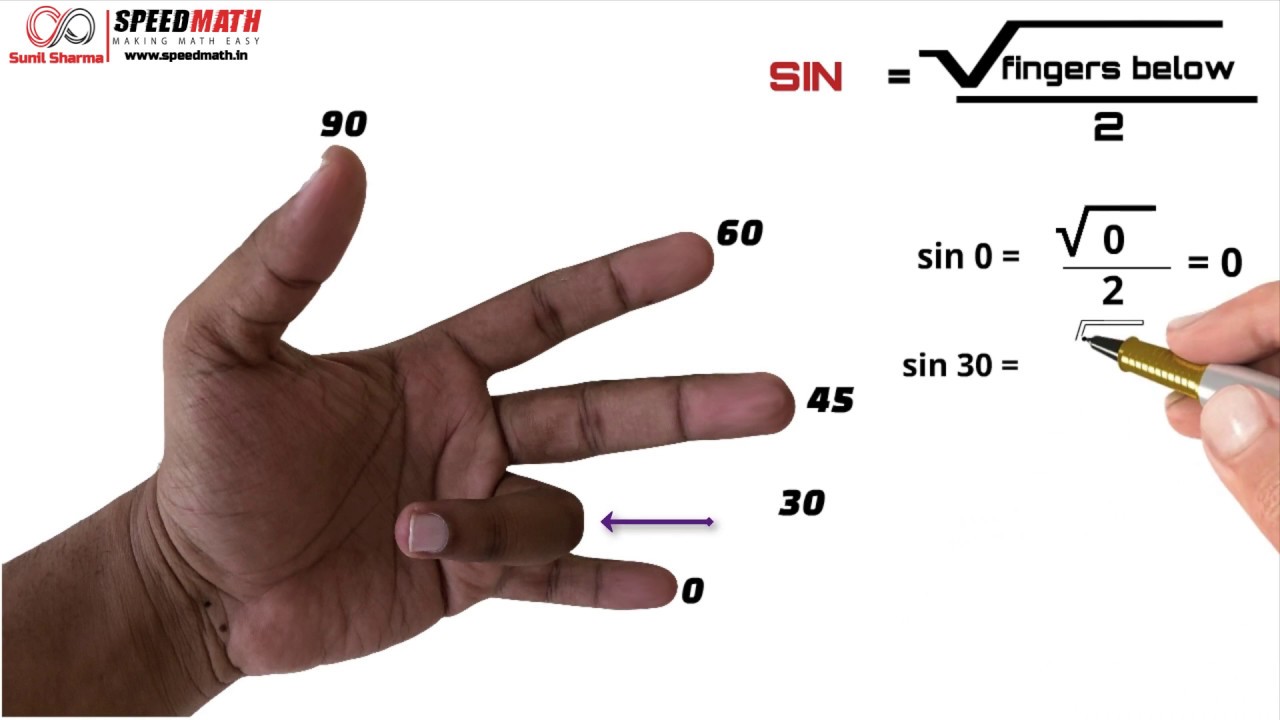
Use the Hand Trick for trig functions.
https://www.youtube.com/watch?v=TyrM8G1MqiI
Please watch: "(1) 3 BULBS 3 SWITCHES PUZZLE (SHORT ANIMATION) "
https://www.youtube.com/watch?v=mimJh6fBKvY --~--
The best method to remember trigonometric values using Hand Trick. No need to write or memorise values. I'm sure you will enjoy. Do post comments and hit like button if you like this trick.
How to write any table...
tardy dragon
Yes you can find values of diff trigo ratio by taking the value of t which is angle written in radian
Can you show me the exercise from 17-26 which they are asking about
gusty carbon
 tardy dragon
Only 17 and 23 is visible what about other
gusty carbon
They are the only 2 i was assigned
tardy dragon
Ok so for both the angles mentioned in q17 and q23 you have to find the value of all the six trigo ratios
gusty carbon
Only sin cos and tan
gusty carbon
17 is the same equation as 11 so that’s why i was wondering what the real number was
tardy dragon
Q23 is in fourth quadrant so Sin and Tan will be negative and Cos will be positive
Yeah angle is same that is pi/4 but in 17 they asked about point and in 21 you have to find the value of trigo ratios
gusty carbon
How do i find the ratios
brisk obsidian
Have you learned about reference angles?
gusty carbon
Maybe but the name doesn’t make me think of anything
What am i supposed to do
<@&286206848099549185>
.close
full forumBOT
Channel closed
Closed by @gusty carbon
Use .reopen if this was a mistake.
full forumBOT
Available help channel!
Send your question here to claim the channel.
Remember:
• Ask your math question in a clear, concise manner.
• Show your work, and if possible, explain where you are stuck.
• After 15 minutes, feel free to ping <@&286206848099549185>.
• Type the command .close to free the channel when you're done.
• Be polite and have a nice day!
Read #❓how-to-get-help for further information on how to ask a good question, and about conduct in the question channels.
 boreal quest
 full forumBOT
boreal quest
boreal quest
full forumBOT
boreal quest
boreal quest
What'd I do wrong
glossy valveBOT

 boreal quest
 gritty rose
can't tell without your steps
gritty rose
can't tell without your steps
u = ln (t+4)
du = 1/t+4
dv = t dt
v = t^2/2
i just plugged that into uv - int v du
then i used synthetic division to obtain int( t - 4 + 16/t+4)
integral of that is t^2/2 - t + 16ln(t+4)
boreal quest
glossy valve
it looks like they moved some things around and divided some terms
idk
gritty rose
boreal quest
then i used synthetic division to obtain int( t - 4 + 16/t+4)
integral of -4 is not -t
boreal quest
oh -4t
gritty rose
yea that should fix it
full forumBOT
Channel closed
Closed by @boreal quest
Use .reopen if this was a mistake.
full forumBOT
Available help channel!
Send your question here to claim the channel.
Remember:
• Ask your math question in a clear, concise manner.
• Show your work, and if possible, explain where you are stuck.
• After 15 minutes, feel free to ping <@&286206848099549185>.
• Type the command .close to free the channel when you're done.
• Be polite and have a nice day!
Read #❓how-to-get-help for further information on how to ask a good question, and about conduct in the question channels.
 short ermine
idk how to do these mann..

 full forumBOT
short ermine
idk how to do these mann..
full forumBOT
short ermine
idk how to do these mann..
Show your work, and if possible, explain where you are stuck.
 lofty linden
use the hint
short ermine
lol
 leaden ermine
short ermine
lol
leaden ermine
short ermine
lol
|||a||b| = |ab|, bring it to the other side and try to resolve the abs. value||
full forumBOT
@short ermine Has your question been resolved?
full forumBOT
Channel closed
Closed due to timeout
Use .reopen if this was a mistake.
Available help channel!
Send your question here to claim the channel.
Remember:
• Ask your math question in a clear, concise manner.
• Show your work, and if possible, explain where you are stuck.
• After 15 minutes, feel free to ping <@&286206848099549185>.
• Type the command .close to free the channel when you're done.
• Be polite and have a nice day!
Read #❓how-to-get-help for further information on how to ask a good question, and about conduct in the question channels.
 fathom void
f,g R->R
f',g linear functions
red is f'
blue is g
a∈R
f and g for every x∈R satisfy
(fog)(x)=f(-2x+a)
g(2)+g'(2)?
 full forumBOT
fathom void
f,g R->R
f',g linear functions
red is f'
blue is g
a∈R
f and g for every x∈R sa...
fathom void
full forumBOT
fathom void
f,g R->R
f',g linear functions
red is f'
blue is g
a∈R
f and g for every x∈R sa...
fathom void
idk i tried like alot of different methods
i tried to use geometry
tried to use intercept
i just dont really know how to approach this
theres alot of info i can use but i dont really know where to use them appropritely
full forumBOT
@fathom void Has your question been resolved?
fathom void
.close
full forumBOT
Channel closed
Closed by @fathom void
Use .reopen if this was a mistake.
Available help channel!
Send your question here to claim the channel.
Remember:
• Ask your math question in a clear, concise manner.
• Show your work, and if possible, explain where you are stuck.
• After 15 minutes, feel free to ping <@&286206848099549185>.
• Type the command .close to free the channel when you're done.
• Be polite and have a nice day!
Read #❓how-to-get-help for further information on how to ask a good question, and about conduct in the question channels.
 faint lava
uh i differentiated f(x) but not sure what to do next
 faint lava

 spiral vigil
factor the other one
 bright bronze
What even is this? Why did the 6 disappear?
 spiral vigil
$24x^2 - 24x + 6$ \textbf{does not equal} $4x^2 - 4x + 1$
bright bronze
Include it as a factor
glossy valveBOT
hayley, who shakes the world
 faint lava
.close
full forumBOT
Channel closed
Closed by @faint lava
Use .reopen if this was a mistake.
full forumBOT
Available help channel!
Send your question here to claim the channel.
Remember:
• Ask your math question in a clear, concise manner.
• Show your work, and if possible, explain where you are stuck.
• After 15 minutes, feel free to ping <@&286206848099549185>.
• Type the command .close to free the channel when you're done.
• Be polite and have a nice day!
Read #❓how-to-get-help for further information on how to ask a good question, and about conduct in the question channels.
 simple fox
need help with integral
full forumBOT
simple fox
need help with integral


 limpid scroll
simple fox
limpid scroll
simple fox
do you know about trig sub?
simple fox
can you elaborate
limpid scroll
trigonometric substitution
simple fox
kinda
limpid scroll
you should substitute y=tanu to remove the square root and evaluate the integral from there onwards
simple fox
huh
limpid scroll
y = tan(x) , dy = sec^2(x) dx
simple fox
we dont use things like this
limpid scroll
oh
simple fox
i never used smt like this in integrals
limpid scroll
what techniques have you been taught to solve integrals
 simple fox
limpid scroll
what techniques have you been taught to solve integrals
simple fox
limpid scroll
what techniques have you been taught to solve integrals
just the basics
limpid scroll
like?
simple fox
welp i havent seen an integrl like that one
limpid scroll
the integral is a standard integral and it evaluates to arcsinh(y)
 lilac oyster
simple fox
lilac oyster
simple fox
these actually are the same up to adding a constant, it just wont be the same +C
there's a difference of pi/2
 full forumBOT
@simple fox Has your question been resolved?
 full forumBOT
@simple fox Has your question been resolved?
 torn lake
simple fox
torn lake
simple fox
.close
full forumBOT
Channel closed
Closed by @simple fox
Use .reopen if this was a mistake.
full forumBOT
Available help channel!
Send your question here to claim the channel.
Remember:
• Ask your math question in a clear, concise manner.
• Show your work, and if possible, explain where you are stuck.
• After 15 minutes, feel free to ping <@&286206848099549185>.
• Type the command .close to free the channel when you're done.
• Be polite and have a nice day!
Read #❓how-to-get-help for further information on how to ask a good question, and about conduct in the question channels.
 violet nebula
The number 64 has the property that it is divisible by its unit digit. How many whole numbers between 10 and 50 have this property?
i saw that the answer for this is 17, and the numbers are:
11,21,31,41,12,22,32,42,33,24,44,15,25,35,45,36, and 48
im confused on why 39 isnt included in here, it's divisible by 3, which is its unit digit, so why is this the case?
full forumBOT
violet nebula
The number 64 has the property that it is divisible by its unit digit. How many ...
violet nebula
ohh my bad
what if they ask if the number is divisible by atleast one of its digits, as in either 3 or 9 can divide 39, what would i do then?
 boreal slate
then yes, 39 would count since 3 divides into 39
another number that would be included for example would be 26
violet nebula
how would i find how many numbers this property applies to
boreal slate
i would assume brute force
actually not really, but still kinda
the number ab = 10*a+b, if you want a to divide into ab, then a divides into b
similarly, if you want be to divide into ab, then b needs to divide into 10*a
so you can list out the possibilities
but i dont know if it will be faster than brute force for a small range
full forumBOT
@violet nebula Has your question been resolved?
violet nebula
thanks
full forumBOT
Channel closed
Closed by @violet nebula
Use .reopen if this was a mistake.
Available help channel!
Send your question here to claim the channel.
Remember:
• Ask your math question in a clear, concise manner.
• Show your work, and if possible, explain where you are stuck.
• After 15 minutes, feel free to ping <@&286206848099549185>.
• Type the command .close to free the channel when you're done.
• Be polite and have a nice day!
Read #❓how-to-get-help for further information on how to ask a good question, and about conduct in the question channels.
 hallow walrus
 full forumBOT
hallow walrus
hallow walrus
full forumBOT
hallow walrus
hallow walrus
I feel like for this one we take a basis of kerS and then extend it to a basis of kerT
This is what I've done so far

not too sure what to do next
I know I can't prove the existence of E by assuming that it exists, but I'm just trying to see what properties E would satisfy if it existed
E has to be a map from rangeS to rangeT
and I believe rangeT is a subspace of rangeS
so a surjective map definitely exists
 stiff musk
possible strategy: show that {Sv_i} are linearly independent for i = k+1 through n
then define E by sending each Sv_i where it needs to go
hallow walrus
I've shown a result like that before so yeah
hallow walrus
stiff musk
then *define* E by sending each Sv_i where it needs to go
ah because {Sv_i} for i=k+1 through n forms a basis of rangeS
stiff musk
right
hallow walrus
so I just send Sv_i to 0 for i=k+1 through m and to Tv_i for i=m+1 through n
stiff musk
yep that's what i was thinking
hallow walrus
hallow walrus
and I believe rangeT is a subspace of rangeS
@topaz valley why is this false?
 topaz valley
you have no reason to expect that to be true
stiff musk
hallow walrus
<@118663865264242688> why is this false?
it's easy to construct an S and T that have the same kernel but different ranges
hallow walrus
oh of course
I saw dim range S >= dim range T and assumed that that meant that range T is a subspace of range S

actually I need injectivity to use 3B.9
I'll come back to this in a bit
.close
full forumBOT
Channel closed
Closed by @hallow walrus
Use .reopen if this was a mistake.
stiff musk
hallow walrus
actually I need injectivity to use 3B.9
try showing it directly then
if v_1 through v_k are a basis for ker(S) then {Sv_i} for i > k will still be LI
hallow walrus
stiff musk
try showing it directly then
Yeah that doesn't seem too bad
full forumBOT
Available help channel!
Send your question here to claim the channel.
Remember:
• Ask your math question in a clear, concise manner.
• Show your work, and if possible, explain where you are stuck.
• After 15 minutes, feel free to ping <@&286206848099549185>.
• Type the command .close to free the channel when you're done.
• Be polite and have a nice day!
Read #❓how-to-get-help for further information on how to ask a good question, and about conduct in the question channels.
 proud crown
What is another way to see this for it to be easier to find its derivative?
 full forumBOT
proud crown
What is another way to see this for it to be easier to find its derivative?
leaden ermine
full forumBOT
proud crown
What is another way to see this for it to be easier to find its derivative?
leaden ermine
Maybe implicit differentiation
[ y^2 = x+\sqrt{x+\sqrt{x}} ]
or let $f(x) = \sqrt{x}$ then
[ y = f(x+f(x+f(x))) ]
proud crown
aaah, I see. I havent done implicit yet, its like the next topic
[(x+(x+(x)^1/2)^1/2)^1/2]
I wanted to do this and do chain rule, but I get lost
glossy valveBOT
anti-algebraist 𝔸dωn𝓲²s
 proud crown
what?
leaden ermine
just start
proud crown
with which one??
leaden ermine
we can divide the problem in sub problems
,, y = \sqrt{x+\sqrt{x+\sqrt{x}}} = \sqrt{g(x)}
glossy valveBOT
anti-algebraist 𝔸dωn𝓲²s
 leaden ermine
Use first chain rule with sqrt(g(x))
proud crown
So 1/2(g(x))^-1/2 * derivative of g(x) ?
leaden ermine
yes
proud crown
alright
leaden ermine
then figure what is g'(x) where g(x) = x+sqrt(x+sqrt(x)) = x+sqrt(h(x))
for example
,, y' = \frac{1}{2\sqrt{g(x)}} \cdot g'(x) = \frac{1}{2\sqrt{g(x)}} \cdot \left ( x + \sqrt{h(x)} \right )'
glossy valveBOT
anti-algebraist 𝔸dωn𝓲²s
 leaden ermine
h(x) = x + sqrt(x)
proud crown
oooh so g(x) is all of the equation while h(x) is what comes after the first square root?
leaden ermine
g(x) = x + sqrt(x+sqrt(x)) = x + sqrt(h(x))
proud crown
okokk
leaden ermine
yea my brain kinda slow
proud crown
so many square roots is confusing me
leaden ermine
me too
,, y' = \frac{1}{2\sqrt{g(x)}} \cdot \left ( x + \sqrt{h(x)} \right )' = \frac{1}{2\sqrt{g(x)}} \cdot \left ( 1 + \frac{1}{2\sqrt{h(x)}} \cdot h'(x) \right )
glossy valveBOT
anti-algebraist 𝔸dωn𝓲²s
 leaden ermine
you basically work yourself from outer to inner
proud crown
yeaa
leaden ermine
sqrt(bla) then bla = x+sqrt(bla2) then bla2 = x+sqrt(x) haha
proud crown
its almost the same expression for the three, but once I find the derivative of the inner, the x turns to 1 + the other derivative
leaden ermine
ya
proud crown
so let me tell you what I got
leaden ermine
ok i will
proud crown
im sorry if left it all expressed

 full forumBOT
Channel closed
Closed by @proud crown
Use .reopen if this was a mistake.
full forumBOT
Available help channel!
Send your question here to claim the channel.
Remember:
• Ask your math question in a clear, concise manner.
• Show your work, and if possible, explain where you are stuck.
• After 15 minutes, feel free to ping <@&286206848099549185>.
• Type the command .close to free the channel when you're done.
• Be polite and have a nice day!
Read #❓how-to-get-help for further information on how to ask a good question, and about conduct in the question channels.
 final cliff
In the vector space P2[x] of polynomials of degree ≤ 2, we have 4 vectors u₁ = 2 - x, u₂ = 1 + 2x + 7x², u₃ = -3 + 2x + x², and v = 3 + 7x + mx². Find the value of m∈ R such that v is in the span of {u₁, u₂, u₃}."
full forumBOT
final cliff
In the vector space P2[x] of polynomials of degree ≤ 2, we have 4 vectors u₁ = 2...
gritty rose
final cliff
can someone check for me pls?
Show work
final cliff
gritty rose
Show work
rank of u1 u2 u3 column matrix is 3
if add v in that matrix aswell rank still 3
so m can be whatever
 sacred sparrow
final cliff
rank of u1 u2 u3 column matrix is 3
if add v in that matrix aswell rank still 3...
sacred sparrow
final cliff
rank of u1 u2 u3 column matrix is 3
if add v in that matrix aswell rank still 3...
then you have your answer
full forumBOT
Channel closed
Closed by @final cliff
Use .reopen if this was a mistake.
full forumBOT
Available help channel!
Send your question here to claim the channel.
Remember:
• Ask your math question in a clear, concise manner.
• Show your work, and if possible, explain where you are stuck.
• After 15 minutes, feel free to ping <@&286206848099549185>.
• Type the command .close to free the channel when you're done.
• Be polite and have a nice day!
Read #❓how-to-get-help for further information on how to ask a good question, and about conduct in the question channels.
 ionic tide
how to solve this? please help
 full forumBOT
ionic tide
how to solve this? please help
full forumBOT
ionic tide
how to solve this? please help
 drowsy summit
show what have you done pls
 severe linden
!show
full forumBOT
Show your work, and if possible, explain where you are stuck.
sacred sparrow
ionic tide
how to solve this? please help
are we supposed to be the lackeys 🦆
full forumBOT
@ionic tide Has your question been resolved?
full forumBOT
Channel closed
Closed due to timeout
Use .reopen if this was a mistake.
Available help channel!
Send your question here to claim the channel.
Remember:
• Ask your math question in a clear, concise manner.
• Show your work, and if possible, explain where you are stuck.
• After 15 minutes, feel free to ping <@&286206848099549185>.
• Type the command .close to free the channel when you're done.
• Be polite and have a nice day!
Read #❓how-to-get-help for further information on how to ask a good question, and about conduct in the question channels.
 storm hinge
for this question would i use u substitution and let u= 1-x^4

 sudden condor
storm hinge
for this question would i use u substitution and let u= 1-x^4
sudden condor
storm hinge
for this question would i use u substitution and let u= 1-x^4
yea
 foggy vapor
Yes that works
storm hinge
like this right
 sudden condor
storm hinge
like this right
sudden condor
storm hinge
like this right
yep looks good
storm hinge
okay and i always forget how/where to write in the du=-4x^3 into the function
sudden condor
storm hinge
okay and i always forget how/where to write in the du=-4x^3 into the function
du=-4x^3dx divide both sides by -4x^3 and it'll be
du/(-4x^3)=dx
 steel solar
storm hinge
okay and i always forget how/where to write in the du=-4x^3 into the function
steel solar
storm hinge
okay and i always forget how/where to write in the du=-4x^3 into the function
where do you see an x^3 term in the integrand?
hollow herald
sudden condor
du=-4x^3dx divide both sides by -4x^3 and it'll be
du/(-4x^3)=dx
It'd be better to write as x³ dx = -du/4
steel solar
and what is the constant multiplying it? (i.e., what should you divide on both sides of the expression du=-4x^3 to get your x^3 term)?
sudden condor
hollow herald
It'd be better to write as x³ dx = -du/4
that's cool tbh
 vale flax
can someone help me??
 sudden condor
vale flax
can someone help me??
sudden condor
vale flax
can someone help me??
!occupied
full forumBOT
vale flax
can someone help me??
Someone else is already using this help channel. If you need help with a question, please open your own help channel/thread (see #❓how-to-get-help for instructions).
storm hinge
hollow herald
It'd be better to write as x³ dx = -du/4
y is this better? where would i go into the function ?
steel solar
storm hinge
y is this better? where would i go into the function ?
$\int\cos(1-x^4)\cdot x^3dx$
glossy valveBOT
;(
 steel solar
remember what i said yesterday or whenever that was
hollow herald
It is immediate that this is int cos u • (-du / 4)
storm hinge
steel solar
remember what i said yesterday or whenever that was
ya but i still dont understand this part because where did the du/4 go?
steel solar
storm hinge
ya but i still dont understand this part because where did the du/4 go?
wdym
we ahve that $du=-4x^3dx$, so $-\frac{du}{4}=x^3dx$, which fits right into the equation
glossy valveBOT
;(
 storm hinge
i just dont understand where in the function there is -du/4 that we can sub x^3 dx into. am i missing a step in my work because i only have dx

is it not easier to just have dx+ du/-4x^3
steel solar
storm hinge
i just dont understand where in the function there is -du/4 that we can sub x^3 ...
$\int\cos(1-x^4)\cdot x^3dx$
glossy valveBOT
;(
 storm hinge
i see that function but i dont know how u got there
storm hinge
okay so is the x^3 is coming from the original function not the u substitution?
steel solar
storm hinge
i see that function but i dont know how u got there
i just rearraganged using communative property
steel solar
storm hinge
okay so is the x^3 is coming from the original function not the u substitution?
yep
storm hinge
okay this whole time i thought it was still part of the u-substitution and i was sooo confused now i get it!
okay
steel solar
storm hinge
okay this whole time i thought it was still part of the u-substitution and i was...
👍
full forumBOT
Channel closed
Closed by @storm hinge
Use .reopen if this was a mistake.
full forumBOT
Available help channel!
Send your question here to claim the channel.
Remember:
• Ask your math question in a clear, concise manner.
• Show your work, and if possible, explain where you are stuck.
• After 15 minutes, feel free to ping <@&286206848099549185>.
• Type the command .close to free the channel when you're done.
• Be polite and have a nice day!
Read #❓how-to-get-help for further information on how to ask a good question, and about conduct in the question channels.
 zealous plank
how would i solve this
 full forumBOT
zealous plank
how would i solve this
zealous plank
full forumBOT
zealous plank
how would i solve this
zealous plank
so far i split it with addition formula and got
 gritty flax
You mean simplify?
zealous plank
mb
zealous plank
gritty flax
You mean simplify?
that=1
gritty flax
Oh ok
zealous plank
sin(3x+pi/6)=1
 manic marlin
zealous plank
so far i split it with addition formula and got
manic marlin
zealous plank
so far i split it with addition formula and got
isnt that overcomplicating it
zealous plank
manic marlin
isnt that overcomplicating it
is it?
sudden condor
zealous plank
sin(3x+pi/6)=1
y=3x+pi/6
sin(y)=1
gritty flax
You can rewrite it as sin(3x + pi/6) = sin(2kpi + pi/2) with k integers
manic marlin
just use the general solution arcsin(1)
and then
3x + pi/6 = npi * (-1)^n(pi/2)
wouldnt that work?
zealous plank
manic marlin
just use the general solution arcsin(1)
and then
3x + pi/6 = npi * (-1)^n(pi/2)
dont follow
like so?
 manic marlin
Yeah
zealous plank
oh yeah mb arcsin(1)
manic marlin
the general solition for sine is
npi + (-1)^n (alpha)
where alpha is the principle value obtained when using arcsin
so if arcsin(1) = pi/2
then
manic marlin
3x + pi/6 = npi + (-1)^n * (pi/2)
zealous plank
arcsin1=pi/2, 3x=pi/3, x=pi/9
manic marlin
manic marlin
3x + pi/6 = npi + (-1)^n * (pi/2)
simply subtract pi/6, divide by 3 to obtain the general solution for x
and then you can start plugging in n where n is an integer
manic marlin
manic marlin
3x + pi/6 = npi + (-1)^n * (pi/2)
You have to say this
zealous plank
zealous plank
this question is on interval 0<x<2pi
why use n pi
the question says find answer between 0 and 2pi
therefore no need for a general solution
manic marlin
zealous plank
the question says find answer between 0 and 2pi
yes
the value you obtain from arcsin
falls between -pi/2 and pi/2
in fact its pi/2
manic marlin
There are several values that work for sin(3x + pi/6) = 1
So you have to use general solution
manic marlin
I was never taught like that, so idk if that might work, let me check 1 sec
Hm
It does work
Well whatevers simplest for you
full forumBOT
Channel closed
Closed by @zealous plank
Use .reopen if this was a mistake.
Available help channel!
Send your question here to claim the channel.
Remember:
• Ask your math question in a clear, concise manner.
• Show your work, and if possible, explain where you are stuck.
• After 15 minutes, feel free to ping <@&286206848099549185>.
• Type the command .close to free the channel when you're done.
• Be polite and have a nice day!
Read #❓how-to-get-help for further information on how to ask a good question, and about conduct in the question channels.
 desert nebula
can sum1 help on this
 full forumBOT
desert nebula
can sum1 help on this
desert nebula
full forumBOT
desert nebula
can sum1 help on this
desert nebula
i dont get why he did tan A = H/b
gritty flax
desert nebula
i dont get why he did tan A = H/b
Tan(A) = côté oppose / côté adjacent
CahSohToa
desert nebula
gritty flax
Tan(A) = côté oppose / côté adjacent
i thought that was only for right angle triangles
gritty flax
Sachant qu'une tour est droite et le sol est pre-supposement plat on peut dire que c'est un triangle rectangle
Mais oui ils auraient dû le préciser
desert nebula
wouldnt it have to be like this though
 gritty flax
Le dessin n'est pas à l'échelle et non, il n'aurait pas été comme ça
desert nebula
where would the 90 degrees be\
gritty flax
The 90 degree wouldn't be on the base triangle
But on the one that link A, base of the tower and top of tower
 desert nebula
it looks like an angle obtus
desert nebula
wait mb but the b line looks like its going downward diagonally
gritty flax
Its perspective vision that make you think this
desert nebula
how would i know its a right triangle or not
gritty flax
They should mention it but in fact you can deduce with context
A tower is straight and the floor is supposed to be flat
So it makes a right angle
desert nebula
ohhhh ok i can see it now kinda in the perspective
gritty flax
Yes
full forumBOT
Channel closed
Closed by @desert nebula
Use .reopen if this was a mistake.
full forumBOT
Available help channel!
Send your question here to claim the channel.
Remember:
• Ask your math question in a clear, concise manner.
• Show your work, and if possible, explain where you are stuck.
• After 15 minutes, feel free to ping <@&286206848099549185>.
• Type the command .close to free the channel when you're done.
• Be polite and have a nice day!
Read #❓how-to-get-help for further information on how to ask a good question, and about conduct in the question channels.
 dense barn
Can anyone guide me to solve this no 18 sum
 full forumBOT
dense barn
Can anyone guide me to solve this no 18 sum
full forumBOT
dense barn
Can anyone guide me to solve this no 18 sum
 safe trench
,rotate
glossy valveBOT
 safe trench
!15min
full forumBOT
Please only use the <@&286206848099549185> ping once if your question has not been answered for 15 minutes. Please do not ping or DM individual users about your question.
 safe trench
Why did you cancel the powers
dense barn
Yes