#help-28
1 messages · Page 191 of 1
 edgy imp
edgy imp
edgy imp
actually i cannot understand the last part
 zinc chasm
Okey
The vector space is finite-dimensional, so there exists a family {e1, ..., e2} such that V = span(e1, ..., en)
Is that ok ?
edgy imp
yes
zinc chasm
From lemma 2.22, you then know that every linearly independant family of V has size <= n
zinc chasm
Fine !
zinc chasm
You are welcome !
edgy imp
.close
 full forumBOT
Channel closed
Closed by @edgy imp
Use .reopen if this was a mistake.
edgy imp
.reopen
full forumBOT
✅
full forumBOT
Channel closed
Closed by @edgy imp
Use .reopen if this was a mistake.
full forumBOT
 Available help channel!
Send your question here to claim the channel.
Remember:
• Ask your math question in a clear, concise manner.
• Show your work, and if possible, explain where you are stuck.
• After 15 minutes, feel free to ping <@&286206848099549185>.
• Type the command .close to free the channel when you're done.
• Be polite and have a nice day!
Read #❓how-to-get-help for further information on how to ask a good question, and about conduct in the question channels.
 floral lynx
 full forumBOT
floral lynx
floral lynx
full forumBOT
floral lynx
floral lynx
guys is this true
how to figure out whether 7^9 is bigger or 9^7 is bigger
any trick or logic i should go by
 thick hedge
here you could just get away by using the values of ln(7) and ln(9(
 hoary ember
floral lynx
how to figure out whether 7^9 is bigger or 9^7 is bigger
hoary ember
floral lynx
how to figure out whether 7^9 is bigger or 9^7 is bigger

Here's a very common question that asks to compare a^b vs. b^a. We will use the calculus derivative of the function f(x)=x^(1/x) to find its maximum. It's a great practice for calculus 1 students.
This video is inspired by my old video e^pi vs. pi^e: https://youtu.be/SPHD7zmLVa8
For more calculus tutorials, check out my new channel "just calcul...
 devout light
Hint: (7+2)^7 vs 7^{7+2}
devout light
hoary ember
https://youtu.be/L0XY6llSzyo?si=SLJejMP7v-3EBCAV
maybe?
Correct
floral lynx
devout light
Hint: (7+2)^7 vs 7^{7+2}
aahh
floral lynx
hoary ember
https://youtu.be/L0XY6llSzyo?si=SLJejMP7v-3EBCAV
maybe?
thanks a lot
.close
full forumBOT
Channel closed
Closed by @floral lynx
Use .reopen if this was a mistake.
full forumBOT
Available help channel!
Send your question here to claim the channel.
Remember:
• Ask your math question in a clear, concise manner.
• Show your work, and if possible, explain where you are stuck.
• After 15 minutes, feel free to ping <@&286206848099549185>.
• Type the command .close to free the channel when you're done.
• Be polite and have a nice day!
Read #❓how-to-get-help for further information on how to ask a good question, and about conduct in the question channels.
 short niche
how did they get the last line?
 full forumBOT
short niche
how did they get the last line?
full forumBOT
short niche
how did they get the last line?
@short niche Has your question been resolved?
full forumBOT
@short niche Has your question been resolved?
full forumBOT
Channel closed
Closed due to timeout
Use .reopen if this was a mistake.
Available help channel!
Send your question here to claim the channel.
Remember:
• Ask your math question in a clear, concise manner.
• Show your work, and if possible, explain where you are stuck.
• After 15 minutes, feel free to ping <@&286206848099549185>.
• Type the command .close to free the channel when you're done.
• Be polite and have a nice day!
Read #❓how-to-get-help for further information on how to ask a good question, and about conduct in the question channels.
 faint dock
 full forumBOT
faint dock
faint dock
full forumBOT
faint dock
faint dock
can someone help me find the laplace transform of this function
 pale oriole
!status
full forumBOT
What step are you on?
1. I don't know where to begin.
2. I have begun but got stuck midway.
3. I got an answer but I was told that it's wrong.
4. I got an answer and would like my work checked.
5. I have a question about someone else's work/solution.
6. I have completed the problem and don't need help anymore. Thank you.
7. None of the above
@faint dock Has your question been resolved?
faint dock
pale oriole
!status
sorry
i am not sure how the formula is written
is it 4cos^2(t*H(3t)) ?
pale oriole
i think its $4(\cos^2(t))H(3t)$
 glossy valveBOT
Flappie
 faint dock
ok so i tried the shift property
so it would be 4/3 * L{cos^2(t)*H(3t)}(s/3)
correct?
pale oriole
 faint dock
is it ok now?
pale oriole
$\mathcal{L}{4(\cos^2(t))H(3t)}(s)=\mathcal{L}\left{4\left(\frac12 (1+\cos(2x)\right)H(3t)\right}(s)$
glossy valveBOT
Flappie
 pale oriole
faint dock
so it would be 4/3 * L{cos^2(t)*H(3t)}(s/3)
pale oriole
faint dock
so it would be 4/3 * L{cos^2(t)*H(3t)}(s/3)
no
pale oriole
pale oriole
$\mathcal{L}\{4(\cos^2(t))H(3t)\}(s)=\mathcal{L}\left\{4\left(\frac12 (1+\cos(2x...
$=2\mathcal{L}{H(3t)+\cos(2x)H(3t)}(s)$
glossy valveBOT
Flappie
 pale oriole
you need to simplify it a bit more before you start doing stuff with it
pale oriole
glossy valve
**Flappie**
this is all done using the laplace transform properties
(and trig formula)
full forumBOT
Channel closed
Closed by @faint dock
Use .reopen if this was a mistake.
 upper osprey
glossy valve
**Flappie**
upper osprey
glossy valve
**Flappie**
.
full forumBOT
Available help channel!
Send your question here to claim the channel.
Remember:
• Ask your math question in a clear, concise manner.
• Show your work, and if possible, explain where you are stuck.
• After 15 minutes, feel free to ping <@&286206848099549185>.
• Type the command .close to free the channel when you're done.
• Be polite and have a nice day!
Read #❓how-to-get-help for further information on how to ask a good question, and about conduct in the question channels.
 obsidian lodge
Would anyone happen to know how to draw these two separate regions?
 obsidian lodge
According to the answer it should look like this

That phi is less than 30° but greater than 0°, what does that look like in a), if someone could draw in the image?
 ashen crescent
obsidian lodge
According to the answer it should look like this
ashen crescent
obsidian lodge
According to the answer it should look like this
 full forumBOT
@obsidian lodge Has your question been resolved?
full forumBOT
@obsidian lodge Has your question been resolved?
obsidian lodge
ashen crescent
Thanks, that makes sense.
If phi starts at 10°, and ends at 45°, how do we end up with the graph in b)? I can tell it needs to be in the first quadrant, but no clue what characteristics it'd give, such as the one pointed to by the red arrow. It seems to be diamond shaped 
 ashen crescent
obsidian lodge
Thanks, that makes sense.
If phi starts at 10°, and ends at 45°, how do we end...
ashen crescent
obsidian lodge
Thanks, that makes sense.
If phi starts at 10°, and ends at 45°, how do we end...
Phi is measuring the angle from positive z going clockwise
obsidian lodge
@ashen crescent

Is the intuition correct here
The 45° would be the edge, pointed to by the right arrow
Not sure why we return to 10° though 🤔
ashen crescent
Like that?
 obsidian lodge
Okay, but it is hard to tell where the 10° is shown
ashen crescent
Yeah that’s true
ashen crescent
obsidian lodge
<@301654480804642816>

This is how it would look if you only consider a cross section in the first quadrant of the yz plane
obsidian lodge
Interesting, but do you know why it oscillates between 10° and 45°?
Like it's 45° the first bottom half
Then it switches to going to 10°
ashen crescent
What do you mean oscillates
obsidian lodge
Is the figure 35° all the way here?
 ashen crescent
That would be 45
obsidian lodge
Okay I think I understand what it would look like if it was a full circle
I just saw it wrong
By oscillate I meant that it has a shape of diamond
Like it goes one direction then changes to another direction midway

Consider that diamond corner
But I realize that's not what this figure is anyway
It's all points between 10° and 45°
But could you help me understand how we know x, y, z can be drawn with the constraint on r? 0≤r≤5.
I've drawn out where the 5's are, but I don't see how the figures even touch it or get close it.
 obsidian lodge
But could you help me understand how we know x, y, z can be drawn with the const...
obsidian lodge
obsidian lodge
But could you help me understand how we know x, y, z can be drawn with the const...
@ashen crescent
ashen crescent
It doesn’t get close because of the constraint on phi
For a, phi goes to 30 degrees from positive z
If it continued to 90 degrees, it would reach the spots where you marked the radius of 5 and would look like a hemisphere
full forumBOT
@obsidian lodge Has your question been resolved?
obsidian lodge
@ashen crescent If we are not using the plot they did in a), how would you draw it?
For example, this is what I had in mind
For 0<=theta<=45

But I am not sure how to draw the top if my drawing is wrong
 ashen crescent
obsidian lodge
<@301654480804642816> If we are not using the plot they did in a), how would you...
ashen crescent
obsidian lodge
<@301654480804642816> If we are not using the plot they did in a), how would you...
I’m not sure what you mean
obsidian lodge
obsidian lodge
@ashen crescent is this drawing correct
ashen crescent
obsidian lodge
<@301654480804642816> is this drawing correct
Do you mean when swapping theta and phi?
obsidian lodge
@ashen crescent Yes
I might be mixing up theta and phi
But here I mean the angle between z and r is 45°
With that in mind, is the drawing correct
ashen crescent
Its slightly wrong
obsidian lodge
||feels like a hit or miss ||
ashen crescent
Since the radius is 5 then the top will be curved and the end of the ‘cone’ will hover over 2.5 mark
obsidian lodge
I am not sure what you mean by “the top” (1) and “end of the cone” (2), could you draw over my image and show what you mean with the color red for (1) and orange for (2) ? @ashen crescent
 ashen crescent
obsidian lodge
I am not sure what you mean by “the top” (1) and “end of the cone” (2), could yo...
ashen crescent
obsidian lodge
I am not sure what you mean by “the top” (1) and “end of the cone” (2), could yo...
Ignore (2), that was wrong
But notice how the red curves round into a sphere, whereas yours looks more like the orange one
obsidian lodge
@ashen crescent I don’t understand
ashen crescent
obsidian lodge
Maybe it's just me, but the black line at the top here makes it look like the top is supposed to be flat
obsidian lodge
ashen crescent
Maybe it's just me, but the black line at the top here makes it look like the to...
And my black is supposed to be your orange?
I might be slow at responding bc I’m painting my house
ashen crescent
obsidian lodge
And my black is supposed to be your orange?
your black should be the red part (within the bounds of course)
obsidian lodge
Hmm
What I intended to achieve with my black was just the silhouette of the figure
But I guess the silhouette also encompasses the curvature of your red
So your criticism is that my black is not curved enough, thereby giving the impression that the top surface is just flat with no slant?
I can see how you figure it should be the way you described, so since we are not employing the entire 0 to 90 degree interval, we need to make the top surface slanted to indicate that the radius is … long? Idk @ashen crescent
ashen crescent
obsidian lodge
I can see how you figure it should be the way you described, so since we are not...
the top surface is curved because of the restriction x^2 + y^2 + z^2 <= 5^2
obsidian lodge
Ok so the radial distance creates the curvature, got it.
obsidian lodge
ashen crescent
But in this image, what says we're not allowed to create a straight line (your curved red line)? As long as we've a radial distance that's 5, right?
Like this green line?

Sorry if I'm dragging this out, I could return to this later but I am doing multivariate calculus and don't know how important grasping this will be for later stages of the course.
ashen crescent
a radial distance of 5 will create the red line
the green line doesn't have a radial distance of 5 in the mid section, only on the end points
obsidian lodge
So you're saying eevery point on the red line maintains a constant radial distance r=5 from the origin, satisfying the equation 𝑥^2 + 𝑦^2 + 𝑧^2 = 25?
Although I'll admit that I don't know how to tell that "the midsection has a radial distance of 5 from the origin". Are those, as opposed to the green line, those (x, y, z) pairs that are ≤ 25?
ashen crescent
obsidian lodge
So you're saying eevery point on the red line maintains a constant radial distan...
yes this is true
if you get a string of 5cm, anchor one end and rotate the other end, it will trace out the red line
full forumBOT
Channel closed
Closed by @obsidian lodge
Use .reopen if this was a mistake.
full forumBOT
Available help channel!
Send your question here to claim the channel.
Remember:
• Ask your math question in a clear, concise manner.
• Show your work, and if possible, explain where you are stuck.
• After 15 minutes, feel free to ping <@&286206848099549185>.
• Type the command .close to free the channel when you're done.
• Be polite and have a nice day!
Read #❓how-to-get-help for further information on how to ask a good question, and about conduct in the question channels.
 torn jolt
hello
full forumBOT
torn jolt
hello
torn jolt
I’m trying to figure out this and I can’t do it

 civic bay
(h o f)(0) is the same thing as h ( f ( 0 ) )
as in
you figure out what f(0) is
and plug that into h
and figure out what h outputs
torn jolt
But I don’t know what f0 is
torn jolt
You get 0
torn jolt
so I take the 0 from the bottom and multiply it by the top?
civic bay
yes
so f(0) = 1
and you want h(f(0))
you now know that's the same thing as h(1)
what's h(1)?
civic bay
yes, they gave you h(z)
torn jolt
Hold on
civic bay
you want h(1)
civic bay
yes
torn jolt
Alright so then what do I do with the -5
torn jolt
oh W
civic bay
make sure you go back and understand how we got that
because it looks like you weren't sure if we were done with -5 or if we had more to do
they gave you f(z) and h(z), you want to find h(f(0))
to figure that out, you first figure out what f(0) is
and then plug that into h
and then whatever you get from that is your answer
you work from the inside to the outside
torn jolt
civic bay
they gave you f(z) and h(z), you want to find h(f(0))
Where did they give us this
civic bay
torn jolt
Where did they give us this
f(z) and h(z) are above the problem, they asked you to find (h o f)(0) but that notation is the same thing as h(f(0))
 civic bay
same thing, you'd find f(-2) first
you have a table, that first table tells you what f spits out when you input certain x
torn jolt
The certain x is -2 right
torn jolt
-2
civic bay
great, now that output is f(-2)
and then you want h(f(-2))
so what does h give you when you input f(-2) which is -2?
torn jolt
2
civic bay
there's your answer
torn jolt
Oh that was easy
civic bay
should be lol either they give you the function itself or a table or a graph, and you just work from the inside out to find values
torn jolt
Alright now I got a graph
My choices are -7 -5 0 and 2
I think it’s 0
How do I figure it out

ok I was wrong it’s not 0
Ayy it was -5
But how does one get that answer
torn jolt
I’m not sure where to look
civic bay
the pink curve is h
torn jolt
Yeah
civic bay
figure out what the y coordinate on that curve is when the x coordinate is 1
that represents h(1)
torn jolt
-1?
civic bay
look again
 torn jolt
Not right at 0 it’s a little off
torn jolt
Alright
civic bay
i'm talking about right here
 torn jolt
oh that’s the X axis
civic bay
yes, and when you move 1 step to the right on the horizontal axis
to x = 1
your function has a y value of 0
what that tells you is that h(1) = 0
you repeat this process for g(h(1)) = g(0)
 full forumBOT
@torn jolt Has your question been resolved?
torn jolt
No it hasn’t
full forumBOT
@torn jolt Has your question been resolved?
torn jolt
No
pale oriole
!status
full forumBOT
What step are you on?
1. I don't know where to begin.
2. I have begun but got stuck midway.
3. I got an answer but I was told that it's wrong.
4. I got an answer and would like my work checked.
5. I have a question about someone else's work/solution.
6. I have completed the problem and don't need help anymore. Thank you.
7. None of the above
@torn jolt Has your question been resolved?
 glossy valveBOT
Flappie
 full forumBOT
@torn jolt Has your question been resolved?
torn jolt
No
torn jolt
glossy valve
**Flappie**
I have no idea
 sick raft
a
pale oriole
torn jolt
I have no idea
it means $h(f(0))$
glossy valveBOT
Flappie
 pale oriole
so, plug in f(0), and then plug that into h
full forumBOT
@torn jolt Has your question been resolved?
 charred oracle
full forumBOT
charred oracle
full forumBOT
Channel closed
Closed due to timeout
Use .reopen if this was a mistake.
Available help channel!
Send your question here to claim the channel.
Remember:
• Ask your math question in a clear, concise manner.
• Show your work, and if possible, explain where you are stuck.
• After 15 minutes, feel free to ping <@&286206848099549185>.
• Type the command .close to free the channel when you're done.
• Be polite and have a nice day!
Read #❓how-to-get-help for further information on how to ask a good question, and about conduct in the question channels.
 white cape
Yo
full forumBOT
white cape
Yo
full forumBOT
@white cape Has your question been resolved?
white cape
.close
full forumBOT
Channel closed
Closed by @white cape
Use .reopen if this was a mistake.
full forumBOT
Available help channel!
Send your question here to claim the channel.
Remember:
• Ask your math question in a clear, concise manner.
• Show your work, and if possible, explain where you are stuck.
• After 15 minutes, feel free to ping <@&286206848099549185>.
• Type the command .close to free the channel when you're done.
• Be polite and have a nice day!
Read #❓how-to-get-help for further information on how to ask a good question, and about conduct in the question channels.
 zenith thistle
 full forumBOT
zenith thistle
zenith thistle
full forumBOT
zenith thistle
zenith thistle
why was this equation used
thick hedge
that's the mid point formula
zenith thistle
thick hedge
that's the mid point formula
can u elaborate?
thick hedge
Like why we use that formula or how its derived ?
thick hedge
given two points $(x_0,y_0)$ and $(x_1,y_1)$; the mid point is $(\frac {x_0+x_1}{2}, \frac{y_0+y_1}{2})$
glossy valveBOT
ƒ(Why am. I here)=I don't Know
 thick hedge
so you don't need the derivation ?
zenith thistle
thick hedge
so you don't need the derivation ?
no but how are values subtitusted
zenith thistle
thick hedge
so you don't need the derivation ?
wait i dont understand the derivation
can u give it?
thick hedge
no
between two points on the xy plane
wait
nvm
misunderstood the question
just the distance between them /2
zenith thistle
so st/2?
thick hedge
yes
 thick hedge
that's the midpoint formula in one dimension
zenith thistle
what is the midpoint formula in 1d
thick hedge
$\frac{x_0 +x_1}{2}$
glossy valveBOT
ƒ(Why am. I here)=I don't Know
 zenith thistle
zenith thistle
zenith thistle
how did we get this equation from that formula?
thick hedge
can you ping helpers, I have some work to do
full forumBOT
@zenith thistle Has your question been resolved?
full forumBOT
Channel closed
Closed due to timeout
Use .reopen if this was a mistake.
Available help channel!
Send your question here to claim the channel.
Remember:
• Ask your math question in a clear, concise manner.
• Show your work, and if possible, explain where you are stuck.
• After 15 minutes, feel free to ping <@&286206848099549185>.
• Type the command .close to free the channel when you're done.
• Be polite and have a nice day!
Read #❓how-to-get-help for further information on how to ask a good question, and about conduct in the question channels.
 floral parcel
Can anyone give me advice on how to memorize derivatives of inverse hyperbolic functions?
full forumBOT
floral parcel
Can anyone give me advice on how to memorize derivatives of inverse hyperbolic f...
@floral parcel Has your question been resolved?
full forumBOT
Channel closed
Closed due to timeout
Use .reopen if this was a mistake.
full forumBOT
Available help channel!
Send your question here to claim the channel.
Remember:
• Ask your math question in a clear, concise manner.
• Show your work, and if possible, explain where you are stuck.
• After 15 minutes, feel free to ping <@&286206848099549185>.
• Type the command .close to free the channel when you're done.
• Be polite and have a nice day!
Read #❓how-to-get-help for further information on how to ask a good question, and about conduct in the question channels.
 summer python

 full forumBOT
summer python
summer python
full forumBOT
summer python
summer python
Is C correct?
 open zinc
Almost
 hardy snow
The coefficients are not accurate
open zinc
You forgot about division
summer python
What are the correct ones
hardy snow
What does 13/-52 simplify into
hardy snow
52 is not prime
summer python
MB
open zinc
summer python
What are the correct ones
All the x y z powers are right
summer python
MB
hardy snow
No it’s ok lol no one’s mad for your mistake
summer python
1/4
summer python
Did I get it?
hardy snow
everything else is right
summer python
LETS GOOOO
 wanton laurel
what a goat
hardy snow
summer python
1/4
Don’t forget the negative tho
wanton laurel
good luck man
hardy snow
👍
summer python
.close
full forumBOT
Channel closed
Closed by @summer python
Use .reopen if this was a mistake.
summer python
.reopen
full forumBOT
✅


 jolly gorge
No, -18/3 equals ?
 wanton laurel
Comic can i ask, what was the reason to put -6a^(-1/2) instead of -18?
jolly gorge
If the question does not specify that negatives are not allowed, then negative numbers are permissible in the answer.
And 6^(-1)=1/6
wanton laurel
jolly gorge
And 6^(-1)=1/6
oh no no
im asking because of the question
up there
its saying -18(bla bla)
jolly gorge
-6≠1/6

 jolly gorge
He thought he can't has negative in the answer, so she changed his answer to incorrect
full forumBOT
@summer python Has your question been resolved?
summer python
wanton laurel
Comic can i ask, what was the reason to put -6a^(-1/2) instead of -18?
Simplifying
summer python
Is ok
I just wanna make sure I know what I’m doing
Because the exam is gonnna cook me
It’s all the easy stuff
But I forgot how to do it 😭
wanton laurel
summer python
Because the exam is gonnna cook me
this is so relatable 😭
wanton laurel
summer python
But I forgot how to do it 😭
this is even more relatable 😭
full forumBOT
Channel closed
Closed due to timeout
Use .reopen if this was a mistake.
full forumBOT
Available help channel!
Send your question here to claim the channel.
Remember:
• Ask your math question in a clear, concise manner.
• Show your work, and if possible, explain where you are stuck.
• After 15 minutes, feel free to ping <@&286206848099549185>.
• Type the command .close to free the channel when you're done.
• Be polite and have a nice day!
Read #❓how-to-get-help for further information on how to ask a good question, and about conduct in the question channels.
 mossy zenith
 full forumBOT
mossy zenith
mossy zenith
full forumBOT
mossy zenith
mossy zenith
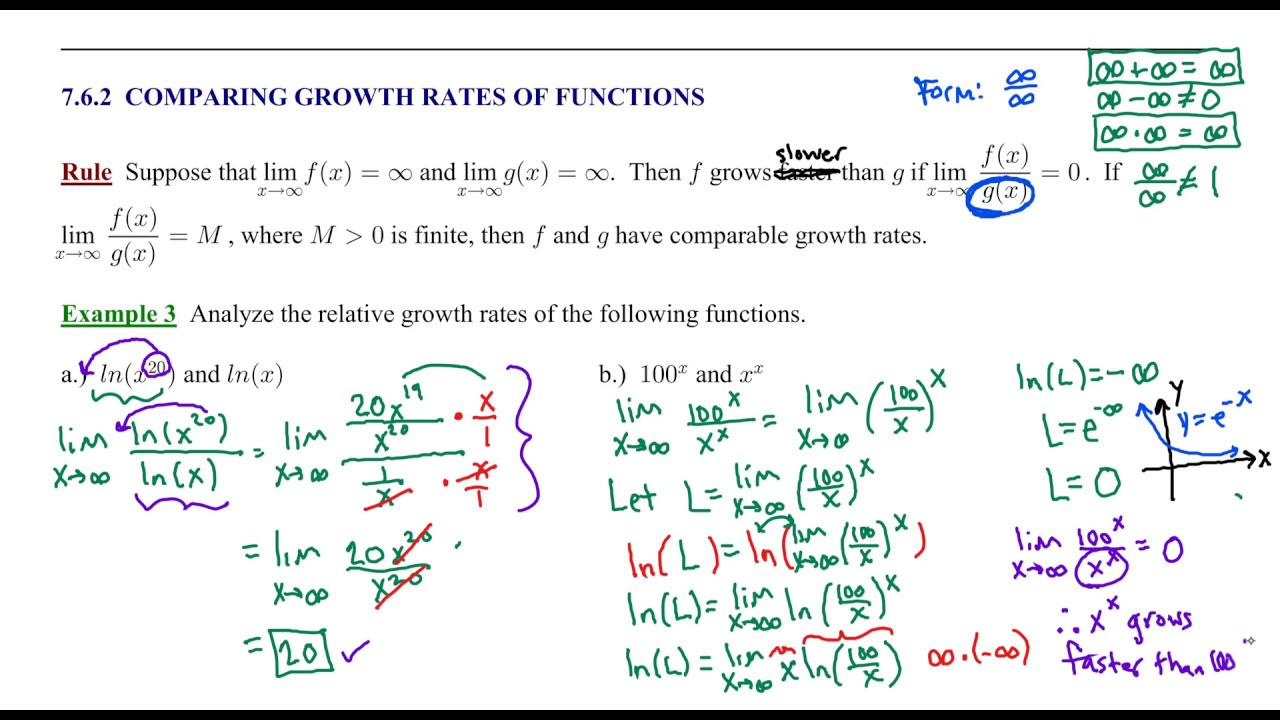
what method do i need to know inorder to solve this?
civic bay
you could probably do this using limits
civic bay
if (log_2(n))^3 is smaller than n when n gets big, that means that the function (log_2(n))^3 / n goes to 0 as n goes to infinity
 full forumBOT
@mossy zenith Has your question been resolved?
Channel closed
Closed by @mossy zenith
Use .reopen if this was a mistake.
 buoyant wharf
Closed by @mossy zenith
Use .reopen if this was a mistake.
full forumBOT
Available help channel!
Send your question here to claim the channel.
Remember:
• Ask your math question in a clear, concise manner.
• Show your work, and if possible, explain where you are stuck.
• After 15 minutes, feel free to ping <@&286206848099549185>.
• Type the command .close to free the channel when you're done.
• Be polite and have a nice day!
Read #❓how-to-get-help for further information on how to ask a good question, and about conduct in the question channels.
 pseudo cape
full forumBOT
pseudo cape
https://discord.com/channels/268882317391429632/328208536029102081/1253073808735...
pseudo cape
full forumBOT
pseudo cape
https://discord.com/channels/268882317391429632/328208536029102081/1253073808735...
@pseudo cape Has your question been resolved?
pseudo cape
.close
full forumBOT
Channel closed
Closed by @pseudo cape
Use .reopen if this was a mistake.
full forumBOT
Available help channel!
Send your question here to claim the channel.
Remember:
• Ask your math question in a clear, concise manner.
• Show your work, and if possible, explain where you are stuck.
• After 15 minutes, feel free to ping <@&286206848099549185>.
• Type the command .close to free the channel when you're done.
• Be polite and have a nice day!
Read #❓how-to-get-help for further information on how to ask a good question, and about conduct in the question channels.
 sturdy isle
How would I go about this?
 full forumBOT
sturdy isle
How would I go about this?
sturdy isle
full forumBOT
sturdy isle
How would I go about this?
sturdy isle
 verbal jolt
what does the perimeter mean
verbal jolt
what does the perimeter mean
the sides of all the shaded triangles added together
 steel cove
sturdy isle
How would I go about this?
steel cove
sturdy isle
How would I go about this?
Perimeter is obvious
sturdy isle
yeah
verbal jolt
ok, and you need help finding the area?
steel cove
For area, what is the height
steel cove
Good
steel cove
sturdy isle
So it's just 12*7.1 divided by 2?
Yea
sturdy isle
that's what i thought but i thought it was too easy to be true
full forumBOT
Channel closed
Closed by @sturdy isle
Use .reopen if this was a mistake.
full forumBOT
Available help channel!
Send your question here to claim the channel.
Remember:
• Ask your math question in a clear, concise manner.
• Show your work, and if possible, explain where you are stuck.
• After 15 minutes, feel free to ping <@&286206848099549185>.
• Type the command .close to free the channel when you're done.
• Be polite and have a nice day!
Read #❓how-to-get-help for further information on how to ask a good question, and about conduct in the question channels.
 viral hedge
Can someone please explain how the highlighted part holds true?

 ivory cairn
Convergence here means every open set containing the limit point also contains a point of the sequence.
This is a very simple example that shows the sequence b,b,b,b,b,b,b,.... obvioustly converges to b
But notice that every open set that contains a also contains b, namely the sets {a,b} and {a,b,c}
so this sequence also converges to a
(and the same argument works for c
viral hedge
ivory cairn
This is a very simple example that shows the sequence b,b,b,b,b,b,b,.... obvious...
I see, thanks! Interesting!
.close
full forumBOT
Channel closed
Closed by @viral hedge
Use .reopen if this was a mistake.
full forumBOT
Available help channel!
Send your question here to claim the channel.
Remember:
• Ask your math question in a clear, concise manner.
• Show your work, and if possible, explain where you are stuck.
• After 15 minutes, feel free to ping <@&286206848099549185>.
• Type the command .close to free the channel when you're done.
• Be polite and have a nice day!
Read #❓how-to-get-help for further information on how to ask a good question, and about conduct in the question channels.
torn jolt
hi guys what does width of 2 mean? whys it 0.02?
 full forumBOT
torn jolt
hi guys what does width of 2 mean? whys it 0.02?
full forumBOT
torn jolt
hi guys what does width of 2 mean? whys it 0.02?
 proven warren
Error for the confidence interval id assume
torn jolt
what would width of 1 be then, for example
full forumBOT
@torn jolt Has your question been resolved?
full forumBOT
Channel closed
Closed due to timeout
Use .reopen if this was a mistake.
Available help channel!
Send your question here to claim the channel.
Remember:
• Ask your math question in a clear, concise manner.
• Show your work, and if possible, explain where you are stuck.
• After 15 minutes, feel free to ping <@&286206848099549185>.
• Type the command .close to free the channel when you're done.
• Be polite and have a nice day!
Read #❓how-to-get-help for further information on how to ask a good question, and about conduct in the question channels.
 candid glade
 full forumBOT
candid glade
candid glade
full forumBOT
candid glade
candid glade
uh well i thought of factorizing here
 spice rose
do you know what the digamma function is?
candid glade
wdym by partial fractions
spice rose
there exist some A, B, C, st. A/4k² + B/6k + C/2 equal the part inside the sum
 stiff musk
write it as the sum or difference of two terms of the form 1/(k+a) and 1/(k+b)
spice rose
that's not how a series works
1/n as n goes to infinity approaches nothing finite, 1/n² does.
candid glade
i honestly hate theses telescoping sums, cuz its so hard to think what the terms will be
im stuck now 😭
spice rose
1/(2k+1)-1/(2(k+1)) I think?
stiff musk
candid glade
i honestly hate theses telescoping sums, cuz its so hard to think what the terms...
in general, first factor the denominator
stiff musk
in this case, 4k^2 + 6k + 2 = 2(2k^2 + 3k + 1) = 2(x+1)(2x+1)
candid glade
right
stiff musk
so you know you're gonna end up with something of the form A/(x+1) + B/(2x+1)
candid glade
oohh that makes sense
stiff musk
so you just solve for A and B by plugging in two values of x so you get two equations, two unknowns
candid glade
so this works for general questions too?
stiff musk
candid glade
so this works for general questions too?
only for ones where partial fractions are useful
in this case it's gonna be a telescoping sum
so definitely useful
stiff musk
yea this is kind of a general technique/trick for this class of problems
candid glade
also is it coming as ln2 then?
candid glade
spice rose
1/(2k+1)-1/(2(k+1)) I think?
no like i got this right
then plugging for k =0,1 and all
im getting
1 - 1/2
then
1/3 - 1/4
then
1/5 - 1/6
and then i need to sum it up
so
1 - 1/2 + 1/3 - 1/4....
this result is log 2 right
stiff musk
oh yep
stiff musk
but yea your work is right
candid glade
thannk you
stiff musk
sure, cheers
candid glade
.close
full forumBOT
Channel closed
Closed by @candid glade
Use .reopen if this was a mistake.
Available help channel!
Send your question here to claim the channel.
Remember:
• Ask your math question in a clear, concise manner.
• Show your work, and if possible, explain where you are stuck.
• After 15 minutes, feel free to ping <@&286206848099549185>.
• Type the command .close to free the channel when you're done.
• Be polite and have a nice day!
Read #❓how-to-get-help for further information on how to ask a good question, and about conduct in the question channels.
 compact cipher
is it correct to say that this function is non integrable because sinx/x^2 tends to infinity when x goes to 0 from the right side?
 full forumBOT
compact cipher
is it correct to say that this function is non integrable because sinx/x^2 tends...
stiff musk
full forumBOT
compact cipher
is it correct to say that this function is non integrable because sinx/x^2 tends...
stiff musk
that fact doesn't automatically imply it's not integrable
for example 1/sqrt(x) goes to infinity as x->0+, but it's still integrable
(in the vicinity of 0, not the tail)
full forumBOT
Channel closed
Closed by @compact cipher
Use .reopen if this was a mistake.
full forumBOT
Available help channel!
Send your question here to claim the channel.
Remember:
• Ask your math question in a clear, concise manner.
• Show your work, and if possible, explain where you are stuck.
• After 15 minutes, feel free to ping <@&286206848099549185>.
• Type the command .close to free the channel when you're done.
• Be polite and have a nice day!
Read #❓how-to-get-help for further information on how to ask a good question, and about conduct in the question channels.
 wheat spruce
what happens when I have -infinity^2? does it remain as -infinity or does it become infinity
full forumBOT
wheat spruce
what happens when I have -infinity^2? does it remain as -infinity or does it bec...
 gritty rose
wheat spruce
what happens when I have -infinity^2? does it remain as -infinity or does it bec...
gritty rose
wheat spruce
what happens when I have -infinity^2? does it remain as -infinity or does it bec...
have you learned limits
wheat spruce
gritty rose
have you learned limits
yeah
i'm doing one right now, where I have limit when a is -infinity and have arctg(a^2)
gritty rose
just plug in some large negative values for a and remember exponent rules
gritty rose
gritty rose
just plug in some large negative values for a and remember exponent rules
like a = -10, -100, -1000
wheat spruce
.close
full forumBOT
Channel closed
Closed by @wheat spruce
Use .reopen if this was a mistake.
full forumBOT
Available help channel!
Send your question here to claim the channel.
Remember:
• Ask your math question in a clear, concise manner.
• Show your work, and if possible, explain where you are stuck.
• After 15 minutes, feel free to ping <@&286206848099549185>.
• Type the command .close to free the channel when you're done.
• Be polite and have a nice day!
Read #❓how-to-get-help for further information on how to ask a good question, and about conduct in the question channels.
 glossy fern
I took the bottom of the tank as the reference point and seem to be getting an entirely different answer. I don't see where I'm going wrong. Can someone please help?
 full forumBOT
glossy fern
I took the bottom of the tank as the reference point and seem to be getting an e...
glossy fern
full forumBOT
glossy fern
I took the bottom of the tank as the reference point and seem to be getting an e...
glossy fern

it's eg 6.26
The solution is available on this link (https://openstax.org/books/calculus-volume-1/pages/6-5-physical-applications)

We can use integration to develop a formula for calculating mass based on a density function. First we consider a thin rod or wire. Orient the rod so it...
<@&286206848099549185>
💀
I'm gonna close this in a bit because I've to go somewhere, but if someone knows what I'm doing wrong, can you please ping me?
.close
full forumBOT
Channel closed
Closed by @glossy fern
Use .reopen if this was a mistake.
Available help channel!
Send your question here to claim the channel.
Remember:
• Ask your math question in a clear, concise manner.
• Show your work, and if possible, explain where you are stuck.
• After 15 minutes, feel free to ping <@&286206848099549185>.
• Type the command .close to free the channel when you're done.
• Be polite and have a nice day!
Read #❓how-to-get-help for further information on how to ask a good question, and about conduct in the question channels.
 bold sparrow
plz help
 full forumBOT
bold sparrow
plz help
glossy valveBOT
full forumBOT
bold sparrow
plz help
glossy valveBOT
pizzanator
 bold sparrow
<@&286206848099549185>
bold sparrow
gritty rose
Use product rule
which ones u which ones v thats what im confused on
gritty rose
bold sparrow
product
Yes
gritty rose
bold sparrow
im just confused which is u which is v
Try anything
gritty rose
bold sparrow
whcih is f(x) which is g(x)
Pick something and try taking the derivative
bold sparrow
.close
full forumBOT
Channel closed
Closed by @bold sparrow
Use .reopen if this was a mistake.
Available help channel!
Send your question here to claim the channel.
Remember:
• Ask your math question in a clear, concise manner.
• Show your work, and if possible, explain where you are stuck.
• After 15 minutes, feel free to ping <@&286206848099549185>.
• Type the command .close to free the channel when you're done.
• Be polite and have a nice day!
Read #❓how-to-get-help for further information on how to ask a good question, and about conduct in the question channels.
glossy valveBOT
ransik

 slender onyx
first there are some bad practices here
you shouldnt remove zero rows during elimination, just keep them in
also we're only putting coords into the matrix, there should be no right side of zeros bc we're not solving a system
lets recall this
$v_1,\dots,v_n$ are LI if and only if $\m{v_1 & \dots & v_n}$ has a pivot in every column
glossy valveBOT
RokettoJanpu
 slender onyx
whatever vectors we're checking become the columns, there should be no extra column of 0s
im not gonna go thru the elimination, thats just computational
,w rref[[1,1,1],[1,-1,0],[2,0,1],[0,-2,-1]]
glossy valveBOT


 Requested by rokettojanpu
slender onyx
Requested by rokettojanpu
slender onyx
yep
we need a base so heres another fact to recall
pivot rows form a basis of the rowspace (span of the rows)
so what we can do is put the coords as rows instead and apply the above
you must do the row ops yourself later but i can get the result now
,w rref[[1,1,2,0],[1,-1,0,-2],[1,0,1,-1]]
glossy valveBOT
 Requested by rokettojanpu
slender onyx
Requested by rokettojanpu
slender onyx
well what im using is this
pivot rows form a basis of the rowspace (span of the rows)
so the first two rows of the result, when we undo the coords, give a base of S
yes
full forumBOT
@torn jolt Has your question been resolved?
Channel closed
Closed by @wheat niche
Use .reopen if this was a mistake.
Available help channel!
Send your question here to claim the channel.
Remember:
• Ask your math question in a clear, concise manner.
• Show your work, and if possible, explain where you are stuck.
• After 15 minutes, feel free to ping <@&286206848099549185>.
• Type the command .close to free the channel when you're done.
• Be polite and have a nice day!
Read #❓how-to-get-help for further information on how to ask a good question, and about conduct in the question channels.
 dense edge
 full forumBOT
dense edge
dense edge
full forumBOT
dense edge
dense edge
are they basically saying both at the same time here?
~(p <-> q) is true when p <-> q is false
~(p <-> q) is false when p <-> q is true
but how do they know p and q have different truth values?

this doesn't make sense to me. the only way p -> q is false is when p is true and q is false
but otherwise it's always true


 torpid stag
'p ⟺ q' being true means both 'p ⟹ q' and 'q ⟹ p' are true at the same time.
dense edge
 dense edge
torpid stag
'p ⟺ q' being true means both 'p ⟹ q' *and* 'q ⟹ p' are true at the same time.
dense edge
torpid stag
'p ⟺ q' being true means both 'p ⟹ q' *and* 'q ⟹ p' are true at the same time.
but both p and q could be false to evaluate to true as well
when it comes to p -> q and q -> p
torpid stag
dense edge
but both p and q could be false to evaluate to true as well
'p ⟺ q' has the value true when both p and q are false, so that doesn't contradict anything.
dense edge
oh so it's talking about the actual evaluation, "true"
not the values of p or q
OK i think that makes sense now
both values, p and q, have to be either true or false to evaluate to true bidirectionally
torpid stag
The answer key is basically saying that 'p ⟺ q' is only only true when p and q have the same truth value, therefore 'p ⟺ q' is only false when p and q doesn't have the same truth value, i.e. have different truth values.
torpid stag
dense edge
OK i think that makes sense now
both values, p and q, have to be either true or ...

dense edge
'p ⟺ q' is only only true when p and q have the same truth value
that would have been a much better way to word it in the answer key
going at it only one way is confusing af
dense edge
torpid stag
The answer key is basically saying that 'p ⟺ q' is only only true when p and q h...
but i still don't understand the answer key

didn't we just say they can't have different values to evaluate to true both ways?
 dense edge
torpid stag
The point of interest is when 'p ⟺ q' is false.
dense edge
torpid stag
The point of interest is when 'p ⟺ q' is false.
but is the proposition also true when p <-> q is true?
what you said here makes sense to me:
'p ⟺ q' is only only true when p and q have the same truth value
dense edge
torpid stag
but this doesn't
torpid stag
'¬(p ⟺ q)' means the negation of 'p ⟺ q', so when 'p ⟺ q' is true '¬(p ⟺ q)' is false and when 'p ⟺ q' is false '¬(p ⟺ q)' is true.
dense edge
could the answer key have been rewritten like this?
The proposition ~p(p<->q) is true when p<->q is false, or when p<->q is true
dense edge
torpid stag
'¬(p ⟺ q)' means the negation of 'p ⟺ q', so when 'p ⟺ q' is true '¬(p ⟺ q)' is ...
hmmm
are you using a truth table to see this?
torpid stag
It's the literal definition of negation.
dense edge
oh right
torpid stag
dense edge
could the answer key have been rewritten like this?
`The proposition ~p(p<->q) i...
'¬(p ⟺ q)' is not true when 'p ⟺ q' is true.
dense edge
so it should maybe say:
The proposition ~p(p<->q) is true when p<->q is false
and
The proposition ~p(p<->q) is false when p<->q is true
just to be extra clear
but i guess that's implied with practice
it's just negation, that's it
I think I'm getting mixed up here thinking somehow I gotta use DeMorgan's law and distribution of negation
nothing like that is needed here to prove it
torpid stag
dense edge
so it should maybe say:
`The proposition ~p(p<->q) is true when p<->q is false`
...
I agree that saying ¬(p ⟺ q) is true only when p ⟺ q is false would have been more clear.
dense edge
torpid stag
I agree that saying `¬(p ⟺ q) is true only when p ⟺ q is false` would have been ...
or just mentioning the negation rule. nothing to do with "if, then"
torpid stag
torpid stag
I agree that saying `¬(p ⟺ q) is true only when p ⟺ q is false` would have been ...
But a proof is about communication. If we had to reduce everything to its bare bones, a simple proof would be pages long (trust me, I've seen one). Sometimes they leave things to the reader because the author deem them clearly enough implied, which seems to have been the case here.
It gets easier to bridge the gaps the more proofs you get through.
dense edge
but i guess the part that confuses me about this, when it comes to negation of "if, then" is that 3/4 chance for it to be true, 1/4 chance for it to be false
when you negate "if, then" it's still same odds for both? 3/4 chance for it to be true, 1/4 chance for it to be false
torpid stag
dense edge
nothing like that is needed here to prove it
In the end, if ever in doubt, you can always just construct a truth table.
dense edge
torpid stag
In the end, if ever in doubt, you can always just construct a truth table.
do you know what i'm getting at by odds for "if, then"?
3 out of 4 it will be true
1 out of 4 it will be false
TT=T
TF=F
FT=T
FF=T
if you negate this, it's still the same I guess?
FF=T
FT=T
TF=F
TT=T
torpid stag
Sorry, gotta go, I have a cheesecake in the oven I need to attend to
dense edge
np lol
full forumBOT
@dense edge Has your question been resolved?
full forumBOT
Channel closed
Closed due to timeout
Use .reopen if this was a mistake.
Available help channel!
Send your question here to claim the channel.
Remember:
• Ask your math question in a clear, concise manner.
• Show your work, and if possible, explain where you are stuck.
• After 15 minutes, feel free to ping <@&286206848099549185>.
• Type the command .close to free the channel when you're done.
• Be polite and have a nice day!
Read #❓how-to-get-help for further information on how to ask a good question, and about conduct in the question channels.
 grand sapphire
i'm going through a basic workbook and trying to apply by myself. if f = v(t), then could i say f = 1v(t) for this? t is an arbitrary value. not actually a question, but wondered if i understood the topic
 full forumBOT
grand sapphire
i'm going through a basic workbook and trying to apply by myself. if *f = v(t)*,...
full forumBOT
grand sapphire
i'm going through a basic workbook and trying to apply by myself. if *f = v(t)*,...
 hot knoll
Well it would depend which region you're in
Does f equal this picture?
And then v is some other function?
grand sapphire
yes
hot knoll
Ok cool
grand sapphire
and t is an input (?)
i'm self studying to understand and teach myself math, not really connected with syllabus
hot knoll
grand sapphire
and t is an input (?)
Yea this is correct
What you would say is
When t is between certain values then,
f(t) = v(t)
or
f(t) = 2*v(t)
or
f(t) = -2*v(t)
grand sapphire
why do you have t on f? f already equals to v(t), so i cant comprehend its necessity
thank you for all the answers
oh
i got it
thank you!
.close
full forumBOT
Channel closed
Closed by @grand sapphire
Use .reopen if this was a mistake.
full forumBOT
Available help channel!
Send your question here to claim the channel.
Remember:
• Ask your math question in a clear, concise manner.
• Show your work, and if possible, explain where you are stuck.
• After 15 minutes, feel free to ping <@&286206848099549185>.
• Type the command .close to free the channel when you're done.
• Be polite and have a nice day!
Read #❓how-to-get-help for further information on how to ask a good question, and about conduct in the question channels.
 opaque terrace
Hello everyone. I am learning about eigenvectors and eigenvalues in linear algebra, and I recently received some feedback from a quiz that I'm trying to understand. I have the following matrix A, where:
[
\begin{bmatrix}
\cos\theta & -\sin\theta \
\sin\theta & \cos\theta
\end{bmatrix}
]
full forumBOT
opaque terrace
Hello everyone. I am learning about eigenvectors and eigenvalues in linear algeb...
glossy valveBOT
RiverineDolphin
 opaque terrace
Now, I know how to find the eigenvalues and eigenvectors of A without any problems. They are:
\begin{align}
\mathrm{Det(A-I\lambda)} &= \begin{vmatrix}
\cos\theta -\lambda & -\sin\theta \
\sin\theta & \cos\theta - \lambda
\end{vmatrix} \
&= (\cos\theta-\lambda)^2 + \sin^2\theta = 0 \
&\implies \lambda_1 = \cos\theta - i\sin\theta \
&\implies \lambda_2 = \cos\theta + i\sin\theta
\end{align}
glossy valveBOT
RiverineDolphin
 opaque terrace
And their corresponding eigenvectors:
\begin{align}
v_1 &= \begin{bmatrix}i \ 1\end{bmatrix} \
v_2 &= \begin{bmatrix}-i \ 1\end{bmatrix}
\end{align}
glossy valveBOT
RiverineDolphin
 opaque terrace
However, when I submitted my response, I received the following feedback:

Where could I be wrong?
gritty rose
opaque terrace
Where could I be wrong?
Eigenvectors aren't unique
Try plugging in their x1 and x2
opaque terrace
I'm sorry, I'm not sure if I understand.
Are you saying that my eigenvectors are wrong, because they are not unique?
gritty rose
Find Ax1 and Ax2
No I'm not saying yours are wrong
If v is an eigenvector then so is cv for and constant c
opaque terrace
Oh. So in this case, if my eigenvectors were v_1 and v_2, the quiz was expecting them in the form of cv_1, and cv_2
Where c is... i?
gritty rose
Maybe!
opaque terrace
Yikes! Help me understand a bit more about eigenvectors, please
gritty rose
gritty rose
If v is an eigenvector then so is cv for and constant c
This really is all there is to know for this problem
gritty rose
gritty rose
Find Ax1 and Ax2
Do this
opaque terrace
Right now my conceptual understanding is that eigenvectors are vectors that do not change direction, when the matrix acts upon them
opaque terrace
gritty rose
Do this
I'm sorry if I'm not seeing it yet
Which x_1 and x_2?
Like, how should I set up the problem?
gritty rose
I guess you need to know the definition
An eigenvector v of a matrix A satisfies
Av = (constant) * v
Usually constant = lambda
gritty rose
gritty rose
An eigenvector v of a matrix A satisfies
Av = (constant) * v
So plug in v = x1
gritty rose
opaque terrace
However, when I submitted my response, I received the following feedback:
x1 here
opaque terrace
Oh, the x_1 from there
Okay, one moment. Let me compute this.
Okay, I got the following
[\begin{bmatrix}
\cos\theta & -\sin\theta \
\sin\theta & \cos\theta
\end{bmatrix}
\begin{bmatrix}
1 \
i
\end{bmatrix} =
\begin{bmatrix}
\cos\theta - i\sin\theta \
\sin\theta - i\cos\theta
\end{bmatrix}]
glossy valveBOT
RiverineDolphin
 opaque terrace
This looks correct, right?
Because the result on the RHS is [1, i] multiplied by the eigenvalue
So that is an eigenvector.
gritty rose
opaque terrace
Because the result on the RHS is [1, i] multiplied by the eigenvalue
And as your lambda1
opaque terrace
gritty rose
Try x2
Yes, x2 fulfills the identity too
Okay, so now I know why I was marked down on that mark
Am I correct to understand that for a given matrix
It has only a few eigenvalues
But it has infinite eigenvectors?
gritty rose
opaque terrace
But it has infinite eigenvectors?
Yes
opaque terrace
Ah, gotcha.
gritty rose
gritty rose
If v is an eigenvector then so is cv for and constant c
Because this
opaque terrace
opaque terrace
However, when I submitted my response, I received the following feedback:
The feedback implies I missed a final mark
Of the choices, I know the last value isn't correct, i.e. the eigenvectors are not (\sin\theta \plusminus i \cos\theta)
glossy valveBOT
RiverineDolphin
Compile Error! Click the  reaction for more information.
(You may edit your message to recompile.)
 opaque terrace
But I'm not sure if the second option is correct.
What does it mean, for "eigenvectors are obtained from ((\lambda - \cos\theta)x_1 + (\sin\theta)x_2 = \ldots)
glossy valveBOT
RiverineDolphin
 gritty rose
Solve their equations for x1 and x2 to see if you get eigenvectors
opaque terrace
Oh, okay
I will do it now.
@gritty rose I am not sure at all if I got it correct

Was I supposed to do a scalar multiplication followed by a matrix addition?
Afterwards... do I substitute for lambda_1, lambda_2, and expect to get a eigenvector?
All I got was a mess.
Oh, are they talking about components of x?
Ah, nevermind, I think I got it
.close
full forumBOT
Channel closed
Closed by @opaque terrace
Use .reopen if this was a mistake.
Available help channel!
Send your question here to claim the channel.
Remember:
• Ask your math question in a clear, concise manner.
• Show your work, and if possible, explain where you are stuck.
• After 15 minutes, feel free to ping <@&286206848099549185>.
• Type the command .close to free the channel when you're done.
• Be polite and have a nice day!
Read #❓how-to-get-help for further information on how to ask a good question, and about conduct in the question channels.
 fathom ore
can someone help me with linear algebra
full forumBOT
fathom ore
can someone help me with linear algebra
fathom ore
true or false
 potent night
False
full forumBOT
@fathom ore Has your question been resolved?
hot knoll
2 rows means 2 equations
Not every equation must mention every variable in the columns
So if you think about some simple 2 equation systems you might be able to come up with a useful example
Oh actually i just realized they specified augmented
So as an augmented it's actually just 2 variables
hot knoll
It is possible but not always true
So check the question carefully to answer
If they're simply asking generally it's false
If they're asking if it's possible to happen then it's true
full forumBOT
@fathom ore Has your question been resolved?
full forumBOT
@fathom ore Has your question been resolved?
full forumBOT
Channel closed
Closed due to timeout
Use .reopen if this was a mistake.
full forumBOT
Available help channel!
Send your question here to claim the channel.
Remember:
• Ask your math question in a clear, concise manner.
• Show your work, and if possible, explain where you are stuck.
• After 15 minutes, feel free to ping <@&286206848099549185>.
• Type the command .close to free the channel when you're done.
• Be polite and have a nice day!
Read #❓how-to-get-help for further information on how to ask a good question, and about conduct in the question channels.
 proper jacinth
quick question how did 1/ sqrtu become u to the 1/2
 proper jacinth
unless i just suck at intetgrating
proper jacinth
 split yacht
u ^ -1/2
split yacht
u ^ -1/2
thats what i thought too haha
i guess teacher messed up
thank u
proper jacinth
yea i also asked chatgpt and it said that too
gotta be a typo unless im missing something
 rocky vale
yeah u^-1/2 is right, but after integration it should be 2u^1/2 + C
proper jacinth
bet thank u
i think ill just tell the teacher
appreciate the help guys
.close
full forumBOT
Channel closed
Closed by @proper jacinth
Use .reopen if this was a mistake.
full forumBOT
Available help channel!
Send your question here to claim the channel.
Remember:
• Ask your math question in a clear, concise manner.
• Show your work, and if possible, explain where you are stuck.
• After 15 minutes, feel free to ping <@&286206848099549185>.
• Type the command .close to free the channel when you're done.
• Be polite and have a nice day!
Read #❓how-to-get-help for further information on how to ask a good question, and about conduct in the question channels.
 shut barn
For isometric projections, would drawing a pipe elbow be as simple as connecting perpendicular pipes by iso-circles (ellipses) as shown? It "looks" right to me but I can imagine there being some 3D geometry "skew" action needed. Thanks
 full forumBOT
shut barn
For isometric projections, would drawing a pipe elbow be as simple as connecting...
full forumBOT
shut barn
For isometric projections, would drawing a pipe elbow be as simple as connecting...
@shut barn Has your question been resolved?
shut barn
.close
full forumBOT
Channel closed
Closed by @shut barn
Use .reopen if this was a mistake.
full forumBOT
Available help channel!
Send your question here to claim the channel.
Remember:
• Ask your math question in a clear, concise manner.
• Show your work, and if possible, explain where you are stuck.
• After 15 minutes, feel free to ping <@&286206848099549185>.
• Type the command .close to free the channel when you're done.
• Be polite and have a nice day!
Read #❓how-to-get-help for further information on how to ask a good question, and about conduct in the question channels.
 wise tartan
what would two trends for this be?
 full forumBOT
wise tartan
what would two trends for this be?
full forumBOT
wise tartan
what would two trends for this be?
 lime ether
guess
wise tartan
uhh as male height increases male weight increases, and as female height decreases weight decreases
or is it asking like if its a strong positive trend
@lime ether is that right?
wise tartan
so for 2 trends can I say males have a strong positive trend and females have a moderate positive trend?
or do I say something else?
lime ether
yea i don’t know how strong i’d say it is
you can play with your words
moderate
fairly
relatively
etc
what matters is that it’s a positive correlation
wise tartan
so for 2 trends could I say that females have a moderate positive trend and males also have a moderate positive trend?
would those count for the 2 trends?
lime ether
yea sure
full forumBOT
@wise tartan Has your question been resolved?
Channel closed
Closed by @wise tartan
Use .reopen if this was a mistake.
Available help channel!
Send your question here to claim the channel.
Remember:
• Ask your math question in a clear, concise manner.
• Show your work, and if possible, explain where you are stuck.
• After 15 minutes, feel free to ping <@&286206848099549185>.
• Type the command .close to free the channel when you're done.
• Be polite and have a nice day!
Read #❓how-to-get-help for further information on how to ask a good question, and about conduct in the question channels.
 graceful vale
 full forumBOT
graceful vale
full forumBOT
graceful vale
 rough tundra
we use the unit circle when the radius is 1, in this case the radius is not necessarily 1
 onyx sleet
Pretty sure this is asking for answers in terms of x, y, and r
You cant assume the angle because it doesn’t tell you it
full forumBOT
@graceful vale Has your question been resolved?
Channel closed
Closed by @graceful vale
Use .reopen if this was a mistake.
full forumBOT
Available help channel!
Send your question here to claim the channel.
Remember:
• Ask your math question in a clear, concise manner.
• Show your work, and if possible, explain where you are stuck.
• After 15 minutes, feel free to ping <@&286206848099549185>.
• Type the command .close to free the channel when you're done.
• Be polite and have a nice day!
Read #❓how-to-get-help for further information on how to ask a good question, and about conduct in the question channels.
torn jolt
I have arrived to a different conclusion
full forumBOT
torn jolt
I have arrived to a different conclusion
torn jolt
Q. How can one infer that which is the smallest pythagorean triplet whose largest number is greater than a given number, say 17?
!occupied
full forumBOT
Someone else is already using this help channel. If you need help with a question, please open your own help channel/thread (see #❓how-to-get-help for instructions).
torn jolt
~~Should I call the moderators?~?
<@&268886789983436800> .
Q. How can one infer that which is the smallest pythagorean triplet whose largest number is greater than a given number, say 17?
I suppose we have to remember them.
<@&286206848099549185>
 plucky sable
shut barn
For isometric projections, would drawing a pipe elbow be as simple as connecting...
plucky sable
shut barn
For isometric projections, would drawing a pipe elbow be as simple as connecting...
This is math, not art
shut barn
plucky sable
This is math, not art
Some would say math is art 🤔 weird way to tell me you don't know the answer and are unfamiliar with 3D geometry lmao
plucky sable
graceful vale
Do you do this for fun, just asking or are u studying for an exam ord sum
torn jolt
plucky sable
Do you do this for fun, just asking or are u studying for an exam ord sum
thats irrelevant for you to know though
shut barn
torn jolt
thats irrelevant for you to know though
He's being an unhelpful idiot, don't mind him
torn jolt
well don't occupy my channel
arguing
Q. How can one infer that which is the smallest pythagorean triplet whose largest number is greater than a given number, say 17?
The original problem I had to solve was like this:
Find a triplet (a,b,c) where c>a,b and a>12, b>12
So we have to find min_c > 17
Where a,b,c are integers
yes
And 12^2 + 12^2 = 288 which is closer to 17^2
So....
plucky sable
shut barn
He's being an unhelpful idiot, don't mind him
Bro, i genuinely dont know, so insteand of saying i am an unhelpful idiot, be nice
torn jolt
@torn jolt you can
maybe
use
AM > GM
do you know it ?
yih
since its a pythegorean triplet c^2 = a^2 + b^2
(a^2 + b^2) > 2ab for distinct a , b is true for distinct positive a , b
right ?
yes
right
because (a-b)^2 > 0
so c^2 > 2ab
c<a+b
idk what now
torn jolt
torn jolt
so c^2 > 2ab
yeah since c , a b all are positive
c > sqrt(2ab)
so you can obtain C
which would be the nearest integer greater than sqrt(2ab)
if i am right
so c>sqrt2 * 12
yes
which is approx
,w root2 * 12
glossy valveBOT

 Requested by anjaliji_74295
torn jolt
Requested by anjaliji_74295
torn jolt
we would get 17
as the answer
wll
well
(15,8,17)
but i said b>12
but this is a numerical method so its not the best
it uses approximations
torn jolt
torn jolt
but i said b>12
yes
its wrong
my bad
thanks
I guess I just have to learn the triplets
.close
full forumBOT
Channel closed
Closed by @pulsar harness
Use .reopen if this was a mistake.
full forumBOT
Available help channel!
Send your question here to claim the channel.
Remember:
• Ask your math question in a clear, concise manner.
• Show your work, and if possible, explain where you are stuck.
• After 15 minutes, feel free to ping <@&286206848099549185>.
• Type the command .close to free the channel when you're done.
• Be polite and have a nice day!
Read #❓how-to-get-help for further information on how to ask a good question, and about conduct in the question channels.
 high bay
 high bay
hey could someone explain where the - 16,928cos(23t) comes from after the first part?
ashen crescent
high bay
hey could someone explain where the - 16,928cos(23t) comes from after the first ...
-2 * 92 * 92 from expanding the (92-92…)^2
high bay
oh right, it's foiling?
ashen crescent
Yes
full forumBOT
Channel closed
Closed by @high bay
Use .reopen if this was a mistake.
Available help channel!
Send your question here to claim the channel.
Remember:
• Ask your math question in a clear, concise manner.
• Show your work, and if possible, explain where you are stuck.
• After 15 minutes, feel free to ping <@&286206848099549185>.
• Type the command .close to free the channel when you're done.
• Be polite and have a nice day!
Read #❓how-to-get-help for further information on how to ask a good question, and about conduct in the question channels.
 ripe pike
How do you find the value of m and b if you're given this type of question:
points: (9,11) (12,a)
the equation is in form y=mx+b
full forumBOT
ripe pike
How do you find the value of m and b if you're given this type of question:
poi...
ripe pike
here is the question in question:

 viral jasper
ripe pike
How do you find the value of m and b if you're given this type of question:
poi...
viral jasper
ripe pike
How do you find the value of m and b if you're given this type of question:
poi...
m is change in y divided by change in x
ripe pike
yeah, but one of the coords in a variable
 leaden ermine
ripe pike
yeah, but one of the coords in a variable
leaden ermine
ripe pike
yeah, but one of the coords in a variable
Unless there is missing information, your slope will depend on a
full forumBOT
@ripe pike Has your question been resolved?
ripe pike
.close
full forumBOT
Channel closed
Closed by @ripe pike
Use .reopen if this was a mistake.
full forumBOT
@ripe pike Has your question been resolved?
ripe pike
.close
full forumBOT
Channel closed
Closed by @ripe pike
Use .reopen if this was a mistake.
Available help channel!
Send your question here to claim the channel.
Remember:
• Ask your math question in a clear, concise manner.
• Show your work, and if possible, explain where you are stuck.
• After 15 minutes, feel free to ping <@&286206848099549185>.
• Type the command .close to free the channel when you're done.
• Be polite and have a nice day!
Read #❓how-to-get-help for further information on how to ask a good question, and about conduct in the question channels.
 woeful anvil
What am I doing wrong? I don’t understand my mistake here
 leaden ermine
woeful anvil
What am I doing wrong? I don’t understand my mistake here
leaden ermine
woeful anvil
What am I doing wrong? I don’t understand my mistake here
it's actually f/g then f'g - fg' not fg' - f'g
so prob off by a minus
I also noticed this when you did product rule, you start with the inner function
but the issue is it works with product rule cause there is a plus so it's commutative (a+b = b+a), but with minus you will be off by a factor of (-1) because it's like trying (a-b = b-a)
woeful anvil
.close
full forumBOT
Channel closed
Closed by @woeful anvil
Use .reopen if this was a mistake.
Available help channel!
Send your question here to claim the channel.
Remember:
• Ask your math question in a clear, concise manner.
• Show your work, and if possible, explain where you are stuck.
• After 15 minutes, feel free to ping <@&286206848099549185>.
• Type the command .close to free the channel when you're done.
• Be polite and have a nice day!
Read #❓how-to-get-help for further information on how to ask a good question, and about conduct in the question channels.
woeful anvil
Am I doing this right?
 full forumBOT
woeful anvil
Am I doing this right?
full forumBOT
woeful anvil
Am I doing this right?
 hasty compass
 pulsar sigil
woeful anvil
Am I doing this right?
pulsar sigil
woeful anvil
Am I doing this right?
 full forumBOT
@woeful anvil Has your question been resolved?
woeful anvil
pulsar sigil
Fixed?
 pulsar sigil
woeful anvil
Fixed?
pulsar sigil
woeful anvil
Fixed?
🎉
full forumBOT
Channel closed
Closed due to timeout
Use .reopen if this was a mistake.
Available help channel!
Send your question here to claim the channel.
Remember:
• Ask your math question in a clear, concise manner.
• Show your work, and if possible, explain where you are stuck.
• After 15 minutes, feel free to ping <@&286206848099549185>.
• Type the command .close to free the channel when you're done.
• Be polite and have a nice day!
Read #❓how-to-get-help for further information on how to ask a good question, and about conduct in the question channels.
woeful anvil
(Sorry for bad handwriting), I’m kinda confused on this. Can someone check if I did it right or where my mistake is
 full forumBOT
woeful anvil
(Sorry for bad handwriting), I’m kinda confused on this. Can someone check if I ...
full forumBOT
woeful anvil
(Sorry for bad handwriting), I’m kinda confused on this. Can someone check if I ...
 static bramble
you didn't apply the product rule here
 full forumBOT
@woeful anvil Has your question been resolved?
woeful anvil
static bramble
you didn't apply the product rule here
I thought I did no?
I brought down the 1/2
pulsar sigil
$p \sqrt p = p^\frac{3}{2}$
glossy valveBOT
 full forumBOT
@woeful anvil Has your question been resolved?
full forumBOT
Channel closed
Closed by @woeful anvil
Use .reopen if this was a mistake.
full forumBOT
Available help channel!
Send your question here to claim the channel.
Remember:
• Ask your math question in a clear, concise manner.
• Show your work, and if possible, explain where you are stuck.
• After 15 minutes, feel free to ping <@&286206848099549185>.
• Type the command .close to free the channel when you're done.
• Be polite and have a nice day!
Read #❓how-to-get-help for further information on how to ask a good question, and about conduct in the question channels.
woeful anvil
Is number 45 a the same thing as (f*g)’(5)
 full forumBOT
woeful anvil
Is number 45 a the same thing as (f*g)’(5)
slender onyx
woeful anvil
Is number 45 a the same thing as (f*g)’(5)
full forumBOT
woeful anvil
Is number 45 a the same thing as (f*g)’(5)
slender onyx
woeful anvil
Is number 45 a the same thing as (f*g)’(5)
yes
full forumBOT
@woeful anvil Has your question been resolved?
Channel closed
Closed by @woeful anvil
Use .reopen if this was a mistake.
woeful anvil
.reopen
full forumBOT
✅
woeful anvil
Can someone help me get started on number 49? I’m kinda confused on how to begin
 static bramble
what information do you need to construct a tangent line?
woeful anvil
static bramble
what information do you need to construct a tangent line?
The slope
And the derivative
static bramble
those two mean the same thing
woeful anvil
static bramble
those two mean the same thing
How do I find the derivative of g(x) though?
woeful anvil
How are you suppose to differentiate a function inside of a function
static bramble
what if g was defined as something like g(x) = xsin(x)
could you find the derivative of that?
static bramble
no it would not
woeful anvil
ok
gritty rose
woeful anvil
uhhh
,tex .diff rules
glossy valveBOT

 gritty rose
You really need to memorize that
 full forumBOT
Channel closed
Closed by @woeful anvil
Use .reopen if this was a mistake.
full forumBOT
Available help channel!
Send your question here to claim the channel.
Remember:
• Ask your math question in a clear, concise manner.
• Show your work, and if possible, explain where you are stuck.
• After 15 minutes, feel free to ping <@&286206848099549185>.
• Type the command .close to free the channel when you're done.
• Be polite and have a nice day!
Read #❓how-to-get-help for further information on how to ask a good question, and about conduct in the question channels.
 crimson saffron
how do we find the “?”
