#help-28
1 messages · Page 149 of 1
 next basalt
 devout valley
,w a + 3b + 7c + d = 0, 2a + 7b+ 5c + 5d = 0
 glossy valveBOT


 glossy valveBOT
 devout valley
so it might be a sign for the second one you're missing 
next basalt
Ah -3d
?
and now i apply the same method on u1 dot v2, u2 dot v2
After I’ve done that and gotten my variables a b c … h
devout valley
Yep basically for your first one, you have a general form of what v1 looks like
Just need to do the same for v2, and then of course pick particular examples from that point such that v1 and v2 are linearly independent, if you can 
devout valley
Yea pretty much
Actually could have saved a bit of work and just gone from here
Just realised  anyways-
The fact you have $a = -34c + 8d$ and $b = 9c - 3d$ means that
[
\pmqty{ a \ b \ c \ d } = \pmqty{ -34c + 8d \ 9c - 3d \ c \ d } = c\pmqty{ -34 \ 9 \ 1 \ 0 } + d \pmqty{ 8\ -3 \ 0 \ 1 }
]
glossy valveBOT
@devout valley
 devout valley
At which point you know that any choice of c and d you pick will get you something that’s perpendicular to both the other vectors, all you want is to choose two that are linearly independent
Which should hopefully be not too difficult to do now…?
next basalt
glossy valve
<@788085606483361802>
I sadly dont get this
c and d are free variables?
devout valley
Yep, basically you had that you started with a general vector (a,b,c,d)^t
The orthogonality requirement imposed restrictions so that, you found how a and b are related in terms of c and d
next basalt
Can't i just stop here and assign values to c and d respectively?
 devout valley
Because of that, putting those back into the vector means you can see its general form
devout valley
next basalt
Can't i just stop here and assign values to c and d respectively?
You could if you wanted to (and in the end it’s pretty much equivalent)
Though if you keep going you can kinda just “read off” an example and you’re happy
Whereas if you pick values you’d need to make sure they’re linearly independent (though that isn’t the most insane to do)
next basalt
next basalt
Can't i just stop here and assign values to c and d respectively?
So essentially..
This form right here is the general form to find all vectors that are perpendicular to $u_1$ and$u_2$.
Example)
$c = 0, d = 0 \implies (0,0,0,0)\
c = 1, d = 1 \implies (-34+8, 9-3, 1,1) = (26, 6, 1, 1)$
Are two vectors that fulfil the criteria's of being perpendicular and linearly independant to $u_1$ and$u_2$
glossy valveBOT
Merineth
 next basalt
I still don't understand what being linearly independant / dependant means
devout valley
Linearly independent basically means that the only way you can make zero with a linear combination is if both scalars you choose are zero
devout valley
next basalt
So essentially..
This form right here is the general form to find all vectors th...
So the examples you gave are not linearly independent 
next basalt
1 2
1 2
1 2
1 2
devout valley
Because any set which has the zero vector in it cannot be linearly independent
next basalt
so these are linearly dependant ?
since the first vector can be written as 2 times the 1st vector?
devout valley
Yep and yep 
next basalt
Doesn't that essnetially mean that if they are paralell then they are linearly dependant ?
devout valley
next basalt
So essentially..
This form right here is the general form to find all vectors th...
Similarly (0,0,0,0) is 0 * the other one
devout valley
next basalt
Doesn't that essnetially mean that if they are paralell then they are linearly d...
Yep-
next basalt
Okiii
i'll remember that
Ok so how do i create two vectors that are not linearly dependant?
devout valley
See here
devout valley
next basalt
Ok so how do i create two vectors that are not linearly dependant?
Good question, well, basically, “pick wisely” 
next basalt
Hmm
Well no matter what i choose for c and d for my two vectors they will always be linearly dependant ? Because they are just a multiple of each other
devout valley
Not quite, there are choices where they won’t be multiples of each other(!)
devout valley
next basalt
Well no matter what i choose for c and d for my two vectors they will always be ...
What choices did you end up thinking of making?
next basalt
I think i have an idea
As long as c is not equal to d
i think it should be fine?
either that or

Well
I'm not sure how to explain it
it was more of an intuitive guess
it has something to do with the definition of multiples i think
devout valley
Hehe
Also of course don’t pick c = d = 0 cause that gets you the zero vector, and as before
But I think as long as you pick things that are “different enough” you’ll be fine
devout valley
glossy valve
<@788085606483361802>
(e.g. if you picked c = 1, d = 0 and then c = 0, d = 1, you’ll see why I decomposed it like this )
next basalt
$(-34,9,1,0) \
(4,-3,0,1)$
glossy valveBOT
Merineth
 next basalt
The 1 and 0 on the last two dimensions are impossible to write as a multiple of each other
is that what you mean?
devout valley
Yep 
next basalt
❤️❤️
Thank you chart as always ;_;  🫶
🫶
Time to do my programming before it gets too late 🙃
Thank you ;-;
.close
 full forumBOT
Channel closed
Closed by @next basalt
Use .reopen if this was a mistake.
full forumBOT
 Available help channel!
Send your question here to claim the channel.
Remember:
• Ask your math question in a clear, concise manner.
• Show your work, and if possible, explain where you are stuck.
• After 15 minutes, feel free to ping <@&286206848099549185>.
• Type the command .close to free the channel when you're done.
• Be polite and have a nice day!
Read #❓how-to-get-help for further information on how to ask a good question, and about conduct in the question channels.
Please don't occupy multiple help channels.
 dull venture
 willow crater
oh yea mb
full forumBOT
Channel closed
Channel closed due to the original message being deleted.
If you did not intend to do this, please open a new help channel,
as this action is irreversible, and this channel may abruptly lock.
Available help channel!
Send your question here to claim the channel.
Remember:
• Ask your math question in a clear, concise manner.
• Show your work, and if possible, explain where you are stuck.
• After 15 minutes, feel free to ping <@&286206848099549185>.
• Type the command .close to free the channel when you're done.
• Be polite and have a nice day!
Read #❓how-to-get-help for further information on how to ask a good question, and about conduct in the question channels.
 terse dove
 full forumBOT
terse dove
terse dove
full forumBOT
terse dove
terse dove
how do you get the last part
 next sail
terse dove
how do you get the last part
next sail
terse dove
how do you get the last part
$3^{-(x+1)} = 3^{-1(x+1)} = \left(3^{-1}\right)^{x+1} = \left(\frac{1}{3}\right)^{x+1}$
glossy valveBOT
Kaisheng21
 full forumBOT
Channel closed
Closed by @terse dove
Use .reopen if this was a mistake.
full forumBOT
Available help channel!
Send your question here to claim the channel.
Remember:
• Ask your math question in a clear, concise manner.
• Show your work, and if possible, explain where you are stuck.
• After 15 minutes, feel free to ping <@&286206848099549185>.
• Type the command .close to free the channel when you're done.
• Be polite and have a nice day!
Read #❓how-to-get-help for further information on how to ask a good question, and about conduct in the question channels.
 crystal gazelle
https://www.chegg.com/homework-help/questions-and-answers/proof-hypothesis-class-h-f-f-n-1-1-classifiers-defined-n-doesn-t-suffice-uniform-convergen-q144555641:
How can I proof that the hypothesis class H = {f|f : N -> {−1, 1}} of all classifiers defined on N doesn't suffice the uniform convergence property?
full forumBOT
crystal gazelle
https://www.chegg.com/homework-help/questions-and-answers/proof-hypothesis-class...
next sail
crystal gazelle
https://www.chegg.com/homework-help/questions-and-answers/proof-hypothesis-class...
might want to try a more advanced channel, idk what field this even is but yeah
crystal gazelle
next sail
might want to try a more advanced channel, idk what field this even is but yeah
I am also not sure where to post this to 😦
full forumBOT
@crystal gazelle Has your question been resolved?
crystal gazelle
<@&286206848099549185>
full forumBOT
@crystal gazelle Has your question been resolved?
full forumBOT
@crystal gazelle Has your question been resolved?
 simple totem
crystal gazelle
https://www.chegg.com/homework-help/questions-and-answers/proof-hypothesis-class...
simple totem
crystal gazelle
https://www.chegg.com/homework-help/questions-and-answers/proof-hypothesis-class...
what is the uniform convergence property?
crystal gazelle
simple totem
what is the uniform convergence property?

$err_S(h) = 1/m\sum_{n=1}^m 1_{h(x_n) = y_n}$ and $err(h) = \mathbb{E}(h(X) = Y)$
glossy valveBOT
FrankF
 full forumBOT
Channel closed
Closed due to timeout
Use .reopen if this was a mistake.
crystal gazelle
.reopen
full forumBOT
✅
 crystal gazelle
Did I do saomethign wrong h ere?
 full forumBOT
@crystal gazelle Has your question been resolved?
 spice knot
crystal gazelle
Did I do saomethign wrong h ere?
spice knot
crystal gazelle
Did I do saomethign wrong h ere?
this is wrong
crystal gazelle
I realized that
spice knot
did you fix it
crystal gazelle
I have new solutions
spice knot
show em
crystal gazelle
ok ser
crystal gazelle
spice knot
show em
gimme 5 min
We need to prove the negation of uniform convergence property, which would be for all $m^{UC}\mathcal{H}: (0,1)^2 \rightarrow \N$, there exists distribution $D$ and $(\epsilon, \delta) \in (0,1)^2$, such that for some $m \geq m^{UC}\mathcal{H}(\epsilon, \delta)$, it holds that $\p{\sup_{f \in \mathcal{H}}\abs{L_{S_m}(f) - L_D(f)} > \epsilon} > 1- \delta$. To simplify this, it suffices to prove that for all $m\in \N$, there exists distribution $D$ and $(\epsilon, \delta) \in (0,1)^2$, such that $\p{\sup_{f \in \mathcal{H}}\abs{L_{S_m}(f) - L_D(f)} > \epsilon} > 1- \delta$ because we may choose $m^{UC}\mathcal{H}$ to be the constant function and $m$ to be $m^{UC}\mathcal{H}$.
glossy valveBOT
FrankF
Compile Error! Click the  reaction for more information.
(You may edit your message to recompile.)
 crystal gazelle
Let $h' \in \mathcal{H}$ be the perfect classifier. Let $m\in \N$. Choose $\epsilon = \frac{1}{4}$ and $\delta = \frac{1}{4}$. Given sample $S_m = (X_n){n=1}^m$ with measurable function $X_n: \Omega \rightarrow \N$ for all $1 \leq n \leq m$, define $h \in \mathcal{H}$ as
\begin{align*}
h(x) := \begin{cases}
h'(x) & (x = X_n \text{ for some } 1 \leq n \leq m)\
-1 & (x \neq X_n \text{ for all } 1 \leq n \leq m \land h'(x) = 1)\
1 & (x \neq X_n \text{ for all } 1 \leq n \leq m \land h'(x) = -1).
\end{cases}
\end{align*}
By definition of $h$, it holds that
\begin{align*}
L{S_m}(h) &= \frac{1}{m}\sum_{n=1}^m \ind{h(X_n) \neq h'(X_n)}\
&= 0.
\end{align*}
Let $A \subset \N$ such that $\abs{A} = 2m$. Consider the distribution $D: \N \rightarrow [0,1]$ defined as
\begin{align*}
D(x) := \begin{cases}
\frac{1}{2m} & (x \in A)\
0 & (\text{else})
\end{cases}
\end{align*}
With this, we get
\begin{align*}
L_{D^m}(h) &= \mathbb{E}{D^m}(\ind{h \neq h'})\
&=D(h \neq h')\
&= \frac{1}{2}
\end{align*}
This yields
\begin{align*}
\p{\sup{f \in \mathcal{H}}\abs{L_{S_m}(f) - L_D(f)} > \frac{1}{4}} &\geq \p{\abs{L_{S_m}(h) - L_D(h)} > \frac{1}{4}}\
&= \p{D(h \neq h') > \frac{1}{4}}\
&\geq \p{D(h \neq h') \geq \frac{1}{2}}\
&= 1
\end{align*}
Hence, we conclude that $\p{\sup_{f \in \mathcal{H}}\abs{L_{S_m}(f) - L_D(f)}} = 1 > 1-\frac{1}{4}$. With this, we have disproven the uniform convergence property.
glossy valveBOT
FrankF
Compile Error! Click the reaction for more information.
(You may edit your message to recompile.)
 crystal gazelle
spice knot
show em
crystal gazelle
spice knot
show em
What do you think?
spice knot
I think its good to have the full proof in two images and to not have that series proof in there
I cant read this otherwise
crystal gazelle
spice knot
I think its good to have the full proof in two images and to not have that serie...

 spice knot
??? that wasnt an instruction
you already had two images when you typed the latex down
that wasnt meant to be an instruction mb
crystal gazelle
These two are updated versions as i said
spice knot
glossy valve
**FrankF**
Compile Error! Click the <:errors:504266556054962196> reaction for mo...
this is outdated already?
crystal gazelle
YOu said that you cannot read them
crystal gazelle
beyond you, like you don't understand it?
spice knot
spice knot
I think its good to have the full proof in two images and to not have that serie...
yes, I wasnt telling you to change the images
spice knot
crystal gazelle
feels like you could just post these two images then have that be your post, so you can .close this and post just those images to have it be cleaned up
full forumBOT
@crystal gazelle Has your question been resolved?
full forumBOT
Channel closed
Closed due to timeout
Use .reopen if this was a mistake.
Available help channel!
Send your question here to claim the channel.
Remember:
• Ask your math question in a clear, concise manner.
• Show your work, and if possible, explain where you are stuck.
• After 15 minutes, feel free to ping <@&286206848099549185>.
• Type the command .close to free the channel when you're done.
• Be polite and have a nice day!
Read #❓how-to-get-help for further information on how to ask a good question, and about conduct in the question channels.
 weary dune
An initial $3700 investment was worth $4200 after two years and six months. What quarterly compounded nominal rate of return did the investment earn? (Do not round intermediate calculations and round your final answer to 2 decimal places.)
full forumBOT
weary dune
An initial $3700 investment was worth $4200 after two years and six months. What...
weary dune
<@&286206848099549185> just trying to go over it and make sure im getting the right answer
full forumBOT
Please only use the <@&286206848099549185> ping once if your question has not been answered for 15 minutes. Please do not ping or DM individual users about your question.
@weary dune Has your question been resolved?
 torn jolt
weary dune
<@&286206848099549185> just trying to go over it and make sure im getting the ri...
torn jolt
weary dune
<@&286206848099549185> just trying to go over it and make sure im getting the ri...
step 1.A=P(1+ r/n)^nt
A is the future value of the investment ($4200),
P is the principal amount ($3700),
r is the nominal annual interest rate (what we're trying to find),
n is the number of times interest is compounded per year (quarterly compounding means
t is the time the money is invested for in years (2 1/2 years means t=2.5 years).
step 2. 4200=3700(1+r/4)^4x2.5
step 3.Simplify the equation by dividing both sides by 3700.
step 4.Express 1+ r/4 as the 10th root of 1.135135135135135.
step 5. Solve for 1 + r/4
step 6:Subtract 1 to solve for r/4
step 7:Multiply by 4 to find the nominal annual interest rate (r)
step 8:Round your final answer to 2 decimal places.
full forumBOT
Channel closed
Closed by @weary dune
Use .reopen if this was a mistake.
torn jolt
weary dune
<@456226577798135808>
no problem happy to help
full forumBOT
Available help channel!
Send your question here to claim the channel.
Remember:
• Ask your math question in a clear, concise manner.
• Show your work, and if possible, explain where you are stuck.
• After 15 minutes, feel free to ping <@&286206848099549185>.
• Type the command .close to free the channel when you're done.
• Be polite and have a nice day!
Read #❓how-to-get-help for further information on how to ask a good question, and about conduct in the question channels.
 split whale
Hallloooop im here with another properties of circle again..😂 how do i find angle ACB?
 full forumBOT
split whale
Hallloooop im here with another properties of circle again..😂 how do i find ang...
split whale
full forumBOT
split whale
Hallloooop im here with another properties of circle again..😂 how do i find ang...
split whale
The only additional info on the question is that AB= AC
 shadow silo
split whale
The only additional info on the question is that AB= AC
shadow silo
split whale
The only additional info on the question is that AB= AC
Should've told that earlier mate
 ionic oracle
and two same angles
ionic oracle
shadow silo
Should've told that earlier mate
yeah i was confused
shadow silo
exactly
split whale
shadow silo
Should've told that earlier mate
Hahaha sorryyyy 😂 forgot to add it
ionic oracle
ig
split whale
So 68-46 to get ocf?
OH wait omg thats the other question
My bAD
But thank youuuu! I think i could solve this now
.close
full forumBOT
Channel closed
Closed by @split whale
Use .reopen if this was a mistake.
Available help channel!
Send your question here to claim the channel.
Remember:
• Ask your math question in a clear, concise manner.
• Show your work, and if possible, explain where you are stuck.
• After 15 minutes, feel free to ping <@&286206848099549185>.
• Type the command .close to free the channel when you're done.
• Be polite and have a nice day!
Read #❓how-to-get-help for further information on how to ask a good question, and about conduct in the question channels.
 hollow loom
how do u solve f(x)=y^2
full forumBOT
hollow loom
how do u solve f(x)=y^2
 glacial pasture
with just that?
full forumBOT
Please show the original problem, exactly as it was stated to you, with the entire original context. A picture or screenshot is best. If the original problem is not in English, then post it anyway! The additional context might still be helpful. Do your best to provide a translation.
 stiff musk
hollow loom
how do u solve f(x)=y^2
stiff musk
hollow loom
how do u solve f(x)=y^2
there is no x on the right hand side, is that intentional?
hollow loom
glacial pasture
with just that?
in general
glacial pasture
there is no in general
hollow loom
stiff musk
there is no x on the right hand side, is that intentional?
wdym
stiff musk
hollow loom
wdym
you wrote f(x) = y^2
that's the constant function with value y^2 for every x
hollow loom
stiff musk
you wrote f(x) = y^2
like x^2 -16
stiff musk
what do you mean by solve, find the roots?
hollow loom
i have to graph y^2 -16 = y^2
stiff musk
the plot thickens
as requested above, can you please show the original problem ,exactly as it was stated to you, with the entire original context. A picture or screenshot is best. If the original problem is not in English, then post it anyway! The additional context might still be helpful. Do your best to provide a translation.
hollow loom
ok
hollow loom
stiff musk
as requested above, can you please show the original problem ,exactly as it was ...
 stiff musk
well y^2 = x^2 - 16 is a hyperbola, do you know about these yet?
hollow loom
stiff musk
well y^2 = x^2 - 16 is a hyperbola, do you know about these yet?
u mean circle?
wait
nvm mb
we only learnt abt rectangular hyperboles
not the normal ones
stiff musk
no, if it was x^2 + y^2 = 16, that would be a circle
hollow loom
yea mb
stiff musk
but you have x^2 - y^2 = 16
stiff musk
hollow loom
we only learnt abt rectangular hyperboles
well this is a rectangular hyperbola
hollow loom
stiff musk
well this is a rectangular hyperbola
it is?
stiff musk
just replace 1 with 16

oh wait
does rectangular mean the slopes of the asymptotes are 1 and -1?
or something else
hollow loom
i dont think rectangular hyperboles have a sloped asymptote
stiff musk
so you've learned like xy = 1?
hollow loom
yea
stiff musk
ok got it
hollow loom
ohk
stiff musk
well you can get more general than this, but something of the form x^2 - y^2 = a^2 has the following properties:
- centered at the origin
- asymptotes are y = x and y = -x
- vertices at (0,a) and (0,-a)
- opens in the +x and -x directions
which is enough info to draw a reasonable sketch
y^2 = 16 - x^2 is the whole circle, y = sqrt(16 - x^2) is the (upper) semicircle
for 2d it would be the whole circle
hollow loom
yea but like
stiff musk
whereas if you take square roots, you have to pick whether you want the + root or - root, you lose half the circle either way
 full forumBOT
Channel closed
Closed by @odd wolf
Use .reopen if this was a mistake.
Available help channel!
Send your question here to claim the channel.
Remember:
• Ask your math question in a clear, concise manner.
• Show your work, and if possible, explain where you are stuck.
• After 15 minutes, feel free to ping <@&286206848099549185>.
• Type the command .close to free the channel when you're done.
• Be polite and have a nice day!
Read #❓how-to-get-help for further information on how to ask a good question, and about conduct in the question channels.
 dark cedar
 full forumBOT
dark cedar
dark cedar
full forumBOT
dark cedar
dark cedar

Has anyone used maple here and point me in the right direction of what’s wrong here!
I can’t see what I’m doing wrong
When I go to get my figures
It just throws out my sum again
Nvm I got it
.close
full forumBOT
Channel closed
Closed by @dark cedar
Use .reopen if this was a mistake.
full forumBOT
Available help channel!
Send your question here to claim the channel.
Remember:
• Ask your math question in a clear, concise manner.
• Show your work, and if possible, explain where you are stuck.
• After 15 minutes, feel free to ping <@&286206848099549185>.
• Type the command .close to free the channel when you're done.
• Be polite and have a nice day!
Read #❓how-to-get-help for further information on how to ask a good question, and about conduct in the question channels.
 odd wolf
what y can be here?
 full forumBOT
odd wolf
what y can be here?
full forumBOT
odd wolf
what y can be here?
 twilit leaf
weird question: by any chance are you applying to university in turkey?
 golden shore
therefore, x+y=10
twilit leaf
funnily enough, i think its 10 but for a valid reason
 fallen loom
how is x=5?
twilit leaf
take the difference of the two adjacent numbers and take their digit sum
golden shore
fallen loom
how is x=5?
symmetry
fallen loom
symmetry!? 😂
twilit leaf
no wtf
full forumBOT
@odd wolf Has your question been resolved?
odd wolf
twilit leaf
take the difference of the two adjacent numbers and take their digit sum
i didn't quite understand this can you give an example?
odd wolf
damn how did you even find this
twilit leaf
digit sums tend to come up here or there
twilit leaf
no, but there have been a few people in the past who are turkish and asked similar questions
odd wolf
yea i hate these questions
no fun in solving them and makes math questions feel easier
.close
full forumBOT
Channel closed
Closed by @odd wolf
Use .reopen if this was a mistake.
 shell ice
help?
<@&286206848099549185>
can someone help me fine the limit with this one? the limit exists (some how)
 steel veldt
 shell ice
this how i started
 steel veldt
$sorry$ wrong one
glossy valveBOT
Roman_Garland
 steel veldt

Limit (1+1/n)^n = e as n approaches to infinity Proof:
https://youtu.be/WB93_KmHFWg
This video explains the simple easy and quick proof of an important theorem Limit (1-1/n)^n = 1/e as n approaches to infinity.
Hope you like it.
Link to the proof of Limit(1+x)^(1/x)=e as x approaches zero:
https://youtu.be/SCBejMZBzCE
Please Share & SUBSCRIBE...
 steel veldt
$\lim_{n\to\infty} (4n - 2 )\cdot (\frac{n-1}{n})^{n-1}$
glossy valveBOT
Roman_Garland
 steel veldt
@shell ice
shell ice
how
 steel veldt
yes
shell ice
and the right gives the 1/e?
steel veldt
diff? do you mean diffrentiate?

 steel veldt
no
steel veldt
limit of (n-1/n)^n-1 is not 1/e
shell ice
oh
steel veldt
????????????????????
 steel veldt
anyways so what are we going to do next?
 full forumBOT
Available help channel!
full forumBOT
Available help channel!
Send your question here to claim the channel.
Remember:
• Ask your math question in a clear, concise manner.
• Show your work, and if possible, explain where you are stuck.
• After 15 minutes, feel free to ping <@&286206848099549185>.
• Type the command .close to free the channel when you're done.
• Be polite and have a nice day!
Read #❓how-to-get-help for further information on how to ask a good question, and about conduct in the question channels.
 dense raft
trying to solve this but I keep messing something up along the way, can I show my work to someone and follow along?
 full forumBOT
dense raft
trying to solve this but I keep messing something up along the way, can I show m...
dense raft
full forumBOT
dense raft
trying to solve this but I keep messing something up along the way, can I show m...
dense raft
so I got it to here, and here my instinct is to divide 6 by 6 so I get 1 there

 deft tulip
i think you made a small error for the last line, you subtracted 3x first equation from the 3rd but 0 - 9 = -9 not -18 isn't it?
dense raft
oh shit wait
yea
true
that might have been the issue, let me try and solve it now
but again should I divide by 6 first on (2) or multiply (3) by -2 and add with (2)?
or it doenst matter?
deft tulip
you could do either but the second option sounds more natural \ what would be my instinct to do
there's no one correct way to solve these since all roads lead to rome so to speak so it's up to your preference \ what computation you think is easier for you to do
dense raft

here I would multiply last row with -2
which I dont get cuz z is suppose to be 3
.close
full forumBOT
Channel closed
Closed by @dense raft
Use .reopen if this was a mistake.
full forumBOT
Available help channel!
Send your question here to claim the channel.
Remember:
• Ask your math question in a clear, concise manner.
• Show your work, and if possible, explain where you are stuck.
• After 15 minutes, feel free to ping <@&286206848099549185>.
• Type the command .close to free the channel when you're done.
• Be polite and have a nice day!
Read #❓how-to-get-help for further information on how to ask a good question, and about conduct in the question channels.
 lapis basin
I have a question about the alternating series test for convergence... if the 1st requirement is not met (that the limit as n approaches infinity = 0) do we know it diverges because of the nth term test?
full forumBOT
lapis basin
I have a question about the alternating series test for convergence... if the 1s...
lapis basin
and then if that 1st part is met, but the 2nd part isn't met, it's inconclusive ??
the 2nd part is that a (n+1) <= a n
 idle kelp
That is not the nth term test. The alternating series test says that given a sum with terms a_n that can be written in the form (-1)^n b_n, then you study properties of b_n to determine convergence.
The nth term test asks you to study properties of a_n.
but yes it would be inconclusive
lapis basin
oh wait so in the case it's inconclusive
you could though try toe nth term test on the WHOLE part
not just the b sub n
idle kelp
that would be a good idea yes
full forumBOT
Channel closed
Closed by @lapis basin
Use .reopen if this was a mistake.
full forumBOT
Available help channel!
Send your question here to claim the channel.
Remember:
• Ask your math question in a clear, concise manner.
• Show your work, and if possible, explain where you are stuck.
• After 15 minutes, feel free to ping <@&286206848099549185>.
• Type the command .close to free the channel when you're done.
• Be polite and have a nice day!
Read #❓how-to-get-help for further information on how to ask a good question, and about conduct in the question channels.
 trail prairie
Hi, in this question(root is over entire fraction of a and b) the solution has used the formula I have attached, however I can't understand how they have established the stuff inside arc tan is +ve as the root stuff will be +ve but tan(theta/2) can be -ve

 full forumBOT
trail prairie
Hi, in this question(root is over entire fraction of a and b) the solution has ...
full forumBOT
trail prairie
Hi, in this question(root is over entire fraction of a and b) the solution has ...
@trail prairie Has your question been resolved?
 brave crater
I really didn't get what you said
and I presume you meant that its the root of ((a-b)/(a+b)) and not just root of (a-b)?
trail prairie
brave crater
and I presume you meant that its the root of ((a-b)/(a+b)) and not just root of ...
yea
trail prairie
yea
brave crater
wait nevermind
this thing inside the tan inverse.. what does it give in terms of cos?
trail prairie
brave crater
this thing inside the tan inverse.. what does it give in terms of cos?
I am not sure what you mean by that, do you mean I should take that the denminator and numerator as perp and base and find cosine?
brave crater
yeah
trail prairie
brave crater
yeah
I will still remain with a 2 outside though
so I doubt that will help

in the solution they did this
brave crater
could you once reframe what you said because im pretty confused
trail prairie
which I am saying shouldn't work as the term inside arctan can be -ve
ok
so
I have to find this in terms of cosine
 trail prairie
trail prairie
trail prairie
the solution equates the above to this
they are using this related

to do so
brave crater
correct
trail prairie
however this relation has the condition that the thing inside arctan should be +ve
however in the given question, I don't think the term inside arctan is +ve
trail prairie
brave crater
so they should have specified that theta belongs from 0 to pi
ig so yea
brave crater
yeah I don't think we can do anything there
trail prairie
I just wanted to make sure I wasn't missing anything
brave crater
okk
full forumBOT
Channel closed
Closed by @trail prairie
Use .reopen if this was a mistake.
full forumBOT
Available help channel!
Send your question here to claim the channel.
Remember:
• Ask your math question in a clear, concise manner.
• Show your work, and if possible, explain where you are stuck.
• After 15 minutes, feel free to ping <@&286206848099549185>.
• Type the command .close to free the channel when you're done.
• Be polite and have a nice day!
Read #❓how-to-get-help for further information on how to ask a good question, and about conduct in the question channels.
 craggy plinth
 full forumBOT
craggy plinth
full forumBOT
craggy plinth
 nova basin
craggy plinth
nova basin
craggy plinth
I'd say "touches" is a key word
craggy plinth
well yeah
that would mean that i could have it as (x - 3)^2
that i get
i just dont know how to do the rest
for example, how do i get x-int # 2
nova basin
craggy plinth
i just dont know how to do the rest
set up the relevant equations
and solve
nova basin
nova basin
I'd say "touches" is a key word
this is very nice because you only have 2 variables rather than 3
nova basin
craggy plinth
if i can try x-int form
why int ?
It could be any number
nova basin
nova basin
why int ?
It could be any number
my inner programmer getting triggered
Don't mind it
craggy plinth
y = a(x - 3)^2 (x-x3) + 18
i mean i could theoretically substitute for x and y but then
nova basin
that's a way, but are you sure the +18 is going to make it easier ?
craggy plinth
nova basin
that's a way, but are you sure the +18 is going to make it easier ?
well
it's the y -intercept
i mean why not?
nova basin
nova basin
this is very nice because you only have 2 variables rather than 3
I did it just fine the standard way
craggy plinth
well i mean what's the easiest way
nova basin
arguably that forces x3 = 0 quite trivially
craggy plinth
because i thought that having a +18 would help
nova basin
so it's probably better
craggy plinth
it's better with a +18 or without
nova basin
with
craggy plinth
ok
so we would turn out to have
20 = a(1 - 3)^2(1 - 0) + 18
can we do that?
it's wrong
whatever i gtg
.close
full forumBOT
Channel closed
Closed by @craggy plinth
Use .reopen if this was a mistake.
full forumBOT
Available help channel!
Send your question here to claim the channel.
Remember:
• Ask your math question in a clear, concise manner.
• Show your work, and if possible, explain where you are stuck.
• After 15 minutes, feel free to ping <@&286206848099549185>.
• Type the command .close to free the channel when you're done.
• Be polite and have a nice day!
Read #❓how-to-get-help for further information on how to ask a good question, and about conduct in the question channels.
 south python
Im have a question regarding the "Fundamental theorem of calculus"
Formula in the picture.
My question is why it is F(x) = ...
and not F(x) - F(a) = ...
full forumBOT
south python
Im have a question regarding the "Fundamental theorem of calculus"
Formula in t...
south python
 south python
yeah that would make sense, and it thought they might have missed it, but also i saw it in 3 different sources.
2 profs and also here https://en.wikiversity.org/wiki/Fundamental_theorem_of_calculus/Riemann/Section
So i thought i was missing something

 gritty rose
south python
Im have a question regarding the "Fundamental theorem of calculus"
Formula in t...
gritty rose
south python
Im have a question regarding the "Fundamental theorem of calculus"
Formula in t...
because it doesn't matter what a is to the conclusion
you have to read the whole statement
 full forumBOT
@south python Has your question been resolved?
south python
Ah ok so we would reach the same conclusion if the wrote F(x) - F(a).
But wouldnt that be better than?
south python
i dont just want go ahead ^^
i want to understand why it wouldnt be better
gritty rose
defining unnecessary terms aren't elegant in math
south python
that makes sense but isnt there also a value in having consistent defintions?
Because sometimes we should define it as F(x) - F(a), no?
gritty rose
who says it's not consistent?
each text or book is consistent within themselves
if you mix books/texts, then you need to figure that out
south python
this is from the same script some lines below :/
 gritty rose
what script are you talking about
south python
from my 2 profs
gritty rose
south python
from my 2 profs
okay so?
your script is different from the link
so you shouldn't expect them to use the same definitions
especially if they're not proving the same thing
south python
thats also from my prof
 gritty rose
showing random snippets without context is pointless
you need to read equations within their context, probably the surrounding couple paragraphs
gritty rose
!ss
full forumBOT
Please post images (such as PNGs or JPGs) of the question rather than other filetypes such as PDFs which have to be downloaded. Non-image downloads can potentially contain viruses or other security risks.
south python
its in german though 😬
but i couldnt really find context that would explain the difference, thats why i asked
full forumBOT
@south python Has your question been resolved?
full forumBOT
Channel closed
Closed due to timeout
Use .reopen if this was a mistake.
Available help channel!
Send your question here to claim the channel.
Remember:
• Ask your math question in a clear, concise manner.
• Show your work, and if possible, explain where you are stuck.
• After 15 minutes, feel free to ping <@&286206848099549185>.
• Type the command .close to free the channel when you're done.
• Be polite and have a nice day!
Read #❓how-to-get-help for further information on how to ask a good question, and about conduct in the question channels.
torn jolt
Can someone explain why $\begin{bmatrix} 4 \ 4 \ 0\ \end{bmatrix}$ is the correct answer here?
 full forumBOT
torn jolt
Can someone explain why $\begin{bmatrix} 4 \\ 4 \\ 0\\ \end{bmatrix}$ is the cor...
full forumBOT
torn jolt
Can someone explain why $\begin{bmatrix} 4 \\ 4 \\ 0\\ \end{bmatrix}$ is the cor...

 granite torrent
torn jolt
Can someone explain why $\begin{bmatrix} 4 \\ 4 \\ 0\\ \end{bmatrix}$ is the cor...
granite torrent
torn jolt
Can someone explain why $\begin{bmatrix} 4 \\ 4 \\ 0\\ \end{bmatrix}$ is the cor...
as the problem clarifies, [4 4 0] is not the correct answer, as multiple vectors satisfy the constraint
the problem asks to find a single vector that works, which [4 4 0] is sufficient
torn jolt
granite torrent
the problem asks to find a single vector that works, which [4 4 0] is sufficient
yeah why does it work tho
how would i go about finding that
granite torrent
oh
torn jolt
I get this when i reduce the matrix
 granite torrent
yes that's right
torn jolt
Why is the third column ignored
granite torrent
the 3rd column isn't a pivot column so we can say c is a free variable
 its not ignored x_3 is just set to zero so it doesn't matter
granite torrent
its not ignored x_3 is just set to zero so it doesn't matter
granite torrent
then ye we just use any value of c to find a solution 👍
torn jolt
.close
full forumBOT
Channel closed
Closed by @sacred canopy
Use .reopen if this was a mistake.
full forumBOT
Available help channel!
Send your question here to claim the channel.
Remember:
• Ask your math question in a clear, concise manner.
• Show your work, and if possible, explain where you are stuck.
• After 15 minutes, feel free to ping <@&286206848099549185>.
• Type the command .close to free the channel when you're done.
• Be polite and have a nice day!
Read #❓how-to-get-help for further information on how to ask a good question, and about conduct in the question channels.
torn jolt
i am very confused on how to do this
 full forumBOT
torn jolt
i am very confused on how to do this
full forumBOT
torn jolt
i am very confused on how to do this
@torn jolt Has your question been resolved?
 languid junco
torn jolt
i am very confused on how to do this
languid junco
torn jolt
i am very confused on how to do this
it's weird wording, but i think they just want you to parameterize the curve
so I would just do that lol
torn jolt
yeah but like how
languid junco
as long as it satisfies that equation, you're good
the easy thing to always do is let x(t) = t
then what is y(t)?
torn jolt
languid junco
then what is y(t)?
y = (9 - t^2)^1/3?
languid junco
torn jolt
y = (9 - t^2)^1/3?
yep
there are a ton of other ways you can do it, but that one is always straightforward
torn jolt
yeah sorry can you walk me through this, i am confused and even went to OH and im still confused
what do i do next
languid junco
well I do not have the curvature formula memorized bc it is disgusting
but I know you at least need the unit tangent vector
torn jolt
like this?
 torn jolt
languid junco
yep
torn jolt
languid junco
yep
Could I set y=t
languid junco
torn jolt
Could I set y=t
if you wanted to sure
you could set anything as long as the equation as true
languid junco
torn jolt
like this?
oh or that sure
torn jolt
I feel like I’m missing something
 torn jolt
languid junco
you just need to define r(t) now, so what is that?
torn jolt
languid junco
you just need to define r(t) now, so what is that?
Isn’t this a tuple
languid junco
torn jolt
that is curvature in a single dimension, we have 2 here
and that formula doesn't involve paramaterization, which it asks you to do
torn jolt
I mean if x = t then r = (t, whatever i said for the y value)
languid junco
torn jolt
I mean if x = t then r = (t, whatever i said for the y value)
yep exactly
torn jolt
Are you sure there isn’t more to it
torn jolt
Okay
Cause this was sjooosed to be a really weird question so
Because they give specific points right
That’s why
languid junco
okay so there is an issue here
torn jolt
Right
languid junco
you might be fine tho, the only thing I am thinking is that the derivative is undefined at (3,0)
if you look at the graph
is it valid for you to say the curvature is undefined at a point?
languid junco
torn jolt
i am very confused on how to do this
did you do an example similar in class I could look at? bc this is such strange wording, and it's making me think it's not as straightforward
but I've never seen anything like this
torn jolt
No this is weird af
torn jolt
languid junco
did you do an example similar in class I could look at? bc this is such strange ...
Can’t I just find separate prametizations and how would I do that
full forumBOT
@torn jolt Has your question been resolved?
full forumBOT
Channel closed
Closed due to timeout
Use .reopen if this was a mistake.
Available help channel!
Send your question here to claim the channel.
Remember:
• Ask your math question in a clear, concise manner.
• Show your work, and if possible, explain where you are stuck.
• After 15 minutes, feel free to ping <@&286206848099549185>.
• Type the command .close to free the channel when you're done.
• Be polite and have a nice day!
Read #❓how-to-get-help for further information on how to ask a good question, and about conduct in the question channels.
 earnest badger
I'm mega lost on this. I'm trying to find x_{1} but my answer is not lining up to the actual answer as seen in the picture.
 full forumBOT
earnest badger
I'm mega lost on this. I'm trying to find x_{1} but my answer is not lining up t...
earnest badger
full forumBOT
earnest badger
I'm mega lost on this. I'm trying to find x_{1} but my answer is not lining up t...
earnest badger
This is what I tried doing. However, I ended up with -62.08 as my answer. as opposed to -0.01610.
 full forumBOT
@earnest badger Has your question been resolved?
full forumBOT
@earnest badger Has your question been resolved?
full forumBOT
Channel closed
Closed due to timeout
Use .reopen if this was a mistake.
full forumBOT
Available help channel!
Send your question here to claim the channel.
Remember:
• Ask your math question in a clear, concise manner.
• Show your work, and if possible, explain where you are stuck.
• After 15 minutes, feel free to ping <@&286206848099549185>.
• Type the command .close to free the channel when you're done.
• Be polite and have a nice day!
Read #❓how-to-get-help for further information on how to ask a good question, and about conduct in the question channels.
 vague fulcrum
 full forumBOT
vague fulcrum
gritty rose
vague fulcrum
<@&286206848099549185>
full forumBOT
vague fulcrum
gritty rose
vague fulcrum
<@&286206848099549185>
!15m
full forumBOT
vague fulcrum
<@&286206848099549185>
Please only use the <@&286206848099549185> ping once if your question has not been answered for 15 minutes. Please do not ping or DM individual users about your question.
full forumBOT
Please only use the <@&286206848099549185> ping once if your question has not been answered for 15 minutes. Please do not ping or DM individual users about your question.
full forumBOT
Channel closed
Closed by @vague fulcrum
Use .reopen if this was a mistake.
full forumBOT
Available help channel!
Send your question here to claim the channel.
Remember:
• Ask your math question in a clear, concise manner.
• Show your work, and if possible, explain where you are stuck.
• After 15 minutes, feel free to ping <@&286206848099549185>.
• Type the command .close to free the channel when you're done.
• Be polite and have a nice day!
Read #❓how-to-get-help for further information on how to ask a good question, and about conduct in the question channels.
 ancient apex
Can somebody explain how they simplified sin3xcos4x? i dont get it lol

 rough tundra
angle addition/subtraction formulae
 spiral vigil
,tex .sum diff trig
glossy valveBOT
hayley!
 languid junco
that's witchcraft
ancient apex
nobody told me about this ._. or i forgot thats probably it
full forumBOT
@ancient apex Has your question been resolved?
full forumBOT
Channel closed
Closed due to timeout
Use .reopen if this was a mistake.
Available help channel!
Send your question here to claim the channel.
Remember:
• Ask your math question in a clear, concise manner.
• Show your work, and if possible, explain where you are stuck.
• After 15 minutes, feel free to ping <@&286206848099549185>.
• Type the command .close to free the channel when you're done.
• Be polite and have a nice day!
Read #❓how-to-get-help for further information on how to ask a good question, and about conduct in the question channels.
 opal pivot
For question c, the answer given by teacher E(X) = 1/0.2, but I think is 1/0.8 since this is expect to not hace an adverse reaction
 full forumBOT
opal pivot
For question c, the answer given by teacher E(X) = 1/0.2, but I think is 1/0.8 s...
full forumBOT
opal pivot
For question c, the answer given by teacher E(X) = 1/0.2, but I think is 1/0.8 s...
@opal pivot Has your question been resolved?
full forumBOT
Channel closed
Closed due to timeout
Use .reopen if this was a mistake.
Available help channel!
Send your question here to claim the channel.
Remember:
• Ask your math question in a clear, concise manner.
• Show your work, and if possible, explain where you are stuck.
• After 15 minutes, feel free to ping <@&286206848099549185>.
• Type the command .close to free the channel when you're done.
• Be polite and have a nice day!
Read #❓how-to-get-help for further information on how to ask a good question, and about conduct in the question channels.
torn jolt
If the square root of 1/2 is 1/2 then what is the square root of 1/2?
 vast fossil
If the square root of 1/2 is 1/2, then the square root of 1/2 is 1/2
Also, keep in mind that the square root of 1/2 is not 1/2 in the first place
torn jolt
Then what is the square root of 1/2?
The video I watched said it was just 1/3 of the final answer
1/2*
vast fossil
What type of an answer do you want? The simplest form of sqrt(1/2) is just 1/sqrt(2)
The video is either wrong or you are remembering it wrongly
vast fossil
A positive number cannot be 9 times itself
vast fossil
Can you show the video?
torn jolt
Yea
Sorry give me a sec
the last part of the video i think
shouild have a 1/2 sqrt fraction in the equation
wait i am so sorry
wrong video
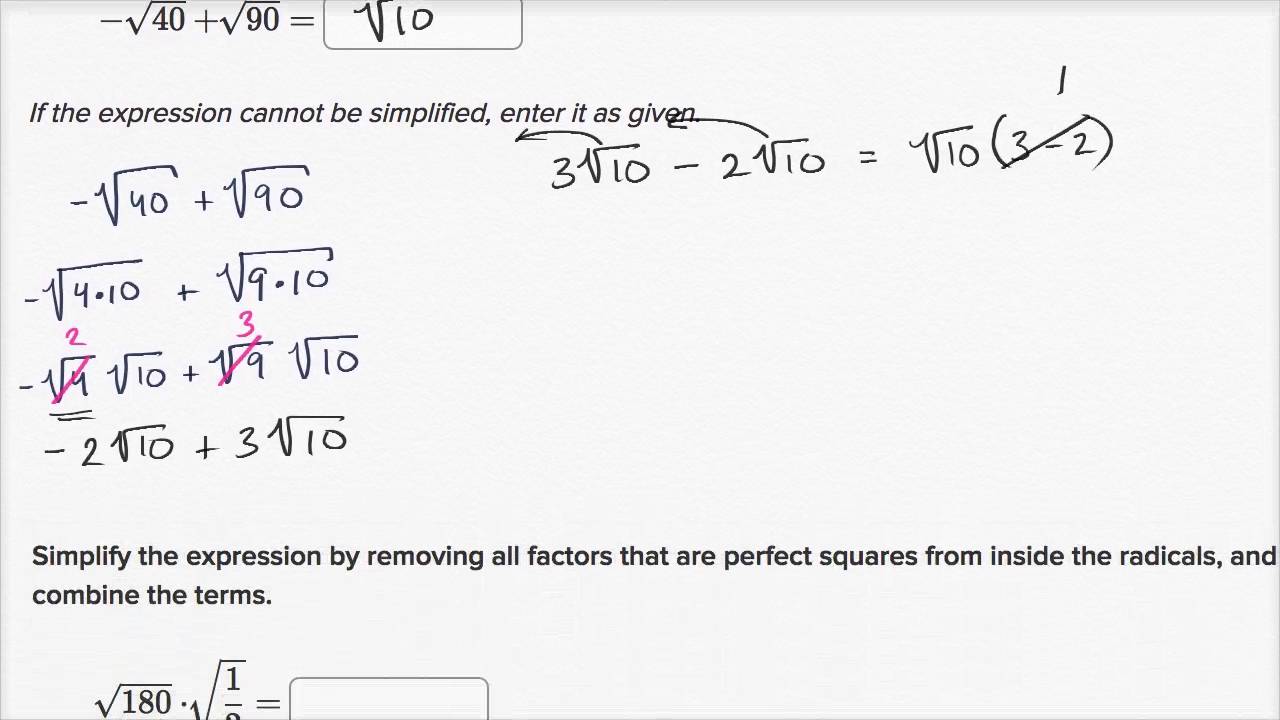
this is the right video
again i apologize
vast fossil
There is no part where the video says anything of the sort 4sqrt(1/2) = 2, you must be misinterpreting something
torn jolt
that was just an example
the equation is sqrt of 180 times 1/2
then it says it is simplified to sqrt of 90
vast fossil
Right, sqrt(180 * 1/2)
torn jolt
how did they get there?
torn jolt
but the question is is why is 1/2 have a sqrt symbol over it?
vast fossil
We are given the expression $\sqrt{180}\sqrt{\frac12}$ and in general $\sqrt{a}\sqrt{b} = \sqrt{ab}$, so we start by saying $\sqrt{180}\sqrt{\frac12} = \sqrt{180\cdot\frac12}$
glossy valveBOT
A Lonely Bean
 torn jolt
so it doesnt matter that the one half has a sqrt over it?
it is just one half of the number multiplied over it?
what if it wasnt multiplied by anything?
what if it was just sqrt1/2?
vast fossil
torn jolt
so it doesnt matter that the one half has a sqrt over it?
It does, what makes it appear like it doesn't matter?
torn jolt
my question is basically what is just the sqrt of 1/2?
vast fossil
torn jolt
what if it was just sqrt1/2?
It is already sqrt(1/2)
vast fossil
torn jolt
what if it wasnt multiplied by anything?
Then you just say $\sqrt{180} = \sqrt{36 \cdot 5} = 6\sqrt5$
glossy valveBOT
A Lonely Bean
 full forumBOT
Channel closed
Closed by @spiral hamlet
Use .reopen if this was a mistake.
opal pivot
hi
full forumBOT
Available help channel!
Send your question here to claim the channel.
Remember:
• Ask your math question in a clear, concise manner.
• Show your work, and if possible, explain where you are stuck.
• After 15 minutes, feel free to ping <@&286206848099549185>.
• Type the command .close to free the channel when you're done.
• Be polite and have a nice day!
Read #❓how-to-get-help for further information on how to ask a good question, and about conduct in the question channels.
ancient apex
hm do these problems work for if your filling the tank instead of draining it? Why is the distance y + 1?
 full forumBOT
ancient apex
hm do these problems work for if your filling the tank instead of draining it? W...
full forumBOT
ancient apex
hm do these problems work for if your filling the tank instead of draining it? W...
 candid sequoia
ancient apex
hm do these problems work for if your filling the tank instead of draining it? W...
candid sequoia
ancient apex
hm do these problems work for if your filling the tank instead of draining it? W...
The original problem statement says the tip was elevated 1 ft above ground... so anything in the cone (y) is y+1 above ground... gravity is based on actual height, not just the height inside the cone
ancient apex
candid sequoia
The original problem statement says the tip was elevated 1 ft above ground... so...
yeah i get the + 1 to account for the gap, but im sorta struggling to grasp the y is it like every y from 0 to cube root 32 needs to move up so new mercury can be piped in? idk if this makes sense
candid sequoia
ancient apex
yeah i get the + 1 to account for the gap, but im sorta struggling to grasp the ...
That second question talks about "work" which is force over distance... guessing why the y+1 for the elevated height is taken into account....as it says it's pumped from ground level. The first problem asked to determine the half capacity point, so now it's work to fill to that level you just calcuated
ancient apex
candid sequoia
That second question talks about "work" which is force over distance... guessin...
so are you rasing every slice of mercury from 0 to cube root of 32 by its current height?
If so wouldnt it like be raised above cube root of 32 which is supposed to be the limit, or does the integral make this not happen
candid sequoia
In the first problem you found the half capacity level.... on the 2nd problem this h is the upper limit of the integral
ancient apex
yeah the distance part of the integral is whats confusing me
candid sequoia
It's a fill rate of a cone to h.... the 2nd problem asks about work, so it's applied over the height from the ground y+1
Distance in the cone? or from the ground? It's really just a volume thing, but as the volume of a cone is not equal for each level rising from the tip, the integral is needed
ancient apex
like the distance every slice of mercruy needs to move
candid sequoia
Yeah, it's really an engineering fluids problem but probably asked in a math class, so they aren't good about writing their units of measure (inches, m^3 etc)... so it's a bit confusing looking at what they did... but I understand it's based on the volume of the cone equation
Like first ask what's the total capacity of the cone? Then what's half that? Then what's the height of the fluid in the cone for this half volume?
full forumBOT
@ancient apex Has your question been resolved?
full forumBOT
Channel closed
Closed due to timeout
Use .reopen if this was a mistake.
Available help channel!
Send your question here to claim the channel.
Remember:
• Ask your math question in a clear, concise manner.
• Show your work, and if possible, explain where you are stuck.
• After 15 minutes, feel free to ping <@&286206848099549185>.
• Type the command .close to free the channel when you're done.
• Be polite and have a nice day!
Read #❓how-to-get-help for further information on how to ask a good question, and about conduct in the question channels.
 rugged pecan
Hey I need help on the last table. Can someone help me out?
 rugged pecan
hey I am good~
 proper hawk
Try to calculate the difference of the terms
rugged pecan
Um~ shot I just calculate the difference of the terms and now I forgot it~
 short heath
how much does y go up by each time x increases by 1?
rugged pecan
Y goes up 3 times right?
rugged pecan
the difference of the terms is 1, 2, 3, 15 right?
short heath
well i wouldnt look at the 15, there is a gap (we need to fill in the blanks)
whats the pattern at the start?
increases by 1, then 2, then 3
so what is happening?
rugged pecan
Its increases by one number?
short heath
yeah
the increase increases by 1 each time
okay, so what does that mean for the next one (first blank)?
rugged pecan
so (4,13) is for the first blank?
short heath
yes
rugged pecan
(5,18) is for the 2nd blank?
short heath
yes
and then you can check by making sure that pattern matches up with the last point
full forumBOT
Channel closed
Closed by @rugged pecan
Use .reopen if this was a mistake.
full forumBOT
Available help channel!
Send your question here to claim the channel.
Remember:
• Ask your math question in a clear, concise manner.
• Show your work, and if possible, explain where you are stuck.
• After 15 minutes, feel free to ping <@&286206848099549185>.
• Type the command .close to free the channel when you're done.
• Be polite and have a nice day!
Read #❓how-to-get-help for further information on how to ask a good question, and about conduct in the question channels.
 hollow summit
 full forumBOT
hollow summit
hollow summit
full forumBOT
hollow summit
hollow summit
whats wrong iwth my answer here?
gritty rose
$\tan(x)^\inv \neq \tan^\inv(x)$
glossy valveBOT
riemann
 gritty rose
try using arctan(x) for inverse tangent function
full forumBOT
Channel closed
Closed by @hollow summit
Use .reopen if this was a mistake.
full forumBOT
Available help channel!
Send your question here to claim the channel.
Remember:
• Ask your math question in a clear, concise manner.
• Show your work, and if possible, explain where you are stuck.
• After 15 minutes, feel free to ping <@&286206848099549185>.
• Type the command .close to free the channel when you're done.
• Be polite and have a nice day!
Read #❓how-to-get-help for further information on how to ask a good question, and about conduct in the question channels.
 zinc epoch
 full forumBOT
zinc epoch
zinc epoch
full forumBOT
zinc epoch
zinc epoch
i tried to do all the multiplication by hand but it took way too long and there was too much room for error
stiff musk
have you tried an eigenvalue approach?
zinc epoch
please elaborate. maybe it has another name in my language
zinc epoch
nope we didnt learn this method yet
stiff musk
hmm
 tribal urchin
There’s a way to do it without eigenvalues
First take a look at AB-BA
What would make an entry in this matrix 0?
zinc epoch
tribal urchin
First take a look at AB-BA
i already calculated it using variables. ik that if a11=x than a22=-x.
zinc epoch
tribal urchin
What would make an entry in this matrix 0?
entry?
tribal urchin
zinc epoch
entry?
Number, a_ij
Think of it this way: if corresponding numbers in AB and BA are equal, they cancel out and that number is 0 in AB-BA
Do you follow that so far?
zinc epoch
yhe I got you
the problem is I have no garantee they cancel out. as far as I know they are completly different veriables
tribal urchin
That is true, I just realized that method wouldn’t actually work…
zinc epoch
 stiff musk
empirically you can see (by generating random 2x2 matrices for example) that (AB-BA)^2 is a scalar multiple of I
from which the result obviously follows
so maybe a better strategy is to try proving that
zinc epoch
wait wait why is it scalar? maybe I missed that part in my calculation
stiff musk
scalar multiple of I
in other words, a matrix of the form $\begin{pmatrix}c & 0 \ 0 & c\end{pmatrix}$$
glossy valveBOT
Bungo
Compile Error! Click the reaction for more information.
(You may edit your message to recompile.)
 zinc epoch
stiff musk
scalar multiple of I
zinc epoch
stiff musk
scalar multiple of I
yes yes ik the definition but dont understand how yk its scalar
stiff musk
like i said, empirically
zinc epoch
ill try to calculate it again now
stiff musk
>> A=rand(2,2); B = rand(2,2); X = A*B-B*A; X^2
ans =
         0.123789001234248                         0
                         0         0.123789001234248
ok
 placid sinew
stiff musk
```
>> A=rand(2,2); B = rand(2,2); X = A*B-B*A; X^2
ans =
0.12378900123...
placid sinew
stiff musk
```
>> A=rand(2,2); B = rand(2,2); X = A*B-B*A; X^2
ans =
0.12378900123...
You are correct
zinc epoch
ill just write it later
but now it maked sense
if the matrix is scaler its far easier
stiff musk
yea, basically trivial if you can show that
zinc epoch
thank you. ill try again and will return if things dont work
full forumBOT
@zinc epoch Has your question been resolved?
Channel closed
Closed by @zinc epoch
Use .reopen if this was a mistake.
full forumBOT
Available help channel!
Send your question here to claim the channel.
Remember:
• Ask your math question in a clear, concise manner.
• Show your work, and if possible, explain where you are stuck.
• After 15 minutes, feel free to ping <@&286206848099549185>.
• Type the command .close to free the channel when you're done.
• Be polite and have a nice day!
Read #❓how-to-get-help for further information on how to ask a good question, and about conduct in the question channels.
 hazy lantern
A line segment has endpoints at A(0,5) and B(-2,-1). Find the coordinates of point C such that
AB/BC = -2/3
AC/AB = 3/4
AB/AC = 5/3
how would i start this?
full forumBOT
hazy lantern
A line segment has endpoints at A(0,5) and B(-2,-1). Find the coordinates of poi...
 flint crane
hazy lantern
A line segment has endpoints at A(0,5) and B(-2,-1). Find the coordinates of poi...
flint crane
hazy lantern
A line segment has endpoints at A(0,5) and B(-2,-1). Find the coordinates of poi...
Let me try
flint crane
hazy lantern
A line segment has endpoints at A(0,5) and B(-2,-1). Find the coordinates of poi...
is there a typo in the first sentence
AB/BC = -2/3
flint crane
is AB A times B, or length of AB
hazy lantern
length of AB
flint crane
how can length/length be negative
hazy lantern
idk xd
flint crane
hazy lantern
idk xd
can you show the original question
hazy lantern
 flint crane
hazy lantern
flint crane
hazy lantern
im not sure for 1. since length is always a positive value afaik
but for 2.
 hazy lantern
whats your formula for x and y?
flint crane
hazy lantern
whats your formula for x and y?
simply treat it as
there's 4k between A and B
full forumBOT
@hazy lantern Has your question been resolved?
 sacred yarrow
hazy lantern
sacred yarrow
hazy lantern
Are those the results of a slope dividing an another?
Kinda confusing since if BC AB represents the length of segment, there shouldn’t spawn a negative real number
full forumBOT
Channel closed
Closed due to timeout
Use .reopen if this was a mistake.
Available help channel!
Send your question here to claim the channel.
Remember:
• Ask your math question in a clear, concise manner.
• Show your work, and if possible, explain where you are stuck.
• After 15 minutes, feel free to ping <@&286206848099549185>.
• Type the command .close to free the channel when you're done.
• Be polite and have a nice day!
Read #❓how-to-get-help for further information on how to ask a good question, and about conduct in the question channels.
 molten island
help pls
 full forumBOT
Channel closed
Closed by @molten island
Use .reopen if this was a mistake.
full forumBOT
Available help channel!
Send your question here to claim the channel.
Remember:
• Ask your math question in a clear, concise manner.
• Show your work, and if possible, explain where you are stuck.
• After 15 minutes, feel free to ping <@&286206848099549185>.
• Type the command .close to free the channel when you're done.
• Be polite and have a nice day!
Read #❓how-to-get-help for further information on how to ask a good question, and about conduct in the question channels.
 gusty carbon
I am confused
 full forumBOT
gusty carbon
I am confused
gusty carbon
full forumBOT
gusty carbon
I am confused
gusty carbon
how do I solve it
 edgy cypress
just take 16 to the other side and do root 4?
gusty carbon
then what?
edgy cypress
then its +2 and -2
gusty carbon
its not
 hardy snow
Aren’t there also imaginary sol
edgy cypress
it says real tho?
hardy snow
Oh right
gusty carbon

 honest nacelle
its -2 and 2
gusty carbon
oh i did it in the wrong order
gusty carbon
how do I do this
 gusty carbon
can you explain more?
edgy cypress
can i dm you
gusty carbon
why?
edgy cypress
nvm lmao dudes scared over discord listen p is multiplied to both 10 and p in the expression right?
edgy cypress
yes
now over here
when the multiplication of two things
equals to 0
that means what?
either one of them is zero or both are 0
gusty carbon
one or both = 0
gusty carbon
wouldnt it be p+10?
gusty carbon
since -10 +10 =0???
gusty carbon
im a little confused sorry
edgy cypress
ur mixing shit up
edgy cypress
gusty carbon
yeah p(p-10)
this is multiplication happening over here not addition
honest nacelle
if you put 10 in $p^2 -10p$ the the equation will become 100-100 which will be equal to 0
glossy valveBOT
Lakshay
 edgy cypress
or if u plug in zero that also results in 0
gusty carbon
so is it 0 or 10?
edgy cypress
both
honest nacelle
gusty carbon
so is it 0 or 10?
both
full forumBOT
Channel closed
Closed by @gusty carbon
Use .reopen if this was a mistake.
full forumBOT
Available help channel!
Send your question here to claim the channel.
Remember:
• Ask your math question in a clear, concise manner.
• Show your work, and if possible, explain where you are stuck.
• After 15 minutes, feel free to ping <@&286206848099549185>.
• Type the command .close to free the channel when you're done.
• Be polite and have a nice day!
Read #❓how-to-get-help for further information on how to ask a good question, and about conduct in the question channels.
 young lark
prove that the matrices form a basis in the space of real symmetric matrices of order 3, and find the coordinates of the matrix x in this basis
full forumBOT
young lark
prove that the matrices form a basis in the space of real symmetric matrices of ...


 full forumBOT
@young lark Has your question been resolved?
young lark
<@&286206848099549185>
(asked this in another channel because didnt have to re-open it when)
please help
sacred yarrow
young lark
(asked this in another channel because didnt have to re-open it when)
You can post it at the forum
There’s no time restrictions there
sacred yarrow
young lark
so how to prove this?
我不知道
young lark
.close
full forumBOT
Channel closed
Closed by @young lark
Use .reopen if this was a mistake.
full forumBOT
Available help channel!
Send your question here to claim the channel.
Remember:
• Ask your math question in a clear, concise manner.
• Show your work, and if possible, explain where you are stuck.
• After 15 minutes, feel free to ping <@&286206848099549185>.
• Type the command .close to free the channel when you're done.
• Be polite and have a nice day!
Read #❓how-to-get-help for further information on how to ask a good question, and about conduct in the question channels.
 oblique skiff
 full forumBOT
oblique skiff
oblique skiff
full forumBOT
oblique skiff
oblique skiff
how did they get 321.1
im assuming they added 180 to arcsec-9/7 but why
and why didnt they add 180 to 38.9
 robust slate
360-reference angle
b/c cos is positive in the first and fourth quadrants
@oblique skiff ^
oblique skiff
but when its first quadrant the angle = the angle
2nd quad is 180 - x
third is x - 180
4th is 360 - x
glossy valveBOT
Result:
321.1
i understand but dont i only doing 360 - ref angle when its in the fourth quad
oblique skiff
mb im distracted lmao
dont i only subtract the reference angle from 360 when its in the fourth quad
full forumBOT
Channel closed
Closed by @oblique skiff
Use .reopen if this was a mistake.
full forumBOT
Available help channel!
Send your question here to claim the channel.
Remember:
• Ask your math question in a clear, concise manner.
• Show your work, and if possible, explain where you are stuck.
• After 15 minutes, feel free to ping <@&286206848099549185>.
• Type the command .close to free the channel when you're done.
• Be polite and have a nice day!
Read #❓how-to-get-help for further information on how to ask a good question, and about conduct in the question channels.
 stable crow
 full forumBOT
stable crow
stable crow
full forumBOT
stable crow
stable crow
Can someone explain where I went wrong
 fallen tundra
In the first line it has to be like dv=cos4xdx and u=x.
fallen tundra
x will disappear once you taka the derivative.
cosine function will turn into sine and cosine
stable crow
Yeah I get that but shouldn't it be the same result if I consider u=x or u=cos4x
stable crow
fallen tundra
The result is the same, but you will not proceed.
Wdym
One sec lemme get the Wolfram alpha sol
fallen tundra
 stable crow
 fallen tundra
this part is harder to integrate than the original problem.
fallen tundra
any constant
stable crow
Pardon me If I'm a little slow 🙏
 stable crow
yea v is 1/2 x^2
but we need to integrate v to get the second part
shouldnt that be 1/6 x^3
fallen tundra
fallen tundra
In the first line it has to be like dv=cos4xdx and u=x.
then you should do it like this
stable crow
if you dont mind
can you try doing it by considering u=cos4x and v=x
cause im still lost at why it isnt the same if we consider u=x or u=cos4x
Ooooh
wait i see my mistake
thanks
.colse
.close
full forumBOT
Channel closed
Closed by @stable crow
Use .reopen if this was a mistake.
full forumBOT
Available help channel!
Send your question here to claim the channel.
Remember:
• Ask your math question in a clear, concise manner.
• Show your work, and if possible, explain where you are stuck.
• After 15 minutes, feel free to ping <@&286206848099549185>.
• Type the command .close to free the channel when you're done.
• Be polite and have a nice day!
Read #❓how-to-get-help for further information on how to ask a good question, and about conduct in the question channels.
 sleek quest
how would i do this? im not sure where to start
 full forumBOT
sleek quest
how would i do this? im not sure where to start
full forumBOT
sleek quest
how would i do this? im not sure where to start
 open igloo
What is being referred to in "must it also be a power..."?
deft tulip
ya lol..."it is a power of two, must it also be a power of two?"
full forumBOT
@sleek quest Has your question been resolved?
sleek quest
open igloo
What is being referred to in "must *it* also be a power..."?
im honeslty not sure
deft tulip
sleek quest
im honeslty not sure
seems like just a badly written problem \ typo in your book or course
sleek quest
so it isnt solvable
sleek quest
deft tulip
seems like just a badly written problem \ typo in your book or course
i think they are asking if n has to be a power of two
sleek quest
anyone? <@&286206848099549185>
full forumBOT
@sleek quest Has your question been resolved?
sleek quest
.close
full forumBOT
Channel closed
Closed by @sleek quest
Use .reopen if this was a mistake.
sleek quest
.reopen
full forumBOT
✅
sleek quest
anyone?!
 placid vale
What are they asking for?
full forumBOT
@sleek quest Has your question been resolved?
sleek quest
placid vale
What are they asking for?
i think they are asking if n has to be a power of two
full forumBOT
@sleek quest Has your question been resolved?
 austere cove
@sleek quest we're not being difficult, it's just that the problem is badly written, and it's difficult to guess what it means.
If the first n terms of an arithmetic progression are powers of two this means each member of the sequence (a, a + k, a + 2k, ..., a + nk) are all powers of two. In particular, if we consider the arithmetic progression of n-1 terms (a, a + k, a + 2k, ..., a + (n-1)k) this is also an arithmetic progression with all members a power of 2, and (n-1) cannot be a power of 2 unless n = 2. So if there exists an arithmetic progression of length 3 then this proposition is false.
Assume there exists a 3-term arithmetic progression (a, a + k, a + 2k) with a = 2^l, a + k = 2^m, a + 2k = 2^o for integers l, m, o with l < m < o
2^l + k = 2^m so (2^(m-l) - 1) 2^l = k
2k + a = 2^o = 2^(m+1) - 2^l = 2^l (2^(m-l+1) - 1)
The extreme right hand side cannot be a power of 2, because 2^(m+1) is more than twice 2^l, so we are left with (2^(m-l+1) - 1) which is odd and not equal to 1, so it contains a prime factor not equal to 2.
So 3 term arithmetic progressions of this form cannot exist.
Arithmetic progressions are trivial with fewer than 3 terms, so it's not clear what this question could be asking.
Oh, nevermind, I missed a key word, "sum".
Ok, ignore the above
Sum of an AP is given by na + n(n-1)k
This is obtained by summing (a, a + k, a + 2k, ..., a + (n-1)k) (total of n terms)
na + n(n-1)k = 2^m for some integer m.
We can factor out an n from the left side: na + n(n-1)k = n(a + (n-1)k) = 2^m
Therefore n must be a power of 2, because it is a factor of a power of 2.
Hope this helps @sleek quest
 rocky vale
austere cove
Sum of an AP is given by na + n(n-1)k
rocky vale
austere cove
Sum of an AP is given by na + n(n-1)k
Should be na + (n/2)(n-1)k, shouldn't it?
or (n/2)(a+a_n) where a_n is the nth term, a_n = a+(n-1)k
austere cove
Yes sorry
rocky vale
the argument still works though
sleek quest
austere cove
Hope this helps <@996044212158083084>
Thank you
rocky vale
no worries I just thought I was trippin for a sec lol
austere cove
Instead of pulling out n you would need to pull out n/2 and leave (2a + (n-1)k) because (n-1) is odd, and k is not guaranteed to be even.
But it still works.
sleek quest
austere cove
<@996044212158083084> we're not being difficult, it's just that the problem is b...
Yeah sorry about that lol
Thank you for the help
.closr
austere cove
You can leave it open if you want to
austere cove
Wait until you understand the solution
sleek quest
Ok
austere cove
And leave this around for context. No harm
Just in case you need to ask a follow up question
sleek quest
austere cove
Sum of an AP is given by na + n(n-1)k
Why the n(n-1)k?
austere cove
That is the sum of numbers from 1 to (n-1)
Well it should be kn(n-1)/2
I forgot the /2
sleek quest
Ohh
Ok
But you can just multiply by two
And it’s still a power of two
So it would become 2na+kn(n-1)=2^(m+1)
austere cove
Your AP is (a, a + k, a + 2k, ..., a + (n-1)k)
sleek quest
Right
austere cove
Where a is some base integer value
So you have n copies of it when you sum it up, na
sleek quest
Right
I understand the solution, it’s much simpler then I thought
Should I still leave the channel open?
austere cove
If you understand the solution then there's no reason to anymore, unless you feel like you might have a follow up in the morning
full forumBOT
Channel closed
Closed by @sleek quest
Use .reopen if this was a mistake.
full forumBOT
Available help channel!
Send your question here to claim the channel.
Remember:
• Ask your math question in a clear, concise manner.
• Show your work, and if possible, explain where you are stuck.
• After 15 minutes, feel free to ping <@&286206848099549185>.
• Type the command .close to free the channel when you're done.
• Be polite and have a nice day!
Read #❓how-to-get-help for further information on how to ask a good question, and about conduct in the question channels.
 sturdy nymph
 full forumBOT
sturdy nymph
sturdy nymph
full forumBOT
sturdy nymph
sturdy nymph
how would i find the equation of this quadratic function
is it something along the lines of
,, y = (x-1)^2 + 1
glossy valveBOT
rxhuls👽
 sturdy nymph
theres no x intercepts
why is there an x in the equation i wrote does it still work
open igloo
sturdy nymph
theres no x intercepts
Yeah
open igloo
open igloo
(0,3) should satisfy the equation
This is the y intercept
open igloo
Have you learnt differentiation?
sturdy nymph
i dont think so