#help-28
1 messages · Page 129 of 1
 torpid stag
 glossy valveBOT
jan Mikkel
 torpid stag
Discrete uniform
torpid stag
You could also just run a simulation
Which would be much easier
To my knowledge at least
 foggy shore
Yep somebody already did that but I thought actually calculating the S would be nice so I can graph it on Geogebra
torpid stag
How much silk did you get
foggy shore
Well it was a while back I did it but lowest I can remember the worker getting was around 10200+
torpid stag
Hmmmm
The expected value is pretty straightforward to calculate to 11.000
I tried running a simulation of 200.000 trials, and got a standard deviation of around 128
Since the sum of independent discrete uniform random variables has asymptotic behavior of a normal distribution you should lie within [μ - 2σ; μ + 2σ] = [10.744; 11.256] in most cases
foggy shore
Honestly, 128 might very well be accurate enough for this since its from 200k trials, ill try graphing it when I get home
 thin quartz
isn't this equivalent to rolling 10-sided dice?
I found this https://math.stackexchange.com/questions/2245194/what-is-the-standard-deviation-of-dice-rolling
plugging the numbers in gives 128.452325787 so 128 seems good

Mathematics Stack Exchange
When trying to find how to simulate rolling a variable amount of dice with a variable but unique number of sides, I read that the mean is $\dfrac{sides+1}{2}$, and that the standard deviation is $...
torpid stag
Lmfao, you're right. I don't know why I went back to variance definition instead of just using the independence assumption 
 full forumBOT
@foggy shore Has your question been resolved?
Channel closed
Closed by @foggy shore
Use .reopen if this was a mistake.
foggy shore
Thanks guys
full forumBOT
 Available help channel!
Send your question here to claim the channel.
Remember:
• Ask your math question in a clear, concise manner.
• Show your work, and if possible, explain where you are stuck.
• After 15 minutes, feel free to ping <@&286206848099549185>.
• Type the command .close to free the channel when you're done.
• Be polite and have a nice day!
Read #❓how-to-get-help for further information on how to ask a good question, and about conduct in the question channels.
 unreal hull
What do I do for 1a?
 full forumBOT
unreal hull
What do I do for 1a?
full forumBOT
unreal hull
What do I do for 1a?
 torn jolt
if you are allowed to use basic application of differentiation.
then calculate dy/dx at x= 2
so now you have slope
find out the y-cordinate by putting x=2 in f(x)
you would get the corresponding point on the curve
so now you have a point and slope at x =2
use slope point form and get the equation
full forumBOT
Channel closed
Closed by @unreal hull
Use .reopen if this was a mistake.
Available help channel!
Send your question here to claim the channel.
Remember:
• Ask your math question in a clear, concise manner.
• Show your work, and if possible, explain where you are stuck.
• After 15 minutes, feel free to ping <@&286206848099549185>.
• Type the command .close to free the channel when you're done.
• Be polite and have a nice day!
Read #❓how-to-get-help for further information on how to ask a good question, and about conduct in the question channels.
 buoyant wigeon
How can I show that $\sum_{k=0}^{n} C^k_n \phi_k = \phi_{2n}$ where $\phi_n$ is the Fibonacci sequence ?
I tried induction but i can't seem to figure out how to proceed
full forumBOT
buoyant wigeon
How can I show that $\sum_{k=0}^{n} C^k_n \phi_k = \phi_{2n}$ where $\phi_n$ is ...
glossy valveBOT
Azenx
 buoyant wigeon
$\sum_{k=0}^{n+1} C^k_{n+1}\phi_k =\sum_{k=0}^{n+1} (C^{k-1}{n}+C^{k}{n})\phi_k \ \
\sum_{k=0}^{n+1} (C^{k-1}{n}+C^{k}{n})\phi_k = \sum_{k=0}^{n+1} C^{k-1}{n}\phi_k +\sum{k=0}^{n+1} C^{k}{n}\phi_k = \phi{2n}+ \sum_{k=0}^{n+1} C^{k-1}{n}\phi_k
\\ \phi{2n}+ \sum_{k=0}^{n+1} C^{k-1}{n}\phi_k = \phi{2n}+ \sum_{k=0}^{n} C^{k}{n}\phi{k+1}$
glossy valveBOT
Azenx
 buoyant wigeon
For induction step
Now to finish we'd have to show why $\sum_{k=0}^{n} C^{k}{n}\phi{k+1}$ is $\phi_{2n+1}$ but i cant seem to show it
glossy valveBOT
Azenx
 full forumBOT
@buoyant wigeon Has your question been resolved?
full forumBOT
@buoyant wigeon Has your question been resolved?
full forumBOT
@buoyant wigeon Has your question been resolved?
full forumBOT
@buoyant wigeon Has your question been resolved?
 hollow sable
Cant you say that the last sum in the second line is phi(2n-1)?
buoyant wigeon
hollow sable
Cant you say that the last sum in the second line is phi(2n-1)?
Well I don’t think so, or at least maybe theres something I didn’t realize about the induction hypothesis that would allow us to do so
I also showed that $\phi_{n+1}^2-\phi_n \phi_{n+2}=(-1)^n$ if that’s any useful
glossy valveBOT
Azenx
 hollow sable
buoyant wigeon
Well I don’t think so, or at least maybe theres something I didn’t realize about...
hollow sable
buoyant wigeon
Well I don’t think so, or at least maybe theres something I didn’t realize about...
I’m not very well acquainted with induction but we can show that the result holds if it holds for n-1 and n, so our base step would be showing that it holds for n=1 and n=2.
full forumBOT
@buoyant wigeon Has your question been resolved?
 tiny bridge
glossy valve
**Azenx**
tiny bridge
glossy valve
**Azenx**
As you showed here, proving $\sum_{k=0}^{n} C^k_n \phi_k = \phi_{2n}$ is equivalent to proving that $\sum_{k=0}^{n} C^{k}{n} \phi{k+1} = \phi_{2n+1}$. So simply expand your induction hypothesis to handle both of those.
glossy valveBOT
chencking
 full forumBOT
Channel closed
Closed due to timeout
Use .reopen if this was a mistake.
Available help channel!
Send your question here to claim the channel.
Remember:
• Ask your math question in a clear, concise manner.
• Show your work, and if possible, explain where you are stuck.
• After 15 minutes, feel free to ping <@&286206848099549185>.
• Type the command .close to free the channel when you're done.
• Be polite and have a nice day!
Read #❓how-to-get-help for further information on how to ask a good question, and about conduct in the question channels.
 minor creek
i dont get how to solve e
 full forumBOT
minor creek
i dont get how to solve e
minor creek
full forumBOT
minor creek
i dont get how to solve e
minor creek
ye but i get stuck
 glacial pasture
show me
 glacial pasture
youre going to be missing solutions
if theres a solution at 1.23, theres another at pi-1.23
then you can do the adding of 2npi for each one
minor creek
how would i know which numbers would work though
the answer is supposed to be 3:30m and 12:30am, both were rounded to the nearest half hour
how do i get to it
my teacher was too lazy to post solutions
full forumBOT
@minor creek Has your question been resolved?
minor creek
.close
full forumBOT
Channel closed
Closed by @minor creek
Use .reopen if this was a mistake.
Available help channel!
Send your question here to claim the channel.
Remember:
• Ask your math question in a clear, concise manner.
• Show your work, and if possible, explain where you are stuck.
• After 15 minutes, feel free to ping <@&286206848099549185>.
• Type the command .close to free the channel when you're done.
• Be polite and have a nice day!
Read #❓how-to-get-help for further information on how to ask a good question, and about conduct in the question channels.
 ionic spear
Yo
full forumBOT
ionic spear
Yo
ionic spear
Can anybody help me find the bearings of b)i) and ii)
 full forumBOT
@ionic spear Has your question been resolved?
full forumBOT
Channel closed
Closed due to timeout
Use .reopen if this was a mistake.
full forumBOT
Available help channel!
Send your question here to claim the channel.
Remember:
• Ask your math question in a clear, concise manner.
• Show your work, and if possible, explain where you are stuck.
• After 15 minutes, feel free to ping <@&286206848099549185>.
• Type the command .close to free the channel when you're done.
• Be polite and have a nice day!
Read #❓how-to-get-help for further information on how to ask a good question, and about conduct in the question channels.
 abstract shard
 full forumBOT
abstract shard
abstract shard
full forumBOT
abstract shard
abstract shard

the top image is the question and the bottom is the answers
I'm trying to find the derivative but my question has more to do w algebra
how does 21 look like 1/ sqrt x+2 and 22 look like sqrt (1/t^2-2) but they both turn into (x+2)^-1/2 (for 21) and t^2-2)^-1/2
like how is their first stepts the same?
unless im trippin and they arnt the same
 smoky wing
[\wrb{
\s{\f ab} = \f{\s a}{\s b}
}
]
glossy valveBOT
Pure
 abstract shard
woaaa its rainbow
ok wait yea
but
#21 isnt all square rooted ...
only the denom is
glossy valveBOT
Pure
 smoky wing
and sqrt(1) = 1
abstract shard
ohhhh
smoky wing
So you can rewrite g(t) as 1/(sqrt(t^2-2))
Which looks similar to the expression in question 21.
smoky wing

abstract shard
.close
full forumBOT
Channel closed
Closed by @abstract shard
Use .reopen if this was a mistake.
Available help channel!
Send your question here to claim the channel.
Remember:
• Ask your math question in a clear, concise manner.
• Show your work, and if possible, explain where you are stuck.
• After 15 minutes, feel free to ping <@&286206848099549185>.
• Type the command .close to free the channel when you're done.
• Be polite and have a nice day!
Read #❓how-to-get-help for further information on how to ask a good question, and about conduct in the question channels.
 jolly girder
How can i solve this ? (Worded problems involving ratios) 
- Divide 252 into 3 parts having the ratio 8:7:6 . What are the tree numbers?
full forumBOT
jolly girder
How can i solve this ? (Worded problems involving ratios) <:4cat_sad:85890285215...
jolly girder
Then what would i do next
 compact zodiac
Solve
jolly girder
how do i solve it
compact zodiac
 open igloo
You can assume the numbers as 8x,7x,6x
open igloo
You can assume the numbers as 8x,7x,6x
I mean did you understand this
jolly girder
not really
open igloo
You've to seperate 252 in 3 numbers
I've assumed those 3 as 8x,7x,6x
Since the 3 numbers also have to be in the ratio 8:7:6
compact zodiac
Now solve it
compact zodiac
You can always verify the answer yourself after computing it!
jolly girder
i added all the answrs
i got 252!
its correct

Will the same rul apply if the give nwas
was 2 ratios
like
9:8 and 187
open igloo
jolly girder
Will the same rul apply if the give nwas
You mean two numbers in ratio 9:8 and sum 187?
Then yes
jolly girder
oh
and what if
the ratio is 5:1
but theres no sum
A pair of complementary angles has the ratio 5:1 find the number of degrees in each angle
thats the question
open igloo
There's a sum hidden in the question
 open igloo
jolly girder
<@770188154946715708>
open igloo
jolly girder
<@770188154946715708>
... no
jolly girder
is it
open igloo
What are complementary angles
jolly girder
5+1?
jolly girder
open igloo
What are complementary angles
I kinda forgot 

 jolly girder
open igloo
Search it up
jolly girder
open igloo
Search it up
am i right
open igloo
So you're saying complementary angles mean 60⁰ and 30⁰?
Just search the proper definition bruh
jolly girder
im too deep in algebra thanks 
open igloo
So same thing
jolly girder
.close
full forumBOT
Channel closed
Closed by @jolly girder
Use .reopen if this was a mistake.
full forumBOT
Available help channel!
Send your question here to claim the channel.
Remember:
• Ask your math question in a clear, concise manner.
• Show your work, and if possible, explain where you are stuck.
• After 15 minutes, feel free to ping <@&286206848099549185>.
• Type the command .close to free the channel when you're done.
• Be polite and have a nice day!
Read #❓how-to-get-help for further information on how to ask a good question, and about conduct in the question channels.
 cursive path
why does sin (-1/2) = 11π/6 but sin-1 (-1/2) = -π/6
thin quartz
cursive path
why does sin (-1/2) = 11π/6 but sin-1 (-1/2) = -π/6
first statement is false
cursive path
maybe but its more about sin-1 (-1/2) = -π/6 because I dont see this in the circle
 velvet sedge
negative angles are considered by going clockwise from the positive x-axis around the circle
cursive path
because cos-1 (-1) is pi and I can see it
velvet sedge
so sin(-pi/6)=sin(2pi-pi/6)=sin(11pi/6)
sin^-1 or arcsin is defined (as a function) only on interval from -pi/2 to pi/2
so it will only capture angles in that range, despite the fact that sin(x)=-1/2 has many answers that aren't just -pi/6, infinitely many in fact
full forumBOT
@cursive path Has your question been resolved?
Channel closed
Closed by @cursive path
Use .reopen if this was a mistake.
Available help channel!
Send your question here to claim the channel.
Remember:
• Ask your math question in a clear, concise manner.
• Show your work, and if possible, explain where you are stuck.
• After 15 minutes, feel free to ping <@&286206848099549185>.
• Type the command .close to free the channel when you're done.
• Be polite and have a nice day!
Read #❓how-to-get-help for further information on how to ask a good question, and about conduct in the question channels.
 spice orchid
. @verbal root put your question here
 verbal root
Okay
full forumBOT
verbal root
Okay
verbal root
Write the equation of the line that passes through the given point M(3,2) and makes an angle of 45° with the abscissa axis
 buoyant pewter
$y-y_{0}=\tan\alpha\cdot \left( x-x_{0} \right)$
glossy valveBOT
Joanna Angel
 verbal root
write the equation of the line that passes through the point M(2,1) and is normal to the line 2x+3y+4=0
buoyant pewter
$\text{If}\text{ }\text{ }k:y=ax+b\text{ }\text{ and}\text{ }\text{ }m:y=cx+d\\\text{ then}\text{ }\text{ }k\bot m\Leftrightarrow a\cdot c=-1$
glossy valveBOT
Joanna Angel
 full forumBOT
@verbal root Has your question been resolved?
full forumBOT
Channel closed
Closed due to timeout
Use .reopen if this was a mistake.
Available help channel!
Send your question here to claim the channel.
Remember:
• Ask your math question in a clear, concise manner.
• Show your work, and if possible, explain where you are stuck.
• After 15 minutes, feel free to ping <@&286206848099549185>.
• Type the command .close to free the channel when you're done.
• Be polite and have a nice day!
Read #❓how-to-get-help for further information on how to ask a good question, and about conduct in the question channels.
 ocean urchin
doin some practice before my final and this one has me stumped
 ocean urchin
the derivative of G would be g right?
so the critical points of G would be the points where g(s) = 0
but the issue is that...thats in terms of s and the function we want the critical points of is G(x)
What ive got so far:
critical points are 0, 1 and 2 (0 and 2 because they are endpoints, and 1 because of a jump discontinuity)
is the integral always increasing? my class is using the definition that "Integrals represent actual area"
so like...that would mean that 2 is a maximum?
since like, a larger "range" of integration would result in a larger area
 full forumBOT
@ocean urchin Has your question been resolved?
verbal root
full forum
<@1018614986861449256> Has your question been resolved?
Nuh uh
I don't understand anything
full forumBOT
@ocean urchin Has your question been resolved?
 granite shore
@ocean urchin I can likely help with this
Give me a few moments to draw g(s) so I can see what it looks like
granite shore
studying calculus will do that lol
so I like the way you are thinking: idea here is to the the FTC to get the derivative $G'(x) = g(x)$, and then we simply want to find $g(0)$.
glossy valveBOT
 granite shore
Then, I agree with your logic that the next step would be to use the Extreme Value Theorem: a max/min must happen either when the derivative is zero, or we hit an end point. Now, the issue here is that you have the jump discontinuity, so you are correct in thinking that the max/min might also occur at the discontinuity
ocean urchin
right now the biggest hurdle for me is that g is given as a function of s, not x
granite shore
But when you take the derivative of G(x), then you get g(x), so it will be in terms of x when you go to solve the problem
ocean urchin
so in that case G'(x) or g(x) is
(1 - x^3)^1/2         if 0 <= x < 1
-1 - (1 + x^4)^1/2    if 1 <= x <= 2
Yes
So now we note that g(x) = 0 has no solution, so we next check the endpoints g(0) and (2).
ocean urchin
g(0) = 1
g(2) = ~-5.12
ocean urchin
g(1) would be - 1 - sqrt(2)
but thats not a max/min so why would it be important to calculate that?
granite shore
Maybe the idea here is to notice that on the interval $x \in (0,1)$ you are always decreasing, same with $x \in (1,2)$. So the max must necessarily happen on (0,1) and the min on (1,2)
glossy valveBOT

 granite shore
Yes I agree
ocean urchin
is the area not maximised when G(x) is integrating from 0->2?
 granite shore
So since the function is always decreasing the max has to be at the left end point and the min at the right endpoint
ocean urchin
since the G(x) is the integral of g(x), i.e., the "area"?
that was an issue that the professors ran into as well at the very last like 2 weeks of the course; and they reached the conclusion that integral will represent the "absolute" area of a graph, so no negatives
at least for the definition used in this course
granite shore
Here, G(x) will give the "net" area and will consider the areas under the x axis as negative

In blue is G(x)
 granite shore
I think I was explaining something wrong, so I'll try again lol
Basically the max/min for G must happen either at a critical point, endpoint, or at a point of discontinuity. We have the endpoints evaluated already, there are NOT critical values on the interval we are working on since the derivative is always decreasing. So that last step would be to see what happening at x=1
ocean urchin
I'm listening
granite shore
I'm just spitballin here, you'll maybe have access to something else we can use. But I think the idea here is that we know G(x) will be continuous (but not necessarily differentiable) at x=1 since it is keeping track of area
ocean urchin
yeah I'm just not entirely convinced yet because if it was maximized at anything except 2, (like 1), that would mean that the area from 0-1 is less than the area from 0-2
because that doesn't seem possible if we're not taking negative areas (which the professor said not to)
ocean urchin
.close
full forumBOT
Channel closed
Closed by @ocean urchin
Use .reopen if this was a mistake.
Available help channel!
Send your question here to claim the channel.
Remember:
• Ask your math question in a clear, concise manner.
• Show your work, and if possible, explain where you are stuck.
• After 15 minutes, feel free to ping <@&286206848099549185>.
• Type the command .close to free the channel when you're done.
• Be polite and have a nice day!
Read #❓how-to-get-help for further information on how to ask a good question, and about conduct in the question channels.
 unborn moth
What linear algebra books do you recommend
full forumBOT
unborn moth
What linear algebra books do you recommend
 cedar pumice
granite shore
cedar pumice
granite shore
Looks like an oligopoly graph lol
full forumBOT
@unborn moth Has your question been resolved?
full forumBOT
Channel closed
Closed due to timeout
Use .reopen if this was a mistake.
Available help channel!
Send your question here to claim the channel.
Remember:
• Ask your math question in a clear, concise manner.
• Show your work, and if possible, explain where you are stuck.
• After 15 minutes, feel free to ping <@&286206848099549185>.
• Type the command .close to free the channel when you're done.
• Be polite and have a nice day!
Read #❓how-to-get-help for further information on how to ask a good question, and about conduct in the question channels.
 rigid cedar
Hello. How do I read this and why is there the dash above the "∪"? I know it's supposed to be complement of, but it being above the U is confusing me.
The while thing for context.

 full forumBOT
rigid cedar
Hello. How do I read this and why is there the dash above the "∪"? I know it's s...
rigid cedar
full forumBOT
rigid cedar
Hello. How do I read this and why is there the dash above the "∪"? I know it's s...
rigid cedar
but on 2 different editions?
rigid cedar
ohhhh
velvet sedge
A^c U B^c means union of A complement with B complement
 velvet sedge
complement of A
 grim skiff
velvet sedge
A^c U B^c means union of A complement with B complement
grim skiff
velvet sedge
A^c U B^c means union of A complement with B complement
Technically A complement or B complement, the combined set, if I'm not mistaken
rigid cedar
this book really loves throwing stuff without saying what it is
even though it has two dashes on top?
velvet sedge
grim skiff
Technically A complement or B complement, the combined set, if I'm not mistaken
reworded for clarity :)
rigid cedar
velvet sedge
reworded for clarity :)
gotcha
grim skiff
rigid cedar
even though it has two dashes on top?
Double complement
grim skiff
Complement of the complement of set A
velvet sedge
yeah complements cancel
rigid cedar
oh. it does say that A two dashes = A
velvet sedge
yes
rigid cedar
but i thought it was a bit unnecessary so i thought it had to mean something else
velvet sedge
nah it's just basically saying complement of the complement of a set is itself
grim skiff
It's more common when you see in like $\overline{(\overline{A} U B)}$
rigid cedar
oh
glossy valveBOT
CaptainNova22
 grim skiff
You get what I'm trying to say
rigid cedar
yeah i do
interesting. seems a bit hard to understand at first though. hopefully i'll be able to read it easily soon
grim skiff
Because then you do de morgans to get $\overline{\overline{A}} \cap \overline{B}$
glossy valveBOT
CaptainNova22
 rigid cedar
huh
grim skiff
glossy valve
**CaptainNova22**
De morgan this
grim skiff
glossy valve
**CaptainNova22**
You get this
rigid cedar
yeah, the book mentions De Morgan's law
rigid cedar
glossy valve
**CaptainNova22**
but in this case isn't it just easier to write A?
or is there something i'm not getting
grim skiff
Yes it simplies to A but if you were showing work, that's what it would look like
rigid cedar
ah, to show some kind of specific thinking or something?
grim skiff
If your teacher wants full work in the proof
full forumBOT
Channel closed
Closed by @rigid cedar
Use .reopen if this was a mistake.
Available help channel!
Send your question here to claim the channel.
Remember:
• Ask your math question in a clear, concise manner.
• Show your work, and if possible, explain where you are stuck.
• After 15 minutes, feel free to ping <@&286206848099549185>.
• Type the command .close to free the channel when you're done.
• Be polite and have a nice day!
Read #❓how-to-get-help for further information on how to ask a good question, and about conduct in the question channels.
 cunning sorrel
 full forumBOT
cunning sorrel
cunning sorrel
full forumBOT
cunning sorrel
cunning sorrel
i know how to do it kinda because on the platform im using it gives me a guideline of what to do but I don't understand why its telling me to do what its telling me to do

i dont understand the thought process behind figuring out what is supposted to go in the blank
I assume is 116 but I don't know why
 hot herald
same side interior angles
hot herald
yeh, its literally just applying that
hot herald
whats your definition of supplementary?
 versed tendon
they are looking at the triangles formed by dividing the rhombus in 2
cunning sorrel
like two angles adding up to 180
cunning sorrel
versed tendon
they are looking at the triangles formed by dividing the rhombus in 2
what about the triangles
hot herald

the relevant parallel lines are marked there
green + red = 180
and that green is <1 + <2
hot herald
doesn't matter if they're congruent or not for what they're applying in that first step
hot herald
no
cunning sorrel
cuz only 2 and 116 are on same side of transversal
hot herald
you need to consdier the position of your parallel lines
cunning sorrel
should i try rewriting the figure but like without all the extra lines
just parallel and transversal
hot herald
if may help
cunning sorrel
ok im gonna do that rq
i dont think it works
cuz i need the extra lines to form the angles
hot herald
when consider the same-side angle / co-interior angle to the 116 that involes angles 1 and/or 2:

that red line would be the transversal

just going to erase the 1 and 2 entirely
cunning sorrel
oh i see it now
i was using the diagonal as the transversal
so that green angle is supplementary to 116
and that green angle is made up of angle 1 and 2
so angle 1 + angle 2 +166 =180
ok thank you
.close
full forumBOT
Channel closed
Closed by @cunning sorrel
Use .reopen if this was a mistake.
Available help channel!
Send your question here to claim the channel.
Remember:
• Ask your math question in a clear, concise manner.
• Show your work, and if possible, explain where you are stuck.
• After 15 minutes, feel free to ping <@&286206848099549185>.
• Type the command .close to free the channel when you're done.
• Be polite and have a nice day!
Read #❓how-to-get-help for further information on how to ask a good question, and about conduct in the question channels.
full forumBOT
glossy valveBOT
Mycobacterium
 full forumBOT
@torn jolt Has your question been resolved?
velvet sedge
i think it'd be easier to do them as separate sums then take their difference :)
buoyant pewter
they are ordinary geometric series
no need to use any criterion for that
just verify if | q | <1
like in school
$\sum_{n=0}^{\infty }q^{n}=\frac{1}{1-q}\text{ }\Leftrightarrow \text{ }\left| q \right|<1$
glossy valveBOT
Joanna Angel
 velvet sedge
ye, and q^(-n)=(1/q)^n
buoyant pewter
defintion you want to know ?
velvet sedge
glossy valve
**Mycobacterium**
this is almost correct
yea, and for your sum above, you just needed to put the odd number index inside the -
glossy valveBOT
Mycobacterium
 velvet sedge
$\sum_{n=0}^{\infty} 5^{-2n}-3^{-(2n+1)}$
glossy valveBOT
Moosey
 velvet sedge
glossy valve
**Mycobacterium**
velvet sedge
glossy valve
**Mycobacterium**
this also works :)
full forumBOT
Channel closed
Closed by @mint light
Use .reopen if this was a mistake.
Available help channel!
Send your question here to claim the channel.
Remember:
• Ask your math question in a clear, concise manner.
• Show your work, and if possible, explain where you are stuck.
• After 15 minutes, feel free to ping <@&286206848099549185>.
• Type the command .close to free the channel when you're done.
• Be polite and have a nice day!
Read #❓how-to-get-help for further information on how to ask a good question, and about conduct in the question channels.
 glacial flame
I just watched a video on a simple math problem 6÷2(1+2)=??? and it didnt make sense to me. in the video he states it could be 2 answers but does math work that way? I understand as you go higher up you and sqrts and stuff but how can a simple problem have multiple answers?
full forumBOT
glacial flame
I just watched a video on a simple math problem 6÷2(1+2)=??? and it didnt make s...
glacial flame
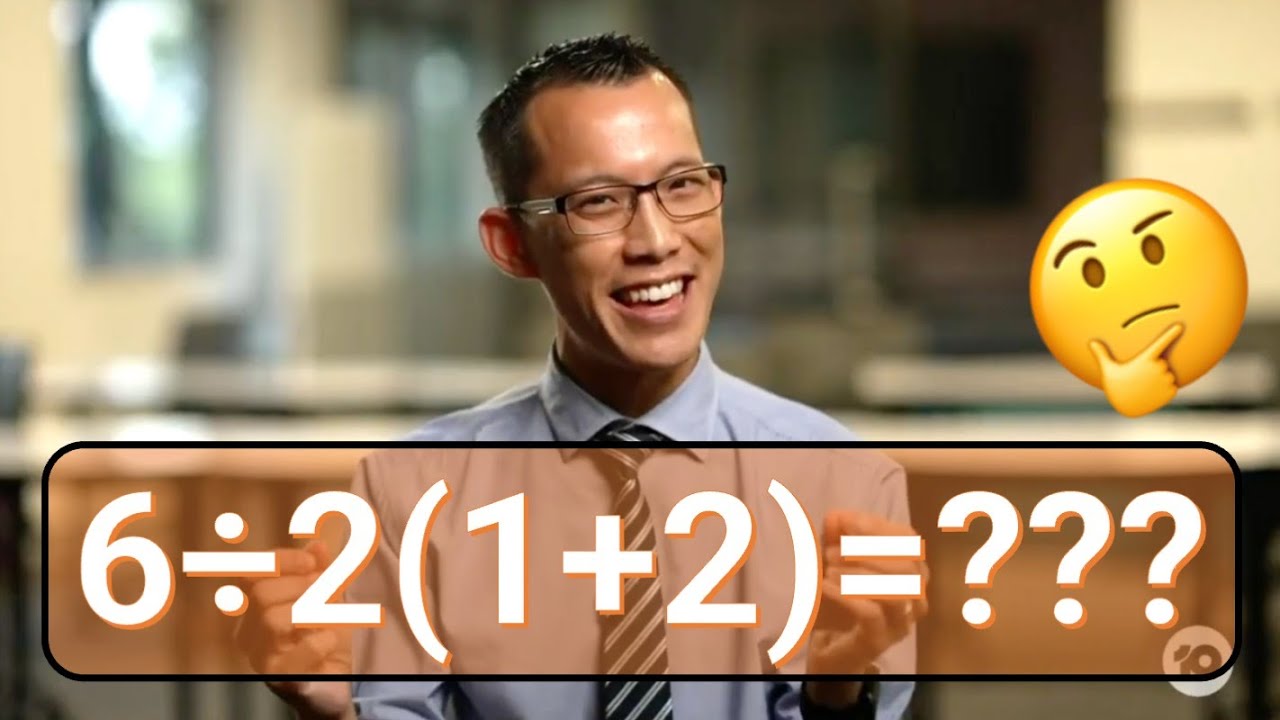
This problem goes viral on the internet every now and then, so I was very glad to have an opportunity to explain it on the air. I didn't have very long to talk so that's why I gloss over a few details, but the overall point is still true: the (intentional) ambiguity of the mathematical statement is the real issue here. This is not really about o...
the video in question
glossy valveBOT
ℝαμΩℕωⅤ
 full forumBOT
Channel closed
Closed by @glacial flame
Use .reopen if this was a mistake.
Available help channel!
Send your question here to claim the channel.
Remember:
• Ask your math question in a clear, concise manner.
• Show your work, and if possible, explain where you are stuck.
• After 15 minutes, feel free to ping <@&286206848099549185>.
• Type the command .close to free the channel when you're done.
• Be polite and have a nice day!
Read #❓how-to-get-help for further information on how to ask a good question, and about conduct in the question channels.
 vocal niche
How to solve 38
 full forumBOT
vocal niche
How to solve 38
full forumBOT
vocal niche
How to solve 38
 full forumBOT
Channel closed
Closed by @vocal niche
Use .reopen if this was a mistake.
full forumBOT
Available help channel!
Send your question here to claim the channel.
Remember:
• Ask your math question in a clear, concise manner.
• Show your work, and if possible, explain where you are stuck.
• After 15 minutes, feel free to ping <@&286206848099549185>.
• Type the command .close to free the channel when you're done.
• Be polite and have a nice day!
Read #❓how-to-get-help for further information on how to ask a good question, and about conduct in the question channels.
 amber palm
Find the points of non differentiability of the function
glossy valveBOT
naxtisy

 onyx glen
$f(x) = \frac{1}{2} - x + \frac{1}{2} \floor{2x} - \frac{1}{2} \floor{1 - 2x}$
glossy valveBOT
Ann
 amber palm
wait its loading
sorry wifi was off
is still slow
yep
thats the function @onyx glen
onyx glen
ok
amber palm
So like
onyx glen
and you want to find how many discontinuities it has in [0, 1].
amber palm
the way i was thinking
amber palm
onyx glen
and you want to find how many discontinuities it has in [0, 1].
no no
point of non differentiabilities
onyx glen
oh, not discontinuity. non-differentiability. my bad.
onyx glen
so what were you thinking?
amber palm
onyx glen
so what were you thinking?
right
amber palm
glossy valve
**Ann**
so breaking off the function in 3 parts
1/2 - x and then the other two
amber palm
glossy valve
**Ann**
now [2x] is ND at 2x = Z so x = Z/2
onyx glen
bad notation again. don't like using the same letter for a set and for an arbitrary element of that set.
onyx glen
no, it is not.
onyx glen
Z represents the set of all integers.
amber palm
i am treating them separate
onyx glen
you can't use the symbol $\bZ$ to refer to an arbitrary integer.
glossy valveBOT
Ann
 amber palm
so breaking off the function in 3 parts
amber palm
amber palm
so breaking off the function in 3 parts
.
onyx glen
from this you should have concluded that in your domain [0, 1] you get the following points as suspect for discontinuity (from which follows non-differentiability):
0, 1/2, 1.
amber palm
mhm
 ionic trout
Bro how can I learn integral
amber palm
ionic trout
Bro how can I learn integral
!occupied
full forumBOT
ionic trout
Bro how can I learn integral
Someone else is already using this help channel. If you need help with a question, please open your own help channel/thread (see #❓how-to-get-help for instructions).
onyx glen
ionic trout
Bro how can I learn integral
!occupied
full forumBOT
ionic trout
Bro how can I learn integral
Someone else is already using this help channel. If you need help with a question, please open your own help channel/thread (see #❓how-to-get-help for instructions).
onyx glen
amber palm
mhm
ok, so did you continue from here?
amber palm
onyx glen
ok, so did you continue from here?
nope
onyx glen
well then continue! for the function g(x) = floor(2x) - floor(1-2x), calculate at x = 0, 1/2, 1:
- the value
- the left-hand limit (except at x=0)
- the right-hand limit (except at x=1)
you will get discontinuities this way
full forumBOT
@amber palm Has your question been resolved?
Channel closed
Closed by @amber palm
Use .reopen if this was a mistake.
Available help channel!
Send your question here to claim the channel.
Remember:
• Ask your math question in a clear, concise manner.
• Show your work, and if possible, explain where you are stuck.
• After 15 minutes, feel free to ping <@&286206848099549185>.
• Type the command .close to free the channel when you're done.
• Be polite and have a nice day!
Read #❓how-to-get-help for further information on how to ask a good question, and about conduct in the question channels.
 wheat furnace
 full forumBOT
wheat furnace
wheat furnace
full forumBOT
wheat furnace
wheat furnace
no idea how to solve this
buoyant pewter
wheat furnace
no idea how to solve this
look at scuh examples:
$x^{2}+\frac{1}{x^{2}}=\left( x+\frac{1}{x} \right)^{2}-2\\x^{3}+\frac{1}{x^{3}}=\left( x+\frac{1}{x} \right)^{3}-3x-\frac{1}{x}=\left( x+\frac{1}{x} \right)^{3}-3\left( x+\frac{1}{x} \right)$
glossy valveBOT
Joanna Angel
 buoyant pewter
in an analogous way, you can evaluate your expression
 frosty meteor
nasty case of identities but solvable
wheat furnace
frosty meteor
nasty case of identities but solvable
how
wheat furnace
glossy valve
**Joanna Angel**
I got this thing but how do I apply this to ^7 of something
frosty meteor
[x^7 + \frac{1}{x^7} = \left(x^3 + \frac{1}{x^3}\right) \cdot \left(x^4 + \frac{1}{x^4}\right) - \left(x + \frac{1}{x}\right)]
glossy valveBOT
GigaChad
 wheat furnace
oh is this thing correct?
frosty meteor
wdym
wheat furnace
didnt know you could rewrite x^7+1/x^7 as (x^3 etc
well didnt know is the wrong word but couldnt see it
frosty meteor
wheat furnace
didnt know you could rewrite x^7+1/x^7 as (x^3 etc
you can expand it and check
full forumBOT
@wheat furnace Has your question been resolved?
full forumBOT
Channel closed
Closed due to timeout
Use .reopen if this was a mistake.
Available help channel!
Send your question here to claim the channel.
Remember:
• Ask your math question in a clear, concise manner.
• Show your work, and if possible, explain where you are stuck.
• After 15 minutes, feel free to ping <@&286206848099549185>.
• Type the command .close to free the channel when you're done.
• Be polite and have a nice day!
Read #❓how-to-get-help for further information on how to ask a good question, and about conduct in the question channels.
 devout grove
How to do
(4ab + 2a² + 2b²) ÷ (4a + 4b)
full forumBOT
devout grove
How to do
(4ab + 2a² + 2b²) ÷ (4a + 4b)
 keen shoal
what are you trying to do with that
devout grove
İm tryna solve a question i find the numbers but cant solve it
full forumBOT
Please show the original problem, exactly as it was stated to you, with the entire original context. A picture or screenshot is best. If the original problem is not in English, then post it anyway! The additional context might still be helpful. Do your best to provide a translation.
 simple ridge
devout grove
How to do
(4ab + 2a² + 2b²) ÷ (4a + 4b)
simple ridge
devout grove
How to do
(4ab + 2a² + 2b²) ÷ (4a + 4b)
so you want to simplify it ?
devout grove
Yeah
simple ridge
ok so as a hint start by taking 2 as a common fact in the num and 4 as a common factor in the denom
then check if you see something nice
devout grove
English is not my main language so i didnt understand what do you mean
And by the way the problem is
There is (a + b) cups all cups have (2a + 2b) tennis balls inside it and they want to share all tennis balls to players there is (4a + 4b) players
simple ridge
devout grove
And by the way the problem is
There is (a + b) cups all cups have (2a + 2b) ten...
same as you did
check common factor
devout grove
İs the answer a² + b²
glossy valveBOT
calculus is fun
 simple ridge
glossy valve
**calculus is fun**
simple ridge
glossy valve
**calculus is fun**
can you continue from here
devout grove
(2ab+a²+b² ) / (2(a + b) )
simple ridge
devout grove
(2ab+a²+b² ) / (2(a + b) )
dont expand the 2 on the bottom
does the above look familiar
full forumBOT
Channel closed
Closed by @devout grove
Use .reopen if this was a mistake.
Available help channel!
Send your question here to claim the channel.
Remember:
• Ask your math question in a clear, concise manner.
• Show your work, and if possible, explain where you are stuck.
• After 15 minutes, feel free to ping <@&286206848099549185>.
• Type the command .close to free the channel when you're done.
• Be polite and have a nice day!
Read #❓how-to-get-help for further information on how to ask a good question, and about conduct in the question channels.
 lilac junco
i dont really understand this part of the proof? from d = ..... why have they let it equal x -a > 0
 full forumBOT
lilac junco
i dont really understand this part of the proof? from d = ..... why have they le...
full forumBOT
lilac junco
i dont really understand this part of the proof? from d = ..... why have they le...
 devout valley
The idea is that by $x$ being a boundary point, for any choice of $\delta > 0$, you have said interval $(x - \delta, x + \delta)$ must have a point of $S$ in it - but because you assumed $x > a$, you know that $x - a > 0$, so choosing $\delta = x - a$ is valid
 glossy valveBOT
@devout valley
 devout valley
The fact that you know that $x - \delta = x - (x - a) = a$ allows you to simplify things a bit nicely to lead to the contradiction you do
glossy valveBOT
@devout valley
 lilac junco
glossy valve
<@788085606483361802>
lilac junco
glossy valve
<@788085606483361802>
ah this is the part i was getting confused with that, thanks for clearing it up
im still unsure as to WHY they would think to do that though, that would be hard for me to think of in an exam situation i think
is there a hint im missing that would lead me in that direction of thinkning? or just practice
devout valley
It can be pretty tough to think along those lines - the idea here is that being a boundary point is as per that definition you had, so you want to think about whether there's a valid way to get a positive distance you could work with (and the assumption that x>a lends you to the idea of noticing x - a > 0, and thinking "hey, that's strictly positive, why don't I use that!")
Then of course you spot you can make those simplifications, and what it ends up to you concluding
lilac junco
ok thank you so much for your explanation, it was very detailed but concise! have a good day
.close
full forumBOT
Channel closed
Closed by @lilac junco
Use .reopen if this was a mistake.
full forumBOT
Available help channel!
Send your question here to claim the channel.
Remember:
• Ask your math question in a clear, concise manner.
• Show your work, and if possible, explain where you are stuck.
• After 15 minutes, feel free to ping <@&286206848099549185>.
• Type the command .close to free the channel when you're done.
• Be polite and have a nice day!
Read #❓how-to-get-help for further information on how to ask a good question, and about conduct in the question channels.
 gilded tapir
Need to prove 5 and 6
 full forumBOT
gilded tapir
Need to prove 5 and 6
gilded tapir
full forumBOT
gilded tapir
Need to prove 5 and 6
gilded tapir
writing ctg as 1/tg
 twilit leaf
I suggest breaking it down even more to sin and cos
 twilit leaf
Make everything have a common denominator
twilit leaf
The numerator and denominator would have different ones
twilit leaf
gilded tapir
sina cosb?
This one would be for the denokinator
 twilit leaf
Do the numerator and denominator of the big fraction have something in common?
twilit leaf
Yes, you can cancel those out
gilded tapir
the whole one?
twilit leaf
The whole thing
gilded tapir
ok so i have left with what
twilit leaf
Take a guess
gilded tapir
cosasinb/sinacosb
twilit leaf
What do you think we should do next?
gilded tapir
idk
twilit leaf
Hint: we arw dividing fractions
gilded tapir
cosasinb/sinacosb?
gilded tapir
mmm
twilit leaf
Are you familiar with keep and flip?
twilit leaf
We keep the first fraction the same and multiply by a flipped version of the second one
gilded tapir
tg*ctg?
twilit leaf
tg what?
gilded tapir
a
twilit leaf
And ctg what?
twilit leaf
gilded tapir
1/tgb
So you replace ctgb with that
twilit leaf
I suggest opening a new help channel, i have to go eat
twilit leaf
Cant, sorry
full forumBOT
Channel closed
Closed by @gilded tapir
Use .reopen if this was a mistake.
Available help channel!
Send your question here to claim the channel.
Remember:
• Ask your math question in a clear, concise manner.
• Show your work, and if possible, explain where you are stuck.
• After 15 minutes, feel free to ping <@&286206848099549185>.
• Type the command .close to free the channel when you're done.
• Be polite and have a nice day!
Read #❓how-to-get-help for further information on how to ask a good question, and about conduct in the question channels.
 lunar bramble
 full forumBOT
lunar bramble
full forumBOT
lunar bramble
 cold quarry
full forumBOT
cold quarry
full forumBOT
@lunar bramble Has your question been resolved?
lunar bramble
Sin(x+2x)?
full forumBOT
Channel closed
Closed due to timeout
Use .reopen if this was a mistake.
full forumBOT
Available help channel!
Send your question here to claim the channel.
Remember:
• Ask your math question in a clear, concise manner.
• Show your work, and if possible, explain where you are stuck.
• After 15 minutes, feel free to ping <@&286206848099549185>.
• Type the command .close to free the channel when you're done.
• Be polite and have a nice day!
Read #❓how-to-get-help for further information on how to ask a good question, and about conduct in the question channels.
 royal fox
 royal fox
i can’t figure out what the bounds of integration are after i change variables
i know it’s 0 <= x <= 1 and 0 <= y <= -x +1
but plugging in the transformed forms is confusing me
idk how to manipulate them right
full forumBOT
@royal fox Has your question been resolved?
royal fox
<@&286206848099549185> pretty please
full forumBOT
@royal fox Has your question been resolved?
royal fox
<@&286206848099549185>
full forumBOT
@royal fox Has your question been resolved?
full forumBOT
Channel closed
Closed due to timeout
Use .reopen if this was a mistake.
Available help channel!
Send your question here to claim the channel.
Remember:
• Ask your math question in a clear, concise manner.
• Show your work, and if possible, explain where you are stuck.
• After 15 minutes, feel free to ping <@&286206848099549185>.
• Type the command .close to free the channel when you're done.
• Be polite and have a nice day!
Read #❓how-to-get-help for further information on how to ask a good question, and about conduct in the question channels.
 ruby vale
hello people, can anyone provide a playlist of an introduction to partial differential equations? I am looking to study PDEs from the very start, any help is appreciated 👍
full forumBOT
ruby vale
hello people, can anyone provide a playlist of an introduction to partial differ...
ruby vale
(i do not prefer books for topics I find difficult, like PDEs. I much so prefer being taught by someone from like a YouTube video)
 gritty rose
ruby vale
hello people, can anyone provide a playlist of an introduction to partial differ...
gritty rose
ruby vale
hello people, can anyone provide a playlist of an introduction to partial differ...
Help channels are for specific problems or questions
.close
full forumBOT
Channel closed
Closed by @gritty rose
Use .reopen if this was a mistake.
ruby vale
gritty rose
Help channels are for specific problems or questions
wtf is wrong with u man
if u dont wanna help just move on
im asking FOR specific problems
gritty rose
ruby vale
wtf is wrong with u man
Don't misuse help channels
ruby vale
its not a misuse?
i used help channels to ask for help on other topics i wanted to learn, they were very helpful too
gritty rose
ruby vale
i used help channels to ask for help on other topics i wanted to learn, they wer...
Good for you
It was still a misuse
full forumBOT
Available help channel!
Send your question here to claim the channel.
Remember:
• Ask your math question in a clear, concise manner.
• Show your work, and if possible, explain where you are stuck.
• After 15 minutes, feel free to ping <@&286206848099549185>.
• Type the command .close to free the channel when you're done.
• Be polite and have a nice day!
Read #❓how-to-get-help for further information on how to ask a good question, and about conduct in the question channels.
 flint dew
i did solve it but it took me a while to find the trick
 flint dew
is there a faster way to find tricks and stuff
like the trick to this was to double it and add one to get (2a+1)(2b+1) = 675 and factorize from there
but it was really hard to find
does anyone have tip to intuitively find stuff like this
 reef palm
is 704 the right answer?
i think the solutions are
(1, 112)
(2, 67)
(4, 37)
(7, 22)
(12, 13)
so 112 + 67(2) + 4(37) + 7(22) + 12(13) = 704 so yes it is nvm
so i'm sure a genius would know a better way but
but,
- find an expression for the number of matches used in a nxm rectangle
- find n in terms of m
- find when both are integers. note that 337 is prime and you dont need to check above sqrt(337)
full forumBOT
@flint dew Has your question been resolved?
Channel closed
Closed by @flint dew
Use .reopen if this was a mistake.
Available help channel!
Send your question here to claim the channel.
Remember:
• Ask your math question in a clear, concise manner.
• Show your work, and if possible, explain where you are stuck.
• After 15 minutes, feel free to ping <@&286206848099549185>.
• Type the command .close to free the channel when you're done.
• Be polite and have a nice day!
Read #❓how-to-get-help for further information on how to ask a good question, and about conduct in the question channels.
torn jolt
guys
full forumBOT
torn jolt
guys
torn jolt
how do i find inradius of a triangle
like a triangle inscribed inside a circle
if i know coordinates of its vertices
 stiff summit
The inradius of a triangle is the area over the semiperimeter
there’s a nice geometric way to see this
let ABC be a triangle, and let r be its inradius, with O its incenter
torn jolt
okay
stiff summit
then the perpendiculars from O to AB, AC, and BC are all r units long
then, consider the areas of the triangles OAB, OAC, and OBC
torn jolt
yeah
stiff summit
they are (1/2)r*AB, (1/2)r*(AC), and (1/2)r*(BC)
and these must add up to the area of ABC, which you can see if you draw a picture
stiff summit
but when you distribute while adding them together, and move a few things around, you get r*(1/2)(AB+BC+CA)
(AB+BC+CA) is exactly the perimeter, and half of that is called the semiperimeter
so, we get that the radius of the incircle times the semiperimeter is the area
torn jolt

something like this right
i got it

@stiff summit is there some nice geometry to find circumradius aswell
stiff summit
torn jolt
<@661915034888175618> is there some nice geometry to find circumradius aswell
I just googled it and it turns out there is
the formula is nice and symmetric, but the method they used isn’t as nice as the one for the inradius
torn jolt
for right triangle its intuitive and obvious
torn jolt
stiff summit
the formula is nice and symmetric, but the method they used isn’t as nice as the...
i have no idea about eulers theorem for triangle
i think they used it there
stiff summit
torn jolt
i have no idea about eulers theorem for triangle
See the proof following the first diagram in the link I sent
full forumBOT
Channel closed
Closed by @severe plover
Use .reopen if this was a mistake.
full forumBOT
Available help channel!
Send your question here to claim the channel.
Remember:
• Ask your math question in a clear, concise manner.
• Show your work, and if possible, explain where you are stuck.
• After 15 minutes, feel free to ping <@&286206848099549185>.
• Type the command .close to free the channel when you're done.
• Be polite and have a nice day!
Read #❓how-to-get-help for further information on how to ask a good question, and about conduct in the question channels.
 dull mauve
If A(3,1), B(5,7) and C(6,4) are three consecutive vertices of a parallelogram:
full forumBOT
dull mauve
If A(3,1), B(5,7) and C(6,4) are three consecutive vertices of a parallelogram:
dull mauve
At what point do the two diagonals intersect?
 queen crater
If it's a parallelogram, they intersect at their midpoints
 fossil wren
yeah you're gonna need section formula as far as i know
dull mauve
fossil wren
yeah you're gonna need section formula as far as i know
and there is not other way?
fossil wren
nope
at least i don't know any other way
section formula isn't that hard
it just takes a few problems to get the hang of it
queen crater
Not sure what the section formula is but it sounds more complicated than what you need here
A midpoint is just the average between two points
fossil wren
that is the section formula
at least, section formula describes the point between two other points if the point is dividing the line in any ratio
a midpoint is just a specific application of the section formula where the ratio is 1:1
dull mauve
queen crater
A midpoint is just the average between two points
can you teach me how to do it?
fossil wren
just add the two points and divide it by two
dull mauve
like AC=(3,3) and the average of this?
fossil wren
for example if you have (2,3) and (4,5), just take the average of the x and y coordinates
(2 + 4)/2 and (3 + 5)/2
(3,4) would be the mid point
dull mauve
ok tysm
dull mauve
queen crater
Not sure what the section formula is but it sounds more complicated than what yo...
What is the fourth vertex? About this question do you have any way to find it without using section formula?
dull mauve
queen crater
The vectors AD and BC are the same
but how i can know that is AD and not AB?
queen crater
Draw a figure
dull mauve
queen crater
Draw a figure
and i can know it without drawing that?
queen crater
I mean you can draw a figure in your mind too
A, B, C are consecutive vertices
If D is the fourth one, then it comes after C and closes the parallelogram with A
So AB and DC are opposite sides
And AD and BC are also opposite sides
So when you take direction into account, the vectors AB and DC are the same, and the vectors AD and BC are the same
dull mauve
queen crater
A, B, C are *consecutive* vertices
sorry for my ignorance, but what does consecutive verticals mean?
queen crater
consecutive: following each other continuously
Start at A, go to B by drawing one side, then go to C by drawing another side, then to D, then back to A
Instead of going from A to C to B to D for example
dull mauve
queen crater
Start at A, go to B by drawing one side, then go to C by drawing another side, t...
like this?
 queen crater
Yes for example
dull mauve
queen crater
Yes for example
thank you for your patience and teaching😊
queen crater

dull mauve
.close
full forumBOT
Channel closed
Closed by @dull mauve
Use .reopen if this was a mistake.
Available help channel!
Send your question here to claim the channel.
Remember:
• Ask your math question in a clear, concise manner.
• Show your work, and if possible, explain where you are stuck.
• After 15 minutes, feel free to ping <@&286206848099549185>.
• Type the command .close to free the channel when you're done.
• Be polite and have a nice day!
Read #❓how-to-get-help for further information on how to ask a good question, and about conduct in the question channels.
 stable dew
hii, im stuck in another linear combination question again
stable dew
Determine the set of all vectors in R2 that are linear combinations of:
(b) (1, 2);
(c) (1, 2) and (-2, 4);
(d) (1, 2) and (0, 0);
(e) (1, 2) and (2, 1).
idk wth im supposed to say
when we have two vectors, it can be the whole set or a plane
but when do i know whether it is one or another?
reef palm
if they are linearly independent
devout valley
stable dew
but when do i know whether it is one or another?
In this case, you're in R^2, so the "plane" happens to just be a line (for example, in R^3, there's the whole space, but also a plane and a line, and there are similar "in-betweens" for higher dimensions)
devout valley
stable dew
then what
The idea is that if you have two linearly independent vectors in R^2 (which has dimension 2), you get the whole space, and if you don't, then it's probably a line
Any vector by itself (with one exception!) is linearly independent with itself - though of course you won't get the whole space...
full forumBOT
@stable dew Has your question been resolved?
stable dew
so in R3, when do we know whether its the whole space, a plane or a line?
devout valley
Depends on how many linearly independent vectors you have
if 1, it's a line,
if 2, a plane
if 3 or more, you get all of R^3
stable dew
ok
so in the examples i got, b) is a line, c) is the whole space d) is a line that crosses de origin and e) is a plane?
devout valley
stable dew
Determine the set of all vectors in R2 that are linear combinations of:
(b) (1,...
Yes - but for e) R^2 is "the only plane", and for b)/d) all lines you'll find must pass through the origin
devout valley
devout valley
if 1, it's a line,
if 2, a plane
if 3 or more, you get all of R^3
To clarify, the lines and planes here for R^3 also must be through the origin
stable dew
ok so in conclusion we have b) line c) the whole set d) line e) the whole set
?
another question, is this a subspace?
 devout valley
stable dew
ok so in conclusion we have b) line c) the whole set d) line e) the whole set
devout valley
stable dew
ok so in conclusion we have b) line c) the whole set d) line e) the whole set
Yea that’s fine 
devout valley
stable dew
another question, is this a subspace?
And you tell me 
stable dew
i dont think it is, but like
my brain is NOT braining today
so idk
because if x = 1 and y = 1, the statement is false
bro
its a subspace, isnt it
granite shore
stable dew
my brain is NOT braining today
hate those days lol
granite shore
stable dew
its a subspace, isnt it
totally
stable dew
granite shore
hate those days lol
im in my finals week
is it my final week tho=
?
stay tuned
devout valley
Do you know how to show if something is a subspace or not?
 devout valley
Well the very basic one is that you’re a subset such that if you copy and paste the definition of vector addition and scalar multiplication, you still get a vector space
There are quicker ways to check whether something is a subspace though, a lot of things get inherited from the larger space(!)
You just need to show that you aren’t empty, and that you’re closed under linear combinations
In a bit easier, if U is the subspace of the vector space V, then if you take u1, u2 from U, then u1 + u2 must also be in U
And also if you take some u in U, and some scalar a, then a.u needs to be in U as well
Does that sound familiar? 
stable dew
yeah yeah
i just didnt know how to verbalize it, english is not my first language
damn
i think i got this
devout valley

devout valley
stable dew
i think i got this
Awww 
There’s also a faster way to kind of check too - notice that as 2x + y = 0, then y = -2x
So then if you think about (x,y), then…
stable dew
(i totally didnt get this btw, im just coping)
im getting this SLOWLY
but i will at the end of the day
stable dew
devout valley
So then if you think about (x,y), then…
we have x, -2x
but what do i do with this information
devout valley
stable dew
we have x, -2x
Yep, or basically x(1, -2) - a line that goes through the origin 
devout valley
devout valley
Yes - but for e) R^2 is "the only plane", and for b)/d) all lines you'll find *m...
Wonder whether something like that was said somewhere 
stable dew
ok so, if i have a linear combination with two elements like a(1,2) and b(3,4), its automatically considered a subspace?
because its the whole set in R2?
devout valley
stable dew
ok so, if i have a linear combination with two elements like a(1,2) and b(3,4), ...
Yep - because it should hopefully be easy to see that the sum of two things of that form is also of that form, as with scalar multiples
 full forumBOT
Channel closed
Closed by @stable dew
Use .reopen if this was a mistake.
full forumBOT
Available help channel!
Send your question here to claim the channel.
Remember:
• Ask your math question in a clear, concise manner.
• Show your work, and if possible, explain where you are stuck.
• After 15 minutes, feel free to ping <@&286206848099549185>.
• Type the command .close to free the channel when you're done.
• Be polite and have a nice day!
Read #❓how-to-get-help for further information on how to ask a good question, and about conduct in the question channels.
 soft agate
how would i change the vertex form y= -0.48(x-0)^2+3 into standard form and factored form
full forumBOT
soft agate
how would i change the vertex form y= -0.48(x-0)^2+3 into standard form and fact...
soft agate
<@&286206848099549185>
full forumBOT
@soft agate Has your question been resolved?
 pallid tiger
is this graph or sth
 spare panther
your trying to get it into standard form
you could expand the (x-0)^2
but it would be redundant since 0 wouldn’t change anything so then -0.48x^2 + 3
standard form
soft agate
spare panther
your trying to get it into standard form
would i be able to use foil?
like at the end i got
-0.48x^2 + 3 = 0
spare panther
You could use foil
FOIL works for sure but
If u want a short cut you can see that the 0 is redundant
So it would just be (x)^2 which is x^2
Just a little faster but both work
full forumBOT
Channel closed
Closed by @soft agate
Use .reopen if this was a mistake.
Available help channel!
Send your question here to claim the channel.
Remember:
• Ask your math question in a clear, concise manner.
• Show your work, and if possible, explain where you are stuck.
• After 15 minutes, feel free to ping <@&286206848099549185>.
• Type the command .close to free the channel when you're done.
• Be polite and have a nice day!
Read #❓how-to-get-help for further information on how to ask a good question, and about conduct in the question channels.
 shrewd crystal
I'm new to functional equations and I was trying these questions involving equations on Natural numbers as range. But this one has R+ as range and I can't seem to find a way to crack this. Someone help
 full forumBOT
shrewd crystal
I'm new to functional equations and I was trying these questions involving equat...
full forumBOT
shrewd crystal
I'm new to functional equations and I was trying these questions involving equat...
Please show the original problem, exactly as it was stated to you, with the entire original context. A picture or screenshot is best. If the original problem is not in English, then post it anyway! The additional context might still be helpful. Do your best to provide a translation.
 plush egret
lol looks like someone is testing out the bot
shrewd crystal
I understand till the 2^k<_l^n part but how did he get equation 1?
 devout valley
But this one has R+ as range
what, the one in your picture? Assuming your natural numbers don't include 0, then (b) and (c) mean that you can't get any reals strictly between 0 and 1
velvet sedge
shrewd crystal
I understand till the 2^k<_l^n part but how did he get equation 1?
applied f() to everything
well
to the inequality 2^k <= m^n <=2^(k+1)
and f preserves the inequality
shrewd crystal
devout valley
> But this one has R+ as range
what, the one in your picture? Assuming your natu...
Yes thats right the range contains all reals from 1 to infinity
velvet sedge
$2^k \leq m^n \leq 2^{k+1} \to f(2^{k}) \leq f(m^{n}) \leq f(2^{k+1})$
glossy valveBOT
🫎 A Certain User(Moosey) 🫎
 shrewd crystal
velvet sedge
to the inequality 2^k <= m^n <=2^(k+1)
shrewd crystal
velvet sedge
to the inequality 2^k <= m^n <=2^(k+1)
Okay but how applying f() gets 1/2??
devout valley
shrewd crystal
Yes thats right the range contains all reals from 1 to infinity
(oh, I see, usually R+ implies all strictly positive reals)
shrewd crystal
velvet sedge
equation (1) is the second equation
Yeah
shrewd crystal
devout valley
(oh, I see, usually R+ implies all strictly positive reals)
Sorry my bad its not R+
Its [1, infinity)
shrewd crystal
velvet sedge
they divided by l^n?
That would explain the (m/l)^n term but I don't see how 1/2 and 2
devout valley
[also note that as $2^k \leq l^n < 2^{k+1}$ for example implies that $\frac1{l^n} \leq \frac1{2^k}$ and $\frac1{l^n} > \frac1{2^{k+1}}$]
glossy valveBOT
@devout valley
 shrewd crystal
devout valley
[also note that as $2^k \leq l^n < 2^{k+1}$ for example implies that $\frac1{l^n...
shrewd crystal
devout valley
[also note that as $2^k \leq l^n < 2^{k+1}$ for example implies that $\frac1{l^n...
Ahh
Oh yeah
Got it thanks
.close
full forumBOT
Channel closed
Closed by @shrewd crystal
Use .reopen if this was a mistake.
full forumBOT
Available help channel!
Send your question here to claim the channel.
Remember:
• Ask your math question in a clear, concise manner.
• Show your work, and if possible, explain where you are stuck.
• After 15 minutes, feel free to ping <@&286206848099549185>.
• Type the command .close to free the channel when you're done.
• Be polite and have a nice day!
Read #❓how-to-get-help for further information on how to ask a good question, and about conduct in the question channels.
 hushed jackal
can someone check if my process is what you're suppose to do for this problem
 full forumBOT
hushed jackal
can someone check if my process is what you're suppose to do for this problem
hushed jackal
full forumBOT
hushed jackal
can someone check if my process is what you're suppose to do for this problem
hushed jackal
 glossy valveBOT


 Requested by onetrackpony
 harsh pilot
Wolfram agrees
full forumBOT
@hushed jackal Has your question been resolved?
Channel closed
Closed by @hushed jackal
Use .reopen if this was a mistake.
full forumBOT
Available help channel!
Send your question here to claim the channel.
Remember:
• Ask your math question in a clear, concise manner.
• Show your work, and if possible, explain where you are stuck.
• After 15 minutes, feel free to ping <@&286206848099549185>.
• Type the command .close to free the channel when you're done.
• Be polite and have a nice day!
Read #❓how-to-get-help for further information on how to ask a good question, and about conduct in the question channels.
smoky wing
well, (\s{x-2}) will be undefined if (x<=2)
glossy valveBOT
Pure
 smoky wing
What rules?
Not sure what you mean by this. The fact that (-inf,1] can't be in the domain follows directly from the calculations.
We need (\unb{\p{(-\8,1] \cup [2,\8)}}{\t{from the quadratic}} \cap \unb{(2,\8)}{\t{from the denominator}}).
glossy valveBOT
Pure
 smoky wing
god awful spacing
 neon basin
You find the intersection of all solutions (conditions)
smoky wing
[\unb{\p{(-\8,1] \cup [2,\8)}}{\t{from the quadratic}} \qq\cap \unb{(2,\8)}{\t{from the denominator}}]
glossy valveBOT
Pure
 smoky wing
Better
neon basin
$(x \neq 2) \cap (x \geq 2) \cap (x \in (-\infty, 1] \cup [2, \infty))$
glossy valveBOT
USS-Enterprise
 glossy valveBOT
Pure
 neon basin
0 is fine for the top root, you get sqrt(2), but in the bottom root you get sqrt(-2), which isn't fine
That's why you need the intersection and not union
smoky wing
Yes.
neon basin
smoky wing
\[x-2 > 0\9x^2-3x+2>=0\]
and x != 2 🙂 if we had greater or equal on both this would matter
smoky wing
neon basin
and x != 2 🙂 if we had greater or equal on both this would matter
x != 2 is implied by x-2>0
neon basin
smoky wing
x != 2 is implied by x-2>0
I know, that's why I added the second part of the message
Not everyone sees it
smoky wing
Same idea; you look for the overlap
smoky wing
neon basin
I know, that's why I added the second part of the message
Gotcha.
Where all the conditions overlap.
You need all the conditions to hold on the domain.
neon basin
$\8$
glossy valveBOT
USS-Enterprise
Compile Error! Click the  reaction for more information.
(You may edit your message to recompile.)
 neon basin
What
smoky wing

neon basin
Oh
I thought this was universal
Thought I could save myself from typing infty every time 😦
smoky wing
Not sure what you mean about directions and all this but quadratic can be one or two directions depends on whether it's >= or <=
smoky wing
neon basin
Thought I could save myself from typing infty every time 😦
It's not hard to do just add \let\8\infty to your preamble
Yeah we need all of them to overlaps
for example
[\4{\s{x-2}}{\s{2-x}}]
the domain is empty
glossy valveBOT
Pure
 glossy valveBOT
Pure
 glossy valveBOT
Pure
 full forumBOT
Channel closed
Closed by @tulip lantern
Use .reopen if this was a mistake.
Available help channel!
Send your question here to claim the channel.
Remember:
• Ask your math question in a clear, concise manner.
• Show your work, and if possible, explain where you are stuck.
• After 15 minutes, feel free to ping <@&286206848099549185>.
• Type the command .close to free the channel when you're done.
• Be polite and have a nice day!
Read #❓how-to-get-help for further information on how to ask a good question, and about conduct in the question channels.
gilded tapir
Every side of this hexagon is equal fc splits it into two trapezoids ac eaquels 13 ae eaquels 10 need to find the area
 full forumBOT
gilded tapir
Every side of this hexagon is equal fc splits it into two trapezoids ac eaquels ...
gilded tapir
full forumBOT
gilded tapir
Every side of this hexagon is equal fc splits it into two trapezoids ac eaquels ...
gilded tapir
<@&286206848099549185>
 pale oriole
!15m
full forumBOT
Please only use the <@&286206848099549185> ping once if your question has not been answered for 15 minutes. Please do not ping or DM individual users about your question.
gilded tapir
Can yoh help me?
torn jolt
gilded tapir
Can yoh help me?
Angle F is the same as angle B right
torn jolt
gilded tapir
The sides are all equal
Well yes then the angle should be too right
pale oriole
 drowsy summit
Gz on active role <@347380823810637825>
drowsy summit
Gz on active role <@347380823810637825>
hm?
torn jolt
But that doesn’t make sense I guess, because if angle B and angle F are equal and also AB=BC=AF=FE, that would make triangle ABC congruent to triangle AFE
gilded tapir
Yes
torn jolt
gilded tapir
The hexegon is split into 2 trapezoids
That’s not what I‘m saying, see triangle ABC and triangle AFE, they’re congruent to SWS
torn jolt
gilded tapir
But thats what the problem says
Hmm that’s weird
gilded tapir
So what is the problem wrong?
torn jolt
gilded tapir
So what is the problem wrong?
I think the construction is wrong, it should be formulated different, because AC=AE, which is false
torn jolt
gilded tapir
Ac and ae are both diagnals
Yes but they‘re equal
torn jolt
gilded tapir
Yea drawing is bad ik
No no I don’t mean your sketch I mean the construction of the problem
What does the problem exactly say?
torn jolt
gilded tapir
cf is common
No matter what the problem says, we should not get into any contradictions
And the fact that the both triangles I mentioned are congruent is a contradiction
Perhaps I‘m wrong, but I think there‘s some problem in the task
gilded tapir
ok i have 1 more problem i need help with
so i have a isosceles trapezoid and there is a circle inscribed in it trapezoids area is 8 and the trapezoids cornor is 30 degrees i need to find the sides
@torn jolt
torn jolt
gilded tapir
so i have a isosceles trapezoid and there is a circle inscribed in it trapezoid...
What’s the corner?
gilded tapir
30 degree
gilded tapir
bottom
torn jolt
Bad how does the information with the inscribed circle help, there‘s not anything given about it
torn jolt
I‘m thinking we must use some formula for the area of a trapezoid
gilded tapir
ok what?
torn jolt
Are you sure that the circle is inscribed and not around the trapezoid?
torn jolt
gilded tapir
ok what?
Well I‘m not sure yet, we must use the given information
gilded tapir
trapezoid is outside the circle
torn jolt
gilded tapir
trapezoid is outside the circle
This can help us

 gilded tapir
so there is not a problem? in the task?
 forest widget
also didn’t i tell you what to do yesterday
gilded tapir
yea but i couldnt
forest widget
ye, problem is fine, your diagram is a little misleading
gilded tapir
ok so what do i do?
torn jolt
forest widget
ye, problem is fine, your diagram is a little misleading
Hmm, it seemed first wrong to me
forest widget
make the hexagon a rectangle
gilded tapir
how tho?