#help-28
1 messages · Page 124 of 1
 spiral vigil
 glossy valveBOT
hayley
 spiral vigil
in particular the power rule and the change of base rule will be very helpful here
spiral vigil
get everything into base 2 or 3
 spiral vigil
yeah
spiral vigil
yes
spiral vigil
yes the divisor is 2
 lucid sierra
spiral vigil
yes the divisor is 2
lucid sierra
spiral vigil
yes the divisor is 2
i need help about the uhh
spiral vigil
use the power rule up top
lucid sierra
dividend
wait

idk next step
does that makes ²log 4
and where do the superscripts goes
or exponent idk what its called
spiral vigil
i don't think that 3/2 makes sense there
usually they're subscripts so I'm having a hard time following
spiral vigil
at any rate, remember that √x = x^1/2
lucid sierra
Ohh i see
spiral vigil
and 4 is 2²
lucid sierra
NOO its so weird
idk how to ask it
letme write it again then
log2 (root (3))^2 + log(root (3) (2)^2
or
log2 (3) + log(3^(1/2)) (2)^2
sorry idk how to use texlit
spiral vigil
those are equal
lucid sierra
yeah but which one is better
spiral vigil
um the bottom one seems better
lucid sierra
kk
lucid sierra
 lucid sierra
spiral vigil
whether that's 2 or 3
lucid sierra
spiral vigil
whether that's 2 or 3
uhh
spiral vigil
it does not matter which one
lucid sierra
idk how to do that
glossy valveBOT
hayley
 lucid sierra
let me try
spiral vigil
once everything is in the same base you can stop writing the base it's really useful
spiral vigil
wdym
spiral vigil
$\log_{(3³)} 3²$ will be $\f{\log 3²}{\log 3³}$ yes
glossy valveBOT
hayley
 lucid sierra
what abt the base
lucid sierra
kk
ohh a sec
the logarithm multiplication rule
i still dont understand this part sry


can i use this for something idkk
spiral vigil
i guess you could
but literally just convert everything into log3
and then a lot of stuff cancels
 spiral vigil
it's unclear to me where you're starting from on that first equation
lucid sierra
spiral vigil
it's unclear to me where you're starting from on that first equation
im turning them into log 3
lucid sierra
 spiral vigil
oh. then no, that's entirely wrong.
draw a big ass fraction bar and put 2 below it
and nothing else
then focus on the nimerator
you'll have subfractions
it'll look like this...
 spiral vigil
lucid sierra
this kinda takes too long ig
spiral vigil
lucid sierra
this kinda takes too long ig
the more you do this the faster you get, but you must do it correctly
lucid sierra
 lucid sierra
should i just make it 2log3 (3) or just 2
spiral vigil
if you're comfortable doing that in one step you can do that
lucid sierra
do what
 spiral vigil
again, √3 is 3^½
 lucid sierra
log3 (2)
spiral vigil
yeah
 spiral vigil
sure seems fine
lucid sierra
and i dont know if its actually correct or no
and i havent even study exponent equation
it took me a dam hour
tysm
spiral vigil
lucid sierra
it took me a dam hour
and the next one will take you significantly less time
lucid sierra
spiral vigil
and the next one will take you significantly less time
uhh its currently 1am and i have exam at 7
i have some more subss to study
and next one is geometric and arithmetic sequence ugh which i need a lot of formula to remember

is this correct or wrong and or i can simplify it?
well
.close
 full forumBOT
Channel closed
Closed by @lucid sierra
Use .reopen if this was a mistake.
spiral vigil
looks right, idk if it can be meaningfully simplified
full forumBOT
 Available help channel!
Send your question here to claim the channel.
Remember:
• Ask your math question in a clear, concise manner.
• Show your work, and if possible, explain where you are stuck.
• After 15 minutes, feel free to ping <@&286206848099549185>.
• Type the command .close to free the channel when you're done.
• Be polite and have a nice day!
Read #❓how-to-get-help for further information on how to ask a good question, and about conduct in the question channels.
 limpid bane
,rotatw
 full forumBOT
limpid bane
,rotatw
limpid bane
full forumBOT
limpid bane
,rotatw
limpid bane
,rotate
glossy valveBOT
 full forumBOT
@limpid bane Has your question been resolved?
limpid bane
.close
full forumBOT
Channel closed
Closed by @limpid bane
Use .reopen if this was a mistake.
Available help channel!
Send your question here to claim the channel.
Remember:
• Ask your math question in a clear, concise manner.
• Show your work, and if possible, explain where you are stuck.
• After 15 minutes, feel free to ping <@&286206848099549185>.
• Type the command .close to free the channel when you're done.
• Be polite and have a nice day!
Read #❓how-to-get-help for further information on how to ask a good question, and about conduct in the question channels.
 surreal spindle
What kind of function would generate a curve like this? I would've tried an exponential but it's almost like a reverse exponential, I'm confused
I'm not sure if I'm in the right place to ask so please point it out if I'm not, thanks <33
 full forumBOT
surreal spindle
What kind of function would generate a curve like this? I would've tried an expo...
full forumBOT
surreal spindle
What kind of function would generate a curve like this? I would've tried an expo...
 quaint prawn
 velvet sedge
surreal spindle
What kind of function would generate a curve like this? I would've tried an expo...
velvet sedge
surreal spindle
What kind of function would generate a curve like this? I would've tried an expo...
looks like a power law
if its something with like word counts or ranking, it would be expected
surreal spindle
oh it does
surreal spindle
velvet sedge
what are you graphing?
amount of identifiers in relation to the character count
velvet sedge
like x^(a) to be clear, with a clearly being some negative
surreal spindle
Okayy I see
velvet sedge
surreal spindle
amount of identifiers in relation to the character count
this is in the context of coding I assume? Are there other ways you can phrase this? what dataset are you looking at?
surreal spindle
yeah it is in the context of coding
velvet sedge
well idenfitiers and characters are like words of a language
because identifiers are just...variable names right?
and words of a language and their usage follow zipf's law/power law
surreal spindle
it's just
y: unique identifier count divided by character count
x: character count
velvet sedge
yeah, word lengths
surreal spindle
velvet sedge
because identifiers are just...variable names right?
Right i see
velvet sedge
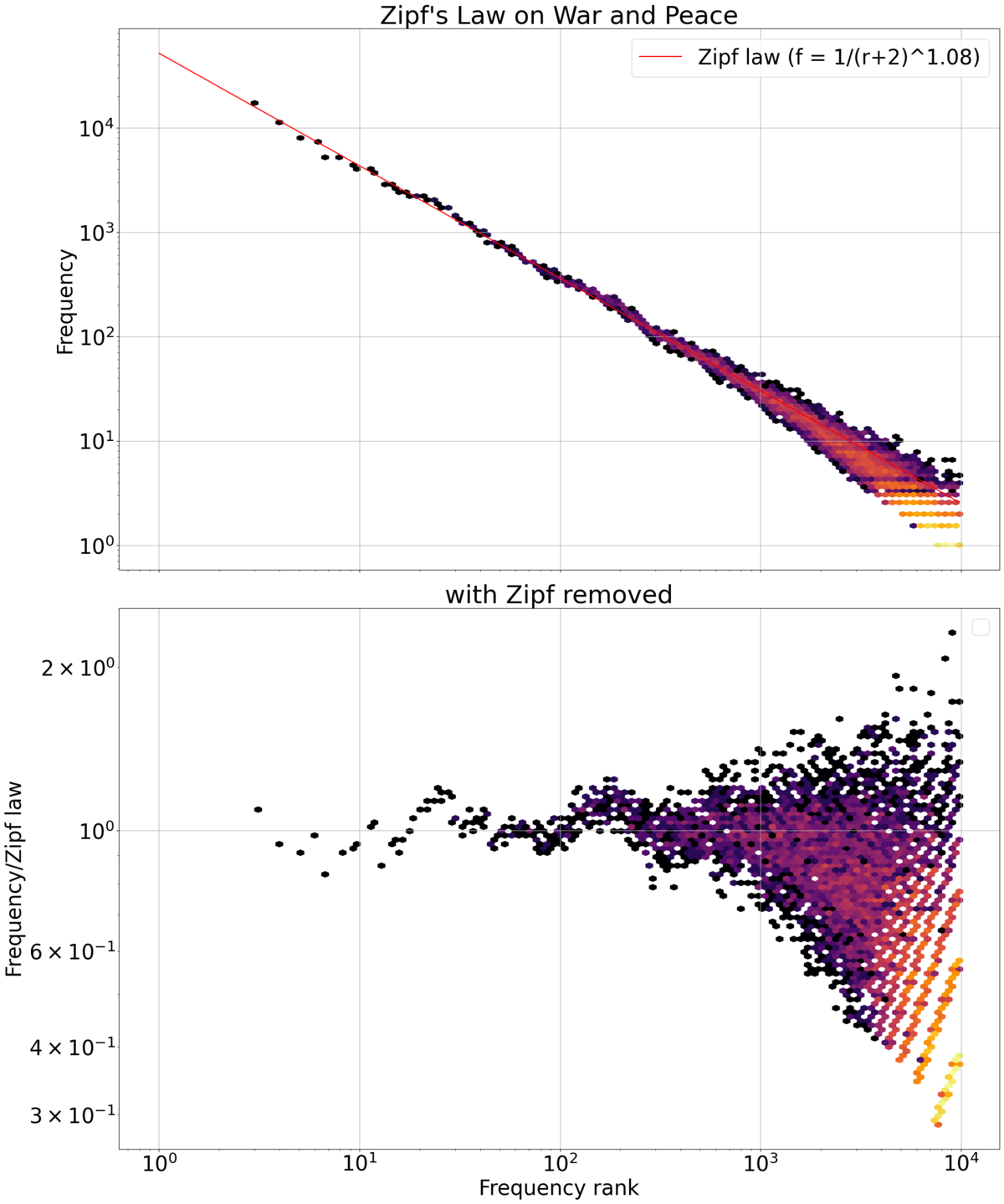
Zipf's law (, German: [ts͡ɪpf]) is an empirical law that often holds, approximately, when a list of measured values is sorted in decreasing order. It states that the value of the nth entry is inversely proportional to n.
The best known instance of Zipf's law applies to the frequency table of words in a text or corpus of natural language: It is ...

In linguistics, the brevity law (also called Zipf's law of abbreviation) is a linguistic law that qualitatively states that the more frequently a word is used, the shorter that word tends to be, and vice versa; the less frequently a word is used, the longer it tends to be. This is a statistical regularity that can be found in natural languages a...
this one
surreal spindle
Not quite
velvet sedge
yeah
surreal spindle
it's the amount of unique words in relation to the size of the entire thing
velvet sedge
OH

In linguistics, Heaps' law (also called Herdan's law) is an empirical law which describes the number of distinct words in a document (or set of documents) as a function of the document length (so called type-token relation). It can be formulated as
      V

        R


    (
  ...
oh damn right on the money I think
velvet sedge
maybe? or maybe I'm misunderstanding how you're ranking/assigning
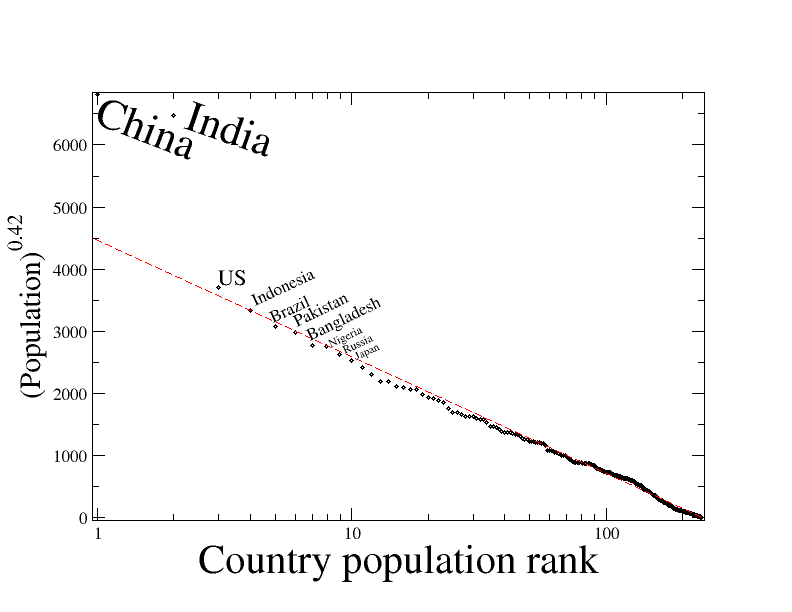
Rank–size distribution is the distribution of size by rank, in decreasing order of size. For example, if a data set consists of items of sizes 5, 100, 5, and 8, the rank-size distribution is 100, 8, 5, 5 (ranks 1 through 4). This is also known as the rank–frequency distribution, when the source data are from a frequency distribution. These are p...
there's a lot of these, but they all tend to follow power laws
surreal spindle
velvet sedge
https://en.wikipedia.org/wiki/Heaps%27_law
I think this is exactly it
surreal spindle
thank youuu
i'm gonna go check it against the data
Yep

those two look pretty similar
Thanks a lott!!!
.close
full forumBOT
Channel closed
Closed by @surreal spindle
Use .reopen if this was a mistake.
full forumBOT
Available help channel!
Send your question here to claim the channel.
Remember:
• Ask your math question in a clear, concise manner.
• Show your work, and if possible, explain where you are stuck.
• After 15 minutes, feel free to ping <@&286206848099549185>.
• Type the command .close to free the channel when you're done.
• Be polite and have a nice day!
Read #❓how-to-get-help for further information on how to ask a good question, and about conduct in the question channels.
@void arch Has your question been resolved?
full forumBOT
@void arch Has your question been resolved?
full forumBOT
@void arch Has your question been resolved?
full forumBOT
@void arch Has your question been resolved?
full forumBOT
Channel closed
Closed due to timeout
Use .reopen if this was a mistake.
Available help channel!
Send your question here to claim the channel.
Remember:
• Ask your math question in a clear, concise manner.
• Show your work, and if possible, explain where you are stuck.
• After 15 minutes, feel free to ping <@&286206848099549185>.
• Type the command .close to free the channel when you're done.
• Be polite and have a nice day!
Read #❓how-to-get-help for further information on how to ask a good question, and about conduct in the question channels.
 warped sapphire
 full forumBOT
warped sapphire
warped sapphire
full forumBOT
warped sapphire
warped sapphire
would this be correct
based off of my notes it looks correct but it marked it as incorrect for some reason
warped sapphire
nvm it was some stupid error I fixed it
thx
there was like a space in the answer box
 shrewd hamlet
Bruh webassign garbo
warped sapphire
tru
full forumBOT
@warped sapphire Has your question been resolved?
Channel closed
Closed by @warped sapphire
Use .reopen if this was a mistake.
Available help channel!
Send your question here to claim the channel.
Remember:
• Ask your math question in a clear, concise manner.
• Show your work, and if possible, explain where you are stuck.
• After 15 minutes, feel free to ping <@&286206848099549185>.
• Type the command .close to free the channel when you're done.
• Be polite and have a nice day!
Read #❓how-to-get-help for further information on how to ask a good question, and about conduct in the question channels.
 marsh tusk
Find the number of times the digit $9$ appears in the list of all integers from $1$ to $500$. (The number $ 99 $, for example, is counted twice, because $9$ appears two times in it.)
full forumBOT
marsh tusk
Find the number of times the digit $9$ appears in the list of all integers from ...
glossy valveBOT
龖

 weak iron
marsh tusk
Find the number of times the digit $9$ appears in the list of all integers from ...
weak iron
marsh tusk
Find the number of times the digit $9$ appears in the list of all integers from ...
in 1-89 the digit ‘9’ appears 9 times
in 90-99 the digit ‘9’ appears 10 times
this can be extended for each multiple of 100 (up to 800)
marsh tusk
weak iron
in 1-89 the digit ‘9’ appears 9 times
in 90-99 the digit ‘9’ appears 10 times
...
so 19*5?
weak iron
i would say so
 left bone
what?
weak iron
?
left bone
what would you say so?
weak iron
the number 9 appears 19*5 times in all integers between 1-500
left bone
this is both answer giving and wrong
marsh tusk
left bone
this is both answer giving and wrong
whats th ansewr then
left bone
I'm not giving you the answer
you can see what aysob did, the idea is right, then check it and apply the idea to get the right answer
marsh tusk
bruh i dont see what he did wrong though
left bone
did you count both groups?
it's possible I'm the one making a mistake as well, in which case you should do what you know is right
full forumBOT
weak iron
the number 9 appears 19*5 times in all integers between 1-500
As a helper, please do not give out answers that could be copied as a homework solution. Have the student work through the problem themselves and guide them along the way.
full forumBOT
marsh tusk
whats th ansewr then
The purpose of this server is to help you learn, not to hand out answers. Do not ask someone to give you the answer directly.
marsh tusk
yeah i got 9 values for first
and 10 valjues for second
so dont you jst plus the two
so 19 values for 100 digits
and 19x5
marsh tusk
u wrote 99 twice
marsh tusk
doesnt the question say distinct though
OH
nvm
i loked at th wrong question
oh
so its 100
thanks
.close
full forumBOT
Channel closed
Closed by @marsh tusk
Use .reopen if this was a mistake.
Available help channel!
Send your question here to claim the channel.
Remember:
• Ask your math question in a clear, concise manner.
• Show your work, and if possible, explain where you are stuck.
• After 15 minutes, feel free to ping <@&286206848099549185>.
• Type the command .close to free the channel when you're done.
• Be polite and have a nice day!
Read #❓how-to-get-help for further information on how to ask a good question, and about conduct in the question channels.
 left creek
"Sketch the solid by the given definition"
 full forumBOT
left creek
"Sketch the solid by the given definition"
left creek
full forumBOT
left creek
"Sketch the solid by the given definition"
left creek
I can't think of a way I can math this out to make it make sense
I have half a cylinder right now
full forumBOT
@left creek Has your question been resolved?
Channel closed
Closed by @left creek
Use .reopen if this was a mistake.
Available help channel!
Send your question here to claim the channel.
Remember:
• Ask your math question in a clear, concise manner.
• Show your work, and if possible, explain where you are stuck.
• After 15 minutes, feel free to ping <@&286206848099549185>.
• Type the command .close to free the channel when you're done.
• Be polite and have a nice day!
Read #❓how-to-get-help for further information on how to ask a good question, and about conduct in the question channels.
 torn jolt
Hi, im just learning sine/cosine graphing and my question is how can I get the starting point (reference point) from simply the equation. I know you can use (-h,k) but i was told at school by a friend that you cant always use h,k
This is the equation im trying to figure out right now, would the starting point be (-pi/6,-2) or am i wrong?
 full forumBOT
torn jolt
Hi, im just learning sine/cosine graphing and my question is how can I get the s...
full forumBOT
torn jolt
Hi, im just learning sine/cosine graphing and my question is how can I get the s...
 rocky vale
yeah that's right
if I understand what you mean by reference point
like the point on the graph that would normally be at the origin?
torn jolt
Yeah
rocky vale
yeah
torn jolt
is there any difference with cosine?
rocky vale
No, but the cosine graph wouldn't go through the reference point, right?
just to make sure I understand you
torn jolt
uhhhh cuz cosine is like min or max only right
rocky vale
yeah the normal cosine graph doesn't go through the origin, it starts at a maximum
rocky vale
does the question actually use the term reference point?
I just want to make sure we're talking about the same thing, becasue I don't think that's a standard term
torn jolt
 rocky vale
,rotate
glossy valveBOT
 rocky vale
ok yeah it does seem to mean what I thought
so yes you have the right idea
I think what your friend was referring to, is if you have a coefficient in front of the variable, then you need to factor it out to find h
for example if you had cos(2x-pi/2)+1, you would factor out the 2 and make it cos(2(x-pi/4))+1
torn jolt
torn jolt
Hi, im just learning sine/cosine graphing and my question is how can I get the s...
he was addressing this problem
ahhhh
nah we aint that far yet 😭
i got confused because i thought its always h,k when its in that form
these questions are from a team quiz we did a day ago and i dont remember exactly what we put since i just copied
rocky vale
wait, do you mean (h,k) as opposed to (-h,k)?
torn jolt
sorry -h,k
rocky vale
it is always the opposite of what appears in the function for h
torn jolt
Yeah
rocky vale
rocky vale
for example if you had cos(2x-pi/2)+1, you would factor out the 2 and make it co...
the only caveat is what I mentioned here
rocky vale
you tell me
torn jolt
😭 😭
rocky vale
no, you had the exact right idea from the beginning
just tell me what you think
exactly like the sine one
torn jolt
1sec let me graph it
wait im so confused
the "reference point" for the cosine graph doesnt exist unless i didnt graph right

,rotate
rocky vale
,rotate

 rocky vale
lol
torn jolt
😂
rocky vale
graph looks good 👍
If I'm understanding what you mean by reference point, it's (pi/2, 1)
and yes, that's not actually on the curve for cosine
rocky vale
everything there is definitely right
torn jolt
but (pi/2, 1) doesnt exist
rocky vale
hm
you might need to ask your teacher to clarify what "reference point" means. I've never seen that term used like that and I can't find it online
torn jolt
yeah thats why i came here 😭
starting point is exchanged with reference point
previous page asked "What is the starting point (reference point)"
rocky vale
I'll ask around but I don't think it's common terminology
torn jolt
i just found some notes "reference point (h,k) - the new origin"
rocky vale
ah
okay, that's basically what I thought
then we shouldn't expect the graph of a cosine function to go through the reference point
the normal cosine graph doesn't pass through the origin, after all
torn jolt
Ah
rocky vale
and yes, it's (h,k), not (-h,k), but that's only because the - sign is in the general form of the equation: cos(x-h)+k
torn jolt
wait would it be that since sin graphs start at this "new origin" since they start at mid prehaps this reference point thing is just an artifical 0,0 or something
rocky vale
yes
artificial (0,0) is a good way to think of it
sin passes through the origin
cos does not
torn jolt
rocky vale
and yes, it's (h,k), not (-h,k), but that's only because the - sign is in the g...
yeah cuz like u do x-h=0 and u move the h over which is x=h so u inverted the sign in other words
okay welp idk what that applies towards but thanks for ur help
🙏
rocky vale
sure thing 👍 no problem
torn jolt
.close
full forumBOT
Channel closed
Closed by @oak arrow
Use .reopen if this was a mistake.
full forumBOT
Available help channel!
Send your question here to claim the channel.
Remember:
• Ask your math question in a clear, concise manner.
• Show your work, and if possible, explain where you are stuck.
• After 15 minutes, feel free to ping <@&286206848099549185>.
• Type the command .close to free the channel when you're done.
• Be polite and have a nice day!
Read #❓how-to-get-help for further information on how to ask a good question, and about conduct in the question channels.
 solemn lance
Alina wants to make keepsake boxes for her two best friends. She doesn't have a lot of money, so she wants to make each box described so that it holds as much as possible with a limited amount of material.
For Jen, Alina wants to make a box with a square base whose sides and base are made of wood and whose top is made of metal. The wood she wants to use costs 5 cents per square inch, while the material for the metal top costs 12 cents per square inch. What is the largest possible box (in terms of volume measured in cubic inches) that Alina can make for Jen if she only has $30.00 to spend on materials? (Round your answer to three decimal places.)
full forumBOT
solemn lance
Alina wants to make keepsake boxes for her two best friends. She doesn't have a ...
@solemn lance Has your question been resolved?
full forumBOT
Channel closed
Closed due to timeout
Use .reopen if this was a mistake.
full forumBOT
Available help channel!
Send your question here to claim the channel.
Remember:
• Ask your math question in a clear, concise manner.
• Show your work, and if possible, explain where you are stuck.
• After 15 minutes, feel free to ping <@&286206848099549185>.
• Type the command .close to free the channel when you're done.
• Be polite and have a nice day!
Read #❓how-to-get-help for further information on how to ask a good question, and about conduct in the question channels.
 dense fable
#1(27)->#2(35)=29.6%
#2(35)->#3(48)=37.1% +7.5%
#2(7.5%)>#3(6.15%) -18% Delta
#3(48)->#4(63)=31.25% +6.15%
Scaling increases #4(6.15%)>#5(22.75%) +269.9% Delta
#4(63)->#5(97)=54% +22.75%
#5(97)->#6(~?)=
#6(~?)->#7(219)=
#5(97)->#7(219)=125.8%
I'm trying to find what #6 equals while factoring in the % scaling from the other numbers
full forumBOT
dense fable
#1(27)->#2(35)=29.6%
#2(35)->#3(48)=37.1% +7.5%
#2(7.5...
@dense fable Has your question been resolved?
full forumBOT
@dense fable Has your question been resolved?
full forumBOT
@dense fable Has your question been resolved?
Channel closed
Closed by @dense fable
Use .reopen if this was a mistake.
Available help channel!
Send your question here to claim the channel.
Remember:
• Ask your math question in a clear, concise manner.
• Show your work, and if possible, explain where you are stuck.
• After 15 minutes, feel free to ping <@&286206848099549185>.
• Type the command .close to free the channel when you're done.
• Be polite and have a nice day!
Read #❓how-to-get-help for further information on how to ask a good question, and about conduct in the question channels.
 spark vapor
I am confused about how to compute low rank approximation
 fast peak
compute svd and then just ignore a few of the singular values
spark vapor
im going to leave this open i have more questions
full forumBOT
@spark vapor Has your question been resolved?
Channel closed
Closed by @spark vapor
Use .reopen if this was a mistake.
full forumBOT
Available help channel!
Send your question here to claim the channel.
Remember:
• Ask your math question in a clear, concise manner.
• Show your work, and if possible, explain where you are stuck.
• After 15 minutes, feel free to ping <@&286206848099549185>.
• Type the command .close to free the channel when you're done.
• Be polite and have a nice day!
Read #❓how-to-get-help for further information on how to ask a good question, and about conduct in the question channels.
 languid lion
guys i need help with a geometry task it says: Imagine your math book is a rectangle. This rectangle stands on a corner and is held by the opposite corner. Your book rotates around the imaginary line (s. Fig.), which encloses a right angle with the table.
A) Draw an exact oblique image on white paper on a scale of 1:2. Enter all values and guidelines that have been measured or calculated (with a solution).
B) Calculate the volume and surface content of the resulting body.
For A I kind of know what to do but i’m stuck on B. The Book is 20x26,5cm and the rotation axis is 33.2cm. Now i don’t know how i’m supposed to calculate the volume and surface content 🥹

 full forumBOT
languid lion
guys i need help with a geometry task it says: Imagine your math book is a recta...
full forumBOT
languid lion
guys i need help with a geometry task it says: Imagine your math book is a recta...
@languid lion Has your question been resolved?
languid lion
nope
full forumBOT
Channel closed
Closed due to timeout
Use .reopen if this was a mistake.
Available help channel!
Send your question here to claim the channel.
Remember:
• Ask your math question in a clear, concise manner.
• Show your work, and if possible, explain where you are stuck.
• After 15 minutes, feel free to ping <@&286206848099549185>.
• Type the command .close to free the channel when you're done.
• Be polite and have a nice day!
Read #❓how-to-get-help for further information on how to ask a good question, and about conduct in the question channels.
full forumBOT
 stiff musk
is this a test?
 thorny spire
.close
full forumBOT
Channel closed
Closed by @thorny spire
Use .reopen if this was a mistake.
stiff musk
<@&268886789983436800> (not sure if this is actionable, but user deleted second screenshot that indicated this was a test)
 reef sparrow
stiff musk
<@&268886789983436800> (not sure if this is actionable, but user deleted second...
reef sparrow
stiff musk
<@&268886789983436800> (not sure if this is actionable, but user deleted second...
i'll just time out for a few hours to make sure the test deadline passes
full forumBOT
Available help channel!
Send your question here to claim the channel.
Remember:
• Ask your math question in a clear, concise manner.
• Show your work, and if possible, explain where you are stuck.
• After 15 minutes, feel free to ping <@&286206848099549185>.
• Type the command .close to free the channel when you're done.
• Be polite and have a nice day!
Read #❓how-to-get-help for further information on how to ask a good question, and about conduct in the question channels.
 ancient sequoia
Hello, I'm a chemistry student and i haven't officially taken MVC yet but i understand the basics. a variation of this statement with different variables is used for my lecture notes, and i am not understanding how this statement holds true. would it be possible for anyone to explain this verbally or write a step by step process to prove this? even a link to a page describing whatever law or rule this follows would be fine, i just don't know how to start.
 full forumBOT
ancient sequoia
Hello, I'm a chemistry student and i haven't officially taken MVC yet but i unde...
full forumBOT
ancient sequoia
Hello, I'm a chemistry student and i haven't officially taken MVC yet but i unde...
@ancient sequoia Has your question been resolved?
full forumBOT
@ancient sequoia Has your question been resolved?
full forumBOT
Channel closed
Closed due to timeout
Use .reopen if this was a mistake.
Available help channel!
Send your question here to claim the channel.
Remember:
• Ask your math question in a clear, concise manner.
• Show your work, and if possible, explain where you are stuck.
• After 15 minutes, feel free to ping <@&286206848099549185>.
• Type the command .close to free the channel when you're done.
• Be polite and have a nice day!
Read #❓how-to-get-help for further information on how to ask a good question, and about conduct in the question channels.
 lethal temple
hiii
full forumBOT
lethal temple
hiii
 full forumBOT
@lethal temple Has your question been resolved?
lethal temple
pls help
 vague moss
Do you see (5-9/2)²=(4-9/2)²?
lethal temple
yes
vague moss
What do the numbers within each bracket evaluate to?
lethal temple
like, when you solve it what do you get?
vague moss
Yes
lethal temple
it's 25-45+(81/4)=16-36+(81/4)
vague moss
No no
Just tell me what the numbers inside the brackets evaluate to
Let the square remain
lethal temple
so (1/2)^2=(-1/2)^2?
lethal temple
it's 1/2=-1/2
vague moss
Do u see the problem?
lethal temple
not actually
vague moss
Ok can u gimme 5 mins
lethal temple
k
vague moss
 lethal temple
so technically i can't demonstrate them they're wrong?
vague moss
No, they're wrong because when we take a square root, we have to account for both solutions
vague moss
Sqrt(4), algebraically, gives 2 and -2
lethal temple
thx, really appreciate it
lethal temple
vague moss
The reason there is a mistake here is that we forget about the +/-
yes yes
thx
full forumBOT
@lethal temple Has your question been resolved?
Channel closed
Closed by @lethal temple
Use .reopen if this was a mistake.
Available help channel!
Send your question here to claim the channel.
Remember:
• Ask your math question in a clear, concise manner.
• Show your work, and if possible, explain where you are stuck.
• After 15 minutes, feel free to ping <@&286206848099549185>.
• Type the command .close to free the channel when you're done.
• Be polite and have a nice day!
Read #❓how-to-get-help for further information on how to ask a good question, and about conduct in the question channels.
 gritty robin
"We can label the height and the slant height of the small triangle as H and L respectively. On the diagram below, h is divided in the ratio 2 : 1 (because "the strut is one third of the way up the ladder");"
 full forumBOT
gritty robin
"We can label the height and the slant height of the small triangle as H and L r...
full forumBOT
gritty robin
"We can label the height and the slant height of the small triangle as H and L r...
 elfin stream
similarity i suppose
gritty robin
but how
it tells that it is similar
but we don't know the length of the base of the other triangle
elfin stream
gritty robin
"We can label the height and the slant height of the small triangle as H and L r...
do u mind giving the full question
 elfin stream
lol its given
full forumBOT
Channel closed
Closed by @gritty robin
Use .reopen if this was a mistake.
Available help channel!
Send your question here to claim the channel.
Remember:
• Ask your math question in a clear, concise manner.
• Show your work, and if possible, explain where you are stuck.
• After 15 minutes, feel free to ping <@&286206848099549185>.
• Type the command .close to free the channel when you're done.
• Be polite and have a nice day!
Read #❓how-to-get-help for further information on how to ask a good question, and about conduct in the question channels.
 stiff swan
Can someone explain why this is true by the Markov Property: $P(X_3 = 3 | X_1 = 1) = P( X_2 = 3 | X_0 = 1)$.
I dont really see how the Markov property : future depends only on present works here
full forumBOT
stiff swan
Can someone explain why this is true by the Markov Property: $P(X_3 = 3 | X_1 = ...
glossy valveBOT
LeGM

 gritty rose
stiff swan
Can someone explain why this is true by the Markov Property: $P(X_3 = 3 | X_1 = ...
gritty rose
stiff swan
Can someone explain why this is true by the Markov Property: $P(X_3 = 3 | X_1 = ...
Not enough context
stiff swan
gritty rose
Not enough context
given a transistion probability matrix for example and I am asked to find P(X_3 = 3 | X_1 = 1)

I want to know why this is true $P(X_3 = 3 | X_1 = 1) = P( X_2 = 3 | X_0 = 1)$
glossy valveBOT
LeGM
 stiff swan
is this just a time homogeneity property?
gritty rose
Yea that matrix is very important to the question

Notice the lack of indices less than t on the right side
Only the difference between t and t+n matters
Apply that to your problem
full forumBOT
@stiff swan Has your question been resolved?
stiff swan
gritty rose
Apply that to your problem
ok I got the answer 1/15 but what's the point of this $P(X_3 = 3 | X_1 = 1) = P( X_2 = 3 | X_0 = 1)$ equation
glossy valveBOT
LeGM
 stiff swan
is it just to clearly show how many n-steps are required?
full forumBOT
@stiff swan Has your question been resolved?
full forumBOT
@stiff swan Has your question been resolved?
full forumBOT
@stiff swan Has your question been resolved?
full forumBOT
Channel closed
Closed due to timeout
Use .reopen if this was a mistake.
Available help channel!
Send your question here to claim the channel.
Remember:
• Ask your math question in a clear, concise manner.
• Show your work, and if possible, explain where you are stuck.
• After 15 minutes, feel free to ping <@&286206848099549185>.
• Type the command .close to free the channel when you're done.
• Be polite and have a nice day!
Read #❓how-to-get-help for further information on how to ask a good question, and about conduct in the question channels.
 olive horizon
 full forumBOT
olive horizon
full forumBOT
olive horizon
 summer echo
what's the question?
olive horizon
it wants x lenght
summer echo
are you supposed to use trigonometry btw?
olive horizon
No u shouldnt for now
summer echo
Maybe you should draw a diagram yourself, this one seems inaccurate
not sure how to continue without trig though
olive horizon
No, this question is correct, it's just very difficult to see, at least for you and me. And you shouldn't do it with trigonometry, because according to the topic order in the book, I haven't seen that topic yet.
Please anyone?
<@&286206848099549185>
olive horizon
 digital wedge
is angle ADB a right angle?
digital wedge
is angle ADB a right angle?
Yep its 90 degree
Btw if anyone wonders this is a geometry question for YKS (Turkiye university exam)
summer echo
I tried for a bit but the only way I can think of is finding the value of sin(15) with geometric arguments
You can look up how the exact value of sin(15) is derived
Here's a more accurate version of the drawing by the way:
 olive horizon
Thank u for ur attention but i wonder is there no way to solve this question other than trigo?
 warm flicker
full forumBOT
warm flicker
full forumBOT
@olive horizon Has your question been resolved?
full forumBOT
@olive horizon Has your question been resolved?
full forumBOT
@olive horizon Has your question been resolved?
 charred canopy
@olive horizon u here?
ig i solved it

forgot to write it, u get BH by doing pythagoras in BDH triangle
ig it's like this
digital wedge
we need to find x
from what i understand, you have proved that dbc=dcb=15degrees
but that could be proved by taking the angle sum property for triangle adb and dbc=dcb because they are base angle of isosceles
full forumBOT
Channel closed
Closed due to timeout
Use .reopen if this was a mistake.
Available help channel!
Send your question here to claim the channel.
Remember:
• Ask your math question in a clear, concise manner.
• Show your work, and if possible, explain where you are stuck.
• After 15 minutes, feel free to ping <@&286206848099549185>.
• Type the command .close to free the channel when you're done.
• Be polite and have a nice day!
Read #❓how-to-get-help for further information on how to ask a good question, and about conduct in the question channels.
 halcyon prism
 full forumBOT
halcyon prism
halcyon prism
full forumBOT
halcyon prism
halcyon prism
i have no clue as to how to do this question
all i was able to find so far is that AEC=84

clearer version
<@&286206848099549185>
digital wedge
.reopen
full forumBOT
Please only use the <@&286206848099549185> ping once if your question has not been answered for 15 minutes. Please do not ping or DM individual users about your question.
digital wedge
Gordon Freeman, you can use pythagoras in the end for your answer. the value of tan 15 is 2- root 3
in terms of x?
IMz
not much info cuz of the question
aint being full
full forumBOT
@halcyon prism Has your question been resolved?
full forumBOT
Channel closed
Closed due to timeout
Use .reopen if this was a mistake.
Available help channel!
Send your question here to claim the channel.
Remember:
• Ask your math question in a clear, concise manner.
• Show your work, and if possible, explain where you are stuck.
• After 15 minutes, feel free to ping <@&286206848099549185>.
• Type the command .close to free the channel when you're done.
• Be polite and have a nice day!
Read #❓how-to-get-help for further information on how to ask a good question, and about conduct in the question channels.
 outer dust
 full forumBOT
outer dust
outer dust
full forumBOT
outer dust
outer dust
so i find r'(t) = <2t,5,3t^2>
ah wait i need to find the unit tangent vector right?
the unit tangent vector looking realllll weird here
full forumBOT
@outer dust Has your question been resolved?
 red blade
outer dust
red blade
outer dust
hi keaton!!
outer dust
red blade
hi keaton!!
hi
 slate violet
outer dust
ah wait i need to find the unit tangent vector right?
slate violet
outer dust
ah wait i need to find the unit tangent vector right?
you don't need to actually
converting to parametric form, the line has direction vector (-2, 5, 3)
so you just need to dot r'(t) with (-2, 5, 3) and set it equal to 0
the value of t you get will give you the point
outer dust
i tried that but i just got 9t^2-4t+25=0?
slate violet
yeah
outer dust
that cant be factored, oh do i need to use the quadratic formula?
outer dust
huh
slate violet
oh wait the normal plane of the curve
ahhhh so when (t^2, 5t, t^3) is some multiple of (-2, 5, 3)
cause the normal plane of the curve is perpendicular to the direction vector of the curve
so the curve and the direction vector are parallel
outer dust
yea im not sure though how to proceed, its looking for a point but i cant stop thinking about cross product
which i know is wrong
full forumBOT
Channel closed
Closed by @outer dust
Use .reopen if this was a mistake.
full forumBOT
Available help channel!
Send your question here to claim the channel.
Remember:
• Ask your math question in a clear, concise manner.
• Show your work, and if possible, explain where you are stuck.
• After 15 minutes, feel free to ping <@&286206848099549185>.
• Type the command .close to free the channel when you're done.
• Be polite and have a nice day!
Read #❓how-to-get-help for further information on how to ask a good question, and about conduct in the question channels.
 paper kraken
for this problem you are trying to determine if the shapes are congruent. If they are what transformations are needed. My friends told me how the figures are not congruent as point N is odd whille all the other points are even. Can somewone explain this further please
 full forumBOT
paper kraken
for this problem you are trying to determine if the shapes are congruent. If the...
full forumBOT
paper kraken
for this problem you are trying to determine if the shapes are congruent. If the...
 white geyser
i think what they mean by even and odd is that triangle ZXY's vertices are all on coordinate points, while triangle LMN has the point N that lands somewhere in between coordinates.
paper kraken
Meaning the y value of point N is odd right?
white geyser
i wouldn't call it odd, we could say its y value is not an integer.
paper kraken
white geyser
i wouldn't call it odd, we could say its y value is not an integer.
The cordinates of P N are (8,-5)
white geyser
ah i wasn't reading the whole graph mb, yeah then what they said about even/odd is true.
the triangles are not congruent and thus cannot be mapped onto eachother.
paper kraken
white geyser
ah i wasn't reading the whole graph mb, yeah then what they said about even/odd ...
What do the odds and evens represent
white geyser
just points on the coordinate plane
you could also just find an angle or side that is not similar to the other triangle and prove they are not congruent that way
paper kraken
white geyser
you could also just find an angle or side that is not similar to the other trian...
True
.close
full forumBOT
Channel closed
Closed by @paper kraken
Use .reopen if this was a mistake.
Available help channel!
Send your question here to claim the channel.
Remember:
• Ask your math question in a clear, concise manner.
• Show your work, and if possible, explain where you are stuck.
• After 15 minutes, feel free to ping <@&286206848099549185>.
• Type the command .close to free the channel when you're done.
• Be polite and have a nice day!
Read #❓how-to-get-help for further information on how to ask a good question, and about conduct in the question channels.
 violet minnow
I thought i was right
 full forumBOT
violet minnow
I thought i was right
full forumBOT
violet minnow
I thought i was right
 worn matrix
yea u are right.
violet minnow
worn matrix
yea u are right.
hmm it didn't work tho
 full forumBOT
Channel closed
Closed by @violet minnow
Use .reopen if this was a mistake.
violet minnow
thank you
full forumBOT
Available help channel!
Send your question here to claim the channel.
Remember:
• Ask your math question in a clear, concise manner.
• Show your work, and if possible, explain where you are stuck.
• After 15 minutes, feel free to ping <@&286206848099549185>.
• Type the command .close to free the channel when you're done.
• Be polite and have a nice day!
Read #❓how-to-get-help for further information on how to ask a good question, and about conduct in the question channels.
 graceful peak
 full forumBOT
graceful peak
graceful peak
full forumBOT
graceful peak
graceful peak
how do i approach this problem
i tried to simplify it
which gives me [abc + a + c]/[bc + 1] = 3.14
no idea how to go from that (or if its even right)
 hot herald
consider that since b,c are positive integers
b + 1/c > 1,
what will be the range of 1/(b+1/c)?
graceful peak
it would still be greater than 1 right
glossy valveBOT
ℝαμΩℕωⅤ
 graceful peak
OHHH
okay so
sry i thought since a>0 then 1/a>0 it also applied to a>1 😅 im dum
since 1/(b+1/c) is less than 1 and a is a positive integer
a = 3
and 1/(b+1/c) = 0.14 ?
b + 1/c = 7 and 1/7
so b = 7 and c = 7 ?
so a + b + c = 17
hot herald
yeh
full forumBOT
Channel closed
Closed by @graceful peak
Use .reopen if this was a mistake.
Available help channel!
Send your question here to claim the channel.
Remember:
• Ask your math question in a clear, concise manner.
• Show your work, and if possible, explain where you are stuck.
• After 15 minutes, feel free to ping <@&286206848099549185>.
• Type the command .close to free the channel when you're done.
• Be polite and have a nice day!
Read #❓how-to-get-help for further information on how to ask a good question, and about conduct in the question channels.
 boreal folio
Im trying to solve this problem and keep getting lost, here is my work:
 full forumBOT
boreal folio
Im trying to solve this problem and keep getting lost, here is my work:
boreal folio
full forumBOT
boreal folio
Im trying to solve this problem and keep getting lost, here is my work:
boreal folio

 devout valley
A valid basis, but not unique - different ways to do it, luckily you know that each option is linearly independent by not being scalar multiples of each other, so you could test whether each vector is a valid element of the plane
boreal folio
so if the answer was a, i should be able to plug in x_1 = 1, x_2 = 2, x_3 = -1 and get 0?
hypothetically lol
devout valley
Yep, that's the idea - do you get zero when you do that? similar for the other one (they're also nice to repeat the options a bit!)
boreal folio
ah
well tysm that makes it so much easier
was there anything wrong with my approach?
devout valley
Not really - as mentioned, your basis is valid, so if they asked you for one, and you gave that, it would be fine
devout valley
Another way you could do it is to see if you can get any of the other vectors from your basis ones
For example, $\pmqty{1 \ 0 \ 3} + \pmqty{0 \ 1 \ -2}$ is a pretty nice choice \catthink
glossy valveBOT
@devout valley
 boreal folio
just to make sure I understand, d would be the answer because you can reverse plug them back in?
devout valley
Yep it's d 
boreal folio
Ok bet thank you 😄 ive been at this for so long lmao that explanation really helped
I kept thinking i did something wrong and not finding my mistake, didnt know there were multiple answes
answers*
.close
full forumBOT
Channel closed
Closed by @boreal folio
Use .reopen if this was a mistake.
devout valley
glossy valve
<@788085606483361802>
Also note that this gets you the $\pmqty{1 \ 1 \1}$, you can get that $\pmqty{1 \ 2 \ -1} = \pmqty{1 \ 0 \ 3} + 2 \pmqty{0 \ 1 \ -2}$, so from your basis you can create theirs
glossy valveBOT
@devout valley
 boreal folio
.reopen
full forumBOT
✅
devout valley
 sorry was just trying to add that in
boreal folio
wait so if I just factored mine a little I could get that too?
ah
well thats good to know lol
devout valley
boreal folio
I kept thinking i did something wrong and not finding my mistake, didnt know the...
But yep, (uncountably) infinitely many in fact(!)
boreal folio
to build on that they have a couple more equations with the same style of questions

can I do the same thing here? like reverse plug them back in?
devout valley
Basically for those ones, you want to figure out if the sets are linearly independent (for a set of two vectors, that's if they're not scalar multiples of each other) and they satisfy the equation 
Note the importance of the linear independence comment!
(one you should immediately be able to rule out as a basis from just looking at it...)
boreal folio
so both the vectors cant be a multiple of other ones? Like for ii they arnt liniarly independednt?
sorry I came from diff eq lol this is my first lesson on linalg
devout valley
Yep, (ii) is linearly dependent, in fact any set with the zero vector in it is linearly dependent!
boreal folio
hmm ok thats neat
so for these, as long as they are not linearly independent and they satisfy the equation they work, no more rules?
and I can do what i was doing before to find it if ans choices are not given?
devout valley
For this one, pretty much (might change a bit for other questions though!)
devout valley
boreal folio
and I can do what i was doing before to find it if ans choices are not given?
Yep, you can!
boreal folio
ah ok perfect, so for this one the last two work
second one isnt liniarly independent
and first one jsut doesnt satisfy the equation
devout valley
 nice nice!
boreal folio
ok bet
again tysm lol you just explained something to me which 30 minutes in the book did not
.close
full forumBOT
Channel closed
Closed by @boreal folio
Use .reopen if this was a mistake.
full forumBOT
Available help channel!
Send your question here to claim the channel.
Remember:
• Ask your math question in a clear, concise manner.
• Show your work, and if possible, explain where you are stuck.
• After 15 minutes, feel free to ping <@&286206848099549185>.
• Type the command .close to free the channel when you're done.
• Be polite and have a nice day!
Read #❓how-to-get-help for further information on how to ask a good question, and about conduct in the question channels.
torn jolt
How do I simplify $\frac{1}{\frac{x+2}{3x-6}}$
full forumBOT
torn jolt
How do I simplify $\frac{1}{\frac{x+2}{3x-6}}$
glossy valveBOT
Matt

 lime ether
kcf
torn jolt
lime ether
kcf
?
lime ether
keep change flip
when u take the reciprocal of any fraction
it just makes the denominator the numerator
1/(x+2/3x-6)
torn jolt
ohh
lime ether
is the same thing as 1 * (3x-6/x+2)
then factor the numerator
and u will see it simplifies nicely
ur final answer is
just
torn jolt
lime ether
is the same thing as 1 * (3x-6/x+2)
so $\frac{3x-6}{x+2}*1 = \frac{1}{\frac{x+2}{3x-6}}$
glossy valveBOT
Matt
 torn jolt
$\frac{3(x-2)}{x+2}$
glossy valveBOT
Matt
 lime ether
👍🏻
torn jolt
i see
lime ether
yup
full forumBOT
Channel closed
Closed by @atomic zodiac
Use .reopen if this was a mistake.
lime ether
no problem
hot herald
factorisation not needed
torn jolt
hot herald
factorisation not needed
why
hot herald
doesn't make it objectively simpler
hot herald
its situational
hot herald
here there's no significant difference
lime ether
true
hot herald
so not much point
lime ether
🤷🏼♂️
full forumBOT
Available help channel!
Send your question here to claim the channel.
Remember:
• Ask your math question in a clear, concise manner.
• Show your work, and if possible, explain where you are stuck.
• After 15 minutes, feel free to ping <@&286206848099549185>.
• Type the command .close to free the channel when you're done.
• Be polite and have a nice day!
Read #❓how-to-get-help for further information on how to ask a good question, and about conduct in the question channels.
 plush egret
I need some help understanding this conclusion.
full forumBOT
plush egret
I need some help understanding this conclusion.
glossy valveBOT
jan Niku
We have some function $\rho(t) = \phi(t) + i \psi (t)$ is analytic. Assume we are moving along some contour $C$ where $\psi$ is constant, and that $\phi$ has a maximum at some $t_0$ on the interior of $C$.

Now, what Strogatz says is that let $\hat T$ be the unit tangent vector at $t_0$. Then the directional derivative $\dv{\psi}{s} = 0$ at $t_0$ since $\psi$ is constant on $C$ (here $s$ parameterizes $C$). But, $\phi$ satisfies $\dv{\phi}{s}$ at $t=t_0$ because $\phi$ has an interior maximum there. so $\dv s (\phi + i \psi) = 0$ at $t=t_0$, and $\dv s \rho$ in direction $\hat T$. But $\rho$ is analytic, so its derivative is the same in all directions. Then $\rho ' (t_0) = 0$, and $t_0$ is a saddle point.
 plush egret
I'm not sure that i understand why t_0 is a saddle point
the fact that both the directional derivatives are 0 along C at some point would mean that both phi and psi should increase if we moved orthogonally off of it there, right?
I get that this means that the level curves have crossed, I just dont understand what that means for the global curvature there
why cant we just have a maximum or a minimum?
full forumBOT
@plush egret Has your question been resolved?
full forumBOT
@plush egret Has your question been resolved?
full forumBOT
@plush egret Has your question been resolved?
 simple totem
@plush egret by interior of C, do you mean a point not on the endpoint? or do you mean that C is a closed loop and you're talking about the area bounded by C
i think you were talking about the former. let me see if i can explain
plush egret
simple totem
<@331558346333224964> by interior of C, do you mean a point not on the endpoint?...
C is just some counter along which we have $\psi$ is constant
glossy valveBOT
jan Niku
 plush egret
I just dont think i undestand some kind of critical relationship between the directional derivative, the level curves, the gradients, the function, and the CR equations 
simple totem
plush egret
why cant we just have a maximum or a minimum?
my thinking is that by CR you immediately have that p'(t) = 0 implies a saddle point
phi_x = psi_y, and phi_y = -psi_x
if you were to have a maximum, you would need phi_y = psi_x as well
plush egret
i guess i dont believe p'=0
i mean, i dont really get why we have that
strogatz just constructs it
out of p=phi + ipsi
but i am not convinced thats uhh
i am not convinced
like its a dot product ... does that give us that we can just assemble it this way?
simple totem
p'(t_0) = 0 by construction
phi' = 0 on C, and psi' = 0 by virtue of being a maximum
or
i have it backwards
but yeah
plush egret
i guess okay maybe by stretch of me saying i understand and believe
direction derivative along C of p is 0
but why does that give p'(t_0) = 0?
plush egret
plush egret
direction derivative along C of p is 0
i guess critically at t_0 in the direction of C
simple totem
what does p'(t_0) mean to you
plush egret
im not really sure
i have in my head either a minimum or a maximum of the function locally
and there it makes sense
simple totem
i mean rigorously
plush egret
i dont know
simple totem
i understand it as p' = phi' + i*psi'
where (-)' = d-/dt
or ds
whatever the parametrization variable is
plush egret
i guess we get interactions between phi and psi maybe cancel some of that dependence out
simple totem
(\dv{\rho}{t} = \pdv{\rho}{x}\cdot\dv{x}{t} + \pdv{\rho}{y}\cdot\dv{y}{t})
glossy valveBOT
maximo
 simple totem
where dx/dt and dy/dt are coming from the countour C
plush egret
bleh i might not know enough multivar to understand this
simple totem
well like
plush egret
i think strogatz is trying to lean into multivar calculus
to be handwavey about complex stuff
simple totem
the countour C can be parametrized via (r(t) = \langle x(t), y(t)\rangle)
glossy valveBOT
maximo
 plush egret
sure
simple totem
we then have the tangent vector (\langle x'(t), y'(t)\rangle)
glossy valveBOT
maximo
 plush egret
oh
simple totem
only makes sense while you're on C
plush egret
glossy valve
**maximo**
then this almost looks like grad r dot tangent
simple totem
yeah
plush egret
but each component function has its own gradient
should i not be putting too much neccesity on understanding his like
construction of dp/ds?
youre talking about it like i can just jump to dp/ds at t_0 along C directly from just understanding how its constructed there
the point, i mean, not dp/ds
does that make sense 
simple totem
what i am saying is that dp/ds only makes sense along C
if you forget about C
and forget it's parametrization wrt s
then dp/ds loses meaning
what is ds?
plush egret
i understand that, i mean, then you don't have a tangent vector so what are you even dotting it with
simple totem
yeah exactly
plush egret
but strogatz moves right from dp/ds to p'
so idk if understanding how he builds up from the other directional derivatives is critical here
plush egret
should it be clear why mechanically we can do that
plush egret
simple totem
what does p' mean?
idk anymore i used to think of it as a linearization
but i dont think thats right either
i mean, i can give the definition
but i dont understand what it means on an intuitive level
simple totem
maybe im jumping ahead of myself
have you shown that analytic implies smooth?
plush egret
i heard ryc say this the other day
i dont really get what it means
doesnt analytic just mean its once differentiable?
in whatever blah domain
so this is saying if you can differentiate once, you get infinitely many as a result?
but i hadnt heard it until ryc said it
simple totem
differentiable -> smooth on C is another result yeah. im actually not sure about the relationship
what i was going to say is that you know p is analytic
and so smooth
plush egret
okay
simple totem
so what you should expect is that the derivative at a point behaves well, regardless of where you approach the point from
plush egret
this is just because you can break it apart right
i mean or maybe uhh
you arent restrained in your choice of what distance means in the limit defn of the derivative
wrt direction
or i guess you mean more intuitively otherwise itd indicate some kind of not niceness
a jump or something somewhere
but that wouldnt make sense
because its smooth
simple totem
yeah what i think of is that our complex derivative exists, and so the limit converges "regardless of path"
so this contour is not particularly special when it comes to the derivative, that is, p' is going to be 0 regardless of which contour we approach x(t_0) + iy(t_0) by.
C just has some outstanding properties that let us compute the derivative
namely that psi is constant and phi has a maximum at t_0
plush egret
so its like
if we find some path through the complex plane
and some tangent unit vector along that path gives dp/ds
then if p is analytic, it must be that p'(that point) = 0, too
i guess it didnt make sense to translate from like
derivative is notion of as you approach a point
and to me directional derivative is like
simple totem
plush egret
and some tangent unit vector along that path gives dp/ds
if dp/ds = 0 here, then yes i think we are saying the same thing
plush egret
as you move away from it
so i think it doesnt seem like they should connect in that way
okay so
so why does p'(t_0) = 0 mean t_0 is a saddle point
should that be clear
you said something before, sorry
simple totem
CR
plush egret
simple totem
my thinking is that by CR you immediately have that p'(t) = 0 implies a saddle p...
this
simple totem
phi_x = psi_y, and phi_y = -psi_x
plush egret
i don't really get why this would mean saddle 😳
is it intepretable through gradients/level curves
simple totem
let me see
maybe it's not as obvious as i thought
i was thinking that if phi_x = psi_y and phi_y = psi_x, that would amount to a max/min
so changing the sign in one of the directions would result in a saddle instead
plush egret
i guess i dont even get why that would mean max 😅
simple totem
let me see if i can justify it somehow
plush egret
i was more wondering like
plush egret
i just imagine, two level curves
each one is at level 0 or however you would say that
and theyre orthogonal
and the gradients are pointing some direction orthogonal to the level curves
so really, at t_0, you have gradients pointing along each level curve, like an overlayed capital L ontop of an X
yea i guess i dont know
@simple totem I appreciate your help, my sleeping pills are kicking in
maybe itd be better if i slept on it then toyed with this and see what happens
i can come back with something better than idk

.close
full forumBOT
Channel closed
Closed by @plush egret
Use .reopen if this was a mistake.
simple totem
yeah i was trying to think of something but nothing comes to mind
maybe i should look at the definition of a saddle point in C 😂
good night jan
full forumBOT
Available help channel!
Send your question here to claim the channel.
Remember:
• Ask your math question in a clear, concise manner.
• Show your work, and if possible, explain where you are stuck.
• After 15 minutes, feel free to ping <@&286206848099549185>.
• Type the command .close to free the channel when you're done.
• Be polite and have a nice day!
Read #❓how-to-get-help for further information on how to ask a good question, and about conduct in the question channels.
full forumBOT
simple totem
good night jan
simple totem
.close
full forumBOT
Channel closed
Closed by @simple totem
Use .reopen if this was a mistake.
Available help channel!
Send your question here to claim the channel.
Remember:
• Ask your math question in a clear, concise manner.
• Show your work, and if possible, explain where you are stuck.
• After 15 minutes, feel free to ping <@&286206848099549185>.
• Type the command .close to free the channel when you're done.
• Be polite and have a nice day!
Read #❓how-to-get-help for further information on how to ask a good question, and about conduct in the question channels.
 verbal adder
can someone explain what formula theyre using

 full forumBOT
verbal adder
can someone explain what formula theyre using
full forumBOT
verbal adder
can someone explain what formula theyre using
@verbal adder Has your question been resolved?
verbal adder
<@&286206848099549185>
 inland beacon
@verbal adder its the exponetial decay model f(t)=A*e^kt
torn jolt
Prove that (abc)^2>4∆/√3, where a, b and c are the sides of a triangle and ∆ is its area. Give me a hint
full forumBOT
@verbal adder Has your question been resolved?
verbal adder
.close
full forumBOT
Channel closed
Closed by @verbal adder
Use .reopen if this was a mistake.
Available help channel!
Send your question here to claim the channel.
Remember:
• Ask your math question in a clear, concise manner.
• Show your work, and if possible, explain where you are stuck.
• After 15 minutes, feel free to ping <@&286206848099549185>.
• Type the command .close to free the channel when you're done.
• Be polite and have a nice day!
Read #❓how-to-get-help for further information on how to ask a good question, and about conduct in the question channels.
 light steppe
tiny question about cauchy sequences and the right intuition
light steppe
so the way i understand it cauchy sequences are those where the elements get arbitrarily close together
however, in my lecture notes it says that it is not sufficient to require that the distance between successive elements converges towards 0 and i have a hard time understanding why
 ocean lark
Because cauchy says something stronger
not just about the difference between consecutive elements
But about the differences between every element
if that makes sense
I remember a question on a quiz or something from my analysis class that provided some intuition as to why exactly this is different
but its been a while so i cant remember
light steppe
but if i think about it visually, the elements of a sequence whose consecutive elements get closer and closer, wouldn't that mean that if i go along infinitely long in the sequence all elements will converge towards 1 point
light steppe
ocean lark
I remember a question on a quiz or something from my analysis class that provide...
in the lecture script we got it just says that these notions are not equivalent but not why 😕
 ivory cairn
cauchy says for any value n and m greater than some N, we have |a_n - a_m| is less than a given epsilon.
What you have is that after some N, |a_n - a_(n+1)| is less than a given epsilon
take something like a_n = log(n)
as n increases log(n) and log(n+1) get closer. So at some point |log(n) - log(n+1)| will be less than a given epsilon.
however, log(n) and log(1000n) will always be far apart, so log(n) is not a cauchy sequence.
light steppe
okay thank you both, i don't totally get the intuition but i see how the statements differ
.close
full forumBOT
Channel closed
Closed by @light steppe
Use .reopen if this was a mistake.
Available help channel!
Send your question here to claim the channel.
Remember:
• Ask your math question in a clear, concise manner.
• Show your work, and if possible, explain where you are stuck.
• After 15 minutes, feel free to ping <@&286206848099549185>.
• Type the command .close to free the channel when you're done.
• Be polite and have a nice day!
Read #❓how-to-get-help for further information on how to ask a good question, and about conduct in the question channels.
 misty fractal
Hello guys, could someone help me with this?
 full forumBOT
misty fractal
Hello guys, could someone help me with this?
misty fractal
full forumBOT
misty fractal
Hello guys, could someone help me with this?
misty fractal
I guess i'd have to use simon's favorite factoring trick here
Not sure how though maybe i'm dumb
x + y = 1/4 xy
 minor crater
misty fractal
x + y = 1/4 xy
minor crater
misty fractal
x + y = 1/4 xy
yeah
notice that x+y is an integer
thus 1/4 xy is also an integer
so xy must have a multiple of 4
misty fractal
minor crater
so xy must have a multiple of 4
hmm okay i see
4x + 4y = xy
4x + 4y - xy = 0
x(4-y) + 4y = 0
x(4-y) -4(4-y) = 0
(4-y)(x-4) = 16
then list out all the combinations?
minor crater
misty fractal
x(4-y) -4(4-y) = 0
not sure what you did here
misty fractal
minor crater
not sure what you did here
i rewrote it so that i can factor?
i subtracted by 16
so i added by 16 on the other side to compensate for it
misty fractal
minor crater
oh you wrote = 0
oh whoops typo
yes since i'm subtracting 16 from both sides i add it back to both sides so rhs should've been 16 not 0
torn jolt
||dont want to disturb you guys,
i just have one idea to solve it,
according to the question we need to consider a line y=x and all the points above this line and on this line would be the points where x<y
so you might try sketching the graph or taking intersections maybe
might help ya||
misty fractal
torn jolt
or maybe a new function which satifies the condition given ?
i'm not sure what you mean 😭
misty fractal
minor crater
so x(4-y)-4(4-y) = 16
it should be -16 right
or am i dumb 😭
(x-4)(4-y) = -16
(x-4)(y-4) = 16
not trying to be pedantic, just making sure 
torn jolt
misty fractal
i'm not sure what you mean 😭
never mind me
although i dont think it would work
full forumBOT
@misty fractal Has your question been resolved?
full forumBOT
Channel closed
Closed due to timeout
Use .reopen if this was a mistake.
full forumBOT
Available help channel!
Send your question here to claim the channel.
Remember:
• Ask your math question in a clear, concise manner.
• Show your work, and if possible, explain where you are stuck.
• After 15 minutes, feel free to ping <@&286206848099549185>.
• Type the command .close to free the channel when you're done.
• Be polite and have a nice day!
Read #❓how-to-get-help for further information on how to ask a good question, and about conduct in the question channels.
 kindred raven
derivatives
$e^{5tanx} + 5^{2x}$
full forumBOT
kindred raven
derivatives
$e^{5tanx} + 5^{2x}$
glossy valveBOT
odokawa
 kindred raven
why I can't to use the sum formula
torn jolt
are you trying to compute [
\m[\bigg]{\dv x}{e^{5\m\tan x} + 5^{2x}}
]
glossy valveBOT
 glossy valveBOT
odokawa
 torn jolt
glossy valve
**odokawa**
torn jolt
glossy valve
**odokawa**
yes that is valid (not the way you wrote it)
kindred raven
torn jolt
yes that is valid (not the way you wrote it)
 torn jolt
Use chain rule
kindred raven
chain rule for this?
kindred raven
5sec^2
torn jolt
What 💀
kindred raven
or am I wrong
kindred raven
torn jolt
What 💀
i have mental issues and skill issues if you could help me to understand better it would be great
torn jolt
That is the chain rule
kindred raven
$e^x = e^x (x')$
glossy valveBOT
odokawa
 torn jolt
kindred raven
i have mental issues and skill issues if you could help me to understand better...
torn jolt
kindred raven
i have mental issues and skill issues if you could help me to understand better...
You are smart my dude, just missing out on a stupid theorem
Yes
That
kindred raven
$e^{5tanx} (5sec^2e^{5tanx})$
glossy valveBOT
odokawa
 kindred raven
torn jolt
You are smart my dude, just missing out on a stupid theorem
kindred raven
torn jolt
You are smart my dude, just missing out on a stupid theorem
this for the left side
torn jolt
Why would e^x appear again
full forumBOT
Channel closed
Closed by @kindred raven
Use .reopen if this was a mistake.
Available help channel!
Send your question here to claim the channel.
Remember:
• Ask your math question in a clear, concise manner.
• Show your work, and if possible, explain where you are stuck.
• After 15 minutes, feel free to ping <@&286206848099549185>.
• Type the command .close to free the channel when you're done.
• Be polite and have a nice day!
Read #❓how-to-get-help for further information on how to ask a good question, and about conduct in the question channels.
 clear turret
This has to be in cos
I don’t understand the period
 clear turret
so far I have this 5 cos ( x + pi/3 ) -2
<@&286206848099549185>
<@&286206848099549185>
 woven eagle
Do you have problem finding period ??
clear turret
yes
woven eagle
clear turret
yes
There's a property stating thar
If fundamental period of f(x) is T then fundamental period of f(ax ± b) is T/abs(a)
Just use that
clear turret
woven eagle
Just use that
can u simplify what u said cause i did not understand a single word
full forumBOT
@clear turret Has your question been resolved?
clear turret
.close
full forumBOT
Channel closed
Closed by @clear turret
Use .reopen if this was a mistake.
Available help channel!
Send your question here to claim the channel.
Remember:
• Ask your math question in a clear, concise manner.
• Show your work, and if possible, explain where you are stuck.
• After 15 minutes, feel free to ping <@&286206848099549185>.
• Type the command .close to free the channel when you're done.
• Be polite and have a nice day!
Read #❓how-to-get-help for further information on how to ask a good question, and about conduct in the question channels.
 coarse tundra
Hello