#help-28
1 messages · Page 106 of 1
 austere cove
 strange scarab
I mean I dont get why it is divided by 2
austere cove
strange scarab
I mean I dont get why it is divided by 2
So the focus and the directrix are one way to define a parabola, right? The parabola is the set of all points that are equidistant from the focus and the directrix
The vertex is immediately between the focus and the directrix. The closest point to both of them
austere cove
For 2 and 3 yeah
If you're wondering how I got 3 for the vertex, it's because that's the average of 0 and 6
The vertex is also the average of the roots of a parabola
So if the roots were x = 2 and x = 8, then the vertex would x = 5
strange scarab
About number 2 and 3 how do i get its standard form?
austere cove
The standard form of the parabola is: (x - h)^2 = 4p(y - k)
However, because your parabola is in y rather than x your standard form is:
(y - k)^2 = 4p(x - h),
instead.
 austere cove
That looks good to me, they didn't ask for a graph though, so you can leave it off
@strange scarab
strange scarab
They asked a graph too actually
austere cove
Ah, well in that case you can set y = 0
And solve for x
To get the roots
Sqrt(1/16) = 1/4, so your roots are at -3-1/4 = -13/4 and -3+1/4 = -11/4
So you have three points to draw a parabola through.
strange scarab
austere cove
Sqrt(1/16) = 1/4, so your roots are at -3-1/4 = -13/4 and -3+1/4 = -11/4
huh?
austere cove
Roots are when y = 0.
y+1 = 16(x+3)^2
0+1 = 16(x+3)^2
1 = 16(x+3)^2
1/16 = (x+3)^2
±√(1/16) = x+3
-3±(1/4) = x
@strange scarab
austere cove
Ok, 3 is similar to 2 and 5 is similar to 4.
Give them a try and ping me if you have a specific question.
strange scarab
so it means that h is 3.5 and p is .5

 full forumBOT
Channel closed
Closed by @strange scarab
Use .reopen if this was a mistake.
 Available help channel!
Send your question here to claim the channel.
Remember:
• Ask your math question in a clear, concise manner.
• Show your work, and if possible, explain where you are stuck.
• After 15 minutes, feel free to ping <@&286206848099549185>.
• Type the command .close to free the channel when you're done.
• Be polite and have a nice day!
Read #❓how-to-get-help for further information on how to ask a good question, and about conduct in the question channels.
 sturdy thicket
What did I do wrong here? I’m doing quiz corrections and I think 1a) is wrong bc I didn’t state the relative extrema and I wasn’t supposed to include y values, is that right? And 1b) is wrong bc I didn’t state all points of inflection?
 full forumBOT
sturdy thicket
What did I do wrong here? I’m doing quiz corrections and I think 1a) is wrong bc...
full forumBOT
sturdy thicket
What did I do wrong here? I’m doing quiz corrections and I think 1a) is wrong bc...
@sturdy thicket Has your question been resolved?
full forumBOT
@sturdy thicket Has your question been resolved?
full forumBOT
@sturdy thicket Has your question been resolved?
full forumBOT
Channel closed
Closed due to timeout
Use .reopen if this was a mistake.
Available help channel!
Send your question here to claim the channel.
Remember:
• Ask your math question in a clear, concise manner.
• Show your work, and if possible, explain where you are stuck.
• After 15 minutes, feel free to ping <@&286206848099549185>.
• Type the command .close to free the channel when you're done.
• Be polite and have a nice day!
Read #❓how-to-get-help for further information on how to ask a good question, and about conduct in the question channels.
 sacred crystal
when taking the d/dt of this
 full forumBOT
sacred crystal
when taking the d/dt of this
sacred crystal
full forumBOT
sacred crystal
when taking the d/dt of this
sacred crystal
is
.4695
considered a constant
just cant remember if the starting value gets carried to the front for derivative
i think so
specifically because its linked to the exp
.close
full forumBOT
Channel closed
Closed by @sacred crystal
Use .reopen if this was a mistake.
Available help channel!
Send your question here to claim the channel.
Remember:
• Ask your math question in a clear, concise manner.
• Show your work, and if possible, explain where you are stuck.
• After 15 minutes, feel free to ping <@&286206848099549185>.
• Type the command .close to free the channel when you're done.
• Be polite and have a nice day!
Read #❓how-to-get-help for further information on how to ask a good question, and about conduct in the question channels.
 real lantern
i got 7/8 for a and -infinite for the other still a bit unsure

 torn jolt
real lantern
i got 7/8 for a and -infinite for the other still a bit unsure
torn jolt
real lantern
i got 7/8 for a and -infinite for the other still a bit unsure
Correct for a
B, I believe incorrect
torn jolt
$$\lim_{x \to - \infty} \frac{x^5}{-3x^4}$$
 glossy valveBOT
<:F_button:1095679234497843251>
 full forumBOT
Channel closed
Closed by @real lantern
Use .reopen if this was a mistake.
Available help channel!
Send your question here to claim the channel.
Remember:
• Ask your math question in a clear, concise manner.
• Show your work, and if possible, explain where you are stuck.
• After 15 minutes, feel free to ping <@&286206848099549185>.
• Type the command .close to free the channel when you're done.
• Be polite and have a nice day!
Read #❓how-to-get-help for further information on how to ask a good question, and about conduct in the question channels.
Channel closed
Closed due to the original message being deleted
Available help channel!
Send your question here to claim the channel.
Remember:
• Ask your math question in a clear, concise manner.
• Show your work, and if possible, explain where you are stuck.
• After 15 minutes, feel free to ping <@&286206848099549185>.
• Type the command .close to free the channel when you're done.
• Be polite and have a nice day!
Read #❓how-to-get-help for further information on how to ask a good question, and about conduct in the question channels.
 inner heron
Help
 full forumBOT
@inner heron Has your question been resolved?
full forumBOT
Channel closed
Closed due to timeout
Use .reopen if this was a mistake.
Available help channel!
Send your question here to claim the channel.
Remember:
• Ask your math question in a clear, concise manner.
• Show your work, and if possible, explain where you are stuck.
• After 15 minutes, feel free to ping <@&286206848099549185>.
• Type the command .close to free the channel when you're done.
• Be polite and have a nice day!
Read #❓how-to-get-help for further information on how to ask a good question, and about conduct in the question channels.
 slate oyster
does anyone here know how to do Arc length and surface area with integration?
full forumBOT
slate oyster
does anyone here know how to do Arc length and surface area with integration?
slate oyster
been trying to get help for the longest time to understand this question but ive been ignored
i explain how i answered it and im wondering how they arrived at that answer
full forumBOT
@slate oyster Has your question been resolved?
slate oyster
<@&286206848099549185>
full forumBOT
@slate oyster Has your question been resolved?
full forumBOT
@slate oyster Has your question been resolved?
 calm nacelle
full forumBOT
calm nacelle
full forumBOT
Channel closed
Closed by @calm nacelle
Use .reopen if this was a mistake.
Available help channel!
Send your question here to claim the channel.
Remember:
• Ask your math question in a clear, concise manner.
• Show your work, and if possible, explain where you are stuck.
• After 15 minutes, feel free to ping <@&286206848099549185>.
• Type the command .close to free the channel when you're done.
• Be polite and have a nice day!
Read #❓how-to-get-help for further information on how to ask a good question, and about conduct in the question channels.
 pine pond
 glossy valveBOT
putridplanet
 pine pond
the answer sheet says x + not x -
 lean bronze

How would i do this
Do i use distance formula
i know how to do it from point to point but not point to line
 deft parrot
You'd do E to G i think, if G is the midpoint of FGH
You could use pythagorean or distance
pine pond
.close
full forumBOT
Channel closed
Closed by @pine pond
Use .reopen if this was a mistake.
Available help channel!
Send your question here to claim the channel.
Remember:
• Ask your math question in a clear, concise manner.
• Show your work, and if possible, explain where you are stuck.
• After 15 minutes, feel free to ping <@&286206848099549185>.
• Type the command .close to free the channel when you're done.
• Be polite and have a nice day!
Read #❓how-to-get-help for further information on how to ask a good question, and about conduct in the question channels.
 hardy pivot
 full forumBOT
hardy pivot
hardy pivot
full forumBOT
hardy pivot
hardy pivot
soo this is the right answer but
i get A = -8/3 and B = 2

how am i mixing them up?
 hot herald
what A,B represent depends on how you set up your initial decomposition
what are the steps before this?
hardy pivot
dont rlly do much besides change
A/3x + B/4x + 5 into
A(3x) + B(4x + 5)
 stray ether
hot herald
stray ether
hot herald
you messed up the that step then
hardy pivot
but how
hot herald
from
$$\frac{10}{3x(4x+5)}= \frac{A}{3x} + \frac{B}{4x+5}$$
multiply both sides by $3x(4x+5)$
glossy valveBOT
ℝam()n()v
 hardy pivot
i dont rlly understand the steps u take from this point tho
i genuinely cannot decipher the mess my school feeds me
hot herald
do the multiplaction I mentioned
hot herald
yes
full forumBOT
Channel closed
Closed by @hardy pivot
Use .reopen if this was a mistake.
Available help channel!
Send your question here to claim the channel.
Remember:
• Ask your math question in a clear, concise manner.
• Show your work, and if possible, explain where you are stuck.
• After 15 minutes, feel free to ping <@&286206848099549185>.
• Type the command .close to free the channel when you're done.
• Be polite and have a nice day!
Read #❓how-to-get-help for further information on how to ask a good question, and about conduct in the question channels.
 brazen moth
How would I do part A?
 full forumBOT
brazen moth
How would I do part A?
brazen moth
full forumBOT
brazen moth
How would I do part A?
brazen moth
,rotate
glossy valveBOT
 brazen moth
graph for the problem

 white smelt
brazen moth
graph for the problem
white smelt
brazen moth
graph for the problem
from a height of 30 meters, it takes the rock 4 seconds to fall back down
at 30m, the velocity of the rock is 0
s = ut + 1/2 gt^2
white smelt
np
brazen moth
.close
full forumBOT
Channel closed
Closed by @brazen moth
Use .reopen if this was a mistake.
Available help channel!
Send your question here to claim the channel.
Remember:
• Ask your math question in a clear, concise manner.
• Show your work, and if possible, explain where you are stuck.
• After 15 minutes, feel free to ping <@&286206848099549185>.
• Type the command .close to free the channel when you're done.
• Be polite and have a nice day!
Read #❓how-to-get-help for further information on how to ask a good question, and about conduct in the question channels.
hardy pivot
 full forumBOT
hardy pivot
hardy pivot
full forumBOT
hardy pivot
hardy pivot
so uhhh, where does the 6 come from
 forest widget
probably comes from solving the partial fraction decomposition
 agile ferry
hardy pivot
so uhhh, where does the 6 come from
agile ferry
hardy pivot
so uhhh, where does the 6 come from
you could just go from the opposite sens, meaning from the simplification then develop
full forumBOT
@hardy pivot Has your question been resolved?
full forumBOT
Channel closed
Closed due to timeout
Use .reopen if this was a mistake.
Available help channel!
Send your question here to claim the channel.
Remember:
• Ask your math question in a clear, concise manner.
• Show your work, and if possible, explain where you are stuck.
• After 15 minutes, feel free to ping <@&286206848099549185>.
• Type the command .close to free the channel when you're done.
• Be polite and have a nice day!
Read #❓how-to-get-help for further information on how to ask a good question, and about conduct in the question channels.
 oak ruin
How would I approach this problem? I'm not exactly sure where to start.

 hot knoll
To write an equation for a plane in 3 dimensions, you need two pieces of information:
- A point on the plane
- A Normal vector of the plane
In this case youre given the point but you need to deduce the Normal vector
oak ruin
hot knoll
In this case youre given the point but you need to deduce the Normal vector
ah and that'd be the cross product right
oak ruin
Ok thanks I think I got it from here 😄
hot knoll
Give any two vectors in the plane/parallel to the plane and their cross product will serve as a normal vector
Yw goodluck
oak ruin
.close
full forumBOT
Channel closed
Closed by @oak ruin
Use .reopen if this was a mistake.
Available help channel!
Send your question here to claim the channel.
Remember:
• Ask your math question in a clear, concise manner.
• Show your work, and if possible, explain where you are stuck.
• After 15 minutes, feel free to ping <@&286206848099549185>.
• Type the command .close to free the channel when you're done.
• Be polite and have a nice day!
Read #❓how-to-get-help for further information on how to ask a good question, and about conduct in the question channels.
 late grail
if $A^3 = I + A$, then $A, I + A$ and $A − I$are nonsingular (invertible).
full forumBOT
late grail
if $A^3 = I + A$, then $A, I + A$ and $A − I$are nonsingular (invertible).
late grail
i'm lost
i don't know how to prove that a matrix is invertible or not
i only know how to use the determinant method
but these matrices we have here are arbitrary
glossy valveBOT
nd
 full forumBOT
@late grail Has your question been resolved?
 acoustic bobcat
to show matrix A is invertible, you want to get it in a form like $A \cdot C$ = $I$
glossy valveBOT
AlphaNull
 acoustic bobcat
so I'd suggest putting your I on the right and trying to factor the remaining stuff on the left into something nice
full forumBOT
@late grail Has your question been resolved?
full forumBOT
Channel closed
Closed due to timeout
Use .reopen if this was a mistake.
full forumBOT
Available help channel!
Send your question here to claim the channel.
Remember:
• Ask your math question in a clear, concise manner.
• Show your work, and if possible, explain where you are stuck.
• After 15 minutes, feel free to ping <@&286206848099549185>.
• Type the command .close to free the channel when you're done.
• Be polite and have a nice day!
Read #❓how-to-get-help for further information on how to ask a good question, and about conduct in the question channels.
 ivory zinc
 full forumBOT
ivory zinc
ivory zinc
full forumBOT
ivory zinc
ivory zinc
Im having trouble understanding letter D.
I've been able to do everything else but i just can't figure out the last one.
I do understand that f(x)>0 would be above the x-axis and whenever y = 0 but nothing seems to work.
 deft flower
We know by definition that $f(x) \geq 0$ {\bf if and only if} $f(x) \not< 0$
glossy valveBOT
@deft flower
 deft flower
We also know by Part A that $f(x) < 0$ {\bf if and only if} $x$ is in the range $(-\infty, -2) \cup (2, \infty)$
glossy valveBOT
@deft flower
 ivory zinc
Yes, that's right
deft flower
We can take what's called the `contrapositive' of this statement, and determine that
\begin{center}
$f(x) \not< 0$ {\bf if and only if} $x$ is {\bf NOT} in the range $(-\infty, -2) \cup (2, \infty)$
\end{center}
glossy valveBOT
@deft flower
 deft flower
\def\iff{\ \text{\bf if and only if}\ }
Altogether, this gives us
\begin{align*}
f(x) \geq 0 &\iff f(x) \not< 0 \
&\iff x \text{ is {\bf NOT} in the range }(-\infty, -2) \cup (2, \infty)
\end{align*}
glossy valveBOT
@deft flower
 deft flower
So now we only need to find the range of values of $x$ where $x$ isn't in $(-\infty, -2) \cup (2, \infty)$
glossy valveBOT
@deft flower
 deft flower
Do you think you'd be able to describe that as an interval/union of intervals?
ivory zinc
I think so let me take a look at the graph again
Well it's hard to understand, but x isn't in (-oo, -2)U(2,oo) at (-2, 0), (-1, 0), and (2,0)
Am i correct?
ivory zinc
What?
I would assume at the maximum value but it's hard to determine that because the graph doesn't tell me
From (-1,0) the graph does not show where it curves. Only that it goes up and lands down on 2. It can't be infinity cause it clearly indicates it curves and goes down to -oo.
deft flower
If we convert $(-\infty, -2)$ to natural language, we might say $x$ is less than $2$'', and for $(2, \infty)$ that $x$ is greater than $2$'', so we need an interval that captures all the points where
\begin{center}
$x$ is not less than $-2$ and $x$ is not greater than $2$
\end{center}
glossy valveBOT
@deft flower
 ivory zinc
Ohh okay so just between -2 and 2
deft flower
yep; and should that be inclusive or exclusive?
ivory zinc
I don't entirely remember. Is it exclusive?
I know that < > are paranthesis and that with "_" is brackets. However i forget which means inclusive and which is exclusive
deft flower
Ah yeah
Inclusive means we include the bound, so $[-2, 2]$ (or $-2 \leq x \leq 2$) and exclusive excludes the bound, so $(-2, 2)$ (or $-2 < x < 2$)
glossy valveBOT
@deft flower
 ivory zinc
Ohh so it would be inclusive
deft flower
Yep, exactly
ivory zinc
Ookay so inclusive and between -2 and 2. I was thinking [-2, -1]U[-1, 2]
Am i correct?
deft flower
Yes, but we can simplify here
ivory zinc
Simplify? I didn't know interval notation could be simplified!
deft flower
There has to be specific conditions for it to work
ivory zinc
And what would those be?
I don't think I've ever simplified interval notation so I'm entirely new to this
Oh wait!! Would it instead be [-2, 2]?
deft flower
Yep, exactly!
deft flower
That's good
deft flower
Yeah of course!
ivory zinc
.close
full forumBOT
Channel closed
Closed by @ivory zinc
Use .reopen if this was a mistake.
full forumBOT
Available help channel!
Send your question here to claim the channel.
Remember:
• Ask your math question in a clear, concise manner.
• Show your work, and if possible, explain where you are stuck.
• After 15 minutes, feel free to ping <@&286206848099549185>.
• Type the command .close to free the channel when you're done.
• Be polite and have a nice day!
Read #❓how-to-get-help for further information on how to ask a good question, and about conduct in the question channels.
 round gust
 full forumBOT
round gust
full forumBOT
round gust
 full forumBOT
@round gust Has your question been resolved?
round gust
<@&286206848099549185>
the maximum deflection should be f(6), right
,w 10^(-3) * (1/3 * x^3 -6x^2) for x=6
glossy valveBOT


 Requested by masteroogway0599
round gust
Requested by masteroogway0599
round gust
,calc -18/125
glossy valveBOT
Result:
-0.144
 Requested by masteroogway0599
round gust
Requested by masteroogway0599
round gust
,w 10^(-3) * (1/3 * x^3 -6x^2) for x=1.5
glossy valveBOT
 Requested by masteroogway0599
round gust
Requested by masteroogway0599
round gust
,w 10^(-3) * (1/3 * x^3 -6x^2) for x=3
glossy valveBOT
 Requested by masteroogway0599
round gust
Requested by masteroogway0599
round gust
,calc -9/200
glossy valveBOT
Result:
-0.045
,w 75% * 6
glossy valveBOT
 Requested by masteroogway0599
round gust
Requested by masteroogway0599
round gust
,w 10^(-3) * (1/3 * x^3 -6x^2) for x=4.5
glossy valveBOT
 Requested by masteroogway0599
round gust
Requested by masteroogway0599
round gust
,w x/100 * 6 = -0.012375
glossy valveBOT
 Requested by masteroogway0599
round gust
Requested by masteroogway0599
round gust
,w x/100 * 6 = -0.091125
glossy valveBOT
 Requested by masteroogway0599
round gust
Requested by masteroogway0599
round gust
,w x/100 * 6 = -9/200
glossy valveBOT
 Requested by masteroogway0599
round gust
Requested by masteroogway0599
round gust
why am i getting negative percentages
should i use the absolute value?
like this: ?
,w x/100 * 6 = 0.012375
glossy valveBOT
 Requested by masteroogway0599
round gust
Requested by masteroogway0599
round gust
the deflection at 25% of the 6 meter beam represents 20.625% of the maximum deflection?
round gust
<@&286206848099549185>
round gust
,w x/100 * -0.144 = -0.012375
glossy valveBOT
 Requested by masteroogway0599


 full forumBOT
Channel closed
Closed by @round gust
Use .reopen if this was a mistake.
full forumBOT
Available help channel!
Send your question here to claim the channel.
Remember:
• Ask your math question in a clear, concise manner.
• Show your work, and if possible, explain where you are stuck.
• After 15 minutes, feel free to ping <@&286206848099549185>.
• Type the command .close to free the channel when you're done.
• Be polite and have a nice day!
Read #❓how-to-get-help for further information on how to ask a good question, and about conduct in the question channels.
 half remnant
can someone help with question e please
 full forumBOT
half remnant
can someone help with question e please
full forumBOT
half remnant
can someone help with question e please
 onyx glen
your pdf is shifted right by h
half remnant
wait I got it
I think
a is 1
b is h
so its E(X) + h
or c/2 + h
yeah thats correct
mb
.close
full forumBOT
Channel closed
Closed by @half remnant
Use .reopen if this was a mistake.
Available help channel!
Send your question here to claim the channel.
Remember:
• Ask your math question in a clear, concise manner.
• Show your work, and if possible, explain where you are stuck.
• After 15 minutes, feel free to ping <@&286206848099549185>.
• Type the command .close to free the channel when you're done.
• Be polite and have a nice day!
Read #❓how-to-get-help for further information on how to ask a good question, and about conduct in the question channels.
 tired aurora
yo
full forumBOT
tired aurora
yo
tired aurora

 sharp flame
Have you thought of anything?
 pseudo cape
tired aurora
pseudo cape
tired aurora
By the way, regarding C), primes of the form 2^n - 1 are called Mersenne primes.
 short crest
tired aurora
short crest
tired aurora
So... just find counter examples right?
tired aurora
short crest
So... just find counter examples right?
ya
tired aurora
pseudo cape
By the way, regarding C), primes of the form 2^n - 1 are called Mersenne primes.
ok
tired aurora
sharp flame
Have you thought of anything?
ya
full forumBOT
Show your work, and if possible, explain where you are stuck.
sharp flame
!show
full forumBOT
Show your work, and if possible, explain where you are stuck.
sharp flame
welp
tired aurora
one sec
tired aurora
tired aurora
A) counter example = if x or y if one of them is negative
nah im just confused
sharp flame
you need to find 2 numbers such that x^2 = y^2 but x != y
tired aurora
sharp flame
you need to find 2 numbers such that x^2 = y^2 but x != y
2^2 = -2^2
4 != -4
sharp flame
2^2 = (-2)^2 but 2 != -2
tired aurora
ye so i am right
tired aurora
sharp flame
2^2 = (-2)^2 but 2 != -2
wdymn ()
it just said y^2
so it can be -2^2
?
tired aurora
short crest
So... just find counter examples right?
how can it be "The right script, the wrong line. "???
in your bio
short crest
why not?
tired aurora
dont make sense
short crest
It does mak sense.
sharp flame
tired aurora
so it can be -2^2
no
glossy valveBOT
jan Nejon
 short crest
tired aurora
how can it be "The right script, the wrong line. "???
short crest
tired aurora
how can it be "The right script, the wrong line. "???
A script consists of many lines, and a poem consists of multiple rhymes...
How does it not make sense to choose the wrong one?
tired aurora
if its the right script it will have right lines
and the poem will have right ryhmes if its the right poem
short crest
Suppose a script,
You : Hi
Other guy: Hello
If you read Hello, is it the right line?
short crest
nvm just later.
sharp flame
tired aurora
then what i do tthen?
you say x = 2, y = -2 is a counterexample
tired aurora
glossy valve
**jan Nejon**
ye but if you said -2 as y
this means to y^2
and that is (-2)^2
so x = 4 and y = 4
so its same value
oh maybe ik what u mean
sharp flame
yes but x != y
tired aurora
x^2 and y^2 has to be same number
sharp flame
the statement says if x^2 = y^2, x = y
tired aurora
even if its same value after calculate
sharp flame
but we found x^2 = y^2 such that x != y
tired aurora
it means x and y have to be same value before calculate?
2^2 and 2^2
2^2 and -2^2
sharp flame
tired aurora
it means x and y have to be same value before calculate?
the statement says that if x^2 = y^2 then x must be equal to y
but that's not true
tired aurora
but its only true after calculate
so x^2 = y^2 isnt equal
you mean that?
x = 2^2, y = (-2^2)
now they are not the same
but x = 4, y = 4
now same
 vast fossil
To disprove an implication "If p, then q", it is enough to show an instance where p is true but q is false, e.g., "If x is a real number, then x^2 > 0" is false because I can show you a real number x such that x^2 is not positive (namely, x = 0)
Similarly here we can provide values for x and y such that x^2 = y^2 but x =/= y
Like Neon said, letting x = 2 and y = -2 disproves the statement
Since x^2 = 2^2 = 4 = (-2)^2 = y^2 (meaning x^2 = y^2 is true) but x = 2 =/= -2 = y (meaning x = y is false)
tired aurora
vast fossil
To disprove an implication "If p, then q", it is enough to show an instance wher...
which real number?
vast fossil
tired aurora
x and y not true but x^2 and y ^ 2 is true
Yeah, showing that such scenario can occur is sufficient
tired aurora
tired aurora
A) x and y not true but x^2 and y ^ 2 is true
B) n can be negative (-3)
C) ? idk
C) N can be negative??
vast fossil
tired aurora
C) N can be negative??
They have not stated where x, y and n are from, but I suppose they are real numbers
tired aurora
vast fossil
They have not stated where x, y and n are from, but I suppose they are real numb...
wait
n is maybe only natrual numbers
vast fossil
Again, a counterexample would when the premise holds but the conclusion does not, meaning you need to pick a value of n such that n^2 > 9 is true but n > 3 is false
tired aurora
but if its impposisble then n is not only natrual numbers
vast fossil
-3 does not count as a counterexample as you need n^2 > 9 to be true
tired aurora
vast fossil
-3 does not count as a counterexample as you need n^2 > 9 to be true
(-3)
oh higher than 9
vast fossil
tired aurora
but if its impposisble then n is not only natrual numbers
Right, but we can't tell whether they meant n to be natural or not
vast fossil
tired aurora
oh higher than 9
Yes
tired aurora
vast fossil
Right, but we can't tell whether they meant n to be natural or not
its possible solve with natrual numbers?
vast fossil
If n is natural, then the implication "n^2 > 9 -> n > 3" is true, yes, but we aren't told whether n is natural or not
tired aurora
vast fossil
If n is natural, then the implication "n^2 > 9 -> n > 3" is true, yes, but we ar...
is it possible to make it untrue?
nah its not
vast fossil
It is untrue if we are allowed to pick numbers less than -3
vast fossil
Right
vast fossil
Or simply integers
tired aurora
Z
vast fossil
Yes
 vast fossil
What is it?
 glossy valveBOT
 tired aurora
I did right?
tired aurora
how?
tired aurora
vast fossil
It looks like you forgot to square 4 and 10^(-4)
i didint forgot
i put it into 8
vast fossil
4^2 is not 8
vast fossil
And 10^-4 is not a square of itself
vast fossil
Yes
tired aurora
and to calculate now
vast fossil
Right
vast fossil
If necessary, yeah, but simplify first
It looks like powers of 10 are going to cancel out
tired aurora
divided by 3200000000000
tired aurora
vast fossil
If necessary, yeah, but simplify first
ok
tired aurora
vast fossil
It looks like powers of 10 are going to cancel out
ok
1,2^8x16
divided by 3,2x^10^11?
????
vast fossil
Should be (1.2 * 16)/(3.2 * 10^3) since the 10^8 in the numerator cancels out with the 10^8 in the denominator
full forumBOT
Channel closed
Closed by @tired aurora
Use .reopen if this was a mistake.
full forumBOT
Available help channel!
Send your question here to claim the channel.
Remember:
• Ask your math question in a clear, concise manner.
• Show your work, and if possible, explain where you are stuck.
• After 15 minutes, feel free to ping <@&286206848099549185>.
• Type the command .close to free the channel when you're done.
• Be polite and have a nice day!
Read #❓how-to-get-help for further information on how to ask a good question, and about conduct in the question channels.
 fair walrus
 full forumBOT
fair walrus
fair walrus
full forumBOT
fair walrus
fair walrus
What is this kind of problem called
 astral steppe
full forumBOT
astral steppe
full forumBOT
Channel closed
Closed by @fair walrus
Use .reopen if this was a mistake.
full forumBOT
Available help channel!
Send your question here to claim the channel.
Remember:
• Ask your math question in a clear, concise manner.
• Show your work, and if possible, explain where you are stuck.
• After 15 minutes, feel free to ping <@&286206848099549185>.
• Type the command .close to free the channel when you're done.
• Be polite and have a nice day!
Read #❓how-to-get-help for further information on how to ask a good question, and about conduct in the question channels.
torn jolt
 torn jolt
Can anyone explain how to do this?
I know@its f(b) - f(a)
—————-
B-A
But there’s only one x value in the problem
What would I put for x?
1 because the -3 there already or what
Idk if the -3 is from the interval they gave or just coincidence
vast fossil
torn jolt
I know@its f(b) - f(a)
—————-
B-A
That's the slope, pretty sure it's unnecessary to mention that
 shut thorn
coincidence
vast fossil
torn jolt
But there’s only one x value in the problem
I see infinitely many values of x in [-3, 1]
Anyway, you can basically obtain a double inequality describing the range of f given its formula and that x is in [-3, 1]
First of all, what does it mean for some x to be in [-3, 1]?
torn jolt
Wdym
vast fossil
What do I mean by what exactly?
torn jolt
First of all, what does it mean for some x to be in [-3, 1]?
vast fossil
Do you know what the interval [-3, 1] is?
vast fossil
Not only them
[a, b] denotes the set containing every real number x such that a <= x <= b
So in this case we are talking about x with -3 <= x <= 1
Alright, so, given that, ? <= x - 3 <= ?
torn jolt
1 <= x - 3 <= -3?
vast fossil
No, that double inequality is never true either
1 <= -3 is false
-3 <= x <= 1 implies that -3 - 3 <= x - 3 <= 1 - 3
So -6 <= x - 3 <= -2
Meaning -6 <= f(x) <= -2
torn jolt
Yeah idk bro this lost me
Way my teacher tryna teach it is with fractions
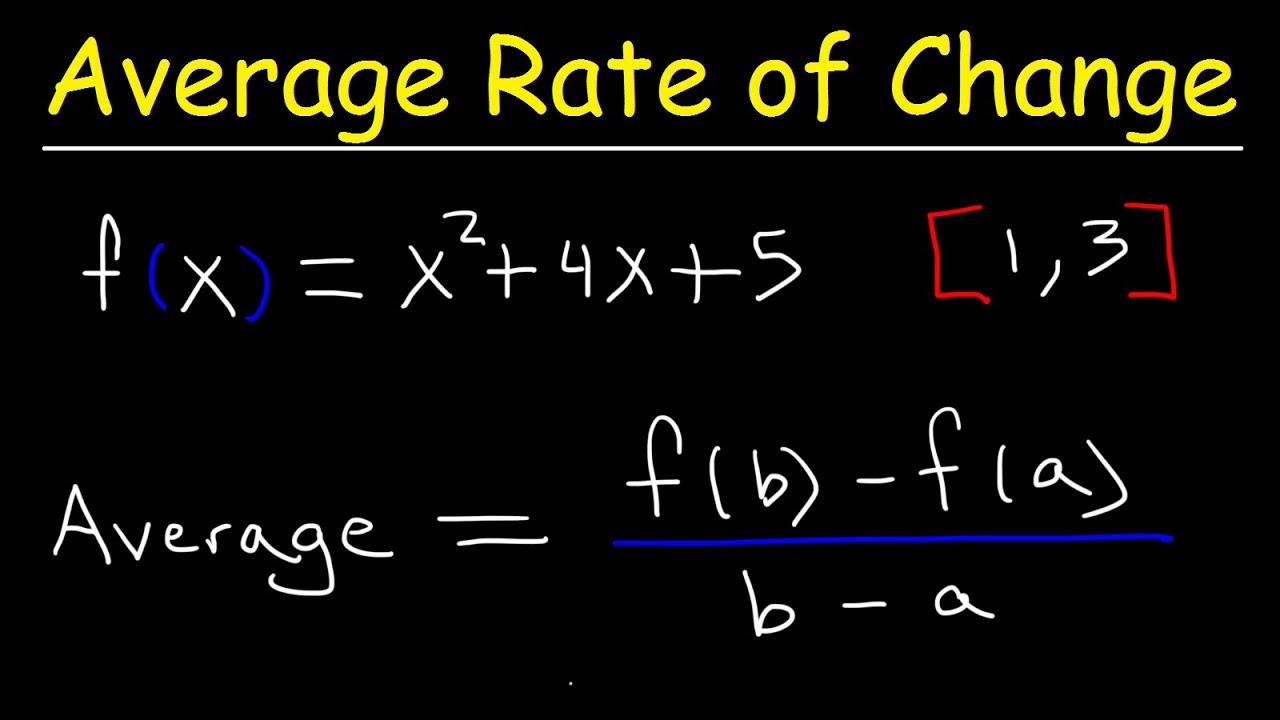
This precalculus video tutorial explains how to calculate the average rate of change of a function over an interval. This video contains plenty of examples and practice problems.
My E-Book: https://amzn.to/3B9c08z
Video Playlists: https://www.video-tutor.net
Homework Help: https://bit.ly/Find-A-Tutor
Subscribe: https://bit.ly/37WGgXl
Su...
He linked this video
But there’s 2 x values but on mine only 1 x input
I mean like 1 x to put the numbers in
vast fossil
Ugh, sorry, I misread your problem
I thought it asked for the range
The average rate of change will be simply (f(b) - f(a))/(b - a), yes
vast fossil
torn jolt
But there’s 2 x values but on mine only 1 x input
You have -3 and 1 as endpoints though
Calculating this quotient is unnecessary btw since the function is of the form f(x) = mx + b
For linear f it will always be the slope m
So the average rate of change is 1 here
vast fossil
If you were to go ahead and use the formula anyway, you would end up with 1 too as follows
f(-3) = -3 - 3 = -6
f(1) = 1 - 3 = -2
So (f(1) - f(-3))/(1 - (-3)) = (-2 - (-6))/(1 + 3) = (6 - 2)/4 = 4/4 = 1
vast fossil
You got 2 by adding the endpoints, you are supposed to subtrack
vast fossil
And in the numerator you should have -2 - (-6)
Uh wait
Again, no, you are adding 1 and -3
You are supposed to subtrack them
So -3 - 1
And it will be -4 in the denominator
torn jolt
But it’s b - a no?
torn jolt
Ah right ok
Wait but again 1 should be the first number
Cuz that’s b
Ion think you make it negative
vast fossil
You can pick the order as you wish
Letting a = 1 and b = -3 is as valid as letting a = -3 and b = 1
torn jolt
.close
full forumBOT
Channel closed
Closed by @dim coral
Use .reopen if this was a mistake.
full forumBOT
Available help channel!
Send your question here to claim the channel.
Remember:
• Ask your math question in a clear, concise manner.
• Show your work, and if possible, explain where you are stuck.
• After 15 minutes, feel free to ping <@&286206848099549185>.
• Type the command .close to free the channel when you're done.
• Be polite and have a nice day!
Read #❓how-to-get-help for further information on how to ask a good question, and about conduct in the question channels.
 unique urchin
is is possible to write (x+2)/x in the form 1 + 2/x??
 errant abyss
Yeah
unique urchin
im confused how it gets into that form
errant abyss
(x+2)/x = x/x + 2/x = 1 + 2/x
full forumBOT
Channel closed
Closed by @unique urchin
Use .reopen if this was a mistake.
Available help channel!
Send your question here to claim the channel.
Remember:
• Ask your math question in a clear, concise manner.
• Show your work, and if possible, explain where you are stuck.
• After 15 minutes, feel free to ping <@&286206848099549185>.
• Type the command .close to free the channel when you're done.
• Be polite and have a nice day!
Read #❓how-to-get-help for further information on how to ask a good question, and about conduct in the question channels.
torn jolt
Hello. There’s this theorem: A sequence of functions converges uniformly if and only if $\lim_{n\to \infty} sup_{x\in I} \lvert f_n(x)-f(x) \rvert=0$
full forumBOT
torn jolt
Hello. There’s this theorem: A sequence of functions converges uniformly if and ...
glossy valveBOT
bla
 torn jolt
However, I don’t understand what this supremum means
 idle kelp
You should just read the definition but it's basically analogous to a maximum
The big difference is that an open set like (0,1) has a supremum but no maximum
torn jolt
idle kelp
The big difference is that an open set like (0,1) has a supremum but no maximum
Yea I see
But I don’t get what the supremum has to do with that difference in this case
Also what does that x element in I mean under the supremum
<@&286206848099549185>
full forumBOT
@torn jolt Has your question been resolved?
idle kelp
The supremum acts on a set, the set is the image of f_n - f as you apply each element x in the set I
torn jolt
idle kelp
The supremum acts on a set, the set is the image of f_n - f as you apply each el...
But then our set would only contain of zeros because $\lvert f_n(x)-f(x)\rvert = 0$ as $n \rightarrow \infty$
glossy valveBOT
bla
 idle kelp
No, for each fixed n, you have a set by looking at the image over I of |f_n -f|. That is the set you are taking the supremum over. This then gives you a sequence of supremums indexed by n which you are taking the limit of.
torn jolt
idle kelp
No, for each fixed n, you have a set by looking at the image over I of |f_n -f|....
Ohhh so it does mean as n increases over I?
idle kelp
no
torn jolt

idle kelp
You need to go back and focus on the meaning of the individual notation before piecing it back together
torn jolt
I understood what the supremum is and also I know what the difference represents in the absolute value
But I‘m still not sure what the $x\in I$ means under the supremum and what this statement even means
glossy valveBOT
bla
 torn jolt
I know also that you can take the supremum only of a set but what’s our set here
idle kelp
You have a set I, this contains elements we call x
torn jolt
Yes
idle kelp
Take the function |f_n(x) - f(x)| and plug in every single x in I
take every output and put it in a box
that box is your set
torn jolt
But as n approaches infinity, our result will always be zero
Because $f_n(x) approaches f(x)$ as $n \rightarrow \infty$
glossy valveBOT
bla
 full forumBOT
Channel closed
Closed by @quartz plank
Use .reopen if this was a mistake.
Available help channel!
Send your question here to claim the channel.
Remember:
• Ask your math question in a clear, concise manner.
• Show your work, and if possible, explain where you are stuck.
• After 15 minutes, feel free to ping <@&286206848099549185>.
• Type the command .close to free the channel when you're done.
• Be polite and have a nice day!
Read #❓how-to-get-help for further information on how to ask a good question, and about conduct in the question channels.
 lean rock
@wispy glade this seems to be a solution
 full forumBOT
lean rock
<@754314797679640618> this seems to be a solution
lean rock
full forumBOT
lean rock
<@754314797679640618> this seems to be a solution
lean rock


The idea is to see how reciprocal scaling works with the simpler form of scaling squares.
The proportion of the square seems to change at the same ratio as half of it, so the hypotenuse, or c value, does not matter what is, in finding the area.
I kept in mind that we don't know which value is which side of the right triangle. I looked at squares, then rectangles, where the two side are different lengths. Different values for a and b converged to or diverged from the solution of A, 2A.
full forumBOT
@lean rock Has your question been resolved?
full forumBOT
Channel closed
Closed due to timeout
Use .reopen if this was a mistake.
Available help channel!
Send your question here to claim the channel.
Remember:
• Ask your math question in a clear, concise manner.
• Show your work, and if possible, explain where you are stuck.
• After 15 minutes, feel free to ping <@&286206848099549185>.
• Type the command .close to free the channel when you're done.
• Be polite and have a nice day!
Read #❓how-to-get-help for further information on how to ask a good question, and about conduct in the question channels.
full forumBOT
@torn jolt Has your question been resolved?
full forumBOT
@torn jolt Has your question been resolved?
Channel closed
Closed by @indigo crow
Use .reopen if this was a mistake.
Available help channel!
Send your question here to claim the channel.
Remember:
• Ask your math question in a clear, concise manner.
• Show your work, and if possible, explain where you are stuck.
• After 15 minutes, feel free to ping <@&286206848099549185>.
• Type the command .close to free the channel when you're done.
• Be polite and have a nice day!
Read #❓how-to-get-help for further information on how to ask a good question, and about conduct in the question channels.
 celest fulcrum
Can someone please help me find the mistake in my work or where I am going wrong? I have looked at it multiple times:
 full forumBOT
celest fulcrum
Can someone please help me find the mistake in my work or where I am going wrong...
celest fulcrum
full forumBOT
celest fulcrum
Can someone please help me find the mistake in my work or where I am going wrong...
celest fulcrum
Here is the answerkey:

 thorn bobcat
can barely see that 😭
celest fulcrum
Lmaoo sorry one second
I can send it in parts


@thorn bobcat is that better lmao
 brave blaze
woaw you are brave
my ass would have diagonalize the matrix
celest fulcrum
Idk how to do that yet :(
legit jsut started systems of odes
we are doing elimition and substitution and such
 gritty rose
 you can take ODEs before linear algebra
celest fulcrum
Yes
Its a joint class lol but im starting lin alg after this
Its kinda mixed in tho like we used it for variation of perimeters and such
gritty rose
yea it's not impossible, just uhhh, a lot easier with lin alg
celest fulcrum
Lmao may as well do it that way then ig
but yeah how would you solve this without lin alg
like where did I go wrong compared to his work
gritty rose
just looks like you need to use initial conditions to find c1 and c2
celest fulcrum
I did and got it incorrect, but even before that
what I got for y
is what he had for x
im just wondering how that happened
gritty rose
it doesn't really matter if you solve for x or y first
your answer after plugging in initial conditions should be the same
gritty rose
celest fulcrum
I did and got it incorrect, but even before that
where?
celest fulcrum
ok wait one sec let me retry the initial condiations then
at my y= here
he had


initial conditions ^
I got it wrong with those plugged in
gritty rose
celest fulcrum
I dont think its an algibric error because i redid it
but again It could be
his answer is correct tho I checked it again with an online calc

so im just wondering did i do something fundamentally wrong with the stratigy or is it just some math error
gritty rose
the method is fine, just some arithemetic error probably
celest fulcrum
What would lead x and y to be switched tho?
Ill recheck one more time then
@gritty rose I went over it extremely carefully up until that y and can not find anything wrong

@brave blaze @thorn bobcat if yall are alive lmao
Im really lost
brave blaze
well i'm kinda lazy to read all that
celest fulcrum
lmao you good nw
thorn bobcat
celest fulcrum
<@411882877933060109> <@784516737236336690> if yall are alive lmao
sorry i don't know this
gritty rose
Your general form of DE is right, just the initial condition arithmetic is wrong somewhwre
celest fulcrum
@gritty rose yeah im trying to redo it
thank you
@gritty rose so I got a different answer, which seams correct and the calculator shows it as correct if I shitch it to elimination method too:


But this is still different from what my prof got, and the calculator matches his answer when set to euilers method:


so are both these answers corect?
or i was just wondering why the disruptancies exist
.close
full forumBOT
Channel closed
Closed by @celest fulcrum
Use .reopen if this was a mistake.
Available help channel!
Send your question here to claim the channel.
Remember:
• Ask your math question in a clear, concise manner.
• Show your work, and if possible, explain where you are stuck.
• After 15 minutes, feel free to ping <@&286206848099549185>.
• Type the command .close to free the channel when you're done.
• Be polite and have a nice day!
Read #❓how-to-get-help for further information on how to ask a good question, and about conduct in the question channels.
 quick minnow
Hello I was wondering how I use these graphs to calculate the below
quick minnow

 glacial pasture
f(1) means f when x=1
quick minnow
yes but I have to use the graph
quick minnow
Mind blown 🤯 Im sorry for wasting your time that was a stupid question
Thanks for the help though
glacial pasture
no worries
full forumBOT
@quick minnow Has your question been resolved?
full forumBOT
Channel closed
Closed due to timeout
Use .reopen if this was a mistake.
Available help channel!
Send your question here to claim the channel.
Remember:
• Ask your math question in a clear, concise manner.
• Show your work, and if possible, explain where you are stuck.
• After 15 minutes, feel free to ping <@&286206848099549185>.
• Type the command .close to free the channel when you're done.
• Be polite and have a nice day!
Read #❓how-to-get-help for further information on how to ask a good question, and about conduct in the question channels.
 eager kernel
 full forumBOT
eager kernel
full forumBOT
eager kernel
 brave blaze
(2k)! >= 2^k (k!)²
(2k+2)(2k)! >= (2k+2) 2^k (k!)²
(2(k+1))! >= (k+1) 2^{k+1} (k!)²
🤔
 eager kernel
i know what i missed now
wait hold on
lemme try it

like this right
and then i just do the rest
glossy valveBOT
 brave blaze
(2k+2)! is definitely not equal to (2k+2)(2k+1)(2k)!
eager kernel
is it not?
brave blaze
it is not
eager kernel
am i tripping
brave blaze
maybe
eager kernel
brave blaze
(2k+2)! is definitely not equal to (2k+2)(2k+1)(2k)!
why is it not equal
cuz if we let (2k+2) be equal to n, then its just n(n-1)(n-2)!, right?
brave blaze
(2k+2) = 2(k+1)
(2k+2)! = (2(k+1))(2k)!
brave blaze
eager kernel
but 2(k+1) does not equal (2k+1)
yes
eager kernel
brave blaze
(2k+2) = 2(k+1)
(2k+2)! = (2(k+1))(2k)!
shouldnt this be (2(k+1)(2k+1)) instead
brave blaze
no
brave blaze
again,
(2k+2)! = (2k+2)(2k)(2k-2)...2x1
eager kernel
and then minus another 1 is 2k
brave blaze
eager kernel
and then minus another 1 is 2k
the index is k, not 2k
thats why I rewrote 2k+2 as 2(k+1) so you could see
🤔
well lets verify, maybe Im saying shit who knows
,w (2n+2)!
hmm
(2k)! >= 2^k (k!)²
(2k+2)! >= (2k+1)(2k+2) 2^k (k!)²
(2k+2)! >= (k+1)(2k+1) 2^{k+1} (k!)² >= (k+1)(k+1) 2^{k+1} (k!)²
yeah I was saying shit, my bad I'm tired
eager kernel
lol all good
full forumBOT
Channel closed
Closed by @eager kernel
Use .reopen if this was a mistake.
full forumBOT
Available help channel!
Send your question here to claim the channel.
Remember:
• Ask your math question in a clear, concise manner.
• Show your work, and if possible, explain where you are stuck.
• After 15 minutes, feel free to ping <@&286206848099549185>.
• Type the command .close to free the channel when you're done.
• Be polite and have a nice day!
Read #❓how-to-get-help for further information on how to ask a good question, and about conduct in the question channels.
 bright jewel
how do I figure this out?
 full forumBOT
bright jewel
how do I figure this out?
full forumBOT
bright jewel
how do I figure this out?
@bright jewel Has your question been resolved?
 last sparrow
Hi there, first off, do you know how to normalise the expression?
bright jewel
I think so not sure
last sparrow
alright, give it a go and i can have a look at your normalised P expression here
bright jewel
im not sure
 hollow wharf
Do you know of z-scores?
bright jewel
ye kinda
hollow wharf
Ok good
Your distribution is normal, you’re given your mean and SD
And you have your “target” of 113
So find the corresponding z-score
last sparrow
use the normalisation formula P(x > (xvalue-mean) /s. d)
then apply symmetry to convert the expression to 1-P(x < normalised value) and use a z score table to find the final answer
bright jewel
would I add together 113.4 with 14.84 to get z score?
last sparrow
itd be Z > (113-113.4)/14.84
 novel vector
Just jumping in to say that yes, I got the same Z score as you
bright jewel
so is that the answer or do I need to do more things?
hollow wharf
Do you have a z-score table
bright jewel
 hollow wharf
btw it would help if you sketch a bell curve and shade the area you need (probability of a normal distrib is the area under its curve)
bright jewel
whatevers the simplest and fastest way to understand how to solve my answer
hollow wharf
So your z-score table tracks the area from the left tail to the positive z-score
full forumBOT
@bright jewel Has your question been resolved?
bright jewel
.close
full forumBOT
Channel closed
Closed by @bright jewel
Use .reopen if this was a mistake.
Available help channel!
Send your question here to claim the channel.
Remember:
• Ask your math question in a clear, concise manner.
• Show your work, and if possible, explain where you are stuck.
• After 15 minutes, feel free to ping <@&286206848099549185>.
• Type the command .close to free the channel when you're done.
• Be polite and have a nice day!
Read #❓how-to-get-help for further information on how to ask a good question, and about conduct in the question channels.
 compact coral
Does anyone know what I need to do for the C part?
 full forumBOT
@compact coral Has your question been resolved?
compact coral
<@&286206848099549185>
full forumBOT
@compact coral Has your question been resolved?
compact coral
.close
full forumBOT
Channel closed
Closed by @compact coral
Use .reopen if this was a mistake.
Available help channel!
Send your question here to claim the channel.
Remember:
• Ask your math question in a clear, concise manner.
• Show your work, and if possible, explain where you are stuck.
• After 15 minutes, feel free to ping <@&286206848099549185>.
• Type the command .close to free the channel when you're done.
• Be polite and have a nice day!
Read #❓how-to-get-help for further information on how to ask a good question, and about conduct in the question channels.
torn jolt
hi 🙂
in the rational funtion
(x^2 - 4)/(x-2)
how can I find the range
torn jolt
$\frac{{x^2 - 4}}{{x-2}}$
glossy valveBOT
x
 torn jolt
x^2 - 2 = (x-2)*(x+2)
so its
(x-2)(x+2)/(x-2)
yeah the second one
you can cancel out x-2
i know that part
the result is
x+2
yes
but what next?
x cannot equal to two
so i guess its R - {2} ?
are you sure thats the entire question
well my friend answer is 4
torn jolt
torn jolt
are you sure thats the entire question
no
but that-s the part i need
the entire question is
find the graph, domain and range of...
(x^2 - 4)/(x-2)
the domain is
$\mathbb{R} - {2}$
glossy valveBOT
x
 torn jolt
$f(2) = (2) + 2 \
f(2) = 4 \
\text{Range of } f(x) = \mathbb{R} - {-4}$
my friend did something like this but i didnt understood haha
glossy valveBOT
x
 torn jolt
please ping if you answer this
full forumBOT
@torn jolt Has your question been resolved?
full forumBOT
@torn jolt Has your question been resolved?
full forumBOT
Channel closed
Closed by @eager thistle
Use .reopen if this was a mistake.
full forumBOT
Available help channel!
Send your question here to claim the channel.
Remember:
• Ask your math question in a clear, concise manner.
• Show your work, and if possible, explain where you are stuck.
• After 15 minutes, feel free to ping <@&286206848099549185>.
• Type the command .close to free the channel when you're done.
• Be polite and have a nice day!
Read #❓how-to-get-help for further information on how to ask a good question, and about conduct in the question channels.
 ivory moon
Need help with this
 full forumBOT
ivory moon
Need help with this
full forumBOT
ivory moon
Need help with this
 spiral vigil
what about it?
ivory moon
f-1(U) defined as the set of x such that f(x) in U for some U subset of B
I don’t really know how to start the proof
spiral vigil
you may be able to show they're subsets of each other
ie $f\inv(f(X)) \subseteq X$ and $X \subseteq f\inv(f(X))$
glossy valveBOT
jan Hayley
 spiral vigil
take any x in X and watch what happens to it when it goes through the f -> f\inv machine
ivory moon
So if we have x in f-1 (f(x)) then f(x) is in f(X) and then x is in X.
Like does that work
I guess the fact that it is invective has something to do with it
spiral vigil
f(x) is in f(X) and then x is in X.
this isn't true for all functions
spiral vigil
spiral vigil
take any x in X and watch what happens to it when it goes through the f -> f\inv...
use this idea\
ivory moon
Okay so f(x) is in B
Since f is invective the output is distinct for each element in X and when you take the inverse you get the original domain X back?
I’m so confused
f(x) send every element of X to a distinct element in B call this T the subset of B, then f-1 takes every x in A such that such that f(x) is in T. But there can’t be any element in A outside of X that could be sent into T since f is injevtive so we get back X.
I think that makes sense
spiral vigil
there can’t be any element in A outside of X that could be sent into T since f is injevtive
yep that's the key
seems good
full forumBOT
@ivory moon Has your question been resolved?
full forumBOT
Channel closed
Closed due to timeout
Use .reopen if this was a mistake.
Available help channel!
Send your question here to claim the channel.
Remember:
• Ask your math question in a clear, concise manner.
• Show your work, and if possible, explain where you are stuck.
• After 15 minutes, feel free to ping <@&286206848099549185>.
• Type the command .close to free the channel when you're done.
• Be polite and have a nice day!
Read #❓how-to-get-help for further information on how to ask a good question, and about conduct in the question channels.
 normal thicket
arcsin(-√3/2)
It will be 4π/3 or 5π/3?
full forumBOT
normal thicket
arcsin(-√3/2)
It will be 4π/3 or 5π/3?
onyx glen
neither, it's -pi/3.
onyx glen
wtf is "positive form"
 rapid rain
Arcsin's codomain is [-pi/2,pi/2]
normal thicket
-pi/3+2pi
rapid rain
So arcsin(-sqrt3/2) is CONGRUENT to 5pi/3
onyx glen
rapid rain
Arcsin's codomain is [-pi/2,pi/2]
/2
onyx glen
normal thicket
-pi/3+2pi
answered your own question
rapid rain
onyx glen
/2
Yeah I saw it thx
normal thicket
So codomain here is [-1.5 to 1.5]
-1.04 will be in the interval
Can you guys write step by step how do you solve arc functions
I am too much confused with arc functions and their values
If you show me how you solve it I'll follow all the steps for further questions
I know it is not a big thing but each day i am not getting proper explanation with arc functions
Because previously with the arctanx function i saw that we add +π and -π
This is the reason i am now doing it into decimals
Sometimes add +2π, -2π
There is no proper explanation on youtube and on google about these things
,w range of sinx
glossy valveBOT

 Requested by arjunn5589
normal thicket
Requested by arjunn5589
normal thicket
,w codomain of sinx
glossy valveBOT
 Requested by arjunn5589
normal thicket
Requested by arjunn5589
normal thicket
,w domain of sinx
glossy valveBOT
 Requested by arjunn5589
normal thicket
Requested by arjunn5589
normal thicket
,w domain of arcsin
glossy valveBOT
 Requested by arjunn5589
normal thicket
Requested by arjunn5589
normal thicket
,w domain of arcsin in radian
glossy valveBOT
Wolfram Alpha doesn't understand your query!
Perhaps try rephrasing your question?
Click here to refine your query online
Requested by arjunn5589
normal thicket
,w domain of arcsin in radian
glossy valveBOT
Wolfram Alpha doesn't understand your query!
Perhaps try rephrasing your question?
Click here to refine your query online
Requested by arjunn5589
normal thicket
,w range of arcsin
glossy valveBOT
 Requested by arjunn5589
normal thicket
Requested by arjunn5589
normal thicket
How do you guys solve it? I just need to know the starting steps that's it
Arcsin(sinπ-π/3)
Arcsin(sin2π-π/3)
I want to know this thing
rapid rain
We use sin(pi/3) = sqrt3/2
normal thicket
Noooo
rapid rain
?
rapid rain
Arcsin is odd
normal thicket
You will do it like this?
rapid rain
Yes
normal thicket
Yes it is odd cos is even
normal thicket
rapid rain
Then it's -2pi + pi/2
So what will you do for your interval?
,w arcsin(-3π/2)


 normal thicket
.close
full forumBOT
Channel closed
Closed by @normal thicket
Use .reopen if this was a mistake.
Available help channel!
Send your question here to claim the channel.
Remember:
• Ask your math question in a clear, concise manner.
• Show your work, and if possible, explain where you are stuck.
• After 15 minutes, feel free to ping <@&286206848099549185>.
• Type the command .close to free the channel when you're done.
• Be polite and have a nice day!
Read #❓how-to-get-help for further information on how to ask a good question, and about conduct in the question channels.
 thorn fjord
$R = {(m, n) \in \mathbb{N} \times \mathbb{N} \colon n = m^3 - 3m^2 - m}$
full forumBOT
thorn fjord
$R = \{(m, n) \in \mathbb{N} \times \mathbb{N} \colon n = m^3 - 3m^2 - m\}$
glossy valveBOT
rainy
 thorn fjord
I have to plot this in mathplotlib
but idk how (never used it before)
Hopefully someone knows python here 😅
Think i got it
.close
full forumBOT
Channel closed
Closed by @thorn fjord
Use .reopen if this was a mistake.
Available help channel!
Send your question here to claim the channel.
Remember:
• Ask your math question in a clear, concise manner.
• Show your work, and if possible, explain where you are stuck.
• After 15 minutes, feel free to ping <@&286206848099549185>.
• Type the command .close to free the channel when you're done.
• Be polite and have a nice day!
Read #❓how-to-get-help for further information on how to ask a good question, and about conduct in the question channels.
full forumBOT
 outer dust
full forumBOT
outer dust
full forumBOT
@outer dust Has your question been resolved?
gritty rose
your proof is backwards, just rewrite it in reverse
full forumBOT
@outer dust Has your question been resolved?
full forumBOT
Channel closed
Closed due to timeout
Use .reopen if this was a mistake.
Available help channel!
Send your question here to claim the channel.
Remember:
• Ask your math question in a clear, concise manner.
• Show your work, and if possible, explain where you are stuck.
• After 15 minutes, feel free to ping <@&286206848099549185>.
• Type the command .close to free the channel when you're done.
• Be polite and have a nice day!
Read #❓how-to-get-help for further information on how to ask a good question, and about conduct in the question channels.
 broken rain
When I have two sets A and B, and I do the operation A \ B, ¿A and B must have an intersection?
full forumBOT
broken rain
When I have two sets A and B, and I do the operation A \ B, ¿A and B must have a...
sharp flame
not necessarily
You're just meant to remove all elements in A that are in B
If A and B are disjoint then A \ B = A
broken rain
Okay, get it. Then, I'm lost with this, when A∩B ≠ Ø, why (A\B) U B = A U B?
 full forumBOT
@broken rain Has your question been resolved?
broken rain
.close
full forumBOT
Channel closed
Closed by @broken rain
Use .reopen if this was a mistake.
Available help channel!
Send your question here to claim the channel.
Remember:
• Ask your math question in a clear, concise manner.
• Show your work, and if possible, explain where you are stuck.
• After 15 minutes, feel free to ping <@&286206848099549185>.
• Type the command .close to free the channel when you're done.
• Be polite and have a nice day!
Read #❓how-to-get-help for further information on how to ask a good question, and about conduct in the question channels.


 rose cloak
did i graph this correctly?
glacial pasture
seems valid
spiral vigil
yeah
full forumBOT
Channel closed
Closed by @rose cloak
Use .reopen if this was a mistake.
Available help channel!
Send your question here to claim the channel.
Remember:
• Ask your math question in a clear, concise manner.
• Show your work, and if possible, explain where you are stuck.
• After 15 minutes, feel free to ping <@&286206848099549185>.
• Type the command .close to free the channel when you're done.
• Be polite and have a nice day!
Read #❓how-to-get-help for further information on how to ask a good question, and about conduct in the question channels.
 tacit geode
Hi, I was wondering how to go about finding the equation of the line of intersect of two planes. I've been trying to solve it for a while but I keep finding unreasonable solutions. This is the question and I cannot find the equation of l1
full forumBOT
tacit geode
Hi, I was wondering how to go about finding the equation of the line of intersec...
tacit geode

I've also put it into geogebra and found this parametric equation of the line:

<@&286206848099549185>
full forumBOT
@tacit geode Has your question been resolved?
full forumBOT
@tacit geode Has your question been resolved?
full forumBOT
@tacit geode Has your question been resolved?
full forumBOT
@tacit geode Has your question been resolved?
 mighty ridge
your equation for l1 is correct, to find it, take two points of l1 and deduce the parametric representation from it
full forumBOT
Channel closed
Closed by @tacit geode
Use .reopen if this was a mistake.
Available help channel!
Send your question here to claim the channel.
Remember:
• Ask your math question in a clear, concise manner.
• Show your work, and if possible, explain where you are stuck.
• After 15 minutes, feel free to ping <@&286206848099549185>.
• Type the command .close to free the channel when you're done.
• Be polite and have a nice day!
Read #❓how-to-get-help for further information on how to ask a good question, and about conduct in the question channels.
eager kernel
in this question, i chose the right answer, but for the wrong reasoning (according to the markscheme). my reasoning was that if frequency increases, that means it must be moving faster. and since the centripetal force is m(v^2/r), increasing the velocity will increase the centripetal force exponentially
 full forumBOT
eager kernel
in this question, i chose the right answer, but for the wrong reasoning (accordi...
eager kernel
full forumBOT
eager kernel
in this question, i chose the right answer, but for the wrong reasoning (accordi...
eager kernel
this question doesnt ask for a reasoning, but if it did, would my explanation be correct?
full forumBOT
@eager kernel Has your question been resolved?
eager kernel
no
full forumBOT
Channel closed
Closed due to timeout
Use .reopen if this was a mistake.
full forumBOT
Available help channel!
Send your question here to claim the channel.
Remember:
• Ask your math question in a clear, concise manner.
• Show your work, and if possible, explain where you are stuck.
• After 15 minutes, feel free to ping <@&286206848099549185>.
• Type the command .close to free the channel when you're done.
• Be polite and have a nice day!
Read #❓how-to-get-help for further information on how to ask a good question, and about conduct in the question channels.
 bright flame
 full forumBOT
bright flame
bright flame
full forumBOT
bright flame
bright flame

im trying to solve y=6x-x^2 with points (1,5) with equation 1, where am i going wrong 😭😭
 fast marlin
something is wrong here lol
bright flame
did i do something stupid somewhere😭
fast marlin
if you arent cancelling out a whole bunch of numbers and ending up with something like h(something) at the top, theres something wrong
bright flame

heres the actual problem in case i misintrepreted something but i dont think i did
hopefully
fast marlin
bright flame
i prefer doing this by putting in x instead of what x actually is before doing any sort of calculation
 timid heart
bright flame
timid heart
bright flame
i see, your error is in line 2
fast marlin
you also forgot -f(x)
timid heart
 bright flame
fast marlin
you also forgot -f(x)
bright flame
fast marlin
you also forgot -f(x)
but isnt that 5 from (1,5)
fast marlin
uh