#help-28
1 messages · Page 100 of 1
 regal forge
 sharp dawn
Jps
regal forge
according to notes definition region: if it is an open set together with none, some or all of its bounary points
 wary walrus
oh ok
sharp dawn
C come le ven diagram des ensembles
wary walrus
well we got a closed set here
regal forge
cool, so just closed
regal forge
so just closed and not polygonally connect and etc.
wary walrus
yep
regal forge
okay thanks
wary walrus
and obviously not bounded so not compact
regal forge
I think I understand
can I ask you more when I reach to other parts and mobius transformatinos
wary walrus
uh
i just started studying those
so i don't think i'll have the required knowledge
regal forge
So you've done the polygonally connected right?
wary walrus
well i know what it means
 full forumBOT
Channel closed
Closed by @regal forge
Use .reopen if this was a mistake.
 Available help channel!
Send your question here to claim the channel.
Remember:
• Ask your math question in a clear, concise manner.
• Show your work, and if possible, explain where you are stuck.
• After 15 minutes, feel free to ping <@&286206848099549185>.
• Type the command .close to free the channel when you're done.
• Be polite and have a nice day!
Read #❓how-to-get-help for further information on how to ask a good question, and about conduct in the question channels.
sharp dawn
wary walrus
well i know what it means
Bro tu connais quelques choses sur l'extension algebrique
sharp dawn
J'en ais mare de déterminer les polynôme minimales pour les valeurs alpha engendre dans un K algebre
wary walrus
sharp dawn
Bro tu connais quelques choses sur l'extension algebrique
2-3 définitions et résultats mais pas plus
sharp dawn
Frer j'ai un K[x] UN ss K ev de C engendre par alpha^n
Et n a valeur dans N
La question me demande de trouver les polynômes minimale pour valeur de alpha donné
Tu c l'astuce?
Le poly k-min est note Pk(alpha)
Et il est irréductible
full forumBOT
@sharp dawn Has your question been resolved?
Channel closed
Closed by @sharp dawn
Use .reopen if this was a mistake.
sharp dawn
 full forumBOT
Available help channel!
full forumBOT
Available help channel!
Send your question here to claim the channel.
Remember:
• Ask your math question in a clear, concise manner.
• Show your work, and if possible, explain where you are stuck.
• After 15 minutes, feel free to ping <@&286206848099549185>.
• Type the command .close to free the channel when you're done.
• Be polite and have a nice day!
Read #❓how-to-get-help for further information on how to ask a good question, and about conduct in the question channels.
sharp dawn
@wary walrus je rédigé ma solution
full forumBOT
sharp dawn
<@334416666010058754> je rédigé ma solution
sharp dawn
,reopen
sharp dawn
sharp dawn
Au Fuck la photo est encours toute tordu 😭😭😭
full forumBOT
@sharp dawn Has your question been resolved?
full forumBOT
Channel closed
Closed due to timeout
Use .reopen if this was a mistake.
Available help channel!
Send your question here to claim the channel.
Remember:
• Ask your math question in a clear, concise manner.
• Show your work, and if possible, explain where you are stuck.
• After 15 minutes, feel free to ping <@&286206848099549185>.
• Type the command .close to free the channel when you're done.
• Be polite and have a nice day!
Read #❓how-to-get-help for further information on how to ask a good question, and about conduct in the question channels.
 warped sapphire
 full forumBOT
warped sapphire
warped sapphire
full forumBOT
warped sapphire
warped sapphire
how do i even simplify this
full forumBOT
@warped sapphire Has your question been resolved?
 brisk obsidian
warped sapphire
how do i even simplify this
brisk obsidian
warped sapphire
how do i even simplify this
Multiply by the conjugate of the numerator.
warped sapphire
ok
full forumBOT
Channel closed
Closed due to timeout
Use .reopen if this was a mistake.
Available help channel!
Send your question here to claim the channel.
Remember:
• Ask your math question in a clear, concise manner.
• Show your work, and if possible, explain where you are stuck.
• After 15 minutes, feel free to ping <@&286206848099549185>.
• Type the command .close to free the channel when you're done.
• Be polite and have a nice day!
Read #❓how-to-get-help for further information on how to ask a good question, and about conduct in the question channels.
 vocal crescent
 vocal crescent
I did this work since I thought it might be helpful but not sure where to go from here.

maybe something like this?
 full forumBOT
@vocal crescent Has your question been resolved?
 blissful nova
looks good
full forumBOT
@vocal crescent Has your question been resolved?
Channel closed
Closed by @vocal crescent
Use .reopen if this was a mistake.
Available help channel!
Send your question here to claim the channel.
Remember:
• Ask your math question in a clear, concise manner.
• Show your work, and if possible, explain where you are stuck.
• After 15 minutes, feel free to ping <@&286206848099549185>.
• Type the command .close to free the channel when you're done.
• Be polite and have a nice day!
Read #❓how-to-get-help for further information on how to ask a good question, and about conduct in the question channels.
 tropic portal
Notation question
full forumBOT
tropic portal
Notation question
tropic portal
Suppose I have a set ${A_1, A_2, ..., A_n}$ and I want to sum over all the possible combinations of 3 that can be made with this set. How would I write that with maths notation
 glossy valveBOT
Realist

 narrow ermine
Can you give an example of one combination just so I can see what you mean by a combination?
tropic portal
(A1, A2, A3)
narrow ermine
Ok
tropic portal
order doesnt matter
narrow ermine
Well you have n things to choose from
And order doesn't matter
So the operation you are looking for is a binomial coefficient $\binom{n}{k} = \frac{n!}{k!(n-k)!}$
glossy valveBOT
Azyrashacorki
 narrow ermine
This gives the number of choices when picking k elements from a pool of n of them
That's not what you were asking though was it
tropic portal
narrow ermine
That's not what you were asking though was it
It wasnt but thanks for trying
I'm trying to write a random variable as the sum of indicator functions
tropic portal
ok
narrow ermine
Someone more knowledgeable in that field can probably give a more definitive answer
tropic portal
tropic portal
I'm trying to write a random variable as the sum of indicator functions
I have a probability question though based on this


 full forumBOT
@tropic portal Has your question been resolved?
full forumBOT
Channel closed
Closed due to timeout
Use .reopen if this was a mistake.
Available help channel!
Send your question here to claim the channel.
Remember:
• Ask your math question in a clear, concise manner.
• Show your work, and if possible, explain where you are stuck.
• After 15 minutes, feel free to ping <@&286206848099549185>.
• Type the command .close to free the channel when you're done.
• Be polite and have a nice day!
Read #❓how-to-get-help for further information on how to ask a good question, and about conduct in the question channels.
 white jungle
 full forumBOT
white jungle
white jungle
full forumBOT
white jungle
white jungle
i need help on starting this
 rain sundial
Use chain rule
 torn jolt
white jungle
new to the chain rule
torn jolt
white jungle
new to the chain rule
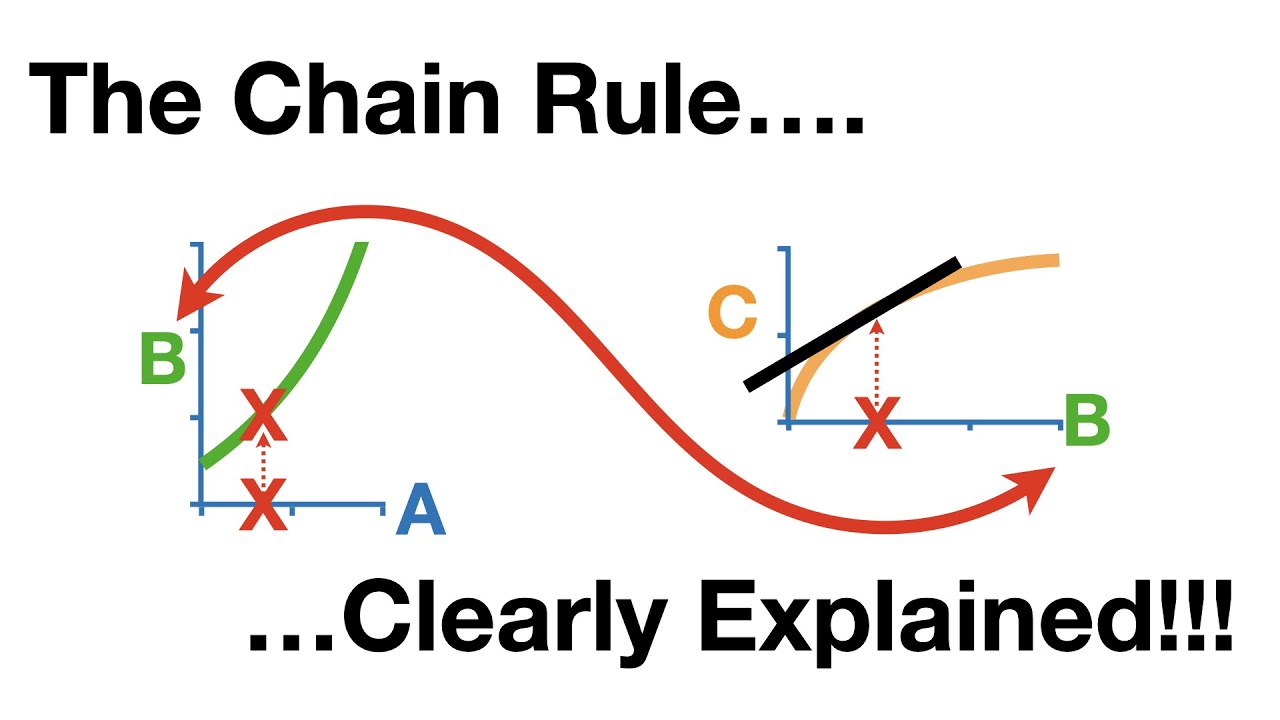
The Chain Rule is a method for finding complex derivatives and is used all the time in Statistics and Machine Learning. This video breaks it down into its two simple pieces and shows you how they easily come together. We then use the Chain Rule to solve a common Machine Learning problem - optimizing the Residual Squared Loss Function.
For a com...
rain sundial
white jungle
how would i use chain rule?
d/dx(sin(x+sin2x))= d(sin(x+sin2x)/d(x+sin2x) ×d(x+sin2x)/dx

 empty sapphire
A nested chain rule is just you keep going inward and inward until you can't take a derivative anymore. So in your case, it'd be
 wide sundial
full forumBOT
wide sundial
full forumBOT
@white jungle Has your question been resolved?
full forumBOT
Channel closed
Closed due to timeout
Use .reopen if this was a mistake.
Available help channel!
Send your question here to claim the channel.
Remember:
• Ask your math question in a clear, concise manner.
• Show your work, and if possible, explain where you are stuck.
• After 15 minutes, feel free to ping <@&286206848099549185>.
• Type the command .close to free the channel when you're done.
• Be polite and have a nice day!
Read #❓how-to-get-help for further information on how to ask a good question, and about conduct in the question channels.
 twin wolf
Did I correctly anti differentiate (2x+3)^1/2?
 full forumBOT
twin wolf
Did I correctly anti differentiate (2x+3)^1/2?
full forumBOT
twin wolf
Did I correctly anti differentiate (2x+3)^1/2?
 light sonnet
twin wolf
Did I correctly anti differentiate (2x+3)^1/2?
light sonnet
twin wolf
Did I correctly anti differentiate (2x+3)^1/2?
Take the derivative to check
twin wolf
light sonnet
Take the derivative to check

So I guess I didn’t do it right?
I don’t understand
light sonnet
How did you do that?
twin wolf
Using differentiation
twin wolf
light sonnet
How did you do that?
 light sonnet
You were suppose to take the derivative of that
 twin wolf
What?
light sonnet
light sonnet
You were suppose to take the derivative of that
To check your answer
twin wolf
Oh
I don’t really understand the process of anti differentiation could you explain it to me
light sonnet
It's just the reverse process to taking the derivative
twin wolf
Yeah I get that but it’s easier to say it like that than to actually do it 
Like what should I be looking for during anti differentiation
light sonnet
For the problem you are doing, you're doing a technique called u sub
twin wolf
So how does that work?
light sonnet
So given f(x) = (2x + 3)^(1/2), you basically did u = 2x + 3, correct?
twin wolf
Yeah
light sonnet
The proper form is $\int (2x + 3)^{1/2} dx$
glossy valveBOT
dldh06
 light sonnet
So u = 2x + 3
Meaning that $\int (u)^{1/2} dx$
glossy valveBOT
dldh06
 light sonnet
Do you understand up to there?
twin wolf
Yeah I think so
I’ve only used the F(x) notation for anti derivatives haven’t used integral yet but I think I get it so far
light sonnet
So notice how that integral has both u and x in it but it needs to be uniform, meaning it should have one letter, in this case u, because we replaced the 2x + 3 with u
So to convert that dx in terms of u, you want to take the derivative of u = 2x + 3
So du/dx = 2
Then you rearrange that so it's in terms of dx
du/dx = 2 -> du/2 = dx
So far so good?
twin wolf
So we take u’ to be 2?
light sonnet
light sonnet
So to convert that dx in terms of u, you want to take the derivative of u = 2x +...
Yes because of what was said here
twin wolf
Okay yeah
light sonnet
light sonnet
Then you rearrange that so it's in terms of dx
du/dx = 2 -> du/2 = dx
Does this part make sense?
light sonnet
you want to take the derivative of u = 2x + 3
In terms of x, hence the derivative of u = 2x + 3 is du/dx = 2
Then you rearrange that so it's in terms of dx
Basically setting it equal to dx
So that's why du/dx = 2 -> du/2 = dx
twin wolf
So if du/dx = 2 then du = 2dx
du/2 = dx okay I get that algebra. But is there a reason we want to rearrange so it’s equal to dx?
light sonnet
So notice how that integral has both u and x in it but it needs to be uniform, meaning it should have one letter, in this case u, because we replaced the 2x + 3 with u
$\int (u)^{1/2} dx$
glossy valveBOT
dldh06
 twin wolf
oh okay
light sonnet
Because the original was $\int (2x + 3)^{1/2} dx$, it's pointless to go back to x (and because we're doing u sub)
glossy valveBOT
dldh06
 twin wolf
Right
light sonnet
So have du/2 = dx and the integral $\int (u)^{1/2} dx$, you substitute now, you know what dx is in terms of u
glossy valveBOT
dldh06
 light sonnet
$\int (u)^{1/2} \frac{du}{2}$
glossy valveBOT
dldh06
 light sonnet
Basically what I did there was replace the dx with du/2 because of the statement of du/2 = dx
twin wolf
Yeah
glossy valveBOT
dldh06
 twin wolf
oh you can do that?
light sonnet
Now you just integrate like normal, reverse power rule
light sonnet
twin wolf
oh you can do that?
Which part? The 1/2?
twin wolf
Yeah
light sonnet
Yes because it's a constant
Same logic with derivatives, you can pull out constants, and you can do the same with integrals
$$\frac{1}{2}\int (u)^{1/2} du$$
So you integrate and get $\frac{1}{2}\left[\frac{(u)^{3/2}}{3/2} + C\right]$
glossy valveBOT
dldh06
 twin wolf
glossy valve
**dldh06**
twin wolf
glossy valve
**dldh06**
Wait so what do we do with the du again?
light sonnet
Basically it's integrating $\frac{1}{2}\int (x)^{1/2} dx$
glossy valveBOT
dldh06
 light sonnet
twin wolf
Wait so what do we do with the du again?
light sonnet
twin wolf
Wait so what do we do with the du again?
Wdym
twin wolf
Like we have a du next to the u^1/2
light sonnet
twin wolf
Like we have a du next to the u^1/2
You just integrate in terms of u
Meaning you leave things with u
light sonnet
glossy valve
**dldh06**
Like this
twin wolf
When 1/2 is outside of the integral does that mean we don’t need to integrate that

Like this?
light sonnet
$\frac{1}{2}\left[\frac{(u)^{3/2}}{3/2} + C\right]\$
That's what you have, but remember that at the beginning we did u = 2x + 3
So you want to plug that back in to be in terms of x again so
$$\frac{1}{2}\left[\frac{(2x+3)^{3/2}}{3/2} + C\right]\$
glossy valveBOT
dldh06
Compile Error! Click the  reaction for more information.
(You may edit your message to recompile.)
 twin wolf
Ah okay
light sonnet
glossy valve
**dldh06**
Compile Error! Click the <:errors:504266556054962196> reaction for mo...
This is the last step and you're done
You can simplify if needed
 light sonnet
Then you end up with $$\left[\frac{(2x+3)^{3/2}}{3} + C\right]$$
glossy valveBOT
dldh06
 twin wolf
What about the 1/2?
light sonnet
light sonnet
Because if you notice here the (1/2)(2/3) = 1/3
.
glossy valveBOT
dldh06
 twin wolf
Oh
Yeah
But what about the constant C, we don’t distribute it to that to make 1/2*C?
twin wolf
Ah okay
light sonnet
glossy valve
**dldh06**
Now take the derivative of this and you'll see that you'll get your original problem
twin wolf
Okay
light sonnet
But I gotta go, look up u sub
full forumBOT
Channel closed
Closed by @twin wolf
Use .reopen if this was a mistake.
Available help channel!
Send your question here to claim the channel.
Remember:
• Ask your math question in a clear, concise manner.
• Show your work, and if possible, explain where you are stuck.
• After 15 minutes, feel free to ping <@&286206848099549185>.
• Type the command .close to free the channel when you're done.
• Be polite and have a nice day!
Read #❓how-to-get-help for further information on how to ask a good question, and about conduct in the question channels.
torn jolt
 torn jolt
What does assume the initial displacement have to do with this?
 onyx glen
the object starts at position 0
torn jolt
I got it right but if I used initial displacement = 0 then I would be wrong
onyx glen
torn jolt
I got it right but if I used initial displacement = 0 then I would be wrong
but you DID use initial displacement=0...
torn jolt
Where
onyx glen
by not adding anything to the integral
 tawdry iron
0 to 5
onyx glen
otherwise you'd have $s(5) = s(0) + \int_0^5 v \dd{t}$
torn jolt
?
glossy valveBOT
Ann
 onyx glen
btw you missed the dt
torn jolt
Oh yeah
But they ask for the distance travelled in the first 5 seconds the initial displacement shouldn’t affect it right
torn jolt
But even if it wasn’t zero it shouldn’t affect it
Because they don’t want you to add on the initial displacement they want the distance travelled in the first 5 seconds
full forumBOT
@torn jolt Has your question been resolved?
full forumBOT
Channel closed
Closed due to timeout
Use .reopen if this was a mistake.
Available help channel!
Send your question here to claim the channel.
Remember:
• Ask your math question in a clear, concise manner.
• Show your work, and if possible, explain where you are stuck.
• After 15 minutes, feel free to ping <@&286206848099549185>.
• Type the command .close to free the channel when you're done.
• Be polite and have a nice day!
Read #❓how-to-get-help for further information on how to ask a good question, and about conduct in the question channels.
 crystal cobalt
how to disprove the last one?
 full forumBOT
crystal cobalt
how to disprove the last one?
crystal cobalt
full forumBOT
crystal cobalt
how to disprove the last one?
crystal cobalt
i know the answer is D but yeah still
onyx glen
dispove 2x - y < 2xy ?
 cursive badger
2x<2y
onyx glen
cursive badger
=
<=> not =
crystal cobalt
onyx glen
dispove 2x - y < 2xy ?
yeah more like showing it doesn’t always have to be true
i could try numbers but what’s the “slick way”
if there is any
onyx glen
i do not see any slick way
crystal cobalt
onyx glen
i do not see any slick way
so i just simplify a bit and test with numbers?
onyx glen
yeah ig
full forumBOT
Channel closed
Closed by @crystal cobalt
Use .reopen if this was a mistake.
Available help channel!
Send your question here to claim the channel.
Remember:
• Ask your math question in a clear, concise manner.
• Show your work, and if possible, explain where you are stuck.
• After 15 minutes, feel free to ping <@&286206848099549185>.
• Type the command .close to free the channel when you're done.
• Be polite and have a nice day!
Read #❓how-to-get-help for further information on how to ask a good question, and about conduct in the question channels.
twin wolf
Im finding a formula for the sum $\sum_{i=1}^{n}\left(i^{3}-4i\right)$
glossy valveBOT
water beam
 twin wolf
I wanna know if im correct
so i rewrote $\sum_{i=1}^{n}\left(i^{3}-4i\right)=\sum_{i=1}^{n}\left(i^{3}\right)-4\sum_{i=1}^{n}i$
glossy valveBOT
water beam
 twin wolf
and then
$\frac{n^{2}\left(n+1\right)^{2}}{4}-4\left(\frac{n\left(n+1\right)}{2}\right)=\frac{n^{4}}{4}+\frac{n^{3}}{3}-\frac{7n^{2}}{4}-2n$
glossy valveBOT
water beam
 twin wolf
did I do anything wrong here?
 left bone
it's the right idea, we can double check arithmetic with WA
twin wolf
alright
left bone
,w sum from n=1 to k of (n^3-4n)
glossy valveBOT


 left bone
the only difference is the denominator in the n^3 twrm
they have n^3/2 and you have n^3/3
left bone
👍
twin wolf
thanks
left bone
looks good then nice work
 full forumBOT
Channel closed
Closed by @twin wolf
Use .reopen if this was a mistake.
Available help channel!
Send your question here to claim the channel.
Remember:
• Ask your math question in a clear, concise manner.
• Show your work, and if possible, explain where you are stuck.
• After 15 minutes, feel free to ping <@&286206848099549185>.
• Type the command .close to free the channel when you're done.
• Be polite and have a nice day!
Read #❓how-to-get-help for further information on how to ask a good question, and about conduct in the question channels.
 eager crag
when can i use y=x to find f(x)=f-1(x)
full forumBOT
eager crag
when can i use y=x to find f(x)=f-1(x)
glossy valveBOT
USS-Enterprise
 full forumBOT
@eager crag Has your question been resolved?
eager crag
yes
 neon basin
Graphically, $f(x)$ and $f^{-1}(x)$ are reflections about the y=x line.
glossy valveBOT
USS-Enterprise
 full forumBOT
@eager crag Has your question been resolved?
full forumBOT
Channel closed
Closed due to timeout
Use .reopen if this was a mistake.
Available help channel!
Send your question here to claim the channel.
Remember:
• Ask your math question in a clear, concise manner.
• Show your work, and if possible, explain where you are stuck.
• After 15 minutes, feel free to ping <@&286206848099549185>.
• Type the command .close to free the channel when you're done.
• Be polite and have a nice day!
Read #❓how-to-get-help for further information on how to ask a good question, and about conduct in the question channels.
 royal halo
I need help w/ no.7
 full forumBOT
royal halo
I need help w/ no.7
royal halo
full forumBOT
royal halo
I need help w/ no.7
royal halo
I do not know how to start off
 hot herald
start by writing the equation that represents that first statement
full forumBOT
@royal halo Has your question been resolved?
full forumBOT
@royal halo Has your question been resolved?
full forumBOT
Channel closed
Closed by @royal halo
Use .reopen if this was a mistake.
royal halo
.reopen
full forumBOT
✅
 hot herald
not quite, you need to be careful with your subtraction

(also write equations on a single line)
royal halo
this is confusing
hot herald
you need to subtract the whole angle, not just whatever term happens to appear first
full forumBOT
Channel closed
Closed by @royal halo
Use .reopen if this was a mistake.
Available help channel!
Send your question here to claim the channel.
Remember:
• Ask your math question in a clear, concise manner.
• Show your work, and if possible, explain where you are stuck.
• After 15 minutes, feel free to ping <@&286206848099549185>.
• Type the command .close to free the channel when you're done.
• Be polite and have a nice day!
Read #❓how-to-get-help for further information on how to ask a good question, and about conduct in the question channels.
 lusty leaf
 full forumBOT
lusty leaf
full forumBOT
lusty leaf
 formal scarab
$\lim_{x\rightarrow\infty}(\frac{7x+10}{1+7x})^{x/3}$
glossy valveBOT
chlamydia
 lusty leaf
Yep
full forumBOT
@lusty leaf Has your question been resolved?
full forumBOT
Channel closed
Closed due to timeout
Use .reopen if this was a mistake.
Available help channel!
Send your question here to claim the channel.
Remember:
• Ask your math question in a clear, concise manner.
• Show your work, and if possible, explain where you are stuck.
• After 15 minutes, feel free to ping <@&286206848099549185>.
• Type the command .close to free the channel when you're done.
• Be polite and have a nice day!
Read #❓how-to-get-help for further information on how to ask a good question, and about conduct in the question channels.
 runic oxide
2x-1 = |x+10|
full forumBOT
runic oxide
2x-1 = |x+10|
 hollow wharf
You can plug into the original to check
 proper plank
|x+10| = ±(x+10) so u just need to plug those two in
hollow wharf
Yes it’s the second pair
full forumBOT
@runic oxide Has your question been resolved?
full forumBOT
Channel closed
Closed due to timeout
Use .reopen if this was a mistake.
Available help channel!
Send your question here to claim the channel.
Remember:
• Ask your math question in a clear, concise manner.
• Show your work, and if possible, explain where you are stuck.
• After 15 minutes, feel free to ping <@&286206848099549185>.
• Type the command .close to free the channel when you're done.
• Be polite and have a nice day!
Read #❓how-to-get-help for further information on how to ask a good question, and about conduct in the question channels.
 misty raven
this a trapezium
 full forumBOT
misty raven
this a trapezium
misty raven
full forumBOT
misty raven
this a trapezium
misty raven
?
 odd fox
Ye
misty raven
k ty
runic oxide
proper plank
|x+10| = ±(x+10) so u just need to plug those two in
tysm!
proper plank
yw
full forumBOT
@misty raven Has your question been resolved?
Channel closed
Closed by @misty raven
Use .reopen if this was a mistake.
Available help channel!
Send your question here to claim the channel.
Remember:
• Ask your math question in a clear, concise manner.
• Show your work, and if possible, explain where you are stuck.
• After 15 minutes, feel free to ping <@&286206848099549185>.
• Type the command .close to free the channel when you're done.
• Be polite and have a nice day!
Read #❓how-to-get-help for further information on how to ask a good question, and about conduct in the question channels.
 tacit blade
hello!
full forumBOT
tacit blade
hello!
full forumBOT
Channel closed
Closed by @tacit blade
Use .reopen if this was a mistake.
full forumBOT
Available help channel!
Send your question here to claim the channel.
Remember:
• Ask your math question in a clear, concise manner.
• Show your work, and if possible, explain where you are stuck.
• After 15 minutes, feel free to ping <@&286206848099549185>.
• Type the command .close to free the channel when you're done.
• Be polite and have a nice day!
Read #❓how-to-get-help for further information on how to ask a good question, and about conduct in the question channels.
 eager hinge
why f1 is equal to Tension
 full forumBOT
eager hinge
why f1 is equal to Tension
eager hinge
full forumBOT
eager hinge
why f1 is equal to Tension
eager hinge
/rotate
 teal whale
,rotate
eager hinge
.rotate
glossy valveBOT
 eager hinge
 eager hinge
why f1 is equal to Tension
eager hinge
eager hinge
why f1 is equal to Tension
can someone explain
help

why f_1=T
.close
full forumBOT
Channel closed
Closed by @eager hinge
Use .reopen if this was a mistake.
Available help channel!
Send your question here to claim the channel.
Remember:
• Ask your math question in a clear, concise manner.
• Show your work, and if possible, explain where you are stuck.
• After 15 minutes, feel free to ping <@&286206848099549185>.
• Type the command .close to free the channel when you're done.
• Be polite and have a nice day!
Read #❓how-to-get-help for further information on how to ask a good question, and about conduct in the question channels.
 spring vigil
what is happening
 full forumBOT
spring vigil
what is happening
formal scarab
full forumBOT
spring vigil
what is happening
formal scarab
it wants you to move the arrow to show x>27/6?
spring vigil
formal scarab
it wants you to move the arrow to show x>27/6?
yeah
oh damn i just realized i put the circle on the 5 not 4.5
andy yeah ik the arrows backwards
spring vigil
formal scarab
it wants you to move the arrow to show x>27/6?
this should be right
 formal scarab
yeah
spring vigil
careless mistake
spring vigil
formal scarab
yeah
i was panicking cause i was on my last submission thank you though
./close
.close
full forumBOT
Channel closed
Closed by @spring vigil
Use .reopen if this was a mistake.
Available help channel!
Send your question here to claim the channel.
Remember:
• Ask your math question in a clear, concise manner.
• Show your work, and if possible, explain where you are stuck.
• After 15 minutes, feel free to ping <@&286206848099549185>.
• Type the command .close to free the channel when you're done.
• Be polite and have a nice day!
Read #❓how-to-get-help for further information on how to ask a good question, and about conduct in the question channels.
 dense edge
 full forumBOT
dense edge
dense edge
full forumBOT
dense edge
dense edge
could I somehow manipulate that top example into an answer that uses a different method than below? or not really
 fast peak
well you could u-sub
 dense edge
fast peak
well you could u-sub
dense edge
fast peak
well you could u-sub
u-sub from here?
 fast peak
yes
dense edge
could you also u-sub from the original?
fast peak
yes
dense edge
OK
so that would save time
it sounds like u-sub would be the fastest?
i would like to avoid any trig identity bullshit if possible
not sure if it's possible tho..
formal scarab
they both end up with -cscx
dense edge
like the simple ones are fine but I don't know if my brain can effectively store all of these for an exam
 fast peak
remembering stuff sucks. and in the end the derivatives all boil down to expressing stuff as sin and cos and using product/chain rule
so they can all be solved using ibp or u-sub
dense edge
fast peak
remembering stuff sucks. and in the end the derivatives all boil down to express...
so you can literally take any trig question, no matter how complex, and break it down to simple sin/cos using u-sub and/or integration by parts?
fast peak
in principle, yes
dense edge
that would make my life a heck of a lot easier. it's what you do too? or do you memorize all this shit
fast peak
I look it up if I need it. because I don't have to write tests on that shit anymore
but it's what I would do if I had to
dense edge
fast peak
I look it up if I need it. because I don't have to write tests on that shit anym...
i wish exams would give trig tables, but since they don't I think I should use the u-sub / ibp methods to simplify trig expressions into extremely simple sin and cos only
onyx glen
i think it's a matter of practice to cement them in your mind
than straight memorization
dense edge
onyx glen
i think it's a matter of practice to cement them in your mind
you know all of them by heart? or still sometimes forget a few
onyx glen
all of what
dense edge
dense edge
like the simple ones are fine but I don't know if my brain can effectively store...
these
onyx glen
line #6 is wrong btw int tan(x) dx is not sec^2(x)
fast peak
only students know stuff like that by heart
onyx glen
lines 7 and 8 are redundant
as are most of these integral-derivative pairs
derivatives of sec and csc i don't bother memorizing cause i have never found a use for sec where 1/cos would not do
dense edge
oh woah, you are right. i copied these from somewhere else, i gotta remember where..

might have been organic chemistry tutor.. i tend to find the most mistakes on his channel
onyx glen
why do you have the derivatives of cot and -cot on separate lines too
it's strange to me
why not also include 2 cot, 3 cot, 4 cot and 42069 cot as well
dense edge
lol, i think it was just for practice, and for different +-
i may be missing some identities too
onyx glen
dense edge
lol, i think it was just for practice, and for different +-
weak justification
dense edge
onyx glen
weak justification
why? i have all my notes here it's just to practice and write them down https://web.goodnotes.com/s/4MqLSJxlN9qvdabDYidlN8#page-8
GoodNotes app
onyx glen
it takes up space
dense edge
and they sync on the web in real time with GoodNotes on iPad
onyx glen
it shows you have not grokked the linearity of the derivative
dense edge
i will probably make flash cards out of these identities for furhter review
hoping to make it through a good chunk of these today

i watch at 2x speed but with notes it about averages out to same speed
 spice orchid
you need to spend way more time on the first couple tbh
rather than trying to get through as many as you can
dense edge
yeah, I'm re-watching the first one
3B1B helped me out a lot as well yesterday
in our course we learned Riemann Sums first day
good for visualizing the approximations, but we don't really use it in calculus, as we want the exact values
but I suppose the formula still holds true, if n is approaching infinity
is there any reason in particular that FTC Part 2 is taught before FTC Part 1?
like why not switch indefinite to Part 1, and definite to Part 2?
since definite is taught after indefinite
dense edge
mine too, I think Discord bottleneck
the message takes a while to send, I see a grey text for about a minute and then it appears
onyx glen
yeah can you remind me which part of the ftc is called #1 and which one is #2?
dense edge
onyx glen
which part is which again
wait, i thought FTC 2 is when there is a definite integral? but it's when limits are constant

FTC 1 includes a variable for a limit
glossy valveBOT
Ann
 dense edge
maybe my prof has been teaching this wrong, I swear I heard definite integrals are FTC 1
indefinite integrals are FTC 2
onyx glen
"definite integrals are FTC1" is oversimplification
dense edge
lol, another minor/annoying math thing that is set in stone now
dense edge
glossy valve
**Ann**
why not f(x)?
why f(t)
oh you started with d/dx
hmmm
I gotta think about that..
so this is wrong?
 dense edge
amazing. yet this is first result on Google Image search...

Google should probably fix this and give less PageRank to CueMath
"the math expert"

 full forumBOT
@dense edge Has your question been resolved?
full forumBOT
Channel closed
Closed due to timeout
Use .reopen if this was a mistake.
Available help channel!
Send your question here to claim the channel.
Remember:
• Ask your math question in a clear, concise manner.
• Show your work, and if possible, explain where you are stuck.
• After 15 minutes, feel free to ping <@&286206848099549185>.
• Type the command .close to free the channel when you're done.
• Be polite and have a nice day!
Read #❓how-to-get-help for further information on how to ask a good question, and about conduct in the question channels.
 bright jewel
I need help on this
 full forumBOT
bright jewel
I need help on this
bright jewel
full forumBOT
bright jewel
I need help on this
bright jewel
I don't understand why if I add 0.5333 and 0.6500 it doesnt give me what it lists is my school thing messed up or am I?
 wicked aurora
How did you get 39?
bright jewel
by adding all known frequencys
wicked aurora
I don't think that is how you are supposed to do it
It doesn't say no 3 is any kind of total
I think you should compute the relative frequecy first and use that to find the frequency
bright jewel
ok It was timed and I would like to understand it better
It said its 21 instead of 39
how did it go to that because someone in the past on this discord told me to add em all up
to find the unknown frequency
wicked aurora
Okay, there is only one possible value of the third relative frquency. Find it
bright jewel
?
thats 0.3500
but I'm asking how did they find 21 for the frequency
I know how to do the rest entirely
I just don't understand fully the frequency stuff
ik RF and CRF
wicked aurora
Can't you determine frequency from RF?
bright jewel
 bright jewel
wicked aurora
Can't you determine frequency from RF?
bright jewel
wicked aurora
Can't you determine frequency from RF?
I'm not sure thats my question rn
ik for sure its 21 and everything else is correct
to determine RF you need frequency
wicked aurora
So, relative frequency seems to be proportional to the frequency, which you also can tell by their names
bright jewel
so are we both lost on how to solve it or you know and your trying to explain? I've melted half my brain cells already trying to figuire out other stuff within the lesson today sorry if I'm getting confused here
wicked aurora
bright jewel
so are we both lost on how to solve it or you know and your trying to explain? I...
the second alternative
sorry for the delay
wicked aurora
You need to solve a proportion
full forumBOT
Channel closed
Closed by @bright jewel
Use .reopen if this was a mistake.
Available help channel!
Send your question here to claim the channel.
Remember:
• Ask your math question in a clear, concise manner.
• Show your work, and if possible, explain where you are stuck.
• After 15 minutes, feel free to ping <@&286206848099549185>.
• Type the command .close to free the channel when you're done.
• Be polite and have a nice day!
Read #❓how-to-get-help for further information on how to ask a good question, and about conduct in the question channels.
 chrome idol
 full forumBOT
chrome idol
chrome idol
full forumBOT
chrome idol
chrome idol
I am not sure how much proof would be needed for this.
By definition of bounded, $(a_n)$ is bounded if there exist $M >0$ such that $|a_n| < M$ for all $n \in \mathbb{N}$. Negating this would give: "$(a_n)$ is unbounded if for all $M > 0$, there exist $n \in \mathbb{N}$ such that $|a_n|> M$" which means that either $a_n > M$ or $a_n < -M$"
glossy valveBOT
KN
 full forumBOT
Channel closed
Closed by @chrome idol
Use .reopen if this was a mistake.
Available help channel!
Send your question here to claim the channel.
Remember:
• Ask your math question in a clear, concise manner.
• Show your work, and if possible, explain where you are stuck.
• After 15 minutes, feel free to ping <@&286206848099549185>.
• Type the command .close to free the channel when you're done.
• Be polite and have a nice day!
Read #❓how-to-get-help for further information on how to ask a good question, and about conduct in the question channels.
 stray raven
 full forumBOT
stray raven
full forumBOT
full forumBOT
stray raven
full forumBOT
@stray raven Has your question been resolved?
 gritty rose
stray raven
gritty rose
stray raven
Use the hint
stray raven
gritty rose
Use the hint
i didnt quite get how to start to move with it
can yoy help me
stray raven
gritty rose
Understand that one first
what he means by that f(theta) = Summation(- infinity to infinity) f hat(n) e^-intheta converges to f(theta) for the condition mentioned at the end of question
stray raven
or the limit tend to infinity Nth partial sum f theta converges to f theta
stray raven
gritty rose
Just screenshot the thm and proof
 gritty rose
Which part of that exactly don't you get?
 gritty rose
Jeeze uhhh
stray raven
this is the theorem that gave the corollary
gritty rose
Go back to the beginning where you do understand something
gritty rose
Do you know why uniformly continuous implies the limit is continuous
No it's not easy necessarily
Helping you is hard because you're not being precise what you want help with
stray raven
gritty rose
Do you know why uniformly continuous implies the limit is continuous
yeah because lim x tends to c f(c) exists
for any c on interval
and using uniform contionus
for all |x-c|< theta
f(x)-f(c)< epsilon
which implies limit exist
gritty rose
That's not the right definition for your theorem
You have a sequence of functions
Find the definition that applies to the sequence converging uniformly
full forumBOT
@stray raven Has your question been resolved?
full forumBOT
@stray raven Has your question been resolved?
full forumBOT
Channel closed
Closed due to timeout
Use .reopen if this was a mistake.
Available help channel!
Send your question here to claim the channel.
Remember:
• Ask your math question in a clear, concise manner.
• Show your work, and if possible, explain where you are stuck.
• After 15 minutes, feel free to ping <@&286206848099549185>.
• Type the command .close to free the channel when you're done.
• Be polite and have a nice day!
Read #❓how-to-get-help for further information on how to ask a good question, and about conduct in the question channels.
torn jolt
Please I need help with this

 full forumBOT
torn jolt
Please I need help with this
full forumBOT
full forumBOT
torn jolt
Please I need help with this
full forumBOT
@torn jolt Has your question been resolved?
torn jolt
<@&286206848099549185>
 next steeple
rebonjour (rebonsoir ?)
f est continue et admet pour limite + infini et - infini dans l'intervalle ]a;b[
ok
pour la question 1), que veut dire que f(alpha)f(beta) < 0 ?
||l'un est strictement positif, l'autre strictement négatif||
torn jolt
next steeple
pour la question 1), que veut dire que f(alpha)f(beta) < 0 ?
Ça veut dire qu’ils ont deux signes opposé
next steeple
exactement
torn jolt
Donc je dois montrer cela ?
next steeple
oui
next steeple
tu sais que f(x) -> + infini quand x tend vers alpha
et f(x) -> - infini quand x tend vers beta
et f continue
torn jolt
Alors f(alpha) positivé et f(beta) négative ?
next steeple
hm non
x est dans l'intervalle ]alpha;beta[
alpha et beta sont donc exclus de l'intervalle
torn jolt
Ah oui c’est vrai
Le prof il avait dit qu’il faut utiliser la définition de la limite dans cet exo mais on a jamais vu ça car je suis en terminal
du coup j’ai chercher mais la définition en l’utilise l’orque la limite = un nombre
Pas l’infinie
next steeple
ici
ça veut dire qu'il existe x dans ]a;b[ tel que f(x) soit aussi petit que l'on veut, mais aussi f(x) aussi grand que l'on veut
puisque f(x) tend vers les deux infinis
next steeple
tu dois motnrer qu'ils existent
torn jolt
next steeple
tu dois motnrer qu'ils existent
Ta pas une idée comment le montrer je suis vraiment confuse ?
next steeple
next steeple
ça veut dire qu'il existe x dans ]a;b[ tel que f(x) soit aussi petit que l'on ve...
tu peux remplacer x par alhpa et beta
torn jolt
next steeple
tu peux remplacer x par alhpa et beta
Ouii bah en faite j’essaye d’utiliser tvi
next steeple
ah oui, ça marche aussi
torn jolt
car avec la 2 question c’est forcément ça
next steeple
oui
en fait pour la première question, puisque tu peux prends x tel que f(xà soit aussi petit que tu veux
tu peux dire que tu prends f(x) très petit négatif
enfin, je sais pas combien tu dois faire avec la rigueur
torn jolt
ahh je vois
Mais le problème que j’ai ici c’est que l’indice que le prof m’a donné c’est d’utiliser la définition de la limite
Mais je vois pas comment je peux l’exploiter icic
next steeple
dire que f(x) tend + infini quand x tend vers a
avec f continue
avec x dans l'intervalle ]a;b[
ça signifie que pour tout réel M, il existe x dans cet intervalle que f(x) >= M
 tribal oxide
Oh un random
torn jolt
En mode je dois utilise cet définition
 next steeple
tribal oxide
Oh un random
next steeple
tribal oxide
Oh un random
cocuou
next steeple
torn jolt
En mode je dois utilise cet définition
ok, ben tu peux prende des e arbitraires
torn jolt
Vous êtes tous français ici haha
torn jolt
next steeple
ok, ben tu peux prende des e arbitraires
Epsilon ?
next steeple
oui
torn jolt
Et le l ?
next steeple
le l c'est la limite non ?
torn jolt
Non icic dans l’exercice c’est l’infinie
Mais attend t’es en quel classe ?
T’es en terminal toi aussi ?
torn jolt
Okay c’est pas grave
next steeple
je pourrais pas t'aider plus que ça
torn jolt
merci pour l’aide quand même
full forumBOT
@torn jolt Has your question been resolved?
torn jolt
No
full forumBOT
@torn jolt Has your question been resolved?
full forumBOT
Channel closed
Closed due to timeout
Use .reopen if this was a mistake.
Available help channel!
Send your question here to claim the channel.
Remember:
• Ask your math question in a clear, concise manner.
• Show your work, and if possible, explain where you are stuck.
• After 15 minutes, feel free to ping <@&286206848099549185>.
• Type the command .close to free the channel when you're done.
• Be polite and have a nice day!
Read #❓how-to-get-help for further information on how to ask a good question, and about conduct in the question channels.
 lucid sierra
if log(3) = a and log2(10) = b then how do i simplify log 675 (you have to put both a and b)
full forumBOT
lucid sierra
if log(3) = a and log2(10) = b then how do i simplify log 675 (you have to put b...
lucid sierra
ive got into
log 675
log (3^3)
3A + log (5^2) and then idk what to do
 fathom saddle
full forumBOT
fathom saddle
full forumBOT
@lucid sierra Has your question been resolved?
full forumBOT
Channel closed
Closed due to timeout
Use .reopen if this was a mistake.
Available help channel!
Send your question here to claim the channel.
Remember:
• Ask your math question in a clear, concise manner.
• Show your work, and if possible, explain where you are stuck.
• After 15 minutes, feel free to ping <@&286206848099549185>.
• Type the command .close to free the channel when you're done.
• Be polite and have a nice day!
Read #❓how-to-get-help for further information on how to ask a good question, and about conduct in the question channels.
 digital fractal
Would it be differentiable if x = 0, f(0) = 5?
 digital fractal
I'm hesitating between B and C here
 teal nimbus
Have you computed the left and right hand limits of the difference quotient?
Or tried to at least
digital fractal
yes
I plugged in -1 and 1
but since it's in the absolute value
it would be 4
limit from left and right both exist
but are not equal to 5
 atomic blade
Wdym plugged in -1 and 1
atomic blade
I mean you'd need to do f(-1 + h) ... versus f(1 + h) ...
digital fractal
I actually did lim from the left and lim from the right
-1+h and 1+h would give 4+h for both
 coarse elbow
What do the points -1 and 1 have to do with this?
Did you try calculating and simplifying the limit in the question?
atomic blade
Show me your work
digital fractal
coarse elbow
What do the points -1 and 1 have to do with this?
Did you try calculating and si...
well it's asking for x=0 , so I tried getting the limit from the left and right
atomic blade
Because you'd need to define the limit differently for each side
coarse elbow
The expression you need to look at is $$\frac{f(h) -f(0)}{h}$$
glossy valveBOT
Morrow
 atomic blade
Since |x| is equivalent to x for x > 0, likewise equivalent to -x for x < 0
digital fractal
hold on I'm a bit confused here
all I did was f(x)=5-|x|
f(0)=5-|0| = 5
f(0+h)= 5 - h
coarse elbow
digital fractal
f(0+h)= 5 - h
Not quite
h can be negative
can't just remove the absolute value
Unless you're looking at h > 0 first
in which case that's fine
And then you check for h < 0 afterwards
teal nimbus
Yeah but to do that you may assume some properties about the "derivative" of f, which is what you're looking for already...
Like the derivative could vary a lot around 0, so that may be the best approach for any function if you don't know how it behaves
digital fractal
but all I'm looking for is whether the function is differentiable or not
coarse elbow
digital fractal
f(0+h)= 5 - h
Well continue this line of thought then
digital fractal
ok so would I just do 5 - h -5 /h?
which would be -h/h
but that doesn't really help right?
digital fractal
yes
coarse elbow
(specifically h =/= 0)
digital fractal
because it cannot be 0 right
coarse elbow
yeah we're first looking at h -> 0 from the positive direction
And we found that the limit is -1
We need to check the case where h -> 0 from the negative direction, and see if we get the same limit
coarse elbow
lol discord formatting
digital fractal
so positive 1 / - 1
which would still be -1
so the limit does exist at -1
as long as it is not 0
coarse elbow
I think you messed up there
digital fractal
did I?
coarse elbow
f(h) = 5 -|h| = 5 - (-h)
digital fractal
it's -h/h right?
coarse elbow
So f(h) - f(0) = (5 + h) - 5 = h
digital fractal
oh yes I did then
coarse elbow
So it's h/h
coarse elbow
-1 from the right
digital fractal
1/1?
digital fractal
ok so the limit does not exist then
because it has to be equal from left and right
coarse elbow
Yeah, the limit does not exist
digital fractal
ok but how do I test differentiability then?
I know it's non-differentiable if there is a sharp corner
coarse elbow
Well what's the definition of differentiable?
digital fractal
if the left and right limit exist?
wait no
if left and right limit = f(x) right?
but if left and right are not equal, then it can't differentiable
coarse elbow
It's's just that the limit you calculated exists (if we're talking about differentiability at x=0 specifically)
And we found that it doesn't
digital fractal
oh they both exist but the limit does not
coarse elbow
Yeah
full forumBOT
Channel closed
Closed by @digital fractal
Use .reopen if this was a mistake.
Available help channel!
Send your question here to claim the channel.
Remember:
• Ask your math question in a clear, concise manner.
• Show your work, and if possible, explain where you are stuck.
• After 15 minutes, feel free to ping <@&286206848099549185>.
• Type the command .close to free the channel when you're done.
• Be polite and have a nice day!
Read #❓how-to-get-help for further information on how to ask a good question, and about conduct in the question channels.
 torpid oxide
 full forumBOT
torpid oxide
torpid oxide
full forumBOT
torpid oxide
torpid oxide
Hello this might be an easy question because I just started calculus but how can I say that this is equal to positive infinity without a calculator ?
 silk rock
x → 1⁻ ⇒ x < 1
Then
x² < 1² = 1
x² - 1 < 0
1 - x² > 0
Also, remember that in Limits, 1/0 = ±∞
full forumBOT
Channel closed
Closed by @torpid oxide
Use .reopen if this was a mistake.
Available help channel!
Send your question here to claim the channel.
Remember:
• Ask your math question in a clear, concise manner.
• Show your work, and if possible, explain where you are stuck.
• After 15 minutes, feel free to ping <@&286206848099549185>.
• Type the command .close to free the channel when you're done.
• Be polite and have a nice day!
Read #❓how-to-get-help for further information on how to ask a good question, and about conduct in the question channels.
 pine rampart
are these traces of a cone or a hyperboloid in one sheet?
 pine rampart
the traces in x=k make me think its a hyperboloid in one sheet because the smallest radius the ellipses get still has some area (isn't a point like it would be in a cone)
but the traces in z=k make me think its a cone because of k=1, the intersecting lines
.close
full forumBOT
Channel closed
Closed by @pine rampart
Use .reopen if this was a mistake.
full forumBOT
Available help channel!
Send your question here to claim the channel.
Remember:
• Ask your math question in a clear, concise manner.
• Show your work, and if possible, explain where you are stuck.
• After 15 minutes, feel free to ping <@&286206848099549185>.
• Type the command .close to free the channel when you're done.
• Be polite and have a nice day!
Read #❓how-to-get-help for further information on how to ask a good question, and about conduct in the question channels.
 muted kite
hii!, can someone double check my solution if I did it correclty? I was supposed to find the arithmetic series. Thank you!

 full forumBOT
muted kite
hii!, can someone double check my solution if I did it correclty? I was supposed...
full forumBOT
muted kite
hii!, can someone double check my solution if I did it correclty? I was supposed...
 tulip marlin
use a calculator. 30 terms isnt many.
muted kite
hmm? which item are you referring to if may I ask?^^
tulip marlin
the ones which are computing the 25th term or something
you just go 2, 5, 8, 11, 14, ... for example
add 3 each time until u hit the 25th one
muted kite
I did itt, it was -523
full forumBOT
@muted kite Has your question been resolved?
muted kite
hello?? can someone confirm
full forumBOT
@muted kite Has your question been resolved?
full forumBOT
Channel closed
Closed due to timeout
Use .reopen if this was a mistake.
Available help channel!
Send your question here to claim the channel.
Remember:
• Ask your math question in a clear, concise manner.
• Show your work, and if possible, explain where you are stuck.
• After 15 minutes, feel free to ping <@&286206848099549185>.
• Type the command .close to free the channel when you're done.
• Be polite and have a nice day!
Read #❓how-to-get-help for further information on how to ask a good question, and about conduct in the question channels.
 late gorge
how do i make a function that gets 4 times larger and it starts at 20k
glossy valveBOT
孙悟空
 late gorge
because
 rapid rain
glossy valve
**孙悟空**
rapid rain
glossy valve
**孙悟空**
Up to a multiplicative constant
late gorge
rapid rain
Up to a multiplicative constant
what does that mean?
rapid rain
Like $C\cdot 4^x$
late gorge
$20000*4^x$?

 late gorge
so if
rapid rain
late gorge
$20000*4^x$?
If 20k is your money at x=0 then Yes
full forumBOT
Channel closed
Closed by @late gorge
Use .reopen if this was a mistake.
full forumBOT
Available help channel!
Send your question here to claim the channel.
Remember:
• Ask your math question in a clear, concise manner.
• Show your work, and if possible, explain where you are stuck.
• After 15 minutes, feel free to ping <@&286206848099549185>.
• Type the command .close to free the channel when you're done.
• Be polite and have a nice day!
Read #❓how-to-get-help for further information on how to ask a good question, and about conduct in the question channels.
 livid nova
 full forumBOT
livid nova
livid nova
full forumBOT
livid nova
livid nova
how did he do this help
 reef dust
same base denominator
they wrote 2/3 as 4/6
because u can only add or subtract fractions with the same denoninator
then they simplified the denoninator
by dividing both the numerator and the denominator by 3
 half mist
 reef dust
what do you notice about the numerators
livid nova
oh numeraotr
sorry i read id denomitaor ...............
so
its weird patern in numeraotr
livid nova
2
reef dust
3 to 7
livid nova
4
reef dust
7 to 13
livid nova
6
reef dust
13 to 21
livid nova
8
livid nova
10
reef dust
so 21 + 10
that is ur numerator
as for the denominator the pattern is pretty obvious it just adds by 2
 reef dust
its in their working out
they did middle term split
if you arent familiar with it, learn about quadratic equations and middle term split first
i have to go for now though
livid nova
oh ok thank you
full forumBOT
@livid nova Has your question been resolved?
Channel closed
Closed by @livid nova
Use .reopen if this was a mistake.
full forumBOT
Available help channel!
Send your question here to claim the channel.
Remember:
• Ask your math question in a clear, concise manner.
• Show your work, and if possible, explain where you are stuck.
• After 15 minutes, feel free to ping <@&286206848099549185>.
• Type the command .close to free the channel when you're done.
• Be polite and have a nice day!
Read #❓how-to-get-help for further information on how to ask a good question, and about conduct in the question channels.
 reef iron
Why are these not equal?
 full forumBOT
reef iron
Why are these not equal?
gritty rose
full forumBOT
reef iron
Why are these not equal?
gritty rose
cos(0) = ?
reef iron
1
 primal thicket
the integral of cos isn't cos?
gritty rose
oh that's the mistake he made
primal thicket
lol okay i thought i was going crazy good
primal thicket
once u use sin it should flip the signs
full forumBOT
Channel closed
Closed by @reef iron
Use .reopen if this was a mistake.
Available help channel!
Send your question here to claim the channel.
Remember:
• Ask your math question in a clear, concise manner.
• Show your work, and if possible, explain where you are stuck.
• After 15 minutes, feel free to ping <@&286206848099549185>.
• Type the command .close to free the channel when you're done.
• Be polite and have a nice day!
Read #❓how-to-get-help for further information on how to ask a good question, and about conduct in the question channels.
full forumBOT
 inner finch
I could use a hint for what I should research?
I know the equation for tangent planes is

And so I thought the intersection was when f(x, y)=g(x, y)
So, I thought to put the two tangent plane equations equal to each other and then you'd somehow end up with the equation buuut no
full forumBOT
@inner finch Has your question been resolved?
inner finch
Nope..
full forumBOT
@inner finch Has your question been resolved?
inner finch
Nope..
full forumBOT
Channel closed
Closed by @inner finch
Use .reopen if this was a mistake.
Available help channel!
Send your question here to claim the channel.
Remember:
• Ask your math question in a clear, concise manner.
• Show your work, and if possible, explain where you are stuck.
• After 15 minutes, feel free to ping <@&286206848099549185>.
• Type the command .close to free the channel when you're done.
• Be polite and have a nice day!
Read #❓how-to-get-help for further information on how to ask a good question, and about conduct in the question channels.
 spark field
We haven't really talked about how the amplitudes, period, or midline truly affect the graph yet, but it's on my homework assignment. Could I get some help with this?
 full forumBOT
spark field
We haven't really talked about how the amplitudes, period, or midline truly affe...
full forumBOT
spark field
We haven't really talked about how the amplitudes, period, or midline truly affe...
@spark field Has your question been resolved?
full forumBOT
@spark field Has your question been resolved?
spark field
.close
full forumBOT
Channel closed
Closed by @spark field
Use .reopen if this was a mistake.
Available help channel!
Send your question here to claim the channel.
Remember:
• Ask your math question in a clear, concise manner.
• Show your work, and if possible, explain where you are stuck.
• After 15 minutes, feel free to ping <@&286206848099549185>.
• Type the command .close to free the channel when you're done.
• Be polite and have a nice day!
Read #❓how-to-get-help for further information on how to ask a good question, and about conduct in the question channels.
 spare ingot
Do holes in a rational function get included in the domain?
spare ingot

For example, would the -2 get included or not?
because when simplified all the way, x+2 isn't in the denominator
 rugged harbor
No, it's not in the domain, even though it simplifies. You are studying the first function, not its simplified version
For example f(x) = x/x has as domain R - {0}

spare ingot
gotcha
rugged harbor

spare ingot
so the domain would be (-inf, -2)U(-2,2)U(2,+inf)
rugged harbor
In this case yes, well done
spare ingot
thanks 🙂
rugged harbor
You did everything
spare ingot
.close
full forumBOT
Channel closed
Closed by @spare ingot
Use .reopen if this was a mistake.
Available help channel!
Send your question here to claim the channel.
Remember:
• Ask your math question in a clear, concise manner.
• Show your work, and if possible, explain where you are stuck.
• After 15 minutes, feel free to ping <@&286206848099549185>.
• Type the command .close to free the channel when you're done.
• Be polite and have a nice day!
Read #❓how-to-get-help for further information on how to ask a good question, and about conduct in the question channels.
 frail berry
just a simple question real quick. How do I calculate the fourth number, when I know the average of four numbers, but I am only told three numbers?
full forumBOT
frail berry
just a simple question real quick. How do I calculate the fourth number, when I ...
light sonnet
Do you know the formula for average?
frail berry
Im not sure what you mean, but I know how to calculate the average of numbers given
 last gazelle
sorry boss
frail berry
I do not speak english as my first langauge so please dumb it down
light sonnet
What was your first language
frail berry
Finnish
light sonnet
Did you learn a formula for average?
frail berry
this paper does not have any formula for it
I can give you the numbers if that would help to make it easier
light sonnet
But did you learn one?
frail berry
No
last gazelle
oh you have three numbers?
frail berry
Yes
last gazelle
do you know the average?
last gazelle
light sonnet
Did you learn a formula for average?
^ then do you know the formula for average?
last gazelle
first what three numbers are you given?
frail berry
5, 10 and 12
light sonnet
Do you know how to calculate average? Were you shown a method to find average?
frail berry
yes Ill try to write it with the keyboard
ill use the numbers I said as an example
__1 * 5 + 1 * 10 + 1 * 12 __
3
last gazelle
that's the average of the three numbers but we are given the average of four
frail berry
yes I do not have the formula for that
last gazelle
lets says we took the average of 5,10,12, and some other number x
frail berry
It was not taught nor is it on the paper
last gazelle
last gazelle
lets says we took the average of 5,10,12, and some other number `x`
how would you do this ^?
frail berry
I think like so
1 * 5 + 1 * 10 + 1 * 12 + 1 * x
4
light sonnet
frail berry
yes I do not have the formula for that
The process for finding average for 3 numbers, 4 numbers, even 100 numbers is the same, you just increase it
light sonnet
frail berry
I think like so
__1 * 5 + 1 * 10 + 1 * 12 + 1 * x__
4
Yes and that equals the average given
last gazelle
frail berry
I think like so
__1 * 5 + 1 * 10 + 1 * 12 + 1 * x__
4
yep! now that's the average of those four numbers, and we also know it must be 8
finding that number now is easy! 🙂
frail berry
sorry I do not understand? I dont understand how I can calculate it when I do not have the fourth number
light sonnet
You have an equation
Do you know how to solve equations?
Like for example 3x + 4 = 19
Can you find x?
frail berry
yes it is 5
last gazelle
frail berry
yes it is 5
yep! but now we have $\frac{5+10+12+x}{4}=8$
light sonnet
last gazelle
yep! but now we have $\frac{5+10+12+x}{4}=8$
Denominator is 4
last gazelle
oh yeah good catch
glossy valveBOT
Stumpman
 full forumBOT
Channel closed
Closed by @frail berry
Use .reopen if this was a mistake.
Available help channel!
Send your question here to claim the channel.
Remember:
• Ask your math question in a clear, concise manner.
• Show your work, and if possible, explain where you are stuck.
• After 15 minutes, feel free to ping <@&286206848099549185>.
• Type the command .close to free the channel when you're done.
• Be polite and have a nice day!
Read #❓how-to-get-help for further information on how to ask a good question, and about conduct in the question channels.
 stray oasis
 full forumBOT
stray oasis
stray oasis
full forumBOT
stray oasis
stray oasis
How do i do b
full forumBOT
@stray oasis Has your question been resolved?
 green saffron
 elder pumice
Move one equation to the other side such that it’ll be something like
ax^2 + bx + c = 0
full forumBOT
@stray oasis Has your question been resolved?
Channel closed
Closed by @stray oasis
Use .reopen if this was a mistake.
Available help channel!
Send your question here to claim the channel.
Remember:
• Ask your math question in a clear, concise manner.
• Show your work, and if possible, explain where you are stuck.
• After 15 minutes, feel free to ping <@&286206848099549185>.
• Type the command .close to free the channel when you're done.
• Be polite and have a nice day!
Read #❓how-to-get-help for further information on how to ask a good question, and about conduct in the question channels.
 cobalt bay
anyone know how to find the equivalent resistor of this problem?
 light sonnet
Do you know your resistors in series and parallel rules?
light sonnet
Move the wires
 unkempt sparrow
Start by the obvious ones and replace them with an equivalent.
r3 and r4 are in parallel. That will give you a new resistor. then r2 and this new one will be in series. You replace r2 and the combined r3, r4. Now this one is in parallel with r1...etc.
light sonnet
cobalt bay
anyone know how to find the equivalent resistor of this problem?
You can move things around like this
 cobalt bay
ohhh