#help-28
1 messages · Page 86 of 1
 dense vector
 elder cape
well ye the + c.
 placid oar
It kind of looks like you're doing Integrating Factor, and if you're doing that, by exponent rules, the +c shouldn't matter because you're going to multiply your whole equation by your factor, but then you can juste divide everything by c thus rendering that constant useless. If you're not doing that however, yes, keep the +c
elder cape
.close
 full forumBOT
Channel closed
Closed by @elder cape
Use .reopen if this was a mistake.
 Available help channel!
Send your question here to claim the channel.
Remember:
• Ask your math question in a clear, concise manner.
• Show your work, and if possible, explain where you are stuck.
• After 15 minutes, feel free to ping <@&286206848099549185>.
• Type the command .close to free the channel when you're done.
• Be polite and have a nice day!
Read #❓how-to-get-help for further information on how to ask a good question, and about conduct in the question channels.
 inland fjord
 full forumBOT
inland fjord
inland fjord
full forumBOT
inland fjord
inland fjord
Not sure where to begin with this problem
 tulip beacon
inland fjord
tulip beacon
inland fjord
can you not just sub in values and compare your results?
inland fjord

this was my thought process because it says to use differentials
but I don't know what this tells me 🙂
or if I need to differentiate in a different way
inland fjord
tulip beacon
can you not just sub in values and compare your results?

this is what subbing in the values to the given function gives me
then made into a difference
inland fjord
It's what it says 🤷♂️ "Consider L as a function of the variables I and r. Use differentials to find dL at the point given"
The entire image posted is only one question
tulip beacon
inland fjord
It's what it says 🤷♂️ "Consider L as a function of the variables I and r. Use...
Oh i thought that is the next question
full forumBOT
@inland fjord Has your question been resolved?
inland fjord
<@&286206848099549185>
 brisk imp
This is multivariable calculus, right?
For sure you need partial derivatives here
Let's start with single-variable first, so that you see the picture
Suppose you have y=f(x) and a point (x0, y0)
We increase x0 by dx
What will be the new y?
You must have studied this
inland fjord
y0 + dy?
inland fjord
the derivative with respect to y?
brisk imp
it's f(x0).dx
It's a well known formula
$y_{1} = y_{0} + dy = y_{0} + f'(x_{0}) \cdot dx$
 glossy valveBOT
LUNA
 inland fjord
ok yes
brisk imp
it's called tangent line of a function at a given point
it's the formula for the tangent line if you recall
which allows you to compute y's close to y0
for x's close to x0
inland fjord
Ok
brisk imp
Did you actually understand it?
Or you're just oking me
😛
(x0,y0)
(x0+dx, y0+dy)
and dy = f'(x0).dx
as simple as that
So, the new y becomes
y0 + f'(x0).dx
inland fjord
Yes I understand
brisk imp
Allright, time to generalize to 2 variables
brisk imp
Yes, and the function f(x) of course
inland fjord
gotcha
inland fjord
yes makes sense
brisk imp

Now, we generalize to 2 variables
We had one variable only x
f (or y) was varying to x only
What if we had 2 variables!
Consider z=f(x,y) and the point (x0,y0,z0)
z0 = f(x0,y0) okay?
inland fjord
ok 👍
brisk imp
Now since we have 2 variables, we add to x0 an amount dx
and to y0 an amount dy
at the same time
(x0,y0,z0)
The new point automatically will be
(x0+dx,y0+dy,z0+dz)
Right!
inland fjord
ok ok
brisk imp
The thing is, what is dz?
When x0 changed by dx, and y0 changed by dy
How much does z0 change?
When we had one variable x
dy was equal to f'(x0).dx
Following the same logic, dz = f'(x0).dx + f'(y0).dy
it's just another variable added
it adds to the change in z
inland fjord
gotcha
brisk imp
So that's basically it
But since f is a function of two variables
It has 2 derivatives, not just one
One with respect to the first variable only
And one with respect to the second variable only
We call them partial derivatives
f'(x0) is the derivative of f with respect to x, evaluated at x0
f'(y0) is the derivative of f with respect to y, evaluated at y0
inland fjord
in single variable, y1 = y0 + dy. in two variables, z1 = z0 + dz? and dz = f'(x0)dx + f'(y0)dy
is that correct
brisk imp
yes exactly
I will write down the general formula
The z1 is simply called z
and z=f
Okay
I will write it
inland fjord
ok
brisk imp
$z=z_{0} + \frac{ \partial z}{ \partial x} \cdot dx + \frac{ \partial z}{ \partial y} \cdot dy$
glossy valveBOT
LUNA
 brisk imp
This is it
Compact form
Somehow
When you partially differentiate the function with respect to x, you consider x only to be variable
You treat y as a constant
And when you partially differentiate the function with respect to y, you consider y only to be variable
You treat x as a constant
inland fjord
this might be dumb but that formula looks like it assumes z0 is given. so given a point (x0, y0) how do u solve for z0?
brisk imp
z0 = f(x0,y0)
You are given the function
of course
How else would you find z's from x's and y's
and how else would you be able to differentiate if you were not given f?
😛
inland fjord
true true
brisk imp
one small example before doing the exercise you sent?
brisk imp
i'll make it very simple
z = xy and you have a point (x0,y0,z0)=(1,1,1)
I increase x by 0.5
I increase y by 0.5
What will be the new z?
Let's say z1
Show me!
 inland fjord
thx
brisk imp
Now do the same for your exercise
L = i/r²
i0 = 100, r0 = 90
di = 1, dr=2
Notice, here they do not want the new intensity
They want just the change in it
not z1, just the dz
inland fjord
 brisk imp
Wait, but I told you
They only want dL
Not the new L
$z=z_{0} + \frac{ \partial z}{ \partial x} \cdot dx + \frac{ \partial z}{ \partial y} \cdot dy$
glossy valveBOT
LUNA
 brisk imp
The dz is just this part here
inland fjord
brisk imp
not z1, just the dz
wouldn't dz = z1? because z1 = f'(x0)dx + f'(y0)dy
brisk imp
$dz= \frac{ \partial z}{ \partial x} \cdot dx + \frac{ \partial z}{ \partial y} \cdot dy$
glossy valveBOT
LUNA
 inland fjord
u right
brisk imp
other than that, you did good!
it's just that you do not need to find L1
Then do L1-L0 for dL
inland fjord
i see
brisk imp
They're just asking for dL
inland fjord
i didnt need to find L0 to find dL
brisk imp
Right, but it's okay
inland fjord
unless I wanted to find L1
brisk imp
Yes
You did great!
Modify it a little bit and show me again
Always at first write your main equation that you will be working on
$dL= \frac{ \partial L}{ \partial i} \cdot di + \frac{ \partial L}{ \partial r} \cdot dr$
glossy valveBOT
LUNA
 brisk imp
To know exactly what the question requires
And avoid wasting time on unnecessary stuff
 brisk imp
You're welcome!
inland fjord
.close
full forumBOT
Channel closed
Closed by @inland fjord
Use .reopen if this was a mistake.
brisk imp
Now you owe me a CFA sandwich
inland fjord
brisk imp
Now you owe me a CFA sandwich
i got u
brisk imp
😂
full forumBOT
Available help channel!
Send your question here to claim the channel.
Remember:
• Ask your math question in a clear, concise manner.
• Show your work, and if possible, explain where you are stuck.
• After 15 minutes, feel free to ping <@&286206848099549185>.
• Type the command .close to free the channel when you're done.
• Be polite and have a nice day!
Read #❓how-to-get-help for further information on how to ask a good question, and about conduct in the question channels.
 chrome idol
Im not sure what I need to do here
 full forumBOT
chrome idol
Im not sure what I need to do here
full forumBOT
chrome idol
Im not sure what I need to do here
 fathom saddle
The usual idea. You want to show that the limit definition of the derivative exists
Actually now that I think about it, there's multiple ideas of what "differentiable" is here. What does your book say?
full forumBOT
@chrome idol Has your question been resolved?
full forumBOT
Channel closed
Closed due to timeout
Use .reopen if this was a mistake.
Available help channel!
Send your question here to claim the channel.
Remember:
• Ask your math question in a clear, concise manner.
• Show your work, and if possible, explain where you are stuck.
• After 15 minutes, feel free to ping <@&286206848099549185>.
• Type the command .close to free the channel when you're done.
• Be polite and have a nice day!
Read #❓how-to-get-help for further information on how to ask a good question, and about conduct in the question channels.
chrome idol
Sorry, had to leave for a bit
full forumBOT
chrome idol
Sorry, had to leave for a bit
chrome idol
fathom saddle
Actually now that I think about it, there's multiple ideas of what "differentiab...
The prof actually told what to do at the end of lecture. Its more like I didnt understand it
He said, to check f_x(0,0) and f_y(0,0) using the limit definition
Then take partial f wrt x and y at (x,y) != (0,0) (this I wasnt sure if I copied wodn correctly).
Lastly take limit of partial x and y as (x,y) goes to (0,0)
 stiff musk
chrome idol
Lastly take limit of partial x and y as (x,y) goes to (0,0)
stiff musk
chrome idol
Lastly take limit of partial x and y as (x,y) goes to (0,0)
he wants you to use the theorem that if the partial derivatives exist and are continuous, then the function is differentiable
which seems like a bit overkill if you just want to show that it's differentiable at zero (also that method may fail even if the function is differentiable, because that theorem only gives a sufficient condition, not a necessary condition)
chrome idol
Ok, I'll first use his method. Then see if there is another way.
So to check f_x(0,0) using limit definition, I just do f(h,0) - f(0,0) = 0
Here I'm already stuck? Since f(h,0) = 0
stiff musk
yep, so f_x(0,0) is zero
 stiff musk
well the limit as h->0 of zero is zero
stiff musk
yes, both partials at (0,0) exist and are zero
that shows that if f is differentiable at (0,0), its derivative will also be zero
but unfortunately, existence of the partials isn't enough to imply differentiability
chrome idol
right. I think I remember that from lecture.
stiff musk
simple counterexample, you can make f(x,y) = 0 on the x and y axes, and anything you like everywhere else
then the partials will be zero at (0,0) but there's no reason the function should even be continuous at (0,0) let alone differentiable
chrome idol
$\frac{\partial f}{\partial x} = \frac{2xy^4}{(x^2+y^2)^2}$ and $\frac{\partial f}{\partial y} = \frac{2x^4y}{(x^2+y^2)^2}$
glossy valveBOT
KN
 chrome idol
make sense..
chrome idol
glossy valve
**KN**
Then what does this show?
stiff musk
to show differentiability at (0,0), you already found that if the derivative exists, it needs to be equal to zero, so the most straightforward way to do this is via the definition: if you make the magnitude of (h,k) small, does that make the difference quotient small
where magnitude of (h,k) is sqrt(h^2 + k^2)
and the difference quotient is $\frac{f(h,k) - f(0,0)}{\sqrt{h^2 + k^2}}$
glossy valveBOT
Bungo
 chrome idol
stiff musk
and the difference quotient is $\frac{f(h,k) - f(0,0)}{\sqrt{h^2 + k^2}}$
chrome idol
stiff musk
and the difference quotient is $\frac{f(h,k) - f(0,0)}{\sqrt{h^2 + k^2}}$
So a easier way, you are suggesting, is just computing this limit as h and k goes to 0?
stiff musk
yes
the way your prof suggested should work in this case as well, but imo it's more complicated since it involves two limits
and as i said, that's only a sufficient condition, not necessary, so if it fails you can't conclude anything
chrome idol
Hmm. Ok I will do both ways.
chrome idol
glossy valve
**KN**
But what is the point of computing this?
stiff musk
well you would do that with the goal that showing the each of those goes to zero as you let (x,y) go to zero
that will show that they are both continuous at (0,0)
and continuity (as opposed to merely existence) of partial derivatives at (0,0) implies that the function is differentiable at (0,0)
chrome idol
stiff musk
and continuity (as opposed to merely existence) of partial derivatives at (0,0) ...
and this is a theorem?
stiff musk
right, that's a theorem
the converse is false
a function can be differentiable at (0,0) even if its partials are not continuous there
that's another reason why you should generally approach a question like this via the definition
(most likely at some point they will give you a problem where the partials are not continuous but the function is still differentiable)
(there are standard examples of this that professors love to ask haha)
chrome idol
i see
chrome idol
glossy valve
**KN**
Ok in the final step with my profs approach, letting x,y go to 0,0 will make both of these 0/0
stiff musk
chrome idol
Ok in the final step with my profs approach, letting x,y go to 0,0 will make bot...
yea, indeterminate forms, so you'll have to try simplifying first, or maybe sandwich them below something larger that also goes to zero
 full forumBOT
@chrome idol Has your question been resolved?
Channel closed
Closed by @chrome idol
Use .reopen if this was a mistake.
full forumBOT
Available help channel!
Send your question here to claim the channel.
Remember:
• Ask your math question in a clear, concise manner.
• Show your work, and if possible, explain where you are stuck.
• After 15 minutes, feel free to ping <@&286206848099549185>.
• Type the command .close to free the channel when you're done.
• Be polite and have a nice day!
Read #❓how-to-get-help for further information on how to ask a good question, and about conduct in the question channels.
 torn jolt
- whats the difference between a maximum and supremum?
- why is the integral less or equal to the supremum?
 full forumBOT
torn jolt
1. whats the difference between a maximum and supremum?
2. why is the integral l...
full forumBOT
torn jolt
1. whats the difference between a maximum and supremum?
2. why is the integral l...
 fast peak
supremums exist
maximums might not
sure the circumference of the circle gets bigger but why does that matter
we are bounding the integrand by some number
eg 2
and then evaluate $\int_0^{2\pi } 2 dt$
glossy valveBOT
denascite
 torn jolt
 torn jolt
fast peak
sure the circumference of the circle gets bigger but why does that matter
torn jolt
fast peak
sure the circumference of the circle gets bigger but why does that matter
hm idk isnt it lenght * sup
fast peak
the length appears after you plug in the parametrization
so thats already taken care of
torn jolt
fast peak
the length appears after you plug in the parametrization
a circle right
fast peak
yes
fast peak
and that is already taken care of
from plugging in the parametrization
we are just integrating from 0 to 2pi here
 brave blaze
torn jolt
1. whats the difference between a maximum and supremum?
2. why is the integral l...
brave blaze
torn jolt
1. whats the difference between a maximum and supremum?
2. why is the integral l...
Jordan's lemma ? 🤔
torn jolt
hmmm
torn jolt
fast peak
from plugging in the parametrization
okay kinda makes sense now but if he wouldnt have parameterised it then it would depend on r right
fast peak
yes
full forumBOT
Channel closed
Closed by @slender terrace
Use .reopen if this was a mistake.
Available help channel!
Send your question here to claim the channel.
Remember:
• Ask your math question in a clear, concise manner.
• Show your work, and if possible, explain where you are stuck.
• After 15 minutes, feel free to ping <@&286206848099549185>.
• Type the command .close to free the channel when you're done.
• Be polite and have a nice day!
Read #❓how-to-get-help for further information on how to ask a good question, and about conduct in the question channels.
 gilded prairie
i know that the response is b but im unsure if i got the description h(t) & g(t) correct: I have their equation as h(t) = x^2 and g(t) = e^3t/20? please let me know if this is ok
 full forumBOT
gilded prairie
i know that the response is b but im unsure if i got the description h(t) & g(t)...
full forumBOT
gilded prairie
i know that the response is b but im unsure if i got the description h(t) & g(t)...
@gilded prairie Has your question been resolved?
 spiral vigil
hmm, if it's tripling every twenty years the base should be 3, shouldn't it?
i know it's tempting to see exponential and put e but it's not always that ;)
gilded prairie
spiral vigil
i know it's tempting to see exponential and put e but it's not *always* that ;)
got it
gilded prairie
spiral vigil
hmm, if it's tripling every twenty years the base should be 3, shouldn't it?
do you mean like this: 3e^x/20?
spiral vigil
no, let's take a look at this
if my money doubled every day, starting with 1 on day 0, what is the equation I could use to describe how much money I had?
0 -> 1
1 -> 2
2 -> 4
3 -> 8
full forumBOT
Channel closed
Closed due to timeout
Use .reopen if this was a mistake.
gilded prairie
.reopen
full forumBOT
✅
gilded prairie
spiral vigil
no, let's take a look at this
if my money doubled every day, starting with 1 on ...
would it be x^2 if doubled?
spiral vigil
3^something yeah, since it's tripling every 20 days it needs to be stretched horizontally by a factor of 20
3^(20x) would shrink it horizontally
gilded prairie
20*3^x to make it stretch?
spiral vigil
uhhh no i mean 3^(x/20)
gilded prairie
spiral vigil
uhhh no i mean 3^(x/20)
ohh ok got it
thank you
also one more question: i got horizontal asym for 1,2,& 4 would that be right?
 spiral vigil
,w graph sqrt(x) from -1 to 30
glossy valveBOT


 Requested by kitten.in.a.teacup#0
full forumBOT
Requested by kitten.in.a.teacup#0
full forumBOT
Channel closed
Closed by @gilded prairie
Use .reopen if this was a mistake.
spiral vigil
uhhhhh no
full forumBOT
Available help channel!
Send your question here to claim the channel.
Remember:
• Ask your math question in a clear, concise manner.
• Show your work, and if possible, explain where you are stuck.
• After 15 minutes, feel free to ping <@&286206848099549185>.
• Type the command .close to free the channel when you're done.
• Be polite and have a nice day!
Read #❓how-to-get-help for further information on how to ask a good question, and about conduct in the question channels.
 hazy igloo
could someone help me with b and c
 full forumBOT
hazy igloo
could someone help me with b and c
hazy igloo
full forumBOT
hazy igloo
could someone help me with b and c
hazy igloo
im not sure how to get those answers, i just put the answers the website told me
so im just wondering how do i actauly solve it
i know how to get A, B, and C, but not sure on the others
glossy valveBOT
rie.mann

 gritty rose
glossy valve
**rie.mann**
gritty rose
glossy valve
**rie.mann**
you know one side length and one angle, so solve for the other variables using the trig functions
hazy igloo
so to find like hyp
it would be sin74.6= 4.4/hyp right?
but how do i solve from there thats my question
spiral vigil
remember to be in degree mode on your calculator
gritty rose
hazy igloo
but how do i solve from there thats my question
what is your whole question exactly
gritty rose
hazy igloo
it would be sin74.6= 4.4/hyp right?
do you know how to solve for hyp from here
hazy igloo
hazy igloo
but how do i solve from there thats my question
how do i solve hyp from this
no that is my question basically
spiral vigil
if i gave you an equation like $4 = \frac8x$ could you solve it for x?
glossy valveBOT
Hayley
 spiral vigil
it's the same idea here
 delicate anchor
GUYS help me with this:
 spiral vigil
okay you need to review algebra then and do a lot of practice problems
full forumBOT
Channel closed
Closed by @dire agate
Use .reopen if this was a mistake.
spiral vigil
.reopen
full forumBOT
✅
spiral vigil
(this is nythzn's channel)
gritty rose
hazy igloo
8/x * x/1?
you have a=b/c
then multiply by c on both sides to get ac = b
then divide by c to solve for a
gritty rose
hazy igloo
i got a decimal that i dont think is right
!show
full forumBOT
hazy igloo
i got a decimal that i dont think is right
Show your work, and if possible, explain where you are stuck.
gritty rose
hazy igloo
it would be sin74.6= 4.4/hyp right?
did you use sin(74.6)?
delicate anchor
GUYS ACTUALLY CAN ANYONE HELP ME WITH THIS:
 gritty rose
delicate anchor
GUYS ACTUALLY CAN ANYONE HELP ME WITH THIS:
gritty rose
delicate anchor
GUYS ACTUALLY CAN ANYONE HELP ME WITH THIS:
<@&268886789983436800> spammer
delicate anchor
gritty rose
<@&268886789983436800> spammer
dUDE I JUST WANT HELP
hazy igloo
gritty rose
did you use sin(74.6)?
no im sorry im so confused
gritty rose
hazy igloo
it would be sin74.6= 4.4/hyp right?
do you know where you got this equation?
 gleaming fractal
delicate anchor
dUDE I JUST WANT HELP
hazy igloo
gritty rose
do you know where you got this equation?
gleaming fractal
delicate anchor
dUDE I JUST WANT HELP
hazy igloo
gritty rose
do you know where you got this equation?
yes cuz sin is equal to opp/hyp then u plug the angle into sin along w the sides u have
but im just mad consfused on how to solve from there
gritty rose
hazy igloo
then i divide 74.6 away from both sides to get c by itself
so you don't use 74.6, but you use sin(74.6)
gritty rose
correct
spiral vigil
ok write on your paper $\sin(74.6^\circ) = \frac{4.4}{\text{hyp}}$
glossy valveBOT
Hayley
 spiral vigil
then calculate sin(74.6) and rewrite that equation with the value you get
gritty rose
sine is a function. so sin(some angle) is just a number
hazy igloo
.9640=4.4/hyp is what i got
gritty rose
tell mods, not me
full forumBOT
Channel closed
Closed by @hazy igloo
Use .reopen if this was a mistake.
gritty rose
,calc sin(74.6 deg)
glossy valveBOT
Result:
0.96409540423411
Send your question here to claim the channel.
Remember:
• Ask your math question in a clear, concise manner.
• Show your work, and if possible, explain where you are stuck.
• After 15 minutes, feel free to ping <@&286206848099549185>.
• Type the command .close to free the channel when you're done.
• Be polite and have a nice day!
Read #❓how-to-get-help for further information on how to ask a good question, and about conduct in the question channels.
 radiant hemlock
calculate the value of the generalized triple integral


 charred ivy
@radiant hemlock off topic but what paper is that, nice handwriting btw
radiant hemlock
charred ivy
<@904360321903366205> off topic but what paper is that, nice handwriting btw
Haha thanks!
anyway, according to the solution suggestion given to me, the expression should be simplified to R^2rsin(theta). I get it to R^2*r so I must be close..
radiant hemlock
charred ivy
<@904360321903366205> off topic but what paper is that, nice handwriting btw
The paper is called "Whitelines"
nvm, I see my problem now
.close
full forumBOT
Channel closed
Closed by @radiant hemlock
Use .reopen if this was a mistake.
full forumBOT
Available help channel!
Send your question here to claim the channel.
Remember:
• Ask your math question in a clear, concise manner.
• Show your work, and if possible, explain where you are stuck.
• After 15 minutes, feel free to ping <@&286206848099549185>.
• Type the command .close to free the channel when you're done.
• Be polite and have a nice day!
Read #❓how-to-get-help for further information on how to ask a good question, and about conduct in the question channels.
gilded prairie
So im confused on the Amplitude ... the amplitude would be legnth of reaching the max or min value? so wouldnt it be 300?
 full forumBOT
gilded prairie
So im confused on the Amplitude ... the amplitude would be legnth of reaching th...
full forumBOT
gilded prairie
So im confused on the Amplitude ... the amplitude would be legnth of reaching th...
@gilded prairie Has your question been resolved?
full forumBOT
@gilded prairie Has your question been resolved?
gritty rose
gilded prairie
So im confused on the Amplitude ... the amplitude would be legnth of reaching th...
Yes. Do you have something that says otherwise?
gilded prairie
gritty rose
Yes. Do you have something that says otherwise?
i checked answer key and its saying that A is -300
and C 4300
gritty rose
gilded prairie
So im confused on the Amplitude ... the amplitude would be legnth of reaching th...
In your case, A is not the amplitude
Amplitude = 300 is correct
Try calculating P(0) to see why
gilded prairie
i got 4000 since the given says a min value
full forumBOT
@gilded prairie Has your question been resolved?
gilded prairie
.close
full forumBOT
Channel closed
Closed by @gilded prairie
Use .reopen if this was a mistake.
Available help channel!
Send your question here to claim the channel.
Remember:
• Ask your math question in a clear, concise manner.
• Show your work, and if possible, explain where you are stuck.
• After 15 minutes, feel free to ping <@&286206848099549185>.
• Type the command .close to free the channel when you're done.
• Be polite and have a nice day!
Read #❓how-to-get-help for further information on how to ask a good question, and about conduct in the question channels.
 gaunt flume
Is there any way to solve this without lhospital rule?

 crisp geode
try factoring
gaunt flume
.close
full forumBOT
Channel closed
Closed by @gaunt flume
Use .reopen if this was a mistake.
full forumBOT
Available help channel!
Send your question here to claim the channel.
Remember:
• Ask your math question in a clear, concise manner.
• Show your work, and if possible, explain where you are stuck.
• After 15 minutes, feel free to ping <@&286206848099549185>.
• Type the command .close to free the channel when you're done.
• Be polite and have a nice day!
Read #❓how-to-get-help for further information on how to ask a good question, and about conduct in the question channels.
 gentle heart
Can someone help with this task? Calculate the integral
xdV over the set E where E is the set of points between the cylinders x^2 + y^2 = 1
and x^2 + y^2 = 4, which are also between the surfaces z = 0 and z = y + 2.
How do I calculate the integral? I am not sure what the integral limits are here.
full forumBOT
gentle heart
Can someone help with this task? Calculate the integral
xdV over the set E where...
full forumBOT
@gentle heart Has your question been resolved?
gentle heart
Is this correct? because the answer would be zero then

nvm I just read the link you sent
.close
full forumBOT
Channel closed
Closed by @gentle heart
Use .reopen if this was a mistake.
Available help channel!
Send your question here to claim the channel.
Remember:
• Ask your math question in a clear, concise manner.
• Show your work, and if possible, explain where you are stuck.
• After 15 minutes, feel free to ping <@&286206848099549185>.
• Type the command .close to free the channel when you're done.
• Be polite and have a nice day!
Read #❓how-to-get-help for further information on how to ask a good question, and about conduct in the question channels.
 merry swallow
Kind of confused over what the author means by using the axiom of replacement twice
 full forumBOT
merry swallow
Kind of confused over what the author means by using the axiom of replacement tw...
merry swallow
full forumBOT
merry swallow
Kind of confused over what the author means by using the axiom of replacement tw...
merry swallow
Isn’t it just a single application, we replace (a,b) in the set N x N with a—b?
 spice orchid
you also do (a,b) ~ (c,d) iff a + d = c + b
oh i see
yeah im not sure where two applications is coming from if you're starting from N x N and applying a single equivalence relation
full forumBOT
Channel closed
Closed by @merry swallow
Use .reopen if this was a mistake.
Available help channel!
Send your question here to claim the channel.
Remember:
• Ask your math question in a clear, concise manner.
• Show your work, and if possible, explain where you are stuck.
• After 15 minutes, feel free to ping <@&286206848099549185>.
• Type the command .close to free the channel when you're done.
• Be polite and have a nice day!
Read #❓how-to-get-help for further information on how to ask a good question, and about conduct in the question channels.
 untold swallow
Hi, I got stuck doing this limit, I've tried doing it differently, but dont know what I'm doing wrong
 full forumBOT
untold swallow
Hi, I got stuck doing this limit, I've tried doing it differently, but dont kno...
full forumBOT
untold swallow
Hi, I got stuck doing this limit, I've tried doing it differently, but dont kno...
@untold swallow Has your question been resolved?
untold swallow
<@&286206848099549185>
gritty rose
this is right

on the next line you gained a power of t ?
and somehow gained a power of -1 in the exponent
and lost the cosine term
 untold swallow
But that t isn't the t that is at the start with the 2t?
Or when. I move the 2 to the left of the Lim do I have to move also the t?
gritty rose
where did the t in the denominator go then
this is what happens when you try to do too many steps at once
 gritty rose
untold swallow
Doesn't the limit of cos (3t)/ 3t =1?
gritty rose
untold swallow
Doesn't the limit of cos (3t)/ 3t =1?
no
untold swallow
Oh ok
untold swallow
gritty rose
this is right
So, it's ok up to here, the rest is wrong, right?
gritty rose
yes
untold swallow
And how could I continue? Cuz if I replace the 0 as it is, it's still undefined
full forumBOT
@untold swallow Has your question been resolved?
full forumBOT
@untold swallow Has your question been resolved?
full forumBOT
Channel closed
Closed due to timeout
Use .reopen if this was a mistake.
full forumBOT
Available help channel!
Send your question here to claim the channel.
Remember:
• Ask your math question in a clear, concise manner.
• Show your work, and if possible, explain where you are stuck.
• After 15 minutes, feel free to ping <@&286206848099549185>.
• Type the command .close to free the channel when you're done.
• Be polite and have a nice day!
Read #❓how-to-get-help for further information on how to ask a good question, and about conduct in the question channels.
 west mango
 full forumBOT
west mango
west mango
full forumBOT
west mango
west mango
can someone help me with this one
 potent shale
 simple totem
!status
full forumBOT
What step are you on?
1. I don't know where to begin
2. I have begun but got stuck midway
3. I got an answer but I'm told it's wrong
4. I got an answer and would like my work checked
5. I have a question about someone else's worked solution
6. None of the above
do you know what a relation is
west mango
reflexive antisymmetric symmetric
simple totem
do you know what a relation is
west mango
yes
simple totem
do you know how to show a relation is reflexive?
west mango
when every element is related to itself
simple totem
a relation is reflexive if xRx for any x
so take a pair of subsets of X
(A,B)
and compute $A\Delta B$
glossy valveBOT
maximofs
 simple totem
and compute $A\Delta B$
simple totem
simple totem
and compute $A\Delta B$
your task is to show (A,B)R(A,B)
that is, $A\Delta B\subseteq A\Delta B$
glossy valveBOT
maximofs
 simple totem
hopefully it should be clear that it’s true
west mango
yes
simple totem
can you prove to me that it’s true? it should be like a single sentence
west mango
i mean every set is a subset of itself
west mango
yes
west mango
for all a and b in A if aRb then bRa
simple totem
good
now do you think this relation is symmetric?
also, do you know what $A\Delta B$ means
glossy valveBOT
maximofs
 west mango
symmetric difference of sets, union of A - B, B-A
simple totem
yup
so back to deciding whether R is symmetric
the fact that we’re doing a subset relation should tell you something about whether this is probably symmetric or not
so do you think it’s a symmetric relation?
simple totem
is the relation < on R (the reals) symmetric?
if a < b, is it true that b < a?
the point i want to get across is that if A is a subset of B, B is not necessarily a subset of A
so maybe our first guess should be they this is not symmetric
west mango
oh i see
west mango
simple totem
is the relation < on R (the reals) symmetric?
no
simple totem
so then let’s try to build a counterexample
a good thing to note is that the symmetric difference with the empty set gives doesn’t change anything
so in particular, the symmetric difference of X and the empty set is X
does that make sense?
west mango
simple totem
so then let’s try to build a counterexample
{1} subset of {1,2} but {1,2} not a subset of {1}, like this?
simple totem
yes basically
what i’m getting at is
every element of P(X) is a subset of X
and incidentally
every element of $\mathcal P(X)$ is a subset of $X\Delta \emptyset$
glossy valveBOT
maximofs
 simple totem
that is
everything relates to (X, empty set)
west mango
so the symmetric difference between a set and an empty set returns the original set
simple totem
simple totem
that is
everything relates to (X, empty set)
all we need to do now is find a symmetric difference that gives us something smaller than X
in language a little more relevant to your problem, we now have
$\forall\ (A,B) \in P(X)\times P(X), (A,B)R(X,\emptyset)$
glossy valveBOT
maximofs
 simple totem
now we just need to find a pair A,B so that
(X,empty set) doesn’t relate to (A,B)
which amounts to finding A and B so
$X \cancel\subseteq A\Delta B$
glossy valveBOT
maximofs
 simple totem
is this clear so far
west mango
yes
simple totem
ok
since X is the biggest possible set here
we just want a symmetric difference that doesn’t give us X
can you give me sets (A,B) so that their symmetric difference is not X
feel free to play around with a few examples
west mango
let X = {1, 2, 3, 4}, A = {1, 2} and B = {3, 4}. AΔB = (a-b)u(b-a) = {1,2} u {3,4} = {1,2,3,4}
let X = {1,2,3,4}, A = {1,2} and B = {2,3}, a-b = {1}, b - a = {3}, {1} u {3} = {1,3}
simple totem
X is given to you already
i was taking that to be X
you have the right idea i think
let’s walk through an easy example though
so as i explained above the symmetric difference of X and {} is X
and since X is the largest set there is here
everything is a subset of X
specifically every symmetric difference of A and B is a subset of X
so (A,B)R(X,empty set)
but now
what if we took A = B = {}?
what is the symmetric difference of two empty sets?
simple totem
yes
so (A,B)R(X,{})
since the empty set is a subset of X
but what if we flip this
is X a subset of the empty set?
west mango
no
simple totem
then this is an example of when R is not symmetric
did all of that make sense to you
west mango
yes makes sense
simple totem
ok so we found a counterexample to symmetry, so R is not symmetric
do you want to try the anti symmetric and transitive ones yourself
west mango
yes but what about the second one
simple totem
so for that we can use the fact that every subset can be written as a symmetric difference
hm
let me think about it a little more
ok i have an idea for number 2, i’m not sure if it’s what they’re going for
the symmetric difference of A and B gives us {1,2,7,8}
in order to get a symmetric difference that includes these elements, we need to move 1,2,7,8 into 2 different sets
that is, how many different ways can we put 4 elements into 2 sets
for each element we can pick one of the two sets
so we have 2^4 ways to move these around
then for the rest of the elements we can pick whether they’re in one of the sets, both of the sets, or neither
this amounts to multiplying by 2^4 for each other element in X
does this make sense to you
simple totem
where did 4^6 come from
west mango
there are 6 remaining numbers which could be in C in D or in both or none, 4 possibili
simple totem
oh yes sorry
it should be 6^4
or bio
no
each has 4 possibilities
so we have 4^6
so total it should be 2^4 * 4^6 = 2^16
west mango
holy wack this is hard
west mango
you know any good books where I can learn more about this topic?
simple totem
this is a pretty generic topic
any intro to proofs book will go over the first question
the second is like baby combinatorics
full forumBOT
@west mango Has your question been resolved?
Channel closed
Closed by @west mango
Use .reopen if this was a mistake.
Available help channel!
Send your question here to claim the channel.
Remember:
• Ask your math question in a clear, concise manner.
• Show your work, and if possible, explain where you are stuck.
• After 15 minutes, feel free to ping <@&286206848099549185>.
• Type the command .close to free the channel when you're done.
• Be polite and have a nice day!
Read #❓how-to-get-help for further information on how to ask a good question, and about conduct in the question channels.
 royal mantle
 full forumBOT
royal mantle
royal mantle
full forumBOT
royal mantle
royal mantle
i have no idea what is happening here whatsoever
gritty rose
is that your typing?
royal mantle
no
gritty rose
can you show the original source from your book
gritty rose
royal mantle
well, source is in spanish
show it
royal mantle
 royal mantle
its from word document, i enabled edition so that is probably why it looks like that
okay the whole thing is like this

i already did the first one
gritty rose
screenshot the original document
royal mantle
this is the original document sorry....
is not from a book
but from custom word homework document assigned to us
simple totem
porque estás escribiendo f(x) con la (x) debajo de la f
usualmente se escribe todo en la misma línea
royal mantle
it already looked like this
not my doing...
by the way i haven't touched anything there
we usually do it with paper and pencil and take photos of our notebooks
.close
full forumBOT
Channel closed
Closed by @royal mantle
Use .reopen if this was a mistake.
full forumBOT
Available help channel!
Send your question here to claim the channel.
Remember:
• Ask your math question in a clear, concise manner.
• Show your work, and if possible, explain where you are stuck.
• After 15 minutes, feel free to ping <@&286206848099549185>.
• Type the command .close to free the channel when you're done.
• Be polite and have a nice day!
Read #❓how-to-get-help for further information on how to ask a good question, and about conduct in the question channels.
 frosty warren
This is my important test paper, but I don’t have the answer😭 I try to solve it. Is my answer right?
 full forumBOT
frosty warren
This is my important test paper, but I don’t have the answer😭 I try to solve it...
frosty warren
full forumBOT
frosty warren
This is my important test paper, but I don’t have the answer😭 I try to solve it...
frosty warren
Please check my solution
full forumBOT
@frosty warren Has your question been resolved?
frosty warren
Help
full forumBOT
@frosty warren Has your question been resolved?
full forumBOT
Channel closed
Closed due to timeout
Use .reopen if this was a mistake.
Available help channel!
Send your question here to claim the channel.
Remember:
• Ask your math question in a clear, concise manner.
• Show your work, and if possible, explain where you are stuck.
• After 15 minutes, feel free to ping <@&286206848099549185>.
• Type the command .close to free the channel when you're done.
• Be polite and have a nice day!
Read #❓how-to-get-help for further information on how to ask a good question, and about conduct in the question channels.
 hybrid cloak
 full forumBOT
hybrid cloak
full forumBOT
full forumBOT
hybrid cloak
full forumBOT
@hybrid cloak Has your question been resolved?
hybrid cloak
<@&286206848099549185>
gritty rose
hybrid cloak
Can I have a walkthrough of how to do this
Find the distance halfway first
Use distance= speed*time
 light sonnet
I mean tbh it's a lot easier than that, by process of elimination
hybrid cloak
gritty rose
Find the distance halfway first
2.5 miles
1/6 times 15
and idk about the second one bc im only given speed
fxck this.
.close
full forumBOT
Channel closed
Closed by @hybrid cloak
Use .reopen if this was a mistake.
Available help channel!
Send your question here to claim the channel.
Remember:
• Ask your math question in a clear, concise manner.
• Show your work, and if possible, explain where you are stuck.
• After 15 minutes, feel free to ping <@&286206848099549185>.
• Type the command .close to free the channel when you're done.
• Be polite and have a nice day!
Read #❓how-to-get-help for further information on how to ask a good question, and about conduct in the question channels.
torn jolt
|(x-3)/(x^2-4)| ≤ 1
full forumBOT
torn jolt
|(x-3)/(x^2-4)| ≤ 1
torn jolt
how to solve this inequality
 brittle steeple
|u| ≤ 1 becomes 2 inequalities
-1 ≤ u ≤ 1
So apply that to get rid of the absolute value bars
full forumBOT
@torn jolt Has your question been resolved?
Channel closed
Closed by @stark igloo
Use .reopen if this was a mistake.
torn jolt
.reopen
full forumBOT
✅
torn jolt
brittle steeple
So apply that to get rid of the absolute value bars
okay thanks
.close
full forumBOT
Channel closed
Closed by @stark igloo
Use .reopen if this was a mistake.
Available help channel!
Send your question here to claim the channel.
Remember:
• Ask your math question in a clear, concise manner.
• Show your work, and if possible, explain where you are stuck.
• After 15 minutes, feel free to ping <@&286206848099549185>.
• Type the command .close to free the channel when you're done.
• Be polite and have a nice day!
Read #❓how-to-get-help for further information on how to ask a good question, and about conduct in the question channels.
 gentle stump
Bezout’s identity
Why can’t I just say that since gcd(a,b)|a,b by definition, then it must divide a(x)+b(y)
full forumBOT
gentle stump
Bezout’s identity
Why can’t I just say that since gcd(a,b)|a,b by definition, t...
gritty rose
What proof are you looking at
gentle stump
gritty rose
What proof are you looking at
In mathematics, Bézout's identity (also called Bézout's lemma), named after Étienne Bézout, is the following theorem:
Here the greatest common divisor of 0 and 0 is taken to be 0. The integers x and y are called Bézout coefficients for (a, b); they are not unique. A pair of Bézout coefficients can be computed by the extended Euclidean algorithm...
 swift shell
Fuck
full forumBOT
@gentle stump Has your question been resolved?
full forumBOT
Channel closed
Closed due to timeout
Use .reopen if this was a mistake.
Available help channel!
Send your question here to claim the channel.
Remember:
• Ask your math question in a clear, concise manner.
• Show your work, and if possible, explain where you are stuck.
• After 15 minutes, feel free to ping <@&286206848099549185>.
• Type the command .close to free the channel when you're done.
• Be polite and have a nice day!
Read #❓how-to-get-help for further information on how to ask a good question, and about conduct in the question channels.
hazy igloo
 full forumBOT
hazy igloo
hazy igloo
full forumBOT
hazy igloo
hazy igloo
does this seem right
 brisk obsidian
,calc 7/4 * cos(150 *pi/180)
glossy valveBOT
Result:
-1.5155444566228
,calc 7/4 * sin(150 * pi/180)
glossy valveBOT
Result:
0.875
seems ritht to me
brisk obsidian
Yes.
hazy igloo
i just dont know how to format it
do you think they want like an exact answer

i had another one where the answer was exact answer so i just wanna figure that out
i got the answer
help help help help

plase please please
 twilit leaf
What is ||v||?
brisk obsidian
Do you recall what I told you previously about calculating the unit vector?
hazy igloo
sqrt v1^2+v2^2
twilit leaf
Which is?
twilit leaf
sqrt(144), so 12
twilit leaf
So now divide vector v by ||v||
hazy igloo
so like 12/12?
twilit leaf
<12/12,0/12>
hazy igloo
would htat be U
twilit leaf
Check is ||u||=1
hazy igloo
yes it is right
twilit leaf
Ok, remember, to find the unit vector, you do (vector v)/(||v||)
brisk obsidian
$\hat{\bold{v}} = \frac{\bold{v}}{||\bold{v}||}$
glossy valveBOT
kookiemon
 brisk obsidian
The carot is notation to indicate the normalized vector, or unit vector, of a vector.
You will also see |v| or ||v|| notation to indicate magnitude.
hazy igloo
yes i understand that part
i know what the plug in for ||v|| but not for v itself
| | v | |
 hazy igloo
fuck i figured it out okay i think hold up
?

fuck that was it jesus

would i do the same steps for this one?
brisk obsidian
Calculate the unit vector of u then multiply by the magnitude ||v||.
hazy igloo
would this be the answer <2/8,2/8>?
brisk obsidian
What is the magnitude of u?
brisk obsidian
<2/sqrt(8) , 2 /sqrt(8)> is the unit vector of u.
You divide the components of u by the magnitude of u.
brisk obsidian
,calc 8 * 2/sqrt(8)
glossy valveBOT
Result:
5.6568542494924
,wolf 8* 2/sqrt(8)
glossy valveBOT

 Requested by kookiemon#0
hazy igloo
Requested by kookiemon#0
hazy igloo
so thats V?
brisk obsidian
That's how you will find the components of v.
hazy igloo
so the answer ouwld be <4sqrt2,4sqrt2> right?
im sorru im just not understanding very well this is my first day leraning vectors shits ocnfusnog
brisk obsidian
$\hat{\bold{u}} = \frac{\bold{u}}{|\bold{u}|}$
glossy valveBOT
kookiemon
 brisk obsidian
As long as you know how to calculate the magnitude of a vector, you can find its unit vector using that formula.
A unit vector is just a vector inside of a unit circle.
 hazy igloo
ohhhhhh taht makes a lot more since
first i need to find magn of U so it would be
sqrt 8
shouldnt it be <2/sqrt8, 2/sqrt8>?
brisk obsidian
Yes.
The image I posted is just some generic vector I made. Nothing to do with your question.

This is the vector u = <2,2>.
And its unit vector.
 brisk obsidian
That is the unit vector of u. To find the vector v, you multiply the unit vector of u by the magnitude of v.
$\bold{v} = ||\bold{v}|| \cdot \frac{\bold{u}}{||\bold{u}||}$
glossy valveBOT
kookiemon
 hazy igloo
ohhhh so then its 8*2/sqrt8
brisk obsidian
Correct.
hazy igloo
<4\sqrt{2},4\sqrt{2}>
brisk obsidian
Correct.
hazy igloo
would tha tbe the answer?
brisk obsidian
Yes.
brisk obsidian
To understand what's actually going on, realize that ||v||/||u|| is just a ratio.
You are just multiplying a vector by a ratio to get a resized vector.
hazy igloo
ohhh yeah that makes a lot more sense
this class im taking is like 4 montjs of info in like the span of 5 weeks
brisk obsidian
Calculus or just vectors?
hazy igloo
its a trig class
brisk obsidian
Never take a STEM class in the summer. There is just way too much to learn.
hazy igloo
yeah i lowkey regret it
im a sohpmore going into junior year and last year i took alg 2
and for junior year im trying to take calc ab and skip precalc trhough my school
so i took this class to try and prepare for it
brisk obsidian
Trig and Precalc usually cover most of the same topics.
 brisk obsidian
No.
brisk obsidian
How did you calculate the magnitude?
glossy valveBOT
Result:
39
oh its just 39
brisk obsidian
Yes.
hazy igloo
i was close silly error
brisk obsidian
hazy igloo
i was close silly error
That's how it usually goes.
hazy igloo
okay one more then i think i might be good if you wouldnt mind helping?

do i kinda do what i did before witht his one?
brisk obsidian
hazy igloo
do i kinda do what i did before witht his one?
Find the unit vector of v and then verify the magnitude of that unit vector is equal to 1.
So divide the components of v by the magnitude of v.
hazy igloo
so the vector the sqrt17
the unit vector of v would be <1/sqrt17, -4/17>
then i would divide for example 1sqrt17 by sqrt17 again??
brisk obsidian
The magnitude of v is sqrt(17). You have the correct unit vector.
Calculate the magnitude of the unit vector that you found in the same manner as before to verify that it is equal to 1?
hazy igloo
so like 1/sqrt16^2+4sqrt17^2?
brisk obsidian
 hazy igloo
yeah thats what i thought so

this is the right answer
nbm
that is notright
.close
full forumBOT
Channel closed
Closed by @hazy igloo
Use .reopen if this was a mistake.
Available help channel!
Send your question here to claim the channel.
Remember:
• Ask your math question in a clear, concise manner.
• Show your work, and if possible, explain where you are stuck.
• After 15 minutes, feel free to ping <@&286206848099549185>.
• Type the command .close to free the channel when you're done.
• Be polite and have a nice day!
Read #❓how-to-get-help for further information on how to ask a good question, and about conduct in the question channels.
 wintry shore
This question may not come in the format of a standard math question, i hope that is okay
Anyways, ive got a little bit of a road block in programming here
I am trying to make this character follow the camera's pitch rotation. Here you can see i was successful in the spine and neck:
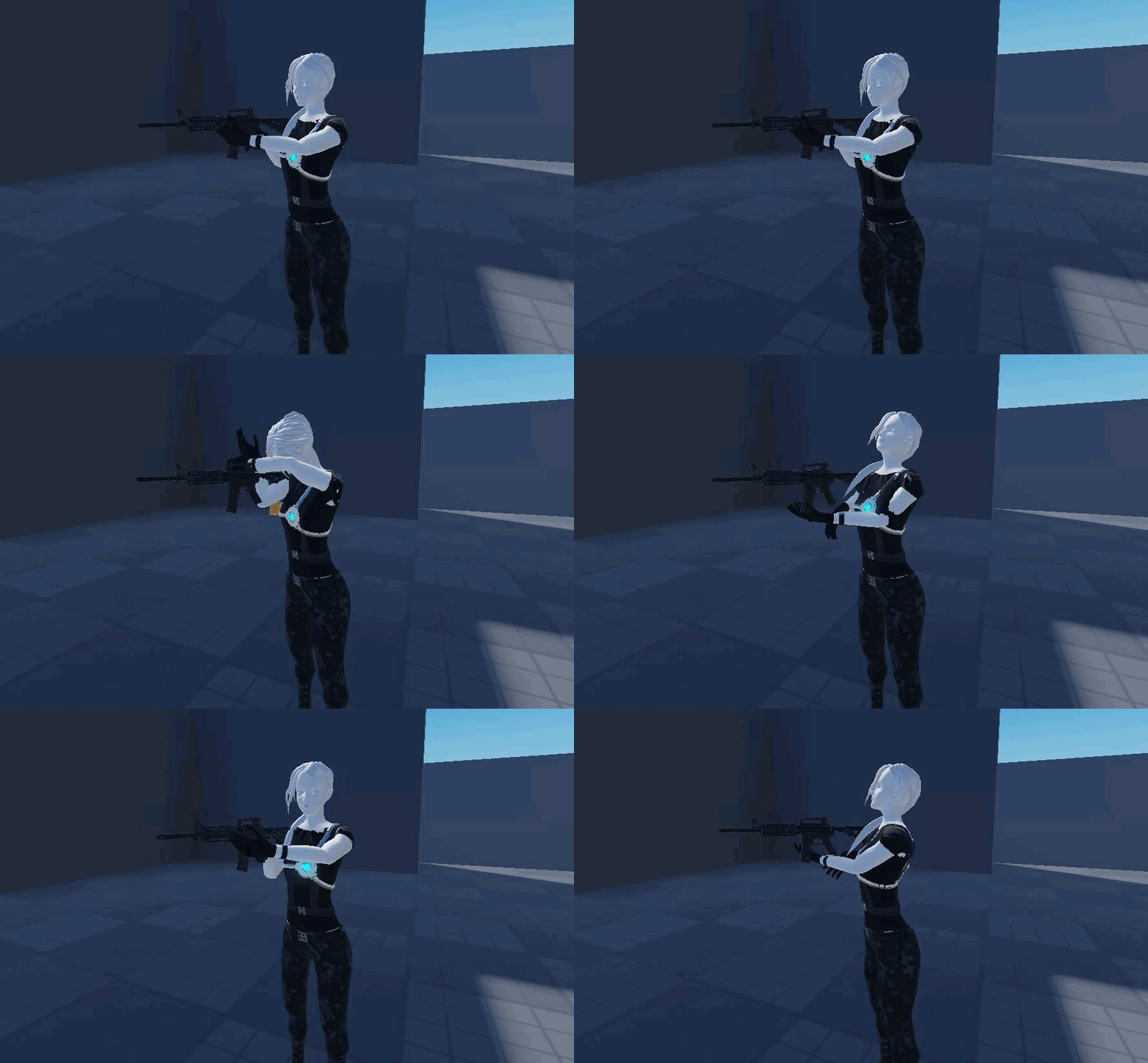 full forumBOT
wintry shore
This question may not come in the format of a standard math question, i hope tha...
wintry shore
full forumBOT
wintry shore
This question may not come in the format of a standard math question, i hope tha...
wintry shore
But the arms are not so simple
The neck starts out completely aligned with the direction it needs to turn. (Orientation in x, y, z format starts out at 0, 0, 0. All i need to do here is modify the x component by θ degrees and it tilts forward perfectly). But the arms start out with a specific rotation, which in turn also throws the axis off of an easy rotation.
Here's an example of what i mean:
The arm bone here points downward at many different angles. Its precice orientation at this point is (-25.567, 34.957, -149.071).

The green, blue and red lines represent the three axis i can rotate them on. But I want to rotate the arm about the yellow line. Does anyone know how this can be accomplished?
I know this will need to be done via a combination of all three vectors. I just need to find out the proportions of each.
wintry shore
wintry shore
This question may not come in the format of a standard math question, i hope tha...
In the gif above, you can see how the spine and neck bend perfectly, but the arms (only being rotated about the red axis) bend the wrong way, due to only one of the axis being affected
Programming is tough because everything is done in reverse from what you've learned in math class. In math class, you are given and an equation and are trying to find the variables. In programming, you are given the variables and are trying to find the equation
 nimble fable
Wait so let me see if I understand the question
Is it just that you're trying to rotate along an axis that doesn't align nicely with the axes you can easily rotate on
wintry shore
yes
Instead of just increasing the X axis by 5 degrees or whatnot, I have to rotate all 3 axis by a unknown amount in order to rotate along the yellow line
nimble fable
Would a change of basis matrix not work here?
wintry shore
Basis matrix?
nimble fable
Do you know any linear algebra
wintry shore
I do not believe i have taken the class
nimble fable
It's a (change of basis) matrix not a (change of) basis matrix
Though change of basis matrix might still be a weird thing to say
wintry shore
As far as mathematics, the most relevant classes I have taken are Calculus and trigonometry
though I cannot say either class has prepared me for this problem
nimble fable
Yeah this feels like a problem that's easy if you've done linear algebra but tricky otherwise
Let's see if I can explain what to do
Ok so is this problem equivalent to the following
You just want to rotate along a line that's not a coordinate axis right?
wintry shore
yes
nimble fable
Ok then you don't even need to change basis or anything
There's just a standard formula for this I can look up
Change of basis is just a tool you could use to derive the formula, but isn't necessary to apply it
This should have the answer
Should be this

So to apply this you first write the axis you're rotating around as a unit vector (u_x, u_y, u_z)
wintry shore
Is that unit vector in degrees or coordinates?
nimble fable
Coordinates basically
nimble fable
Pick a point on the line you're rotating around
wintry shore
The unit vector would be (-1, 0, 0)
nimble fable
You need to write it in terms of the basic axes you can rotate around
nimble fable
wintry shore
The arm bone here points downward at many different angles. Its precice orientat...
If I'm understanding correctly, the basis axes here are the green, blue, and red ones, and yellow is what you want to rotate around
So take a unit vector along the red, green, and blue lines
nimble fable
Actually that's probably what you want to start with since those won't be the standard unit vectors
wintry shore
The unit vector of the red, green and blue axes is (-0.5168537497520447, -0.431569367647171, -0.7393308877944946)
nimble fable
That's a unit vector for one of them?
wintry shore
yes, most likely the red one
nimble fable
Ok so take a unit vector on each one, and also on one the yellow line
wintry shore
The yellow one will be (-1, 0, 0)
nimble fable
The one on the yellow line should just be (1,0,0). Or (-1,0,0) works too
wintry shore
Okay so
nimble fable
Doesn't really matter which you use.
It'll just change the direction you'll end up rotating in, not the axis
Now what you want to do is write the yellow one in terms of the other ones
Honestly I'm not sure if there's a good way to do this without learning linear algebra
wintry shore
Yellow: (-1, 0, 0)
Red: (-0.5168537497520447, -0.431569367647171, -0.7393308877944946)
Green: (-0.5759537816047668, -0.46364542841911316, 0.6732831597328186)
Blue: (0.6333557367324829, -0.7738093137741089, 0.008927153423428535)
Okay
nimble fable
I could maybe walk you through the formula, but you'd want to get an intuition for why it works
If you ever wanted to debug, rewrite your code, or solve a similar problem
wintry shore
I think i remember possibly doing something like this at some point, im not sure
nimble fable
It actually isn't that tricky is the good news
And it'll serve you very well to learn as a programmer
Linear algebra is essential in computer graphics
The outline is this
You've just represented the red green and blue unit vectors in terms of the standard ones
It turns out you can encode that representation in what's called a matrix
Then if you take the inverse of that matrix (which is something any good math library for any programming language will have a standard function to do) it'll give you a representation of the standard unit vectors in terms of the yellow red and blue ones
This is called a change of basis
wintry shore
hold on a sec
nimble fable
This will let you represent the yellow unit vector in terms of the red green and blue ones
wintry shore
It looks like we're building something kinda like this

A data type that represents both a 3D position and orientation.
I never really understood what the nine rotational arguments meant or how they worked
nimble fable
Then you can apply the formula for rotating around an axis
wintry shore
That makes sense now
nimble fable
And then you use your original change of basis matrix to convert back to the standard coordinates and boom you have your rotation formula
Look up 3blue1brown's essence of linear algebra series on youtube
It's under 2 hours long and will give you a great overview of the core concepts of linear algebra
Then study it a bit in whatever way feels best (textbook, youtube lectures, etc) and go back to this problem
It'll take a bit of time, but will save you far more time in the long run
nimble fable
As an added bonus, linear algebra is used in a lot of other cool stuff too
And is just a beautiful subject in it's own right
Also in the future I think the kind of question you asked is better suited for a programming server.
wintry shore
Thats true, but a lot of them were stumped as they did not know linear algebra.
nimble fable
For here I'd maybe more just ask "what kind of math is needed to solve X problem" instead of asking for a solution
And I'd ask that sort of thing in the discussion channels not the help channels
wintry shore
Yeah thats what i was kinda going for, trying to see if anyone knew how to build the equation
nimble fable
But I mean, what you did here worked so eh
wintry shore
.close
full forumBOT
Channel closed
Closed by @wintry shore
Use .reopen if this was a mistake.
full forumBOT
Available help channel!
Send your question here to claim the channel.
Remember:
• Ask your math question in a clear, concise manner.
• Show your work, and if possible, explain where you are stuck.
• After 15 minutes, feel free to ping <@&286206848099549185>.
• Type the command .close to free the channel when you're done.
• Be polite and have a nice day!
Read #❓how-to-get-help for further information on how to ask a good question, and about conduct in the question channels.
 burnt birch
 full forumBOT
burnt birch
full forumBOT
burnt birch


 light sonnet
burnt birch
light sonnet
burnt birch
You do not need to keep closing and opening channels, stay in one channel and wait patiently
burnt birch
bro i been here since like 10
light sonnet
Okay, and?
light sonnet
You still don't need to close and open channels to get attention
 civic beacon
I already told you it's wrong
burnt birch
<@&286206848099549185>
full forumBOT
@burnt birch Has your question been resolved?
full forumBOT
Channel closed
Closed due to timeout
Use .reopen if this was a mistake.
full forumBOT
Available help channel!
Send your question here to claim the channel.
Remember:
• Ask your math question in a clear, concise manner.
• Show your work, and if possible, explain where you are stuck.
• After 15 minutes, feel free to ping <@&286206848099549185>.
• Type the command .close to free the channel when you're done.
• Be polite and have a nice day!
Read #❓how-to-get-help for further information on how to ask a good question, and about conduct in the question channels.
 proud spear
This is a graphical representation of a problem I found in an old textbook. In this drawing each of the two circles with centers B and C has a radius of 3 cm , AB ⟂ CB and |CA| = 10 cm . Find out the angle BAC.
 full forumBOT
proud spear
This is a graphical representation of a problem I found in an old textbook. In t...
full forumBOT
proud spear
This is a graphical representation of a problem I found in an old textbook. In t...
 elfin stream
proud spear
This is a graphical representation of a problem I found in an old textbook. In t...
elfin stream
proud spear
This is a graphical representation of a problem I found in an old textbook. In t...
sin BAC = (BC/CA)
BC = the sum of radius of two circles
proud spear
BC = 6cm
elfin stream
proud spear
Is there a simpler solution?
not one i can think of
proud spear
ok, so from what you said I can deduce, that sin BAC = 3/5
elfin stream
proud spear
ok, so from what you said I can deduce, that sin BAC = 3/5
using inverse trig functions
arcsin(sin(BAC)) = arcsin(0.6)
BAC = arcsin(0.6)
u need a calc to find arcsin(0.6)
proud spear
my calculator doesn't have arcsins : (
 clear vigil
proud spear
my calculator doesn't have arcsins : (
clear vigil
proud spear
my calculator doesn't have arcsins : (
use your phone :D
 serene hazel
proud spear
my calculator doesn't have arcsins : (
serene hazel
proud spear
my calculator doesn't have arcsins : (
use shift button
clear vigil
great
proud spear
.close
full forumBOT
Channel closed
Closed by @proud spear
Use .reopen if this was a mistake.
full forumBOT
Available help channel!
Send your question here to claim the channel.
Remember:
• Ask your math question in a clear, concise manner.
• Show your work, and if possible, explain where you are stuck.
• After 15 minutes, feel free to ping <@&286206848099549185>.
• Type the command .close to free the channel when you're done.
• Be polite and have a nice day!
Read #❓how-to-get-help for further information on how to ask a good question, and about conduct in the question channels.
spice orchid
#help-18 message
What are some sufficient conditions (weaker than being twice differentiable) for an everywhere differentiable function f : R -> R to have a continuous derivative?
full forumBOT
spice orchid
https://discord.com/channels/268882317391429632/903463354654404658/1129377379073...
@spice orchid Has your question been resolved?
full forumBOT
@spice orchid Has your question been resolved?
 distant shuttle
hmm
full forumBOT
@spice orchid Has your question been resolved?
 rose rain
 i wonder if ive seen this before
gritty rose

Mathematics Stack Exchange
Give an example of a function f that is defined in a neighborhood of a s.t. $\lim_{h\to 0}(f(a+h)+f(a-h)-2f(a))/h^2$ exists, but is not twice differentiable.
Note: this follows a problem where I p...
x^2 * sin(1/x) but I don't know how to generalize it
rose rain
i remember this bad boy:
idk if it helps
[
g_n(x) = \begin{cases}
x^n \sin(1/x) , \text{if $x \neq 0$} \
0 , \text{otherwise}
\end{cases}
]
glossy valveBOT
 full forumBOT
@spice orchid Has your question been resolved?
 ocean birch
.close
full forumBOT
Channel closed
Closed by @ocean birch
Use .reopen if this was a mistake.