#help-28
1 messages · Page 78 of 1
 onyx glen
 torn jolt
Yeah
onyx glen
you miscopied the problem statement...
 terse karma
instead of cos
torn jolt
Yeah I miscopied sorry
onyx glen
copy it correctly or send a picture
torn jolt
 onyx glen
okay
rewriting everything on the LHS in terms of sin(θ) and cos(θ) should be a good idea.
torn jolt
Well we could write it as
sin0/cos0+ cos0/sin0
 gritty rose
t for theta
onyx glen
torn jolt
How would you write it out tho
write what out
onyx glen
so you're confused on how to follow my instruction of
rewriting everything on the LHS in terms of sin(θ) and cos(θ)
because of the division symbol that is present.
did i understand you correctly?
torn jolt
Yeah
onyx glen
do you know how to write csc(θ) in terms of sin(θ) and/or cos(θ)?
torn jolt
1/sin t
onyx glen
great
the fact that csc(t) = 1/sin(t) is entirely unaffected by the presence of the fraction bar
you can and should write the LHS as $\frac{\frac{\sin(\theta)}{\cos(\theta)} + \frac{\cos(\theta)}{\sin(\theta)}}{1/\sin(\theta)}$ as per my instruction
 glossy valveBOT
Ann
 torn jolt
Can’t everything cancel out, but 1/sin
torn jolt
Oh ok
onyx glen
if you want some lubricant: division by 1/sin(θ) is the same as multiplication by sin(θ),
so your expression transforms into $\sin(\theta) \paren{\frac{\sin(\theta)}{\cos(\theta)} + \frac{\cos(\theta)}{\sin(\theta)}}$
glossy valveBOT
Ann
 torn jolt
Okay makes more sense
I believe the sin can cancel out only so you’re left with cos+cos
onyx glen
incorrect.
no cancellation can occur here.
would you like to try to do something on your own or do you want me to give further pointers? @torn jolt
 full forumBOT
@torn jolt Has your question been resolved?
onyx glen
👻
full forumBOT
Channel closed
Closed due to timeout
Use .reopen if this was a mistake.
 Available help channel!
Send your question here to claim the channel.
Remember:
• Ask your math question in a clear, concise manner.
• Show your work, and if possible, explain where you are stuck.
• After 15 minutes, feel free to ping <@&286206848099549185>.
• Type the command .close to free the channel when you're done.
• Be polite and have a nice day!
Read #❓how-to-get-help for further information on how to ask a good question, and about conduct in the question channels.
 calm tinsel
 full forumBOT
calm tinsel
calm tinsel
full forumBOT
calm tinsel
calm tinsel
How am I suppose to do these questions?
onyx glen
binomial distribution
 calm tinsel
what would p be in this specific senario
onyx glen
calm tinsel
curious how the left-hand side is missing
calm tinsel
onyx glen
curious how the left-hand side is missing
there is no left hand side to this, I didn't crop anything out
 wispy hamlet
calm tinsel
what would p be in this specific senario
wispy hamlet
calm tinsel
what would p be in this specific senario
obviously 1/2 ... was a typo .. sorry
onyx glen
calm tinsel
what would p be in this specific senario
p is the probability of success; in this case, a success is heads xor tails (pick one and stick with it), and in either case its probability is 1/2
calm tinsel
oh so P represents the success of that senario specificly
not the senario when it's been flipped 10 times
I will take the silence as a yes
thanks lads
.close
full forumBOT
Channel closed
Closed by @calm tinsel
Use .reopen if this was a mistake.
Available help channel!
Send your question here to claim the channel.
Remember:
• Ask your math question in a clear, concise manner.
• Show your work, and if possible, explain where you are stuck.
• After 15 minutes, feel free to ping <@&286206848099549185>.
• Type the command .close to free the channel when you're done.
• Be polite and have a nice day!
Read #❓how-to-get-help for further information on how to ask a good question, and about conduct in the question channels.
 wicked nacelle
 full forumBOT
wicked nacelle
wicked nacelle
full forumBOT
wicked nacelle
wicked nacelle
does question 5 mean that to make h as the subject and then write an eqaution for cd?
full forumBOT
@wicked nacelle Has your question been resolved?
 quaint prawn
It means to write CD=f(h) (using whatever the actual function of h should be)
so not solving for h alone, but solving for CD alone, in terms of h
full forumBOT
Channel closed
Closed due to timeout
Use .reopen if this was a mistake.
Available help channel!
Send your question here to claim the channel.
Remember:
• Ask your math question in a clear, concise manner.
• Show your work, and if possible, explain where you are stuck.
• After 15 minutes, feel free to ping <@&286206848099549185>.
• Type the command .close to free the channel when you're done.
• Be polite and have a nice day!
Read #❓how-to-get-help for further information on how to ask a good question, and about conduct in the question channels.
 craggy sandal
Want to prove that if $0 \neq \pi \in \mathbb{Z}[i].$ The following are equivalent:
full forumBOT
craggy sandal
Want to prove that if $0 \neq \pi \in \mathbb{Z}[i].$ The following are equivale...
glossy valveBOT
LeftySam
 craggy sandal
$\pi$ is a Gaussian prime
glossy valveBOT
LeftySam
 craggy sandal
If, for some $\alpha$ and $\beta \in \mathbb{Z}[i]$ we have $\pi = \alpha \cdot \beta,$ then either $\alpha$ or $\beta$ is a unit.
glossy valveBOT
LeftySam
 craggy sandal
I'm stuck on the latter implies the former.
My notes say: We have $\pi$ divides $\alpha \cdot \beta,$ let $\delta$ be a gcd($\alpha,\pi)$ this implies there exists $\gamma$ such that $\pi = \gamma\delta$ which implies $\gamma$ or $\delta$ is a unit. If $\gamma$ is a unit, then $\pi\gamma^{-1} = \delta$ divides $\alpha$ which implies $\pi$ divides $\alpha.$ Otherwise, if $\delta$ is a unit then 1 is also a gcd($\alpha,\pi)$ which implies $\beta$ is a gcd($\alpha\beta,\pi\beta).$ Since $\pi$ divides $\alpha\beta$ and $\pi$ divides $\pi\beta$ which implies $\pi$ divides $\beta$
glossy valveBOT
LeftySam
 craggy sandal
There's certain points of this proof I don't understand
Largely the last two sentences, I don't know why 1 would be a gcd(alpha,pi)
full forumBOT
@craggy sandal Has your question been resolved?
full forumBOT
@craggy sandal Has your question been resolved?
Channel closed
Closed by @craggy sandal
Use .reopen if this was a mistake.
Available help channel!
Send your question here to claim the channel.
Remember:
• Ask your math question in a clear, concise manner.
• Show your work, and if possible, explain where you are stuck.
• After 15 minutes, feel free to ping <@&286206848099549185>.
• Type the command .close to free the channel when you're done.
• Be polite and have a nice day!
Read #❓how-to-get-help for further information on how to ask a good question, and about conduct in the question channels.
calm tinsel
 full forumBOT
calm tinsel
calm tinsel
full forumBOT
calm tinsel
calm tinsel
I'm trying to do the first one but I didn't get the right answer
I did 8C2 * (1/6)^2 * (5/6)^6
 vital wadi
To calculate the probability of rolling 2 6-sided dice from 8 dice, we can use the binomial probability method.
The probability that Mary rolls 2 sixes dice from 8 rolls is:
P(2) = (8 c 2) * (1/6)^2 * (5/6)^6
calm tinsel
I did it right then?
 potent shale
But that's exactly what he did
vital wadi
yes
vital wadi
0.2939
potent shale
Convert to a rational number
Or just calculate: 8 choose 2 * (1/6)^2 * (5/6)^6 = 4 * 7 * 5^6 / 6^8
= 109375/419904
calm tinsel
oh is the problem just the calculator can't proccess a number that big hence its a decimal
:V
potent shale
Just break it down
full forumBOT
Channel closed
Closed by @calm tinsel
Use .reopen if this was a mistake.
Available help channel!
Send your question here to claim the channel.
Remember:
• Ask your math question in a clear, concise manner.
• Show your work, and if possible, explain where you are stuck.
• After 15 minutes, feel free to ping <@&286206848099549185>.
• Type the command .close to free the channel when you're done.
• Be polite and have a nice day!
Read #❓how-to-get-help for further information on how to ask a good question, and about conduct in the question channels.
 strong prism
 full forumBOT
strong prism
strong prism
full forumBOT
strong prism
strong prism
what is this uprising graphj called
there's linear
there's oscillating
idk what this one is called, graphical or something like that
 gilded quarry
Well, could you send the equation of the graph if possible
strong prism
oh no
theres no equations
well how doi explain this
uhh
theres liek shapes that graphs come in forms of
sin graphs are oscillating
linear graphs are linear
what is this graph in shape of
theres like another word for curved
gilded quarry
Could you send or the whole graph as I am not able to see an oscillating
strong prism
no- thats not what i mean
it's in topic of sequences

this is a graph of y = e^x
gilded quarry
exponential
strong prism
but just focus on the part where x is greater than 0
strong prism
gilded quarry
exponential
im not looking for the name of the graph
im looking for names of graph shapes
gilded quarry
monotonically increasing ?
strong prism
nah something else
so
let's say
in sequences
if you have a sequence of
t_n+1 = 4t_n
what is that called
there's arithmetic
and somehintg else
gilded quarry
geometric
full forumBOT
Channel closed
Closed by @strong prism
Use .reopen if this was a mistake.
gilded quarry
lol
full forumBOT
Available help channel!
Send your question here to claim the channel.
Remember:
• Ask your math question in a clear, concise manner.
• Show your work, and if possible, explain where you are stuck.
• After 15 minutes, feel free to ping <@&286206848099549185>.
• Type the command .close to free the channel when you're done.
• Be polite and have a nice day!
Read #❓how-to-get-help for further information on how to ask a good question, and about conduct in the question channels.
 wary marsh
 full forumBOT
wary marsh
wary marsh
full forumBOT
wary marsh
wary marsh
Wouldn’t this just be times 1.24 for all
onyx glen
no
the growth factor is only going to be 1.24 for annual compounding
for monthly it will be (1 + 0.24/12)^12
wary marsh
And yearly just be (1 + 0.24/365)^12?
onyx glen
and daily is (1 + 0.24/365)^365
 clear lily
,calc (1 + 0.24/365)^365
glossy valveBOT
Result:
1.2711488914413
Ah alr that seems more simpler
wary marsh
clear lily
dont you mean (1 + 0.24)^(1/12)
That’s monthly
clear lily
and (1 + 0.24)^(1/365)
wary marsh
And dat daily
clear lily
yes
 full forumBOT
Channel closed
Closed by @wary marsh
Use .reopen if this was a mistake.
Available help channel!
Send your question here to claim the channel.
Remember:
• Ask your math question in a clear, concise manner.
• Show your work, and if possible, explain where you are stuck.
• After 15 minutes, feel free to ping <@&286206848099549185>.
• Type the command .close to free the channel when you're done.
• Be polite and have a nice day!
Read #❓how-to-get-help for further information on how to ask a good question, and about conduct in the question channels.
 cyan lagoon
 full forumBOT
cyan lagoon
full forumBOT
full forumBOT
cyan lagoon
full forumBOT
Channel closed
Closed by @cyan lagoon
Use .reopen if this was a mistake.
Available help channel!
Send your question here to claim the channel.
Remember:
• Ask your math question in a clear, concise manner.
• Show your work, and if possible, explain where you are stuck.
• After 15 minutes, feel free to ping <@&286206848099549185>.
• Type the command .close to free the channel when you're done.
• Be polite and have a nice day!
Read #❓how-to-get-help for further information on how to ask a good question, and about conduct in the question channels.
 wheat turret
 full forumBOT
wheat turret
wheat turret
full forumBOT
wheat turret
wheat turret
Task is:
show with the help of induction that that thing is diviseable by 9 for all numbers equal or bigger to 0

i did it like this
put in the n+1
how do i advance from here
 ember shadow
try to express the P(n + 1) expression in terms of P(n)
so you can use the assumption that P(n) is true
ember shadow
I don't know what you mean
start with P(n+1), see if you can write it as "P(n) + something" and simplify

 ember shadow
I don't think subtracting one from the other is correct/valid
wheat turret
we already know the latter is true
ember shadow
look at the forms of both P(n+1) and P(n). How can you "obtain" P(n) from the expression for P(n+1)?
 devout valley
ember shadow
I don't think subtracting one from the other is correct/valid
devout valley
ember shadow
I don't think subtracting one from the other is correct/valid
You could do that - that would be equivalent to what you said if you can show what you get is divisible by 9
(In particular, that's P(n+1) - P(n) = "something")
wheat turret
ember shadow
look at the forms of both P(n+1) and P(n). How can you "obtain" P(n) from the ex...
yeah you get the answer to that questions by subraction right? you just need to write it again in the form you suggested
ember shadow
you can try it, and then I can explain how I'm thinking about it
wheat turret
sec i need to find out how to calculate this term

never done ^3 ^4 ^5 in school before
devout valley
So you haven't done binomial expansion?
Alternatively you can expand (n + 3)(n + 3)^2
wheat turret
devout valley
So you haven't done binomial expansion?
we only used ^2 all the time
devout valley
devout valley
Alternatively you can expand (n + 3)(n + 3)^2
That's fair enough, as per before you can do this here
Expand it bit by bit
wheat turret
is it n^3+9n^2+27n+27 ?
wheat turret
kk then we have the answer here
glossy valveBOT


 Requested by chartbit#3171
devout valley
Requested by chartbit#3171
devout valley

wheat turret
devout valley
<:catThumbsUp:662911317090369546>

so this is the term from the left
and its the old term +
devout valley
Accidentally missed cubes on the RHS but otherwise it's all good
devout valley
ember shadow
start with P(n+1), see if you can write it as "P(n) + something" and simplify
[Worth noting that this is the same idea - expand the (n + 3)^3 and then you can show that P(n + 1) is P(n) + "something"]
wheat turret
i forgot the ^3 after the brackets on the right side ^^
but still you get the point
devout valley
wheat turret
what do i do now?
You have two things that are divisible by 9 on the right hand side, the n^3 + (n + 1)^3 + (n + 2)^3 [by induction hypothesis] and the 9n^2 + 27n + 27 [= 9(n^2 + 3n + 3) ]
ember shadow
devout valley
[Worth noting that this is the same idea - expand the (n + 3)^3 and then you can...
Yeah I see that now. Just seemed "backwards" to me at first
wheat turret
i am still totally confused why you can't just - the old thing that we know that is already diviseable
devout valley
Added them together so therefore you can conclude that (n+1)^3 + (n + 2)^3 + (n + 3)^3 is divisble by 9
wheat turret
then we would only need to check it for the rest that is left
wheat turret
devout valley
You have two things that are divisible by 9 on the right hand side, the n^3 + (n...
yeah exactly
so what is the correct notation/process here?
Is my technique with just subtraction allowed?
devout valley
wheat turret
Is my technique with just subtraction allowed?
Provided you then justify why P(n+1) is divisible by 9 you could
ember shadow
I think so, but I'm not sure it would be for all induction problems
ember shadow
wheat turret
so what is the correct notation/process here?
you just show that since n^2 + 3n + 3 is an integer then the whole thing must be divisible by 9
wheat turret
ember shadow
I think so, but I'm not sure it would be for all induction problems
I mean how else would you have found out what you needed to add to get the new term?
devout valley
wheat turret
I mean how else would you have found out what you needed to add to get the new t...
Algebra - see the comment that i had made before
Expanding the (n + 3)^3 in P(n + 1) should reveal to you the P(n) and the "something" [the 9n^2 + 27n + 27]
ember shadow
I would have just expanded (n + 3)^3; the other 2 terms of P(n+1) are already "part of" P(n).
then you have (n + 3)^3 = n^3 + 9n^2 + 27n + 27.
substitute "9k" for the "P(n) terms", then you have P(n+1) = 9k + 9n^2 + 27n + 27.
now you can factor 9 on the RHS
wheat turret
ember shadow
I would have just expanded (n + 3)^3; the other 2 terms of P(n+1) are already "p...
ah ok that's pretty similar to my idea anyway ^^
wheat turret
devout valley
You have two things that are divisible by 9 on the right hand side, the n^3 + (n...
how do we know this is diviseable by 9 now?
 ember shadow
what is the definition of divisibility?
wheat turret
ember shadow
what is the definition of divisibility?
^^
getting smarter every day
it's like looking up definitions for vocabulary

i wrote it like this now
full forumBOT
@wheat turret Has your question been resolved?
Channel closed
Closed by @wheat turret
Use .reopen if this was a mistake.
full forumBOT
Available help channel!
Send your question here to claim the channel.
Remember:
• Ask your math question in a clear, concise manner.
• Show your work, and if possible, explain where you are stuck.
• After 15 minutes, feel free to ping <@&286206848099549185>.
• Type the command .close to free the channel when you're done.
• Be polite and have a nice day!
Read #❓how-to-get-help for further information on how to ask a good question, and about conduct in the question channels.
 pure pond
Hi i did not get how he got this and im really confused how

 sharp flame
Damn look at that formatting
Do you understand what the slope and intercept of a line is
pure pond
yes i think
 dim compass
pure pond
yes i think
dim compass
pure pond
yes i think
And so you know how to find x and y intercepts from a linear equation?
If you really understand what is x intercept and y intercept then you should be able to do that
pure pond
dim compass
And so you know how to find x and y intercepts from a linear equation?
nope im confused how to find those
dim compass
pure pond
nope im confused how to find those
x intercept is just like its name, the point on x axis where the graph of the equation intersects. And x axis lie at y=0 so tell me, based on this information, can you find x intercept of any linear equation?
like if I tell you to find x intercept of y=3x+2, would you be able to do that?
pure pond
uhmm nope
dim compass
If y=0 in y=3x+2, won't that means that the x axis for y=0 will be the x intercept?
dim compass
pure pond
uhmm nope
So whenever you're given y=linear function of x, you can find x intercept by putting y=0
And same concept is used to find y intercept, you put x=0 in the equation and the y value which you get will be the y intercept of the linear equation
pure pond
ok srry i need to renew evrything since i forgot so How do i find the slope first?
dim compass
pure pond
ok srry i need to renew evrything since i forgot so How do i find the slope firs...
Okay, have you tapped into calculus before. Like differentiation?
In any case, slope is the tangent of the angle that a line makes with the positive direction of x axis.
By tangent of the angle, I mean tan theta
pure pond
i have no idea what tangent mean
torn jolt
pure pond
ok srry i need to renew evrything since i forgot so How do i find the slope firs...
Slope is the rate of change of $y$ with respect to $x$.
$m=\frac{y_2-y_1}{x_2-x_1}$
glossy valveBOT
Masala Oats
 torn jolt
This equation represents that if you take 2 points on the line, i.e., (x1, y1) and (x2, y2), then the slope is the difference in the y values divided by difference in the x values.
Slope := (Change in y) ÷ (change in x)
full forumBOT
Channel closed
Closed by @pure pond
Use .reopen if this was a mistake.
Available help channel!
Send your question here to claim the channel.
Remember:
• Ask your math question in a clear, concise manner.
• Show your work, and if possible, explain where you are stuck.
• After 15 minutes, feel free to ping <@&286206848099549185>.
• Type the command .close to free the channel when you're done.
• Be polite and have a nice day!
Read #❓how-to-get-help for further information on how to ask a good question, and about conduct in the question channels.
 shell glen
I have got an interesting problem here.
full forumBOT
shell glen
I have got an interesting problem here.
shell glen
We are given a^x = log (base a) x, a < 1. Find the range of a for which only 1 solution exists and range for which 3 distinct solutions exist.
Ping me if anyone gets any idea.
full forumBOT
@shell glen Has your question been resolved?
full forumBOT
@shell glen Has your question been resolved?
 fleet cedar
i dont think you can get a nice closed form for this (unless you use lambert W)
but ig the general idea is
glossy valveBOT
 fleet cedar
if not, then it will have only 1 soln
fleet cedar
glossy valve
*positive x
shell glen
I have been given the solution, it being that 3 solutions exist if a belongs (0, e^-e] and 1 solution if a belongs ( e^-e, 1). Need to figure out the process.
fleet cedar

Mathematics Stack Exchange
How many solutions are there for the equation $a^x = \log_a x$, where $0 < a < 1$?
When I first saw this quiz for japanese high school students, I wondered there was only 1 solution for the
full forumBOT
@shell glen Has your question been resolved?
full forumBOT
Channel closed
Closed due to timeout
Use .reopen if this was a mistake.
Available help channel!
Send your question here to claim the channel.
Remember:
• Ask your math question in a clear, concise manner.
• Show your work, and if possible, explain where you are stuck.
• After 15 minutes, feel free to ping <@&286206848099549185>.
• Type the command .close to free the channel when you're done.
• Be polite and have a nice day!
Read #❓how-to-get-help for further information on how to ask a good question, and about conduct in the question channels.
 sonic thicket
Hey guys I need some help
full forumBOT
sonic thicket
Hey guys I need some help
sonic thicket
How can I solve this

I don't know what can I do now
I just prepared my matrix with my equations
But I don't know what's the next step
@fleet cedar @shell glen @ember shadow @wheat turret
Please
fleet cedar
dont ping random ppl
full forumBOT
Channel closed
Closed by @sonic thicket
Use .reopen if this was a mistake.
Available help channel!
Send your question here to claim the channel.
Remember:
• Ask your math question in a clear, concise manner.
• Show your work, and if possible, explain where you are stuck.
• After 15 minutes, feel free to ping <@&286206848099549185>.
• Type the command .close to free the channel when you're done.
• Be polite and have a nice day!
Read #❓how-to-get-help for further information on how to ask a good question, and about conduct in the question channels.
 silk nexus
guys when writting the domain for a function
full forumBOT
silk nexus
guys when writting the domain for a function
silk nexus
how do I exclude
and how do I include
using brakets
[ , ]
] , [
idk how to use them
 fast peak
yes
fast peak
yes
full forumBOT
@silk nexus Has your question been resolved?
Channel closed
Closed by @silk nexus
Use .reopen if this was a mistake.
full forumBOT
Available help channel!
Send your question here to claim the channel.
Remember:
• Ask your math question in a clear, concise manner.
• Show your work, and if possible, explain where you are stuck.
• After 15 minutes, feel free to ping <@&286206848099549185>.
• Type the command .close to free the channel when you're done.
• Be polite and have a nice day!
Read #❓how-to-get-help for further information on how to ask a good question, and about conduct in the question channels.
 tidal flicker
ok so my question in algebra is x-5= something. I know that x=-2 due the the code thing at the top. i was wondering if it would be -2-5=-7 or would you change the minus in the question to a plus so -2+5=3
full forumBOT
tidal flicker
ok so my question in algebra is x-5= something. I know that x=-2 due the the cod...
 light sonnet
tidal flicker
ok so my question in algebra is x-5= something. I know that x=-2 due the the cod...
light sonnet
tidal flicker
ok so my question in algebra is x-5= something. I know that x=-2 due the the cod...
would you change the minus in the question to a plus so -2+5=3
No because it's not minus negative 5, aka - -5
tidal flicker
light sonnet
> would you change the minus in the question to a plus so -2+5=3
No because it's...
so it would stay the same, -2-5=7 ?
light sonnet
It'll be this
-2-5=-7
tidal flicker
oh yes sorry i frogot to put in the minus before the 7.
thank you so much
.close
full forumBOT
Channel closed
Closed by @tidal flicker
Use .reopen if this was a mistake.
Available help channel!
Send your question here to claim the channel.
Remember:
• Ask your math question in a clear, concise manner.
• Show your work, and if possible, explain where you are stuck.
• After 15 minutes, feel free to ping <@&286206848099549185>.
• Type the command .close to free the channel when you're done.
• Be polite and have a nice day!
Read #❓how-to-get-help for further information on how to ask a good question, and about conduct in the question channels.
 astral garnet
how do I solve this
 full forumBOT
astral garnet
how do I solve this
full forumBOT
astral garnet
how do I solve this
 astral sinew
diagonalize or some shit ig
astral sinew
let's find the eigenvalues of this matrix
astral garnet
so 2 and 1
astral sinew
check your signs
gritty rose
astral garnet
so 2 and 1
!show
full forumBOT
astral garnet
so 2 and 1
Show your work, and if possible, explain where you are stuck.
astral sinew
also it'll be easier if we just multiply through by the scalar
so we have
$\begin{bmatrix} \frac{3}{2} & 1 \ -1 & -1 \end{bmatrix}$
glossy valveBOT
Mr. Gamer
 glossy valveBOT
Mr. Gamer
 astral sinew
now find v1 and v2
astral garnet
is that the eigenvector
 unreal roost
I got a question regarding center of dialation
Where is it at exactly?
How do I find it?
astral garnet
@astral sinew letting M=PDP^-1
is $P=\begin{bmatrix} 1 & 1 \ 2 & -\frac{1}{2} \end{bmatrix}$
glossy valveBOT
ミョーみ
 astral garnet
wait fk
astral sinew
not quite
 astral sinew
yea
astral sinew
yeah
then P = [v1, v2], where v1 and v2 are COLUMN vectors
also i think you mean k2 = -1/2 (please keep your subscripts straight it's a pain in the ass if you don't)
astral garnet
wait so $P=\begin{bmatrix} -2 & -\frac{1}{2} \ 1 & 1 \end{bmatrix}$
astral garnet
astral sinew
also i think you mean k2 = -1/2 (please keep your subscripts straight it's a pai...
ah yea
astral sinew
v1 and v2 are COLUMN vectors
maybe it's just the latex that's tripping you up
you should have:
glossy valveBOT
ミョーみ
 astral garnet
$D=\begin{bmatrix} 1 & 0 \ 0 & -\frac{1}{2} \end{bmatrix}$
glossy valveBOT
ミョーみ
 astral sinew
yep, looks good
now just find the inverse of P
$P^{-1} = \frac{1}{-3/2} \begin{bmatrix} 1 & -1 \ \frac{1}{2} & -2 \end{bmatrix}$
glossy valveBOT
Mr. Gamer
 astral garnet
yep got it
astral sinew
$P^{-1} = \begin{bmatrix} -2/3 & -1/3 \ -2/3 & 4/3 \end{bmatrix}$
let me double check that
,w inverse ((-2,-1/2),(1,1))
glossy valveBOT

 Requested by Mr. Gamer#6658
astral sinew
Requested by Mr. Gamer#6658
astral sinew
mb
forgot to take the transpose of the cofactor. lol
so now we have:
$$M = \begin{bmatrix} -2 & -\frac{1}{2} \ 1 & 1 \end{bmatrix} \cdot \begin{bmatrix} 1 & 0 \ 0 & -\frac{1}{2} \end{bmatrix} \cdot \begin{bmatrix} -2/3 & -1/3 \ 2/3 & 4/3 \end{bmatrix}$$
glossy valveBOT
Mr. Gamer
 astral garnet
yep let me try doing M^n
$\begin{bmatrix} \frac{4}{3} & \frac{2}{3} \ \ \frac{2}{3} & -\frac{1}{3} \end{bmatrix}$
glossy valveBOT
ミョーみ
 astral garnet
by doing first evaluating $M^n=PD^nP^{-1}$
glossy valveBOT
ミョーみ
 astral garnet
and we know that $\left( -\frac{1}{2} \right)^{\infinity}=0$
glossy valveBOT
ミョーみ
Compile Error! Click the  reaction for more information.
(You may edit your message to recompile.)
 astral sinew
\infty
also you should have:
$M^{\infty}= \begin{bmatrix} \frac{4}{3} & \frac{2}{3} \ - \frac{2}{3} & -\frac{1}{3} \end{bmatrix}$
holdon
glossy valveBOT
Mr. Gamer
 astral garnet
oh yea sorry i forgot the negative sign
astral sinew
just missing a negative sign
astral garnet
perfect thank you!
astral sinew
there is something interesting to be gained from this exercise
what do you notice about the magnitude of the eigenvalues?
astral garnet
less or equal to 1?
astral sinew
yeah. why do you think we can even write M^infinity at all?
do you see what i'm getting at?
astral garnet
ah right
cuz less than 1 will equal to 0
if 1 then its just 1
anything bigger will just be inf
astral sinew
yep. so M^infinity only makes sense if all eigenvalues lie in the interval (-1,1]
idk thought that was pretty neat
 astral sinew
yeah.
i'll give you the following hints for part a:
*nilpotent matrices are not invertible
*a matrix is diagonalizable if and only if its eigenvectors span R^n
astral garnet
so we have $A^k=PD^kP^-{1}=0$
glossy valveBOT
ミョーみ
 astral sinew
yep
astral garnet
$A=P^{1/k}D\left(P^{-1}\right)^{1/k}=0^{1/k}$
glossy valveBOT
ミョーみ
 astral garnet
oh cant we
astral sinew
we sort of can but it's complicated and there's no need
beyond the scope of what we're doing right now
if we know that D^k = 0, then that implies that D is singular.
when can a diagonal matrix be singular?
astral sinew
and that pretty much answers part b as well
astral garnet
wait because
0 is an eigenvalue -> nullspace is non-trivial -> matrix is singular -> only matrix that is singular and diagonalisable is nilponent
astral sinew
yep
astral garnet
astral garnet
0 is an eigenvalue -> nullspace is non-trivial -> matrix is singular -> only mat...
which is the 0 matrix
so B=0
@astral sinew is this enough?
astral sinew
yes!
full forumBOT
@astral garnet Has your question been resolved?
full forumBOT
Channel closed
Closed due to timeout
Use .reopen if this was a mistake.
Available help channel!
Send your question here to claim the channel.
Remember:
• Ask your math question in a clear, concise manner.
• Show your work, and if possible, explain where you are stuck.
• After 15 minutes, feel free to ping <@&286206848099549185>.
• Type the command .close to free the channel when you're done.
• Be polite and have a nice day!
Read #❓how-to-get-help for further information on how to ask a good question, and about conduct in the question channels.
full forumBOT
onyx glen
are you required to use l'hop?
put the limit in a form where l'hop is applicable.
in this case, you can first factor out the $3x$ to get $3x(e^{1/x} - 1)$, then rewrite $x$ as $\frac{1}{x^{-1}}$ and thus get $\frac{3(e^{1/x} - 1)}{x^{-1}}$
glossy valveBOT
Ann
 onyx glen
this will also make your limit into a 0/0 indeterminate form, which is one of the two forms in which l'hop is applicable.
full forumBOT
Channel closed
Closed by @marsh apex
Use .reopen if this was a mistake.
Available help channel!
Send your question here to claim the channel.
Remember:
• Ask your math question in a clear, concise manner.
• Show your work, and if possible, explain where you are stuck.
• After 15 minutes, feel free to ping <@&286206848099549185>.
• Type the command .close to free the channel when you're done.
• Be polite and have a nice day!
Read #❓how-to-get-help for further information on how to ask a good question, and about conduct in the question channels.
 severe basin
When a number p is divided by 5, the remainder is 3 and when pq is divided by 5, the remainder is 2. What is the remainder when q is divided by 5?
full forumBOT
severe basin
When a number p is divided by 5, the remainder is 3 and when pq is divided by 5,...
severe basin
p=5a+3
pq=5b+2
onyx glen
is this where you're stuck or is there more coming?
onyx glen
gonna be tricky to progress from this point.
$p \equiv 3 \pmod{5} \ pq \equiv 2 \pmod{5}$
glossy valveBOT
Ann
 onyx glen
this implies $3q \equiv 2 \pmod{5}$
glossy valveBOT
Ann
 severe basin
Yes
onyx glen
3 times what gives something that's congruent to 2 mod 5?
 onyx glen
it is not true that q is specifically the number 9
you cannot know q itself, but you CAN know its remainder mod 5.
severe basin
Ok
onyx glen
and its remainder mod 5 is indeed 4 as you claim.
this is a solution that avoids uttering the i-word
 pure sandal
and what is the remainder when divided by 5 of all of these numbers
onyx glen
onyx glen
and its remainder mod 5 is indeed 4 as you claim.
i can repeat this
 full forumBOT
Channel closed
Closed by @severe basin
Use .reopen if this was a mistake.
Available help channel!
Send your question here to claim the channel.
Remember:
• Ask your math question in a clear, concise manner.
• Show your work, and if possible, explain where you are stuck.
• After 15 minutes, feel free to ping <@&286206848099549185>.
• Type the command .close to free the channel when you're done.
• Be polite and have a nice day!
Read #❓how-to-get-help for further information on how to ask a good question, and about conduct in the question channels.
torn jolt
How to choose a parameter that's adequate for searching if the function is continuous.
 full forumBOT
torn jolt
How to choose a parameter that's adequate for searching if the function is conti...
torn jolt
full forumBOT
torn jolt
How to choose a parameter that's adequate for searching if the function is conti...
torn jolt
with a parameter a for example, a in ]0, infinity[
full forumBOT
@torn jolt Has your question been resolved?
torn jolt
<@&286206848099549185>
full forumBOT
@torn jolt Has your question been resolved?
torn jolt
<@&286206848099549185>
full forumBOT
@torn jolt Has your question been resolved?
torn jolt
.close
full forumBOT
Channel closed
Closed by @gleaming zinc
Use .reopen if this was a mistake.
Available help channel!
Send your question here to claim the channel.
Remember:
• Ask your math question in a clear, concise manner.
• Show your work, and if possible, explain where you are stuck.
• After 15 minutes, feel free to ping <@&286206848099549185>.
• Type the command .close to free the channel when you're done.
• Be polite and have a nice day!
Read #❓how-to-get-help for further information on how to ask a good question, and about conduct in the question channels.
 runic igloo
 full forumBOT
runic igloo
full forumBOT
runic igloo
 vast fossil
It's been chosen
vast fossil
runic igloo
is it the 3rd term
Of course
runic igloo
@vast fossil

why are they dividing 36/3
i dont get that
is it bc of the constant multiplying of + or - 3
12 36
etc
vast fossil
t(2) = r * t(1), right?
runic igloo
yeah
vast fossil
So t(1) = t(2)/r
runic igloo
yeah
so
how did they know it was 2 r
is it because theres 2 spots we need to find?
the 1st and 3rd
and since its constant
vast fossil
Looks like they chose positive r for some reason
vast fossil
Yeah there should be 2 answers
vast fossil
t(3) = r * t(2) and we know that t(2) = r * t(1)
So t(3) = r * r * t(1) = r^2 * t(1)
 thick minnow
runic igloo
thick minnow
runic igloo
You can also solve (a) as 8-2 = 3y+5 - 8
As the successive difference remains constant
full forumBOT
@runic igloo Has your question been resolved?
full forumBOT
Channel closed
Closed due to timeout
Use .reopen if this was a mistake.
Available help channel!
Send your question here to claim the channel.
Remember:
• Ask your math question in a clear, concise manner.
• Show your work, and if possible, explain where you are stuck.
• After 15 minutes, feel free to ping <@&286206848099549185>.
• Type the command .close to free the channel when you're done.
• Be polite and have a nice day!
Read #❓how-to-get-help for further information on how to ask a good question, and about conduct in the question channels.
 ocean helm
I know one solution that is: (1,1) and another I have though of was that Y = 1/x^2, so than x^2/x^2 = 1, but I am unsure about that
 nova basin
y = 1/x^2 and then unless x = 1 or -1 the powers of x must be equal in the first equation
ocean helm
nova basin
y = 1/x^2 and then unless x = 1 or -1 the powers of x must be equal in the first...
Oh yeah, I had done that then got a wrong answer, but I just miscalculated something, ty
.close
full forumBOT
Channel closed
Closed by @ocean helm
Use .reopen if this was a mistake.
full forumBOT
Available help channel!
Send your question here to claim the channel.
Remember:
• Ask your math question in a clear, concise manner.
• Show your work, and if possible, explain where you are stuck.
• After 15 minutes, feel free to ping <@&286206848099549185>.
• Type the command .close to free the channel when you're done.
• Be polite and have a nice day!
Read #❓how-to-get-help for further information on how to ask a good question, and about conduct in the question channels.
 slow gulch
hi
full forumBOT
slow gulch
hi
slow gulch
ive been trying a question for hours but nothing worked

part (c) of the question
i tried replacing x with 1/x
but im stuck after that

here’s a clearer pic of what i tried to do
i need to show the form they want me to in (c)
<@&286206848099549185>
full forumBOT
@slow gulch Has your question been resolved?
slow gulch
<@&286206848099549185>
full forumBOT
@slow gulch Has your question been resolved?
full forumBOT
Channel closed
Closed due to timeout
Use .reopen if this was a mistake.
Available help channel!
Send your question here to claim the channel.
Remember:
• Ask your math question in a clear, concise manner.
• Show your work, and if possible, explain where you are stuck.
• After 15 minutes, feel free to ping <@&286206848099549185>.
• Type the command .close to free the channel when you're done.
• Be polite and have a nice day!
Read #❓how-to-get-help for further information on how to ask a good question, and about conduct in the question channels.
 lime jolt
this is 12.6 right?
 full forumBOT
lime jolt
this is 12.6 right?
full forumBOT
lime jolt
this is 12.6 right?
 willow wagon
Why do you say so
lime jolt
i solved it earlier and this is what i got with some friends but we entered it in and it says its wrong so im wondering if the answer overall is wrong
vast fossil
lime jolt
this is 12.6 right?
Approximately, yes
lime jolt
well i did 12.69 at first but remembered it said to the tenths so i did 12.6 but now idk it said its wrong
willow wagon
Maybe you guys have rounded it off wrong
 brittle steeple
Round to the nearest
lime jolt
so 12.7?
lime jolt
is it right tho we only get 2 trys
lime jolt
wdym link u up
willow wagon
Alright
lime jolt
you would need to sign in my stf/account 💀
lime jolt
ye
willow wagon
I think the answer is 10
lime jolt
im not that desperate for an answer either
lime jolt
willow wagon
I think the answer is 10
straight up?
willow wagon
If it does mean round off to the nearest tens, yes
 static bramble
It doesn't say that
static bramble
12.7 is correct
full forumBOT
@lime jolt Has your question been resolved?
full forumBOT
Channel closed
Closed by @lime jolt
Use .reopen if this was a mistake.
 thin prism
.close
full forumBOT
Available help channel!
Send your question here to claim the channel.
Remember:
• Ask your math question in a clear, concise manner.
• Show your work, and if possible, explain where you are stuck.
• After 15 minutes, feel free to ping <@&286206848099549185>.
• Type the command .close to free the channel when you're done.
• Be polite and have a nice day!
Read #❓how-to-get-help for further information on how to ask a good question, and about conduct in the question channels.
 crisp zodiac
Can someone please explain the last 2 dots. It has to be solved for G

 merry swallow
is there more context to what part of math this is? I have no recognition of whats going on
crisp zodiac
They want the first dot to be rewritten to this The little dots are supposed to be a number
 brittle steeple
Seems they evaluated the fraction
full forumBOT
@crisp zodiac Has your question been resolved?
full forumBOT
Channel closed
Closed due to timeout
Use .reopen if this was a mistake.
full forumBOT
Available help channel!
Send your question here to claim the channel.
Remember:
• Ask your math question in a clear, concise manner.
• Show your work, and if possible, explain where you are stuck.
• After 15 minutes, feel free to ping <@&286206848099549185>.
• Type the command .close to free the channel when you're done.
• Be polite and have a nice day!
Read #❓how-to-get-help for further information on how to ask a good question, and about conduct in the question channels.
 scenic prism
wHy is lim x --> 0 x/sinx =1
full forumBOT
scenic prism
wHy is lim x --> 0 x/sinx =1
 empty sapphire
so you know the fact that that lim x -> 0 sin(x)/x = 1?
scenic prism
no I don't understand that too
 stiff musk
what kind of proof do you want?
there's a reasonably persuasive geometric argument here: https://math.stackexchange.com/a/75151
Mathematics Stack Exchange
How can one prove the statement
$$\lim_{x\to 0}\frac{\sin x}x=1$$
without using the Taylor series of $\sin$, $\cos$ and $\tan$? Best would be a geometrical solution.
This is homework. In my math c...
stiff musk
it's a provable fact, but the way a rigorous proof would proceed depends on how you have defined sin
scenic prism
.close
full forumBOT
Channel closed
Closed by @scenic prism
Use .reopen if this was a mistake.
Available help channel!
Send your question here to claim the channel.
Remember:
• Ask your math question in a clear, concise manner.
• Show your work, and if possible, explain where you are stuck.
• After 15 minutes, feel free to ping <@&286206848099549185>.
• Type the command .close to free the channel when you're done.
• Be polite and have a nice day!
Read #❓how-to-get-help for further information on how to ask a good question, and about conduct in the question channels.
 latent spoke
can someone explain the reasoning behind this
 full forumBOT
latent spoke
can someone explain the reasoning behind this
empty sapphire
full forumBOT
latent spoke
can someone explain the reasoning behind this
empty sapphire
because the domain of f(x) is all real numbers except for x = 1 and the domain of g(x) is all real number except for x= 0
so when you add them together you need to account forthat
latent spoke
is that the rule for it? like domain of f(x) is always real numbers except for x = 1?
how did you come to that conclusion if you dont mind me asking
empty sapphire
sure thing
so the domain is all of the x inputs that are possible
so for f(x), the only numbers that don't work are where the denominator is 0
because we can't divide by 0
latent spoke
ohh ok i get it
so in those equations you need a value that would make it impossible, so in this case the f(x) equation if you input 1 for x it would be 1/1-1 which is 1/0 and g(x) is 0 because its impossible to have 1/0?
empty sapphire
no not quite
remember that domain is "all valid values of x"
are there any values of x here that won't work?
latent spoke
i have no clue, all i understand is if x is 0 then its considered invalid, so 2x would need to equal to -3 in order to make 0 with the +3?
empty sapphire
no x = 0 it's valid
all real numbers for x are valie
*valid
here I think that a video will help you
one moment
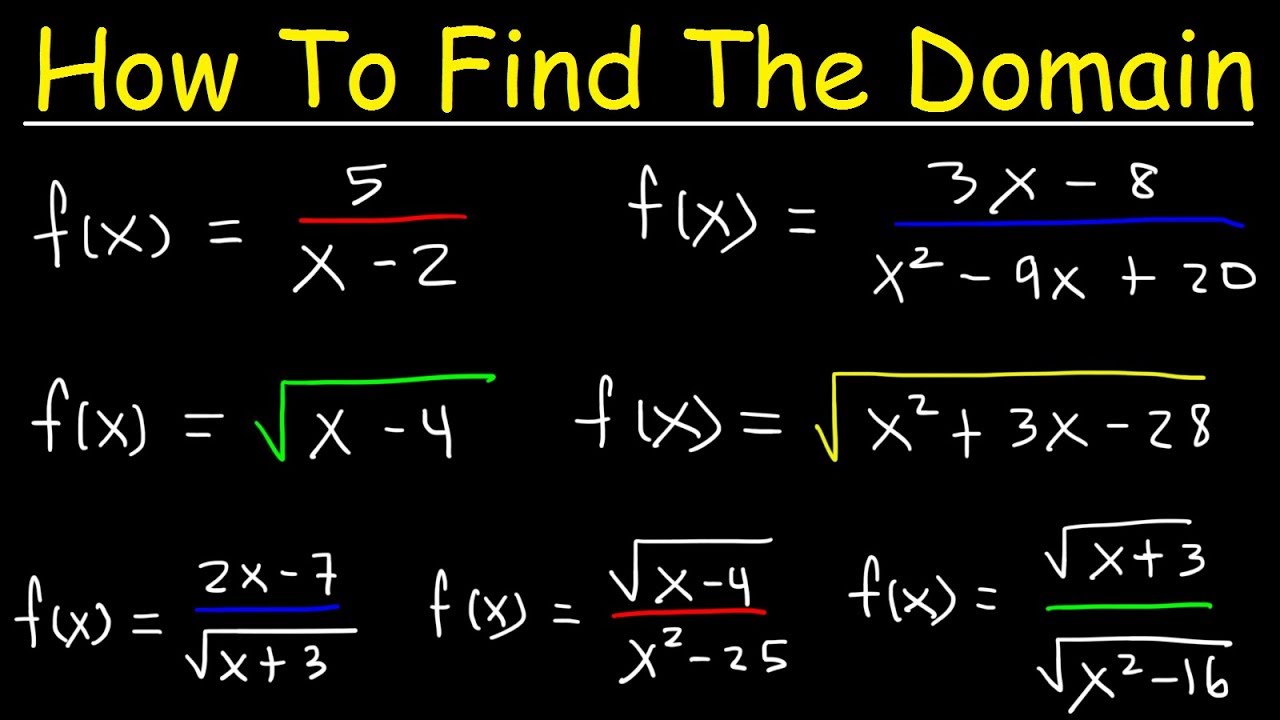
This algebra video tutorial explains how to find the domain of a function that contains radicals, fractions, and square roots in the denominator using interval notation. This video contains plenty of examples and practice problems and is useful for students in algebra and precalculus.
Twitter Page:
https://twitter.com/OrgoChemTutor21
Precalcu...
I would recommend giving this a watch
latent spoke
alright ill get back to you
latent spoke
@empty sapphire so
there is no number that can make it impossible
so its just any number?
empty sapphire
yep exactly!
for f(x) = 3x + 2, all real number is the domain!
you might've seen (-inf, inf) as the notation
or a big giant capital R
latent spoke
ya
empty sapphire
okay
latent spoke
with the lines
empty sapphire
now what if I were to say g(x) = sqrt(x)
what's the domain?
can you have negative numbers inside the square root?
latent spoke
no
empty sapphire
ok so it's fair to say the domain is x >= 0 right?
latent spoke
mhm
empty sapphire
nah not quite
the domain for f(x) is (-inf, inf)
the domain for g(x) is [0, inf)
so the domain for f(x) + g(x) will be [0, inf)
latent spoke
Ohhhhh ok i get that
empty sapphire
so it's the same with your problem
f(x) is all real number except for 1, g(x) is all real number except for 0
so the domain will be (-inf, 0)U(0,1)U(1, inf)
latent spoke
@empty sapphire im reviewing the problems and i got to this one where i dont know how they simplified these equations even after my friend explained it

do you have a video for these problems? It's on the topic of radicals
 willow sedge
You need to take common
empty sapphire
is there anything in $x^3 + x^2$ that can be factored out? What about $4 + 4x$?
glossy valveBOT
MellowDramaLlama
 full forumBOT
@latent spoke Has your question been resolved?
full forumBOT
Channel closed
Closed due to timeout
Use .reopen if this was a mistake.
Available help channel!
Send your question here to claim the channel.
Remember:
• Ask your math question in a clear, concise manner.
• Show your work, and if possible, explain where you are stuck.
• After 15 minutes, feel free to ping <@&286206848099549185>.
• Type the command .close to free the channel when you're done.
• Be polite and have a nice day!
Read #❓how-to-get-help for further information on how to ask a good question, and about conduct in the question channels.
 gaunt bobcat
Where did I go wrong?
 full forumBOT
gaunt bobcat
Where did I go wrong?
full forumBOT
gaunt bobcat
Where did I go wrong?
 viral jasper
Where did the extra $+\cos^2{x}$ come from?
glossy valveBOT
SWR
 gaunt bobcat
viral jasper
Where did that come from?
gaunt bobcat
viral jasper
Where did that come from?
I'm dividing it to simplify it
Is that not allowed? Would dividing it by cos alter the value?
gaunt bobcat
Then where do I go from here to get 1-2sin²x?
 vast fossil
Rewrite it as cos^2 + sin^2 - sin^2 - sin^2
gaunt bobcat
vast fossil
Rewrite it as cos^2 + sin^2 - sin^2 - sin^2
Where did the extra sin come from?
vast fossil
We added and subtracted it
vast fossil
 vivid wren
cos^2 = 1-sin^2
vivid wren
cos^2 = 1-sin^2
But using this is slightly more straightforward
gaunt bobcat
vivid wren
cos^2 = 1-sin^2
Thanks! School didn't teach me this for some reason, it isn't in my notes
 vast fossil
Is that a SEELE pfp
gaunt bobcat
vast fossil
~~Is that a SEELE pfp~~
Yep
latent spoke
empty sapphire
is there anything in $x^3 + x^2$ that can be factored out? What about $4 + 4x$?
i have no clue
i watched videos but cant find problems similar to that
vivid wren
empty sapphire
is there anything in $x^3 + x^2$ that can be factored out? What about $4 + 4x$?
For the first one you can factor out an x^2 to be left with x^2 *(x+1)
latent spoke
how would you do that
vivid wren
You just pull out an x^2 term?
Try foiling what I just got
It's the exact same expression
latent spoke
Right but why are they in the square root sign
vivid wren
You would factor the x^2 inside the square root, then perform the appropriate operation to simplify that
sqrt[x^2 *(x+1)]
Remember your root properties, namely sqrt(a*b) = sqrt(a)*sqrt(b)
bruh discord does NOT like asterisks
latent spoke
Yeah, im just having trouble understanding how there is an x outside of the sqrt and in the inside its x+1
vivid wren
vivid wren
Remember your root properties, namely sqrt(a*b) = sqrt(a)*sqrt(b)
Because of this
What is sqrt[(x^2)*(x+1)] using this rule?
latent spoke
sqrt(x^2) sqrt(x+1)
vivid wren
Right
vivid wren
Yes
vivid wren
In your case yes but realistically it would be + or - x cause either one squared yields x^2
Just stick to the positives here to avoid confusion
latent spoke
Alright
Ao the process would be
Factor the xs inside of the sqrt then use the rule
vivid wren
Yes
latent spoke
That applies to the second one too?
latent spoke
vivid wren
Yoi just gotta make sure to be careful on what the factor is
wdym by this?
vivid wren
Cause in some other problems the factor may not be x^2
Just a side note to keep an eye out for
Example: x^5 + x^4
latent spoke
you cant factor those?
vivid wren
Yes you can
The factor isjust different
x^5 can be rewritten as x^4 *x
and x^4 is just x^4 *1
latent spoke
right
full forumBOT
@gaunt bobcat Has your question been resolved?
full forumBOT
Channel closed
Closed due to timeout
Use .reopen if this was a mistake.
full forumBOT
Available help channel!
Send your question here to claim the channel.
Remember:
• Ask your math question in a clear, concise manner.
• Show your work, and if possible, explain where you are stuck.
• After 15 minutes, feel free to ping <@&286206848099549185>.
• Type the command .close to free the channel when you're done.
• Be polite and have a nice day!
Read #❓how-to-get-help for further information on how to ask a good question, and about conduct in the question channels.
 crimson terrace
Help needed
crimson terrace
Mb
 void warren
?

 full forumBOT
@crimson terrace Has your question been resolved?
full forumBOT
@crimson terrace Has your question been resolved?
 gaunt quartz
He collected 10 each level and there are 5 levels he also collected 30 points per level and there’s 5 levels. The 10 is a variable because we don’t know how many points per gem stone
 minor ravine
crimson terrace
I worked it out and got to 100
minor ravine
crimson terrace
I worked it out and got to 100
good
full forumBOT
Channel closed
Closed due to timeout
Use .reopen if this was a mistake.
Available help channel!
Send your question here to claim the channel.
Remember:
• Ask your math question in a clear, concise manner.
• Show your work, and if possible, explain where you are stuck.
• After 15 minutes, feel free to ping <@&286206848099549185>.
• Type the command .close to free the channel when you're done.
• Be polite and have a nice day!
Read #❓how-to-get-help for further information on how to ask a good question, and about conduct in the question channels.
 barren iris
Problem: I need to decide what should be u for my substitution.
Question: Without telling me which one I should choose, what are some things to consider when deciding which one to choose? Should I just try both and see where either of them lead me? Example: choose u = sec theta or u = tan theta?
 full forumBOT
barren iris
Problem: I need to decide what should be u for my substitution.
Question: Witho...
sharp flame
full forumBOT
barren iris
Problem: I need to decide what should be u for my substitution.
Question: Witho...
sharp flame
$$\int f(x) \cdot f'(x) \dd x$$
$$f(x) = u \implies f'(x) \dd x = \dd u$$
$$\int u \dd u$$
glossy valveBOT
NEONPerseus
 sharp flame
This is the general structure you want to look for while substituting
(at a lower level)
sharp flame
Well not exactly
sharp flame
Sometimes you'll get an easier to integrate function in u
terse karma
sharp flame
$$\int f(x) \cdot f'(x) \dd x$$
$$f(x) = u \implies f'(x) \dd x = \dd u$$
$$\int...
Could've used g(f(x)) to make it more general
sharp flame
I suppose
barren iris
hmm
well this one has me confused
I don't think I can combine the terms in a way to get that
gaunt quartz
Try letting u = tan
barren iris
Maybe I need to rewrite the trig functions into an trig identity ?
gaunt quartz
Because du = sec^2
gaunt quartz
Yes
barren iris
that was way easier than I thought
gaunt quartz
Then it’s just a basic power rule
gaunt quartz
Lmaoo I felt that
barren iris
what do I do
gaunt quartz
You really only need to use Pythagorean’s identities when it’s like sin^2cos^3
Even and odd
But for close powers
barren iris
gaunt quartz
Try letting u = tan
ty for your help as well
gaunt quartz
Np
barren iris
sharp flame
$$\int f(x) \cdot f'(x) \dd x$$
$$f(x) = u \implies f'(x) \dd x = \dd u$$
$$\int...
ty for your help
.close
full forumBOT
Channel closed
Closed by @barren iris
Use .reopen if this was a mistake.
Available help channel!
Send your question here to claim the channel.
Remember:
• Ask your math question in a clear, concise manner.
• Show your work, and if possible, explain where you are stuck.
• After 15 minutes, feel free to ping <@&286206848099549185>.
• Type the command .close to free the channel when you're done.
• Be polite and have a nice day!
Read #❓how-to-get-help for further information on how to ask a good question, and about conduct in the question channels.
 royal sedge
 full forumBOT
royal sedge
glossy valveBOT
full forumBOT
royal sedge
glossy valveBOT
 royal sedge
h prime was constant so thats y we didnt have any input of g prime?
with 2 i mean
.close
full forumBOT
Channel closed
Closed by @royal sedge
Use .reopen if this was a mistake.
Available help channel!
Send your question here to claim the channel.
Remember:
• Ask your math question in a clear, concise manner.
• Show your work, and if possible, explain where you are stuck.
• After 15 minutes, feel free to ping <@&286206848099549185>.
• Type the command .close to free the channel when you're done.
• Be polite and have a nice day!
Read #❓how-to-get-help for further information on how to ask a good question, and about conduct in the question channels.
 pale jackal
How can I find other values of angles using the sin, cos, and tan rules? Forgot the rules
full forumBOT
pale jackal
How can I find other values of angles using the sin, cos, and tan rules? Forgot ...
 tardy matrix
pale jackal
How can I find other values of angles using the sin, cos, and tan rules? Forgot ...
tardy matrix
pale jackal
How can I find other values of angles using the sin, cos, and tan rules? Forgot ...
sohcahtoa
pale jackal
I think sin is 180 - x but I don't remember the others
pale jackal
xD
tardy matrix
it's 2am here my eyes are bleeding
 grave elm
pale jackal
I think sin is 180 - x but I don't remember the others
grave elm
pale jackal
I think sin is 180 - x but I don't remember the others
sin(x) = sin(180-x), is that what you meant?
tardy matrix
grave elm
sin(x) = sin(180-x), is that what you meant?
i'm guessing for cosine and tangent too?
grave elm
for cos and tan it doesnt work
tardy matrix
grave elm
for cos and tan it doesnt work
yeah ik
grave elm
cos(180-x) = -cos(x)
tardy matrix
but i think he wants to know more rules
grave elm
and tan(180-x) = -tan(x)
pale jackal
I mean for a question like this where ACB when found is 44, but given that BAC is acute, ACB should be 136
 tardy matrix
grave elm
cos(180-x) = -cos(x)
tardy matrix
grave elm
cos(180-x) = -cos(x)
yuppers
tardy matrix
pale jackal
I mean for a question like this where ACB when found is 44, but given that BAC i...
ok why is it in comic sans
grave elm
because it's the best font
pale jackal
idk, my school just gives practice questions in that font xD
pale jackal
okay, I found the rules i was looking for, idk what they're called but it's
180 - x for sin, 180 + x for tan, 360 - x for cos
grave elm
oh, ACB is 136, so it would be 23° + 136° + m<BAC = 180°
 atomic blade
Slap your teacher for using comic sand
grave elm
atomic blade
Slap your teacher for using comic sand
no
I dont get what do people have against comic sans
tardy matrix
grave elm
I dont get what do people have against comic sans
we just follow the sheep
grave elm
I use it in every document, in every presentation in everything I do
tardy matrix
gotta fit in 😔
full forumBOT
@pale jackal Has your question been resolved?
Channel closed
Closed by @pale jackal
Use .reopen if this was a mistake.
full forumBOT
Available help channel!
Send your question here to claim the channel.
Remember:
• Ask your math question in a clear, concise manner.
• Show your work, and if possible, explain where you are stuck.
• After 15 minutes, feel free to ping <@&286206848099549185>.
• Type the command .close to free the channel when you're done.
• Be polite and have a nice day!
Read #❓how-to-get-help for further information on how to ask a good question, and about conduct in the question channels.
 sharp perch
How to find angle d,c?
 full forumBOT
sharp perch
How to find angle d,c?
full forumBOT
sharp perch
How to find angle d,c?
 glass crystal
hint for c: AO = OB
and then idk how C is built?
what property does it have?
because it seems like it could be any point really


 sharp perch
But there is only one that is touching the segment
The one in the center doesn't count
I got the answers if that's gonna help
c=42
d=44
glass crystal
thats because you also need this

but i didnt forget about it
so lets do c first
using the hint i gave you
sharp perch
AO=OB
sharp perch
c must equal the right angle?
glass crystal
why?
sharp perch
Yeah
glass crystal
can you say what is the theorem?
never heard of it
maybe i got a different name for it
sharp perch
AO=OB right?
glass crystal
yes
sharp perch
Wait nvm it doesn't apply for angles
glass crystal
since A and B are on the circle with center O
glass crystal
please lets have an interaction about the problem and how to solve it instead of just throwing guesses,
if you have an idea
pls say it
instead of just a result
sharp perch
THat's what I meant at the beginning lmao
glass crystal
yes
thats it
OAB = OBA
so now do you know something about the sum of angles of a triangle?
sharp perch
I'm pretty sure I tried to say that at the beginning
I just wasn't familiar with the term
Just started learning math in english so
glass crystal
sharp perch
Just started learning math in english so
whats your native language?
sharp perch
glass crystal
whats your native language?
Arabic
glass crystal
oh nvm then lol
but yeah c is the same as the angle on the right
but is not a right angle
sharp perch
But I'm almost at a native level at english, so I'm just trying to learn those really long terms
glass crystal
glass crystal
so now do you know something about the sum of angles of a triangle?
now this