Available help channel!
#help-28
1 messages · Page 76 of 1
 full forumBOT
Available help channel!
full forumBOT
Available help channel!
 stiff quartz
Hello, say I have a 2d orientation basis matrix, for example the identity matrix, and I have a 2d vector [x, y]. How would I get the angle between the heading direction and the 2d vector.
full forumBOT
stiff quartz
Hello, say I have a 2d orientation basis matrix, for example the identity matrix...
 gritty rose
stiff quartz
Hello, say I have a 2d orientation basis matrix, for example the identity matrix...
gritty rose
stiff quartz
Hello, say I have a 2d orientation basis matrix, for example the identity matrix...
what is the "heading direction"
gritty rose
okay so you want pi/4 from the matrix?
stiff quartz
ye
gritty rose
you can take arcsine and/or arccos of the entries
stiff quartz
 gritty rose
or just take the arccos of that of the normalized dot product of the two vectors
stiff quartz
the column vector?
gritty rose
 stiff quartz
yea
so the 2nd column vector represents the y?
my linear algebra skills are rusty lol
gritty rose
gritty rose
what don't you understand here? do you not understand the dot product
stiff quartz
i dont really understand the matrix
the basis matrix
I know I can represent the heading angle as a scalar
but im trying to do it with a 2d basis matrix
gritty rose
 stiff quartz
ye I know the dot product
gritty rose
why do you need to understand the matrix at all?
you just need to understand matrix-vector multiplication
stiff quartz
gritty rose
this formula is for two vectors
gritty rose
matrix times vector = vector
stiff quartz
ye
gritty rose
yes you should be using the formulas that give you the angle
stiff quartz
i see thank you
full forumBOT
@stiff quartz Has your question been resolved?
full forumBOT
Channel closed
Closed by @stiff quartz
Use .reopen if this was a mistake.
full forumBOT
Available help channel!
Send your question here to claim the channel.
Remember:
• Ask your math question in a clear, concise manner.
• Show your work, and if possible, explain where you are stuck.
• After 15 minutes, feel free to ping <@&286206848099549185>.
• Type the command .close to free the channel when you're done.
• Be polite and have a nice day!
Read #❓how-to-get-help for further information on how to ask a good question, and about conduct in the question channels.
 mortal owl
what is 2x^2 + 3x^3
full forumBOT
mortal owl
what is 2x^2 + 3x^3
 keen shoal
what are you trying to solve
 mortal owl
okay and
 wide sundial
That’s it
keen shoal
basic addition and subtraction
mortal owl
I'll type out my answer and you guys can check if it's right
-x^2+7x^3 2y^2
yeah I think I didn't get the idea
wide sundial
Show your working out
mortal owl
I made it into 9x^2 y^3 -10x^2 y^3+4x^3 y^2 + 3x^3 y^2
keen shoal
subtract/add like terms
mortal owl
mortal owl
I made it into 9x^2 y^3 -10x^2 y^3+4x^3 y^2 + 3x^3 y^2
is this even right though
keen shoal
looks right
keen shoal
where is y^3 - y^3
 mortal owl
2xy?
mortal owl
-xy?
keen shoal
yes
full forumBOT
Channel closed
Closed by @mortal owl
Use .reopen if this was a mistake.
Available help channel!
Send your question here to claim the channel.
Remember:
• Ask your math question in a clear, concise manner.
• Show your work, and if possible, explain where you are stuck.
• After 15 minutes, feel free to ping <@&286206848099549185>.
• Type the command .close to free the channel when you're done.
• Be polite and have a nice day!
Read #❓how-to-get-help for further information on how to ask a good question, and about conduct in the question channels.
 torn jolt
@mortal owl i need help with the square root
 rugged narwhal
What’s the question?
mortal owl
wait what
full forumBOT
@torn jolt Has your question been resolved?
Channel closed
Closed by @ivory lagoon
Use .reopen if this was a mistake.
Available help channel!
Send your question here to claim the channel.
Remember:
• Ask your math question in a clear, concise manner.
• Show your work, and if possible, explain where you are stuck.
• After 15 minutes, feel free to ping <@&286206848099549185>.
• Type the command .close to free the channel when you're done.
• Be polite and have a nice day!
Read #❓how-to-get-help for further information on how to ask a good question, and about conduct in the question channels.
 crystal delta
 full forumBOT
crystal delta
full forumBOT
crystal delta
Please don't occupy multiple help channels.
@crystal delta Has your question been resolved?
crystal delta
HELP PLEASE
full forumBOT
@crystal delta Has your question been resolved?
full forumBOT
Channel closed
Closed due to timeout
Use .reopen if this was a mistake.
Available help channel!
Send your question here to claim the channel.
Remember:
• Ask your math question in a clear, concise manner.
• Show your work, and if possible, explain where you are stuck.
• After 15 minutes, feel free to ping <@&286206848099549185>.
• Type the command .close to free the channel when you're done.
• Be polite and have a nice day!
Read #❓how-to-get-help for further information on how to ask a good question, and about conduct in the question channels.
 junior geode
 full forumBOT
junior geode
junior geode
full forumBOT
junior geode
junior geode
I need help on question 61
I have (y-1)^2 = -x
and then im lost
because no negative square roots on the real plane
 viral jasper
You are correct
So ask yourself what the domain could be to make the square root not be negative
junior geode
-x >= 0
x <= 0
Any x equal to or less than zero
junior geode
Alright
Nearly there

Just still need to determine how to find the bottom half of the parabola
viral jasper
junior geode
You can try graphing
junior geode
,w plot(1 + sqrt(-x))
 glossy valveBOT


 Requested by play#5477
junior geode
Requested by play#5477
junior geode
,w plot(1 - sqrt(-x))
glossy valveBOT
 Requested by play#5477
full forumBOT
Requested by play#5477
full forumBOT
Channel closed
Closed by @junior geode
Use .reopen if this was a mistake.
Available help channel!
Send your question here to claim the channel.
Remember:
• Ask your math question in a clear, concise manner.
• Show your work, and if possible, explain where you are stuck.
• After 15 minutes, feel free to ping <@&286206848099549185>.
• Type the command .close to free the channel when you're done.
• Be polite and have a nice day!
Read #❓how-to-get-help for further information on how to ask a good question, and about conduct in the question channels.
rugged narwhal
Did i answer question 5 correctly?
 full forumBOT
rugged narwhal
Did i answer question 5 correctly?
rugged narwhal
full forumBOT
rugged narwhal
Did i answer question 5 correctly?
rugged narwhal

 astral sinew
a doesnt even make sense
full forumBOT
@rugged narwhal Has your question been resolved?
full forumBOT
Channel closed
Closed due to timeout
Use .reopen if this was a mistake.
Available help channel!
Send your question here to claim the channel.
Remember:
• Ask your math question in a clear, concise manner.
• Show your work, and if possible, explain where you are stuck.
• After 15 minutes, feel free to ping <@&286206848099549185>.
• Type the command .close to free the channel when you're done.
• Be polite and have a nice day!
Read #❓how-to-get-help for further information on how to ask a good question, and about conduct in the question channels.
crystal delta
Bro fr? @viral jasper
full forumBOT
crystal delta
Bro fr? <@374795910032523266>
Please don't occupy multiple help channels.
crystal delta
I asked for help for so long
 stiff musk
!15min
full forumBOT
Please only use the <@&286206848099549185> ping once if your question has not been answered for 15 minutes. Please do not ping or DM individual users about your question.
stiff musk
emphasis: Please do not ping or DM individual users about your question.
viral jasper
crystal delta
Bro fr? <@374795910032523266>
Where do I come in on this? 
crystal delta
I was asking for help for so long I pinged helpers twice and nobody came!
I still need help@
!
viral jasper
So why you pinging me specifically?
crystal delta
Because you are in chat which means you saw me pings and ignored them!
viral jasper
I don't get notified from Helpers ping, and even if I did, I have no obligation to help
keen shoal
crystal delta
no one will help if the question isn’t even readable
upload a better picture or type it
 empty sapphire
crystal delta
Mm sure
empty sapphire
crystal delta
Mm sure
The fact of the matter is that we're here on a volunteer basis, which unfortunately means that
- help will not always be available
- helpers can and are selective about what they work on
- there's not an obligation to help out with a problem if they don't feel like they're up to the task or if they decide there's a personality conflict with a person
- Just because someone's a helper doesn't mean they know how to solve problems. For example I help out here mostly with calculus problems and maybe some adv math stuff but I'm super weak on my geometry stuff since I haven't done any of it since like the 6th grade
crystal delta
O
Anyway i will be super respectful and post a clearer image

If anyone can help me It would be amazing this is one of the last problems i need help with before I finish my finals!
viral jasper
this is your final?
crystal delta
No it is a homework that I need to finish before I start my finals
My teacher is cool and he is about to lose his job so he made the final another home work assigment
professor*
viral jasper
Wish I could help, but I don't know econ
empty sapphire
crystal delta
oh damn I wish I could help with this.
yeah same
econ is not something i've taken before :/
crystal delta
dang this is super hard and I find patterns but they always mess up
stiff musk
i'm no expert on these sorts of questions, but i would first try working out what the balance is on day 14 before the $57.92 purchase is made
then add the purchase
then work out the balance on day 23 before the late fee
then add the late fee
etc
 terse karma
Yeah
terse karma
crystal delta
dang this is super hard and I find patterns but they always mess up
Start with it
crystal delta
Ok i will try!
full forumBOT
@crystal delta Has your question been resolved?
crystal delta
Yea It isn't working
full forumBOT
@crystal delta Has your question been resolved?
full forumBOT
Channel closed
Closed due to timeout
Use .reopen if this was a mistake.
full forumBOT
Available help channel!
Send your question here to claim the channel.
Remember:
• Ask your math question in a clear, concise manner.
• Show your work, and if possible, explain where you are stuck.
• After 15 minutes, feel free to ping <@&286206848099549185>.
• Type the command .close to free the channel when you're done.
• Be polite and have a nice day!
Read #❓how-to-get-help for further information on how to ask a good question, and about conduct in the question channels.
 runic spruce
 full forumBOT
runic spruce
runic spruce
full forumBOT
runic spruce
runic spruce

in this step i dont get why 1 + h -1 is important
because in our formula booklet it just says h
so i dont get where that comes from?
full forumBOT
@runic spruce Has your question been resolved?
full forumBOT
@runic spruce Has your question been resolved?
 robust slate
runic spruce
because in our formula booklet it just says h
robust slate
runic spruce
because in our formula booklet it just says h
You're conflating the gradient expression with the limit definition of the derivative
The x coordinates of the points are 1 (from point P) and 1+h (some small distance away)
full forumBOT
Channel closed
Closed by @runic spruce
Use .reopen if this was a mistake.
Available help channel!
Send your question here to claim the channel.
Remember:
• Ask your math question in a clear, concise manner.
• Show your work, and if possible, explain where you are stuck.
• After 15 minutes, feel free to ping <@&286206848099549185>.
• Type the command .close to free the channel when you're done.
• Be polite and have a nice day!
Read #❓how-to-get-help for further information on how to ask a good question, and about conduct in the question channels.
 calm sun
 calm sun
can someone help me through this? I don't understand how sir got to that answer
robust slate
calm sun
can someone help me through this? I don't understand how sir got to that answer
Expand out the numerator, divide all the terms in the numerator by $2\sqrt{x}$, and apply power rule
glossy valveBOT
Civil Service Pigeon
 calm sun
robust slate
Expand out the numerator, divide all the terms in the numerator by $2\sqrt{x}$, ...
calm sun
robust slate
Expand out the numerator, divide all the terms in the numerator by $2\sqrt{x}$, ...
how do you divide it by 2 root x?
robust slate
Rewrite $\sqrt x$ as $x^{1/2}$
glossy valveBOT
Civil Service Pigeon
 calm sun
is 2 root x the same as root x?
robust slate
No
calm sun
what can root x be re-written as then? x^2?
robust slate
glossy valve
**Civil Service Pigeon**
...
calm sun
oops I meant 2 root x
robust slate
$2\sqrt x$ is the same as multiplying $\sqrt x$ by $2$
glossy valveBOT
Civil Service Pigeon
 robust slate
Take that as you will
terse karma
robust slate
$2\sqrt x$ is the same as multiplying $\sqrt x$ by $2$
He mean $\sqrt[2]{x}$ I guess but idk
glossy valveBOT
fäf
 calm sun
robust slate
Expand out the numerator, divide all the terms in the numerator by $2\sqrt{x}$, ...
calm sun
robust slate
Expand out the numerator, divide all the terms in the numerator by $2\sqrt{x}$, ...
I got it now, I was just very confused on how to take 2 root x as, but you helped a lot so thank you !
full forumBOT
@calm sun Has your question been resolved?
Channel closed
Closed by @calm sun
Use .reopen if this was a mistake.
Available help channel!
Send your question here to claim the channel.
Remember:
• Ask your math question in a clear, concise manner.
• Show your work, and if possible, explain where you are stuck.
• After 15 minutes, feel free to ping <@&286206848099549185>.
• Type the command .close to free the channel when you're done.
• Be polite and have a nice day!
Read #❓how-to-get-help for further information on how to ask a good question, and about conduct in the question channels.
runic spruce
for 10b
 full forumBOT
runic spruce
for 10b
runic spruce
full forumBOT
runic spruce
for 10b
runic spruce
they've let m = that so it remains positive?
 full forumBOT
@runic spruce Has your question been resolved?
full forumBOT
Channel closed
Closed by @runic spruce
Use .reopen if this was a mistake.
Available help channel!
Send your question here to claim the channel.
Remember:
• Ask your math question in a clear, concise manner.
• Show your work, and if possible, explain where you are stuck.
• After 15 minutes, feel free to ping <@&286206848099549185>.
• Type the command .close to free the channel when you're done.
• Be polite and have a nice day!
Read #❓how-to-get-help for further information on how to ask a good question, and about conduct in the question channels.
 faint bobcat
pls help justify option b
 full forumBOT
faint bobcat
pls help justify option b
faint bobcat
full forumBOT
faint bobcat
pls help justify option b
faint bobcat
<@&286206848099549185> waited half an hour in other channel for this already no response pls help
full forumBOT
@faint bobcat Has your question been resolved?
faint bobcat
.close
full forumBOT
Channel closed
Closed by @faint bobcat
Use .reopen if this was a mistake.
full forumBOT
Available help channel!
Send your question here to claim the channel.
Remember:
• Ask your math question in a clear, concise manner.
• Show your work, and if possible, explain where you are stuck.
• After 15 minutes, feel free to ping <@&286206848099549185>.
• Type the command .close to free the channel when you're done.
• Be polite and have a nice day!
Read #❓how-to-get-help for further information on how to ask a good question, and about conduct in the question channels.
 dim compass
If $$B=C$$ Can you premultiply A on both sides if $$|A|=0$$
dim compass
 brave blaze
context...
brave blaze
context...
I mean if you can premultiply A on both sides of B=C if |A| is equal to 0
brave blaze
but what are A, B, C
you didnt define anything
glossy valveBOT
Calamity
 dim compass
brave blaze
but what are A, B, C
you didnt define anything
dim compass
brave blaze
but what are A, B, C
you didnt define anything
Oh, mb they are square matrices
brave blaze
and what |.| means ?
dim compass
It's sign for determinant of Matrix
In this case it's determinant of A
I had this question because when it's AB=AC but |A|=0 you can't get to B=C as A inverse doesn't exist
brave blaze
If B = C
you can still multiply A on both sides
its a thing about regularity if I remember
dim compass
brave blaze
If B = C
you can still multiply A on both sides
And also if |A|=0
dim compass
brave blaze
its a thing about regularity if I remember
I see
brave blaze
but I could be wrong too, so lets wait for someone to confirm
dim compass
Oh okay!
Even if you can get from B=C to AB=AC when |A|=0, you don't seem to be able to reverse the process
brave blaze
Yea
dim compass
So I found this weird
brave blaze
But if AB = AC implies B=C, it means A is regular on the left
but I think A must be invertible
dim compass
brave blaze
But if AB = AC implies B=C, it means A is regular on the left
Wait, what does regular means?
brave blaze
oh its just some words we use in group theory lol
dim compass
brave blaze
but I think A must be invertible
Yeah only then you can premultiply A inverse to make that into B=C
dim compass
brave blaze
oh its just some words we use in group theory lol
I see
brave blaze
but maybe thats not the correct word in english
full forumBOT
@dim compass Has your question been resolved?
Channel closed
Closed by @dim compass
Use .reopen if this was a mistake.
full forumBOT
Available help channel!
Send your question here to claim the channel.
Remember:
• Ask your math question in a clear, concise manner.
• Show your work, and if possible, explain where you are stuck.
• After 15 minutes, feel free to ping <@&286206848099549185>.
• Type the command .close to free the channel when you're done.
• Be polite and have a nice day!
Read #❓how-to-get-help for further information on how to ask a good question, and about conduct in the question channels.
 strange sonnet
hello
full forumBOT
strange sonnet
hello
strange sonnet
need some help finding total distance traveled
if v(t) = 8-2t over [0,0.5]
what i did was set the equation to 0 and found t = 4
 oak shadow
@strange sonnet
full forumBOT
As a helper, please do not give out answers that could be copied as a homework solution. Have the student work through the problem themselves and guide them along the way.
strange sonnet
could you delete that message i would like to work through the problem
i already know the answer from before hand
just trying to understand step by step
oak shadow
The function is linear, with a negative slope of -2. This means that the object is slowing down at a constant rate.
The initial velocity is 8, and the final velocity at t = 0.5 is 7. This means that the object is moving in the negative direction (since the velocity is decreasing), and is still moving in the negative direction at the end of the time interval.
The distance traveled may not be the same as the displacement, since the object changes direction at some point during the interval. If the object changes direction exactly once, then the distance traveled will be the sum of the distances traveled in each direction.
strange sonnet
okay so i have the value t = 4
now how would i know which interval is positive and negative?
oak shadow
You can determine the sign of the velocity function over each subinterval to determine the direction of motion, and therefore the sign of the distance traveled on each subinterval.
For the subinterval [0,4], the velocity function is v(t) = 8 - 2t. This function is positive for t < 4, which means that the object is moving in the negative direction (since the velocity is decreasing). Therefore, the distance traveled on this subinterval will be negative.
For the subinterval [4,0.5], the velocity function is v(t) = 2t - 8. This function is positive for t > 4, which means that the object is moving in the positive direction (since the velocity is increasing). Therefore, the distance traveled on this subinterval will be positive.
So the total distance traveled will be the sum of the absolute values of the distances traveled on each subinterval. The sign of the total distance traveled will be negative, since the distance traveled on the first subinterval is negative.
full forumBOT
Channel closed
Closed by @strange sonnet
Use .reopen if this was a mistake.
full forumBOT
Available help channel!
Send your question here to claim the channel.
Remember:
• Ask your math question in a clear, concise manner.
• Show your work, and if possible, explain where you are stuck.
• After 15 minutes, feel free to ping <@&286206848099549185>.
• Type the command .close to free the channel when you're done.
• Be polite and have a nice day!
Read #❓how-to-get-help for further information on how to ask a good question, and about conduct in the question channels.
 scenic wren
heyyy
full forumBOT
scenic wren
heyyy
scenic wren

i have this proof
which is not entirely correct
as far as i know, the fact that f is bounded is important
any idea which step depends on that?
torn jolt
wouldn't bounded be used for existence of the integral?
scenic wren
uhm
torn jolt
ie, everything is finite
scenic wren
but aren't there improper integrals?
where stuff is not finite
or is that not yet a thing with riemann integrals
yeah i think you are right
torn jolt
I cant think of a counterexample rn
full forumBOT
@scenic wren Has your question been resolved?
Channel closed
Closed by @scenic wren
Use .reopen if this was a mistake.
Available help channel!
Send your question here to claim the channel.
Remember:
• Ask your math question in a clear, concise manner.
• Show your work, and if possible, explain where you are stuck.
• After 15 minutes, feel free to ping <@&286206848099549185>.
• Type the command .close to free the channel when you're done.
• Be polite and have a nice day!
Read #❓how-to-get-help for further information on how to ask a good question, and about conduct in the question channels.
 ocean helm
Is there a symbol to represent a concatenation of numbers? Like I have X = 1 and Y = 42, and I want to represent the concatenation of X and Y, in a way that X (concatenation annotation symbol) Y = 242
full forumBOT
ocean helm
Is there a symbol to represent a concatenation of numbers? Like I have X = 1 and...
ocean helm
I have searched but I didn't find anything relevant
 upbeat crag
draw a line above XY
torn jolt
ocean helm
Is there a symbol to represent a concatenation of numbers? Like I have X = 1 and...
X||Y is a common way to write it
full forumBOT
Channel closed
Closed by @ocean helm
Use .reopen if this was a mistake.
torn jolt
torn jolt
X||Y is a common way to write it
By the way, this is where I got it from:
https://www.youtube.com/watch?v=pasyRUj7UwM&t=30s&ab_channel=Numberphile

Previous video sets this up: https://youtu.be/-ruC5A9EzzE
Extra on concatenation: https://youtu.be/LgnoYsbI7Uc
More links & stuff in full description below ↓↓↓
We appreciate any help on Patreon - it lets us make a few more and better videos: http://www.patreon.com/numberphile
Matt Parker on Numberphile playlist: http://bit.ly/Matt_Videos
Matt'...
full forumBOT
Available help channel!
Send your question here to claim the channel.
Remember:
• Ask your math question in a clear, concise manner.
• Show your work, and if possible, explain where you are stuck.
• After 15 minutes, feel free to ping <@&286206848099549185>.
• Type the command .close to free the channel when you're done.
• Be polite and have a nice day!
Read #❓how-to-get-help for further information on how to ask a good question, and about conduct in the question channels.
 vocal coral
 full forumBOT
vocal coral
vocal coral
full forumBOT
vocal coral
vocal coral
how would you do this
torn jolt
use a calculator and the unit circle
 proud briar
or… just a calculator
vocal coral
could i just do sin 3/4
torn jolt
vocal coral
ok but on my test im not allowed a calculator
this type of question will not be given in a no calculator test
proud briar
But considering the correct to three 3 decimals
torn jolt
unless you are given tables
proud briar
yeah
vocal coral
torn jolt
unless you are given tables
what tables?
torn jolt
trig tables
vocal coral
torn jolt
trig tables
isnt the unit cricle basically a table?
torn jolt
it depends how detailed your circle is
vocal coral
oh
vocal coral
torn jolt
it depends how detailed your circle is
ok so i get how to do the x term
but in the answers it is a coord pair
torn jolt
wdym?
vocal coral
for sin0=3/4
you can do sin inverse 3/4
to get the x term

and i got 0.848
but idk how to get 2.294
vocal coral
torn jolt
use the unit circle
idk how
vocal coral
torn jolt
or draw sine
what is this
torn jolt
vocal coral
torn jolt
<https://www.youtube.com/watch?v=kEcbxiLeGTc>
all of the values used in the video are on the unit circle
3/4 is not
torn jolt
use a calculator
torn jolt
vocal coral
and i got 0.848
like this
torn jolt
vocal coral
but idk how to get 2.294
you are asking how to get this
in which case follow the video
vocal coral
torn jolt
in which case follow the video
ok i did it
full forumBOT
@vocal coral Has your question been resolved?
full forumBOT
Channel closed
Closed due to timeout
Use .reopen if this was a mistake.
Available help channel!
Send your question here to claim the channel.
Remember:
• Ask your math question in a clear, concise manner.
• Show your work, and if possible, explain where you are stuck.
• After 15 minutes, feel free to ping <@&286206848099549185>.
• Type the command .close to free the channel when you're done.
• Be polite and have a nice day!
Read #❓how-to-get-help for further information on how to ask a good question, and about conduct in the question channels.
 broken rain
why the cos(u) is positive if g = -cos(u) the same with u*cos(u)?

 umbral dome
,w integrate xsin(x)
 hot herald
show the full thing
glossy valveBOT

 Requested by cloud#5517
umbral dome
Requested by cloud#5517
umbral dome
yeah it's just wrong
broken rain
this minus
 umbral dome
that would reverse the sign then
hot herald
well yeh, they had a - in front
full forumBOT
Channel closed
Closed by @broken rain
Use .reopen if this was a mistake.
hot herald
so book is actually fine
full forumBOT
Available help channel!
Send your question here to claim the channel.
Remember:
• Ask your math question in a clear, concise manner.
• Show your work, and if possible, explain where you are stuck.
• After 15 minutes, feel free to ping <@&286206848099549185>.
• Type the command .close to free the channel when you're done.
• Be polite and have a nice day!
Read #❓how-to-get-help for further information on how to ask a good question, and about conduct in the question channels.
 sterile ledge
im just confused on what this is asking
full forumBOT
sterile ledge
im just confused on what this is asking
 sterile ledge
 fast peak
you have to show that A^-1 = q(A) for some polynomial q
fast peak
you have to show that A^-1 = q(A) for some polynomial q
ok i think i get it
Im not sure where I would start
does this have to do with CH theorem?
fast peak
more or less
sterile ledge
.close
full forumBOT
Channel closed
Closed by @sterile ledge
Use .reopen if this was a mistake.
Available help channel!
Send your question here to claim the channel.
Remember:
• Ask your math question in a clear, concise manner.
• Show your work, and if possible, explain where you are stuck.
• After 15 minutes, feel free to ping <@&286206848099549185>.
• Type the command .close to free the channel when you're done.
• Be polite and have a nice day!
Read #❓how-to-get-help for further information on how to ask a good question, and about conduct in the question channels.
 buoyant ivy
 full forumBOT
buoyant ivy
full forumBOT
buoyant ivy
 wheat sinew
find the length and width (they should be the same number) and multiply one of the sides by 0.10
then you have your answer
buoyant ivy
Huhh
wheat sinew
@hot herald i'm wrong?
hot herald
yes, you're wrong
 hot herald
overcomplicating a lot of it
buoyant ivy
hot herald
overcomplicating a lot of it
😔
hot herald
you are told that you have a square garden
buoyant ivy
Why did I think of it as a rectangle 
buoyant ivy
wheat sinew
all sides are equal in a square
Yes
wheat sinew
so what x what gives you 10,000?
buoyant ivy
Yes
hot herald
doesn't actually make a difference to the answer if it was a rectangle
buoyant ivy
B is the answer right ?
hot herald
note that you know w * l
and to find the increase, subtract the original area
buoyant ivy
2100
Danggg
Tysm, I really need to acquire some skill at solving these problems
.close
full forumBOT
Channel closed
Closed by @buoyant ivy
Use .reopen if this was a mistake.
wheat sinew
👍🏾
full forumBOT
Available help channel!
Send your question here to claim the channel.
Remember:
• Ask your math question in a clear, concise manner.
• Show your work, and if possible, explain where you are stuck.
• After 15 minutes, feel free to ping <@&286206848099549185>.
• Type the command .close to free the channel when you're done.
• Be polite and have a nice day!
Read #❓how-to-get-help for further information on how to ask a good question, and about conduct in the question channels.
 pliant finch
 fast peak
!status
full forumBOT
What step are you on?
1. I don't know where to begin
2. I have begun but got stuck midway
3. I got an answer but I'm told it's wrong
4. I got an answer and would like my work checked
5. I have a question about someone else's worked solution
6. None of the above
also, what is P
 fast peak
very handwavy
you arent really using the definitions of injective and surjective
your argument is based on "same size". but you also need to use that the set is finite.
pliant finch
How would you incorperate that
pliant finch
fast peak
very handwavy
Would u just say that they are the same size and finite then
cause otherwise idk where to add it
fast peak
I'm not sure what the cleanest way to prove this is. I would use induction probably
pliant finch
.close
full forumBOT
Channel closed
Closed by @pliant finch
Use .reopen if this was a mistake.
Available help channel!
Send your question here to claim the channel.
Remember:
• Ask your math question in a clear, concise manner.
• Show your work, and if possible, explain where you are stuck.
• After 15 minutes, feel free to ping <@&286206848099549185>.
• Type the command .close to free the channel when you're done.
• Be polite and have a nice day!
Read #❓how-to-get-help for further information on how to ask a good question, and about conduct in the question channels.
pliant finch
 full forumBOT
pliant finch
torn jolt
full forumBOT
pliant finch
torn jolt
try drawing it first
pliant finch
torn jolt
try drawing it first
I think the tan function might work
torn jolt
that's a good start
pliant finch
im not sure it works though cause isint tan from -pi/2<x <pi/2
torn jolt
try using suitable linear transformations to get it where you want
pliant finch
What like multiplying the bounds?
torn jolt
 glossy valveBOT
AKAPROTYPE
 torn jolt
almost
pliant finch
what am I missing
What if instead of straching the bounds I reduced the bound of tanx and then said because tan has a bijection over -pi/2 < x < pi/2 it should have one over this interval
@torn jolt
full forumBOT
@pliant finch Has your question been resolved?
Channel closed
Closed by @pliant finch
Use .reopen if this was a mistake.
Available help channel!
Send your question here to claim the channel.
Remember:
• Ask your math question in a clear, concise manner.
• Show your work, and if possible, explain where you are stuck.
• After 15 minutes, feel free to ping <@&286206848099549185>.
• Type the command .close to free the channel when you're done.
• Be polite and have a nice day!
Read #❓how-to-get-help for further information on how to ask a good question, and about conduct in the question channels.
 simple plume
 full forumBOT
simple plume
full forumBOT
simple plume
What step are you on?
1. I don't know where to begin
2. I have begun but got stuck midway
3. I got an answer but I'm told it's wrong
4. I got an answer and would like my work checked
5. I have a question about someone else's worked solution
6. None of the above
 tulip beacon
simple plume
tulip beacon
simple plume
do you have an idea of which one to go with|?>|
full forumBOT
@simple plume Has your question been resolved?
full forumBOT
Channel closed
Closed due to timeout
Use .reopen if this was a mistake.
full forumBOT
Available help channel!
Send your question here to claim the channel.
Remember:
• Ask your math question in a clear, concise manner.
• Show your work, and if possible, explain where you are stuck.
• After 15 minutes, feel free to ping <@&286206848099549185>.
• Type the command .close to free the channel when you're done.
• Be polite and have a nice day!
Read #❓how-to-get-help for further information on how to ask a good question, and about conduct in the question channels.
 tepid root
 full forumBOT
tepid root
full forumBOT
tepid root
 hollow sable
Multiply numerator and denominator by sqrt(2)
This is known as rationalizing the denominator
full forumBOT
Channel closed
Closed by @tepid root
Use .reopen if this was a mistake.
Available help channel!
Send your question here to claim the channel.
Remember:
• Ask your math question in a clear, concise manner.
• Show your work, and if possible, explain where you are stuck.
• After 15 minutes, feel free to ping <@&286206848099549185>.
• Type the command .close to free the channel when you're done.
• Be polite and have a nice day!
Read #❓how-to-get-help for further information on how to ask a good question, and about conduct in the question channels.
 cosmic crag
help with part b pls

 full forumBOT
cosmic crag
help with part b pls
full forumBOT
cosmic crag
help with part b pls
 red onyx
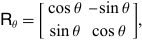
Rotation by 60 degrees and dilation by a factor of 2 I think
full forumBOT
red onyx
Rotation by 60 degrees and dilation by a factor of 2 I think
As a helper, please do not give out answers that could be copied as a homework solution. Have the student work through the problem themselves and guide them along the way.
 fathom saddle
Definitely have rotation matricies in the back of your mind, they tend to take that diagonal form
full forumBOT
@cosmic crag Has your question been resolved?
full forumBOT
Channel closed
Closed due to timeout
Use .reopen if this was a mistake.
full forumBOT
Available help channel!
Send your question here to claim the channel.
Remember:
• Ask your math question in a clear, concise manner.
• Show your work, and if possible, explain where you are stuck.
• After 15 minutes, feel free to ping <@&286206848099549185>.
• Type the command .close to free the channel when you're done.
• Be polite and have a nice day!
Read #❓how-to-get-help for further information on how to ask a good question, and about conduct in the question channels.
 stiff geyser
I need help with Task 9, I believe task 8 is related to it but I'm not sure how to do it either can someone help me please
 full forumBOT
stiff geyser
I need help with Task 9, I believe task 8 is related to it but I'm not sure how ...
upbeat crag
full forumBOT
stiff geyser
I need help with Task 9, I believe task 8 is related to it but I'm not sure how ...
upbeat crag
what's "the string"?
stiff geyser
I'm not exactly sure myself but I believe its referring to the order of the euler path ACDA for example

<@&286206848099549185>
full forumBOT
@stiff geyser Has your question been resolved?
full forumBOT
@stiff geyser Has your question been resolved?
full forumBOT
@stiff geyser Has your question been resolved?
full forumBOT
Channel closed
Closed by @stiff geyser
Use .reopen if this was a mistake.
Available help channel!
Send your question here to claim the channel.
Remember:
• Ask your math question in a clear, concise manner.
• Show your work, and if possible, explain where you are stuck.
• After 15 minutes, feel free to ping <@&286206848099549185>.
• Type the command .close to free the channel when you're done.
• Be polite and have a nice day!
Read #❓how-to-get-help for further information on how to ask a good question, and about conduct in the question channels.
 ionic gate
 full forumBOT
ionic gate
ionic gate
full forumBOT
ionic gate
ionic gate
so i have this question

the answer was this
why did they do the times thing on the left row
and not the top colom?
2 is properly the determent so every thing divided by 2
but they did it for the numbers on the left
how whould you approch this querstioin
full forumBOT
@ionic gate Has your question been resolved?
ionic gate
.close
full forumBOT
Channel closed
Closed by @ionic gate
Use .reopen if this was a mistake.
Available help channel!
Send your question here to claim the channel.
Remember:
• Ask your math question in a clear, concise manner.
• Show your work, and if possible, explain where you are stuck.
• After 15 minutes, feel free to ping <@&286206848099549185>.
• Type the command .close to free the channel when you're done.
• Be polite and have a nice day!
Read #❓how-to-get-help for further information on how to ask a good question, and about conduct in the question channels.
 vale glacier
hi, how do I show that this limit approaches -inf
 keen shoal
vale glacier
hi, how do I show that this limit approaches -inf
keen shoal
vale glacier
hi, how do I show that this limit approaches -inf
0 or -inf?
vale glacier
-inf
 worthy coral
x -> -∞?
vale glacier
i forgot how to deal with limits like this, do I just plug in the 0, get -1/0 and then say it equals -inf?
 vast fossil
Generally it would be more accurate to pick something like 0.001 and -0.001
keen shoal
0 in the denominator is undefined?
vast fossil
worthy coral
In limits, a/0 = ±∞
That in no way defines 1/0
vast fossil
vast fossil
Generally it would be more accurate to pick something like 0.001 and -0.001
Anyways, stick with this
vast fossil
keen shoal
the goal is to get rid of the 0 in the denominator
You can't
keen shoal
hmm
worthy coral
You have to evaluate lateral limits
vale glacier
vast fossil
Anyways, stick with this
are there any other ways?
worthy coral
That's an option
keen shoal
worthy coral
False
i’m curious to know your logic behind this
full forumBOT
@vale glacier Has your question been resolved?
Channel closed
Closed by @vale glacier
Use .reopen if this was a mistake.
full forumBOT
Available help channel!
Send your question here to claim the channel.
Remember:
• Ask your math question in a clear, concise manner.
• Show your work, and if possible, explain where you are stuck.
• After 15 minutes, feel free to ping <@&286206848099549185>.
• Type the command .close to free the channel when you're done.
• Be polite and have a nice day!
Read #❓how-to-get-help for further information on how to ask a good question, and about conduct in the question channels.
vocal coral
 full forumBOT
vocal coral
vast fossil
full forumBOT
vocal coral
vast fossil
If you don't see it, you can substitute for cos(theta)
Let's say x = cos(theta)
Then the equation becomes 2x^2 - x - 1 = 0
Can you solve this now?
vocal coral
vast fossil
Then the equation becomes 2x^2 - x - 1 = 0
yeah i can
vast fossil
Right, the answers for x will also be the answers for cos(theta)
Yet make sure that x is not outside of [-1, 1]
vocal coral
vast fossil
Yet make sure that x is not outside of [-1, 1]
wdym
 rough tundra
vocal coral
vast fossil
After doing part a, like MrFancyu2 suggested
rough tundra
vocal coral
vast fossil
After doing part a, like MrFancyu2 suggested
couldnt i also just use unit circle
and find where cos -1/2 is
vast fossil
That's good as well
full forumBOT
Channel closed
Closed by @vocal coral
Use .reopen if this was a mistake.
Available help channel!
Send your question here to claim the channel.
Remember:
• Ask your math question in a clear, concise manner.
• Show your work, and if possible, explain where you are stuck.
• After 15 minutes, feel free to ping <@&286206848099549185>.
• Type the command .close to free the channel when you're done.
• Be polite and have a nice day!
Read #❓how-to-get-help for further information on how to ask a good question, and about conduct in the question channels.
 ashen bluff
I'm using a statistical learning python library called scikit-learn and it has an implentation of Principal Component Analysis for dimensionality reduction. It also an implementation of Incremental Principal Component Analysis whereby the samples can be provided in batches. My understanding of PCA is that the PCs are obtained by performing eigendecomposition on the covariance matrix. I want to understand, which part of this is possible to do in batches?
full forumBOT
ashen bluff
I'm using a statistical learning python library called scikit-learn and it has a...
ashen bluff
I want to know for sure that the result of using IPCA will be equal/v.similar to that of PCA.. or at the very least I woud like to know where the drawbacks would be if there are any
full forumBOT
@ashen bluff Has your question been resolved?
ashen bluff
.close
full forumBOT
Channel closed
Closed by @ashen bluff
Use .reopen if this was a mistake.
Available help channel!
Send your question here to claim the channel.
Remember:
• Ask your math question in a clear, concise manner.
• Show your work, and if possible, explain where you are stuck.
• After 15 minutes, feel free to ping <@&286206848099549185>.
• Type the command .close to free the channel when you're done.
• Be polite and have a nice day!
Read #❓how-to-get-help for further information on how to ask a good question, and about conduct in the question channels.
 red girder
 full forumBOT
red girder
red girder
full forumBOT
red girder
red girder
how do i do this ?
full forumBOT
@red girder Has your question been resolved?
full forumBOT
Channel closed
Closed due to timeout
Use .reopen if this was a mistake.
Available help channel!
Send your question here to claim the channel.
Remember:
• Ask your math question in a clear, concise manner.
• Show your work, and if possible, explain where you are stuck.
• After 15 minutes, feel free to ping <@&286206848099549185>.
• Type the command .close to free the channel when you're done.
• Be polite and have a nice day!
Read #❓how-to-get-help for further information on how to ask a good question, and about conduct in the question channels.
 sterile heath
I asked help with this same question a wee while ago and got good help but i wonder if theres a simpler way to solve. I was told to use a probability tree but I think I can use probability with combinations instead
 full forumBOT
sterile heath
I asked help with this same question a wee while ago and got good help but i won...
full forumBOT
sterile heath
I asked help with this same question a wee while ago and got good help but i won...
 summer echo
Yes you can, note that the probability of at most three kings is 1 - P(all 4 kings)
Now find the number of hands with 4 kings and the number of total possible hands
sterile heath
the number of hands with all four kings is 48 i think
summer echo
Yes, because the last card has 48 options
sterile heath
and the possible hands is 52C5
summer echo
Yup, so what's P(all 4 kings)?
sterile heath
48/52c5
summer echo
Now the probability of at most three kings is just 1 - 48/(52C5)
Which is really close to 1
sterile heath
summer echo
So, you won't ever get 4 kings in your hand
its always possible
just a 0.002% chance
summer echo
I think the expected value of games is 50000 before you get 4 kings, but I have to go now
full forumBOT
Channel closed
Closed by @sterile heath
Use .reopen if this was a mistake.
full forumBOT
Available help channel!
Send your question here to claim the channel.
Remember:
• Ask your math question in a clear, concise manner.
• Show your work, and if possible, explain where you are stuck.
• After 15 minutes, feel free to ping <@&286206848099549185>.
• Type the command .close to free the channel when you're done.
• Be polite and have a nice day!
Read #❓how-to-get-help for further information on how to ask a good question, and about conduct in the question channels.
 sinful onyx
 full forumBOT
sinful onyx
sinful onyx
full forumBOT
sinful onyx
sinful onyx
this is a regular tetrahedron, M divides DB perfectly in half
i need to find the angle between the line AM and the plane ABC
which is the same as the angle between AM and AM', where M' is the orthogonal projection of M onto ABC
but how do I know where this projection is
<@&286206848099549185>
full forumBOT
@sinful onyx Has your question been resolved?
sinful onyx
<@&286206848099549185>
 mossy halo
ортогональная - это то как она будет лежать на плоскости ABC
подожди я нарисую
Нет там это не будет половина
Это будет 1/4
У тетраедара все углы 60?
sinful onyx
Только если они принадлежат к одной стороне
mossy halo
 mossy halo
sinful onyx
Только если они принадлежат к одной стороне
mossy halo
sinful onyx
Только если они принадлежат к одной стороне
У тетраедра все грани равны все ребра тоже
sinful onyx
Какова мера угла M'AM
mossy halo
не знаю
наверное 45
а нет
он вроде 30
потому что у тебя треугольник ADC подобен AMK
короче фигня
короче как-то через углы
full forumBOT
@sinful onyx Has your question been resolved?
full forumBOT
Channel closed
Closed due to timeout
Use .reopen if this was a mistake.
Available help channel!
Send your question here to claim the channel.
Remember:
• Ask your math question in a clear, concise manner.
• Show your work, and if possible, explain where you are stuck.
• After 15 minutes, feel free to ping <@&286206848099549185>.
• Type the command .close to free the channel when you're done.
• Be polite and have a nice day!
Read #❓how-to-get-help for further information on how to ask a good question, and about conduct in the question channels.
full forumBOT
torn jolt
The central rectangle of a small carpet in the shape of
mosaic is 5 m by 3 m. Its plain border is a uniform width.
If the total area of the carpet is 24m2, determine the width of the border.
full forumBOT
Channel closed
Closed due to the original message being deleted
torn jolt
The central rectangle of a small carpet in the shape of
mosaic is 5 m by 3 m. Its plain border is a uniform width.
If the total area of the carpet is 24m2, determine the width of the border.
this is so weird
 atomic blade
Now you have to get your own channel yourself
You locked this channel and it's heading towards its demise
full forumBOT
Available help channel!
Send your question here to claim the channel.
Remember:
• Ask your math question in a clear, concise manner.
• Show your work, and if possible, explain where you are stuck.
• After 15 minutes, feel free to ping <@&286206848099549185>.
• Type the command .close to free the channel when you're done.
• Be polite and have a nice day!
Read #❓how-to-get-help for further information on how to ask a good question, and about conduct in the question channels.
 winged rock
help
full forumBOT
winged rock
help
 fossil stump

 sinful onyx
just shade everything that isn't inside circle C
the first () is part of a union with everything that isn't C and a union just adds stuff together
full forumBOT
@winged rock Has your question been resolved?
winged rock
can u show it?
full forumBOT
@winged rock Has your question been resolved?
Channel closed
Closed by @winged rock
Use .reopen if this was a mistake.
full forumBOT
Available help channel!
Send your question here to claim the channel.
Remember:
• Ask your math question in a clear, concise manner.
• Show your work, and if possible, explain where you are stuck.
• After 15 minutes, feel free to ping <@&286206848099549185>.
• Type the command .close to free the channel when you're done.
• Be polite and have a nice day!
Read #❓how-to-get-help for further information on how to ask a good question, and about conduct in the question channels.
 frozen portal
Hi everyone!!
full forumBOT
frozen portal
Hi everyone!!
frozen portal
How would I do this problem?

I want to know an intuitive way to do it
All I know is that the line of reflection cuts through C/C' because C and C' have the same coordinate
full forumBOT
@frozen portal Has your question been resolved?
full forumBOT
Channel closed
Closed due to timeout
Use .reopen if this was a mistake.
Available help channel!
Send your question here to claim the channel.
Remember:
• Ask your math question in a clear, concise manner.
• Show your work, and if possible, explain where you are stuck.
• After 15 minutes, feel free to ping <@&286206848099549185>.
• Type the command .close to free the channel when you're done.
• Be polite and have a nice day!
Read #❓how-to-get-help for further information on how to ask a good question, and about conduct in the question channels.
 serene sage
 full forumBOT
serene sage
serene sage
full forumBOT
serene sage
serene sage
how does the first part turn into 1/e?
torn jolt
e^(n+1) = e*e^n
full forumBOT
Channel closed
Closed by @serene sage
Use .reopen if this was a mistake.
Available help channel!
Send your question here to claim the channel.
Remember:
• Ask your math question in a clear, concise manner.
• Show your work, and if possible, explain where you are stuck.
• After 15 minutes, feel free to ping <@&286206848099549185>.
• Type the command .close to free the channel when you're done.
• Be polite and have a nice day!
Read #❓how-to-get-help for further information on how to ask a good question, and about conduct in the question channels.
 next zephyr
 full forumBOT
next zephyr
viral jasper
full forumBOT
next zephyr
viral jasper
what have you tried
next zephyr
viral jasper
what have you tried
i figured it out i forgot the most basic power property 💀
.close
full forumBOT
Channel closed
Closed by @next zephyr
Use .reopen if this was a mistake.
full forumBOT
Available help channel!
Send your question here to claim the channel.
Remember:
• Ask your math question in a clear, concise manner.
• Show your work, and if possible, explain where you are stuck.
• After 15 minutes, feel free to ping <@&286206848099549185>.
• Type the command .close to free the channel when you're done.
• Be polite and have a nice day!
Read #❓how-to-get-help for further information on how to ask a good question, and about conduct in the question channels.
 harsh cairn
on step 2 how did they change -7 to -42
 full forumBOT
harsh cairn
on step 2 how did they change -7 to -42
full forumBOT
harsh cairn
on step 2 how did they change -7 to -42
 stuck summit

harsh cairn
pls
stuck summit
it looks like they multiplied it by the 6 in front of x but i cannot for the life of me understand this
 ivory cairn
oh that is an awful way to teach factoring
stuck summit
this looks like it was scanned in the 90s
harsh cairn
did they do it wrong?
stuck summit
i dont understand this step at all
 light sonnet
harsh cairn
on step 2 how did they change -7 to -42
light sonnet
harsh cairn
on step 2 how did they change -7 to -42
There's a factoring method, I forget the name, but you divide and slide the a coefficient, where you divide that a coefficient to get 1 and "slide" it to do a * c
ivory cairn
they're doing the AC trick of multiply the leading coefficient and constant terms. 6 * 7 = 42
light sonnet
So you can have a = 1
stuck summit
that works??
light sonnet
Which makes factor easier
harsh cairn
what
ivory cairn
technically.
harsh cairn
whats another factor trick?
light sonnet

This video goes through 3 examples showing how to use the "Slide & Divide" Method for factoring a trinomial with a leading coefficient other than 1.
#mathematics #slideanddivide #factoring
Math Tutorials on this channel are targeted at college-level mathematics courses including calculus, pre-calcul...
This method
harsh cairn
explain pls
light sonnet
The video I linked explains it
stuck summit
woulda saved me hours of testing combinations of factors
harsh cairn
theyve never taught this in class tho
harsh cairn
stuck summit
woulda saved me hours of testing combinations of factors
pls explainn
light sonnet
As mentioned, you slide the a coefficient, to do a * c, and then divide to make a = 1
Because factoring equations when a = 1 is easier
harsh cairn
i just divided the whole thing by 6?
harsh cairn
ok
harsh cairn
light sonnet
https://www.youtube.com/watch?v=TU15PaFhj5o&ab_channel=Cole%27sWorldofMathematic...
bro doesnt this like defy all the laws of mathematics
light sonnet
harsh cairn
bro doesnt this like defy all the laws of mathematics
No
Just watch that video, it explains it
full forumBOT
@harsh cairn Has your question been resolved?
Channel closed
Closed by @harsh cairn
Use .reopen if this was a mistake.
Available help channel!
Send your question here to claim the channel.
Remember:
• Ask your math question in a clear, concise manner.
• Show your work, and if possible, explain where you are stuck.
• After 15 minutes, feel free to ping <@&286206848099549185>.
• Type the command .close to free the channel when you're done.
• Be polite and have a nice day!
Read #❓how-to-get-help for further information on how to ask a good question, and about conduct in the question channels.
 lucid oasis
 full forumBOT
lucid oasis
full forumBOT
lucid oasis
 grand hound
lucid oasis
so if i get infin over infin what does that mean
grand hound
lucid oasis
so if i get infin over infin what does that mean
That means it is indeterminate. This mean you still have to continue solving or find alternative ways to find the limit
lucid oasis
but lopital would just make it infin over infin again rightr?
oh wait its infin minus infin over infin
so 0
grand hound
you would have to continue doing l'hopital
sometimes you have to do l'hopital multiple times till it stops being indeterminate
grand hound
lucid oasis
oh wait its infin minus infin over infin
actually this is incorrect
infinity - infinity is also another indeterminate form

here is all the indeterminate forms
 sudden yoke
i thought 0^0 = 1
 olive plaza
sudden yoke
i thought 0^0 = 1
olive plaza
sudden yoke
i thought 0^0 = 1
It leads to division by 0
grand hound
sudden yoke
i thought 0^0 = 1
it is UNLESS you are dealing with limits
then it's indeterminate
grand hound
yeah it's a weird circumstance, if you are taking AP it probably won't show
sudden yoke
yeah i'm in bc rn and never had to deal with 80% of that chart
grand hound
yeah i also taken it and i haven't seen it
however, ive seen it in college
so it's good to know if you are doing higher level math
full forumBOT
@lucid oasis Has your question been resolved?
Channel closed
Closed by @lucid oasis
Use .reopen if this was a mistake.
Available help channel!
Send your question here to claim the channel.
Remember:
• Ask your math question in a clear, concise manner.
• Show your work, and if possible, explain where you are stuck.
• After 15 minutes, feel free to ping <@&286206848099549185>.
• Type the command .close to free the channel when you're done.
• Be polite and have a nice day!
Read #❓how-to-get-help for further information on how to ask a good question, and about conduct in the question channels.
lucid oasis
 full forumBOT
lucid oasis
next zephyr
full forumBOT
lucid oasis
next zephyr
yeah
full forumBOT
Channel closed
Closed by @lucid oasis
Use .reopen if this was a mistake.
next zephyr
lucid oasis
.close
gl on ap test tmr btw
lucid oasis
thank man you too
next zephyr
thx
full forumBOT
Available help channel!
Send your question here to claim the channel.
Remember:
• Ask your math question in a clear, concise manner.
• Show your work, and if possible, explain where you are stuck.
• After 15 minutes, feel free to ping <@&286206848099549185>.
• Type the command .close to free the channel when you're done.
• Be polite and have a nice day!
Read #❓how-to-get-help for further information on how to ask a good question, and about conduct in the question channels.
 dim elm
 dim elm
Unsure how to do this
I was gonna try replacing it as a1 and a3 and use formulas but I’m kinda tripped up on the algebra equation part about the sequence. I’ve never done that before.
 plush egret
they give you choices so
you could just guess and check
probably the most reasonable way to approach this problem
 boreal marlin
B is the only formula that's correct for a_9
dim elm
How do you know?
dim elm
plush egret
you could just guess and check
I mean I could do that but this is my final review and I kinda wanna be able to know how to do it for the final 
dim elm
boreal marlin
Replace n for 9 in each formula to check
Wait
Plug in the number 9 ?
Not 16x-2?
boreal marlin
No, that's the value of a_9
You're given a_9 and a_11, and multiple choices for a_n, to check which one is correct replace n for 9, also for 11, in each formula
dim elm
So then the values are just to be able to see if the formula is correct?
boreal marlin
Well, it asks for a_6
So once you have a formula that matches you could replace n for 6, but it's already given in each option
dim elm
So how would I find the formula for a^n if it wasn’t multiple choice?
 smoky root
You're told it's an arithmetic sequence, so the difference between consecutive terms is always the same
Since your given a_9 and a_11, you can find the difference between them and cut it in half to find the difference between each term
then, you can work backwards to find a_0 and come up with the formula
dim elm
How would I find that difference? Subtract a^9 from a^11?
dim elm
But a^9 and a^11 are kinda far apart so how could U determine the difference after subtraction?
Would the answer be a^10 or d? Im a bit confused on that part
smoky root
what do you get when you subtract them?
boreal marlin
In general you can't know the formula for any sequence
smoky root
boreal marlin
In general you can't know the formula for any sequence
they're told it's arithmetic, though
boreal marlin
You're right, my bad
smoky root
np
dim elm
When I subtract a^9 from a^11 I get 2x+6?
smoky root
good, so since they're two apart, the common difference is half of that, or x+3
dim elm
So d=x+3
smoky root
yup
boreal marlin
Careful with notation, a^n is the nth power of a, not the nth value of the sequence a
glossy valveBOT
Lemma
 dim elm
And then youd plug that into the arithmetic sequence formula
smoky root
yeah
dim elm
Ahhhhh
smoky root
but we want to find a_0
dim elm
boreal marlin
Careful with notation, a^n is the nth power of a, not the nth value of the seque...
Oh thank uou!!
So would it then be a_n okay noted
dim elm
smoky root
but we want to find a_0
a_0?
smoky root
well, do you have a formula for arithmetic sequences?
(I might be using different notation)
dim elm
Yes, a_n=a_1 + (n-1)d
dim elm
Ohhh
smoky root
they're equivalent
but you'll want to find a_1 then
and you can use a_9 to do it
since
$a_9=a_1 + 8d$
glossy valveBOT
Lemma
 smoky root
but as the others have said
if it's multiple choice, just plugging 9 into all of them is faster, lol
dim elm
That’s true honestly. I think my final is multiple choice so I’ll probs just do that but i wanna know just in case lol
smoky root
that's good!
dim elm
.close
full forumBOT
Channel closed
Closed by @dim elm
Use .reopen if this was a mistake.
full forumBOT
Available help channel!
Send your question here to claim the channel.
Remember:
• Ask your math question in a clear, concise manner.
• Show your work, and if possible, explain where you are stuck.
• After 15 minutes, feel free to ping <@&286206848099549185>.
• Type the command .close to free the channel when you're done.
• Be polite and have a nice day!
Read #❓how-to-get-help for further information on how to ask a good question, and about conduct in the question channels.
 woeful cave
I need to compute in Z13, in the form [k] where 0 <= k <= 12
25^513 + (-2)(9)
full forumBOT
woeful cave
I need to compute in Z13, in the form [k] where 0 <= k <= 12
25^513 + (-2)(9)
woeful cave
Im struggling with figuring out how to convert the 25^513
i know its something like
25= -1(mod)13 but i dont know what to do with that
vast fossil
And (-1)^513 = -1
vast fossil
-1 - 18 you mean?
vast fossil
-19 + 23 = 4
full forumBOT
Channel closed
Closed by @woeful cave
Use .reopen if this was a mistake.
full forumBOT
Available help channel!
Send your question here to claim the channel.
Remember:
• Ask your math question in a clear, concise manner.
• Show your work, and if possible, explain where you are stuck.
• After 15 minutes, feel free to ping <@&286206848099549185>.
• Type the command .close to free the channel when you're done.
• Be polite and have a nice day!
Read #❓how-to-get-help for further information on how to ask a good question, and about conduct in the question channels.
 grand kiln
a drawer contains 8 black,5 red and 4 blue pencils. assuming you remove them without looking what is the minimum of pencils you should take to ensure that you get at least one of each color? need some help with this question
full forumBOT
grand kiln
a drawer contains 8 black,5 red and 4 blue pencils. assuming you remove them wit...
upbeat crag
pigeonhole principle
hot herald
think about the worst case scenario
and/or consider if you were able to look,
how could you maximise the amount of pencils you could pick before getting one of each colour
grand kiln
hot herald
think about the worst case scenario
and/or consider if you were able to look,
h...
worst case scenario would be getting pencils only in 1 color?
hot herald
and what happens after picking pencils only in one colour
grand kiln
hot herald
and what happens after picking pencils only in one colour
i'll be left with the other colored pencils
hot herald
yeh, and after picking all pencils of the same colour, how can you keep picking that avoids getting one of each colour
grand kiln
by getting 8 black ones, 5 red, 4 blue ones
grand kiln
so i should pick all the pencils without picking 3 of each color?
hot herald
you don't want at least one of each
how could you pick them without getting one of each
grand kiln
i'll pick 7 black, 4,red,3 blue ones?
hot herald
no
you'd have 3 of each there and more
pick these one at a time
the second you've got at least 1 black, red, blue,
you've failed for what i'm trying to get you to consider
grand kiln
i'll pick the black ones and red ones or black and blue or red and blue
hot herald
now, which of those combinations will require the most picks
grand kiln
black and red?
hot herald
yes
and the pick after that guarantees that you'll have (at least) one of each colour
grand kiln
so the minimum picks would be 13?8+5?
grand kiln
14?
grand kiln
so i'll have 8 black ones, 4 red ones and to get all three colors i'll need to pick from 4 blue ones SO i'll just need to pick one. so 14, does this make sense?
hot herald
yes
full forumBOT
Channel closed
Closed by @grand kiln
Use .reopen if this was a mistake.
Available help channel!
Send your question here to claim the channel.
Remember:
• Ask your math question in a clear, concise manner.
• Show your work, and if possible, explain where you are stuck.
• After 15 minutes, feel free to ping <@&286206848099549185>.
• Type the command .close to free the channel when you're done.
• Be polite and have a nice day!
Read #❓how-to-get-help for further information on how to ask a good question, and about conduct in the question channels.
 slender pond
Can someone help me with 6 please
 full forumBOT
slender pond
Can someone help me with 6 please
torn jolt
full forumBOT
slender pond
Can someone help me with 6 please
torn jolt
.
slender pond
?
torn jolt
U already claimed it sry
full forumBOT
@slender pond Has your question been resolved?
full forumBOT
Channel closed
Closed due to timeout
Use .reopen if this was a mistake.
full forumBOT
Available help channel!
Send your question here to claim the channel.
Remember:
• Ask your math question in a clear, concise manner.
• Show your work, and if possible, explain where you are stuck.
• After 15 minutes, feel free to ping <@&286206848099549185>.
• Type the command .close to free the channel when you're done.
• Be polite and have a nice day!
Read #❓how-to-get-help for further information on how to ask a good question, and about conduct in the question channels.
 vernal haven
Hello
full forumBOT
vernal haven
Hello
vernal haven
Use an appropriate compound angle formula to determine an exact value for tan (19π/
12 ). Do not use a calculator.
Leave your answer in proper radical form, fully simplified.
 hallow walrus
!status
full forumBOT
What step are you on?
1. I don't know where to begin
2. I have begun but got stuck midway
3. I got an answer but I'm told it's wrong
4. I got an answer and would like my work checked
5. I have a question about someone else's worked solution
6. None of the above
4
hallow walrus
show your work
vernal haven
hello There
hallow walrus
for future reference, you can just send in your work directly
hallow walrus
if youre having trouble you can just tell me over text your process
vernal haven
 hallow walrus
,w tan(19pi/12)
glossy valveBOT

 Requested by kheerii#8421
hallow walrus
Requested by kheerii#8421
hallow walrus
looks good
hallow walrus
sure but dont ping me
 hallow walrus
what's cot2theta
vernal haven
The cotangent of 2θ
vernal haven
cot(2θ) = (cot²(θ) - 1) / 2cot(θ)
vernal haven
like the solution
vernal haven
The expression 2cot(2θ) represents the value of the cotangent function for an angle that is twice the size of θ.
hallow walrus
are you giving these answers from chatgpt
full forumBOT
Channel closed
Closed by @vernal haven
Use .reopen if this was a mistake.
Available help channel!
Send your question here to claim the channel.
Remember:
• Ask your math question in a clear, concise manner.
• Show your work, and if possible, explain where you are stuck.
• After 15 minutes, feel free to ping <@&286206848099549185>.
• Type the command .close to free the channel when you're done.
• Be polite and have a nice day!
Read #❓how-to-get-help for further information on how to ask a good question, and about conduct in the question channels.
torn jolt
help
full forumBOT
torn jolt
help