
#help-28
1 messages · Page 49 of 1
 glossy valveBOT
 deft tulip
-1/5 because 4/5 - 1 = -1/5
deft tulip
so if you write that as (x^2 - 2)^ (+1/5) in the denominator (Send the negative exponent to the denominator) you can see that if you try to plug in sqrt(2) or -sqrt(2) and evaluate the derivative, it leads to division by 0 therefore the derivative is not defined, that's all there is to it
 swift fulcrum
$\frac{8x}{5\left(x^{2}-2\right)^{\frac{1}{5}}}$
deft tulip
$f'(x) = \frac{8x}{(x^2-2)}^{1/5}}
glossy valveBOT
AirToastie

 deft tulip
i mean you dont need a calculator to see that the denominator is 0 : )
not sure what youre using for that
2 - 2 is 0
0^(1/5) is 0
things explode
deft tulip
no idea, could be some floating point error
no idea what software youre using for that calculation
swift fulcrum
Desmos
deft tulip
anything else about this q or you got it now?
swift fulcrum
Btw is double bigger than float?
swift fulcrum
deft tulip
anything else about this q or you got it now?
I got it! Thanks
deft tulip
double uses twice as much memory as float generally i believe so it is more precise
but generally neither standard double \ floats can be trusted for precise operations, most programming languages have more complex libraries for storing precise decimals that are slower computationally and take up more memory, you would never use standard float \ double data types for banking operations for example
swift fulcrum
I guess they had to use float due to the lack of memory? xD
deft tulip
probably isnt very precise when you take square root of 2
then when you square that it isn't exactly 2
swift fulcrum
Yea true
deft tulip
and when you do - 2 it is some tiny number like 0.000000001
iirc one of those datatypes is usually precise up to 12 or so decimals
i forget which one of them
anyway thats neither here nor there 😄
moral of the story: dont rely on calculators when its a simple arithmetic you can do yourself
😛
 full forumBOT
Channel closed
Closed by @swift fulcrum
Use .reopen if this was a mistake.
 Available help channel!
Send your question here to claim the channel.
Remember:
• Ask your math question in a clear, concise manner.
• Show your work, and if possible, explain where you are stuck.
• After 15 minutes, feel free to ping <@&286206848099549185>.
• Type the command .close to free the channel when you're done.
• Be polite and have a nice day!
Read #❓how-to-get-help for further information on how to ask a good question, and about conduct in the question channels.
 flint falcon
here is my problem: i was stuck in choosing a summand to use Cauchy inequality with 3a^2/b and 4b^3, literally here i want the proof, not the straight answer because we all can guess the smallest value occurs if and only a=b=2
 full forumBOT
flint falcon
here is my problem: i was stuck in choosing a summand to use Cauchy inequality w...
deft tulip
flint falcon
here is my problem: i was stuck in choosing a summand to use Cauchy inequality w...
full forumBOT
flint falcon
here is my problem: i was stuck in choosing a summand to use Cauchy inequality w...
deft tulip
flint falcon
here is my problem: i was stuck in choosing a summand to use Cauchy inequality w...
a, b integers?
i guess that's kind of a stupid question of me to ask since there would only be unique values =\
flint falcon
deft tulip
a, b integers?
no, real number
flint falcon
deft tulip
i guess that's kind of a stupid question of me to ask since there would only be ...
that's inequality:/
 torn jolt
Can anyone help?
deft tulip
torn jolt
Can anyone help?
flint falcon
i think i need to explain a bit, with each different pair of number a and b, P will get different value. Like if a=5,b=1 => P=79
here smallest value of P is 38 when a=b=2, but i need a proof:/
deft tulip
the problem makes sense but after playing around with it for a few minutes, i don't know how i would go about proving that
full forumBOT
@flint falcon Has your question been resolved?
flint falcon
<@&286206848099549185>
full forumBOT
@flint falcon Has your question been resolved?
flint falcon
.close
full forumBOT
Channel closed
Closed by @flint falcon
Use .reopen if this was a mistake.
Available help channel!
Send your question here to claim the channel.
Remember:
• Ask your math question in a clear, concise manner.
• Show your work, and if possible, explain where you are stuck.
• After 15 minutes, feel free to ping <@&286206848099549185>.
• Type the command .close to free the channel when you're done.
• Be polite and have a nice day!
Read #❓how-to-get-help for further information on how to ask a good question, and about conduct in the question channels.
 night storm
anyone with assignment dm me
full forumBOT
night storm
anyone with assignment dm me
 hazy wedge
night storm
anyone with assignment dm me
hazy wedge
night storm
anyone with assignment dm me
whats your question
 thick minnow
night storm
anyone with assignment dm me
thick minnow
night storm
anyone with assignment dm me
If you are a helper you go to others help channels and help them
They won't come to you
night storm
thick minnow
If you are a helper you go to others help channels and help them
thanks
thick minnow
close this channel
thick minnow
night storm
thanks
use .close
full forumBOT
@night storm Has your question been resolved?
night storm
yes
full forumBOT
Channel closed
Closed due to timeout
Use .reopen if this was a mistake.
Available help channel!
Send your question here to claim the channel.
Remember:
• Ask your math question in a clear, concise manner.
• Show your work, and if possible, explain where you are stuck.
• After 15 minutes, feel free to ping <@&286206848099549185>.
• Type the command .close to free the channel when you're done.
• Be polite and have a nice day!
Read #❓how-to-get-help for further information on how to ask a good question, and about conduct in the question channels.
 blazing fulcrum
hi guys
full forumBOT
blazing fulcrum
hi guys
blazing fulcrum
i need help with some problem
Given two events A and B, if the outcome of B is dependent on the outcome of A, P(B) can be calculated as:
P(B) = P(A ∩ B) + P(A' ∩ B)
P(B) = P(A)P(B|A) + P(A')P(B|A')
P(B) = P(A ∪ B) + P(A' ∪ B)
P(B) = P(A)P(B|A) - P(A')P(B|A')
whats the right answer if someone can help?
full forumBOT
@blazing fulcrum Has your question been resolved?
 nocturne creek
blazing fulcrum
Given two events A and B, if the outcome of B is dependent on the outcome of A, ...
nocturne creek
blazing fulcrum
Given two events A and B, if the outcome of B is dependent on the outcome of A, ...
Have you tried simplifying the rhs for the options?
Also just asking but is the question supposed to have two answers?
full forumBOT
Channel closed
Closed due to timeout
Use .reopen if this was a mistake.
Available help channel!
Send your question here to claim the channel.
Remember:
• Ask your math question in a clear, concise manner.
• Show your work, and if possible, explain where you are stuck.
• After 15 minutes, feel free to ping <@&286206848099549185>.
• Type the command .close to free the channel when you're done.
• Be polite and have a nice day!
Read #❓how-to-get-help for further information on how to ask a good question, and about conduct in the question channels.
torn jolt
Why is the sum S=1-1+1-1+1-1+1… not convergent? Is the reason because the common ratio is 2 and is greater than 1?
full forumBOT
torn jolt
Why is the sum S=1-1+1-1+1-1+1… not convergent? Is the reason because the common...
thick minnow
Do you know the meaning of convergence of a series?
torn jolt
thick minnow
Do you know the meaning of convergence of a series?
Yes it approaches a limit
thick minnow
That's vague, there's a more precise definition
torn jolt
In a geometric series, the ratio has to be greater than -1 and less than 1
torn jolt
thick minnow
That's vague, there's a more precise definition
What is it?
thick minnow
The series converges if and only if the partial sums converge to some real number
torn jolt
What is meant by the part, if the partial sums converge
thick minnow
Let $S_n = \sum_{i=1}^{n} {(-1)}^i$
glossy valveBOT
numbpy
 thick minnow
So, Sn would be a sequence, if this sequence converges then the original series converges
torn jolt
Yea but what is „converge“, we cannot define convergence with convergent
thick minnow
In particular, notice that S1 = 1, S2 = 1 - 1 = 0, S3 = 1 - 1 + 1 = 1, S4 = 1 - 1 + 1 - 1 = 0 and so on...
thick minnow
torn jolt
Yea but what is „converge“, we cannot define convergence with convergent
We defined convergence of series in terms of convergence of a sequence
thick minnow
thick minnow
In particular, notice that S1 = 1, S2 = 1 - 1 = 0, S3 = 1 - 1 + 1 = 1, S4 = 1 - ...
Notice that the sequence of partial sums oscillate between 0 and 1
Thus they would never converge to any value
torn jolt
What is the difference between a series and a sequence?
thick minnow
sequence means {an}, like a1 = something, a2 = something and so on...
For example let {an} = 1/n
Then a1 = 1, a2 = 1/2, a3 = 1/3 and so on....
Which series is the sum of sequence
So, Sn would be sum of an
torn jolt
thick minnow
The series converges if and only if the partial sums converge to some real numbe...
But I don’t understand the part of the partial sums
thick minnow
Take the previous example of an = 1/n
torn jolt
Yes
thick minnow
The main issue is that we have no clue how to sum anything upto infinity
So, instead we sum up finitely many terms which are called partial terms
For example Sn for 1/n would be
S1 = 1, S2 = 1 + 1/2, S3 = 1 + 1/2 + 1/3, S4 = 1 + 1/2 + 1/3 + 1/4 and so on...
In fact $S = \lim_{n \rightarrow \infty} S_n$
torn jolt
I would define it so, a series that is convergent approaches some limit, here is meant that if we add one number after the other in the series, we get partial sums that get closer to a given number
glossy valveBOT
numbpy
 thick minnow
torn jolt
I would define it so, a series that is convergent approaches some limit, here is...
thick minnow
torn jolt
I would define it so, a series that is convergent approaches some limit, here is...
It's the same thing what I said but my definition is more precise
I shouldn't say my definition
This is how it's defined in any math textbook
torn jolt
Yes, but I still don’t get what partial sums are, is there meant just a part of the sum, so if I would have a sequence of 1/1+1/2+1/3…, then the 1/1+1/2 is a partial sum or what?
thick minnow
Yes, partial sums basically means truncated after some point
Using the previous example, what we really want is
$S = 1 + \frac12 + \frac13 + \frac14 + \frac15 + \frac16 ...$
glossy valveBOT
numbpy
 thick minnow
Instead we find the truncated sums, first we take only the first term
Then first 2 terms, then first 3 terms, then first 4 terms and so on...
This gives the sequence of partial sums
torn jolt
Ah, okay. So it means that if we take the first term, the second, the third, it approaches some real number
thick minnow
yep, exactly
torn jolt
But why isn’t then the above thing not convergent
thick minnow
For example if you take an = 1/2^n
torn jolt
Or is it
thick minnow
Then the partial sums converge to 2
torn jolt
Yes
thick minnow
which you already know using the gp sum formula
torn jolt
$S=1-1+1-1+1…$
glossy valveBOT
Bla
 torn jolt
This isn’t convergent isn’t it?
torn jolt
But it also approaches a real number
thick minnow
which number does it approach?
torn jolt
1 or 0
thick minnow
How does it approach a number then?
It is approaching 2 different numbers
The limit if exists must be unique
torn jolt
Haha, okay. I understood, but would be a reason that it is not a convergent geometric series because the common ratio is 2
And it is not allowed to be greater than 1 in geometric series
thick minnow
Yeah for geometric series |r| < 1
ie -1 < r < 1
Strictly between -1 and 1
You'll learn a lot many things like this if you ever take a Real Analysis class
torn jolt
Yea and in that example it’s 2 isn’t it
thick minnow
no, the common ratio is -1
torn jolt
thick minnow
You'll learn a lot many things like this if you ever take a **Real Analysis** cl...
Yes maybe later I think that’s too early for 8th grade
torn jolt
thick minnow
no, the common ratio is -1
But the distance between 1 and -1 is 2?
thick minnow
I was talking about the sequence NOT the series
If the sequence doesn't converge the series will never converge
torn jolt
Yes but why is common ratio here -1, and not 2
thick minnow
torn jolt
But the distance between 1 and -1 is 2?
Also common ration is multiplicative not an addition
thick minnow
1 then 1 x (-1) = -1, then 1 x (-1) x (-1) = 1 and so on...
thick minnow
wdym?
torn jolt
The common ratio in that sequence
thick minnow
the common ratio is -1
torn jolt
Because in a geometric sequence the common ratio must be |r|<1
 bitter lagoon
torn jolt
1 or 0
bitter lagoon
torn jolt
1 or 0
If there are 2 limits there can't be a limit as the limit of a series must be unique
thick minnow
torn jolt
Because in a geometric sequence the common ratio must be |r|<1
That is for convergent geometric sequence
In general the common ratio can be any real number
torn jolt
thick minnow
That is for convergent geometric sequence
Yea but I mean that sequence is not a geometric series because the common ratio is -1
thick minnow
It is geometric, it is not CONVERGENT geometric series
torn jolt
But every geometric series is a convergent one
thick minnow
In fact 1, 2, 4, 8, 16, 32 is a geometric sequence
torn jolt
Because a geometric series can only be summed if it’s convergent
thick minnow
torn jolt
But every geometric series is a convergent one
That's straightaway wrong
torn jolt
How
 shell pulsar
Do you know the definition of convergence
thick minnow
The geometric series is any series with a common ratio
torn jolt
Yes
thick minnow
thick minnow
The geometric series is any series with a common ratio
This has nothing to do with convergence
torn jolt
But I read in internet that a infinite geometric series can only be summed if it’s convergent
bitter lagoon
torn jolt
But I read in internet that a infinite geometric series can only be summed if it...
And yours can't be summed
shell pulsar
A series is convergent if the sequence of partial sums get arbitrarily close to a unique finite value
informally
does this sequence do that?
thick minnow
That is true, it can be summed when it is convergent otherwise it can't be summed
for example 1 + 2 + 2^2 + 2^3 + 2^4 + .... cannot be summed
torn jolt
thick minnow
That is true, it can be summed when it is convergent otherwise it can't be summe...
Yea but that does mean that every geometric one is convergent
bitter lagoon
You are perhaps confusing the series having an upper and lower boundary with it converging
thick minnow
torn jolt
Yea but that does mean that every geometric one is convergent
No
1 + 2 + 2^2 + 2^3 + 2^4 + ... This is a geometric series
This cannot be summed to a real number
As it will diverge to infinity
torn jolt
Oh man I am confused
thick minnow
There are geometric sequences
Some can be summed to get a real number
Others cannot be summed
thick minnow
correct
torn jolt
But a geometric series can only be summed to a real number if it is convergent
thick minnow
yesss
thick minnow
torn jolt
But a geometric series can only be summed to a real number if it is convergent
And a series is convergent if and only if -1 < r < 1
thick minnow
torn jolt
And if that is ignored, errors can happen
Yesss
torn jolt
thick minnow
And a series is convergent if and only if -1 < r < 1
For a geometric one?
thick minnow
For example try to find the sum for 1, 2, 2^2, 2^3 and so on...
ie the common ratio is 2
Try using the formula and see what happens
torn jolt
Yes, but it is divergent because it goes to infinity
And because the common ratio is 2, it is not a geometric one
thick minnow
torn jolt
And because the common ratio is 2, it is not a geometric one
because the common ration is 2, it is divergenct
full forumBOT
Channel closed
Closed by @green trench
Use .reopen if this was a mistake.
full forumBOT
Available help channel!
Send your question here to claim the channel.
Remember:
• Ask your math question in a clear, concise manner.
• Show your work, and if possible, explain where you are stuck.
• After 15 minutes, feel free to ping <@&286206848099549185>.
• Type the command .close to free the channel when you're done.
• Be polite and have a nice day!
Read #❓how-to-get-help for further information on how to ask a good question, and about conduct in the question channels.
Channel closed
Closed due to the original message being deleted
Available help channel!
Send your question here to claim the channel.
Remember:
• Ask your math question in a clear, concise manner.
• Show your work, and if possible, explain where you are stuck.
• After 15 minutes, feel free to ping <@&286206848099549185>.
• Type the command .close to free the channel when you're done.
• Be polite and have a nice day!
Read #❓how-to-get-help for further information on how to ask a good question, and about conduct in the question channels.
 dark leaf
why does integrationgive the are underneath a curve
 vast fossil
By definition, no?
 clear lily
 short siren
Integration is by design made to give the area under the curve.
That's the definite integral
 grave elm
Intuition for integrals, and why they are inverses of derivatives.
Help fund future projects: https://www.patreon.com/3blue1brown
An equally valuable form of support is to simply share some of the videos.
Special thanks to these supporters: http://3b1b.co/lessons/integration#thanks
Check out the Art of Problem Solving: https://aops.com/3blue1bro...
short siren
It takes the curve and approximates the area under it with thinner and thinner rectangles till it reaches the actual area
And you can't really approach the concept properly without understanding limits and derivatives
full forumBOT
@dark leaf Has your question been resolved?
full forumBOT
Channel closed
Closed due to timeout
Use .reopen if this was a mistake.
Available help channel!
Send your question here to claim the channel.
Remember:
• Ask your math question in a clear, concise manner.
• Show your work, and if possible, explain where you are stuck.
• After 15 minutes, feel free to ping <@&286206848099549185>.
• Type the command .close to free the channel when you're done.
• Be polite and have a nice day!
Read #❓how-to-get-help for further information on how to ask a good question, and about conduct in the question channels.
 frail ferry
How many times could f(x)=a(x-h)^2+k and g(x)=a|x-h|+k intersect?
deft tulip
the second one doesn't have an exponent of 2?
frail ferry
frail ferry
How many times could f(x)=a(x-h)^2+k and g(x)=a|x-h|+k intersect?
g(x) has no exponet to the 2nd power
deft tulip
ok, just checking
 north warren
well equate them to find all the values for y that it intersects, resulting a(x-h)²+k=a|x-h|+k
so (x-h)²=|x-h|
|x-h|=sqrt(|x-h|) so x-h can be +-1 or 0, resulting in 3 points
assuming a isnt equal to 0
north warren
yeah, but do you understand why
north warren
oki great
frail ferry
.close
north warren
anything else?
full forumBOT
Channel closed
Closed by @frail ferry
Use .reopen if this was a mistake.
north warren
oh alr
frail ferry
no
north warren
.reopen
full forumBOT
✅
north warren
deft tulip
that doesn't seem right to me
do check for me cause i may have messed up somewhere
that i dont see
deft tulip
i would think of (x-h)^2 as equal to |x-h|^2 since you are squaring it becomes positive anyway, then just cancel out one side
north warren
oh fair enough
deft tulip
so |x-h| = 1 which gives two solutions, ah yeah i guess theres also x - h = 0 as a 3rd solution, guess im just saying same thing in a different way
north warren
either way its 3
deft tulip
alright just took me a second to get there, thanks : )
full forumBOT
Channel closed
Closed by @north warren
Use .reopen if this was a mistake.
full forumBOT
Available help channel!
Send your question here to claim the channel.
Remember:
• Ask your math question in a clear, concise manner.
• Show your work, and if possible, explain where you are stuck.
• After 15 minutes, feel free to ping <@&286206848099549185>.
• Type the command .close to free the channel when you're done.
• Be polite and have a nice day!
Read #❓how-to-get-help for further information on how to ask a good question, and about conduct in the question channels.
 patent crag
.reopen
A tray contains of 21 toffees. Jaya and Uma take in turn some toffees from the tray. Each time they are allowed to take 1, 2 or 3 toffees only. The person who gets the last toffee, looses. how can jaya or uma can winA tray contains of 21 toffees. Jaya and Uma take in turn some toffees from the tray. Each time they are allowed to take 1, 2 or 3 toffees only. The person who gets the last toffee, looses. how can jaya or uma can win
full forumBOT
patent crag
A tray contains of 21 toffees. Jaya and Uma take in turn some toffees from the t...
 ivory cairn

 gritty rose
.close
full forumBOT
Channel closed
Closed by @gritty rose
Use .reopen if this was a mistake.
Available help channel!
Send your question here to claim the channel.
Remember:
• Ask your math question in a clear, concise manner.
• Show your work, and if possible, explain where you are stuck.
• After 15 minutes, feel free to ping <@&286206848099549185>.
• Type the command .close to free the channel when you're done.
• Be polite and have a nice day!
Read #❓how-to-get-help for further information on how to ask a good question, and about conduct in the question channels.
 tawny belfry
hi question hopefully not too difficult but
full forumBOT
tawny belfry
hi question hopefully not too difficult but
tawny belfry

does it matter like which order I put my (x-4) or (x+3)
sorry more context

im just not sure what order goes what first
 frosty geyser
tawny belfry
does it matter like which order I put my (x-4) or (x+3)
frosty geyser
tawny belfry
does it matter like which order I put my (x-4) or (x+3)
its multiplication, so generally you don't care about the order, as long as your brackets stay correct
tawny belfry
so like that 6 comes down I shouldnt forget about it
but then after that as long as the bracket is correct
im okay?
like whats inside the bracket?
frosty geyser
yes, you can rewrite the brackets as a*b, and per rule you can swap them around as you wish
tawny belfry
okay so wait jigglyproff

gonna do this one
i'll let u know what i get
actually i'll close so people can get help
.close
full forumBOT
Channel closed
Closed by @tawny belfry
Use .reopen if this was a mistake.
Available help channel!
Send your question here to claim the channel.
Remember:
• Ask your math question in a clear, concise manner.
• Show your work, and if possible, explain where you are stuck.
• After 15 minutes, feel free to ping <@&286206848099549185>.
• Type the command .close to free the channel when you're done.
• Be polite and have a nice day!
Read #❓how-to-get-help for further information on how to ask a good question, and about conduct in the question channels.
 alpine chasm
The thing I marked with a red line doesn’t make sense to me. How is the probability of X = 1 and Y = 0.2 equal to 0.2
 full forumBOT
alpine chasm
The thing I marked with a red line doesn’t make sense to me. How is the probabil...
alpine chasm
full forumBOT
alpine chasm
The thing I marked with a red line doesn’t make sense to me. How is the probabil...
alpine chasm
Shouldn’t Y be 2?
alpine chasm
Damn I sat for half an hour trying to figure out what he meant because I always have the silly assumption that professors don’t make errors
torn jolt
unfortunately, they do make errors (some quite often)
alpine chasm
torn jolt
unfortunately, they do make errors (some quite often)
Yeah also I think I might have found another error but im not sure (marked with yellow)

Shouldn’t Y be equal to 2?
alpine chasm
Yeah the first yellow
full forumBOT
@alpine chasm Has your question been resolved?
full forumBOT
Channel closed
Closed due to timeout
Use .reopen if this was a mistake.
Available help channel!
Send your question here to claim the channel.
Remember:
• Ask your math question in a clear, concise manner.
• Show your work, and if possible, explain where you are stuck.
• After 15 minutes, feel free to ping <@&286206848099549185>.
• Type the command .close to free the channel when you're done.
• Be polite and have a nice day!
Read #❓how-to-get-help for further information on how to ask a good question, and about conduct in the question channels.
torn jolt
Hey
full forumBOT
torn jolt
Hey
torn jolt

Why is the very top and very bottom different ?
I first took the reverse of ln(x+3)
And then tried to reverse the result that i got in order to get back to the origin. It doesnt seem to work though
 bronze scaffold


 clear fog
Because the base always stays as the base, when you convert this into exponential form, you get $e^x = e^x$
glossy valveBOT
Zenoxy
 clear fog
i wish that didnt do the whole sentence like damn
ill give u a visual for this concept
$ln(e^x) = log_e(e^x)$
glossy valveBOT
Zenoxy
 glossy valveBOT
Zenoxy
 full forumBOT
@torn jolt Has your question been resolved?
full forumBOT
Channel closed
Closed due to timeout
Use .reopen if this was a mistake.
Available help channel!
Send your question here to claim the channel.
Remember:
• Ask your math question in a clear, concise manner.
• Show your work, and if possible, explain where you are stuck.
• After 15 minutes, feel free to ping <@&286206848099549185>.
• Type the command .close to free the channel when you're done.
• Be polite and have a nice day!
Read #❓how-to-get-help for further information on how to ask a good question, and about conduct in the question channels.
 pearl socket
 full forumBOT
pearl socket
pearl socket
full forumBOT
pearl socket
pearl socket
Need help learning how to solve this type of question.
 worn heart
fairly straightforward, it gives a point with rotational symmetry, and the lines of symmetry.
imagine rotating the given point around the point of rotational symmetry until it lined up with the one you need to find.
pearl socket
Okay
worn heart
Now, since the origin and the point of rotational symmetry aren't the same, you need to first figure out what the point would be if they were. In this case, point Q would have the coordinates (2, 6).
pearl socket
Oh, so it's just the positive integer of the opposite co-ordinate?
worn heart
then, picture sliding the figure so that the point of rotational symmetry and the origin are one and the same.
pearl socket
The question features x = 1 and y = 5, do I need to do anything with those?
worn heart
yes
those are how far you need to slide the figure to get the correct coordinates. \
subtract the coordinates of the point of rotational symmetry from the point you want to find Q (2, 6). This means that the final coordinates are equal to ((2-1),(6-5))
or, (1, 1)
Wait, that's incorrect. My bad, you need to add them.
Final point would be (3, 11)
pearl socket
So i'm adding X1 and Y1 to the listed X and Y values?
worn heart
in this specific case, yes you add them to the positive integers of the given point.
pearl socket
So Q = (3,11)?
worn heart
yes
pearl socket
Alright I see.
Btw, how did you get (2,6)
Did you just make the negative co-ordinates positive?
worn heart
since it's the exact opposite point to the one given, yes.
think of it like a piece of graph paper
pearl socket
Alright, thanks.
worn heart
np
pearl socket
.close
full forumBOT
Channel closed
Closed by @pearl socket
Use .reopen if this was a mistake.
Available help channel!
Send your question here to claim the channel.
Remember:
• Ask your math question in a clear, concise manner.
• Show your work, and if possible, explain where you are stuck.
• After 15 minutes, feel free to ping <@&286206848099549185>.
• Type the command .close to free the channel when you're done.
• Be polite and have a nice day!
Read #❓how-to-get-help for further information on how to ask a good question, and about conduct in the question channels.
torn jolt
For all integers m and n, m2(n + 3) is even iff m is even or n is odd, can i prove this with remainder theorem
full forumBOT
torn jolt
For all integers m and n, m2(n + 3) is even iff m is even or n is odd, can i pro...
 fast peak
not sure how you wanna use remainder theorem here?
if a product of two numbers is even, then at least one of the numbers has to be even
torn jolt
so i use like 2k and 2k+1
fast peak
something like that, sure
fast peak
then do a bit of casework
torn jolt
like for all instances?
fast peak
there arent that many cases
fast peak
iff means both directions
bijection is something else
iff is short for 'if and only if'
torn jolt
how would i prove it in the other way after using the definitions of even and odd for both cases
fast peak
m=2k and n=2s or something
torn jolt
and then explained any odd number multiplied by an even is even
torn jolt
and then i also did m = 2k and n = 2k
ohh so add another var
thank you
but what would the other direction be
fast peak
well did you do all 4 cases for m and n
torn jolt
even, even (case 1), odd even (case 2), odd odd (case 3)
even, odd (case 4)
in the order of m n
fast peak
ok and what is m^2(n+3) in each of these cases
torn jolt
always even
fast peak
no
fast peak
yes
so it's only even if either m is even or n is odd
which is exactly what you want
torn jolt
that works because i did cases for all directions
full forumBOT
@torn jolt Has your question been resolved?
Channel closed
Closed by @golden anchor
Use .reopen if this was a mistake.
Available help channel!
Send your question here to claim the channel.
Remember:
• Ask your math question in a clear, concise manner.
• Show your work, and if possible, explain where you are stuck.
• After 15 minutes, feel free to ping <@&286206848099549185>.
• Type the command .close to free the channel when you're done.
• Be polite and have a nice day!
Read #❓how-to-get-help for further information on how to ask a good question, and about conduct in the question channels.
 grand night
 full forumBOT
grand night
full forumBOT
grand night
 ivory cairn
that's not right. There's 4 options on each question
ivory cairn
he's randomly guessing on each question. If there's 4 options to choose form on a question, what is the probability he gets that question right?
grand night
4/8?
ivory cairn
This doesn't have anything to do with the 8 questions.
Each question has 4 options, there is 1 correct option. What is the probability of choosing the correct option
 grand night
oh wait 1/4 my bad
ivory cairn
yes. So your probabilities should be .25 and .75
not .125
ivory cairn
grand night
For part i) it wants exactly 3 correct answers. You don't need to choose 2 or 1 or 0
grand night
but i can with them if i wanted too?
ivory cairn
sure, but they aren't part of the answer to (i)
grand night
so i gotta go for 5,6,7,8 option?
grand night
so 1,2,3
ivory cairn
if you correct decimals, this is the probability of exactly 3 correct answers.
 grand night
jesus christ appreciate it
would you mind staying just for the next 2?
or you gotta dip?
ivory cairn
ping me when you have something
grand night
bet bet
full forumBOT
@grand night Has your question been resolved?
Channel closed
Closed by @grand night
Use .reopen if this was a mistake.
 full forumBOT
✅
grand night
@ivory cairn ive done one question and im quite confused with the 3rd one if you dont min helping
ivory cairn
you're (ii) isn't right.
right idea, wrong numbers
grand night
is it the decimals in whcih is wrong?
ivory cairn
you need to do 1 - (probability of none right + probability of 1 right)
grand night
how come is that the answer if you dont me asking
grand night
ivory cairn
you need to do 1 - (probability of none right + probability of 1 right)
and also if do that 1-(0.75+0.25) itll be zero
ivory cairn
it asks for the probability of at least two correct answers.
So you want all the possibilities except 0 or 1 correct answers.
hence, 1 - (probability of none + probability of 1)
ivory cairn
grand night
and also if do that 1-(0.75+0.25) itll be zero
you have to do the 8C1 stuff again to find the probability
ivory cairn
you'd need the 8C0 and 8C1 probabilities.
 ivory cairn
assuming the computations are correct, that should be correct for the probability of none or one
now do 1 - (that)
grand night
i did that and is that it
and tbh this is the last one, can you just go through the last one
is the formula correct for that actually
ivory cairn
the last one first 5 are just wrong, so the probability is just (.75)^5
The last 3 has 2 correct answers. So use the formula you've been using but with 3C2
grand night
and then add them together?
ivory cairn
multiply, they're happening simultaneously
 ivory cairn
that seems too big, did you multiply them?
grand night
i got 0.0120 instead
full forumBOT
@grand night Has your question been resolved?
full forumBOT
Channel closed
Closed due to timeout
Use .reopen if this was a mistake.
Available help channel!
Send your question here to claim the channel.
Remember:
• Ask your math question in a clear, concise manner.
• Show your work, and if possible, explain where you are stuck.
• After 15 minutes, feel free to ping <@&286206848099549185>.
• Type the command .close to free the channel when you're done.
• Be polite and have a nice day!
Read #❓how-to-get-help for further information on how to ask a good question, and about conduct in the question channels.
 ember oxide
I need help on completing the square in algebra
full forumBOT
ember oxide
I need help on completing the square in algebra
ember oxide
im pretyy sure im doing all the steps right, but it ends up being wrong most of the time

 hot herald
show work
 twilit leaf
full forumBOT
twilit leaf
full forumBOT
What step are you on?
1. I don't know where to begin
2. I have begun but got stuck midway
3. I got an answer but I'm told it's wrong
4. I got an answer and would like my work checked
5. I have a question about someone else's worked solution
6. None of the above
 marsh gust
ember oxide
marsh gust
ember oxide
do you still need help
full forumBOT
@ember oxide Has your question been resolved?
full forumBOT
Channel closed
Closed due to timeout
Use .reopen if this was a mistake.
full forumBOT
Available help channel!
Send your question here to claim the channel.
Remember:
• Ask your math question in a clear, concise manner.
• Show your work, and if possible, explain where you are stuck.
• After 15 minutes, feel free to ping <@&286206848099549185>.
• Type the command .close to free the channel when you're done.
• Be polite and have a nice day!
Read #❓how-to-get-help for further information on how to ask a good question, and about conduct in the question channels.
 silk basin
how do i do this
 full forumBOT
silk basin
how do i do this
glossy valveBOT
full forumBOT
silk basin
how do i do this
glossy valveBOT
Stephen
 silk basin
yes what is it
 craggy verge
you want to give 1/2 a common denominator with 3/4
glossy valveBOT
Scythe
 silk basin
4/8 and 6/8
craggy verge
that works yes
silk basin
then what
craggy verge
it's not the simplest answer, but it is a valid way to solve your problem
you could have simply multiplied 1/2 by 2/2
and left 3/4 alone
since 1/2 times 2/2 gives (1*2)/(2*2)=2/4
and 2/4 shares a common denominator with 3/4, which is left untouched
that said, you did it correctly by giving both a denominator of 8, which is just slightly more complicated
silk basin
so i add them now
craggy verge
yup
numerators added together, their common denominator stays the same, which gives a result of?
silk basin
10/8
silk basin
2?
craggy verge
yes!
craggy verge
same stuff, multiply by a fraction equivalent to 1 (like 5/5 or 3/3 or 7/7 or 12/12 or π/π), each one, so that they end up sharing a common denominator
since 4 and 5 do not share a common factor, your smallest (and therefore simplest) potential target common denominator will be 4*5=20
once they have a common denominator (and only once you do so), you can add or subtract the numerators as you wish
silk basin
wdym
subtract or add?
i will subtract
yea i got 15/20 and 8/20 and 7/20 that’s right?
 tulip depot
1/2 + 3/4?
craggy verge
silk basin
yea i got 15/20 and 8/20 and 7/20 that’s right?
that looks right to me!
craggy verge
silk basin
subtract or add?
I mean in general, with common denominators. In this case you are supposed to subtract, which you did do correctly.
glossy valveBOT
Scythe
 craggy verge
this ^?
silk basin
yea
craggy verge
it's fraction multiplication
4=4/1
you multiply the numerators together, and multiply the denominators together
silk basin
it’s not 1/4 oh
craggy verge
when dealing with fractions always ask yourself if your answer makes sense
for instance: 2/3-1/2, we know 2/3 is bigger than 1/2, so 2/3-1/2 should be greater than zero. If we get a negative fraction, we made a mistake.
likewise: 4 to 1/4, we know 4 is a "big" whole number, bigger than 1, so why would it become 1/4, a "small" fraction, less than 1? it means we made a mistake.
silk basin
so it’s 8/3
craggy verge
yup!
silk basin
is 1 1/2 x 1 1/2 = 9/4
glossy valveBOT
Scythe
 silk basin
yea
craggy verge
I don't see how?
we can combine them straight off: 1*1/2 is just 1/2, since 1 times anything is anything
so we have
[\frac{1}{2}\cdot\frac{1}{2}=\frac{1\cdot 1}{2\cdot 2}]
correct?
glossy valveBOT
Scythe

 craggy verge
ohhh I see what you did
you did
THIS IS WRONG BTW
[1\frac{1}{2}\cdot 1\frac{1}{2}=(1+\frac{1}{2})\cdot(1+\frac{1}{2})]
[(\frac{2}{2}+\frac{1}{2})\cdot (\frac{2}{2}+\frac{1}{2}) = \frac{3}{2}\cdot\frac{3}{2}=\frac{9}{4}]
glossy valveBOT
Scythe
 craggy verge
instead of multiplying each by 1, you added 1 to each
silk basin
wdym i can’t multiply or do anythin if the fraction is 1 1/2 and 1 1/2?
craggy verge
you misunderstand
you confused adding with multiplying
you went from 1 times 1/2, to 1 plus 1/2
[1\frac{1}{2}\cdot 1\frac{1}{2}=(1+\frac{1}{2})\cdot(1+\frac{1}{2})]
glossy valveBOT
Scythe
 craggy verge
look at this line
silk basin
how do i do it
craggy verge
what is 1(1/2)? what does it mean? in words?
one times one half. or one over one times one over two. or 1/1*1/2, or (1*1)/(1*2)=1/2, multiplying by 1 does not change anything
 glossy valveBOT
Scythe

 shrewd hamlet
Yes
craggy verge
so, what is the first thing we do here zzzz?
personally, I would simplify. get rid of the 1s.
silk basin
idk
shrewd hamlet
Simplify to what?
craggy verge
[1\frac{1}{2}X1\frac{1}{2}=(1\frac{1}{2})X(1\frac{1}{2})]
[(\frac{1}{1}\frac{1}{2})X(\frac{1}{1}\frac{1}{2})=\frac{1\cdot 1}{1\cdot 2}X\frac{1\cdot 1}{1\cdot 2}=\frac{1}{2}X\frac{1}{2}]
glossy valveBOT
Scythe
 shrewd hamlet
No, Im saying those are mixed numbers
shrewd hamlet
In the problem
craggy verge
ohhhhh damn I'm an idiot
very very very sorry about that
@silk basin you are correct it is 9/4
I haven't seen mixed numbers in years, very sorry about that ;-;
silk basin
ok
craggy verge
I apologise for any and all confusion
you were correct in your method (and everything else)
silk basin
how do i do 1/4 divided by 4 is it 1/10???
glossy valveBOT
Scythe
 craggy verge
which is 1/4 divided by 4
aka (1/4)/4
or you can turn divided by 4 into a fraction of its own
which would be 1/4*1/4 (the first 1/4 is the one in the problem, the second 1/4 is the division by 4)
silk basin
so it’s 4/4
glossy valveBOT
Scythe
 craggy verge
you turn dividing by 4 into multiplying by 1/4
you're not dividing by 1/4, since by turning 4 into 1/4 you inverted the division into multiplication, if that makes sense, you made it its opposite
silk basin
you flipped the 4/1?
silk basin
so it’s 1/16
craggy verge
yup
silk basin
wait
craggy verge
yes?
silk basin
how do i do this it’s wrong right
 craggy verge
,rotate
glossy valveBOT
 craggy verge
these are mixed numbers yes?
silk basin
yea
craggy verge
that looks right to me
do you know the butterfly method though? You could have canceled out the two 3s and gone to 14/4 straightaway instead of 42/12
silk basin
nope i’m not gonna do that
silk basin
i have another question wait
craggy verge
still here dw
silk basin
is this right
 craggy verge
nope
silk basin
how do i do it
craggy verge
you know pemdas?
add the two fractions in the parentheses first
1/8+1/4=1/8+(1/4)x(2/2)=1/8+2/8=3/8
so you have 3x(3/8)-1
then you do multiplication, so 3x3/8
9/8-1
then you do subtraction
1/8
make sense? need any steps explained?
silk basin
this is right ?
 craggy verge
for adding the fractions yes!
silk basin
then 12/32 x 3
craggy verge
yes
though I still say you are overcomplicating it: you know 2x4=8, so turning 1/4 to ?/8 means multiplying 1/4 by 2/2, becomes precisely 2/8 without reaching the double digits of 8/32
that said, you know best
since it's working for you
silk basin
i don’t have to make them a bigger divide number? the teachers dont mind?
craggy verge
the teachers minding is a different thing entirely, but unless your teacher has asked you to put it in this expanded form, there's no reason to directly multiply both denominators
ex: turning 1/8+1/4 into 4/32+8/32 when you can just do 1/8+2/8
if your teacher is asking you to do it that way though, that's how you have to do it ):
but every teacher is different so I can't really advise you on what your teacher would want, I don't know better than you.
silk basin
i did 12/32 x 3/1 = 36/32
craggy verge
that is correct
silk basin
and the -1 is 35/32?
craggy verge
ahem nope
you are not subtracting -1/32
you are subtracting a whole -1 AKA -32/32
common. denominator. always.
silk basin
ok 31
craggy verge
how did you get 31?
silk basin
36/31?
glossy valveBOT
Scythe
 craggy verge
pardon? that's a -1, no?
craggy verge
so turn 1 into 32/32, common denominator
you then have 36/32-32/32
common denominator
then subtract the numerators, as per the sign, -
denominators stay the same since this is addition/subtraction (as a rule generally, I mean, but in this case it is subtraction)
and the answer is?
silk basin
it’s subtraction
craggy verge
I gtg, unfortunately. Your answer is ||36/32-32/32=4/32, or 1/8 however.||, if you want to check (you're one step away, just the subtraction is left)
full forumBOT
Channel closed
Closed by @silk basin
Use .reopen if this was a mistake.
Available help channel!
Send your question here to claim the channel.
Remember:
• Ask your math question in a clear, concise manner.
• Show your work, and if possible, explain where you are stuck.
• After 15 minutes, feel free to ping <@&286206848099549185>.
• Type the command .close to free the channel when you're done.
• Be polite and have a nice day!
Read #❓how-to-get-help for further information on how to ask a good question, and about conduct in the question channels.
 stoic torrent
could someone check my work for this problem. Plz. I don t know where im getting it wrong. The help will,be appreciated . Its graphing logs by hand.
full forumBOT
stoic torrent
could someone check my work for this problem. Plz. I don t know where im getting...

 full forumBOT
@stoic torrent Has your question been resolved?
stoic torrent
<@&286206848099549185>
stoic torrent
 unborn pike
<@730452083962019921> do you know graph transformations?
unborn pike
<@730452083962019921> do you know graph transformations?
yes
unborn pike
y+2=log (x+6) <= y=log (x+6) <= y=log (x)
now can you do this
Use transformation in each step
full forumBOT
Channel closed
Closed by @stoic torrent
Use .reopen if this was a mistake.
full forumBOT
Available help channel!
Send your question here to claim the channel.
Remember:
• Ask your math question in a clear, concise manner.
• Show your work, and if possible, explain where you are stuck.
• After 15 minutes, feel free to ping <@&286206848099549185>.
• Type the command .close to free the channel when you're done.
• Be polite and have a nice day!
Read #❓how-to-get-help for further information on how to ask a good question, and about conduct in the question channels.
torn jolt
Not sure what is incorrect here
 full forumBOT
torn jolt
Not sure what is incorrect here
torn jolt
full forumBOT
torn jolt
Not sure what is incorrect here
torn jolt
I am using the formula of V = integral of a to b.. pi R^2 (y) dy
for the integral where I put 1, i know thats wrong cuz idk how to do that but i thought my equation is right
full forumBOT
@torn jolt Has your question been resolved?
full forumBOT
Channel closed
Closed due to timeout
Use .reopen if this was a mistake.
Available help channel!
Send your question here to claim the channel.
Remember:
• Ask your math question in a clear, concise manner.
• Show your work, and if possible, explain where you are stuck.
• After 15 minutes, feel free to ping <@&286206848099549185>.
• Type the command .close to free the channel when you're done.
• Be polite and have a nice day!
Read #❓how-to-get-help for further information on how to ask a good question, and about conduct in the question channels.
 tacit eagle
how is this statement true? BELOW PIC shouldnt both decrease? if its higher than it should be but less people buying it then making more will mean too much inventory and not enough sales, which means cant pay the fixed costs, which means you should produce less of that item since others prob sell it cheaper or at a reasonable competitive price; thus making more than you
full forumBOT
tacit eagle
how is this statement true? *BELOW PIC* shouldnt both decrease? if its higher th...
tacit eagle

 viral jasper
Increasing supply reduces cost
tacit eagle
but if you sell close to nothing, you should only produce less than normal inventory
not make more of it
?
increasing supply means more cost to produce that item
you'd produce the appropriate number so you reach profit, which should be less than normal inventory lol
full forumBOT
@tacit eagle Has your question been resolved?
tacit eagle
<@&286206848099549185>
full forumBOT
Channel closed
Closed by @tacit eagle
Use .reopen if this was a mistake.
full forumBOT
Available help channel!
Send your question here to claim the channel.
Remember:
• Ask your math question in a clear, concise manner.
• Show your work, and if possible, explain where you are stuck.
• After 15 minutes, feel free to ping <@&286206848099549185>.
• Type the command .close to free the channel when you're done.
• Be polite and have a nice day!
Read #❓how-to-get-help for further information on how to ask a good question, and about conduct in the question channels.
torn jolt
Is there an easy way to integrate the area outside x^2+y^2=9 and inside x^2+(y-0.5)^2=12.25? I tried using polar coordinates but I can't find the equation of the big circle and using rectangular coordinates looks like a complete mess.
full forumBOT
torn jolt
Is there an easy way to integrate the area outside x^2+y^2=9 and inside x^2+(y-0...
@torn jolt Has your question been resolved?
torn jolt
<@&286206848099549185>
I'm currently using rectangular coordinates and multiple integrals to find this unless someone can help. I have a 3D region bounded by x^2+y^2=9, z=15-x^2-y^2, and z+y=3.
Alright I'm completely lost with these roots, rectangular is unnecessarily complicated for what im trying to do.
<@&286206848099549185> Is my projected region of r=3 and x^2+(y-0.5)^2=12.25 at least correct?
torn jolt
.close
full forumBOT
Channel closed
Closed by @steep tiger
Use .reopen if this was a mistake.
Available help channel!
Send your question here to claim the channel.
Remember:
• Ask your math question in a clear, concise manner.
• Show your work, and if possible, explain where you are stuck.
• After 15 minutes, feel free to ping <@&286206848099549185>.
• Type the command .close to free the channel when you're done.
• Be polite and have a nice day!
Read #❓how-to-get-help for further information on how to ask a good question, and about conduct in the question channels.
 round gyro
 full forumBOT
round gyro
full forumBOT
round gyro
 queen wing
Can you help me please

 thorny horizon
queen wing
Can you help me please
thorny horizon
queen wing
Can you help me please
you must get your own channel, please read #❓how-to-get-help
queen wing
ok sorry
thorny horizon
round gyro
try marking the centers of both circles, and joining the points of intersection together
and joining the centers of the circle to the points of intersectin
full forumBOT
@round gyro Has your question been resolved?
full forumBOT
Channel closed
Closed due to timeout
Use .reopen if this was a mistake.
Available help channel!
Send your question here to claim the channel.
Remember:
• Ask your math question in a clear, concise manner.
• Show your work, and if possible, explain where you are stuck.
• After 15 minutes, feel free to ping <@&286206848099549185>.
• Type the command .close to free the channel when you're done.
• Be polite and have a nice day!
Read #❓how-to-get-help for further information on how to ask a good question, and about conduct in the question channels.
 quick sage
 full forumBOT
quick sage
quick sage
full forumBOT
quick sage
quick sage
The integral on the right
When I do
Let u=1+cos^2(x)
I get the bounds as 2 and 2
Which implies the area is 0
But that’s not the case?

It should give a positive answer between pi and 0
full forumBOT
@quick sage Has your question been resolved?
full forumBOT
Channel closed
Closed due to timeout
Use .reopen if this was a mistake.
Available help channel!
Send your question here to claim the channel.
Remember:
• Ask your math question in a clear, concise manner.
• Show your work, and if possible, explain where you are stuck.
• After 15 minutes, feel free to ping <@&286206848099549185>.
• Type the command .close to free the channel when you're done.
• Be polite and have a nice day!
Read #❓how-to-get-help for further information on how to ask a good question, and about conduct in the question channels.
 merry glen
Hi I am trying to solve (sin x + x^0.5)/(sin x - x^0.5) while x is approaching 0.
I can't seem to find a good explanation for why the answer is what it is, I suspect that the (sin x/x) = 1 while x approaches 0 rule is related. But I can't make sense of it. I think I understand how the rule works but I don't understand how to apply it to the original problem. Thanks : ))
full forumBOT
merry glen
Hi I am trying to solve (sin x + x^0.5)/(sin x - x^0.5) while x is approaching 0...
 rose rain
!show
full forumBOT
Show your work, and if possible, explain where you are stuck.
merry glen
There is nothing to show unfortunately.
(sin x + x^0.5)/(sin x - x^0.5) while x is approaching 0.
I am stuck at step one, in my mind if x approaches 0 here the result will be undefined
full forumBOT
@merry glen Has your question been resolved?
 drifting hatch
Try using sin(A + B) = sin A cos B + cos A sin B
merry glen
drifting hatch
Try using sin(A + B) = sin A cos B + cos A sin B
Ah I am sorry I should have written more properly.
(sin (x) + x^0.5)/(sin (x) - x^0.5)
Or can I still use it? I can't right
full forumBOT
@merry glen Has your question been resolved?
full forumBOT
@merry glen Has your question been resolved?
full forumBOT
@merry glen Has your question been resolved?
torn jolt
drifting hatch
Try using sin(A + B) = sin A cos B + cos A sin B
I cant possibly see any way to use it hmm
torn jolt
merry glen
There is nothing to show unfortunately.
(sin x + x^0.5)/(sin x - x^0.5) while x...
For the undefined part , you basically have to bring out the simplest factor of the question
But I'm unable to solve this yet , so can't help further
full forumBOT
@merry glen Has your question been resolved?
 trim kayak
Surprised no one has gotten further with this one. Anyways notice first that
$$\lim_{x\to0^+}\frac{\sin x}{\sqrt{x}}=\lim_{x\to0^+}\left(\underbrace{\frac{\sin x}{x}}{\to1}\cdot\underbrace{\sqrt{x}}{\to0}\right)=0.$$
From this we get that
$$\lim_{x\to0^+}\frac{\sin x+\sqrt{x}}{\sin x-\sqrt{x}}=\lim_{x\to0^+}\ä\frac{\frac{\sin x}{\sqrt{x}}+1}{\frac{\sin x}{\sqrt{x}}-1}=\frac{0+1}{0-1}=-1.$$
glossy valveBOT
Lorago
Compile Error! Click the  reaction for more information.
(You may edit your message to recompile.)
 trim kayak
@merry glen makes sense?
merry glen
trim kayak
<@144935314044092416> makes sense?
Ah dividing all by square root of x? makes total sense thanks !
trim kayak

merry glen
trim kayak
<:catthumbsup:614540188747563008>
Can't believe I missed it tbh 😁 ty ty, was searching far and wide for an answer
trim kayak
Haha based on the chat you don't seem like the only one who missed it either :)
full forumBOT
@merry glen Has your question been resolved?
Channel closed
Closed by @merry glen
Use .reopen if this was a mistake.
full forumBOT
Available help channel!
Send your question here to claim the channel.
Remember:
• Ask your math question in a clear, concise manner.
• Show your work, and if possible, explain where you are stuck.
• After 15 minutes, feel free to ping <@&286206848099549185>.
• Type the command .close to free the channel when you're done.
• Be polite and have a nice day!
Read #❓how-to-get-help for further information on how to ask a good question, and about conduct in the question channels.
 copper birch
Im stuck in part d of this q.. its about vectors
 copper birch
Im not sure how to approach it even
 hallow cedar
copper birch
Im not sure how to approach it even
hallow cedar
copper birch
Im not sure how to approach it even
what would vector AY be?
copper birch
AO+OY
copper birch
Ah alr
copper birch
Then AY is b+k?
copper birch
The extra part is k?
hallow cedar
copper birch
How do i relate that find the ratio
so OY would be nOM where n is a scalar, but it would also be kb + a (OA + AY)
hallow cedar
copper birch
How do i relate that find the ratio
from there you can find n, and then k and then solve the question, but one step at a time
full forumBOT
@copper birch Has your question been resolved?
full forumBOT
Channel closed
Closed due to timeout
Use .reopen if this was a mistake.
full forumBOT
Available help channel!
Send your question here to claim the channel.
Remember:
• Ask your math question in a clear, concise manner.
• Show your work, and if possible, explain where you are stuck.
• After 15 minutes, feel free to ping <@&286206848099549185>.
• Type the command .close to free the channel when you're done.
• Be polite and have a nice day!
Read #❓how-to-get-help for further information on how to ask a good question, and about conduct in the question channels.
 icy cairn
Help with creating a complex question with an answer of 0
I used lim, integral, sigma, cos tan, and logs, but I want the log part and the sigma part more difficult, so make the sigma and log answers 0, 0.5 or 1, 0.5, keep the sigma in the style of a fraction inside a root
 full forumBOT
icy cairn
Help with creating a complex question with an answer of 0
I used lim, integral, ...
full forumBOT
icy cairn
Help with creating a complex question with an answer of 0
I used lim, integral, ...
 ruby cairn
my opinion: without knowing limits the i pi made the first part too easy, maybe try making the i pi a bit more hidden
ruby cairn
i have no idea tbh
icy cairn
ruby cairn
my opinion: without knowing limits the i pi made the first part too easy, maybe ...
and about that one?
we just need an equation with an answer of pi
ruby cairn
4 arctan (1)
icy cairn
so is e^i*4arctan(1) legal?
full forumBOT
@icy cairn Has your question been resolved?
full forumBOT
@icy cairn Has your question been resolved?
full forumBOT
@icy cairn Has your question been resolved?
full forumBOT
@icy cairn Has your question been resolved?
 normal tree
icy cairn
Help with creating a complex question with an answer of 0
I used lim, integral, ...
normal tree
icy cairn
Help with creating a complex question with an answer of 0
I used lim, integral, ...
none of that is complicated, just annoying. Something like $\int_{-\infty}^\infty e^{-x^2} , dx = \sum\limits_{k=0}^\infty \int_{-\infty}^\infty \frac{(-x^2)^k}{k!} , dx = \sqrt{\pi}$
glossy valveBOT
Saccharine
 normal tree
evaluating a gaussian integral takes more than just applying rules
icy cairn
normal tree
none of that is complicated, just annoying. Something like $\int_{-\infty}^\inft...
could you please create a logarithmic question including a root, maybe pi, and an answer of plus/minus 1?
not equation
full forumBOT
@icy cairn Has your question been resolved?
full forumBOT
Channel closed
Closed due to timeout
Use .reopen if this was a mistake.
full forumBOT
Available help channel!
Send your question here to claim the channel.
Remember:
• Ask your math question in a clear, concise manner.
• Show your work, and if possible, explain where you are stuck.
• After 15 minutes, feel free to ping <@&286206848099549185>.
• Type the command .close to free the channel when you're done.
• Be polite and have a nice day!
Read #❓how-to-get-help for further information on how to ask a good question, and about conduct in the question channels.
 stuck island
 full forumBOT
stuck island
stuck island
full forumBOT
stuck island
stuck island
how do you do this
full forumBOT
@stuck island Has your question been resolved?
full forumBOT
Channel closed
Closed due to timeout
Use .reopen if this was a mistake.
Available help channel!
Send your question here to claim the channel.
Remember:
• Ask your math question in a clear, concise manner.
• Show your work, and if possible, explain where you are stuck.
• After 15 minutes, feel free to ping <@&286206848099549185>.
• Type the command .close to free the channel when you're done.
• Be polite and have a nice day!
Read #❓how-to-get-help for further information on how to ask a good question, and about conduct in the question channels.

 stuck fiber
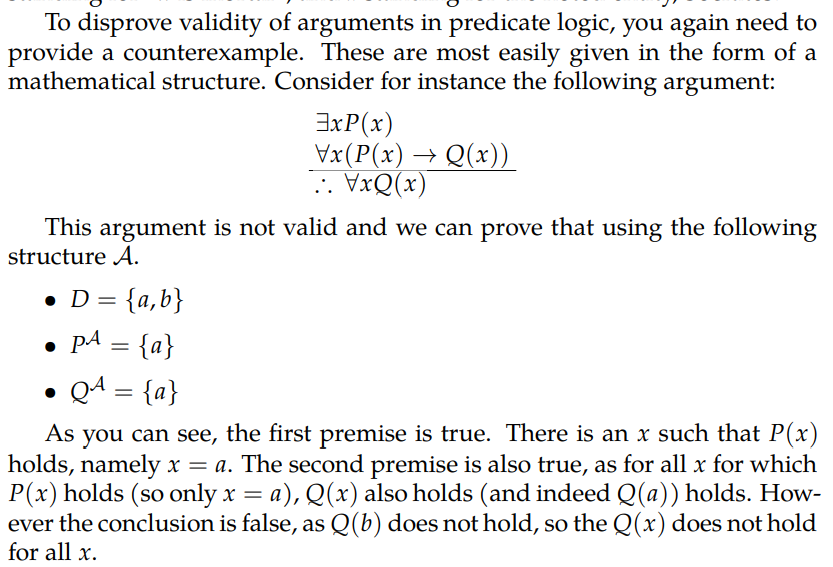
From my logic textbook ^^
I understand why ∀xQ(x) is a invalid argument since ∃xP(x) and ∀x(P(x) → Q(x)) do not prove it but I dont really understand the bit about the structure A
Could someone explain this bit please?
full forumBOT
@stuck fiber Has your question been resolved?
full forumBOT
@stuck fiber Has your question been resolved?
full forumBOT
@stuck fiber Has your question been resolved?
full forumBOT
Channel closed
Closed by @stuck fiber
Use .reopen if this was a mistake.
Available help channel!
Send your question here to claim the channel.
Remember:
• Ask your math question in a clear, concise manner.
• Show your work, and if possible, explain where you are stuck.
• After 15 minutes, feel free to ping <@&286206848099549185>.
• Type the command .close to free the channel when you're done.
• Be polite and have a nice day!
Read #❓how-to-get-help for further information on how to ask a good question, and about conduct in the question channels.
 copper quiver
How should you approach this, and for that matter other questions in which variables are used to represent digits?
 full forumBOT
copper quiver
How should you approach this, and for that matter other questions in which varia...
full forumBOT
copper quiver
How should you approach this, and for that matter other questions in which varia...
Please don't occupy multiple help channels.
 nova basin
deduce an equation for c. Then see what equation that gives for b to see whether a full solution exists
 tired olive
1,5,0 works
nova basin
don't just give answers
nova basin
then keep it to yourself please
tired olive
But 150 = 3x50 +0
nova basin
it's 1 solution
copper quiver
i got c = 40a - 8b
nova basin
but you don't solve such an exercise nicely by just trying stuff
copper quiver
i changed the digits to variables (abc = 100a + 10b +c)
nova basin
copper quiver
i got c = 40a - 8b
genuinely curious about how you got that
copper quiver
i dont really know what to do from there though
nova basin
arguably it allows you to just list the possibilities and check each one
I went with the digit-wise equalities:
3.5c = c [10], i.e. 5c = 0 [20] so c is a multiple of 4
etc
which your formula also yields
we already found a solution for c = 0
technically
then c = 4 gives b = 3b+1 [10], which has no solutions as that's equivalent to 2b = 9 [10]
copper quiver
what do the numbers in brackets mean?
nova basin
since the exercise doesn't allow for 3 as an answer, we "know" there has to be a solution for c = 8, hence we arrive at a solution without the proof, which is sad but works
nova basin
copper quiver
what do the numbers in brackets mean?
never did modular arithmetic before ?
copper quiver
nope
nova basin
how old are you ?
we define a = b [n] as being true if and only if n divides b - a, i.e. b-a is a multiple of n
therefore being equivalent to saying their remainders when divided by n are equal
copper quiver
mhm
nova basin
nova basin
I went with the digit-wise equalities:
3.5c = c [10], i.e. 5c = 0 [20] so c is a...
so here I looked modulo 10 to look at the first digit of the number
but then that's not the kind of solution you were expected to go for
copper quiver
what else could you do?
nova basin
copper quiver
i got c = 40a - 8b
you could try to work with that
100a + 10b + c = 30b + 3.5c therefore
200a - 40b = 5c
copper quiver
100a + 10b + c = 30b + 3.5c
100a + 10b = 30b + (3.5-1)c
100a + 10b = 30b + 2.5c
copper quiver
we all have our moments
nova basin
so c has to be a multiple of 8
so c is 0 or 8
so then just find an example for each value of c or prove there can't be
and that will finish the proof
we already know it for c = 0
as 150 works
which you can find by saying that if c = 0 then
8b = 40a so taking a = 1, b = 5 gives a solution
and the only one since b < 10
do something similar for c = 8
copper quiver
oh yeah that works
148 is also a solution
so is 298
so c = 0 or 8
i get it now thank you so much
.close
full forumBOT
Channel closed
Closed by @copper quiver
Use .reopen if this was a mistake.
full forumBOT
Available help channel!
Send your question here to claim the channel.
Remember:
• Ask your math question in a clear, concise manner.
• Show your work, and if possible, explain where you are stuck.
• After 15 minutes, feel free to ping <@&286206848099549185>.
• Type the command .close to free the channel when you're done.
• Be polite and have a nice day!
Read #❓how-to-get-help for further information on how to ask a good question, and about conduct in the question channels.
 glad prairie
i've trouble to do the limit of the function in +infinite
 glad prairie
when i'm trying to do a series expansion i have x(x + x^3/6 etc...)
,w series in +infinite of x*sinh(1/x)
glossy valveBOT

Wolfram Alpha doesn't understand your query!
Perhaps try rephrasing your question?
Click here to refine your query online
 Requested by Max.cc#5208
 spice orchid
you might instead consider the subtitution u = 1/x
full forumBOT
Channel closed
Closed by @glad prairie
Use .reopen if this was a mistake.
full forumBOT
Available help channel!
Send your question here to claim the channel.
Remember:
• Ask your math question in a clear, concise manner.
• Show your work, and if possible, explain where you are stuck.
• After 15 minutes, feel free to ping <@&286206848099549185>.
• Type the command .close to free the channel when you're done.
• Be polite and have a nice day!
Read #❓how-to-get-help for further information on how to ask a good question, and about conduct in the question channels.
icy cairn
${\displaystyle {\begin{aligned}\prod _{n=2}^{\infty }\left(1-{\frac {1}{n^{2}}}\right)&=\prod _{n=2}^{\infty }{\frac {(n-1)(n+1)}{n^{2}}}\&=\lim _{N\to \infty }\prod _{n=2}^{N}{\frac {n-1}{n}}\times \prod _{n=2}^{N}{\frac {n+1}{n}}\&=\lim _{N\to \infty }\left\lbrack {{\frac {1}{2}}\times {\frac {2}{3}}\times {\frac {3}{4}}\times \cdots \times {\frac {N-1}{N}}}\right\rbrack \times \left\lbrack {{\frac {3}{2}}\times {\frac {4}{3}}\times {\frac {5}{4}}\times \cdots \times {\frac {N}{N-1}}\times {\frac {N+1}{N}}}\right\rbrack \&=\lim _{N\to \infty }\left\lbrack {\frac {1}{2}}\right\rbrack \times \left\lbrack {\frac {N+1}{N}}\right\rbrack \&={\frac {1}{2}}\times \lim _{N\to \infty }\left\lbrack {\frac {N+1}{N}}\right\rbrack \&={\frac {1}{2}}\times \lim _{N\to \infty }\left\lbrack {\frac {N}{N}}+{\frac {1}{N}}\right\rbrack \&={\frac {1}{2}}.\end{aligned}}}$
full forumBOT
icy cairn
${\displaystyle {\begin{aligned}\prod _{n=2}^{\infty }\left(1-{\frac {1}{n^{2}}}...
glossy valveBOT
skittle
 icy cairn
${\displaystyle {\begin{aligned}\sum _{n=1}^{\infty }{\frac {1}{n(n+1)}}&{}=\sum _{n=1}^{\infty }\left({\frac {1}{n}}-{\frac {1}{n+1}}\right)\{}&{}=\lim _{N\to \infty }\sum _{n=1}^{N}\left({\frac {1}{n}}-{\frac {1}{n+1}}\right)\{}&{}=\lim _{N\to \infty }\left\lbrack {\left(1-{\frac {1}{2}}\right)+\left({\frac {1}{2}}-{\frac {1}{3}}\right)+\cdots +\left({\frac {1}{N}}-{\frac {1}{N+1}}\right)}\right\rbrack \{}&{}=\lim _{N\to \infty }\left\lbrack {1+\left(-{\frac {1}{2}}+{\frac {1}{2}}\right)+\left(-{\frac {1}{3}}+{\frac {1}{3}}\right)+\cdots +\left(-{\frac {1}{N}}+{\frac {1}{N}}\right)-{\frac {1}{N+1}}}\right\rbrack \{}&{}=\lim _{N\to \infty }\left\lbrack {1-{\frac {1}{N+1}}}\right\rbrack =1.\end{aligned}}}$
glossy valveBOT
skittle
 icy cairn
${\displaystyle \left(\int _{-\infty }^{\infty }e^{-x^{2}},dx\right)^{2}=\int _{-\infty }^{\infty }e^{-x^{2}},dx\int _{-\infty }^{\infty }e^{-y^{2}},dy=\int _{-\infty }^{\infty }\int _{-\infty }^{\infty }e^{-\left(x^{2}+y^{2}\right)},dx,dy.}$
glossy valveBOT
skittle
 icy cairn
${\displaystyle {\begin{aligned}\iint _{\mathbb {R} ^{2}}e^{-\left(x^{2}+y^{2}\right)}dx,dy&=\int _{0}^{2\pi }\int _{0}^{\infty }e^{-r^{2}}r,dr,d\theta \[6pt]&=2\pi \int _{0}^{\infty }re^{-r^{2}},dr\[6pt]&=2\pi \int _{-\infty }^{0}{\tfrac {1}{2}}e^{s},ds&&s=-r^{2}\[6pt]&=\pi \int _{-\infty }^{0}e^{s},ds\[6pt]&=\pi \left(e^{0}-e^{-\infty }\right)\[6pt]&=\pi ,\end{aligned}}}$
glossy valveBOT
skittle
 frosty geyser

icy cairn
${\displaystyle \left(\int _{-\infty }^{\infty }e^{-x^{2}},dx\right)^{2}=\pi ,}$
glossy valveBOT
skittle
 icy cairn
${\displaystyle \int _{-\infty }^{\infty }e^{-x^{2}},dx={\sqrt {\pi }}.}$
glossy valveBOT
skittle
 full forumBOT
 mental bolt
Guys help me <#359052604149465088> , it’s 9th grade mathematics.
mental bolt
Guys help me <#359052604149465088> , it’s 9th grade mathematics.
Please stick to your channel.
@icy cairn Has your question been resolved?
icy cairn
.close
full forumBOT
Channel closed
Closed by @icy cairn
Use .reopen if this was a mistake.
Available help channel!
Send your question here to claim the channel.
Remember:
• Ask your math question in a clear, concise manner.
• Show your work, and if possible, explain where you are stuck.
• After 15 minutes, feel free to ping <@&286206848099549185>.
• Type the command .close to free the channel when you're done.
• Be polite and have a nice day!
Read #❓how-to-get-help for further information on how to ask a good question, and about conduct in the question channels.
torn jolt

 full forumBOT
torn jolt
https://media.discordapp.net/attachments/1071194822389534760/1071195843207643136...
torn jolt
full forumBOT
torn jolt
https://media.discordapp.net/attachments/1071194822389534760/1071195843207643136...
torn jolt
My friend is stuck on this.
It would really help me if you could answer, so I can better understand how to explain to them.
 tulip beacon
torn jolt
My friend is stuck on this.
tulip beacon
torn jolt
My friend is stuck on this.
You could either simplify or stick a random number in and check which one works
 atomic blade
I often find letting x = 3 helps
atomic blade
Combine the fractions in the denominator
Surely you know how to combine/add fractions
atomic blade
Yeah
Which is equivalent to 20/9
What are you even doing
Why are there prods
That has nothing to do with his problem
Bruh he deleted rhem
atomic blade
torn jolt
So if id use 2 it would be 1/ 9/20 right
But yes. 1/(9/20) = 20/9 though
atomic blade
It is B