#help-28
1 messages · Page 38 of 1
 atomic blade
 hot herald
doesn't hurt to also consider the domain
hot herald
try not to overthink again
hot herald
and in case it wasn't clear,
when I mentioned do not try to find for the inverse,
you shouldn't be attempting to isolate x in the equation 2 = 2x + ln(x) either
atomic blade
If you're confused on what inspection is:
||The thing is this: it's really convenient that you have a term 2x, and you have to make it equal to 2. It would be very convenient if we let x = 1 and hope that ln(1) = 0.
Which it does. This is what we mean by "inspection". The question's rigged such that you can make that correlation.||
 proven heron
@random mica ty for the explanation
 random mica
found it
is 1
Am I right
because if we put 1
in the original function
we see
2x + lnx
2+ ln 1
2 +0
=2
and as I said
atomic blade
atomic blade
If you're confused on what inspection is:
||The thing is this: it's really con...
Lil late but yeah
proven heron
and also ty @atomic blade and @hot herald
random mica
what is ty
proven heron
I think I have found out the anwser
atomic blade
"Thank you"
proven heron
random mica
what is ty
thank you
hot herald
Ty is a name
random mica
in the answering page
proven heron
Hmm
I think that
I will let f^-1(2) be a random variable
such as "a"
and then
I will have f(f^-1(2)) = a
which leads to 2 = 2a + ln a
hot herald
no
random mica
what ????
hot herald
I will let f^-1(2) be a random variable
such as "a"
I will have f(f^-1(2)) = a
you're saying a is both f^-1(2) and f(f^-1(2))
proven heron
wait
hot herald
you should have
f(f^-1(2)) = f(a)
proven heron
f(f^-1(2)) = f(a)
random mica
the rule
random mica
f o g (x) = g o f (x) = x
hot herald
yes
proven heron
okay then
proven heron
 hot herald
[insert work]
f^-1(2) = 1
proven heron
here's my draft
proven heron
proven heron
how'd u think? @random mica
I think it's possible to write like this in the answering page
proven heron
okay
 full forumBOT
@proven heron Has your question been resolved?
Channel closed
Closed by @proven heron
Use .reopen if this was a mistake.
proven heron
@random mica dm me privately, I wanna see your sheet, now I gotta do the other problems hehe
full forumBOT
 Available help channel!
Send your question here to claim the channel.
Remember:
• Ask your math question in a clear, concise manner.
• Show your work, and if possible, explain where you are stuck.
• After 15 minutes, feel free to ping <@&286206848099549185>.
• Type the command .close to free the channel when you're done.
• Be polite and have a nice day!
Read #❓how-to-get-help for further information on how to ask a good question, and about conduct in the question channels.
 viral cargo
I have a feeling I have to show the van Hall theorem here. But I have no clue how to approach this question.
 full forumBOT
viral cargo
I have a feeling I have to show the van Hall theorem here. But I have no clue ho...
full forumBOT
viral cargo
I have a feeling I have to show the van Hall theorem here. But I have no clue ho...
 fast peak
well (a) is the easy direction of that theorem. if there is a matching that means every node in U is connected to a different note in N(U). surely then there can't be less nodes in N(U) than in U
viral cargo
I can see that principal yes, but how would I incorporate the Van Hall theorom in a proof like that?
fast peak
ok what statement of halls theorem do you have
but well I would assume that if anything you have to use your version of hall in some later task
viral cargo
We didn't get any statement or anything. And our lecturer works without a book, he just gives exercises for us to figure out and chooses a few the following lecture that he will explain.
fast peak
how are you supposed to use a theorem without knowing what it says
viral cargo
He gave that as a hint. He likes us finding out things via the internet, so we can create our own material to use for studying for the exams. So all exercises together will form our syllabus for the exam.
fast peak
well that's a bit weird
viral cargo
Yes, lots of people struggle with this class...
fast peak
a very classic statement of halls theorem is: a bipartite graph like this has a matching if and only if for all U, |U| <= |N(U)|
and like you notice, a is just the direction =>
which is easy
the hard part of the theorem is the other direction
viral cargo
Ah, okay. I see
fast peak
the setup of the question sounds to me more like they want you to use max-flow-min-cut somewhere
viral cargo
I have only ever used that in actual given graphs, never with proofing.
But looking at question b, you might be right.
b) proof that every matching M in G gives a motivation for an s-t flow in D under c of value |M|.
fast peak
max-flow-min-cut and halls theorem are equivalent
you can prove each one using the other
viral cargo
Ah cool!
viral cargo
Awesome! Thank you so much. I am gonna give it another go with this new knowledge! If I get stuck again, I will open a new channel 🙂
fast peak
👍
full forumBOT
@viral cargo Has your question been resolved?
Channel closed
Closed by @viral cargo
Use .reopen if this was a mistake.
Available help channel!
Send your question here to claim the channel.
Remember:
• Ask your math question in a clear, concise manner.
• Show your work, and if possible, explain where you are stuck.
• After 15 minutes, feel free to ping <@&286206848099549185>.
• Type the command .close to free the channel when you're done.
• Be polite and have a nice day!
Read #❓how-to-get-help for further information on how to ask a good question, and about conduct in the question channels.
 silk mirage
solve the equation graphically
 full forumBOT
silk mirage
solve the equation graphically
silk mirage
full forumBOT
silk mirage
solve the equation graphically
silk mirage
task e and f need help with how to make the left side = 0
hot herald
apply the same operation to both sides of the equation
what could you do to 8x that would result in 0
( apart from multiplying by 0)
and do that to both sides of the equation
hot herald
so -8?
and -x
no
silk mirage
alright
hot herald
8x - 8 - x isn't 0
hot herald
don't overthink this
silk mirage
i am
hot herald
lets use a simpler example,
k = 5,
how would get 0 on the right side of the equation
 pearl ocean
Antar at du skal løse det grafisk. Bruk geogebra til det.
Hvis det er for hånd, bruk kvadratsetninger.
hot herald
what could you do to 5 that would result in 0
( apart from multiplying by 0)
silk mirage
pearl ocean
Antar at du skal løse det grafisk. Bruk geogebra til det.
Hvis det er for hånd,...
det er grafisk, men jeg skjønner ikke hvorfan jeg skal gjøre det med geogebra det er det som er problemet
pearl ocean
@hot herald is it okay for you that I take over?
hot herald
sure if they're more comfortable and more likely to understand in their native language. try to avoid feeding the answer though if possible
silk mirage
silk mirage
solve the equation graphically
jeg trodde jeg skrev det her at det skulle gjøres grafisk
pearl ocean
silk mirage
det er grafisk, men jeg skjønner ikke hvorfan jeg skal gjøre det med geogebra de...
Er du vant med funksjoner?
silk mirage
pearl ocean
Er du vant med funksjoner?
er ganske så ny med algebra
pearl ocean
silk mirage
jeg trodde jeg skrev det her at det skulle gjøres grafisk
Jo, det gjorde du. Det var jeg som ikke så.
pearl ocean
silk mirage
er ganske så ny med algebra
Funksjoner er resultatet av endringer.
F.eks. f(x)=2x+1
Du har y-verdier (y-akse) på venstre side, og x-verdier (x-akse) på høyre side.
silk mirage
ja har forstått det
men ikke det første du sa
vent du mener at på venstre side av = er y akse og høyre x-akse?
pearl ocean
pearl ocean
F.eks. f(x)=2x+1
Ta utgangspunkt utifra denne funksjonen.
silk mirage
åja okok forstått
men er det meningen at jeg skal klare å forstå det i hode med hvordan d blir det samme?
pearl ocean
pearl ocean
Funksjoner er resultatet av endringer.
.
Du har variabler, de er de som endrer verdien av funksjonen.
silk mirage
skjønner
pearl ocean
Så du har bare y på den ene siden, og x på den andre siden.
pearl ocean
silk mirage
solve the equation graphically
Prøv å få e til det som jeg sa, y på den ene siden og x på den andre.
silk mirage
hva mener du nå
pearl ocean
Nei, jeg sa det forvirrende.
Bare ha verdier på den ene siden.
Og den andre siden ingenting.
silk mirage
jeg misforstår
pearl ocean
silk mirage
solve the equation graphically
Se på løsningsforslaget i eksempel 26.
Samme algoritme.
silk mirage
f(x)=x^2+16?
pearl ocean
Hva er likningen i eksempel 26?
silk mirage
10x+2x^2=0
pearl ocean
Hva har du på høyre siden?
silk mirage
0
pearl ocean
Samme gjør du med e og f.
silk mirage
what
pearl ocean
$x^2 +16=8x$ , gjør det som du sa, høyre side er 0.
 glossy valveBOT
Potet
 pearl ocean
silk mirage
0
pearl ocean
silk mirage
0
Det skal være 0 på den ene siden.
silk mirage
men på eksempel 26 starter likningen med 0 på høyre side så hvordan gjør jeg det når e har 8x på høyre side
pearl ocean
Er du kjent med likninger?
silk mirage
kan ikke si meg godt kjent
pearl ocean
Det er som en skålvekt.
Begge sidene skal være like.
Du tar en mengde av noe fra den ene siden, som du samtidig gjør på den andre siden.
silk mirage
ja men kan jeg gjøre -8 -x?
pearl ocean
8x er en, ikke to.
pearl ocean
pearl ocean
Det er som en skålvekt.
.
Du tar 8x fra høyre siden. Det betyr at du også skal ta 8x fra venstre siden.
silk mirage
ja var det ikke det jeg gjorde?
pearl ocean
silk mirage
så da blir det x+8=0
Hva er det her da?
silk mirage
jeg er helt dø i hodet
pearl ocean
Skålvekt. Det er en vekt som måler forholdet mellom to plattformer.
Når du har 8 epler og 2 appelsiner på venstre plattform, og 9 epler og 5 appelsiner på høyre plattform.
Du skal ta 2 appelsiner fra venstre plattform, hva er det du må gjøre for at plattformene som fortsatt i balanse?
pearl ocean
$x^2+16=8x$
glossy valveBOT
Potet
 pearl ocean
Du tar 8x vekk fra høyre siden. Hva er du skal ha på venstre siden?
Det skal være balanse.
Det som skjer på side a skjer det samme på side b
pearl ocean
Skjønner du hva jeg prøver å få deg til å gjøre?
silk mirage
vell ja jeg bare skjønner ikke hvordan du skal regne det ut
pearl ocean
pearl ocean
Du skal ta 2 appelsiner fra venstre plattform, hva er det du må gjøre for at pla...
.
pearl ocean
silk mirage
tar 2 fra høyre
.
silk mirage
går det ann å skrive x^2+16-8x=0
pearl ocean
silk mirage
går det ann å skrive x^2+16-8x=0
Der gjorde du det.
silk mirage
åja det er det jeg har prøvd å gjøre hele tiden bare at jeg har prøvd å ta fra tallene som allerede er der 💀
pearl ocean
Når det er gange mellom noe, så er de sammen som en.
silk mirage
skjønner
pearl ocean
Null stress.
silk mirage
.close
full forumBOT
Channel closed
Closed by @silk mirage
Use .reopen if this was a mistake.
Available help channel!
Send your question here to claim the channel.
Remember:
• Ask your math question in a clear, concise manner.
• Show your work, and if possible, explain where you are stuck.
• After 15 minutes, feel free to ping <@&286206848099549185>.
• Type the command .close to free the channel when you're done.
• Be polite and have a nice day!
Read #❓how-to-get-help for further information on how to ask a good question, and about conduct in the question channels.
 stuck fiber
Is there any way to work out cos^2(7pi/3) without a calculator
hot herald
cos^2(7pi/3) is convenient notation to represent
(cos(7pi/3))^2
knowing the value of cos(7pi/3) = 1/2
square that and you'll have what you need
hot herald
they've already done that
 hot wadi
So it's ultimately cos(pi/3) which u know already
full forumBOT
Channel closed
Closed by @stuck fiber
Use .reopen if this was a mistake.
stuck fiber
.reopen
full forumBOT
✅
stuck fiber
I have a follow up question
What about cos^2(4pi/6)
because (4pi/6) is -1/2
but does the minus cancel after being squared?
 short siren
Yep
hot herald
*cos(4pi/6) is -1/2
stuck fiber
so its always going to be a + no matter what quadrant?
short siren
stuck fiber
so its always going to be a + no matter what quadrant?
If you square it, yes. It's gonna be positive, assuming you're in the real numbers
stuck fiber
okok cool
hot herald
same idea as earlier
stuck fiber
thanks again guys!
hot herald
square (-1/2) and you'll have what you need
short siren

full forumBOT
Channel closed
Closed by @stuck fiber
Use .reopen if this was a mistake.
Available help channel!
Send your question here to claim the channel.
Remember:
• Ask your math question in a clear, concise manner.
• Show your work, and if possible, explain where you are stuck.
• After 15 minutes, feel free to ping <@&286206848099549185>.
• Type the command .close to free the channel when you're done.
• Be polite and have a nice day!
Read #❓how-to-get-help for further information on how to ask a good question, and about conduct in the question channels.
 novel sparrow
 full forumBOT
novel sparrow
short siren
full forumBOT
novel sparrow
short siren

novel sparrow
Small question: What does the "a arrow to a" mean?
My notation would be h=>0 and then a+h and b-h as integral borders
short siren
That's a peculiar way to write limits
novel sparrow
I got it from wikipedia
 nocturne creek
novel sparrow
Small question: What does the "a arrow to a" mean?
My notation would be h=>0 a...
nocturne creek
novel sparrow
Small question: What does the "a arrow to a" mean?
My notation would be h=>0 a...
Alpha arrow to a
novel sparrow
nocturne creek
Alpha arrow to a
but what does that mean? is it identical to what I wrote or something different?
glossy valveBOT
 short siren
Oooo
glossy valveBOT
 novel sparrow
ahh thank you
Am I deducing correctly that this would be the same as h=>0 and then a+h and b-h as integral borders?
 topaz valley
obviously you dont know if f is defined outside of the interval (a, b)
so you cant even take the limits from the other sides
no
topaz valley
unless you specify h to be positive
 glossy valveBOT
 novel sparrow
 topaz valley
yes that works
novel sparrow
okay okay
novel sparrow
terminals?

 novel sparrow
ahh yeah I know what you mean
these examples are unrelated to each other and were used in a situation where only one border is critical
topaz valley
no as in
topaz valley
topaz valley
the upper limit should still be b here
topaz valley
topaz valley
and lower limit should still be a here
novel sparrow
but wait a second

 novel sparrow
lets say we are integrating over the intervall (a,b) which means both borders are critical
= we have to divide the integral in 2 seperate intervals
the first one is from a+h to c
the second one is from c to b-h
h being lim h=>0+
is that correct?
topaz valley
yeah sure
novel sparrow
(and c being somewhere between a and b)
okay okay
but the 2 examples you posted would be in used in a case where only one border is critical right?
novel sparrow
glossy valve
a here
topaz valley
yeah
novel sparrow
glossy valve
and b here
okay
I am just asking to make sure I understood correctly, its a bit confusing tbh
but thanks for clearing it up
topaz valley
its just weird behaviour => take limit
full forumBOT
@novel sparrow Has your question been resolved?
Channel closed
Closed by @novel sparrow
Use .reopen if this was a mistake.
Available help channel!
Send your question here to claim the channel.
Remember:
• Ask your math question in a clear, concise manner.
• Show your work, and if possible, explain where you are stuck.
• After 15 minutes, feel free to ping <@&286206848099549185>.
• Type the command .close to free the channel when you're done.
• Be polite and have a nice day!
Read #❓how-to-get-help for further information on how to ask a good question, and about conduct in the question channels.
 west spire
Does anyone know why the step function has t-1 and what to do when the a value which is 2 does not match with 3
 full forumBOT
west spire
Does anyone know why the step function has t-1 and what to do when the a value w...
west spire
full forumBOT
west spire
Does anyone know why the step function has t-1 and what to do when the a value w...
west spire
And why is there not a sin
 gritty rose
Yea that all just looks wrong unless U(t) relates to sin
west spire
Yea idek, I understand every other example shown but this example just seems weird
west spire
west spire
Does anyone know why the step function has t-1 and what to do when the a value w...
<@&286206848099549185>
gritty rose
west spire
Yea idek, I understand every other example shown but this example just seems wei...
Find the definition of U
west spire
gritty rose
Find the definition of U
What do you mean like u(t-2)?
gritty rose
Any definition of U
gritty rose
west spire
Does anyone know why the step function has t-1 and what to do when the a value w...
The one used in the example
west spire
There is one given saying, Ua(t) = U(t-a)
gritty rose
That looks like a property and not the definition. Screenshot the definition.
west spire
I can’t find a definition definition, my notes just has plenty of examples
full forumBOT
@west spire Has your question been resolved?
full forumBOT
@west spire Has your question been resolved?
full forumBOT
Channel closed
Closed due to timeout
Use .reopen if this was a mistake.
Available help channel!
Send your question here to claim the channel.
Remember:
• Ask your math question in a clear, concise manner.
• Show your work, and if possible, explain where you are stuck.
• After 15 minutes, feel free to ping <@&286206848099549185>.
• Type the command .close to free the channel when you're done.
• Be polite and have a nice day!
Read #❓how-to-get-help for further information on how to ask a good question, and about conduct in the question channels.
west spire
Does anyone know why cos does not become (s/(s^2+9pi^2))
 west spire
<@&286206848099549185>
 worthy ginkgo
Because you evaluate it on one point
$\cos(t) \delta(t-3\pi) = \cos(3\pi) \delta(t-3\pi)$
glossy valveBOT
black_couscous
 full forumBOT
@west spire Has your question been resolved?
west spire
worthy ginkgo
Because you evaluate it on one point
I don’t understand that
What does it mean to evaluate on a single point. I am trying to connect this to step functions and this does not make sense
gritty rose
west spire
What does it mean to evaluate on a single point. I am trying to connect this to ...
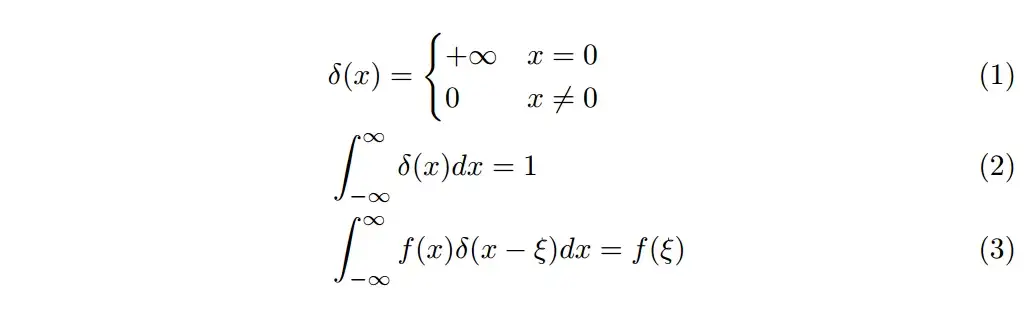
Do you know the definition of delta function?
Write out the integral formula for the Laplace transform of the product cos and delta
west spire
gritty rose
Do you know the definition of delta function?
According to like the notes, it’s a function which is zero everywhere except a point where it takes the value inf
gritty rose
west spire
According to like the notes, it’s a function which is zero everywhere except a p...
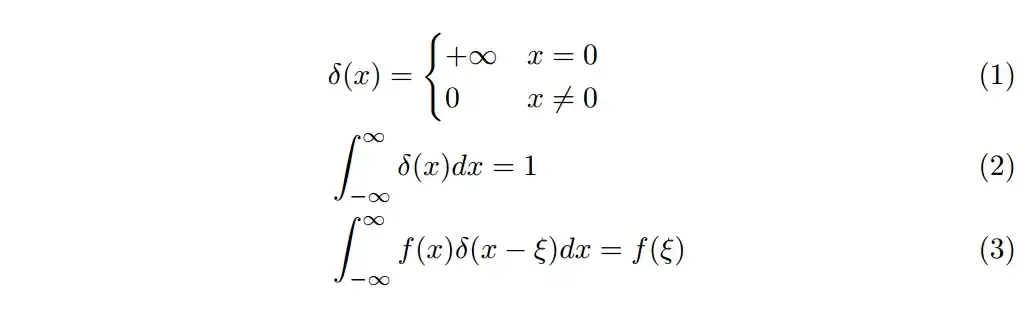
Use equation 3 with f=cos
west spire
Ohhh i didn’t see that theorem thank you
I am actually going insane with this course but truly appreciate your help
Thank you @gritty rose and @worthy ginkgo
.close
full forumBOT
Channel closed
Closed by @west spire
Use .reopen if this was a mistake.
Available help channel!
Send your question here to claim the channel.
Remember:
• Ask your math question in a clear, concise manner.
• Show your work, and if possible, explain where you are stuck.
• After 15 minutes, feel free to ping <@&286206848099549185>.
• Type the command .close to free the channel when you're done.
• Be polite and have a nice day!
Read #❓how-to-get-help for further information on how to ask a good question, and about conduct in the question channels.
 rugged raven
sin sin x θ . find the value of θ
full forumBOT
rugged raven
sin sin x θ . find the value of θ
 torn jolt

 short crest
rugged raven
short crest
rugged raven
ye thats the question in my exams and I cant figure it out
 light sonnet
You're taking an exam?
rugged raven
its already done
torn jolt
Theta isn't even in the expression that we are meant to magically find for you 
Or u somehow have $\sin(\sin(x\theta))$
glossy valveBOT
♡LexQa♡
 torn jolt
Which is wild
full forumBOT
Channel closed
Closed by @rugged raven
Use .reopen if this was a mistake.
full forumBOT
Available help channel!
Send your question here to claim the channel.
Remember:
• Ask your math question in a clear, concise manner.
• Show your work, and if possible, explain where you are stuck.
• After 15 minutes, feel free to ping <@&286206848099549185>.
• Type the command .close to free the channel when you're done.
• Be polite and have a nice day!
Read #❓how-to-get-help for further information on how to ask a good question, and about conduct in the question channels.
 nocturne trench
#help-31 message
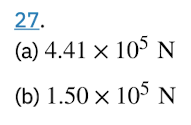
I'm trying to handle problem B
https://i.imgur.com/Uxl5BpU.png Here are the answers path to them?
 full forumBOT
nocturne trench
https://discord.com/channels/268882317391429632/905286165316403271/1053908769781...
full forumBOT
nocturne trench
https://discord.com/channels/268882317391429632/905286165316403271/1053908769781...
 full forumBOT
@nocturne trench Has your question been resolved?
full forumBOT
Channel closed
Closed due to timeout
Use .reopen if this was a mistake.
Available help channel!
Send your question here to claim the channel.
Remember:
• Ask your math question in a clear, concise manner.
• Show your work, and if possible, explain where you are stuck.
• After 15 minutes, feel free to ping <@&286206848099549185>.
• Type the command .close to free the channel when you're done.
• Be polite and have a nice day!
Read #❓how-to-get-help for further information on how to ask a good question, and about conduct in the question channels.
 mild veldt
 full forumBOT
mild veldt
mild veldt
full forumBOT
mild veldt
mild veldt
How do you work out the probability of A and P
B
i got P(A) = 31/216
Because u do 25/216 + 5/216 + 1/216
e.g for 25/216 you have 1/6 * 5/6 * 5/6
 forest widget
pretty sure you're severely undercounting
why is the odds of rolling at least one 6 going below 1/6 when you have more dice 
mild veldt
What
U roll 3 dice
and whats the porbability i get at least one six?
So the probability i get one 6 from rolling 3 dice
is 1/6 * 5/6 * 5/6
the probability i get 2 6 from rolling 3 dice is
1/6 * 1/6 * 5/6
and 3 6's from 3 dice is
1/6 * 1/6 * 1/6
and u add the overall probabilities up
@forest widget
forest widget
mild veldt
is 1/6 * 5/6 * 5/6
what if the first dice isn't the 6
mild veldt
its 5/6 * 5/6 * 1/6?
forest widget
the 6 can be any of the 3 dice
forest widget
does your question mention anything about order
forest widget
ye, so if you only get one 6, it can be any of the 3 rolls that got the 6
so you have to consider cases where {the first roll is the 6}, {the second roll is the 6}, {the 3rd roll is the 6}
forest widget
that's the case where all 3 dice come up 6s
forest widget
yes, and the other 2 cases you're undercounting
 forest widget
because for example, {6,1,2} is a valid arrangement where you get one 6
but so is {6,2,1}
and so is {1,6,2}, {2,6,1}, {1,2,6}, {2,1,6}
forest widget
forest widget
so you have to consider cases where {the first roll is the 6}, {the second roll ...
come back to this
when you multiply probabilities together you're implicitly defining some form of ordering
forest widget
ye
forest widget
multiplying probabilities together always implicitly define some form of order
sometimes it doesn't matter due to the problem's restrictions, but in this case it does, since (6,1,2) and (1,6,2) are considered distinct
and you judge whether to account for permutations based on whether different orders are considered distinct or identical
mild veldt
ah ok i get u
so for P(B)
im rly confused on that
because i wasnt sure how the ordering works
e.g can i do 112,121,211 ?
forest widget
they're considered distinct, so that's 3 permutations
forest widget
no
forest widget
usually you try to calculate the probability of getting a valid combination then permute each combination
but that's not exactly intuitive to grasp until it clicks
in this case, try to think through:
i want a pair, what's the probability of getting a pair in my first 2 rolls?
i then want a single, what's the probability the 3rd roll isn't the same as the pair?
i now have a valid combination, how many ways can i permute this combination? (remember that you have combinations of the form {a,a,b}, but for the probability you want to calculate, the pair can be any 2 dice)
mild veldt
the thing is
e.g when trying to work out the prob of getting a pair in the first 2 rolls
my logic is ok, for the first roll i can choose any number
so 1/6
then the 2nd roll has to be the same
so 1/6
and the third can be anything so the probability is 1
is that the correct way of thinking
forest widget
no
first we're not worried about the 3rd dice yet
second are you sure the odds of rolling 2 dice and getting a pair is 1/36
for 2 dice the sample space is small enough that you can realistically list out all outcomes or look up a chart
then you might want to think about where your line of reasoning is flawed
forest widget
oh that's what you're trying to express, ok
it just looks weird, because the first roll can be any number, so the probability the first roll is acceptable is 1
the second roll must agree with the first, so you accept the second roll with probability 1/6 (since the first roll is already determined to be some number between 1 to 6)
now continue
forest widget
what's the probability you accept the 3rd dice, such that the 3 dice form a pair + a single
mild veldt
the 3rd roll can be anything
forest widget
can it be equal to the first 2 dice?
forest widget
yes, so the probability of getting a valid combination, where in the exact order, you get a pair and a single, is 1 * 1/6 * 5/6 = 5/36
but this is only the case where you roll the single on the 3rd roll, how many ways can you permute each of these dice arrangements (a,a,b)?
mild veldt
u can have (b,a,a),(a,a,b),(a,b,a)?
forest widget
yes, so the final probability is?
mild veldt
15/36
forest widget
and that's the correct answer
forest widget
ye
mild veldt
tf
thats more simple than i thought
Thanks a lot
So to work out P( A and B)
So how do I work out P(B|A) now
mild veldt
I got it
Idk how to work out probability of A and B
I know the cardinality
is 30
but i dont know what its over
forest widget
conditional probability formula
mild veldt
so A and B = (116) (226) (336) (446) (556) (661) (662) etc until (665)
then u have 3 permutations for each
so thats 30
forest widget
correct, so what's P(A and B)
forest widget
how many possible results are there when you roll 3 dice
this shouldn't be the hard part i think
mild veldt
6 * 6 * 6?
forest widget
ye that's it
mild veldt
so 30/216
ah ok cool
so its 30/216 divided by P(A)
Alright I did the question
Thanks a lot
for ur helpp
Acc 1 more question
What is P(A and B and C) the same as writing
 full forumBOT
@mild veldt Has your question been resolved?
Channel closed
Closed by @mild veldt
Use .reopen if this was a mistake.
Available help channel!
Send your question here to claim the channel.
Remember:
• Ask your math question in a clear, concise manner.
• Show your work, and if possible, explain where you are stuck.
• After 15 minutes, feel free to ping <@&286206848099549185>.
• Type the command .close to free the channel when you're done.
• Be polite and have a nice day!
Read #❓how-to-get-help for further information on how to ask a good question, and about conduct in the question channels.
 solid nova
 full forumBOT
solid nova
forest widget
full forumBOT
solid nova
forest widget
factorise the expression
forest widget
let n be an odd number, then investigate the behavior
forest widget
that might help
forest widget
then you can start the proof
solid nova
ok cool
so i made n=(2x+1)
then expanded n(n^2+1)
so i got
8x^3+12x^2+8x+2
@forest widget
forest widget
good, what does this expression mean
solid nova
so first i also divided by 2
but then how do i show its not a multiple of 4
could i replace x with like an odd number and see result?
forest widget
solid nova
8x^3+12x^2+8x+2
this is the expression for n²+n
can you notice anything about its divisibility by 4
forest widget
that completes the proof
solid nova
oh
ok
so i just say
but at the start it says
n^3+n is an even number which is not a multiple of 4
forest widget
and you just showed both
solid nova
ok so my fianl sattement will be
this expressions cannot be divided by 4 so therefore its not a multiple of 4
solid nova
why plus 2n
glossy valveBOT


 solid nova
why would u add 2n to that factorsied bracket
topaz valley
then because n is odd, n+1 and n-1 are both even so the first term is divisible by 4
but 2n is not
solid nova
but why would u put the 2n in the equation
topaz valley
because it's what makes it equal to n^3 + n?
otherwise you get n^3 - n
i mean you can't leave it out
it's just there because that's how the algebra plays out
solid nova
right i see ok thanks
full forumBOT
@solid nova Has your question been resolved?
Channel closed
Closed by @solid nova
Use .reopen if this was a mistake.
Available help channel!
Send your question here to claim the channel.
Remember:
• Ask your math question in a clear, concise manner.
• Show your work, and if possible, explain where you are stuck.
• After 15 minutes, feel free to ping <@&286206848099549185>.
• Type the command .close to free the channel when you're done.
• Be polite and have a nice day!
Read #❓how-to-get-help for further information on how to ask a good question, and about conduct in the question channels.
 kind kraken
 full forumBOT
kind kraken
kind kraken
full forumBOT
kind kraken
kind kraken
I do not know how to write a proof for this
It seems like very trivial but how to write a proof can someone help me?
 carmine minnow
It's showing that two sets (of solutions) are the same
full forumBOT
@kind kraken Has your question been resolved?
kind kraken
carmine minnow
It's showing that two sets (of solutions) are the same
so should i take some sytem of two equation
and such that the second one is the linear combination of the first
and then prove that they have the same solutios
carmine minnow
you dropped a condition
kind kraken
each equation is a linear combination of the equations in the other?
Can you tell me how I should prove it?
carmine minnow
each equation in one system is a linear combination of the equations in the other system
kind kraken
I have no Idea how and where to start?
carmine minnow
It's showing that two sets (of solutions) are the same
To show two sets are the same, show that one is a subset of the other, then a superset of the other
carmine minnow
an example would be say I want so show that the span of (1, 2, 0) is {(t, 2t, 0) : t real}
both of these are sets
so if we take an element in the first set, say a(1, 2, 0), we see it is (a, 2a, 0), and substituting t=a shows it is in the second set - so the first set is a subset of the second
full forumBOT
Channel closed
Closed due to timeout
Use .reopen if this was a mistake.
Available help channel!
Send your question here to claim the channel.
Remember:
• Ask your math question in a clear, concise manner.
• Show your work, and if possible, explain where you are stuck.
• After 15 minutes, feel free to ping <@&286206848099549185>.
• Type the command .close to free the channel when you're done.
• Be polite and have a nice day!
Read #❓how-to-get-help for further information on how to ask a good question, and about conduct in the question channels.
torn jolt
how to do this problem???
full forumBOT
torn jolt
how to do this problem???
 carmine minnow
equal lengths?
torn jolt
it's a weird way to show equal lengths but prob
so basically a condition for triangle similarity is AA
so using this information
it's possible to find the volume i think
 clear lily
no trig
 verbal mantle
Pithagoras
clear lily
just pyramid height formula
full forumBOT
@torn jolt Has your question been resolved?
Channel closed
Closed by @fringe heart
Use .reopen if this was a mistake.
torn jolt
ty
full forumBOT
Available help channel!
Send your question here to claim the channel.
Remember:
• Ask your math question in a clear, concise manner.
• Show your work, and if possible, explain where you are stuck.
• After 15 minutes, feel free to ping <@&286206848099549185>.
• Type the command .close to free the channel when you're done.
• Be polite and have a nice day!
Read #❓how-to-get-help for further information on how to ask a good question, and about conduct in the question channels.
torn jolt
 torn jolt
Please help me how do I do 43
I tried doing it here but apparently I'm wrong

I'm so confused bros
full forumBOT
@torn jolt Has your question been resolved?
 shrewd hamlet
Start at the step: x^2 - 2x - y^2 - 4y - 4 = 0
Then complete the square for x and y correctly
to complete the square for y, try factoring out a -1
-(y^2 + 4y + 4)
Then see if u still need to complete the square
full forumBOT
@torn jolt Has your question been resolved?
torn jolt
shrewd hamlet
Then see if u still need to complete the square
I dont even know what completing the square means🗿
Also I factored out -1
This is what I got

By the way this is the answer
 shrewd hamlet

Learn how to complete the square in one minute! Completing the square creates a perfect square trinomial, which we can easily factor and solve for x.
Check out this video for many more examples and things to watch out for! https://youtu.be/IPr8ZRvFhAM
torn jolt
Thank you
torn jolt
shrewd hamlet
-(y^2 + 4y + 4)
I did this
And this is what I got

I dont know what I'm doing wrong
full forumBOT
@torn jolt Has your question been resolved?
full forumBOT
@torn jolt Has your question been resolved?
torn jolt
shrewd hamlet
Did u watch the video?
Yes
Idk if your there
But I got this

But that isnt right since the y+2 shouldnt have -1 under it
I seriously dont know what I did wrong
1/-1 is -1
I need help please I'm begging
🙏
.close
full forumBOT
Channel closed
Closed by @coarse quartz
Use .reopen if this was a mistake.
Available help channel!
Send your question here to claim the channel.
Remember:
• Ask your math question in a clear, concise manner.
• Show your work, and if possible, explain where you are stuck.
• After 15 minutes, feel free to ping <@&286206848099549185>.
• Type the command .close to free the channel when you're done.
• Be polite and have a nice day!
Read #❓how-to-get-help for further information on how to ask a good question, and about conduct in the question channels.
 brave star
why does it have to be zero vector , not just any element of K ?
 clear lily
that wouldnt be a subspace
{0} is closed under addition and scalar multiplication
so {0} is a subspace
brave star
.close
full forumBOT
Channel closed
Closed by @brave star
Use .reopen if this was a mistake.
brave star
.reopen
full forumBOT
✅
fast peak
any vector space by definition always needs to include the zero vector
clear lily
but thats a consequence of closedness under scalar multiplication right
fast peak
so at the very least you need {0} as a subset of your subspace
clear lily
and/or scalar -1 and closedness under addition
fast peak
well by definition of (V,+) being an abelian group I would say
clear lily
hahah alright
fast peak
the zero element is unique
if a and b are both zero elements, then a = a+b (cause b is a zero element) = b (cause a is a zero element)
brave star
.close
full forumBOT
Channel closed
Closed by @brave star
Use .reopen if this was a mistake.
full forumBOT
Available help channel!
Send your question here to claim the channel.
Remember:
• Ask your math question in a clear, concise manner.
• Show your work, and if possible, explain where you are stuck.
• After 15 minutes, feel free to ping <@&286206848099549185>.
• Type the command .close to free the channel when you're done.
• Be polite and have a nice day!
Read #❓how-to-get-help for further information on how to ask a good question, and about conduct in the question channels.
 slow gulch
hi!
full forumBOT
slow gulch
hi!
slow gulch

I need help with part ii
oh it’s okay, I can wait for someone else
I’ve tried am-gm but I’m still stuck
 alpine girder
is this uni?
slow gulch
oh I’m not in uni hahah
alpine girder
damn
carmine minnow
well i guess you'll need to use part 1 to do part 2
carmine minnow
(a) would be useful in simplifying the denominators, wouldn't it?
 carmine minnow
hmm, maybe don't apply AM-GM too quickly
slow gulch
ohh
alpine girder
if this isnt uni what is it
carmine minnow
idk math competition?
alpine girder
looks like one bro
alpine girder
so you take further math?
slow gulch
yes
alpine girder
are you a girl or a guy
slow gulch
umm girl why
carmine minnow
what happens when you use part a to simplify the denominator
alpine girder
I dont know many girls who take further math lmao
didnt mean for it to sound weird mbmb
slow gulch
carmine minnow
what happens when you use part a to simplify the denominator
let me try
slow gulch
alpine girder
didnt mean for it to sound weird mbmb
it’s ok hahah
okay I’ve tried using a and b
let me send a picture
 alpine girder
just asking
slow gulch
um
 gaunt lynx
alpine girder
just asking
gaunt lynx
alpine girder
just asking
take it to dms
 rare dock
don't take it to dms either
topaz valley

short siren
Senses tingling
gaunt lynx
alpine girder
she’s pretty
stop filling this channel with your nonsense pls
short siren

rare dock
gaunt lynx
stop filling this channel with your nonsense pls
same with you 💀
alpine girder
get outta here dude i wasnt doing anything

 short siren
Sure
alpine girder
@slow gulch reply dm
rare dock
alpine girder
<@251189299981058050> reply dm
stop
alpine girder
im not talking to you
slow gulch
hahah pls stop
alpine girder
just want to talk to you
slow gulch
I just want my question answered 🥲
alpine girder
ill answer all your questions in dms
gaunt lynx
<@&268886789983436800>
short siren
This is a math server
 normal tree
hmm well working backward, maybe you can show that the second term <= 1/4?
actually no, that doesn't work
slow gulch
ohh hmm
normal tree
also this was fun to watch LOL
slow gulch
normal tree
hmm well working backward, maybe you can show that the second term <= 1/4?
wait that seems ok
I can try
slow gulch
normal tree
also this was fun to watch LOL
haha 💀
gaunt lynx
never seen a guy sliding into a girl's channel before lmao
short siren
Same lmao
carmine minnow
slow gulch
maybe changing the denominator back might be a good idea since it's a nice product
normal tree
well, you can write (b+c) = 1-a or something
carmine minnow
but yeah, all we need to do now is show $\frac{abc}{ab+bc+ca-abc}\leq\frac{1}{8}$
glossy valveBOT
Element118
 carmine minnow
sorry, wrong direction
slow gulch
oh ok! I think I can do that
short siren
Hmm
carmine minnow
i think it would be easier to do
$\frac{abc}{(a+b)(b+c)(c+a)}\leq\frac{1}{8}$
glossy valveBOT
Element118
 carmine minnow
since it's homogeneous
slow gulch
wait isn’t my work enough to show it is < or equal to 1/4
and I can cross multiply and use am gm I think
carmine minnow
yeah I think that works
slow gulch
yaey! ok let me try
carmine minnow
yeah AM-GM should work because muirhead says yes
normal tree
does calculus work for this one too
 topaz valley
after rewriting the denoms as (a+b)(a+c) it's already homogenous
slow gulch
is this ok?
topaz valley
then you can lift the restriction on a,b,c
if you divide through by b,c and impose another restriction jensens should finish it
unless im tripping
carmine minnow
yeah it does
homogenising is a useful step
because it tells you "okay I don't need to continue using the condition given"
slow gulch
ohhhhh!
carmine minnow
so it's one less thing to work with
carmine minnow
in terms of sqrt(a), sqrt(b) and sqrt(c), eww
 cloud shore
You probably can write it as a sum of squares
cloud shore
cloud shore
You probably can write it as a sum of squares
Nvm not necessarily
normal tree
proof looks reasonably solid though
full forumBOT
@slow gulch Has your question been resolved?
full forumBOT
Channel closed
Closed due to timeout
Use .reopen if this was a mistake.
full forumBOT
Available help channel!
Send your question here to claim the channel.
Remember:
• Ask your math question in a clear, concise manner.
• Show your work, and if possible, explain where you are stuck.
• After 15 minutes, feel free to ping <@&286206848099549185>.
• Type the command .close to free the channel when you're done.
• Be polite and have a nice day!
Read #❓how-to-get-help for further information on how to ask a good question, and about conduct in the question channels.
torn jolt
 torn jolt
Can someone tell me how I got this wrong? I did definite integration with an upper limit of -4 and a lower limit of 2
<@&286206848099549185>
 onyx glen
maybe you messed up the arithmetic somewhere?
torn jolt
I checked online and it said I was correct
onyx glen
where did you check and what did you enter
 stable plover
,w integral x=-4 to 2 of |5x^2 + 5x - 30|
glossy valveBOT


 Requested by tushar#0942
stable plover
Requested by tushar#0942
stable plover
@torn jolt
you're calculating the signed area
it seems they wanted the absolute area
full forumBOT
Channel closed
Closed by @fickle night
Use .reopen if this was a mistake.
Available help channel!
Send your question here to claim the channel.
Remember:
• Ask your math question in a clear, concise manner.
• Show your work, and if possible, explain where you are stuck.
• After 15 minutes, feel free to ping <@&286206848099549185>.
• Type the command .close to free the channel when you're done.
• Be polite and have a nice day!
Read #❓how-to-get-help for further information on how to ask a good question, and about conduct in the question channels.
torn jolt
i dont understand what this is asking exactly
 full forumBOT
torn jolt
i dont understand what this is asking exactly
full forumBOT
full forumBOT
torn jolt
i dont understand what this is asking exactly
full forumBOT
Channel closed
Closed by @onyx haven
Use .reopen if this was a mistake.
Available help channel!
Send your question here to claim the channel.
Remember:
• Ask your math question in a clear, concise manner.
• Show your work, and if possible, explain where you are stuck.
• After 15 minutes, feel free to ping <@&286206848099549185>.
• Type the command .close to free the channel when you're done.
• Be polite and have a nice day!
Read #❓how-to-get-help for further information on how to ask a good question, and about conduct in the question channels.
 fallow locust
How does the graph of the integral equation of a circle's equation look like? What are it’s properties?
full forumBOT
fallow locust
How does the graph of the integral equation of a circle's equation look like? Wh...
clear lily
you would like to integrate y^2 + x^2 = r^2 with respect to x?
fallow locust
I mean how the graph will look like
clear lily
well yes but its important to be sure of what graph you mean
fallow locust
If you normally think of x coordinate going to the positive x then you will have two rate of changes at the same time. Like if the circle has a radius of 10 and it’s centre is at the y axis then when you start graphing the integrated function from 0 you will have two rates of changes at the same time
stable plover
$f(x) = 2 \int_{-r}^x \sqrt{r^2 - t^2} dt$
fallow locust
,w f(x) = 2( int from -r to x {r^2 - x^2})
glossy valveBOT
tushar
 stable plover
,w plot f(x) = \int_{-5}^x \sqrt{5^2 - t^2} dt
glossy valveBOT
Wolfram Alpha doesn't understand your query!
Perhaps try rephrasing your question?
Click here to refine your query online
Requested by tushar#0942
stable plover
lol let's see here
glossy valveBOT

 Requested by Alan turing#0137
fallow locust
Requested by Alan turing#0137
fallow locust
,w plot f(x)=2(-1/3+x-(x^3/3))
glossy valveBOT
 Requested by Alan turing#0137
fallow locust
Requested by Alan turing#0137
fallow locust
Can anyone explain me how this came?
stable plover

Desmos
fallow locust
clear lily
well yes but its important to be sure of what graph you mean
I meant graph of f(x)=x
stable plover
at x = r, x should be pi*r^2
fallow locust
How the graph is continuous?
The derivative of the graph is a graph of circle so there shouldn't be any value after r for which int f(x) is differentiable
stable plover
oh wait
i thought you meant a function that represents the area of a circle from -r to x where x is between -r and r
full forumBOT
@fallow locust Has your question been resolved?
full forumBOT
Channel closed
Closed due to timeout
Use .reopen if this was a mistake.
Available help channel!
Send your question here to claim the channel.
Remember:
• Ask your math question in a clear, concise manner.
• Show your work, and if possible, explain where you are stuck.
• After 15 minutes, feel free to ping <@&286206848099549185>.
• Type the command .close to free the channel when you're done.
• Be polite and have a nice day!
Read #❓how-to-get-help for further information on how to ask a good question, and about conduct in the question channels.
torn jolt
hello! one question, how would i typically calculate for example "-12,3 : 66,79" as a long division? thanks for any help :)
full forumBOT
torn jolt
hello! one question, how would i typically calculate for example "-12,3 : 66,79"...
onyx glen
$-\frac{12.3}{66.79} = -\frac{12.3 \times 100}{66.79 \times 100} = -\frac{1230}{6679}$
glossy valveBOT
Ann
 full forumBOT
@torn jolt Has your question been resolved?
full forumBOT
@torn jolt Has your question been resolved?
torn jolt
onyx glen
$-\frac{12.3}{66.79} = -\frac{12.3 \times 100}{66.79 \times 100} = -\frac{1230}{...
thanks so much, but, do you maybe know how to do that as a long division? thanks :,)
anybody knows how to do that as a long division? thank you for anything :)
onyx glen
torn jolt
thanks so much, but, do you maybe know how to do that as a long division? thanks...
do you know how to do long division on integers?
if you do, then what i said should be enough for you to continue.
if you don't, then say so.
torn jolt
onyx glen
do you know how to do long division on integers?
yes
onyx glen
ok, then you should be able to divide 1230 by 6679
torn jolt
ohhh, now i think i understood
yeah, understood, thank you :3
i guess i will just calculate it normally and then add the negative after
thank you again :)
.close
full forumBOT
Channel closed
Closed by @lyric venture
Use .reopen if this was a mistake.
Available help channel!
Send your question here to claim the channel.
Remember:
• Ask your math question in a clear, concise manner.
• Show your work, and if possible, explain where you are stuck.
• After 15 minutes, feel free to ping <@&286206848099549185>.
• Type the command .close to free the channel when you're done.
• Be polite and have a nice day!
Read #❓how-to-get-help for further information on how to ask a good question, and about conduct in the question channels.
 tulip beacon
 tulip beacon
still no clue how to do it
gritty rose
Did you try using the condensation method
tulip beacon
gritty rose
Did you try using the condensation method
Yea i watched a couple of youtube videos
it did something like
how
1 + 1/2 + 1/3 + 1/4 + 1/5 + 1/6 + 1/7 + 1/8 ..... .
than it grouped it
like
(1) + 1/2 + (1/3+ 1/4) + (1/5 + 1/6 + 1/7 + 1/8)
gritty rose
Looks right. Bound each grouping by the number of terms times the smallest term
1/3 + 1/4 > 1/4 + 1/4 = 2 (1/4) = 1/2
tulip beacon
Yea
gritty rose
Do the same for the next (1/5+...+1/8)
tulip beacon
it changes them all to 1/8 + 1/8 + 1/8 + 1/8 = 1/2
gritty rose
Almost done. Count how many groupings you have
tulip beacon
gritty rose
Almost done. Count how many groupings you have
2^n
gritty rose
tulip beacon
(1) + 1/2 + (1/3+ 1/4) + (1/5 + 1/6 + 1/7 + 1/8)
This is 4 groupings
tulip beacon
OH
Ok
so we wanna know how many grouping we got all togeather
idk how many will we have?
full forumBOT
@tulip beacon Has your question been resolved?
Channel closed
Closed by @tulip beacon
Use .reopen if this was a mistake.
full forumBOT
Available help channel!
Send your question here to claim the channel.
Remember:
• Ask your math question in a clear, concise manner.
• Show your work, and if possible, explain where you are stuck.
• After 15 minutes, feel free to ping <@&286206848099549185>.
• Type the command .close to free the channel when you're done.
• Be polite and have a nice day!
Read #❓how-to-get-help for further information on how to ask a good question, and about conduct in the question channels.
 dapper scaffold
How to do?
 full forumBOT
dapper scaffold
How to do?
clear lily
full forumBOT
dapper scaffold
How to do?
clear lily
did they teach you the intermediate value theorem?
if not please disregard what i said
dapper scaffold
i've not heard of it but maybe they have
i mean if that theorem uses the integral info i think it'll work
clear lily
well if they didnt teach you yet then its not needed
and probably not what they intended for you to use
dapper scaffold
do you know how to do it another way?
like using upper and lower bound integrals?
clear lily
yeah that sounds like the way
dapper scaffold
i just don't understand how you get that simple of an LHS and RHS
my working out doesn't show that all
clear lily
ehm ill draw it one second


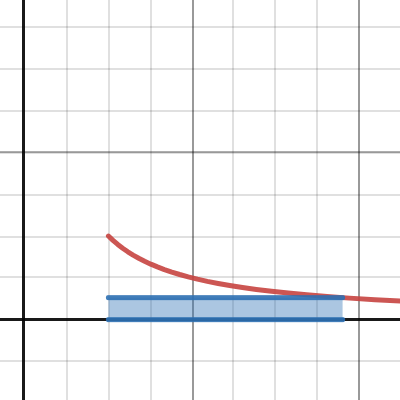 dapper scaffold
i get the diagram but i can only see how it equates to 1/1 + 1/2 + 1/3 + .... 1/t
not 1-1/t
like where does the minus even come from
dapper scaffold
wait why only 1?
clear lily
wait perhaps im mistaken
topaz valley
,w integral from 1 to t of 1/t dx
glossy valveBOT

 glossy valveBOT

 Requested by Gijs#0201
clear lily
clear lily
Requested by Gijs#0201
clear lily
clear lily
this area of the lower sum is (t-1)(1/t) = 1 - 1/t
dapper scaffold
yeah makes sense
wiat
dx
don't you have to make a substituion then? Like for dt?
topaz valley
,w integral from 1 to t of 1+1/t (1 - x) dx
glossy valveBOT
 dapper scaffold
uhh aren't you taking the integral of a completley different function then?
dapper scaffold
glossy valve
but isn't that an entirely different function?
glossy valveBOT
 topaz valley
integrating gives the required result
clear lily
$\leq *$
glossy valveBOT
Gijs
 topaz valley

clear lily
im just complaining about notation
topaz valley
clear lily
everybody know $\leq$ is better than $\le$
glossy valveBOT
Gijs
 clear lily
wait
topaz valley

clear lily
how did you know to add 1/t(1-x)
 faint sigil
Hello I need help
topaz valley
,w 1 + 1/t (1 - x) where x=t
glossy valveBOT
 faint sigil
paimon is 2 feet tall. her feet are 4 feet above the ground. celestia is 29029 feet from the ground. the angle of elevation is 80°. how far does paimon need to fly if she wants to be directly below celestia?
What is the answer?
topaz valley
clear lily
so you just found the line tangent to 1/x?
topaz valley
no
clear lily
is that the linear approximation

 dapper scaffold
.close
full forumBOT
Channel closed
Closed by @dapper scaffold
Use .reopen if this was a mistake.
Available help channel!
Send your question here to claim the channel.
Remember:
• Ask your math question in a clear, concise manner.
• Show your work, and if possible, explain where you are stuck.
• After 15 minutes, feel free to ping <@&286206848099549185>.
• Type the command .close to free the channel when you're done.
• Be polite and have a nice day!
Read #❓how-to-get-help for further information on how to ask a good question, and about conduct in the question channels.
 young bramble
is this better for calculating the sum of an arithmetic series than just doing:
averge(min and max value) * number of elements
n = length of sequence
a = first value
d = difference between any two numbers which are next to each other in the sequence
 full forumBOT
young bramble
is this better for calculating the sum of an arithmetic series than just doing:
...
young bramble
full forumBOT
young bramble
is this better for calculating the sum of an arithmetic series than just doing:
...
young bramble
ok
 narrow pawn
Its the same result but I just use the second one based on standard convention and because of memory
full forumBOT
Channel closed
Closed by @young bramble
Use .reopen if this was a mistake.
young bramble
.reopen
full forumBOT
✅
young bramble
one question
what was the formula to calculate the length of a sequence
nvm i remember
.close
full forumBOT
Channel closed
Closed by @young bramble
Use .reopen if this was a mistake.
Available help channel!
Send your question here to claim the channel.
Remember:
• Ask your math question in a clear, concise manner.
• Show your work, and if possible, explain where you are stuck.
• After 15 minutes, feel free to ping <@&286206848099549185>.
• Type the command .close to free the channel when you're done.
• Be polite and have a nice day!
Read #❓how-to-get-help for further information on how to ask a good question, and about conduct in the question channels.
 calm field
im not sure how to answer the lemma part
 full forumBOT
calm field
im not sure how to answer the lemma part
calm field
full forumBOT
calm field
im not sure how to answer the lemma part
calm field
this is induction
 deft zodiac