#help-28
1 messages · Page 28 of 1
 slate hemlock
 worthy bridge
yeah
slate hemlock
So you have both height and base now
slate hemlock
Yw
 dull escarp
Hi how to multiply decimal
worthy bridge
.close
 full forumBOT
Channel closed
Closed by @worthy bridge
Use .reopen if this was a mistake.
slate hemlock
dull escarp
Hi how to multiply decimal
Open a new channel
dull escarp
how
full forumBOT
 Available help channel!
Send your question here to claim the channel.
Remember:
• Ask your math question in a clear, concise manner.
• Show your work, and if possible, explain where you are stuck.
• After 15 minutes, feel free to ping <@&286206848099549185>.
• Type the command .close to free the channel when you're done.
• Be polite and have a nice day!
Read #❓how-to-get-help for further information on how to ask a good question, and about conduct in the question channels.
 atomic vortex
how would I simplify something like this any further
atomic vortex
(1/x)/(-csc^2(x))
Just so that its to find the derivative of it
I was thinkin of simplifyin it if possible
some guy did -sin^2(x)/x
idk how
All I could do was 1/x(-csc^2(x))
full forumBOT
@atomic vortex Has your question been resolved?
atomic vortex
.close
full forumBOT
Channel closed
Closed by @atomic vortex
Use .reopen if this was a mistake.
Available help channel!
Send your question here to claim the channel.
Remember:
• Ask your math question in a clear, concise manner.
• Show your work, and if possible, explain where you are stuck.
• After 15 minutes, feel free to ping <@&286206848099549185>.
• Type the command .close to free the channel when you're done.
• Be polite and have a nice day!
Read #❓how-to-get-help for further information on how to ask a good question, and about conduct in the question channels.
 bright trellis
Is basic physics problems helpable here?
full forumBOT
bright trellis
Is basic physics problems helpable here?
bright trellis
There is an object(mass isnt known)
This object is pushed by some Force and it traveled 0.4m
When they added 0.2kg on the object with the same force it went only 0.2m
I need to find Mass of the object
bright trellis
Yes
 wide sundial
It doesn’t move distance
bright trellis
Object was still
Then some force pushed it
And it went 0.4m
And in the same time with the same force it but with added 0.2kg it went only 0.2m
 wise wyvern
I'm going to have to ask, when you say it went 0.4m and 0.2m, it's safe to assume we're talking same time?
wide sundial
That force has to be applied over some timeframe for the object to move
bright trellis
wise wyvern
I'm going to have to ask, when you say it went 0.4m and 0.2m, it's safe to assum...
Yes
wise wyvern
Okay. That makes more sense.
Then x is proportional to acceleration.
Acceleration is inversely proportional to mass.
Use that.
wide sundial
wise wyvern
I'm going to have to ask, when you say it went 0.4m and 0.2m, it's safe to assum...
Ah that is a lot better way to ask what I was trying to ask haha
 dawn glacier
Help
wise wyvern
bright trellis
wise wyvern
Acceleration is inversely proportional to mass.
Yes
Then im gonna = them right?
wise wyvern
equate what
bright trellis
F=ma
F=(m+0.2)a
full forumBOT
Channel closed
Closed by @bright trellis
Use .reopen if this was a mistake.
Available help channel!
Send your question here to claim the channel.
Remember:
• Ask your math question in a clear, concise manner.
• Show your work, and if possible, explain where you are stuck.
• After 15 minutes, feel free to ping <@&286206848099549185>.
• Type the command .close to free the channel when you're done.
• Be polite and have a nice day!
Read #❓how-to-get-help for further information on how to ask a good question, and about conduct in the question channels.
 half remnant
how are you supposed to work out these pronumerals?
 half remnant
ik that there are 2 angles equal to 90
do you have to prove TOP is an equilateral triangle or smth
 simple totem
is there more information than this?
do we know OPA is straight
heck even then alpha could be anything < 90 if you make TA long enough
half remnant
simple totem
is there more information than this?
im assuming that OPA is straight, O is the centre and TA is a tangent
ive figured out that a = 2b
simple totem
that looks about right, but im still not sure if you can solve for all angles without some more info
half remnant
damn alr
simple totem
is anything else given to you?
half remnant
nope
simple totem
what were you asked to do
 simple totem
well it doesn't have to be
half remnant
yeah
simple totem
i think there's a missing dash on one of these edges to show they're equal to the radius (probably the chord)
in which case TOP is indeed equilateral and this is very solvable
half remnant
yeah if TP had a dash this would be solveable
alas, it does not
I will skip this question for now. Thanks for the help though
.close
full forumBOT
Channel closed
Closed by @half remnant
Use .reopen if this was a mistake.
full forumBOT
✅
half remnant
oh u meant that
half remnant
alralr
simple totem
so OT = OP right
half remnant
mhm
half remnant
simple totem
and TA^2 = (2OT)^2 - OT^2
isnt it OA*PA
simple totem
instead of what
half remnant
instead of (2OT)^2 - OT^2
half remnant
its like this thing
 half remnant
simple totem
i was just using pythagoras
half remnant
simple totem
i was just using pythagoras
ohhh
 simple totem
this is an x, 2x, xroot3 triangle right?
half remnant
yes
simple totem
so the angles should be trivial. are you allowed trigonometry?
half remnant
simple totem
so the angles should be trivial. are you allowed trigonometry?
yes
ohh OTA = 30
simple totem
then sin(gamma) = x/2x = 1/2 -> gamma=30
half remnant
coz -sin(30
yeahh
ok this is starting to click
and A is 60
since the identity sqrt3/2
yes yes yes i get this
thank you so much 🙏🙏🙏🙏🙏🙏🙏
.close
full forumBOT
Channel closed
Closed by @half remnant
Use .reopen if this was a mistake.
Available help channel!
Send your question here to claim the channel.
Remember:
• Ask your math question in a clear, concise manner.
• Show your work, and if possible, explain where you are stuck.
• After 15 minutes, feel free to ping <@&286206848099549185>.
• Type the command .close to free the channel when you're done.
• Be polite and have a nice day!
Read #❓how-to-get-help for further information on how to ask a good question, and about conduct in the question channels.
 dense raft
Can someone explain how this works? They moved out the V, but im confused how.
 full forumBOT
dense raft
Can someone explain how this works? They moved out the V, but im confused how.
dense raft
full forumBOT
dense raft
Can someone explain how this works? They moved out the V, but im confused how.
dense raft
right
 torn jolt
Then multiplied both sides by 1/t
to get 2s/t = v_0+v
Then they subtracted both sides of v_0
To get v = (2s)/t - v_0
dense raft
im just thinking im not gone 😛
torn jolt

dense raft
ok got it thank you very much. so the 2 being inside the () doesnt matter?
as in you can normally multiply both sides with it
torn jolt
I mean it was improper of me to multiply both sides by 2 first
But you would preferably multiply both sides by 1/t first
dense raft
right, doing that would remove the ()
and you would reach the same conclusion, sweet 😄
thakn you, much appreciated.
.close
full forumBOT
Channel closed
Closed by @dense raft
Use .reopen if this was a mistake.
torn jolt
dense raft
and you would reach the same conclusion, sweet 😄
Yeppie
full forumBOT
Available help channel!
Send your question here to claim the channel.
Remember:
• Ask your math question in a clear, concise manner.
• Show your work, and if possible, explain where you are stuck.
• After 15 minutes, feel free to ping <@&286206848099549185>.
• Type the command .close to free the channel when you're done.
• Be polite and have a nice day!
Read #❓how-to-get-help for further information on how to ask a good question, and about conduct in the question channels.
 glacial swift
 full forumBOT
glacial swift
full forumBOT
glacial swift
 latent cobalt
How far are you on this problem?
glacial swift
latent cobalt
How far are you on this problem?
Sorry so far im stuck i think i got a rough idea of what to do
latent cobalt
Ok, and what are you thinking so far/where are you stuck?
glacial swift
Its a related rates problem i think so i have 2 sin pi = 2
I got no idea if this is right tho
glacial swift
latent cobalt
Ok, and what are you thinking so far/where are you stuck?
Am i slightly on track?
latent cobalt
That's not what I got
glacial swift
Oh 😭 could u explain
latent cobalt
So what did you get when you took the derivative of y cos(x) = 2x?
glacial swift
Dy/d tsin(x) =2 dx/dt right?
latent cobalt
I think you forgot the y on your left hand side
You should be using product rule here
latent cobalt
I don't think so, I think your product rule should give you something more complicated
glacial swift
Sorry im kinda blanking
latent cobalt
So for product rule, you have f(x)g'(x)+f'(x)f(x) right?
latent cobalt
well on the LHS, you have y cos(x) right?
glacial swift
Yep
latent cobalt
So, f(x) = y, and g(x) = cos(x). What are your f'(x) and g'(x)?
glacial swift
F would be y' and g would be sin x
latent cobalt
g' would not be sin(x)
glacial swift
-sin?
latent cobalt
Since you are taking the derivative with respect to t, you have to use the chain rule on it
And yes it also needs to be negative
Do you know the chain rule?
latent cobalt
If we were taking the derivative with respect to x, yes, but we are taking it wrt to t
glacial swift
-sin(x) dx/dt?
latent cobalt
Yep!
glacial swift
So something like this?!
 latent cobalt
I'm not quite sure what you are showing me
latent cobalt
Not quite, you've made another error somewhere, but we are definitely on the right track. What did you get for the derivative of the equation?
glacial swift
The derivative i got y-sin(x)+dy/dt cos(x) dx/dt
 latent cobalt
Ok, so it should be f'(x)g(x)+f(x)g'(x), you have an extra addition in there
Also the dy\dt cos(x) should not be negative
latent cobalt
Do you understand what we have gone over so far?
glacial swift
Yep!
latent cobalt
Cool, so you can keep solving it and let me know if you get stuck/what answer you get and we can go from there?
 latent cobalt
Yes it isn't y-sin(x) it is y*(-sin(x)). Does that make sense?
glacial swift
Yes please
latent cobalt
We are getting close here, and your doing great lol
glacial swift
Ok i really appreciate ur help
latent cobalt
glacial swift
Ok i really appreciate ur help
How is it going?
glacial swift
latent cobalt
How is it going?
Im working on it rn
Ngl im kinda stuck but heres what i got so far
 latent cobalt
I think we are running into an issue with the RHS of you equation. What is the derivative of 2x in this case?
glacial swift
2x is just 2?
latent cobalt
If we were taking it with respect to x, but remember, we are taking the derivative with respect to t
glacial swift
So its 2 dx/dt?
latent cobalt
Yep!
I think right now you might be able to get it right, because what you had before that was very close to being right
glacial swift
So the 0 cancels out both y and dx/dt then i divide the 2 out on both sides and get -1= dx/dt?
latent cobalt
YES!!!!!
latent cobalt
Haha, I'm majoring in math at college, so I have the advantage of spending all my time doing it
glacial swift
Yeah i make way too many mistakes when it comes to math
latent cobalt
Haha, I feel that. TBH I'm actually just procrastinating my HW by helping other people tonight
My stuff was to hard so I decided to take a break
latent cobalt
I wish I could, but it's 4 AM where I live and I have to go to bed. But if you want you can dm me and I'll help you with it tomorrow
glacial swift
Ok tyy! Goodnight
latent cobalt
No problem. Goodnight!
glacial swift
.close
full forumBOT
Channel closed
Closed by @glacial swift
Use .reopen if this was a mistake.
full forumBOT
Available help channel!
Send your question here to claim the channel.
Remember:
• Ask your math question in a clear, concise manner.
• Show your work, and if possible, explain where you are stuck.
• After 15 minutes, feel free to ping <@&286206848099549185>.
• Type the command .close to free the channel when you're done.
• Be polite and have a nice day!
Read #❓how-to-get-help for further information on how to ask a good question, and about conduct in the question channels.
 next basalt
I need some help with logarithms.
40 = 10^x -0,2 * 10^x
 cold quarry
@next basalt 10^x is common on the right side of equation so factor it out
 next basalt
Hmm
cold quarry
ya
full forumBOT
Channel closed
Closed by @next basalt
Use .reopen if this was a mistake.
Available help channel!
Send your question here to claim the channel.
Remember:
• Ask your math question in a clear, concise manner.
• Show your work, and if possible, explain where you are stuck.
• After 15 minutes, feel free to ping <@&286206848099549185>.
• Type the command .close to free the channel when you're done.
• Be polite and have a nice day!
Read #❓how-to-get-help for further information on how to ask a good question, and about conduct in the question channels.
 jovial dagger
i need help with calulating a bore stonke and pistion zise for a 8 culinder engine
full forumBOT
jovial dagger
i need help with calulating a bore stonke and pistion zise for a 8 culinder engi...
jovial dagger
1 pistion has 93.75cc on 1 cylinder but how big dose the pistion need to be and how long dose the stoke need to be to make that work
(need) 750cc spit on 8 cylinders
what is the bore stroke and pistion size
full forumBOT
@jovial dagger Has your question been resolved?
jovial dagger
how many times do i need to devide 3622 to get to 750
16,15129874042647 bore
19,67145359410917 stoke
full forumBOT
@jovial dagger Has your question been resolved?
Channel closed
Closed by @jovial dagger
Use .reopen if this was a mistake.
full forumBOT
Available help channel!
Send your question here to claim the channel.
Remember:
• Ask your math question in a clear, concise manner.
• Show your work, and if possible, explain where you are stuck.
• After 15 minutes, feel free to ping <@&286206848099549185>.
• Type the command .close to free the channel when you're done.
• Be polite and have a nice day!
Read #❓how-to-get-help for further information on how to ask a good question, and about conduct in the question channels.
@barren escarp Has your question been resolved?
full forumBOT
@barren escarp Has your question been resolved?
full forumBOT
@barren escarp Has your question been resolved?
full forumBOT
Channel closed
Closed due to the original message being deleted
Available help channel!
Send your question here to claim the channel.
Remember:
• Ask your math question in a clear, concise manner.
• Show your work, and if possible, explain where you are stuck.
• After 15 minutes, feel free to ping <@&286206848099549185>.
• Type the command .close to free the channel when you're done.
• Be polite and have a nice day!
Read #❓how-to-get-help for further information on how to ask a good question, and about conduct in the question channels.
 void arch

 frosty geyser
void arch
Is that essentially SSS and more
frosty geyser
void arch
Is that essentially SSS and more
seems like it, SS to SSSS
frosty geyser
English isnt my main language so Im not sure if consecutive includes the first element
It could also mean SSS and SSSS
From examples I find online it says that {1,2,3} are 3 consecutive numbers
full forumBOT
@void arch Has your question been resolved?
full forumBOT
Channel closed
Closed due to timeout
Use .reopen if this was a mistake.
Available help channel!
Send your question here to claim the channel.
Remember:
• Ask your math question in a clear, concise manner.
• Show your work, and if possible, explain where you are stuck.
• After 15 minutes, feel free to ping <@&286206848099549185>.
• Type the command .close to free the channel when you're done.
• Be polite and have a nice day!
Read #❓how-to-get-help for further information on how to ask a good question, and about conduct in the question channels.
 next abyss
 full forumBOT
next abyss
full forumBOT
next abyss

 ivory cairn
you were given the coordinate vector of x, and the basis.
x is the linear combination of of the basis vectors with the coefficients of the coordinate vector
What you did was the process to find the coordinate vector
you should do the product of the basis matrix with the coordinate vector to find the original x vector.
B*[x]_B
next abyss
ivory cairn
B*[x]_B
I'm confused by what this means
ivory cairn
put the vectors of B into a matrix.
Multiply by [x]_B
full forumBOT
@next abyss Has your question been resolved?
full forumBOT
@next abyss Has your question been resolved?
full forumBOT
Channel closed
Closed due to timeout
Use .reopen if this was a mistake.
full forumBOT
Available help channel!
Send your question here to claim the channel.
Remember:
• Ask your math question in a clear, concise manner.
• Show your work, and if possible, explain where you are stuck.
• After 15 minutes, feel free to ping <@&286206848099549185>.
• Type the command .close to free the channel when you're done.
• Be polite and have a nice day!
Read #❓how-to-get-help for further information on how to ask a good question, and about conduct in the question channels.
 hushed cairn
prove that . if n is a perfect square then 2n cannot be a perfect square ?
full forumBOT
hushed cairn
prove that . if n is a perfect square then 2n cannot be a perfect square ?
cold quarry
if n is a perfect square then sqrt(n) gives a integer. but sqrt(2n) = sqrt(2)*sqrt(n) doesnt give a integer since its multiplied by sqrt(2)
full forumBOT
@hushed cairn Has your question been resolved?
hushed cairn
cold quarry
if n is a perfect square then sqrt(n) gives a integer. but sqrt(2n) = sqrt(2)*sq...
oh so when sqrt(2) times n then it dont equal perfect square
 rare dock
a positive integer is a perfect square iff all the primes in its prime factorization have even exponents
full forumBOT
@hushed cairn Has your question been resolved?
full forumBOT
Channel closed
Closed due to timeout
Use .reopen if this was a mistake.
Available help channel!
Send your question here to claim the channel.
Remember:
• Ask your math question in a clear, concise manner.
• Show your work, and if possible, explain where you are stuck.
• After 15 minutes, feel free to ping <@&286206848099549185>.
• Type the command .close to free the channel when you're done.
• Be polite and have a nice day!
Read #❓how-to-get-help for further information on how to ask a good question, and about conduct in the question channels.
 twin wolf
For 5a) how would we do that
 full forumBOT
twin wolf
For 5a) how would we do that
full forumBOT
full forumBOT
twin wolf
For 5a) how would we do that
full forumBOT
@twin wolf Has your question been resolved?
wise wyvern
twin wolf
So it would be numbers above than 5?
If you're talking (a) then, not quite.
You don't want the distance to be greater than 5. Nor do you want it to be less than 5. You want it to be exactly 5. From origin.
so if you have your point (a,b) the distance of that point from origin should be 5. How'd you do that? Well, there's distance formula.
full forumBOT
Channel closed
Closed due to timeout
Use .reopen if this was a mistake.
Available help channel!
Send your question here to claim the channel.
Remember:
• Ask your math question in a clear, concise manner.
• Show your work, and if possible, explain where you are stuck.
• After 15 minutes, feel free to ping <@&286206848099549185>.
• Type the command .close to free the channel when you're done.
• Be polite and have a nice day!
Read #❓how-to-get-help for further information on how to ask a good question, and about conduct in the question channels.
 faint scarab
During foil, can i say -L * -L = L^2 or is it -L^2?
faint scarab
it affects the trinomial i am factoring
 eager violet
A negative times a negative is a positive
faint scarab
Okay, so i CAN give it a positive coeffecient?
faint scarab
Just a thing ig i never learned. Although the answer to any L would be positive in that place i didnt know if it has a coeffecient of 1, or if "it has a -1 coeffecient but when you plug in L it will go away"
eager violet
L has a positive coefficient but that doesn't mean L is positive
Idk what exactly you're saying
faint scarab
Okay so, im finding an eigenvalue. I have the equation like (-x -4) (-x -3). Dont know if the proper foil should result in x^2 + 3x + 4x + 12
eager violet
It should, yes
full forumBOT
Channel closed
Closed by @faint scarab
Use .reopen if this was a mistake.
Available help channel!
Send your question here to claim the channel.
Remember:
• Ask your math question in a clear, concise manner.
• Show your work, and if possible, explain where you are stuck.
• After 15 minutes, feel free to ping <@&286206848099549185>.
• Type the command .close to free the channel when you're done.
• Be polite and have a nice day!
Read #❓how-to-get-help for further information on how to ask a good question, and about conduct in the question channels.
 fathom arrow
 fathom arrow
i have one try left
why 4 is wrong?
the critical points i have are 3 and 1
i tried those
f(-1) = 12
f(1) = 8
f(3) = 4
f(6) = 58
it should be 4?
oh -1 is actually -12
that's the one?
 rain quail
someone tell me what is science notation
 short latch
open a new channel
short latch
fathom arrow
that's the one?
yup!
fathom arrow
short latch
yup!
thank u
short latch
definitely -1
 fathom arrow
yeah i put it in and it is right
fathom arrow
.close
full forumBOT
Channel closed
Closed by @fathom arrow
Use .reopen if this was a mistake.
Available help channel!
Send your question here to claim the channel.
Remember:
• Ask your math question in a clear, concise manner.
• Show your work, and if possible, explain where you are stuck.
• After 15 minutes, feel free to ping <@&286206848099549185>.
• Type the command .close to free the channel when you're done.
• Be polite and have a nice day!
Read #❓how-to-get-help for further information on how to ask a good question, and about conduct in the question channels.
 rare zenith
How to find the gradient of $\frac{z}{\sqrt{x^2+y^2+z^2}}$
full forumBOT
rare zenith
How to find the gradient of $\frac{z}{\sqrt{x^2+y^2+z^2}}$
Please don't occupy multiple help channels.
 glossy valveBOT
todadqa
 rare zenith
I can see that the gradient of $\abs{x}^2 is (2x, 2y, 2z)$
glossy valveBOT
todadqa
 full forumBOT
@rare zenith Has your question been resolved?
rare zenith
.close
full forumBOT
Channel closed
Closed by @rare zenith
Use .reopen if this was a mistake.
Available help channel!
Send your question here to claim the channel.
Remember:
• Ask your math question in a clear, concise manner.
• Show your work, and if possible, explain where you are stuck.
• After 15 minutes, feel free to ping <@&286206848099549185>.
• Type the command .close to free the channel when you're done.
• Be polite and have a nice day!
Read #❓how-to-get-help for further information on how to ask a good question, and about conduct in the question channels.
 spiral bronze
how can i integrate this to get the answer
 full forumBOT
spiral bronze
how can i integrate this to get the answer
full forumBOT
spiral bronze
how can i integrate this to get the answer
 torn jolt
spiral bronze
i get the first 1/5v^5 but dont know what to do to get the rest
torn jolt
spiral bronze
i get the first 1/5v^5 but dont know what to do to get the rest
convert the q into indices format ; do each of them seperately
so for -3/2 sqrt(v^5) ==
-3/2 v^{5/2}
spiral bronze
ive never had to use indeces format and i have no clue how to apply it to this im bad with fractions
torn jolt
torn jolt
so for -3/2 sqrt(v^5) ==
-3/2 v^{5/2}
.
spiral bronze
torn jolt
so for -3/2 sqrt(v^5) ==
-3/2 v^{5/2}
right
spiral bronze
same for 6 v^{1/8}
torn jolt
suppose its just v^{5/2} ; integrate it and then multyiply the ans by -3/2 after all done and then simplify
yes
spiral bronze
torn jolt
so for -3/2 sqrt(v^5) ==
-3/2 v^{5/2}
hold on where did the /2 come from here, is it just assumed because its sqrt its ^1/2 so place the top number over 2
forget that question i got that
torn jolt
spiral bronze
forget that question i got that
k
spiral bronze
so now ive got
 torn jolt
some weird formatting at the end i sppose
spiral bronze
spiral bronze
im supposed to have gotten very similar to this format though
whats this
torn jolt
the final answer
spiral bronze
my book and an integral calculator both get different answers than yours for some reason
spiral bronze
spiral bronze
i have shown it
spiral bronze
correct
torn jolt
i trust tht book ans
but uhh
thats weird
yes
book is correct @spiral bronze
so did u get it?
spiral bronze
nope hes pulling the denominators out of thin air
spiral bronze
I get everything he does until the last fraction
torn jolt
YE
the last fract of book is rong

this is wat i get wen i do nd ye
16/3 x^9/8 shud be right
book last fract is rong
they prob did a misprint etc
.
@spiral bronze
spiral bronze
.close
full forumBOT
Channel closed
Closed by @spiral bronze
Use .reopen if this was a mistake.
Available help channel!
Send your question here to claim the channel.
Remember:
• Ask your math question in a clear, concise manner.
• Show your work, and if possible, explain where you are stuck.
• After 15 minutes, feel free to ping <@&286206848099549185>.
• Type the command .close to free the channel when you're done.
• Be polite and have a nice day!
Read #❓how-to-get-help for further information on how to ask a good question, and about conduct in the question channels.
torn jolt
I am not sure how to solve it with this formula
 full forumBOT
torn jolt
I am not sure how to solve it with this formula
simple totem
full forumBOT
torn jolt
I am not sure how to solve it with this formula
simple totem
the limit they gave you gives you the slope of the tangent at x=a
so if you want the slope of the tangent at x=2, you'd want to find the limit $\lim_{h\to 0}\frac{f(2+h)-f(2)}{h}$
glossy valveBOT
maximo
 torn jolt
simple totem
so if you want the slope of the tangent at x=2, you'd want to find the limit $\l...
torn jolt
simple totem
so if you want the slope of the tangent at x=2, you'd want to find the limit $\l...
okay and I can do that by inputting a very small number for h?
simple totem
i mean kind of but that's not in the spirit of the question
torn jolt
simple totem
i mean kind of but that's not in the spirit of the question
how do I solve it that way then?
simple totem
compute f(2+h) and f(2), and do some algebra until you can plug in h = 0 and get a number
have you done limits before?
torn jolt
simple totem
compute f(2+h) and f(2), and do some algebra until you can plug in h = 0 and get...
This look better?
 simple totem
looks good
full forumBOT
Channel closed
Closed by @slow granite
Use .reopen if this was a mistake.
Available help channel!
Send your question here to claim the channel.
Remember:
• Ask your math question in a clear, concise manner.
• Show your work, and if possible, explain where you are stuck.
• After 15 minutes, feel free to ping <@&286206848099549185>.
• Type the command .close to free the channel when you're done.
• Be polite and have a nice day!
Read #❓how-to-get-help for further information on how to ask a good question, and about conduct in the question channels.
 cursive badger
 full forumBOT
cursive badger
cursive badger
full forumBOT
cursive badger
cursive badger
hi guys quick question
what happens with the 2
after sin
do i times the bracket
or flip it to other side
 forest widget
not a fan of the notation at all, but it's equivalent to
$2 \sin (2(\frac{x}{4}-\frac{\pi}{3}))$
glossy valveBOT
IV
 cursive badger
so times the bracket
full forumBOT
@cursive badger Has your question been resolved?
cursive badger
.close
full forumBOT
Channel closed
Closed by @cursive badger
Use .reopen if this was a mistake.
Available help channel!
Send your question here to claim the channel.
Remember:
• Ask your math question in a clear, concise manner.
• Show your work, and if possible, explain where you are stuck.
• After 15 minutes, feel free to ping <@&286206848099549185>.
• Type the command .close to free the channel when you're done.
• Be polite and have a nice day!
Read #❓how-to-get-help for further information on how to ask a good question, and about conduct in the question channels.
 tired perch
Hey guys, could someone please try and explain the definition of a direct sum of vector spaces ?
full forumBOT
tired perch
Hey guys, could someone please try and explain the definition of a direct sum of...
tired perch
Especially in a dimension > 2
 fast peak
well for starters, what is the definition and what do you not get about it
tired perch
fast peak
well for starters, what is the definition and what do you not get about it
I can seem to find a convenient definition in english 🙁

E1,…Ep are "under" vector spaces of E
fast peak
"subspaces"
tired perch
Subspaces thank you
The regular sum is the first equation
The direct sum is the second one
I’m having trouble visualising a direct sum in a vector space
 fast peak
well can you visualise the regular sum?
tired perch
For example these 3 vectors aren’t a direct sum yet they fill out the whole space right ? I’m so confused
tired perch
fast peak
well can you visualise the regular sum?
Good point, i’m not too sure to be honest
fast peak
if anything, the span of those vectors is the whole space
tired perch
I guess you just sum up each vector and end up with a point, a line or a apace ?
fast peak
not the vectors themselves
but we are talking about adding subspaces, not adding vectors
tired perch
fast peak
if anything, the span of those vectors is the whole space
Yes that’s what i meant mb, the direct sum is looking at the sum of the span of each vector
But the definition is for all vectors of the subspaces
fast peak
lets try to add two lines "visually" and then figure out how this corresponds to the addition of certain vectors in those subspaces given by the lines
tired perch
In this particular combination of vectors, the definition says that the 3 subspaces engendered by these 3 vectors is not a direct sum right ?
fast peak
you can imagine taking one of the lines and sliding it along the second one

Desmos
something like this
tired perch
The sum would give us 1 unique line right ?
Which corresponds to the sum of every combination of vectors on each line yes ?
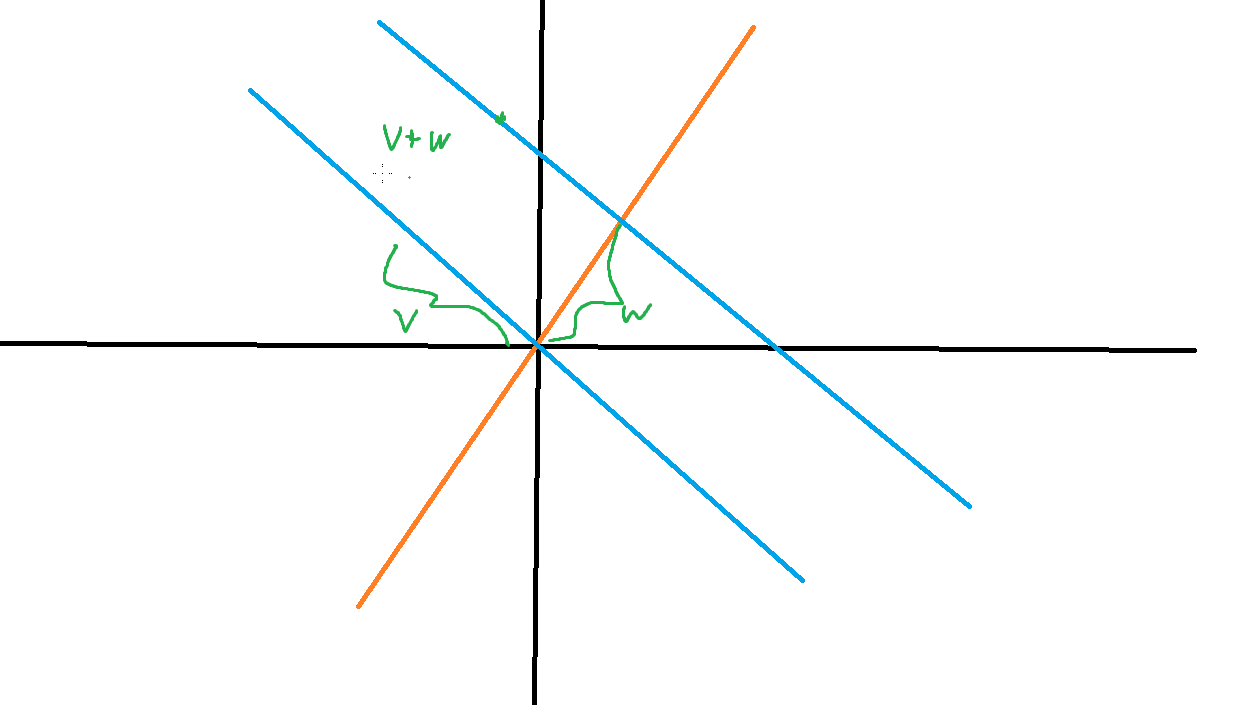 tired perch
I follow 👍
fast peak
clearly v and w are linearly independent so if you take all possible combinations of them you reach the whole space
which you can imagine as sliding the blue line until it intersects with the orange one at a_1*w and then going along the blue line to a_2*v
tired perch
Yes 👍
fast peak
and we see that just with the two lines we already reach the whole space, we don't need a third one
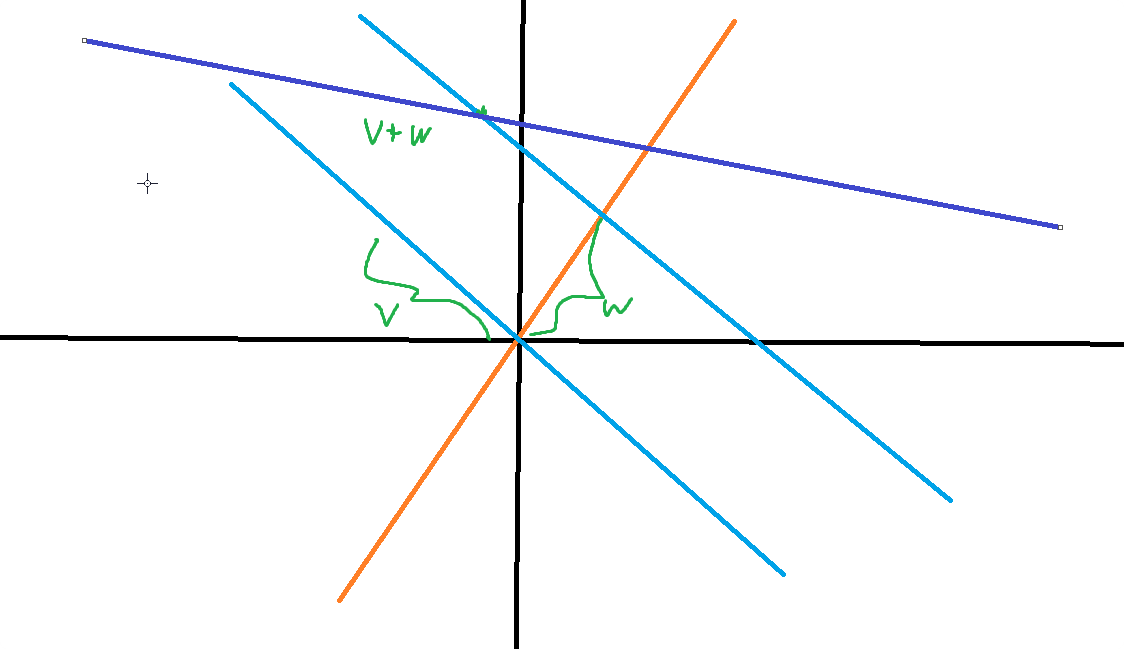
we could imagine taking a third line and sliding it along the blue one while the blue one slides along the orange one
tired perch
The bottom blue line right ?
fast peak

Desmos
something like this
although hmm no that isn't that nice
urgh I don't really wanna think about the relevant functions I need
tired perch
Yeah never mind i’m out of time need to get back at it
fast peak
ok
tired perch
Thx for trying to help bro, appreciate you @fast peak ❤️
fast peak
anyway the point is, direct sums are just those where we don't have "unnecessary lines"
like the purple one here
fast peak
they are still like the other sums, just "more efficient"
and if you wanna think about it in terms of linear independence, the basis vectors of the relevant subspaces are all linearly independent
which gets you an obvious choice for a basis for the sum
tired perch
That’s what was fucking with me
I was wondering if they had to be linearly independent
fast peak
but here if we wanted to build a basis out of the basis vectors for the orange, blue and purple line, we know that we need two of them but there is no obvious choice which two of the three we should choose. while before when we just had the two lines, we just take the two basis vectors and are done
yes try proving that this is the case from the definition
it follows pretty fast
tired perch
fast peak
which gets you an obvious choice for a basis for the sum
What do you mean ? You just take all the basis vectors and create a basis vector for the sum right ?
fast peak
yes you combine all the bases of the subspaces and get a basis for the sum
while with a regular sum you can't do that, you might end up with too many vectors
full forumBOT
Channel closed
Closed by @tired perch
Use .reopen if this was a mistake.
full forumBOT
Available help channel!
Send your question here to claim the channel.
Remember:
• Ask your math question in a clear, concise manner.
• Show your work, and if possible, explain where you are stuck.
• After 15 minutes, feel free to ping <@&286206848099549185>.
• Type the command .close to free the channel when you're done.
• Be polite and have a nice day!
Read #❓how-to-get-help for further information on how to ask a good question, and about conduct in the question channels.
 stray cloak
Hello, I've been stuck in this question: $\phi: G \rightarrow G$ bijective, $\phi(ab)=\phi(a)b, \forall a, b \in G$. Must $\phi$ be an isomorphism?
Well, it isn't because then it necessitates that $\phi(b) = b$ which isn't always the case. But i can't really seem to give a convincing proof for it.
full forumBOT
stray cloak
Hello, I've been stuck in this question: $\phi: G \rightarrow G$ bijective, $\ph...
glossy valveBOT
soda
 full forumBOT
@stray cloak Has your question been resolved?
 stable plover
stray cloak
Hello, I've been stuck in this question: $\phi: G \rightarrow G$ bijective, $\ph...
stable plover
stray cloak
Hello, I've been stuck in this question: $\phi: G \rightarrow G$ bijective, $\ph...
what is \bar{G}?
stray cloak
stable plover
what is \bar{G}?
Oh sorry. They’re both groups
stable plover
stray cloak
Oh sorry. They’re both groups
it's just an arbitrary group?
well it has to contain G
stray cloak
stable plover
it's just an arbitrary group?
yep they're just arbitrary groups
wait no, I was wrong
there's no G bar
rewrite: $\phi: G \rightarrow G$ bijective, $\phi(ab)=\phi(a)b, \forall a, b \in G$. Must $\phi$ be an isomorphism?
glossy valveBOT
soda
 stable plover
you just need to check that $\phi$ is a homomorphism
you're given the property that $\phi(ab) = \phi(a)b$ for all $a$ and $b$ in $G$, so you can deduce (as you have done) that $\phi(b) = b$ for all $b$ in $G$
then the homomorphism property follows by combining the two equations
glossy valveBOT
tushar
 stray cloak
I see, so since $\phi = \phi^{-1}$, we got 2-way homomorphism = isomorphism
glossy valveBOT
soda
 stray cloak
actually i'm not sure about $\phi = \phi^{-1}$...
glossy valveBOT
soda
 stable plover
bijection + homomorphism = isomorphism
it is the case that the inverse of a bijection is a bijection, the inverse of a homomorphism a homomorphism, the inverse of an isomorphism an isomorphism, but i don't think that's related to this problem
you're given that it's a bijection
and bijection <=> invertible
but you know nothing about the behavior of the inverse function
stable plover
stray cloak
I see, so since $\phi = \phi^{-1}$, we got 2-way homomorphism = isomorphism
homomorphism from G to G' and homomorphism from G' to G does not imply isomorphic
not sure if that's what you're saying
stray cloak
stable plover
homomorphism from G to G' and homomorphism from G' to G does not imply isomorphi...
yea, that's what i was wondering about
thank you!
stable plover
e.g. you can have trivial homomorphisms between any two groups
full forumBOT
Channel closed
Closed by @stray cloak
Use .reopen if this was a mistake.
Available help channel!
Send your question here to claim the channel.
Remember:
• Ask your math question in a clear, concise manner.
• Show your work, and if possible, explain where you are stuck.
• After 15 minutes, feel free to ping <@&286206848099549185>.
• Type the command .close to free the channel when you're done.
• Be polite and have a nice day!
Read #❓how-to-get-help for further information on how to ask a good question, and about conduct in the question channels.
 coral rapids
 full forumBOT
coral rapids
full forumBOT
coral rapids
 sharp vine
rewrite it as quadratic equation in terms of x
 trail oasis
Yes developp the square
full forumBOT
@coral rapids Has your question been resolved?
full forumBOT
Channel closed
Closed due to timeout
Use .reopen if this was a mistake.
Available help channel!
Send your question here to claim the channel.
Remember:
• Ask your math question in a clear, concise manner.
• Show your work, and if possible, explain where you are stuck.
• After 15 minutes, feel free to ping <@&286206848099549185>.
• Type the command .close to free the channel when you're done.
• Be polite and have a nice day!
Read #❓how-to-get-help for further information on how to ask a good question, and about conduct in the question channels.
 sleek brook
is this correct?
 full forumBOT
sleek brook
is this correct?
full forumBOT
sleek brook
is this correct?
 sharp flame
Yup
torn jolt
Yes
 sharp flame
Yes
sleek brook
so both answers are correct?
sharp flame
There's also a third correct answer 😂
 karmic elbow
they are equivalent
sharp flame
But yes both are correct
full forumBOT
Channel closed
Closed by @sleek brook
Use .reopen if this was a mistake.
Available help channel!
Send your question here to claim the channel.
Remember:
• Ask your math question in a clear, concise manner.
• Show your work, and if possible, explain where you are stuck.
• After 15 minutes, feel free to ping <@&286206848099549185>.
• Type the command .close to free the channel when you're done.
• Be polite and have a nice day!
Read #❓how-to-get-help for further information on how to ask a good question, and about conduct in the question channels.
 summer ibex
 full forumBOT
summer ibex
summer ibex
full forumBOT
summer ibex
summer ibex
how do i solve this
its a bonus on my old test im reviewing it
and just one thing to is R(x+2)
is R like a polynomial or a varialble
sharp flame
The roots of the equation are then -b/a and 0
summer ibex
but in question a it says prove R(2) = 0 and with my anwser it will be 4
?
wait a=0 too right
summer ibex
cause we dont have a x² just a x
sharp flame
But you know that 2 is also a solution
summer ibex
idk what a quadratic is
sharp flame
You can just construct the equation I mean
summer ibex
i know like the ax³ + bx² +cx +d =0 thing on the calc only
summer ibex
im not usa so its not like that man
sharp flame
Yeah it is
summer ibex
ohh
sharp flame
11
summer ibex
nice
wait
doesnt that create an infinate pardox.
like you can keep replacing R(x+2)
in R(x)
i think i almost got it
sharp flame
Nope
It simply means that the polynomial evaluated at x
Gives the same value if evaluated at x + 2 and you add 2x
sharp flame
Sorry I don't have paper on me right now
summer ibex
its fine
sharp flame
How did you get that relation between a and b
summer ibex
im doing it
ok so
wait
i did something wrong one sec
i forgot the +2x
doesnt matter its still correct
okay so
i did the R(x)=R(x+2)+2x
than i made R(0)=0
stable plover
what are you working on? are you trying to show that R(2) = 0?
summer ibex
stable plover
what are you working on? are you trying to show that R(2) = 0?
yea im tryna solve the bonus
stable plover
summer ibex
i did the R(x)=R(x+2)+2x
substitute x = 0 into this equation
summer ibex
than the new R(x) we do a bunch of things and get
stable plover
that'll give you R(2) = 0
summer ibex
wait ill just get it for u
sharp flame
ax^2 + bx = a(x + 2)^2 + b(x + 2) + 2x
summer ibex
what
sharp flame
You did this right?
summer ibex
wait but its inside the paranthesis
stable plover
you can solve a) by simply substituting x = 2 and x = -2 into R(x) = R(x+2) + 2x
summer ibex
 karmic elbow
I suggest you do this question in order of a) then b)
 sharp flame
It is
karmic elbow
R(x+2) is a polynomial
sharp flame
What you did is right
stable plover
karmic elbow
I suggest you do this question in order of a) then b)
this
part a) will help you solve part b)
stable plover
you're done
summer ibex
ok
karmic elbow
^
stable plover
R(0) = 0
summer ibex
stable plover
you're done
?
stable plover
so simplify the terms on each side
summer ibex
stable plover
R(0) = 0
yes
stable plover
summer ibex
ok than how can u make it R(0)=R(0+2)+2x0
R(0) = R(2)
summer ibex
summer ibex
u cant go inside the polynomial right
^
stable plover
and you're given R(0) = 0
stable plover
summer ibex
u cant go inside the polynomial right
i don't follow what this means, but you're simply asked to show R(2) = 0
summer ibex
ok so what u are saying works but what i mean is
if P(x)=P(x+2)+whatever
if you subsitute x for lets say 3
when u do P(3)=P(x+2)<-- this paranthesis i should not be able to go in and say x=3
karmic elbow
Why wouldn't you be able to
P is a function. P(x) is a function of x. You can manipulate the parameters however you'd like
karmic elbow
Have you found the answers to a) yet?
karmic elbow
I feel like Neon might've misled you a bit on this specific question. There's no need to find the vertex of the parabola, there's a much cleaner solution
summer ibex
?
karmic elbow
Given that you know
- c = 0
- When x is 0, R(0) = 0
- When x is 2, R(2) = 0
- When x is -2, R(-2) = -4
You can solve this through factored form algebra
karmic elbow
Standard form of a quadratic equation can be translated into a factored form, if you know the roots.
Roots of a polynomial equation is basically which values of x = 0 for R(x).
We know that R(0) = 0, and R(2) = 0, meaning that when x - 2 = 0, and x = 0
You can put this in the form of a*(x-0)(x-2) = 0, for whatever the value of 'a' is.
This is simplified to ax(x-2) = 0. We can solve for a if we have a point besides the roots, such as R(-2) = -4
Plug this in, a(-2)(-2 - 2) = -4, and solve for a. You then have a. If you plug the value of a back into the factored form, you can multiply out the brackets to get the standard form ax^2 + bx + c
summer ibex
i can start my workout now
summer ibex
karmic elbow
Standard form of a quadratic equation can be translated into a factored form, if...
bro are u albert eistein number 2 holy shit thats so complex
man i thought i was smart XD
all i did was that R(2) and R(0)
karmic elbow
It's probably simpler and more intuitive to solve this way in the long term with future equations, rather than trying to find the vertex and convert from vertex form to standard
summer ibex
R(0) told me 2a=-b
and R(2) told me 16a+3b=-4
but i dont know the quadratic thing btw
i use mr calculator
karmic elbow
Ah, system of equations, that also works given the formula. But will probably be slower in the long term with larger numbers
summer ibex
u know that 0 divided by zero is x
or anything
i did the equation of the calculation of the quadratic equation on my own

the triange of truth
stable plover
system of equations was the solution i saw
R(0) = 0 => c = 0
R(2) = 0 => 4a + 2b = 0
R(-2) = -4 => 4a - 2b = -4
then pretty simply elimination
karmic elbow
both are intuitive in this situation
summer ibex
bro what im getting b=1 when i do R(-2)
stable plover
summer ibex
bro what im getting b=1 when i do R(-2)
correct
stable plover
stable plover
R(0) = 0 => c = 0
R(2) = 0 => 4a + 2b = 0
R(-2) = -4 => 4a - 2b = -4
this system yields a = -1/2, b = 1
summer ibex
wait
oh right i made a tiny calculation mistake and made it
16a+3b=-4
instead of
16a+4b=-4
one last thing in question 1 the teacher said its impossible but like if X=0 and b=-1 shouldnt it be possible
 stable plover
summer ibex
one last thing in question 1 the teacher said its impossible but like if X=0 and...
stable plover
summer ibex
one last thing in question 1 the teacher said its impossible but like if X=0 and...
what is impossible?
part 1?
summer ibex
yes
stable plover
a polynomial being identical to 0 means that the polynomial is equal to 0 for all inputs x
stable plover
f(0) = b + 1, so it's clearly not identically zero whenever b is not -1
if b = -1, then f(1) = a + 3, which is not zero unless a = -3
summer ibex
 stable plover
exactly
that's the intuitive explanation
mine is analytical
polynomial being identically zero means all the coefficients for each power of x are zero
this is equivalent to being equal to 0 for all inputs x
stable plover
yes
full forumBOT
Channel closed
Closed by @summer ibex
Use .reopen if this was a mistake.
Available help channel!
Send your question here to claim the channel.
Remember:
• Ask your math question in a clear, concise manner.
• Show your work, and if possible, explain where you are stuck.
• After 15 minutes, feel free to ping <@&286206848099549185>.
• Type the command .close to free the channel when you're done.
• Be polite and have a nice day!
Read #❓how-to-get-help for further information on how to ask a good question, and about conduct in the question channels.
 ember tartan
 full forumBOT
ember tartan
ember tartan
full forumBOT
ember tartan
ember tartan

So i'm not getting that basis for row space at all and i have no clue what i'm doing wrong

basis should be 1 -1 3 right???
forest widget
if you look closely the answer key is very close to what you have, just that r2 is added to r1 again
i guess the text wanted rref
full forumBOT
Channel closed
Closed by @ember tartan
Use .reopen if this was a mistake.
full forumBOT
Available help channel!
Send your question here to claim the channel.
Remember:
• Ask your math question in a clear, concise manner.
• Show your work, and if possible, explain where you are stuck.
• After 15 minutes, feel free to ping <@&286206848099549185>.
• Type the command .close to free the channel when you're done.
• Be polite and have a nice day!
Read #❓how-to-get-help for further information on how to ask a good question, and about conduct in the question channels.
 tropic steppe
I'm doing the euclidean algorithm
full forumBOT
tropic steppe
I'm doing the euclidean algorithm
tropic steppe

gcd(5,21)=1, they are asking me to find the s and t, of s5+t21=1 by doing the extended euclidean algorithm
i did so, i even used the online calculator, but when plotting in the numbers, supposed s=1, t=-4
i get this:

that's weird, it should be 1=1 right?
 dusky island
switch t and s
tropic steppe
okay
ayo tf
thanks for the help, i don't know how i didn't see that.
how can that be?

did i do it oppositely?
because there it says s is 1, and t is -4, how can it be oppositely
full forumBOT
@tropic steppe Has your question been resolved?
full forumBOT
Channel closed
Closed due to timeout
Use .reopen if this was a mistake.
Available help channel!
Send your question here to claim the channel.
Remember:
• Ask your math question in a clear, concise manner.
• Show your work, and if possible, explain where you are stuck.
• After 15 minutes, feel free to ping <@&286206848099549185>.
• Type the command .close to free the channel when you're done.
• Be polite and have a nice day!
Read #❓how-to-get-help for further information on how to ask a good question, and about conduct in the question channels.
 vagrant linden
hey why isnt this convergent? doesnt diverge/converge test if the area of a curve is infinite or finite?
wouldnt you say -cos(infinity) if finite because it cancels its own area every time it goes below the axis, and vice versa?
 full forumBOT
vagrant linden
hey why isnt this convergent? doesnt diverge/converge test if the area of a curv...
vagrant linden
full forumBOT
vagrant linden
hey why isnt this convergent? doesnt diverge/converge test if the area of a curv...
vagrant linden
so it just has to approach a value
 glass crystal
when x goes to infinity
glass crystal
vagrant linden
so it just has to approach a value
thats the defintionof a limit
glass crystal
well idk
but cos(inf)
seems like a limit
or maybe you were doing
integral of sin(x)
from 0 to infinity
vagrant linden
that was the og prob
glass crystal
well
when you have a infinite symbol
in a integral
that means we are taking a limit
the limit of the integral from a to y of f(x) dx
when y goes to inffinity
vagrant linden
we arent measuring area under the curve?
glass crystal
well an integral is an area under a curve
vagrant linden
ye
glass crystal
but we are taking the limit of the ares
as you consider the function further and further
glass crystal
because thats how we deal with infinity
when you have
an infinity symbol
theres a limit somewhere
in this case
its a limit of integrals
but still a limit
vagrant linden
but why do we shift from an itegral to a limit when we use infinity
glass crystal
we dont shift
thats the definition
integral from a to infinity
by definition
is the lim of integral from a to b
when b goes to infinity
glass crystal
so here
if you calculate the integral of sin
from 0 to y
you get
cos(y)-1
and this has no limit
when y goes to infinity
so your integral is undefined
vagrant linden
alright that makes sense because really we are measuing the limit
dope
is there anything else i should know?
glass crystal
dont write the infinity symbol
if you are not familiar with what you are doing
unless its lim( ...) =inf
like cos(inf) simply does not make sense
its like dividing by 0
vagrant linden
ok, i will try to apply that to every area of my life as that sounds like life advice
glass crystal
vagrant linden
whats the most important minecraft tip
be on point with your water bucket tricks
vagrant linden
appriciate the wise words they will not go unotes
^
i will go waterbucket into infinity and get 0/0 in minecraft and life
appriciate the advice on the real tho, thanks for explaining this
have a good one lol
.close
full forumBOT
Channel closed
Closed by @vagrant linden
Use .reopen if this was a mistake.
full forumBOT
Available help channel!
Send your question here to claim the channel.
Remember:
• Ask your math question in a clear, concise manner.
• Show your work, and if possible, explain where you are stuck.
• After 15 minutes, feel free to ping <@&286206848099549185>.
• Type the command .close to free the channel when you're done.
• Be polite and have a nice day!
Read #❓how-to-get-help for further information on how to ask a good question, and about conduct in the question channels.
torn jolt
 full forumBOT
@torn jolt Has your question been resolved?
torn jolt
<@&286206848099549185>
torn jolt
<@&286206848099549185>
full forumBOT
@torn jolt Has your question been resolved?
torn jolt
<@&286206848099549185>
full forumBOT
@torn jolt Has your question been resolved?
torn jolt
.close
full forumBOT
Channel closed
Closed by @tight jungle
Use .reopen if this was a mistake.
full forumBOT
Available help channel!
Send your question here to claim the channel.
Remember:
• Ask your math question in a clear, concise manner.
• Show your work, and if possible, explain where you are stuck.
• After 15 minutes, feel free to ping <@&286206848099549185>.
• Type the command .close to free the channel when you're done.
• Be polite and have a nice day!
Read #❓how-to-get-help for further information on how to ask a good question, and about conduct in the question channels.
 paper kelp
is there a short way to solve this question or do i have to manually guess
 full forumBOT
paper kelp
is there a short way to solve this question or do i have to manually guess
full forumBOT
paper kelp
is there a short way to solve this question or do i have to manually guess
 smoky wing
m^2 + 2017 = n^2
 hollow herald
paper kelp
is there a short way to solve this question or do i have to manually guess
hollow herald
paper kelp
is there a short way to solve this question or do i have to manually guess
 and then write:
 (n^2 - m^2) = 2017
Factorize the LHS and break RHS to factors to compare
 woven snow

hollow herald
I knew 2017 was prime =_=
 paper kelp
I have to manually guess then?
woven snow
wdym?
hollow herald
(╯°□°)╯︵ ┻━┻
paper kelp
like guess values of m
hollow herald
n^2 - m^2 = 2017
paper kelp
ye but 2017 cannot factor
paper kelp
2n=2018
woven snow
how do u get such symbols
paper kelp
so n = 0 and m =1? as n+m is 1 you say?
woven snow
hm?
paper kelp
but it doesn't work no?
hollow herald
paper kelp
2n=2018
here we FIXED the only possible value for n don't you think?
woven snow
in naturals
paper kelp
so n = 1009
woven snow
yes
paper kelp
m^2+2017 = 1009^2
woven snow
,calc 2018/2
glossy valveBOT
Result:
1009
yes
woven snow
or well n-m=1
paper kelp
so that's the only possible thing left so answer is 1
hollow herald
yessir but did you get what we did?
hollow herald
smoky wing
m^2 + 2017 = n^2
hollow herald
hollow herald
<:this:489575168314966026> and then write: ``(n^2 - m^2) = 2017``
> Factorize th...
hollow herald
hollow herald
``(n+m)(n-m) = 2017 • 1``
paper kelp
you put m^2+2017 as n^2 then you shift n^2 to the left and 2017 to the right so it becomes n^2-m^2=2017 then you did n+m+n-m = 2018 and then n is 1009 and that is the only possible value so then as there is only one possible value of n, m can only be one thing as well
and m is positive so the answer can't be 2
hollow herald
(ヘ・_・)ヘ┳━┳ just to be sure.. you understood why:
- n + m + n - m = 2018?
- why n = 1009 => m has only 2 possible values?
right?
paper kelp
yes
hollow herald
perfect.. Good luck
paper kelp
m has 2 possible values because m could be a negative number or positive number and question says m has to be positive so rule out negative so answer is one
full forumBOT
Channel closed
Closed by @paper kelp
Use .reopen if this was a mistake.
Available help channel!
Send your question here to claim the channel.
Remember:
• Ask your math question in a clear, concise manner.
• Show your work, and if possible, explain where you are stuck.
• After 15 minutes, feel free to ping <@&286206848099549185>.
• Type the command .close to free the channel when you're done.
• Be polite and have a nice day!
Read #❓how-to-get-help for further information on how to ask a good question, and about conduct in the question channels.
paper kelp
 full forumBOT
paper kelp
paper kelp
full forumBOT
paper kelp
paper kelp
I have no clue how to solve this
full forumBOT
@paper kelp Has your question been resolved?
 crude yarrow
i tried 2 different ways to approximate this sum but the precision was not good enough to be able to mark the correct ans (which, testing with wolfram, is D)

the approximations were decent but the problem asks for even more precision 😕
full forumBOT
@paper kelp Has your question been resolved?
paper kelp
.close
full forumBOT
Channel closed
Closed by @paper kelp
Use .reopen if this was a mistake.
Available help channel!
Send your question here to claim the channel.
Remember:
• Ask your math question in a clear, concise manner.
• Show your work, and if possible, explain where you are stuck.
• After 15 minutes, feel free to ping <@&286206848099549185>.
• Type the command .close to free the channel when you're done.
• Be polite and have a nice day!
Read #❓how-to-get-help for further information on how to ask a good question, and about conduct in the question channels.
 left crown
 full forumBOT
left crown
stable plover
left crown
How do i solve this
full forumBOT
left crown
stable plover
left crown
How do i solve this
$\sqrt{8} = \sqrt{4 \cdot 2} = \sqrt{4}\sqrt{2}$
glossy valveBOT
tushar
 left crown
 full forumBOT
@left crown Has your question been resolved?
 wanton osprey
Still need help with this one?
@left crown
You have 5sqrt2 minus 3sqrt8
You need to find the highest perfect square that is a factor of 8
This would be 4
What times 4 gives you 8? 2
wanton osprey
So we now write it as 5sqrt2 minus 3sqrt4sqrt2
Yes I know
Now square root of 4 can be simplified to 2
5sqrt2 - 3x2sqrt 2
left crown
 left crown
Like that bro?
wanton osprey
U did it right
wanton osprey
Mhm XD

 left crown
Ye yeah byeee
full forumBOT
Channel closed
Closed due to timeout
Use .reopen if this was a mistake.
Available help channel!
Send your question here to claim the channel.
Remember:
• Ask your math question in a clear, concise manner.
• Show your work, and if possible, explain where you are stuck.
• After 15 minutes, feel free to ping <@&286206848099549185>.
• Type the command .close to free the channel when you're done.
• Be polite and have a nice day!
Read #❓how-to-get-help for further information on how to ask a good question, and about conduct in the question channels.
 neon mulch
how is E(Y)=5?
 full forumBOT
neon mulch
how is E(Y)=5?
neon mulch
full forumBOT
neon mulch
how is E(Y)=5?
neon mulch
I found E(X)=13/6 and squared that to find E(Y) but it's wrong
 onyx glen
yeah because $E(X^2) \neq [E(X)]^2$ lol
glossy valveBOT
Ann
 neon mulch
what's the correct formula?
 mighty ridge

